Category: Industry Insights

  • How Patients Are Searching for Doctors Online: Make It Easier for Them to Find You

    The digital world has infiltrated every facet of our lives, including our health care. Yet, many physicians don’t know how to best compete in this online marketplace. The sheer amount of information on the internet has empowered patients to choose physicians with discretion and change care providers if they don’t have a good experience.

    By placing your clinic’s online presence in the same digital spaces that your potential patients occupy, you can increase the likelihood that they’ll choose you for their next appointment.

    Help Them Find Their Diagnosis

    Patients come into an appointment with a pretty robust working knowledge of all the possible rare tropical diseases they could have and a comprehensive list of all side effects of each potential treatment. How do they have all of this information? They Googled it.

    While some people still go straight to their mom, most first enter their symptoms into a search engine or medical-focused portal like WebMD. They investigate all the possible causes of the symptoms, available treatment options, and further advice on what kind of care they should seek. By creating content that answers these questions, you can position yourself as an authority on the subject and build trust with the readers.

    Claim Your Listings

    Once people have a good idea of what could be wrong with them and what kind of medical care they need, they might not immediately make an appointment. Instead, they may return to search engines to do further research. They search facilities and doctors nearby, check to see which providers are in their insurance network, and read reviews. This chart from Gravitate shows some of the queries people are searching.

    Having information about specializations, board certifications, awards, presented papers, and other selling points on your website is useful, but often patients are looking at third-party sites like Healthgrades for reviews from other patients. You only have control over the content of your website, but if you claim your listings on some of these sites, you can update them to have an up-to-date address and phone number, a link to your website, a list of current physicians and specialties, and even responses to negative reviews.

    For help claiming your listings or other healthcare marketing services, contact Search Influence.

    Put a Face to Your Practice

    When you claim your listings, it’s a good idea to list all of your physicians and some of their basic information. You can also provide detailed bios of each doctor on your website. Yext conducted a study on how people search for physicians and found that 76.3% of patients search for individual providers, while only 29.9% research facilities.

    Patients want to feel like a partner in their own healthcare, so finding a physician who is personable, knowledgeable, a good listener, and willing to go out of their way to help the patient is important; a strong doctor-patient relationship may even be favored over a cutting-edge facility if the patient is seeing a different doctor every time or feels more like a lab rat than a person.

    By giving information about the people behind your practice, you’ll appear in front of a much wider audience and get conversions through your personality and expertise.

    Take Advantage of Social Media

    Americans, especially the younger generations, get the majority of their news and information from social media, for good or ill. But even older people use social media to share interesting articles and connect with people who share similar experiences and worldviews. By sharing important and relevant medical information, you can help educate patients and combat misinformation. 

    If you consistently share quality content, potential patients will trust you and see you as an authority within your field. While they may not run off and make an appointment immediately, you will be in their minds already the next time they get sick. Social media is also a great way to continue to engage with patients you’ve seen before by responding to comments and questions. This way, they will feel like you still care for them as a person, even after their treatment has ended. Just be sure to maintain patient privacy.

    By finding patients where they are on the internet and providing them with quality content that answers their questions, you can position yourself as a source for medical information and quality care. Contact our team for help building a digital marketing campaign suited to the unique needs of the medical industry.


    Images:

    Gravitate Graph

  • Security! This Site Isn’t Safe! What Will Google Do About It?

    Business is booming, leads are pouring in from your homepage form, and it seems that the direction of your company couldn’t be brighter. Then your leads seem to stop in the tracks and business slows down considerably. What could’ve happened? Your landing pages and main site call to action are perfect for getting users to fill in forms. Then, as you peruse your site, you notice something new, and now one of your greatest assets is your greatest foe.

    Google and The Internet

    I’m sure everyone here is familiar with the fact that Google got its start as a search engine and is now the most popular. After conquering the way people search, Google decided that it was time to innovate how people browse the internet itself. In September of 2008, Google Chrome was released in its beta format. This new web browser boasted being integrated with Google technologies and quickly put a foothold into the internet browser market. Now that Google controls a majority of the internet browser market share, their next big move is about to launch—security.

    Internet and Privacy

    The internet has come a long way since my childhood days of signing into AIM over a 14.4K dial-up modem. Now, I play League of Legends (yes I am using them as my example) with my gaming rig linked directly to my cable modem with a T1 cable that provides download speeds of at least 150mbps. With this rapid transfer of information constantly happening, one has to worry about the downsides, right? Right? Most of us don’t think about the downsides, but Google has thought of this for us. Back in January of this year, Google released its first major security update from the scope of usability.

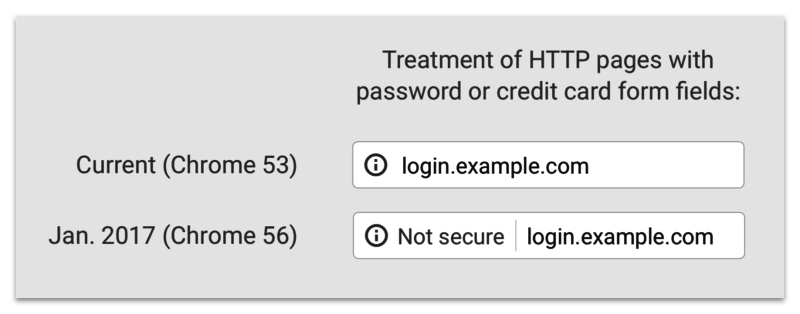
    Image Screenshot of Google's first security update - Search Influence

    Previously, a lowercase “i” was displayed in the address bar and could be clicked to display more information about the particular web page including the security of your connection, how many cookies the page uses, and a plethora of other tidbits of information. Now, whenever you enter a password or a credit card number on a site that isn’t secure, a handy message pops up to indicate that your connection to the website is not secure.

    So What Exactly Is a “Secure” Site?

    A website that doesn’t have an SSL Certificate installed transmits all data as plain text. Meaning, if I type my name “Jared” or my email address, or even “281-330-8004” into a field on an http website and send it to the server, it will be sent and saved on the server as plain text. What this means is that any vulnerability that is exploited in one of these sites would hold a nice, tasty database of personal information for would-be attackers to exploit. Sites with https servers work a bit differently. Your computer and the secure site initiate what is commonly referred to as the “SSL Handshake” to confirm that it is trustworthy. The https sends its SSL Certificate over to prove that it is a source that can be trusted. Any information shared over this connection is encrypted, which means that even if an attacker is able to procure a database of information that doesn’t belong to him, it will be encrypted and unable to be read.

    And This Has to Do With Google How?

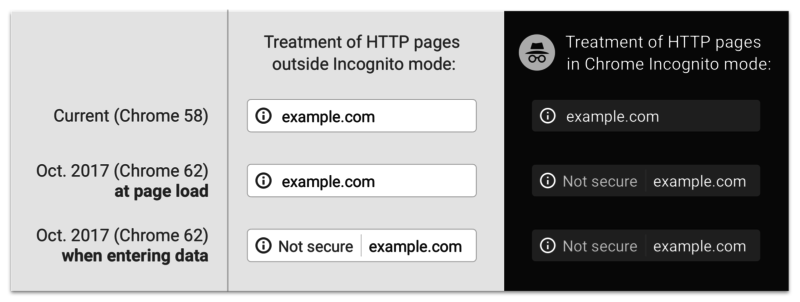
    At Search Influence, it is our duty to know Google as well as we know ourselves. Through various means, we keep tabs on Google and exactly what this robot and its creators are really up to. In our findings, we’ve discovered that Google is about to shake up the internet. On October 1st, Google Chrome will receive a security update that will change how it displays sites that are not secure.

    Screenshot image of Google's past, present, and future "not secure" notifications - Search Influence

    The graphic above displays past, present, and future versions of Chrome. As you can see, the “not secure” notification in the address bar will not only display on password and credit card form fills, but on **ANY** form fill. Google is using its bots to track down any <input type=”x”> elements on your page and flagging them according to the notice that webmasters received in Google Search Console.

    That Doesn’t Seem THAT Bad

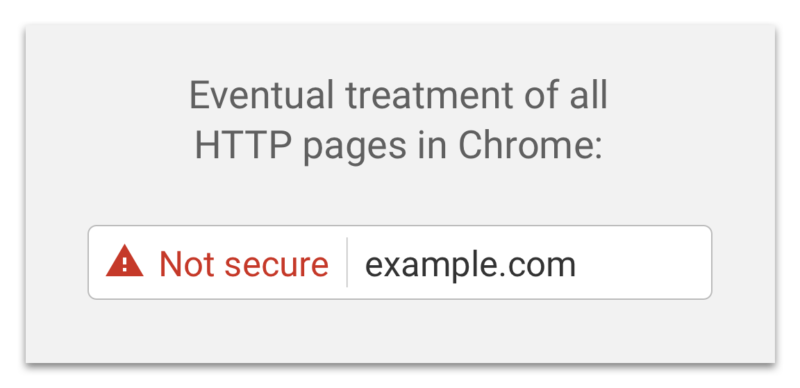
    If you feel this way, I’m personally inclined to agree with you. Most of my online purchases and passwords are already behind secure sites like Amazon and the like. If some hacker gets my email or my alternate email, why would I care? Well, if you think like me, there will be an eventual rude awakening. Google has already announced that it plans on marking all non-secure sites with a nasty red triangle and red text reading “not secure” in the address bar (see below).

    Screenshot of Google's "not secure" warning - Search Influence

    That tiny addition to the address bar may not cause a slowdown in form submissions on October 1st, but in the future, when that beautiful red triangle and glorious red text appear next to your web address, I’m sure people will think twice before submitting their personal information to your website. There’s no need to panic about this quite yet; Google hasn’t announced an official time of release for that update and, luckily, they’ve given us ample time to comply.

    Will This Slow My Site Down?

    Barely. Previously, this was an issue with https websites sometimes taking a half a second longer to load, but in this day and age, technological advances have reduced this slowdown time to a few milliseconds. If you do migrate your site to a secure server and notice significant slowdowns, it more than likely means that your site isn’t optimized for a secure server. Cloudflare has an in-depth article about bolstering your site’s configurations to improve speed after migration. The benefit of a visual that proves your site is secure is definitely worth the cost of a negligible increase in load time.

    In addition to migrating your website to a secure server, some auxiliary tasks must be completed to ensure your search rankings aren’t affected. Here at Search Influence, we know that your business is very important to you. Contact us for help ensuring your website is safe and secure for your visitors.

    If you want some more information about Google’s push for secure sites, check out the talk below by Emily Schechter, Google’s own Security Project Manager.

  • Paid Search, SEO, and the Evolution of Google

    Paid Search, SEO, and the Evolution of Google

    No man ever steps in the same river twice, for it’s not the same river and he’s not the same man. –Heraclitus

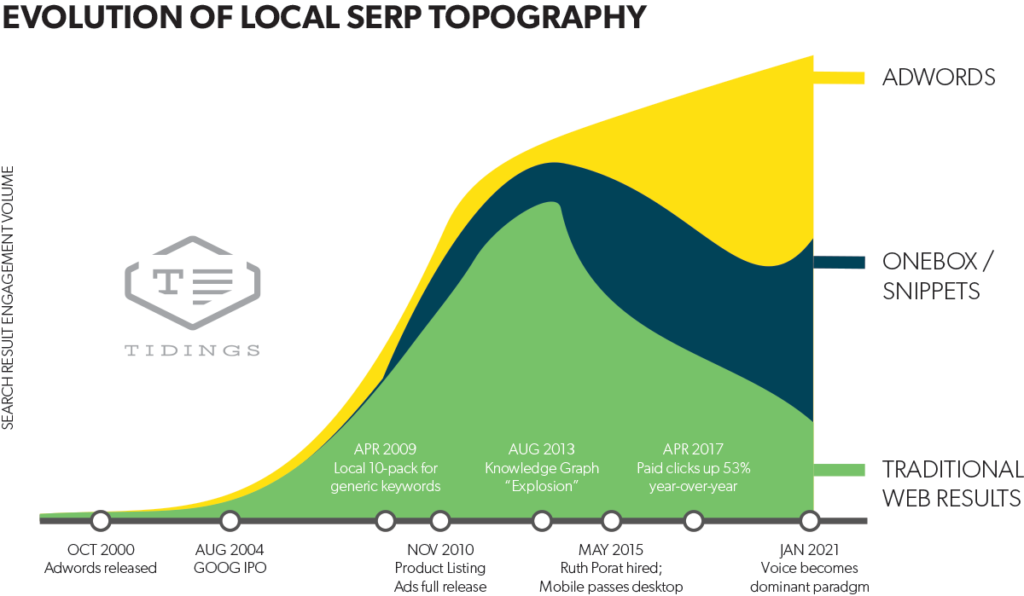
    One thing that’s certain in the world of search is that technology and user habits are always evolving. David Mihm recently wrote an excellent blog on the ever-changing landscape of search engines otherwise known as “SERP Topology.” We recently had the honor of hosting David as a guest speaker for a lunch & learn for the whole team. He provided us with some powerful insights about the evolution of Google. Here are some key takeaways.

    Local serp topography graph

    As you can see above, based on his predictions it is highly likely that Google search results will be more and more driven by paid advertising as opposed to traditional SEO in the next 5-10 years.

    Practically, this will impact your business in a few different ways. Some industries will continue to stay relevant with a traditional SEO approach, but for many, it will become a less effective strategy.

    If you’re a business owner, here are some things to keep in mind:

    1. What percentage of closed business is coming from digital marketing efforts?
    2. Where, specifically, are your leads coming from?
    3. How is your team converting those opportunities?

    Brand Awareness

    If you’re producing content, it will become increasingly important to promote that content using social platforms and other advertising options, such as Google Display Ads. Marketing your brand through ads will continue to be an important and useful strategy.

    Referrals

    The connection economy will continue to increase in importance. Who are the influencers in your industry online? Where are they? Find out what platforms the thought leaders are on and connect with them.

    Also, find out where your customers are hanging out. If it’s Facebook, then you should seriously consider developing a strong presence there.

    Lead Generation

    Organic SEO is very powerful, however, one of the downsides is that it can take a long time to grow results. Google ads are a great option to compliment SEO and content marketing strategies because you get instant feedback from your target audience. From there, you can take that feedback, find those great leads, and nurture them into customers.

    SEO

    Search engine optimization is not going away anytime soon. And, in the next 10 years, it will remain relevant for many industries. However, it won’t be quite as effective in the near future. As Google continues to generate the majority of its revenue from advertising expenditure, it inherently implies a push toward incentivizing businesses to use those tools.

    If you’d like to understand more about how to advertise your business online, or how you can best take advantage of SERP Topology, reach out here to chat with a strategist.

    Image:

    SERP Topology

  • Marketing Myths Small Business Owners Should Stop Believing

    When you’re running a small business, it’s often up to you or a member of a very small team to research and make all decisions for the business. And when you’re trying to allocate a marketing budget, being well informed is essential to the future of the business’ success. If you’re considering investing in SEO for your company but aren’t sure if it is going to pay off in the end, get the real facts about common SEO misconceptions.

    Myth 1: Only businesses of a certain size, in particular industries, or with certain audience demographics need a website.

    Some of you might be shaking your head at this one, but of the 500 small business marketers surveyed by highervisability.com, 20 percent said their company didn’t have a website. Having a website in today’s world is essential for getting found by customers, and everyone can benefit from one. SEO will help you get found by the right audience, no matter how niche your market may be, from HVAC companies and mom-and-pop shops to CNC engineers and doctors.

    Physician typing on a laptop keyboard

    Myth 2: Keyword stuffing and duplicate content are good SEO practices.

    While a majority of those surveyed believed copy-and-pasting content from other sites wasn’t ok, 12 percent didn’t see anything wrong with duplicating content from another site or page of your own site. When you copy from another person’s site, it’s plagiarism, and Google will penalize you for it. But even if it’s your own content repeating on different pages of the site, Google still flags it as duplicate content and therefore dings you for failing to provide new and useful information for your readers.

    Keyword stuffing was considered a good idea by 38 percent of responders, but this is another practice that will get you in trouble with Google. Keyword stuffing involves cramming a chosen keyword into your content as much as humanly possible, even if it makes the content sound stilted and unnatural. Not only will Google penalize your site for it, but it also makes things difficult for readers, and pleasing them is the most important thing at the end of the day.

    Myth 3: SEO is all about keyword rankings.

    Keyword rankings are obviously an important metric for gauging your site’s performance, but there’s more to SEO than sprinkling some keywords into your content and calling it a day. Content creation, link building, local search optimization, and technical aspects of your website, like page speed, are all necessary components of a well-rounded and robust SEO campaign.

    If you’re having trouble evaluating the technical side of your SEO, request a site audit from us.

    Myth 4: Social media is just for sharing pictures of my kids at the beach.

    19 percent of small businesses don’t have any social media presence. Of those 19 percent, only 35 percent are happy with their Google rankings. It then stands to reason that social media is a very important piece of the puzzle.

    Social media helps you promote your content, share industry news with your followers, show off a bit of your personality and your brand’s tone, and engage directly with your customers. It’s the personal touch that matters in today’s business world. Plus, social media lets you find your customers where they spend the most time.

    Myth 5: All of this should cost me less than $100 a month.

    SEO services are a marketing investment. And like all investments, you have to spend money to see money. According to Pigzilla, we’re in the middle of a pandemic where shady SEO companies are charging rock bottom prices and not delivering the kind of results their customers are hoping for. Positive results require consistent efforts in content creation and quality link building, not just a few tweaks to your site or a handful of spammy links. A reputable SEO company is charging you for their expertise in the industry coupled with a truly hands-on approach for your campaign. Even if your budget isn’t huge, a good company will tailor their work to give you the most bang for your buck.

    There’s a lot more to SEO than most small businesses realize. Whether you’re just starting to allocate some of your marketing budget to digital marketing or you’ve been burned by a bad SEO company in the past, talking to one of Search Influence’s sales executives can help you determine what your next best steps are for building an SEO campaign that will give you results.

  • 5 Questions Your Medical Practice Should Ask Before Hiring a Paid Search Firm

    5 Questions Your Medical Practice Should Ask Before Hiring a Paid Search Firm

    When it comes to choosing a marketing firm for your paid search campaign, it’s important to do your homework—especially if you’re in the medical industry. According to Pew Research Center, 8 in 10 online health inquiries start with a search engine, and 72 percent of internet users said they looked online for health-related information. Beyond patients frantically Googling their symptoms, they’re also searching for medical care providers. The right ad agency will make sure you show up on page one of the search results.

    But on top of a highly competitive and saturated market, medical practices also face added challenges to adhere to strict medical guidelines and discuss sensitive and highly personal topics appropriately. All said, a paid search campaign can do wonders to both improve your brand awareness and get new patients in your door. Here are five questions you should ask your prospective paid search agency before signing a contract.

    1. What Experience Do You Have Working With Clients in the Medical Industry?

    Your ad agency shouldn’t just know costs per click and search engine optimization, they should also know how to speak your language. More than that, they should know how to speak your language to your prospective patients. Search Influence has been helping clients in the medical industry stand out and rank in search results since 2007. In that time, we’ve worked with medical clients in 30+ cities across 18 states. Our experience ranges from plastic surgeons and dermatology clinics to hospitals, counseling services, and physical therapists. We use a holistic approach for every campaign to create brand recognition, improve ranking, and—most importantly—deliver qualified leads.

    Our years of experience have helped us build a database of technical and demographic knowledge in order to strategically reach your desired patients where they’re at. In fact, we have helped our clients stay on the frontline of innovation by optimizing their sites for procedures as soon as they are approved and available to the public. For example, when the FDA approved gummy bear implants in 2013, we already had content written for our clients and were ready to run promotions to highlight this highly desirable option at the time.

    We also understand the meticulous detail required to accurately reflect the standards and restrictions of medical societies, HIPAA, and the platforms where we promote your content. We know how to accurately post images in accordance with both American Society for Aesthetic Plastic Surgery (ASAPS) and American Society of Plastic Surgeons (ASPS) promotional guidelines or how to use language that aligns with Google’s expectations for websites in the medical industry—an issue that can even cause Google to suspend your site.

    Stethoscope on a computer keyboard

    If you’re curious about the current state of your website or worried about a site suspension, you can contact us to help you get on the right track.

    In addition to meeting all of the medical industry standards, it’s also important that you position your practice as a thought leader. Our deep knowledge of the subject matter ensures that your content is optimized and technically accurate. More than just knowing that gynecomastia is the condition and breast reduction surgery is the procedure, we also understand the discreet and laser-precise writing required to appeal to men who are searching for this sensitive topic. As your PPC agency, we will deliver results because we start with strategy, and we understand your business.

    2. What Is My Cost Per Lead?

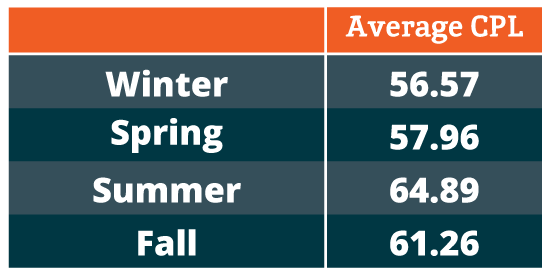
    Your cost per lead will depend on market factors such as seasonality, the size of your city, and the number of advertisers in your area. However, at Search Influence, our typical target for plastic surgeons is $50-$60 per lead. For us, we care most about delivering you qualified leads that actually become patients.

    So how do we actually calculate your cost per lead (CPL)? Let’s say, as an example, that you offer a procedure for $5,000, and you’re willing to pay 10 percent (or $500) in order to get a lead for that procedure. However, you know that not every lead that contacts you is going to become a patient. Let’s say that 1 out of every 10 leads who contact you about the procedure will actually become a patient. That’s a 10 percent conversion rate, which results in a CPL of $50.

    Of course, if your conversion rate is higher or if your cost for acquisition is higher or lower than the example, we can adjust accordingly. The table below outlines seasonal averages for some of our plastic surgery clients to show how we can achieve results for your practice.

    As a medical practitioner, your bottom line all comes down to how many patients are walking through your door (and how much you paid to get them there). For you, a worthwhile investment in paid search results in qualified leads that can translate into actual patients. We get that. That’s why we have built-in systems to seamlessly track your leads, and a post-launch schedule to fine-tune your campaign as quickly as possible. Not only will you have clear reporting, but you can also use our lead tracking system to create an organized database of qualified leads, allowing your team to close leads faster.

    3. How Do You Measure Return on Investment?

    PPC is not a “set it and forget it” machine. Successful online ad campaigns should run on a continual loop. You have to look back to determine what’s working and adjust in real-time to build on successes. Our reporting can help you pinpoint the average cost per patient so you know your exact return on investment. You’ll know if your leads prefer to call or fill out a contact form, and you’ll gain valuable insights like location demographics.

    Physician holding a tablet

    Your PPC agency should also collect continual feedback from you about the quality of your leads in order to apply that information directly to your campaign and avoid any wasted ad spend. With endless customization opportunities—not a prix fixe package—your marketing firm should have a system in place to make things easy, but also be ready to break the rules to fit your budget and make your campaign a success for you.

    4. What Procedures Are You Promoting and What Drives the Most Leads?

    Remember that thing about endless customization? Yeah, that applies here, too. Your ad agency should have the know-how to build a holistic strategy that both grows your brand and promotes your most important services.

    Brand building and search engine optimization are definitely comparable to the age-old chicken and the egg situation. You have to have some brand recognition if you want to rank high on search engines, and once you rank, you’ll get greater brand recognition. So what does that mean for you? Well, if you don’t rank yet, you’ll need to do more than simply optimize your content and build your link profile. You’ll have to create a dynamic strategy to build the overall awareness of your brand. After all, in the age of the internet, who says you can’t have all your eggs in your basket and eat some chicken, too?

    Your online marketing agency can help you do just that. That’s why at Search Influence we start with a comprehensive kickoff meeting to understand the details of your business. Why? It’s simple. Formulating the right strategy first will save you money and get you the right leads.

    Once we understand your business goals, we can target the right procedures and help you establish your brand around specialties and services that matter to you. We can also help you identify missed opportunities. For example, while aesthetic services aren’t the highest revenue driving procedures, they’re a great way for plastic surgery practices to continue generating revenue even when the doctor is booked with another client. Or, perhaps you specialize in rhinoplasty and want to be established as the leader in your market for that procedure. We can center your campaign on your qualification as a rhinoplasty surgeon to build your brand as the preferred specialist. It all depends on your needs, and your ad agency should do the setup work to understand those needs from day one.

    5. On What Page Do Leads Land During a Campaign?

    You can have beautifully written ads, but without the right landing page, your leads are highly unlikely to convert into patients. Especially when it comes to AdWords, you have to optimize for both your human readers and Google’s Quality Score. Google can spot landing pages that don’t align with the search term in the ad and actually make you pay more as result. For example, if someone searches for liposuction, clicks on your ad all about liposuction, then lands on a general page about body contouring services, then you’re missing the mark on user experience and Google’s best practices.

    Without optimized content and a dedicated landing page, your chances of converting are slim.

    A recent report from Unbounce placed the average conversion rate in the healthcare industry at only 2.9 percent. And if you’re using your homepage as your landing page, then you’re totally missing out. Your ad agency can create dynamic landing page content that makes it easy for prospective patients to take an action, with custom forms and click to call buttons that prove your return on investment. In fact, the same Unbounce report shows that healthcare businesses in the 90th percentile achieve conversion rates at 9.3 percent, and the right content and strategy can help get you there.

    Landing pages are just one key element in a successful ad campaign. At Search Influence, we care about delivering a holistic advertising strategy focused on results. Contact our team to see how we can help optimize your medical practice’s online presence.

  • Rookie Website Mistakes, Part 1: Slow Loading Speed

    74 percent of customers will leave a website if it fails to load within 5 seconds. And the numbers don’t look too great even if your site is noticeably faster—according to Google engineers, anything slower than the blink of an eye, 400 milliseconds, can cause users to leave a page and search elsewhere. Google released their Caffeine update in 2010, placing importance on site speed for search ranking factors. With such a demand on site performance, it’s more important than ever that business owners and their partners understand not only why page speed is important but also what affects it and how to remedy a sluggish site.

    Snail crossing an asphalt road - Search Influence

    Why Is Speed Important for Search Factors?

    Overall site speed is based on a sample of different pages from the site. “Page speed” can be broken down either as “time to first byte” or “page load time.” The first of these, the time it takes for a browser to receive the first byte of information from the server, has been shown to correlate to search rankings. “Page load time” more noticeably affects the user experience, but it can also impact SEO.

    All of that hard work you’ve put into developing and designing your new site, implementing beautiful images, creating an intuitive navigation, and writing and implementing pages of content for users to scour—it can all mean nothing if your pages take longer to load than what has come to be expected. The longer someone waits for a page to load, the sooner he or she begins to look for other avenues to find a product, purchase a ticket, or make a reservation. And with the magnitude of resources available today, it’s only a matter of time until they leave your slow-loading site (bounce) and seek their information elsewhere via a new search.

    The average user doesn’t have time for your slow page to load, and rightly so. We shouldn’t be subjecting potential customers to a dull experience. We wait in traffic. We wait on elevators. We wait on our bread in the toaster. But when it comes to our web experience, we aren’t stuck in the ‘90s with pages that can’t possibly load any faster than 10 seconds. There are tools and practices at our fingerprints that can make your flashy new website lightning fast and more easily crawlable by search engines.

    Open exposure capture of cars driving on a road at night - Search Influence

    Page Performance Impacts User Experience

    Now, a slow loading page isn’t the be-all-end-all factor for search rankings. In fact, there are over 200 factors that go into search rankings. However, it can impact conversions and sales due to a poor user experience.

    When’s the last time you sat and waited for a page to load? How long until you gave up and tried a competitor that sells the same type of product or service? It’s worth repeating that users expect speed. Whether they’re searching on desktop or mobile (and most have been on mobile for close to two years), an inefficient website can frustrate users and result in lost business. So, what are some easy ways to make the user experience more friendly and eliminate high bounce rates that result from slow load times? Our developers can help diagnose more specific problems, but here are a few tips to get started:

    • Eliminate multiple pop-ups or spammy widgets used for sales on your site
    • Create smart site navigation to give users a clear path to a purchase
    • Implement direct calls to action with forms or buttons throughout your site

    There are other steps that can be made on the backend of your site that can help with load time, like limiting redirects, organizing your HTML, and compressing your images, but the above-mentioned tips are a step in right direction toward enhancing the way users will interact with your site.

    Co-workers sitting around a wooden table with electronic devices in hand - Search Influence

    Regain Potential Lost Conversions and Sales

    While load time might not be the biggest contributing factor to a poor search ranking, it can certainly contribute to a lower conversion rate. According to surveys done by Akamai and Gomez.com, 79 percent of web shoppers who have trouble with website performance say they won’t return to the site to buy again, and around 44 percent of them would tell a friend if they had a poor experience shopping online.

    In the same survey, they found that a 1-second delay in page response can result in a 7 percent reduction in conversions. To put that in a sales perspective, if an e-commerce site is making $100,000 per day, a 1-second page delay could potentially cost $2.5 million in lost sales every year. That’s a huge number for a 1-second delay. To give another example of a direct ROI, for every 1 second of speed improvement to Amazon’s website, their conversion rate went up 2 percent.

    For your landing pages to convert visitors into customers, you need to give them an enjoyable experience. The nice thing about doing technical work to decrease page load time is that it simultaneously benefits your bottom line. A faster, cleaner site means a higher likelihood that visitors will stay, peruse your content, fill out a form, and eventually convert into a customer.

    A Faster Site Helps You Serve Your Customers Better

    While there are many mistakes that rookies make when building a website, starting a marketing campaign, and attempting to grow their brand, not recognizing key SEO factors that slow down their pages’ load times is one of the more frequent culprits.

    Stay tuned for our next entry in our blog series: Rookie Mistakes, Part 2: Not Allowing Your Site to Be Found by Search Engines.

    Contact an expert from our team if page load time has been an issue for your business’s or institution’s website.

    Images:

    Snail

  • Grow Your Business With These 7 Digital Marketing Tactics

    Members of the Search Influence team gave their insight on tried and true digital marketing strategies. These strategies apply to every industry, from plastic surgeons to attorneys, and many can be implemented across different channels of marketing. Using a mix of or all of the 7 tactics below is a sure-fire way to optimize your business’ online potential.

    1. Mobile

    Before updating the aesthetics or adding content to your site, it’s of the utmost importance that you make sure your site is responsive and functions properly on both desktop and mobile. More than half of users say they wouldn’t recommend a business if they encountered a poorly designed mobile site.

    “To me, the biggest trend (and this is as much a wish as it is a prediction) is that small businesses begin to take mobile optimization more seriously. I’m still surprised by the number of businesses I see in my day-to-day life that haven’t reacted to the continuous uptick in mobile search by having their site optimized for mobile users.

    My main focus, in terms of a trend, is the expansion of mobile search as a primary source of information. The trend will be more companies utilizing tools like Google AMP in order to improve the mobile user experience. Currently, far too many don’t take the number of leads they can get from a mobile-optimized site.” – Cory Agular

    Later in this post, I’ll go over AMPs and some more specific mobile moves, but I really want to emphasize that mobile should be incorporated in every aspect of your online marketing campaign. Google has stated that not only are 60% of users unlikely to revisit a mobile site they had difficulty visiting, but also 40% will then go on to visit a competitor’s site. You’re not supposed to judge a book by its cover, but if you can’t open the book, you’re not even going to try reading it.

    Image Of A Cell Phone Searching - Search Influence

    2. Schema Markup

    Schema markup, coding that can be added to a page on your site, makes information more easily readable to search engines like Google. This code labels pieces of important information on the page. Search engines not only understand the information better but they can also provide richer search results to users.

    “As far as I’ve noticed, Schema’s been underutilized… however I’m seeing a lot more talk acknowledging it for its on-site SEO value and correlation with rich snippets and Google’s knowledge graph. And as we’ve seen, Google’s been working to improve its algorithm and knowledge graph to really ‘understand’ content to better predict user trends.” – Kiersten Kampschroeder

    “It’s been increasingly popular to integrate schema into your content. I think that providing meta information using schema markup not only helps SEO, but it also aids the programmer and contributes to making better semantic websites. 2017 will be the year where instead of thinking how we can ADD schema to existing sites, we instead shift toward creating websites with schema markup baked into their design and writing content with schema markup in mind. I’d compare thiscoming year with what happened with responsive design 3–4 years ago. That was the shift where everything became mobile first. 2017 will be the year schema is integrated into the general development workflow.” – Member of Web Development Team

    A search for “breast augmentation new orleans” shows how review schema implemented on Dr. Kinsley’s site appears in results:
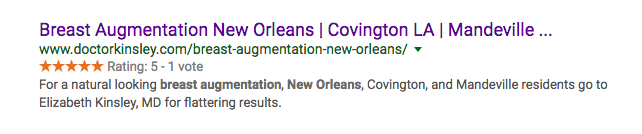
    Image Of Dr. Kinsley's Search Results - Search Influence

    3. GIFs

    While 2016 saw a rise in GIFs, an acronym for Graphics Interchange Format, they were first debuted by Steve Wilhite of Compuserve in 1987. They are the epitome of #thirtyflirtyandthriving. These dynamic, digestible pieces of content are easy to create and share and provide a more engaging user experience than a single static image.

    “GIFs are important to any brand aesthetic, be it personal or public, because they offer a truncated version of the desktop’s fluid experience (i.e. video).

    GIFs are a better option now since they’re more pervasive and different social media platforms accept them or give you a way to use them easily. Instagram, Twitter, Facebook, and Facebook Messenger are all compatible with GIFs now.

    Twitter actually integrated, similarly to Facebook, a GIF search within the post tool. [It has] allowed for a closer relationship between Facebook and Twitter, as well. You’ve always been able to link the two accounts, … [but] now, it looks like Twitter, when auto-posted to Facebook, is fully integrated into Facebook’s platform and presents the post as it would be presented on Twitter.” – Member of Graphics Team

    There are so many reasons you should incorporate GIFs into your marketing strategy this year. As mentioned, the fluidity of GIFs can make the creation of cross-platform content so much easier. They’re easy to create and even easier to share. Most of all, it’s a fun and unique way to reach your consumers!

    So, why not shake things up a bit?

    4. Social and Mobile Paid Advertising

    In 2016, we saw a rise in mobile advertising, but this year, with more than half of searches on mobile devices, it will be an essential component of an effective and well-rounded search engine marketing campaign. Expanded ads are now easily translatable between desktop and mobile, but it’s almost important to mobile users’ needs when determining the content, location, and timing of your paid ads.

    Social advertising like Facebook Paid Ads are showing increased popularity and effectiveness. The level of granularity continues to rise with Facebook audience targeting, and we have seen an increase in conversions even as CPCs remain low.

    “With the introduction of ‘new’ campaign objectives, such as lead generation and local awareness, Facebook really does seem to be a place for lots of growth. With Facebook trying to essentially phase out Fan Building campaigns, local awareness campaigns present an interesting opportunity for smaller budget clients who want to focus on a local market.” – London Fougerousse

    While Facebook ads are more cost-effective than traditional paid ads, that’s not a reason to rely on them solely. The decision to use Facebook vs. Google Adwords or a mixture of the two is truly dependent on a variety of factors, such as your location, industry, and goals. I recommend hopping on the mobile train sooner rather than later. Forecasters are predicting that by 2019, 72% of digital ad spend will be on mobile advertising!
    Image Of Smiley Face Emojis - Search Influence

    5. Google’s Accelerated Mobile Pages

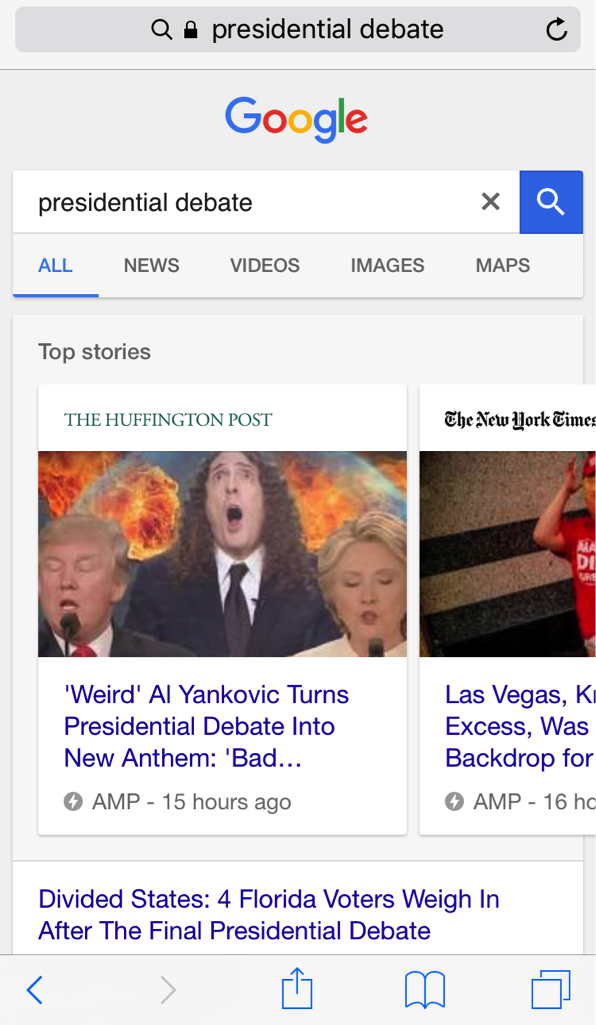
    As I mentioned at the beginning of this post, mobile should be a consideration for all of your online marketing efforts. Google’s Accelerated Mobile Pages (AMPs) are a way to take that focus even further. AMPs are not a ranking factor in Google (for now) but they can positively impact impressions, clicks, and user experience.

    “Since the rollout of AMPs in mobile SERPs this past spring, pages have typically only been found at the top of the results page in a carousel—which is still prime real estate—however, Google recently announced that AMPs will soon also begin showing in the organic results and supporting more content types. We’ve all heard the mobile-friendliness search stats, and adopting AMPs is another way to bring content to your consumers instantly and on the go.

    “Historically, AMPs have been utilized mainly by news publishers, but with the expansion to the organic results, I can see a future for almost every type of industry. Shopify, eBay, and Fandango recently announced their integration of AMPs, so this is a good trend for e-commerce clients especially to be conscious of. And Google also hinted that they will begin supporting more content types like live videos, galleries, etc., which can also open more doors for clients to take advantage of.” – Member of Account Management Team
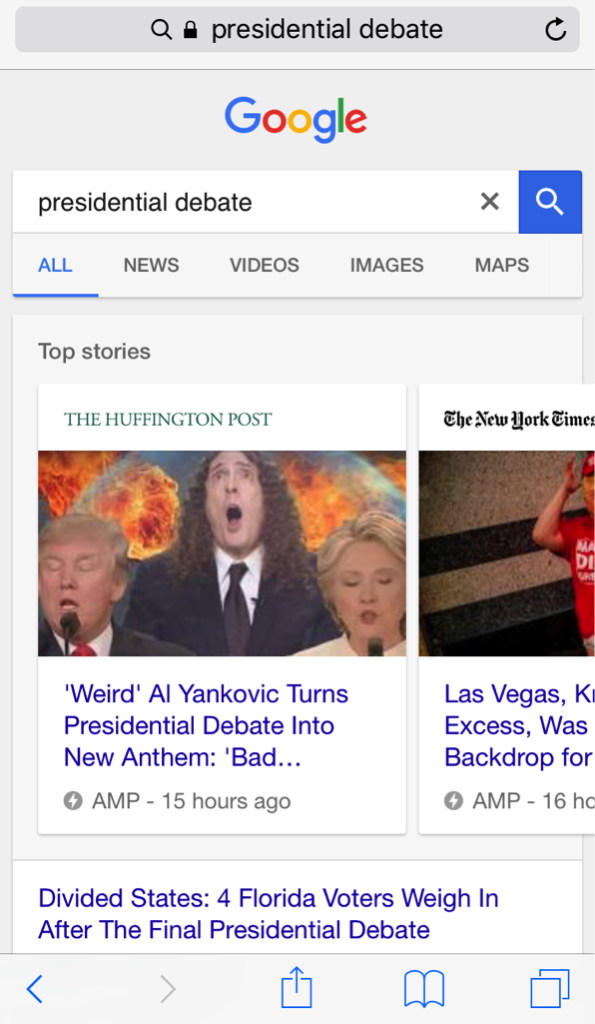
    Image Of Google Search Of Presidential Debate - Search Influence

    The increased speed of Accelerated Mobile Pages leads to a better user engagement, and those (potential) customers/clients are more likely to return to your site if it was able to quickly provide them the information they were looking for. A recent study shows that with AMPs, The Washington Post saw a 23% increase in mobile search users who return in 7 days. If you’re a business receiving the majority of your site traffic from mobile devices, AMPs could be a strategic way to boost your online presence above and beyond your competitors.

    6. Video

    Video is not just for YouTube. It should be incorporated into as many of your online marketing efforts as possible: product/procedure pages on your site, email marketing, display ads, social platforms, and everything in between!

    “For online marketing rich content could include native video content and paid video ads on both YouTube and Facebook Video Display ads. Also, I think brands will begin to utilize Facebook Live more for events and branded content to engage their fans.

    “I believe these videos will be prominent cross-device! Today, people are constantly moving between devices throughout the day and advertisers need to be innovative and streamline their message to engage users across all devices.

    “For Facebook Live, I would recommend this for brands and businesses that have a strong Facebook following. Facebook Live is a tool to engage your audience, not necessarily build an audience. These videos are best for events, conferences, speaking engagements, big company announcements, etc. There are so many options to deliver creative, curated content!” – Sophie Kirk

    Rich video content is content that keeps on giving. One video can apply organic, paid, and social campaigns across devices, and can be broken down and repurposed to create a number of assets. Videos are not only attention-grabbing, but are also a great way to establish your brand’s message and have lasting effects in terms of brand recall.

    7. Links

    Links might not be the most exciting item on this list, but they’re certainly one of the most important. Link building is an essential aspect of a well-rounded SEO strategy! When the search engines crawl pages on your site, links are used to identify how it relates to other internal pages and other sites. Links connecting one site to another can indicate that a particular page/site is the authority on a given topic. But, as you should know, not all links are created equal!

    Google first launched its Penguin Update in spring of 2012 and rolled out its final update, Penguin 4.0, this past fall. Penguin is Google’s effort to catch sites that are using “black-hat SEO” techniques like spammy link acquisition to affect search rankings.

    “In 2017, ‘link’ will no longer be a dirty 4-letter word. For far too long, bad link building has been lumped in with quality link earning. Everyone got freaked out by Penguin and the industries either shied away from “linkbuilding,” or, if they were doing it, were hush-hush about it.

    “Google’s initial differentiator was to focus on links as votes, which is at the core of PageRank. Google has, in the past, described their foundational algorithm by stating: PageRank works by counting the number and quality of links to a page to determine a rough estimate of how important the website is. The underlying assumption is that more important websites are likely to receive more links from other websites.” – Paula French

    Google truly is looking for quality over quantity when it comes to link building, but that’s just part of the SEO puzzle. If your site is suffering from technical issues or lacking rich, natural content, links will not save you. Make sure your online marketing strategy includes both on and off-site efforts.

    Image Depicting Online Marketing Tactics - Search Influence

    These 7 online marketing tactics are an inexpensive way to boost awareness of your practice and bring in new, revenue-generating patients. With a little strategy and effort, you can have a comprehensive SEO campaign that brings your practice’s website up to speed!

    Image Resources:

    Cell Phone Image

    Facebook Emojis Image

    Social Network Image
  • Follow the Numbers: Trends to Guide Your 2017 Plastic Surgery Marketing Plan

    With 17.1 million surgical and minimally invasive cosmetic procedures performed in the United States in 2016, a few key trends stand out as opportunities. According to a report released by the American Society of Plastic Surgeons, patients are trending toward fat grafting, non-invasive fat reduction, and facial enhancements. These trends present areas of potential growth for plastic surgeons by focusing their annual marketing plans on the procedures that patients are most interested in learning about. After all, the first step to any great marketing campaign is to understand how to appeal to your target demographic.

    What Do the Numbers Show?

    The first and most notable pattern is that patients are using their fat to enhance other areas of their body. Using liposuction, plastic surgeons remove unwanted fat from the abdomen and inject it into other areas, including the face, buttock, and breasts, to enhance and sculpt the desired look. This process of fat grafting showed a 26 percent increase for the use of buttock augmentation and a 72 percent increase for use in breast augmentation in 2016.

    Patients love the longevity of the results achieved using this method, and that’s certainly a potential benefit to highlight in a marketing campaign. Plus, patients often mention the added benefit of two surgeries in one, as they are especially happy to remove unwanted fat while also enhancing desired body parts. In addition to the cosmetic benefits, this surgery is also a popular option for breast reconstruction patients for many of the same reasons.

    Do Patients Know All Their Options?

    Audrey Hepburn getting a closer look - Search Influence

    While these innovative procedures are gaining popularity, doctors might not realize that many potential clients don’t even realize that this is an option for them. In fact, recent studies show that only 23 percent of women understand the full range of breast reconstruction options available. This indicates that marketing campaigns targeting new customers should focus on disseminating the facts and shining a spotlight on industry advances. By presenting the full range of innovative options available, like fat grafting, patients are more inclined to take the first step to schedule a consultation.

    Paid search and Facebook advertising campaigns may be especially effective in this instance, as both are often great avenues for reaching highly specific demographics. For example, Facebook’s targeting options include new people who have moved into your office’s geographic area or even specifications like salary, industry, and age. You probably already have an idea of the ideal customer for your medical practice, and using these targeting features, you are not only more able to reach them, but you can also present them with the information that they actually want to learn about.

    The same applies to Google searches. After all, if someone is searching on Google to learn about new augmentation options available, don’t you want your practice to show up in the top results as a trusted source for their desired information? Your campaigns should focus on the keywords that match the data trends, and your content should focus on informative, highly-curated landing pages that prove you’re a reputable source. All of these elements combined can lead to big conversion results.

    What About Non-Invasive Trends?

    Another major trend shown in the data from 2016 indicates a move toward non-invasive techniques for skin tightening, rejuvenation, and fat reduction. Injection procedures, like Kybella, that target areas of fat in areas under the chin or along the bra line increased 18 percent in 2016. Additionally, procedures like cryolipolysis (to “freeze” away fat cells) also showed an upward trend with a 5 percent increase. Other non-invasive skin tightening procedures saw a similar 5 percent increase.

    Broadband light and laser treatments are among these popular options for non-invasive skin tightening and offer versatile results with little to no downtime for the patient. While these procedures do not require surgery, patients still want to know that they are receiving services from a reputable, board-certified physician. This is a major area of opportunity for plastic surgeons to focus on in marketing campaigns. An emphasis on innovative technology to achieve long-lasting results shows patients that your office is ahead of the curve and committed to new advances in the field.

    How Do Trends Look Year Over Year?

    Looking at the changes and trends from 2015 to 2016, we can also note which types of procedures show an increase or decrease in popularity. With nearly 1.8 million cosmetic surgical procedures performed, liposuction showed a noticeable jump, up 6 percent from 2015, which may reflect our earlier trend toward fat grafting. Additionally, breast augmentation remained a popular choice for patients, filling the top slot and showing a 4 percent rise from 2015. Finally, as a fairly new procedure to gain in popularity over the last few years, the labiaplasty procedure increased by 36 percent in 2016.

    Another notable movement is the focus on the face, with an increase in facelifts by 4 percent from 2015. In conjunction with the surgical focus on face enhancements, non-invasive procedures, among the 15.5 million performed in 2016, showed a similar trend. Filling the number one slot, Botox procedures increase by 4 percent, with a total of 7 million procedures performed annually. Soft tissue fillers and chemical peels also showed steady inclines in usage from 2015 to 2016.

    How Do You Build Relationships with Patients?

    One possible pattern indicated in these trends is the frequency in which patients are meeting with their plastic surgeons. Patients feel more comfortable discussing all areas of their body with their surgeon, and a long-term relationship can develop between patient and physician. This indicates that a person may be interested in learning about multiple procedures, including both non-invasive and surgical options. A dynamic marketing campaign should reach new target demographics while also building on the loyalty of current patients.

    Emoji Gif - Search Influence

    Email newsletters and Facebook campaigns are great ways to stay in contact with your audience and keep them engaged in your services. Share patient testimonials, highlight employee profiles, and add personal elements that showcase the people-centric side of your business. Encourage happy customers to share their results with Facebook reviews and always make time to answer questions and comments that arise from your posted content. By creating multiple platforms for engagement online, you’re opening a line of communication with clients that can build trust, keep them informed, and ultimately create long-term success for your medical practice.

    If you’re ready to create a dynamic marketing campaign that draws on current trends and builds your plastic surgery practice as an industry leader, the first step might be less invasive than you think. Focus on your audience, deliver relevant information, and stay true to your brand.

  • How a Debate About Onions Showed Google Might Not Be Infallible

    A couple of weeks ago, I was driving to meet a friend for dinner when I heard a segment on NPR’s Marketplace that featured Tom Scocca talking about his article on Gizmodo about caramelized onions. At first, it seemed like many a segment on NPR we’ve come to expect—interesting and mildly entertaining. It wasn’t until the segment got to the point of the matter that I was hooked. When people were searching on Google for “how long does it take to caramelize onions?” they were getting misinformation. How could such a simple question turn up a false response from the world’s largest, and arguably smartest, search engine? I wondered, are there other moments like this that have happened between users and Google?

    How Did Google Misinterpret What Is Common Knowledge to Most Chefs?

    To be fair to Google, this wasn’t entirely their fault. The initial blame goes back to the thousands of recipes that live on the internet telling readers how to caramelize onions, from an at-home amateur cook’s blog to the New York Times. For whatever reason, instead of telling home cooks to patiently take their time to cook the onions on a low to medium heat for upwards of 30-45 minutes, a lot of recipes listed the expected cooking time as 5-10 minutes. If you’ve ever attempted to caramelize onions in this amount of time, I’ll go ahead and break it to you—it’s impossible. To save you from a bunch of food chemistry, I’ll just say that it has to do with the sugar content in onions.

    Purple Onion Cut In Half - Search Influence

    So, why is there so much content online that gives users, and in turn Google, misinformation? The simplest answer is that writers of recipes were trying to simplify a process that would turn an ordinarily easy recipe for a weeknight meal, like French Onion Soup, into a 1 ½ –2-hour ordeal. In Scocca’s Slate article written in 2012, he gave many different examples of well-known chef’s attempts and failures at trying to achieve caramelization in less than 20 minutes. The article is littered with keywords Google would love and came from a highly reputable source. At its beginning, he references the 5-10 minute myth, and for a while, this had a positive response—The New York Times changed their language when talking about caramelization in their recipes, and even the Wikipedia page was updated as a result.

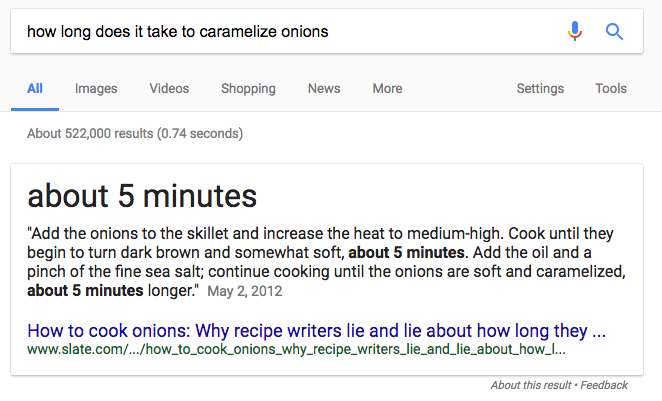
    But, when people typed “how long does it take to caramelize onions” into Google, they continued to see the false expected cooking times appear in Google’s search result box that is supposed to give users “one true answer,” a term coined by Danny Sullivan, founder of SearchEngineLand.

    How Long Does It Take To Caramelize Onions Google Search - Search Influence

    It turns out, Google was looking at Scocca’s Slate article, with all of its high word count and keyword-laden, well-written text, as the authoritative source. The only problem was that its algorithm focused on and crawled the first paragraph that referenced the 5-minute cooking time. The myth Scocca was trying to debunk ended up getting “bunking,” to use his inverse take on the word.

    Users Push for Quick Answers

    Google hasn’t always answered questions. Users typed in what they were looking for, and they got a list of web pages that may help them find it. But Google realized people wanted short, quick answers to questions, so they developed the short answer box. It’s virtually set apart from the search results and has a slight drop shadow.

    This also isn’t the first time Google has had issues with its short answer box. About a month ago, if you were to ask “Is Obama planning a coup d’etat against the U.S. government?” the response was that he indeed was planning a communist coup at the end of his term. Ask why a fire truck is red and you got a Monty Python joke. While the latter could lead to some harmless John Cleese quotes passed around the office, the former could actually misinform the public in a harmful way.

    Why Are Firetrucks Red Google Search - Search Influence

    Google’s Response and Their Plan to Fight False Information and Fake News

    Google has been dealing with this for a couple of years now. In 2015, they announced that they were using RankBrain, an artificial intelligence algorithm, in combination with Knowledge Graph, which pulls information for short queries from sources like Freebase, Wikipedia, and the CIA World Factbook—very reputable sources. It currently contains 3.5 billion facts. And, with all of these instances of inaccurate snippet responses, Google was quick to fix the issues. Searching for the cooking time for caramelizing onions now brings up the correct answer. Also, along with Facebook, Google also upped their fight against fake news by using fact check systems in their searches and feeds. So the big question is, how does all of this relate to your small business, practice, firm, bakery, brewery, insurance agency, etc.?

    The Importance of Rich, Accurate Content

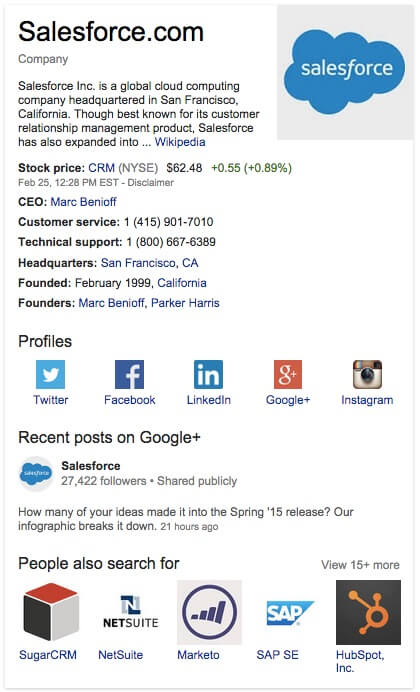
    Whether you’re working on new content or need on-site or local search optimization, the importance of producing educational, on-point, authoritative content is key. The Knowledge Graph’s “panels” pull information from your “about us” page, including contact information. These show up in the sidebar of searches and can include photos from your Google+ page as well as any reviews of your business. So, it should be a no-brainer that your Google+ page should be up to date and any reviews of your company are responded to promptly. Above all, make absolutely sure that your NAPs are consistent and current; an incorrect address showing up in a panel is not the quick answer that potential customers want.

    Salesforce Google Plus Account Screenshot - Search Influence

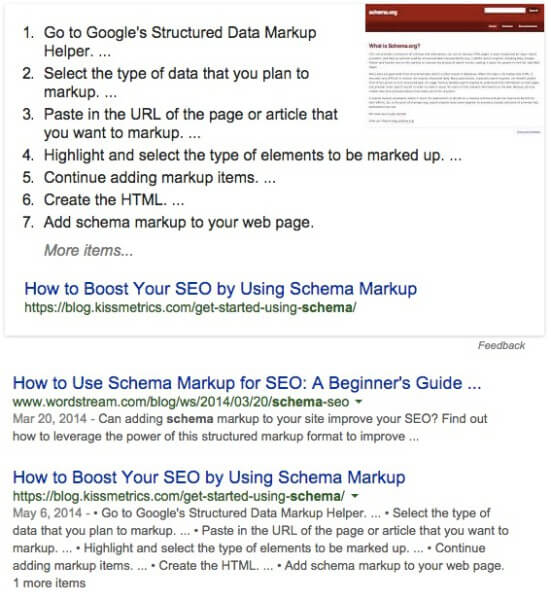
    There’s also the chance that your longer content could be pulled into a short answer box. At first, Google’s Knowledge Graph was pulling just short answers to questions, but it has since gotten smarter at pulling answers from longer content, like how-to guides with 20-point checklists or in-depth, 1,000+ word content that gives users lots of useful information to peruse. As always, make certain your content is not only accurate but also engaging enough to pull viewers deeper into your site and actually convert.

    Does This Completely Change SEO?

    In short, no. As this article from SearchEngineLand points out, in most cases, “the source getting pulled into the Knowledge Graph is already in the first few organic search results anyway.”

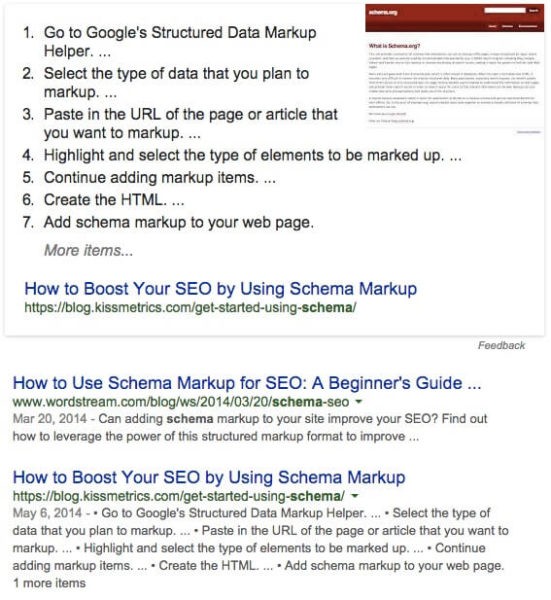
    How To Boost Your SEO Using Schema Markup Screenshot - Search Influence

    Good SEO will improve your ranking regardless and will, in turn, improve your chances of showing up in a short answer box. But even if your business never shows up there, your target audience is still searching for more than just a quick answer. They’ll want to dive into your site for in-depth, relative information. Similar to previous algorithm updates with Hummingbird and Panda, there may be some minor ups and downs in organic search numbers. But if your content is consumer-focused, educational, expertly written, and optimized, then your SEO plan will help out Google’s Knowledge Graph as well.

    If anything, these inaccuracies in Google’s AI have taught us that the search begins and ends (ideally in conversion) with the user. Keep in mind the unique relationship between your business and your potential client.

    Make It Easier for Google

    So, what are some additional steps you can take to make sure your site is up to current SEO best practices? Check out our recent white paper on things to avoid when building or optimizing your website. It includes valuable information, like configuring your URLs and making sure you’re mobile-friendly. Have any more questions on how to increase website traffic? Reach out to us at any time.

    Images

    Onions

    Short Answer Box via Gizmodo

    Fire Truck via TheOutline.com

    Knowledge Graph Panel via SearchEngineLand

    Short Answer Box via SearchEngineLand

  • Marketing to Males: How Can Your Cosmetic Surgery Practice Draw in More Men?

    In a society that remains focused on physical appearance, plastic surgeons have plenty of healthy competition to appeal to the audience in their community. Because plastic surgery procedures are being purchased overwhelmingly by women—in 2016, women purchased 90.7% of plastic surgery procedures compared to 9.3% purchased by men—most marketers target female prospects. However, research shows that doctors could be doing a lot more with their marketing strategies when it comes to targeting men.

    A New York University Medical Center study demonstrated the highly female-centric marketing campaigns being implemented by plastic surgeons. After analyzing 453 websites and 4,239 images on plastic surgeons’ websites, only 5% of the pictures included males, and 0.9% depicted both men and women together—not to mention that only 22% of these websites included any services related directly to males. In fact, some plastic surgeons completely ignore the male market in online marketing efforts or minimize them significantly.

    While popularity in some procedures has risen in male patients, plastic surgeons are seeking appealing and effective ways to market their services to men. What exactly is drawing in the men who are getting these procedures? Research shows that the following factors could help influence men to feel comfortable undergoing plastic surgery procedures for issues they want to resolve, ultimately helping them to gain more confidence.

    Dos Equis Man Jazzed About Plastic Surgery - Search Influence

    Pay Attention to What’s Already Popular

    When it comes to marketing to male consumers, it’s important to note trends. At the top of the list of surgical procedures performed on men in 2016 were liposuction, breast reduction, eyelid surgery, nose surgery, and facelifts. Popular non-surgical cosmetic procedures included injectables like Botox and Sculptra, as well as skin rejuvenation procedures like dermabrasion. Choosing to focus on these procedures and providing a plethora of before-and-after photos of men who have had these procedures done could prove beneficial to your plastic surgery ad campaign. Plus, the images can demonstrate the natural results that men may be seeking if they associate cosmetic procedures with highly noticeable and dramatic results.

    Focus on Youth and Energy

    The last thing that any male—or person, for that matter—wants to hear is that they look “tired.” Appearing to lack energy can be detrimental in a lot of ways, especially in a busy workplace that may be riddled with young people vying for the next promotion. By decreasing wrinkles and folds through plastic surgery, the fatigued look improves dramatically. Many men want to restore that youthful, energetic look that they had in their twenties, and this could provide effective fuel for your ad campaign. Again, consider highlighting before-and-after photos that demonstrate the great results men might not know they’re looking for!

    Target the Dads

    After years of raising kids, it’s hard for the stress and work not to take a toll on the body and appearance in general. Child raising years are common for the appearance of wrinkles and weight gain. Fathers are an excellent and relatively untapped market for plastic surgeons, in a similar way that mothers have been an effective marketing target. Try changing the dialogue in your ads to focus on hardworking fathers who deserve to treat themselves to a naturally younger look—a.k.a. the “Daddy Do-Over.”

    New Girl's Schmidt Celebrating Himself - Search Influence

    Emphasize a Natural Yet Rugged Look

    While many men may attribute plastic surgery to women and femininity, in reality, strong, masculine features can be enhanced with procedures that can provide natural-looking results. Some of Hollywood’s most notable and masculine heartthrobs haven’t come by their looks completely naturally. Even Dwayne “The Rock” Johnson confessed to having liposuction performed on stubborn flab, and George Clooney admitted to having an eyelid lift to help achieve his youthful glow. Men’s grooming is increasingly popular and less taboo than it has been in previous years, and the idea of shaving off ten years is now a highly acceptable idea.

    Beauty And The Beast Gaston Showing Off His Manly Chest - Search Influence

    Market to Couples

    Perhaps one of the more effective tactics is to reach men through their girlfriends or wives. It isn’t uncommon for a husband or boyfriend to use his girlfriend’s or wife’s products and to become hooked on the results. This can translate to cosmetic procedures as well: if a female significant other comes back from a cosmetic treatment with a refreshed glow, this becomes a recommendation in itself. Target your marketing to couples by age, encouraging them to enhance their bodies together or to reclaim their youthful looks.

    Pay Attention to Male Shopping Trends Online

    Men are increasingly turning their shopping experiences into social experiences, comparing prices and discussing them with others via social media. While this type of online behavior has been typically associated with women in the past, it is becoming increasingly popular among males. An online study from ManScan shows that 72% of men compare prices online, 56% read reviews of products and services, and 44% share this information with others. In many cases, the products and services discussed involve health and wellness. This information bodes well for the sharing of information about potential surgical procedures. By using a cost/benefit analysis with cosmetic procedures, plastic surgeons may see positive results with the male market.

    The male market provides an excellent opportunity for cosmetic surgeons to grow their practice through online advertising. By focusing on trends and behaviors, targeting men in ads can prove highly beneficial when done well. Consider these ideas and get more clicks to your website.