Category: Digital Advertising

  • Top 3 Things to Check in AdWords “Dimensions” Tab

    The Dimensions tab in AdWords is a very useful area. You can really dig into a variety of different data sets to analyze your PPC performance. This data can give you valuable information on how best to optimize your campaign to maximize your budget, especially if you are limited by budget. There are a TON of things you can see and analyze in the Dimensions tab, but below are my three favorites.

    1. Paid & Organic

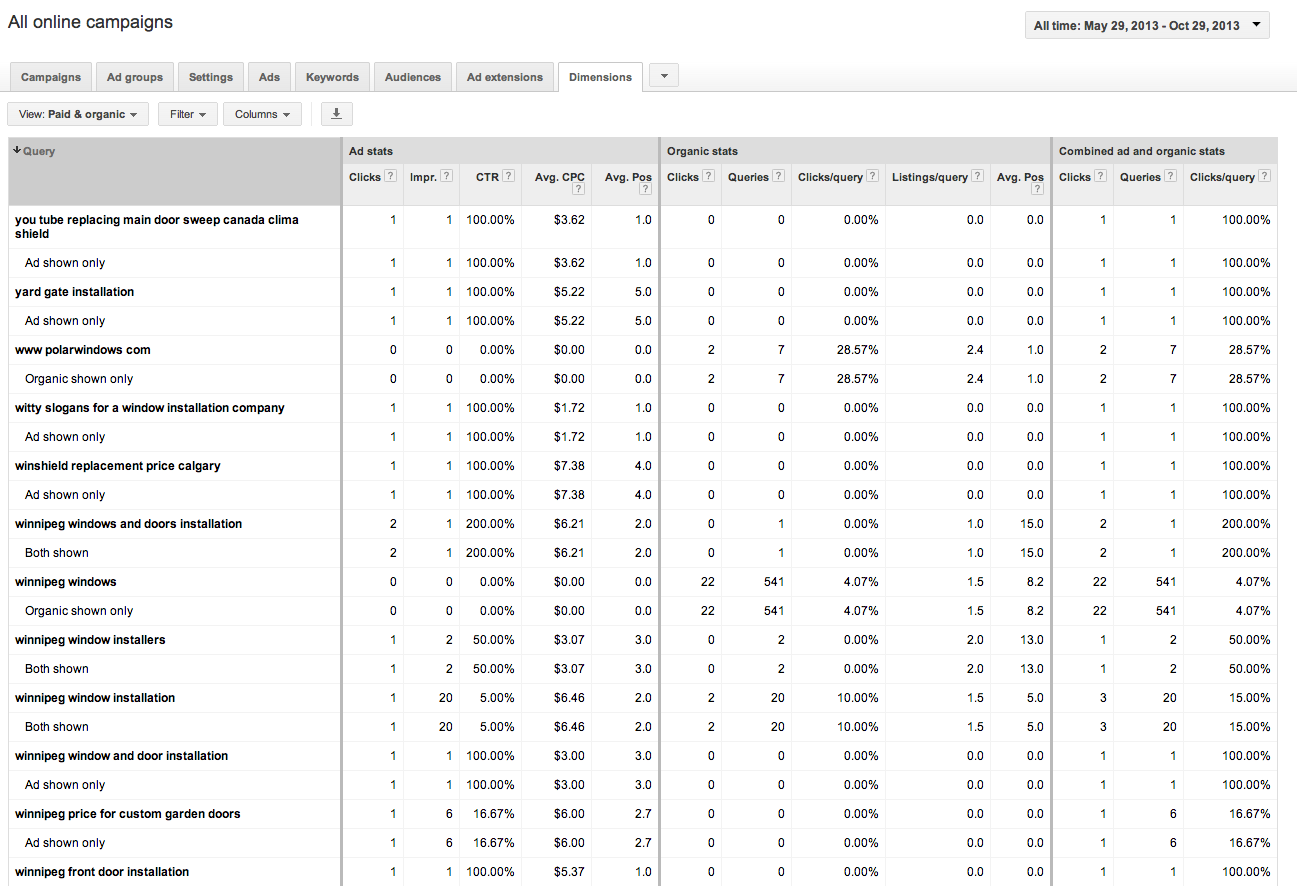
    A recently added feature, this table shows how your paid and organic results performed for every search that triggered an ad or organic listing. You can view your click through rates (CTR) for both paid and organic searches individually, but also the CTR for when you have both an ad and an organic listing displaying in the SERPs. This tool can be great to convince clients the value of paid search (even if they have great organic results!). You can also use this to gather some keyword data for making decisions for your SEO campaign given that Google’s decision to make all organic searches (not provided).

    Best Use: Gather information on how your ads perform when they are shown with your organic results.

    Learn how to link your AdWords account and Webmaster Tools account to view this data.

    2. Time > Day of the Week

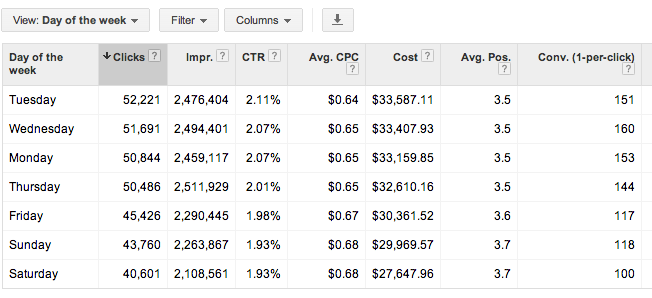
    This report shows you all stats for each day of the week over your selected date range. You can determine which day performs the best by meeting your defined KPIs. You can then adjust your bids based on the performance you see. Are Tuesdays and Wednesdays higher converting than Saturdays? Focus on those days!

    Best Use: Determine which day of the week is highest converting, and spend budget there.

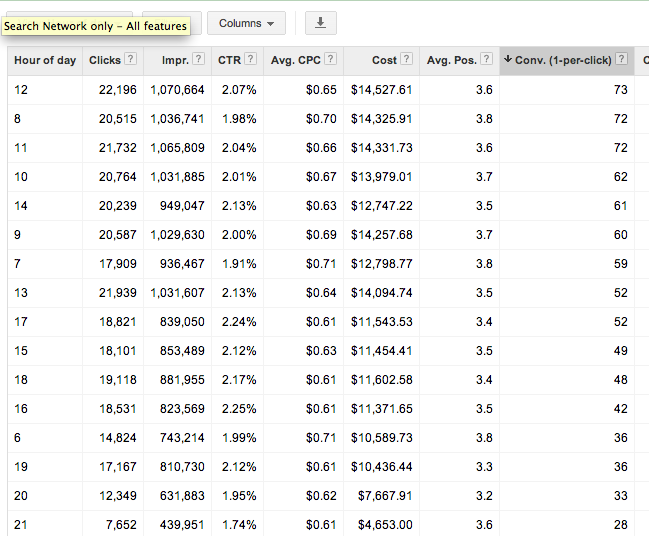
    3. Time > Hour of day

    Shows you cummulative stats for hours of the day for the selected date range. As with the above, you can determine which hours of the day best meet your goals (impressions, clicks, conversions) and adjust your bids accordingly. Be mindful that if you are limited by budget, the hours later in the day may have lower performance due to the budget constraints. You may want to test day parting for hours later in the day if you cannot adjust your daily or monthly budget to determine if those later hours are actually more successful.

    Best Use: Determine which hours of the day convert best and set up dayparting to spend more budget during these times.

    Check out the dimensions tab for yourself and get familiar with the data that is available. There are many more reports available that give you actionable information to better optimize your campaigns. Which are your favorites? Let us know in the comments!

  • 6 AdWords CTR Boons & Bombs

    You might not need a NASA mathematician, but a keen eye can help you identify your own CTR boons & bombs.[/caption]

    Many internet marketers tend to forget that they sit on a veritable gold mine of big data. Each visit to a website is one data point. For paid advertising such as AdWords and Facebook ads, marketers end up with literally thousands of data points to test even the most minute characteristics of ads. While pulling the data, aggregating it, and analyzing it can be time-consuming, the value to your marketing plan is immeasurable. Recently, we pulled a sample of over 16,000 ads from the past 7 years of our AdWords accounts to see what aspects of ad copy increased click-through-rates, the overwhelmingly largest factor in keeping your costs per click low.

    These ads predate the full rollout of enhanced campaigns, and are not segmented for anything such as ad position, device, or industry. Furthermore, of the 16,000 ads in the study, only ones with over 1000 impressions were sampled, an arbitrary but significant amount. When compared to large-scale CTR studies, the size of the sample falls short; however, we reached a statistical significance of at least 95% using single-tailed t-scores* in all 6 of these variables. Finally, it’s important to note that these six actionable insights were gleaned from 48 interaction, linear, and binomial variables that were tested. Of course, it’s hoped that these flaws do not invalidate the study; at worst, it’s an invitation for someone to check under the hood of their own accounts.

    CTR Boons

    Three main factors were the most certain to be the cause of increases in click-through rate: “Sentence Format,” which changes the display of the ad; Calls to Action, in either line of the body copy; and DKI in the headline, which inserts the triggered keyword. In general, factors that increased relevance to keywords and uniqueness among competing ads increased CTR, which isn’t terribly far from the general status quo of ad copy literature.

    Use Periods in Both Description Lines

    Two variables checked for sentence-ending punctuation, one for each line of the body copy. Both lines lead to higher click-through rates, which is a bit of a surprise. Because we at Search Influence tend to keep our ads in the top positions, using punctuation will bring up the first body line into the headline of the ad, making the ad stand out against competitors on the page. However, the second line seems equally as influential, lifting the average CTR by .6% at a near-perfect confidence interval.
    boost adwords ctr
    Ending the second line with an ending punctuation makes the user feel like the thought is done, a natural fit for an English-speaking user. A further aspect to look into is an ongoing debate in the office: Do exclamation marks entice or drive away users?

    Call Your Users to Action in the Description

    Putting calls to action in the description has a palpable effect on conversion rate, but highlighting the value to the user entices .52% more clicks at a 99.99% confidence interval. Placing the CTA in the first line teams up with using ending punctuation, raising CTR by .6% at 99.9% confidence, but the second line performs admirably as well, raising CTR by .38% at a 99.99% confidence.

    Calls to action are treated very broadly, matching a variety of words often used in our campaigns. These words like “call,” “download,” or “contact” make your audience know that you’re expecting a certain action and can highlight unique selling propositions along the way. Interestingly, having a call to action in the headline was loosely correlated (90% confidence) to a significant drop in CTR. Users seem to subconsciously like to be guided, not bashed over the head with the sales pitch.

    Use DKI in Your Headline

    Finally, DKI remains an effective way to match user queries to ad copy. By inserting the triggering keyword into the headline, you raise your CTR by .44% at a 99.99% confidence interval, though DKI anywhere else in the ad has very little measurable effect on click-throughs. Relevance is by far the easiest way to get a users’ click, but it seems users are used to a matching keyword only in the headline, leaving the rest of the ad for setting yourself apart from the other people on the page.

    In the same vein, I checked for the existence of the ad group name in the copy, expecting the same idea to hold true in static ads. Either due to inconsistent naming from the various alternative campaign structures that exist such as personas or highlighting the wrong keyword in the ad group, such as [breast augmentation] rather than [breast implants], there was either no correlation or a negative effect between including the ad group name in the ad copy and CTR.

    CTR Bombs

    On the other hand, these three aspects of ad copy were pretty certain to have caused drops in click-through rate. Unlike the CTR Boons, the Bombs generally fly in the face of conventional advice. In fact, blogs often suggestusing copy that drops these bombs.

    Use Obscure Parts of Speech

    Previously, we had suggested that a natural language answer to a search query is best. Yet “little” words like “the,” “an,” and “on” anywhere in the ad copy lowers click-through rates by over 1% at a 99.99% interval. This was the most consistent bomb across positions and the biggest drop to CTR, showing that it’s absolutely hated by users.

    Users seem to need clear and direct writing, something along the lines of a grammatically correct Tonto. Simple, clear sentences win over verbosity every time. Furthermore, bullet-point style copy can also quickly outline main unique selling points and make the value of clicking on the ad clear to users.

    Ask Your Reader Questions

    “Try asking a question in your ad copy,” say so many copywriting guides, but our dataset shows a 1.18% drop (99.99% confidence) in CTR from asking questions in the headline and a .55% drop (98% confidence) due to questions in the body. This may tie into the previous bomb because questions often require little “helping” words to make sense. However, it could also be a question of relevance — asking a question like “Are You a Candidate?” introduces doubt into the user whether or not the page is really relevant to them, discouraging the click.

    Buy Now!

    Finally, including “Now” or “Today” in the headline seems to turn off users from clicking, to the tune of a .97% drop at a 98% confidence. At lower confidences (90%), including the word “Now” in the body copy drops CTR by .33%. It seems that too much immediacy is a bad thing for users, making them feel pushed. Most verticals have a buying cycle, and trying to artificially shorten that may gain short-term clients but won’t net the same results.

    Interestingly, at a 90% confidence interval, the word “Today” doesn’t have the same effect in the first line of body copy, boosting CTR by .4%. It seems that, again, playing to the buying cycle of the industry will ensure that your ads, and not your less pushy competitors’, will get the click.

    Next Steps

    After all this, it should be made clear that CTR isn’t the only holy grail, as being able to vet users before the click is extremely important. As with any data, more research will always be needed. The next step for this dataset is to look into collinearities that may shed further light onto the data. Finding data-based “power combos” for ad copy can jump-start any campaign and gives your copywriters real formulas for effective, large-scale advertising solutions.

    Unfortunately, we can’t share all our data, but the next-best thing is to test your own data and test your assumptions — it’s the only way to make sure you’re doing the best job for your campaigns. Do you have any data you’d like to share?


    *Disclaimer: Please excuse any oversimplifications of terms, though feel free to correct anything outright wrong with how I’m describing processes or data. (Get back to reading)
  • AdWords Enhanced Campaigns: Naughty or Nice for SMBs & Agencies?

    Yesterday, Google announced what might be the largest restructuring of the AdWords platform to date: Enhanced Campaigns. Building on (and some say attempting to boost) the influx of mobile advertisements on AdWords, Enhanced Campaigns are an attempt to simplify the mobile pay-per-click management process by removing barriers to ROI calculation for SMB advertisers. While many advertisers are less than enthused about the changes, Search Influence welcomes the new features, streamlined campaign creation process, and simpler campaign management and assessment that Enhanced Campaigns brings to the table.

    Nice!

    The official blog post on Inside AdWords is clear about the goals of Enhanced Campaigns: simplify mobile and multi-touch marketing for the part-time advertiser. Citing a study on the new world of multi-screen browsing, Google claims 90% of consumers “move sequentially” between several devices during the conversion funnel.

    Google highlights three refinements to existing AdWords features that will be live for everyone starting in June: (1) laser-targeted bid adjustment based on location, device, time of day, “and more” within a single campaign; (2) easy management of one campaign across multiple devices, which is in contrast to the previous recommended best practice of duplicating identical campaigns for different device targeting; and (3) more accurate click-to-call data and conversion measurement across devices. These changes allow advertisers to more easily set up mobile campaigns, a strategy Wordstream founder and CTO Larry Kim says only 4% of advertisers participated in despite lower costs-per-click and, in our experience, high conversion rates from calls.

    The new bidding system is based on a percentage of a basic bid which covers the equivalent of today’s national desktop campaigns. This bid can be multiplied by -100% to 300% depending on device targeted and -90% to 900% depending on geographic area or time targeted. This allows advertisers to avoid tedious duplication of campaigns simply for different targeting, while making it much easier on “part-timers” and campaigns with limited budgets to run on multiple devices and control who sees their ads.

    Combined with the recently-simplified Remarketing Lists in Analytics, the upcoming Universal Analytics, and the storyline offered in a post on SEER Interactive, it becomes clear that the other shoe dropping with Enhanced Campaigns is the continued march toward multi-touch lead attribution.

    AdWords is also dropping the direct fee for Google-offered click-to-call numbers in mobile search ads, tracking only calls over one minute as a conversion. This has been a point of contention for marketers who know that a click on a phone number and a call connected are very different things.

    Naughty!

    Not everyone is excited about the changes brought by Enhanced Campaigns. Many advertisers are concerned about the cost-per-click increase that will come with a variety of new advertisers not effectively managing their bids using combined campaigns. According to an Adobe study, the gap between mobile and desktop costs-per-click dropped by 15% between the 3rd and 4th quarters 2012, meaning that there’s already less of an advantage to advertising on mobile. Automatically setting advertisers to run on mobile means that despite the availability of new bidding tactics, less savvy advertisers will inflate the ad auction and lead the platform to be less profitable for everyone.

    Others are concerned that Google won’t be able to effectively manage the preferences expressed in the myriad targeting options provided by Enhanced Campaigns. Per Google’s Guide to Upgrading to Enhanced Campaigns, Quality Scores in upgraded campaigns are reported at a bird’s-eye view, making it difficult to see what targeting is driving increases or decreases of an already-opaque metric. Similarly, the inability to separate out tablets from desktop searchers makes some wary; there are some markets that would be highly affected by this, such as downloads of a desktop program. While this is concerning to some, it may also outline an overarching corporate goal of Google: to make the world fast and universally accessible — contrary to ideas like single-platform apps and solutions off the cloud.

    Misconceptions: Looks Naughty, but Is Nice!


    But some, seeing the change as a step backward for targeting, have unfairly found fault with the update. Enhanced Campaigns eliminates confusion by changing locations of settings.  Many have said that the “mobile-only campaign” has disappeared from AdWords. On the contrary, AdWords provides a checkbox to help Google figure out what device an ad should be shown. Furthermore, ads with extensions such as App Store downloads that only make sense on certain mobile carriers and operating systems will be automatically targeted to those devices.

    There’s also some worry about other platforms following suit. As BingAds has matured as a platform and international search engines have found monetization easier with cost-per-click ad auctions, it might follow that this grand experiment by Google will shape the industry. Yet BingAds has tried to forge its own path in the paid search realm; I can’t see them blindly following Google with its targeting any more than it already has — to wit, only slightly. But while the industry as a whole might not change, it is important to note the Google has over search ads, especially on mobile devices.

    How to Win with AdWords Enhanced Campaigns

    Best practices can already be parsed out from what has been released about AdWords Enhanced Campaigns, but they aren’t necessarily far divorced from current ones.

    1. Follow Google’s guide to transitioning your account to Enhanced Campaigns
    2. Be sure to take advantage of all appropriate ad extensions, which allow you to target you ads appropriately to device and location
    3. Ensure you’re using the most up-to-date version of AdWords Editor to effectively Enhance your Campaigns.
    4. Anticipate a variety of devices coming to your site by providing dynamic content and alternate conversion paths based on device
    5. Provide natural redirection to and from your mobile site if it’s required for your business to avoid issues when desktop ads show on mobile or vice versa
    6. Now more than ever, bid appropriately for your location, device, and time of day — the best strategy in a second-price auction like AdWords is to bid what that website visit is actually worth to you

    We’re looking forward to learning more as marketers start experimenting with these new tools. What do you think? Will this change the way you’re doing PPC?

  • Why You Should Start a PPC Campaign Today

    PPC Questions & Answers for Small Businesses

    I get a lot of questions from clients about starting or maintaining a paid search or Pay Per Click (PPC) campaign. While we at SI are undoubtedly convinced of the positive impact a paid search campaign can have on a small business, others need more information before committing. Some of the most frequently asked questions about a paid search campaign include:

    • “What are the advantages and disadvantages of a PPC campaign?”
    • “Why should I do PPC if I rank in the first position organically?” in the same sense, “Should I start a PPC campaign until I start ranking organically?”
    • “Why should I pay for people to click on my website when they are already looking for my brand?”
    • “How will this help my business, and what should I expect for an ROI?”

    So, what are the answers to these important questions facing small businesses? Here’s my take:

    What are the advantages and disadvantages of a PPC campaign?

    1. Starting a PPC campaign allows you to show up in the Google search results for search terms that you may not rank for organically.
    2. A PPC campaign allows you to set daily and monthly budgets for the keywords and areas you want to target. If you are selling a product or service that is sold out or fully booked, you can allocate your budget to a different product or service with a simple click.
    3. You also have more control over the locations where your ads show. With SEO, you are building overall site authority, and while you may be targeting specific geo-modified keywords, you could potentially rank in other locations. With paid search, you can set your preferred locations as well as the exact geo-modified keywords you want to target.
    4. One of the main benefits of a paid search campaign is that results can be instantaneous. While it typically takes 30-60 days to fully optimize a campaign to see optimal results, you can begin receiving leads or making sales the first day your ads are live.

    Will paid search marketing ads still help me if I rank in the first position organically?

    The answer to this is, of course, “YES!” — but let me tell you why.

    1. For terms that you do rank for organically, having a paid ad allows you to claim more “real estate” on the search engine results page and increases the likelihood that people will come to your site. People tend to believe your site is more authoritative because Google allows you to show up more than once on the page. According to Search Engine Watch, 34 percent of paid search clicks occur when the same website ranks organically on the page. If the paid search ad is paused, only 11 percent of the traffic generated by the ads will be replaced by the organic clicks.
    2. Having a paid search campaign gives you the ability to control your message through your ad copy and change it easily and often if necessary. You can create unique ads for specials and seasonal offerings and have them rank in top positions quickly. This allows your ads to always be relevant.
    3. PPC also gives you the ability to control the message and content of the landing page to which you send your visitors. You can optimize this landing page for conversions and sales, with less focus on keyword-related content.
    4. Finally, you have the ability to test ad content, landing pages and keywords on a larger scale. You can determine which calls to action are driving traffic and which keywords convert the best in a shorter time frame. Then, you can apply this knowledge to your SEO campaign.

    Side Note: Running a paid search campaign will NOT improve your organic rankings.

    Should I start a PPC campaign until I start ranking organically?

    You should most certainly start a PPC campaign immediately. However, see the question above for why you should continue the campaign even if you rank in the first position organically.

    Why should I pay for people to click on my website when they are looking for my brand?

    Besides the points mentioned above, there are many reasons to bid on branded keywords.

    1. Competitors may be bidding on your branded terms and you will want to ensure you are showing in the top position for your brand.
    2. Branded clicks are very inexpensive, as you are going to be the most relevant result for your brand, and Google will “reward” you for that.
    3. People searching for your brand are more likely to convert, and you want to be where they are searching.

    How will this help my business, and what should I expect for an ROI?

    Search Influence tracks all aspects of a paid search campaign, similar to how we track success for SEO. We provide call tracking numbers for campaigns and set up form tracking to attribute leads directly to paid search campaigns. Our monthly reports include a list of leads, cost per lead, clicks, click through rates, and average cost per click (among other factors). This helps our clients determine if the leads we provide are valuable and what leads are becoming actual customers. ROI will vary depending on industry, but we strive to provide a positive ROI for every client.

    So if you are wondering if you should start a paid search campaign, the answer is almost certainly “Yes!” With effective research, targeting and analysis, you can have a successful campaign that will generate leads and sales for your business.

    I’d love to hear your opinions on PPC, so leave a comment below!

  • When Keeping It Relevant Goes Wrong

    Brenda Johnson Knows What's Up

    I’ve been actively creating and managing Google AdWords campaigns for over five years. In that time, I’ve made a lot of mistakes with everything from keyword selection to match type to ad content. It happens — if no one ever made a mistake on AdWords, we would all be PPC success stories, and that’s certainly not the case. So when I typically see mistakes with sponsored ads, I take a screenshot, write a short heads-up email to the advertiser explaining their mistake, and keep it rollin’. However, over the weekend I came across what could possibly be the worst targeting and most confusing landing page I’ve ever seen on AdWords.

    While I was searching for “delaware county oh plastic surgery” (before you start reading too much into this, no, I was not looking for a plastic surgeon. I am quite comfortable with my stout lil’ man-child body), I came across this gem of an ad…

    Find the Bad Ad

    (more…)

  • 3 PPC Keyword Research Strategies to Break Free From Organic

    ppc keyword research strategies
    Battle for the Planets? The Difference is more Power Rangers.

    Organic and paid search are both, at the core, about the search queries. These queries are, of course, sought by optimizing for or bidding on certain keywords. These keywords, found using keyword research tools such as Google’s or Wordstream’s and then turned into a comprehensive list using your favorite keyword expansion tool.

    Organic keyword research focuses on traffic, looking for quality descriptors for the products, service, or content offered to the visitor. These descriptors are filtered for the search phrases that are the best fitting and for “low-hanging fruit,” ones with low competition and high value to the business.

    However, strategies for paid research must be different, because the mediums are used in a different way. In addition to search traffic, competition and metrics that might be overlooked or generalized, like average CPC, must be included in the research. Furthermore, these three additional discovery strategies can help create a more robust keyword profile.

    Three Keyword Discovery Strategies

    General

    Unlike in organic search, general keywords play a central role. Organic keywords, especially for businesses, tend to be of the general pattern *geographic area* *keyword*. However, because a paid search campaign can geotarget its ads, any search using the non-geomodified keyword from the targeted area would also trigger the ad. Thus, someone in Montana searching {window cleaner} will see ads targeted to Montana Window Cleaner.

    General keywords focusing on the domain name and business name are also useful for brand marketing. There is a bit of a debate over whether PPC clicks cannibalize organic clicks for this kind of keyword. A few theories and strategies have arisen, with of course the best answer being “What’s best for you,” though problems can arise with attribution.

    Long-Tail

    Long-tail keywords, searches like {cost of criminal lawyer} or {home security free installation}, while relatively low traffic, are specific searches that strengthen the depth of the research. This way, deep searches you wouldn’t optimize for organic search can be explored and taken advantage of. These deep searches are largely of two types, researching and buying. Phrases like {cost of …}, {buy …},  or client-specific long-tail terms like car models can be used to serve ads leveraging the search intent of the viewer.

    Match Types

    The three match types are Broad, [Exact], and “Phrase.” These three types are even more important to the research than for organic search, as it can affect CPC.

    Broad keywords would trigger on longer-tail searches, synonyms, common misspellings, and word reversals. The broad keyword Criminal Lawyer would show ads on the queries {criminal law}, {attorney for criminal case}, or {criminal lawyer new orleans}.

    To save on CPC, [Exact] keywords will run ads on the keywords only in that order, so [criminal lawyer] would trigger on the searches {cost of criminal lawyer} but not {lawyer for criminal case}.

    “Phrase” Keywords display ads solely on the phrase entered. The keyword “criminal lawyer new orleans” would show solely on that term, and none others. This one is less necessary for PPC research.

    Facebook and Display

    The final addendum for any PPC keyword research is that you have to take into account for display ads, whether through Adsense or social media platforms. These ads, though not for paid search, are the bread and butter for retargeting and remarketing or brand awareness. Approaching this match types as keywords may not yield much, but treating broad keywords as categories or thinking laterally and approaching the keywords from demographics and related interests could solidify a bland targeting spectrum.

    With the “reimagining” of Keyword Research strategies focused around these three concepts (and one quick point), your ROI will skyrocket from the CTR and quality score increases that come with a well-curated keyword list. What tricks have you used to get the most out of your keywords?

  • Google-Groupon Faceoff: Google Daily Deals Enter The Arena As Other Social Media Backs Off

    Just four months after jumping into the daily deals pool, Facebook abandoned its efforts with regard to small business space (at least those not related to check-in services). Given that the business in question had to have a Facebook profile and only about 15% of the average business’ fans are located in the same city as the business itself, it makes sense that the social media giant would turn its focus toward more profitable venues — eliminating its Groupon competitor while reducing its lame-duck Foursquare competitor to a sideline project. Hot on the heels of this news, however, comes the announcement from local-focused entity Yelp that their daily deal program will be severely scaled back, and that “we’ll continue to email out any amazing Deals we find; rest assured when it comes to quality vs quantity, we’ll choose quality every time.”

    Well, there are worse places to get your deals.
    Well, there are worse places to get your deals.

    While Yelp isn’t on the same scale as the ‘book as far as user base or diversification of services, it is by nature a very local presence, making the small-biz deal model a seemingly natural fit. However, Yelp CEO Jeremy Stoppelman has stated concerns with the “deep discount” approach that has provided an extremely negative experience for many small-scale businesses, leaving nobody happy in the end via use of an unsustainable model — albeit one with considerable consumer response. However, despite the reputational backlash growing from the business end, Groupon has reported record profits and its name has even been bandied about as the fastest-growing company ever. While long-term results are as of yet unproven and more merchant-friendly policies seem inevitably necessary to keep the brand afloat, it’s certainly hard to argue with the numbers at the moment.

    So why, with other social web presences getting washed out of the pool by Groupon’s leviathan-scale belly flop, is Google dipping a toe in? The search behemoth has established a deals program in Portland, OR and seems to be looking to expand, given its recent display of a New York-based deal on admission to the Museum of Natural History. I guess the saying goes that if you can’t beat ’em, attempt to acquire them for $6 billion and if that doesn’t work, well, go back to trying to beat them.

    Part of this is almost certainly to do with timing, as Groupon recently filed for an IPO that could happen as soon as next month, launching it as a publicly-traded company and opening up an entire new world of earning potential. Its unprecedented fast-track growth also offers significant incentive to mount a counter-campaign and nip the competition in the bud before it grows to Death Star-like proportions. El Goog is facing an uphill battle, given that it’s moving against some pretty entrenched competitors — but at the company’s current scale it wouldn’t have much trouble deploying a nuclear bomb to swat a fly. There’s no clear path to adoption for users (certainly nothing as convenient and reliable as an email plunking into one’s mailbox every morning) and no real incentive to sign on when faced with the plethora of other, more popular options, at least for the moment. However, the sheer number of eyeballs (particularly if location-targeted deals are to be featured on Google’s famously minimalist home page) is a force to be reckoned with in and of itself. (In fact, a Piper Jaffray analyst estimated the Nexus One placement on the Google home page to be worth between $4 and $5 million if it were a bought-and-paid-for ad.)

    The Google brand, for better or for worse, has a lot of leverage with consumers and products that gain popularity tend to stick around for the long haul. The company also seems to have wider ambitions with its deal models, tying the Offers brand up with Google Wallet and check-ins, as well as developing Google Offer ads and coupons that can be displayed along regular PPC content. While Groupon is currently mobile-accessible, the all-in-one convenience of Google Wallet could be a strong selling point to those who want all their resources and grabs in one place. It’s clear that with the resources at their fingertips the success of Google’s deals platform isn’t contingent simply upon the “daily deals” Groupon-like aspect; however, it remains to be seen whether the attempt at diversification will pay off or Groupon’s 115 million users will stay true to the service that’s provided staggering discounts for its duration as an entity.
  • First step in writing PPC ad copy: THINK

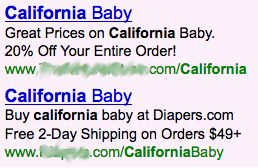
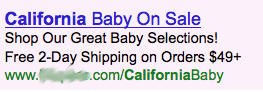
    Earlier this year Anthony, our resident PPC expert, wrote a great blog post titled, Pay Per Click for Dummies? Hire a Professional. Consider this its sequel. A part 2: Electric Boogaloo, if you will.  While doing a little Google Maps magic for one of our clients, I stumbled upon this PPC ad when searching for the phrase, baby moon California.

    Somebody call the CPS!

    I was shocked. How did the baby-selling black market get ad space for their sale? I thought Google had standards! Though, free 2-day shipping on an 8 lbs. package is a steal. My curiosity was piqued. I just had to click. Needless to say, I was let down. Apparently, California Baby is a product line of shampoos, soaps, etc. If this is how they advertise baby lotions, I’d hate to see how their ad for the importance of baby naps would look…

    I really don’t know how the site owners gave it the go-ahead. Perhaps if I lived in California and knew of the product, my mind wouldn’t have automatically jumped to such a horrendous conclusion. However, not every person who is searching for baby moons is going to be familiar with this brand. Even just adding the word “products” in between “baby” and “on sale” would have helped. It’s much clearer, still falls in the 35-character limit, and doesn’t remind people of the Lindbergh baby.

    Awkward first impressions aside, they make a couple other rookie mistakes. First, the keyword selection is incredibly unclear. Most search engines bold the keywords in the title and copy. I assume they’re going for the phrase “California Baby,” but Google doesn’t seem to recognize it as a keyword. That’s why only California is in bold but nothing else. This should have prompted them to rethink their strategy.

    Next, it’s best to try to squeeze the keyword into the copy as well. The bolder, the better. It stands out more to the customer, which means they are more likely to click through. They must have learned this lesson between the above ad and the most recent one I found:

    TWO ads for baby sales? They must be selling like hot cakes. The free market has spoken!

  • Google Display Ad: “Watch This Space”

    In my opinion, Mad Men is one of the greatest shows on TV. Not just because it treats television as an art form, but because it also shows that advertising can be too.  Print ads, to be specific. Well, with Google’s new “Watch This Space” campaign, they’re showing that display banner ads can be just as artful.

    Many businesses are still wary to commit to display advertising and instead fall back on dated methods, such as print, radio, and television. Not to say these forms aren’t effective, I just don’t understand this fear of the digital world. With the advent of DVR and the failing print industry, I’d be more afraid of the more traditional means of advertising. Not only that, but it is so much easier to track progress through display ads than it is for other forms.

    The ad is fantastic. Check it out.

    This particular feature has been available in the Adwords platform for a few years now. Google likely treated that as a soft run and is now ready to repackage and really push it to gain more advertiser attention.

    Display ads still lack the specific demographic targeting of Facebook, but the ability to display and manage ads on a multitude of sites while using one interface is a huge bonus. It gives busy business owners and marketing managers more flexibility and extends their reach. They can quickly and easily change what message is displayed depending on the type of site, whether it’s a men’s lifestyle site, a parenting site, or a teen magazine site, they have the ability to target the same or similar products to all of those demographic groups by packaging the ads in a different way for each.

  • Pay Per Click for Dummies? Hire a Professional.

    When Doing It Yourself Isn’t Such a Smart Idea

    Pay Per Click Search
    Pay Per Click Search

    I come from a family of “do-it-yourselfers”.  When my mom wanted new curtains for the kitchen, she’d go to the local craft store and purchase 3 – 5 feet of fabric and hot glue to her heart’s content.  My dad was no better; I remember watching him jury rig the plumbing after the basement flooded.  While I always admired their “make it work” attitudes, these (and many other) situations always ended with a call to a professional.  So when I hear that non-search marketers are doing pay per click marketing, I have flashbacks of curtains falling apart, pipes constantly leaking, and money being wasted.

    Pay per click marketing is a tricky platform with many intricate pieces.  As a PPC professional, I find myself in the role of a copywriter, researcher, accountant, analyst, and a gambler.  It’s a daily routine juggling daily budgets, maximum bids, and demographic settings to ensure the highest possible ROI with the given budget.

    Paid Search Keywords
    One of the biggest mistakes in many paid search campaigns is choosing keywords. Instead of choosing terms that visitors are searching for, first-timers choose keywords they are familiar with or possibly even industry terms – an example of this is “abdominoplasty” versus “tummy tuck”. While abdominoplasty is the correct term, it yields significantly lower traffic because the average person would type in tummy tuck.

    Another aspect of choosing keywords for a campaign is determining niche keywords. A niche keyword is a low traffic but high CTR phrase. For instance, while most searchers will use the phrase “tummy tuck,” there is a smaller segment of the population that will type in “tummy tuck stories.” This type of searcher has already done the “tummy tuck” search and is now looking for further information regarding the procedure.  This visitor is also most likely to convert into a lead.

    PPC Ad Content

    A big part of a successful campaign is the ad’s content. Writing compelling copy that follows the search platform’s and your industry’s best practices in 75 characters can be difficult. Most novice marketers tend to overload the ad with irrelevant content or keywords.

    Google Adwords Ad Copy
    Good Ad Copy, Bad Ad Copy

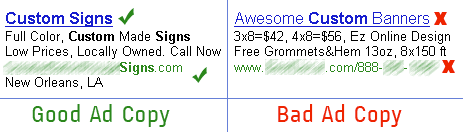
    If you look at the two examples below, you can see that the ad I deemed “good” has more bold keywords (keywords automatically bold based on the phrases the searcher used), the copy has a voice with a clear competitive advantage and call-to-action, and the location of the advertiser.  You might be wondering why I decided that the right ad is bad – well even though it gives pricing information, a phone number, and a competitive advantage (“Free Grommets&Hem”), it lacks a call-to-action, voice, location, and most importantly suggests a lack of professionalism by including “Awesome” in the title.

    Not only will the good ad be rewarded by Adwords for incorporating more keywords naturally into the ad copy, but people respond better to complete statements in ads and more likely to click through.

    Managing Your Paid Search Campaigns

    This is probably the hardest because it relies on advertisers knowing how to analyze site metrics, campaign details, and conversion rates.  Even after years of being Google Adwords certified, I still find quantifying the data difficult. Tracking cost per click at a keyword level is tedious and granular work – if you don’t know what you are looking for or even at, you could negatively impact your conversion rate.

    Another challenge for advertisers is bidding against competitors on ad placement. I always find this the most fun because of the level of difficulty.  It’s like eBay bidding on steroids.  If you are not closely managing your daily budget and cost per click, you can easily be pushed off the page – especially when in competition for placement of broad, high-traffic keywords.

    Anyone can pick up a “for Dummies” book, but there is no substitute for experience.  I don’t want to discourage those who are interested in paid search, but I want to inform do-it-yourself types that there is a lot of work that goes into a PPC campaign. You could easily spend thousands of dollars without a single lead to show for it, so please, hire a professional.