Author: Will Scott

  • Fully CHARGED: Search Influence Announces Seven Core Values

    Fully CHARGED: Search Influence Announces Seven Core Values

    Ten years. This January marks the tenth anniversary of Search Influence’s founding: quite the milestone accomplishment, when I look back on our humble beginnings around Angie and my dining room table.

    In ten years, our company has evolved as it’s grown from the two of us to three to nearly 90 employees today. The ever-evolving Internet and the competitive marketing landscape constantly challenge us to adapt, evolve, and innovate for our customers. We’ve had our fair share of challenges, while forging ahead as recognized trailblazers both in New Orleans and nationally.

    Amidst all the change and challenges to improve, one thing I am especially proud of is our company’s ability to remain true to our identity. As we continue to grow and set new goals for our 11th year in business and beyond, we’ve found it more and more important to put that identity into words: words to define what our customers can expect from working with us, skills our hiring managers seek in new Influencers, and values that our employees embody every day they come to work.

    We’ve admired companies like HubSpot, WordStream, and Zappos, who transparently publish their values and culture, so we sought to do the same. Over the course of a few months, we made it a focus to define our identity and develop our core values.

    Today, I’m proud to present the newly defined and adopted Search Influence core values:
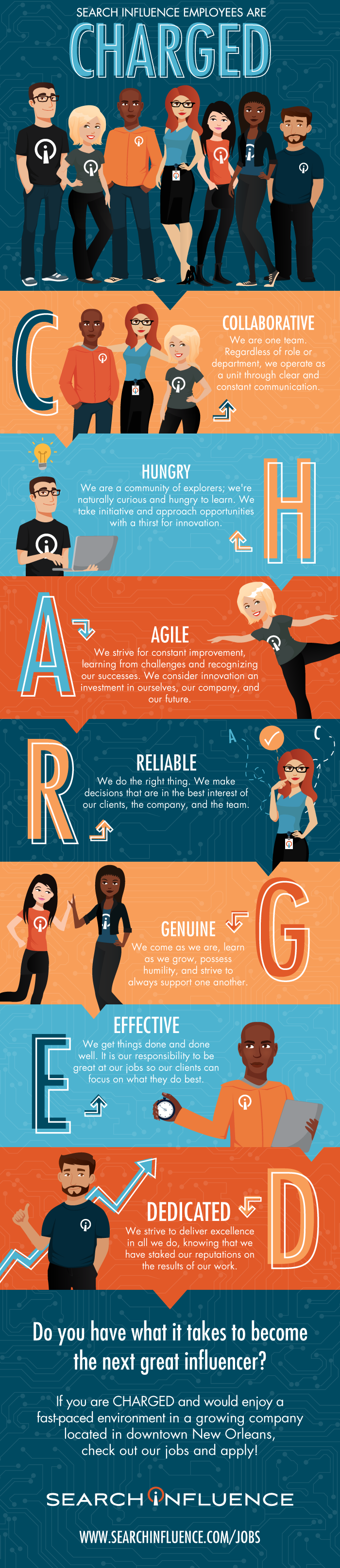
    Search Influence Core Values Infographic - CHARGED

    The Journey to Define Our Values

    Now that you’ve seen them, I’ll explain how we got there. It was important to us to get the perspectives of employees from across the company. With the help of our leadership team, we gathered a group of 20 employees from all departments, from almost every position, and with varying amounts of time with the company.

    Ahead of our first gathering, we asked each employee to think about a story that embodied what they believe makes Search Influence special. Boy, did they deliver.

    In our first meeting, there were a lot of laughs and even a few tears as everyone told their stories. Some of our more tenured employees reflected on the past and talked about the formative years of Search Influence. Here are a few of the highlights:

    “When you work at a big company, you are also really replaceable and not made to feel that what you have to say matters. At former jobs, I remember times where I would see things that could be improved and ideas wouldn’t go anywhere. When I came to SI, it wasn’t like that. If an employee says ‘Hey, I have an idea about this one thing,’ someone typically says, let’s run with it. People listen.”

    -Rebekah Durel, Account Manager

    Empowered is a good word for how I feel here. I started out in Production working on technical tasks but kept asking about Development stuff. I had no experience in this at all, but when I asked, people taught me. I thought ‘Oh my god, these people are actually going to train me on this just because I am interested. So cool.’ I had a total career change in about four to five months. That makes me feel really good about coming here every day because I know I have some investment in this, and they have some investment in me. Most companies won’t do that.”

    -David Fransen, Web Developer

    “Our company puts so many resources into training that we can take a college grad and turn them into SEO expert in a matter of months. And it’s always improving. This year, we spent a lot of time making sure our trainers had the right resources to be effective at teaching new employees. After Will and I presented at Google in New York last year, someone asked me what company I was with before Search Influence. My response was ‘College. We just kick ass at training.’”

    -Gabrielle Benedetto, Partner Relationship Manager

    “Over four years ago, I was about one month in at SI when I took over the QA department. We had a less than adequate transition, and I basically had to learn everything on my own. I started relying on the Development team and Account Management team to make this role more efficient. I was hovering over Developers’ screens and AMs’ screens about the same amount of time I was at my desk. I was in constant contact with the Dev team, and we were constantly working on how to improve our production. I like telling potential employees in interviews that we are all a big team at SI. For myself and my team, each department collaborating together is crucial to our success. We don’t ever feel like we can’t get something done.”

    -Jeff Ramos, Internet Marketing Team Lead

    Hearing all of the stories was quite the humbling experience. Rather than just starting with a brainstorming of value words, we had real examples and stories, springing from which were clear threads and connections that made the next steps almost easy.

    From Stories to Value Statements

    A core group of us took the notes from all the stories and analyzed the themes and common words that flowed throughout. Taking all the descriptive words we thought best described us, we grouped them together into themes and reconvened the entire group to make sure everyone felt as though their stories were represented.

    The feedback came with full force (we expected nothing less!), which sent us back to the drawing board once or twice, but there were a few values that everyone agreed on right off the bat: collaborative and agile were two.

    Finally, we arrived at seven core values with some words to further describe each. The next step was to develop statements to further define each value.

    The Company Kickoff

    In our October company meeting, we rolled out the new values and gave out mousepads featuring our new statement and acronym: Search Influence employees are CHARGED. We had some members of our core group present their stories as we introduced each value to personify them and help the larger team believe in our process.

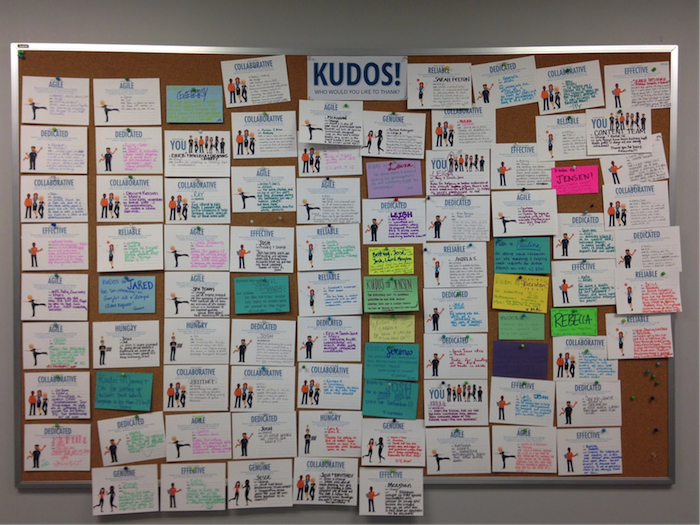
    To keep the values top-of-mind and help our team continue to integrate them into their daily lives at Search Influence, we took an already thriving initiative, our Kudos board, and stepped it up a notch. Our ever-brilliant graphic design team developed kudos cards related to each value.
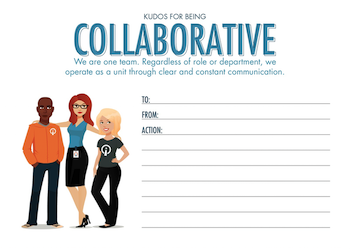
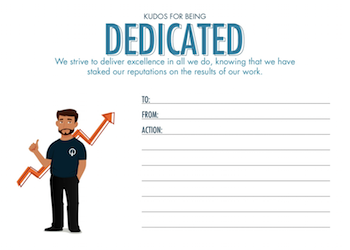
    CHARGED 4 size-full wp-image-18403  CHARGED 5 size-full wp-image-18402

    Now, when our employees recognize one another for their contributions, it all ties back to what matters most: that we are Collaborative, Hungry, Agile, Reliable, Genuine, Effective, and Dedicated.
      Charged 6

    What Search Influence’s Core Values Mean for You

    As a customer, you can expect to get what you’re paying for: effective results and peace of mind from a group of good people.

    As a partner, you can rest assured you’ve selected in Search Influence a dedicated partner who’s focused on agility and effective results to grow with you.

    As an interviewee, you should embody these core values and do so genuinely.

    As an employee, you can expect to come to work in a genuinely positive and collaborative environment where the dress code is casual but our work pace is not.

    Are you CHARGED and think you have what it takes to be the next great Influencer? Apply to join our growing team today.

  • Survive Google’s ‘Mopocalypse’ with these Tips for Your Mobile Strategy

    Survive Google’s ‘Mopocalypse’ with these Tips for Your Mobile Strategy

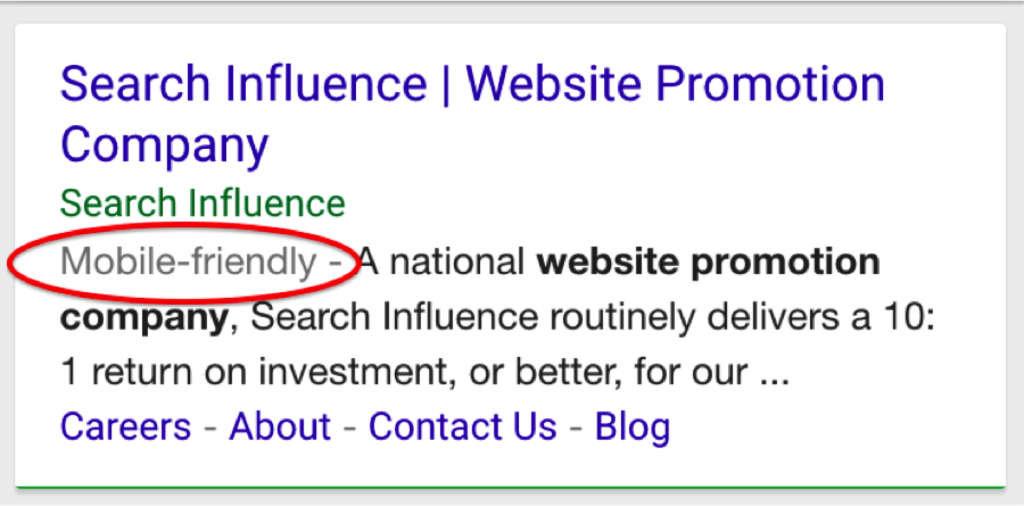
    Mobile Friendly Image Search Influence

    Google’s new mobile-friendly update, which I originally discussed in my Search Engine Land column, is rolling out this month, and it’s time to put the focus on mobile. But with all this buzz about mobile websites, you may be thinking, “My website looks fine on my smartphone when I pinch and zoom, so what’s the big deal?”

    Well, there’s much more to it than that.

    Step 1: Get a Mobile Website

    Just because your Web developer tells you your site is mobile doesn’t necessarily make it true. Make sure you’ve used Google’s handy mobile-friendly testing tool to check your website. In Google’s eyes, businesses have three main options for becoming mobile-friendly: responsive website design, dynamic serving, and separate URLs.

    So what option is right for your business? The bottom line is this: for businesses with growing mobile traffic that has not yet reached a critical percent of site traffic, a purely mobile version on a separate URL is a viable option. But for businesses with mobile website traffic pushing 50 percent or more of all site traffic, it is time to invest in a responsive website. While a responsive website typically requires a complete overhaul, your customers will probably thank you when your website can display differently based on the screen size.

    Step 2: Use ‘Barnacle SEO’

    Even before your mobile website is in action, your business needs to attach itself to large, fixed objects, and then wait for mobile customers to float by in the powerful current. I like to call this Barnacle SEO, also known as the “If you can’t beat ‘em, join ‘em” strategy. Basically, this means identifying large, high-ranking online directories such as Yelp, for example, and adding your information there in the hopes of “borrowing” some of their page one rankings. And there are many trusted online directories like Yelp out there you can barnacle up to: Angie’s List, Foursquare, Google+, Avvo (for lawyers), HealthGrades (for doctors), even TripAdvisor.

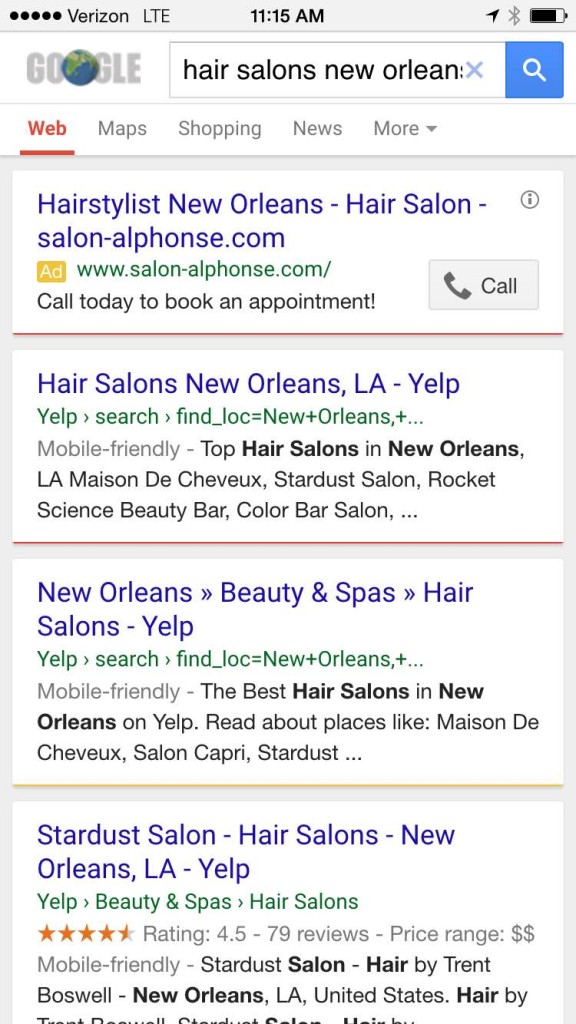
    This strategy works well in mobile because these websites are optimized for the mobile experience—providing the targeted information that local customers searching on their smartphones really need. When you perform a Google search for “hair stylists New Orleans,” for example, the top results are mostly from Yelp:

    Yelp Mobile Screenshot Image - Search Influence

    Step 3: Focus on Location, Location, Location

    Let’s face it: when mobile matters, location matters. Consider this: 50 percent of consumers who performed a local search on a smartphone visited a store within a day, according to a recent study from Google. So that’s good news for brick-and-mortar businesses with a mobile-friendly website. Those businesses will enjoy the additional ranking factors from the upcoming mobile-friendly algorithm, getting these small businesses in front of their target market at the time and place searchers are looking.

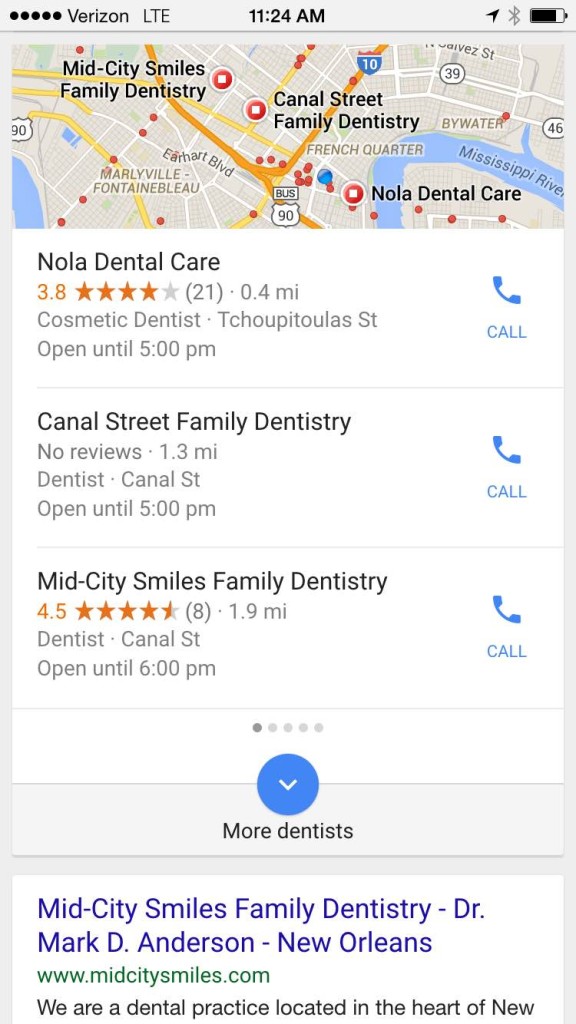
    The challenge? Local businesses must break into the top three local results—the ones typically seen on your smartphone. For example, if I search for “dentists,” Google is going to give me dentists near me … and I see only the first three results:

    Dentists Near Me Search Image - Search Influence

    To wrap it up, these are three steps you can get started on now. But remember, as with all Google algorithm updates, stay calm and give it time. April 21 was not the end-all-be-all date. This rollout will likely be a period of rollouts rather than a single-day launch. We usually recommend giving an update 60 days to see the full impact. And even then, there are revisions and updates and you just don’t know.

    So what’s your next move? Keep an eye on your website traffic to see if the update is impacting your mobile traffic. If you need help, give us a call at 504-208-3900. We’re here to help ease your “Mopocalypse” fears.

  • #LocalUp – Making Content The Sexy Part of Social

    The presentation below was developed for a joint conference put on by Local University and Moz in Seattle on February 7th, 2015, called LocalUp.

    My “beat” if you will as a Local U faculty member is Social Media, and given our work with customers of Search Influence, I have always leaned toward the advertising side of Social Media Marketing. With some of the changes being made by Facebook, most particularly, the elimination of “selling” content from the news feed, that focus is getting more important.

    Facebook is no longer a free lunch. You’ve got to pay to play.

    That said, it’s still very important to build community and engagement and good content makes it easier. That’s what this presentation is about. I hope you enjoy. I’d love to have your comments here or on SlideShare.

  • 8 Must Visit Eateries For BIA Kelsey SMB Digital Attendees

    8 Must Visit Eateries For BIA Kelsey SMB Digital Attendees

    SoBouNolaCracklinImage
    Cracklin. Yes. Cracklin. Tasty.

    My colleague Neal Polachek, a noted analyst and advisor, wrote me an email asking my opinion on New Orleans restaurants. He is coming to town for the BIA Kelsey LEADING IN LOCAL: SMB Digital Marketing event. He mentioned Cochon, which is excellent, but I had a few other recommendations.

    If you’re coming to New Orleans for the BIA Kelsey show, then please look up Search Influence. We’re only a few blocks from the Hyatt and we would love to see you.

    The following is a transcript of my email to Neal:

    As you know, there are TONS of great places in New Orleans. I do love Cochon. Your only challenge may be the noise level.

    Donald Link’s group has another new restaurant called Peche which is also great.

    Others you should consider off the beaten path:

    Lillette – One of our current favorites, on Magazine St. just passed the Garden District towards Uptown.

    Gautreau’s – Hidden in an Uptown residential neighborhood – worth the trip!

    Pascal’s Manale – Also in Uptown, it’s classic, quintessential New Orleans.

    Oddly enough, one of our current favorite restaurants is actually inside the Hyatt pavilion, called Borgne.

    Another current favorite that is seldom as busy as it should be is SoBou, which is attached to the W in the French Quarter. You can make a meal of the appetizers alone.

    If you want a super-fancy wine and dine, a hot prospect or a hot date kind of thing, there’s R’evolution in the french quarter just past Bourbon Street. This restaurant is excellent. We just ate there for the first time a couple of weeks ago.

  • Our New Home: The Floor Between 12 & 14

    Our New Home: The Floor Between 12 & 14

    According to USA Today, Otis Elevators’ records indicate that 85% of elevators do not have the number 13. Generally, the building owner will omit the 13th floor by skipping from 12 to 14 or by naming it “12B” or any number of strategic means to avoid the unlucky 13.

    ElevatorButtonsNoThirteenImage

    Well, I don’t believe in superstitions — black cats crossing my path, walking under ladders, breaking mirrors, or the 13th floor of any building. (If this were a reasonable discussion, I would argue that floor 12B really is the 13th floor by another name).

    Search Influence has outgrown our beloved Oak Street office and, after months of searching, we finally found an office that has the space we need with room to grow. On Monday morning, we had our first workday in our new office space: the 13th floor of the Exchange Centre (cue the scary music).

    SearchInfluenceMoveBlogPullQuote

    From Humble Beginnings

    With this recent move, we have done some reminiscing, looking back on the offices that once were. Our first true office space was on Jackson Avenue, and I have to be honest and say that it wasn’t all that beloved. It had a slightly funky smell and strange characters walking the halls, but it did redeem itself with some of its quirky charms.

    Funny story. While at the office one Saturday, we went into the storage closet for something and — absolutely true — there was a woman sleeping in our storage closet. She was living in our storage closet. She even had a microwave, so she had indeed set up house. We tip-toed our way out (didn’t want to wake her up) and called the building owners to deal with the squatter.

    A great part of Jackson Avenue was the BadNinja9 production office across the hall. This really was the production office for Dorian Dardar’s own film starring his Dorian Hudson character as zen master/detective/life coach. He interviewed all manner of fascinating people in his office for the film, including barely clothed young ladies, which happened more often than you would think.

    I can’t make this stuff up.

    We laugh looking back, but Jackson Avenue did have a very real impact on the growth of the company. Angie and I shared an office that was actually the conference room, so we were intimately involved in just about every meeting, every discussion — everything. We all grew to be a close group in that space, and those close quarters have paid off, translating into a deep level of trust and a shared knowledge among the team that we may not have achieved in a larger work area.

    As bizarre as the Jackson Avenue office was at times, it really cemented those work relationships that act as the foundation of this team.

    Our Beloved Oak

    We outgrew Jackson Avenue after 1 year — really after 4 months, but we were lucky to be able to take over a lease that had ended prematurely. All along, we’d been eyeing a newly renovated building that housed a wine bar and had the space to allow us to all work and grow.

    We coordinated with the owner of Oak Wine Bar, building out the unused upper floors of her building. An office over a wine bar, what’s not to love about that scenario?

    It seemed like it took forever (only because we were so anxious to get into the new space). When it was finally completed, it was beautiful. The space was clean and bright — wood floors, original fireplaces and windows. It managed to be both modern and historic at the same time.

    As much as we love the Oak Street office for its physical space, we also have a tremendous amount of affection for what Oak represents in the history of Search Influence. It was on Oak that we reached a pivotal point in the business. It was from that open and inviting space that we matured as a group and really grew into our own.

    SearchInfluenceOakStreetImage

    From Oak, we were able to start truly giving back to the community. We began providing free seminars for local businesses and started our work with nonprofits such as Youth Rebuilding New Orleans, The Audubon Institute, New Orleans Wine & Food Experience, and Hogs for The Cause. We have always wanted to give back directly to NOLA, and we had reached a point where we are finally able to devote time and energy to it.

    Also while on Oak, we were listed in Inc 500, which ranks the fastest growing private companies in the United States. At #418, we were incredibly excited to be one of 18 companies in the Greater New Orleans area to be recognized (of which we were the only residents of New Orleans proper). Honestly, I will never be not-excited about that honor.

    Our years on Oak represent our greatest growth, as a company and as a team. The last three years are an unforgettable time in the history of Search Influence. So, we leave Oak with a bittersweet goodbye.

    The 13th Floor

    After months of searching for new space, we found a few options for our next great adventure. We chose the option with the most square footage and a great downtown location: the 13th floor of The New Orleans Exchange Centre on Gravier Street.

    The Exchange Centre houses a number of New Orleans’ finest, including mature and start-up, technology firms such as TurboSquid, Archon Information Systems, Carrollton Group, Kickboard for Teachers, and many more businesses, tech and non-tech alike.

    NewOrleansExchangeCentreImage

    We moved in over the weekend, and our management team really pitched in to have the place ready for work first thing Monday morning. And 13th floor notwithstanding, there were very few glitches to work out. But as with anything new, it takes some getting used to. Even with the hiccups, the Influencers have been great. Everyone is pumped up and settling in. It feels good.

    It’s an incredibly professional space (it even has a reception area). All of the walls are lined with wide, open windows that look out on the surrounding CBD. Most exciting of all, with more than four times the square footage, we’ve really given the team room to spread out and keep growing. We plan to do even more amazing things at our new address.

    Yes, it’s the 13th floor, and for us, 13 is a very lucky number.

    Image Sources:
    Thanks to Dwayne Bent for the elevator buttons photo.
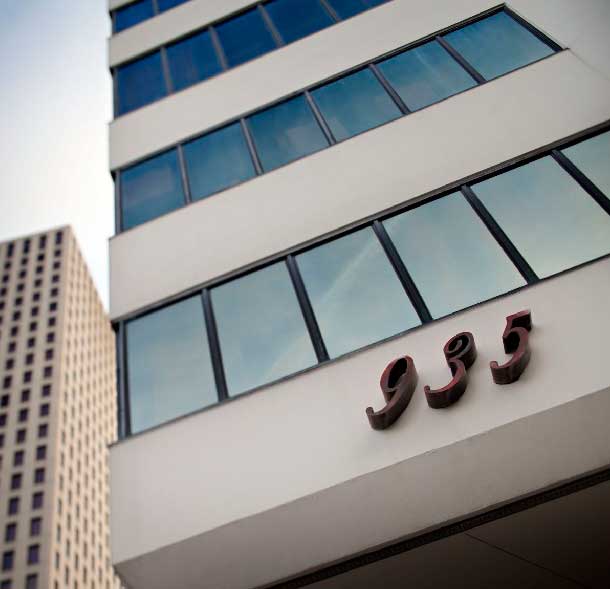
    The 935 Gravier Image was provided by The Exchange Centre.


  • Un-blurring The Lines of The FTC and Native Advertising

    Un-blurring The Lines of The FTC and Native Advertising

    To those of us in SEO and other forms of web marketing, native advertisements may seem like a God-send, the perfect combination of advertising power and positive user experience. The content-driven marketing platform is under a great deal of scrutiny, however, as it becomes more and more commonplace on the web.

    While advertorials have been used for the greater part of the last century, native advertising is a more recent development that has capitalized on user experience in the digital age. In 2013, more than 70% of websites offered native advertising, and that number is likely to increase by around 10% this year (Mondaq). Due to their editorial nature, regulators—as well as members of the general public—are worried that native ads blend too seamlessly with unsponsored web content, and many are eager for the issue to be formally addressed.

    The SEO value of native advertising is obvious. It’s an excellent tool that not only allows for optimization, but also provides great content to the user. And as we all know, content is king. Native ad campaigns can be more successful than traditional online ads, and as marketers, we like to believe that’s because users enjoy the content we’re putting out.

    Critics, on the other hand, argue that the ad serves as a sneak attack, tricking users into clicking through. As Federal Trade Commission Chairwoman Edith Ramirez told Reuters, “By presenting ads that resemble editorial content, an advertiser risks implying, deceptively, that the information comes from a non-biased source.” The drama around native advertising recently culminated in an FTC workshop focused on the method. This idea of hiding advertising in content inspired the FTC workshop’s name, “Blurred Lines: Advertising or Content?”

    blurred-lines-logo
    http://www.ftc.gov/news-events/events-calendar/2013/12/blurred-lines-advertising-or-content-ftc-workshop-native

    Un-blurring the Lines

    The workshop’s panelists questioned standardization and responsibility, trying to keep all three parties—buyers, sellers, and consumers—in mind, with perhaps a little more favor to the consumers, who have the least agency in the situation. While everyone agreed that transparency is necessary, some argued that it wasn’t enough. Chris Jay Hoofnagle of Berkeley’s Law and Technology Center, for example, presented results from his research, showing that as many as 35% of consumers didn’t identify a native ad as an advertisement although it was marked. On the other hand, Chris Pedigo of the Online Publishers Association reported that more than 70% of websites that offer native advertising had not received complaints from users.

    These statistics are just two examples of the myriad of arguments that seem to complicate the issue rather than clarifying. If there was one thing everyone could agree upon at the end of the workshop, it was that more work still needs to be done before any definite regulation can be imposed. Even Jessica Rich, Director of the FTC’s Bureau of Consumer Protection, stated that native advertising may be too complex an issue for one-size-fits-all standardization.

    In the meantime, the responsibility remains on the publisher to use discretion and focus on un-blurring the lines with clear indications of sponsorship on native ads. That may not be an attractive idea to advertisers hoping to fool users, but those producing strong content know better. If a company is actually creating the content users want, it shouldn’t matter that it’s marked with their logo and a big “Sponsored” label.

    Publishers can look at the situation one of two ways: embrace the responsibility or abuse it. With freedom from regulation, publishers are free to respect users and clearly label native ads or take deals with eager corporations to disguise the content. We advertisers share in the opportunity, as we can always choose which publications we partner with.

    Running a Clean Campaign

    While partnering with a publication that sneaks in sponsored content may seem like a good tactic from a purely bottom-line-driven approach, some innovative companies have already proven to us that it’s really not necessary in the end. Several publications are working to show their dedication to corporate responsibility when it comes to native advertising, and it turns out native ads are successful no matter their labeling.

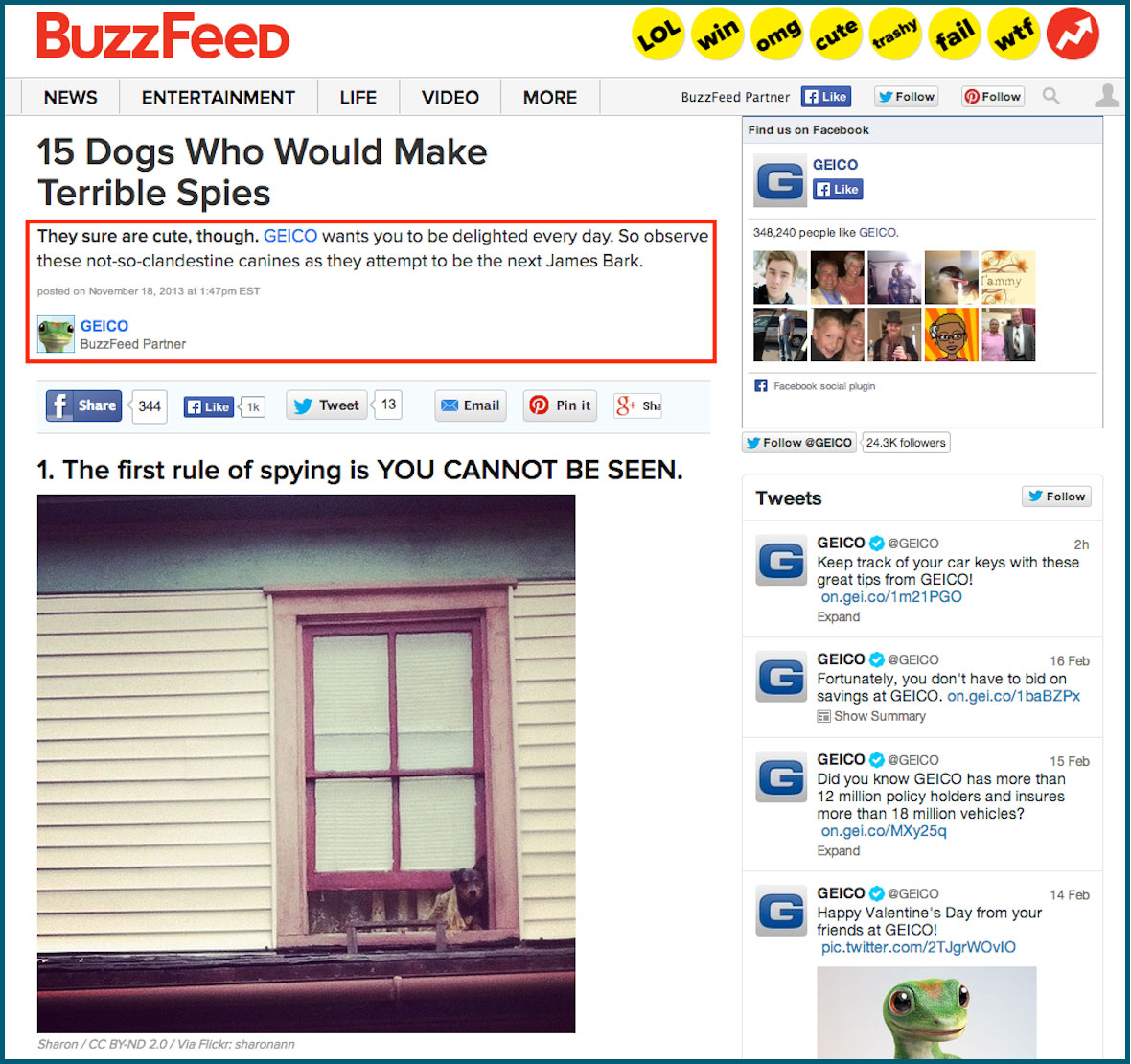
    BuzzFeed is a truly great example. The site rejects display ads entirely, relying on only native ads for advertising revenue. And it’s working out pretty well, according to Peter Kafka at All Things D, Buzzfeed planned to earn somewhere around $40 million in 2013, but the end number ended up being closer to $60 million. This sales boom comes in spite of the fact that advertisers’ contributions on the site are marked “Sponsored.” Buzzfeed’s pioneering efforts have obviously benefited the company greatly, and their sponsored content often drives more web traffic than traditional posts.

    infographic-pic
    http://www.buzzfeed.com/geico/15-dogs-who-would-make-terrible-spies

    Buzzfeed isn’t alone in their honest tactics. Many other companies acknowledge their native ads, including The New York Times, which announced in December that it would mark sponsored content with colored bars and “Paid Post.” According to the Times, publisher Arthur Sulzberger Jr. sent a letter to all employees emphasizing the “strict separation between the newsroom and the job of creating content for the new native ads.” The Times even published an article on their attitude toward native advertising, turning a policy into a great PR moment.

    IAB Playbook

    While no formal regulations are in place, the Interactive Advertising Bureau has set out to clarify the practice and set standards in the industry with the Native Advertising Playbook. By publishing the playbook, the IAB is acknowledging both the importance of native advertising and the danger it poses to unsuspecting consumers. Patrick Albano, the vice president of Social, Mobile and Innovation Sales at Yahoo and co-chair of the IAB Native Advertising Task Force explained that the organization set out with the goal of providing “guidance based on the state of the industry today while at the same time leaving room for flexibility to inspire innovation and growth.”

    The playbook goes over six different “core interactive ad formats” that are currently being used in native advertising: in-feed units, paid search units, recommendation widgets, promoted listings, IAB standard ads with native elements and custom ads. It also gives broader ethical principles advertisers can use to protect the consumer. With all native ads, the playbook suggests advertisers consider form, function, integration, buying & targeting, measurement and disclosure to “ensure that a unit will meet their brand objectives.”

    What This Means For Marketers

    To be completely honest, things are just as uncertain as before the FTC held its workshop. The workshop raised just as many questions as it answered and proved that no one has thought of a fair way to regulate native advertising. What the workshop really did is formally alert the industry to the FTC’s ever-growing interest into this marketing technique. As an industry I’m sure we’d hoped to avoid regulation altogether. We will now need to wait and see, and the good news is it’s not imminent given industry professionals and federal regulators still can’t seem to figure out what, in particular, should be regulated, much less in what way.

    In the meantime, Bureau Director Jessica Rich suggests that advertisers continue to rely on the FTC’s Dotcom Disclosure Guidelines when in doubt, while discussions continue. The IAB seems to be leading the discourse, with a series of native advertising workshops beginning in March 2014. Until then all we can do is focus on our own marketing efforts, working to keep consumers informed and clients successful. And native advertising is sure to be part of that process. In fact, with the advent of Penguin, native advertising seems to be our best hope. With each update, Google pushes even further back against search marketers, emphasizing the importance of well-thought-out and informative content. While I have always maintained that SEO is built on content, Google is regulating marketers in its own way by devaluing anchor text and deep links in favor of solid branding. So basically, if your native ads are giving users what they want, then Google’s happy, too.

    Has all of the recent hubbub around native advertising had an impact on your strategies? What do you see on the horizon? I’d love to hear your thoughts on the subject and on my theories. Please share below!


  • Reputation Rescue: Dealing with Your Business’s Online Reviews

    Reputation Rescue: Dealing with Your Business’s Online Reviews

    These days more customers are turning to their social networks and online review sites before making purchases. While local directories and review sites are important for your business’s online presence and SEO, it also opens up the door to both positive and negative reviews from customers.

    Reputation Rescue Infographic

    Copy and paste the code in the area below to place “Reputation Rescue: Dealing with Your Business’s Online Reviews” image on your site for free.

    Yes, People are Actually Looking at Them

    It’s been estimated that about half of American consumers have written at least one online review. Even those not writing reviews are reading them, with 70% of consumers saying they read reviews before making a purchase decision. The same number, seven out of ten, share the reviews they read with friends and family, meaning that these reviews are reaching even more people.

    And Making Decisions Based Off of Them

    For positive reviews, this is great! In fact, 87% of consumers say a positive review confirmed their decision to make a purchase. As one might expect, a similar yet opposite effect comes from negative reviews. Four out of five consumers report having reversed a purchase decision based on negative reviews. Yep. That’s 80%.

    But You Can Take Action

    Luckily, for businesses, there is a positive way to handle negative reviews. Respond quickly and publicly, keeping your response polite yet personal. Own the issue without being defensive and try to rectify the situation while still keeping your response simple. A whopping 97% of people found the reviews of a product they purchased to be accurate. This confirms that no one should be brushing off negative reviews. Responding correctly will give future customers confidence that they will not have the same experience.

    You know the saying about the best defense, right? Give your business a good offense by encouraging reviews from loyal customers. Reach out to customers via Facebook, Twitter, and email. Make reviewing your business as easy as possible and send those that do review a thank you.

    Real Reviews = Real Revenue

    Getting a considerable volume of real, accurate reviews will lead to real revenue. Positive online reviews have been shown to increase sales by 74%, and on a related note, consumers who conduct research online spend 18-36% more than those who do not.

    Don’t be scared to put your business out there! Transform your online review portals into revenue-making tools by garnering your existing customer relationships, addressing negative experiences, and improving your online presence. Reviews also create 21% higher purchase satisfaction and 18% higher customer loyalty. These are huge numbers for something that you aren’t even spending money on.

  • Google +Post Ads Offer Near Limitless Exposure to Social Messages

    Google has just announced a revolutionary social ads concept for brands dubbed “+Post ads.” +Post ads will allow marketers to re-package selected Google+ posts for promotion by way of Google’s display ad network.

    Google-Plus-Logo

    Unlike Facebook ads which live only within the walled garden, Google is taking the revolutionary step of pushing these ads OFF of Google+. In fact, Google+ will, for now, remain pristine, with no apparent ads.

    +Post ads have the potential to be more disruptive due to their “content as display” nature. It is likely the novelty will wear off in time, but in the early going brands who jump into this platform will likely see great exposure for their Google+ social content.

    For more information, see the related Google site. Our own Jeanne Gaudet has also contributed a brief writeup  (published under my account) to the LocalU.org blog.

  • Why Call Tracking Numbers in Local SEO Make Me Angry

    SEOhulk
    Don’t make me angry.

    At a recent event I found myself ranting – yes, really, ranting and I understand there’s video – about what I think is a very big deal for SMBs and those who market for them. The topic at hand was call tracking and local search.

    Over the course of my interaction with a few of our attendees I discovered that at least a couple of them were using call tracking to demonstrate ROI for their customers in a potentially harmful way. Call tracking in local SEO, if done poorly, is one of the most irresponsible things an online marketing company can do.

    What’s Coming – It’s Kinda Long:

    • The NAP (+W)
    • The History of Call Tracking
    • Why doing it wrong really hurts SMBs
    • When is it OK?
    • How you can do it with less risk

    Your NAP +W and Why It’s So Important Not to Mess It Up

    The first time I heard the NAP (Name, Address, Phone Number) referenced was in a presentation by my friend Gib Olander who at that time worked for Localeze, one of the 3 main data providers for online and offline directories. Gib and I were presenting on a panel at SMX Local & Mobile in July 2008. My presentation was on a concept I called “Barnacle SEO” and Gib’s was all about the NAP. Mike Blumenthal has sinced added the +W (web site).

    NAP +W is:

    • Business Name – you should have one and only one name. It should be the same on your web site, yellow pages listings, Secretary of State web site and everywhere else.

    • Address – the location of your business in the real world. This should be identical, or very close, to the version of your  address in the USPS database.

    • Phone Number – your main business phone number. In the best case this phone will be answered by someone who says “Thanks for calling [Business Name], may I help you”?

    • + Web Address – your home on the web. All about your business, hopefully including your Name, Address and phone number.

    In relational databases there’s a concept of a Primary Key, which is the piece of data which ties together data in different tables. So, in databases, the primary key helps you identify a unique record. In the world of Local Search, the NAP is like that. In other words, your NAP defines your business. It’s like your fingerprint on the web.

    Hopefully it’s self-evident that when you mess with your NAP you run the risk of confusing Google and other local search engines, which is never a good idea. If you screw up your NAP you may find yourself invisible in maps and locally focused searches.

    If you get many customers who came to you from search, this can be devastating for your business.

    History of Call Tracking

    The WorldA lot of folks in online marketing are relatively new to call tracking. To those of us who grew up in and around the Yellow Pages business, they’re nothing new. In the Yellow Pages universe, they refer to them a number of ways. “Metered lines,” “RCF (remote call forwarding) lines,” and other names all describe what we now know as call tracking.

    The Yellow Pages providers and their industry analysts were trying to do the same thing we’re trying to do now. They were trying to show either directly, or by inference from category data, that the ads they were selling had value by demonstrating a direct ROI (Return on Investment). There is little doubt that if your primary goal is to prove the value of your marketing efforts, you can’t beat call-tracking for service and local businesses.

    Over the years, some of those same companies who were providing call-tracking for Yellow Pages have morphed into our current crop of call-tracking providers for local SEO and online marketing.

    Why Doing It Wrong Hurts SMBs

    Small business advertisers typically have a limited budget for marketing and are therefore attracted to “performance based” solutions, in other words, those that feel like they come with a guarantee. Call-tracking is a great way to track leads and demonstrate the performance of these programs.

    Small businesses are also often fickle and impatient. And they’re not professional marketers, so we can’t expect them to think like we do about their investment.

    And they don’t usually understand exactly what it is we as marketers are doing for them. In the case of Call Tracking, they likely have NO idea of the risks of their local and maps rankings if their NAP gets screwed up.

    According to an acquaintance of mine who works for Google in Local Support and Operations, Google’s systems don’t support replacing your local number with an 800 number if they’re still able to verify your local number. Yes, you can have multiple numbers, but Google is going to treat the one they are able to find and confirm through their own data as authoritative. Google is looking for the greatest number of signals — some of them human generated, like phone verification — to assure their data is correct, so if they find a call tracking number in all the places they look for authoritative data it can be incredibly problematic long term.

    There are 3 major data providers in the US, Axciom, Localeze, and InfoGroup. One of those 3 is the origin for 90+ percent of the data you see online. But, like Google, they too get some of those data from crawling the web. So you can see how it becomes a vicious cycle – publish bad NAP, bad NAP get’s crawled and goes back into the ecosystem, bad NAP lives on long after the campaign has ended.

    At Search Influence we have a pretty deep expertise in NAP clean up — that’s right, NAP clean up — and a staff trained in how to manage listings. Most locally focused SMBs, plumbers, roofers, even doctors and lawyers don’t have the expertise to do it themselves. And, this should be obvious, they’ve got businesses to run.

    Putting a bad NAP into the ecosystem can hang around for YEARS. We all know that guy who keeps getting calls for the pizza place which used to have his number, right? Imagine your frustration if you were the pizza place. Think of all the sales you’d be missing.

    Beyond the NAP issues, for local search call tracking can be a crutch for weak metrics. It’s a heck of a lot easier to tell a customer they got 20 calls than to pick up the phone and ask about their business.

    When is It OK to Use Call Tracking for Local SEO

    NEVER!

    Ok, maybe not never.

    I think it’s OK to use call tracking with PPC and other online ads as long as one takes precautions against those numbers being seen with other referral sources. And, for national accounts (preferably with ads) I don’t feel as strongly given the lower, perhaps negligible impact of maps. But I realize that’s not Local SEO.

    For local / maps SEO, I want to state clearly that tracking numbers in local search should be avoided at all costs.

    My friend Thomas Ballantyne says he’d be OK with lead gen services in local as long as the business name wasn’t a match for his. In other words, if you want him to buy leads that use local search you’d better not muck up his NAP. From a home-service provider we hear it clearly, think about using a slightly different business name in the same way some providers use a slightly different URL. That way you don’t have to worry about your lead-gen stuff winding up in the cluster.

    If, however, a client is adamant that they need to see the calls generated or they need to record calls that come from search it can be done, but the proper precautions have to be in place.

    How You Can Do It with Less Risk

    SMB NAPThe safest way to track phone leads is by dynamically switching the number using Javascript.
    Search engine robots are increasingly capable of “seeing” dynamic content so this is an imperfect method by itself.

    It does, however, reduce the likelihood your tracking numbers will be identified and muck up your NAP+W.

    A little more technological implementation can reduce the likelihood of NAP confusion even further:

    • First, determine the User Agent of the visitors to your site – the identifier of the browser – and ensure that it’s not a robot, such as GoogleBot or BingBot. If you determine the visitor is a robot, you must show your proper NAP.

    • If at all possible, ONLY show a call-tracking number when there is a utm_source, or other tracking code on the URL string. Doing this will explicitly assure your tracking numbers are only present for visitors from a specific source, or ad campaign.

    Finally, if you want to be absolutely certain your numbers won’t get spidered you can render them in images. By replacing the image which contains the phone number you assure it won’t be misread. This is not the preferred method given it’s not mobile friendly and clickable.

    End of Rant…Phew!

    I hope it’s clearer now why call-tracking is such a dangerous tool. Yes, it’s a tool we use, but much like using a chainsaw, we take every precaution available.

    Our local business clients don’t know what they don’t know and often don’t know to ask “what are the risks.” So we, as their shepherds, need to be sure that we do no harm.

    I’d love to hear some other opinions. Do we have an ethical responsibility to our clients to educate them in the risks, or does the end justify the means?

  • What Local U can do for Your Business

    Local University Staff
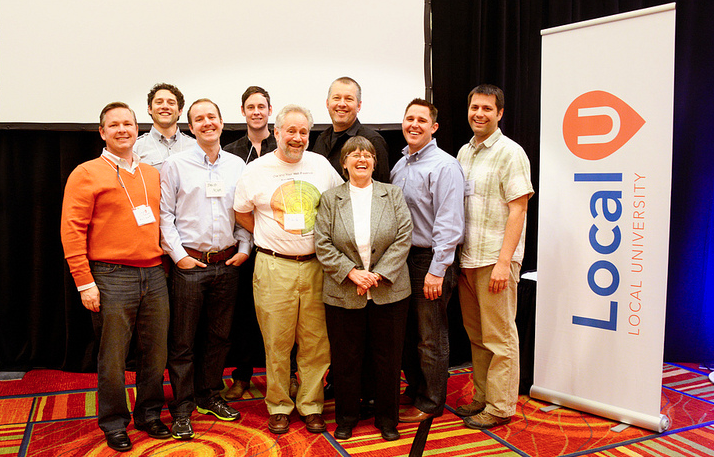
    Local U brings together the brightest minds in Local Search.

    With Local U just around the corner, I’m getting really excited about the opportunity it’s bringing to New Orleans. While there are so many things I love about the this city, it’s not necessarily known for its booming tech industry… yet. Local businesses could use a technological boost, and that’s exactly why I’m so eager to have Local U in our city. This informative event brings together some of the top players in local search to give entrepreneurs an introductory training session in Internet marketing.

    Local University will take place at Tulane’s Lavin-Bernick Center on May 7, from 8:30 am – 1 pm, featuring tons of great speakers and topics. It’s extraordinary to have so many great minds come together to share their wisdom. Experts in the field such as Mike Blumenthal, Mary Bowling, Ed Reese, Aaron Weiche, and Mike Ramsey will all be there, as well as the lead Consumer Support staffer from Google Places.

    Local U logoI see local U as the perfect way for anyone who is managing their local online marketing, or managing those who do, to learn practical tools they can use for any current or future enterprise. There’s no better way to spread the word about your business in this day and age than online, and this conference gives you the know-how to do just that. I know a lot of people who have no idea how to clean up their reputation online or connect with clients through social media, and they often don’t know where to turn to harness these skills.

    With sessions like Getting Social Online and Going Local with Google, individuals who have never previously taken an interest in search engine optimization, local search, or even social media can learn how simple techniques can maximize their online presence. If you’re interested in learning more about marketing your business online, make sure to sign up now!

    See you at the conference!

    Click Here to Sign up for Local U New Orleans!