New Orleans born and raised, SI’s own Account Manager Paula Keller was thrilled to get connected with a growing company in a growing industry after graduating from Louisiana State University with a degree in Marketing. With a strong interest economic development and a goal of being a part of the revival of big business in the city she’s always loved, she realized during this very interview that she’s fulfilling that goal by working at Search Influence. Not only does Paula work with an expansive variety of clients across the county, she also has the opportunity to work with some great local companies, including Audubon Nature Institute and Archon Information Systems. Paula bringing the party as always!
Let’s start with the important stuff: if you were a pastry, what kind of pastry would you be?
A chocolate glazed donught from Dorignac’s. It’s an old fashioned classic that’s always in style.
What is it that you do around here? What kind of skills do you find yourself using throughout the average workday?
While my new business card doesn’t list a title, I’m officially an Account Manager. You could also call me a Keywordsmith, Google Place Page Perfectionist, and Package Crafter. I do a little bit of everything. I think that is pretty typical of an Account Manager in any organization – we do everything and anything necessary to serve our clients the best work product. I manage not only some stellar direct clients, but also some fantastic white label relationships.
There’s a few responsibilities / projects that stand out when I think about what I do exactly. Shortly after I started with Search Influence, I dived into Google Place Page creation, claiming and optimization for all of our existing clients, which led to hands-on creation of far over 100 Google Place Pages during my time here. Secondly, over the past 6 months, I’ve worked with Will and crew to totally revamp our SEO packages and some additional a la carte offerings, which was a great learning experience and a lot of fun.
The average workday requires a wide range of skills, from time management, organizational, personal, and the ever important: “where are we eating lunch today?” skills.
Is there anything you’d like to be doing more or less of around the SI offices? In the perfect world, what would you be doing all day?
In a perfect world, I’d be cooking (and eating) all day. I was secretly hoping for a stove in our kitchen at the new office, but its probably a good thing that we don’t have one, or else I would be bringing batches of ingredients to whip up deliciousness in the kitchen at lunch time.
As some of our readers know, you used to be the blog manager, cajoling, bribing and occasionally extorting entries out of everyone at the company. Be honest: do you miss it a little?
Every day! Blogger-in-chief was one of my favorite hats I’ve worn around here. I’ve always loved to write (even research papers), and friends often asked me to review their papers as I was honest and would often edit it as much as I would if I was putting my name on it. WIth SI’s blog, not only did I love editing the posts, I was privileged to be the first to read SI’s take on breaking SEO news!
Is there anything that excites you about coming to work every day?
Is this a Yelp review or an interview? I love working with our clients. The best thing about what we do is that we get to help increase and improve the bottom line for small and large businesses. I love the whole process of selecting keywords, putting the strategy to work, and then watching the rankings climb, traffic go up, and customers come to the business.
Does keeping track of so much information from the people in production and directly interfacing with clients every day get to be a lot of pressure? Any tips for handling it?
Pressure? Nah. It’s a joy. That’s what the coffee is for. And To Do Lists. My #1 tip for handling any situation: Just write it down. Even if you think “oh, I’ll remember that” – write it down (and remember where you wrote it).
Thanks so much for everything you do around here, Paula K! For the new readers, you can check out the wide variety of informative and insightful blog posts Paula has written for us, and stay tuned for more Influencer profiles in weeks to come!
INFOGRAPHIC: Facebook Shopping Will Be B in 2015 — All Facebook
In light of our recent focus on Facebook integration, this is an interesting infographic — social commerce is a booming field, and it’s predicted that Facebook shopping alone will generate over $30 billion in 2015. Take a look to find the numbers on customer behavior, graphs of predicted growth and a timeline of the movement.
Social gems: More new tools for social marketing — B to B
Interested in expanding your social marketing horizons beyond the dynamic duo of Facebook and Twitter? B to B has a handy list of tools and applications to fill any marketing campaign niche you can imagine.
While there are alternatives available (see above), Facebook is still the dominant way to interface with your online customers and create a community around your brand. However, simply maintaining a page isn’t enough — here are some tips to create a dynamic, active profile that’s bursting with fresh content to engage your audience.
Google+ as a Business Tool — Pronet Advertising
It’s no surprise that businesses are already horning in on Google+ profiles in order to market to a whole new audience. It appears to be working so far, but Google has indicated that this still-in-beta feature is intended expressly for personal users, with a business-optimized Google experience currently in development.
Good news for Apple: despite the growing number of customers converting away from the iPhone to the Droid, developer support for Android appears to be waning. A smaller share of developers started Android projects in the second quarter of the year than the first, despite earlier reports that the painstaking Apple app approval process was causing programmers to shy away from iOS. Could this be a temporary flurry spurred by the announcement of the Verizon iPhone and the popularity of the iPad 2, or is Apple’s domination of the market here to stay?
The realm of Local SEO can be a complex, frustrating land. A fruitful, popular land but a land where seemingly easy obstacles can quickly turn into uphill battles. And, if your client happens to be in a country other than the U.S, that hilly jog transforms into a trek up Everest… without a Sherpa.
For example, we are currently working with a Playa del Carmen hotelsclient that is interested in ramping-up their local presence. This isn’t the easiest task but it certainly isn’t impossible. A few Mexico-focused business directories will need to be sourced, Google translator will be used like it is going out of style and a Mexican-formatted Google Places listing will need to be created. Again, not simple but all in a day’s work around here.
The most important thing to keep in mind when it comes to local SEO is that it is a newer industry and is constantly changing. This means that there can be quite a few kinks in the technology. Google is no exception to this.
After creating the client’s Google Places listing, we had the misfortune of discovering that the wrong country code was added to the listing. Typically, this would be a setback that would require another round of verification for the listing but not a deal breaker. Unfortunately, this was not a typical case. The country code had not been added incorrectly by us, but by Google and our client wasn’t the only one that was affected by this.
After some research, we discovered that listings in Playa Del Carmen, Mexico are using the USA country code (01) rather than Mexico’s country code (52) in the main search engine results page. However, the correct country code is used on the actual Place page. This is a pretty significant bug in Google Places but is par for the course in local SEO. Surely, the issue will eventually be resolved but for the time being it seems like there are going to be quite a few Mexican businesses with silent phone lines.
Around here at the SI office we take our lunches seriously, and at the intersection of tasty food and a bunch of fun, hardworking SEO professionals comes our new “Lunch and Learn” series. This recently-debuted program is a biweekly tradition here at the office, where an Influencer will take the time to put together a humorous and educational presentation to embiggen the knowledge of even the most seasoned SEO veteran. Today, our very own Anthony Coleman kicked off the series with a superhero-tastic exploration of Facebook reveal tabs and newsletter sign-ups, as well as how iframes can be a boon to development, tracking and user interaction.
Since Facebook’s native markup of a combination of HTML and XML can be clunky and very limited (especially when it comes to more sophisticated elements like Javascript), iframes offer a sleeker approach to Facebook brand display. They pull content directly from a business’s site, so that traditional HTML and the aforementioned advanced elements can be utilized to create a much more multi-faceted approach to drawing in eyeballs both before and after the “like.” Additionally, multiple tabs can be created within the frame, allowing for a customized complexity not normally seen in the basic FB layout. These tabs can offer different aspects of the business such as a “thank-you for liking” display, locations, specials, and forms.
As most Facebook users simply “like and forget,” this kind of direct data can draw traffic to the business’s page instead of its Facebook. Since the third-party content exists on a familiar platform, though, it can function as a preliminary landing page, easing the users in to getting to know the brand or service. The more dynamic aspect of the frame tabs also makes it easier to track page views and user behavior. In turn, targeting demographics by aspects such as location, sex, age and interests is made simpler as well — something that anyone with an interest in Facebook marketing is surely invested in.
On a more surface-level aspect, this approach is simply more engaging to the user than passive newsfeed updates. There are over 750 million users on Facebook (150 million + in the US alone), and maintaining a strong presence is a must for any social media-savvy brand. The updates can be informational (such as special offers and exclusives shown directly from the website onto the viewer’s feed), but also allows for direct interaction in the form of contests, mailing list sign-ups and other conversion points from viewer to participator.
It was an educational afternoon at Search Influence, and we thank Anthony for his hard work putting together his presentation! He’s got an upcoming blog post on more Facebook tactics, and you can bet that future Lunch & Learns will be written up right here. In the meantime, you can check out his heroic (and informative!) presentation here.
"I'll take the case!"Over the past few years, Google has been investigated by the FTC over most aspects of their business, largely circling around their aggressive acquisition of properties to vertically integrate other services into their core search. As Google has added features such as Products, Maps, and Video searches and integrated them into the main search results, competitors have seen their traffic decrease as users stay on Google-owned sites.
Making good on a somewhat threatening letter from the Senate Subcommittee on Antitrust, Competition Policy, and Consumer Rights two weeks earlier, on June 23, the FTC continued their impression of Harvey Birdman. Issuing a subpoena “relating to a review… of Google’s business practices, including search and advertising,” the FTC has opened an investigation to “address fundamental questions of business operations.” These questions, though immediately unclear to Google (if their admission and response on their blog isn’t just rhetoric), have been speculated on rather endlessly by pundits.
Starting from their blog, Google lists a few ways that they believe they put the user, i.e. their consumer in economic terms, first in their decisions. Search neutrality, vertical integration of search, the relationships involving paid search, clarity of function and policy, and consumer choice and freedom of movement, are all core facets upon which Google prides itself. Similarly, SEO dominatrix Matt Cutts discussed with Bloomberg news about the case, but managed to deflect most of the more interesting questions.
On first glance, this investigation seems to parallel the Microsoft case that crippled the company’s ability to innovate on its OS, but not its market share or company size. The Findings of Fact from that case, which were not overturned in the successful appeal, offer insight into the kinds of inquiry Google will endure. However, it’s quickly becoming clear that substantive differences may doom the FTC’s case.
Much of the argument for monopoly power in the Microsoft case stems from an inability for consumers to effectively and seamlessly switch from platform to platform. If you have a PC, you’ll either have to run Windows or put in serious effort to run your computer like Windows. But in Google’s case, they are more like the open-source alternatives in that there is a high level of customizability and a large number of competitors that are easy to switch to. Google and Microsoft both benefit from the positive feedback loop (or arguably vicious cycle, if you’re a competitor) caused by being the dominant firm in the industry. Consumers and business partners (read: surfers and webmasters) use and develop for Google first and primarily, as it is the best-known way of finding things on the Internet.
Google’s close-to-first-mover advantage is, of course a major effect on competitiveness of the industry, outstripping Yahoo and, so far, with more panache than Bing. Furthermore, Google’s dominance isn’t just in search. Their maps and directions have all but relegated Mapquest to vintage sites; YouTube is clearly the most-used video site on the web; the image search, though lacking some of the features of TinEye, certainly is used more; Google Docs is infinitely more well-known than any of its competitors, including offerings from Microsoft Office and Adobe; and their forays into social platforms, though rather unsuccessful, may have finally found its niche, cutting into Facebook shares per article across the top 100 tech sites. Google might even suffer the same fear of pre-installation, as three of four major browsers, one of which is owned by the company, search on Google by default.
Sure, Google has the majority of search share, between 60% and 70%. But do the influences of Facebook’s social search, Twitter’s massive linksharing search, the vertical search engines, and the distinctive qualities that truly separate Google’s broad search competitors from the Big Panda really have no effect on the breadth of choices the consumer has to find content on the web? Even more so, many of the features of Docs are better implemented outside of a browser. And ever-lurking behind that success is the fact that technology, and especially non-physical products and services, have a habit of being fleeting or changing focus rapidly — case in point: Mahalo. Google isn’t invulnerable — their social networks so far have been rife with deep enough privacy issues to be all but shuttered by a class-action settlement.
Even further complicating the antitrust case is the increasingly incestuous relationship between Google and the US government. “Only” $40 million (.13%) of Google’s revenue comes from government contracts, but it’s extraordinarily clear that even having government contracts gives a major foothold in emerging markets, amplifying the first-mover advantage already in place. These contracts range from simple things like email (using Google’s Apps for Government) and Analytics to more bizarre agreements involving Google Earth for the Pentagon, FBI, and DEA and aircraft parking deals with NASA. Even more sticky is the enormous amount of lobbying Google has done over the past 5 years, increasing their budget from $800,000 in 2006 to over $5.1 million in 2010. Eric Schmidt, former Google CEO, is a close friend of President Obama, and the company came in 5th for campaign donations to his campaign.
But the obvious monopoly power wasn’t even the focus of the Microsoft trial — it was, in fact, a bait-and-switch on the general public to garner support for much more complex antitrust issues. The trial was to “address fundamental questions of business operations” concerning how it licensed the APIs differently to different companies to limit competition. While on the one hand Google has relentlessly supported open source coding, helping create a transparent and easy-to-enter market, they are also constantly involved in boxing out competitors, though this doesn’t minimize that coalitions have gathered to do the same to Big Panda too.
A slough of allegations regarding Google’s advertisement business have cropped up in the wake of the announcement of the investigation. Two arguments are at the center of the debate: that Google unfairly affects the Adwords bidding process in favor of Google-owned entities, and that Google unfairly affects the organic rankings in favor of high-revenue Adsense partners. Both of these arguments fly in the face of official Google policy.
Those claims must be on the radar of FTC officials, but judges and prosecutors will almost certainly either be too unfamiliar with the system to be able to parse out the technical details in place, or be baffled by the ubiquity of Google ads across the internet and lose the forest for the trees — such relatively outlandish accusations drive attention away from more prescient issues in the advertising system, such as uneven application of standards for content. These arguments break down even further on investigation, since social sharing likely drives more traffic to larger content farms, such as perennial slacker favorite and Demand Media flagship Cracked, which enjoys a vibrant social share rate. It would be extremely surprising if either of these accusations turn out to be true; however, if they are, Google will have to answer for significantly more than anyone expected.
The other side of the allegation coin is significantly less conspiracy-theory. The massive vertical integration Google has committed since moving away from simply being a text search engine, starting with Images and moving towards Maps and GIS systems, Books, shopping, and travel links. Such rapid expansion into every money-making part of the web leads some to ask “How many industries is Google allowed to index under search and deprive the creators of an ability to monetize it?”
That would be a valid question if two factors weren’t in play. First, modern economic theory finds vertical integration to be more economically efficient and better for consumers — the real victims of noncompetitive markets for antitrust theory, as opposed to the monopoly’s competitors. But this isn’t enough — if the only portal to websites were search engines, it would be a travesty to allow search engines to keep eating up website business models and including them as “search.” But why would a company solely rely on a third party to provide traffic? Certainly the reason why one would go to Kayak or Expedia is because of more traditional marketing they’ve done to draw attention to their site. Where the internet is concerned, many e-businesses seem to forget that their branding isn’t their top-ranking keyword — it’s actually having a business that people will want to use and recommend to their friends.
Recommendations are not only through social media sites, either. +1 and Facebook and Twitter and whatever else is around the bend isn’t the only kind of endorsement e-business can enjoy — whatever happened to meatspace? Yelp, Foundem, and Kayak have all registered complaints against Google, saying that the vertical search integration has damaged their businesses irreparably. The short answer is “get over it;” the longer one involves some stern words to the companies’ marketing departments.
But Google+ is different, and may be taken as a gigantic pyrotechnic middle finger to the FTC. Facebook and Google do compete, but the lines have always been in different business models, even as Facebook includes more and more Internet searching into their platform. Google+ is the first real competitor to Facebook, as Orkut was pre-existing and woefully underpopulated in the US and Buzz was more of a Twitter competitor. This kind of vertical integration and attempt to eat up more of people’s time on the web is exactly the wrong kind of publicity Google needs, even as it avoids the problems of stagnation that Microsoft had when it was under investigation. It’s hard to believe the competition-themed sales pitch Google cooked up after receiving the FTC notification, when even the Economist sees Google+ as a direct competitor to FB in order to return Google to its position as the “main conduit via which people access the web.”
Regardless of the intent or timing of Google+, the expansion and Internet buzz around the new service shows the power of the already-abandoned mantra “Don’t be evil.” The Economist likened the “addictiveness” of Google to chocolate instead of cigarettes; Internet analyst Greg Sterling mentions Google’s “capacity to evoke a certain kind of enthusiasm when it tries to do something that is difficult;” and everyone’s Facebook feed seems to have one friend who’s closing up shop and scooting over to feed El-Goog because they somehow trust Singhal, Schmidt, and Cutts over Zuckerberg.
And that consumer trust, despite the wails of webmasters of various types and complaints of those who work closely with Google, might be the deciding factor in this case. In general, we choose to search, share, and produce with Google, despite the fact that we might be more than gently directed recursively back to other Google properties. While this FTC investigation could spell the end of Google dominance, the tipping point is a filing of a complaint, not the start of the review, and even former FTC official David Balto assumes that there is likely no explicit wrongdoing. This FTC case, however, may give Bing its golden ticket to significantly differentiate itself from Google and become a more significant competitor.
Online monetary transfer giant PayPal has boldly announced that wallets will be obsolete by 2015, aiming to replace traditional credit cards with mobile phone payments. With Paypal gearing up for focus on mobile payments, as well as Google’s recently launched Google Wallet service and Visa’s new interest in the mobile payment platform Square, the claim might not be so grandiose as it seems. This handy infographic presents some data on where mobile payments might go from here.
Can’t Get Enough Of Facebook’s News Feed? — All Facebook
Facebook has been revving its engine at full throttle lately, implementing a new chat setup, a Facebook Video collaboration with Skype and now a new data-intensive news feed that can be scrolled through without shuffling any ads, application bookmarks and the navigation bar off-screen. While the aforementioned new features have been generating a lot of buzz, this marks the first redesign of the home page in over a year. Is it just time for some late spring cleaning, or are they feeling the pressure in competition with Google+?
Study: Local businesses ‘like’ social media for marketing — B to B Online
According to a recent Roost poll, small business owners show strong approval for social media marketing, with nearly three-quarters indicating that it is more effective than paid search. While many cited positives such as ease of use, cost-effectiveness and ability to keep them on their toes, they also reported downsides such as not being able to get concrete indications of the success of their endeavors.
A third-party application designed to allow a Facebook user to export their friends’ data such as name, email address, birthday and so on has been blocked from Facebook. While this application does have legitimate conflicts with Facebook’s TOS (specifically the privacy and information-gathering clauses) (I’ll leave this comment up to your imagination), the fact that FB officials chose to go after it only after the announcement of Google+ speaks volumes.
What is the Best Time of Day to Tweet — Graywolf SEO
So you’ve established your online identity, accumulated the appropriate number of followers and are ready to start writing attention-grabbing, informative tweets. When to post so they get the maximum number of eyeballs possible? Tweriod.com will analyze your last 5,000 followers and ascertain when they were online. While this isn’t a one-way ticket to permanent broadcast mode, this tool (especially when combined with other reporting utilities such as those that come with Hootsuite and Bufferapp) can be significantly handy for scheduling.
Steve showing off just one example of the fine millinery that graces the SI Funny Hats Box.We’re back with another Influencer Profile! This week’s honoree is Production and Content Manager Steve Maloney, he of impeccable taste in headgear and nut-based snack food. While most people think of newspapers as what happens when you print out NPR, Smaloney (as he’s known around the SI offices) used to write them. Steve comes from the world of print journalism, having been a newspaper reporter before transitioning over into the world of keyword-rich, search engine friendly, online content. With experience running blogs, writing blogs, wrangling writers, and making a living as a writer himself, Steve brings a wide range of experience to Search Influence.
So what do you find yourself doing around here?
A little bit of everything. I assign out hundreds of articles to our writers every month, make sure they are completed correctly and on time, make sure the production crew is running like the well-oiled machine that it is, and put out any fires I may come across every day. I also train new people and keep the bowl of mixed nuts on my desk at least halfway full most of the time.
Is there anything that particularly excites you about coming to work every day?
My chair is really comfortable, and I always enjoy it when my “snakes in a can” trick fools some unsuspecting sap.
What do you think your most awesome contributions have been so far?
Snakes in a can. Oh, and I introduced Leigh to the wonderful world of Care Bears this morning.
Seriously. Just… don’t.
Anything you’d like to do more of? In the ideal world, what would you be doing all day?
Mostly cruising around Bayou St. John in a kayak. But since I don’t own a kayak or live particularly close to Bayou St. John anymore, I guess my ideal day would involve a swimming pool and a good book.
How do you handle staying on top of and motivating your colleagues and us titans of production?
The Titans of Production is not only the name of an underground 80’s hair metal band [citation needed], but the nomenclature also fittingly describes the production team here at Search Influence. Reining in this team requires a delicate balance of sight gags, cat-like reflexes, snacks, comic books, early 90’s soft rock, and comfortable shoes.
How does SI compare to the more writing-intensive work that you’re experienced with? Do you think an element of creativity comes through?
Much of the finesse and control I once enjoyed over English wordings gone… now… but I really like setting the deadlines instead of being petrified of them as I was back when I was a newspaper reporter. I do miss the fedora with my press pass in the headband, though. I’m always writing, even if most of it doesn’t make it to paper. It’s a reflex action, much like breathing.
Thanks for all that you do herding the metaphorical cats in the production room, Steve. Keep an eye out for this one’s inaugural blog post — it’s sure to be a good read!
San Francisco’s Topsy.com is poised to become the new leader in social search with the holiday weekend closing of Google Realtime. The Google service, which displayed results garnered from Twitter and Facebook feeds, was eliminated after Google’s contract with Twitter expired; however, Google claims that the shutdown is temporary and the feature will soon be integrated into the still-nascent Google+, its new social service. While the streamlined Realtime feature has been eliminated, though, all public information on Twitter that is available to web crawlers will still be discoverable via Google searches.
Topsy.com's user interface upon searching for a trending topic.
Topsy.com boasts an impressive searchable index of data, having served real-time social web search returns since 2006. The three year-strong index of Twitter data is the largest of its kind on the web and continues to grow every day, with numerous options for identifying relevant web content. The secret sauce comes in the form of a sophisticated set of dynamic algorithms that serve to filter the “firehose” of tweets, updates and other socially-generated media. As this constantly-generated, stream-of-consciousness data is subject to large amounts of irrelevant noise when attempting to search for a specific term, Topsy has come up with an elegant solution to accurate real-time search results by monitoring the influence of its users and making this influence a large part of their ranking system. Only approximately 0.2% of Twitter users are ranked as “highly influential” and 0.5% as “influential,” so the standards are obviously exacting. Additionally, trackback pages are provided for all indexed items, allowing you to see what everyone is saying about your specific query. Trending items are also given the same consideration, with bonus syndication options for you to insert relevant realtime content into your page. (If you’re interested in checking out what goes on from the tweet-to-search-result process, check out this blog post on their V2 platform and plans to index 100 billion status updates.)
While Topsy isn’t perfect — Akismet and other comment monitoring programs often flag its trackbacks as spam, and the top-trending features for those simply looking to browse could use some work — it seems to be the most elegant solution for the matter available. However, Microsoft’s Bing.com has been publishing recent tweets as long as Google, since late 2009, and does not appear to be facing the same kind of contractual disputes that eliminated Google’s partnership with them.
In addition to search capaiblity, Topsy also offers trend analytics with the ability to compare up to three keywords.
Will this development push Bing further into the realm of being a purely social search engine, or will the inevitable integration of real-time search into Google+ make this social media package deal too good for users to pass up? What do you think?
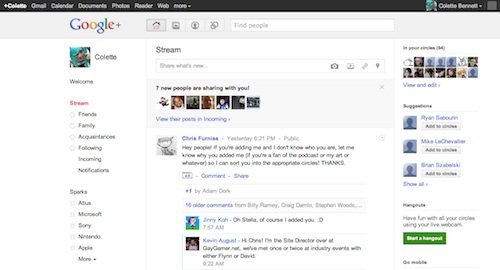
Early last month, we talked a bit about the launch of Google’s “Facebook killer” service, Google+, and the addition of the +1 button to major websites. The service launched a few days ago as invite only to start, and quickly overloaded to capacity. Some people that I sent invites to were unable to use them all day yesterday as Google worked out the kinks to allow the tsunami of people waiting to check out how to social network Google-style.
So what does it have that Facebook doesn’t? Well, let’s start with what it has that Facebook does. You can update your status, update a profile, chat, add interests (called “Sparks”), and add pictures. The new stuff that FB doesn’t have: Circles, which is a pretty way of organizing your friends, family, acquaintances, and even the people you’ve blocked. There’s also Hangouts, where you can video call several people in your friend circles at a time, either in a limited status or open to other friends to join at anytime. Did we mention you can access all this from your phone, too?
What else can we expect as Google+ finds its footing? Well, Google + Games, which is going to compete with the popularity of Facebook games such as FarmVille and Zuma Blitz. Google invested over $100 million in Zynga, the company that owns FarmVille, in 2010. We think it’s safe to say we will be seeing these popular titles on Google+ in the near future, which ought to soothe new users of the service who are missing the fix they get from Facebook gaming.
Google has made smaller efforts in the past to attempt to topple the Facebook kingdom, but this is by far the most comprehensive offering. It seems to be coming at a good time, as more and more people seem to be finding reasons to dislike Facebook as it soars further along in popularity (MySpace syndrome, anyone?). Seamlessly integrating all of your current Google info, such as contacts and profile info, makes it feel like a very natural evolution. The only drawback is that Facebook has such a tremendous userbase already. Then again, I remember many years ago when a friend said to me, “You have to come to MySpace! It’s better than Friendster!” and my reply, “Oh, no way. Nothing could be better than Friendster.”
Need a Google+ tutorial? Check the official videos out here.
Recently I tweeted a statistic from Google that 39% of searchers use their mobile devices while going to the bathroom. While it served the intended purpose of getting people to @ me (I’m incredibly thirsty for Internet attention), I didn’t think about what this statement really meant for SEO. Several days later a friend of mine posted the following on Facebook wall:
As comical as it is my friend’s post forced me to think about the legitimacy of Google’s mobile user stat, how many times have you sat down on the can and immediately reached for the phone in your pocket? There you are in complete solitude with your device. Just checking /b/, posting trivial Facebook statuses, or finding the address for local adult entertainment –- completely engrossed in the Internet.
The isolation of the bathroom becomes the perfect environment for search marketers. While users are going, they are also staying focused on search engines or social media. Internet marketers can use this opportunity to make them brand-aware through mobile ads on Google* or promote their newest special offer on Facebook and Twitter.
While I originally took this Google “fact” as something funny to tweet, it shows how much potential there is with mobile search. Users are more attentive on what is being presented to them when they are in the bathroom. With the right content and call-to-action, you can easily convert these users into leads or at the very least have them remember your name.

 INFOGRAPHIC: Facebook Shopping Will Be B in 2015 — All Facebook







 The isolation of the bathroom becomes the perfect environment for search marketers. While users are going, they are also staying focused on search engines or social media. Internet marketers can use this opportunity to make them brand-aware through mobile ads on