Author: Search Influence Alumni

  • Taking Flight in 140 Characters or Less: Twitter Advertising 101

    Twitter advertising can be a great way to increase your follower base and drive traffic to both your social media pages and your website. It is relatively cost efficient, and it can help you drive the right traffic to your pages. There are three different types of Twitter ads all used for different purposes.

    Promoted Accounts

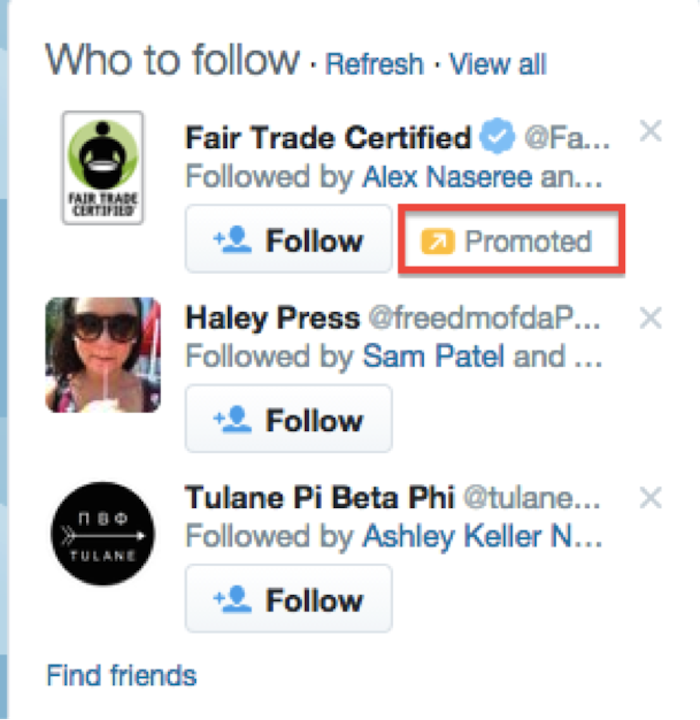
    For those of you who are familiar with Facebook advertising, this type of ad is very similar to Facebook fan-building ads. They are used to grow your follower base and draw more attention to your Twitter account. Promoted accounts typically range between $2-4 per follower. This price is dependent upon targeting: the more specifically targeted the ad is, the more it costs. The cost of these ads is subject to results, because you are charged when a user clicks on the ad and follows your account, but you do have the ability to set a maximum budget.
    Who to Follow Twitter Ads Image - Search Influence

    Promoted Tweets

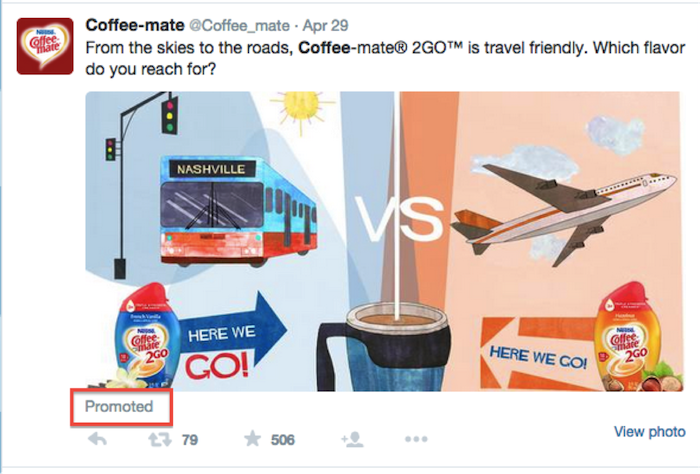
    Promoted tweets can be used to promote a specific product or service, and they can also be used to get more attention and exposure for your quality tweets. These ads help promote user engagement and show your content to people who are not necessarily following you on Twitter. These ads are also on a “pay per” basis, but instead of paying per follow, you pay per interaction. “Interacting” includes clicking, replying, retweeting, or favoriting your tweet. These interactions typically cost between $0.50-$2, depending on your targeting. Just like with the promoted accounts, you can set a budget so that you don’t end up spending more than you can afford (due to the awesome success of the campaign, of course).
    Twitter Advertising Promoted Tweet - Search Influence

    Promoted Trends

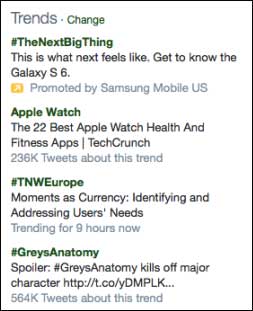
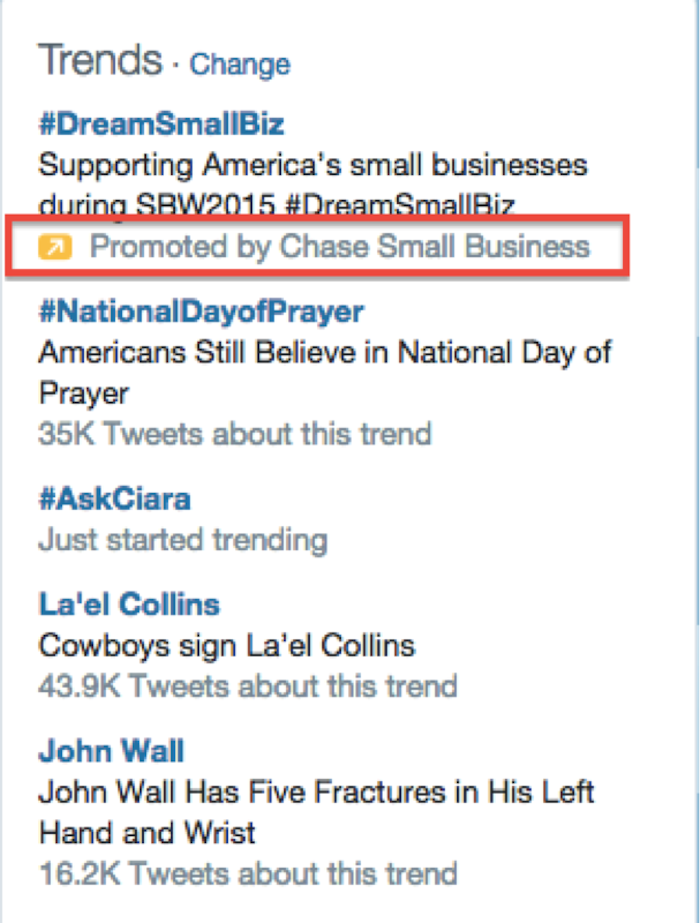
    This type of Twitter advertising is really meant for the iconic brands of the world. These will only work for you if you are looking for significant exposure in a short amount of time. Promoted trends are guaranteed placement in the “trends” section and are shown to everybody. The types of businesses that do this appeal to the masses (McDonald’s, Nike, Chase, etc.). Another reason that this type of ad only appeals to huge companies is the large price tag: it costs $200,000 to run a promoted trend for one day.
    Twitter Advertising Trends Image - Search Influence

    Targeting

    For promoted accounts and tweets, you can get pretty granular with the targeting. Twitter allows you to target based on a multitude of different demographic and behavioral factors. Advertisers can target based on behaviors, gender, region, device (mobile, desktop, or tablet), and more. Social media targeting is a delicate balance because as you get more specific, the price per click or interaction goes up, but it is important to be specific enough that you are targeting people who are likely to convert.

    Twitter ads can be a really great way to drive more followers, engagement, and even traffic to your website. Using this ad platform also allows advertisers full access to Twitter analytics so they can see what types of tweets perform the best, which helps them choose which ones to promote in the future. Happy tweeting!
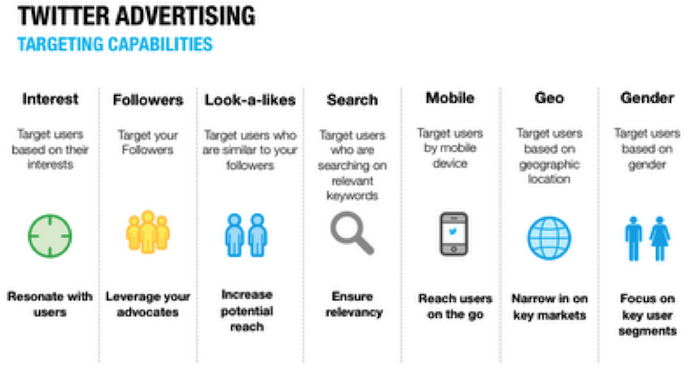
    Twitter Advertising Targeting Image - Search Influence

    Image sources:

    Twitter targeting image


  • More Locations, More Problems? Optimize Your Franchise SEO—Part 2

    Franchise SEO tips image - Search Influence

    In part two of this two-part series about how to successfully optimize your franchise SEO, you will find three more winning strategies and steps for multi-location or franchise SEO.

    It’s All About Location

    The effort to have each location found in its own market is often perceived as the most challenging part of multi-location SEO. In part one of this series, we discussed the importance of building the central brand. Now we will tackle how to deal with individual location information, and the ways your franchisees can help to best optimize your franchise marketing and location SEO.

    1. On-Site Location Pages

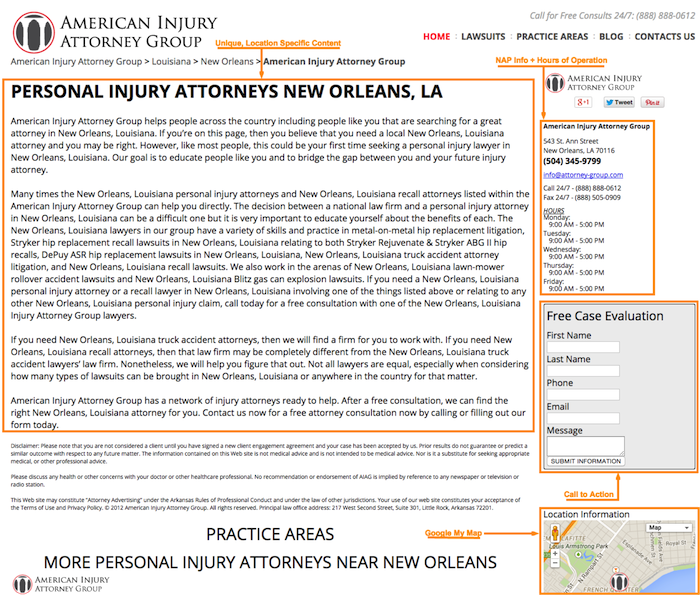
    Now that you have built up your central brand, it is time to focus on your individual franchises. Each franchise location should have its own location landing page on your company’s website. Taking extra care to create separate location pages allows search engines to better understand that you have individual locations in specific geographic areas. It also gives you an opportunity to tell users about the unique products and services offered at each different location.

    Here is a list of the necessary elements for an effective location page for Internet franchise opportunities:

    • My Map to Google+ page
    • Unique content for the specific location
    • Directions to the location from different landmarks, highways, surrounding cities, etc.
    • Photos of the location
    • Reviews of the location (probably best to have a separate page for these)
    • List of products and/or services (should link back to the main products/services pages)
    • Schema MarkUp to the name, address, and phone number
    • Link to the individual location’s social profiles
    • Link to staff member profile pages
    • Strong call to action

    Franchise SEO Tips 1 Image Search Influence

    As with all web pages, it is a best practice to implement unique, compelling content on your location landing pages. Users expect a rich experience when navigating your site, and bland content may turn them away. At the same time, content that is too dense with information or full of keywords may deter users from your web page. To keep site visitors interested, give them valuable information using bullet points in case they are in a hurry. Some multi-location businesses leave a portion of these elements to be completed by the individual franchise owners and managers. In an ideal world, this would be an effective solution, but knowing that these kinds of franchise marketing requests are often put on the backburner, it is best to have a solitary stakeholder in the corporate office responsible for these tasks.

    2. Citation Building

    Citation building is perhaps the most daunting exercise when approaching multi-location SEO. As it is with SEO for single-location businesses, consistency of name, address, and phone number in your online business listings is key. You will often see name formats including the location, such as “Company Name – Lakeview Location.” However, this is not a best practice for SEO purposes. Instead, remove the location information, and keep the business name exactly the same for all of the locations. The different addresses and phone numbers for each location will be enough to differentiate them for both Google and your potential customers.

    Each location should have a unique business description written for its online listings. This task may be best completed by individual franchisees, as it might be difficult for any one individual to write multiple, unique descriptions for essentially the same business.

    On the other hand, you should choose the same categories and logo for every location. Adding unique pictures of each location and its staff would be a nice touch, as well, but it may not be worth the trouble if you have upwards of 10 to 15 locations. Some directories will offer more fields than others. It is in your best interest to provide as much information as possible.

    Rather than taking on the incredibly time-consuming task of doing this for each individual business directory for every single location, consider using Moz Local. This tool makes pushing out each location’s name, address, phone number, categories, business descriptions, etc., to major directories as easy as a simple click of your mouse.

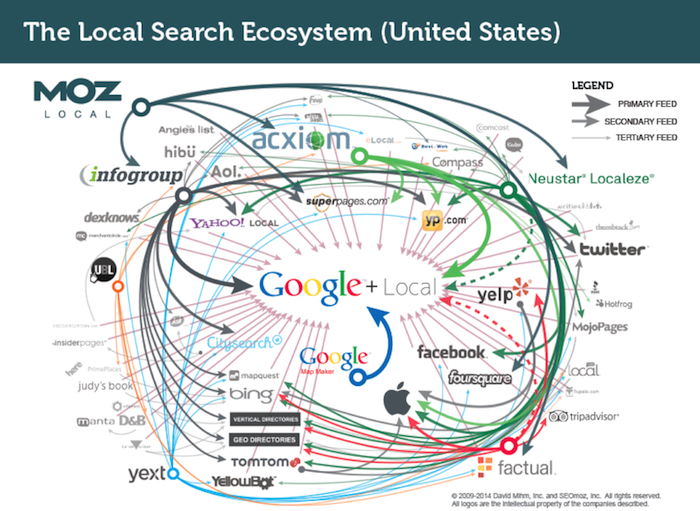
    As you can see below, the major online data feeds and directories share their information with each other, which should allow Moz to take care of most of your citation building and cleanup. Just 90 days after you submit the listings to Moz, go back and see where you stand. Some manual cleanup may be required.

    Local Search Ecosystem Image

    Expanding your search for niche directory opportunities for your company’s industry and each franchisee’s market is also highly recommended. By getting listed in these hyper-specific and hyper-local directories, you are giving search engines that much more information about what you offer and where your business should be found.

    3. Enlist the Help of Your Franchisees

    Enlisting the help of your franchisees may be a time-consuming task for some, which is why everything preceding this recommendation can be taken care of by one single source.

    Allowing each of your locations to manage its own social presence can be both empowering and helpful for your visibility in search engine results. To help manage the challenges that may arise, you should create a clear social media policy outlining what is and what is not acceptable. Make your branding and the content of the posts a top priority when creating this social media manifesto. You will also want to make this a working document just in case someone finds a loophole that needs closing.

    Each location should also be responsible for collecting positive reviews and testimonials from their customers. I would highly recommend incentivizing this effort and coaching your managers on the proper way to approach their customers. Written testimonials on the website serve as phenomenal selling tools. Reviews on Yelp, Google+, and other third-party review sites are even better.

    Getting everyone on the same page with webinars can also be advantageous to the cause. Some topics that you will definitely want to cover include social media branding, social media posting, social media interaction, and how to ask customers for reviews. Break each of these up into bite-sized chunks, and keep your focus on the industry’s top three social media platforms. Side note: record all of your webinars, and make them available to your franchisees at their leisure.

    Get Started!

    As you can see, there is plenty of work to be done in order to achieve success with multi-location SEO. As your franchise grows and brings on new franchisees, use the above recommendations as a checklist for each new location. You can get most of this done within a week’s time for each new franchise location. Doing so will save you a lot of trouble down the road. It may be in your best interest to contact Search Influence for your online marketing needs, especially including the complicated maze of managing multi-location SEO and franchise marketing.

    Image source:

    Local Search Ecosystem image

  • A Family Affair: Teaching Mom a Thing or Two About SEO

    Here at Search Influence, I have had the opportunity to work with a diverse group of clients—business owners from all kinds of different industries. But the best thing about coming to work every day? I have the privilege of working with a very special client: my mom.

    Bridget Mothers Day Image - Search Influence

    “So What Is It Exactly That You Do?”

    As the owner of two audiology practices, my mom has always been fascinated with the online marketing work that we do here at Search Influence. She understood well the need to strengthen her website and her practices’ online visibility in order to attract new patients and keep her business thriving. I encouraged her when she was ready to design a new, up-to-date, and well optimized website (something she desperately needed).

    Let’s Make This Official

    Although I was able to provide guidance and support, my individual capabilities were limited. Fortunately, though, I have the privilege of working with an extremely talented group of people with a wide array of skill sets. The next step was clear: it was time to get the Search Influence team involved and make my job as her “marketing consultant” official.

    Bridget Mothers Day 2015 Image Search Influence 2

    Giving Back

    I feel a great sense of satisfaction knowing that I am able to give back to such a hardworking, supportive, and inspiring individual. Through her SEO and online advertising campaigns, I have helped her attract more patients, strengthen brand awareness, and remain relevant in the highly competitive online marketplace.

    Working with her has been overwhelmingly positive. She is inquisitive, trusting, and always willing to help when needed. The only strange part has been adjusting to addressing her in this new professional capacity…for example, beginning a formal business email with “Hi Mom.”

  • This National Small Business Week, Step up Your Online Marketing

    It’s National Small Business Week—time to celebrate the successes and the insane amount of work small business owners put in. The struggle is real.

    You know you’re a small business owner when…

    …Your nightmares are about getting bad Yelp reviews.

    …Your social media “strategy” consists of bribing your college-aged daughter to handle your Facebook and Twitter accounts.

    …Your holiday hours did not quite make it to the Internet, and customers actually showed up only to find your business closed.

    To cure these and other headaches, start with a little TLC for your website and your online marketing strategy—after all, both of these play a huge role in bringing you customers, but they may unfortunately also be keeping you up at night. Follow these top three online marketing tips for small businesses.

    If You Can’t Beat ‘Em, Join ‘Em

    It may sound upsetting that Yelp listings are front and center in a Google search for your business while your own website is far down the list of search results. But savvy small business owners know that Yelp and other large online directories can win over customers with minimal effort. So if you can’t beat the Yelps of the world, join ‘em!

    This strategy is also known as Barnacle SEO. Basically, your business needs to attach itself to large, fixed objects and then wait for customers to float by in the powerful current. Identify the large, high-ranking online directories that matter to you most, such as Yelp, and add your information there in the hopes of “borrowing” some of the page one rankings. There are many trusted online directories like Yelp out there you can barnacle up to: Angie’s List, Foursquare, Google+, Avvo (for lawyers), Healthgrades (for doctors), and even TripAdvisor.

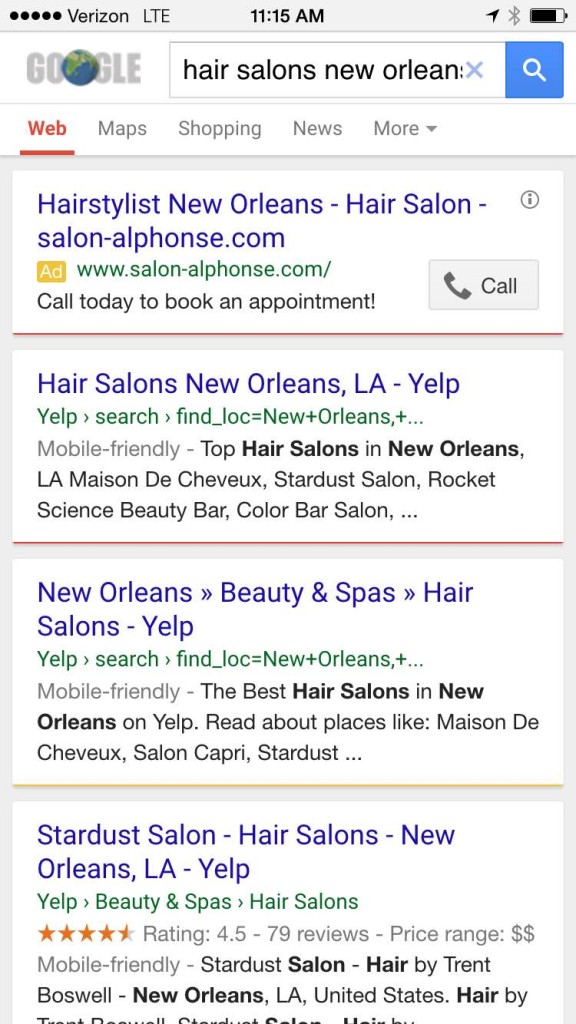
    And this tip comes with a bonus: this strategy also works well for customers searching on smartphones because these websites are optimized for the mobile experience—providing the targeted information that local customers searching on their smartphones really need. When you perform a Google search for “hair stylists New Orleans,” for example, the top results are mostly from Yelp:

    Yelp Mobile Screenshot Image - Search Influence

    Target Your Social Media Efforts

    Another thing that keeps you as a small business owner up at night? Social media—or more specifically, finding the time for it. For starters, why is social media worth your time? The latest statistics from the Pew Research Center paint a pretty compelling picture that customers are on social media: 74 percent of online adults use social networking sites.

    As a time-starved small business owner, you must get the most for your social media time. This requires targeting your social media efforts. Start by channeling your ideal customer. What is your typical customer’s age, marital status, and family status? Where is your customer physically located? Do your customers fall into a certain income bracket?

    Once you know who your target customer is, find the social media channel that appeals to them. For example, Facebook still skews significantly female and is the top-used social network for U.S. teens, making it ideal for fast-moving consumer goods, according to Business Insider. Instagram is also popular among females ages 18 to 44, so clothing, accessories, and those types of brands tend to perform well on this network. While LinkedIn is most popular for adults, Twitter is primarily a news source and attracts mostly male users. YouTube reaches more adults ages 18-34 than any single TV network. Pinterest is the place for food and drink-related information as well as parenting tips.

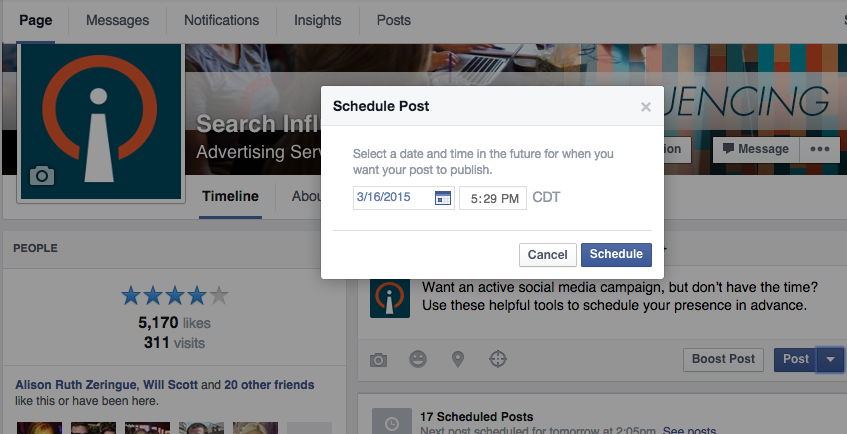
    But remember, whichever social networks you decide to focus on, automate your posts with these quick tips.

    Facebook Scheduled Post Image - Search Influence

    Avoid Customers Crying in Your Parking Lot

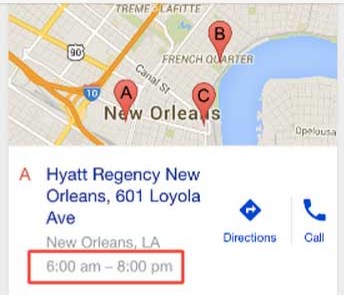
    If you’ve ever done a Google search for your business, you’ve likely seen this kind of result:

    MapsTimeViewImage

    But what happens when you have special holiday hours? Will customers see your normal hours in a Google search and show up in your parking lot over the holidays? Currently, Google My Business has not built out the functionality for saving holiday-specific hours ahead of time. As the profile setup currently stands, you’ll need to manually edit the hours of operation on a given day when your business is open (or closed) outside your standard hours of operation. See Google’s steps on how to update your business’ hours.

    Also, remember to let folks know when you are, in fact, open on the holidays. For instance, let everyone know your restaurant is open on Independence Day and post your holiday-specific menu for the day or highlight any patriotic specials. Is your medical practice open for limited hours on Memorial Day this year? Post a piece to your blog or social media profiles highlighting the top summertime health hazards from boating accidents to severe sunburns.

  • More Locations, More Problems? Optimize Your Franchise SEO—Part 1

    Franchise SEO tips image - Search Influence

    Do you ever feel like your efforts to market your business with more than one location are ineffective? Do you live with the constant doubt about whether or not you did as much for one location as you did for another, or if your franchisees are doing something counterproductive that will painfully squander your efforts? You may also be wondering how to get users from all of your markets to find their corresponding local franchise business. How much is too much when it comes to overstuffed keywords for franchise SEO and duplicate web pages with franchise marketing?

    You don’t need to be an industry professional to know that comprehensive search engine optimization (SEO) requires a balance of more than a dozen simultaneously active elements. From consistently monitoring your targeted keywords to constantly generating new, compelling website content, maintaining high search engine rankings proves to be a multidimensional effort. It seems like all it takes is one surprise update or manual action from Google, and your entire SEO strategy can collapse like a house of cards. For multi-location businesses and franchises, this balancing act becomes even more complex, which is why Search Influence is here to help you not only maintain, but maximize the results of your Internet marketing and digital franchise efforts.

    In this two-part series, you will receive a five-step guide that should answer all of your questions about multi-location or franchise SEO. This first piece will focus on building the corporate brand—a frequently forgotten necessity in effective franchise marketing for any business, regardless of the number of locations.

    Build Your Brand

    This may seem logical, but many times, webmasters and marketers get so caught up in the challenges that come with the individual locations that they forget they have a brand to promote. These recommendations have nothing to do with location-based information; however, they are just as significant to your franchise SEO and Internet marketing success.

    1. Focus on the Main Pages

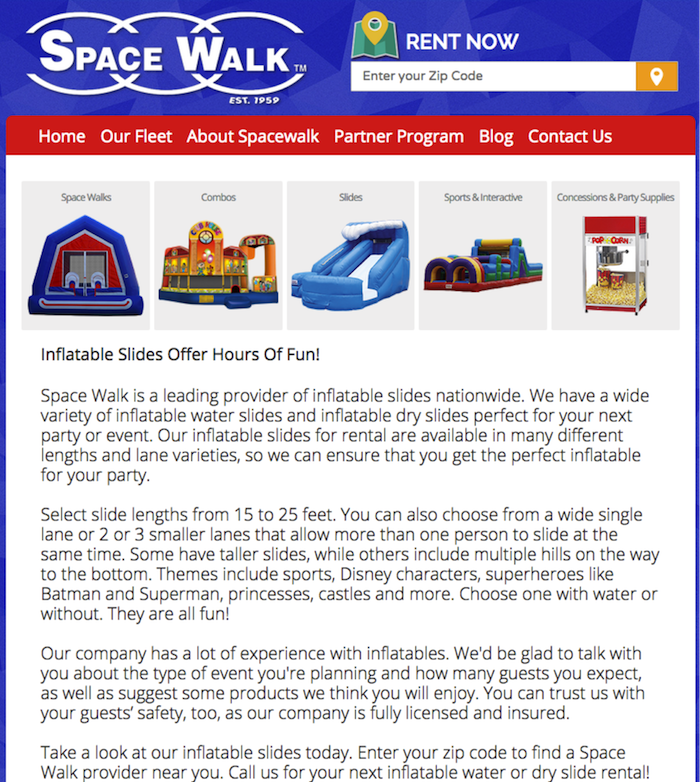
    When I refer to the main pages, I am referring to the homepage, the “about us” page, your blog, and your products and services pages—in other words, any page that contains content that is applicable to the brand and its offerings.

    These pages need to contain the best content on your site, as they will likely be the most visited. Depending on how many locations you have, you may want to include each location in the title tags of these pages, but I would avoid this practice if you have more than three, as title tags should not appear forced or spammy.

    Space Walk Franchise SEO Image Search Influence

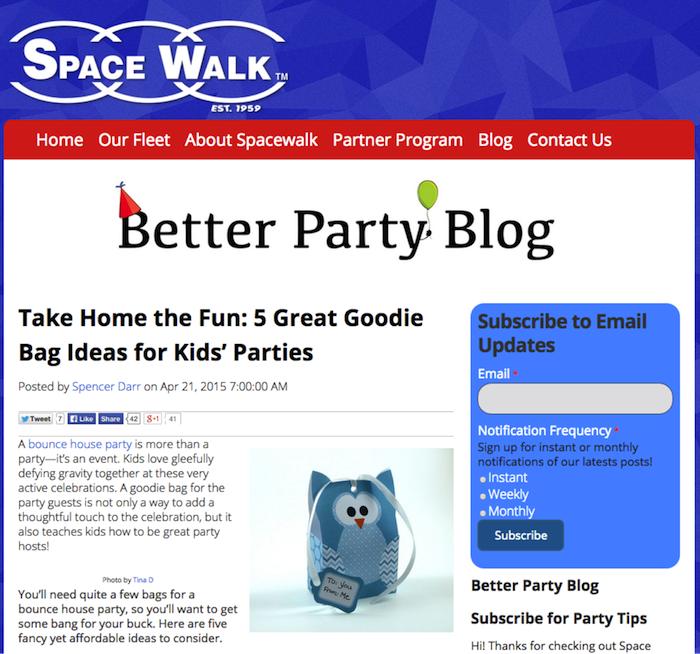
    The blog, on the other hand, can be more versatile with regards to the content that you create. Your blog should be focused mainly on industry-specific topics, but it should also have a touch of personality. Things like showcasing your community involvement or a franchisee’s achievement are both great blog topics. Search engines love active blogs, because they show that you are keeping your site up to date by offering the latest and greatest industry knowledge in a timely fashion.

    Better Party Blog Space Walk Fanchise Image - Search Influence

    Having a mobile-friendly site is important to your franchise’s digital marketing efforts, especially with our heavy reliance on smartphones today. As Google rolled out one of its most significant algorithm updates in April 2015, your site could have been practically wiped off the map if it was not mobile-friendly, and the same is just as true today.

    2. Off-Site Authority for Your Brand

    Since Google’s more recent Penguin updates, the link building game has changed. Instead of worrying about getting links to your website and becoming keyword obsessed, we need to be thinking about building authority and a stronger overall presence for the brand.

    The simplest way to do this is by creating social profiles for your brand. This is not to say that franchisees cannot or will not create their own individual pages, but you should own the brand and its voice by claiming and being active on the major social channels.

    What are the major social channels, you ask? Google+, Facebook, and YouTube are all surefire winners here. But why Google+ and YouTube? One, they are both owned by Google, and you always want to make friends with the decision maker. Two, YouTube is the second biggest search engine in the world. By regularly posting content to these profiles, search engines will get a better sense of what you offer and, in turn, what you should be found for. Note: you will have to rely on your franchisees to help you verify their individual Google+ listings.

    Listing your company in categorical directories can also help the cause of brand building. If there is a relevant directory for the product or service you offer, your business should be listed, along with all of the details of your offering. In this scenario, becoming a part of industry associations can have as much of a benefit online as off.

    There is nothing that can beat real, newsworthy press. Whether it be a press release, a magazine article, or a blog post, when your brand is mentioned online, Google is going to recognize it and correlate the content around it to your website. A link back to the site in these cases can prove helpful as well.

    Now that you have a better sense for basic brand building, stay tuned for part two of this blog series, which will explain how to manage the optimization of all of your individual locations. At Search Influence, we are best equipped to help you succeed with your franchise marketing plan and franchise SEO efforts. Contact us today with any inquiries regarding how we can guarantee a successful online marketing strategy for your company.

  • Five for Friday: Twitter Trends, #Mobilegeddon, the State of Moz, and More!

    1. Twitter Is Rolling Out Trends with Descriptions on the Web – Marketing Land

    TwitterTrendsListImageIn an effort to improve engagement with its more casual users, Twitter has made multiple changes to its platform. The most recent has just rolled out on mobile and web, offering descriptions and metrics on trending topics. Now, you can see what a trending topic means and how many other users have shared it.

    2. Moz’s 2014 Annual Report – Moz

    SEO authority Moz has just released their annual report for 2014, showing “many ups and downs.” Despite a few challenges this year, CEO Sarah Bird still proudly showcases the decrease in cost-of-revenue, increase in workplace diversity, and interesting work perks like charity donation totals and paid vacation. In this bid for transparency, we see another interesting example of tech company work culture.

    3. Mobilegeddon Is Here: Google’s Mobile-Friendly Algorithm Is Live! – Search Engine Journal

    Wondering what all the hubbub is about with Google’s new update? Normally, Google doesn’t give much warning ahead of its changes, but this one has been on the SEO world’s radar since last October. Google’s major mobile-friendly push will affect more sites than either Penguin or Panda. But don’t worry: if your site is already mobile-friendly, your ranking won’t be affected. If not, Google’s Webmaster Tools feature will tell you how to fix it.

    4. How Mobilegeddon Impacts Paid Search – PPC Hero

    Speaking of #Mobilegeddon, it’s very likely Google’s Ad Rank formula will be affected by the new mobile criteria. With the changes leading up to the algorithm rollout, we saw both organic search results and AdWords ads labelled with the “mobile-friendly” tag. So it’s not a stretch that AdWords ads will also be affected by how mobile-friendly a website is, both as a factor in the ranking formula and as it affects ad extensions and formatting.

    5. Game of Angels Maps Tech Influence Networks – Tech Crunch

    influencermapimage

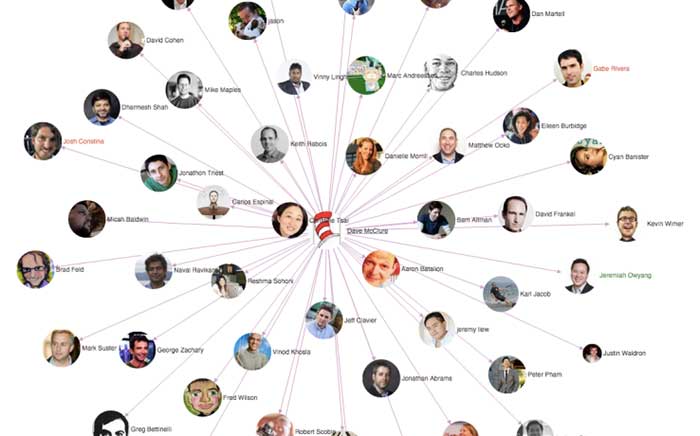
    Developer Pierre-Jean Camillieri is trying to answer the question “who influences the influencers” with his new tool, Game of Angels. Though the program is in its early stages, it could help entrepreneurs connect with industry leaders who have the most online clout.

    The tool gives a visual map of influencers and their major connections based on the number of interactions they have. However, it’s currently limited to those Camillieri himself deems major influencers and industry leaders.

    Image Sources:

    Twitter Trends

    Influence Map

  • Optimize Your Commute: Influencers Caught Ridin’ Sweaty

    Search Influence Bike to Work Image

    At Search Influence, biking to work is not a passing fad (and that’s not just because this is how our CEO Will Scott gets to work). Search Influence riders braved rainy weather conditions last week to ride in support of the 2015 NOLA Bike to Work Week, finishing among the top businesses citywide along the way.

    Bike Easy’s 2015 Nola Bike to Work Week included a total of 35 New Orleans businesses participating, with more than 1,015 trips logged over the course of the eight-day challenge, according to Bike Easy.

    Search Influence Bike to Work Image

    Out of the 35 participating workplaces, Search Influence placed in the top five for two of the three pillars of the challenge. Though the team was small, we came in third place for the total number of trips our riders logged as well as fourth for the most new riders (first-time participants in NOLA Bike to Work Week).

    For many members of the SI family, biking extends far beyond just one week a year—it is the way they commute to work daily. Some ride from Mid City, Central City, and Treme, while others come from as far as the Ninth Ward to get to the CBD. Influencer Mattie Kenny said her favorite part about biking to work is “connecting with my environment while I have ‘me time.’”

    NOLA Bike to Work Week is one of many events throughout the year put on by Bike Easy, whose mission is to “make bicycle riding in New Orleans easy, safe, and fun.” To find out more about what Bike Easy is and how to get involved, you can check out its website here.

    Search Influence Bike to Work Image


  • New Influencers Put a Spring in our Step

    Recently, we were lucky enough to welcome a few new faces to the team here at Search Influence. Say hello to our three newest Influencers!

    Kiersten Kampschroeder Image Search Influence CareersKiersten KampschroederJunior Internet Marketing Associate

    Kiersten has been enjoying the laid-back New Orleans lifestyle for almost two years, having previously worked in IT and social media from home. Originally from Northern Virginia, she went to school in New York for anthropology and has since put her degree to great use observing cafe culture around the city. She’s a serial dabbler and uses her free time to try every hobby known to man (the current obsession is gardening/landscaping).

    Mallory Richardson Image Search Influence CareersMallory RichardsonAccount Associate

    Originally from Mandeville, La., Mallory graduated from Louisiana State University in May 2014, earning a bachelor’s degree in mass communication with a concentration in public relations. She served as the Publications Editor in Chief on the 2013-2014 Public Relations Student Society of America (PRSSA) National Committee during her senior year, leading more than 11,500 pre-professional public relations students nationwide. After graduating, she moved to her birthplace of Chicago to begin her career in social media marketing, serving as an account manager at Blueye. While Mallory loved her time in the Windy City, she knew that Louisiana was too special of a place to leave for long (plus she really hated the Chicago winter). In her free time, she enjoys reading, playing soccer and planning trips to faraway places.

    Brennan Schexnaydre Image Search Influence CareersBrennan SchexnaydreJunior Account Assistant

    Brennan is a sophomore at the University of New Orleans working toward a bachelor’s in marketing and a minor in hotel, restaurant, tourism. She is a member of Sigma Kappa Epsilon Beta sorority and worked at Pier One Imports for three years before coming to Search Influence. She is originally from Destrehan, but moved to the Westbank in fifth grade. She cries over television shows and sometimes can’t finish watching a show if there is too much conflict (reality shows on Bravo that overwhelm her). She loves watching random documentaries on Netflix.

    We’re always excited to welcome new energy and talent to our growing team. Will you be next to jump on board? Visit our careers page and apply! We look forward to hearing from you.

  • Making Patients & Customers into Fans: Are Facebook Fan-Building Campaigns Effective?

    Medical Facebook Likes Image Preview - Search Influence

    Looking to connect with your ideal patients and customers online? Facebook fan-building campaigns are just what the doctor ordered for creating the perfect online experience for your audience as well as building your community of followers.

    But before we delve into the specifics of Facebook fan-building campaigns and how this online marketing strategy can win you customers and patients alike, let’s briefly go over what fan building is. Fan building is a way for businesses to acquire likes on Facebook and to connect with all the people that matter to them. While a business can acquire fans organically, paid ads are more effective and efficient at increasing a business’s fan base and amplifying the rate of fan growth.

    Part 1: Are Page Like Ads Effective at Fan Building?

    Short answer: Yes. Facebook page like ads are effective.

    Case Study 1: 

    Let’s look at Client A. Client A is a well-established business specializing in reconstructive surgery. Search Influence started a fan-building campaign for Client A toward the end of 2011 and have been actively managing it ever since.

    In order to maximize the client’s budget, we focused ad copy around the authoritative nature of our client in the field of reconstructive surgery and targeted these ads to users we identified as most likely to convert (in the form of a page like) based on their interests and online behaviors.

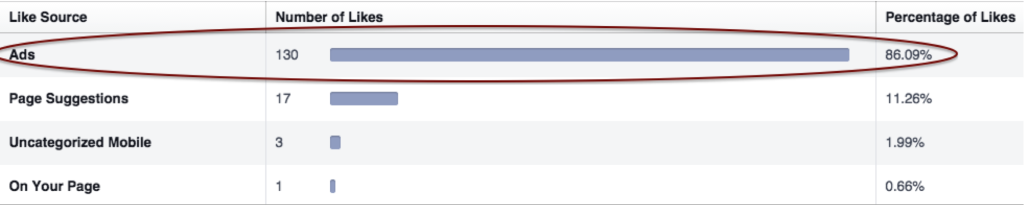
    Prior to the Facebook fan-building campaign, Client A had around 550 page likes from various organic sources. Not a shabby number to begin with, but we were able to get that number up to 21,000 within a year. Within two years, Client A had more than 30,000 fans … within three years, more than 65,000 fans. And likes acquired from our fan-building advertising campaign made up of a majority of the fan growth:

    Page Likes By Source (Daily):

    Facebook Fan Buikding Likes Image Search Influence

    The above segments the daily page likes gained by source. As you can see, likes as a result of fan-building ads made up more than 85 percent of the likes gained.

    Case Study 2:

    Client B is a multi-location addiction treatment and recovery facility. We started running a fan-building campaign for Client B toward the end of 2012. The campaign lasted two years and increased Client B’s fan base by more than 6,000. For Client B, we focused on grabbing the attention of users by including encouraging and supportive language within our ad copy, and we targeted users that we identified as most likely to be interested in the services offered by the client or to know someone that could benefit from the services offered.

    One of the main roadblocks was getting users to like a page that focused on such a sensitive subject. After all, why would anyone want to publicly like a page about addiction treatment and recovery? Well, if you fill your page with interesting content that is relevant to your business and engaging to your audience, users are more likely to follow and interact with your page. So with Client B, we first got users’ attention with our page like ads, and we kept their attention with the content on the page!

    Once we stopped running Client B’s fan-building campaign, we noticed that while the fans gained from the campaign were still there … the rate at which new fans were coming in has stalled. Take that as you will, but we came to the conclusion that fan-building campaigns are, in fact, effective. Moreover, fan-building campaigns are sustainable (more on that next).

    Part 2: Is Fan Building Sustainable? YES!

    Fan-building campaigns are a sustainable way to increase your fan base. If you create an effective campaign with the right message and proper targeting, page likes gained from fan-building campaigns don’t just disappear once the campaign ends. Users like pages because they’re interested in the product, the business, or the brand, and they want to know what’s going on and to get updates.

    That being said, just having an active fan-building campaign isn’t the be-all and end-all to building and maintaining fans. As demonstrated in Case Study 2, an effective fan-building campaign only starts with knowing who your target audience is, how to reach them, and what message will speak best to your target audience. From there, the campaign flows into what is actually on your page.

    You can get page likes by having the most interesting and enticing messaging in your ads and by targeting the exact audience that should be interested … but if your page is boring and dry, you’re not going to be able to sustain the page likes you gain and maximize your fan-building campaign’s potential.

    Lagniappe: Likes For Lives

    A relatively recent tactic used for fan-building campaigns is called “Likes For Lives.” The concept behind Likes For Lives is that for every like a business receives on its page, it will take some sort of action to save a life. The action is usually a donation of some sort.

    Below is an ad from our most recent Likes For Lives campaign we ran for a client of ours during October 2014. October happens to be breast cancer awareness month, so we decided to incentivize Facebook users to click like by pledging to give a $1 donation for every like. This particular Likes For Lives campaign gained our client 748 likes from October 10 to October 30, 2014. The average cost per like was 48 cents.

    The Likes For Lives campaign generated more clicks in the 20 days that it ran compared to this client’s monthly average of 150 likes from its regular fan-building campaign. Therefore, a Likes For Lives campaign for this specific client was very successful.

    Likes For Lives Faebook Fan Building Image Search Influence

    One of the best ways to stand out and speak to users, no matter what type of advertising campaign you’re running, is to have a unique and attention-grabbing ad copy. And Likes For Lives campaigns provide just that. If you know who you’re trying to reach and how to create the targeting needed on Facebook to reach them, why not utilize the Likes For Lives incentive to build your fans and help a cause? Likes For Lives campaigns are a great way for all businesses, especially those with a health care focus, to gain positive brand awareness and to strengthen the fan base.

  • YourCompany.Sucks – Dealing with the Future of Domains

    When I first read that .sucks domains would be launching in 2015, I chatted with a friend of mine about it. This friend is not in the search engine optimization industry, but he does have a website for his established local business. The whole .sucks conversation boiled down to this: it is a big money grab, he told me. How is he supposed to build his local brand and defend it online when really, he has to focus his marketing budget on offense, not defense?

    I can imagine a lot of small businesses having similar reactions, and I assured Angry Friend that this is not a priority for him as a small, locally owned business. If he buys the .sucks of his domain, then he has to invest in domain-squatting for all negative versions of his domain, and he has better things to do with his limited marketing dollars.

    Who are “They?”

    After repeating a few different variations of “they are just creating a money grab,” Angry Friend asked “and who the hell are ‘they?!’

    The mysterious “they” are the Internet Corporation for Assigned Names and Numbers, or ICANN. It is responsible for the domain name system, among other things. This means ICANN establishes policies for the domain system and for introducing new top-level domains (TLDs) like .com, .net, .info, .org, .sucks, etc.

    Management of most top-level domains is assigned to specific organizations by ICANN. In the .sucks controversy, Vox Populi Registry Ltd. is the manager and registry of the .sucks domains. It set .sucks domains at prices that are being denounced as exorbitant and predatory. It is a subsidiary of Momentous based in Canada.

    .Sucks Domains are Rolling out Now

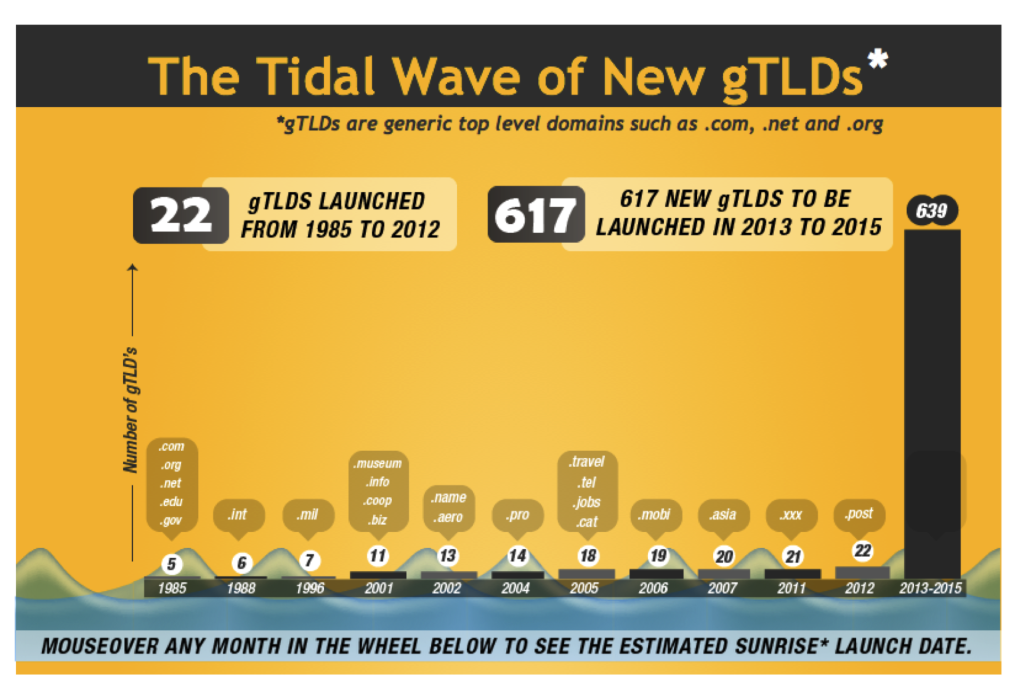
    New Domain Tidal Wave Image - Search Influence

     ICANN will have introduced 600+ new TLDs slowly, a few each month, starting in 2013 and going through 2015. This is a pretty cool interactive infographic that allows you to see which TLDs have rolled out/will roll out each month.

    Some of the more controversial TLDs are .porn and .adult and .xxx. And .fail and .wtf. You can imagine the scramble by brands and celebrities to grab their names with these extensions as a defensive measure against slam sites.

    Per Vox Populi Registry (nic.sucks), these domains are already registered:

    • burberry.sucks
    • tommybahama.sucks
    • eharmony.sucks
    • urbanoutfitters.sucks
    • beats.sucks
    • hersheys.sucks
    • tupperware.sucks
    • hyatt.sucks
    • mac.sucks
    • internetexplorer.sucks

    According to CBS, these .sucks domains have also been claimed:

    • Youtube.sucks
    • Bing.sucks
    • Visa.sucks
    • Yahoo.sucks

    Obviously, these corporations and brands have deep pockets and a significant advantage in controlling these domains themselves.

    Getting Your .Sucks Domain Is Expensive

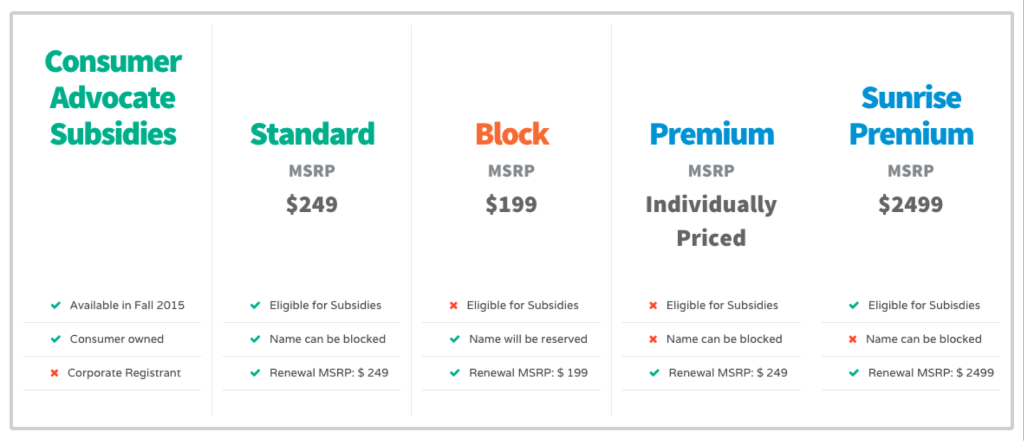
    A “Sunrise Claim” is an early registration of any new TLD by holders of registered trademarks. Sunrise Claims are usually a few hundred dollars; however, the money grab is afoot with .sucks. Some would say the shakedown has started. The .sucks TLD starts at $2,499—that’s right, starts at.

    If a trademark brand opts to not claim anything in the Sunrise period, it may still have to pay the $2,499 or more. Vox Populi has created a “premium” list for trademark brands, and those will have to pay the premium even during the general availability period. For “premium” brands, Vox Populi has ensured the .sucks price will be $2,499 or more no matter when the registration is made, and domain renewals will cost the same as the Sunrise prices.

    Consumer Advocate Subsidies Image - Search Influence

    The .sucks Sunrise period is March 30, 2015 – May 29, 2015. General availability (or the land rush), which is on a first-come, first-served basis, starts June 1, 2015.

    Then, when the land rush starts, an average business .sucks domain will cost $249/year. You can get a blocked domain for $199/year, which means it won’t resolve, you can squat on the domain, and no one else can register it either. EasyDNS says, “It is quite the controversy and our advice to anybody on the verge of getting caught up in all this is quite simply not to play. ”

    Really, anybody who wants to complain about a brand or a business has plenty of opportunity to do so already with the variety of legitimate ratings and reviews sites, complaint sites such as ripoffreport.com, the ability to create sucks domains such as yelp-sucks.com, and the availability of .fail and .wtf. If you really felt passionate about defending your brand, you would need deep pockets to defend on the domain front. Those dollars would be a much better investment if used for quality online presence strategies.

    Fighting Back

    ICANN approved .sucks when it announced the plan to introduce the 600+ TLDs from 2013 through 2015. Big brands such as Verizon and eBay make up an advisory panel that has recently complained about the .sucks availability. Trademark lawyers for Intellectual Property Constituency sent ICANN a forceful letter describing the .sucks scenario as “predatory” and requested a halt to the rollout.

    The IPC letter calls into question Vox Populi’s plans to (this is quoting from the letter):

    (1) categorize TMCH-registered marks as “premium names,”

    (2) charge exorbitant sums to brand owners who seek to secure a registration in .sucks, and

    (3) conspire with an (alleged) third party to “subsidize” a complaint site should brand owners fail to cooperate in Vox Populi’s shakedown scheme.

    Under pressure, ICANN has now asked the U.S. Federal Trade Commission and Canada’s Office of Consumer Affairs to comment on the legality of the high-priced process used by Vox Populi. If the Vox Populi pricing strategy is found to be illegal, ICANN will be able to declare them in breach of contract, request changes to its policies, and breathe a sigh of relief with the public eye turned to Vox Populi as the bad guy.