Author: Search Influence Alumni

  • 3 Tips to Help Law Firms Generate More Leads on Social Media

    In 2015, 35% of all lawyers obtained clients from their social networks, according to an ABA survey. Tech-savvy attorneys and digital marketing experts alike know that social media sites like LinkedIn, Google+, and Facebook are great business development tools. Engagement is an imperative. In fact, it is the new word-of-mouth for client referrals. Here are three tips to help any firm develop a strong social media strategy.

    1. Start Slow and Develop a Message

    To start, a firm or individual attorney should pick out one or two social media platforms and focus on posting quality, engaging posts. There are only 24 hours in a day, and legal professionals already have a lot on their plate. By focusing efforts on posting good content on a few outlets, a firm can develop its own individual image and message. Once a lawyer becomes comfortable on one or two platforms, they can open various social media accounts and integrate their message across all of them. In 2015, 96% of lawyers and 90% of law firms maintained a presence on LinkedIn, while 33% of lawyers and 52% of law firms maintained a presence on Facebook. As the most popular social media sites in the legal field, these are the best places to start networking. Legal professionals also use Twitter, Google+, blogs, and several other niche social media platforms.

    Lawyer Social Media Engagement Post Image

    2. Set a Policy: Reactionary Content

    Who is the target audience, and what will solicit a response from them? Because of the conservative nature of law, many attorneys may shy away from controversial topics. However, as long as the information is within the constraints of what an attorney is allowed to say in public, it can be posted on the Internet. The whole point of social media is to provoke a reaction. Effective legal social media means not only engaging with potential clients on industry-specific topics, but also provoking a share, like, +1, or comment. One tactic involves posting about real world events, changes to state or federal law, landmark rulings, or events the firm is hosting. These posts showcase the attorney as an expert who is aware of the most recent changes shaping the dynamic field. Up-to-date content appeals to potential clients who may respond with their own opinions, creating a conversation and potential leads.

    Lawyer Social Media News Post Image

    3. Build Relationships

    To maximize the reach of a firm’s social media message, make sure every attorney is involved. If one partner writes a blog or is featured in a local news story, make sure everyone in the office does what they can to promote the story. Through re-posts and shares, good news stories can reach a much larger audience. Each and every digital connection is a lead. To build professional relationships, use social media platforms at conferences, local business events, or any other professional event the firm is involved in. By connecting with other attendees or organizers, a lawyer can expand their social media outreach even further.

    As long as a firm approaches social media as part of a modern marketing campaign, it is easy to develop a successful strategy. Social media is not just for the young: the largest-growing demographic for Facebook is ages 30-50. A creative law firm can connect with social media users of all ages to generate leads and gain new clients.

  • 5 Reasons You Want to Work at Search Influence

    Perhaps the single most valuable component to an enjoyable work environment is the people with whom you will work every day. Upon entering the Search Influence office space to interview for a position on the content team, I was consumed by the company culture on display. From the art on the walls to the big, bright orange couch, I knew this was a space I would enjoy coming to every day, and I knew I had to get this job.

    1. Co-Workers: I’ve Got Friends in All the Right Places

    People often ask me what I love the most about working at Search Influence. I never hesitate to say that the people I call my co-workers make even the toughest workdays delightful, and that is definitely something to give a sweet, humble brag about! If you don’t like who you work with, it doesn’t matter what you’re doing—it’s not going to be pleasant, right? The regularly scheduled team-building events and ever-evolving, even encouraged camaraderie of Search Influence definitely speaks for itself, and you just know it the moment you walk into the office.

    BS 1-21 3

    2. A Decade of Honorable Company Culture

    Along with a large staff of genuinely great folks, Search Influence boasts a decade of applause-worthy company culture. As the largest online marketing company on the Gulf Coast, Search Influence was commended for being a breastfeeding-friendly workplace champion, as well as having been selected for the 2015 Inner City 100 by Fortune and the Initiative for a Competitive Inner City.

    3. Training: Get Paid to Learn the Ins and Outs of SEO

    Perhaps one of the most beneficial parts about working for Search Influence is how much you’ll learn upon getting the green light. To put this into perspective, just last year we provided over 14,000 hours of job training to 36 new hires.

    BS 1-21

    4. Grow with Us in this Expanding Industry

    As the ultra-competitive industry of online marketing continues to grow expeditiously, we do, too. In fact, just last year, Search Influence was named one of America’s fastest-growing private companies for the fifth time by Inc. 5000. As previously mentioned, the ICIC and Fortune also selected Search Influence for the 2015 Inner City 100, a list of the fastest-growing inner city businesses in the nation. With a current staff of 85 full-time, in-house employees and 125 freelance writers, our sights are set for further expansion in 2016.

    5. Power to the She in Tech: 70% of Our Staff Members Are Women

    Even in today’s age, men outnumber women 7 to 3 in the technology industry. However, at Search Influence, we like to break stereotypes and advocate for women empowerment and gender equality. Having said that, we love to share that women make up a whopping 70% of our staff. Our COO and co-founder, Angie Scott, recently earned the title of 2015 Woman of the Year by City Business.

    BS 1-21 2

    Join Our Team of SEO Rock Stars Today

    With a decade of milestones and monumental growth in the rearview, the future is bright for Search Influence. No time is better than now to join our ever-growing staff of company culture-surged, online marketing rock stars whom you’ll soon call your friends, and not a whole lot could be better than that—so why wait? Find the job opening that best fits your interests and skill set, and apply today.

  • How Medical Professionals Use Google Display Ads to Win New Patients

    Google Display Network Ads Image

    By now, most professionals in the medical industry know that a robust Internet marketing campaign is necessary to achieve maximum exposure in the digital age. Doctors, practice managers, and other medical professionals may have an SEO plan that is designed to improve their search engine rankings with web crawlers such as Google. They may even have discovered AdWords, Google’s PPC (pay-per-click) advertising program. However, many aren’t aware of the visibility available to them via Google’s most powerful tool: Google Display Ads.

    GDN Banner Sizes: Get the Most for Your Money

    All ads come in various shapes and sizes and are measured in pixels. Depending on GDN banner size you opt for, the number of partner sites available to you may dwindle. Generally speaking, the options available are as follows:

    • 200×200 Small Square: Appears on the right-hand sidebar on a limited number of sites.
    • 250×250 Square: As above.
    • 300×250 Medium Rectangle: Appears within or toward the end of an article, with a good number of sites to choose from.
    • 336×280 Large Rectangle: As above.
    • 300×600 Half-Page Ad: Appears on the left or right hand of the site, with a growing number of participating websites.
    • 728×90 Leaderboard: Appears inside or at the top of an article, with a good number of sites to choose from.
    • 468×60 Banner: Appears in small spaces inside an article or to the left side, with few participating sites.
    • 234×60 Half Banner: As above.
    • 120×600 Skyscraper: Appears on the sidebars of sites, with few participating sites.
    • 160×600 Wide Skyscraper: As above, with a good number of sites available.
    • 970×90 Wide Skyscraper: This ad appears at the top of websites, with few participating sites.

    What Is the Google Display Network (GDN)?

    AdWords promotion will get your business and services noticed, as it bumps your site toward the top of SERPs (while simultaneously flagging it as an advertisement), but the GDN is slightly different. Google has said that the GDN reaches over 90% of Internet users worldwide, expanding across 2 million pages, including Google-owned sites like YouTube and Gmail, popular news outlets like The Huffington Post and, best of all, a large number of webpages devoted to the medical and healthcare industry. Not only do these ads display when a consumer is already searching for your services, but they also appear on related sites and target the lead while not in “shopping mode.” This unique ability to shape and direct the scope, reach, and target audience for your ad makes the GDN an invaluable tool in anyone’s digital marketing strategy.

    Donaldson Plastic Surgery Ad BannerWhere to Begin: Types, Formats, and Focus

    Though you can opt for a text ad, researchers have found that maximum impact occurs with image ads, which Google places into four categories; static, animated, interactive, and video.

    Static ads: These are just what you might imagine: banners of different sizes that occupy space (usually at the top, bottom, or sides) of a website. The GDN allows these in the most common image file formats: JPG, JPEG, PNG, and non-animated GIF. The example to the left is a static ad created for Donaldson Plastic Surgery.

    Animated ads: This type of ad often generates more interest, as the eye is drawn to movement on an otherwise still display. This type of image also has the benefit of including more information, as you can phase from one still image to the next without having to take up a large amount of page space. These can be uploaded as an SWF or GIF.

    Interactive ads: These encourage input from the user, whether it be by including a link to sign up for a newsletter or showing a photo gallery of products that requires the user to click to view more. These ads can only be uploaded in SWF format. Studies suggest that people are 2.5 times more likely to take action after viewing an interactive ad; however, it’s worth noting that opting for static ads gives you a greater number of sites to advertise on.

    Video ads: These ads can be particularly eye-catching, and they allow you to market on sites that display video content, like YouTube.


    Here is an infographic that will help you easily remember the sizes.
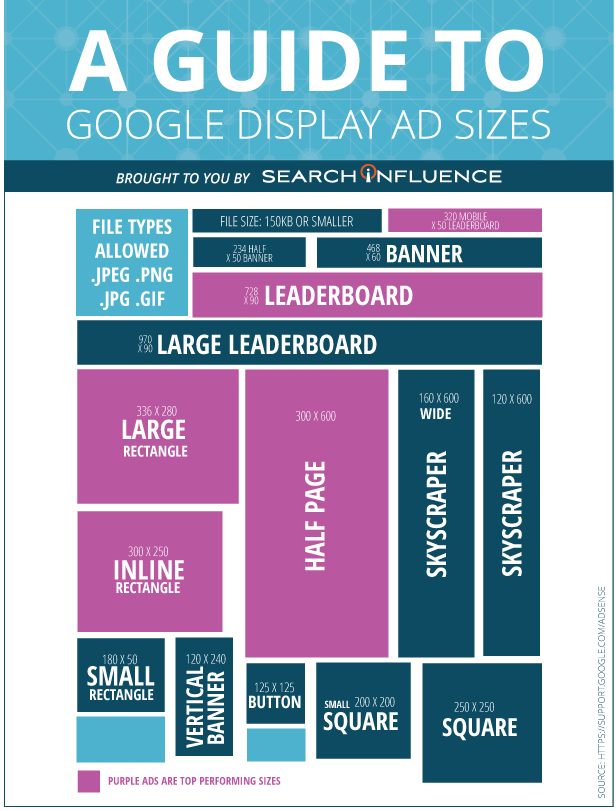
    Search Influence Ad Size Infographic

    When selecting a size for your Google Display Ads, it’s paramount to consider the both the click-through rates and the number of potential clients who will be exposed to your campaign.
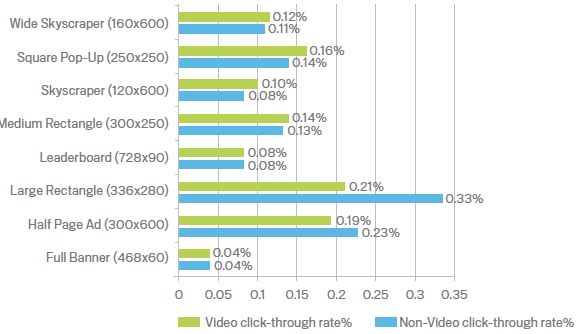
    A large interactive ad may seem like a good idea, but if it only appears on a handful of websites, it may not be worth the cost—or the effort.

    Technical & Content Requirements

    The GDN will not accept ads that are larger than 150KB. Reducing image size—particularly for animated or interactive files—without sacrificing quality can be difficult, which is why it’s always a good idea to consult with a professional design and marketing team. While animated ads can be looped (effectively playing forever), they cannot be more than 15 seconds long consecutively. Ads in GIF format must be 5 frames a second, whereas Flash ads (whether video or animated) can be considerably longer—up to 20 frames a second and sometimes slower.

    Google Display Ads also carries content guidelines that are particularly pertinent for those in the medical profession. Some of these rules are self-apparent, like not duplicating site content, not tricking users into clicking your ad by pretending to be a virus warning, and making it clear that the material is an advertisement. However, Google also has rules regarding adult-oriented content that can impact healthcare professionals, particularly in fields like OB/GYN and plastic surgery. For example, images containing exposed skin and nudity are not allowed, nor is content that is sexually suggestive. Again, consulting an Internet marketing specialist may be the best way to get your brand out there without inadvertently violating Google’s policies on restricted content.

    Tips for Successful Ads

    There’s no question about it: Google’s paid advertising options are powerful, but they’re complicated. Making the most of the GDM requires completely rethinking the way you market your services and products. You need to be intimately acquainted with your target audience, what sites they’re likely to visit, and what types of advertisements they’re most likely to respond to. Additionally, what works for a general practitioner isn’t going to work for an inpatient addictions clinic. Doctors who specialize in breast augmentation may encounter more problems than those who specialize in psychiatry and counseling—it all depends on your business and your prospective clientele.

    With years of experience in paid search and display advertising for medical practices, Search Influence is uniquely qualified to help you and your business harness the extraordinary power of Google Display Ads. Get in touch today, and we’ll be happy to come up with a plan to increase your visibility and enhance your bottom line.

    Image Credits:

    Ad Click-Through Rates

  • How the Google Penguin Update Will Affect Your Site in 2016

    Happy Penguin Awareness Day! (You remembered, right?) Today, we celebrate everyone’s favorite quirky, aquatic natives of the Southern Hemisphere. Maybe you’ll want to spend the day in a tuxedo, visit your local zoo, or adopt a penguin to celebrate?

    Of course, if you’re in the world of SEO, you might find that instead of adorable fluff balls, Google’s massive algorithm springs to mind. While it’s not quite as cute and cuddly as its animal cousin, this Google algorithm continues to be a crucial part of SEO in 2016—and this January, it’s more important than ever to be aware of how it affects your site.

    Google’s Big, Fluffy Penguin

    First launched in April 2012, Google’s Penguin update made massive waves in the SEO world. That era was a dark time in the online world—back when questionable content and black-hat SEO could earn you high rankings in the SERPs. The Penguin update’s primary aim was to make these manipulative strategies ineffectual, decreasing the SERP rankings of any website found to be in violation of Google’s Webmaster Guidelines, especially those sites that tried to increase their rankings through various link schemes.

    The penalty for sites with too many low-quality, “spammy” links is steep: you may lose your high rankings in the SERPs, or Penguin may even remove your URLs from the SERPs altogether, which is the last thing you want. Fortunately, penalties can be removed in a number of ways, from manually removing questionable links to using Google’s Disavow Tool. In a January 2015 video hangout, John Mueller also stated that these penalties can be removed by simply building high-quality links—which can help Penguin overlook some of your more questionable links.

    What’s New?

    Up until recently, Penguin was pretty old news: the last confirmed Penguin update was over a year ago in October 2014. But Google has been working on a revamped version of its favorite fluffy algorithm for some time, and Penguin 4.0 is expected to be released within the next few weeks. With anticipation hanging in the air, influencers throughout the industry have been on the edge of their seats awaiting the update—but in spite of a lot of unusual ranking changes, Google has confirmed that the latest Penguin update has not yet been released as of January 12.

    The Penguin update, according to Webmaster Trends Analyst Gary Illyes, promises to be the “real time version,” which means that the revamped Penguin algorithm will update continuously, discovering and analyzing your site’s links in real time. This, in turn, means that any changes to your site (whether good or bad) should have a much faster impact on your rankings.

    In the long run, this is great news: fast and frequent “real time” analysis should mean that Penguin penalties are less lasting, so removing unnatural links from your site should allow you to see a speedy recovery.

    How to Prepare for the Coming of Penguin

    While massive Google algorithm updates tend to shake up the SERPs for a while, the good news is that the same SEO best practices we preach so frequently on this blog should be a good defense against the worst of the changes.

    Now is the time to perform a comprehensive link audit, especially if it’s been a while, just to be sure your site is prepared. Take the time to eliminate any bad, exact match, low-quality, or irrelevant links in favor of clean linking strategies. If you’ve made every attempt to remove an unnatural link, use the Disavow Tool as a last resort: this tool tells Google that despite your attempts to remove the link, you were unable to do so.

    Aside from this careful audit of your site’s links, the best thing you can do is continue creating content that is high-quality, helpful, and informative—or tweaking your existing content to be this way. Organic backlinks are grown from this kind of information, as people naturally share content that they find interesting or informative.

    If the impending Penguin update has you worried, don’t forget that Search Influence offers a wealth of SEO services to ensure that this penguin doesn’t come back to bite you!


    Image Credits:

    Jumping Penguins
    You Didn’t See Anything
    Penguin Attack

  • The Verdict Is In: How to Make Your Law Firm Mobile-Friendly

    The Internet is not contained to just desktop computers anymore. With the massive proliferation of mobile devices, including smartphones, tablets, and phablets, users have the Internet wherever they go, and that means there are a lot of mobile search inquiries. In fact, according to Google, more people search using mobile devices than with desktop computers worldwide.

    2283584007_f199332890_z

    Importance for Law Firms

    What this means is that your law firm must be optimized for mobile searches in order to be found, especially by younger generations. Think about it: when a smartphone user needs timely legal advice to handle a situation such as a car accident, they will immediately use it to search for a reputable law firm. And the closer your law firm is to the top of the mobile search rankings, the more likely your firm is to receive that phone call.

    Whether on desktop or mobile, more and more people are using the Internet to find a lawyer. Citing a survey conducted by Moses & Rooth Attorneys at Law and Mike Blumenthal, Will Scott notes that 15.5 percent of those searching for legal assistance use the Internet. He also points out that those between the ages of 18 and 24 have a stronger inclination to search for legal representation using the Internet.

    13677439224_d5d7dc7387_b (1)

    Become Mobile-friendly

    But how can your tell if your law firm is optimized for mobile searches? Google Analytics will provide you with the tools you need to know if your website is up to its standards. Some things to pay attention to when optimizing your site for mobile is your site speed, internal links, how many images are used, the word count, and strong social signals. These elements all affect your search rankings, communicating to Google whether or not your website is mobile-friendly.

    In addition to having a site that is easy to find on Google, you’ll also want to implement strategies to convert mobile website hits into clients. Adding a click-to-call button to your website will allow users to easily call your office so they can arrange a meeting for a consultation. A simple inquiry form is also important to implement on your website so mobile users can fill in the fields with pertinent information about their case without having to wait to find a desktop to do so.

    It is also important to understand what your potential clients will be putting into the search box. Besides specific and location-targeted keywords, Blue Nile research has discovered that 27 percent of search engine users form their searches as questions. That means when a potential client searches for a law firm, over 1 in 4 people will search for phrases such as “where can I find a medical malpractice lawyer?” or “how can I fight a ____ charge?” A detailed and informative FAQ page will help lead these searches to your law firm. Not only does the FAQ page help for search engine optimization purposes, but it also benefits the user experience. A potential client will see the detailed information that answers their question and gain confidence that the site of your law firm has the solution to their legal matters. And with the aforementioned click-to-call button, the initial consultation meeting will be set up with effortlessly.

    As the world transitions further and further into the digital realm, it is important for your law firm to understand how to stand out from the other law firms online. Search Influence is here to make sure your website is optimized for mobile searches to convert hits to consultations.

    Image Credits:

    Law Books

    Mobile Phone Search

  • How to Rein in Your Content Marketing Budget

    Scope creep. A concept that strikes fear in the heart of every project manager. Content can be a slippery slope when you’re racing against the competition to build your brand, show your expertise, and earn the trust of your customers, you may find yourself sacrificing quality to post new content more often. Your challenge is to produce enough quality content to keep your brand in the public eye. Without a clear strategy, it can get out of hand. Here’s how you can stay on budget and still deliver the goods.

    Brainstorming and Buy-Ins

    You want your blog to be informative and have an insider feel, and the best people to produce that kind of content are your employees. Asking your employees to blog benefits them by making them feel more valued and valuable. But, let’s be honest, not every employee is a writer. That’s where brainstorming comes in. Schedule a meeting every two weeks to brainstorm blog content. Invite stakeholders from each department, especially those on the front lines: customer service and sales.

    You’ll also want to hear from the back end – whoever is monitoring your analytics. If you’re using a CRM with comprehensive reporting features, you have a wealth of data at your disposal. You’ll be able to spot trends, find out what customers are discussing on social media, and develop a comprehensive customer persona.

    Using input from all departments, develop topics based on questions customers ask and problems they encounter. Your blog calendar should include a nice mix of informational topics, interaction, and personality. Employees who don’t have blogging skills (or the time) can contribute ideas and knowledge by way of bullet points to be sent to a writer.

    Be sure to appoint an editor who can fact and quality check everything posted, make sure enough content is submitted, and ensure that sensitive company information doesn’t accidentally go public. An experienced editor will help protect your online reputation.

    Stretch Your Most Valuable Assets

    Buzzsumo analyzed thousands of posts and found that the most shared content is long…really long. More than 3,000 words. Professionally written content of length can be very costly, and your customers might not actually read it.

    To make the most of an expensive piece of content, you can:

    • Break points into shorter blog posts and discuss one concept at a time in more depth.
    • Make a slide presentation with bullet points from a report.
    • Create an infographic.
    • Schedule dozens of tweets and social media posts with snippets of information.
    • Discuss the information in a video.
    • Create a how-to teaching viewers to apply the information you’ve presented.
    • Schedule a livestream webinar with Q&A to discuss your findings.
    • Create eye-catching graphics to tweet and post

    Curate Content

    The beauty of curated content is simple: you don’t have to produce it or pay for it. Curation allows you to provide a lot of content, even if you don’t have a lot of resources. You can add value with commentary and your own insight in just a few sentences. The content you pull into your site should be relevant to your industry, interesting, and new.

    Ask for Guest Posts

    Most blogs have a “write for us” page with guidelines about what they are willing to post. As your blog grows in popularity, writers will likely contact you to offer guest posts. Accept only quality posts, and make sure any links are to authoritative, high-quality sites.

    You can also invite execs from partner industries to share their expertise.

    Invite Your Readers to Participate

    User-generated content (if appropriate) can be a fun and interesting way to get your customers involved:

    Long before your content budget spins out of control, you can create a strategy to contribute, curate, and invite. Done well, you can provide a wide variety of content to interest and entertain your customers, even on a limited budget.

  • A Dentist’s Guide for Choosing Target Audiences on Facebook

    A Dentist's Guide For Choosing Target Audiences On Facebook Image

    The number one tool in any business’s online advertising arsenal is knowing your audience. In a field as wide-ranging and diverse as dentistry, such knowledge can mean the difference between a stagnant online presence and social media success. So we’ve put together a helpful guide to improving your understanding of Facebook’s targeting tools in the hopes that you can hit that sweet spot of audience-targeting potential!

    We’ve investigated the targeting strategies behind some of our most successful social media campaigns in the dental industry to bring you three distinct targeting groups: family dentistry, young adults and orthodontics, and cosmetic dentistry. We dug deep to provide you with result-generating, relevant targeting parameters that go beyond the typical dental hygiene-related interests of mediocre social media campaigns. For each of these three hypothetical campaigns, we’ve provided some of Facebook’s best options for reaching your intended audience.

    5684115572_55bc83414f_z

    Family Dentistry

    Although your first instinct may be to target users by selecting more obvious interests, such as pediatric dentistry, oral hygiene, or dental care, you can generate much more social engagement through streamlining your strategy and focusing on specific age groups, lifestyle choices, and purchase behavior.

    For a family or pediatric dentist group, we recommend targeting women between the ages of 25 and 55 who have children. This demo group comprises the family decision makers who are most likely to engage with your page. Exploring Facebook’s fantastic targeting tools within the “More Demographics” dropdown will allow you to target parents of children within a specific age range. For instance, you can target new parents all the way through parents with children aged 12. This will ensure that your bid for impressions is going to the right users and not parents with adult children who would be more likely to seek out a dentist on their own.

    Finally, investigating the options available under Facebook’s “Behaviors” section is most helpful in providing you with the best methods for reaching those most likely to engage with your social media presence. Here, you can ensure you are reaching parents who are willing to invest in health and wellness products for themselves and their children. We recommend exploring the “Purchase Behaviors” section and adding behaviors like spa enthusiasts, shoppers, and baby care.

    Young Adult & Orthodontics

    This group can be a little tricky to reach. The sticky situation, if you will, is developing a targeting strategy wide enough to include parents of teenagers as well as young adults and even older adults who require orthodontics. For best results, we recommend targeting both men and women between the ages of 18 and 45. Under “More Demographics,” we have found that the option to target by “Generation,” which includes Baby Boomers, Generation X, and Millennials, is most useful. We’ve discovered that targeting Generation X and Millennials, which encompasses those users born between 1961 and 2004, is quite effective for this subset of the dental field.

    The most useful behaviors for this targeting group are those related to technology. Facebook now allows for targeting by “Mobile Device User,” including tablet and smartphone owners. You can even get more focused by choosing to target only those who prioritize being up to date with their tech gadgets by selecting new smartphone and tablet owners. As common as orthodontics have become and as the stigma of adult orthodontics is reduced through innovations such as invisible braces, more and more of this targeting group’s social media audience will be young adults who are plugged in.

    Cosmetic Dentistry

    Our last targeting group presents the widest range of targeting options based on exactly who your cosmetic dentistry office intends to serve. Here, we have provided you with just a sample of what Facebook’s targeting parameters can allow you to do.

    For this specific targeting group, we recommend focusing on both women and men in the 30 to 65+ age range. Once again, we can look to the “More Demographics” dropdown to provide even more insight into the makeup of our audience. Take a look at Facebook’s “Work” and “Financial” targeting options to get the most out of your marketing budget. You can focus on specific job titles and industries, highlighting those occupations in which a winning smile is most beneficial, such as CEO, lawyer, broadcast journalist, and the entertainment, sports, and media industries. Targeting by financial parameters allows you to engage customers with enough expendable income to prioritize cosmetic procedures.

    Under “Behaviors,” we can select those users who are already investing in health and wellness, especially when it comes to dental care. Facebook provides options for targeting users whose purchase behaviors reflect investments in beauty products and accessories, cosmetics, and oral care. Lastly, Facebook’s “Behaviors” section provides our hypothetical campaign with one of my favorite targeting parameters: photo uploaders. This group includes those Facebook users who posted more than 50 photos in the last month. We all have one of those Facebook friends who is obsessed with selfies, and who wouldn’t want to make sure their perfect pearly whites are on point for all those photos?

    7910370882_39d180fb66_z

    The benefits of social media marketing campaigns are apparent. Every time you flip through your News Feed, you are greeted, hopefully, by well-targeted promotional campaigns that bring you the products and services you’re interested in. With the tips we’ve provided in this helpful guide to understanding your social media audience, you, too, can be on your way to increasing audience engagement and building your online presence!

    Image Sources:

    Facebook Like Button Image
    Smartphone Image

  • Think Your Coworkers Have Cool Hobbies? Check Out These Interesting Influencers!

    1601-SI-Newsletter-0112-Big-KG-E-01

    As the largest online marketing firm on the Gulf Coast, Search Influence has attracted an eclectic group of employees with an array of talents. While our clients know our team members as talented online marketing experts, our Influencers’ talents extend beyond the friendly confines of our 13th-floor office. Since January is National Hobby Month, I spoke with a few Influencers about their hobbies outside of work.

    Influencer: Shaye

    Department: Production

    Hobby: Drawing and art are some of Shaye’s most notable hobbies. Recently, Shaye showcased at the New Orleans Comic and Zine festival and sold works at a local pop up shop called<100, which aims to promote gender wage equality.

    Quote from Shaye: “I started out just doodling on everything. You should see my meeting notes. All my friends and family have been incredibly supportive of my art. My partner bought me a graphics tablet this year, and everything took off from there. I still can’t believe I was able to showcase next to so many amazing artists at NOCAZ and at <100.”

    Shaye Display Illustrations

    Influencer: Meaghan

    Department: Production

    Hobby: Meaghan has been swing dancing for roughly five years and has learned all the major swing dance types, including lindy, balboa, blues, and solo jazz, which she believes is her best dance. Meaghan has also done a bunch of other partner dances like the waltz, foxtrot, and tango, as well as the salsa and cha cha.

    Quote from Meaghan: “Sometimes dancing feels more natural than walking. The music comes on, and it’s automatic and instinctual. When you dance with a partner, you end up sharing that with another person. So then it’s like nothing exists except your connection and the music, and there’s nothing that makes me feel more alive, or more human in a way.”

    Influencer: Maggie

    Department: Account Management

    Hobby: Maggie plays in a cornhole league with a number of her Search Influence coworkers! Search Influence prides itself on a collaborative team environment, so it’s no surprise that Maggie and her coworkers form one of the most imposing cornhole squads you’ll see in the Crescent City.

    Quote from Maggie: “We all have a great time cheering each other on, and competing against each other too! It’s a great way for us to relax after work, especially since cornhole is a leisurely and (mostly) no contact sport.”

    Influencer: Serena

    Department: Account Management

    Hobby: Serena plays roller derby for the Big Easy Rollergirls AllStars, New Orleans’ premier women’s flat track league. Serena is all business in the office and on the track, so if you come at her, you better come correct.

    Quote from Serena: “I love playing roller derby because it makes you part of a community that promotes more than just being athletic (but that helps too!). I’ve skated alongside so many amazing women from many backgrounds over the last six years, and roller derby teaches you not only about teamwork but about yourself. It’s about empowering women to be real, strong and revolutionary–on skates and off! Come see the Big Easy Rollergirls skate at the Lakefront Arena in 2016!”

    Influencer: Gabrielle

    Department: Account Management

    Hobby: In her spare time, Gabrielle is an avid runner. She recently ran the St. Jude Marathon and asked her fellow Influencers to support the cause. Thanks to her team’s support, Gabrielle raised $330 for a worthy cause. Around race season, Gabrielle participates with her coworkers in SI Running Club to train for 10Ks and half marathons. They even have team shirts, too!

    Search Influence Runners

    Want to be part of our dynamic and talented workforce? If you can visualize yourself as a member of the Search Influence team, check out our current openings for your chance to shine!

  • A War of Words: 4 Tips to Help Lawyers Win the Cost-Per-Click Bidding Wars

    1601-SI-Newsletter-0112-Big-KG-C-01

    Whether a veteran attorney or a recent law school graduate, legal professionals have likely noticed that the world of generating leads and winning new clients has changed drastically. While tried and true marketing methods such as word of mouth and putting your picture on a billboard still have their place, effectively using online resources can have a huge impact in establishing a solid client base. In particular, paid online advertising for attorneys has become so vital that competition for keywords has skyrocketed. Although it may seem daunting and difficult to know how to begin, these critical tips can help you win the cost-per-click (CPC) bidding war.

    1. Understanding the Competition

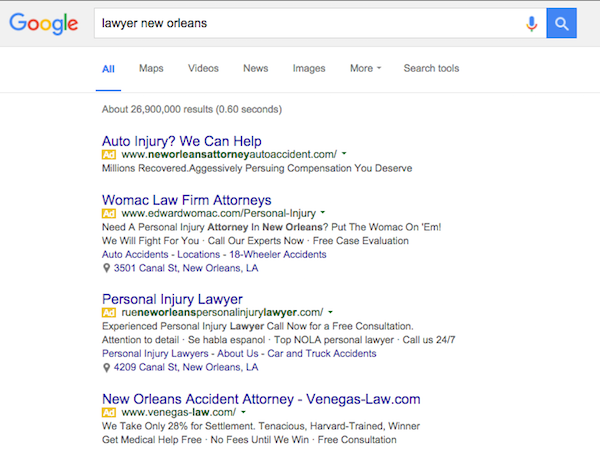
    Consumers who are searching for a lawyer often turn to the Internet to conduct their research. With that in mind, marketing online has become an integral part of building and sustaining a law practice. When it comes to paid online advertising, it’s important to first understand your competition. Legal keywords are typically among the most expensive in Google AdWords, with terms related to “attorney” and “lawyer” topping the cost charts. High levels of competition naturally follow expensive keywords, as lawyers constantly place bids on the exact same terms. Try conducting your own competitive research and search the keywords in your geographic area to see for yourself what ads are getting top placement. Simply run a search on the keywords you’re hoping to target and see which keywords your competition is already bidding on. Take a look at their ads and start crafting a plan to make yours even better.

    Screen Shot 2016-01-05 at 9.04.41 AM

    2. Target Specific Keywords

    So how do you overcome the highly competitive landscape and win the bidding war in your online ads campaign? First, you should create a list of specific and relevant three- to five-word keywords to explicitly target. This is a trial-and-error process, and it takes time to accumulate useful data. A simple way to start is to use the Google AdWords Keyword Planner, which will help you compile specific keyword ideas. This tool will also help you determine average traffic and CPC for your potential keywords, and it will make suggestions based on your site’s URL. In addition, it’s critical to focus on relevancy and make sure that your keywords, your ads, and your landing pages all match the searcher’s intent. For example, if the keyword in your ad is “DWI lawyer,” the click should take the consumer to a page with content for “DWI lawyer.”

    How Can I Fight A DWI Charge?

    3. Use Negative Keywords

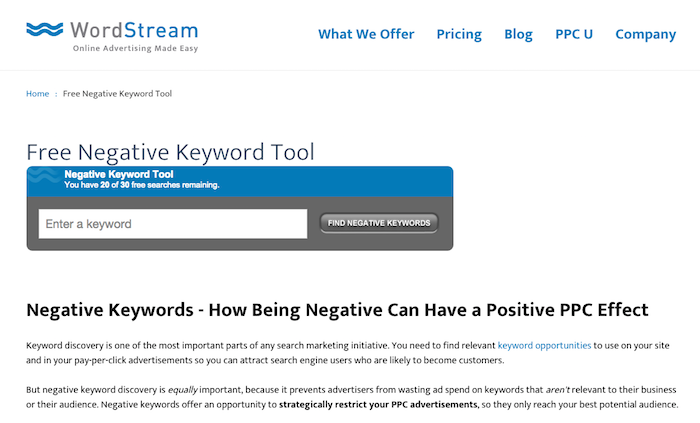
    Another crucial aspect of a successful paid online advertising campaign is the use of negative keywords. This allows you to stop your ad from appearing when you know that the consumer isn’t interested, which can help improve the click-through-rate of your ads. Using negative keywords informs Google that certain search queries are irrelevant to your practice, ensuring that you don’t pay for clicks that will not lead to conversions. You can start by using a free negative keyword tool like the one from Wordstream, which will return an extensive list of search terms that may not be related to your practice area. Using this tool is especially essential in the legal world, where you are bidding on expensive keywords that could result in unnecessary and costly clicks.

    Screen Shot 2016-01-05 at 9.25.01 AM

    4. Optimize Your Landing Pages

    Now that your paid online advertising campaign is set up with specific and relevant keywords and you’re getting clicks from consumers searching for your exact type of practice, it’s important not to derail all of your efforts with ineffective landing pages. Your landing pages should be directly on point to the ads that the consumer clicked on. They will likely need to be continuously tweaked with different types of offers to see how people respond to them. You might want to consider using videos on your landing pages with subject matter explanations directly from a lawyer, or customer testimonials from successful cases. In addition, having a chat function on legal landing pages can be particularly critical for consumers who are hoping to have immediate answers to case-specific questions.

    Keeping your paid online advertising strategy focused on these tips will help you capture leads that you would have normally missed, allowing you to conquer the competitive CPC bidding war for attorneys.

  • Birds of a Feather Tweet Together: How to Shape Your Dental Practice’s Strategy

    1601-SI-Newsletter-0112-Big-KG-D-01

    With today being National Bird Day, one saying comes to mind, and it’s one that forever rings true: “Birds of a feather…” Like-minded individuals with similar interests and agendas generally come together and communicate with each other more regularly. This can be beneficial for dentists, periodontists, and orthodontists as they work on growing their audiences online.

    Who’s in Your Flock?

    For those in the family dental industry, consider who will be most inclined to tweet about your services. First to note in the flock is, of course, parents and families. With that in mind, crafting your content with families in mind can benefit both your business as well as your audience, both of which will do wonders for your online presence and, in turn, grow your respective audience as more of that same audience is brought in by their own family and like-minded friends.

    Tweet to Your Birds

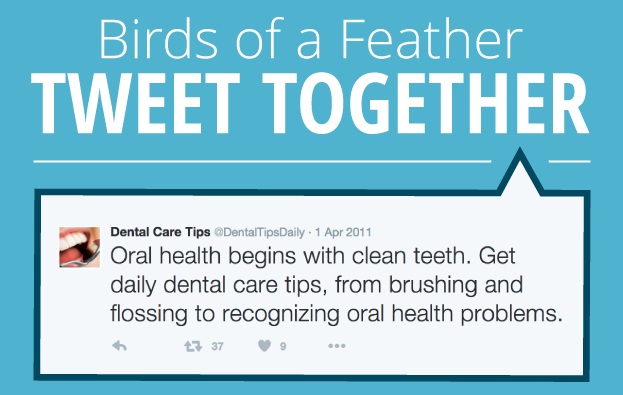
    Birds go where other birds go. If you want your Twitter audience to grow, start with those on Twitter who fit your audience to a tee. From there, encourage interaction and engagement with them and their fellow followers who share the same general mindset and lifestyle. For example, if you share a great joke, infographic, or helpful fact about oral health practices and end it with “RT to your friends and fam!,” more will learn of your company’s personality and expertise through shared tweets, and those with whom the messages resonate will join your flock of followers, allowing your audience to continue to grow and prosper.

    Take Flight Today

    The idea of growing your audience online can be daunting to those who aren’t entirely familiar with the method, as the Internet has grown to become a whole new world of its own. Don’t worry, though—that’s what online marketing services are for! Allow a professional company to best serve you in the way that will grow your audience, your company, and your success via online marketing today.