Tag: social media marketing

  • 4 Internet Marketing Mistakes You Might Be Making

    There is nothing more frustrating than putting all your money and effort into your site’s content only to see a conflicting ROI. Many companies and businesses rely on Internet marketing to increase their profits, but some make simple and even unpredictable mistakes as they go about it. Feeling frustrated or annoyed with your results? You’re not alone.

    WAIT! Don’t break your computer just yet—we’re here to point out some mistakes you might be making.

    1.) Every part of your content concentrates on sales.

    Everyone wants to make sales and increase profits. That’s the whole point of your Internet marketing campaign, right? But new users who visit your site may not purchase your product or service right away. Smart buyers want to research your product, learn more about your brand, see what you offer, and compare your prices to the prices of your competitors. Your potential customers likely won’t have the compulsion to commit to a purchase right away unless you are a well-known company like Amazon. Don’t try to sell your product outright; rather, tell a story with your content. Ease your customer in slowly to make them believe in what you are selling.

    To do this, avoid making your content too product-specific. Let’s say you sell garden hoses, and garden hoses are all you know. You don’t want to talk about just garden hoses all the time; you’ll lose customer interest. And let’s face it—you can’t talk specifically about garden hoses non-stop while keeping your content interesting. So make sure you expand your content beyond your specific product. On certain pages of your site, spill expert gardening secrets, discuss ways to keep your lawn fresh, or start an FAQ section on popular gardening techniques. Always expand on your product and related topics to keep the customer engaged!

    2.) You’re using social media sites…incorrectly.

    One of the biggest components of any company’s campaign is the strategic use of social media. Coordinating posts on Facebook, Twitter, LinkedIn, and other social media platforms can take up exorbitant amounts of time and effort. Concentrating too much or too little on certain posts or topics can lead to fewer followers on a specific page, and no one wants to see multiple, random posts appear on their newsfeed every single day. Creating posts and utilizing social media should be a strategic and intelligent endeavor, not a disorganized, chaotic mess.

    Plan ahead by understanding the goals of your social media strategy. Do you want to drive traffic to your site? Generate more sales? Enhance your email list? Work toward brand awareness? Know your brand and, most importantly, know your customers! You don’t need to use every social media outlet; just figure out which channels your customers use most. If you’re not sure which media sites your customers prefer, just ask! It’s important to learn as much as you can about your clients, their social activity, and how to appeal to them. Absorb yourself in the community’s conversation and interact with your clients. Marketing 101: customer service and knowledge is the number one driving component to any business.

    3.) Your content is SEO-heavy.

    SEO is essential to any marketing campaign. You want Google to find your specific keywords and phrases to generate more traffic. SEO helps human users know you exist within their area!

    While all that is true, you do not want to write all of your content specifically for search engines. No one wants to read website content that has keywords stuffed into every sentence; content needs to be well-written and unique! When creating pages for your visitors, you want the writing to be memorable and easy to read. Once you start to write your content, all of the information you have about your product will flow out naturally, and the content will optimize itself: users will be more likely to share your content through social media, blogs, or websites when the writing is more natural. And if you want to give your content greater authority, be sure to link to other credible websites within your industry.

    4.) You aren’t calling your clients to action.

    You caught the fish, and now you have to reel them in.

    It is a very common misunderstanding that if you drive traffic, you will automatically increase sales. Maybe your new customers aren’t making purchases, and even your old customers who have been following your site and posts since the beginning of time still aren’t biting. Personally, I have followed many company sites without ever buying their products. Why is that?

    Creating an easily accessible path to your product is crucial. You want clients to have a simple conversion from viewing/visiting to buying. By embedding relevant calls to action within your text, you can ensure that content on your site gets potential customers deeply involved with your product. Every page for your products should have a link to sign up for your site, email list, or newsletter in three places: on the sidebar, below the article, and underneath the header.

    Don’t leave your customers to ponder what to do after reading your page. Send them along the right path!

    Image Sources:

    Smashing Computer Gif

    According to Google Gif

    Thumbs Up Gif

  • Five for Friday: Pay for Twitter Verification, Snapchat Goes Local, and More!

    1. If You Want to Be Verified on Twitter, All You’ll Have to Do Is Pay! – Mashable

    If you’ve ever tried, you know that getting verified on Twitter is a lengthy process. Twitter does not accept requests for verification, so users just have to wait until the site feels that your page should be verified—and the process can take an extremely long time. But not anymore: Twitter is considering letting people pay to get that little blue check mark symbol. Hopefully, if this change is adopted, the days of waiting for verification will be gone!

    2. Google Answers the Question “Is Link Building Good?” – Search Engine Round Table

    In any discussion about link building, the conversation usually turns into a debate about whether the strategy is good or bad for a website. If you’ve been searching for the answer, you may finally have it: in a recent Google+ hangout, Google’s John Mueller was asked to answer this common question. Ultimately, Mueller stated that he would “try to avoid” link building in general, but he also gave helpful tips on how to allow others to link to your site.

    3. Snapchat Wants to Show You What’s Happening in Your City – Tech Crunch

    Have you ever ignored a Snap from Team Snapchat because it relates to an event taking place in a different state or even a different country? Well, Snapchat has caught on. The company is currently experimenting with regional Our Stories, which will add content that will be visible only to locals within a specific area. Keep an eye out for these relevant Our Stories!

    4. 4 SEO Landmines to Avoid if You’re Updating Your Website – Search Engine Watch

    From time to time, it becomes necessary for all of us to update our websites—but how do we manage the change without losing the authority our sites have built up? Whenever you update your website, you may leave yourself vulnerable to changes in domain authority and search engine indexing. If you’re thinking about changing your website, a few tips from this recent Search Engine Watch article can teach you what to avoid in order to keep your SEO intact.

    5. Facebook Will Be Revealing the Relevance Score of Your Ad – Marketing Land

    Ever wonder how Facebook chooses which ads to show? The company uses a combination of bid price and relevance scoring to decide which ads will make an appearance, but the process might seem confusing. Well, Facebook has begun to allow marketers to see the relevance score of their ads. In doing this, Facebook hopes to incentivize the creation of better ads that are more relevant to target audiences.

    Image Sources:

    All You Have To Do Is Pay

  • #LocalUp – Making Content The Sexy Part of Social

    The presentation below was developed for a joint conference put on by Local University and Moz in Seattle on February 7th, 2015, called LocalUp.

    My “beat” if you will as a Local U faculty member is Social Media, and given our work with customers of Search Influence, I have always leaned toward the advertising side of Social Media Marketing. With some of the changes being made by Facebook, most particularly, the elimination of “selling” content from the news feed, that focus is getting more important.

    Facebook is no longer a free lunch. You’ve got to pay to play.

    That said, it’s still very important to build community and engagement and good content makes it easier. That’s what this presentation is about. I hope you enjoy. I’d love to have your comments here or on SlideShare.

  • Five for Friday: Beef Up Your Local SEO, Twitter Welcomes Newbies, and More

    1. Google’s Domain Registration Service Now Open To All US Residents – Search Engine Journal

    Google now has a proprietary domain registration service! What’s great about this service is that, like most Google products, it’s fully integrated with Gmail forwarding as well as other goodies provided by Google’s partners – Squarespace, Weebly, Wix, and Blogger. Streamlined and familiar, domain registration starts at $12, with additional add-ons available. For more information about this service in different countries, you can sign up to a mailing list.

    2. A Step-By-Step Introduction to Amazon Product Ads – PPC Hero

    Amazon has always been kind enough to direct customers to your product, and it sometimes even directs them straight to your website. With Amazon Product Ads, the company helps you become better at selling your wares the right way – with the consumer in mind, but the seller at heart. This article details the step-by-step process on how to utilize APAs to the fullest, and it educates you on the nuances of selling products online.

    3. How to Have a Successful Local SEO Campaign in 2015 – Moz

    These tips are typically a no-brainer for us optimizers, but as evinced by our recent SI Conference, there are nuances to local SEO, and SEO in general, that we sometimes just don’t see right off the bat. With the new Google updates, optimizing is getting more personal and organic than ever. Check out the interesting click map to see just how organic SERPs are becoming.

    4. The Big List: 80 Of The Hottest SEO, Social Media & Digital Analytics Tools For Marketers – Marketing Land

    Note: this is not a ranked list of SEO tools, but rather a running total of great tools out there at the moment. Perhaps we will see some of these in our near future as employees of Search Influence. It’s nice to see kind things said about the tools we currently use, if not only to solidify the reasons why we chose the ones we did.

    5. Report: Twitter Planning New Home Page For Logged-Out Visitors – Marketing Land

    As an avid Twitter user, I’ve always been concerned with the esoteric universe that is Twitter’s inner sanctum. What’s in a homepage, you ask? Well, currently Twitter leaves a lot to be desired (a marketing ploy perhaps); there’s no indication of what the user interface even remotely looks like based on their homepage. Reports indicate that, unlike many social media home pages, Twitter may give in to human curiosity and allow potential users to glimpse its inner workings.


    Image Sources:

    Oh Boy Gif

  • Behind the Scenes: How Social Media Is Being Used in the Local Film Industry

    Unless you have been living under a rock for the past ten years or so (and not just any rock, but one without TV or Netflix), chances are you have watched a movie that was filmed here in New Orleans. The city – and the state as a whole – has seen an explosion of film and television productions over the past several years, earning the region the title of “Hollywood South.”

    From comedies like 21 Jump Street to Oscar-winners like 12 Years a Slave, Louisiana has even surpassed film production stalwarts like Los Angeles and New York City to become the country’s production capital – all thanks to the highly lucrative tax credits introduced in 2002.

    And while the big-budget movies are driving the local industry (check out NOLA-shot blockbusters Jurassic World and Terminator: Genisys in theaters this year), this influx has also helped inject momentum into the independent film industry – more specifically, the micro-budget indie film scene. These are projects made by passionate local filmmakers looking to find a foothold in the industry at large.

    These are not films the average moviegoer is typically going to be able to see or even hear about. So how do these filmmakers get the word out? How do they raise the funds to even get it made? And how do people find out where they can see these smaller films?

    The best and easiest way is through social media, an umbrella term that can be divided into several different platforms (Facebook, Twitter, Instagram, etc.). The most effective social media strategies take a multi-faceted approach into account and are tailored to suit each medium’s strengths to maximize effectiveness.

    I talked to a few local filmmakers about the importance of social media and other Internet marketing strategies. I found that first and foremost on these filmmakers’ minds is exposure, whether for fundraising or promotional purposes.

    Fundraising and Promotion

    “Facebook is a useful platform that enabled a community to form around the project. It is very useful in promoting fundraisers and screenings,” explains Sam Bass, who has helped with the social media campaigns for two films, How to Disappear Completely and Give Light: Stories from Indigenous Midwives. “Twitter is better for engaging with people outside of your immediate community with the potential to lead to significant opportunities and connections.”

    “We began our social media campaign to draw attention to our Kickstarter,” says Hunter Burke of Construct Films, who is using social media to raise funds for and promote the film Atchafalaya. “It was the quickest and most effective way to get our message out.”

    Greg Tilton, director-producer of reddit doc, had a similar mindset, but he wanted to lay the groundwork for their project before asking for fundraising help. “Social media was key because I did not want our IndieGoGo campaign to be the first time someone had heard of the project,” he states. “It’s been successful because people who don’t know me or my immediate network are following and engaging the project.”

    Mac Alsfeld, the writer-director-star of Father-Like Son, found social media to be most effective after the film was made. “We heavily relied on Twitter to build a relationship with festivals,” he explains. “I think it is important to show festivals that you are the type of filmmaker that will market yourself and that festival to potential filmgoers.”

    Getting Help

    For these filmmakers and others, this was a very important part of the behind-the-scenes process. For the most part, they were navigating the tricky waters of social media without any substantial professional Internet marketing experience – though some had help.

    Burke turned to a friend who had social media marketing and crowdfunding experience. “I really owe a lot to him for educating me on what is standard, what has worked in the past, and also coming up with some wonderful ideas. Without him, I would have been totally lost.”

    Lucky enough to be dating someone in the tourism and marketing industry, Tilton found it helpful to have someone more experienced to bounce ideas off of. “As I experimented, talked to her, and read a lot of articles online, I slowly built up my knowledge. She was a great sounding board for ideas.”

    Thoughts on Social Media

    Even without much prior experience, these filmmakers now have some very astute thoughts about the medium overall gained from their newfound experience.

    “I do believe that it is VERY important to have a presence within the social media community,” declares Kenna J. Moore of Ghost of Elysian Films, who was awarded the Emerging Vision Award for a Louisiana Filmmaker at the 2013 New Orleans Film Festival and the Louisiana Shorts Jury Award in 2014. “It is crucial that our image and what is being put out there is closely monitored. I like to have a presence but stay away from all of the ‘look-at-me’ syndrome that one can easily fall victim to in most social media settings.”

    “The thing about social media is that it is, at its core, incredibly voyeuristic,” says Tilton. “Many people do follow the musings of their interests, so there is a large audience to be engaged and many want to be a part of something big. You can find that audience.”

    Tips for Fellow Filmmakers

    As for fellow indie filmmakers feeling overwhelmed by social media, all the filmmakers have useful tips to share:

    Bass: “Have a social media strategy. Know how to work it. And don’t panic when nothing happens for a week. The most important things are follow-through and relationship building.”

    Alsfeld: “Show people that you have passion. Use your social media to blast information. And even more importantly, have fun. Don’t be boring.”

    Burke: “We performed the best when we released media. Posting a picture, an interview with the filmmaker, or a sample of the score really got our audience interested. People really responded to something they could interact with. Make it a fun experience. Keep it simple. Leave them wanting more.”

    Moore: “I’ve learned that social media has pros and cons. Some people gain opportunity and references from it. Some social media activity allows for negativity and distraction. I would encourage people to stay focused.”

    Tilton: “If you have nothing to say, don’t say anything. So many people are retweeting and posting haphazardly. It’s just a jumble of buzzwords and hashtags. Just make sure it’s always quality and you will find that pays off bigger.”

    Additional Resources
    Here are some more tips directed specifically at indie filmmakers on making the most out of social media:

    7 Tips for Promoting Your Indie Film on Social Media via Premium Beat

    6 Tips on Using Social Media for Your Indie Film via Media-Match

    Image Sources:

    3, 2, 1 Film Image

    Social not-working Image

    The End Image

  • Five for Friday: Is Your Social Media In Good Hands? Link-Dieting & More

    1. New Year, New Link Takedown – Search Engine Land

    As we all know, many sites were put on Google’s naughty list thanks to Penguin’s distaste for bad links. Their next move? Request, request, request. Looking back on 2014, Google certainly got a lot of action. Torrent Freak reports that Google received a 75% increase in link removal requests in 2014 as compared to the previous year. We’re talking highs of 12 million URLs requested for removal per week. 2014 was clearly the year of cleanup.

    2. Project Share Aware: Sugar Bowl Not So Sweet For Some – MarketingLand

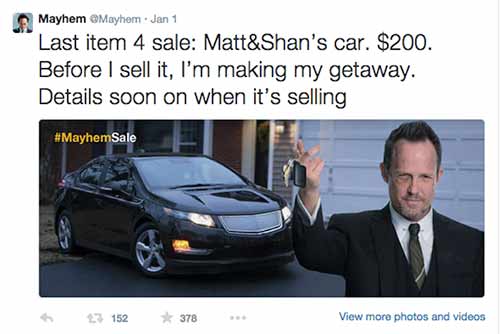
    An unsuspecting real-life couple, dubbed “oversharers” by Allstate, was burglarized during their outing to the Sugar Bowl. You might be wondering why an insurance company would do such a thing. Allstate’s latest campaign, Project Share Aware, aimed to alert the public to encroaching social media-savvy burglars. Long story short, if you’re telling people where you are in a public sphere, those without your best interest in mind (aka burglars) can take advantage of your oversharing. The event went as far as holding a fake online sale of the couple’s property using #MayhemSale on Twitter. Many claim this was just another ploy of Allstate’s fear-mongering advertising tactics, but it certainly made a few rethink their privacy settings. Although rattled, the couple did walk away a little sweeter with free Sugar Bowl tickets.

    MayhemImage

    3. Modern Family: Device Edition – Search Engine Land

    This may not come as a surprise, but if it’s not on a modern advertiser’s to-do list, it certainly needs to be. What am I referring to? Cross-device advertising. We’re talking about your new modern family, each member gazing at their device of the moment, whether it’s a PC, mobile, or tablet. John Crosley, Bing Columnist, argues that households engaging with multiple devices within one day tend to be more receptive to advertising. The overall goal? Reaching your audience, wherever they are and on whatever device they may be using at the moment. Let’s just say cross-device advertising is the Lily of Modern Family.

    ModernFamilyLionKingImage

    4. New Year’s Resolutions: Cutting Carbs or Social Media? – Community2Business

    Which did you pick? If you picked social media, you’re probably in the right place. As you step into 2015, take some time to rethink how you’re reaching your audience. Some top tips include boosting visuals, knowing when the time is right, and monitoring your #HASHTAG.

    First things first, if your post lacks engaging visual content such as images, memes, or infographics, your audience will likely yawn and pass through. Also, consider donning those visual-friendly social media platforms like Pinterest or Instagram. Tick, tock – we’re talking about time. Although articles regarding the perfect posting times abound, don’t forget you’re unique! Pay mind to your particular market or industry and play around with tools to measure what time is actually best for you to post. Finally, it’s time to discuss the beloved hashtag. While this is an incredibly relevant and useful tool, it can be abused. Make sure you are picking appropriate wording and wisely follow the rule of no more than three hashtags per post!

    MeanGirlsButterImage

    5. Boost Your Newsworthy-ness! – Business2Community

    Based on an analysis of 2014 search trends, the most searched items were Robin Williams-related. This was followed up by the World Cup, ISIS, Frozen, and more. What can we take away from this? People want news! Alongside your SEO efforts, focus on making your business reflect the most recent, exciting news in the industry. As an added bonus, if you regularly update this information, it will be new news. And as we all know, Google loves to bask in fresh, updated content. Now, that’s killing two birds with one stone!

    Image Sources:

    Mayhem Last Item 4 Sale Tweet

    Modern Family Gif

    Mean Girls Gif

  • Five for Friday: Facebook Ads Get a Facelift, Google’s Panda Goes into Hibernation, and More!

    Photo by Benson Kua

    1. Tips For Growing Traffic and Revenue Through Keyword Targeting – Search Engine Land

    It is widely known throughout the tech world that choosing the right keywords is important when trying to draw more attention to your website. Trond Lyngbø discusses how to do this by gathering relevant information, prioritizing your targets, and taking appropriate action. He goes through each of these steps in detail and offers advice on which tools to use and how to narrow down your targeted keywords. Finally, he goes through your options on how to take action through content marketing, personalization, and more. Trond Lyngbø offers advice and suggestions on taking action with high search volume keywords and turning those leads into conversions.

     2. What’s Next in SEO Trends – Venture Beat

    With the new year approaching fast, people are wondering what’s next in SEO trends. Yoav Vilner discusses how the focus in 2014 has been on honest and well-built link profiles, unique and informative content, and a compatible mobile site.

    In 2015, he expects the focus to shift in a number of ways.

    1. Addition of Social Layers: This will include putting faces on visitors and allowing them to get to know other visitors and even the website owners through social profiles like Spot.IM.
    2. Increase of Visual Content: Websites with engaging visual content such as BuzzFeed are showing us that users are becoming more engaged when aided by a visual rather than a plain text site.
    3. Defense Against Negative SEO: In 2015, businesses will need to work harder to protect themselves against negative SEO by securing a healthy link profile and proving to Google that the brand is legitimate.

    3. Panda Goes on Holiday Vacation Too – Search Engine Roundtable

    photo by Jrwooley6

    Panda has been one of Google’s most influential updates. Thanks to the update’s focus on quality content, advertisers have been striving to satisfy this furry animal since 2011. In this blog, Barry Schwartz discusses why we haven’t seen any updates or refreshes from Google’s Panda over the past month. He discusses how Panda has been known to go on vacation (or perhaps hibernation) during the holiday season and goes into more detail about when Panda was last updated.

    4. Insight Into Which Products Drive Store Visits – Search Engine Watch

    During the holiday season, advertisers are constantly trying to track their marketing efforts, asking questions like “What drives consumers to purchase?” and “How do we get customers to think of us first?” Yuyu Chen discusses a new Google AdWords metric called “store visit measurements,” which is added to its Estimated Total Conversions (ETC). Using data compiled from the company’s search ads, this tool tracks which products drive consumers to the store to make a purchase. Chen discusses privacy concerns as well as whether or not this feature will be available outside of the US.

    5. The Redesign of Facebook Ads Yield High Results – Marketing Land

    In April, Facebook redesigned its right rail ads by making them larger but less frequent. Ever since then, we have been awaiting the results of this redesign. In this blog, Martin Beck discusses Facebook’s announcement regarding the success of the redesign. He also discusses the success associated with these new ads and explains why they are cost efficient.

  • Don’t Be An Advertising Grinch: Grow Your Profits 3 Sizes This Holiday Season

    Can you believe we’re already on the verge of December? Are you prepared for the holidays? I’m not asking if you have your Christmas tree (or Hanukkah bush) picked out or if your travel plans are confirmed…we’re talking about advertising, and specifically online advertising. Hopefully, you’ve already adopted online advertising into your business’s ad strategy (if not, I just happen to know of an exceptional company that can help you get started), but this year, having an online presence for your products or services is more crucial than ever.

    Therefore, it’s only appropriate that we at Search Influence help prepare you and your business for the upcoming season! Here are 8 Questions, Tips, and Best Practices to get you in the right mindset and bring some holiday cheer to your ad strategy.

    1. What channels are you using?

    It’s common knowledge that there are a plethora of ways you can reach potential customers online, whether it’s via email marketing, PPC, social media, etc., but which is the best for your message?

      1. Email Marketing
      2. PPC
      3. Facebook
      4. Social Media in General
      5. Retargeting

    It’s easy to get overwhelmed if you think about utilizing all of these channels, especially if you consider how much it could cost you. So if you don’t have an unlimited budget, try and think about it this way: which channels are you already utilizing that you can focus on during the holidays? Which one (or two) channels might you add, even if it’s just for the holiday season, in order to build awareness and not get lost amongst all the other businesses advertising during the holidays? As with anything else during the holidays, the most important thing is to try not to spread yourself too thin. It’s better to put more budget and effort into a couple of channels than to lose your message by trying to use them all.

    2. Let the Christmas creativity flow!

    Your audience is already primed for the holidays – feed into it!

    Creative is extremely important this time of year. Keep your ad copy fresh by changing up your creative from the rest of the year and integrating topical messages into your ads. And don’t worry about sounding cheesy — this is one of the few times you can get away with it! When people are bombarded with holiday messages, think outside of the box. How do your products or services apply to this time of year? For example, are you a culinary business with an audience inclined to embrace your new recipes and cooking supplies at this time of year? Or are you a travel agency whose key demographic might be looking to escape from the cold weather with one of your vacation packages? There are many lenses you can look through when selling your product, so don’t lose sight of the way your consumer will be feeling during the holidays. Just ask yourself: how can your business/brand help enhance the message of the holidays?

    3. What are you prepared to offer?

    Use “giftable” language.

    This is crucial, especially if you have an online business or utilize e-commerce. It’s the holiday season after all, so people are looking everywhere for – and expecting to see – holiday deals. Remember to use gift-centric language in your ad copy. Could you market your service as a gift for your customers? Make it less about you trying to sell them something and more about what they’ll be getting from you if they turn to you during the most competitive time of year.

    Think about advertising sales/offers/discounts that are time sensitive. Putting out an offer that must be utilized before the new year is a good option because it encourages people to buy now, and it could be more trackable and traceable to a holiday campaign.

    On the other hand, if you’re a “resolution-related” company, your holiday advertising might expand past Christmas into the new year. No one wants to hear about gym memberships when they’re wolfing down the cranberry sauce.

    BraceYourselvesNewYearsImage

    Finally, if you’re going to advertise offers during the holidays, be sure to utilize offers that are truly compelling. Don’t announce something as including free shipping unless it is paired with something else; your message certainly won’t stand out if you’re offering only free shipping along with everyone else.

    4. Christmas isn’t the only holiday in December,

    nor should it be the only thing on which you focus your advertising efforts.
    Is your product or business Christian-centric? If not, would you risk alienating a subset of your audience if you mention “Christmas” in your ad copy and/or message? This may seem like a minor opportunity, but it could be a great chance to demonstrate self-awareness and show your customers how well you know them.

    Additionally, be sure to think about the time surrounding the holidays, not just the holidays themselves. For example, if you’re utilizing a mobile campaign, use the pre-holiday weeks to increase your customer base and drive mobile app installs ahead of the holiday season, and focus your post-holiday time for new device owners activating apps and devices for the first time. Lastly, remember that a lot happens in the buying cycle after December 25th. Consider using after-holiday clearance or Boxing Day specials, and keep in mind New Years and everything that comes with that – hello, resolutions!

    5. Think device.

    If you’re an online advertiser, multi-device targeting for this time of year is crucial. Consumers are omni-channel. People shop online and in-store; therefore, you should really boost your visibility and advertise on as many devices as possible. This may sound easy, as on Google Adwords all you need for this is to make sure your device targeting is set to “All.” However, just because your ads can show up on mobile or tablet does not mean they are automatically optimized to do so. Here are some thoughts to keep you focused on multi-device targeting:

      1. Mobile is where it’s at! This year, there are more people using more devices than ever before.
      2. According to this year’s Facebook Holiday Webinar, over 60% of people in the US use at least 2 devices every day.
      3. Facebook also found that over 40% of all online adults start an activity on one device and finish it on another (think conversions); therefore, cross-platform and cross-device marketing are extremely important. Simply put, more consumers are starting their holiday shopping in-store and finishing it online (or vice versa).
      4. Do not think of mobile as a technology, but as a consumer behavior. Why is your consumer searching on mobile? What do you want to tell them when you show up on their mobile device?
      5. Mobile optimized ads should have creative that accommodates a small screen. For example, utilize a click-to-call function and display a very short, user-friendly menu so your site is easily navigable on a smartphone display. To learn more about using mobile ads or optimizing your site to fit mobile parameters, check out what Google has to say on the matter: Google Mobile Ads.

    6. Account for Black Friday/Cyber Monday.

    The holiday season seems to be getting earlier and earlier each year. This year, the retail space seems to have forgotten about Thanksgiving by skipping straight from Halloween to Christmas.

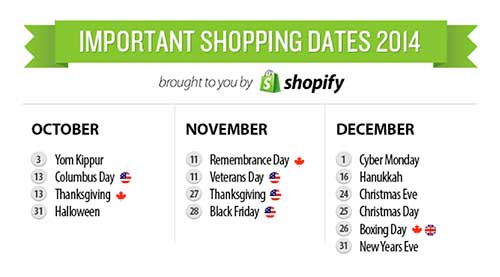
    Technically, you as an advertiser should be thinking similarly (thoughts about holiday shopping and marketing do start in October), but it’s certainly ok if you’re late to the party! Everyone knows the real “gifting” takes off around Thanksgiving and Black Friday.
    ImportantShoppingDatesImage

    That being said, there are certain days that have evolved online regarding holiday shopping. If you’re into e-commerce, you’re already familiar with Cyber Monday, but it might help to organize your holiday advertising efforts even more granularly, as every year there seem to be more “dates to remember.”

    1. Black Friday – November 28th

    2. Cyber MondayDecember 1st – keep in mind: Facebook announced that this year, 25% of online shoppers will place their orders from a mobile phone on Black Friday and Cyber Monday! (https://www.facebook.com/business/success).

    3. Green Monday – December 8th – usually the shipping cut off for most postal outlets to get standard-shipped packages to customer before Christmas.

    4. Free Shipping Day – December 18th – a one-day event held in mid-December. Merchants are encouraged to offer free shipping with guaranteed delivery before Christmas. Like I said earlier, don’t think free shipping alone will give you an edge above everyone else – but it certainly helps! Sign up to be listed as a participant of Free Shipping Day here.

    5. Super Saturday – December 20th – the last Saturday before Christmas, Super Saturday is a big revenue day, as it technically marks the end of the shopping season that is considered to begin on Black Friday. Super Saturday targets last-minute shoppers. Typically, this day is a good day to offer one-day sales in an effort to accrue a great deal of last-minute Christmas revenue.

    6. Boxing Day – December 26th – As mentioned in #5, people are opening the new devices they received over the holidays, downloading apps, and/or looking to trade gifts in for something else. Online and in-store advertisers oftentimes offer deeper discounts on remaining merchandise, which can be a great way to get rid of leftover inventory.

    7. Social Media Presence is Crucial.

    GrinchMemeSocialImage

    The holidays are a very popular time for social media presence; your audience is online more often, whether it’s for shopping or to connect with friends and family. Therefore, make sure you increase your presence as well! Up your post load, produce more articles, and sponsor more updates to make sure you’re seen by your target audience and to show them you’re not “out of office” for the holidays.

    However, you may have to do some shopping yourself in order to make this happen. Advertising inventory prices will be rising for the holidays across Facebook, Twitter, and LinkedIn, so you must decide if you want to expand your budget in order to adequately boost your social media involvement.

    Before you grinch out on this, consider that your potential profit might be worth a slightly (and temporarily) elevated budget. After all, Facebook reports that 46% of shoppers who used Facebook before shopping used it to look for deals, promotions and holiday gift ideas, and they often discovered these things through their news feed. (Facebook Holiday Webinar).

    8. Stay organized!

    This last “tip” isn’t so much about online advertising as it is about advertising in general! Like anything concerning your business, staying organized is key, but it can be even trickier around the holidays when we seem to be juggling our personal and professional lives more than usual.

    Regarding your online presence, we recommend creating a promotional calendar before the month even begins. Know what days you’d like to run what ads, and become as comfortable as possible with the seasonality of the month. You can also take advantage of the ad-scheduling features on certain ad platforms – this way, you can create your ads, post promotions, sponsored updates, etc. ahead of time and then schedule them to run on certain dates/times without you having to be around the computer.

    Simply put, plan ahead as much as possible! This will leave less work for you to do later when you’re trying to baste a turkey, or when your luggage inexplicably gets lost by the airline…

    Now some might think this goes without saying, but remember to breathe. You do not need to implement all of these suggestions into your ad strategy! Whatever you do decide to do this holiday season, the most important thing is to document and remember the results for next year and to ultimately strengthen your marketing strategy. Just because it’s the holiday season doesn’t mean you need to stress about your advertising. But unlike the holidays, just try not to get your family too involved.

    SIHappyHolidaysImage

    Image Sources:

    Brace Yourselves

    Important Shopping Dates

    The Grinch

  • Help! I’m A Cyborg And Nobody “Likes” Me

    Technology is redefining human connections, which has made social media a crucial ingredient in any marketing strategy. With many different outlets available used to communicate with your audience, how do you choose the best approach for your business? When sitting behind a computer screen, it is easy to forget the purpose of B2C marketing – building and maintaining meaningful relationships with your customers.

    Here are some quick tips to create that connection through your social media campaign.

    Be Receptive

    Always be conscious of how your product and service will benefit the customer. Keep these benefits in mind when encouraging your customers to engage in your promotion and be receptive to their feedback. The beauty of social media is that it allows you to create a more personal approach to marketing those benefits, receiving feedback from the consumer and personally responding to his or her thoughts or concerns within minutes, demonstrating your excellence in customer service.

    FacebookPeopleFirstImage

    Be Genuine

    It is critical that the voice and verbiage used for your campaign is coming from an authentic place. Eliminate the robotic, scripted tone and your audience will feel like they are not conversing with a business, but with a person who actually cares about their needs.

    HaveALotOfFeelingsImage

    Be Direct

    In this fast-paced society, your audience is most likely pressed for time and multitasking. Give them stimulating content in a short, digestible format that they will consider worth their time. Your mindfulness and appreciation for their time can go a long way.

    Keeping your campaign personal, and showing your gratitude to your customers in a genuine way can be the key to a successful social media campaign. As long as your customer service is consistent with your social media efforts, your business can build and maintain those essential relationships.

    Image Sources:

    Thanks to Buzzfeed for the Mean Girls gif and for the Facebook “People First” image.

    Other Source:

    LinkedIn’s Social Media & Emotional Brand Attachment Case Study


  • Five For Friday: A Very Twitter Christmas, Facebook Gets Scroogy With Likes, & More!

    iphone5borderimage

    1. Are Twitter Users the Most Efficient Holiday Shoppers? – MarketingLand

    Given their 160-character count limit, Twitter users are clearly efficient communicators. And now, we are learning that they are super efficient holiday shoppers as well. The popular social platform released a study highlighting its ability to influence shoppers in their decisions on retail establishments and which specific items to purchase. 54% of users are more likely to purchase an item if they saw it advertised on Twitter. The study also shows that Twitter users not only shop earlier, but they also shop more frequently for holiday purchases. I guess now we know where retail shops should be marketing during the holidays.

    2. Secrets to Properly Linking on LinkedIn – Business2Community

    We all have a LinkedIn page. We’ve entered in our resume details, uploaded a picture, maybe got endorsed by a friend or two, and received a glowing recommendation from our moms, but now what? How exactly can you benefit from this?

    Here are 12 secrets from LinkedIn pros! Adopting some of these habits will help you increase your presence and improve your network. Some tips include:

    • Message people in groups for free!
    • Share useful and relevant news (mainly for attention).
    • Use tools, like FiveHundredPlus, to stay organized.
    • Follow first; Like, Share, and Comment second.

    LinkedIn can be confusing, and it may seem unnecessary, but with the growing number of companies and business people joining and actively using the platform, it has become more beneficial to understand how it works. Creating a substantial network will help in the long run. So, go forth and connect!

    3. How-To: The Most Perfect List Post – Business2Community

    Everyone loves lists! However, with their increasing popularity and Internet users’ ever-prevalent short attention spans, how do you keep readers reading?

    Business2Community offers a near-perfect list of tips for creating the best and most effective list post. There are several things to consider when writing out a list, and remember, every detail matters. Some of the tips provided are:

    • Always, always, always have an introduction and a conclusion (excluding the distinguished SI Five for Friday posts).
    • Pick the right number (10 instead of 5, 7 instead of 8). Trust us, it’s science.
    • In the title, use “10” instead of “ten.” Seriously, it matters.
    • Write longer posts.

    These tips are guaranteed to help make your list go viral, or at least make sure your readers actually read through to the end.

    YouArePerfectImage

    4. The End of Facebook Like-Gate as We Know It – MarketingLand

    Say goodbye to the days of entering a contest on Facebook with the simple click of a Like button. Facebook engineers have dismantled the ability for companies to use Likes as the entrance fee for contests and prize drawings.

    The effects of this are two-fold. For one, companies will now have to engage users on a deeper level in order for them to connect with the business. This change effectively ends the use of “artificial incentives.” Two, they also expect to see more conclusive results when determining demographics, as opposed to the scattered results received when companies were giving away iPads haphazardly to gain social media presence.

    However, it is also being argued that ending Like-gating is solely meant to gain revenue for Facebook. The belief is that companies will pay for Likes if they have to. And now, they have to.

    5.  What’s the About Page Supposed to Be About? – CopyBlogger

    The About page seems pretty self-explanatory, but it has actually evolved over the years and is no longer a place for you to just describe your business/products. For a more effective page, use it to start a conversation with your reader and emphasize to potential clients that you have what they are looking for. Because this is often the most visited page on your site, it is wise to grab the reader’s attention from the get-go. Let your personality shine! This will assure your visitors that they are in the right place, and they are more likely to continue browsing your site.

    There are 5 steps to creating a superior About page:

    1. Engage with readers by introducing your personality and humor on the site. Don’t be afraid to be different.
    2. Get into the readers’ heads. Make them think you’re reading their mind by showing them you have exactly what they are looking for.
    3. Brag, but humbly. Include some testimonials so others are singing your praises.
    4. Near the end, insert a bit of your biography. Make sure you express why you do what you do, and why you love it.
    5. Call to action! Invite your readers to sign up for your email list, call, or contact you. Most of the time, they will!

    Image Sources:

    Thanks to Mariah Summers for the “You Are Perfect” gif.