Tag: social media marketing

  • Instagram SEO Playbook: How to Win Over Google and AI Search

    Instagram SEO Playbook How to Win Over Google and AI Search

    This post was updated by Rebecca Michelet on 12/15/25 to reflect current best practices. It was originally published on 11/13/25.

    Key Insights

    • Instagram is now part of the search landscape. Google’s indexing update means public Instagram content can appear alongside websites, articles, and videos, expanding what visibility means for every brand.
    • Discovery depends on relevance, not reach. Algorithms now reward clear, consistent context that helps users find relevant content faster on both Instagram’s Explore page and in Google search.
    • Social and search now shape each other. The lines between platforms are disappearing, and visibility depends on how well your strategy connects storytelling with search intent.
    • Authority is earned through clarity and consistency. Profiles, captions, and visuals that reinforce who you are (and what you’re known for) help algorithms and audiences recognize your expertise.
    • AI is redefining what it means to be found. As generative tools reference social content in answers, brands that post with intention will lead the next wave of discoverability across search and AI.

    Search engines are getting extra social lately.

    Google’s been busy expanding its reach, and it’s now pulling public Instagram posts and profiles directly into search results.

    Your feed just became part of the search universe. For brands and creators, that means every post has the potential to rank, not just resonate. The problem? Most treat Instagram strategy like an art project, not a search tactic.

    That gap decides who shows up first and who never shows up at all.

    It’s time to post with purpose. This playbook teaches you how to treat your Instagram like SEO, built to rank, not just scroll.

    What Is Instagram SEO?

    Instagram SEO is the strategy behind making your content findable, both inside the app and beyond it. It’s how you craft profiles, captions, hashtags, and visuals so that they not only attract followers but also earn visibility in search results.

    The goal is simple: help people (and algorithms) understand what your content is about and why it matters.

    Instagram SEO has entered a new era

    Traditionally, Instagram SEO focused on the platform’s own search function, optimizing for in-app discovery through relevant keywords, hashtags, and engagement. But that world just got much, much bigger.

    In July 2025, Google began indexing public profiles, posts, and Reels, giving your content a direct line to the world’s largest search engine.

    And it doesn’t stop there. AI tools like ChatGPT, Gemini, and Google’s AI Overviews are beginning to pull Instagram content into their own generated answers, referencing social posts alongside articles and web pages.

    That means your captions, keywords, and hashtags now have a dual job:

    • Engage your audience (the scroll-worthy part)
    • Signal context to search and AI systems that decide what to surface (the rank-worthy part)

    Why Search and Social Can’t Be Separate Anymore

    Every post now speaks two languages: one for people and one for algorithms. The more those messages align, the easier it is for both to recognize your brand as relevant and trustworthy.

    Search and social are no longer parallel strategies. They’re parts of the same visibility engine. What earns engagement on Instagram can reinforce authority in search, and the clarity of your SEO can help social content reach new audiences.

    Together, they create a loop of discoverability that rewards consistency, clarity, and intent.
    image of an instagram logo

    How to Optimize Instagram for Search and AI Visibility

    Now that Instagram feeds into Google and AI results, optimization isn’t optional. Every detail on your profile and in your posts shapes how algorithms understand your brand and where you show up.

    Here’s how to make your Instagram work smarter for search.

    Optimize your profile for search context

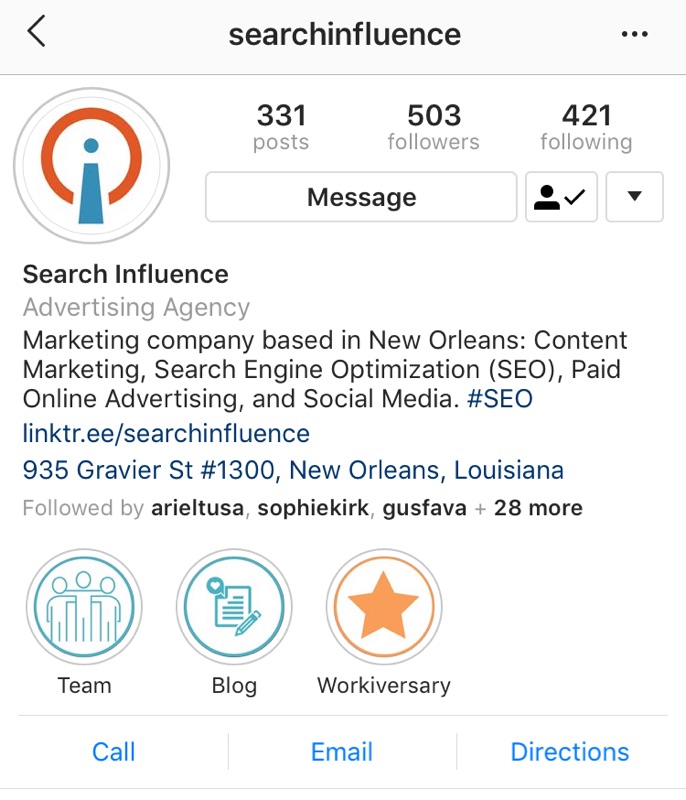
    Your profile is where discoverability starts. It’s both a visual first impression and a key data point that search engines and AI tools use to understand your brand’s relevance and authority. A strong profile bridges your social identity with your search presence, giving users and algorithms the context they need to trust what they’re seeing.

    What to do:

    • Use a keyword-rich bio that includes your brand, industry, and (if relevant) your location. Write naturally, but make sure the words you’d want to rank for appear early.
    • Keep your name, handle, and profile image consistent across Meta platforms (and anywhere else your brand appears). Consistency builds recognition and reinforces entity alignment.
    • Add a link in bio that leads to a meaningful destination. Link to key internal pages such as services, program listings, or resource hubs that reinforce what you want to be known for.
    • Complete every profile field, including your category, contact details, and business information. These small details help confirm legitimacy and topical authority for both users and search crawlers.
    • Treat your highlights and pinned posts as secondary signals. Label them clearly with relevant keywords or phrases that reflect your expertise.

    An optimized profile becomes the anchor of your Instagram SEO strategy and the foundation for everything else to build upon.

    Write captions that reflect search and AI language

    Instagram captions carry their weight and more. They tell both your audience and search engines what your content means and why it matters. The right phrasing can help your post resonate with people while signaling relevance to AI tools that decide what to surface.

    What to do:

    • Speak like your audience. Use plain, direct phrasing that mirrors how people search. A caption like “what to do during a weekend in New Orleans” performs better than one filled with stiff, bleak terminology.
    • Use long-tail keywords with intent. People search in phrases, not single words. Using specific, natural keywords helps your posts surface in both Google and AI-driven results.
    • Add clarity through structure. Algorithms read relationships the way people do (who’s doing what, and for whom). Think in patterns like subject, action, object: “Search Influence helps universities improve SEO visibility.”
    • Answer real questions. Captions that solve problems or explain value are easier for both users and algorithms to understand: (ex, “what to do after a car accident”)
    • Match your on-screen text. Keep phrasing consistent across Reels, carousels, and captions so both people and machines connect the dots.
    • Lean on proven formats that teach or explain. AI tools favor content that answers questions directly, and people tend to share it more, too. Think FAQ or Q&A Reels, “how-to” carousels, and tip-based lists.

    Captions written with intention earn visibility in both the feed and search results, helping your audience find you faster and engage for longer.

    Use hashtags, alt text, and structure to reinforce meaning

    Relevant hashtags and alt text help algorithms understand the context behind your visuals. They give search engines, AI tools, and even screen readers clearer cues about what your content represents, which improves both accessibility and visibility.

    What to do:

    • Focus on relevance. Use up to three highly relevant hashtags that accurately describe your content and the community you want to reach.
    • Avoid hashtag stuffing. The practice of adding long lists of tags for reach is no longer effective. Instagram’s new hashtag limit signals the end of that trend. Hashtags will still help categorize content, but they won’t meaningfully drive reach. Precision and clarity now matter more than volume.
    • Prioritize a solid keyword strategy. Strengthen discovery by using clear, descriptive keywords in your captions, on-screen text, audio, and bio.
    • Write natural alt text that describes what’s on screen while subtly reinforcing your topic or entities. Think of it as another way to teach search engines what your post is about.
    • Keep a logical post structure. Use line breaks, spacing, and clear formatting so both users and algorithms can quickly identify key ideas. Clean captions signal clarity, which AI-powered search engines reward.

    Each of these small details adds up to stronger discoverability. When your visual, written, and structural cues all point in the same direction, search engines and AI tools know exactly how to classify your content and who should see it.

    Strengthen interlinking between platforms

    Search engines and AI tools use connections between your website and social profiles to verify identity and relevance. When your Instagram activity points back to your site (and your site points back to Instagram), it helps algorithms confirm that both belong to the same trusted entity. Those links also give users clear paths to learn, engage, and convert.

    What to do:

    • Link with purpose. Use bio links, Stories, and post CTAs to direct users to pages that expand on your content, such as articles, services, or case studies.
    • Embed with intent. Add Reels or posts to your website where they strengthen context, such as testimonials or event highlights.
    • Stay consistent. Keep the same handle, URLs, and naming conventions across platforms to help algorithms and users connect the dots.
    • Reference across channels. Mention your website in captions or Stories when relevant, and link to Instagram posts from your site when they add visual context.

    When those signals align, both users and search engines can follow a clear trail of relevance, one that reinforces authority across every platform.

    Monitor and test your visibility across search and AI tools

    Visibility is always shifting. Regular testing helps you see where your Instagram content appears across Explore pages, Google search results, and AI tools — plus, how those systems interpret it.

    What to do:

    • Search for yourself. Each month, test branded and topic-based prompts in Google. Note when your posts or profile appear.
    • Watch for mentions and citations. Check if AI summaries reference your brand, posts, or captions. These signals show your content is being recognized as a trusted source.
    • Identify what works. Look for patterns in visibility to see which formats, keywords, or topics consistently surface.
    • Refine and repeat. Use your findings to adjust your captions and hashtags.

    Treat this step as ongoing maintenance. The more you measure, the faster you can fine-tune what helps your content rank and resonate.

    Advanced Instagram SEO Strategies

    Once your Instagram profile and posts are optimized, the next phase is strengthening how your brand connects across the web. These advanced Instagram SEO tips focus on off-page and contextual signals, which act as the cues that help Google and AI systems verify your identity, recognize your authority, and include your content in richer search experiences.

    Use schema and structured data to strengthen Instagram visibility

    Schema markup doesn’t live inside Instagram, but it works behind the scenes to connect your social presence to your website’s authority. By adding structured data to your site, you’re giving Google and AI platforms the proof they need to confirm your Instagram account belongs to the same verified brand.

    What to do:

    Start with foundational schema types like Organization, Person, and Event to define who you are and what you do. Within that markup, use the sameAs property to list your verified social URLs, like Instagram, Facebook, LinkedIn, and others.

    Example:

    "sameAs": [
    
      "https://www.instagram.com/searchinfluence",
    
      "https://www.facebook.com/searchinfluence",
    
      "https://www.linkedin.com/company/search-influence/"
    
    ]
    

    This creates a direct line between your website and your social profiles, reinforcing brand trust and helping algorithms understand how your content fits into larger entity networks. It also supports accurate attribution in AI-generated search results, where structured data helps your content surface and be cited correctly.

    Build authority through mentions and tagging

    Mentions and tags strengthen your network of credibility. Every time you connect with another verified account, you’re giving algorithms extra context about your brand’s relevance and relationships.

    What to do:

    • Tag collaborators, partners, and organizations in posts, Reels, and Stories to build visible connections that reinforce trust and expertise.
    • Encourage reciprocal mentions through joint campaigns, shared content, or reposts to show consistent engagement between verified entities.
    • Focus on relevant tagging. Partner with accounts that reflect your niche, values, or audience to expand visibility in meaningful ways.

    These authentic connections give search engines and AI tools clearer signals of authority, helping your brand appear alongside other trusted names in search.

    Align content calendars with search trends

    Search and social trends shift fast. Aligning your Instagram schedule with real-time search demand helps your content stay visible when audiences are actively exploring related topics.

    What to do:

    • Study what’s trending. Use tools like Google Trends and TikTok Creative Center (TikTok and Instagram trends often go hand-in-hand) to identify keywords, questions, and topics gaining traction in your space.
    • Spot crossover moments. When a topic starts spiking in Google or TikTok, create a Reel or carousel that adds your brand’s take. This timing boosts your chance of appearing in both social feeds and search results.
    • Plan for peaks. Build posts around predictable cycles (seasonal interest, product launches, or industry events) to meet audience curiosity right as it grows.
    • Revisit quarterly. Review analytics and search trends every few months to refine your calendar and ensure content reflects current interest signals.

    By syncing your posts with how people search and engage, your Instagram feed becomes part of the larger discovery landscape, showing up where curiosity, relevance, and visibility meet.

    Applying Instagram SEO in Higher Education

    The same strategies that help brands stand out now shape how universities are discovered online. As Google and AI tools begin indexing Instagram content, higher education marketers have a new opportunity to influence visibility across both search and social.

    Findings from AI Search in Higher Education: How Prospects Search in 2025 by UPCEA and Search Influence show how search behavior is evolving:

    • Social media plays an expanding role in program discovery.
    • Nearly 7 in 10 respondents said regular social recommendations influence what they explore/purchase.
    • Among learners using social media to research continuing education, 35% said they would use Instagram.

    For colleges and universities, that means Instagram content now supports both storytelling and search visibility. Optimized posts can appear in Google results and AI-generated summaries, helping prospective students encounter your institution at the moment curiosity begins.

    Higher education applications

    To turn visibility into value, higher education marketers need to bring SEO precision to Instagram strategy. Applying search principles to social content helps universities connect what they share to how prospects search.

    Here’s how to put that strategy into action:

    • Showcase programs through Reels. Use short-form video to highlight classroom experiences, alumni achievements, and student life moments that illustrate your institution’s impact.
    • Tag with purpose. Include degree names, job titles, and institutional accounts to help search engines and AI tools recognize relationships between people, programs, and career paths.
    • Share faculty insights. Turn research, thought leadership, or current-event commentary into accessible posts written with context that supports search visibility.
    • Guide discovery with links. Direct users to program details, faculty bios, or admissions pages to capture intent and move prospective students toward the next step.

    Institutional benefits

    When used strategically, Instagram becomes part of the enrollment pipeline. Optimized content strengthens visibility at the awareness stage and builds the kind of credibility that influences applications and conversions.

    The impact shows up in three key ways:

    • Wider reach. Optimized Instagram content can surface in Google results and AI-generated summaries, expanding where prospective students encounter your institution.
    • Greater credibility. Consistent tagging, structured profiles, and cross-platform links help search engines recognize your university as a trusted source.
    • Quality engagement. Posts written with SEO awareness attract prospects already interested in your programs and lead them toward inquiry and enrollment.

    Common Mistakes to Avoid

    You’ve mastered the do’s. Time for the don’ts.

    Even small missteps can make your Instagram content harder to find. These are the habits that quietly weaken your visibility on and off the platform:

    • Keyword and hashtag overload. Overstuffing captions signals spam and makes it harder for algorithms to identify what matters. Keep hashtags intentional and tied to context.
    • Unclear or incomplete bios. Leaving out details like your industry, location (if relevant), or brand focus prevents search engines from understanding who you are.
    • Vague or missing alt text. Alt text helps algorithms interpret your visuals. Use it to describe what’s on screen in clear, specific language.
    • Trend chasing without strategy. Jumping on every viral sound or topic dilutes your relevance and confuses your audience.
    • No visibility tracking. Skipping regular tests in Instagram search bars, Google, and AI tools means missing out on what’s actually helping you rank.

    Attention to detail beats post volume every time. Keep your structure clean, your context strong, and your brand voice consistent across every update.

    someone using the instagram app on their phone

    FAQs About Instagram SEO

    Does Google index all Instagram posts?

    No, Google only indexes public Instagram profiles, posts, and Reels. Private accounts and Stories remain inaccessible to search engines. Indexing is determined by visibility settings and engagement signals, so consistent public activity increases your chances of appearing in search results.

    How long does it take for Instagram content to appear in Google results?

    Indexing can take anywhere from a few days to several weeks. Timing depends on how often Google crawls your account and the authority of your connected website or entity. Keeping your profile active, public, and properly linked through structured data can speed up discovery.

    What’s the difference between Instagram SEO and social media marketing?

    Instagram SEO sits at the intersection of social media marketing and search engine optimization. It focuses on improving visibility and discoverability within both the Instagram app and external search engines. In contrast, social media marketing encompasses broader goals like engagement, audience growth, and storytelling across social channels.

    How can I tell if my Instagram content appears in AI Overviews or ChatGPT responses?

    Search your brand or topic-related prompts directly in Google, ChatGPT, and Gemini. If your Instagram content or handle appears in summaries, citations, or linked examples, it’s being referenced. Regularly track visibility to identify which posts or keywords are driving the most inclusion.

    Can Search Influence assist with social media marketing?

    Yes. Search Influence advises on strategies to help you apply SEO principles to your social media presence. Our team provides recommendations that enhance visibility and connect what you post to how your target audience searches.

    Let’s Talk Your Instagram SEO Strategy

    Visibility is shifting fast. As Google indexes Instagram content, every post influences what people see, when, and where.

    Search Influence helps you stay ahead of the social search shift. Our experienced team advises on strategies that position your brand to capitalize on trends and lead in search, not lag behind it.

    Now’s the time to align your social strategy with search. Let’s chat about what proper Instagram SEO can do for you.


    Images:
    Unsplash
    Unsplash

  • In-House Marketing vs. Agency Teams: Build a Strong Strategy Together

    In-House Marketing vs. Agency Teams: Build a Strong Strategy Together

    This post was updated by Paula French on 2/28/25 to reflect recent trends and best practice. It was originally published on 12/6/2018.

    Working professionals giving each other a high five

    Key Insights

    • As brands grow, marketing demands increase, making it difficult for internal teams to execute strategy, create content, analyze performance, and keep up with industry shifts all at once.
    • Agencies provide specialized expertise and resources that complement in-house efforts, allowing internal teams to focus on core business priorities and guide overall strategy.
    • Combining internal marketing strengths with agency support creates a scalable, results-driven strategy that adapts to changing needs without overloading your team.

    Internal marketing teams are often expected to manage it all — strategy, execution, and analysis — on top of keeping up with regular day-to-day tasks. But as the workload grows, so does the risk of burnout, missed priorities and deadlines, and campaigns that don’t perform as expected. The faster the industry evolves, the harder it is for stretched-thin teams to keep up, leading to outdated strategies and missed opportunities.

    While outsourcing can help lighten the internal load, some in-house teams hesitate to seek out agency support, fearing they’ll lose control over their marketing strategy. In reality, internal teams and agencies don’t have to compete. They can leverage their respective strengths to create an agile, focused, and impactful marketing approach.

    If you’re deciding between keeping all of your marketing in-house or partnering with an agency, here’s why you don’t have to choose just one, plus how to balance both for the best results.

    How Can an Agency Help Me If I Am a…

    Single-person marketing team

    Instead of feeling like a one-person show, you’ll have a team to bounce ideas off, refine strategies, and make sure nothing slips through the cracks while improving your results.

    Single-person marketing “teams” can feel isolated and underappreciated. Your organization’s leaders expect you to handle it on your own, but as you’ve tried to run campaigns, manage vendors, write content, plan the strategy, update your website, and still get results, you find two challenges:

    1. There isn’t enough time to do it all yourself.
    2. One person rarely has the skills to be strategic, create graphics, update a website, monitor results, and evaluate and manage vendors.

    A marketing agency takes the weight off your shoulders by acting as an extension of your team. They bring the time, skills, and experience to tackle everything from strategy planning to execution and performance tracking, so you’re not stuck doing it alone.

    Business leader

    No more juggling ads, content, and campaigns on the fly. Partnering with an agency ensures your marketing is always working, even when you’re too busy to think about it.

    When you’re responsible for driving the business forward, marketing is just one of many things competing for your time. Whether you’re managing it all yourself or working with local media vendors, it can be difficult to stay strategic and aligned with your goals.

    You may often feel that:

    1. Marketing takes a back seat when business operations call for urgent attention.
    2. You got into your field to do what you love, not market what you love.
    3. You are reacting to promotional ideas as they cross your desk, with no real strategy about how to best reach your customers.

    Being a leader means wearing many hats, and marketing often ends up as an afterthought. An agency helps shift it from a scattered, reactionary task to a well-planned strategy that actually supports your growth.

    Medium-to-large marketing team

    Even with a well-staffed, in-house department, keeping up with every aspect of marketing can be a challenge. Between aligning team members, executing campaigns, and adapting to industry updates, it’s easy to get stuck in the weeds and lose valuable time for strategy. You may find that:

    1. Your internal marketing team needs support in strategy and direction.
    2. The time it takes to execute tactics gets in the way of strategically analyzing what is truly working (and what is not).
    3. You struggle to keep up with new and changing marketing technologies and ideas.

    Partnering with a marketing agency helps bridge these gaps by bringing fresh insights, specialized expertise, and extra hands where you need them most.  Whether it’s adjusting your strategy, handling time-consuming execution, or keeping your team ahead of evolving trends, they’ll keep your marketing in check and on track without overloading your internal resources.

    Higher education marketer

    Instead of constantly shifting from one urgent task to the next, an agency’s support helps you be more intentional with your marketing.

    Higher education marketing is a constant balancing act. One minute you’re fine-tuning messaging for a new degree program, the next you’re trying to boost student engagement — all while keeping an eye on enrollment goals. With so many priorities commanding your attention, it’s easy to feel like you’re always in reactive mode and that:

    1. Your marketing efforts are spread too thin. You’re trying to serve prospective students, current students, and alumni all at once while balancing multiple degrees and programs.
    2. Data analysis and performance reporting fall by the wayside due to time constraints.
    3. Meeting ambitious enrollment goals feels unattainable without additional resources or expertise.

    An agency will take on recruitment and retention efforts, ensuring you reach the right students at the right time. With deeper data insights, you’ll make informed strategic decisions, focusing your time and budget on what drives real results.

    Want to find out if partnering with an agency is right for your institution? Take our Higher Ed SEO Quiz to discover your best staffing approach based on your current resources, strategy, and performance.

    In-House Marketing vs. Agency Partnerships

    A person giving a presentation in a conference room

    Balancing in-house marketing with agency support lets you stay involved while tapping into advanced expertise. Your team knows your brand best, while an agency brings the skills, strategy, and execution power to amplify your efforts.

    At Search Influence, many of our clients handle routine tasks internally while relying on us for more strategic, high-impact initiatives. The key is knowing which responsibilities are best handled by your in-house team and which most benefit from external support.

    What work should my in-house marketing team handle?

    Identifying unique stories that can be included in marketing

    Great marketing starts with great stories, but you can’t share what you don’t know.

    As part of your internal tasks, build relationships with departments and stakeholders across your organization. This ensures you stay informed of exciting news and developments that bring your marketing to life.

    For example, let’s say you are marketing for a university, and one of your instructors learns that one of her students won a research award. Would your marketing team hear about it?

    If you educate your staff on your marketing goals and build vital relationships, you’ll be less likely to miss valuable stories that strengthen your outreach.

    Serving as spokespeople for public relations and media opportunities

    Having the right people represent your organization in the media bolsters your brand’s credibility and reach. Instead of scrambling when a press opportunity arises, establish a roster of internal experts who can confidently speak on key topics.

    Identifying multiple spokespeople prevents over-reliance on a single person, speeds up media responses, and ensures you always have a knowledgeable representative prepared to engage with the public.

    By designating these spokespeople internally, you streamline the process and create a sense of ownership within your team. When staff members are prepared and empowered to speak on behalf of the organization, it fosters consistent messaging and a proactive approach to media inquiries.

    Creating day-to-day organic social posts

    Social media is where you build a genuine connection with your audience, and staying consistent is what’s key to maintaining that bond. Hubspot reports that social media is the preferred means for product discovery among consumers aged 18 to 44, making routine posting all the more important.

    For businesses with the right in-house resources, managing daily posts can be straightforward. But when time or expertise is limited, outsourcing certain aspects to an agency — like content scheduling, caption writing, or hashtag strategy — can help maintain consistency without adding to your team’s workload.

    You may find that capturing photos or videos in-house and passing them along to an agency for posting works best. This ensures fresh, timely content without the hassle of managing every detail.

    When should I hire a digital marketing agency?

    To improve your website’s SEO and increase organic traffic

    If your in-house team can’t keep up with the nuances of SEO, it’s time to bring in the experts.

    SEO is fundamental to getting your site seen, but it’s far from a one-size-fits-all solution. It takes ongoing attention, work, and a deep understanding of both on and off-site SEO tactics to rank high and stay ranked high.

    An agency will create a comprehensive SEO strategy that aligns with your specific goals, covering key areas like:

    • Deep keyword research to target the right audience
    • On-page optimization to improve visibility, from meta descriptions to header tags
    • Content creation that considers what your audience is actually searching for
    • Site performance improvements, from navigation to mobile optimization
    • Building valuable backlinks to boost your site’s authority
    • Performance tracking to refine strategies and stay ahead of the curve

    When an agency handles these technical details, you free up your team to focus on bigger-picture goals, knowing that your SEO is in the best hands.

    To manage and optimize your digital advertising campaigns

    With an agency managing your digital ads, you’ll rest easy knowing your budget is being spent efficiently, your ads are reaching the right people, and your strategy is always evolving to stay competitive.

    Digital advertising is one of the fastest ways to get your brand in front of the right audience. However, making the most of it is no easy feat. If you’re struggling to create effective campaigns, manage budgets, or keep up with performance tracking, an agency will give your campaigns the focus they need.

    Applying their specialized expertise, an agency positions your brand for paid advertising success by:

    • Crafting targeted campaigns on platforms like Google Ads and Meta
    • Selecting and optimizing keywords for maximum visibility
    • Writing engaging ad copy and designing eye-catching visuals
    • Leveraging advanced targeting to refine audience demographics and interests
    • Setting and managing budgets to ensure your ads reach the right people without overspending
    • Testing different ad variations to identify the most effective strategy
    • Monitoring and adjusting campaigns to keep things running smoothly

    To monitor campaign success through advanced analytics tracking and reporting

    Let an agency take the guesswork out of ad management, using data to refine and enhance your campaigns for maximum performance.

    Analytics and lead tracking require more than just simple data collection. It takes advanced know-how to make sense of your metrics, assess your performance, and use the insights as fuel for your future strategy. If you’re feeling lost in a sea of metrics, an agency will interpret the numbers and guide you toward smarter decisions.

    Trust your advanced tracking and reporting to an agency when you need support with:

    • Tracking leads from forms, calls, and other inquiries
    • Identifying the top-performing marketing channels to allocate resources effectively
    • Analyzing lead quality to improve conversion rates and maximize ROI
    • Conversion tracking set-up to measure sales, sign-ups, and other key outcomes
    • Making sense of your data with customized reports and KPI dashboards 
    • Conducting an ROI analysis to showcase the effectiveness of your efforts
    • Optimizing your campaigns based on performance data

    To craft and execute customized email marketing strategies

    With an agency’s guidance, your email marketing will be a well-oiled machine that consistently delivers high-quality, results-driven campaigns.

    Email marketing often gets treated as an internal “check the box” task without much thought beyond getting the message sent. But when the average cold email open rate is only 27.7%, it’s clear that every detail matters to help your emails stand out in a cluttered inbox.

    From timing to content, getting it right from the start is how you improve opens, reads, and conversions. An agency helps support your email strategy by:

    • Developing the right mix, whether that’s newsletters, nurture campaigns, or frequent email reminders
    • Curating relevant, targeted content that aligns with recipients’ interests and needs
    • Crafting compelling subject lines designed to increase open rates
    • Designing visually appealing emails that work across all types and prompt clicks
    • Segmenting your audience to send the right emails to the right people at the right time
    • Timing emails to ensure they land in inboxes at peak engagement times

    But I Don’t Want to Give Up Control! How Do I Balance In-House and Outsourced Marketing?

    Still debating between in-house vs. agency marketing, or a hybrid approach?

    For the aspects you are currently handling internally, take a moment and ask yourself if it’s the right responsibility for your business. As you go through each item, think…

    Yes, you CAN do it, but…

    1. Are you doing it well?
    2. Are you doing consistently?
    3. Are you monitoring results and making adjustments?
    4. If you were not spending time on this, what else could you be doing?

    If you’re worried about losing control over your marketing when you outsource, rest assured. While your agency will take the heavy lifting off your plate, you’ll still have the head seat at the dinner table. The best agency for you will integrate themselves as part of your team and include you in the strategy and reporting of results, at a minimum.

    Find Your Right Approach to Working With a Marketing Agency

    Are you feeling stretched thin in your marketing approach?

    When your in-house team partners with an agency, you create a dream duo that distributes the workload, increases your day-to-day efficiency, and grants you the extra bandwidth to achieve sustainable success.

    If you’re a higher education marketer interested in further assessing your ideal marketing approach, check out our Higher Ed SEO Quiz. This 5-question quiz will help you determine whether to outsource your work, keep it internal, or take on a hybrid strategy. In just minutes, you’ll have personalized insights to make informed staffing choices.

    See how Search Influence can help you develop a marketing plan that works for your team today!

  • 10 Winning Higher Education Marketing Strategies

    10 Winning Higher Education Marketing Strategies

    [ez-toc]

    Research shows that 93% of Americans think they are better drivers than average, 90% of teachers think they are more skilled than their peers, and this overestimation is pervasive across many skills — including logic tests.

    For the typical higher education institution, effective marketing strategies are like that.

    Mathematically speaking, it’s not possible for a majority to be “above average.”

    We analyzed the top 10 results in Google for “Higher Education Marketing Strategies” and extracted some really useful learnings. First, I’ll share the most commonly cited strategies, and then give you a skimmable summary of each article.

    Top 10 Higher Education Marketing Strategies

    These strategies are the most frequently cited in the following articles, in order of prominence.

    • SEO (Search Engine Optimization): Emphasized across multiple articles. Ensuring high visibility on search engines is critical for Higher Education SEO.
    • Social Media Marketing: Highlighted in almost all articles for engaging authentically on each social media platform preferred by younger generations.
    • Email Marketing: A recurring theme emphasizing personalization, automation, and AI-powered programs.
    • Video Content: Both short-form and long-form videos, including live streaming and platforms like TikTok and YouTube, are great ways to educate prospective students.
    • Personalization: Tailoring content and communication to individual preferences, including personalized messaging and content.
    • PPC (Pay-Per-Click) and Digital Advertising: Discussed in multiple articles for targeted advertising on platforms like Facebook Ads and Google Ads.
    • Content Marketing: The importance of creating engaging and informative content, such as blogs, podcasts, and videos.
    • Branding: Consistent branding across all marketing channels, including a recognizable voice and image.
    • Chatbots and Conversational Marketing: Highlighted in several articles for real-time, one-to-one connections and instant answers.
    • Data-Driven Strategies: Using data to inform marketing decisions, track KPIs, and understand the audience.

    Digital Marketing and Marketing Strategy Opportunities

    What we learned in the UPCEA SEO research study was that there are some big gaps in the university marketing strategy and the typical higher education website for attracting prospective students.


    When we got deeper into the data, we saw that the higher education industry is overly reliant on certain digital marketing channels. A good marketing campaign addresses the full funnel. To attract students, you must increase search engine visibility, maintain a strong social media presence, and ensure you’re doing all you can to target prospective students.

    So, with all the great tactics and technologies to attract prospective students (virtual campus tours, student ambassadors, and taking advantage of digital technology to highlight student activities), one has to wonder why other higher ed institutions seem to be attracting more new students.

    As I’m sure you’re aware, Google and the other search engines know everything, right? So, I thought, why not let Google guide me? I wanted to see how other higher ed marketers were thinking about the strategy to build brand awareness and get in front of prospective students.

    I think it’s important to take content created by marketers talking about a marketing strategy with a grain of salt. We can, however, learn a lot when we analyze the frequency with which these articles cite specific tactics, platforms, or strategies to get in front of prospective students for educational institutions.

    Effective Higher Education Marketing Strategies

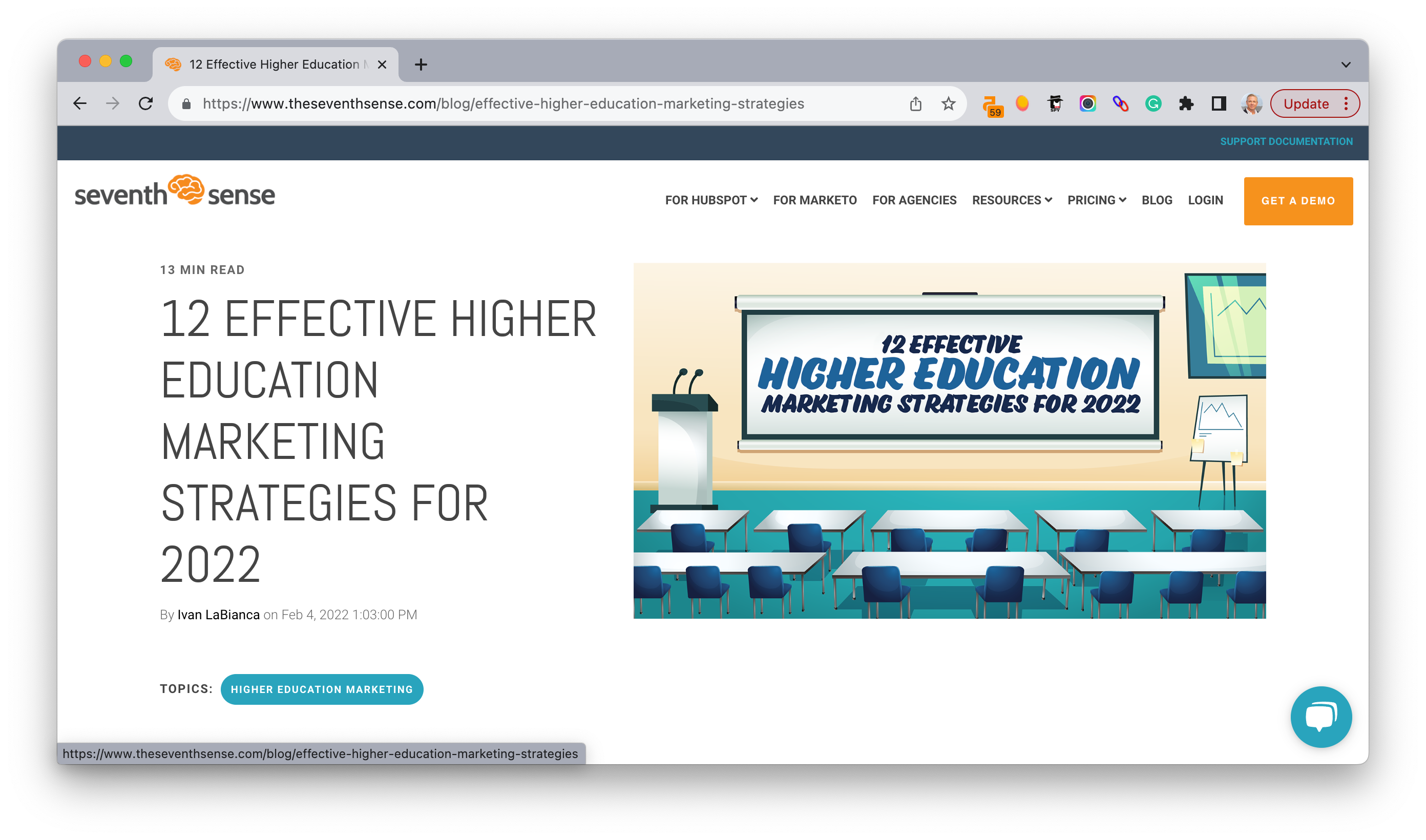
    Effective Higher Education Marketing Strategies -www.theseventhsense.com-blog-effective-higher-education-marketing-strategies

    https://www.theseventhsense.com/blog/effective-higher-education-marketing-strategies

    My perspective: It’s surprising to see this continued focus on the pandemic. From what we’ve seen, things are different — the pandemic is done in most people’s minds, and we’re now in the “new normal.”

    The article discusses the challenges faced by university marketers due to the pandemic and the downturn in undergraduate student enrollment. It provides 12 strategies for higher education marketing:

    1. Centralize Strategy and Reporting: Emphasizes the importance of centralizing marketing expenditures and standardizing KPIs.
    2. Track the Right KPIs: Highlights the importance of tracking call-to-action conversion rates, traffic sources, social media engagement, and cost of acquisition.
    3. Use Marketing Automation: Discusses the benefits of tracking digital interactions with prospective students.
    4. Optimize Your Email Program With AI: Offers email deliverability and engagement solutions.
    5. Improve SEO: Stresses the importance of using relevant keywords and answering prospective students’ queries.
    6. Build a Digital-Friendly Brand: Talks about updating branding to be more digital-friendly.
    7. Live Streaming: Suggests using live streams as an authentic way to connect with potential students.
    8. Personalized Communication: Emphasizes the importance of segmenting audiences and tailoring communication.
    9. Higher Education Marketing on Social Media: Provides various strategies to maximize social media efforts.
    10. Personalized Mobile-Friendly Website: Highlights the importance of a responsive and personalized website.
    11. Chatbots for Higher Education Marketing: Discusses the benefits of using chatbots for immediate responses.
    12. Don’t Forget Visuals and Aesthetics: Emphasizes the importance of appealing visuals for the Gen Z audience.

    Unique Positions:

    • The article emphasizes the importance of data-driven strategies, especially in the context of the challenges posed by the pandemic.
    • It highlights the significance of understanding and catering to the preferences of Gen Z, who are the next in line for higher education.

    Conclusion: The article concludes by emphasizing that marketing shouldn’t be stagnant but should evolve with the university’s overall goals.

    Higher Education Marketing: Strategies and Trends to Know

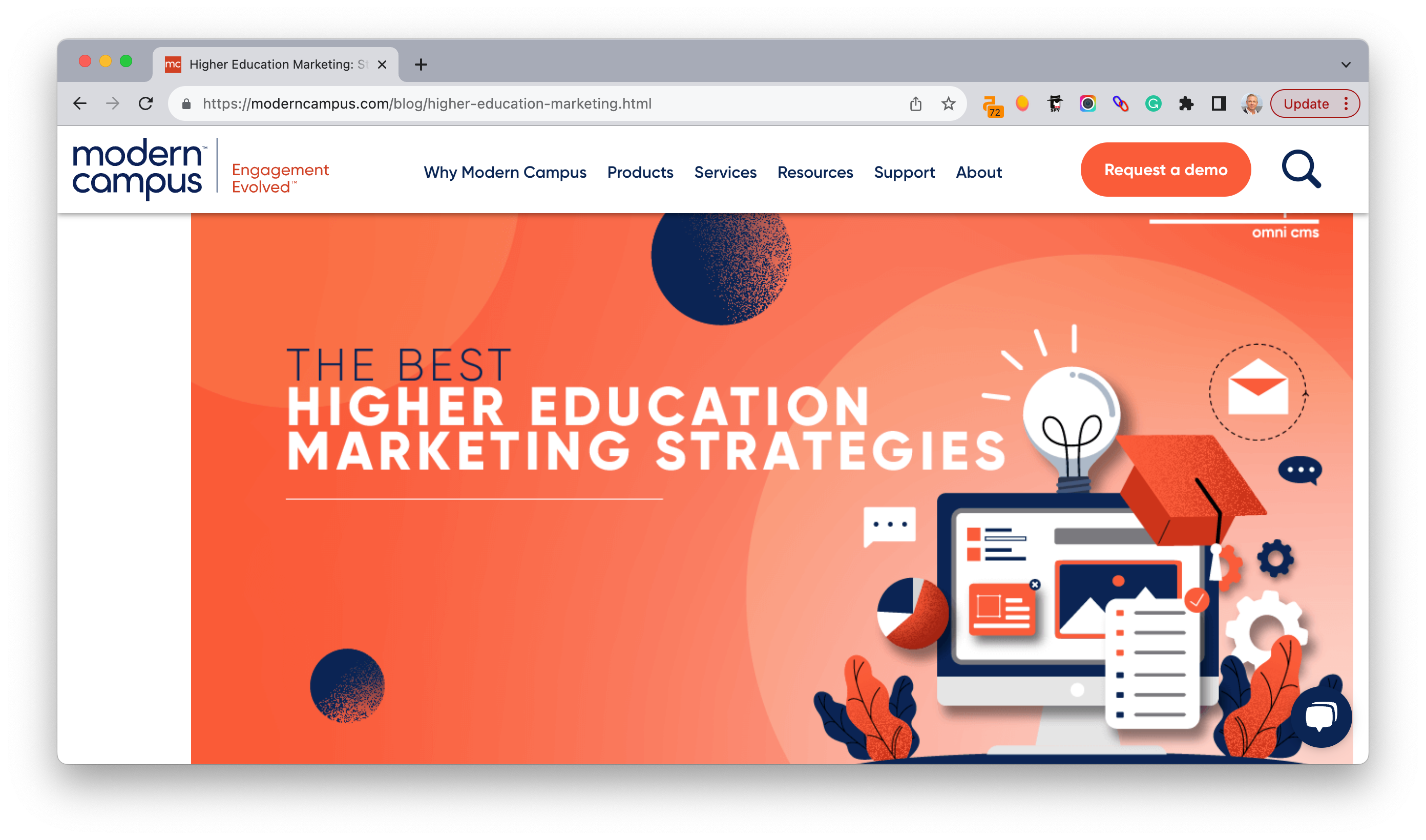
    Higher Education Marketing - Strategies and Trends to Know-moderncampus.com-blog-higher-education-marketing

    https://moderncampus.com/blog/higher-education-marketing.html

    My perspective: It’s interesting to see a focus on the rise of Instagram. TikTok is more timely and clearly the place where Gen Z and beyond are starting their product experiences.

    The article emphasizes the importance of refining marketing strategies for higher education institutions, especially in light of decreasing college enrollments.

    It provides insights into current higher ed trends and offers strategies to enhance student recruitment.

    Key Questions for Your Higher Education Marketing Plan:

    • Identifying target audience and personas.
    • Determining KPIs for engagement.
    • Establishing the cornerstone of the marketing plan.
    • Differentiating from other institutions.

    Platforms to Market Your Educational Offerings:

    • Text messages, especially during the student enrollment process.
    • Social media platforms like Twitter, Facebook, LinkedIn, Instagram, and Snapchat.
    • Email, direct mail, phone calls, and websites.

    Higher Education Marketing Strategies:

    1. Use a CMS Built for Higher Education: Implement a quality web content management system (CMS) tailored for educational institutions to address challenges like outdated content, complicated coding, inconsistent branding, and low search rankings.
    2. Get Current Students Involved: Engage existing students to provide authentic insights into campus life.
    3. Choose a CMS With an Email Module: Emphasizes personalized and targeted email marketing.
    4. Focus on Video Content: Highlights the importance of integrating video content into marketing strategies.
    5. Keep Track of Your Brand: Monitor the digital image and reputation of the institution.
    6. Use the Power of Social Media: Utilize a mix of social media platforms for effective messaging.
    7. Use Videos and Images on Social Media: Emphasizes the growing preference for visual content on platforms like Instagram, YouTube, and TikTok.
    8. Personalize at Scale: Deliver personalized content across various platforms.
    9. Include SEO and Conversion in Your Program Pages: Optimize program pages for search engines and conversions.
    10. Target Parents: Recognize the influential role of parents in students’ college decisions.

    Unique Positions:

    • The article underscores the importance of authenticity, especially when involving current students in marketing efforts.
    • It highlights the shift in the relevance of different social media platforms, noting the rise of Instagram and the decline of Facebook in the context of college planning.

    Conclusion: The article concludes by emphasizing the significance of a quality website and the potential of a CMS to fine-tune a college or university’s marketing strategy.


    Analyzing Effective Higher Education Marketing Strategies

    Analyzing Effective Higher Education Marketing Strategies-www.ama.org-analyzing-effective-higher-education-marketing-strategies

    https://www.ama.org/analyzing-effective-higher-education-marketing-strategies/

    My perspective: I wonder if the author’s suggestion of the value of traditional marketing is pandering to the old guard. Sure, brochures, commercials, etc., may appeal to the parents, but the students are on social media and search.

    The article delves into the unique challenges of marketing in the higher education sector, emphasizing the need for institutions to create a superior academic environment while facing intense competition.

    It underscores the importance of an effective marketing strategy blending traditional and digital methods to achieve institutional goals.

    Why Is it Important to Prioritize Marketing?

    • Higher education institutions need to maximize enrollment and diversify their student and faculty demographics.
    • They must cater to various stakeholders: students, parents, faculty, and donors.

    Traditional Marketing in Higher Education:

    • Print: Newspaper or magazine ads, billboards, and stationery.
    • Mail: Targeted ads, imagery, and product samples.
    • Radio: Over-the-air ads, jingles, and testimonials.
    • Television: Video ads, customer reviews, and product demonstrations.
    • Unique Assets: Campus tours and visits, research and development, arts, music, and sports.

    Digital Marketing Strategies:

    1. Email Marketing: Deliver branded messages, newsletters, and offers.
    2. Social Media Marketing (SMM): Disseminate content across channels and engage with influencers.
    3. Content Marketing: Use blogs, podcasts, videos, etc., to enhance branding.
    4. Search Engine Optimization (SEO): Enhance online presence and search engine ranking.
    5. Search Engine Marketing (SEM): Utilize paid placement and digital ads.
    6. Pay-Per-Click (PPC): Cost-effective advertising where payment is made only when the ad is clicked.

    Ideal Marketing Strategy for Higher Education:

    • Blend traditional and digital methods.
    • Maintain a dynamic website showcasing institutional value.
    • Engage in SEO and SEM efforts.
    • Execute a comprehensive digital advertising strategy.
    • Implement a multifaceted SSM plan.
    • Produce diverse content across various media.
    • Secure advertising spots in local, regional, and national media.
    • Leverage unique assets like research, campus visits, arts, music, and sports.
    • Highlight notable faculty and alumni.

    Unique Positions:

    • The article emphasizes the two-way nature of digital marketing, allowing institutions to have meaningful conversations with interested parties.
    • It suggests that, while traditional marketing methods remain relevant, digital marketing has taken precedence in the modern age.

    Conclusion: The article concludes by promoting the benefits of joining the American Marketing Association (AMA) for institutions looking to elevate their marketing strategies.


    The Ultimate Guide to Higher Education Marketing Strategies

    The Ultimate Guide to Higher Education Marketing Strategies-myemma.com-blog-the-ultimate-guide-to-higher-education-marketing-strategies

    https://myemma.com/blog/the-ultimate-guide-to-higher-education-marketing-strategies/

    My perspective: Ultimate is a bit of a stretch, but I do appreciate the view on good copy and the needs of various university stakeholders, like advancement, athletics, and current students.

    The article addresses the challenges higher education marketers face in today’s digital age. It emphasizes the shift from traditional mass marketing methods, like glossy brochures, to more personalized strategies that resonate with modern students.

    Defining the Goals of Your Higher Education Marketing Strategies:

    1. Marketing for Enrollment: With declining enrollments, targeting prospective students and their parents using digital channels is crucial. Strategies include:
      • Publishing informational blog posts and podcasts.
      • Engaging authentically on social media.
      • Collaborating with micro-influencers.
      • Creating video content, including live streams.
      • Adopting a mobile-first marketing approach.
    2. Marketing for Advancement: This focuses on building relationships with alumni and friends of the institution, often for fundraising purposes.
    3. Marketing for Athletics: Promoting athletic programs to boost interest, spirit, and revenue.
    4. Marketing for Student Involvement: Inform enrolled students about on-campus activities and opportunities.

    The Role of Email in Higher Education Marketing Strategies:

    • Email marketing offers a high return on investment (ROI) across various aspects of higher education marketing.
    • Effective email strategies include automation, mobile-friendliness, relevant content, inclusion of images and videos, and personalization.

    Using Segmentation and Personalization for Prospective Students:

    • Personalized email subject lines are more likely to be opened.
    • Segmentation ensures content relevance, further increasing open rates.

    Consistent Branding:

    • Emails should maintain consistent branding, using recognizable colors, fonts, and logos.

    Killer Subject Lines and Captivating Content:

    • Subject lines should be personable, actionable, and unique.
    • Content should be relevant and valuable to the reader.

    The Importance of Testing:

    • A/B testing or split testing is crucial to determine the effectiveness of email campaigns.
    • Testing provides data to refine campaigns for optimal results.

    Conclusion: Higher education marketing strategies are essential for institutions to overcome challenges and achieve their goals. Email marketing, in particular, is a powerful tool that can be tailored for various purposes, from boosting enrollment to promoting athletic programs. The article emphasizes the importance of personalization, segmentation, and consistent branding in email campaigns to engage and convert recipients effectively.


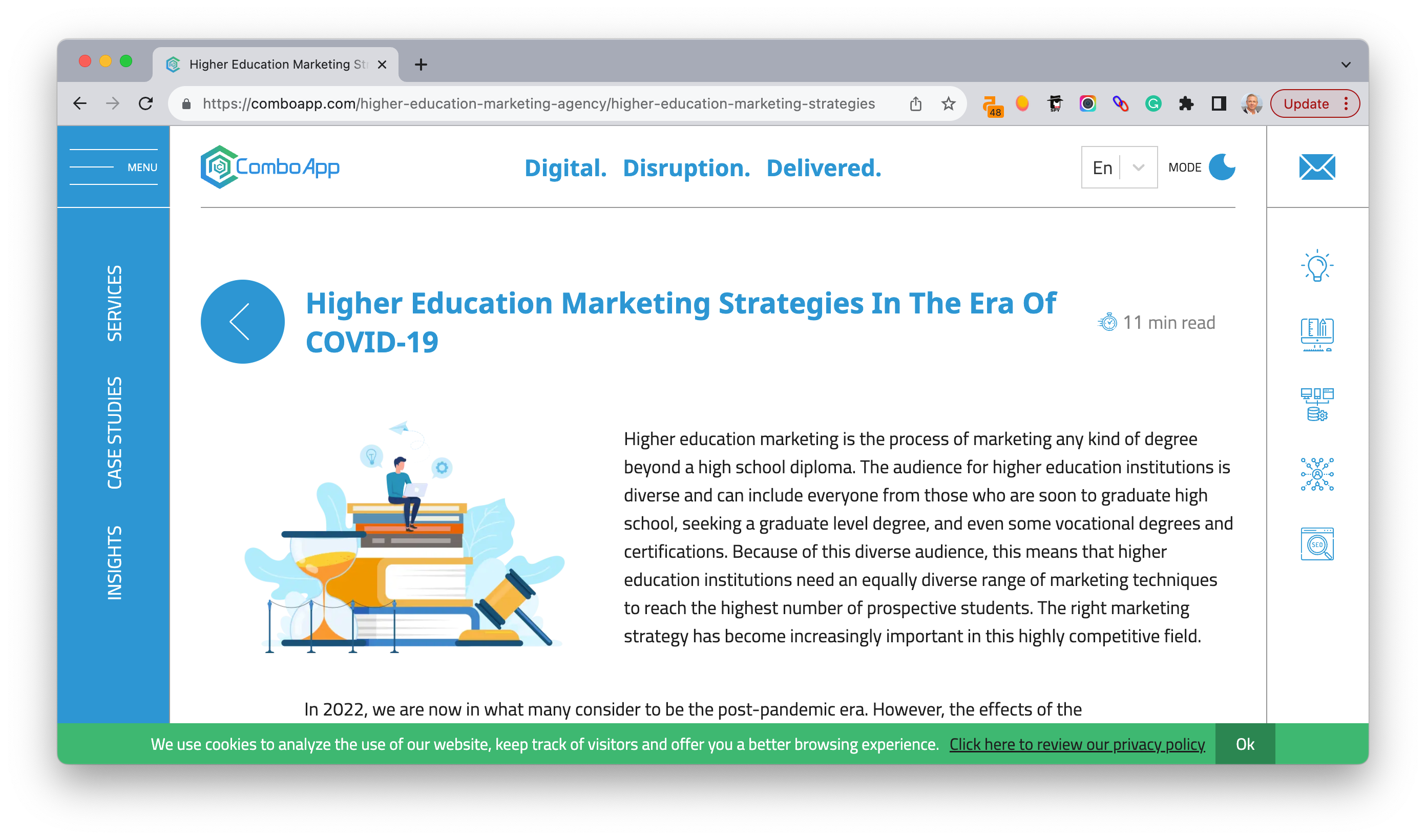
    12 Higher Education Marketing Strategies for 2022

    12 Higher Education Marketing Strategies for 2022-comboapp.com-higher-education-marketing-agency-higher-education-marketing-strategies

    https://comboapp.com/higher-education-marketing-agency/higher-education-marketing-strategies

    My perspective: I find the idea of marketing “Higher Education” as a concept compelling. I recently had a conversation with one of our summer interns in which he asked, “Do I even need a degree?”

    There are definitely fields, like computer science, for instance, where we’re learning that degrees don’t necessarily separate the wheat from the chaff.

    The article emphasizes the long-term changes in higher education institutions due to the pandemic, highlighting the importance of distance learning programs, local student outreach, and improved campus safety. It presents 12 techniques for an effective higher education marketing strategy:

    1. Branding: Focuses on crafting an identity that represents both the school and its student body. Authenticity is key.
    2. Search Engine Optimization (SEO): Highlights the importance of high rankings on search engines and lists several SEO techniques.
    3. A Great Website Experience: Stresses the importance of mobile-first design, speed, and ease of use.
    4. Social Media Marketing: Discusses the significance of authentic engagement on social media platforms, especially for Gen Z and millennials.
    5. Live Streaming: Emphasizes the use of platforms like Facebook Live, Instagram Live, and YouTube for events, Q&A sessions, and classes.
    6. Email Marketing: Highlights the preference of students for email communication and the importance of personalization and segmentation.
    7. Interactive Advertising: Describes the potential of interactive ads, such as games and story-based video ads.
    8. Leveraging Alumni and Students: Discusses the power of word-of-mouth marketing and the importance of reviews and testimonials from current and former students.
    9. Distance Learning: Highlights the increasing demand for distance learning options post-pandemic and the opportunities it presents for institutions.
    10. Pay Per Click Advertising: Discusses the benefits of targeted advertising on platforms like Facebook, Google Ads, and Bing Ads.
    11. Short-Form Video Content: Emphasizes the importance of platforms like TikTok, Instagram Reels, and YouTube Shorts in engaging potential students.
    12. Focus on Positive Career Outcomes: Addresses the ongoing discussions about the value of higher education and the importance of showcasing the tangible benefits of a college education, such as high-paying jobs after graduation.

    Unique Positions:

    • The article stresses the need for institutions to market themselves and the very idea of higher education in light of recent discussions questioning its value.
    • It highlights the blend of traditional and modern marketing strategies, emphasizing the importance of authenticity in all communications.

    Conclusion: The article concludes by promoting ComboApp as a full-cycle higher education marketing agency that can assist institutions in crafting a comprehensive digital marketing strategy.


    8 Higher Ed Digital Marketing Tactics & Trends for 2023

    8 Higher Ed Digital Marketing Tactics & Trends for 2023-www.oho.com-blog-8-higher-ed-digital-marketing-tactics-trends-2023

    https://www.oho.com/blog/8-higher-ed-digital-marketing-tactics-trends-2023

    My perspective: Social will continue to be a tremendous way to get in front of future university students. Even though we’re no longer talking about the “Zero moment of truth” (thank goodness), students will continue to be exposed to our schools and programs before they even know they’re looking.

    The article sheds light on the evolving landscape of higher education marketing in 2022, emphasizing the need for institutions to adapt to the digital age and the unique preferences of Gen Z.

    1. Understanding the Crowdsourcing Habits of Gen Z: Gen Z’s decision-making is described as “crowdsourcing,” where they seek opinions from peers, influencers, and reviewers. Institutions should involve them in conversations and connect with their sense of humor, especially on platforms like TikTok.
    2. Reaching Gen Z With Conversational Marketing: The trend of “conversational marketing” is growing, emphasizing real-time, one-to-one connections to answer questions and assist consumers. University websites should incorporate a human voice and chat opportunities.
    3. Data Insights Shedding More Light on Higher Ed Audiences: Research indicates that understanding the audience leads to better marketing outcomes. Universities are using CRM systems and other software to analyze the student journey and understand their motivations.
    4. Growing Emphasis on Personalized Messaging: Digital content engages young people, but they are wary of overt marketing. Personalized, targeted messaging helps universities connect with students and boost conversions.
    5. Growing Preferences for Short-Form Video: Universities should incorporate short-form videos (around 90 seconds) into their marketing strategies. Examples include video campus tours, answers to FAQs, and student-guided mini-tours.

    Unique Positions:

    • The article emphasizes the importance of understanding and connecting with Gen Z’s unique preferences, especially their reliance on crowdsourcing for decision-making.
    • It highlights the significance of conversational marketing and the need for human interaction, even in the digital age.

    Conclusion: The article concludes by promoting Unibuddy, a platform designed for students that offers tools to enhance higher education marketing strategies in line with current trends.

    15 Best Marketing Strategies for Universities

    15 Best Marketing Strategies for Universities- penji.co-marketing-strategies-for-universities

    https://penji.co/marketing-strategies-for-universities/

    My perspective: It’s not surprising Penji would focus on social and ad creative since they are a marketplace for creative work. I’m not familiar with Penji, but it looks like a new-style iteration of a “99 Designs” concept.

    The article underscores the importance of marketing in universities, especially given the competitive nature of higher education marketing. It provides a comprehensive list of strategies to enhance university branding and appeal to a younger audience.

    1. Social Media: Emphasizes the shift from traditional mail to social media platforms to engage with prospective students. Universities should be present where students are active and ensure their content aligns with the platform’s audience.
    2. User-Generated Posts: Encourages universities to monitor and engage with content created by students about the institution. This provides insights into the university’s perception and offers opportunities for authentic engagement.
    3. Define Your Brand Image: Universities should have a consistent voice and image across all marketing channels. This helps in creating a recognizable and trustworthy brand.
    4. Focus on the Students: Marketing strategies should prioritize the needs and interests of students, both current and prospective. This includes promoting events, assistance, and showcasing the university’s supportive environment.
    5. Video Marketing on All Platforms: Highlights the increasing importance of short-form video content on platforms like YouTube. Videos offer a dynamic way to showcase campus life, events, and more.
    6. Statistics: Using data to showcase the university’s achievements, such as high graduation rates, can be a compelling marketing tool.
    7. Promote Sitting in Classes Before Enrolling: Offering prospective students the chance to experience lectures can help in their decision-making process.
    8. SEO (Search Engine Optimization): Ensuring the university’s website ranks high on search engines is crucial for visibility.
    9. Showcase Success: Highlighting the achievements of alumni can serve as a testament to the quality of education provided.
    10. Embrace Diversity: Marketing campaigns should reflect the diverse student body and cater to non-traditional students as well.
    11. Use Infographics: Visual representations of data can be more engaging and easier to digest than text-heavy content.
    12. Paid Traffic: Utilizing paid ads, especially on platforms like Instagram, can help in reaching a wider audience.
    13. Interactive Webinars: Hosting webinars can provide valuable information to prospective students and give them a taste of the university’s teaching style.
    14. Downloadable Guides: Offering resources to help students prepare for college can be a valuable tool in the decision-making process.
    15. Email Marketing: Automated email series tailored to the student’s application process stage can provide personalized guidance.

    Unique Positions:

    • The article emphasizes the importance of understanding the younger generation’s preferences and adjusting marketing strategies accordingly.
    • It highlights graphic design’s role in enhancing marketing campaigns’ effectiveness.

    Conclusion: The article concludes by promoting Penji, a graphic design service, as a valuable tool for universities looking to enhance their marketing strategies with quality designs.

    16 Effective Digital Marketing Strategies for Higher Education in 2023

    https://www.thinkorion.com/blog/digital-marketing-for-universities

    My perspective: I appreciate the focus on real-time and alumni engagement. We’ve been spoiled by instant responses and always on media.
    And, students want to know what’s out there after attainment of that degree or certificate. Alumni can help tell this story much better than administrators or (gasp) marketers.

    The article delves into the competitive landscape of higher education marketing, emphasizing the importance of standing out to attract the best students. It provides a comprehensive list of strategies to enhance university visibility and appeal:

    1. Maximize Organic Traffic through Optimized SEO Techniques: Emphasizes the importance of SEO for attracting the right students. It covers aspects like keyword research, internal linking, backlinking, technical audits, and on-page optimization.
    2. Accelerate Your Sales With Proven PPC Techniques: Discusses the benefits of pay-per-click advertising for promoting university programs and increasing web traffic.
    3. Attract, Engage, and Retain Students With a Winning Content Marketing Strategy: Highlights the importance of creating engaging and informative content to resonate with potential students.
    4. Elevate Your Brand Visibility With Google Display Advertising: Discusses the effectiveness of digital display ads over traditional billboard ads, especially on Google’s Display Network.
    5. Unlock the Power of Social Media: Explores the role of social media platforms like Twitter, Instagram, LinkedIn, and Facebook in connecting with potential students.
    6. Use Exclusive Email Marketing Campaigns to Promote: Emphasizes the continued relevance of email marketing, stressing the importance of personalization and using AI-powered email programs.
    7. Make Informed Decisions With Advanced Analysis and Tracking: Discusses the importance of setting specific tracking goals beyond what Google Analytics provides.
    8. Utilize Video Marketing to its Fullest Potential: Highlights the engagement potential of video content, both in long and short formats.
    9. Inspire Student Success With Real-Life Stories: Advocates for sharing student success stories to showcase the value of the university’s programs.
    10. Maximize Your Reach With Influencer Marketing: Discusses the power of influencer marketing, especially leveraging successful alumni.
    11. Boost Engagement With Short and Snappy Video Content: Emphasizes the importance of short video content, especially in the wake of reduced on-campus visits due to COVID-19.
    12. Optimize for Featured Snippets: Discusses the importance of ranking in Google’s featured snippet for increased visibility.
    13. Reach Your Ideal Customers With Lookalike Audience Targeting: Highlights the benefits of using lookalike audience models to improve brand reach.
    14. Improve Customer Service With Chatbots Integration: Discusses the rise of conversational marketing and the effectiveness of chatbots in providing instant answers.
    15. Build Connections With Live Streaming: Emphasizes the engagement potential of live streaming over traditional content.
    16. Hire a Professional Higher Education Digital Marketing Agency: Advocates for seeking professional assistance if universities lack the resources or expertise for effective digital marketing.

    Unique Positions:

    • The article emphasizes the blend of traditional and modern marketing strategies, highlighting the importance of adapting to the evolving digital landscape.
    • It underscores the importance of personalization, real-time engagement, and leveraging alumni for effective marketing.

    Conclusion: The article concludes by emphasizing the importance of current marketing strategies for universities to attract future leaders. It also suggests hiring a higher-ed marketing agency for those lacking the time or resources to run effective campaigns.


    Effective Higher Education Marketing Strategies

    Effective Higher Education Marketing Strategies-shorthand.com-the-craft-effective-higher-education-marketing-index.html

    https://shorthand.com/the-craft/effective-higher-education-marketing/index.html

    My perspective: OK, I know it’s shallow, but I like the look and feel of this site. It’s got a very medium-esque vibe.

    On a more serious note, the authors point out one of my constant refrains: The decentralized nature of a higher education marketing strategy is costing universities dearly. Very few schools have central oversight and are therefore cannibalizing their own messaging and budgets.

    The article delves into the complexities of marketing in higher education, highlighting the unique challenges faced by universities. One of the primary challenges is the siloed nature of marketing in universities. While universities typically have a central marketing team focused on boosting student enrollment and driving donations, there are also numerous smaller teams across various academic departments and schools, each with slightly different target audiences.

    These smaller teams often work independently on their marketing strategies, employing a wide range of tactics such as social media, SEO, email marketing automation, PPC campaigns, live streaming video content, direct mail, in-person events, and even chatbot scripts. This decentralized approach can lead to several issues:

    • Dilution of the Brand: Inconsistent application of messaging and brand guidelines can weaken the overall brand identity.
    • Missed Opportunities: Due to weak communication channels, potential marketing opportunities might be overlooked or not fully capitalized upon.
    • Decreased Morale: Teams or individuals working in isolation can experience reduced morale.

    Despite these challenges, the article offers hope by suggesting nine strategies to promote more cohesive and effective higher education marketing. While the specific strategies aren’t detailed in the provided excerpt, the article emphasizes the importance of cohesive marketing efforts across the institution.

    Unique Positions:

    • The article highlights the unique challenges higher education institutions face due to the decentralized nature of their marketing efforts.
    • It underscores the importance of a unified approach to marketing to ensure consistent branding and messaging.

    Noteworthy Mentions:

    • The article references recent engagement examples related to the pandemic, suggesting that universities have proactively created content around COVID-19.
    • The University of Queensland is highlighted for its digital publication, “Contact,” which offers an engaging and interactive user experience while catering to those who prefer traditional print magazines.

    Final Thoughts

    As you can see, there are a number of ways to get in front of students for your school.

    The consensus seems to be that SEO, social media marketing and advertising, email, and PPC are great ways to invest your marketing dollars.

    It’s surprising to see how little attention is paid in the articles to analysis, tracking, and reporting, given how many of the UPCEA Higher Education SEO Study respondents indicate this is lacking.

    As management icon Peter Drucker is famously quoted, “What gets measured gets managed.” All the landing pages, tactics, and strategies in the world won’t make us successful if we don’t know what’s working.

    For more tips to create a winning higher education marketing strategy, check out our Higher Education Marketing Resources & Guides. For more information about higher education marketing – and to learn more about services like our SEO Roadmap for universities, contact our team at Search Influence today.


  • Seven Tactics to Maximize Your Restaurant’s Organic Reach On Instagram

    In the world of pay-to-play, restaurants are seeing their organic reach diminish across social media. Organic reach is the number of unique people who have seen your unpromoted post. When posting organically, you rely on the social platform’s algorithm to distribute your content to whoever it chooses to show your post to.

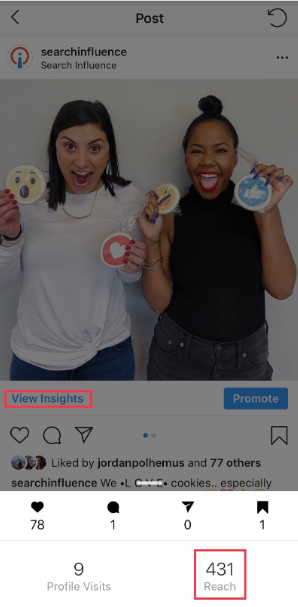
    In order to see your reach on Instagram, you need a business Instagram account. Click on the post you want to analyze and then click “View Insights” under the photo.

    Fortunately, Instagram still has best practices for maximizing reach organically. We’ll start with Instagram basics to lay some marketing groundwork and work our way to reach-increasing tactics. You’ll need a solid organic strategy in place in order to receive engagement and consistently grow your reach. Use these seven tactics to get started.

    1. Know Your Branding

    Checking a restaurant’s Instagram before deciding where to eat is becoming second nature to Millennials. They’ll probably already know what they’re ordering before they get to the restaurant too.

    To impress these Millennials, you’ll need a good Instagram aesthetic, or “theme.” This involves consistent branding, style, and voice—whether it’s an in-feed post, Story, caption, or comment.

    There are a few ways you can nail this, but the most important part is understanding your own brand. If you understand your restaurant’s branding, it will reflect in your posts.

    Tactic #4 will go into detail about how to create a cohesive Instagram theme.

    Dropping phone into food while trying to snap photo for Instagram

    2. Post Consistently

    Be consistent in time and frequency of posting. Your followers will start to expect your posts and even look out for them! It’s best to post daily if you can. One way restaurants can achieve this is by posting daily specials.

    Also, find the optimal time to post, then be consistent. Start by thinking about when your customers are getting hungry. This may be an hour before your restaurant’s typical peak times.

    If needed, you can test different posting times to find which will bring the most reach. You can click “View Insights” under your photo to find the photo’s reach and then compare your results for different times.

    3. Engage Back With Those Who Engage With Your Restaurant on Instagram

    According to the Maru/Matchbox Retail Vision Study, 69% of Millennials take a photo of their food before they’re about to eat. It’s no secret that many of those photos will wind up on Instagram.

    That said, if someone posts a photo at your restaurant and tags your restaurant’s Instagram, be sure to engage with that post. You could even ask to repost it on your account if it fits into your feed’s theme. The same goes for Instagram Stories since you can now share Stories that you’re mentioned in.

    Engaging with customer photos is another great touchpoint beyond table service. Once customers notice that you’re engaging back or even reposting their content, they’ll be more motivated to share food photos and tag your restaurant. #foodie

    4. Get Creative With Your Instagram Theme

    Don’t limit yourself to professional photos of your food. Those will get stale (no pun intended). Instead, fill your feed with drool-worthy food photos, social events, employees, and more.

    To start, choose three to five categories of posts to rotate through. For example, a trendy restaurant with a cocktail bar may rotate photos of appetizer close-ups, cocktails, social events, and interior photos. Knowing this will help you plan which content you need to capture in advance.

    Next, pick your Instagram feed’s aesthetic or tone. Will it be dark and moody? Bright and colorful? Monochromatic? Once you’ve decided this, stick with it and keep that in mind when taking or curating photos.

    Pro Tip: Don’t post blindly. Use any free Instagram planner like UNUM to plan out your feed. Rotate through your photo categories to ensure no two are next to each other. This will keep your content fresh and varied but still consistent.

    You can read more about getting the best photos for social media here.

    5. Reach Out to Local Food Bloggers

    The increased exposure from influencer marketing can make a big impact on your business. Once you have an understanding of who you want to reach, find local food bloggers with a similar following.

    Many food bloggers with a smaller following (under 15k) will be willing to exchange an Instagram post and Story for a meal on the house. For food bloggers with a large following, try offering them a high-value gift card in exchange for their time and discuss the possibility of a giveaway.

    Giveaways are often beneficial for both the influencer and restaurant in terms of brand awareness and follower growth. Make sure not to skimp out on the giveaway prize, and always keep giveaways fresh and unique.

    For example, giving away a gift card every time will get boring and won’t garner much excitement over time. Try giving away a romantic dinner for two in February and free cocktails for a group of friends in March. You’ll reach different audiences this way.

    6. Use Instagram’s Video Features

    According to Hubspot’s study on content trends globally, video content from brands is preferred by consumers. Instagram has three options for sharing video: Stories, IGTV, and an in-feed video post.

    First, use Stories to share videos that are on-the-whim and unedited. Make sure to tag locations, use hashtags, and tag accounts for maximum reach. When you tag other accounts, they have the ability to “mention” your Story in their Story. Essentially, it’s an earned repost.

    In addition to Stories, try IGTV for edited videos. You can share 15-second to 10-minute vertical videos, which are currently the preferred format on social. There are two features you should be using with IGTV:

    1. Show an IGTV preview in your Instagram feed by selecting this option when uploading.
    2. Link the IGTV in your Story so users can swipe up to watch the video.

    Last, you can share videos in your feed like you would share any other image post!

    7. Ensure Maximum Reach With Each Post

    Finally, all your effort comes full circle in this step, where you want to ensure you’re getting maximum organic reach. The key to high reach on Instagram is using most of Instagram’s available features. The more reach you get, the higher the chance you’ll capture the right user’s attention at the right time.

    There are two significant ways to maximize your post’s reach organically, including users who do not follow you: location tagging and hashtags.

    Always tag a location to your photos so that your photo will show in the “Places”’ feed. For example, if you type in “New Orleans” in the Places search bar, you’ll see the top and recent photos that have tagged a location within New Orleans.

    In addition to tagging locations, use all 30 hashtags allowed for each post. If you’re a locally owned restaurant, you should use around 20 local hashtags and the rest as branded hashtags or common food hashtags on Instagram.

    A good hashtag strategy requires you to check and adjust every few months to make sure your photos are appearing in the hashtag feeds. Keep the hashtags that for which you’re appearing at the top, and replace the others with new hashtags. The goal is to appear somewhere in the top of the feed for all 30 hashtags; however, since this is always changing, you’ll always be checking and adjusting.

    Bonus Step: Promote Your Posts

    This is a bonus step because this is not an organic tactic. However, organic strategy pairs very well with paid strategy. If there’s a specific promotional post you want everyone to see, you should pay to promote it. This is a great way to get the word out about weekly specials, and we’ve seen it work well for our own clients.

    To reiterate the importance of an organic strategy, you’ll stay top-of-mind for old customers and certainly reach new ones this way. Start building your organic strategy today! If you need assistance to make it happen, contact the team at Search Influence and utilize our social media expertise.

    Images

    Phone drop

    Wine glasses

    Dining outside

  • Do Businesses With Multiple Locations Need Multiple Facebook Pages?

    Facebook has become an integral part of marketing for any business. Those with multiple physical locations must decide how they would like to present themselves on this platform: in one corporate page representing all locations, or in separate pages that reflect each location. While the ease of managing one corporate page may sound appealing, it is important to have a social media presence for all locations. It is likely that each location has its nuances. Whether they differ in menu items, atmosphere, or specials, it is important that these differences are reflected accurately in all marketing so the local brand is well represented and customers have correct expectations.

    There are two ways to accomplish separate Facebook marketing for multi-location businesses: creating multiple business pages or using Facebook Locations.

    Young man using computer for Facebook

    Facebook Locations Vs. Multiple Business Pages

    When a business has multiple business pages, they have created a separate page for each location, meaning that each location is set up completely independent from the other. This is one way to account for all locations; however, it often makes more sense to utilize Facebook Locations to accomplish this.

    Facebook Locations is set up with one parent page that represents the main brand. Within this page, there are local pages that account for each individual location. All pages are managed through the central parent page. One way to think about Facebook Locations is the parent page as an umbrella and the local pages underneath it.

    Who Should Use Facebook Locations?

    While Facebook Locations is a great tool, it is not appropriate for every business to use. Multi-location businesses with a generally centralized brand identity are the best candidates for Facebook Locations. Additionally, this method is best for businesses that have an employee that can communicate and be involved with all locations, since all pages are through the parent page.

    The Advantages of Using Facebook Locations

    The main advantages of using Facebook Locations are that it can save time while allowing each location to share increasingly specific and relevant content.

    As mentioned before, all pages are managed through one central spot, the parent page, with one login. Through the central login, a business is able to post content to all pages by sharing from the parent page. This is a quick and easy way to share company-wide information. Additionally, content (such as location-specific events, specials, etc.) can be posted just to certain pages from this same login. These features increase efficiency by reducing the amount of time spent logging in and out of multiple business pages.

    Using Facebook Locations allows for highly targeted location-ads and content to be shared to each local community. This way, followers are more likely to pay attention to and engage with the ads and content they see because it is relevant and important to their location.

    The parent page will have a map that shows all individual locations, in addition to listing them out under a “Locations” tab. This feature makes it easier for potential customers to find the nearest location to them.

    One objective that is only available for businesses that use Facebook Locations is store visits. According to Facebook: “Store visits reporting shows you visits that happen within 1 day, 7 days, and 28 days after a person clicks an ad, and 1 day, 7 days, and 28 days after your ad is viewed.”

    This is extremely valuable information, as it is the most advanced way to correlate posts or ads with actual customer visits. Facebook uses a variety of measurement signals to calculate this metric, which they explain further in this post.

    Person using mobile device for Facebook pages

    Creating and Managing Facebook Location Pages

    The first step in creating a Facebook Location page is to set up a parent page. This should be a page for the main brand and is the same as setting up any Facebook Business page.

    After this, there are three ways to add specific locations:

    1. Manually add each address
    2. Upload using a CSV template
    3. Migrate existing pages into new location structures

    Once all pages are set up, someone must be in charge of managing them. This role includes ensuring all information is correct, publishing posts, managing reviews, and more. Some businesses assign these responsibilities to an in-house marketing employee. However, many find it more effective to hire an agency for social media management.

    Ready to set up your business’ Facebook Location pages? Search Influence has been helping brands succeed online since 2006. Our services include social media management, content creation, and online advertising. Request a proposal today to learn how we can help you make the most of your brand on social media.

    Images

    Computer User

    Mobile Device

  • The Travel Marketer’s Guide to Capturing the Romance Market

    The Travel Marketer’s Guide to Capturing the Romance Market

    With the right targeting and audience intelligence, it can be easy for travel marketers to sweep romantic travelers off their feet. Many businesses in key travel markets are missing the opportunity to market to romantic travelers. The latest data shows that romantic travel trends go beyond the obvious honeymooners and destination wedding travel, though those segments shouldn’t be ignored! According to the Travel Industry of America, romantic getaways are trips “with a spouse or other love interest without children to rekindle the romantic feelings in the relationship.” From outdoor adventure travel to “foodie” trips, today’s couples are doing things differently and travel marketers should take notice. Whether you market a destination city or you’re a business within a destination city, positioning carefully to appeal to romantic travelers is a good idea for 2018 and beyond. Read on for more details on the latest romantic travel trends all marketers need to know.

    Top Romantic Travel Trends in 2018

    Romantic travel is booming, and it’s more than just the honeymoon. According to statistics from TripSavvy, a quarter of all American weddings are destination weddings. On average, couples who plan destination weddings are a little older with more disposable income compared to other newlyweds. With travel to a beach or somewhere overseas, the average budget for a destination wedding is $28,000. The added expenses make for a shorter stack of invitations, but the guests who attend destination weddings also plan to spend more than $600 on average.

    After the wedding, couples currently spend three times as much on honeymoons as they do on other vacations making honeymoons a$12 billion dollar industry. Other popular trends in romantic travel surfacing in 2018 include would-be grooms planning getaways around the proposal (thanks to social media for the increased pressure for the perfect proposal!). All kinds of couples enjoy “foodie” trips, choosing destinations with the best dining options as a top priority. Where entertainment and music drew travelers in earlier decades, cuisine is a top priority for today’s travelers.

    Not Just for the Newlyweds: Who Are Today’s Romantic Travelers?

    While family trips need to balance the different preferences of all the kids, couples traveling romantically tend to spend more on dining and activities when it’s just the two of them.

    Marriage drives a high percentage of the travel in America, but households with children travel less often, shocking, right?! While single households were responsible for 21 percent of trips, married households took a whopping 61 percent of trips, according to the same research from TripSavvy. Couples without children have taken an average of 3.1 trips in the past year, compared to couples with children, who took 1.9 trips indicating the sweet spot for the travel market is married couples without children.

    When planning a romantic getaway, a strong majority of those surveyed said that they traveled to a particular city for the local cuisine and entertainment. The next most popular getaway option was bodies of water, such as lakes or beaches. Other common, but significantly less popular plans centered around gambling, outdoor sports, and cruises. Romantic couples are interested in local attractions, but they also want a setting where they can enjoy each others company. By emphasizing a quiet, relaxing atmosphere, nearby nightlife, and quality restaurants, most cities have something to offer couples trying to unwind.

    Romance For All: LGBTQ Travel Trends

    Now more than ever, it pays to be inclusive. LGBTQ travelers are especially aware of the attitudes in different parts of the world.  Just as some countries still require a marriage certificate to share a hotel room, many regions still have laws and prejudices against homosexuality and other lifestyles. Because some travel agents are unaware of those nuances in different regions, many LGBTQ travelers use agents who specialize in serving clients with similar priorities.

    If there are festivals like Pride Parade in your area, think about whether your business can participate in some way. Decorating for the occasion, offering special discounts, and sponsoring a local non-profit are a few ways to show support. Make sure to share the ways in which your business shows support via your social media channels and look for ways to make your imagery more inclusive by default.

    Most of these travelers want a safe place where they won’t be excluded on the basis of their orientation, identity, appearance, or anything else. That said, your employees have a big impact on the perception of your brand. Employees who bring prejudices into the workplace can be a complicated problem, especially in politically divisive times. While it’s impossible to satisfy every customer, a negative review that implies intolerance can be especially impactful. The best course of action is prevention, making sure that you create a safe and inclusive environment both for customers and employees. In the event you suffer a negative review from a customer, make sure to respond publicly stating that your company does not share the views of this individual though feedback is appreciated.

    Not A Tropical Oasis? “Romantic” Doesn’t Have to Mean Bikinis

    Commercials have marketed beaches as the “ultimate” romantic getaway, but there are loads of alternatives for landlocked businesses. = With employment up and cautious optimism about the economy, Americans are looking to travel frequently, and in smaller doses. Over the past 12 months, Google Trends has shown an increase in the search terms “weekend getaways” and “couples getaway near me,” Indicating growing demand for this information online. With the help of local SEO professionals, you can dominate the search results for travelers within driving distance.

    All kinds of activities and attractions can be adapted for a romantic audience. Historic districts, museums, festivals, and even agriculture can be romantic. With a scenic overlook and the right photographer, your area’s cotton fields start to look as romantic as a vineyard or a country album cover.

    In all, romantic travel is about a lot more than honeymooning couples. A growing number of adults are looking at travel as an investment in their relationship and their own quality of life. At Search Influence, we have everything you need to market to those couples and drive leads to your business. If you’re interested in honing your local SEO strategy, then request your marketing analysis today to get started.

    Images:

    Couple at a Scenic View

    Couple Walking in Hand

  • Why You Should be Posting on Google My Business

    “Just Yahoo it,” said no one ever. It just doesn’t have the same ring as “Google it,” which was officially added to the Oxford English Dictionary and the Merriam-Webster Collegiate Dictionary in 2006. That’s because Google has practically monopolized internet searching. According to NetMarketShare, Google accounted for over 79 percent of all global desktop search traffic in 2017, followed by Bing at 7.27 percent, Baidu at 6.55 percent, and Yahoo at 5.06 percent. In addition, Google receives over 63,000 searches per second on any given day. In the U.S., more Google searches take place on mobile devices than on computers, and 30 percent of mobile searches are related to a location. It’s obvious that to succeed in the SEO world, you have to play by Google’s rules.

    So, Just How Do You Play By Google’s Rules?

    One way to do this is by creating a Google My Business (GMB) page for your company. This page allows your businesses to manage their online presence across Google, through a physical location. Within this company page, Google has a social posting platform that allows business to provide “up-to-date posts from verified people, places or things, directly in search results.” These public posts allow businesses to share company updates to feature what’s new, respond to customer reviews, and add photos to highlight what makes your business special, and build brand awareness.

    Screenshot of a Google My Business post from Exterior Crew, LLC

    These posts are particularly captivating because, rather than appearing in the search results, they are displayed in the knowledge panel, which presents a more engaging visual aid. This is NOT to be confused with Google +, which was Google’s attempt to compete with Facebook as a social platform. And let’s be real; it was a major fail. Realizing this, Google reconstructed their platform and created GMB. Google + profiles and pages still exist, but they are now subpages of a GMB page.

    The Start of Google Posts With Candidate Cards

    Before July 2017, Google’s now-called “Google Posts” were only accessible to few. It all started with “Candidate Cards.” You may remember seeing these around the 2016 presidential election. Google described these as non-ad privileges, giving 2016 Republican and Democratic candidates a place in Google search.

    Image of Google's candidate cards - Search Influence

    Proving to be both appealing and informative by viewers, Google allowed the expansion of these cards for celebrities and sports teams. As of June 2017, GMB brought these now-called “Google Posts” to local businesses as an easy way to help attract new customers and build relationships with the customers you already have. These posts have proven particularly effective in promoting flash sales or promotions, emergency updates, such as school closings, and sharing job openings. In addition, these posts contain a call to action (CTA) feature, which provides an easy and direct way for customers to book appointments or reservations.

    Benefits of Google Posts Over Traditional Social Media Posts

    You may be thinking, why would I need to use Google as a social platform when I already use Facebook, Twitter, Instagram, etc.? And you have a point. These social platforms are still great ways to post updates about your business. Although similar, Google Posts offer a few advantages that the typical social media platforms do not, including the following:

    They’re more searchable

    You can literally “Google it.” When searching for a business, these posts will appear directly on Google Search and Google Maps pages. When someone searches for your business, your location address and phone number will appear in the knowledge panel on the right-hand side of your search results. Your company’s address/location is the primary piece of information searched for by local customers. In regard to mobile, local searches lead 50 percent of viewers to visit stores within one day.

    Screenshot of a GMB post by Echo Limousine - Search Influence

    You will expand your reach

    Not only does Google lead the way in search engine results, but it also surpasses Facebook search queries. According to Adweek, Google averages 3.5 billion searches per day, compared to Facebook’s 2 billion per day. In addition, 82 percent of people turn to search engines to find local information.

    Keyword Searches

    On Google, you can use keywords to target certain audiences—specifically, people that are already looking for your services. Since these people already have an idea of what they are looking for, they are likely to be further along in the decision stage, meaning they are more likely to convert into a client or customer. By contrast, Facebook is geared more toward targeting specific interests and in-depth personal information to lure in a potential customer.

    Impact on your ranking

    Google’s goal is to provide you with the most relevant information based on a search query. When you post new content directly through your GMB listing, you are sharing relevant content and information about your local business, which contributes to building your location authority. This tells Google that your business is legit. The more you legitimize your business to Google, the higher ranking you will get. The higher ranking you have, the higher you will appear on Google search and gain more traffic to your site.

    Screenshot showing how to create a Google My Business post - Search Influence

    Connect with your customers directly

    You can include CTA buttons on all of your GMB posts. Call to action buttons have been proven priceless for converting customers. According to Everything You Need to Know About the Psychology of the Call to Action by Neil Patel, the human mind expects a call to action button. “Our minds are prepared for and are expecting an experience of being called to act and have already decided that there will be a CTA. We know that expectation affects behavior. That’s why people know to act on the CTA. They aren’t staring at the CTA button wondering what it is. They know its a button they are being asked to click.”

    Some examples of how a business can utilize these buttons include the following:

      1. Make a reservation
      2. Sign up for a newsletter
      3. Learn more about the latest offers
      4. Buy a specific product from your website
      5. Call now

    Get backlinks

    Everyone knows that backlinks have a huge effect on organic search results. By posting compelling content on your GMB posts, people are more likely to engage and reference information from your site. You can also link your site pages in a post, making it easier for researchers to find your pages.

    Start Posting!

    Although still green, GMB posting is projected to be incredibly valuable to local businesses. Facebook, Twitter, and Instagram are saturated with businesses looking to promote brand awareness. But since GMB posts are still in the early phases, it hasn’t been flooded by the masses just yet—which is why you should get in now! GMB is an excellent platform that allows your customers to stay in the know of what is going on with your businesses. Not to mention, it’s free! What do you have to lose?

    Here at Search Influence, we’re constantly staying on top of new ways in which we can help our clients be found online and thrive in their industry. If you’re interested in honing your local SEO strategy with rich, relevant Google My Business posts, then request your marketing analysis today to get started.

    Images:

    Candidate Cards

  • 8 Facebook & Instagram Features You Might Not Know About

    8 Facebook & Instagram Features You Might Not Know About

    Facebook is going cross-country with a free conference, bringing it to 30 cities, including New Orleans! This is part of Facebook’s mission to better educate businesses in using their platform. They state that… “By 2020, we’re committing to provide 1 million US workers and entrepreneurs the digital skills they need to compete in today’s workplace.”

    My evaluation is that their goal of this effort is to increase and improve business use of Facebook (and ultimately advertising dollars) and try to make up for their data privacy blunders earlier this year.

    Given that 2.07 billion people access FB monthly, and ¾  of those users come back daily, there’s an appropriate way for most businesses to engage with consumers.

    I really enjoyed seeing traditional advertising promoting this free event as I drove around New Orleans, from downtown digital billboards to suburban bus stop ads. While it may seem ironic that Facebook would use out-of-home media to promote their conference, it is not that surprising since part of their strategy is likely to reach NEW businesses in addition to improving the skills of those already on the platform.

    In case it’s not coming to a city near you, check out these tips from our team of Influencers who attended various sessions!

    Build Creative for Mobile

    Because 90% of time on Facebook is spent on mobile, businesses must get out their desktop-focused world and think about the screen size of their audience.

    One key media type for mobile optimization is video—your typical rectangle, landscape video (16:9 aspect ratio) videos are suboptimal for mobile. Square is better, but the best is to create vertical, full-screen videos—think Snapchat, Instagram Stories, and Facebook Live style.

    In addition to it being a more immersive and engaging experience, a key benefit is you aren’t sharing the screen with other content.

    If you use Instagram, you may not be surprised to hear that ⅓ of the content that people are engaging with on Instagram is BRAND content!

    Thanks to Alison Zeringue & Amanda Ball for this takeaway!

    Mobile Creative Doesn’t Have to Be Hard or Expensive

    All you need is a phone, lighting and a $20 Amazon tripod (for video) to make something look REALLY nice!

    These 10 apps can enable you to enhance your photos and videos on your mobile device, on the fly.

    Considering that by 2020, 75% of content on Facebook will be videos, it is time to put on your videographer hat!

    Photo Enhancing Apps

    1. Adobe Photoshop Express
    2. Adobe Spark Post
    3. PicLab
    4. Plotaverse
    5. RIPL

    Video Enhancing Apps

    1. Videoshop
    2. Quik
    3. Instagram Stories
    4. Boomerang
    5. Legend

    See here for direct links to these Top 10 Creative Apps.

    Remix

    The apps above and others allow you to “remix.” Easily take images you already have and create gifs and videos to better engage your audience, including overlaying text (love the Living Proof example… ask me how many bottles of Living Proof I have stocked—major “life hack” for professionals on the go!).

    Amanda Ball likes the Pop Up Plus example, which uses e-commerce product images and “remixes” them into fun videos with vibrant colors and movement. An app called Videoshop can help do this FOR FREE.

    Shooting from Scratch

    Facebook also provides tips on making great videos from scratch for ads and posts. Check out this savvy use of Boomerang to show a spiralizer in action. As Amanda Ball describes it, “Potential buyers are prompted to feel like they know how the product works, making them more on board to dig deeper into your brand and products.“

    Thanks to Amanda Ball, Account Management Team Lead, for this tip!

    Secret Boomerang Menu

    Did you know Boomerang has a secret menu!? Learn how a four finger tap can bring up options on options to edit your video. You can smooth it out, speed it up, slow it down, and so much more.

    Thanks to Alison Zeringue, Director of Account Management, for this tip!

    Custom Contact Methods on Instagram Profile

    On a standard Instagram profile, call, email, and directions are standard calls to action that you can add.

    Through settings, you can hook up third-party apps like Open Table and Eventbrite.

    1. Go to your profile
    2. Click “Edit Profile”
    3. Click “Contact Method”
    4. Choose from the ever-growing list of action buttons that correspond with other apps and services you may already be using

    Thanks to Alison Zeringue, Director of Account Management, for this tip!

    Get a “Shop” Button on Your Instagram Profile

    Those who sell products may wonder how to activate the “Shop” button of their Instagram profile. After you’ve created nine “shoppable” Instagram posts, a “Shop” button will appear on your profile. It will direct users to all of your shoppable posts, making it that much easier for users to buy your product on their phone.

    Thanks to Ariel Tusa, Account Manager, for this takeaway!

    Vying for “Swipe Up for More”?—What to Do in the Meantime

    We're all vying for the "Swipe up for more" feature on Instastories, but, alas, you must have 10,000 followers for this feature to show up. In the meantime, use the "screen record" feature on your iPhone to create a video that guides users to important content. Then you can add that video to your Instastories.

    "https://townsend.bunksite.com/wp-content/uploads/2018/08/Screencast-of-Search-Influence-Blog-Post-for-Instagram-Story.mp4%22

    Thanks to Ariel Tusa, Account Manager, for this takeaway!

    Donate Button on Facebook Live

    Facebook has offered a selection of calls to action (CTAs) for your page and ads for some time. One way non-profits can use CTAs creatively is by using the “Donate” CTA button on a Facebook Live video. For example, you can “go live” at a fundraising event so those who aren’t in attendance can check out the action, and you can feature the “Donate” button on this post to capture their wallets while you are capturing their hearts. Bonus—giving a sneak peek into your event this year can create a buzz that translates to more attendees next year (as we talk about in our blog post with more tips to increase event attendance).

    Requirements for Fundraising on Facebook:

    In order to have access to features like the “Donate” button, you must be an approved non-profit.

    • 501c3
    • US-based
    • Verified page
    • Page meets community standards
    • Application approved

    Thanks to Ceallaigh Montgomery, Sales Executive & Digital Marketing Strategist, for this takeaway.

    Audience Network

    I find the Audience Network isn’t talked about nearly enough. By default, ads set up on Facebook will run on Instagram as well as the Audience Network, which is a collection of sites around the web. This idea is core to Google Display, which leverages the Google Content Network as the avenue for showing all ads. When people talk about Facebook ads, they take for granted this opportunity to be in front of people when they are “surfing the web”—not just browsing the “ ‘book.”

    Thanks to Shawn Kelly, Sales Manager, for this takeaway!

    Also, thanks to Shauntae Joseph, Account Manager, & Jenna Mire, Account Coordinator, for takeaways worked in throughout!

    If you need help implementing these tactics, let’s start a conversation about how we can help you.
  • Impact Your Tourism Marketing With Instagram Stories

    If you’ve been keeping up with our blog, then you already know how to market your travel and tourism business during the off-season, and how to engage with vacationers using mobile search. But, do you know how to leverage Instagram Stories for impactful tourism marketing? Stories are temporary videos or photos strung together to form a slideshow gallery that, well, tells a story. Since Instagram rolled them out in 2016, over 25 million active business profiles and 300 million active daily users have flocked to this feature, according to ClickZ.com. This means that Stories could be a huge area of opportunity for your business—if you use them the right way. If you’re unfamiliar with Stories, Cnet.com offers in-depth instructions on how to use this feature. But once you have the basics down, dive into our pro tips for how to make Instagram Stories most effective for your company.
    A graphic of someone using Instagram - Search Influence

    Promote Yourself Creatively

    Here’s the great thing about Stories—you no longer have to worry about over-posting. You are free to share as much content as you want throughout the day without taking over anyone’s feed. Plus, since the rollout of Instagram’s latest algorithm update, your traditional posts may have even less chance to be seen by followers in their feed, but Stories will appear right in front of your users at the top of their screens. This gives you more potential screen time and more creative ways to showcase your brand. But remember, it’s not about just posting links and asking users to click them. It’s about creating an experience where following your links is a natural and enticing option. Maybe you’ll be inspired by The North Face, who designed their Story to look like a dating app and asked users to swipe up to match with the perfect sleeping bag. Or, maybe you’ll start a little smaller by moving your weekly newsletter onto Instagram Stories. Whether you’re promoting events, products, newsletters, or just trying to drive extra traffic to your website, keep it creative and enticing and you can’t go wrong.

    A graphic of a stories page for Cheerios Instagram - Search Influence

    Actively Engage Followers

    Promoting your company is important, but the strongest marketing campaigns are customer-focused, not you-focused. Instagram Stories allow you to engage with your customers on a more personal level, while still reflecting your brand’s identity creatively. One great idea for customer engagement comes from Cheerios, who posted a Story that compliments their followers. When followers are tagged in a personalized compliment, they feel valued by the brand, which deepens their sense of connection with Cheerios and builds brand trust and loyalty.

    A more common approach is to leverage user-generated content—using your story to promote posts created by your followers. User-generated content is popular because it not only saves your company the time and energy of designing your own Story, but it also makes your customers feel like a valued part of your brand story, again building trust and loyalty.

    As a final engagement strategy, consider using an Instagram Story poll. Polls tend to be fun and entertaining, and most importantly they ask followers to take an action on your Story that feels far less pushy than clicking a link. They also provide the opportunity to get genuine customer feedback or opinions, which can inform your future marketing strategies. For example, you could post a poll asking followers to choose between an island cabana or a cozy ski lodge, and then use their results to determine whether your next campaign should be focused on the tropics or the mountains. Whether you opt for compliments, user-generated content, polls, or something even more creative, always keep your audience at the forefront of your mind and your engagement will likely be successful.

    A screenshot of Instagram highlights for Search Influence

    Customize Your Highlights

    Unlike regular Stories, which appear across the top of Instagram users’ home feeds, Stories Highlights are located on your company’s profile, between your bio and your photos. Highlights are kept for as long as you want—they will not automatically disappear after 24 hours like a regular Story. Because of this, Stories Highlights are a great way to share important brand information right on your profile, in an organized and aesthetically pleasing way. For an in-depth guide on how to customize your Stories Highlights, later.com walks you through the process of creating your own icons and covers in Canva. And, for an in-depth look at how to use Canva, our blog offers some friendly tips on what Canva can do for your business.

    An example of a sponsored Instagram ad from Search Influence

    Don’t Forget Advertising

    While authentically engaging with your followers is the ideal situation, sometimes it’s necessary to establish your brand or grow your network with paid advertising. On Instagram Stories, photo ads last 10 seconds, while video ads last for 15 seconds. It’s a very short window of time, but with the right approach, it can still be effective. Design your ads to catch your audience’s eyes quickly. Interest users with strong visuals, engage them with clear messaging, and then urge them into action. With this combination of tactics, you’ll have a good chance of achieving the goal of your ad campaign, whether it’s recruiting more followers, increasing sales, or gaining website traffic.

    Ask the Professionals

    If right now you feel confident and inspired to dive head first into creating exciting Instagram Stories, that’s awesome! But if you want more advice about managing your company’s social media, advertising online, or learning how to use additional Stories features like geotagging, the experts at Search Influence are here to help. Call 504-595-1623 with questions, or request a proposal online today.

    Images:

    Stories Demonstration

    Cheerios

  • Zoos, Aquariums, and Non-profits: Here Are Three Top Tips to Fundraise Like a Pro

    Based in a city known for its tourism and attractions, Search Influence is no stranger to digital marketing for zoos, museums, and other non-profits. We’re here today to pass on some of our knowledge to you! These three tips for fundraising through social media are sure to spark your creativity and help get donations flowing through the door.

    Two hands holding a ball of money - Search Influence

    1. Make Giving Easy

    Even the most dedicated patron can get turned off if they have to fill out confusing forms or trudge to your office in person. Streamline the donation process by taking advantage of easy online giving platforms. Some user-friendly platforms and campaigns include:

    FundRazr

    MuseoBlogger points to the Boston Museum of Science’s success with FundRazr. This app is free to download and offers patrons a number of custom giving options. For example, they can either choose to contribute anonymously or to identify themselves via their Facebook profiles. Similarly, they can choose to give either by credit, debit, or PayPal. MuseoBlogger writes that FundRazr is “intuitive, convenient, and provides both instant gratification and recognition.” Maybe that’s why Boston Museum of Science raised over $1,200 from Facebook users alone—likely all donors who were not contributing via the traditional channels.

    Text to Give

    Colleen Dilenschneider, Chief Market Engagement Officer for IMPACTS Research & Development, highlights Cameron Park Zoo’s mobile giving campaign and Rosamond Gifford Zoo’s Adopt an Animal program as two nontraditional fundraising campaigns. As part of their mobile giving campaign, the zoo encouraged guests to donate $5 or $10 through a simple text message, making it easy for patrons to show support from home or say thanks after a great day at the zoo.

    Adopt an Animal

    The Adopt an Animal program at Rosamond Gifford Zoo is available to animal-loving patrons throughout the year, but in honor of National Adoption Day, the zoo ran a two-day promotion to spread awareness of the program. To reach a wider audience, they lowered the minimum donation requirement and created a smaller, custom donation package. This promotion generated an extra $350 and gave incentive to those who may not normally donate to the program.

    It’s simple. The easier it is to give to your organization, the more likely people are to donate.

    2. Establish a Brand

    Having easy donation platforms is great—as long as people know about them! To make the most of any digital fundraising campaign, you first need a community of fans and followers. And the first step in building that community is establishing your own brand. This gives patrons a clear idea of who they’re engaging with and helps them feel a personal connection with your organization and its values. After all, no one wants to give away hard earned money to a stranger on the internet!

    Complete branding should be an in-depth endeavor. It requires cohesion between your physical location, website, and social media platforms. If you’re looking for a place to start, think about visual branding: assure your color scheme, logos, fonts, and overall visual aesthetic remain consistent across all your on- and off-line locations. Or, you could start with brand values. Post clear causes or ideals that your organization believes in, and then provide evidence of those values through success stories and patron or employee spotlights. For an at-home example of establishing brand values, check out our About Us page and see how we communicate our dedication to optimizing business’ potential and the New Orleans community. Then, pop over to our pages about Success Stories and Company Culture to see those values demonstrated in action.

    3. Get Inspired With Engagement Ideas

    With your brand established and clearly communicating exactly who patrons support when they donate to you, it’s time to engage with the community! There are tons of great ideas out there, but here are some of our personal favorites.

    First, make it very clear where donations will be going and how patrons will benefit by giving. Just like how people prefer to support trusted brands over internet strangers, patrons are more likely to donate if they know exactly what their money will achieve. Consider offering additional perks for high-dollar donors. For example, a newsletter with updates about their chosen animal or a plaque with their name by their sponsored exhibit.

    Another popular engagement idea is live-streaming certain exhibits. Offer a night-stream that shows patrons what nocturnal creatures are up to when the zoo or aquarium is closed. Keep a 24/7 feed going on monkeys or other active and entertaining animals. Or, if one of your animals is expecting, consider broadcasting her pregnancy and birth, as well as her baby’s early growth. While this isn’t as directly tied to fundraising as animal adoption programs, it will nonetheless warm viewers’ hearts and get them engaged with and excited about your organization, building the meaningful connections that could turn into donations down the road.

    Finally, appeal to photographers. Nothing gets people excited about zoos and aquariums like cute pictures of fuzzy animals, and encouraging visiting professionals to take photos means your organization gets all the exposure with a fraction of the cost and effort. Consider using your social media accounts to host fan photo contests, like the Shedd Aquarium, or repurpose the photos you already have with a caption contest. To go even further, consider hosting photographer-only after-hours events, like Aquarium of the Pacific. This offers amateurs and professionals alike the opportunity to take great pictures without the general public getting in the way. When they post their photos, it’s free advertising for your organization, and it’s a great opportunity to extend your network to include the photography communities.

    Consult the Experts

    We promised three fundraising tips, but here’s a bonus fourth! If you want to focus the majority of your time and energy on running your organization, Search Influence is here to help you with everything from content marketing to online advertising. Request your proposal online today.

    Images:

    Moneyball

    Zootopia

    Giraffe