Tag: reviews

  • The Most Impactful Restaurant Review Directories (According to Google Data)

    Entrance to a restaurant in France

    We all know that online reviews are important because more and more potential customers are consulting them before they make a purchase decision; simultaneously, reviews are all over the place and popping up in web search results. Sometimes, even when someone searches for your business name, a review site is the first result. It makes sense, then, that you would need to manage your presence on these sites — but where to start?

    For those with limited resources who can’t find the time to manage all your listings (or if you’re just curious like me) I gathered a list of the most impactful restaurant review sites based on real data that I stole from Google observed in Google search results, rather than arbitrarily deeming one more important than the other.

    I decided the most impactful sites would be the ones that rank the highest on average, and show up the most often, in restaurant-related searches. To figure this out, I gathered a list of 583 keywords composed of [restaurant + city name] like [antoine’s new orleans] and [del fina san francisco] for restaurants in Atlanta, Chicago, Dallas, New Orleans, New York and San Francisco. Then I used Advanced Web Ranking to run searches of these keywords in Google and record the information.

    In the chart below, the Average Rank column indicates how a particular domain was ranked, on average, for the 583 restaurant searches. (To see the full list of keywords and stats, check out the Google doc here). As you can see, Yelp is far and away the highest ranking, and therefore the most impactful.

    Domain Average Rank
    yelp.com 3.3
    opentable.com 5.3
    urbanspoon.com 7.1
    menupages.com 7.2
    tripadvisor.com 8.1
    citysearch.com 8.3
    zagat 9.7
    chow.com 11.4
    local.yahoo.com 12.4
    allmenus.com 13.3
    yellowpages.com 13.7
    gayot.com 13.9


    Yelp’s dominance isn’t only revealed in how high it ranks in the SERPs for these queries, but also in its share of the searches. A Yelp link was present in the top 20 results for 97% of these searches! The closest competitors are Urban Spoon (87%), Trip Advisor (77%), and City Search (73%). After Zagat at 66%, there is a huge drop off. See the chart below.

    Domain % Share of Searches
    yelp.com 97
    urbanspoon.com 87
    tripadvisor.com 77
    cityseearch.com 73
    zagat.com 66
    opentable.com 43
    local.yahoo.com 38
    menupages.com 36
    chow.com 26
    gayot.com 25
    allmenus.com 18
    yellowpages.com 18


    What all of this really means is that if you don’t know where to start, you should probably just start with Yelp, Open Table and Urban Spoon. Or, if you have a chain of restaurants that need immediate attention, start with Yelp, Urban Spoon and Trip Advisor, since those sites seem to have a presence on most SERPs.

    How high a review site ranks matters because it has the power to reach your customers before you do. I’ve blogged about this in the past: you need to tell your story in your words so that others don’t end up doing it for you because that can get ugly. Of course, the best way to do this is by having such a great product that no one can complain, but there’s always going to be the guy who gets really, really pissed when you don’t have black napkins.

    About the Data

    Please note that this is an extremely small set of keywords, and these are probably not statistically significant figures, since our sample is extremely small compared to all of the possible local restaurant searches in the United States (although, I still think the findings are meaningful, since the difference between Yelp and most of the other sites is consistently large). Also, as you can see on the Google doc, those aren’t live calculations, I did them in Excel and didn’t have time to convert them to doc formulas. Lastly, know that, of course there can be some bad data in here (perhaps a certain keyword didn’t turn up restaurant results, and therefore skewed the results). Feel free to point out any mistakes with my assumptions, data and calculations. Most of all, please chip in if you have a list of restaurant names and let me know which city they’re in, and I’ll update the information accordingly, as it was a lot more difficult to find a raw list of restaurant names than I thought it would be. Don’t forget to share you comments below!
  • The Yelp Review Filter is Broken

    A few months ago I came upon an EpicFail image that I found amusing. The image was of a supposed Google review. The review was actually a positive review, but it was the content that really grabs one’s attention:

    “Wendy’s SoNnNnNnN This place is BAWLIN’ yo. Chicken nuggitz be crispy like you never SEEN. I tried one and I was like ‘WHAAAAT! Are you serious Wendy?’ Mean girls workin’ the frier tho. This one chick wouldn’t let me holla. I was like ‘please you ugly anyway.’”

    I was intrigued. As the marketing guy for a pest control service, I love positive customer reviews. I love using them in marketing. Makes the job of marketing really easy. So I decided to hunt down this fantastic review and find out if Wendy’s was using it.

    Lo and behold, the review was actually found on Yelp… odd, since the original image was of a Google review. It is possible the reviewer was so ecstatic about his crispy chicken nuggets that he left the review on both Yelp and Google. It happens on rare occasions. Well to my astonishment this Yelper was an ELITE! Yes sir, Mr. Joseph W. is an Elite Yelper. No wonder the review was so fantastic!

    I decided to find where else in the Internet review world Joseph may have dropped this hyped up review. So I went back to the search engine and searched “Wendy’s SoNnNnNnN”. Most of the sites found were sites about this particular review, but were not the review. And then I stumbled upon a 2nd yelp page in the search. This 2nd page was not the same Yelp reviewer. Mr. Joseph? …Digging a little deeper, I found the following:

    http://www.yelp.com/biz/wendys-old-fashioned-hamburgers-saint-paul-3
    http://www.yelp.com/biz/wendys-sunnyvale
    http://www.yelp.com/biz/wendys-old-fashioned-hamburgers-gainesville-5
    http://www.yelp.com/biz/wendys-new-york-5
    http://www.yelp.com/biz/wendys-waltham
    http://www.yelp.com/biz/wendys-old-fashioned-hamburgers-lawrenceville-2
    http://www.yelp.com/biz/wendys-old-fashion-hamburgers-oceanside
    http://www.yelp.com/biz/wendys-restaurant-la-mirada
    http://www.yelp.com/biz/wendys-portland-4
    http://www.yelp.com/biz/wendys-sunnyvale
    http://www.yelp.com/biz/wendys-old-fashioned-hambergers-restaurant-joliet (Note the spelling)

    11 duplicate reviews on Yelp. Different users. Different Wendy’s locations. All of these are showing and not being filtered. I was shocked. I was appalled.

    It’s a funny review. What’s the big deal?

    Yelp prides itself on their review filter. “We try to showcase the most helpful and reliable reviews… Not all reviews make the cut, and those that don’t are posted to a separate “Filtered Review” page. Filtered reviews don’t factor into a business’s overall star rating…”

    Why does this bug me? I understand that Yelp wants legit reviews. I do too. I think the world would be a better place if everyone were honest. But at times, this filter is dishonest. It cuts honest reviews. While some of these review filters are easy to spot and the rules easy to understand, there still seems to be this oddity about what reviews actually show up and what reviews don’t. I struggle with this because I’ve got some competing pest control companies with a higher Yelp review count and rating showing than Bulwark because of this review filter. If all reviews were to be counted I’d have both the highest rating and the highest number of reviews. And despite their statement of “Businesses cannot pay for favorable treatment,” the fact that a competing exterminator is a Yelp Advertiser leaves suspicion that the filter favors advertisers. But back to the matter at hand.

    Yelp is publishing all 11 of these fake reviews! Their filter is broken! Further more, they have deemed Joseph an “Elite Reviewer.” In my opinion, Joseph can no longer be trusted. Nor can the rest of these reviewers. It seems to me that if Yelp truly took this higher standard for reviews serious that all of these reviewers would be removed. Is calling for a removal of the users a little extreme? For those of us that must sit back and simply have faith in the Yelp review filter, this is a huge slap in the face.

    Thomas Ballantyne is the Director of Marketing for Bulwark Exterminating, although he prefers the title of “Pest Control Guy.” He frequents Online Marketing Conferences and on occasions speaks at events about small business marketing. His career at Bulwark has put him in the trenches of Local SEO, Reputation Management, Paid Search, Conversion Optimization, and Online Review Strategies. Outside of bug life, he enjoys family time with his lovely wife and five children. And he’s an avid “Board Gamer” ready for a game of Settlers anytime, anywhere. Find him on Twitter: @Thos003

  • The Importance of Online Reviews: What Your Customers Really Think

    You might be very surprised by what your customers really think of your business, especially if you haven’t looked before. Go ahead. Take a second and go Google any business. I googled sandwich shop reviews New Orleans.

    All business owners know a businesses online presence is important, but to what extent might not be fully appreciated. Consumers continue to evolve the way in which they research and buy goods or services. Online shopping is a multi-billion dollar industry and continues to grow every year. Recognizing its importance is vital to the success of any business. No longer can businesses ignore what its customers are saying about them. Much like word of mouth, online reviews are growing in popularity and trustworthiness.

    Online Reputation Management ReviewsAs social media and technology continue to root themselves in peoples daily lives the value of a well managed online presence continues to grow. The ability of a customer to express themselves freely and anonymously on the Internet can be a scary thought to many business owners, but proper monitoring of the top channels can result in very valuable advertising.
    In the automotive industry, dealers blanket the air waves with television commercials, radio spots, direct mail pieces, billboard advertisements, and many other forms of advertising. But the decision process does not end there. There is a negative stigma related to the auto industry that makes people tend not to trust car dealers. If the money spent on advertising is met with an overwhelming number of negative reviews it is safe to assume potential buyers see this information and that the money was probably wasted.

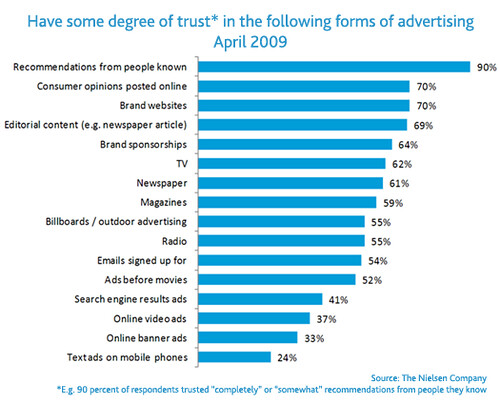
    In response to this dilema, people flock to online reviews to get an opinion. According to a Nielsen study in April 2009, consumer opinions posted online was the second most trusted form of advertising.

    Reputation Management of Online Reviews

    Why not use that to your advantage?

    In theory, every single customer becomes a brand ambassador either positively or negatively expressing their opinions. For a minimal investment a dealer can leverage the word of mouth of all of their satisfied customers to enhance their businesses reputation. You can not control what they say, but you can take the following steps to help maintain your online reputation.

    The three most important things someone can do to improve their online reputation are:

    1. Maintain and Monitor a list of the top review websites in your industry
    2. Treat all comments seriously and respond quickly and courteously. Use the channel where the review first appeared to respond.
    3. Take the conversation offline, this does NOT mean get the comment removed. It means reach out to the reviewer with another way to contact you. Give them your phone number, set up a meeting, or send the person a direct message asking what can be done to help resolve or rectify the issue. Not all issue can be resolved but by reaching out to them you show everyone that you care what people have to say or think.

    Reputation Management Online Reviews
    As food for thought, Where would you eat? I know where I would…

  • Are Online Reviews More Influential Than Advertising?

    When it comes to how we consume, things have dramatically changed over the last twenty years. For instance, if your mother and father wanted to go to a restaurant in the seventies, it was probably because they heard it was good from friends or neighbors or simply wanted to give it a shot. 1979 brought about the debut of the Zagat guide, which of course gave people more of a guideline than ever before. Fast forward a few decades, and there’s suddenly more information than you could imagine available for everything from eateries to shopping for clothing. Because of the popularity of the internet as a means of sharing information, people can now log on and leave reviews for all sorts of experiences, making it that much harder to pass off a bad meal or a sleazy transaction than it used to be. In some ways, it’s great. But how is it affecting us as consumers?

    If numbers are to be believed, the effect is greater than you might think. In fact, it seems as if user reviews are the method of choice when it comes to consumers making decisions in the modern age. Financial agency Deloitte were recently quoted as saying that:

     “82% (of consumers) say their purchase decisions have been directly influenced by the user reviews, either influencing them to buy a different product than the one they had originally been thinking about purchasing or confirming the original purchase intention.”

    Naturally, Deloitte aren’t the only ones noticing the trend. Media Planning company EXL Media also tells us that the numbers are rising when it comes to advertising versus consumer review:

    “55% of U.S. consumers believe strongly/somewhat that online consumer reviews and ratings influence their buying decisions more than any type of online advertising.”

    These are no small figures! So I guess all those people logging into Yelp from their phones and madly blogging about their experiences aren’t just a voice after all. Collectively, we form something stronger — a body of opinions that has enough klout to get people reading and making choices. In fact, making choices that disdain traditional advertising. In other words, the system is changing yet again — and advertisers will be forced to reinvent themselves if they want to compete with the voices of the common people.

    This movement isn’t limited to finding a good place to eat, either. Even doctors are included, as there are websites such as Vitals that allow you to find and rate doctors. Deloitte tells us that home electronics rate among the items people seek out online reviews for most often, with personal electronics, games and toys and kitchen appliances close behind.

    Because of these new perimeters, every business faces a new challenge: To not only provide good service and leave customers impressed, but to also properly address unhappy ones and help to resolve their concerns. Otherwise, a bad review or two could smudge your name and drive away potential clients. Gives a whole new meaning to “Honesty is the best policy,” doesn’t it?
  • Reviewing the Yelp Review Filter

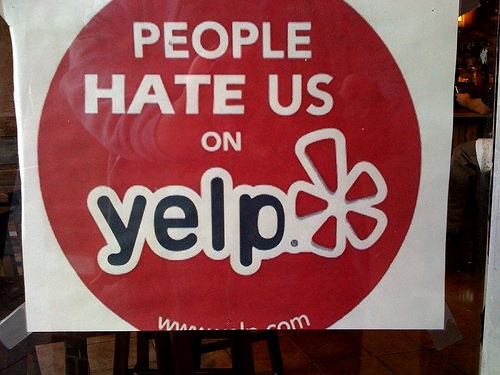
    Image: People Hate Us on YelpI’ve just published a longer article on the Yelp Review Filter, what it is, how to manage it and, of course, how to spam it.

    Since I wanted to make it a page rather than a post it doesn’t have comments so I’m putting up this post to collect comments.

    Are you a business who is stinging from being Yelped? Tell us about it and we’ll do a follow up blog post with the best stories.

    And even if you’re not a business owner I’d love to hear your opinion of the Yelp Review Filter in the comments.

  • Place Page Reviews are Now Separated

    Cobbler making shoes, but not for his kids Tonight, I was logged into the Place Page account for my husbands’ business adding a Coupon.  I haven’t looked around his Place Page in a while, and I was trying to see what I have missed in the months since I last logged in.  (Just as the cobbler’s children go without shoes, the Place Page accounts most personal to me tend to get ignored.  And that is not my husband in the picture.  That is a cobbler.)

    Then I saw some newness .. what’s this? … The reviews are separated out.  Check it out on this Place Page …

    Denver Dentistry – Dr. Guy Grabiak, DMD, FAGD
    3190 S Wadsworth Blvd, Suite #300, Lakewood, CO 80227
    (303) 988-6118

    Place Page Reviews Separated
    Reviews cached from sources around the internet are categorized under “Reviews from around the web” while Google reviews are segregated into their own special area, “Reviews by Google users.”

    Reviews from around the web

    Reviews from Google Users

    I had to ask a few Search Influence dedicated employees still working and available on chat tonight, “have you seen this?  Is this new?”  The resounding response was a confirmation that it is indeed a new development.

    Paula Keller
    gives feedback that she saw this earlier today, so perhaps this is the first day for the evolution of this separation.

    What does this mean?  I’m not sure what it means.  But there is definitely more transparency on reviews and the sources of those.

    And it’s interesting that Google puts “Reviews from around the web” above their own.   They want browsers and searchers to read the other reviews before those that Google gathered.  Perhaps, it’s a nod to the Google reviews having a tendency for attracting inauthentic reviews?

    Digging around, I can see those businesses that have ALL of their reviews from Google and none from other sources.  Suspicious behavior.  This guy has 22 reviews, everyone of them great, and everyone of them from Google users.

    all 22 reviews from Google Users

    Oooo! And this is cool.  It very clearly indicates how many reviews are being pulled from these web sources right in the source Title.  David Mihm found the New Place Page Reviews Format earlier today andhe points out the little flavicon on the review sources:

    82 reviews from 1 source!

    This newness is curious and interesting.  Just when we’ve decided that reviews are always important but maybe not as strong a factor as they once were, Google shakes it up for us.

    Thanks to hans s for his very cool medieval cobbler image.

  • Yelp Review Filter Explained (How do I spam that?)

    I was looking for more contact info for Luther Lowe and noticed his tweet about a blog post explaining Yelp’s Review Filter. Luther does a good job of explaining the Yelp Review Filter and Yelp has commissioned a video which tries to explain it in a friendly way. The review filter, Yelp’s legal woes and the general state of Yelpdom have been the topics of many conversations lately.

    While in Portland last week presenting on Facebook Marketing at SEMpdx SearchFest I had a couple great dinners with some really smart people. One of those dinners included the aforementioned smart person Luther Lowe who is part of Yelp’s business outreach team.

    Luther gave a good explanation in person of the review filter and I think he’s done a good job in the blog post as well. I have to admit, after my personal experience with Luther and his colleagues I’m a lot more positive toward the organization as a whole (I may be influenced by Mat Siltala too).

    From what I could discern, that the most critical component of the review filter is one which looks at a users yelpish tendancies to see how active a yelper they are. In other words, if you just created your account, or have a very thin profile you might get filtered.

    I can see it. I understand it, but I think the position Yelp takes regarding small businesses requesting reviews is unreasonable. And, their system presumes guilt which is downright un-American.

    I’m assured by some of Luther’s colleagues with whom I spoke at SMX West that there are semantic elements too. But, it looks like the biggest factor is how “real” you look by virtue of your history on Yelp.

    But, as we learned at SMX, Yelp has 180 in Sales & Marketing as compared to 40 Engineers.

    So, I know what you’re asking: “Given all this, how do I spam Yelp”?

    It’s easy, be patient and build a quality profile. In other words, if you look real you have a higher likelihood of having your spammy review not filtered. (hint: real doesn’t mean 10 reviews of disparate places within 24 hours)

    I’m reminded of the quote with which I start most SEO presentations:

    The most important thing in business is sincerity.
    If you can FAKE that, you’ve got it made 🙂

    Seriously though, I appreciate the attempts at outreach. It’s clear that Yelp is cognizant of the PR issues (and their legal issues) and that they’re working to provide a valuable service. I hope they can get their act together on the sales front before they go up in flames.

    Amilia's Diner - SEO Invasion
    Amilia's Diner – SEO Invasion

    Amazingly, none of these reviewers were filtered (Amilia’s Diner on Yelp).

    Related Posts:

  • Burying Negative Content – What to Do Versus What Not to Do


    These days it is really easy to tarnish the online reputation of a company.  Just one bad review or article posted on a high traffic web site is all it takes.  In most instances it is impossible to have negative comments and stories removed.

    The best way to fight negativity is through positivity.  The simplest way to do this is to drown it out.  Good news can chase bad news down the search engine ranks to the 2nd or 3rd page, where it is less likely to be found.

    Here are some action steps:

    1) Monitor activity- Find all of the sites where the bad news lives.

    2) Stay calm- Be patient, it takes some time.

    Patience for reputation management techniques to work!

    3) Post positive- Here are just a few ideas:

    Create a social networking profile – Facebook
    Create a business profile – Linked In
    Start a blog – WordPress
    Share photos- Flickr
    Claim your identity- Naymz
    Create a Wiki- Wetpaint

    The number 1 thing NOT to do is search for yourself or search for the negative information.  This is the fastest way to ensure it will NEVER go away.

    It is hard work and extremely time consuming to bury bad press.  I know it is tempting to look, but that one search can enable the bad news to resurface and erase all of the work that was already done, bringing you right back where you started.

    Even if you do not have a reputation management issue at this time, please know if one does present itself, there are ways to fix it, as well as one major way to prevent it from disappearing!

    Image Credits: Thanks to ladybeames and stevoarnold for the great imagery for this post.

  • Practical Ways to Combat Potential Negative Publicity

    I am super excited! After weeks and weeks of searching, I finally found the red, snakeskin platform pumps I have been looking for! Of course, before I make the purchase (and part with that amount of money for a pair of shoes), the first thing I do is Google them and look at customer reviews to see what other users have to say…”Worst shoes ever bought”…”Heel broke after one wear”…”Leather stretched”…”Strap punctured”.  Shockingly, they are all negative!

    WOW! This company truly needs some online reputation management. Online reputation management is simply the process of monitoring a brand online, dealing with anything negative and understanding how to be pro-active to prevent negative content. The tactics are mostly used by companies to pro-actively protect their reputation from damaging content found online, unfortunately some companies use online reputation management to reactively “fix” the damage that is already done.

    Reputation management is more important than ever in how your company is positively or negatively perceived. Think about the popularity of search engines, emerging social media and blogging. These things make it easier than ever for the public to voice their opinions – good or bad – to a very large group of people.

    So, how can you maintain control of your online presence? Here are 4 ways:

    1. Create new pages to rank higher

    In other words, create positive content to replace negative content. This will help push any negative content further down.

    2. Create pages on other sites

    Set up a lens on Squidoo and send some links back to it. Start a blog on wordpress.com or blogger.com. Keep up with posts, add some links and watch it climb. Set up social networking profiles on Facebook, Twitter, Linked In or My Space.

    3. Respond to the issue if a blog or forum post

    One day, someone is going to find the page so why not respond. If the person is genuinely upset, don’t get defensive, just apologize and try to resolve the issue. If the post is false, contact the site, even though there is no guarantee it will be removed.

    4. Encourage happy customers to post positive reviews.

    It is not as motivating to make a happy customer leave a review, as it is an irate customer. Make it easy for them to share their experience. Offer a link to a review site in e-mails to your customers, and perhaps even some sort of incentive.

    The above four ways are a great start to managing your online presence. There is always something that can be done to work on this. Take the time to find where your company is mentioned or listed, and be sure to check back every so often. Reputation management isn’t a one-time thing, it’s an ongoing process!

  • Online Reviews Rule With Google’s Sidewiki

    The reason testimonials and reviews are so powerful is because they provide a third-party (and hopefully, unbiased) opinion of what actual users think about products and services. Google knows this and considers reviews and citations an important factor in local search rankings.

    Studies have shown that not only do long customer stories (2.5 times longer than reviews) lead to increased, more relevant search results, but increasing website interactivity with fresh, real-world content like customer questions and answers can increase sales conversions and lower customer service costs. For some business owners online reviews have become far more useful than the traditional print yellow pages and savvy business owners have figured out proactive ways to use online review sites.

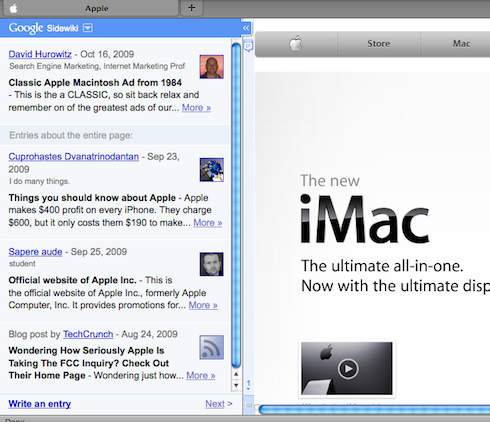
    But there are concerns that Google is now trying to dominate the local search landscape with new developments, some of which place user reviews at the heart of their new features. Google’s new browser add-on called “Sidewiki” allows anyone to contribute comments about any web page. According to Google, Sidewiki entries use an algorithm that promotes the most useful, high-quality entries. It takes into account feedback from users, previous entries made by the same author and many other signals developed.

    How Google uses these entries to rank web pages remains to be seen, but most marketers agree that the impacts of this are far reaching, because it includes every web page on the internet in Google’s own social network, with consumer opinion – both positive and negative – displayed every time a user opens a web page. With this new feature, Google has shifted power firmly away from corporate web teams and placed it in the hands of the consumer.

    applesidewiki

    The good thing is that Sidewiki entries are tied to a Google profile. There’s no guarantee that the profile isn’t bogus, but the advantage is that no anonymous entries are allowed. Also, Google will analyze language so that “stupid comments” are automatically discounted or removed.

    Some marketers surmise that user profiles will be moderated by a quality algorithm, so more influential, active or powerful users, with more powerful Google Profiles or Personal PageRank, will have more influence in the comments. This is very likely the case, as measurements of Twitter influence have demonstrated in the past. It’s usually a small minority of influencers who create the most comments and influence the majority of users.

    So how do businesses make use of this feature? The same way they bring newly-created linkbait to the notice of influential bloggers – by cultivating customer evangelists and monitoring social networks for influential voices and alerting them to content that is interesting and valuable. Sidewiki is just another way for Google to introduce a new feature of quality control into its already formidable algorithm and ensure that SEO and website promotion experts don’t get too complacent with their efforts.