I’ve been actively creating and managing Google AdWords campaigns for over five years. In that time, I’ve made a lot of mistakes with everything from keyword selection to match type to ad content. It happens — if no one ever made a mistake on AdWords, we would all be PPC success stories, and that’s certainly not the case. So when I typically see mistakes with sponsored ads, I take a screenshot, write a short heads-up email to the advertiser explaining their mistake, and keep it rollin’. However, over the weekend I came across what could possibly be the worst targeting and most confusing landing page I’ve ever seen on AdWords.
While I was searching for “delaware county oh plastic surgery” (before you start reading too much into this, no, I was not looking for a plastic surgeon. I am quite comfortable with my stout lil’ man-child body), I came across this gem of an ad…
Battle for the Planets? The Difference is more Power Rangers.
Organic and paid search are both, at the core, about the search queries. These queries are, of course, sought by optimizing for or bidding on certain keywords. These keywords, found using keyword research tools such as Google’s or Wordstream’s and then turned into a comprehensive list using your favorite keyword expansion tool.
Organic keyword research focuses on traffic, looking for quality descriptors for the products, service, or content offered to the visitor. These descriptors are filtered for the search phrases that are the best fitting and for “low-hanging fruit,” ones with low competition and high value to the business.
However, strategies for paid research must be different, because the mediums are used in a different way. In addition to search traffic, competition and metrics that might be overlooked or generalized, like average CPC, must be included in the research. Furthermore, these three additional discovery strategies can help create a more robust keyword profile.
Three Keyword Discovery Strategies
General
Unlike in organic search, general keywords play a central role. Organic keywords, especially for businesses, tend to be of the general pattern *geographic area* *keyword*. However, because a paid search campaign can geotarget its ads, any search using the non-geomodified keyword from the targeted area would also trigger the ad. Thus, someone in Montana searching {window cleaner} will see ads targeted to Montana Window Cleaner.
General keywords focusing on the domain name and business name are also useful for brand marketing. There is a bit of a debate over whether PPC clicks cannibalize organic clicks for this kind of keyword. A few theories and strategies have arisen, with of course the best answer being “What’s best for you,” though problems can arise with attribution.
Long-Tail
Long-tail keywords, searches like {cost of criminal lawyer} or {home security free installation}, while relatively low traffic, are specific searches that strengthen the depth of the research. This way, deep searches you wouldn’t optimize for organic search can be explored and taken advantage of. These deep searches are largely of two types, researching and buying. Phrases like {cost of …}, {buy …}, or client-specific long-tail terms like car models can be used to serve ads leveraging the search intent of the viewer.
Match Types
The three match types are Broad, [Exact], and “Phrase.” These three types are even more important to the research than for organic search, as it can affect CPC.
Broad keywords would trigger on longer-tail searches, synonyms, common misspellings, and word reversals. The broad keyword Criminal Lawyer would show ads on the queries {criminal law}, {attorney for criminal case}, or {criminal lawyer new orleans}.
To save on CPC, [Exact] keywords will run ads on the keywords only in that order, so [criminal lawyer] would trigger on the searches {cost of criminal lawyer} but not {lawyer for criminal case}.
“Phrase” Keywords display ads solely on the phrase entered. The keyword “criminal lawyer new orleans” would show solely on that term, and none others. This one is less necessary for PPC research.
Facebook and Display
The final addendum for any PPC keyword research is that you have to take into account for display ads, whether through Adsense or social media platforms. These ads, though not for paid search, are the bread and butter for retargeting and remarketing or brand awareness. Approaching this match types as keywords may not yield much, but treating broad keywords as categories or thinking laterally and approaching the keywords from demographics and related interests could solidify a bland targeting spectrum.
With the “reimagining” of Keyword Research strategies focused around these three concepts (and one quick point), your ROI will skyrocket from the CTR and quality score increases that come with a well-curated keyword list. What tricks have you used to get the most out of your keywords?
Shutting down the ability for these sites to advertise online…
As expected from page 21 of the May 10 quarterly report to the SEC, Google will pay for a Department of Justice investigation into the use of American ad space for illegal Canadian pharmaceuticals. Finding that from 2003 to 2009, Google “both allowed and helped” Canadian pharmacies that tried to sell to US patients, this DOJ settlement avoids criminal prosecution. It’s also one of the largest forfeitures in US history, according to Rhode Island U.S. Attorney Peter F. Neronha. Crimaldi argues that Google may see long-term reputation damage from the case, which butts heads with the mantra of “Don’t be Evil.”
But is this backlash really going on? Google’s stock price was up $4.47 (.86%) on the day, despite Crimaldi’s piece coming out at 8am yesterday. Crimaldi predicted this by mentioning its miniscule amount compared to Google’s cash on hand; but not only this, the money has been paid for already. Google already mentioned it almost a year ago. The fallout for this may have already rippled the zeitgeist — May 10 began a 6-day slump, though not the nadir of a 3-month losing streak starting in April. Making comparisons even harder is the 5-day selloff that was likely a direct commentary on Standard and Poor’s downgrade of the company’s shares to “Sell.” S&P rated the stock a “Hold” yesterday, basically saying “the price is right.” Similarly, Robert W. Baird & Co. sees verticals like YouTube as undervalued, and sees the stock outperforming the market, even growing to $650 a share.
Three salient points arise from this story. First, there is a lot of trust in Google. The business world sees one of the main thrusts of European antitrust investigation as a boon to the company: the vertical integration Google has enacted. Secondly, Google isn’t the Dad and Dad store it was, even as recently as last decade. Google’s revenue has exploded by 33% over the past fiscal year, in no small part due to the Adsense/Admeld deal. Finally, Google has often toed the line of what is or isn’t legal — for a less objectionable example, look at Google’s reticence to Chinese censorship laws.
Peter F. Neronha, sending "a clear message to… Google and to others that contribute to America's pill problem that they will be held to account."
Most importantly is that this has already been planned for and dealt with. The submitted Form 10-Q says:
In May 2011, in connection with a potential resolution of an investigation by the United States Department of Justice into the use of Google advertising by certain advertisers, we accrued $500 million for the three month period ended March 31, 2011. Although we cannot predict the ultimate outcome of this matter, we believe it will not have a material adverse effect on our business, consolidated financial position, results of operations, or cash flows.”
Many veteran PPC marketers tend to vilify dynamic keyword insertions (or DKI). They usually present examples of DKI which have been obviously done by someone who is not skilled in the nuances of paid search copy writing – this bothers me.
It bothers me because I think there is a valid purpose for dynamic keyword insertion in paid advertising. While some uses are nefarious (let‘s be clear – I do not own a black hat) a lot of them are legitimately useful for marketing efforts.
First let’s talk about how to use DKI because after seeing some serious DKI GONE BAD, I figured I should explain how to use it.
When using DKI, you need to be careful of how you input the word “keyword” before the colon.
{keyword:________} would make your inserted keyword will not be capitalized. By capitalizing the “K” in {Keyword:________} the first letter of the word is capitalized. When you type {KeyWord::________} every word will be capitalized. And when you capitalize every letter i.e. {KEYWORD:________} all of your letters will be capitalized and searchers will think you are partially deaf and/or screaming your headline at them – don’t do this.
Now that I’ve explained how to use DKI, let’s move on to when it is appropriate to use it.
BE WARNED! I am not advocating DKI abuse – use at your own discretion.
Image courtesy of jeffreyhill.typepad.com
The Good Use of Leveraging Other Brands
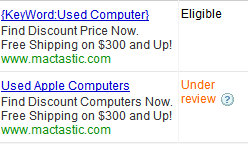
This is a scary, scary topic for most advertisers because they fear legal pursuit from owners – however DKI is probably the smartest way to advertise when you are a small third-party reseller. A great example is Apple. If you are a Main St. electronic boutique who specializes in selling discounted Apple computers, how do you set up a campaign that is effective that isn’t flagged by the ad po-po? Build a focused ad group using the trademark terms as keywords and DKI in your headline.
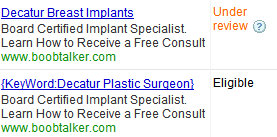
EXAMPLE:
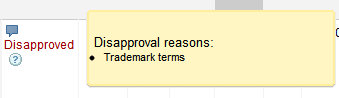
The Eligible ad will fly through the review process unharmed because it does not directly mention Apple but the Under Review ad will result in you seeing this message time and time again:
Doing this can really help you penetrate a very specific niche of a larger market quickly and, if set up properly (i.e. exact matching the correct terms you want to appear in the headline), cost-effectively.
The Bad Use of Leveraging Other Brands
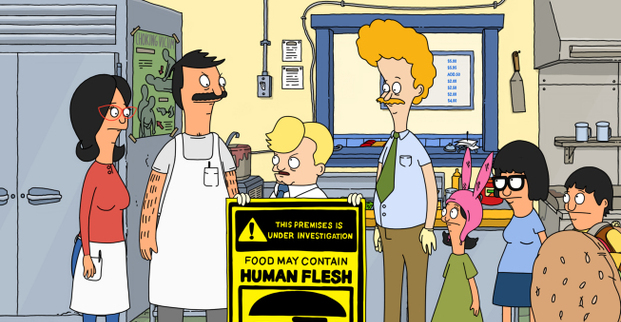
Using DKI for leveraging a competitors’ brand is great when you want to undermine their newest promotion, expose possible unsightly transgressions, or just really piss them off.
Image courtesy of FOX TV Network
Let’s say you are the neighborhood traditional American restaurant and you want to increase your market share after some bad press comes out about a direct competitor – use it to your advantage.
Find all the variables and misspelling of their name, use one of those misspelling as your fallback phrase and have their actual brand name insert dynamically in the headline.
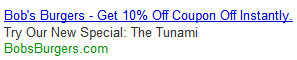
So if your competitor’s ad is in position one for the phrase “Bob‘s Burgers“:
Have your ad in position two with :
This will make your competitor $#*! a brick and Google won’t do anything because you are following their guidelines. This is like saying you love praying so you are giving it up for Lent – you got them in a technicality.
NOTE: I would never do this for a client – this is merely a suggestion for you devilish paid search marketers out there *polishes halo*
The Good Way to Avoiding Negative Approval Status
Another use of DKI is avoid long review process and disapprovals because of “non-family“ or “adult” ad copy. What are “non-family” and “adult” ads? Here’s the official definition:
Ads are reviewed and categorized as Family Safe, Non-Family Safe, or Adult Sexual Content depending on the content of the ad and website.
So basically anything part of the human anatomy and any word you wouldn’t say around your mother. I am frequently annoyed by this particular rule because I deal with a lot of plastic surgeons who perform cosmetic and reconstructive breast procedures. Breast – a word that is so mundane that to be considered “non-family” by the Search Overlord Googleus Maximus is ridiculous. I’m still confused that the headlines “Breast Cancer Treatment”, “Breast Implants Surgery”, and “See Big MILF Breasts Now” are all consider the same even though the context of the word is vastly different. Since this is a problem I run into on daily basis, using dynamic keyword insertion is pivotal to me getting ads up and running (without several phone calls and 5-7 business day wait time).
Here are some examples of ads that will be marked as “Non-family” and “Approved”.
Image courtesy of knowyourmeme.com
The Bad Way to Avoiding Negative Approval Status
Google hates drugs and at the top of their list seems to be medical mary jane. I’m not sure why, especially considering it is legal in California (and safer than all other drugs).
Regardless of Google’s Stalin impersonation, if you are trying to advertise on Google for marijuana related ads and terms you are gonna have to jump through some hoops. What I’ve learned from my time running a medical marijuana campaign is you can trick Google into approving your ads and use DKI to make your ad relevant to searchers.
EXAMPLE:
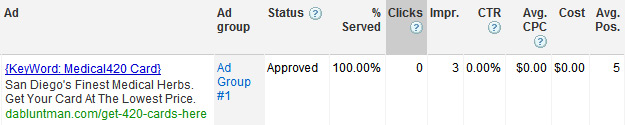
This is an ad I tried to run for for the lulz on a $100 free Google Adwords account just to see if I could do it. As soon as I hit the submit button, the image below appeared on my screen.
Google’s automated system was not in the mood for my shenanigans.
Using DKI, I changed the headline and even made the display url more ridiculous to prove a point and in less than 30 minutes my “medical marijuana” ad was not only Approved, it was receiving impressions.
The shocking part about this is my free Google Adword account’s medical marijuana ads were approved faster than a 6-year-old plastic surgery account that had the word “breast” in the adcopy (I swear Adwords’ review team is composed of untrained golden snub monkeys that respond negatively to the human anatomy – “DKI,” more like “DIK”.)
Image courtesy of zoofacts.com
They are sooooo cute but such terrible ad reviewers…
I guess this post was to make people aware it does not make you lazy, dumb, or a noob to use dynamic keyword insertion. In fact, I think if you know how to use is properly it can be extremely beneficial to your ad campaigns. Think of DKI as something to master, like martial arts. Could you possibly kill your ad group’s performance? Of course! But if you hone this skill you could be hundred hand slapping your ad competition, Kenshiro-style.
I come from a family of “do-it-yourselfers”. When my mom wanted new curtains for the kitchen, she’d go to the local craft store and purchase 3 – 5 feet of fabric and hot glue to her heart’s content. My dad was no better; I remember watching him jury rig the plumbing after the basement flooded. While I always admired their “make it work” attitudes, these (and many other) situations always ended with a call to a professional. So when I hear that non-search marketers are doing pay per click marketing, I have flashbacks of curtains falling apart, pipes constantly leaking, and money being wasted.
Pay per click marketing is a tricky platform with many intricate pieces. As a PPC professional, I find myself in the role of a copywriter, researcher, accountant, analyst, and a gambler. It’s a daily routine juggling daily budgets, maximum bids, and demographic settings to ensure the highest possible ROI with the given budget.
Paid Search Keywords
One of the biggest mistakes in many paid search campaigns is choosing keywords. Instead of choosing terms that visitors are searching for, first-timers choose keywords they are familiar with or possibly even industry terms – an example of this is “abdominoplasty” versus “tummy tuck”. While abdominoplasty is the correct term, it yields significantly lower traffic because the average person would type in tummy tuck.
Another aspect of choosing keywords for a campaign is determining niche keywords. A niche keyword is a low traffic but high CTR phrase. For instance, while most searchers will use the phrase “tummy tuck,” there is a smaller segment of the population that will type in “tummy tuck stories.” This type of searcher has already done the “tummy tuck” search and is now looking for further information regarding the procedure. This visitor is also most likely to convert into a lead.
PPC Ad Content
A big part of a successful campaign is the ad’s content. Writing compelling copy that follows the search platform’s and your industry’s best practices in 75 characters can be difficult. Most novice marketers tend to overload the ad with irrelevant content or keywords.
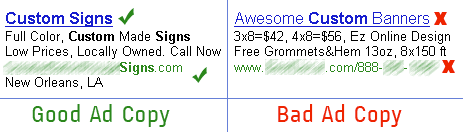
Good Ad Copy, Bad Ad Copy
If you look at the two examples below, you can see that the ad I deemed “good” has more bold keywords (keywords automatically bold based on the phrases the searcher used), the copy has a voice with a clear competitive advantage and call-to-action, and the location of the advertiser. You might be wondering why I decided that the right ad is bad – well even though it gives pricing information, a phone number, and a competitive advantage (“Free Grommets&Hem”), it lacks a call-to-action, voice, location, and most importantly suggests a lack of professionalism by including “Awesome” in the title.
Not only will the good ad be rewarded by Adwords for incorporating more keywords naturally into the ad copy, but people respond better to complete statements in ads and more likely to click through.
Managing Your Paid Search Campaigns
This is probably the hardest because it relies on advertisers knowing how to analyze site metrics, campaign details, and conversion rates. Even after years of being Google Adwords certified, I still find quantifying the data difficult. Tracking cost per click at a keyword level is tedious and granular work – if you don’t know what you are looking for or even at, you could negatively impact your conversion rate.
Another challenge for advertisers is bidding against competitors on ad placement. I always find this the most fun because of the level of difficulty. It’s like eBay bidding on steroids. If you are not closely managing your daily budget and cost per click, you can easily be pushed off the page – especially when in competition for placement of broad, high-traffic keywords.
Anyone can pick up a “for Dummies” book, but there is no substitute for experience. I don’t want to discourage those who are interested in paid search, but I want to inform do-it-yourself types that there is a lot of work that goes into a PPC campaign. You could easily spend thousands of dollars without a single lead to show for it, so please, hire a professional.
Lately I have been doing a lot of research on landing page strategy and as I read about what not to do and what you must do, I think someone needs to break it all down into a simpler form. Where are we going wrong, maybe it’s all just too much? Make it simple. All you need are these 5 things arranged properly and it is most likely going to perform better than what you are using now:
Coming in for a smooth landing
1.) Your Company Logo clearly marked in the top left corner of your landing page.
Your company logo is your brand and it is what is going to clearly connect your landing page to your website. You do not need or want the exact navigation that exists on all of your web pages, it offers too many distractions and takes up too much room, most likely forcing the more important information (the Form) below the fold.
2.) The only content needed is a few credible and useful facts that must satisfy the users search inquiry.
Display this text concisely using bullet points. The messaging should match the ad copy and try to use relevant keywords. Only add relevant images that will enhance the users intent to take action. Do not use stock photos for design because it will likely distract the user from the intended action.
3.) Make the point of your page loud and clear with clear and obvious calls to action.
To be golden be loud and clear
If you want the user to fill out the form or call a number don’t make it difficult for them. Add the phone number clearly in the top right of the page. Add a visible contact form that is above the fold, and does not ask irrelevant questions like “how did you hear about us?” Since, we can track all of our leads in analytics, we do not need to ask this question, so don’t ask it!
4.) Add your credibility symbols above the fold.
This is very important, because the users need to immediately see a reason to trust your brand, if they do not see it right away, they will not scroll to the bottom of the page, but they will hit the back button to find it somewhere else.
Visible trust symbols are also very important for the ad copy. For example many of our client’s are plastic surgeons, and we cannot say, “board certified” in the ads unless it is proven on the landing page.
5.) Offer links to more information or to other pages on your website.
Link to the website at the top and the bottom of the landing page and from your logo. Add “read more” links to your bullets points, which will allow the uses to find more information. Remember you do not want to use too many links out because this will distract them from the purpose of the page, but not using any, the user will use the back button and navigate off the page, which is the last thing you want to have happen.