Stay ahead in digital marketing with The Influencer, Search Influence’s monthly newsletter covering SEO, digital advertising, and content strategy. Get top tips to fuel your online growth, expert insights from the Search Influence team, and our latest company news. Don’t miss out!
CEO Will Scott Shares His Ultimate Tracking Guide
AI SEO Tracking Tools 2026: Comparative Analysis of Over 15 Platforms
WILL SCOTT | 32-MINUTE READ
Get a side-by-side evaluation of the top AI SEO tracking platforms to help you evaluate and choose the right tool for scale, accuracy, and budget.
The Future of Search Marketing as AI Search Optimization Expands Beyond Google
CHUCK WILKINS | 10-MINUTE READ
Explore the future of search marketing as AI search optimization expands beyond Google. Learn how Search Influence tracks search behavior across platforms.
Search Influence SEO: Powering Your Visibility in AI and Your Enrollment Growth
PAULA KELLER FRENCH | 16-MINUTE READ
Discover how Search Influence’s SEO approach strengthens visibility in Google and AI tools with strategies that support discovery, trust, and enrollment.
In the blog, Alison highlights why schools can no longer rely on SEO or paid ads alone.
Today’s student search behavior is fragmented across AI Overviews, social media platforms, and traditional search engines.
To compete, institutions must build integrated campaigns that engage prospective students, wherever discovery happens.
Reaching Students in a Fragmented Search Landscape
The modern student search journey is no longer linear. Students may watch a TikTok video, ask ChatGPT for degree comparisons, browse Google AI Overviews, or click a retargeted Instagram ad, all within the same day.
Without a unified digital strategy, schools risk losing visibility at critical touchpoints. Alison explains how aligning SEO and PPC helps institutions close those gaps.
SEO builds brand authority and improves organic visibility in both traditional search results and AI-generated summaries. Paid ads provide guaranteed placement in high-intent moments, supporting awareness, lead generation, and enrollment conversion.
When combined, these tactics ensure your institution shows up consistently, guiding prospective students through every stage of their decision-making process.
Building an Integrated Strategy That Drives Results
In her guest post, Alison offers actionable advice for bringing SEO and paid efforts into alignment. She covers how to:
Structure SEO content for AI-driven search
Build funnel-specific paid campaigns that match student intent
Use cross-channel insights to refine targeting and messaging
As she emphasizes, schools that take a siloed approach will struggle to compete as AI-powered search and social search reshape how prospective students explore their options.
Build a Smarter Enrollment Funnel
If your team is ready to bring its marketing strategy in line with today’s search behavior, Alison’s blog is a valuable starting point.
Map the full enrollment funnel based on how students actually search
Align website content, paid media, and email nurturing to engage prospects at each stage
Build a cross-channel marketing strategy that drives more inquiries and conversions
The white paper is built for higher ed marketers looking to drive measurable enrollment outcomes, not just traffic. If you’re ready to rethink your strategy, this is the resource to guide your next steps.
Research shows that 93% of Americans think they are better drivers than average, 90% of teachers think they are more skilled than their peers, and this overestimation is pervasive across many skills — including logic tests.
For the typical higher education institution, effective marketing strategies are like that.
Mathematically speaking, it’s not possible for a majority to be “above average.”
We analyzed the top 10 results in Google for “Higher Education Marketing Strategies” and extracted some really useful learnings. First, I’ll share the most commonly cited strategies, and then give you a skimmable summary of each article.
Top 10 Higher Education Marketing Strategies
These strategies are the most frequently cited in the following articles, in order of prominence.
SEO (Search Engine Optimization): Emphasized across multiple articles. Ensuring high visibility on search engines is critical for Higher Education SEO.
Social Media Marketing: Highlighted in almost all articles for engaging authentically on each social media platform preferred by younger generations.
Email Marketing: A recurring theme emphasizing personalization, automation, and AI-powered programs.
Video Content: Both short-form and long-form videos, including live streaming and platforms like TikTok and YouTube, are great ways to educate prospective students.
PPC (Pay-Per-Click) and Digital Advertising: Discussed in multiple articles for targeted advertising on platforms like Facebook Ads and Google Ads.
Content Marketing: The importance of creating engaging and informative content, such as blogs, podcasts, and videos.
Branding: Consistent branding across all marketing channels, including a recognizable voice and image.
Chatbots and Conversational Marketing: Highlighted in several articles for real-time, one-to-one connections and instant answers.
Data-Driven Strategies: Using data to inform marketing decisions, track KPIs, and understand the audience.
Digital Marketing and Marketing Strategy Opportunities
What we learned in the UPCEA SEO research study was that there are some big gaps in the university marketing strategy and the typical higher education website for attracting prospective students.
When we got deeper into the data, we saw that the higher education industry is overly reliant on certain digital marketing channels. A good marketing campaign addresses the full funnel. To attract students, you must increase search engine visibility, maintain a strong social media presence, and ensure you’re doing all you can to target prospective students.
So, with all the great tactics and technologies to attract prospective students (virtual campus tours, student ambassadors, and taking advantage of digital technology to highlight student activities), one has to wonder why other higher ed institutions seem to be attracting more new students.
As I’m sure you’re aware, Google and the other search engines know everything, right? So, I thought, why not let Google guide me? I wanted to see how other higher ed marketers were thinking about the strategy to build brand awareness and get in front of prospective students.
I think it’s important to take content created by marketers talking about a marketing strategy with a grain of salt. We can, however, learn a lot when we analyze the frequency with which these articles cite specific tactics, platforms, or strategies to get in front of prospective students for educational institutions.
My perspective: It’s surprising to see this continued focus on the pandemic. From what we’ve seen, things are different — the pandemic is done in most people’s minds, and we’re now in the “new normal.”
The article discusses the challenges faced by university marketers due to the pandemic and the downturn in undergraduate student enrollment. It provides 12 strategies for higher education marketing:
Centralize Strategy and Reporting: Emphasizes the importance of centralizing marketing expenditures and standardizing KPIs.
Track the Right KPIs: Highlights the importance of tracking call-to-action conversion rates, traffic sources, social media engagement, and cost of acquisition.
Use Marketing Automation: Discusses the benefits of tracking digital interactions with prospective students.
Optimize Your Email Program With AI: Offers email deliverability and engagement solutions.
Improve SEO: Stresses the importance of using relevant keywords and answering prospective students’ queries.
Build a Digital-Friendly Brand: Talks about updating branding to be more digital-friendly.
Live Streaming: Suggests using live streams as an authentic way to connect with potential students.
Personalized Communication: Emphasizes the importance of segmenting audiences and tailoring communication.
Higher Education Marketing on Social Media: Provides various strategies to maximize social media efforts.
Personalized Mobile-Friendly Website: Highlights the importance of a responsive and personalized website.
Chatbots for Higher Education Marketing: Discusses the benefits of using chatbots for immediate responses.
Don’t Forget Visuals and Aesthetics: Emphasizes the importance of appealing visuals for the Gen Z audience.
Unique Positions:
The article emphasizes the importance of data-driven strategies, especially in the context of the challenges posed by the pandemic.
It highlights the significance of understanding and catering to the preferences of Gen Z, who are the next in line for higher education.
Conclusion: The article concludes by emphasizing that marketing shouldn’t be stagnant but should evolve with the university’s overall goals.
Higher Education Marketing: Strategies and Trends to Know
My perspective: It’s interesting to see a focus on the rise of Instagram. TikTok is more timely and clearly the place where Gen Z and beyond are starting their product experiences.
The article emphasizes the importance of refining marketing strategies for higher education institutions, especially in light of decreasing college enrollments.
It provides insights into current higher ed trends and offers strategies to enhance student recruitment.
Key Questions for Your Higher Education Marketing Plan:
Identifying target audience and personas.
Determining KPIs for engagement.
Establishing the cornerstone of the marketing plan.
Differentiating from other institutions.
Platforms to Market Your Educational Offerings:
Text messages, especially during the student enrollment process.
Social media platforms like Twitter, Facebook, LinkedIn, Instagram, and Snapchat.
Email, direct mail, phone calls, and websites.
Higher Education Marketing Strategies:
Use a CMS Built for Higher Education: Implement a quality web content management system (CMS) tailored for educational institutions to address challenges like outdated content, complicated coding, inconsistent branding, and low search rankings.
Get Current Students Involved: Engage existing students to provide authentic insights into campus life.
Choose a CMS With an Email Module: Emphasizes personalized and targeted email marketing.
Focus on Video Content: Highlights the importance of integrating video content into marketing strategies.
Keep Track of Your Brand: Monitor the digital image and reputation of the institution.
Use the Power of Social Media: Utilize a mix of social media platforms for effective messaging.
Use Videos and Images on Social Media: Emphasizes the growing preference for visual content on platforms like Instagram, YouTube, and TikTok.
Personalize at Scale: Deliver personalized content across various platforms.
Include SEO and Conversion in Your Program Pages: Optimize program pages for search engines and conversions.
Target Parents: Recognize the influential role of parents in students’ college decisions.
Unique Positions:
The article underscores the importance of authenticity, especially when involving current students in marketing efforts.
It highlights the shift in the relevance of different social media platforms, noting the rise of Instagram and the decline of Facebook in the context of college planning.
Conclusion: The article concludes by emphasizing the significance of a quality website and the potential of a CMS to fine-tune a college or university’s marketing strategy.
My perspective: I wonder if the author’s suggestion of the value of traditional marketing is pandering to the old guard. Sure, brochures, commercials, etc., may appeal to the parents, but the students are on social media and search.
The article delves into the unique challenges of marketing in the higher education sector, emphasizing the need for institutions to create a superior academic environment while facing intense competition.
It underscores the importance of an effective marketing strategy blending traditional and digital methods to achieve institutional goals.
Why Is it Important to Prioritize Marketing?
Higher education institutions need to maximize enrollment and diversify their student and faculty demographics.
They must cater to various stakeholders: students, parents, faculty, and donors.
Traditional Marketing in Higher Education:
Print: Newspaper or magazine ads, billboards, and stationery.
Mail: Targeted ads, imagery, and product samples.
Radio: Over-the-air ads, jingles, and testimonials.
Television: Video ads, customer reviews, and product demonstrations.
Unique Assets: Campus tours and visits, research and development, arts, music, and sports.
Digital Marketing Strategies:
Email Marketing: Deliver branded messages, newsletters, and offers.
Social Media Marketing (SMM): Disseminate content across channels and engage with influencers.
Content Marketing: Use blogs, podcasts, videos, etc., to enhance branding.
Search Engine Marketing (SEM): Utilize paid placement and digital ads.
Pay-Per-Click (PPC): Cost-effective advertising where payment is made only when the ad is clicked.
Ideal Marketing Strategy for Higher Education:
Blend traditional and digital methods.
Maintain a dynamic website showcasing institutional value.
Engage in SEO and SEM efforts.
Execute a comprehensive digital advertising strategy.
Implement a multifaceted SSM plan.
Produce diverse content across various media.
Secure advertising spots in local, regional, and national media.
Leverage unique assets like research, campus visits, arts, music, and sports.
Highlight notable faculty and alumni.
Unique Positions:
The article emphasizes the two-way nature of digital marketing, allowing institutions to have meaningful conversations with interested parties.
It suggests that, while traditional marketing methods remain relevant, digital marketing has taken precedence in the modern age.
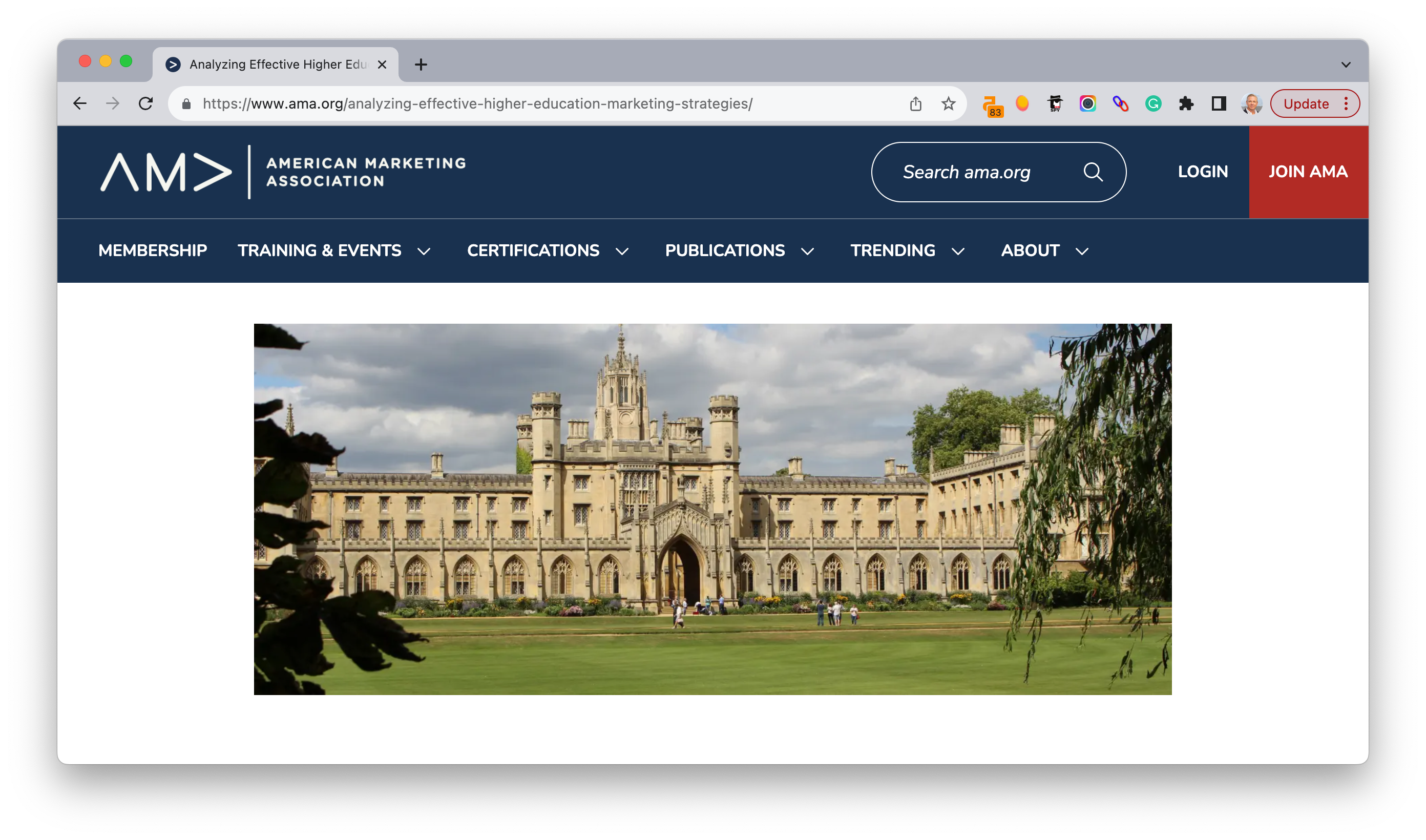
Conclusion: The article concludes by promoting the benefits of joining the American Marketing Association (AMA) for institutions looking to elevate their marketing strategies.
The Ultimate Guide to Higher Education Marketing Strategies
My perspective: Ultimate is a bit of a stretch, but I do appreciate the view on good copy and the needs of various university stakeholders, like advancement, athletics, and current students.
The article addresses the challenges higher education marketers face in today’s digital age. It emphasizes the shift from traditional mass marketing methods, like glossy brochures, to more personalized strategies that resonate with modern students.
Defining the Goals of Your Higher Education Marketing Strategies:
Marketing for Enrollment: With declining enrollments, targeting prospective students and their parents using digital channels is crucial. Strategies include:
Publishing informational blog posts and podcasts.
Engaging authentically on social media.
Collaborating with micro-influencers.
Creating video content, including live streams.
Adopting a mobile-first marketing approach.
Marketing for Advancement: This focuses on building relationships with alumni and friends of the institution, often for fundraising purposes.
Marketing for Athletics: Promoting athletic programs to boost interest, spirit, and revenue.
Marketing for Student Involvement: Inform enrolled students about on-campus activities and opportunities.
The Role of Email in Higher Education Marketing Strategies:
Email marketing offers a high return on investment (ROI) across various aspects of higher education marketing.
Effective email strategies include automation, mobile-friendliness, relevant content, inclusion of images and videos, and personalization.
Using Segmentation and Personalization for Prospective Students:
Personalized email subject lines are more likely to be opened.
Segmentation ensures content relevance, further increasing open rates.
Consistent Branding:
Emails should maintain consistent branding, using recognizable colors, fonts, and logos.
Killer Subject Lines and Captivating Content:
Subject lines should be personable, actionable, and unique.
Content should be relevant and valuable to the reader.
The Importance of Testing:
A/B testing or split testing is crucial to determine the effectiveness of email campaigns.
Testing provides data to refine campaigns for optimal results.
Conclusion: Higher education marketing strategies are essential for institutions to overcome challenges and achieve their goals. Email marketing, in particular, is a powerful tool that can be tailored for various purposes, from boosting enrollment to promoting athletic programs. The article emphasizes the importance of personalization, segmentation, and consistent branding in email campaigns to engage and convert recipients effectively.
My perspective: I find the idea of marketing “Higher Education” as a concept compelling. I recently had a conversation with one of our summer interns in which he asked, “Do I even need a degree?”
There are definitely fields, like computer science, for instance, where we’re learning that degrees don’t necessarily separate the wheat from the chaff.
The article emphasizes the long-term changes in higher education institutions due to the pandemic, highlighting the importance of distance learning programs, local student outreach, and improved campus safety. It presents 12 techniques for an effective higher education marketing strategy:
Branding: Focuses on crafting an identity that represents both the school and its student body. Authenticity is key.
Search Engine Optimization (SEO): Highlights the importance of high rankings on search engines and lists several SEO techniques.
A Great Website Experience: Stresses the importance of mobile-first design, speed, and ease of use.
Social Media Marketing: Discusses the significance of authentic engagement on social media platforms, especially for Gen Z and millennials.
Live Streaming: Emphasizes the use of platforms like Facebook Live, Instagram Live, and YouTube for events, Q&A sessions, and classes.
Email Marketing: Highlights the preference of students for email communication and the importance of personalization and segmentation.
Interactive Advertising: Describes the potential of interactive ads, such as games and story-based video ads.
Leveraging Alumni and Students: Discusses the power of word-of-mouth marketing and the importance of reviews and testimonials from current and former students.
Distance Learning: Highlights the increasing demand for distance learning options post-pandemic and the opportunities it presents for institutions.
Pay Per Click Advertising: Discusses the benefits of targeted advertising on platforms like Facebook, Google Ads, and Bing Ads.
Short-Form Video Content: Emphasizes the importance of platforms like TikTok, Instagram Reels, and YouTube Shorts in engaging potential students.
Focus on Positive Career Outcomes: Addresses the ongoing discussions about the value of higher education and the importance of showcasing the tangible benefits of a college education, such as high-paying jobs after graduation.
Unique Positions:
The article stresses the need for institutions to market themselves and the very idea of higher education in light of recent discussions questioning its value.
It highlights the blend of traditional and modern marketing strategies, emphasizing the importance of authenticity in all communications.
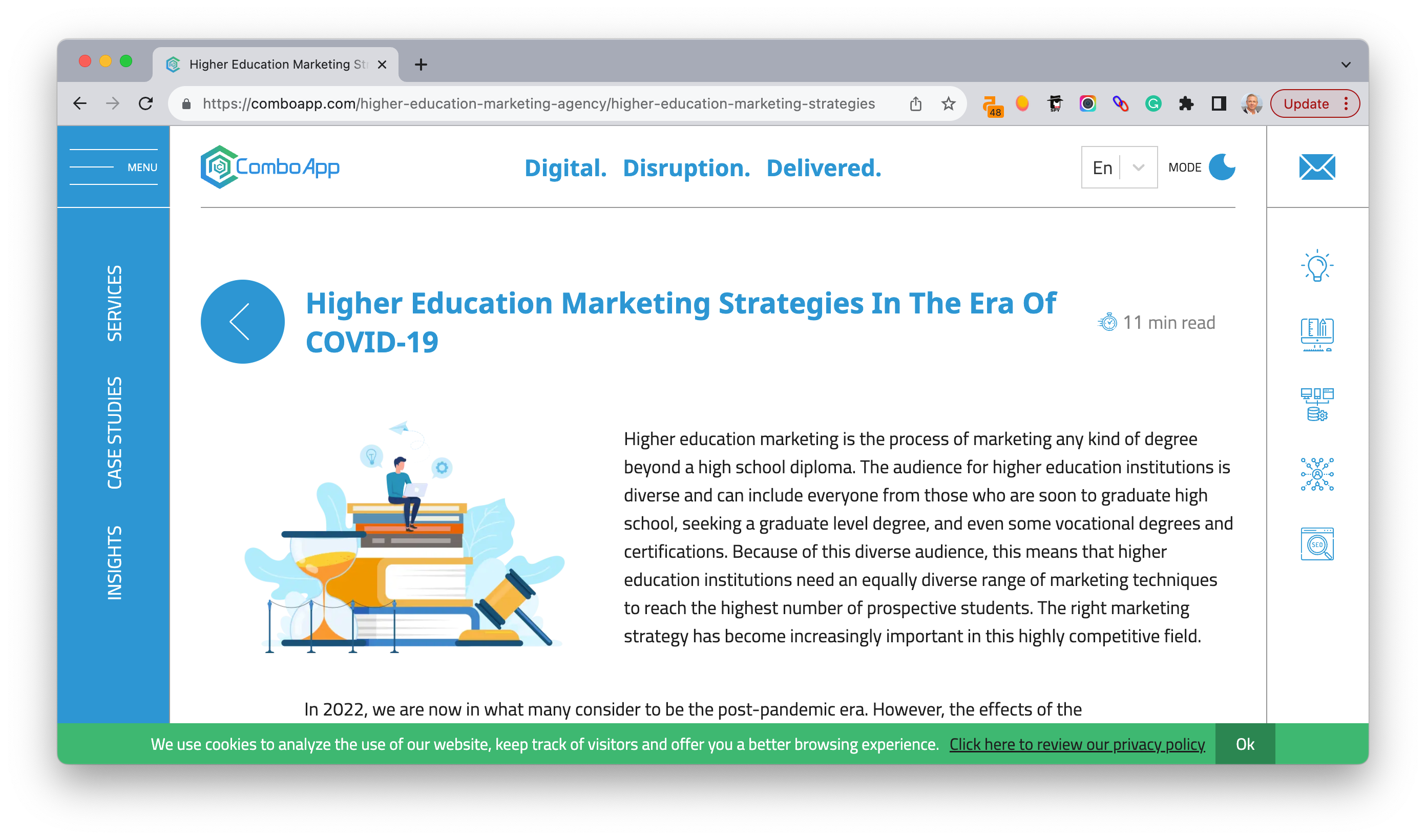
Conclusion: The article concludes by promoting ComboApp as a full-cycle higher education marketing agency that can assist institutions in crafting a comprehensive digital marketing strategy.
8 Higher Ed Digital Marketing Tactics & Trends for 2023
My perspective: Social will continue to be a tremendous way to get in front of future university students. Even though we’re no longer talking about the “Zero moment of truth” (thank goodness), students will continue to be exposed to our schools and programs before they even know they’re looking.
The article sheds light on the evolving landscape of higher education marketing in 2022, emphasizing the need for institutions to adapt to the digital age and the unique preferences of Gen Z.
Understanding the Crowdsourcing Habits of Gen Z: Gen Z’s decision-making is described as “crowdsourcing,” where they seek opinions from peers, influencers, and reviewers. Institutions should involve them in conversations and connect with their sense of humor, especially on platforms like TikTok.
Reaching Gen Z With Conversational Marketing: The trend of “conversational marketing” is growing, emphasizing real-time, one-to-one connections to answer questions and assist consumers. University websites should incorporate a human voice and chat opportunities.
Data Insights Shedding More Light on Higher Ed Audiences: Research indicates that understanding the audience leads to better marketing outcomes. Universities are using CRM systems and other software to analyze the student journey and understand their motivations.
Growing Emphasis on Personalized Messaging: Digital content engages young people, but they are wary of overt marketing. Personalized, targeted messaging helps universities connect with students and boost conversions.
Growing Preferences for Short-Form Video: Universities should incorporate short-form videos (around 90 seconds) into their marketing strategies. Examples include video campus tours, answers to FAQs, and student-guided mini-tours.
Unique Positions:
The article emphasizes the importance of understanding and connecting with Gen Z’s unique preferences, especially their reliance on crowdsourcing for decision-making.
It highlights the significance of conversational marketing and the need for human interaction, even in the digital age.
Conclusion: The article concludes by promoting Unibuddy, a platform designed for students that offers tools to enhance higher education marketing strategies in line with current trends.
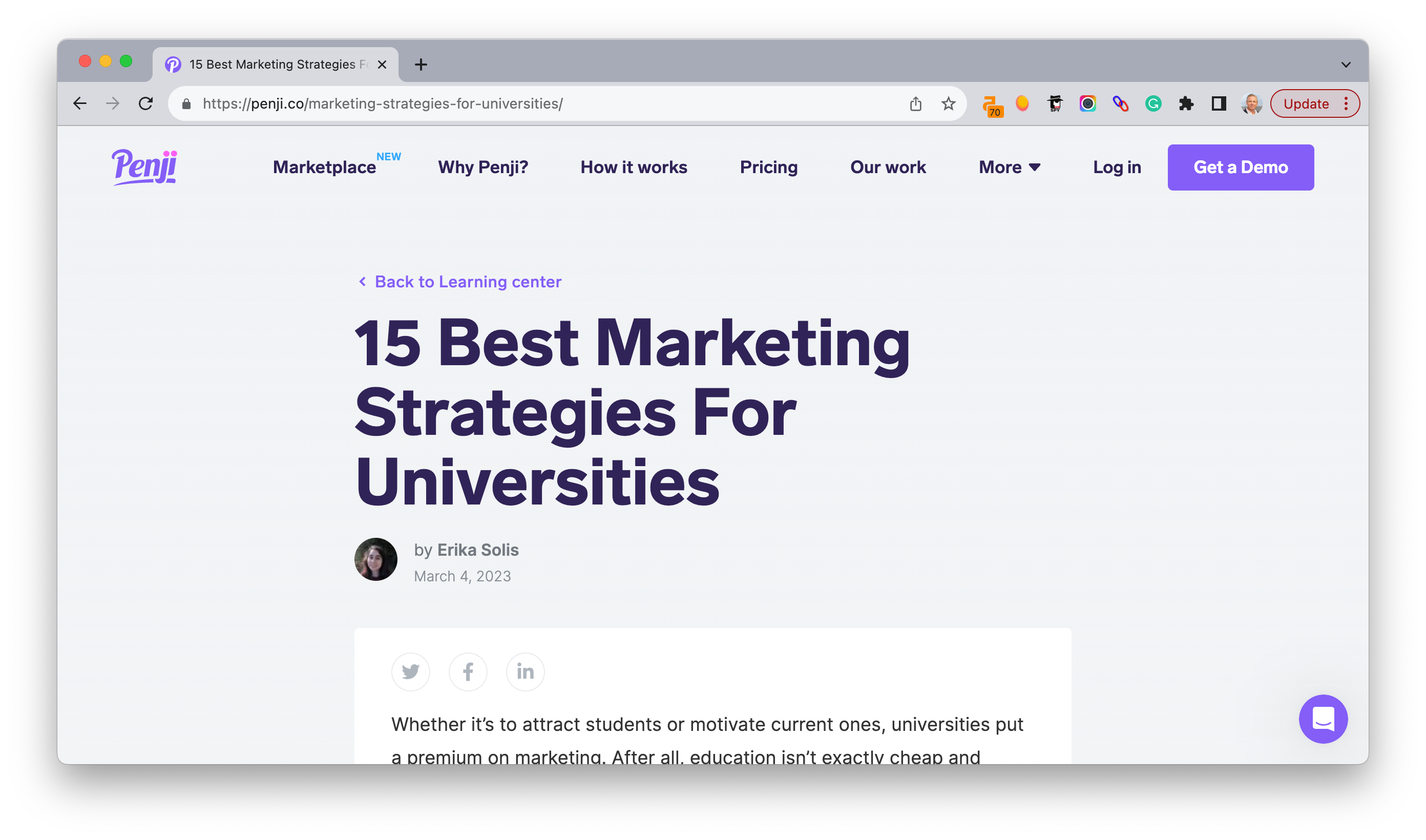
My perspective: It’s not surprising Penji would focus on social and ad creative since they are a marketplace for creative work. I’m not familiar with Penji, but it looks like a new-style iteration of a “99 Designs” concept.
The article underscores the importance of marketing in universities, especially given the competitive nature of higher education marketing. It provides a comprehensive list of strategies to enhance university branding and appeal to a younger audience.
Social Media: Emphasizes the shift from traditional mail to social media platforms to engage with prospective students. Universities should be present where students are active and ensure their content aligns with the platform’s audience.
User-Generated Posts: Encourages universities to monitor and engage with content created by students about the institution. This provides insights into the university’s perception and offers opportunities for authentic engagement.
Define Your Brand Image: Universities should have a consistent voice and image across all marketing channels. This helps in creating a recognizable and trustworthy brand.
Focus on the Students: Marketing strategies should prioritize the needs and interests of students, both current and prospective. This includes promoting events, assistance, and showcasing the university’s supportive environment.
Video Marketing on All Platforms: Highlights the increasing importance of short-form video content on platforms like YouTube. Videos offer a dynamic way to showcase campus life, events, and more.
Statistics: Using data to showcase the university’s achievements, such as high graduation rates, can be a compelling marketing tool.
Promote Sitting in Classes Before Enrolling: Offering prospective students the chance to experience lectures can help in their decision-making process.
SEO (Search Engine Optimization): Ensuring the university’s website ranks high on search engines is crucial for visibility.
Showcase Success: Highlighting the achievements of alumni can serve as a testament to the quality of education provided.
Use Infographics: Visual representations of data can be more engaging and easier to digest than text-heavy content.
Paid Traffic: Utilizing paid ads, especially on platforms like Instagram, can help in reaching a wider audience.
Interactive Webinars: Hosting webinars can provide valuable information to prospective students and give them a taste of the university’s teaching style.
Downloadable Guides: Offering resources to help students prepare for college can be a valuable tool in the decision-making process.
Email Marketing: Automated email series tailored to the student’s application process stage can provide personalized guidance.
Unique Positions:
The article emphasizes the importance of understanding the younger generation’s preferences and adjusting marketing strategies accordingly.
It highlights graphic design’s role in enhancing marketing campaigns’ effectiveness.
Conclusion: The article concludes by promoting Penji, a graphic design service, as a valuable tool for universities looking to enhance their marketing strategies with quality designs.
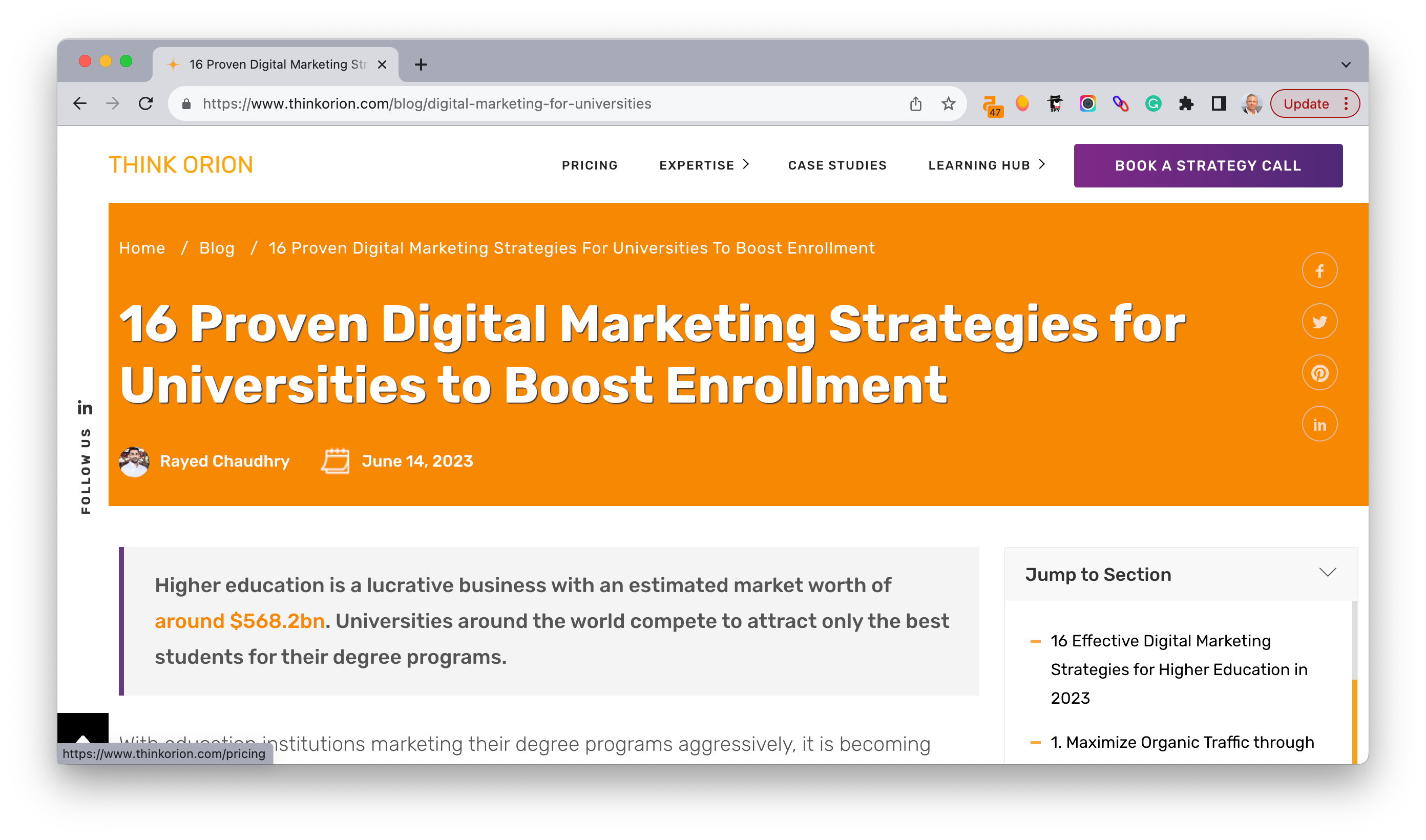
16 Effective Digital Marketing Strategies for Higher Education in 2023
My perspective: I appreciate the focus on real-time and alumni engagement. We’ve been spoiled by instant responses and always on media. And, students want to know what’s out there after attainment of that degree or certificate. Alumni can help tell this story much better than administrators or (gasp) marketers.
The article delves into the competitive landscape of higher education marketing, emphasizing the importance of standing out to attract the best students. It provides a comprehensive list of strategies to enhance university visibility and appeal:
Maximize Organic Traffic through Optimized SEO Techniques: Emphasizes the importance of SEO for attracting the right students. It covers aspects like keyword research, internal linking, backlinking, technical audits, and on-page optimization.
Accelerate Your Sales With Proven PPC Techniques: Discusses the benefits of pay-per-click advertising for promoting university programs and increasing web traffic.
Attract, Engage, and Retain Students With a Winning Content Marketing Strategy: Highlights the importance of creating engaging and informative content to resonate with potential students.
Elevate Your Brand Visibility With Google Display Advertising: Discusses the effectiveness of digital display ads over traditional billboard ads, especially on Google’s Display Network.
Unlock the Power of Social Media: Explores the role of social media platforms like Twitter, Instagram, LinkedIn, and Facebook in connecting with potential students.
Use Exclusive Email Marketing Campaigns to Promote: Emphasizes the continued relevance of email marketing, stressing the importance of personalization and using AI-powered email programs.
Make Informed Decisions With Advanced Analysis and Tracking: Discusses the importance of setting specific tracking goals beyond what Google Analytics provides.
Utilize Video Marketing to its Fullest Potential: Highlights the engagement potential of video content, both in long and short formats.
Inspire Student Success With Real-Life Stories: Advocates for sharing student success stories to showcase the value of the university’s programs.
Maximize Your Reach With Influencer Marketing: Discusses the power of influencer marketing, especially leveraging successful alumni.
Boost Engagement With Short and Snappy Video Content: Emphasizes the importance of short video content, especially in the wake of reduced on-campus visits due to COVID-19.
Optimize for Featured Snippets: Discusses the importance of ranking in Google’s featured snippet for increased visibility.
Reach Your Ideal Customers With Lookalike Audience Targeting: Highlights the benefits of using lookalike audience models to improve brand reach.
Improve Customer Service With Chatbots Integration: Discusses the rise of conversational marketing and the effectiveness of chatbots in providing instant answers.
Build Connections With Live Streaming: Emphasizes the engagement potential of live streaming over traditional content.
Hire a Professional Higher Education Digital Marketing Agency: Advocates for seeking professional assistance if universities lack the resources or expertise for effective digital marketing.
Unique Positions:
The article emphasizes the blend of traditional and modern marketing strategies, highlighting the importance of adapting to the evolving digital landscape.
It underscores the importance of personalization, real-time engagement, and leveraging alumni for effective marketing.
Conclusion: The article concludes by emphasizing the importance of current marketing strategies for universities to attract future leaders. It also suggests hiring a higher-ed marketing agency for those lacking the time or resources to run effective campaigns.
My perspective: OK, I know it’s shallow, but I like the look and feel of this site. It’s got a very medium-esque vibe.
On a more serious note, the authors point out one of my constant refrains: The decentralized nature of a higher education marketing strategy is costing universities dearly. Very few schools have central oversight and are therefore cannibalizing their own messaging and budgets.
The article delves into the complexities of marketing in higher education, highlighting the unique challenges faced by universities. One of the primary challenges is the siloed nature of marketing in universities. While universities typically have a central marketing team focused on boosting student enrollment and driving donations, there are also numerous smaller teams across various academic departments and schools, each with slightly different target audiences.
These smaller teams often work independently on their marketing strategies, employing a wide range of tactics such as social media, SEO, email marketing automation, PPC campaigns, live streaming video content, direct mail, in-person events, and even chatbot scripts. This decentralized approach can lead to several issues:
Dilution of the Brand: Inconsistent application of messaging and brand guidelines can weaken the overall brand identity.
Missed Opportunities: Due to weak communication channels, potential marketing opportunities might be overlooked or not fully capitalized upon.
Decreased Morale: Teams or individuals working in isolation can experience reduced morale.
Despite these challenges, the article offers hope by suggesting nine strategies to promote more cohesive and effective higher education marketing. While the specific strategies aren’t detailed in the provided excerpt, the article emphasizes the importance of cohesive marketing efforts across the institution.
Unique Positions:
The article highlights the unique challenges higher education institutions face due to the decentralized nature of their marketing efforts.
It underscores the importance of a unified approach to marketing to ensure consistent branding and messaging.
Noteworthy Mentions:
The article references recent engagement examples related to the pandemic, suggesting that universities have proactively created content around COVID-19.
The University of Queensland is highlighted for its digital publication, “Contact,” which offers an engaging and interactive user experience while catering to those who prefer traditional print magazines.
Final Thoughts
As you can see, there are a number of ways to get in front of students for your school.
The consensus seems to be that SEO, social media marketing and advertising, email, and PPC are great ways to invest your marketing dollars.
It’s surprising to see how little attention is paid in the articles to analysis, tracking, and reporting, given how many of the UPCEA Higher Education SEO Study respondents indicate this is lacking.
As management icon Peter Drucker is famously quoted, “What gets measured gets managed.” All the landing pages, tactics, and strategies in the world won’t make us successful if we don’t know what’s working.
For more tips to create a winning higher education marketing strategy, check out our Higher Education Marketing Resources & Guides. For more information about higher education marketing – and to learn more about services like our SEO Roadmap for universities, contact our team at Search Influence today.
At first, Quality Score may seem like an arbitrary number attached to your keywords, but there is so much that goes into it. Once you learn how to improve and maintain a keyword’s Quality Score, you can feel confident that you’re also improving the overall health of your Google Ads account.
Defining Quality Score
Google states that “Quality Score is intended to give you a general sense of the quality of your ads.” Quality Scores are provided at the keyword level and meant to reflect how the keyword performs in your account with regards to ad and landing page quality.
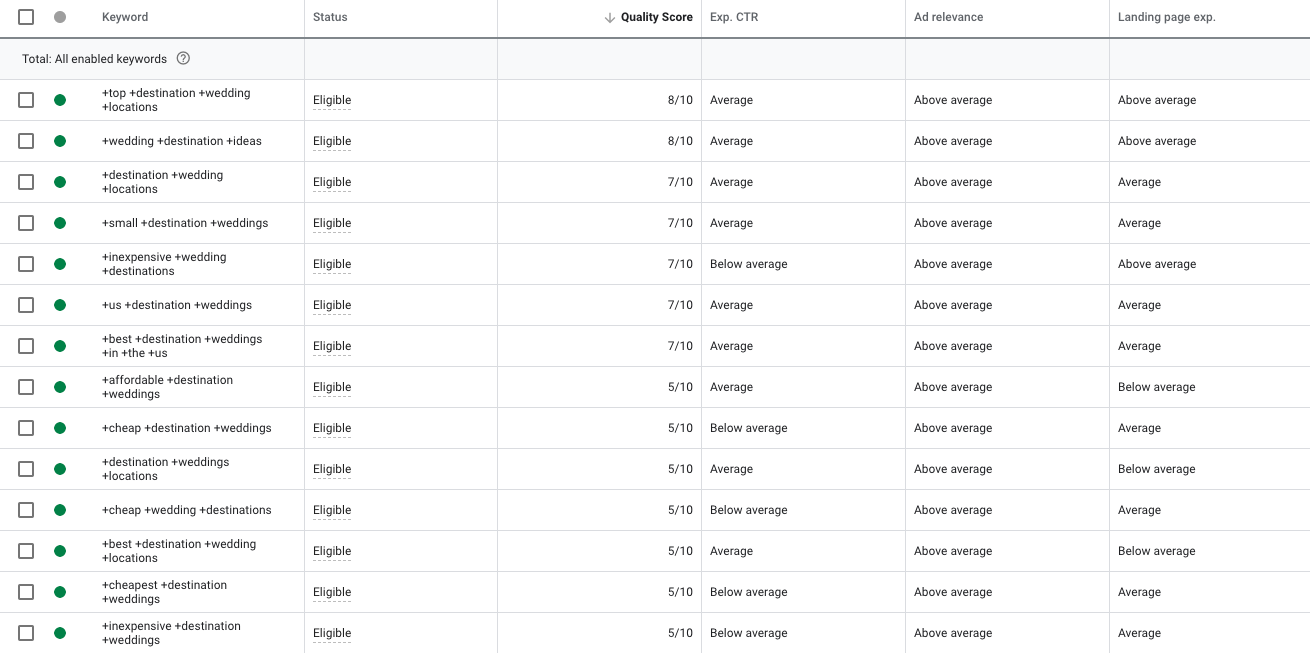
Quality Score is reported on a scale of 1-10 and factors in expected click-through rate, ad relevance, and landing page experience. Overall, a healthy Quality Score averages around 6. Depending on how aggressively you want to improve Quality Score, start by reviewing keywords scored at a 3 or below for opportunities.
It’s important to note that although it’s not used during auctions to determine Ad Rank, your historical Quality Score is a good indicator of how future ads will perform. Learn more about the ad auction in this video.
Improving Quality Score
Three factors can be optimized to enhance the Quality Scores of your keywords: expected CTR, ad relevance, and landing page experience. Each category can be rated as above average, average, or below average.
Let’s talk through each factor and recommendations on how to improve each one.
1. Expected CTR: This is how likely it is that your ad will get clicked when shown for that keyword. Expected CTR is the easiest and most immediate element of Quality Score to improve.
First, try reviewing the Search Term Report for keyword opportunities. This way, you can implement keywords more relevant for users. Once you add these keywords to your ad groups, pause the other keywords with low CTR.
Another consideration is that your ads are not compelling enough for people to click. Test new ads with different messaging. A way to give your ad a natural CTR boost is by using Dynamic Keyword Insertion (DKI) in your ads. This trick is when you write {KeyWord:HeadlineText} in your headline, which then dynamically generates the headline as what the user searched.
2. AdRelevance: This measures “how closely related your keyword is to your ads.” An ad may be deemed relevant to a keyword when the keyword appears in the ad.
If your keyword has a low QS because of ad relevance, instead of writing a brand new ad, try this. First, duplicate an existing ad that has high performance. Then, write in the low QS keyword as part of the ad.
Also, ensure that your ads are answers for the queries the ad group most often receives. You can check queries using the Search Terms report. This is easier to accomplish when your ads and keywords are in specific ad groups consisting of tightly themed keywords.
If you want to try something completely new, test Google’s Responsive Search Ads. This tool lets machine learning determine which of your ad headlines and descriptions will be the most relevant to the searcher. You can enter up to 15 headlines and four descriptions per ad!
Something else to keep in mind is that Google looks at your site for relevance. Make sure you are landing every ad on the page that is most closely related to your keywords rather than only your homepage. Google takes into account keyword density on the site, so using relevant keywords on each landing page can also improve ad relevance.
3. Landing Page Experience: This measures “how relevant and useful your website’s landing page will be to people who click your ad.” Landing pages that are not mobile responsive may take a hit in this factor. According to Statista.com, as of the second quarter of 2019, Google accounted for 95% of the mobile organic search engine visits in the U.S.
Not all online advertisers can swiftly optimize landing pages as needed. If this is your case, start with making sure that your keywords and ads are relevant to the landing page’s current content.
If that still doesn’t improve the Quality Score, you may want to consider the following for your landing page:
Making the page mobile responsive
Minimizing load time
Optimizing images with metatext, tags, title and alt text that include relevant keywords
Making conversion points clearly visible
You should also consider improving your website’s content or testing new call-to-action buttons at each conversion point.
Take Action Now
As you can see, there are three factors that you can improve to increase Quality Score, yet there are only so many things you can do. If all of these possibilities seem overwhelming to you, start by making a list of optimizations you can tackle now, as well as some you may need to address later. Then, create an optimization schedule for yourself and revisit it each week.
We are a Google Premier Partner, meaning we work on ad accounts daily to ensure clients maintain a strong Quality Score and campaign performance. If you find yourself unable to improve Quality Score, reach out to Search influence for specific recommendations and consulting services. Or let us work on your ad account directly with an online advertising package.
As Google has grown into an advertising powerhouse, it has created and improved ad performance metrics. After all, why would advertisers stick around without actionable data for boosting performance?
Average Position is one metric that has been around since the launch of AdWords in 2000. You, like many other advertisers, may use this metric to track the success of your online ads.
In late 2018, Google announced they would retire Average Position in September 2019. Let’s take a look at what this means for advertisers.
What Does Average Position Mean?
The Average Position metric shows the average position where ads are appearing on the search engine results page (SERP). At least, that was its original function.
At first, Average Position helped advertisers gauge the effectiveness of their account changes. It’s easy to see why: if you know where your ads are appearing, you can work your way up to the top of the SERP with adjustments.
Everyone wanted to be at the top because research showed that top search results get the most clicks by far. The Average Position metric was crucial for advertisers chasing the most valuable SERP space.
What’s more, the immediate visibility of an ad at the top of the SERP made Average Position a popular, tangible metric.
Great! We have an intuitive, valuable metric to measure our advertising performance. Why on Google Earth would they get rid of it?
The Decline and Fall of the Average Position Metric
… Because it’s no longer intuitive, and that makes it much less valuable. Let’s look at what changed over the years.
Average Position used to be helpful when all ads appeared above the organic results. If your ad’s average position was 1, it meant the ad was at the very top of the SERP.
Later, ads appeared at the top of the SERP and also down the right side. Google realized they could combine the ads’ spaces and create an auction for all the real estate on the page.
Google restructured the SERP so only highly relevant ads would appear above the organic results. If no ad was relevant enough, they all appeared on the side of the SERP or below the organic results.
Advertisers could no longer be certain where their ads were appearing. Even auction winners may never appear at the top of the page. By this point, Average Position was more of an “Average Auction Rank” metric.
By now, Average Position data was less helpful for optimizing campaigns. There was just no good way to know where on the SERP your ads would appear. Even your best ads could be languishing at the bottom of the page in the dreaded No Click Zone.
Average Position lost more value as Google reorganized the SERP and added features. So, what’s an advertiser to do? How can we find out how our ads are appearing to our audience? What will save our KPIs?
New Metrics to Save the Day
Google introduced two new position metrics ahead of the retirement of the Average Position. These new metrics are helping advertisers transition more easily. Here’s what they tell us:
Search Top Impression Rate is the ratio of impressions appearing anywhere above the organic results. It’s given by Impressions Above Organic / Total Impressions.
Search Absolute Top Impression Rate is the ratio of impressions appearing above all of the other ads that are above the organic results. It’s given by Absolute Top Impressions / Total Impressions.
There are also a few helpful Impression Share (IS) metrics you can bid for to increase Impression Rates:
Impression Share (Top and Absolute Top) is the ratio of impressions at the top or absolute top of the SERP and the impressions you were eligible for.
Search Lost Impression Share Budget (Top and Absolute Top) shows how often your ad wasn’t top or absolute top because of budget limits. This metric can help with bidding and budget changes for more top-of-SERP impressions.
Search Lost Impression Share Rank (Top and Absolute Top) shows how often your ad wasn’t top or absolute top because of your ad rank. This metric can help identify ad copy and landing page changes for more top-of-SERP impressions.
With these new metrics, advertisers are better able to gauge when and how often their ads appear at the top of the SERP. Moreover, with the Lost IS metrics, advertisers can dial in their optimization efforts to where they will have the most tangible impact on ad placement.
Even though Google is retiring a much-loved metric, it’s safe to say that advertisers will wind up with even more and better information than before. Overall, this move is a boon to advertisers who crave control and incremental performance improvements.
What This Means for Advertisers
There’s no reason to be upset over Average Position. The first step is to familiarize yourself with the new metrics. Once you begin using them, you’ll quickly see how useful they are. Here are three ways the new metrics will benefit advertisers:
First, advertisers will be able to create more competitive campaigns with these new metrics. For example, at Search Influence, the new metrics are working well along with the new Auction Insights tool. Using both gives us a starting point for optimization tasks. Now we have to do much less detective work to identify performance-increasing adjustments.
Finally, the new metrics will help engaged advertisers stay on top of their ad performance. Even not-so-engaged advertisers should find campaign optimization easier. Both groups should capture more valuable impressions and clicks with less testing, guesswork, and time.
If you’d like to know more about how to boost your advertising power, get in touch with the digital advertising experts at Search Influence. We’ve got the expertise and experience to help you reach your business goals.
Marketing can sometimes feel like a black box to business owners. Luckily, with digital marketing, there are ways to track pretty much everything so that you can know exactly how your campaigns are performing. As a marketer, I’m often up to my elbows in Excel sheets, pouring through the data provided from Google Ads or Google Analytics. But as you’ll soon learn, only looking at that data is not enough. To have successful campaigns, you, the business owner, must also be involved in the process to help track everything from the first impression to a closed lead.
How Do You Know If Advertising Is Effective?
In order to determine if your advertising is working, you first need to do some self-reflection. Most business owners know they need to spend money on marketing in order to grow, and often, the first thing they do is begin vetting (and maybe even hiring) an agency. But truthfully, it’ll be more difficult for you and your agency to create winning campaigns if you haven’t defined your business and marketing goals before getting started.
Luckily, we have put together an awesome guide that walks you step-by-step through the process of determining the metrics that matter to your business and how to tie those to marketing goals. To get started, gather the necessary stakeholders, download our guide, and fill out the worksheet. When you are done, you will have…
The “M” in S.M.A.R.T. stands for “measurable,” and defining this on the front end helps you determine what Key Performance Indicators are important to you. This doesn’t have to be complicated, and the less metrics, the better!
How Do You Measure the Success of a Campaign?
Now that you’ve defined your metrics and KPIs, you’ll need to figure out what you need to track online and how you will track it. Some common things you might track are leads through phone calls and form fills, transactions and revenue through e-commerce purchases, or interest in your location through “Get Directions” button clicks. Let’s walk through some common platforms for tracking online actions.
Google Analytics: You can use this free platform to track user behavior on your website and set up goals to track form fills, clicks on buttons, views of key pages, and e-commerce transactions. This allows you to compare performance across all campaigns similarly, using the same attribution model and metrics. It integrates well with Google Ads (you can import your Google Analytics goals directly into Google Ads) but doesn’t send conversion data to other advertising platforms.
Ad Platform Pixels and Trackers: Each ad platform offers their own tracking solutions, so you can determine exactly which of your advertising campaigns, keywords, audiences, and ads are converting. If you are using something other than Google Ads, you’ll want to install these pixels in addition to Google Analytics. Most of them work very similarly to Google Analytics, but may have slight variations on how conversions are counted or tracked. Examples include Facebook Pixels, Google Ads Conversion Trackers, Bing Conversion tags, and LinkedIn Insight Tags.
Call Tracking Providers: Setting up call tracking is a must for businesses that receive a lot of phone calls. Call tracking works by placing a piece of code on your site that identifies the source of your site visitor and dynamically switches the phone number to attribute that call back to the source. More advanced call tracking providers are even able to tie these calls to specific ads. They offer a ton of features to make it easier for you to manage your internal process for answering and responding to these calls and to audit your team to ensure they are providing the best customer service. There are several different providers, so do your research on which one best meets your needs.
Setting up all of these things on your website does require some coding skills, so it helps to consult with a developer (or a marketing agency like Search Influence) on the best ways to set up tracking.
How Is ROI Calculated in Digital Marketing?
So now that you are tracking all of your online actions, you’re all set to calculate ROI, right? Well, not exactly. In fact, tracking just online conversions does not give you a full understanding of the success of your efforts. This is mostly true when it comes to lead-based businesses. If we deliver 100 leads to you, but not a single one turns into a client, would you call that a success? This is why it is SO CRUCIAL for you to track the quality of your leads and to provide that information to your marketing agency as close to real-time as possible.
There are many ways to determine lead quality, but some important things to track include the following:
Lead Score: What is a lead worth to you? Devise a scoring system and train all customer service reps on this. Think about scoring the leads based on things like, “I want more leads like this!”
Score Reason: What makes the lead good or bad? What was the roadblock as to why this lead couldn’t become a customer?
Lead Stage: Did the person schedule a consultation? Have they been sent a proposal? Did they become a client? Document where each potential customer is in the process.
Customer Lifetime Value: What was the revenue associated with the services they received?
Using a Customer Relationship Management (CRM) platform makes this process super easy. It can help you track the volume of leads, close rate, and average sale value, which are all important metrics to know and understand. It can also help your internal team keep track of who’ve they’ve talked to and when to follow up with them. The biggest benefit of having a CRM is having a ton of great actionable information to provide to your marketing agency so they can optimize campaigns to meet and succeed your marketing goals.
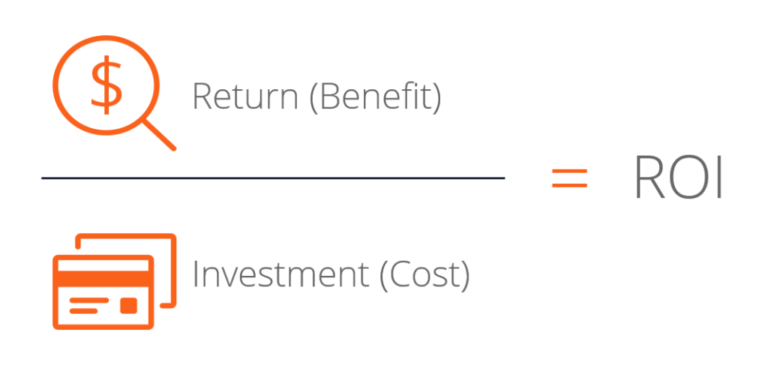
Once this data is collected, you can also determine the Return on Investment (ROI) of your marketing efforts. You’ll take the total revenue you received, subtract the costs associated (return), and divide by your investment.
Combine the Data and Make Smart Decisions
Implementing these tracking mechanisms and processes allows you to better understand exactly which campaigns and tactics are driving real revenue for your business. It is also one of the huge advantages of running digital advertising campaigns (real data that is tied directly to campaigns). It gives you and your marketing agency the insight to make decisions that you can trust will result in growth and allow you to continue to work toward your goals.
If you need help figuring all of this out, don’t worry! Search Influence is stocked with seasoned pros at all things tracking and analytics, and we love to dive deep into numbers to figure out what is working for our clients. We will also provide guidance as you set up your internal systems to make it as easy as possible to track the data on your end. We find that the most successful campaigns we run are ones where there is open communication between our team and our clients—providing honest feedback on the work we are doing because, ultimately, we want to optimize their business’ potential. So start a conversation with one of our digital marketing experts today so you can feel confident in your marketing efforts!
Google Analytics is a free service provided by our friends at Google that automatically collects and allows you to analyze data about your website visitors. Google Analytics is an essential tool for digital marketers, businesses, bloggers, and everyone in between with a website.
Google Analytics can help guide your decision-making processes and marketing strategies. You can figure out why your website visitors are bouncing, learn about the demographics of your audience, monitor progress towards your goals, and more.
With the plethora of information available in Google Analytics, it can be difficult to understand all of its dashboards and metrics.
Google Analytics Terms for Beginners
Users
The number of people who viewed your website at least once within a given time period is represented by users.
Pageviews
Pageviews is the number of times visitors to your site view a page. Every page visit is included in this number, including if someone refreshes the same page. Pageviews is a great metric to look at when you want to determine which pages are your website’s most popular.
Sessions
Sessions are the individual periods of time someone visits your website. A session resets in increments of 30 minutes. A website visit ends when 30 minutes have passed. If a visitor leaves and returns to your site within 30 minutes, that counts as one session.
Bounce Rate
Bounce rate is a number that is found by dividing the number of total bounces by total visits. This represents the percentage of people who visit one page on your website and then leave without going to any other pages. Bounce rates can be applied to an entire website or individual pages.
Dimensions
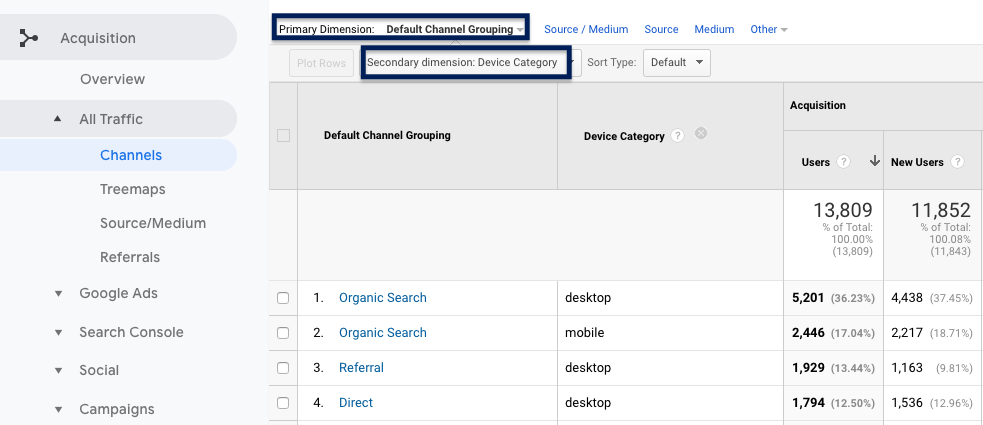
Dimensions are attributes of your Google Analytics data. Some examples of dimensions are the source/medium, which we’ll discuss later, or location. There are several options, including device category, language, and campaign. Dimensions are helpful for making sense of the data generated by different reports.
Primary dimension
A primary dimension in Google Analytics is the first displayed attribute of your data, which differs depending on the report you’re looking at. For example, if you’re looking at Channel under Acquisition, the channels by which people used to visit your website is the primary dimension.
Secondary dimension
A secondary dimension in Google Analytics allows you to add another layer to parse through your data. So, let’s say you wanted to know how many people visited your site through each channel and the device they used to get there, you can add “Device Category” as a secondary dimension to see the data sorted by the device.
Reviewing Acquisition Reports
If you’re curious about how people found your website, acquisition reports will tell you which sources visitors used to get there. The acquisition report shows the origin of the visit (like a search engine, a Facebook ad, or email marketing campaign) and the specific medium.
Channels
Channels in Google Analytics provide a broad idea of where your website visitors came from. Analytics has a default channel grouping. This grouping consists of channels like Direct, Organic Search, Social, and Referral.
Organic Search Traffic
An organic search visit is a visit that came from a search engine. If someone typed in your business name or keywords related to your business in Google and clicked on your website in the Search Engine results page, this counts as an organic website visit.
Direct Traffic
Direct traffic is a result of a user typing in your exact web address in the address bar or clicking a bookmark in their browser.
Referral Traffic
Referral traffic visits are a result of visitors getting to your site from another site on the web. If I were on Yelp browsing restaurants for dinner and came across a place I’d like to check out and then clicked a link to their website from their Yelp listing, this would show up in their Analytics as a referral visit. Reviewing referral traffic can be helpful for deciding if certain off-site tactics are worth the time and effort. For example, if you’re doing a lot of posting and promotion on Facebook and you see that your referral traffic has not increased, you may decide to spend less time on that strategy and focus elsewhere.
Source/Medium
Source/medium provides a closer look at where your website visitors are coming from. Source identifies the referrer of a site visit. A source can be a search engine, an ad, a newsletter, etc. while the medium is the channel used. Examples of source/medium include the following:
Google/organic – Google is the source, organic the medium.
Google/CPC – Google again is the source, but the medium is a paid search ad.
Yelp/Referral – Yelp is the source and a referral is the medium.
For Understanding User Behavior & Measuring Conversions
Landing Page/Exit Page
A landing page is the page a user first sees when they visit your website, and an exit page is last one they browse before leaving.
Events
Events are actions that a user takes on a website. Ideally, these should be created around your key performance indicators. For example, if you have a button on your website that allows users to check the rates of your B&B for a night’s stay, you can set up an event to know how many people clicked that button.
New vs. Returning Visitors
Google Analytics allows you to divide your site traffic into new and returning visitors. New visitors are people who had not previously visited your website during the time period you’ve selected. Returning visitors have viewed your website more than once during that time frame.
Goals
Goals are similar to events but are more focused on conversions. An example of a conversion is someone making a purchase or requesting a proposal from your company. Google Analytics provides 20 slots to track these.
Navigating Google Analytics and all of its reports can be difficult. Properly utilizing the tools within Google Analytics to inform your business decisions can be even more challenging, but we can help with that. At Search Influence, we love analytics and lead tracking. Give us a call at 504-881-1597 to learn how we can help you know where your customers are coming from.
It seems lately that the changes to Google Ads and the types of ads you can create have been coming faster than some advertisers can handle. A few years ago, expanded text ads were a revelation. More headlines and higher character counts had us all loving the extra real estate we were able to have on the SERP. But now Google has come out with a whole new game changer—Responsive Search Ads. RSAs will save you time and management by relying on automation and machine learning to deliver the most relevant ad for each query. How do you take advantage of all this? By exploring this guide to adding responsive search ads to your paid search campaigns.
What Are Responsive Search Ads?
Responsive search ads are a new ad type that’s still in beta, and they might not be available in all Google Ads accounts. Unlike expanded text ads, where you create one static ad, responsive search ads use Google’s machine learning to assess which of the multiple headlines and descriptions that you create will combine to show the most relevant ads to searchers.
How Do Responsive Search Ads Work?
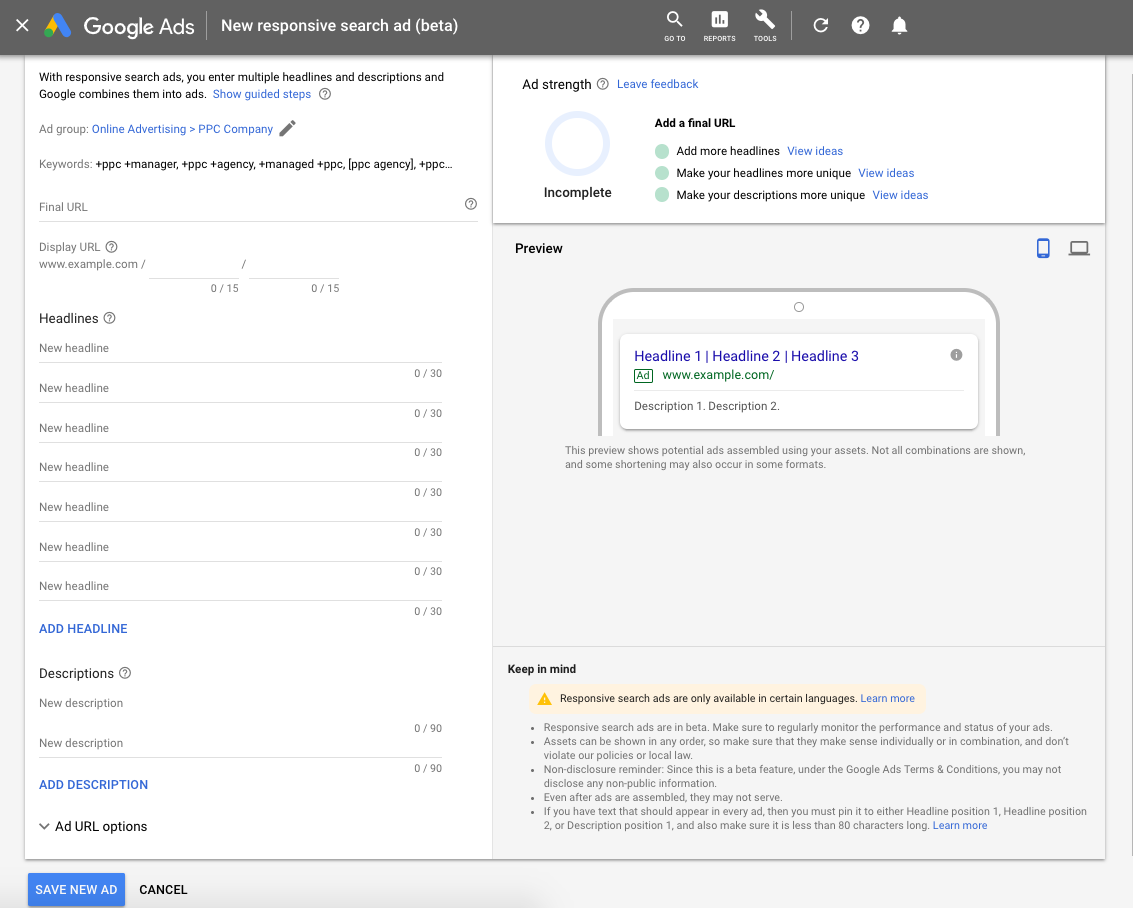
An advertiser enters up to 15 unique headlines (30 characters each) and four unique descriptions (90 characters each) to create an RSA. When a search triggers your ad, Google reads all of the signals available (search term, intent, device, time of day, and many many more) and uses machine learning to determine which of your ad assets will be the most relevant to the searcher. That is the ad combination that gets served.
Responsive Search Ads Vs. Expanded Text Ads
You might be wondering which ad type to use, and the answer is both. In fact, Google’s Matt Lawson writes that, because RSAs are still in beta, they aren’t going to capture all of the traffic that an ETA might.
“Try to implement at least three ads per ad group with an optimized ad rotation. If you have access to responsive search ads already, you should remember to have at least one additional text ad in each of your ad groups. Responsive search ads are still in beta, and some traffic won’t be included in that experiment. You need a text ad to capture those impressions.”
As for the differences between RSAs and ETAs, here’s a breakdown of assets:
Responsive Search Ads
Expanded Text Ads
Number of Headlines Shown on the SERP
2 or 3
2 or 3
Number of Headlines Written
3 – 15
2 – 3
Characters in Each Headline
30
30
Number of Descriptions Shown on the SERP
1 or 2
1 or 2
Number of Descriptions Written
2 – 4
1 – 2
Characters in Each Description
90
90
As you can see, the searcher won’t be able to tell the difference between the two ad types. When responsive search ads were first announced, there was a lot of rejoicing of “more real estate on the SERP,” as the expanded text ads had lower character limits; however, the character counts of ETAs have been expanded once again to match the RSA character limit.
What Are the Benefits of Using Responsive Search Ads?
The most immediately obvious benefit of RSAs is that Google does the testing for you, virtually eliminating the need for you to run A/B tests. This can save tons of paid search account management time. Google claims that the constant testing will lead to the most relevant ad being shown for different search terms. This is something that a lot of advertisers need help with. Though there are scripts that can create reports approximating this effect, there is no way to segment ad copy performance by search term in the Google Ads interface.
What About Disadvantages to Using Responsive Search Ads?
All this time-saving automation comes at a price, of course: control. Someone with lots of time to test minor tweaks and analyze an abundance of data might prefer to conduct their own tests.
Though there are options to “pin” a couple headlines and descriptions so that they always show (useful for compliance reasons or companies with strict branding), you are really limited in controlling the final version of the ad.
Reporting options are subpar so far. We are offered very little insight into how each asset is performing, but we do have an asset-level report that shows how many impressions each headline and description has gotten, and a combination report that shows impressions for each combination.
From this, you can infer which assets are performing best, but it’s only an assumption that’s based on trusting Google to properly optimize. Google says poor performers won’t be delivered, so if you see an asset getting few impressions, it might be underperforming.
Along with the lack of control, RSAs also don’t support ad customizers at this time, with the exception of dynamic keyword insertion, which is actually encouraged. This means that you are unable to use countdowns, IF functions, inventory customizers, etc. with RSAs.
Responsive Search Ad Best Practices
Before you create responsive search ads, you might want to brainstorm a few benefits, features, and calls to action that you’ll want to include in your ads. Some of these features and tactics include…
Unique and Varied Headlines
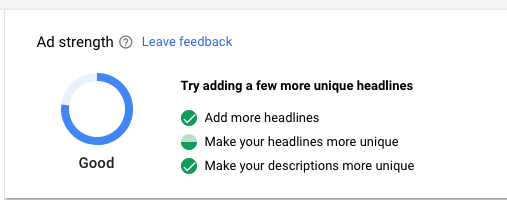
You want your headlines to be distinct. Google says it has controls in place to prevent redundant assets from being served together, but headlines need to be different enough from each other that the system can adequately distinguish between them and serve relevant combinations. When building your ads, you will notice the Ad Strength meter in the upper right of your screen assessing the quality of your ads. This is what it might look like if your headlines are too similar:
Pay attention to the ad strength and get creative. You’ll also see the meter telling you to add more headlines. Strive to fill all 15 spots with a unique headline.
You should also vary the length of your headlines. You don’t want to use all 30 characters in every headline. As with the content of the headlines, this gives Google more factors to test. Also, that third headline is more likely to show if it is short.
Use Your Keywords—But Do So Sparingly
You’ll want to include your keywords in some of your headlines, but not all of them. I like to keep only three or so keywords in the headlines and then maybe one or two in my descriptions. This leaves room for more of the business’ benefits, features, etc., and gives more variety. In addition to three keywords, I also use DKI in one of the headlines.
Use Google’s Recommendations
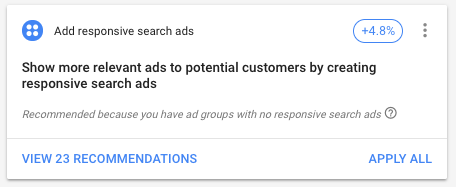
If you haven’t started implementing responsive search ads yet, but are opted into the beta program, you might see recommendations to do so in Google Ads.
This is a great way to get started. When you view the recommendations, you’ll see that Google has already created some RSAs from headlines and descriptions that you are already using in your ETAs. Review these recommendations and make any necessary changes, then hit “Apply,” and you’ve got yourself a responsive search ad.
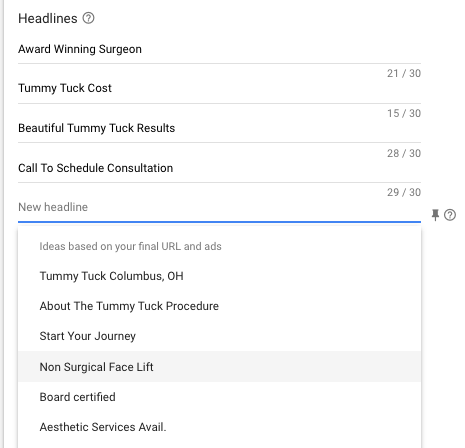
Once you have ads running, you might also notice that when you go to add new headlines, Google will make suggestions based off your other ads and your landing page. Some of these might not be relevant to the particular keywords in your ad group, but some likely are relevant.
How Many Responsive Search Ads Should I Use in an Ad Group?
It’s best practice to have at least one RSA with two or three ETAs in an ad group, but you can include up to three responsive search ads in each ad group. Most advertisers won’t need this many, but if you are pinning headlines and descriptions, you might want to test pinning vs. not pinning, or A/B test the headlines you are pinning.
Don’t Forget to Monitor Responsive Search Ad Performance
Especially while RSAs are still in beta, advertisers need to be monitoring if they are performing as well or better than your ETAs. As always, focus on your bottom line, not solely on click metrics like CTR. Watch that Google’s optimizations aren’t suppressing your most profitable ad in favor of your most clickable ad. I recommend reading this piece on Search Engine Land about not relying too heavily on CTR and conversion rate for more information on this topic.
A strong campaign for your business’ online advertising requires experts who are up-to-date on all of the latest roll-outs from Google and other advertising platforms. Search Influence can expand your business’ online presence. Start a conversation with one of our digital marketers today to grow your business.
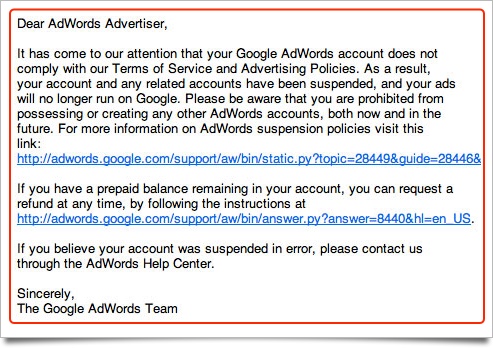
In its continual quest to better serve users, Google has cracked down on misleading content in advertisements as well as website content. When your advertising campaign is slammed for “misleading content,” it can come as quite a surprise. Because Google holds advertisers to a high standard, some of the violations might seem like harmless marketing strategies. Regardless of how the situation arose, it’s important to bring your website and account back in line with Google’s expectations. The sooner you resolve potential violations, the sooner you can get back to building your brand’s online reputation.
What Is the Google AdWords Misleading Content Policy?
“Misleading content” is an umbrella term that includes several types of violations, ranging from problematic testimonials to deceptive branding. The main objective of the misleading content policy is to provide a set of clear standards for online advertisers to follow as to not deceive users with exaggerated or false content. The central component of these standards states that:
– Disclaimers need to be included alongside perceived claims, even if the claims are direct quotations from past customers.
– Images that show before-and-after results also need disclaimers. More broadly, improbable assertions are likely to draw the attention of the Google AdWords team.
We’ve all seen investment opportunities and weight loss programs that sound “too good to be true.” As you might imagine, some of the standards allow room for interpretation, and many affected advertisers find that they need to resolve multiple policy violations to resume advertising.
At least, in theory, Google’s policy should benefit both users and advertisers. Users shouldn’t have to scroll past misleading or spammy content, and advertising slots will become more valuable as users learn that paid search results are also informative and trustworthy. When you edit your ads and website to align with the Google AdWords misleading content policy, you’ll also be improving content and sales copy that might have sounded suspicious to potential customers. The things that Google considers “misleading” may also be off-putting to your target audience.
What Kinds of Businesses Are Most Impacted by This Crackdown?
With shifting expectations for disclaimers and testimonials, medical businesses like plastic surgeons and dermatologists are particularly vulnerable to being caught on the wrong side of AdWords policies. Whenever possible, peer-reviewed journals and other reputable sources can be referenced to support claims. Images are useful for showing the results of weight loss programs and cosmetic procedures, but those types of images need to include disclaimers to emphasize that individual results vary.
Investment firms, lawyers, and other businesses may run afoul of Google AdWords misleading content policy, even though they aren’t making medical claims. The misleading content policy looks for vague guarantees and other wording that implies certainty or permanence. Depending on the phrasing used to describe results, virtually any business can find itself on the wrong side of Google’s misleading content policies.
How Does Google Review and Determine If Content Is Misleading?
In case there was any doubt, Google doesn’t employ a review board of physicians or lawyers to determine which claims are unjustified. Instead, an editor on the Google team judges whether the wording or formatting of a page is misleading. When the editor finds one or more violations that justify disapproving the account, they may (or may not) make a note in your case file. With the number of campaigns and sites reviewed by editors, it doesn’t make sense for them to make exhaustive lists of recommendations beyond the first one or two violations.
As a business owner, you might never interact directly with an editor at Google. When you call the account representatives on the Google helpline, they only have the information that editors chose to note in your case file. If you fix the problems that were cited as “misleading,” there may be additional problems found when your site is re-evaluated. It can be a frustrating runaround but don’t get angry at the person on the helpline. They aren’t the ones who flagged your content, and they don’t have the power to reinstate your account. Instead of focusing on the people who made the decision, it’s better to try to understand the aspects of the policy that might apply to your site and campaign.
What Do I Need to Do to Get My Ads Approved and Running Again?
Not everyone gets site-specific recommendations in his or her case file, and even if you’re lucky enough to get actionable advice, it’s still important to be proactive about finding additional violations. After your campaign account has been flagged, the responsibility is on your company (and your web developer) to make sure that your site and your PPC campaign meet the standards set by Google. Look through your landing pages in search of other potential violations.
Could your seals and stamps be perceived as mimicking government seals? Site layouts and deceptive popups can also trigger penalties. Popup windows shouldn’t simulate messages or system errors, displays intended to trick users into clicking through or interacting by accident. As previously discussed, assertions about future results need to be carefully worded. Some violations are more obvious than others but use due diligence to ensure that your site complies with relevant policies.
How Can I Avoid Getting Ads Disapproved in the Future?
Look at the penalty “sandbox” as a learning opportunity, and try to avoid repeating the same mistakes in future campaigns. Make a point of looking beyond your PPC campaigns to your website and your company’s approach to branding online. The campaigns flagged by AdWords often have issues on the landing page, marketing strategies that may be mirrored across the rest of the website. Even if a PPC campaign can be restarted with changes to a few key pages, it’s worth adjusting other website content to align with misleading content policies. Search algorithms favor high quality, unique content, and the misleading content policy hints at indicators that could eventually affect overall search rankings.
If you don’t have time to spend waiting on the Google helpline, consider getting professional help through digital marketing consulting. Google’s policies and expectations shift periodically, and anticipating changes can become a distraction from your day-to-day business.
As a Google Premier Partner, Search Influence has over 25 employees certified in Google AdWords Search, Video, Mobile, Display, and Analytics. Our digital marketing agency keeps up to date with the latest trends in search engine algorithms and online advertising to best serve our clients. Contact us so we can help get your ads approved and running again.
We’ve come a long way from lugging around heavy guidebooks and drawing out routes on paper maps. In fact, we’ve even come a long way from planning vacations on desktop computers. Google shares that a growing number of travelers are planning vacations on their mobile devices, with mobile’s share of travel visits growing 48 percent in 2016, and mobile web conversions for travel sites growing 88 percent that same year. As a result, it’s increasingly important for businesses in the tourism and travel industries to optimize their websites for mobile and make researching and booking trips easy for mobile customers. Here’s how!
“Micro-Moments”
According to the same source from Google, the key to a successful mobile travel site is leveraging micro-moments. These are moments of intent when someone acts on a need—for example, looking for a hotel once they’ve booked a flight to that city. Google names the core four micro-moments of planning a trip as I-want-to-get-away, Time-to-make-a-plan, Let’s-book-it, and Can’t-wait-to-explore. Different businesses in the travel industry will prioritize different micro-moments—for example, an influencer on Instagram might focus on I-want-to-get-away while a local tourism bureau might concentrate on Can’t-wait-to-explore. But, catering to customers across all four micro-moments certainly can’t hurt!
1. I-want-to-get-away
Also called Dreaming Moments, these are the times when people start thinking about their next vacations—and Dreaming Moments happen often. Again, according to Google, 37 percent of U.S. travelers think about planning vacations once a month, and 17 percent think about it once a week or more. In 2015, 38 percent of non-branded travel searches came from mobile devices. Today, that number is only increasing. So, how can travel and tourism businesses cater to this growing audience?
One option is using SEO services to help your website rank higher in search engine results for questions like, “What to do in [destination]?” and, “Where is [destination]?” These are two of the top travel questions people ask Google. Another great resource is YouTube. Google estimates that roughly 106 million of YouTube’s monthly unique visitors are travelers, and 64 percent of people who watched travel-related videos did so during Dreaming Moments. This means that learning to attract customers on YouTube is a must for businesses catering to I-want-to-get-away micro-moments.
2. Time-to-make-a-plan
Also called Organizing Moments, these are the times when travelers have decided to take a trip but are still considering different hotels and airlines with an open mind. During these moments, travelers are figuring out the logistical details of their journey—like how long flights will take or how much hotels will cost. And, they’re figuring out these logistical details on mobile. On Google, mobile flight-related searches are up 33 percent year over year, and mobile hotel searches are up 49 percent.
To reach customers during Time-to-make-a-plan Moments, consider online advertising campaigns, or Google services such as Hotel Ads and Google Flights. And, of course, make sure that your website is fully optimized for mobile!
3. Let’s-book-it
Booking Moments are incredibly important—not only because they’re the times when travelers start spending money, but also because these moments may have the most room for newcomers to make an impact. Going back to data from Google, 46 percent of travelers who do mobile travel research made their final booking decisions on mobile but did the actual booking itself on a desktop or laptop computer. This means that customers are likely not getting everything they need from mobile during Booking Moments. Businesses that improve their mobile booking have an opportunity to rise above the competition.
Google recommends Book on Google as a way to increase conversion rates for mobile Booking Moments. But, other ways to improve customers’ mobile booking experience include streamlining the check-out process to remove any unnecessary steps and making sure your site is secure. Customers will be more likely to book on-the-go if they trust that their information is safe and secure.
4. Can’t-wait-to-explore
Also called Experiencing Moments, data from Google proves that these are also areas of huge potential. Travelers are increasingly planning their vacation activities while they’re on the trip, with 85 percent of 2016 leisure travelers deciding on activities after arriving at their destinations. Here again, travelers are making these plans on mobile. In fact, mobile searches from hotels increased 30 percent in 2016. Companies who aren’t catering to this growing audience are missing out on potential business.
So, how can a travel industry business appeal to customers in Experiencing Moments? Provide travelers with information! The same source from Google found that 53 percent of leisure travelers are interested in visiting new places, compared to just 18 percent who want to return to previous destinations. This means that the majority of vacationers are somewhere they’ve never been before. Offer recommendations for restaurants or attractions, and make these recommendations location-aware—Google searches for “places to eat near me” more than doubled in 2016.
Travel is increasingly becoming a mobile-centric industry, and businesses have a lot to gain by targeting customers in these core travel micro-moments. Whether it’s improving YouTube reach to grab viewers during I-want-to-get-away Moments, or making sure a site is hosted on a secure server for Let’s-book-it Moments, Search Influence is here to help. Bon Voyage!