Tag: local search

  • Influencer Spotlight: Gabrielle Benedetto

    gab

    Native New Orleanian, Gabrielle Benedetto has been working on the Search Influence account management team for over a year and a half. When she isn’t at the office, you can probably catch her running around New Orleans training for her next big race or enjoying time with friends and family.

    As an Account Manager what do you find yourself doing on an average day?  

    As all members of the account management team, my goal everyday is to make sure my clients are happy! Regardless of how simple a client’s question may be, my job is to make sure they feel confident about their SEO campaign and they understand what our team is doing to improve their online presence.

    Many of the accounts I work on have very niche markets. I make it a point to spend quality time with each client so I can get a better understanding of their marketing goals to insure we are running a great campaign.

    What would you say is your specialty and what do you enjoy most about it?

    I’m one of the few members of the account management team who works on site audits. This is basically a report run on an entire site that analyzes everything from internal links, HTML coding, optimized content, site navigation, and even off-site marketing. I really enjoy working on these as it provides me with a pretty deep understanding of how the site is currently optimized and shines light on opportunities to improve.

    Many client come to me saying “I have a user friendly site and provide visitors with unique content about my business, but I just can’t seem to increase my rankings.” In presenting a site audit, this allows me to spend time with the client and not only show them what areas of their site need improvement but how my team can address each issue.

    You’ve had a great deal of experience working with a wide range of clients, from local business to some national companies.  After working with and analyzing their websites, you’ve discovered some funky stuff along the way.  Any easy tips out there for an average Joe looking to improve their site?

    Ah great question! I have three rules: make it natural, make it pretty, make it search engine friendly. This may be a little easier said than done, but that’s where Search Influence comes into play.

    When optimizing or looking for ways to improve your site, you can’t go wrong if you follow these three rules.  

    1) Make it natural: Although sites with all the bells and whistles can be really nice to look at, they don’t always work properly. When optimizing a site, do what comes natural. This applies to something simple like making sure the content on your site reads naturally and is well optimized for your keywords. You could even take a more technical approach with this in making sure that you’re setting up an easy-to-use navigation and structure for your site.

    2) Make it pretty: I think we have all visited a site that wasn’t organized well and looked unattractive. Having a site that isn’t organized properly or comes across as ugly or outdated is immediately going to make you think of the “s” word… spammy. Having an updated, attractive, and welcoming site allows for a better user experience and also allows for your site to be seen as a little more trustworthy when compared to some of your competitors.

    3) Make it search-engine friendly: So you now have a site that just looks stunning! Your site is organized properly, attractive to visitors, and reads and functions naturally to the human eye. Regardless of how good it looks, if the search engine spiders can’t access your site’s information, no one will be able to visit your site. Make sure all content, pictures, pages, and URLs (just to name a few) are accessible to the search engines.

    If you could give advice to a new client starting up their first SEO campaign, what would you say?

    SEO is a marathon, not a sprint.  I have many clients who come to me with larger-than-life goals for their campaign. While the competitive streak in me is eager to accept a challenge, I always want to make sure realistic goals and expectations are set properly. If you want to rank on page one tomorrow, launch a paid search campaign. If you want to build strength, trust, and authority to your site, run a properly optimized SEO campaign. Results traditionally aren’t immediate, but SEO is a great way to naturally increase your search presence.  Once we lay the foundation and the campaign starts to pick up speed, we can see the rankings “increase to infinity and beyond” as one of my clients put it.

    What’s your favorite thing about working at Search Influence?  Anything in particular you could live without?

    Something that makes Search Influence different than other companies is our staff and work space. Our office is full of monitors, MacBooks Airs, and extremely talented young professionals plugged in and focused on their work. Our staff is not only talented, but energetic and brings so much personality to this company. The team is constantly looking for ways to improve day-to-day internal processes, deliverables to increase the success of our clients’ campaigns, as well as our overall brand.

    SI has a finite amount of candy at the office. There is a love/hate relationship between the team members and the candy supply. I’m trying to quit, but candy is always in the office taunting me.  There are brief periods when the candy supply is low. I secretly enjoy this time without candy, but everyone else in the office starts shaking and needs their candy fix. I think I could live without the candy in the office, but I might miss the constant battle to cut down the candy.  Strange enough, this bonds us a little. But let’s quickly move on to the next question before someone yells at me for speaking out against our candy supply.

    Tell us a little more about your life growing up around The Big Easy.  In your free time, what do you do for fun?

    I am New Orleans through and through. Although we may be called the “Big Easy” there are always events going on in this town. Between races, social events, restaurant openings, or fundraisers there’s always something to do down here.

    gab2

    In a perfect world, left to your own devices, what would you be doing all day?

    When I’m not at the office I’m probably at one of the events mentioned above.  Yet, subconsciously I’m still working, networking, and meeting new people.  Since a lot of people aren’t extremely familiar with SEO or Internet marketing for that matter, I’m always explaining how Search Influence helps companies all over the country promote their business and increase their search presence. I never leave the house without a stack of business cards.

    One last hard hitting question —- If you could identify yourself with one designer brand what would it be and why?

    That’s easy, DVF (Dianne Von Furstenburg)! Her line is classic, professional, and fashion forward. She’s been rocking it for decades and still vogue — just one of my own aspirations!

  • Expand Keywords for Expanded Results

    Letters

    Keywords are the key—no pun intended—to driving traffic to your site, and is part of the SEO basics a site owner needs to know. A smart business manager will put a great deal of thought into which terms to target. Even a fantastic list can always use improvement—however, four simple keyword expansions can be the trick to increasing your impressions using terms that are proven to get results.

    Keyword expansion is quick, easy, and almost guaranteed to work. It might not drive tons of traffic, but it will certainly add to your existing pool.

    1: Pluralize

    Many of the main keywords can come to mind almost automatically: if you sell dog brushes, you’ve probably already factored “buy dog brush” into your list. But even if someone only wants to buy one, they’ll often search for “buy dog brushes”. Because some engines recognize plurals as separate keywords, you are potentially losing out on all the impressions from the “dog brushes” searchers. Adding an –s or –es to your common terms becomes a no-brainer when you realize how easily it can boost your traffic.

    2: Rearrange

    People typing search queries don’t always use syntax and grammar the way they do in everyday speech. To continue the example above, someone might search “dog brush buy,” which follows a pattern of what they want (dog brush), followed by what they want to do (buy). Yes, it’s likely to be a far fewer number of people than those searching “buy dog brush,” but that fewer number is not insignificant. Mixing up your word order often elicits more results.

    3: Misspell

    Another regularly overlooked area for keywords are typos and misspellings. Some errors are certainly more common than others; a check down the search query report should show you where you might have luck. If your canine brushes are of the affordable variety, running both “cheap dog brushes” and “cheep dog brushes” could benefit you. Fewer search engine gurus are competing for misspellings, as well, meaning you’ll have a good chance at capturing more of the market.

    4: Match

    The three different match types—exact, broad, and phrase—generally work together to generate the most impressions and clicks even though many choose to limit to exact match for a quality response. If your aim is to get more traffic to your site, though, casting a wide net will bring in more fish. Broad match additions to “dog brushes” might include “dog kennels” or “hair brushes,” but people running those searches might also be pleased to stumble across you. You’ll also pick up on new keywords, through broad and phrase matches that make sense, which you can incorporate into your list.

    Keywords and keyword rankings are important to being found online. With a few additions and clicks, you’ve now expanded your keywords to draw impressions from those who pluralize, rearrange, or misspell words, as well as those running similar searches. You’ll benefit in impressions and ultimately traffic as well, without stressing over your keyword list.

    Megan Totka is the Chief Editor for ChamberofCommerce.com. She specializes on the topic of small business tips and resources. ChamberofCommerce.com helps small businesses grow their business on the web and facilitates connectivity between local businesses and more than 7,000 Chambers of Commerce worldwide.

  • How To De-Personalize Your Search Results

    As Google continues to update its algorithm to deliver more local and personalized results to searchers, it becomes harder to get a true sense of where your site ranks in the search results. Below are a few different options for “de-personalizing” the search results you see.

    First things first, Sign out of Google

    Since your Gmail or Google+ account may be tied to various searches or a specific location, you should sign out of your account. If you would like to remain signed in, there are a couple of precautions to take:

    Hide Private Results:
    1) In the upper right hand corner there will be an icon for a person and a globe. Select the globe.
    Hide Private Results

    Turn Off Private Results:
    1) In the upper right hand corner select the gear > Search settings
    Update Google Search Settings for Private Browsing

    2) Scroll down to the “Private Results” Section and select “Do not use private results”
    Do Not Use Private Results in Search Settings

    3) Select Save

    De-personalizing your Results: &pws=0

    1) Go to google.com and do a search

    De-Personalize Search Results

    2) In your address bar, scroll to the end of your URL and add “&pws=0” and hit enter

    De-Personalize Search Reults with pws=0

    2) Voila! Your results have been de-personalized.

    Tip: you can also add “&num=100” to display 100 results on your search engine results page instead of just 10!

    Using Chrome? Use an Incognito Window

    If you are using Chrome, you can take an extra step and use an incognito window, which will have no history attached to it.

    1) Go to File > New Incognito Window
    TIP: The shortcut is Command-Shift-N on a Mac (on Windows it is Control-Shift-N)
    De-Personalize Search Results with Incognito Window

    2) Proceed to Google.com to perform your search (or search directly in the address bar)

    De-Personalize Search Results with Incognito Window for Chrome

    3) Finally, for extra precaution, use the &pws=0 method above

    4) Chrome also has this handy extension called Disable Google Personal Search that you can install that will automatically add &pws=0 to all of your searches. This speeds up the process quite a bit!

    Take Advantage of Private Browsing

    Safari
    If you are using Safari, you can browse the Internet using “Private Browsing.” The difference between private browsing and using an incognito window is that this setting is for the Safari Application, as opposed to just one window.

    1) Go to Safari > Private Browsing…
    Private Browsing in Safari

    2) A pop up will appear, select “OK”
    Turn on Private Browsing in Safari

    3) Proceed to Google.com to perform your search (or search directly in the address bar)
    Private Browsing in Safari Address Bar

    4) Finally, for extra precaution, use the &pws=0 method above

    Firefox
    Firefox has a similar feature. Here’s how to turn it on:

    1) Go to Tools > Start Private Browsing
    TIP: The shortcut is Command-Shift-P on a Mac (on Windows it is Control-Shift-P)
    Private Browsing in Firefox

    2) A pop up will appear, select “Start Private Browsing”
    Turn on Private Browsing in Firefox to start browsing

    3) Proceed with your search!
    Turn on Private Browsing in Firefox

    4) I came across this extension, which works in Firefox and in Chrome. It’s called Google Global, and can be used to see search results in other countries but also has a de-personalization option.
    Google Global De-Personalized Search results

    Internet Explorer
    Lastly, Internet Explorer also has a private browsing option. Follow the below steps:

    1) Go to the gear icon in the top-right corner and choose Safety > InPrivate Browsing
    TIP: The shortcut is Command-Shift-P on a Mac (on Windows it is Control-Shift-P)

    2) I haven’t personally tested it out, but there is a plugin you can use for Firefox and Internet Explorer to prevent you from seeing personalized search. Download it here.

    Clear Your Cookies

    If you want to be absolutely sure you have no personalized search,  you can clear all of your cookies. I prefer not to do this as it will also make you sign back in to any accounts that you may have previously been logged in to, but it will definitely do the trick. Here’s a great article on clearing your cookies depending on your browser and computer.

    Thinking About Your Online Results

    Looking at the de-personalized results will only give you a sense of your online presence. Google’s move toward greater personalization around location and search history makes a focus on rankings a less accurate depiction of your overall online presence. Although these are the “truer” results, because most everyone else using the Internet will have personal results, you can see how any one search result page is not 100% accurate or true for everyone.

    Your rankings are a key performance indicator for your online results, but they are by no means the definition of success. It is important to look at a variety of factors which include an increase in traffic for organic traffic, both branded and non-branded, and an increase in conversions, leads, or transactions that are completed as a result of organic searches.

  • Penguin 2.0 May Not Be Done Just Yet

    Penguin 2.0 reconfigure?We’ve been watching Penguin 2.0 and its effects, and as a team we have noticed some fluctuating data that suggests the algorithm has not quite settled in yet.  In another blog post, I put it out there that rankings are not everything, and they are not the primary measure of success.  Ranking reports have known flaws, but they can be used as a weather vane.  When we look at the ranking weather for a few clients, we see some ups and downs, clearly with some effect from the most recent Penguin, but it appears that the players on Google page 1 are still moving around more than a month after the rollout.

    When we look at a few examples, we see the musical chairs being played on page 1 with nobody being safe and comfortable for very long.  We’re watching rankings for a  plastic surgeon in New Jersey for the term “rhinoplasty New Jersey.”

    SEO for plastic surgery

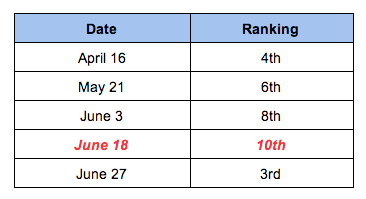
    Here’s a summary of his rankings hopping all over.  His biggest drop was on June 18th:

    Rhinoplasty New Jersey

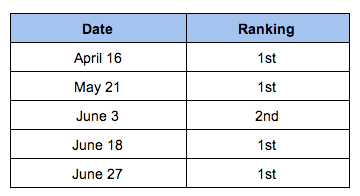
     The same client for “breast augmentation New Jersey” had more subtle changes, but they are meaningful.

    Breast Augmentation New Jersey

    So it looks like he got a little hit from Penguin 2.0, but may be rebounding.  We have done nothing out of the ordinary for this surgeon to move his site from 10th to 3rd in just nine days, so we make an assumption that Penguin is still adjusting.

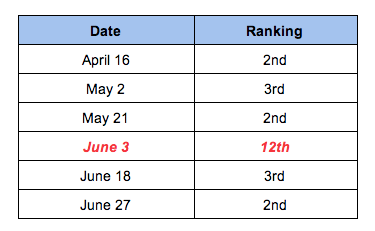
    Another example in ranking fluctuations for “Columbus allergist” is in a doctor’s rankings seen below.  His biggest decrease was on June 3rd vs the guy above who got the hit on June 18th:

    Columbus Allergist

    Rankings Aren’t Everything!

    Rankings are not the only measure by which we watch successes and failures. Organic traffic is another layer of data, and in some organic traffic trends, we see noticeable changes around June 3rd then again around June 18th.

    The client represented in the chart below is a cocktail bar in the South.  They saw a dip in organic traffic after May 22, but they enjoyed an unexpected bump in early June (the traffic dropped off again after that early June peak, but what I want to know is what’s behind that weird little bump up earlier on?):

    Penguin 2.0 adjustment in early June?

    The next example is a traffic bump around June 18th.  This client is a completely different business on the west coast.  We see a little effect from Penguin, then a weird spike:

    Penguin 2.0 adjustment June 18th?


    And Then There Are Other Data Too

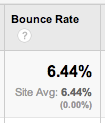
    Bounce rates before and after Penguin 2.0It gets a little fuzzier when you start looking at Bounce rates and Time on Page and these data in Analytics.  Who’s to say that these increases or decreases are a direct effect from Penguin?  You could argue your site is having better or worse quality traffic because of ranking and where your site now shows up vs where it showed before Penguin.  You could argue lots.  All I know is that 3 of the 4 clients mentioned above saw an improvement in Bounce rate after Penguin.

    Bounce rates before and after Penguin 2.0 2013Bounce rates improved after Penguin 2.0

    So … what?

    I’m not convinced that Penguin 2.0 was a one time algorithm update, it did its thing on May 22nd, and we’re experiencing the good or the bad or the indifferent.  I think it’s still shaking out, and we may still see a few odd spikes or odd drops in ranking or traffic or some other data.  We may have a few more weeks before websites settle into a relatively comfortable placement on page 1, and it is only then that we can claim some clear understanding of the full effect of Penguin.

    And because Penguin 2.0 is still reconfiguring, it may not be time for drastic action.  If your site is experiencing some definite ups and downs, then yes, you should look at your backlinks quality, the anchor text quality, internal links, etc.  All of this stuff is covered in many other blog posts.  You should have been long ago working on authoritative backlinks and building up your social cred.  But it’s not time to throw up your hands, and just Disavow everything. It’s not time to scrap your website and start with a brand new domain and design.  Take some time to digest what’s going on before bulldozing ahead.

    What I would really like to know is if anyone else noticed definite odd fluctuations around June 3rd and June 18th.  Or if you noticed unusual changes at anytime after May 22nd.  Leave a comment, and let us know.

  • Local U New Orleans: 14 Things You’ll Want to Know

    About a month ago, my team and I attended Local ULocal U Logo
    an online marketing seminar held at Tulane University. It was an extremely valuable, very energizing half-day! Various industry leaders in local SEO have dedicated their time and resources to helping small businesses learn the basics. It was more than worth the price of admission!

    Not only did I take away a lot of valuable information, but I’ve already started thinking about how I can apply the topics discussed to help Audubon improve our online presence. I’m excited to put a plan into action and work with my team to make the website even better.

    Below are my top takeaways from the day.  If Local U is coming to your city, I highly recommend attending.

    Takeaways:

    1. Does your website answer the top 10 most frequently asked questions that you hear from customers in your physical space/store?
    2. Is your NAP (business name, address, phone number) easy to find on every page?

      White Bengal Tiger NAP
      This tiger needs a nap! Too bad this type of nap won’t help your local presence!
    3. Remove all Marketing Speak.
    4. Are you consistently blogging? (Tip: Top 10 FAQs make excellent blog post topics.)
    5. Are you building links on your site to other reputable sites? Links are gold! Search engines move from link to link.
    6. Content is not just text. Content is photos, graphics, video, reviews.
    7. Future of online marketing is customer reviews. Do you have a review process built into your sales process – to both encourage reviews and deal with negative reviews?
    8. When asked what do you do on Google, 46% say read customer reviews. Reviews are social proof.
    9. If you are not talking about something on your site, you cannot rank in search for it! Create pages for what you want to rank for.

      Sea Otter
      It’s important to add enticing photos and videos. Who wouldn’t love to look at cute pictures of animals all day?
    10. There is no single Google search results page. 50-200 different algorithms at work at any given time and results are personalized. We are all seeing slightly different results.
    11. Rank for what you are best at, be specific!
    12. YouTube is the world’s second largest search engine. What will users find there about you?
    13. You cannot own or control Facebook. You can own and control your website. Your website is most important, at the heart of all your online marketing.
    14. Emails must be readable on all devices. 42% of all mails are opened on a mobile device.

    Lani McWilliams is the Director of Audubon Nature Institute Logo Member Services & Ecommerce at Audubon Nature Institute. Audubon Nature Institute is a 501(c)3 not-for-profit organization dedicated to celebrating the wonders of nature and educating their visitors about the natural world.

  • Google Slider Replacing the Maps Seven Pack?

    Many people have seen the slider on the top of Google search results when searching for “things to do various city,” but have you seen it when searching other local terms lately? When I searched the term, “Pizza New Orleans,” I noticed the slider appearing instead of the seven pack for the first time today! I search this term often–not because of my love for pizza, but because of my client’s pizza chain. Never in the history of everdom have I seen the slider show up for this particular term.

    What if Google is leaning more towards this instead of the seven pack? This can be a good and bad for local businesses. Good because your business will not be pushed all the way to the bottom of page one, way under the seven pack. Potentially bad, because many people may be driven to click the pretty images on top of the screen vs. clicking on the plain jane search results.

    What does this mean for me, you ask? How can I be a part of this beautiful slider? As our fearless leader says, “Barnacle SEO is the answer!” A well optimized Google Place listing and page are the first steps.  Your best possible scenario is to be the Theo’s Pizza of the page! Theo’s is the first Google Place listing in the slider AND the third organic listing on the page. As per usual, the more real estate the better.

    It’s going to be very interesting to see where Google takes this and how far it will go. Will it eventually replace the seven pack? Only God–I mean Google knows!

    P.S. This doesn’t show up for everyone. A few of my co-workers have seen this in the wild and a few have not. Have you noticed this type of result for other queries besides “pizza” or “things to do?” Tell us in the comments below!

  • Company Profile: Culture Shock LLC

    One of the reasons I love New Orleans is that living local is part of everyday life. People love shopping and eating at local businesses. Thankfully, you won’t find many chains in the New Orleans zip codes (you need to go out to Metairie for that)! My friend Christine Alex recently started a jewelry business that imports handmade pieces from several countries across the world. This Q&A profiles her company, touching on why it totally fits in with the local New Orleans vibe.


    New Orleans Local Business


    How did you come up with the idea for your business?
    I came up with the idea for Culture Shock when I was traveling abroad. I thought it was cool to bring back jewelry instead of postcards to my friends and family. The jewelry became a hit and eventually more and more people began giving me money and asking me to bring items back for them.  That’s when I thought it would be really neat for people to be able to buy handmade items from all over the world without having to leave their couch. Culture Shock became an LLC in October 2012 and officially launched on January 18, 2013.

    What is the goal/vision for your business?
    When I studied abroad, I gained a deep level of respect for other cultures and as a result, appreciated my own culture so much more. My goal is to educate my customers about other cultures while selling them a piece of someone else’s culture to wear.

    What products do you offer?
    I sell jewelry that I hand picked from all over the world. The biggest countries that I receive my inventory from are Nicaragua, India, and Nigeria. Aside from offering a selection of imported items, I also began creating my own ethnic inspired items. In addition, as a way of honoring my own Creole culture, I created an apparel line under Culture Shock called Naturally Creole. This line offers a selection of Creole-themed apparel and accessories.

    Jewelry & Accessories


    Do you have an online presence? Website, Facebook, Twitter, Pinterest?
    Yes, I have a website, Facebook, Twitter, Pinterest, and Instagram. Facebook and Instagram receive the most engagement from followers. I have noticed usually the same people follow us across social media platforms.

    Why do you use Facebook? What is the benefit that it is bringing to your business?
    I use Facebook because it’s where my customers are, and I want to develop a relationship with them. Facebook allows my customers to understand the personality of my brand and learn more about my company and the products that I offer.

    On the content she posts to her platforms:
    I try to post content related to the countries that I import my items from. I post photos, videos, and open-ended questions. Pictures usually receive the most activity from our followers. On Pinterest, I pin items from our website.

    Do you run any contests on Facebook? If so, what kind?
    Yes, giveaways.

    On her customers:
    Word of mouth and social media have been important in building brand awareness and getting people to buy our great pieces. I’d love to get more interaction from our social media followers to continue to build the brand!

    Business Info:
    Culture Shock, LLC
    P.O. Box 2217 Harvey, LA 70059
    504-256-3337
    www.cultureshock101.com
    www.facebook.com/cultureshockllc
    Twitter: @cultureshockllc
    Pinterest: cultureshockllc
    Contact email: [email protected]

    About Us Page


  • Keyword Rankings are Important … Just Maybe Not as Important

    I have always been hesitant to use keyword ranking reports as the focus for a successful SEO campaign. They are a useful measure, but they aren’t the most important, nor are they reliable and trustworthy. Don’t get me wrong.  Ranking reports have value.  Just not as the primary reporting standard.

    The prescription for success is focusing on the website performance rather than obsessively watching over the rankings. This image shows this client hit the #1 spot in April then again in May, and within that time the #1 spot garnered them 8 visits.

    A website needs to be a dynamic living entity. Google respects business owners who take care of their website properties and make those sites engaging, interesting places to visit.  Website owners need to be mindful of which pages on the website are the strongest and most visited.  What pages have the highest and lowest Bounce rates, and why?  Which pages have the highest and lowest time spent on page – is there room for improvement?

    A positive user experience is influential to the site strength.  Quality backlinks.  Author trust.  Engagement in the industry discussions online.  These are the things that will make a site strong, and from that strength, the site will show up in the SERPs, but maybe not for the phrases you want or expect.

    Things ain’t what they used to be

    A brief blog post  in mid-May says it very succinctly:

    “Keyword ranking as a metric is diminished in importance and relevance as performance metrics are starting to replace it.”

    “Performance” encapsulates so many details. It’s a lot of what is already mentioned: the behavior of the visitor once they land on your site.

    • If they are digging around to other pages,
    • reading more information,
    • spending time on the site,
    • taking the quizzes sitting in the sidebar,
    • watching the videos embed on the page,

    – if they are doing these things, Google is rewarding that site as being trusted as a resource.

    An excellent Bounce rate, not seen very often in this client's industry.
    An excellent Bounce rate, not seen very often in this client’s industry.

    If visitors land on a page and immediately see the content is not rich enough, there is no multi-media experience, there are no big happy buttons encouraging that visitor to go read about the doctor or lawyer, baker or candle stick maker, it’s boring.  And they will leave.  When visitors Bounce,

    • you lose a potential customer,
    • and it sends signals to Google that your page has little value.

    In Wasting Time Worrying About Keywords,  the blogger asks:

    “If Not Keywords, What SHOULD you be looking at?” Well, it depends on your business and your goals, but traffic and conversions are going to be more useful than keyword rankings alone.”

    I’m not drawing a line in the sand saying that ranking reports no longer have any value.  What I am saying is for years we used rankings as the thumbnail data for reporting.  Rankings were the first thing discussed in new client kick-off calls and the first thing addressed in monthly conference calls.

    However, keyword ranking reports are flawed.  They have been since the beginning of keyword ranking reports.  But they were, and still ar,e one measurement to use; one that is becoming a little less relevant.

    Rankings are always moving around.  How many times have I said “The keyword rankings are simply a snapshot in time.  The report is not reflective of reality for all searchers all of the time.”  I have said that a LOT.

    Ranking reports tell a very specific story.  You’ve chosen keyword A, B, and C, and that’s what you will be chasing.   But what if your site ranks for X, Y, and Z?  You won’t necessarily know it because those phrases aren’t in your list.  This is bad tunnel vision.

    Google is showing us with every algo update, that what the business owner or the SEO thinks that a website should rank for is not necessarily what it will rank for.

    A ranking report can’t predict the success or failure of a business online; it can absolutely help guide decision making and improving the website property, but it is not the definitive measure telling us that we have achieved the #1 spot and can now expect to dominate.

    So What’s Important Now?

    Rankings are still important. We still use rankings as a weather vane. But we have to remember that between the increasing personalization of search results and the localization of search results, rankings data is skewed.  We have to recognize that.

    I am quoting 4 bullet points from Why You Shouldn’t Worry About SEO Ranking Reports:

    • Search results are personalized, based on website browsing history in some cases

    • Results are location based, so if you live in town A you will see something different if you move to town B

    • Previous search history is used to predict the most relevant links

    • People use different devices to search–although as people increasingly sync their smartphones, laptops, and tablets with each other, this may become less of a factor in the future

    Or in Keyword Rankings are Dead: Long Live the ROI:  “A keyword searched in New York by a logged-in Google account user showed different results than those done by a first-time user in Baltimore.  A surfer searching on Google in Montana displayed different results than one in Texas.  The more we searched, the more we realized Google has taken the rankings game one step further and personalized it based on a visitor’s search history, along with other important geographical and demographical information.”

    This is simply more background as to why ranking reports are flawed data, and more evidence why we cannot rely on these as our primary gauge of achievement.

    Search Engine Land posted 5 Reasons Why Rankings are a Poor Measure of Success, suggesting among other things:  “start measuring the things that matter.”

    Our team here has had some fairly intense discussions on improving Bounce rates on select pages and strategies around increasing conversions.  Looking at length of page visits and flow of site visits. Trying to pinpoint ways to improve the user experience and help them stick around longer on site.  These are the things we are talking about and measuring and testing.

    In Rankings are dead – long live conversion!: “With Google’s continued focus on location based rankings, we strongly believe that rankings are becoming much more dependent on their specific location. For example, one keyword could rank much higher in Scotland than it does in Brighton. Even today when our clients mention that their highest paid person in office spots that their website isn’t ranking high for a particular ‘money word’, it can be tempting to scream at nobody in particular “It’s not just about rankings!!”.”


  • 5 For Friday — Links, Stories & Posts For Your Weekend

    1.  A New Google Search Result in Beta – Search Engine Land

    fiveforfriday As usual, Google is always testing new search results and the way the results display. Dr. Peter Meyers of Moz recently noticed a change in the Google search interface. The results displayed included restaurant reviews from Reason, New York Times, and the Wall Street Journal when he searched [mexican restaurants].

    2.  Facebook Cuts Ad Units – Facebook

    In a recent announcement, Facebook plans to consolidate its ad offerings down from 27 to close to half of that. Offers for online deals will disappear and they are changing way “Sponsored Stories” are laid out. Expect these changes to slowly roll out.

    3. Beware of Big Brother – The Guardian

    If you have heard of this NSA PRISM program, you should pay attention now. The Guardian uncovered a top secret document that showed that officials had direct access to systems of Google, Facebook, Apple and other internet bigwigs. The document was allegedly used to educate intelligence operatives on the program.

    4. Google is now Displaying Option to Claim Local Business in Search Results – Mike Blumenthal

    Jade W of Google announced that Google will now start displaying “Are you a business owner?” to direct branded search results. Although it is a minor change, it seems as though Google is attempting to engage small business owners more. Have you started seeing this change for other SMBs?

    5.  Yahoo’s New Search Results – Search Engine Journal

    For those who still use Yahoo as their primary search engine will notice a change in the search results. Yahoo has attempted to de-clutter the SERPs and moving search results higher up on the page. Do you like the new changes? Will you start using Yahoo?