Tag: keywords

  • The Rise of Intent Research and What it Means for Keyword Research in 2020

    Keyword research has long been thought of as one of the most impactful ways to gain prime real estate on SERPs. In the SEO world, if you’re not focusing a vast amount of your effort into keyword research, then you’re missing out on a great deal of SEO value. Finding and analyzing search terms by users and incorporating them into your website’s content is about as old as SEO itself. But as 2020 gets underway, a new kind of research is out to dethrone this age-old SEO practice. Intent research is quickly making its case as the new leader in SEO research. Take a look at these two types of research and where you should put your SEO effort in the coming months.

    Understanding the Basics: What is Keyword and Intent Research?

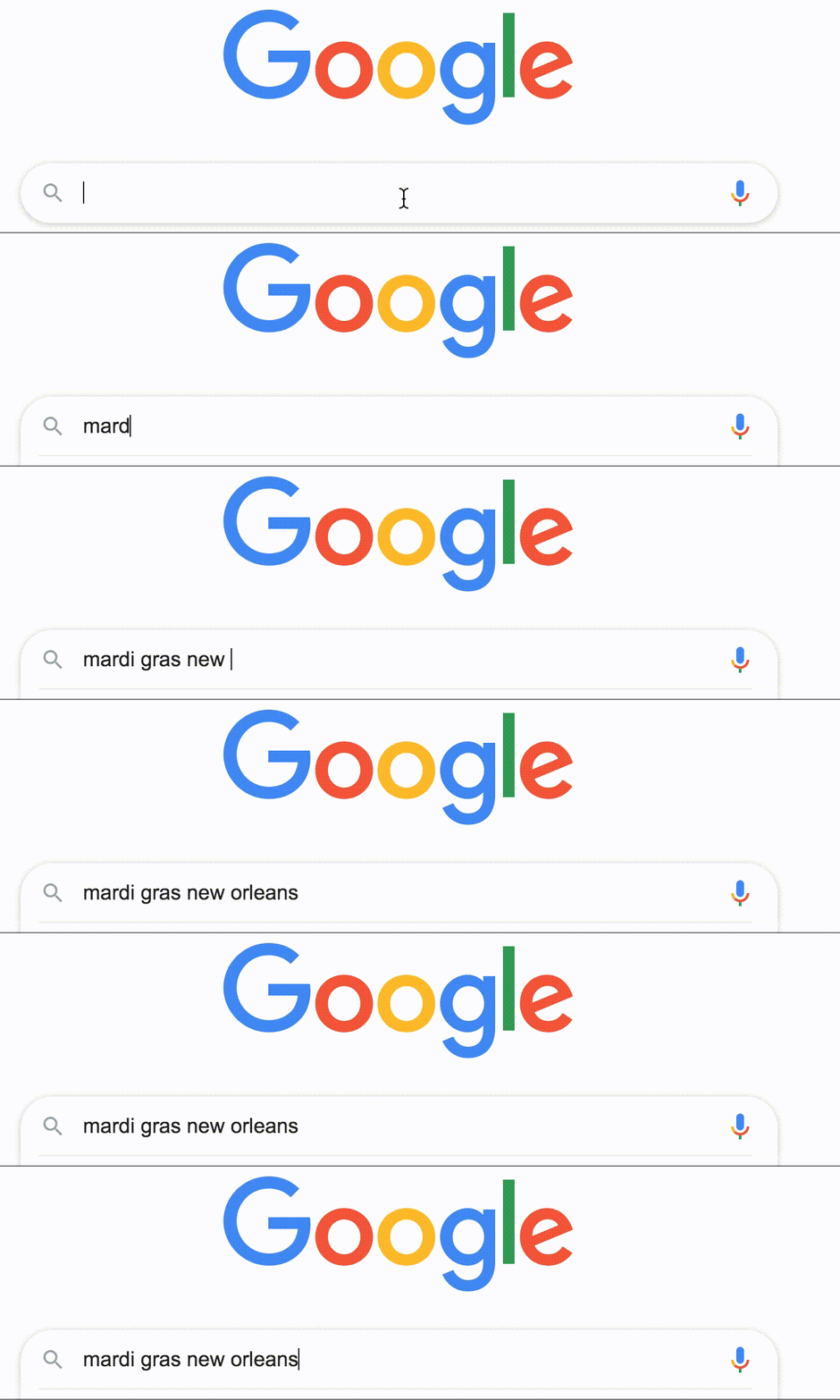
    Gif showing a Google search for Mardi Gras info

    Keyword research is, essentially, the process of identifying and analyzing a word or words users choose to include in search queries and then curating your content based on those specific words or phrases. These words or phrases can be categorized by things like popularity or relevance. Having a good understanding of specific topics is also important. Take, for example, searches done around a holiday—let’s look at Mardi Gras in this case. By understanding the topic, you can assume that users are likely searching for words or phrases like “mardi gras beads,” “mardi gras new orleans,” or “costume stores.” Incorporating those specific keywords into your content in the hopes of getting your content to show up in SERPs is the practice of keyword research.

    Intent research, on the other hand, is less specific and more concerned about what the user is trying to get out of their search. Rather than focusing on particular words and phrases, search engines spit out results based on what they think the user is looking for. Because intent can be hard to pinpoint, and keywords can have several different meanings behind them, how you interpret the keywords you are targeting is essential. Let’s say you’re researching the keyphrase “how to run a marathon.” The intent behind this could mean several different things. Is the user asking how to train for a marathon? How to sign up for a marathon? In understanding the user’s intent behind their search, you can better create content to drive users to your website.

    The Rise of Intent Research

    In a recent video where he discussed what to look forward to in 2020, Bing’s Frédéric Dubut claimed that search engines are quickly moving from keyword to intent research. One of the reasons for this, he believes, is in part due to Google announcing that they are now incorporating their BERT language model into search results. BERT, Bidirectional Encoder Representations from Transformers, is a technique for natural language processing. Google claims that BERT “helps better understand the nuances and context of words in searches” to produce more relevant results. The example they give is the importance of the word “to” in the search “2019 brazil traveler to usa need a visa.” In this example, you can see how the word “to” is what ties together the keyphrase in terms of understanding the user’s intent. By reading and understanding “to” in this context, Google is more likely to weed out content that mentions needing a visa from the USA by a Brazilian traveler, therefore providing them with more accurate search results.

    Is This the End for Keyword Research?

    John Meuller of Google says not so fast. Despite the rise of intent research recently, he believes there will always be room for keyword research. He admits that over time, search engines will become better at understanding a user’s intent, but that at its core, it is more of a balancing act between the two research practices. As he puts it, “even if search engines are trying to understand more than just those words, showing specific words to users can make it a little bit easier for them to understand what your pages are about and can sometimes drive a little bit of that conversion process.”

    So What Does That Mean for SEO in 2020?

    What does that mean gif

    In a nutshell, research practices will largely be a team effort in the coming year. As new language is created and refined and updates to search engines are made, search intent will be easier to understand and interpret. However, specific keywords will still be necessary when understanding that intent. Figuring out what type of research is best suited for your business will take a bit of trial and error. One way to get started is by trying to complete searches as if you were a user and see what sort of results populate. Depending on the types of results generated—and the research practice used—you can get an idea of how you should cater to your target audience. If this sounds overwhelming, don’t worry; we’ve got you covered. Our team of experts is ready to get you on the right path to a successful SEO campaign in the new year. Contact us today for a custom marketing analysis!

    Images

    What does that mean?

  • 3 Practical SEO Tips to Get More Clients for Your Law Firm

    1603-SI-TheInfluencer-KL-A-04-lg

    Have you ever wondered why your competition appears at the top of search engine results pages while your firm is nowhere to be found? Attorneys today face new marketing challenges, including how to access the ever-increasing number of clients who are using the Internet to search for legal services online. These three practical SEO tips are the stepping stones to getting your firm’s website and the specific practice areas of your firm’s lawyers to appear prominently on the results pages of search engines like Google and Bing.

    Law Books Image

    1. Create High-Quality Content

    Most importantly, your site should feature content that is compelling and thoughtful. Rather than prioritizing obvious and underhanded SEO tactics such as keyword stuffing, organize your website so that there are separate pages dedicated to each of your practice areas and focus on writing comprehensive and user-friendly text to explain each practice area. Your content will naturally include the keywords that potential clients search for when they need legal help. For example, if a consumer is searching for a personal injury lawyer in New Orleans, they will be directed to the page on your site that explains how personal injury attorneys can help clients who have been injured in an accident that was the fault of another.

    2. Select High-Value Keywords

    Speaking of keywords, to see results with SEO, you need to do your due diligence and conduct keyword research so that you know exactly what consumers are searching for. The trick is to focus on your local area by using keywords related to your practice areas and where you are physically located. Try using a keyword planning tool that will tell you what keywords consumers are using to search for your type of legal services. For example, consider the case of The Law Office of Jerod Gunsberg. When their campaign first started with us in 2010, the firm was not ranking for any of their crucial competitive keywords. As of May 2018, they rank #3 for “domestic violence defense attorney los angeles”, #6 for “theft defense attorney los angeles” and #2 for “meth lawyer los angeles” and “prostitution lawyer”. By implementing an aggressive strategy in a highly competitive market, we got Jerod Gunsberg in front those in need of a defense attorney and closed quality cases. In the first 5 years of their campaign with us, the SEO strategy brought in 589 leads. With a 469% increase in organic traffic compared to the first month of their campaign, we continue to connect the right audience with strong cases to The Law Office of Jerod Gunsberg.

    Social media icons image

    3. Create and Optimize Social Media and Blog Presence

    For law firms, creating and regularly updating social media pages is another important step in making your firm more visible online. One way to build authority on Google is to create and optimize your Google My Business profile and engage in evolving Google My Business activity to increase your local presence. Most legal professionals make an effort to build their brand and audience on LinkedIn, but you can also create a social profile on sites like Facebook and Twitter and integrate them into your website. Make sure you focus on regular and relevant updates to your social media profiles by simply making updates on topics related to your practice areas. You can also increase the relevancy of your profiles by adding two or three paragraphs of information describing the type of legal services your firm provides. Lastly, consider setting up a blog where you publish your own interesting and unique content focused on your areas of law. Once your social media and blog presence is relevant and current, you will further strengthen your site’s SEO capabilities.

    Let us help you follow these three steps to build your online presence and help potential clients find you when they would never have known you existed!

    Image Credits:
    Law Books Image
    Social Media Icons Image

  • Turning Links Into Lemonade: Your Guide to Juicy Internal Linking

    You’ve likely heard of internal links. In terms of SEO jargon (which there’s a lot to sift through), they’re pretty straightforward. Internal links are just the hyperlinks on your site that point to other pages within the same domain. For example, your homepage content probably has internal links pointing readers to your primary service or product pages. While a blog post might incorporate internal links to other posts that elaborate on a similar topic—or better yet, a service page that helps users solve the problem focused on in the blog post.

    The navigation menu for your website is also a structure for internal linking to ensure that all of your pages are connected and easily crawlable by search engines. It’s important that all new pages you create are linked back to your homepage using this navigation. For the purpose of this post, however, we’re going to assume your navigation is set up and focus on the internal links you incorporate into the actual content of your pages and posts.

    Choose Internal Links for Users & Crawlers

    Internal links are easy to understand, but don’t underestimate their power—both in terms of SEO ranking and an improved user experience.

    A person's hand squeezing a lemon

    When you properly use internal links, you’re spreading ranking power (also known as “link juice”) and authority from your site to that specific page, which improves the chances that it will also rank in search results. Internal links act as road signs, telling search engines which pages to crawl next on your site. On top of that, when you use highly relevant content links that match users’ search queries you’re confirming your authority.

    Internal links also plot the course for users (humans) to navigate your website and find the most relevant content to meet their needs. This keeps them on your site longer and improves the user experience. Just imagine that a prospective customer finds your blog post about steps to take when you get a flat tire, then within the post, they find a strategically-placed link leading them to your tire company’s product page about how to find replacement tires. With the right internal linking, you’ve given that person the information they needed and even offered a solution.

    So what does it mean to properly use internal links? There’s not always a hard and fast rule for when to link, how much to link, where to link, and the like. But this guide can offer a primer for getting started.

    Choose Appropriate Anchor Text

    The anchor text for your internal link is simply the clickable words you select to turn into your hyperlink. You’ll want to think about your selection both in terms of the context of the sentence and how the anchor text reads on its own for skimmers. There’s no character count limitation for anchor text, but you should aim to keep it as concise as possible without sacrificing clarity. Your reader should know where they are headed before they click the link.

    Landing them on a confusing or off-topic page that does not align with your anchor text disrupts the user experience. While keywords or topics for the content are a great first choice for relevant anchor text, Moz recommends using a variety of words throughout the post that most naturally fit for your anchor text. That’s because Google’s algorithm will take note of pages with too many keywords in anchor text and flag them as spam.

    Instead, opt for descriptive, partial-match anchor text that contains part of the target topic within the text. For example, build a comprehensive SEO strategy with Search Influence. This link goes to our SEO services page, which you could probably guess based on the anchor text.

    When in doubt, double-check that your anchor text meets the following criteria:

    1. The anchor text fits naturally within the rest of the content on the page
    2. There is zero mystery about where the user will land when they click the link
    3. Anchor text selection is diverse across all the content on the page

     Opt for Relevancy Over Quantity

    We can’t overemphasize this enough: choose natural, relevant pages to link to within your content. Don’t force a link. Google and your users will catch on quick, end of story.

    You should also avoid linking to the homepage or contact page. Those pages already have plenty of link juice. If your reader is already on an internal page within your site, why would they want to backtrack to your homepage? Instead, do as Kissmetrics recommends and reach for a 1:1 ratio of deep internal links and main navigation links. If your page is content heavy, then you should link out to other content-rich pages that elaborate on your topic and keep your reader engaged.

    Animation of hand counting to five

    While there is no magic number for how many links you need on a page, you can aim for about 2-4 contextual, natural links that make sense and address topics that would interest your reader. Just like with writing calls-to-action, you should assess each linking opportunity from the perspective of your prospective buyer to see if the target page is a good fit.

    Audit Existing Content for Linking Best Practices

    Keeping your content fresh with new internal links is an important step because it notifies Google to crawl the page again, increasing your ranking opportunities. You can also make sure that your inventory of content remains up-to-date and relevant for readers. We recommend building a schedule for updating content on a regular basis, with priority given to posts that cover topics for which you’re most interested in ranking. If you’re a plastic surgeon, that might mean auditing all of your existing posts about breast augmentation and liposuction if those are your top two procedures.

    When you update a page, we recommend checking for necessary updates, adding fresh content in the opening paragraph, then naturally incorporating internal links to any new related content. If you recently added pages about breast augmentation FAQs and post-surgery healing, then you’ll want to ensure those pages have link juice from other breast augmentation pages and posts on your site.

    Tools like Moz’s Open Site Explorer allow you to see how many internal links are going back to each page on your site. This will give you a holistic view of your domain to see how you can move more link juice to specific pages that cover topics related to those top-priority ranking terms.

    Of course, sorting through these tools and creating a dynamic strategy for link building takes a dedicated effort. If you’re short on time but eager to improve your link profile, contact us to chat with an expert.


    Images:

    Lemon

    Counting

  • Marketing Myths Small Business Owners Should Stop Believing

    When you’re running a small business, it’s often up to you or a member of a very small team to research and make all decisions for the business. And when you’re trying to allocate a marketing budget, being well informed is essential to the future of the business’ success. If you’re considering investing in SEO for your company but aren’t sure if it is going to pay off in the end, get the real facts about common SEO misconceptions.

    Myth 1: Only businesses of a certain size, in particular industries, or with certain audience demographics need a website.

    Some of you might be shaking your head at this one, but of the 500 small business marketers surveyed by highervisability.com, 20 percent said their company didn’t have a website. Having a website in today’s world is essential for getting found by customers, and everyone can benefit from one. SEO will help you get found by the right audience, no matter how niche your market may be, from HVAC companies and mom-and-pop shops to CNC engineers and doctors.

    Physician typing on a laptop keyboard

    Myth 2: Keyword stuffing and duplicate content are good SEO practices.

    While a majority of those surveyed believed copy-and-pasting content from other sites wasn’t ok, 12 percent didn’t see anything wrong with duplicating content from another site or page of your own site. When you copy from another person’s site, it’s plagiarism, and Google will penalize you for it. But even if it’s your own content repeating on different pages of the site, Google still flags it as duplicate content and therefore dings you for failing to provide new and useful information for your readers.

    Keyword stuffing was considered a good idea by 38 percent of responders, but this is another practice that will get you in trouble with Google. Keyword stuffing involves cramming a chosen keyword into your content as much as humanly possible, even if it makes the content sound stilted and unnatural. Not only will Google penalize your site for it, but it also makes things difficult for readers, and pleasing them is the most important thing at the end of the day.

    Myth 3: SEO is all about keyword rankings.

    Keyword rankings are obviously an important metric for gauging your site’s performance, but there’s more to SEO than sprinkling some keywords into your content and calling it a day. Content creation, link building, local search optimization, and technical aspects of your website, like page speed, are all necessary components of a well-rounded and robust SEO campaign.

    If you’re having trouble evaluating the technical side of your SEO, request a site audit from us.

    Myth 4: Social media is just for sharing pictures of my kids at the beach.

    19 percent of small businesses don’t have any social media presence. Of those 19 percent, only 35 percent are happy with their Google rankings. It then stands to reason that social media is a very important piece of the puzzle.

    Social media helps you promote your content, share industry news with your followers, show off a bit of your personality and your brand’s tone, and engage directly with your customers. It’s the personal touch that matters in today’s business world. Plus, social media lets you find your customers where they spend the most time.

    Myth 5: All of this should cost me less than $100 a month.

    SEO services are a marketing investment. And like all investments, you have to spend money to see money. According to Pigzilla, we’re in the middle of a pandemic where shady SEO companies are charging rock bottom prices and not delivering the kind of results their customers are hoping for. Positive results require consistent efforts in content creation and quality link building, not just a few tweaks to your site or a handful of spammy links. A reputable SEO company is charging you for their expertise in the industry coupled with a truly hands-on approach for your campaign. Even if your budget isn’t huge, a good company will tailor their work to give you the most bang for your buck.

    There’s a lot more to SEO than most small businesses realize. Whether you’re just starting to allocate some of your marketing budget to digital marketing or you’ve been burned by a bad SEO company in the past, talking to one of Search Influence’s sales executives can help you determine what your next best steps are for building an SEO campaign that will give you results.

  • AI and How It’s Affecting, and Enhancing, Voice Search

    If 2016 was the year of the Internet of Things, 2017 has become the year of AI, and, in particular, voice search. The way people search on their phone, tablet, or computer is changing thanks to devices like Amazon Echo, Siri, Cortana, and Google Home—as of May 2016, 20% of mobile queries are through voice. You can now search for a business, order pizza, turn on your home’s lights, ask for movie reviews, and more just by asking a question or stating an instruction. According to the 2016 Internet Trends Report, by 2020, at least 50% of searches are going to be through images or voice, whereas in 2015, only 1 in 10 search queries came through voice. Understanding how your content is optimized for voice search can help your business succeed in the near future.

    AI, RankBrain, Machine Learning, Deep Learning…What’s the Difference?

    With all of the talk about AI these days, it’s best to separate different terms that get tossed around, like RankBrain, Machine Learning, and Deep Learning. The easiest way to understand their relationship is to think of them as smaller parts of a larger whole. AI has been around since Alan Turing first started trying to decode the Nazi’s Enigma in WWII. In the 1980s, we started to see more advancement with machine learning, which provided computers with the ability to learn predictions and statistics without being explicitly programmed. In the current decade, we have begun to see large advancements in deep learning.

    Image Of A Formula - Search Influence

    Deep Learning

    Also known as deep structured learning or hierarchical learning, deep learning uses neural networks with many hidden layers of processing and information. It mirrors the way the human brain works, learning from mistakes to come up with the best, new solution to an input, not one that it was given with code. For instance, Marie Dollé from SocialMediaToday explains how it recognizes your face in a Facebook photo.

    “For a face, it will first correlate pixels on a photo, then group them and conceptualize its features (eyes, nose, mouth). Finally, it’ll group all these concepts to recognize the unique collection of features as a single face.”

    It’s also how the world’s best Go player, Lee Sedol, got beat by Google’s DeepMind AI dubbed AlphaGo. Go is an ancient game of immense complexity—there are more possible positions on the game board than there are atoms in the universe. This is precisely why we never thought a machine could master a human in this game; it’s more about intuition and instinct. Wired Magazine said that the pivotal play in the game was also the moment that “machines and humanity finally began to evolve together. While the move that set up the machine to win was puzzling to humans, it opened Lee Sedol’s eyes to strategies he hadn’t considered before.” We’ve come a long way since the first game mastered by AI in 1952—Tic Tac Toe.

    Image Of An Artificial Intelligence Brain Versus A Human's - Search Influence

    What About RankBrain?

    It’s best to think of RankBrain as a facilitator for deep learning. Unveiled by Google in 2015, RankBrain converts words and phrases into mathematical vectors that can then be used by deep learning. One of the more interesting things about RankBrain is that it searches for phrases that have never been used before on Google and then attempts to find similar words or phrases that may relate, i.e. your rich content that may not match up perfectly with a user’s search but is close. To put it simply, Greg Corrado, a senior research scientist at Google involved with RankBrain states, “If RankBrain sees a word or phrase it isn’t familiar with, the machine can make a guess as to what words or phrases might have a similar meaning and filter the result accordingly, making it more effective at handling never-before-seen search queries.”

    So, why are we getting these never-before-seen queries? Well, in some way or another, this will always happen. New products will be released, and people will want to find them. However, the introduction and evolution of voice search as a viable tool has transformed the way we talk to search engines.

    The Importance of Semantic Content Marketing in the Age of Voice Search

    Gone are the days of planning your content marketing strategy based on one or two keywords. Sherry Bonelli from SearchEngineLand posits, “Now keywords are no longer just keywords. Keywords in the voice search world are long-tail+. The ‘plus’ refers to the conversational phrases that you need to add when optimizing for conversational voice search.” Because people speak things differently than typing, we have to start adjusting marketing strategies accordingly. In comes long-tail+ keywords and semantic SEO.

    Long-tail+ keywords should mimic the way people actually talk. Think about what types of questions people ask when they call your business, and then think about any follow-up Q&A you have with them. Also, in addition to thinking about what people might be asking or searching, it’s time to start thinking about all of the synonymous and relative topics to that search. The age of the “best digital camera” keyword could likely fall away. Instead, consider the question, “Google, where can I find a digital camera that is waterproof and can also sync w/ and stream Facebook Live?” Look at everything that’s in that question. It mentions streaming and Facebook Live capabilities, it specifies waterproof, and the whole thing is rooted in a local question: the “where.”

    So, if you were to then take a hard look at your content, does it mention syncing devices with live streaming, have you written a blog about waterproof devices that you offer, are all of your physical location pages up to date, and have you claimed your Google My Business listing? Or, have you made the mistake of optimizing for “best digital camera” and called it a day? We’re starting to get to the point wherein Google’s AI technology is becoming as quick thinking, on-the-fly, and complex as us. So, we need to optimize accordingly.
    Image Of OK Google Icon - Search Influence

    Optimizing for Voice and Conversational Searches

    Using long+tail keywords is a good first step to optimizing your content for voice search. Try to understand and predict the user’s next intent or action after finding the answer to their first query. For alternate words or keywords, instead of trying to go for the “be all end all” keyword, think, “tell me how to get to the store,” alongside, “directions to the store.” Experiment with different versions of the same idea.

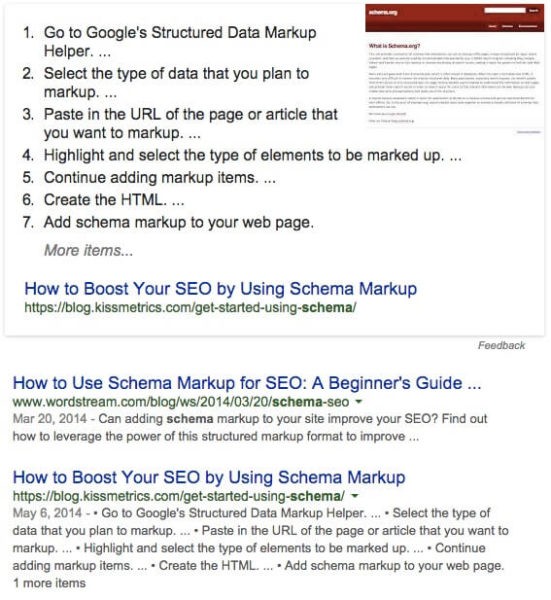
    Local is going to continue to be a big part of success for a business. Research what interests customers in a targeted area and optimize all of your physical location pages by making sure they’re marked up with schema. Structured data markup from schema.org is crucial because it makes it easier for search engines to parse your site and understand your content within context. Here’s a helpful list of additional best practices that can help with showing up in voice search:

    • Claim Your Google My Business Listing: A large part of voice search is based around local. By claiming your Google My Business Listing, you provide Google with more rich information about your business, giving its AI more tools to serve your potential customers with rich, accurate answers to their questions.
    • Use Conversational Keywords: This goes without saying, but if people are searching more naturally, then you should be writing more naturally in your content.
    • Make Sure Your Content Is Trustworthy: Just as AI can evolve to find us the best possible answers to our queries, it also has the ability to learn from and reject black hat SEO practices. Steer clear of link spamming, keyword stuffing, and untrue statements in your content.
    • Set Up a FAQ Page: This may seem like a minor addition to a website, but it’s a simple way to get a lot of good answers to questions, providing content for a vast amount of subjects about your business that could then make it easier for Google to find you.

    Because RankBrain plays a big part of voice search, finding never-before-used phrases and pairing them with trustworthy, on-topic content, it’s worth remembering some advice from a former Influencer: “If your content is written in accord with Panda and Hummingbird, meaning it is rich text, educational, and really on topic, RankBrain should not be a problem for you.”

    How Google’s Cloud Video Intelligence Is Changing Video Search

    Ever wish you could search for a video online or in your cloud library just by asking certain words? Like, “Hey, Google, show me videos with fun cartoon animals,” and getting a result of Zootopia from your library. With Google’s Video Analysis, we’re getting to do just that. This can have a large impact on more than just personal queries. Pretend you’re a Realtor in your local area. By using this tool, you can make your videos more discoverable for potential clients. It’s just another way AI is changing the way we search.
    Image Of Google Adwords Icon - Search Influence

    The Future of Google AdWords

    Google recently held their Google Marketing Next event. One of the features that they mentioned talks about Life Event Targeting. In the past, Google’s AI had been able to run basic “if, then” scenarios for target buyers. Now, they’re able to parse through multiple languages to predict a similar response for the same event. For instance, they gave the example of those recently engaged. They were able to recognize the different but similar terms and phrases that cultures use when people are in a wedding life stage and then provide them with solutions to queries.

    Also, Google is learning to adjust ads and tailor them to each user’s preference. Instead of three people doing the same search getting the same ad display, there will be advertising that suits each person’s preferences for style, graphics, tone, or display. They may have alternate text that is highlighted, one focusing on price and another on the value of a product or service.

    Where Have We Seen This Before?

    Whenever I used to think about artificial intelligence, I would typically conjure images of a Terminator landscape, or a young Haley Joel Osment sentient robot in A.I., or the philosophical complexities that Harrison Ford faces as a replicant (or not?!) in Blade Runner. There have always been predictions about future technology that we can find in pop culture, from space invaders to complete AI domination. However, I think one that best represents where we’re currently exploring and where we may end up being is seen in Spike Jonze’s film, Her.

    Photo From The Movie Her - Search Influence

    There’s no dominating technology that overtakes our lives, no artificial intelligence that turns evil. Instead, it’s a future in which technology is doing what we’re trying to teach it to do now. An operating system’s AI is learning from conversations and adapting and adjusting accordingly. The OS can also see people and judge their facial reactions, something we can already do with facial recognition. Mark Zuckerberg even implemented it in his home.

    To quote the film’s production designer, K.K. Barrett, “This is not a future of harshness, but of bespoke details.”

    What Does the Future Hold for Search and SEO in Its Relation to AI?

    Voice should continue to rise in use; there’s nothing to suggest otherwise. And while this is a bit of a“Wild Wild West” time of development, there’s one nice thing that should placate marketers’ worries—the relationship between the marketer and the client isn’t going to change in some cosmic or complicated way. In fact, it’s the opposite. It gets more personal. Ideally, we’re headed for a future in which our old anxieties about technology are gone—a future in which we no longer worry about technology ruling or destroying us.

    Instead, it may be like what we’ve seen in the movie Her. It’s getting more intuitive. More seamless. More subtle. More adaptive. More inseparable from who we are. It may not be too much longer before voice commands aren’t even necessary—Deep Learning may evolve to where simply walking into a room turns on the lights, and those lights then adjust to a brightness or dimness reflecting your facial features and mood…maybe.

    Instead of a future of wild advancements of technology, of jetpacks and holograms (well, kind of not those), it’s more a future of subtlety. One where we’ll hopefully be able to teach a program to learn from us so well and so naturally that it doesn’t even feel like teaching. To quote a reaction from those watching Google’s AlphaGo win its matches of Go over Lee Sedol, “The machine did a very human thing even better than a human. But in the process, it made those humans better at what they do.” So, instead of tech moving to the forefront of our lives, in front of our faces on the ride home from work, disrupting family dinners with scrolls and feeds, it could dissolve to be part of the background, one that not only knows when to talk to us but also when we can be left alone to be better at what we do.

    Images:

    Math

    Brain

    Ok, Google

    Google AdWords

    Her
  • Grow Your LinkedIn Network With These 3 Optimizing Tips

    With over 400 million users, LinkedIn has become a social networking must for companies large and small. While other platforms like Facebook and Twitter are commonly used in marketing and SEO campaigns, LinkedIn can have a significant impact on online visibility and SEO opportunities. Instead of neglecting your LinkedIn account, utilize it to grow your business’ traffic and network.

    1. Be Consistent

    The Devil Wears Prada Who Are You - Search Influence

    For your traffic to increase, customers have to know it’s you. One of the biggest mistakes a company can make is not maintaining brand consistency across all marketing platforms. LinkedIn provides you with the opportunity to upload banners, background images, videos, and photos. Utilize all of these to tie back into your brand, logo, tagline, and color scheme.

    This also applies to the written content on your LinkedIn profile. If your business’ website uses a formal tone, don’t be overly casual on your social media. This creates brand confusion and can lead to customers not connecting with you because they think you’re someone else. Don’t lose out on growing roots with a client because someone can’t figure out if your profile is the right one.

    2. Engage Your Network

    Parks And Recreation Aziz Ansari On Social Media - Search Influence

    While you may have a lush profile, if it’s not active, no one is looking at it. It’s important to create, share, and like fresh and relevant content to your industry. Shower your followers with content at least twice a day and watch your network grow. This keeps your profile engaging as well as current. When creating or sharing content, make sure to add variety. For example, it can be good to post an interesting article in the morning and then ask an engaging question in the evening. This allows for different types of client interaction and can make a profile look more personable.

    As I’m sure you’re aware, blog posts are great when it comes to a site’s SEO. By posting your company’s blog posts on LinkedIn, you not only help your profile, but you also improve your website’s ratings, which can lead to more business.

    3. Let Your Keywords Shine

    SEO Friendly - Search Influence

    While your company can be searched on LinkedIn by name, it can also be found by keywords. The keywords used in your SEO campaign are the same words you should be using on your social media platforms. Your keywords should shine through your content from your posts, to your description, and to your headline. While it’s still important to stay natural, try to fit in a keyword or two in the first 156 characters of content on your profile. Google previews these first characters, and with the help of keywords, your profile can be more easily found.

    LinkedIn Superman - Search Influence

    By not growing your LinkedIn network, you’re leaving opportunities like referrals and website traffic in the dust. Social media platforms are crucial to interacting with current and potential clients. As LinkedIn’s numbers grow, so can yours. Make sure your profile is the cream of the crop and optimize.


    Image Sources:

    Devil Wears Prada Image

    Aziz Ansari On Social Media

    LinkedIn Superman


  • How a Debate About Onions Showed Google Might Not Be Infallible

    A couple of weeks ago, I was driving to meet a friend for dinner when I heard a segment on NPR’s Marketplace that featured Tom Scocca talking about his article on Gizmodo about caramelized onions. At first, it seemed like many a segment on NPR we’ve come to expect—interesting and mildly entertaining. It wasn’t until the segment got to the point of the matter that I was hooked. When people were searching on Google for “how long does it take to caramelize onions?” they were getting misinformation. How could such a simple question turn up a false response from the world’s largest, and arguably smartest, search engine? I wondered, are there other moments like this that have happened between users and Google?

    How Did Google Misinterpret What Is Common Knowledge to Most Chefs?

    To be fair to Google, this wasn’t entirely their fault. The initial blame goes back to the thousands of recipes that live on the internet telling readers how to caramelize onions, from an at-home amateur cook’s blog to the New York Times. For whatever reason, instead of telling home cooks to patiently take their time to cook the onions on a low to medium heat for upwards of 30-45 minutes, a lot of recipes listed the expected cooking time as 5-10 minutes. If you’ve ever attempted to caramelize onions in this amount of time, I’ll go ahead and break it to you—it’s impossible. To save you from a bunch of food chemistry, I’ll just say that it has to do with the sugar content in onions.

    Purple Onion Cut In Half - Search Influence

    So, why is there so much content online that gives users, and in turn Google, misinformation? The simplest answer is that writers of recipes were trying to simplify a process that would turn an ordinarily easy recipe for a weeknight meal, like French Onion Soup, into a 1 ½ –2-hour ordeal. In Scocca’s Slate article written in 2012, he gave many different examples of well-known chef’s attempts and failures at trying to achieve caramelization in less than 20 minutes. The article is littered with keywords Google would love and came from a highly reputable source. At its beginning, he references the 5-10 minute myth, and for a while, this had a positive response—The New York Times changed their language when talking about caramelization in their recipes, and even the Wikipedia page was updated as a result.

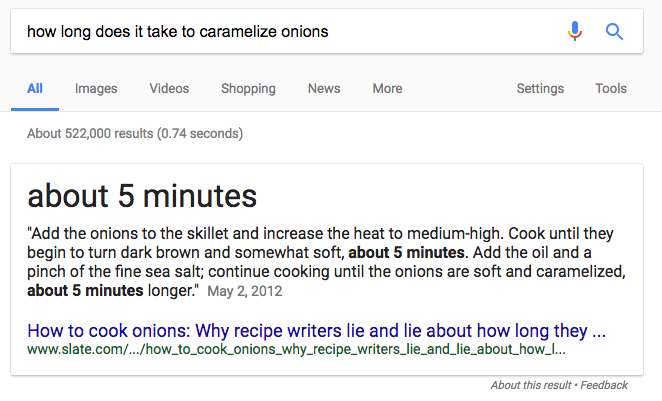
    But, when people typed “how long does it take to caramelize onions” into Google, they continued to see the false expected cooking times appear in Google’s search result box that is supposed to give users “one true answer,” a term coined by Danny Sullivan, founder of SearchEngineLand.

    How Long Does It Take To Caramelize Onions Google Search - Search Influence

    It turns out, Google was looking at Scocca’s Slate article, with all of its high word count and keyword-laden, well-written text, as the authoritative source. The only problem was that its algorithm focused on and crawled the first paragraph that referenced the 5-minute cooking time. The myth Scocca was trying to debunk ended up getting “bunking,” to use his inverse take on the word.

    Users Push for Quick Answers

    Google hasn’t always answered questions. Users typed in what they were looking for, and they got a list of web pages that may help them find it. But Google realized people wanted short, quick answers to questions, so they developed the short answer box. It’s virtually set apart from the search results and has a slight drop shadow.

    This also isn’t the first time Google has had issues with its short answer box. About a month ago, if you were to ask “Is Obama planning a coup d’etat against the U.S. government?” the response was that he indeed was planning a communist coup at the end of his term. Ask why a fire truck is red and you got a Monty Python joke. While the latter could lead to some harmless John Cleese quotes passed around the office, the former could actually misinform the public in a harmful way.

    Why Are Firetrucks Red Google Search - Search Influence

    Google’s Response and Their Plan to Fight False Information and Fake News

    Google has been dealing with this for a couple of years now. In 2015, they announced that they were using RankBrain, an artificial intelligence algorithm, in combination with Knowledge Graph, which pulls information for short queries from sources like Freebase, Wikipedia, and the CIA World Factbook—very reputable sources. It currently contains 3.5 billion facts. And, with all of these instances of inaccurate snippet responses, Google was quick to fix the issues. Searching for the cooking time for caramelizing onions now brings up the correct answer. Also, along with Facebook, Google also upped their fight against fake news by using fact check systems in their searches and feeds. So the big question is, how does all of this relate to your small business, practice, firm, bakery, brewery, insurance agency, etc.?

    The Importance of Rich, Accurate Content

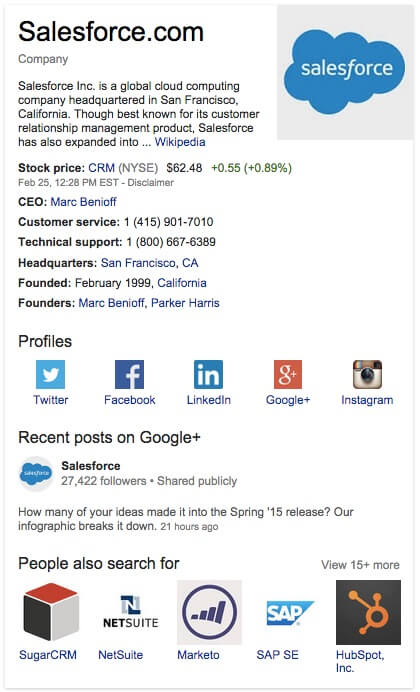
    Whether you’re working on new content or need on-site or local search optimization, the importance of producing educational, on-point, authoritative content is key. The Knowledge Graph’s “panels” pull information from your “about us” page, including contact information. These show up in the sidebar of searches and can include photos from your Google+ page as well as any reviews of your business. So, it should be a no-brainer that your Google+ page should be up to date and any reviews of your company are responded to promptly. Above all, make absolutely sure that your NAPs are consistent and current; an incorrect address showing up in a panel is not the quick answer that potential customers want.

    Salesforce Google Plus Account Screenshot - Search Influence

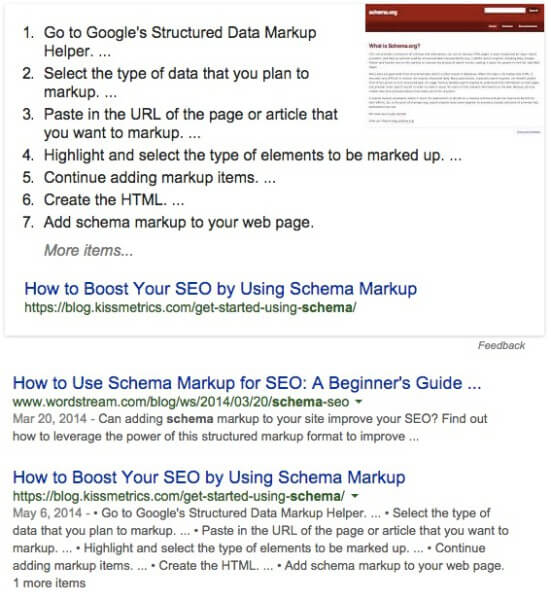
    There’s also the chance that your longer content could be pulled into a short answer box. At first, Google’s Knowledge Graph was pulling just short answers to questions, but it has since gotten smarter at pulling answers from longer content, like how-to guides with 20-point checklists or in-depth, 1,000+ word content that gives users lots of useful information to peruse. As always, make certain your content is not only accurate but also engaging enough to pull viewers deeper into your site and actually convert.

    Does This Completely Change SEO?

    In short, no. As this article from SearchEngineLand points out, in most cases, “the source getting pulled into the Knowledge Graph is already in the first few organic search results anyway.”

    How To Boost Your SEO Using Schema Markup Screenshot - Search Influence

    Good SEO will improve your ranking regardless and will, in turn, improve your chances of showing up in a short answer box. But even if your business never shows up there, your target audience is still searching for more than just a quick answer. They’ll want to dive into your site for in-depth, relative information. Similar to previous algorithm updates with Hummingbird and Panda, there may be some minor ups and downs in organic search numbers. But if your content is consumer-focused, educational, expertly written, and optimized, then your SEO plan will help out Google’s Knowledge Graph as well.

    If anything, these inaccuracies in Google’s AI have taught us that the search begins and ends (ideally in conversion) with the user. Keep in mind the unique relationship between your business and your potential client.

    Make It Easier for Google

    So, what are some additional steps you can take to make sure your site is up to current SEO best practices? Check out our recent white paper on things to avoid when building or optimizing your website. It includes valuable information, like configuring your URLs and making sure you’re mobile-friendly. Have any more questions on how to increase website traffic? Reach out to us at any time.

    Images

    Onions

    Short Answer Box via Gizmodo

    Fire Truck via TheOutline.com

    Knowledge Graph Panel via SearchEngineLand

    Short Answer Box via SearchEngineLand

  • Search Influence Year in Review: Our Top 10 SEO Blog Posts of 2016

    With this year drawing to a close, now is the time to reflect on the year and prepare for a successful and productive 2017. In keeping with this, we’ve highlighted our top SEO blog posts of 2016 to get you extra pumped for your New Year’s re-SEO-lutions.

    Image Of Happy New Year Script - Search Influence

    1. An Update: How to Get Rich (Answers, That Is) With Google

    In 2016, it’s estimated that approximately 40 percent of queries on Google resulted in “Rich Answers.” So what are these Rich Answers, and how can your website get selected for a Rich Answer on Google’s search engine results page (SERP)? This updated post gives you all the details.

    2. Barnacle SEO – Local Search Engine Optimization for the Sam’s Club Crowd

    3745255

    For small businesses with small budgets, the “Barnacle SEO” approach may have big payoffs. Learn how attaching yourself to the white whales of the SEO world can expose you to new markets and customers.

    3. Nix the Wix SEO Challenge: Tips & Tricks

    Sure, Wix is the uber-easy-to-use, code-free web developing platform for dummies, but just how well do Wix sites get along with search engine optimization? Thanks to these quick tips and tricks, it’s easier than you may think for Wix sites to play nice with SEO.

    4. 10 SEO Blogs You Should Be Following

    Fancy yourself a true SEO connoisseur? This list outlines all the insider blogs you should be reading to stay up to date on the constantly changing world of search engine optimization. Hey, even if you’re new to the game, resources like the Google Blog and MOZ Blog provide a plethora of information to get started.

    5. These 10 Expert Tips Will Drive Traffic to Your Business’s Website

    Driving traffic to your website means driving sales for your business. Our in-house experts share their insights when it comes to getting people in the online door. Hint: If you’re promoting on Facebook and publishing press releases, then you’re off to a good start.

    6. 5 Tips to Improve Local Search Rankings Even If You Don’t Have a Physical Location

    Many businesses are opting for prime real estate on the interweb instead of brick and mortar locations, but that doesn’t mean you need to sacrifice website optimization. Check out these five tips for increasing your ranking.

    7. Google My Business for Doctors: Visibility, Authority, & SEO

    Claiming or creating a Google My Business listing can have big search impacts for medical practices. Follow this step-by-step guide for single practitioner practices, multi-practitioner practices, and multi-location practices.

    8. Local SEO: How to Clean up Citations for Better SERP Visibility

    A citation is the presence of a business’s name, address, and phone number (NAP) on any website. The consistency and accuracy of your NAP across sites will improve your local SEO rankings. Learn the four basic steps to complete an effective citation cleanup.

    9. 12 Things You May Not Know About Online Marketing

    Are you ready to be shocked and awed by the amazing (and hard to predict) world of online marketing? Here’s a list of some of the things that caught our Search Influence team members by surprise when they were rookies in the game.

    10. The Importance of Content Marketing to Your SEO Strategy

    Content marketing is the bread and butter of your SEO strategy and, in many ways, the success of your brand. Are you telling a relevant and compelling story about your business? Are you targeting the right audiences? This post will help you answer these important questions.

    What better way to bring in the new year than with a new online marketing strategy? We hope these posts offer some helpful insights and maybe even a little motivation for a productive and optimized 2017.

  • A War of Words: 4 Tips to Help Lawyers Win the Cost-Per-Click Bidding Wars

    1601-SI-Newsletter-0112-Big-KG-C-01

    Whether a veteran attorney or a recent law school graduate, legal professionals have likely noticed that the world of generating leads and winning new clients has changed drastically. While tried and true marketing methods such as word of mouth and putting your picture on a billboard still have their place, effectively using online resources can have a huge impact in establishing a solid client base. In particular, paid online advertising for attorneys has become so vital that competition for keywords has skyrocketed. Although it may seem daunting and difficult to know how to begin, these critical tips can help you win the cost-per-click (CPC) bidding war.

    1. Understanding the Competition

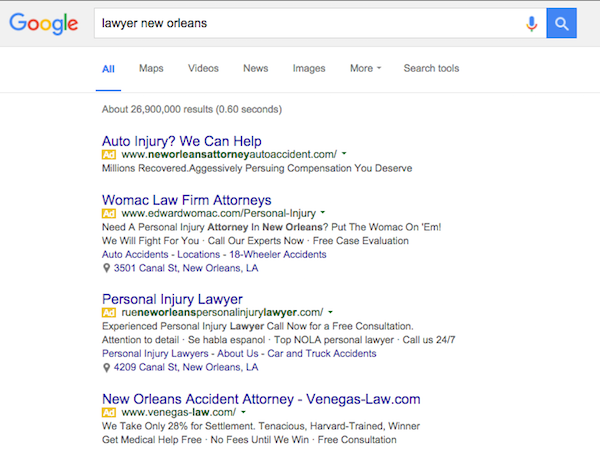
    Consumers who are searching for a lawyer often turn to the Internet to conduct their research. With that in mind, marketing online has become an integral part of building and sustaining a law practice. When it comes to paid online advertising, it’s important to first understand your competition. Legal keywords are typically among the most expensive in Google AdWords, with terms related to “attorney” and “lawyer” topping the cost charts. High levels of competition naturally follow expensive keywords, as lawyers constantly place bids on the exact same terms. Try conducting your own competitive research and search the keywords in your geographic area to see for yourself what ads are getting top placement. Simply run a search on the keywords you’re hoping to target and see which keywords your competition is already bidding on. Take a look at their ads and start crafting a plan to make yours even better.

    Screen Shot 2016-01-05 at 9.04.41 AM

    2. Target Specific Keywords

    So how do you overcome the highly competitive landscape and win the bidding war in your online ads campaign? First, you should create a list of specific and relevant three- to five-word keywords to explicitly target. This is a trial-and-error process, and it takes time to accumulate useful data. A simple way to start is to use the Google AdWords Keyword Planner, which will help you compile specific keyword ideas. This tool will also help you determine average traffic and CPC for your potential keywords, and it will make suggestions based on your site’s URL. In addition, it’s critical to focus on relevancy and make sure that your keywords, your ads, and your landing pages all match the searcher’s intent. For example, if the keyword in your ad is “DWI lawyer,” the click should take the consumer to a page with content for “DWI lawyer.”

    How Can I Fight A DWI Charge?

    3. Use Negative Keywords

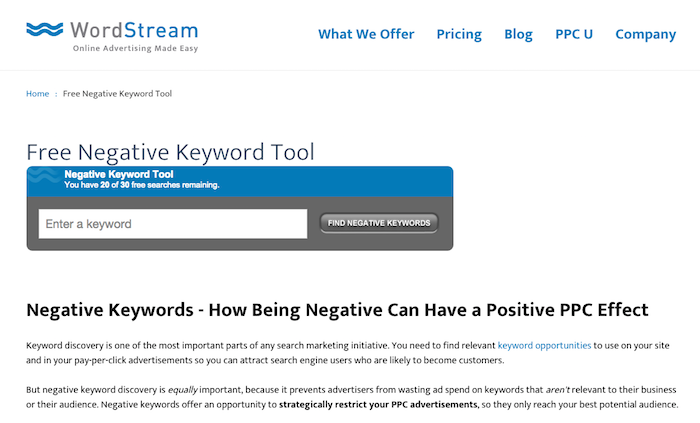
    Another crucial aspect of a successful paid online advertising campaign is the use of negative keywords. This allows you to stop your ad from appearing when you know that the consumer isn’t interested, which can help improve the click-through-rate of your ads. Using negative keywords informs Google that certain search queries are irrelevant to your practice, ensuring that you don’t pay for clicks that will not lead to conversions. You can start by using a free negative keyword tool like the one from Wordstream, which will return an extensive list of search terms that may not be related to your practice area. Using this tool is especially essential in the legal world, where you are bidding on expensive keywords that could result in unnecessary and costly clicks.

    Screen Shot 2016-01-05 at 9.25.01 AM

    4. Optimize Your Landing Pages

    Now that your paid online advertising campaign is set up with specific and relevant keywords and you’re getting clicks from consumers searching for your exact type of practice, it’s important not to derail all of your efforts with ineffective landing pages. Your landing pages should be directly on point to the ads that the consumer clicked on. They will likely need to be continuously tweaked with different types of offers to see how people respond to them. You might want to consider using videos on your landing pages with subject matter explanations directly from a lawyer, or customer testimonials from successful cases. In addition, having a chat function on legal landing pages can be particularly critical for consumers who are hoping to have immediate answers to case-specific questions.

    Keeping your paid online advertising strategy focused on these tips will help you capture leads that you would have normally missed, allowing you to conquer the competitive CPC bidding war for attorneys.

  • Dude, Where’s My Location? Google Removes Location Search Ability

    Dude, Where’s My Location? Google Removes Location Search Ability

    News Impacting Your SEO Graphic Image

    While most people were recovering from Thanksgiving food comas on December 1st, Google was quietly removing the ability to change the location of your search. For those of you who don’t fondly remember, there used to be an option in the search tools that allowed you to pretend you were in a far off land searching, places like Saginaw and Cleveland.

    Google Missing Location Search Image

    What This Means for Online Marketing

    The impact of this change is now starting to really be felt for those of us in the online marketing world.

    Advanced Web Ranking, a popular keyword tracking software, had to make a quick fix for their product. Before this change, tracking keywords anywhere your clients was as simple selecting a location in the software. Just like that, you were seeing the results for “french fries” right along with everyone else located in Newark.

    Then, BOOM. Google changed that.

    According to Google support, the solution to this problem is now to add the city to see results for that city.

    Google Drops Location Search, Screenshot Image

    My example of “french fries” while searching in Newark has now become “french fries Newark” while in New Orleans.

    Changing Keyword Searches

    If you spend time looking at search volume, you might be aware that there is a difference between any two keywords, no matter how similar they may seem. Everyone is different, and I might search “french fries Newark,” you might search “Newark french fries,” and my neighbor might search “french fries in Newark.”

    Since AWR updated their software to fit the new location definition, they are unfortunately changing what is actually being tracked. If you read the comments on their release of the news, users are not happy with the change. AWR needs kudos for their quick response to a large change in online marketing, even though it did not adequately address the change.

    As AWR’s change magnifies, Google has drastically changed online marketers’ ability to peer into markets of their clients from afar. It really brings home the point that online marketing and SEO is are ever-changing industries, and you have to always on your toes, even over the holidays.

    Image Credit:

    Tom Hanks