Tag: Google

  • Let’s Get Medical: How To Manage Healthcare Listings On G+

    When it comes to adding healthcare listings in Google My Business (now the one-stop shop that includes Google Plus business management), there are many things to consider when managing multiple entities within one location. While building out multiple listings unnecessarily is not ideal, some instances may call for multiple listings in order to distinguish between unique departmental differences.

    If there are multiple departments within your hospital or practice that have unique information (for example, a different phone number from the main hospital or practice) and operate differently from the primary location (for example, unique hours are typically considered an operational difference), then it is best to build out separate location pages for each of the departments to provide this information to customers more clearly.

    Let us delve into an explicit example of this. If your general hospital houses a hospital pharmacy and an emergency department, then these departments serve different purposes and might have separate hours and phone numbers.

    IMPORTANT NOTE BEFORE PROCEEDING: The following examples are ENTIRELY FICTIONAL BUSINESSES.

    Creating Pages:

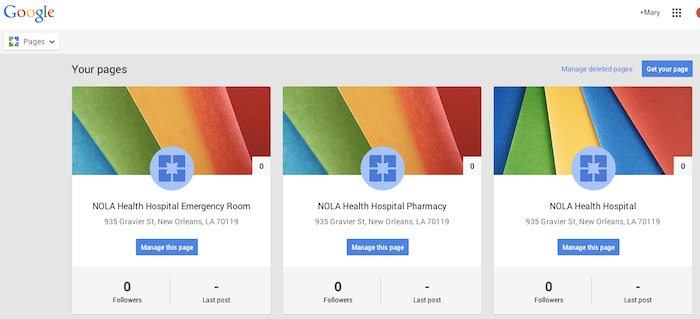
    Let’s say the aforementioned example is called NOLA Health Hospital. NOLA Health Hospital, in this instance, should have three Local (Storefront) Google Plus Pages. Note that these pages, while most likely using the same address, should have unique phone numbers. They should also have unique names; for example, “NOLA Health Hospital,” “NOLA Health Hospital Emergency Room,” and “NOLA Health Hospital Pharmacy” would be the proper names. These pages should also list their hours of operation according to their department-specific hours. If these pages were properly set up in the Google My Business dashboard, they would look like the following screenshot.

    Google My Business Dashboard - Search Influence

    Setting Categories:

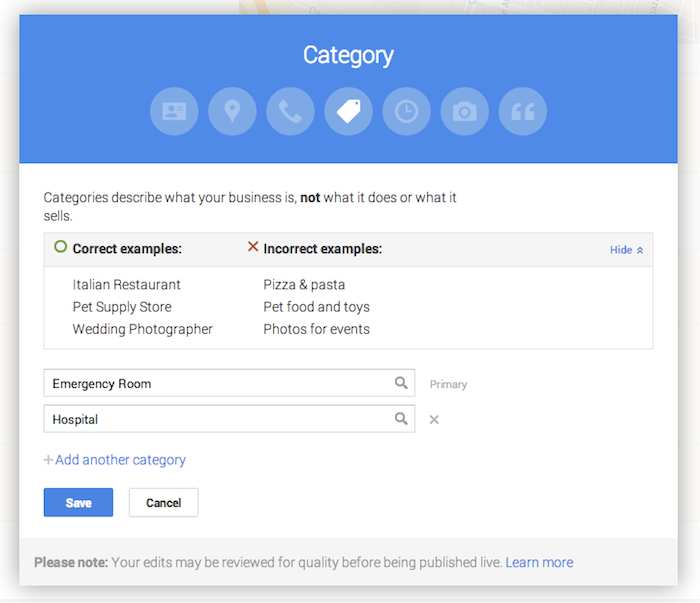
    Now that you have created the pages, it is important to use the categories to distinguish the differences between them. Google’s guidelines for businesses explicitly state that “For each department, the category that is the most representative of that department must be different from that of the main business and that of other departments.” This means that the primary category for each page should be different. In this example, NOLA Health Hospital Emergency Room will have the primary category “Emergency Room,” NOLA Health Hospital Pharmacy will have the primary category “Pharmacy,” and the general hospital of NOLA Health Hospital will have the primary category “Hospital.”

    Google Plus Page Editing - Search Influence

    While these settings are typically arranged during the page creation process, they can also be edited after the page is created. Click on “Manage this page” from the Pages dashboard, then click “Edit” in the top right-hand corner, and finally click into the “Category” section of the editing page to adjust the category. This is also where you can build out supplemental categories for the page. However, it may be wiser to use a few specific categories, as Google’s guidelines advise that it is best to “choose the fewest number of categories it takes to describe your overall core business.”

    As always, if you’re ever confused about how to proceed with your page, you can find the Google My Business “Guidelines for representing your business on Google” on the support site.

  • SEO for 2015: Meet the New Boss, Same as the Old Boss

    The world of SEO is constantly changing. Google, the big prize for search engine ranking, may change its search algorithms from 500 to 600 times a year, and major updates like Panda, Penguin, and Pigeon are rolled out on a fairly regular basis. And while your business can’t shift SEO strategies daily to incorporate every change Google unveils, it makes sense to take a fresh look at your SEO approach at least annually—or does it?

    The answer is yes, and no. While there are some aspects of SEO that can and should be refreshed or updated to keep up with changing algorithms and your audience’s needs and tastes, the good news for online marketers is that the basic SEO strategies you’re already familiar with will continue to be effective—in 2015 and beyond.

    Here’s a look at what will change in the SEO landscape for 2015 and what will remain the same.

    Sticking to the basics still works

    Best practices for SEO strategies have always revolved around delivering high-quality, targeted, and useful content with a few well-chosen, naturally incorporated keywords—and for 2015, that won’t change. Google-sanctioned “white hat” SEO tactics continue to be the most effective strategies for driving SEO and boosting search engine rankings.

    Another basic element of SEO that will remain the same is the need for both on-page (what you say about yourself) and off-page (what others say about you) factors. Successful SEO includes creative, useful, and engaging content creation for your website, social media, and other online channels, along with promotion that drives off-page SEO by attracting links to your content from other authoritative sites.

    Going mobile will be an imperative

    By now, most companies are aware that a responsive, mobile-friendly website is essential for attracting and retaining customers—but mobile SEO is more important than ever when it comes to Google. Responsive site design will be a crucial aspect of ranking high on Google, since the search engine now reports whether or not a site is mobile-friendly to both users and webmasters.

    If you’re not sure whether your business website is mobile-friendly enough, Google offers a free online testing tool, along with a link to information about their mobile-friendly criteria and how it may affect your search engine results.

    For small business, local SEO will be king

    In 2015, it will be important for businesses—especially small businesses—to make sure their websites are optimized for local area searches. Google and other search engines are giving more attention to local directories and citations, including hyperlocal content (relevant content authored by local experts within their geographic areas).

    One effective SEO strategy for optimizing local search is to make sure your phone numbers, addresses, and location pages are consistent with off-page directory listings. If you haven’t done so already, check out third-party business directory and review websites such as Yelp, Google+, and Yahoo Business to ensure that your local information is correct.

    Thinking like a publisher will benefit your SEO

    As search engine algorithms continue to shift weight away from obvious marketing and promotional content and toward contextual relevance, individuals are becoming more important than companies with regard to search engine rank. To take advantage for SEO improvement, more companies are transferring authorship credit to individuals—including text article writers, infographic designers, and video and podcast producers. Giving content creators their own voice will lend your content more weight with search engines.

    Links and keywords will lose center stage

    For a long time, keywords and links have been the cornerstones of SEO. But with a massive shift toward contextual search and high-value content, these primary factors no longer carry the same weight. Inbound and outbound links still matter for search, but their importance has been dwindling as more algorithms place relevance over popularity and authority.

    The same shift is apparently underway with keywords. While a few well-chosen and well-placed keywords still serve to help search engines determine the overall meaning of a page or piece of content, it’s more important that your content answers the right user questions and remains useful and engaging.

    If you’ve been sticking to SEO best practices, your strategy for 2015 is likely to only require minor changes in order to remain effective for the coming year and beyond.

  • Five For Friday: Do You Like Your Friends, Busting SEO Myths, and More

    1. You’re Doing It Wrong: This App Tells You If You Actually Have Friends – Tech Crunch

    Ever wonder if you actually like your friends? There’s now an app for that. The app, called “pplkpr,” monitors your heart rate through a wristband and sends you text message updates about your relationships. It even helps you schedule time to hang out with people it deems “better friends.” So next time you want to bail on plans to sit around and watch Netflix, just say “My app thinks I shouldn’t hang out with you.”

    2. Is Google Making You Dumber? – Mashable

    By keeping your browser homepage set to the default page, usually Google, you’re missing out on the opportunity to see something new every day. Changing your homepage to a more engaging site could allow you to learn a new word every day or to expand your horizons through photos. There are no limits on what page you set it to, and this article offers some great options if you’re looking for a daily knowledge boost.

    3. …But When Will I Get My Robot Butler? – Tech Crunch

    When Siri plays Hall & Oates instead of finding the nearest Walgreens, it makes me wonder if it’s even possible to build functioning, humanoid robots. Though constantly portrayed in popular culture, robots that mimic humans might never be a reality. Issues with artificial intelligence and voice recognition hold us back from being able to send a robot to take the trash out. Till large advances are made, it looks like I’m still going to have to do my chores myself.

    4. A Special Set of Skills: How to Not Let Your Phone Get “Taken” – CNet

    Though you might not need Liam Neeson to get your device free, hackers are taking phones hostage at alarming rates. By hiding ransomware links or apps, hackers can threaten to encrypt your device or lock your phone entirely unless you pay up. If you keep to reputable app sites and stay away from sketchy links, you can avoid having your phone “taken” right in your very hands.

    5. Myths Busted! 5 SEO Myths That Need to Be Debunked – Search Engine Watch

    SEO is always changing and updating (with the help of “P” named animals). With such a fast-paced industry, misconceptions easily find their way into common thinking. These myths can encourage unrealistic goals and set impossible standards. By demystifiying these myths, we set ourselves up for greater success and more satisfied customers. After all, the best place to hide a dead body is on the second page of Google results…

    Image Sources:

    Bye Felicia Image

  • Five for Friday: Beef Up Your Local SEO, Twitter Welcomes Newbies, and More

    1. Google’s Domain Registration Service Now Open To All US Residents – Search Engine Journal

    Google now has a proprietary domain registration service! What’s great about this service is that, like most Google products, it’s fully integrated with Gmail forwarding as well as other goodies provided by Google’s partners – Squarespace, Weebly, Wix, and Blogger. Streamlined and familiar, domain registration starts at $12, with additional add-ons available. For more information about this service in different countries, you can sign up to a mailing list.

    2. A Step-By-Step Introduction to Amazon Product Ads – PPC Hero

    Amazon has always been kind enough to direct customers to your product, and it sometimes even directs them straight to your website. With Amazon Product Ads, the company helps you become better at selling your wares the right way – with the consumer in mind, but the seller at heart. This article details the step-by-step process on how to utilize APAs to the fullest, and it educates you on the nuances of selling products online.

    3. How to Have a Successful Local SEO Campaign in 2015 – Moz

    These tips are typically a no-brainer for us optimizers, but as evinced by our recent SI Conference, there are nuances to local SEO, and SEO in general, that we sometimes just don’t see right off the bat. With the new Google updates, optimizing is getting more personal and organic than ever. Check out the interesting click map to see just how organic SERPs are becoming.

    4. The Big List: 80 Of The Hottest SEO, Social Media & Digital Analytics Tools For Marketers – Marketing Land

    Note: this is not a ranked list of SEO tools, but rather a running total of great tools out there at the moment. Perhaps we will see some of these in our near future as employees of Search Influence. It’s nice to see kind things said about the tools we currently use, if not only to solidify the reasons why we chose the ones we did.

    5. Report: Twitter Planning New Home Page For Logged-Out Visitors – Marketing Land

    As an avid Twitter user, I’ve always been concerned with the esoteric universe that is Twitter’s inner sanctum. What’s in a homepage, you ask? Well, currently Twitter leaves a lot to be desired (a marketing ploy perhaps); there’s no indication of what the user interface even remotely looks like based on their homepage. Reports indicate that, unlike many social media home pages, Twitter may give in to human curiosity and allow potential users to glimpse its inner workings.


    Image Sources:

    Oh Boy Gif

  • Five for Friday: Is Your Social Media In Good Hands? Link-Dieting & More

    1. New Year, New Link Takedown – Search Engine Land

    As we all know, many sites were put on Google’s naughty list thanks to Penguin’s distaste for bad links. Their next move? Request, request, request. Looking back on 2014, Google certainly got a lot of action. Torrent Freak reports that Google received a 75% increase in link removal requests in 2014 as compared to the previous year. We’re talking highs of 12 million URLs requested for removal per week. 2014 was clearly the year of cleanup.

    2. Project Share Aware: Sugar Bowl Not So Sweet For Some – MarketingLand

    An unsuspecting real-life couple, dubbed “oversharers” by Allstate, was burglarized during their outing to the Sugar Bowl. You might be wondering why an insurance company would do such a thing. Allstate’s latest campaign, Project Share Aware, aimed to alert the public to encroaching social media-savvy burglars. Long story short, if you’re telling people where you are in a public sphere, those without your best interest in mind (aka burglars) can take advantage of your oversharing. The event went as far as holding a fake online sale of the couple’s property using #MayhemSale on Twitter. Many claim this was just another ploy of Allstate’s fear-mongering advertising tactics, but it certainly made a few rethink their privacy settings. Although rattled, the couple did walk away a little sweeter with free Sugar Bowl tickets.

    MayhemImage

    3. Modern Family: Device Edition – Search Engine Land

    This may not come as a surprise, but if it’s not on a modern advertiser’s to-do list, it certainly needs to be. What am I referring to? Cross-device advertising. We’re talking about your new modern family, each member gazing at their device of the moment, whether it’s a PC, mobile, or tablet. John Crosley, Bing Columnist, argues that households engaging with multiple devices within one day tend to be more receptive to advertising. The overall goal? Reaching your audience, wherever they are and on whatever device they may be using at the moment. Let’s just say cross-device advertising is the Lily of Modern Family.

    ModernFamilyLionKingImage

    4. New Year’s Resolutions: Cutting Carbs or Social Media? – Community2Business

    Which did you pick? If you picked social media, you’re probably in the right place. As you step into 2015, take some time to rethink how you’re reaching your audience. Some top tips include boosting visuals, knowing when the time is right, and monitoring your #HASHTAG.

    First things first, if your post lacks engaging visual content such as images, memes, or infographics, your audience will likely yawn and pass through. Also, consider donning those visual-friendly social media platforms like Pinterest or Instagram. Tick, tock – we’re talking about time. Although articles regarding the perfect posting times abound, don’t forget you’re unique! Pay mind to your particular market or industry and play around with tools to measure what time is actually best for you to post. Finally, it’s time to discuss the beloved hashtag. While this is an incredibly relevant and useful tool, it can be abused. Make sure you are picking appropriate wording and wisely follow the rule of no more than three hashtags per post!

    MeanGirlsButterImage

    5. Boost Your Newsworthy-ness! – Business2Community

    Based on an analysis of 2014 search trends, the most searched items were Robin Williams-related. This was followed up by the World Cup, ISIS, Frozen, and more. What can we take away from this? People want news! Alongside your SEO efforts, focus on making your business reflect the most recent, exciting news in the industry. As an added bonus, if you regularly update this information, it will be new news. And as we all know, Google loves to bask in fresh, updated content. Now, that’s killing two birds with one stone!

    Image Sources:

    Mayhem Last Item 4 Sale Tweet

    Modern Family Gif

    Mean Girls Gif

  • I’m So Trendy. You Already Know… Using Google Trends on YouTube

    The last time I wrote about Google Trends, I explained how it could be useful in your keyword research process. I am now going to explore how this tool can be used to create a strategically optimized YouTube video.

    Note: As mentioned in my previous blog, keep in mind that the numbers on the graphs presented are not absolute numbers. They are relative to each other to reflect a trend.

    Search by Keyword

    If a client already has a YouTube video featuring a general overview of their business, then we typically try to match up another one of their keywords with a YouTube topic centered around that keyword. Google Trends has a section of the site dedicated to finding trends in search results on YouTube only, so you can see if that keyword is trending and if there are related phrases to consider adding to the title and description of the video.

    Here’s how to get there:

    1. Visit http://www.google.com/trends.

    2. Change your search setting in the top right drop down box in the top navigation from “Web Search” to “YouTube Search.”

    YouTubeSearchImage

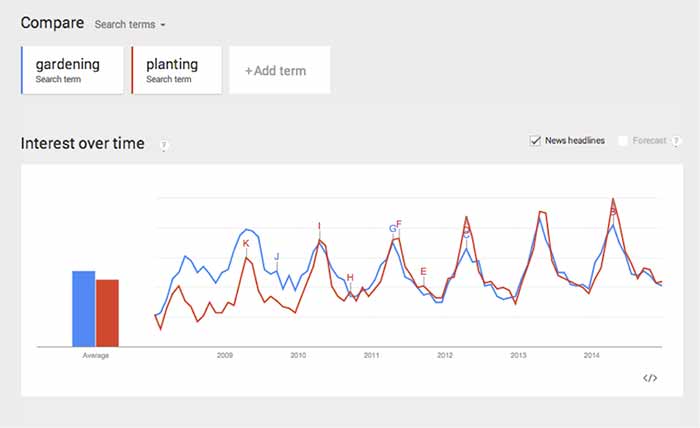
    3. Type in the root of the keyword(s) you want to use in the search box under “Compare.” You can compare up to five keywords at a time. This can be used to help you decide between keywords to use as a video topic.

    CompareChartImage

    In this case, both search terms fluctuate at the same time, so seasonality wouldn’t be a factor, but it could be in other instances. This chart tells me that “gardening” used to be a more popular search trend than “planting” on YouTube, but the gap has closed, and “planting” is actually trending more now. It’s interesting that both of the trends dropped so steeply in 2014.

    Because of this, we should look at similar phrases that could have a stronger trend. This is easy to do when you scroll down the page to “Related Searches.”

    Related Searches

    4. Scroll down the page to “Related Searches.”

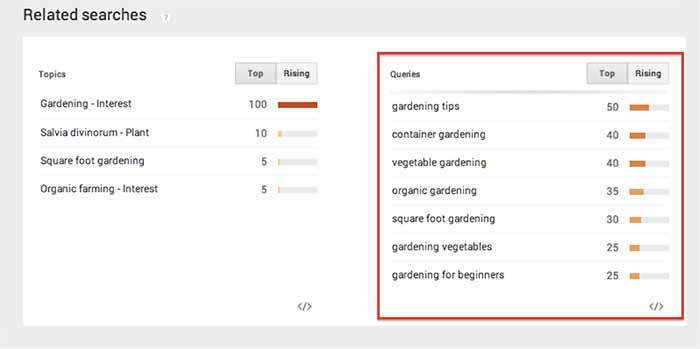
    5. Within “Related Searches” you will see a “Queries” box that shows the most consistently trending searches that are similar to your keyword(s). This is a good place to look for topics that are already popular on YouTube.

    RelatedSearchesImage

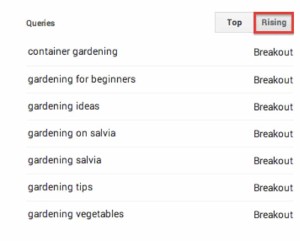
    6. Note the “Rising” column next to “Queries.” These are terms that have been searched for often recently and could become long-term trends.

    As you can see above, I searched for “gardening” and found “container gardening” and “gardening for beginners” as “Related Search” queries. If one of my keywords is “gardening livonia mi,” then I can use “container gardening livonia mi” in the title and description of the video, to optimize it for both terms.

    RisingImage

    Whether you are looking for a way to strategically choose a keyword to optimize a YouTube video or you just need an interesting video topic, Google Trends’ YouTube Search will be a handy tool to explore!

  • Law & Order SEO: Finding The Culprit Behind Your Decreased Organic Traffic

    As digital marketers, we regularly analyze site traffic to ensure that our efforts are producing positive results. But what happens when you’re doing all the right things in your SEO campaign (high-quality website content, blogging, link-building, etc.) and your Google organic website traffic is consistently going down?

    1) Traffic Deep-Dive

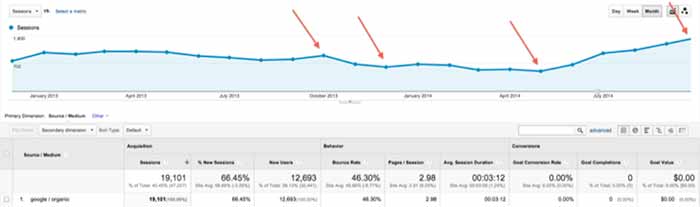
    First, log into Google Analytics and narrow your search down to Google organic traffic over the largest date range possible. Look for trends of upward or downward traffic and make annotations of known changes that might have caused traffic to change (such as a new website launch or the installation of a blog). Also, check traffic by landing page to see if only certain pages were affected.

    TrafficDeepDive

    2) Compare to Algo Timeframes

    Next, see if any of the changes correspond to one of Google’s algorithm updates using the Moz algorithm timeline. Keep in mind that the date might not be exact, because the updates often take time to roll out. If you can attribute the traffic change to an algorithm update, take the necessary action depending on the update. Hit by Panda? Focus on your content strategy. Hit by Penguin? Take a close look at your inbound links and check for a manual action.

    AlgorithmChangeIssue

    3) Investigate Other Possible Culprits

    If your traffic change didn’t correspond to a Google algo update, this is when your analysis gets a little tricky, as there are many possible reasons for the change. Here are some things to check when searching for the source of your traffic change:

    • Rollout of a new website (setting up 301 redirects is essential to this process as well as carrying over all SEO optimizations)
    • Removal or adjustment of your content
    • Relocation of your business (your citations need major focus)
    • Discontinuation of an ad campaign that was generating traffic
    • Adjustment of technical elements of your site, such as meta-tags or robots.txt
    • Change or removal of your Google Analytics tracking code (surprisingly common)
    • Change in the marketplace or seasonality (like a decreased demand for your products/services in general or during a certain part of the year)—check out Google Trends
    • Messy directory profile (check your percentage of correct citations using Moz “Check My Listing”)

    These tips will hopefully help you get to the root of the issue and take the necessary action to achieve your SEO goals. If you need a professional team to do the work for you or to assist you in your efforts, you can always call us: we’ll be happy to discuss our SEO packages with you.

    Have any additional recommendations for things to check? This list is not exhaustive, so please help add to it!

  • Five for Friday: Facebook Ads Get a Facelift, Google’s Panda Goes into Hibernation, and More!

    Photo by Benson Kua

    1. Tips For Growing Traffic and Revenue Through Keyword Targeting – Search Engine Land

    It is widely known throughout the tech world that choosing the right keywords is important when trying to draw more attention to your website. Trond Lyngbø discusses how to do this by gathering relevant information, prioritizing your targets, and taking appropriate action. He goes through each of these steps in detail and offers advice on which tools to use and how to narrow down your targeted keywords. Finally, he goes through your options on how to take action through content marketing, personalization, and more. Trond Lyngbø offers advice and suggestions on taking action with high search volume keywords and turning those leads into conversions.

     2. What’s Next in SEO Trends – Venture Beat

    With the new year approaching fast, people are wondering what’s next in SEO trends. Yoav Vilner discusses how the focus in 2014 has been on honest and well-built link profiles, unique and informative content, and a compatible mobile site.

    In 2015, he expects the focus to shift in a number of ways.

    1. Addition of Social Layers: This will include putting faces on visitors and allowing them to get to know other visitors and even the website owners through social profiles like Spot.IM.
    2. Increase of Visual Content: Websites with engaging visual content such as BuzzFeed are showing us that users are becoming more engaged when aided by a visual rather than a plain text site.
    3. Defense Against Negative SEO: In 2015, businesses will need to work harder to protect themselves against negative SEO by securing a healthy link profile and proving to Google that the brand is legitimate.

    3. Panda Goes on Holiday Vacation Too – Search Engine Roundtable

    photo by Jrwooley6

    Panda has been one of Google’s most influential updates. Thanks to the update’s focus on quality content, advertisers have been striving to satisfy this furry animal since 2011. In this blog, Barry Schwartz discusses why we haven’t seen any updates or refreshes from Google’s Panda over the past month. He discusses how Panda has been known to go on vacation (or perhaps hibernation) during the holiday season and goes into more detail about when Panda was last updated.

    4. Insight Into Which Products Drive Store Visits – Search Engine Watch

    During the holiday season, advertisers are constantly trying to track their marketing efforts, asking questions like “What drives consumers to purchase?” and “How do we get customers to think of us first?” Yuyu Chen discusses a new Google AdWords metric called “store visit measurements,” which is added to its Estimated Total Conversions (ETC). Using data compiled from the company’s search ads, this tool tracks which products drive consumers to the store to make a purchase. Chen discusses privacy concerns as well as whether or not this feature will be available outside of the US.

    5. The Redesign of Facebook Ads Yield High Results – Marketing Land

    In April, Facebook redesigned its right rail ads by making them larger but less frequent. Ever since then, we have been awaiting the results of this redesign. In this blog, Martin Beck discusses Facebook’s announcement regarding the success of the redesign. He also discusses the success associated with these new ads and explains why they are cost efficient.

  • 12 Days of SEO (as Told by Christmas Movies)

    December is finally here, and you know what that means – Christmas SEO! Here are my 12 (Days of Christmas) tips for your small business’ online presence, as told by my favorite Christmas movies:

    1. Accept That SEO Is a Gradual Process

    It may take some time, but if you strategize and take things step-by-step, you’ll be able to improve your results on Google.

    2. Keep It Consistent

    Just like the Rockettes’ kickline, it’s important to keep your business’ name, address, and phone number consistent across the web. This includes your website, social media outlets, and directories!

    3. Work on Positive Reviews

    Getting positive reviews from positive customers can go a long way. Once you have five reviews on your Google+ page, your average star rating will begin to show in search results. Tip: you can give customers this nifty review link to make it really easy.

    4. Don’t Let the Big Guys Push You Down

    Directories and national chains can be intimidating, but play up your strengths as a locally owned business. You can strategically find keywords to target that feature a maps pack; you can also optimize your business listing on the directories that are ranking high.

    5. Feature Fresh, Original Content on Your Site

    Duplicate content can be harmful to your site’s SEO, and it can be boring for potential customers. Make sure that your site’s verbiage isunique and engaging. It’s okay to be different!

    6. Avenge Your Manual Actions

    A manual action from Google may seem worse than being trapped on the Island of Misfit Toys, but there are ways to earn back trust and get in Google’s good graces. With time, money, and effort, you’ll get there one day. Just like Santa, Google checks its list twice. Once you’ve put in the work, wait and see what happens during the next algorithm refresh.

    7. Trust the Keyword Research

    Sometimes it may seem as though the keywords we recommend are not how people are searching, but the numbers don’t lie. Just don’t forget to check for outliers such as news articles, branded searches, and weird town names (Cadillac and Bath, Michigan).

    8. Get Backlinks That Are Natural and Relevant

    Just because you have lots of backlinks doesn’t mean they are good for your site. They may be spammy or unnatural. When getting links back to your site, you should have a combination of quality and quantity. Ideally, you want lots of good links coming from strong, relevant websites.

    9. Pay Attention to the Technical Side

    Keep all of your sitemaps updated and make sure you submit them to Google and Bing Webmaster Tools. It’s also important to add schema so that Google can easily find helpful information about your business. Don’t forget about optimizing your site’s images and meta data; it’s a quick and easy way to get your “ticket” on the Google Express.

    10. Verify High Authority Directory Pages

    Don’t get “lost” in map results or directory searches. Get your listings verified (usually via phone, mail, or email) and optimize them. I suggest claiming your Google+, Yelp, Bing, Foursquare, and Moz Local listings. If niche sites such as Houzz, Avvo, or Edmunds are available for your business, claim those listings as well. P.S.: this helps you with the recent Pigeon update!

    11. Engage with Customers Through Social Media

    It isn’t enough to have social media accounts; you need to be active and interact with your customers. Keep your content interesting and reward fans for commenting on your page. It could be as simple as liking their comments, favoriting their tweets, or saying “Thank you!”

    12. Analyze, React, and Keep Calm after Google’s Algo Updates

    The landscape of Google can seemingly change in the blink of an eye. While it’s important to brace for the worst, don’t forget to check for the best. A lot of recent updates have been good for my clients! Think of the glass of milk as half full and the cookie plate as half empty; be prepared to take action on the latter.

    Image Sources:

    Rockettes

    Christmas Story

    Christmas Vacation

    Miracle on 34th Street

    Mean Girls

    Polar Express

    Grinch

    Santa Clause

    Lost in New York

  • What’s Black & White & May Have Killed Your Site in 2014? This Year’s Top 3 Algo Updates

    In 2014, there were numerous algorithm updates that changed the world of SEO—for the better. Google uses a finely tuned (and ever-changing) algorithm to sort search results in a way that best caters to the searcher. In order to perfect this art, Google turns out algorithm updates, both minute and massive, regularly (and sometimes not so regularly). As such, SEO is always evolving to match this quickly turning tide, which is why it’s best to focus on creating a site that will best benefit the end user.

    Looking back on the past year, there were many, many, MANY updates of note. So let’s just focus on the top three major hitters.

    Panda 4.0

    About

    Being in the top three is no small feat, and kicking off the list of top algorithm updates of 2014 is Panda 4.0. On May 19th, Panda 4.0 rolled out, affecting about 7.5% of English-language queries. Though there was another major Panda update in 2014, Panda 4.1, the effects of this second Panda update were less noticeable than those of its predecessor, “only” affecting about 3-5% of queries.

    Generally, Panda updates are geared towards high-quality content. Their goals are twofold:

    1. To stop sites with low-quality content from working their way into Google’s top search results
    2. To reward high-quality content with more presence by pushing sites with thin content down in SERPs

    What did it do?

    Panda 4.0’s effects did not stray from the Panda expectation. Some of the observed changes that occurred to sites as a result of Panda 4.0 were that it:

    • Penalized aggregated content
      • Aggregated content relates to sites that compile content from other sites. A well-known site that utilizes aggreged content is Buzzfeed, though Buzzfeed seemed to fare this update well.
    • Penalized thin content
      • There were 2 major types of sites with thin content that were affected:
        • Sites lacking quality, long-form content throughout
        • Sites with strong hierarchical structures that may contain quality, long-form content on key pages but contain thin content on higher-level category pages
    • Rewarded high-quality content
      • Sites with reputable, long form, user-friendly content

    How it changed SEO

    Quality content = good content + positive user experience. The major takeaway from Panda 4.0 is not a new one. User experience is always an important factor, but it’s one that can get lost in pursuit of developing long-form content. When developing quality content, an emphasis should also be placed on how the content is viewed.

    AddingCustomGraphic

    Images

    Paragraph after paragraph about your service offerings is likely a wasted effort without visual aids to break up text and give users a new means of understanding.

    Internal Links

    Do you have before and after images? Related blog posts? Anything to give the reader more info? Add links to give users a reason to click through more of your site.

    Mobile Experience

    Now have you considered mobile? Site visits from mobile users are always increasing. Are you providing mobile visitors a good viewing experience that is specific to mobile and easy to navigate and read?
    PizzaNewOrleans

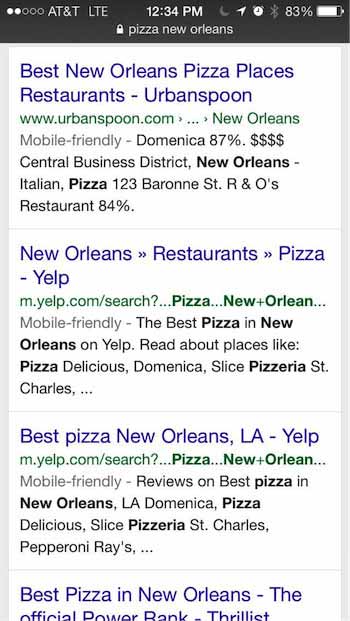
    Though not a part of the Panda update, Google is now providing information in SERPs stating whether a site is mobile-friendly or not. This effectively allows users to skip over results they know cannot be easily viewed on their device, and it furthers the importance of ensuring that your site provides a positive user experience for searchers on all devices.

    “Pigeon”

    About

    A few short months after Panda 4.0, a new breed of animal entered the circus of algo updates when Google rolled out “Pigeon.” Unlike Penguin and Panda updates, Pigeon was not a penalty-based update (aimed at cleaning the SERPs from low-quality sites), but a core change to the local search ranking algorithm. Many different types of businesses were affected by Pigeon. Some of the industries that saw a big effect from Pigeon were real estate, restaurant, hotel, retail, and more.

    What did it do?

    Overall, Pigeon dramatically altered some local results and modified how they handle and interpret location cues. This update is supposed to be a move toward a better user experience for mobile users, with results more concentrated in number and in proximity to your location. Google has also stated that Pigeon helped develop closer ties between the local algorithm and the core algorithms.

    How it changed SEO

    Some of the major changes that occurred as a result of this update were:

    • The disappearance of local listing packs from a large number of SERPs
    • A stronger emphasis placed on relevant directories in search results, leading more SERPs to become directory-heavy rather than heavy with individual businesses’ sites.
    • A switch in focus of local ranking factors
      • Local rankings are expected to depend more on website authority and less on traditional local ranking signals
    • A change to the way in which location cues are interpreted, with results more concentrated in number and in proximity to your current location

    Penguin 3.0

    About

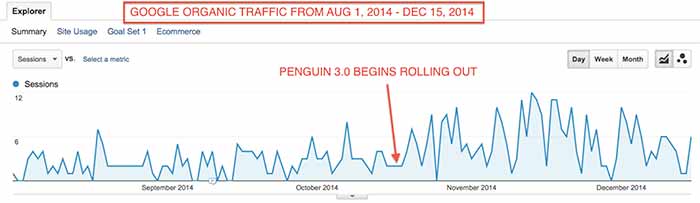
    Last, and certainly not least, this list would not be complete without mention of our long-lost “frienemy,” Penguin. This year, the story of our love/hate relationship with the Penguin algo update was mostly one of love and longing as we patiently awaited its arrival after a yearlong hiatus. Much like preparing for the arrival of Santa, webmasters spent their year diligently reviewing and cleaning up backlinks in an effort to wind up on Penguin’s “nice” list. Finally, Christmas morning came on October 17th when Penguin 3.0 began rolling out, initially affecting less than 1% of US/English queries. 

    What did it do?

    Generally speaking, Penguin updates focus on the level of natural linking behavior. This filter primarily affects websites with a high volume of lower-quality links. For those sites who were affected by the Penguin updates of 2013 and took the initiative to clean up low-quality links in 2014, a positive effect was likely realized after Penguin 3.0.
    PenguinGoogleOrganicTrafficIncreaseImage

    Specifically, Penguin 3.0 also began a movement to begin regular refreshes, much like Panda. As a result, many webmasters have observed major changes since Penguin 3.0, dubbing these major changes Penguin 3.1, 3.2, 3.3, and 3.4.

    How it changed SEO

    Penguin 3.0 resulted in 2 major industry changes in how Penguin updates are processed and anticipated:

    1. Google has stated that they will move toward regular refreshes of Penguin 3.0, much as they have done with Panda. In the past, Penguin updates have been processed offline and pushed live on a specific date and time. With this new change, Google is indicating that they will be making changes to the algo within their live rankings processes.
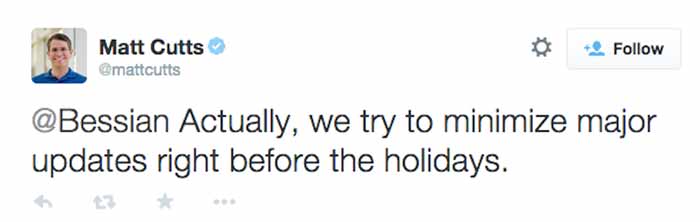
    2. Google broke its “no major updates during the holidays” promise on Thanksgiving Day when Penguin 3.1 occurred. Though Google considered this Thanksgiving Day fluctuation a part of their initial Penguin 3.0 rollout, rarely do updates take this long and cause major fluctuations late in the game.
    MattCuttsTweetHolidayUpdates

    Takeaways For 2015

    So whether Panda, Pigeon, or Penguin affected your site in during 2014, we hope you have been able to use the plethora of circulating information to bounce back. If not, you can always contact Search Influence to help you formulate a specialized plan.

    The big takeaway, however, is that algorithm updates are to be expected, so it’s best to prepare for them ahead of time by making your site as user-friendly as possible. We don’t know what’s headed for us in 2015, but rest assured, it will probably be as eventful as 2014.