Tag: google maps

  • Google Free Europe

    Google France
    LeGoogle

    Google has landed in hot water in France after offering its Google Maps product for free in the country. America is known as the land of the free, and we all know big businesses get to do pretty much whatever they want. The idea of a government stepping in to say a business can’t give away a service for free strikes me as particularly French.

    But while this move may not slow down the Google machine, it could open the door to similar lawsuits as Google sets its sights on new markets in previously un(Google)mapped countries. Could this be the beginning of a real life game of Risk that Google might not want to lose?

    France Fines Google for Flying Free

    French officials allege that the search engine giant is unfairly leveraging its massive size to crush smaller French competitors who offer similar services to paying customers – specifically Bottin Cartographies, who initiated the lawsuit in 2010. A 500,000 Euro fine was leveled against Google as the result of the lawsuit, coupled with an additional 15,000 Euro fine.

    A smaller company — maybe Bottin Cartographies — would take this as a huge and potentially disastrous setback after they sunk an untold sum into digitally mapping a new market, but something tells me Google isn’t losing too much sleep over this. To illustrate how much money Google made in 2010, SEOMoz deconstructed what Google’s reported 2010 earnings of $29.3 billion could buy.

    Let’s just say no one needs that many Justin Bieber albums. Ever.

    Quoi?

    So what’s the big fuss over the relatively small fine?

    Aside from the ongoing anti-trust legislation facing the company in more than half a dozen different jurisdictions, Google has had a relatively straightforward plan of attack since its inception, and charging for services like Google Maps isn’t part of that plan. Generally speaking, Google offers a free service that few can match in quality – search, maps, email – and then sells ads connected to that free service. Advertising is what makes Google’s world turn, and it’s much more difficult to sell ads for a service people have to pay to use than one anyone can access anytime they want to.

    So if this French incident is an indicator of what Google can expect to see as it expands overseas, it could find itself on the slippery slope of charging some users for a service that is free in other parts of the world.

    I guess what it boils down to is this: would you pay for Google Maps? What about anything else Google offers for free?

  • Donde Esta Mexico, Google?

    The realm of Local SEO can be a complex, frustrating land. A fruitful, popular land but a land where seemingly easy obstacles can quickly turn into uphill battles. And, if your client happens to be in a country other than the U.S, that hilly jog transforms into a trek up Everest… without a Sherpa.


    For example, we are currently working with a Playa del Carmen hotelsclient that is interested in ramping-up their local presence. This isn’t the easiest task but it certainly isn’t impossible. A few Mexico-focused business directories will need to be sourced, Google translator will be used like it is going out of style and a Mexican-formatted Google Places listing will need to be created. Again, not simple but all in a day’s work around here.

    The most important thing to keep in mind when it comes to local SEO is that it is a newer industry and is constantly changing. This means that there can be quite a few kinks in the technology. Google is no exception to this.

    After creating the client’s Google Places listing, we had the misfortune of discovering that the wrong country code was added to the listing. Typically, this would be a setback that would require another round of verification for the listing but not a deal breaker. Unfortunately, this was not a typical case. The country code had not been added incorrectly by us, but by Google and our client wasn’t the only one that was affected by this.

    After some research, we discovered that listings in Playa Del Carmen, Mexico are using the USA country code (01) rather than Mexico’s country code (52) in the main search engine results page. However, the correct country code is used on the actual Place page. This is a pretty significant bug in Google Places but is par for the course in local SEO. Surely, the issue will eventually be resolved but for the time being it seems like there are going to be quite a few Mexican businesses with silent phone lines.

  • Top 5 Search Marketing Bloggers You Should Be Stalking in 2011

    Why hasn't Matthew Lesko written a get rich with SEO book yet?
    Why hasn't Matthew Lesko written a get rich with SEO book yet?

    I’m a search marketing guy, have been since my first job out of college (if we are not counting that liquor store on Ponce I worked out for 2 weeks in the summer of ’06. You can’t beat a 30% discount…). Most people can’t grasp what I do or even understand why the company I work for exist (my mother thinks I’m everything from a telemarketer to an Internet panhandler) but it is what I do and love. Recently I have become increasingly more serious about being able to do my job better and become a more rounded internet guy (I mostly just hang out on the fringe of the internet with the /b/tards and tweeps heckling e-celebs for my own amusement). Now I feel I have to pour myself into learning new search marketing strategies in order to keep with the constant changes and competition.

    Finding good information is not always easy for search marketers.

    There are no continued learning programs for SEO backlinking strategies or creating compelling keyword rich content. So I decided to put together a list of my favorite internet marketing bloggers and explain why you should be reading them if you are serious about SEO.

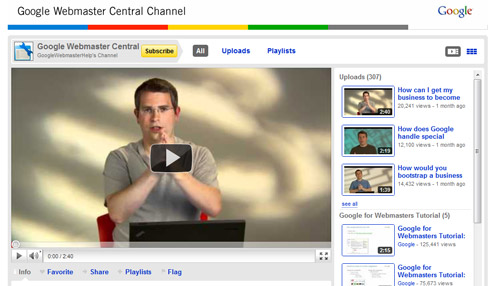
    #1) Matt Cutts is Better Than You

    If you are lazy like me you prefer to just listen to Matt Cutts talk.
    http://www.youtube.com/user/GoogleWebmasterHelp

    If you don’t know who Matt Cutts is and you are in Search Marketing, ctrl+alt+delete your resume. Best known as being the smilin’ enforcer of Google Webmaster Guidelines, Cutts provides guidance to search marketers through his Youtube videos and blog posts.

    Why You Should Care: Matt Cutts is Google’s Prometheus.  He presents SEO guidance in several different formats (videos, blog posts, guest speaking, etc). Having so many different formats make the information he provides easier to digest. If you are like me, hitting the play button is a lot easier to do than reading three paragraphs of insights.

    What Should You Stalk: While you can always follow his blog, I find his information most useful from the Youtube Channel – Google Webmaster Central Channel

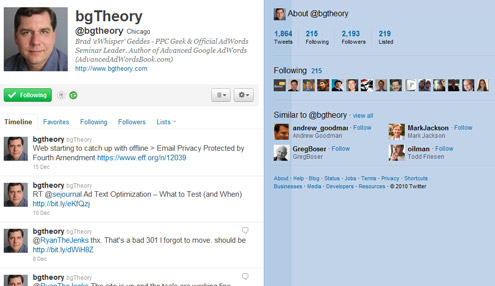
    #2) The eWhisper

    @bgtheory on Twitter
    @bgtheory on Twitter

    bgTheory’s Brad Geddes is a world-class PPC Geek and Adwords affacionato. Besides being the Official Adwords seminar leader, he is also the author of Advanced Google Adwords.

    Why You Should Care: If you want to know what you should be doing with your Adwords account, Geddes is the man to follow. He is a well of information and ideas about how you be better use your Adwords campaign for generating and sustaining ROI.

    What Should You Stalk: His Twitter account – http://twitter.com/#!/bgtheory

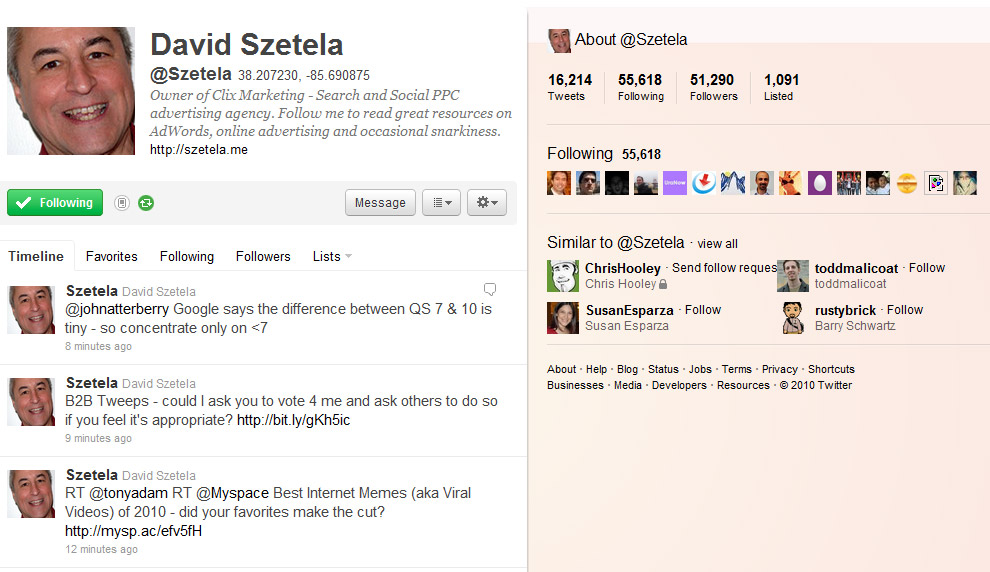
    #3) David and the Paid Goliath

    @Szetela on Twitter
    @Szetela on Twitter

    David Szetela – the occasional snarky owner of Clix Marketing, David Szetela is one of my go-to sources for PPC news and updates.

    Why You Should Care: His knowledge of cross-platform paid search is extensive and an quick follow on Twitter will have your timeline full of information on tweets on paid search strategies and general SEO information.

    What Should You Stalk: Like with Brad, David is most active on Twitter – http://twitter.com/#!/szetela

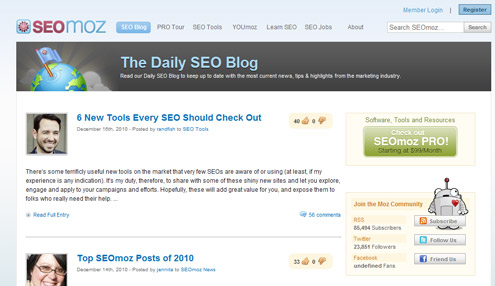
    #4) Moz-el tov

    http://www.seomoz.org/blog
    http://www.seomoz.org/blog

    SEOmoz  has some of the most informative blog post on SEO benefits, keyword mining, and PPC tips.

    Why You Should Care: I’ve been faithfully reading SEOmoz’s blog for up-to-date information on SEO, PPC, and SMM from some of the best and brightest. If you are not following this blog, you are missing out.

    What You Should Stalk: I highly suggest daily readings of the blog – http://www.seomoz.org/blog

    #5) Mike Maps It All Out

    [/caption]

    A student of life, political economy & local search, Mike Blumenthal is a Google Maps and local search guru. He frequently authors articles at Search Engine Land and his blog Understanding Google Maps and Local Search.

    Why You Should Care: Local search, local search, and local search. Oh and maps.

    What You Should Stalk: : Mike’s blog is a warehouse of data points and Google Maps techniques

  • DUDE, Where’s my Map?!?

    I had a team member send out a red flag email about a client’s Maps listing 2 hours ago.  We had successfully squashed a listing created by a competitor who had been spamming with our guy’s business name, but today, it suddenly appeared again, and our guy’s real listing completely disappeared!

    I know Google lost an entire city in Florida, which has now been found, but as we dig into it today, this looks like the entire East coast data is in an upheaval.

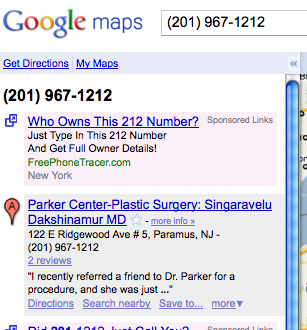
    My concerned team member, Paula Keller, expresses frustration, “I can’t even find the listing. I saw it when I first searched for the phone number, clicked more info, and it said “We currently do not support the location” I logged in and clicked to view the listing and it says “We currently do not support the location” for both the practice’s listing and Dr. Parker’s listing.”

    When we search by phone number, we get the totally wrong listing we thought we had squashed:

    We thought we had squashed this listing months ago starting in April, and we further confirmed it was gone in May and June.  Haunted by listings of the past!

    We logged into the account and clicked on “See your listing on Google Maps” ….

    see your listing on google maps

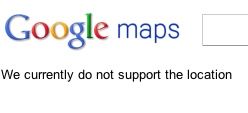
    And this is what we got ….

    we do not support the location

    Google must be up to something or rolling out some changes, and I have another team member check in various Place Page accounts to see if we notice a pattern in geography. Melanie Aleman reports in:

    “I logged into the Google Places account for the following clients to check up what’s up, this is what i found:

    • Dr. A A – no problem
    • C C Doctors – “We currently do not support the location” when I tried viewing either listing on Google Maps
    • Dr. B B – “We currently do not support the location” when I tried viewing either listing on Google Maps
    • Dr M M – “We currently do not support the location” when I tried viewing either listing on Google Maps
    • R R – no problems”

    One of Melanie’s screen shots:

    Google listing not supported

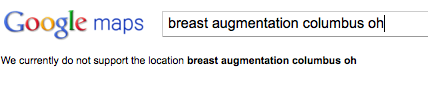
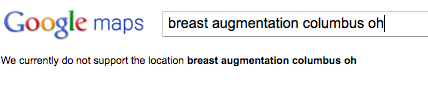
    So far it appears this is on the Eastern time zone.  I see a surgeon’s Place Page listed in maps, but when I click on a Place Page link in Maps (not through the account), I get this:

    breast augmentation columbus ohio

    Oop!  Maybe not just on the East coast!  A doctor in the southern US has a claimed listing, and right now it’s not even showing as owner verified!  And I KNOW it’s verified ….

    I had yet another team member, Elizabeth Selasky, check out some client on the West coast to see how far this chaos is reaching.  She reported back that the West coast appears to be unscathed.

    We also had some other weirdness happen over the last week.  We had 3 clients report back in that Google had called their business, and a real live person at Google wanted to verify their business address because a user had reported a problem with his address. The first occurrence of a real live Google representative calling a business was totally unexpected.  The 2nd and 3rd was just more confirmation that this must be legit Google.  Is Google paying attention to when users are reporting a problem with listing data?

    Something is definitely going on with the Google Place Page product today.  Maybe it’s a database clean up on a massive scale.  We’re not sure, but we’re watching it closely.

  • The Many Faces of Google Maps

    Google Maps… the Local Business Center… Google Places… so many faces, so many problems. While it brings me great happiness once an issue is resolved, when trying to work them out, it seems like it’s never going to end. In the past, I’ve used a puzzle as an analogy for local search. I never really did like puzzles, and if Google Maps was a puzzle it would be a 2,000 piece box full of 1 inch pieces, 50 of which have been eaten by your kitten and thrown about the house by your children.

    So, being that I’ve spent countless hours digging in the sofa cushions for lost pieces of the puzzle, so to speak, and still haven’t gotten them all laid out on the table, I can imagine small business owners often have the same issues.

    Here’s a rundown of some of our latest challenges of Google Maps:

    1. Disappearing Citations

    Disappearing citations = drop in rankings. While citations aren’t essential to beating our your competitors in some markets, in others it can make or break you. When a client came to us for help with Maps rankings on particular search phrases, he was ranking for a number of “money phrases,” despite the listing breaking numerous quality guidelines. We rapidly cleaned everything up on our quest to come out in the end with a clean, strong listing. Then, numerous citations were disassociated with the listing – what! We followed the rules and the listing was ultimately penalized.

    2. The Importance of a Clean Listing – your listing as well as your competitors’

    It is true, the success of your listing can be dependant upon the cooperation of your competitors. In particularly competitive markets, we see a lot of keyword stuffing in titles and all throughout the listing. We’ve learned that the more muddled up the market gets, the less Google trusts the information businesses are including in their listings, and in some cases, penalizes the whole market by removing the map results from the SERPs.

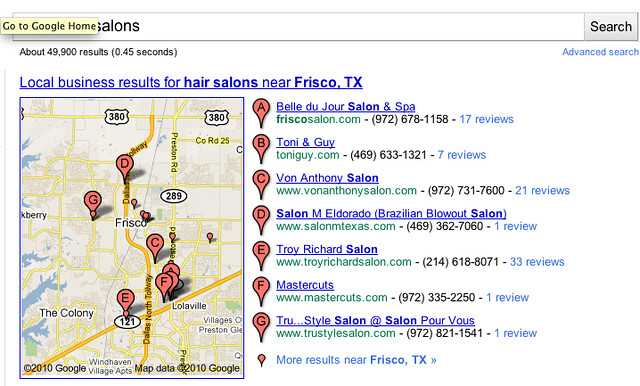
    Let’s use the market of hair salons, Frisco, TX:

    About a month ago, this is the map that was being pulled by the search “Frisco hair salons”

    and now, about a month later:

    As you can see, there’s been quite the mix up of whose listings Google is favoring.  Your best bet is to stick with correct information and avoid anything spammy in order to maintain a strong listing.

    3. Duplicate Listings

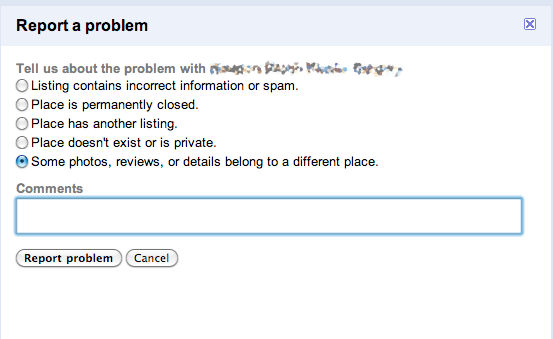
    While the recommended strategies have changed over time, one thing is clear: duplicates are bad!  It’s likely that when you search your business’s phone number, you see more than one listing –  they may or may not have correct information, and in either case, you should address the extra listings in order to reinforce your own. For this issue, Google has handed us a couple of pieces to the puzzle, and let us on to the best way to deal with it. First, only claim your main listing. For all others, you should “report a problem” and tell Google that “This Place has another listing.” While it won’t be instant, this should help clean up your market’s cluster of listings AND help your customers find you and your real information more easily.

    So, whether you are a single location of a business that’s moved a few times, or Matt Dillard Hair Salons, Frisco, TX, Google Places could be your best friend, or it could make you crazy trying to put together all the pieces of the puzzle.

    Thanks to plasticrevolver for the great kitty image!

  • Looks like Google CAN admit they are wrong!

    So today while working with a particularly problematic listing within a particularly jacked up (for lack of a better word) market and cluster of listings, I noticed a new option Google is showing in the “Report a Problem” section.

    Google Listing Crossover: A new way to report it!

    We worked for months to straighten out a client’s listing and were finally feeling a bit of relief when everything seemed to be working… the address was showing up correctly, as was the URL, pictures, and details. Thank goodness, we thought!

    That is, until this morning, when I logged into Google Places to test out the tags that are now available in 29 states. This client has some great videos and we hoped to highlight them to searchers in the 3- and 7-packs that are showing up for various terms in the market. But when I clicked on the listing, alas, it was once again pulling in details from a competitor – just a different one this time. As Places gains popularity, this issue of listing crossover appears to be a growing problem – and clearly, Google recognizes that, and even admits it by giving us the option to report that “some photos, reviews, or details belong to a different place.”

    Thank you, Google, for giving us the option to report this… now, let’s see how long it takes for the reported issues to be fixed!