Tag: Google Analytics

  • How to Use Google’s New Quality Score Columns to Drive Lower Costs Per Conversion

    If you’re a hands-on business owner using Google AdWords, you’ve no doubt come across the term “Quality Score.” You know it’s an important metric for the success of your account, but what does it mean? What factors contribute to this important number? And how does improving the overall quality of your account result in more leads? In this blog post, I’ll take you through a quick introduction to Google’s Quality Score and several strategies for monitoring, analyzing, and optimizing this metric.

    What Is Quality Score?

    According to Google, “Quality Score is intended to give you a general sense of the quality of your ads. The 1-10 Quality Score reported for each keyword in your account is an estimate of the quality of your ads and the landing pages triggered by them.” The main components of a keyword’s Quality Score are the Expected CTR for your account’s keywords and how your performance stacks up against that expectation, Landing Page Experience, and Ad Relevance. As your account runs and your keywords begin to receive impressions and clicks, Google ranks each keyword as Above Average, Average, or Below Average for the following criteria:

    • Ad Relevance – This component quantifies how closely related your keyword is to the ads in your ad group.
    • Landing Page Experience – Google rates your site based on the relevancy of your keywords to your landing page and the ease of navigation. Can the user find what they’re looking for on your landing page?
    • Expected CTR – AdWords knows the historical CTR of your ads. Using this information, the platform determines an Expected CTR for a given keyword and each keyword is then measured by how close actual performance is to that pre-determined expected performance.

    A keyword’s Quality Score used to be based on the keyword’s historical performance on Google until it achieved a significant number of impressions in your account. However, now Google reports a null score until that threshold has been reached. Once the keyword receives a significant number of impressions, its Quality Score will start to reflect how it performs in your account, and historical performance will be a lesser factor.

    Theoretically, your account level Quality Score is the cumulative result of the historical performance of all keywords in an account. It would be a painstaking process to capture this information on an individual keyword basis to determine the average Quality Score across the account. Luckily, there are wonderful geniuses who have developed scripts to do this for us. Google doesn’t confirm this Quality Score’s existence, but it’s generally accepted that there are different levels of Quality Score other than the visible keyword level Quality Score.

    Why Is Quality Score important?

    The components of Quality Score along with your set bid and the expected impact of your ad extensions are factors in the calculation of your Ad Rank. Your Ad Rank determines the position in which your ad will show as well as how much you pay for each click. Improvements in your Quality Score can lead directly to decreased Costs per Click. Without raising your monthly digital advertising budget, reduced CPCs allow you to generate more traffic to your site. The additional, cheaper traffic to your site creates more opportunities for Conversions at a reduced cost.

    Where Can I Find the Quality Score?

    Whether you’re using the new AdWords experience or the old interface, navigation is similar. However, there are a few additional functions currently only available in the old AdWords that we’ll explore in a later section.

    1. Navigate to AdWords and select Keywords in the page menu.
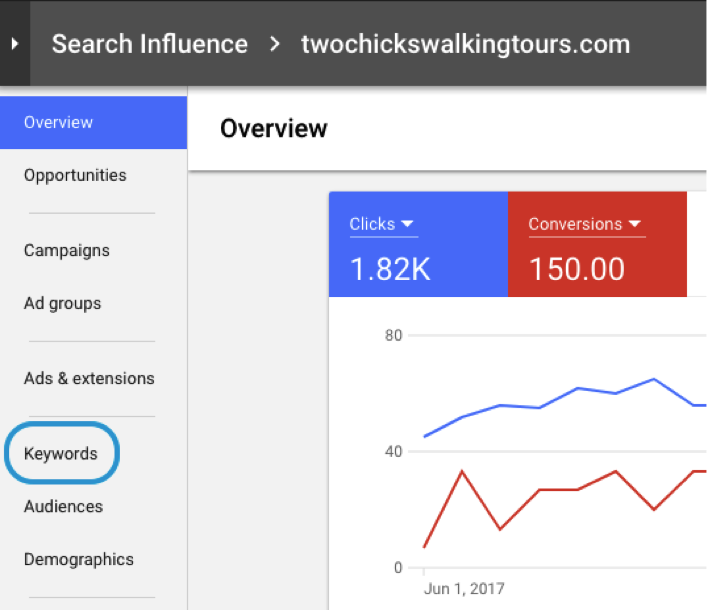
    Screenshot of a keywords tab in Google AdWords - Search Influence

    1. If not already present, you may need to modify your columns to include the Quality Score column.
    2. Now you will be able to compare Quality Score across keywords.
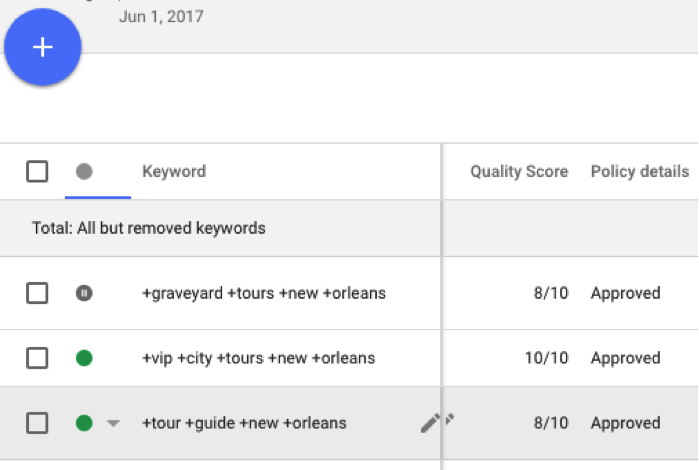
    Screenshot of a Quality Score comparison in AdWords - Search Influence

    • You can sort by Quality Score or use the filter function to view only keywords with a specific Quality Score threshold.

    What Is a “Good” Quality Score?

    If a keyword’s Quality Score is 1-3, this is cause for concern. You’ll want to identify specific criteria needing improvement. If the score is 4-5, you can definitely make a couple of improvements, but you’ll want to focus on improving the areas that will have the biggest impact on your overall Quality Score. If the keyword’s Quality Score is 6 and above, the keyword is performing quite well, and you might only make minor adjustments.

    How Can I Diagnose My Quality Score?

    You know that a Quality Score of 2 isn’t great, but how do you figure out where to start with improvements? In the old AdWords, you used to have to hover over the speech bubble next to the keyword to see Google’s rating of each of the three factors.
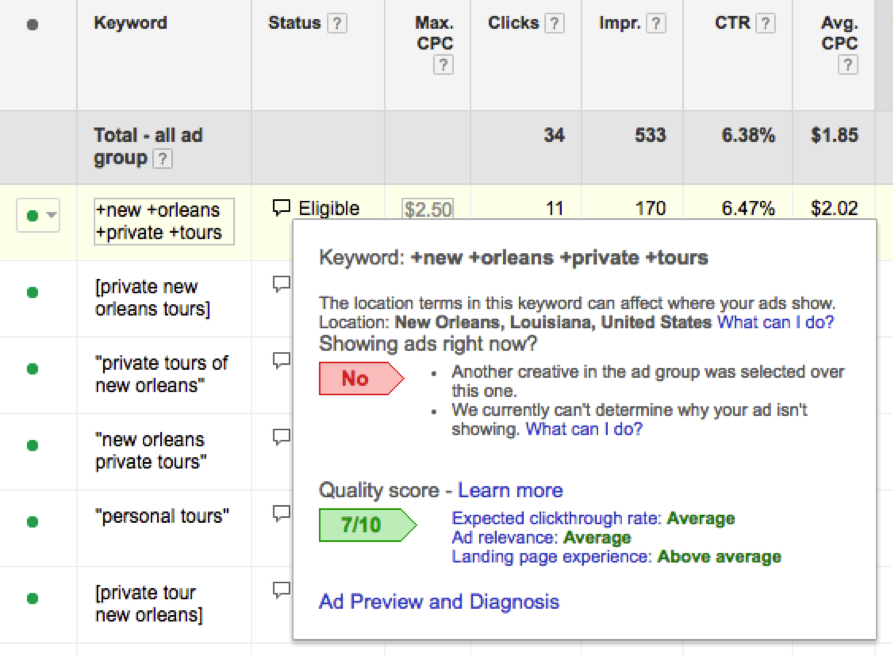
    Screenshot of keyword analysis in AdWords - Search Influence

    This is extremely time-consuming. In the past, we’ve used a script to make this process a little more automated, but in early May of 2017, Google released brand new Quality Score columns to make the large-scale analysis of this data even easier. In the old AdWords, modify your columns and review the parameters available under the Quality Score heading. Unfortunately, these columns are not yet available in the new AdWords experience as of this posting.
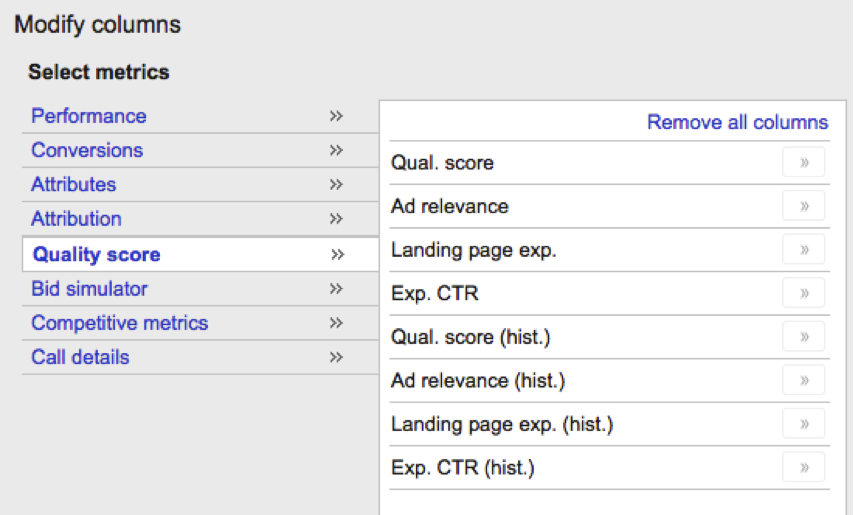
    Screenshot of Quality Score columns - Search Influence

    Google now allows you to add columns to see your criteria rankings—Above Average, Average, or Below Average—within the platform. If a keyword has Above Average ratings for 2 out of 3 factors, you can easily identify which factor is having the greatest impact on the Quality Score for that keyword. There are also historical measurements of these metrics that can help you determine whether changes to your account positively or negatively affect the various components of Quality Score. For instance, reviewing historical Quality Score performance alongside current performance can help you determine if the new ads you implemented improved Ad Relevance or if the edits to your Landing Page contributed to improving the overall experience.

    How Can I Improve My Quality Score?

    So now that you’ve identified areas for improvement, what steps can you take to fix these issues? If your keyword has a Below Average Expected CTR, this is the easiest element of Quality Score to improve. Here are some strategies for improving this criterion:

    • Review the Search Term Report for this keyword for opportunities to implement more relevant keywords that users are searching and clicking in place of the keyword with a low expected CTR.
    • This could also mean that your ads are not compelling enough for people to click through. A quick way to give your account a natural CTR boost is including Dynamic Keyword Insertion (DKI) in your ads.

    If Ad Relevance is an issue in your account:

    • An ad is deemed relevant to a keyword when the keyword appears in the ad. Review your ads alongside your keyword to determine if the keyword in question is highly relevant to the ads for that ad group.
    • As I’ve already mentioned, account organization is key. Would the keyword be more relevant to another existing ad group? Is the keyword important enough to warrant the creation of a separate ad group?
    • You can also duplicate an existing ad and edit the copy to include a keyword with a low Quality Score to try and give that keyword a boost.
    • Ensure that your ads are answers to the queries the ad group most often receives. Reviewing your Search Term reports can help you figure out the information that users are most curious about.
    • Google also takes into account keyword density on the site, so improving your Landing Page could also be a factor to improving ad relevance.

    If your Landing Page Experience is subpar:

    • Don’t ignore the impact of your site’s mobile landing page experience!
    • Make sure that your keywords and ads are relevant to the content on the landing page.
    • Implement image optimizations like meta text, title tags, and alt text to include relevant keywords.
    • Brainstorm better CTAs for your buttons.
    • Improve your content.
    • Create more visible conversion points, like a highlighted click to call button on mobile, a click to call button at the top of the body content, and a corresponding form below.
    • Work to improve the navigation experience.
    • Forms or downloads on the landing page should clearly indicate what will happen if clicked by the user.

    You can’t have a “set it and forget it” mindset when it comes to Quality Score, especially considering the potential impact on your overall Cost per Conversion. I recommend performing a quarterly Quality Score analysis on your account and using insights from that analysis to drive the next quarter’s account optimizations, pacing out your changes, and using the historical Quality Score columns to judge the impact of your optimizations. If you have any other Quality Score tips, tricks or insights, please leave us a comment. If you’re new to AdWords and need some help setting up your account for success, please reach out to our team. We would love to help you optimize your potential!

  • Google Attribution Allows Clear, Seamless Campaign Analysis for Marketers

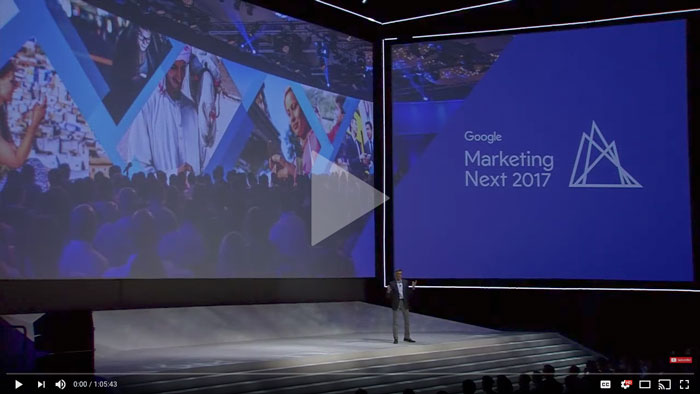
    How do you know which of your interactions with a customer mattered the most? How do you measure an organic search that someone performed for a product on one device compared to an ad clicked right before the point of purchase on another? Well, Google set out to solve some of these and other problems that marketers face daily with their newest rollout from their Marketing Next event—Google Attribution. Now, marketers can finally begin to answer the age-old question that is typically at the forefront of their minds—is my marketing working?

    How Google Attribution Streamlines Data

    Google Attribution uses machine learning and data to help marketers measure the impact of each of their marketing touch points, across multiple channels, and across multiple devices. It uses data that’s already there from Adwords and Google Analytics; it just takes that data and shows you how each customer moved through their buyer’s journey and attributes those conversions respectively. It provides a single view of the path to purchase to help marketers learn what is actually working compared to what seems to be working.

    “The aim of Google Attribution is to simplify the complex problem of multichannel, multi-device attribution by leveraging data advertisers already have in Google Analytics, AdWords, or DoubleClick Search,” said Kishore Kanakamedela, director of product management at Google.

    To give an example of how a richer lens of an entire campaign was able to better benefit a business, Virgin Holidays utilized store sales measurement to look at store sales after users clicked on a search ad:

    “Virgin Holidays discovered that when it factors in store sales, its search campaigns generate double the profit compared to looking at online KPIs alone. A customer purchasing in-store after clicking on a search ad is also three times more profitable than an online conversion.”

    Google already rolled out a store visits measurement in 2014. They’ll be rolling out store sales measurements as yet another touch point that marketers can analyze through Google Attribution.

    And possibly the best part? Attribution is free for anyone to use. It’s in its beta version right now and will be more readily available this fall.

    A Shift Away From Last Click

    Until now, many marketers were left to use last-click attribution to measure the value of their efforts. With last click, the reward for the conversion often went to the last touch point that the user made, often with a sale after a click on an ad. This could lead to false impressions about the effectiveness of an ad campaign versus display ads, organic search, social, email affiliates, and many other interactions that a customer made with a business along the buyer’s journey. Maybe organic search is actually more important display ads or vice versa.

    With Attribution, users can see how effective each step of a campaign is instead of just pointing to the last click of an ad before purchase. There are so many micro-moments that happen on the path to purchase. Now, marketers can have a more accurate view of business, and in turn, can then update bids or move budgets between channels based on such results.

    Image Of Woman Typing On A Computer With Media App Logos Flying Around - Search Influence

    This move to a more holistic view of a campaign makes sense. Video ads, banner ads, carousel ads, emails, social campaigns, and all other types of digital materials work together to drive solid leads to become conversions, so why would it make sense for only the final ad to get all of the credit and influence a business’ campaign and budgeting decisions?

    There is already a slew of companies that have seen the benefit of implementing the data-driven results of Attribution. Check out the success stories that Google has touted so far.

    Eliminating Waste and Annoyance With Unique Reach

    Most people use multiple devices to access their multimedia channels, whether that be a phone, a tablet, a smart TV, or a computer. For example, let’s say you’re shopping for a new laptop. You may first see a search ad when searching on your phone and then find a display ad while on your tablet. Then, you’ll come across a shopping ad by the time you decide to purchase the laptop on your current computer that needs replacing. According to Bill Kee, Google’s Group Product Manager for Attribution presenting at Marketing Next, “30% of people use 5 or more devices today. If you reach each of those devices three times, you’ll reach that person 15 times.” It’s safe to say that’s a bit of an overkill.

    With Unique Reach reporting in AdWords and DoubleClick, marketers will be able to measure how many people were shown display and video ads. It will show unique users and their average impressions. This helps marketers better understand how many people they reached in their target audience and how many times they reached them. This will allow businesses to find any wasted budget in over-saturated placements and, more importantly, better please their potential customers by not wasting their time with endless ads.

    People are expecting a simple, frictionless user experience on their path to purchase. Unique Reach is, well, unique in that it puts the customer right at the heart of the journey. Unique Reach is available in AdWords now and will be available in DoubleClick in the coming months.

    Image Of Person Sitting Out By The Water At Sunset - Search Influence

    The Customer Is the New Channel

    Instead of the mindset of measuring your reports within online or offline channels, Google has highlighted the importance of recognizing the customer or user as the new channel. The line between being online and offline has disappeared.

    Consumer expectations are higher than ever. So, the best way to meet those expectations is to try our best to understand consumers’ intent. Google also shared their Surveys 360 product connected to AdWords and Google Optimize. It helps marketers deliver more relevant ads with targeted surveys that seek to understand a customer’s intent along with their buyer’s journey.

    Marketers are already working hard to develop a strategy that brings conversions for their potential and current clients; Google Attribution helps them work smarter with data. By using their machine learning to put context into the consumer journeys, this new tool should help marketers create a simple, more streamlined campaign that their users will love and respond to. To quote Sridhar Ramaswamy, Senior Vice President of Ads and Commerce at Google and opening speaker at the Marketing Next event: “To really assist people, we need to become smart in how we use data to assist them.”

    Interested in learning how we can better market your business? Reach out to us at any time.


    Image Sources:

    Google Marketing Next

    Woman Checking Her Phone At Sunset

  • Gotta Go Fast! The Impact of Page Speed on Your Rankings

    “We have so much time and so little to do. Strike that, reverse it.”

    Roald Dahl, Charlie and the Chocolate Factory

    That may be a bit dramatic, but time is extremely important. In the digital age where a lot of people barely have the time to stop and say hello unless it was explicitly planned out in their schedule, a slow site can easily get lost in the abyss that is known as the internet. Though the forever relevant Bill Gates quote “content is king” should echo through anyone with a website, there are other factors that can make or break you as well. The best content in the world means nothing if no one sees it. If a tree falls in the woods and no one is around to hear, it does not make a sound; it makes vibrations that will never be converted into sound by ears. If a website has amazing content but a Page Speed as slow as molasses, does anyone ever read it? Probably not.

    How Optimized and Fast Page Speed can Bring in More Customers

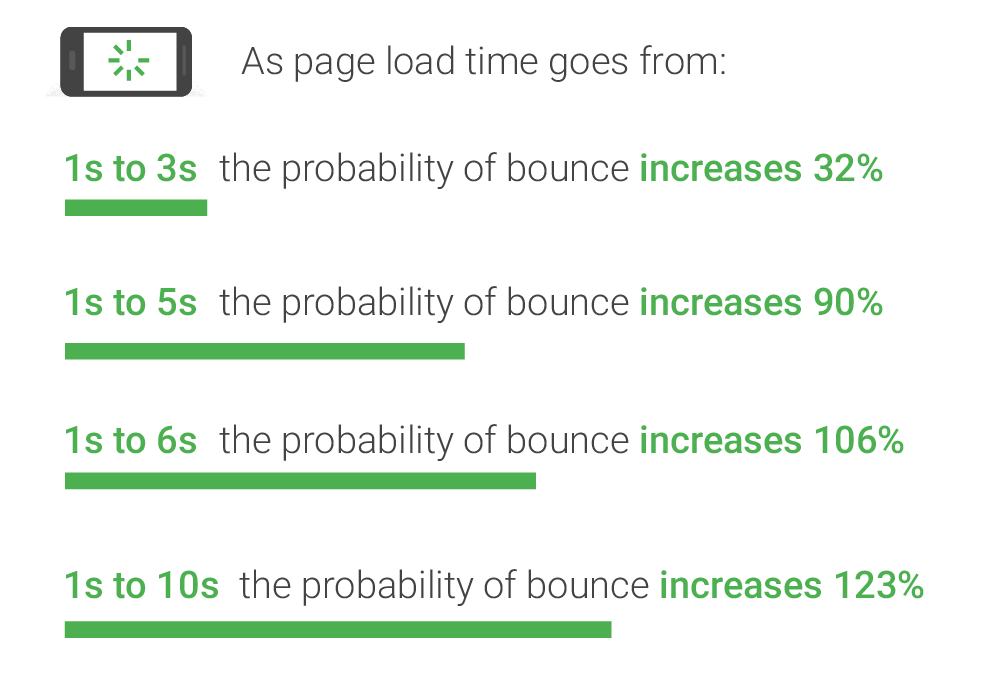
    As you may (or may not) have guessed, page speed is the amount of time it takes for your website to load. On the surface, slow page speed will turn visitors and potential conversions away from your site simply based on the fact that they can’t “use” it, per se. But surely someone would wait 7 seconds to view your homepage or interesting product, right? No. Straight from the source, Daniel An from Google provides this handy chart on the correlation of page speed and bounce rates:

    Image of bounce ratio percentages relative to page load time - Search Influence

    As you can see, if your page takes longer than one second to load, you may see a bounce, which is when a user leaves your site after viewing only one page. The bounce risk increases dramatically the longer it takes for your site to load. This stat doesn’t just apply to your home page either—these statistics will affect every single page on your website. Imagine running an online shop and having someone abandon an order because it takes their cart too long to load. Having engaging content is only half the battle; it has to be seen and digested for it to maximize its potential.

    Page Speed from the SEO Point of View

    From an SEO standpoint, Page Speed has a two-pronged effect on the ranking of your website. Back in 2010 (which is literally forever in internet time), Google spilled the beans on speed having a direct effect on the rankings of websites and encouraged everyone to analyze their page speed to ensure their pages were loading in a timely fashion. Looking at complex Content Management Systems that automatically add mountains of bloat to every single page you publish, it doesn’t seem like many people heeded the warning of Google.

    Image of a snail using a rocket to go fast - Search Influence

    From an indirect standpoint, Page Speed can have an impact on your website’s speed in relation to the crawl speed. Google’s web crawler has an allotted amount of time that it likes to spend crawling a website. Faster loading pages mean that Google’s web crawler can crawl the page faster and move on to the next one, which can lead to more of your pages being indexed. Mix that up with some spicy content and you’ve got a great stew going that can lead to increased Search Engine Rankings!

    Tips for What Website Owners Can Do to Improve

    I personally like to think of Google as the tough love parents that will always steer you in the correct direction, give you the tools to succeed, but punish you if you stray from the light. With that said, Google gives the entire internet a handy tool to test the speed of their website. My favorite online game, League of Legends, will be the topic of example for this go round. After running their URL through Google’s PageSpeed Insights tool, a score is given for both the desktop (61/100, Poor) and mobile (40/100, Poor) versions (it defaults to mobile speed, perhaps because mobile users are using the internet more than desktop users now) along with some details on how to fix the issues and exactly which files are causing the issues. An alternative to Google’s own tool (because we want to show our parents we can succeed our own way) is the Pingdom Website Speed Test. From my experience using both of these tools to compose Site Audits for our clients, Pingdom does give some more in depth information. For instance, the main reason for the League of Legends website taking so long to load is a video (listed below) that has to load twice before the website is considered to be loaded.

    Screenshot of video load time - Search Influence

    This video took over 17 seconds to load. Now for a website such as League of Legends that has the clout of millions of gamers fiending to see the details of the next character being released or an overview of the latest patch notes, these 17 seconds are no big deal. However, if your website was discovered by someone using the Google search “boutique new orleans,” that may be a different story, especially if they’re on the other end of our historic Magazine Street. They may have thought about venturing to your end of Magazine Street had they seen the flashy new “romphims” that your store was offering. Unfortunately for your shop, Magazine Street is loaded with boutiques, and potential customers may just tire themselves out on the other end instead of planning their Magazine Street romp around your boutique.

    Don’t fret, a lot of these fixes aren’t all that difficult to fix, so here are a few common fixes.

    1. Leverage Browser Caching: This fix allows some files on your site to be saved on a user’s local computer so that the next time they visit your site, they won’t have to be downloaded again. In addition to increasing Page Speed, it also lessens the stress on your server.
    2. Optimize Images: This fix involves formatting and compressing your images, which will drastically reduce their size.
    3. Minify CSS: Minifying your CSS is removing spaces, removing line breaks, and combining elements that have the exact styling to reduce the size of your CSS files (yes, even spaces increase the size of your files). You could do it yourself or use a tool such as CSS Minifier to do it for you, but make sure you test it before you completely remove your old CSS.
    4. Minify JavaScript: If you read the previous fix, you can guess what this section is about, just replace styling with functions and that’s the gist of it. JSCompress can take care of this for you.
    5. Enable compression: Using gzip to compress your resources allows them to transfer over the server quicker, which leads to faster page load speeds.

    These fixes are a great way to start pushing your Page Speed close to preferred industry benchmarks and are also among the easiest to implement. There are many more metrics that can be improved as well, but don’t fear—head to Google PageSpeed Insights and plug in your own URL to see how you fare and what you can do to improve. League of Legends has a team of web experts to make sure that even though their videos take close to 17 seconds to load, the rest of their site renders much faster. Here at Search Influence, we also have a team of web experts that are able to analyze and implement fixes to your website to improve its performance and rankings.

    The Importance of Mobile Page Speed Benchmarks

    As revealed in an article earlier in this blog, in November of 2016, the number of mobile and tablet internet users surpassed desktop internet users. This adds increased importance on your website’s mobile speed. With a society that is ever on the go, having a high level of accessibility and a mobile friendly website is considered a necessity for every business. A slow mobile site has a large chance of sending business elsewhere.

    An important addition to keep in mind is the impending rollout of Google’s “mobile-first index,” which should be rolled out soon according to Google and industry experts. This index will reportedly factor mobile content at a higher priority than desktop content. Though all details have not been made public as of yet since Google likes to release this info intermittently after the fact, mobile website speed will probably be one of the factors that are taken into account.

    With cell phones and tablets becoming more powerful and useful in everyday life, it is imperative that your website is optimized to be viewed on mobile if you want any hope of making a splash in the sea that we call the internet. No matter how powerful the receiving device is, there will always be the limiting factor of how quickly files can be transferred across the server. The simplest solution is to ensure that your website is optimized to make it as easy as possible to ford the data transfer river.

    If that sounds like a scary thought, feel free to reach out to the experts at Search Influence. We will gladly take the stress out of it and add you to the list of our many satisfied customers that continue to use our services year after year.

    Images:

    Bounce Rate Percentages

    Snail

    Screenshot

  • Top 5 Ways to Bounce Back from a High Bounce Rate

    Growing up in New Orleans, hearing the word “bounce” means something completely different to most people. I hear the word “bounce” and immediately think of the music! After starting at Search Influence at the end of 2014, I learned that “bounce” also had a meaning in the digital marketing world.

    Artist Big Freedia at a parade - Search Influence

    Bounce rate is a value given to hits on a website from users that don’t stay on the site after viewing a page. This value indicates to Google that you might have uninteresting content or spammy content that users aren’t interested in.

    Though I’d like to take this blog in my usual direction (Beyoncé-themed), I will be paying homage to bounce music, the only bounce reference in my life until I was 29 years old. With the help of some local talent, here are the top five ways to help decrease bounce rate on your site.

    1: Interesting Content Updates

    Image of Rapper Juvenile at a basketball court in New Orleans - Search Influence

    Updating your website content to get Google to crawl your site is a great way to decrease your bounce rate. If you find yourself with a high bounce rate, try updating your content with industry news or new services you are providing. The best way to show Google, and your potential customers, that you are an expert in your field is to use fresh, up-to-date, informative content on your site.

    The way your content is displayed is also a part of this. Bulleted lists and paragraphs that are broken up into smaller “chunks” to display your information in a reader-friendly way are helpful in getting clients engaged and staying on your site.

    2: Navigation Updates

    Your navigation should be incredibly user-friendly so that users will be able to learn about you and your business. There should be a clear path a client can follow with your top level navigation, but not too packed where the user is overwhelmed. If there are too many options, then your user experience might need some work.

    This is also true for sidebars. If you have a sidebar on your site that is embedded in the template (i.e. it shows up on every page) make sure the links here are relevant for all the pages on your site. This  is usually a call to action button (learn more, get a quote, etc.) Having an attractive sidebar can help lead people further into your site and decrease bounce rate.

    3: Become a Google Analytics Wizard

    Image of Birdman rubbing his hands together - Search Influence

    Bounce rate is something that is documented in Google Analytics. Understanding where these numbers come from, what pages they are occurring on, what referral sites they are from, and almost 100 other factors are keys to decreasing your bounce rate. This step could be the trickiest, but that’s OK!

    Hiring a company like Search Influence is the easiest way to accomplish this step. Google has special training and certifications for their products so that people like me (and my fellow co-workers) can be masters at reading all of this amazing data so that you don’t have to.

    4: Enhance the User Experience

    There are a few things that you can add or take away from your site to enhance the user experience. If you currently have multiple pop-ups or widgets on your site to help push for sales, this may be an indicator of why your bounce rate is high. Users are less likely to click on these if they aren’t engaged in your site. Make sure that these aren’t bombarding the client during their natural reading of your content.

    Inversely, if you have a high bounce rate but no particular ad experience on your site, add some! Just be thoughtful about it. Adding catchy call-to-actions to get people to click further through your site is helpful in decreasing bounce rate.

    5: Update Metadata

    Image of Rapper Lil Wayne adjusting his glasses - Search Influence

    Making your site reader friendly for SERPs will not only decrease your bounce rate but also increase your organic ranking for Google. It’s a two-fer! If your landing pages have descriptive, catchy titles along with meta descriptions to entice the reader, you will be guiding Google and its users to the page they are looking for. Bounce rate commonly occurs when someone has landed on a page that they aren’t looking for. They quickly click off of the page because it’s not the information they need. If you have strong metadata, Google will know exactly which user you should be targeting and bring them to you.

    Bounce rate can affect your site’s performance as well as your business goals. Knowing what could be the culprit for your high bounce rate or preemptively updating your site to keep a low bounce rate is a marketing must for your strategy. It’s something that is manageable with the help of an expert digital marketing guru who also knows a thing or two about “bounce.”

    Images:

    Big Freedia

    Juvenile

    Mannie Fresh

    Birdman

    Lil Wayne

  • Grow Your Business With These 7 Digital Marketing Tactics

    Members of the Search Influence team gave their insight on tried and true digital marketing strategies. These strategies apply to every industry, from plastic surgeons to attorneys, and many can be implemented across different channels of marketing. Using a mix of or all of the 7 tactics below is a sure-fire way to optimize your business’ online potential.

    1. Mobile

    Before updating the aesthetics or adding content to your site, it’s of the utmost importance that you make sure your site is responsive and functions properly on both desktop and mobile. More than half of users say they wouldn’t recommend a business if they encountered a poorly designed mobile site.

    “To me, the biggest trend (and this is as much a wish as it is a prediction) is that small businesses begin to take mobile optimization more seriously. I’m still surprised by the number of businesses I see in my day-to-day life that haven’t reacted to the continuous uptick in mobile search by having their site optimized for mobile users.

    My main focus, in terms of a trend, is the expansion of mobile search as a primary source of information. The trend will be more companies utilizing tools like Google AMP in order to improve the mobile user experience. Currently, far too many don’t take the number of leads they can get from a mobile-optimized site.” – Cory Agular

    Later in this post, I’ll go over AMPs and some more specific mobile moves, but I really want to emphasize that mobile should be incorporated in every aspect of your online marketing campaign. Google has stated that not only are 60% of users unlikely to revisit a mobile site they had difficulty visiting, but also 40% will then go on to visit a competitor’s site. You’re not supposed to judge a book by its cover, but if you can’t open the book, you’re not even going to try reading it.

    Image Of A Cell Phone Searching - Search Influence

    2. Schema Markup

    Schema markup, coding that can be added to a page on your site, makes information more easily readable to search engines like Google. This code labels pieces of important information on the page. Search engines not only understand the information better but they can also provide richer search results to users.

    “As far as I’ve noticed, Schema’s been underutilized… however I’m seeing a lot more talk acknowledging it for its on-site SEO value and correlation with rich snippets and Google’s knowledge graph. And as we’ve seen, Google’s been working to improve its algorithm and knowledge graph to really ‘understand’ content to better predict user trends.” – Kiersten Kampschroeder

    “It’s been increasingly popular to integrate schema into your content. I think that providing meta information using schema markup not only helps SEO, but it also aids the programmer and contributes to making better semantic websites. 2017 will be the year where instead of thinking how we can ADD schema to existing sites, we instead shift toward creating websites with schema markup baked into their design and writing content with schema markup in mind. I’d compare thiscoming year with what happened with responsive design 3–4 years ago. That was the shift where everything became mobile first. 2017 will be the year schema is integrated into the general development workflow.” – Member of Web Development Team

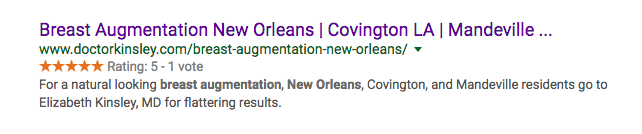
    A search for “breast augmentation new orleans” shows how review schema implemented on Dr. Kinsley’s site appears in results:

    Image Of Dr. Kinsley's Search Results - Search Influence

    3. GIFs

    While 2016 saw a rise in GIFs, an acronym for Graphics Interchange Format, they were first debuted by Steve Wilhite of Compuserve in 1987. They are the epitome of #thirtyflirtyandthriving. These dynamic, digestible pieces of content are easy to create and share and provide a more engaging user experience than a single static image.

    “GIFs are important to any brand aesthetic, be it personal or public, because they offer a truncated version of the desktop’s fluid experience (i.e. video).

    GIFs are a better option now since they’re more pervasive and different social media platforms accept them or give you a way to use them easily. Instagram, Twitter, Facebook, and Facebook Messenger are all compatible with GIFs now.

    Twitter actually integrated, similarly to Facebook, a GIF search within the post tool. [It has] allowed for a closer relationship between Facebook and Twitter, as well. You’ve always been able to link the two accounts, … [but] now, it looks like Twitter, when auto-posted to Facebook, is fully integrated into Facebook’s platform and presents the post as it would be presented on Twitter.” – Member of Graphics Team

    There are so many reasons you should incorporate GIFs into your marketing strategy this year. As mentioned, the fluidity of GIFs can make the creation of cross-platform content so much easier. They’re easy to create and even easier to share. Most of all, it’s a fun and unique way to reach your consumers!

    So, why not shake things up a bit?

    4. Social and Mobile Paid Advertising

    In 2016, we saw a rise in mobile advertising, but this year, with more than half of searches on mobile devices, it will be an essential component of an effective and well-rounded search engine marketing campaign. Expanded ads are now easily translatable between desktop and mobile, but it’s almost important to mobile users’ needs when determining the content, location, and timing of your paid ads.

    Social advertising like Facebook Paid Ads are showing increased popularity and effectiveness. The level of granularity continues to rise with Facebook audience targeting, and we have seen an increase in conversions even as CPCs remain low.

    “With the introduction of ‘new’ campaign objectives, such as lead generation and local awareness, Facebook really does seem to be a place for lots of growth. With Facebook trying to essentially phase out Fan Building campaigns, local awareness campaigns present an interesting opportunity for smaller budget clients who want to focus on a local market.” – London Fougerousse

    While Facebook ads are more cost-effective than traditional paid ads, that’s not a reason to rely on them solely. The decision to use Facebook vs. Google Adwords or a mixture of the two is truly dependent on a variety of factors, such as your location, industry, and goals. I recommend hopping on the mobile train sooner rather than later. Forecasters are predicting that by 2019, 72% of digital ad spend will be on mobile advertising!

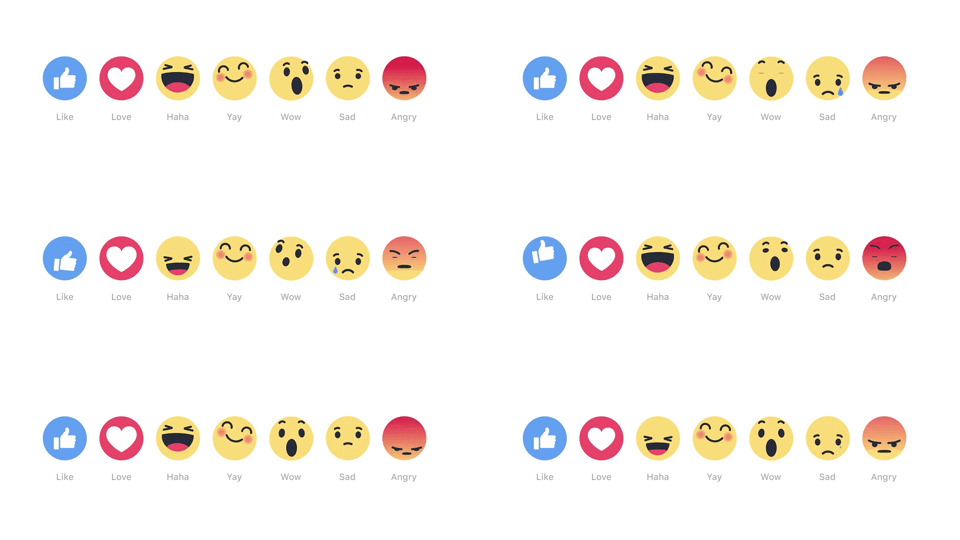
    Image Of Smiley Face Emojis - Search Influence

    5. Google’s Accelerated Mobile Pages

    As I mentioned at the beginning of this post, mobile should be a consideration for all of your online marketing efforts. Google’s Accelerated Mobile Pages (AMPs) are a way to take that focus even further. AMPs are not a ranking factor in Google (for now) but they can positively impact impressions, clicks, and user experience.

    “Since the rollout of AMPs in mobile SERPs this past spring, pages have typically only been found at the top of the results page in a carousel—which is still prime real estate—however, Google recently announced that AMPs will soon also begin showing in the organic results and supporting more content types. We’ve all heard the mobile-friendliness search stats, and adopting AMPs is another way to bring content to your consumers instantly and on the go.

    “Historically, AMPs have been utilized mainly by news publishers, but with the expansion to the organic results, I can see a future for almost every type of industry. Shopify, eBay, and Fandango recently announced their integration of AMPs, so this is a good trend for e-commerce clients especially to be conscious of. And Google also hinted that they will begin supporting more content types like live videos, galleries, etc., which can also open more doors for clients to take advantage of.” – Member of Account Management Team

    Image Of Google Search Of Presidential Debate - Search Influence

    The increased speed of Accelerated Mobile Pages leads to a better user engagement, and those (potential) customers/clients are more likely to return to your site if it was able to quickly provide them the information they were looking for. A recent study shows that with AMPs, The Washington Post saw a 23% increase in mobile search users who return in 7 days. If you’re a business receiving the majority of your site traffic from mobile devices, AMPs could be a strategic way to boost your online presence above and beyond your competitors.

    6. Video

    Video is not just for YouTube. It should be incorporated into as many of your online marketing efforts as possible: product/procedure pages on your site, email marketing, display ads, social platforms, and everything in between!

    “For online marketing rich content could include native video content and paid video ads on both YouTube and Facebook Video Display ads. Also, I think brands will begin to utilize Facebook Live more for events and branded content to engage their fans.

    “I believe these videos will be prominent cross-device! Today, people are constantly moving between devices throughout the day and advertisers need to be innovative and streamline their message to engage users across all devices.

    “For Facebook Live, I would recommend this for brands and businesses that have a strong Facebook following. Facebook Live is a tool to engage your audience, not necessarily build an audience. These videos are best for events, conferences, speaking engagements, big company announcements, etc. There are so many options to deliver creative, curated content!” – Sophie Kirk

    Rich video content is content that keeps on giving. One video can apply organic, paid, and social campaigns across devices, and can be broken down and repurposed to create a number of assets. Videos are not only attention-grabbing, but are also a great way to establish your brand’s message and have lasting effects in terms of brand recall.

    7. Links

    Links might not be the most exciting item on this list, but they’re certainly one of the most important. Link building is an essential aspect of a well-rounded SEO strategy! When the search engines crawl pages on your site, links are used to identify how it relates to other internal pages and other sites. Links connecting one site to another can indicate that a particular page/site is the authority on a given topic. But, as you should know, not all links are created equal!

    Google first launched its Penguin Update in spring of 2012 and rolled out its final update, Penguin 4.0, this past fall. Penguin is Google’s effort to catch sites that are using “black-hat SEO” techniques like spammy link acquisition to affect search rankings.

    “In 2017, ‘link’ will no longer be a dirty 4-letter word. For far too long, bad link building has been lumped in with quality link earning. Everyone got freaked out by Penguin and the industries either shied away from “linkbuilding,” or, if they were doing it, were hush-hush about it.

    “Google’s initial differentiator was to focus on links as votes, which is at the core of PageRank. Google has, in the past, described their foundational algorithm by stating: PageRank works by counting the number and quality of links to a page to determine a rough estimate of how important the website is. The underlying assumption is that more important websites are likely to receive more links from other websites.” – Paula French

    Google truly is looking for quality over quantity when it comes to link building, but that’s just part of the SEO puzzle. If your site is suffering from technical issues or lacking rich, natural content, links will not save you. Make sure your online marketing strategy includes both on and off-site efforts.

    Image Depicting Online Marketing Tactics - Search Influence

    These 7 online marketing tactics are an inexpensive way to boost awareness of your practice and bring in new, revenue-generating patients. With a little strategy and effort, you can have a comprehensive SEO campaign that brings your practice’s website up to speed!

    Image Resources:

    Cell Phone Image

    Facebook Emojis Image

    Social Network Image

  • Up Your Social Media Game With This Handy Reference Guide: The When, How, and Where of Social Posting

    Up-Your-Social-Media-Game-With-This-Handy-Reference-Guide - Search Influence
    Another year, another seemingly endless parade of social media posts gone by. If you haven’t jumped on the social marketing bandwagon yet, 2017 is the year to begin because things are continuing to go up and up. Here are some highlights.

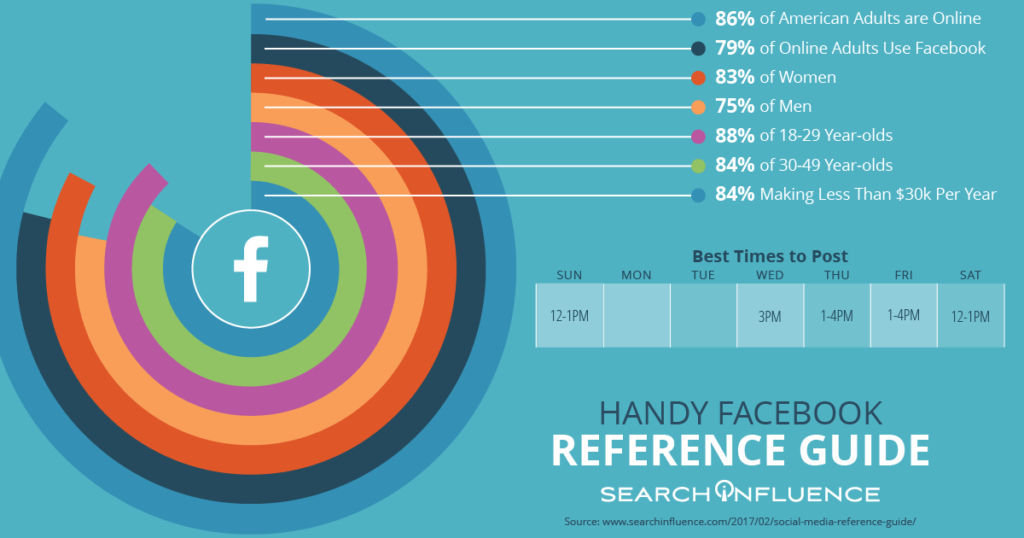
    79% of Online Adults Use Facebook

    The Pew Research Center has done a lot of work tracking the social media usage of American adults. Of all platforms, Facebook has a staggering reach among adults across demographics.

    Handy-Facebook-Reference-Guide - Search Influence

    Of these Facebook users, 76% check in every day and use Facebook as a way to learn about the news, local businesses, trending topics, and more. Facebook is truly on the way to becoming all pervasive, even among adults aged 65 and older.

    57% of Consumers Are Influenced by Online Information

    More than half of internet users surveyed said that they are influenced to think more positively of a business after reading positive reviews or comments about the business online. This means that creating a space for customers to give reviews and interacting with these reviews has tangible benefits and can convert potential customers that are lurking in the background of your social media.

    Social Media Ad Spending Has Hit $35.98 Billion – and Keeps Climbing

    Businesses are learning the advantages of using social media to market to their customers and using that knowledge to their advantage. Social media advertising is becoming the new normal, and we have abundant experience creating campaigns that convert. Contact us if you are ready to get started with paid ad campaigns for your institution or business.

    Sources:

    http://www.pewinternet.org/2016/11/11/social-media-update-2016/

    http://webbiquity.com/social-media-marketing/47-superb-social-media-marketing-stats-and-facts/

    http://www.pewinternet.org/2016/11/11/social-media-update-2016/

    http://coschedule.com/blog/best-times-to-post-on-social-media/

    https://www.emarketer.com/Article/Social-Network-Ad-Spending-Hit-2368-Billion-Worldwide-2015/1012357#sthash.eESedQLL.dpuf

    https://www.emarketer.com/Article/Facebook-Twitter-Will-Take-33-Share-of-US-Digital-Display-Market-by-2017/1012274#sthash.0WToy3rM.dpuf

  • Get More Views on Your Company’s #Facebook Page

    The term “pound sign” has become obsolete and even deserving of ironic quotes these days. The “#,” now the almighty hashtag, is generally associated with where it originated: Twitter. The hashtag’s aim was to unify groups of individuals discussing similar topics across the social media platform. However, hashtag usage has now expanded to Facebook, and using them properly can guide more traffic to your business’s page.

    How Do Hashtags Work?

    The popularity of hashtags is still on the rise, and more and more Facebook users are typing in “#[insert topic]” to seek common ground with others online. Want to promote your nonprofit organization? When typed into a Facebook search bar, hashtags such as #nonprofit and #donate will lead to news articles, Instagram posts, and more that discuss these topics. Used appropriately, your hashtag can generate engagement among social media users who are browsing for a service that your company offers.

    Image Of Schmidt From New Girl Being Excited #Excitement - Search Influence

    #Don’t #Get #Carried #Away

    When deciding what hashtag seems the most appropriate, using a trending topic just for the sake of site traffic is a bad idea. If you’re looking to promote your law firm, adding #KanyeWest to a post would probably generate views, but ultimately would make your page look spammy —and desperate. Plus, doing so could result in ruining your online reputation. It’s also important to keep it short and sweet. Will Facebook users be typing in “#IneedatriallawyerinNewJersey”? Probably not. But #NewJersey and #TrialLawyer could certainly yield some positive engagement while sounding natural.

    Image Of Jimmy Fallon And Justin Timberlake Singing The Hashtag Song - Search Influence

    Facebook as a Search Engine?

    With Facebook generating around 1.5 billion searches per day, it’s easy to say that the platform is getting used as a search engine. With the proper use, hashtags can be excellent in online promotions and business news. However, too many hashtags can generate less traffic, so choose no more than two relevant tags per post. Once you’ve gotten a couple of trial runs with your hashtags, watch your analytics and see where the strengths lie. If a post’s views are going down as a result of your tags, try different ones!

    Photo Of Spongebob And Patrick - Search Influence

    Being clever with Facebook hashtags can enhance your business’s discoverability. Try inserting them into posts and let the results speak for themselves.

  • Top 10 Search Influence Blogs of 2016

    The year 2016 was filled with memes, the Olympics, superhero movies, and the election. You can bet, with over 46% of people now online worldwide, there were plenty of changes to online marketing, too. If you haven’t kept up, here are the top 10 blogs of 2016 to make sure your business is poised for the #bestyearever.

    Lieutenant Dan And Forest Gump At New Years - Search Influence

    1. What Happened to Facebook’s 20% Text Grid Tool?

    Our Internet Marketing Team Lead, Michelle Neuhoff Boyd, created this informative blog post that eased the confusion of Facebook’s 20% text grid tool. Find out how this new rule may affect your business.

    2. An Update: How to Get Rich (Answers, That Is) with Google

    Jim Carrey Typing - Search Influence

    Not rich with money, but with Google. Over the years, Google has changed their algorithm, and our team at Search Influence is making sure to stay on top of every change. Read this post from 2015 to learn more about rich answers.

    3. Getting Hands on With the New Google My Business

    Having a hard time understanding the new Google My Business? This engaging blog post can clear up any confusion on listings, editing, and more.

    4. Three Top Picks for The Big Idea at New Orleans Entrepreneur Week

    During New Orleans Entrepreneur Week, The Big Idea picked 10 entrepreneurs’ ideas in front of a large crowd, and everyone got to vote their favorite. See the top three picks that Paula Keller, our director of sales and marketing, enjoyed the most by reading this post.

    5. Email Marketing for Small Business: 9 Things Not to Do

    Find out how not to email your customers when just starting your business. Originally published in 2010 by a Search Influence Alumni, read all about effective email marketing.

    6. A Dentist’s Guide for Choosing Target Audiences on Facebook

    Jean-Luc Picard Star Ship Enterprise - Search Influence

    Ever wondered how to market your dentistry on Facebook? This guide will help you understand the most successful dental campaigns in the industry. You’ll know what age group and interests to target.

    7. Should You Be Using Google’s URL Shortener in Your Social Media Campaigns?

    Are you still unsure if you should use Google’s URL shortener? This blog post talks about the benefits of using their shortener, such as the URL analytics, redirects, ease-of-use, and more.

    8. Barnacle SEO – Local Search Engine Optimization for the Sam’s Club Crowd

    Will Scott, CEO and co-founder at Search Influence, published this post back in 2011. Learn more about the term Barnacle SEO and which sites to trust for small businesses.

    9. Nix the Wix SEO Challenge: Tips & Tricks

    This post from 2015 helps you make the most out of your Wix website by guiding you on the meta tags updates, sharing your site on social media, making your site visual, and more.

    10. 10 SEO Blogs You Should Be Following

    Do you want to read reliable SEO blogs? Here’s a list of the most informative SEO blogs that Monica Shariffskul put together. Many of these are on my top list, too.


    Be sure to subscribe to our Search Influence blog, and you’ll be the first to know when a new blog has been posted. Also, Happy New Year!

  • Google’s Ascent With User Experience

    Being found on the internet is essential to any business. We all know it, but few understand what it takes to be found. Luckily, there is an easy approach to beginning your own online marketing journey.

    Start by looking at Google, not as a search engine where businesses tirelessly compete to appear at the top spot, but as a user tool. Back in the ancient times of the internet, Yahoo had a $125 billion market cap, and Google was hoping to be acquired for $1 million. As time marched on, Google surpassed Yahoo as the number one search engine because of one key difference between them: the user experience. Google didn’t provide results promoting Google brands or its own material. Instead, it happily delivered the most relevant search results to the user. Results that took the user to a different website.

    While this may seem counter-intuitive—helping users leave your site and go to another—it has proved successful. Sure, users temporarily left Google by clicking on a third party’s link; it also guaranteed their return. Such a great user experience will entice anyone to return time and again for a similar experience. This is how Google surpassed Yahoo as the leading search engine, and it’s the best way for you to start your online marketing process.

    User Experience Vs. Design - Search Influence

    The lesson for you to take away as you embark on your journey is to put user experience first. When creating your website or content, don’t try to be overly fancy or technical. Start by making it simple and convenient. Websites become popular when users can easily navigate and find content that is relevant to their search. Don’t try to force your consumer into a Corvette when they are really looking for a minivan. Your customers will thank you when they can easily access your website, it loads quickly, and the information they are searching for is plain for them to see and understand.

    Going forward, as you build out your website, keep the consumer in mind each step of the way. How would you want to interact with the website of a business like yours? If you don’t know where to start, talk to the friend who doesn’t quite understand what you do. They can be your guide, explaining how they would want to navigate your site and their desired outcome. Use this to cater each step of the user experience to your actual users.

  • Search Influence Year in Review: Our Top 10 SEO Blog Posts of 2016

    With this year drawing to a close, now is the time to reflect on the year and prepare for a successful and productive 2017. In keeping with this, we’ve highlighted our top SEO blog posts of 2016 to get you extra pumped for your New Year’s re-SEO-lutions.

    Image Of Happy New Year Script - Search Influence

    1. An Update: How to Get Rich (Answers, That Is) With Google

    In 2016, it’s estimated that approximately 40 percent of queries on Google resulted in “Rich Answers.” So what are these Rich Answers, and how can your website get selected for a Rich Answer on Google’s search engine results page (SERP)? This updated post gives you all the details.

    2. Barnacle SEO – Local Search Engine Optimization for the Sam’s Club Crowd

    3745255

    For small businesses with small budgets, the “Barnacle SEO” approach may have big payoffs. Learn how attaching yourself to the white whales of the SEO world can expose you to new markets and customers.

    3. Nix the Wix SEO Challenge: Tips & Tricks

    Sure, Wix is the uber-easy-to-use, code-free web developing platform for dummies, but just how well do Wix sites get along with search engine optimization? Thanks to these quick tips and tricks, it’s easier than you may think for Wix sites to play nice with SEO.

    4. 10 SEO Blogs You Should Be Following

    Fancy yourself a true SEO connoisseur? This list outlines all the insider blogs you should be reading to stay up to date on the constantly changing world of search engine optimization. Hey, even if you’re new to the game, resources like the Google Blog and MOZ Blog provide a plethora of information to get started.

    5. These 10 Expert Tips Will Drive Traffic to Your Business’s Website

    Driving traffic to your website means driving sales for your business. Our in-house experts share their insights when it comes to getting people in the online door. Hint: If you’re promoting on Facebook and publishing press releases, then you’re off to a good start.

    6. 5 Tips to Improve Local Search Rankings Even If You Don’t Have a Physical Location

    Many businesses are opting for prime real estate on the interweb instead of brick and mortar locations, but that doesn’t mean you need to sacrifice website optimization. Check out these five tips for increasing your ranking.

    7. Google My Business for Doctors: Visibility, Authority, & SEO

    Claiming or creating a Google My Business listing can have big search impacts for medical practices. Follow this step-by-step guide for single practitioner practices, multi-practitioner practices, and multi-location practices.

    8. Local SEO: How to Clean up Citations for Better SERP Visibility

    A citation is the presence of a business’s name, address, and phone number (NAP) on any website. The consistency and accuracy of your NAP across sites will improve your local SEO rankings. Learn the four basic steps to complete an effective citation cleanup.

    9. 12 Things You May Not Know About Online Marketing

    Are you ready to be shocked and awed by the amazing (and hard to predict) world of online marketing? Here’s a list of some of the things that caught our Search Influence team members by surprise when they were rookies in the game.

    10. The Importance of Content Marketing to Your SEO Strategy

    Content marketing is the bread and butter of your SEO strategy and, in many ways, the success of your brand. Are you telling a relevant and compelling story about your business? Are you targeting the right audiences? This post will help you answer these important questions.

    What better way to bring in the new year than with a new online marketing strategy? We hope these posts offer some helpful insights and maybe even a little motivation for a productive and optimized 2017.