For those of you who don’t know, before Hurricane Katrina ripped through the Gulf South, New Orleans was on a steady rate of decline. However, the city we love to call home here at Search Influence is in the middle of a major renaissance. News sources across the nation have reported New Orleans is the fastest growing city in America.
Population in April 2010: 343,829
Population in July of 2011: 360,740
Change in population: 4.9 percent (national average 0.73%)
With all of these growth changes and increase in jobs, New Orleans has also become a hub of entrepreneurial activity. Forbes recently said New Orleans is one of the biggest brain magnets in the country, attracting young, innovative minds. It is reported that 427 out of every 100,000 adults started up a new business in the New Orleans metro area, which is 40% above the national average.
Many of these entrepreneurial efforts are tech-based. Companies such as Idea Village and LaunchPad have helped young tech and digital media entrepreneurs start their businesses, giving them advice, a place to work, and grants. Marketing firms, apps, and software are all being developed in this city, which is quite shocking considering this has always been a city known for being 10 years behind everyone else. Kickboard, started by Jennifer Medbery after teaching at a charter school, is software that provides a centralized location for teachers to record their students’ progress.
Even Search Influence was founded during Katrina’s aftermath, and along with this city, we have grown at a rapid rate. In 2011 we made it on Inc. 500’s list of fastest growing companies, and we are now the largest online marketing firm in New Orleans. Digital media has many different facets, and we are proud to offer SEO, social media, and paid search services.
New Orleans institutions such as the Audubon Institute, Naked Pizza, and Southern Costume Company have integrated the digital space into their marketing efforts. Naked Pizza tweets on a regular basis, and they have truly embraced pop-culture (I strongly encourage you to watch their Harlem Shake video).
The Audubon Institute and Southern Costume Company have opened their marketing efforts to include social media promotions and building their brand on Facebook.
Digital Media, online marketing, and social media have become vital factors for today’s businesses to succeed. It’s all about the conversation and being transparent with your customers. We are so happy to report that our city and businesses are flourishing due to technology and media advancements.
Facebook announced a new look to their News Feed yesterday, which aims to streamline its appearance and cut down on irrelevant stories. In fact, the tagline on their announcement reads “Goodbye Clutter… Hello bright, beautiful stories.” The new version will focus on images, and they will appear much larger and richer than they had previously. To many reviewers, the updated feed looks like a cross between Google+ and the Facebook Mobile app. For the first time, the platform will look virtually the same across different devices. This leaves just one big question for both Facebook users and brands… Where will the ads go?
Never fear, Facebook advertisers, this update looks poised to deliver even larger and more effective ads than those that are available on the current version of News Feed. The three column design of the new layout allows for larger images and stories from your friends, but also allows for richer, more striking sponsored stories from advertisers. And in the end, isn’t that what Facebook shareholders are demanding? The new update downplays and shrinks the traditional right side bar ads, which seems designed to push brands to utilize creative content and sponsored stories to target potential fans.
The updated News Feed may impact businesses’ organic reach significantly. And truthfully, this may be a deliberate plan to get more brands to utilize sponsored stories in order to reach a wider audience. Facebook quietly released a “Pages” feed several months ago, which has been popping up more and more on my News Feed in the last few weeks to highlight brands I rarely click on. With the new update comes an “All Friends” feed, which allows you to only see people you are friends with in real life on your News Feed. Although Facebook claims the News Feed algorithm will not be changing, its not hard to imagine many users will be clicking “All Friends” rather than viewing their entire feed.
Mashable has some great tips on some ways brands and publishers can get a jump start on succeeding in the new News Feed, many of which are as simple as updating your brand’s cover photo. The biggest takeaway from Facebook’s new look is that brands need to focus more intently on sharable, high quality images, videos, and links rather than plain text updates. For some this might take a bit of adjustment, but it has been a known fact for some time that posts with photos or links get far more interaction on the social media network than text-only statuses.
For the average user, this update seems like an overall positive design change. The look of the News Feed hasn’t been updated in over two years, and quite frankly seems overrun by apps and useless stories. Personally, if the top story on my News Feed is never about “Candy Crush Saga” again (a game I don’t play, for the record) I will be one happy girl. With this redesign, Facebook seems to be getting back to what matters, content from people you actually care about. In the end, isn’t that the point of social media?
I get a lot of questions from clients about starting or maintaining a paid search or Pay Per Click (PPC) campaign. While we at SI are undoubtedly convinced of the positive impact a paid search campaign can have on a small business, others need more information before committing. Some of the most frequently asked questions about a paid search campaign include:
“What are the advantages and disadvantages of a PPC campaign?”
“Why should I do PPC if I rank in the first position organically?” in the same sense, “Should I start a PPC campaign until I start ranking organically?”
“Why should I pay for people to click on my website when they are already looking for my brand?”
“How will this help my business, and what should I expect for an ROI?”
So, what are the answers to these important questions facing small businesses? Here’s my take:
What are the advantages and disadvantages of a PPC campaign?
Starting a PPC campaign allows you to show up in the Google search results for search terms that you may not rank for organically.
A PPC campaign allows you to set daily and monthly budgets for the keywords and areas you want to target. If you are selling a product or service that is sold out or fully booked, you can allocate your budget to a different product or service with a simple click.
You also have more control over the locations where your ads show. With SEO, you are building overall site authority, and while you may be targeting specific geo-modified keywords, you could potentially rank in other locations. With paid search, you can set your preferred locations as well as the exact geo-modified keywords you want to target.
One of the main benefits of a paid search campaign is that results can be instantaneous. While it typically takes 30-60 days to fully optimize a campaign to see optimal results, you can begin receiving leads or making sales the first day your ads are live.
Will paid search marketing ads still help me if I rank in the first position organically?
The answer to this is, of course, “YES!” — but let me tell you why.
For terms that you do rank for organically, having a paid ad allows you to claim more “real estate” on the search engine results page and increases the likelihood that people will come to your site. People tend to believe your site is more authoritative because Google allows you to show up more than once on the page. According to Search Engine Watch, 34 percent of paid search clicks occur when the same website ranks organically on the page. If the paid search ad is paused, only 11 percent of the traffic generated by the ads will be replaced by the organic clicks.
Having a paid search campaign gives you the ability to control your message through your ad copy and change it easily and often if necessary. You can create unique ads for specials and seasonal offerings and have them rank in top positions quickly. This allows your ads to always be relevant.
PPC also gives you the ability to control the message and content of the landing page to which you send your visitors. You can optimize this landing page for conversions and sales, with less focus on keyword-related content.
Finally, you have the ability to test ad content, landing pages and keywords on a larger scale. You can determine which calls to action are driving traffic and which keywords convert the best in a shorter time frame. Then, you can apply this knowledge to your SEO campaign.
Side Note: Running a paid search campaign will NOT improve your organic rankings.
Should I start a PPC campaign until I start ranking organically?
You should most certainly start a PPC campaign immediately. However, see the question above for why you should continue the campaign even if you rank in the first position organically.
Why should I pay for people to click on my website when they are looking for my brand?
Besides the points mentioned above, there are many reasons to bid on branded keywords.
Competitors may be bidding on your branded terms and you will want to ensure you are showing in the top position for your brand.
Branded clicks are very inexpensive, as you are going to be the most relevant result for your brand, and Google will “reward” you for that.
People searching for your brand are more likely to convert, and you want to be where they are searching.
How will this help my business, and what should I expect for an ROI?
Search Influence tracks all aspects of a paid search campaign, similar to how we track success for SEO. We provide call tracking numbers for campaigns and set up form tracking to attribute leads directly to paid search campaigns. Our monthly reports include a list of leads, cost per lead, clicks, click through rates, and average cost per click (among other factors). This helps our clients determine if the leads we provide are valuable and what leads are becoming actual customers. ROI will vary depending on industry, but we strive to provide a positive ROI for every client.
So if you are wondering if you should start a paid search campaign, the answer is almost certainly “Yes!” With effective research, targeting and analysis, you can have a successful campaign that will generate leads and sales for your business.
I’d love to hear your opinions on PPC, so leave a comment below!
I came across a kind of shocking figure the other day while reading about the Facebook IPO. It appears Facebook ad sales generated $3 billion in revenue in 2011. That’s as much money as JP Morgan appears to have lost recently. Whoops.
But here’s an even more brain-wrinkling number: traditional television ads generated $68 billion in revenue last year. You know what you could buy with that extra $65 billion? Bill Gates.
But here’s the real question: how many television ads missed the mark entirely? How much bang for their $68 billion bucks did television advertisers really get in 2011? Think about it – when is the last time you saw a TV commercial, and then immediately went out to buy that product?
As we’ve discussed before, the beauty of Facebook pay per click ads lies in the ability to target your audience. If you don’t care about what grandmothers in Cincinnati think about your bicycle shop in New Orleans, you don’t have to show them your ad. But if you really want to move some spokes and pony up the big bucks to advertise on the major networks, everyone is going to see your commercial, whether they care or not. We won’t even get into DVRs. Fast forward feels like a minor miracle every time some idiot in a gaudy suit starts shouting at me about some car sale I don’t care about.
What I do like, on the other hand, is the movie Rushmore. At some point I probably sought it out on Facebook and liked it. Took me 30 seconds, and made my day a little brighter. Months or even years later, I see an ad for Wes Anderson’s new movie, Moonrise Kingdom, next to my news feed on Facebook. Up to this point, I had no idea that movie existed, but will I go see it now? Possibly.
More Hit than Miss
Now, if you look at the picture of my recent Facebook ad experience, you will see a second ad for SEO, and a third for Orleans Shoring. The picture on the SEO ad makes me want to go buy a donut, but that’s about all. I have no interest in joining some anonymous “Largest SEO Community,” but Facebook at least knows I have an active interest in SEO. Orleans Shoring, now that’s a wash. Can’t win every time.
But how many TV commercials have you fast forwarded through this week? How about this month? How many hundreds of thousands of advertising dollars were thrown your way while you were waiting impatiently for Ted’s baby announcement to load on your phone? The answer is incalculable, of course, but the point is that it’s a wash — literally and figuratively. The messages are so numerous and all-encompassing that they’re easy to tune out, while the hyper-targeted Facebook ads offer a precise and effective alternative.
So as Facebook chomps away at the massive amount of advertising dollars out there, what would you rather see? A commercial aimed at the largest possible audience, or an ad targeted at you?
Over the years, I’ve seen many companies going into damage control for missteps that they took in pushing their message. To learn from the mistakes of others, I’ve compiled a few of the most memorable marketing fails. These companies tried to do something unique or different to increase their brand awareness or create social interaction — but sometimes, things do not go as plan. Below is a list of the top marketing backfires that some of the biggest corporations have faced, offending or even repelling their customers.
1. New Orleans hosted the NCAA Men’s Final Four the weekend of March 30, 2012. Coca-Cola, one of the NCAA Final Four sponsors, sprayed painted their logo using a chalk spray throughout the French Quarter. Residents were angered by the graffiti in their neighborhood, and Twitter blew up with tweets to Coca-Cola about the guerilla marketing that defaced their neighborhood. You can see their response and their graffiti below:
2. McDonald’s started a hashtag twitter campaign #McDStories to connect with their customers about their new healthy food initiative back in January. Instead of getting positive stories, they received negative backlash. People replied with health issues from eating at McDonald’s, criticism of the business model and disgusting things they had found in their food.
3. In March 2011, GoDaddy CEO Bob Parsons posted a video on his blog of him shooting an elephant in Zimbabwe. PETA and several others were upset by this video and shortly after, PETA cancelled their contract with GoDaddy.
4. Groupon’s offensive ad during the 2011 Super Bowl showed poor taste in making a parody of the problems that the Tibetan people face. This controversial ad caused Groupon to go into damage control mode. This ad was no laughing matter when Twitter users lashed back with hard facts on the deaths caused by the Chinese occupation of Tibet.
5. While the 2010 BP oil spill devastated the Gulf of Mexico, Spirit Airlines turned the matter into a mockery. No stranger to controversial ads, they launched several ads that said “Check Out The Oil On Our Beaches”. The tasteless campaign did not sit well with Gulf Coast residents whose coastline and wildlife were devastated by the spill.
When companies think they are on the verge of some creative marketing breakthrough, they’re often failing to see the big picture or contextualize their campaign from the targets’ viewpoint. It’s a miracle some of these even made it past the cutting room. As tempting as it may be to commit our own marketing fail, it’s never funny to just poke fun at someone’s plight: we can all learn from these blunders. What do you think these companies should have done differently, or was their damage control appropriate? Any gaffes of your own to share?
Following advertisements for a contest where Facebook fans can enter to win a 60” 3D television, anchors’ guffaws at “The Facebook” and “The Twitter,” and the third run of a talk about how Facebook and social media peacefully brought down a dictator in 18 days, FOX8, our beloved Fox affiliate network channel, ran a special report on Facebook privacy which showed how confused people are about Facebook.
Stirring up fears about Facebook’s lackadaisical attitude towards users’ privacy is almost as old as the site itself, but really took off after the introduction of the news feed, prompting this post from Michael Cerahimself. But FOX8 reports that there yet is one more person who knows “everything” about you, even after 170 types of privacy options: the social media marketer.
We’ve determined a rough estimate of the gay population of the military using the tools they’re talking about. Dr. Kimberly Mason, cyber-bullying expert at UNO, claims:
“The majority of the individuals who use Facebook of course are on there to make their social connections and keeping in touch with friends and family. So looking at advertising and looking how they monitor that really is not in their realm of awareness.”
Strengthening this argument is the general concern about privacy that Facebook users have cultivated. Avoiding questions of survey design, there is no attempt by Gallup/USAToday to reconcile this data with the knowledge users displayed about the privacy settings even at an early stage of development for the site, nor with the skyrocketing membership and constant activity seen as the site has become the second-most-trafficked site on the web. Obviously we’re not dealing with an all-or-nothing situation, and maybe even analysis of risk perception could be appropriate, though of course not under the language of physical harm.
The FTC supports a browser-based “Do Not Track” system, while Rep. Jackie Speier (D-CA) offers a much more nebulous, but more proactive and far-reaching system. These proposals and recommendations are to protect the users of the site from their private lives being compromised.
But the privacy argument driving interest, polls, and media stories is too muddled to be coherent — there’s privacy, and then there’s privacy, and then there’s privacy. These three realms where users can unknowingly give out information — your network, the public, and advertisers — have different priorities and different interdependencies when it comes to blocking access.
The first kind of privacy — hiding your information from your own network — seems simply counterintuitive to me. Like having a private Livejournal, not using the social aspect of a social network seems a bit counterintuitive. There’s got to be some kind of control here — Reuben Foster of UNO says, “If I don’t want it to be public, then I won’t … click these things,” and that’s right on the money.
Found directly beneath the status box.
In addition, the News Feed is smart. That first variable, the affinity score, is user-controlled. If you don’t talk to someone, they won’t show up as often. To boot, the other variables, weight and time, simply fulfill the definition of a social network. Combined with easy to navigate deletion and blocking capabilities, it’s a hard sell to me that there isn’t enough privacy options for the user.
But that’s a straw man; privacy can be breached in other ways. While privacy settings can stop a lot, so many checkboxes to look at and discover over time might be overwhelming. Worse still, Facebook has a bad habit of resetting its users’ privacy settings when it updates its features. We’ve talked before about other people looking at your posts and online image branding. There are a number of news stories where someone posts something that unintentionally irritates the wrong people, all of which bring up the divide between what is or isn’t public speech.
While I’m not about to open that can of worms, two alternate court cases show the two likely outcomes of privacy issues: either an out of court settlement or a court siding with the company, who can probably show a solid link between loudly kvetching about work and “job performance.” The question on the level of privacy and anonymity of your Facebook profile has not been answered; best to tread with care, but not necessarily lightly.
Even with careful Facebook pruning, you still have your information going to advertisers, and it is this what puts Facebook in a unique position for privacy. Google doesn’t have the instant interest data to tailor their content offerings like Facebook does. Even Microsoft, whose use of Internet Explorer to strengthen Bing’s ranking pages is more insidious and less publicized, gets their data from Facebook
Obviously not the best tool for small fanbases…
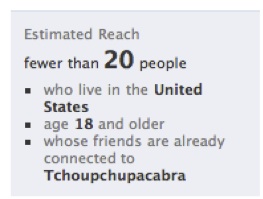
WVUE reflects the average Facebook user’s view when it refers to all ads as “Sponsored Stories.” Ads are ads — it’s neither Facebook’s intent nor in their interest to try to fool you into thinking they’re not, and you’d have to ignore clear headings to think they’re from your friends. There is a difference, though: Sponsored Stories refers to ads that look more like regular news feed posts; however, they again have the telltale heading. They also can only be shown to people “whose friends are already connected to” the Facebook page or post that they’re connected to. Similarly, fan page ads can only be shown to people not already connected to the fan page.
See, nothing terribly creepy here…
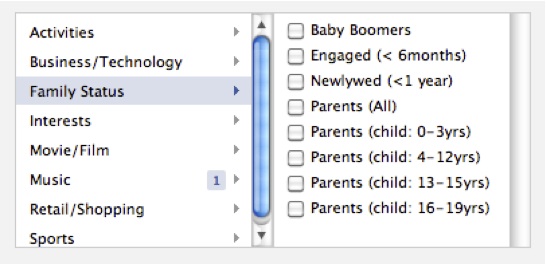
Facebook’s ad targeting is much less sinister than it seems. You can filter by age, sex, and broad category of interest. While the Family Status category under interests is on one hand a bit questionable, it can heavily influence relevance of ads; you wouldn’t want to be showing ads for singles sites if a member is married with kids.
You can then target by Connection to a Page, Event or App. The next section, the Advanced Demographics, provides advertisers with better opportunities to provide relevant content and avoid marketing gaffes. Finally, you can target by education level or workplace.
And that’s it, right? You get your broad information, and nothing’s even tracked deeply enough to cause any concern. That doesn’t seem so bad.
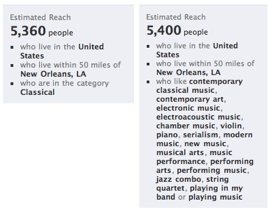
… But we could make this comparison much creepier. I just like music.
But when something* happens with your account, the advertiser gets access to Likes & Interests. This narrows the interests so that it is more like traditional keyword bidding. This isn’t unusual, and follows the traditions from Google pay-per-click advertising. The advertising platform provides vague statistics to give advertisers an idea of how many people are interested in ideas that are related to your link.
But not only does the advertiser get this information. Another privacy craze was raised over Facebook’s Open Graph Platform, which began the rash of “Like” buttons on the site. Extending the simplicity of the “Like” from every kind of “Edge” — the term Facebook uses for any post, link, comment, or ad — to web pages seems logical and extends not only the brand, but the whole social media mentality.
Open Graph allows a content provider to, like Google Analytics, track his links’ likes and clicks on Facebook, even without having a Facebook presence. While this might seem like nothing new to your loss of privacy, an important distinction has to be drawn between this and Google’s tracking programs. Facebook offers this information with your personal information like your friends list in the unseen data. Obviously, this is used not for advertisers, but for the inner machinery. However, the concern remains that someone with a bit of knowhow can get that information.
But that information isn’t useful for advertisers right now. A list of friends might be interesting on a massive level, but then again, the individual is lost looking at larger trends. The other factors, publicly displayed on your profile
Through these three realms of privacy, it seems that there’s good reason to be afraid of Facebook and its privacy issues. But here’s the catch — who’s really looking at this? Advertisers and content providers, even among the slimiest of content farms, simply want to provide a better user experience. They, including us, are looking for the most people clicking on ads and, more importantly, interact with the content behind the ads.
There’s a tendency for people versed in Facebook to blame the user — we all see the inner workings, we know how easy the whole system is if you turn off your brain. We know that all you have to do is click the “Like” button and you’re giving us good information that we can use to give you more of what you already, at least in a marketing sense, “Like.” Those that are trying to target you are trying to give you more of what you’ve already said you want, even if it’s an admittedly selfish gift, since advertisers obviously get benefits from you clicking the link.
But the Skinner box that is Facebook, and particularly the games and apps that tweak and complicate privacy settings beyond the basic problems described, is ultimately something from which its users benefit. The on-first-glance underhanded data-gathering techniques are ultimately the way that Facebook serves its users, by providing content relevant to them, as determined by them.
*We are looking into this. Check back for more info!
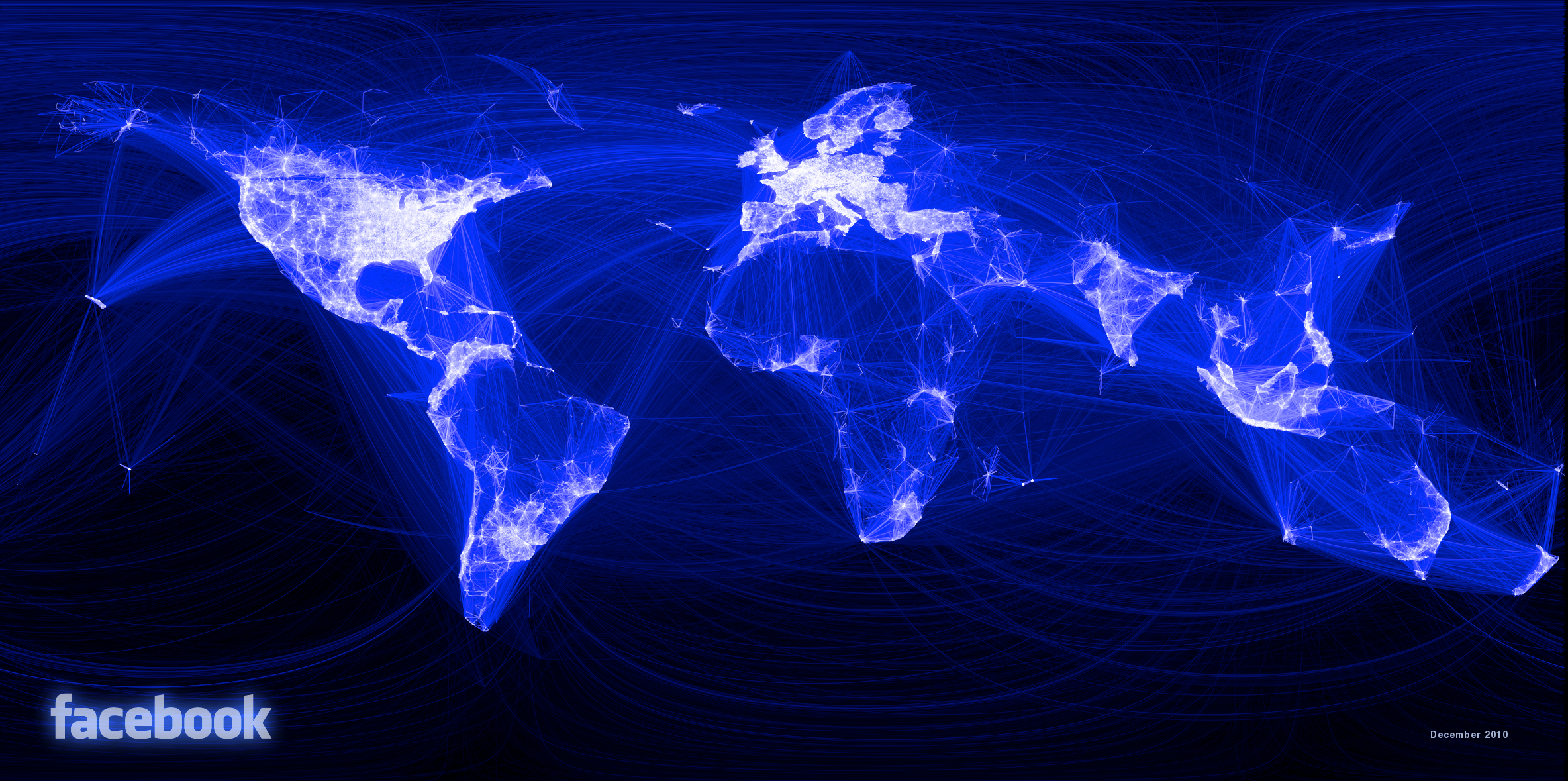
Picture Courtesy of the Facebook Engineering Blog
Don’t forget to “Like” this page. We promise to do every creepy thing we can with your information and show you what you’re sending to advertisers and content providers in an upcoming blog post.
Lately I have been doing a lot of research on landing page strategy and as I read about what not to do and what you must do, I think someone needs to break it all down into a simpler form. Where are we going wrong, maybe it’s all just too much? Make it simple. All you need are these 5 things arranged properly and it is most likely going to perform better than what you are using now:
Coming in for a smooth landing
1.) Your Company Logo clearly marked in the top left corner of your landing page.
Your company logo is your brand and it is what is going to clearly connect your landing page to your website. You do not need or want the exact navigation that exists on all of your web pages, it offers too many distractions and takes up too much room, most likely forcing the more important information (the Form) below the fold.
2.) The only content needed is a few credible and useful facts that must satisfy the users search inquiry.
Display this text concisely using bullet points. The messaging should match the ad copy and try to use relevant keywords. Only add relevant images that will enhance the users intent to take action. Do not use stock photos for design because it will likely distract the user from the intended action.
3.) Make the point of your page loud and clear with clear and obvious calls to action.
To be golden be loud and clear
If you want the user to fill out the form or call a number don’t make it difficult for them. Add the phone number clearly in the top right of the page. Add a visible contact form that is above the fold, and does not ask irrelevant questions like “how did you hear about us?” Since, we can track all of our leads in analytics, we do not need to ask this question, so don’t ask it!
4.) Add your credibility symbols above the fold.
This is very important, because the users need to immediately see a reason to trust your brand, if they do not see it right away, they will not scroll to the bottom of the page, but they will hit the back button to find it somewhere else.
Visible trust symbols are also very important for the ad copy. For example many of our client’s are plastic surgeons, and we cannot say, “board certified” in the ads unless it is proven on the landing page.
5.) Offer links to more information or to other pages on your website.
Link to the website at the top and the bottom of the landing page and from your logo. Add “read more” links to your bullets points, which will allow the uses to find more information. Remember you do not want to use too many links out because this will distract them from the purpose of the page, but not using any, the user will use the back button and navigate off the page, which is the last thing you want to have happen.
The tactics of Local Facebook Marketing just got a whole lot easier to understand. Sarah Smith gave up the goods in her presentation at the Local Search Summit. It turns out there are some very subversive ways to use current Facebook technologies. Marketing on Facebook just got a lot easier.
[caption id="" align="alignright" width="265" caption="Local Search Summit 09"][/caption]
Don Campbell gives a great overview of the ideas presented in our "Using Facebook and Twitter to Drive Local Leads" session. And, I'm looking forward to Aaron Irizarry posting the rest of the video...
... But in the mean time, I'm going to share some ideas based on the Facebook marketing presented by Sarah Smith.
I'm so excited by these ideas that we're going to be implementing some of them THIS WEEK with clients.
But look, I'm even more excited by what YOU are going to do with them. Please comment and let us know what you think the opportunities are.
Ok, ok - so the list:
Kinda mundane but still very helpful: Sarah indicates there is now radius based targeting for ads (e.g.: 15 miles around city X)
Target just your fans or people coming to an event with Facebook Ads (this is definitely cool, and I can see some good applications but not mind-blowing).
Birthday Targeting! Holy cow! This is huge. I have a whole program already laid out for this one.
1 to 1 communication with Event attendees/maybes. The pain point here is less obvious - you'll get it when I 'splain it.
Killer Facebook Marketing Opportunities:
Birthday Targeting:
[caption id="" align="alignright" width="199" caption="Happy Birthday to You!"][/caption]
So, Birthday Targeting - my goodness, how subversive can you get?! Imagine yourself cruising along in Facebook and Blammo
"happy birthday Bob, click here to register for your birthday gift - good all month".
Notice, we plan to message "good all month" (or "all week", or "for the next 10 days"). There is still a serious call to action but clearly it's an obtainable goal.
The challenge of the Birthday message in Facebook marketing is that if you make it a "today only" deal you may miss those who sign in after work hours or who are otherwise unable to commit today. Maybe they've got a party to go to :D.
You can see how this would be a killer tactic for a local business. Let's say you have a non-impulse product. You could make an offer of a $25.00 commodity gift card (Wal-mart, The Gap) or $100.00 gift certificate for your service. Even if you're not perfectly targeted you have the opportunity to start a dialog with a local buyer who knows someone who is.
Event Focused Permission Marketing:
Facebook event invitations are becoming much more prevalent. And, it turns out given this new feature, they're a sneaky marketing opportunity.
[caption id="" align="alignleft" width="240" caption="Ant Party"][/caption]
One of the problems we've had with "Fan Pages" vs. Facebook Groups is that there is no way to push communication to your fans. You can post something which will show up in their feed but you can't get into their inbox without a more personal connection.
So, Sarah says that all you've got to do is get someone to respond "Yes" to your invitation (or "Maybe", I think - hopefully Sarah will clarify) and you can then message them up until the event.
But wait, there's more: You, the group owner don't necessarily have to initiate the "Event" invitation. Meaning that you can easily convert the Fan to a Friend with much less restriction on continued messaging.
I'm not going to tell you how we're going to put this one into use 😉 but I'll tell you once we're done.
---
As you can see, these two opportunities, "Birthday Ads" and "Event Focused Permission Marketing", enable much greater attention getting behavior on Facebook. Marketing through these channels can get you past the banner blindness of the usual ads and may even get you into the Inbox.
With the rate of adoption of Facebook and Twitter we'll take any opportunity, the more sneaky and subversive the better, to build community and then hopefully move that community offline to buy something.
We'd love to hear your thoughts and suggestions on how to best leverage these new Facebook marketing opportunities and any of the others Sarah detailed at Local Search Summit.
---
Related Posts:
Editor’s note: this is the first in a series we’re calling “Don’t Believe The Hype”
Rocket Scientist or Pretender to The Throne?
“It’s OK, you’re not cheating on Google”, says the autopopulated search box on the Leapfish homepage. But is Leapfish, the new meta search kid on the block, just another flash in the pan as far as it’s search aspirations are concerned? Innovation and new applications are always welcome in the world of search. It’s obvious however, that except for their “click-free search”, Leapfish is offering nothing new.
Better known for their free domain appraisal tool (which is still available through the search box on their homepage), Leapfish hopes to position itself as a “multi-dimensional information aggregator and search portal” that serves up results from Google, MSN, Yahoo and other engines. But do internet users really need another “me-too” meta search engine in a field overcrowded with new entrants and start-ups jostling for eyeballs?
Leapfish does have some nifty programming juju to support it. Some call it the “fastest search engine” thanks to its click-free search that shows you the search results as you type. For some users the absence of an “enter” key might be a good thing. With its unique search widget interface and reports of its “relationships through APIs in over 200 Web sites dealing with real estate, music, consumer products, traditional search engines,” news-gatherers and reputation managers might find it useful since it cuts down on the task of having to search different engines and sources for information and turns up search results they may have otherwise missed.
A Piece of The Google Pie?
But most searchers looking for the most relevant and useful information on a topic would rather get their results “straight from the horse’s’ mouth” than from an aggregator. Internet users will always gravitate to engines like Google that give them the most relevant results, not one that returns a bunch of choices they have to dig through to find the information they want.
Leapfish’s advertising model is based on selling “sponsored keyword positions” in its top search results for a flat fee. Their 5% yearly renewal fee and openness to resale transactions leaves the field open for keyword arbitrage of the kind that Google is trying to weed out of it’s Adwords program. Selling keywords may not really be the way to attract quality advertisers. As an advertiser, you want to compete with other websites in your industry, not speculators selling your keyword to the highest bidder.
Leapfish also seems to be targeting a different kind of advertiser – those looking for “permanent ad positions” and the “Mom and Pop” businesses who don’t qualify for Google’s Adwords program because their CPC has gone through the roof, as Behnam Behrouzi of Leapfish.com stated in an interview with uber blogger, Robert Scoble, of Fast Company.
Behrouzi also claims that “everyone is competing with Google”. But Leapfish is not Google and their program for advertisers is not subject to the same quality guidelines that Google’s is. Its launch was also marred by reports of click fraud by super-aggressive sales staff, for which Leapfish’s Director of Marketing, Mark Kithcart, issued a clarification and apology.
The real question now is whether Leapfish will offer value to advertisers the way Google’s program does? Even if you don’t consider the fact that Google owns 65% of market share in online search, it seems unlikely that they will make a dent in Google’s share of the search pie anytime soon.
Reputation, market share and sound business practices mean everything to advertisers looking to put their hard earned money where it matters. It hardly seems likely that a new startup like Leapfish will be able to steal any of Google’s thunder anytime soon.
As far as our recommendation goes, Google’s Adwords program is still the best bet for advertisers looking for value and conversions. For those whose ads don’t do well on Google and are willing to shell out a few thousand dollars every year, Leapfish’s advertising model may offer some visibility..
For most internet users and advertisers trying to gain visibility, search aggregators are a mere flash-in-the-pan looking to skim some of the cream off the Big Daddy of search.



 Over the years, I’ve seen many companies going into damage control for missteps that they took in pushing their message. To learn from the mistakes of others, I’ve compiled a few of the most memorable marketing fails. These companies tried to do something unique or different to increase their brand awareness or create social interaction — but sometimes, things do not go as plan. Below is a list of the top marketing backfires that some of the biggest corporations have faced, offending or even repelling their customers.





 [/caption]
So, Birthday Targeting - my goodness, how subversive can you get?! Imagine yourself cruising along in Facebook and Blammo
[/caption]
So, Birthday Targeting - my goodness, how subversive can you get?! Imagine yourself cruising along in Facebook and Blammo
 [/caption]
One of the problems we've had with "Fan Pages" vs. Facebook Groups is that there is no way to push communication to your fans. You can post something which will show up in their feed but you can't get into their inbox without a more personal connection.
So, Sarah says that all you've got to do is get someone to respond "Yes" to your invitation (or "Maybe", I think - hopefully Sarah will clarify) and you can then message them up until the event.
But wait, there's more: You, the group owner don't necessarily have to initiate the "Event" invitation. Meaning that you can easily convert the Fan to a Friend with much less restriction on continued messaging.
I'm not going to tell you how we're going to put this one into use 😉 but I'll tell you once we're done.
---
As you can see, these two opportunities, "Birthday Ads" and "Event Focused Permission Marketing", enable much greater attention getting behavior on Facebook. Marketing through these channels can get you past the banner blindness of the usual ads and may even get you into the Inbox.
With the rate of adoption of Facebook and Twitter we'll take any opportunity, the more sneaky and subversive the better, to build community and then hopefully move that community offline to buy something.
We'd love to hear your thoughts and suggestions on how to best leverage these new
[/caption]
One of the problems we've had with "Fan Pages" vs. Facebook Groups is that there is no way to push communication to your fans. You can post something which will show up in their feed but you can't get into their inbox without a more personal connection.
So, Sarah says that all you've got to do is get someone to respond "Yes" to your invitation (or "Maybe", I think - hopefully Sarah will clarify) and you can then message them up until the event.
But wait, there's more: You, the group owner don't necessarily have to initiate the "Event" invitation. Meaning that you can easily convert the Fan to a Friend with much less restriction on continued messaging.
I'm not going to tell you how we're going to put this one into use 😉 but I'll tell you once we're done.
---
As you can see, these two opportunities, "Birthday Ads" and "Event Focused Permission Marketing", enable much greater attention getting behavior on Facebook. Marketing through these channels can get you past the banner blindness of the usual ads and may even get you into the Inbox.
With the rate of adoption of Facebook and Twitter we'll take any opportunity, the more sneaky and subversive the better, to build community and then hopefully move that community offline to buy something.
We'd love to hear your thoughts and suggestions on how to best leverage these new