Tag: advertising

  • How Will AI Search Affect Paid Ads? What Marketers Need to Know

    Graphic for How Will AI Search Affect Paid Ads? What Marketers Need to Know blog post

    Key Insights

    • AI Overviews decrease paid ad performance. When an Overview appears, Google Ads CTR drops from 21.27% to 9.87%.
    • Zero-click search is becoming part of the new norm. Some 58.5% of U.S. searches end without a website visit, elevating impression share, on-SERP visibility, and AI-referral traffic as essential metrics.
    • Lower-funnel tactics mitigate loss. AI-driven creative, smart bidding, transactional keywords, and conversational search phrases recover clicks that Overviews cannot satisfy.
    • First-party data and channel diversity preserve revenue. Feeding CRM signals into ad platforms and expanding into programmatic, CTV, and creator-led video sustains growth as generative SERPs evolve.
    • Advertisers will soon be eligible to have their ads shown in AI Overviews and AI Mode if they use Performance Max, Shopping, or broad match Search campaigns, including AI Max for Search.

    Ask any paid search specialist today, “How will AI affect paid search ads?” and you’ll see the same mix of excitement and anxiety.

    The chat-style answer from Google’s AI Overviews (AIOs) now blocks the top of search results, condensing information from multiple web pages and displaying it above everything on the results page.

    Marketers are already measuring the fallout: When an AIO fires, paid ad click-through rates (CTRs) can plunge by more than half, and organic traffic often drops too.

    Yet, declaring PPC dead would be premature.

    AIOs also provide new context signals and fresh attribution labels in GA4 that can boost performance when used strategically.

    And now, there’s a new development: Google has announced that advertisers will soon be eligible to appear in AI Overviews and AI Mode if they use Performance Max, Shopping, and broad match Search campaigns, including AI Max for Search.

    While this capability isn’t yet widely available to all advertisers, it hints at a future where paid visibility within AI-powered experiences will be possible.

    This post unpacks the latest data on visibility declines, explores emerging AI PPC opportunities, and outlines how Search Influence is helping brands safeguard revenue while turning generative search into a competitive edge.

    What Are AI Overviews, and Why Do They Matter for Paid Search?

    AI Overviews appear at the top of the SERP, absorb user attention, and compress the real estate available to paid ads.

    An AIO is essentially Google’s “CliffsNotes” for a query. Google Gemini analyzes millions of pages, extracts key points, and presents a conversational answer with citations. Because the card can occupy the entire first viewport, especially on mobile, users often get what they need before scrolling.

    Fewer impressions reach the positions where search ads typically run, driving immediate visibility loss and, in turn, lower CTR. In practice, that means campaigns relying on upper-funnel traffic or broad-match keywords feel the squeeze first, while tightly focused brand and product queries remain comparatively resilient.

    How Does AI Impact Google Ads’ Performance in 2025?
    A person using Google on their smartphone

    When an AIO triggers, paid ad CTR drops from 21.27% to 9.87%.

    A six-month Seer Interactive panel found that AIOs currently fire on roughly 7% of paid impressions. That share sounds modest until you realize it skews toward high-volume, informational queries that traditionally fill remarketing lists.

    With clicks disappearing on those terms, advertisers face two immediate pressures: shrinking top-funnel traffic and higher average cost per click (CPC) as more brands bid harder for the impressions that remain. Savvy teams now track impression share by SERP feature, segmenting “AIO” versus “no AIO” to spot dips early and reallocate spend before budgets burn.

    Are AI Overviews Reducing Web Traffic and Ad Clicks?

    By satisfying informational intent on-page, AI Overviews cut organic visits by 18–64% and dampen paid ad engagement.

    A Bounteous analysis revealed that sites targeting informational-type queries (think “average HVAC install cost” or “symptoms of low iron”) lost up to two-thirds of traffic once AIOs rolled out. Because AI search platforms resolve a user’s curiosity instantly, many never click another result. Paid ads suffer collateral damage, particularly for queries without commercial intent.

    Brands that once depended on broadly educational content to seed future conversions must now find new ways (first-party data, remarketing from social, and answer-engine optimization) to keep their funnels full.

    What Are Zero-Click Searches?

    Zero‑click searches occur when search engines satisfy user intent on the results page itself, leaving no need to visit another site.

    Featured snippets, knowledge panels, local packs, and now AI Overviews all deliver answers instantly, so the original search queries end right there. Recent SparkToro research found that 58.5 % of U.S. Google searches in 2024 finished without a click — proof that user behavior is tilting toward on‑SERP consumption.

    For marketers, this shift clouds traditional metrics. Impressions may vanish before ads load, and click‑through rate tells only part of the story. Tracking impression share, on‑SERP visibility, and emerging “AI referral” traffic offers a truer view of campaign performance in a world where many journeys now begin and end on Google itself.

    How Do AI Overviews Affect Paid Ads Differently Than Organic Listings?

    AI Overviews diminish paid impressions more than organic visibility because only organic citations appear inside the answer card.

    When Gemini selects content for an Overview, it lists source links at the bottom of the snapshot. That gives SEO teams at least a branding breadcrumb, even if clicks decline. Paid ads, however, receive no such cameo; they’re simply shoved below the fold. The double hit, fewer impressions, and zero on-card mentions force advertisers to squeeze more profit from every click.

    It also nudges CPC upward as marketers bid aggressively for shrinking inventory.

    Collaboration between PPC and search marketers becomes indispensable. Organic can still score brand impressions, while paid must double down on high-intent keywords that AIOs rarely answer outright.

    What Should Marketers Do to Adapt Paid Search Campaigns for AI Search?
    The Google Ads logo

    Advertisers can reclaim lost clicks by combining AI-driven creative, intent-rich targeting, and smart bidding tuned for AI-powered search.

    First, embrace AI as a creative partner. AI-powered tools like Performance Max, ChatGPT, and Gemini can spin adaptive headlines that mirror the conversational phrasing users now type, or voice search, into Google. Feeding first-party CRM segments back into Google Ads sharpens audience models so the algorithm boosts bids only for prospects who resemble real buyers. Smart bidding strategies, such as Target CPA or Target ROAS, then respond in milliseconds if an Overview slashes available impressions.

    Next, pivot budgets toward bottom-of-funnel phrases — “same-day crown dentist near me,” “buy carbon-fiber pickleball paddle,” “cloud ERP demo pricing.” These commercial-ready searches still require a click, making them less vulnerable to AIO cannibalization.

    Finally, test longer, question-style keywords. Broad match combined with responsive search ads (RSAs) can capture AI-driven, voice-style queries like “Who installs tankless water heaters in Austin on weekends?”

    It’s also worth noting that campaigns will be eligible to appear in AI Overviews and AI Mode when using Performance Max, Shopping, or broad match Search, including the new AI Max for Search.

    Marketers leveraging these campaign types should monitor announcements from Google Ads to understand when and how this feature rolls out to their accounts.

    This conversational SEO/PPC crossover ensures visibility as search behavior evolves.

    Will AI Referral Traffic Replace Traditional Clicks?

    AI referral traffic is still embryonic but poised to become a measurable channel worth monitoring in GA4.

    Dig into GA4 source/medium reports, and you might notice entries such as gemini.google.com or chat.openai.com. Creating a custom channel group for any URL or host containing “ai” or “overview” lets marketers benchmark engagement metrics, time on site, scroll depth, and assisted conversions for these visits.

    Early numbers suggest that AI referral users consume content quickly and frequently navigate to deeper pages, perhaps because they arrive already primed by the answer box.

    Tracking micro-conversions (PDF downloads, click-to-call events) will help quantify the true value of this emergent audience as volumes grow.

    How Will the Paid Search Industry Evolve in Response to AI?

    Paid search is shifting toward data-heavy automation, diversified media mixes, and AI-enhanced creative storytelling.

    Google has already infused Gemini into ad creation, offering dynamic headline suggestions pulled from landing pages, product feeds, and customer intent signals. As SERP space tightens, brands are funneling incremental dollars into programmatic native, connected TV, discovery campaigns, and AI paid advertising on social platforms like TikTok Pulse. Agencies that weave PPC, conversion rate optimization, and answer-engine optimization into one cohesive strategy will distance themselves from siloed competitors.

    Meanwhile, the concept of Generative Engine Optimization (GEO) (or AI SEO, as we like to call it) has gone from theory to practice. Expect PPC managers to partner with SEO leads on structured data, schema markup, and entity optimization designed to make both ads and citations algorithm-friendly.

    How Can You Future-Proof Your Paid Search Strategy in an AI-Driven World?

    To future-proof your paid search strategy in an AI-driven world, marry rapid experimentation with rich first-party data and a diversified channel mix so revenue stays resilient as generative SERP features evolve.

    Operate on rapid test–learn loops: Weekly experiments reveal performance swings long before quarterly reviews surface them. Push every offline conversion, call, CRM deal, and store visit into Google Ads and Microsoft Advertising so machine-learning models optimize for profit, not vanity clicks. Layer audience signals, such as lapsed customer reactivation or high-value upsell, to fine-tune bidding during low-impression windows caused by AI models.

    Outside the SERP, pilot creator-led YouTube shorts, TikTok Spark Ads, and programmatic audio to hedge against further search volatility. These channels, amplified by AI-targeting capabilities, keep your message in market even when Google’s answer engines handle the top of the funnel.

    Finally, build dashboards that isolate artificial intelligence search impressions, CPC deltas, and AI-powered search marketing ROI so leadership sees both the risk and the enormous opportunity.

    Higher Ed Spotlight

    AI Overviews reduce top-funnel research traffic, yet high-intent education queries remain prime real estate for paid ads.

    Prospective students may find tuition averages or admission timelines directly in an Overview, but searches like “AACSB-accredited online MBA with scholarships” or “fastest RN-to-BSN program near me” still demand a click. Higher ed institutions that refine keyword match types and clusters around modality, cohort start date, and location continue to generate qualified leads at competitive cost per inquiry (CPI).

    Personalizing ad copy to speak to specific learner motivations, career advancement, salary potential, and schedule flexibility improves conversion rate even when impressions drop.

    To see where AI-powered search has distorted your funnel, use our free Higher Ed CPI Worksheet.

    Learn More About Navigating AI-Powered Search With Search Influence

    AI Overviews aren’t fading. They’re expanding.

    But that doesn’t mean your paid media growth and ad relevance have to shrink.

    The search marketers at Search Influence are already training AI tools to craft conversion-tested creatives, teaching smart-bidding algorithms to detect Overview-heavy SERPs, and visualizing AI referral paths inside GA4.

    We blend AI-powered bidding, conversational keyword research, and cross-channel planning to turn generative search disruption into revenue.

    If your CTR line looks like a ski slope or your CPC has climbed without a parallel rise in leads, it’s time for a deeper conversation.

    Contact our digital marketing team and let’s rewire your PPC campaigns for the AI Overview era.

    Images:
    Unpslash
    Unsplash

  • #1 Organic & No Clicks? Google Ads 2023 SERP Smackdown!

    #1 Organic & No Clicks? Google Ads 2023 SERP Smackdown!

    High Ranking Keywords and Low Traffic?

    google ads 2023

    Are algorithm updates and AI just a red herring for more Google Ads in 2023?

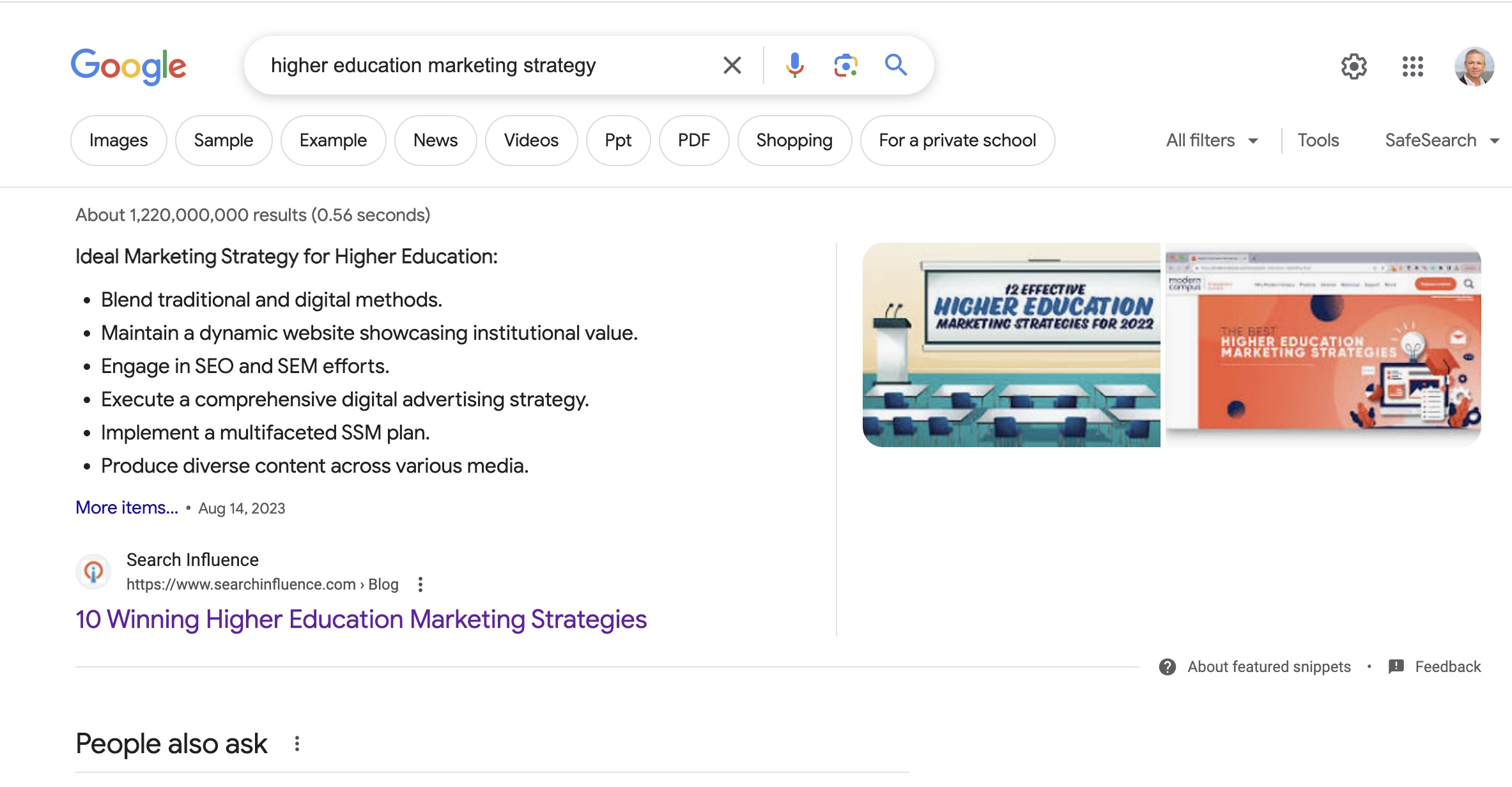
    It’s not just a #1 position. It’s a rich snippet. And a full-feature rich snippet with images, a bulleted list, and everything.

    But the CTR (click-through rate) is a measly 3%.

    We searched for the cause. Was it not a real ranking? Were we seeing a personalized search?

    higher ed marketing

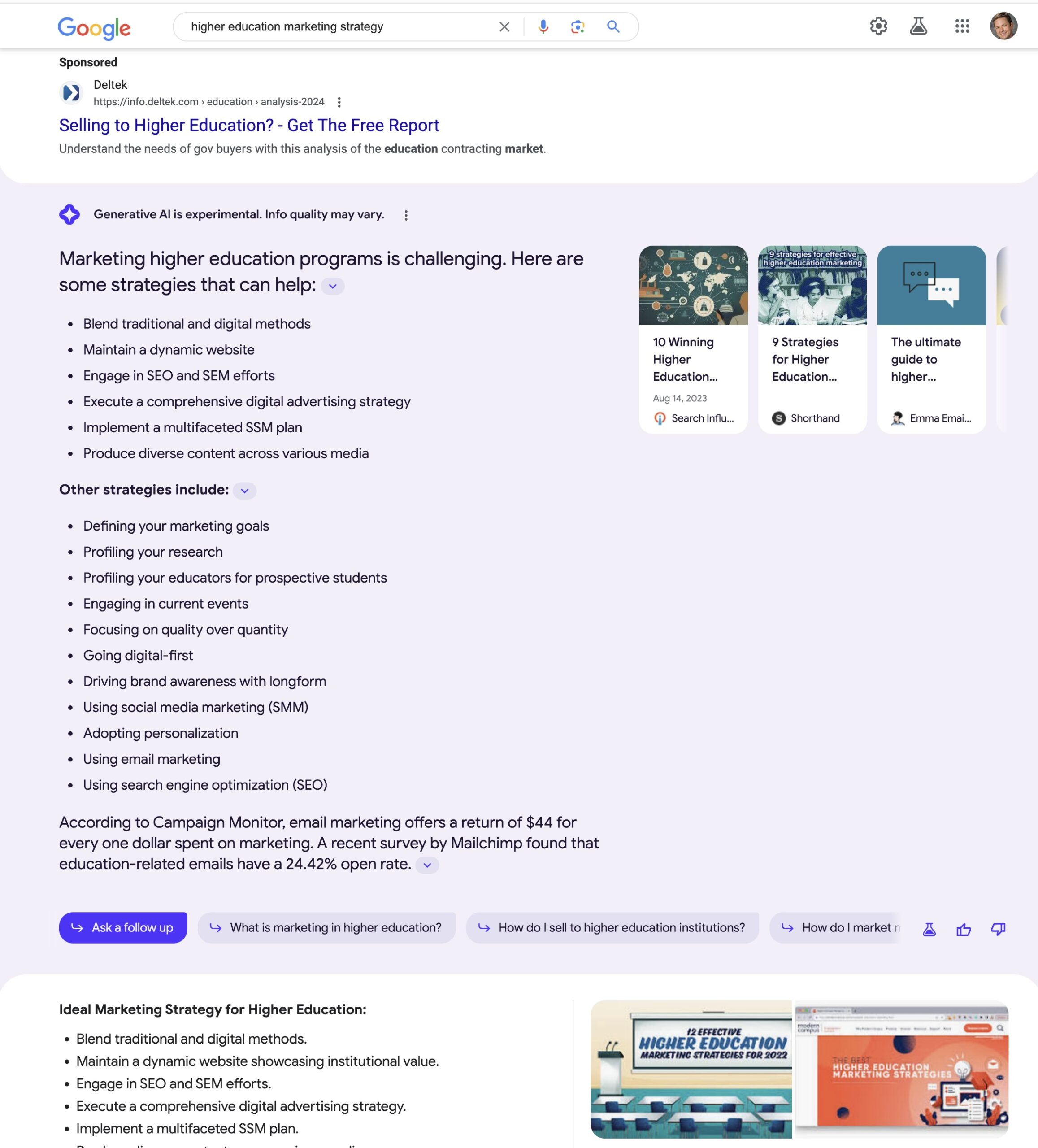
    Screenshot of “Higher Education Marketing Strategy” query on Google

    No. It was Google!

    Google Ads, to be specific.

    And for some searches, Google SGE, the new Search Generative Experience.

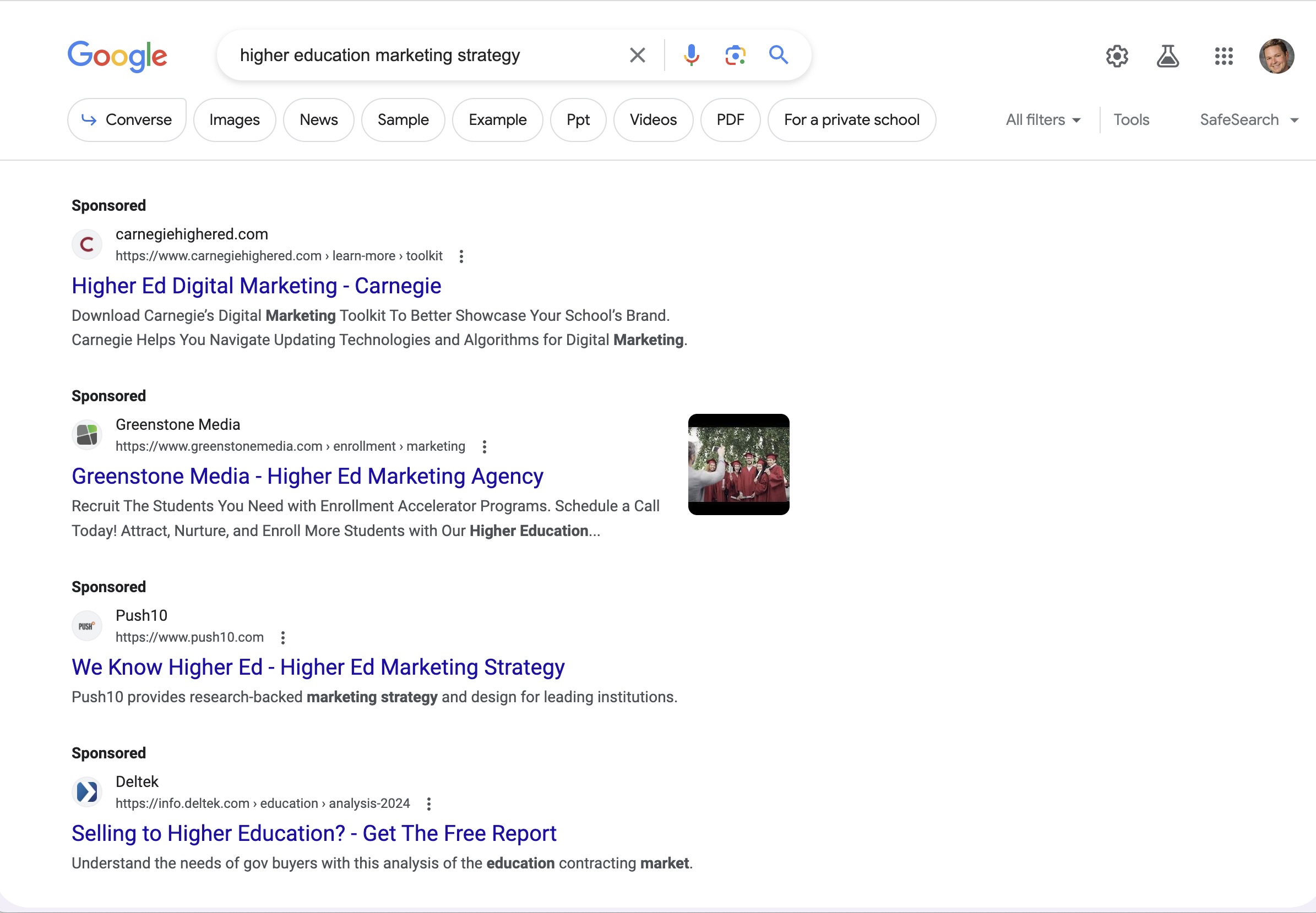
    We discovered that there was now a big fat pack of ads over the top of organic results. Where there used to be a couple of small ads, there are now four, with site links and lots of white space.

    Depending on the search, you have to scroll once, and sometimes twice, to get to the organic results.

    google ads 2023

    Screenshot of “Higher Education Marketing Strategy” query on Google from a non-SI account.

    Why would Google want to suppress organic search results? Let’s look at some examples and see what we find.

    While the SEO community has been worrying about Google Algorithm updates and the impact of AI, Google has quietly expanded the real estate devoted to Google Ads in 2023.

    Perhaps the talk of algorithm updates and AI was a red herring.

    Google SERP (Search Engine Results Page) 2023

    2023 was a busy year for Google. In addition to several algorithm updates, Google had to contend with AI, both in its index and in its user interface.

    AI, specifically the use of Large Language Models, exploded in early 2023. Tools for AI-enabled content creation, previously on the fringe, became mainstream.

    In addition to a flood of new content clogging up its index, Google — already an AI-powered platform — brought some of that intelligence to the search interface in the form of SGE (Search Generative Experience).

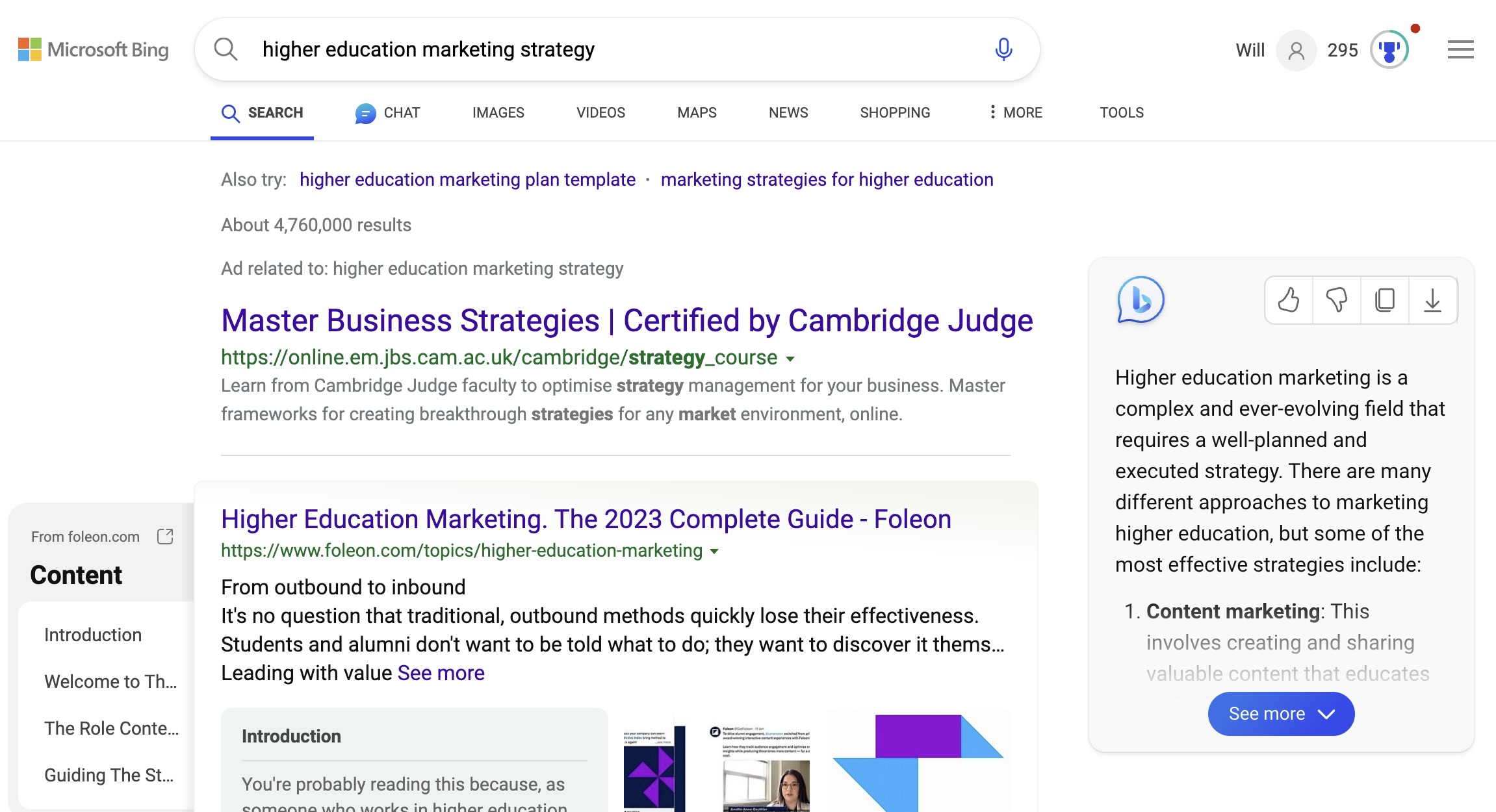
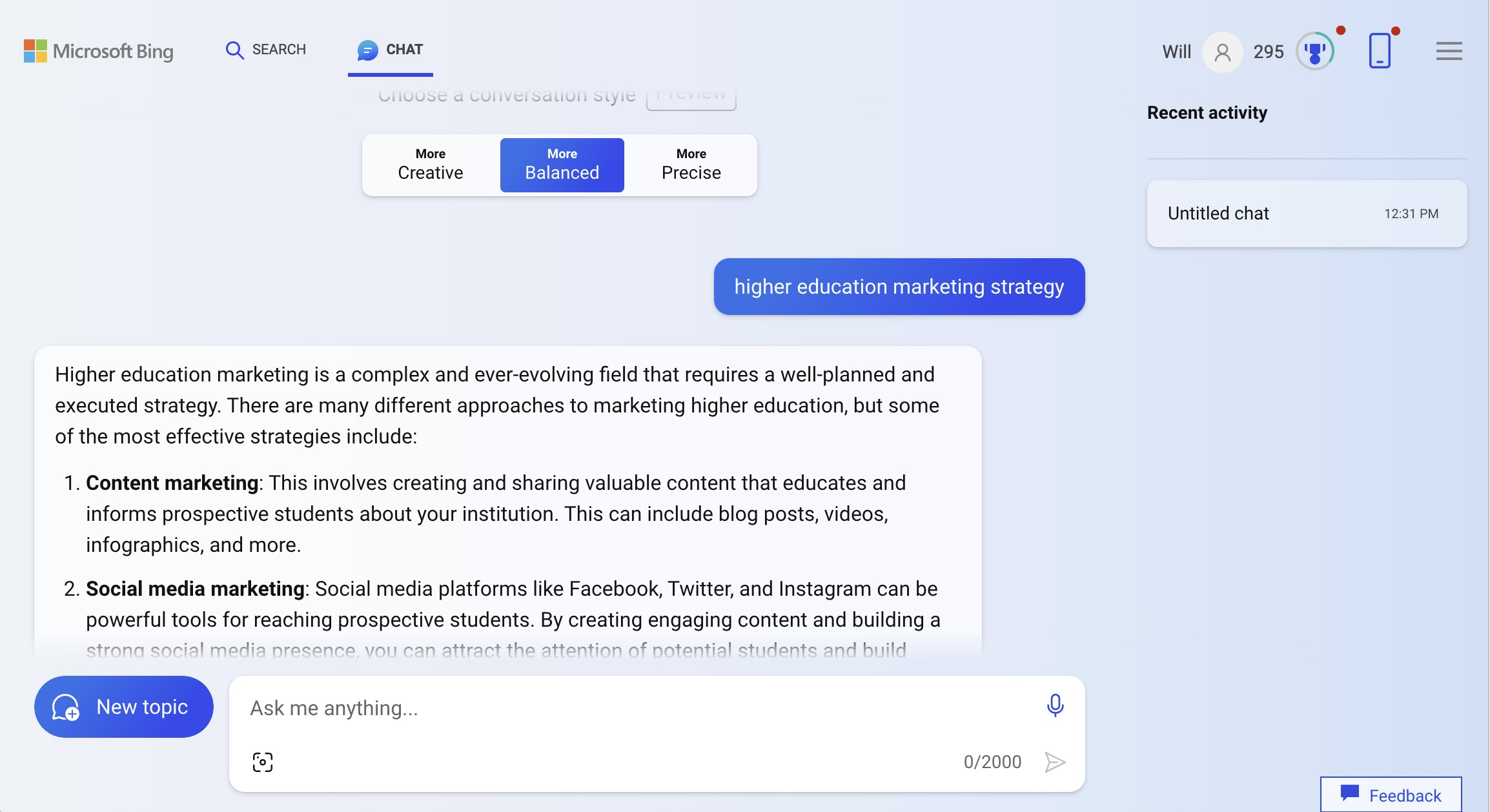
    Bing was the first to market with an AI-powered search experience. But, since it required the Microsoft Edge web browser, it only got a little play outside the Windows world.

    google ads 2023

    That little box on the right is the OpenAI-powered chat module.

    When BingGPT first launched, it was much more like the current Google interface, where the AI-powered elements were above the fold. This version is still accessible in “Chat” mode on Bing, but it’s not the default.

    google ads 2023

    Depending on the search query, Google has gone all in. Some see a slimming of the SGE box, but for our example search “Higher Education Marketing Strategy,” SGE is even more impactful than the ads.

    google ads 2023

    The good news is our content is good enough to be included in (scraped for) the SGE-generated result, but as you can see, even on my 27-inch monitor, I have to scroll to get past the ads and SGE to the rich snippet.

    Not to mention how far you would have to go to reach the traditional 10 blue links.

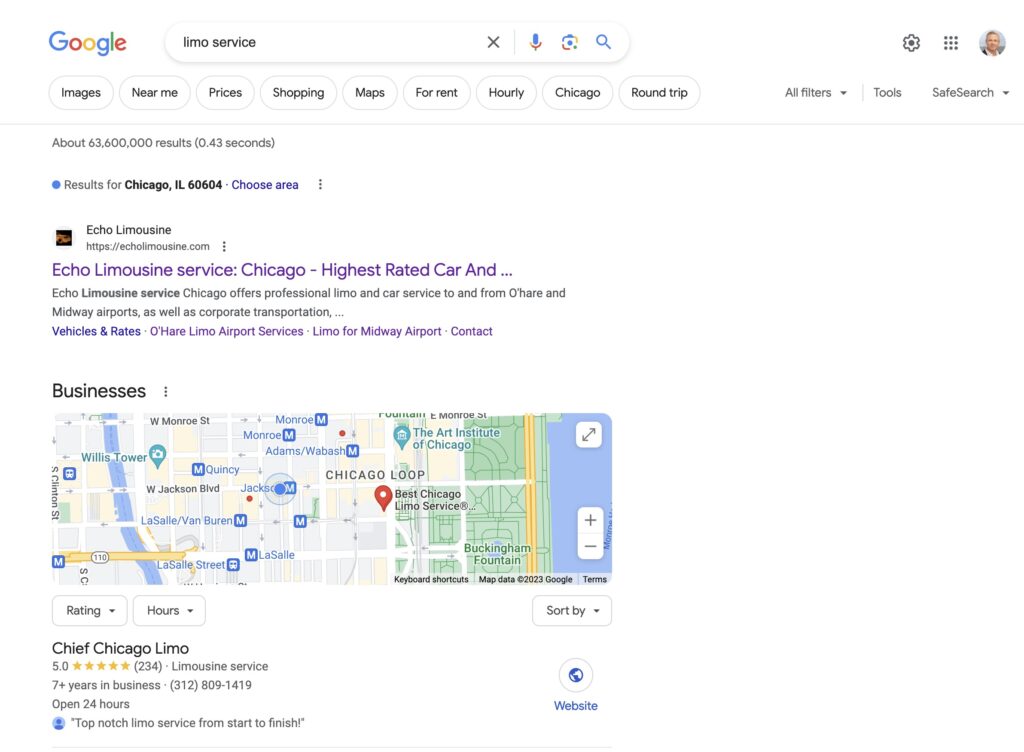
    More good news is that for many very local (hyperlocal, as Greg Sterling would say) searches, the map still prevails.

    google ads 2023

    Digital marketers and Google still have much to learn about user behavior on the SGE results page.

    It’s safe to say that, presented with the above and the typical attention span of the search engine user, the organic results will not get the clicks. And the ads may seem like the most useful part of the page.

    The Rise of Google’s Ad Empire

    Back in the early 2000s, Google ad placements were a speck on the vast landscape of organic search results. Today, as we see above, they’re monolithic.

    The History of Google Ads

    When I first ventured online in the late ’90s, online ads were the equivalent of newspaper ads. They were giant banners with obvious messaging that as much as screamed, “I’m an ad!”

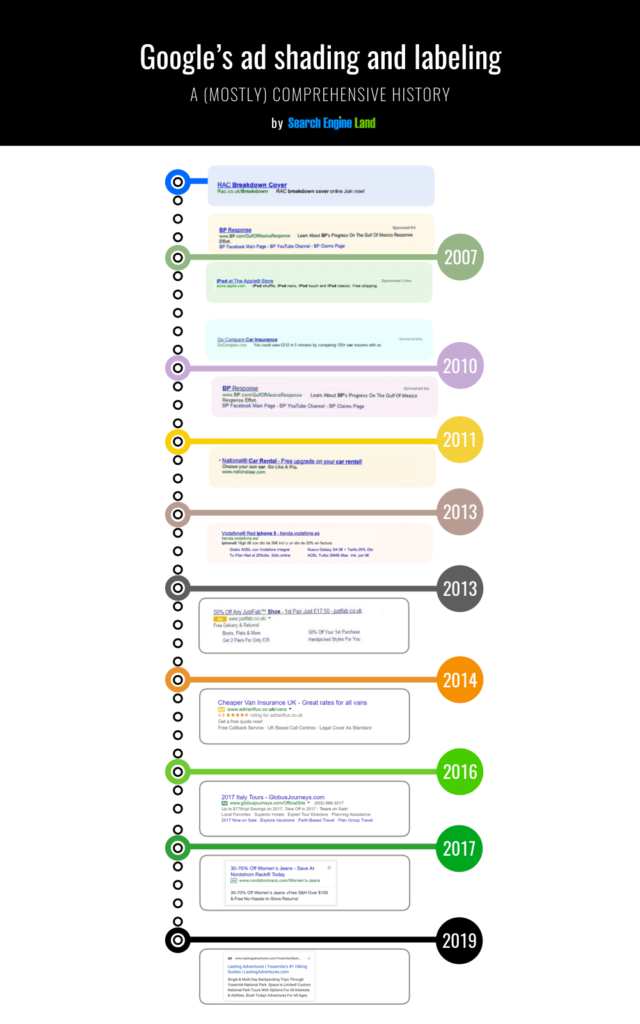
    Google, starting with “Premium Sponsorship,” over the years made their ads more and more subtle, ultimately looking like native content.

    This graphic from Ginny Marvin in her Search Engine Land article A visual history of Google ad labeling in search results tells a pretty good story of how what was originally an obvious ad has become increasingly subtle over time.

    google ads 2023

    It’s compelling to remember back to a time when ads were so obvious they were highlighted. It’s almost as if the original user interface engineers wanted to make sure you knew it was an ad.

    The graphic is a couple of years old and doesn’t account for the more visual ad types like product ads. In the case of product ads and some local service ads, they’re indiscernible from organic content.

    Follow the Money

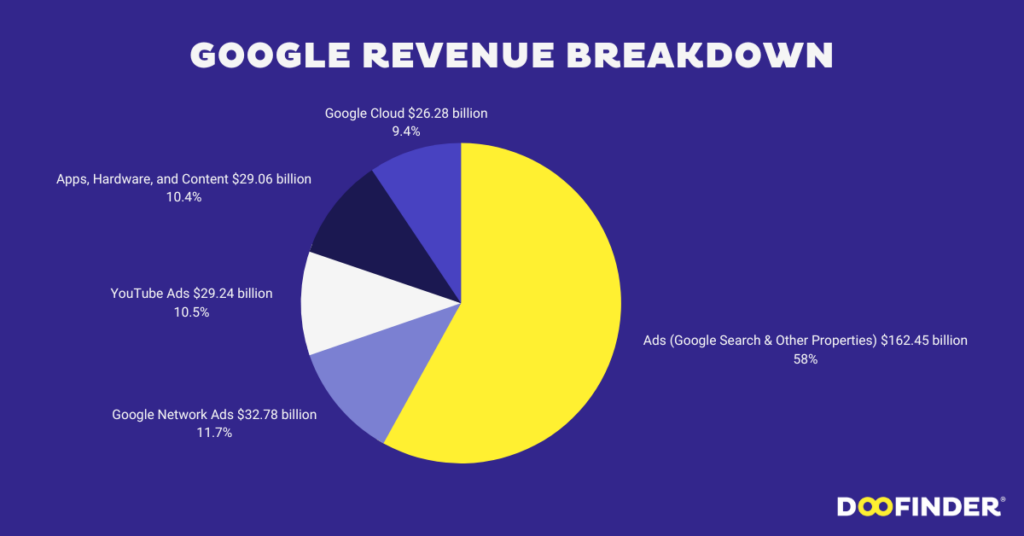
    As this chart from Doofinder, an e-commerce site search provider, shows, ads are the most significant part of Google’s revenue.

    google ads 2023

    Yes, Facebook, Amazon, and TikTok all take their share of the digital advertising market, but Google is still far and wide the leader with the most to lose.

    Why Is Google Doing This? Is This Ethical?

    On socials, there’s argument over whether Google should be regulated or if they’re entitled to do whatever they want.

    The argument goes, “They’re a public for-profit corporation, they can do as they please.” But can they? As the monopoly provider of access to business information, they have become a de-facto public utility.

    In the 1990s, the telephone companies were forced to give up their listing data to competitive phone books, and in the early 2000s, Microsoft was sued for antitrust violations and made two separate parts of their business.

    Is it crazy to think that when Google becomes self-serving (sometimes through aggressive — perhaps “unfair” competition), they should be regulated?

    What are some reasons Google would be taking this approach?

    1. Greed: It’s their search engine, and they can do what they want. The free listings aren’t paying anything, and they’re seeing benefits from inclusion.
    2. Spam: AI content is flooding the internet (not throwing stones, by the way.) Google has recently had issues indexing all the content.
    3. Resources: Indexing is hard. Even excluding spam, the rate of content production from “reputable” publishers is accelerating.
    4. Reality: The search engine results pages are getting pretty crappy. For most searches, authority sites dominate, whether or not they are niche-relevant. Some at Google might argue they at least have validation, by payment, of the trustworthiness of their advertisers.

    The European Union has started to regulate big tech, but the U.S. is not there yet. Arguably, the effect of regulation in the EU is a drop in the bucket compared to the valuations of Google, Facebook, and Amazon.

    We May Be on Our Way to a Pay-to-Play Google

    Until and unless Google reverts the SERP, we may have to buy back our hard-earned ranking for non-local searches.

    As an agency and a business owner, this is frustrating. We will have to watch the evolving SERP to understand the ratio between paid and organic search needs to maintain and grow the number of leads we’ve been accustomed to.

    I know that organic SEO will continue to deliver leads and value. While we wait to see the final form of the Google SERP, we should be focused on two strategies:

    1. Suck it up and buy our previously high-converting keywords.
    2. Continue developing content.
      • Long-tail content where there are fewer ads.
      • Alternative channels: YouTube, Social Media, etc. — the good news on this front is it doesn’t have to be new and unique but just repackaged for the medium.

    We would love to hear your thoughts. Are you seeing the same thing? Is it time to break up Alphabet? What else should we be looking for?

    Postscript – Google Ads 2023 Before & After Pics

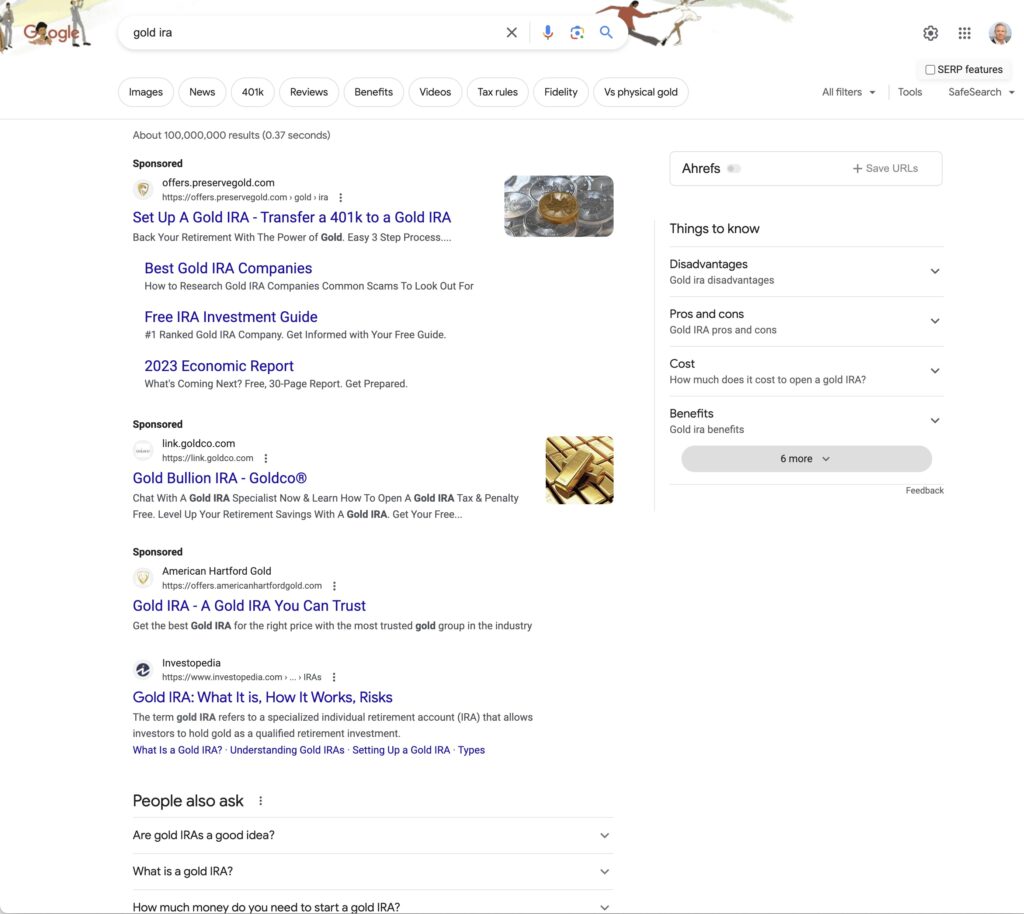
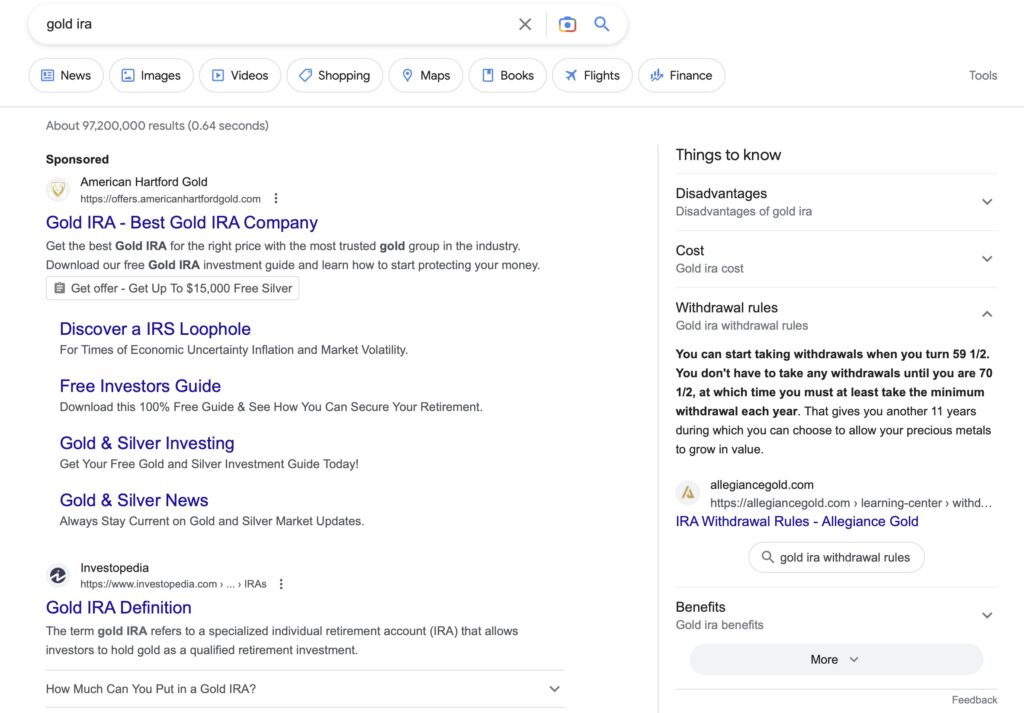
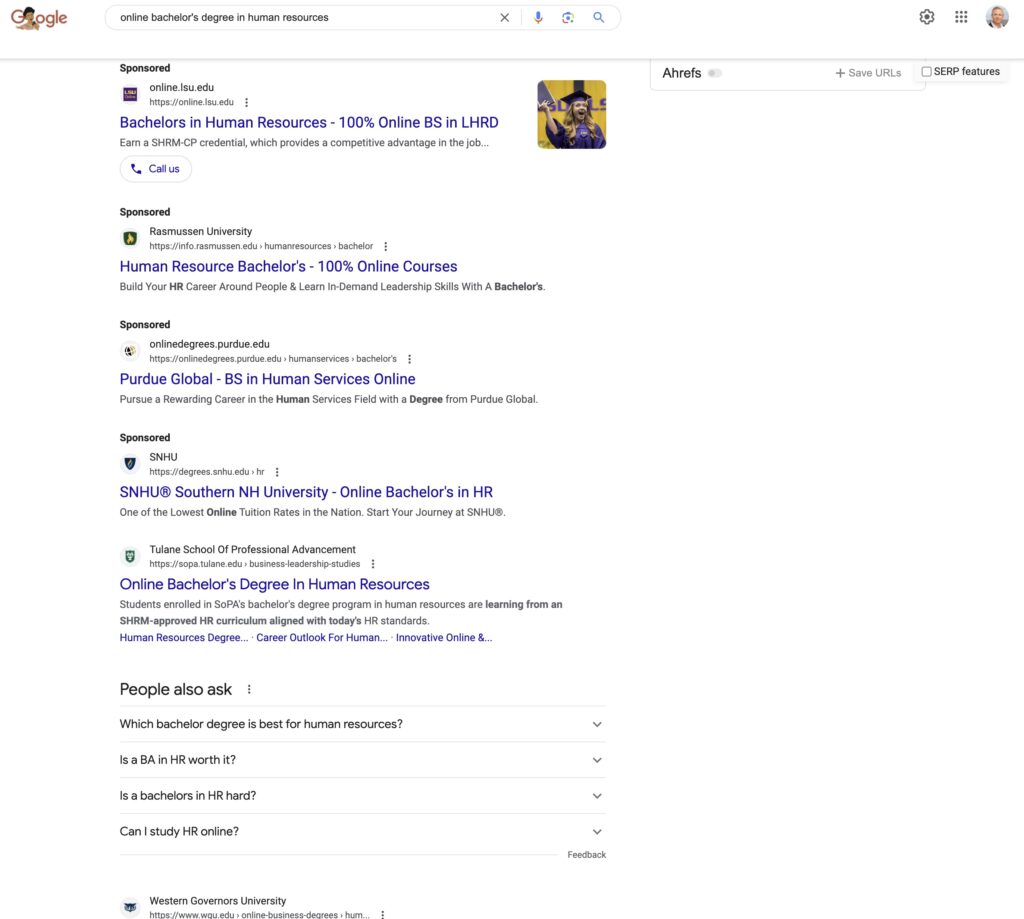
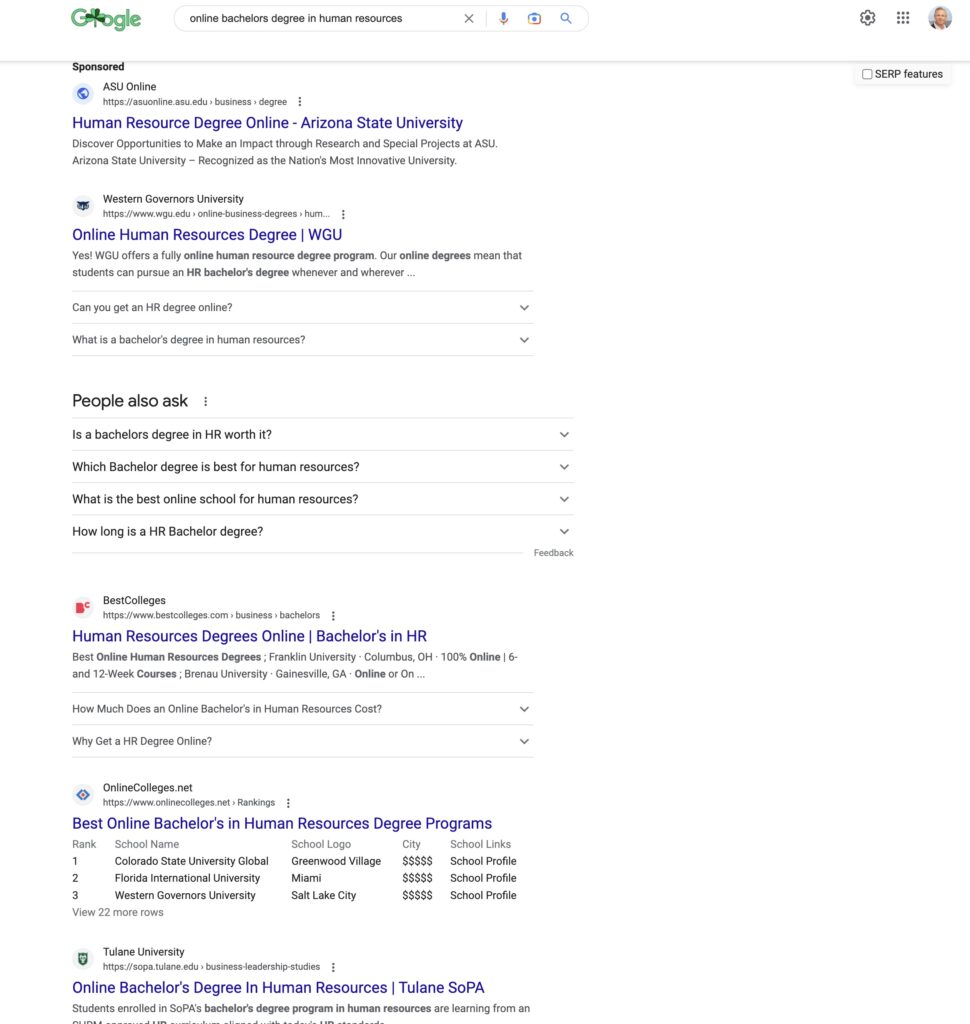
    I was asked to provide some screenshots of the new fat ads pack by our marketing associate and had surprisingly few SERP screenshots. The two below show the extreme nature of the Google Ads 2023 SERP smackdown.

    Gold IRA Today

    google ads 2023

    Gold IRA April 2023

    google ads 2023

    Online Bachelor’s Degree in Human Resources Today

    google ads 2023

    Online Bachelor’s Degree in Human Resources March 2023

    google ads 2023

    Additional References

    Everything wrong with Google in one competitive result – Cyrus Shepard
    How Search Generative Experience works and why retrieval-augmented generation is our future – Mike King

  • Three Ways to Improve the Quality Score of Google Ads

    At first, Quality Score may seem like an arbitrary number attached to your keywords, but there is so much that goes into it. Once you learn how to improve and maintain a keyword’s Quality Score, you can feel confident that you’re also improving the overall health of your Google Ads account.

    Defining Quality Score

    Google states that “Quality Score is intended to give you a general sense of the quality of your ads.” Quality Scores are provided at the keyword level and meant to reflect how the keyword performs in your account with regards to ad and landing page quality.

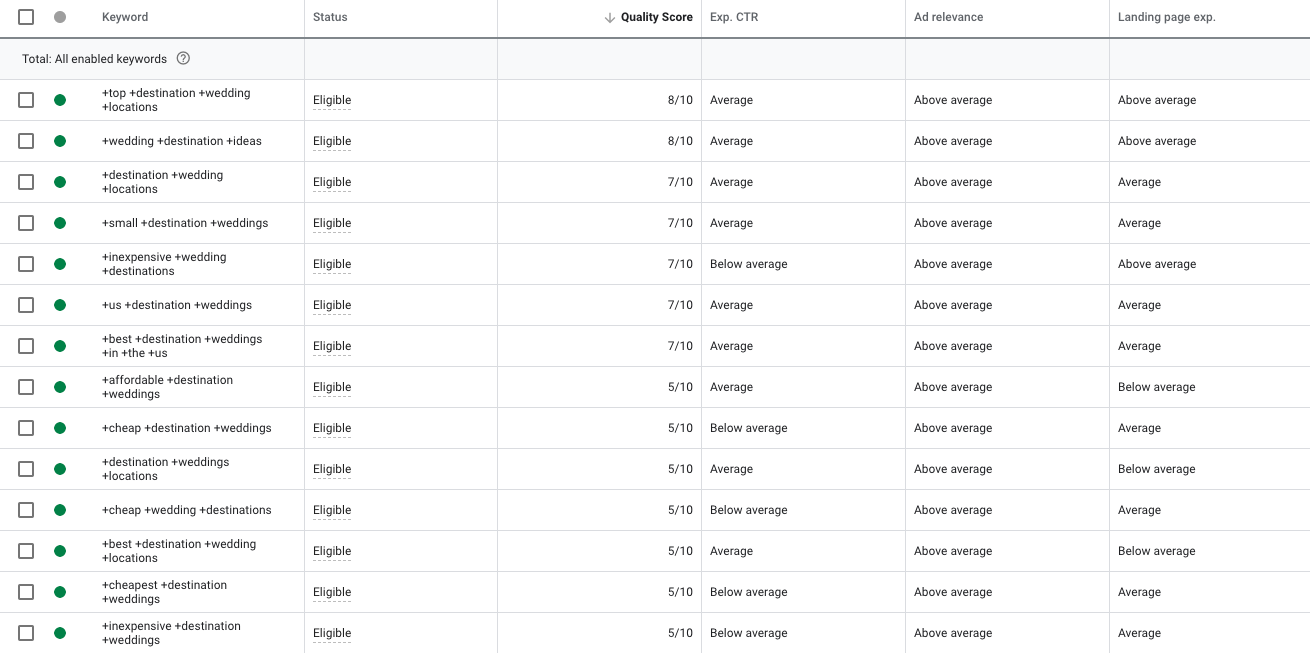
    Quality Score is reported on a scale of 1-10 and factors in expected click-through rate, ad relevance, and landing page experience. Overall, a healthy Quality Score averages around 6. Depending on how aggressively you want to improve Quality Score, start by reviewing keywords scored at a 3 or below for opportunities.

    It’s important to note that although it’s not used during auctions to determine Ad Rank, your historical Quality Score is a good indicator of how future ads will perform. Learn more about the ad auction in this video.

    Improving Quality Score

    Three factors can be optimized to enhance the Quality Scores of your keywords: expected CTR, ad relevance, and landing page experience. Each category can be rated as above average, average, or below average.

    Example of Google Ads campaign being managed by Search Influence in New Orleans, LA

    Let’s talk through each factor and recommendations on how to improve each one.

    1. Expected CTR: This is how likely it is that your ad will get clicked when shown for that keyword. Expected CTR is the easiest and most immediate element of Quality Score to improve.

    First, try reviewing the Search Term Report for keyword opportunities. This way, you can implement keywords more relevant for users. Once you add these keywords to your ad groups, pause the other keywords with low CTR.

    Another consideration is that your ads are not compelling enough for people to click. Test new ads with different messaging. A way to give your ad a natural CTR boost is by using Dynamic Keyword Insertion (DKI) in your ads. This trick is when you write {KeyWord:HeadlineText} in your headline, which then dynamically generates the headline as what the user searched.

    2. Ad Relevance: This measures “how closely related your keyword is to your ads.” An ad may be deemed relevant to a keyword when the keyword appears in the ad.

    If your keyword has a low QS because of ad relevance, instead of writing a brand new ad, try this. First, duplicate an existing ad that has high performance. Then, write in the low QS keyword as part of the ad.

    Also, ensure that your ads are answers for the queries the ad group most often receives. You can check queries using the Search Terms report. This is easier to accomplish when your ads and keywords are in specific ad groups consisting of tightly themed keywords.

    If you want to try something completely new, test Google’s Responsive Search Ads. This tool lets machine learning determine which of your ad headlines and descriptions will be the most relevant to the searcher. You can enter up to 15 headlines and four descriptions per ad!

    Something else to keep in mind is that Google looks at your site for relevance. Make sure you are landing every ad on the page that is most closely related to your keywords rather than only your homepage. Google takes into account keyword density on the site, so using relevant keywords on each landing page can also improve ad relevance.

    3. Landing Page Experience: This measures “how relevant and useful your website’s landing page will be to people who click your ad.” Landing pages that are not mobile responsive may take a hit in this factor. According to Statista.com, as of the second quarter of 2019, Google accounted for 95% of the mobile organic search engine visits in the U.S.

    Not all online advertisers can swiftly optimize landing pages as needed. If this is your case, start with making sure that your keywords and ads are relevant to the landing page’s current content.

    If that still doesn’t improve the Quality Score, you may want to consider the following for your landing page:

    • Making the page mobile responsive
    • Minimizing load time
    • Optimizing images with metatext, tags, title and alt text that include relevant keywords
    • Making conversion points clearly visible

    You should also consider improving your website’s content or testing new call-to-action buttons at each conversion point.

    Take Action Now

    As you can see, there are three factors that you can improve to increase Quality Score, yet there are only so many things you can do. If all of these possibilities seem overwhelming to you, start by making a list of optimizations you can tackle now, as well as some you may need to address later. Then, create an optimization schedule for yourself and revisit it each week.

    We are a Google Premier Partner, meaning we work on ad accounts daily to ensure clients maintain a strong Quality Score and campaign performance. If you find yourself unable to improve Quality Score, reach out to Search influence for specific recommendations and consulting services. Or let us work on your ad account directly with an online advertising package.

  • How to Drive Conversions With the Right Contact Form—And What to Avoid

    Your business’ shiny new website just launched and everyone assumed a deluge of fresh new leads would follow. To everyone’s dismay, the predicted deluge turns out to be nothing more than just a trickle. What gives exactly? “Build it and they will come” may ring true with your traffic itself but that quote lacks an “and convert” at the end. In years past, traffic was the key metric for a lot of businesses since it was assumed that those users would appreciate the brand awareness. Fast forward to the present day in the “Silicon Age” where users not converting is sure to set your business behind further than the Bronze Age.

    One easy way to convert users into customers is through the usage of a handy-dandy online form, but just having a form doesn’t guarantee a conversion rate anywhere near your industry benchmark. I’m here to help bolster those forms from some boxes into lead machines!

    Positioning

    Back when there were only brick and mortar buildings, there was always a huge focus on location, location, location. That phrase may seem like it belongs in the Bronze Age, but it instead adapted to the changing times and is still just as important as it was before. The location of your form is integral to the success of any lead collection campaign. Forms should always be placed in a very obvious place and above the fold, which is the portion of a page that initially loads in the screen’s viewport, as often as possible. Having a form in a good location puts it on users’ minds as soon as they visit your website and makes it more convenient to convert. Overlaying the form over a banner image is a good start for more visibility.

    Another excellent location for your form is on the sidebar of your site. This allows casual site perusers to convert at their own leisure instead of forcing them to a contact page or trying to lead them back to whatever landing page they entered the site within. One last location for a form is on your contact page, of course. Any site user would expect a way to contact your business on the contact page. In addition to an address, phone number, or email, a contact form is a perfect way to capture visitors’ information and nurture leads to eventually becoming loyal customers of your business.

    Layout

    Now that you’ve figured out where to place your form, the next step is to create a form that users can easily understand, fill out, and convert on. One big helper that was pointed out in a Google AI test is how users’ eyes focus on form fields. Having your labels above the inside of form fields is preferable to labels next to the form fields. This allows users to better scan the information and breeze through forms quicker, which leads to lower rates of dropout and errors in fields. Speaking of fields, try not to overwhelm your users with a bunch of unnecessary fields for information that can be gathered further down the line. If you aren’t shipping something to someone, why would you require a home address? If you’re sending users a brochure via email, why would you require a phone number? Requiring an excess of information makes users go “hmm…” and abandon the website completely. This is not to say that long forms have no place on the internet, rather every bit of information should be relative to the call to action.

    Here at Search Influence, we use our own proprietary lead tracking system to create fully customizable and extremely flexible forms that can keep track of your website leads in an easy-to-read reporting system. With our forms, you’ll know where your leads come from the most and learn how to optimize your campaigns to maximize your lead generation.

    Call-to-Action

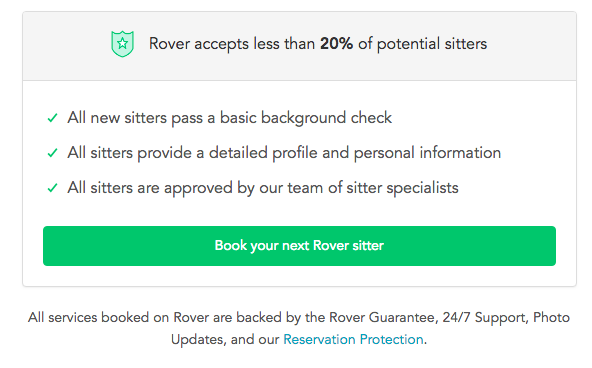
    A “Call-to-Action” (CTA) refers to the phrase that is meant to draw users into completing conversions. In the case of forms specifically, this would be the text that is on the submit button. Hubspot compiled a list of 31 Call-to-Action examples taken from many different corners of the internet and from varying industries. The main takeaway here is your CTA needs to be catchy and draw a user in. “Submit,” which may be seen fairly often around the internet, doesn’t quite cut it anymore. The end of a form should establish some sort of value to a user. Saying “Submit” simply tells the user that you’ll gladly collect their information and may or may not do anything with it.

    Screen shot of a call to action from Rover - Search Influence

    Having detailed text on the CTA button encourages users that your form is something worthwhile whether they’re about to “Subscribe to our newsletter” or Rover.com‘s “Book your next Rover sitter.” Users want to know the value of giving up their precious personal data, so make sure your form is honest and straightforward with how the users’ data will be used.

    Mobile

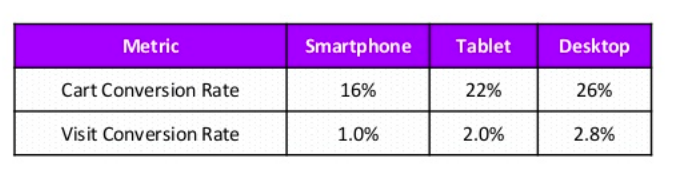
    One factor that can’t be ignored is the impact of mobile users on your website. Considering mobile users surpassed the amount of desktop traffic almost two years ago—eons in internet time—ignoring mobile users is a recipe for failure. What’s even more surprising is that in the same year, even though there were more mobile visits to websites worldwide, mobile users converted almost 65% less than desktop users according to the 2016 Adobe Mobile Retail Report.

    Table of mobile conversion rates - Search Influence

    Our advantage here is that this data is like, eons old. We’ve progressed since then and have become more accustomed to serving mobile users and Google even recognizes the efforts that developers put in to make their websites mobile friendly and adjusted their search to index mobile sites first. This coupled with the rising magnitude of mobile traffic means that being able to capture leads efficiently on mobile platforms is imperative for any campaign.

    At Search Influence, we have everything you need to start a lead generating campaign, from SEO services, digital advertising, social media management, and the capability to track your campaign with pinpoint accuracy. We also practice what we preach; check out the form in the sidebar if you don’t believe us.

  • Top 5 Google Analytics Metrics for E-commerce Tourism Companies

    Top 5 Google Analytics Metrics for E-commerce Tourism Companies

    With a growing number of travelers using mobile search to book their vacations, it’s a great time to be in the tourism industry, assuming you have an e-commerce option for your customers. Whether you’re offering hotel rooms, dinner reservations, or curated experiences, your customers are more likely than ever before to make their travel purchases online and on the go. But, how can you tell if the e-commerce side of your business is operating at peak performance? With a strong track record of successful marketing for zoos, museums, and other tourist attractions, Search Influence is here to help! We’ve compiled the top five Google Analytics metrics that your business should be tracking to make sure you’re optimizing your potential.

    1. E-commerce Conversion Rate

    Google divides the number of completed sales by the number of visitors to your website to provide your e-commerce conversion rate. This metric is one way to measure your business’ success in terms of online sales. While it does not measure how much revenue each sale brings in (that’s the average order value, and we’ll talk about it next!), your e-commerce conversion rate tells you how many visitors to your site have become paying customers. It’s an especially important metric to keep track of because converting current visitors into customers is much more cost effective than acquiring a new customer base.

    Of course, e-commerce isn’t the only conversion rate you can measure. Break down conversion points on your site into micro and macro. In the world of e-commerce, your macro conversion would be a purchased products/tickets. Micro conversions are smaller actions that lead up to the end goal of purchases. For tourism, this would likely include visits to key pages (like ticket pricing page), to adding something to a shopping cart, to email signups. You should watch your success of micro conversions and tune your campaigns to those as well, as each of these actions should be designed to drive customers toward macro conversions—increasing that e-commerce conversion rate of visitors turned into paying customers.

    2. Average Order Value

    Average order value tells you how much revenue online purchases generate for your business, on average. It is calculated by finding the total revenue generated from online orders and dividing it by the number of orders. According to some experts, like Databox, it could be the one most important metric for your e-commerce business to focus on.

    So, how do you improve your average order value? MonsterInsights provides some key suggestions.

    First, price your products with upselling in mind. For example, if you’re a photographer shooting on-site family vacation photos, you might offer a base package of 20 photos, with the option to add more at an increased price-per-photo rate.

    Second, offer product bundles at discounted prices. For example, if you’re running a walking tour company, you could bundle together a daytime and a nighttime tour. Customers will be enticed by the promise of extra touring for their dollars, and you’ll still gain more income than if they had just purchased a single tour.

    Finally, offer savings with a minimum order—something like, spend $100 and get $20 free. Customers may spend more than they ordinarily would just to access the discount. All three of these strategies can drive up your average order value, bringing in more revenue for your e-commerce tourism business.

    A close-up of a woman touching a screen - Search Influence

    3. Revenue Per Visitor

    Revenue per visitor is a crucial metric – increasing it can mean revenue growth for you without having to drive new visitors. You can increase this metric by both converting more visitors into customers and increasing your customers’ average order value. Revenue per visitor is calculated by dividing your total online revenue by the number of unique visitors.

    You can increase revenue per visitor by using any of the previously discussed methods, like upselling, bundling products, and offering discounts with a minimum spend. Keep in mind that a low revenue per visitor is not necessarily an indication that your business is struggling. For example, if you’re selling lower priced items, like postcards or other tourism souvenirs, your revenue per visitor will be much lower than for a company selling high-dollar items like cruise tickets or hotel suites. You’ll just need a larger number of unique visitors to boost your sales and drive revenue overall, and this should play heavily into your marketing goals and strategy.

    4. Customer Lifetime Value

    Customer lifetime value tells you the total value that an individual customer, acquired during a particular time period, has spent with your online business.

    This metric is best used for estimating appropriate marketing costs for your business, and for analyzing your customer acquisition strategy. For example, if your average customer will only spend $100 at your business over the course of their life, it isn’t worth paying hundreds of dollars to attract this customer. Maximize your return on investment (ROI) by keeping your marketing and advertising expenses reasonably lower than the income your average customer is likely to generate for your business. Most businesses are willing to spend 5-10% of revenue to acquire a new customer. (See more in our blog “What’s The Perfect Marketing Budget For Your Company?”)

    5. Return on Advertising Spend

    Speaking of ROI, let’s discuss return on advertising spend—or ROAS as it’s sometimes called—which is a key metric for determining the effectiveness of your digital advertising. It tells you how much income you earn for every dollar spent on advertising campaigns. If you’re running online ads and want them to be as effective as possible (who doesn’t?), you need to raise your return on advertising spend. Ideally, your ads should drive about three times as much income as you paid to advertise.

    A man viewing graphs and charts on a tablet - Search Influence

    So, how can you raise your return on advertising spend to this ideal 3x level? Conversion Fanatics Blog offers some great tips. First, do some testing to figure out what channels work best for your business. For example, if your Facebook ads tend to perform better than your Google ads, channel your dollars to Facebook, where your ads drive the most revenue. Similarly, test the times at which your ads have the best results. If you notice that holiday ads bring in more clients for you than summer ads do, it could be worth concentrating your ad dollars on that crucial time of year. Finally, you can dive into even more metrics. Monitor the user journey by tracking how many customers click on your ad, how long they stay on the resulting landing page, and so on. If you can pinpoint which stages of the user journey are working well for you, and which stages are losing potential customers, you can fine-tune your ads and landing pages for an improved user experience.

    These five metrics, all available through Google Analytics, are key components of e-commerce tracking for any online tourism company. For more information about how to optimize your travel business’ potential, contact Search Influence at 504-208-3900, or request a proposal today to hear opportunities from our strategists.

    Images:

    Camera and Phone

    Touchscreen

    Tablet

  • Zoos, Aquariums, and Non-profits: Here Are Three Top Tips to Fundraise Like a Pro

    Based in a city known for its tourism and attractions, Search Influence is no stranger to digital marketing for zoos, museums, and other non-profits. We’re here today to pass on some of our knowledge to you! These three tips for fundraising through social media are sure to spark your creativity and help get donations flowing through the door.

    Two hands holding a ball of money - Search Influence

    1. Make Giving Easy

    Even the most dedicated patron can get turned off if they have to fill out confusing forms or trudge to your office in person. Streamline the donation process by taking advantage of easy online giving platforms. Some user-friendly platforms and campaigns include:

    FundRazr

    MuseoBlogger points to the Boston Museum of Science’s success with FundRazr. This app is free to download and offers patrons a number of custom giving options. For example, they can either choose to contribute anonymously or to identify themselves via their Facebook profiles. Similarly, they can choose to give either by credit, debit, or PayPal. MuseoBlogger writes that FundRazr is “intuitive, convenient, and provides both instant gratification and recognition.” Maybe that’s why Boston Museum of Science raised over $1,200 from Facebook users alone—likely all donors who were not contributing via the traditional channels.

    Text to Give

    Colleen Dilenschneider, Chief Market Engagement Officer for IMPACTS Research & Development, highlights Cameron Park Zoo’s mobile giving campaign and Rosamond Gifford Zoo’s Adopt an Animal program as two nontraditional fundraising campaigns. As part of their mobile giving campaign, the zoo encouraged guests to donate $5 or $10 through a simple text message, making it easy for patrons to show support from home or say thanks after a great day at the zoo.

    Adopt an Animal

    The Adopt an Animal program at Rosamond Gifford Zoo is available to animal-loving patrons throughout the year, but in honor of National Adoption Day, the zoo ran a two-day promotion to spread awareness of the program. To reach a wider audience, they lowered the minimum donation requirement and created a smaller, custom donation package. This promotion generated an extra $350 and gave incentive to those who may not normally donate to the program.

    It’s simple. The easier it is to give to your organization, the more likely people are to donate.

    2. Establish a Brand

    Having easy donation platforms is great—as long as people know about them! To make the most of any digital fundraising campaign, you first need a community of fans and followers. And the first step in building that community is establishing your own brand. This gives patrons a clear idea of who they’re engaging with and helps them feel a personal connection with your organization and its values. After all, no one wants to give away hard earned money to a stranger on the internet!

    Complete branding should be an in-depth endeavor. It requires cohesion between your physical location, website, and social media platforms. If you’re looking for a place to start, think about visual branding: assure your color scheme, logos, fonts, and overall visual aesthetic remain consistent across all your on- and off-line locations. Or, you could start with brand values. Post clear causes or ideals that your organization believes in, and then provide evidence of those values through success stories and patron or employee spotlights. For an at-home example of establishing brand values, check out our About Us page and see how we communicate our dedication to optimizing business’ potential and the New Orleans community. Then, pop over to our pages about Success Stories and Company Culture to see those values demonstrated in action.

    3. Get Inspired With Engagement Ideas

    With your brand established and clearly communicating exactly who patrons support when they donate to you, it’s time to engage with the community! There are tons of great ideas out there, but here are some of our personal favorites.

    First, make it very clear where donations will be going and how patrons will benefit by giving. Just like how people prefer to support trusted brands over internet strangers, patrons are more likely to donate if they know exactly what their money will achieve. Consider offering additional perks for high-dollar donors. For example, a newsletter with updates about their chosen animal or a plaque with their name by their sponsored exhibit.

    Another popular engagement idea is live-streaming certain exhibits. Offer a night-stream that shows patrons what nocturnal creatures are up to when the zoo or aquarium is closed. Keep a 24/7 feed going on monkeys or other active and entertaining animals. Or, if one of your animals is expecting, consider broadcasting her pregnancy and birth, as well as her baby’s early growth. While this isn’t as directly tied to fundraising as animal adoption programs, it will nonetheless warm viewers’ hearts and get them engaged with and excited about your organization, building the meaningful connections that could turn into donations down the road.

    Finally, appeal to photographers. Nothing gets people excited about zoos and aquariums like cute pictures of fuzzy animals, and encouraging visiting professionals to take photos means your organization gets all the exposure with a fraction of the cost and effort. Consider using your social media accounts to host fan photo contests, like the Shedd Aquarium, or repurpose the photos you already have with a caption contest. To go even further, consider hosting photographer-only after-hours events, like Aquarium of the Pacific. This offers amateurs and professionals alike the opportunity to take great pictures without the general public getting in the way. When they post their photos, it’s free advertising for your organization, and it’s a great opportunity to extend your network to include the photography communities.

    Consult the Experts

    We promised three fundraising tips, but here’s a bonus fourth! If you want to focus the majority of your time and energy on running your organization, Search Influence is here to help you with everything from content marketing to online advertising. Request your proposal online today.

    Images:

    Moneyball

    Zootopia

    Giraffe

  • Why Are My Ads Disapproved by Google’s Misleading Content Policy?

    In its continual quest to better serve users, Google has cracked down on misleading content in advertisements as well as website content. When your advertising campaign is slammed for “misleading content,” it can come as quite a surprise. Because Google holds advertisers to a high standard, some of the violations might seem like harmless marketing strategies. Regardless of how the situation arose, it’s important to bring your website and account back in line with Google’s expectations. The sooner you resolve potential violations, the sooner you can get back to building your brand’s online reputation.

    What Is the Google AdWords Misleading Content Policy?

    “Misleading content” is an umbrella term that includes several types of violations, ranging from problematic testimonials to deceptive branding. The main objective of the misleading content policy is to provide a set of clear standards for online advertisers to follow as to not deceive users with exaggerated or false content. The central component of these standards states that:

    – Disclaimers need to be included alongside perceived claims, even if the claims are direct quotations from past customers.

    – Images that show before-and-after results also need disclaimers. More broadly, improbable assertions are likely to draw the attention of the Google AdWords team.

    We’ve all seen investment opportunities and weight loss programs that sound “too good to be true.” As you might imagine, some of the standards allow room for interpretation, and many affected advertisers find that they need to resolve multiple policy violations to resume advertising.

    At least, in theory, Google’s policy should benefit both users and advertisers. Users shouldn’t have to scroll past misleading or spammy content, and advertising slots will become more valuable as users learn that paid search results are also informative and trustworthy. When you edit your ads and website to align with the Google AdWords misleading content policy, you’ll also be improving content and sales copy that might have sounded suspicious to potential customers. The things that Google considers “misleading” may also be off-putting to your target audience.

    What Kinds of Businesses Are Most Impacted by This Crackdown?

    With shifting expectations for disclaimers and testimonials, medical businesses like plastic surgeons and dermatologists are particularly vulnerable to being caught on the wrong side of AdWords policies. Whenever possible, peer-reviewed journals and other reputable sources can be referenced to support claims. Images are useful for showing the results of weight loss programs and cosmetic procedures, but those types of images need to include disclaimers to emphasize that individual results vary.

    Investment firms, lawyers, and other businesses may run afoul of Google AdWords misleading content policy, even though they aren’t making medical claims. The misleading content policy looks for vague guarantees and other wording that implies certainty or permanence. Depending on the phrasing used to describe results, virtually any business can find itself on the wrong side of Google’s misleading content policies.

    How Does Google Review and Determine If Content Is Misleading?

    In case there was any doubt, Google doesn’t employ a review board of physicians or lawyers to determine which claims are unjustified. Instead, an editor on the Google team judges whether the wording or formatting of a page is misleading. When the editor finds one or more violations that justify disapproving the account, they may (or may not) make a note in your case file. With the number of campaigns and sites reviewed by editors, it doesn’t make sense for them to make exhaustive lists of recommendations beyond the first one or two violations.

    As a business owner, you might never interact directly with an editor at Google. When you call the account representatives on the Google helpline, they only have the information that editors chose to note in your case file. If you fix the problems that were cited as “misleading,” there may be additional problems found when your site is re-evaluated. It can be a frustrating runaround but don’t get angry at the person on the helpline. They aren’t the ones who flagged your content, and they don’t have the power to reinstate your account. Instead of focusing on the people who made the decision, it’s better to try to understand the aspects of the policy that might apply to your site and campaign.

    What Do I Need to Do to Get My Ads Approved and Running Again?

    Not everyone gets site-specific recommendations in his or her case file, and even if you’re lucky enough to get actionable advice, it’s still important to be proactive about finding additional violations. After your campaign account has been flagged, the responsibility is on your company (and your web developer) to make sure that your site and your PPC campaign meet the standards set by Google. Look through your landing pages in search of other potential violations.

    Could your seals and stamps be perceived as mimicking government seals? Site layouts and deceptive popups can also trigger penalties. Popup windows shouldn’t simulate messages or system errors, displays intended to trick users into clicking through or interacting by accident. As previously discussed, assertions about future results need to be carefully worded. Some violations are more obvious than others but use due diligence to ensure that your site complies with relevant policies.

    How Can I Avoid Getting Ads Disapproved in the Future?

    Look at the penalty “sandbox” as a learning opportunity, and try to avoid repeating the same mistakes in future campaigns. Make a point of looking beyond your PPC campaigns to your website and your company’s approach to branding online. The campaigns flagged by AdWords often have issues on the landing page, marketing strategies that may be mirrored across the rest of the website. Even if a PPC campaign can be restarted with changes to a few key pages, it’s worth adjusting other website content to align with misleading content policies. Search algorithms favor high quality, unique content, and the misleading content policy hints at indicators that could eventually affect overall search rankings.

    If you don’t have time to spend waiting on the Google helpline, consider getting professional help through digital marketing consulting. Google’s policies and expectations shift periodically, and anticipating changes can become a distraction from your day-to-day business.

    As a Google Premier Partner, Search Influence has over 25 employees certified in Google AdWords Search, Video, Mobile, Display, and Analytics. Our digital marketing agency keeps up to date with the latest trends in search engine algorithms and online advertising to best serve our clients. Contact us so we can help get your ads approved and running again.

    Image Credits:

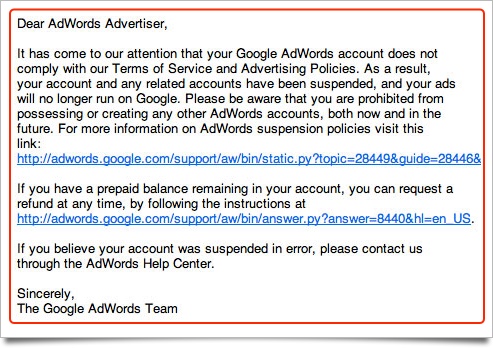
    Google Adwords Email

    Magnifying Glass

  • Four Smart Ways to Market Your Tourism Business in the Off-season

    Seasonality is a major marketing challenge for the tourism industry. Considering the struggle to turn a profit during the low season, and the rush of overtime work during the high season, this challenge should come as no surprise. The good news, however, is that we have solutions! With these four smart ways to market during the off-season, travel and tourism companies can combat seasonality and improve business year-round.

    1. Build Email Databases All Year

    Email might seem a bit old-school in the world of digital marketing, but even in 2018, email databases provide a valuable list of people who are genuinely interested in your brand. And when it comes to efficiently targeting your marketing campaigns, interested people who have subscribed to your database are much more likely to buy your product than those who haven’t subscribed. Some simple ways to build your database include prominently featuring sign-up forms on your website and across your social media channels and clearly informing new customers when they will be added to your email list. This transparency will promote trust in your brand and cut down on any annoying surprise emails, thereby limiting your number of unsubscribers and keeping your database numbers strong.

    Even though you’ll be using your email database to communicate during the off-season, it should be a priority during your peak season, as this is when you’ll be interacting with the most customers, both on and offline. For more tips on how to make the most of your email marketing campaign—and which crucial mistakes to avoid—read our past blog post on email marketing for small businesses.

    2. Create a Low-Season Content Strategy

    With your email database in place, you’ll need fantastic content to send to your customers and leads, keeping them engaged with your brand even when they aren’t able to purchase your products or experiences. This Hubspot blog, for example, suggests some great off-season blog topics for pick-your-own fruit or vegetable businesses, including smoothie recipes with frozen berries, and lists of foods for families to grow in the winter. Providing useful and engaging information even when you’re closed can build customer loyalty and encourage people to remember your business for once you’re back open.

    If your business is still open during the off-season, you have even more opportunity to drive sales with content! Consider a blog that addresses a common tourist concern and turns it into a positive opportunity. For example, a company in the tropics, where the rainy season is a big concern, could write a blog focusing on their location’s amazing indoor experiences, like shopping or museums. Or, if the company is a local zoo, they could write a blog explaining different animals that thrive in wet and humid conditions, and then promote the decreased prices and cooler weather that come with a little rain. To make these blogs especially compelling, your team should get out and about during the off-season and share first-hand accounts and photographs of their activities. This will show potential customers what your area is truly like during the off-season and likely convince them that an off-season trip will still be loads of fun. For more great content ideas, visit our content marketing services page, and learn how our business can help yours!

    3. Offer Discounted Off-season Experience Packages

    In addition to sending your team out and about during the off-season, consider using discounted experience packages to send customers exploring, as well. While discounts can feel like a risky strategy for driving business, there are many ways to leverage these discounts to your advantage. For example, host a contest or giveaway and then require the winners to submit photos, videos, or diary entries while on the trip. You can then form these first-hand customer experiences into a blog for your content strategy, or otherwise use them to promote your experience package.

    Because activities and accommodations are already planned in this type of discounted trip, experience packages will likely appeal to short-on-time travelers who want to get straight from Dreaming to Experiencing Moments, without slogging through Organizing and Booking. For more information on these crucial moments, and how your business can use them to attract customers, read our recent blog post on travel micro-moments.

    4. Don’t Forget About the Locals

    Locals deserve a lot of love for showing their hometown love and support during the off-season. The off-season is the perfect time to say thanks to locals, and make some money while you’re at it! Consider offering discounts for local residents, or altering your marketing strategy to promote staycations or otherwise appeal to the local community. Sometimes people just need a reminder of all the fun things they can do in their own city!

    Also, don’t forget that locals are the primary source for visiting friends and relatives, which can contribute heavily to your customer base, especially during the off-season. To see how Search Influence has helped tourism customers in our community market to both locals and visitors, visit our Zoos, Museums, and Attractions page.

    Seasonality will always be a challenge for businesses in the seasonal tourism industry—after all, it’s right there in the name! However, with these four marketing strategies, you can combat the low profits of the low season and improve your business year-round.

    Images:

    Winter, Spring

    Experiences

    Spring in the City

  • Five Tips for Creating Customer Advocates for your Tourist Attraction

    When your past customers talk to their friends and family about their vacation, are they likely to recommend your business? Word of mouth is critical for sustainable, long-term business growth, and social media has multiplied the number of connections between people sharing travel advice and reviews. In fact, a recent study from Nielsen found that 92 percent of consumers say they trust brand advocates, including recommendations from friends and family. Here are just a few of the ways to encourage customers to help promote your tourist attraction.

    Spongebob Sqaurepants laughing - Search Influence

    1. Attach Your Brand to a Real Person

    People naturally connect better with human beings, and it’s even better if customers interact with the same face repeatedly. Do you have a secretary or hostess who can orient new customers to your services and their options? Family-run and personality-driven businesses have an easier time identifying their brand with friendly owners and managers, but any business can make itself more relatable by avoiding shortcuts that result in impersonal service.

    Whenever possible, avoid using automated responses and impersonal emails. Over the phone, your business should be represented by a friendly voice. When electronic communication is necessary, try to use the same staff member so that customers have a chance to develop a rapport. By creating that dialogue, you’ll appeal to your audience’s emotional side, which neuroscientific research has linked directly to decision making in the brain. This genuine and friendly first impression is the first step toward creating a lasting customer who can, in turn, become an advocate for your brand among their peers.

    An excited man with a camcorder on a beach - Search Influence

    2. Create Photo-Ready Shareable Experiences

    If you know you’re creating a remarkable in-person experience for your guests, be sure you make it easy for them to translate that into photos, videos, and content online through their social channels. Tour guides and attraction managers know the best locations for group photos, and you can remind parties and couples of the optimal times to take out their cameras. Introverts may be reluctant to ask for someone else to take pictures, but waitresses and tour guides can start the conversation by suggesting a photo op. All of your customers’ friends will be curious to see where the picture was taken.

    Whether it’s a funky statue that’s perfect for a photo op or a contest through your social media platform to get guests to share their best photos in exchange for a gift certificate or branded swag, make sharing fun and interactive. You can even offer free Wi-Fi at your location and post signage with your branded hashtag or social media handles to make it as easy as possible for your guests to share right away and include you in their posts.

    3. Claim Your Online Presence & Stay in Touch Through Social Media

    Speaking of social, don’t forget to continue to foster that relationship with your guests online, even long after they’ve left. One of the most important steps of building customer advocacy is claiming your online presence. Brand your social media platforms with your company logo and beautiful photos of your attraction so that guests will know right away that you’re legitimate. Rather than just trying to promote your business on social media, be sure you also provide helpful information, fun events in the community, and posts that showcase your brand “personality.” When your fans find your posts helpful and relevant, they’re much more likely to share them with their fanbase.

    In addition to the usual social media platforms like Instagram and Facebook, you need to claim your Google My Business page. Since the Google ratings and reviews appear alongside search results, it’s important that your listing is accurate, detailed, and looks professional. This includes checking your hours of operation and adding photos of your attraction so that guests know they’re looking at the right listing.

    4. Collect Emails By Offering Promotions

    Every business is offering membership discounts and promotions these days, and an email signup is an easier alternative to the sometimes cumbersome memberships. When advertising on social media and your website, encourage customers to sign up for future promotions. Potential customers who are still planning their vacation will be interested to see whether special discounts or offers coincide with the time of their planned visit. In the meantime, your well-crafted emails will make sure your attraction isn’t forgotten as they get closer to finalizing plans.

    At the end of their visit, satisfied customers will be interested to see if you offer promotions they can share with friends. By giving email subscribers advanced notice about special events, you make them feel like they have inside information. When they feel like they have a special connection with your business, customers are more likely to advocate for your business. When their friends are visiting the same destination, they’re even more likely to recommend your business because you’ve continued to make a positive impression.

    Amy Poehler in Parks and Recreation saying Please - Search Influence

    5. Ask Nicely

    Just like Google My Business, it’s important to keep track of reviews on all social platforms. Depending on your industry, Yelp or TripAdvisor or another website may be more relevant. Many business owners forget to ask customers for reviews. Unfortunately, the customers who are self-motivated to write reviews are often the ones looking to vent about a negative experience. Happy and satisfied customers rarely feel the need to go through the necessary steps to write a review, but they’re more likely to take the time if someone at your company makes it clear how much their time would be appreciated.

    Whether you’re running a Ferris wheel or a hole-in-the-wall gourmet donut shop, you need customers to spread the word and advocate for your business. Once you’re confident in the quality of your services and products, it becomes a matter of encouraging customers to share their excitement online. The good news is that most of the things that help build advocacy also improve your connection with customers. When you leverage that connection to further improve your business, you can join in the success of tourist attractions that are winning on social media.

    Need help getting started? Learn more about our consulting services to help build a solid reputation for your attraction.

    Images:

    Spongebob

    Camcorder Dad

    Parks and Rec

  • 5 Strategies to Get Guests Talking and Increase Event Attendance

    5 Strategies to Get Guests Talking and Increase Event Attendance

    With the right marketing strategy, your event will be the topic that everyone seems to be discussing. Potential attendees will feel compelled to join in the fun. Millennials have coined a term for this pervasive social anxiety: “FOMO,” for “fear of missing out.” This social enthusiasm is great at motivating that final step for a successful gathering: converting people who are merely aware of the event into participants who actually attend. Whether you’re still sending invitations or collecting RSVPs, every event planner needs to know how to make their big bash the talk of the town.

    Image of Ariel from little mermaid in New Orleans, LA

    Email Marketing

    You know the contact information for your most dedicated fans and colleagues. Give newsletter subscribers and loyal customers the inside scoop, and they’ll be happy to make plans in advance. Include links to any special promotions or contests leading up to the event to help encourage your fans to spread the word and invite friends through social media. And be sure to tease out the event over a few targeted emails, building excitement and revealing new surprises that your customers can’t get enough of.

    Whether it is your regular newsletter or promotional messages for the big event, less is more, especially when it comes to emails. Flooded inboxes are a familiar experience, and many people cull through their incoming mail on a smartphone, further limiting the time and screen space allowed for each message to make its case. When you’re promoting an event, don’t send out too many emails to the same recipients, or you may turn potential attendees into unsubscribers.

    Facebook Promotion

    Facebook events allow you to track RSVPs and disseminate essential information. People need clear details about the time, location, and parking. Facebook makes key logistical information easily accessible, and it also provides a platform for easy promotion. With event marketing on Facebook, you can pay for promotion to get more views and attendees. Even without paying for advertising, you can design posts that encourage engagement. Produce exciting promotional infographics, and your fans will be happy to spread the word.

    Schedule important posts for the early afternoon, preferably from Wednesday to Friday. Those times allow a larger number of active Facebook users to see your posts, and they can still share the news before the weekend. Social media also allows you to gauge enthusiasm and adjust your promotional strategy, depending on which posts get more engagement. Learn more about how social media management can help you find attendees for your big event on Facebook and other platforms.

    Remarketing

    Not everyone who clicks on your page will attend, but people who visit your website and event page have demonstrated interest. Target those undecided visitors with remarketing through Google Display or Facebook Display to remind them about the event and keep it top of mind. This is especially important if your event tickets typically sell closer to your event. As with other forms of targeted advertising, you can put your message in front of local viewers with relevant interests, and you can even filter by age groups and other demographic variables. Remarketing is special because it is tailored to potential guests who have demonstrated a very specific interest.

    Not everyone checks Facebook more than five times a day, and it’s easy to forget about upcoming events. Online advertising provides reminders for converting interested viewers into actual attendees. Even users without a social media presence will still see advertising on search engines and other web page banners.

    Influencer Marketing

    Advertisements are great reminders for upcoming occasions, but trusted online personalities can have an even more profound influence on attendance. Make your gathering popular by getting relevant influencers on board. In some ways, the internet is still a lot like high school, and influencers are the popular kids with a lot of sway over which parties and trends are “cool.”

    Reach out to the internet personalities relevant to your industry and audience, and they may be interested in helping to spread the word. Some influencers are content creators who rely on sponsorship. Others are bloggers who share reviews and news relevant to their followers. Influencers make great VIPs, and they may also be interested in giving away tickets, further spreading the word.

    Social media icons rotating in New Orleans, LA

    Snapchat and Instagram Stories

    If you’re targeting a younger audience, you need to keep up with the latest trends. Snapchat and Instagram allow you to tell a compelling visual story. The week and day of the event, be sure to have someone on staff dedicated to updating your feed with behind-the-scenes videos, live updates, and reactions from attendees. You can even get your influencer to take over your social account during the event to stir more excitement. Publishing a lot of content during the event, and encouraging your guests to do the same, is the best way to jumpstart your marketing and attendance for the following year.

    From underwater welders to teenaged musicians, a surprising range of communities are active on Instagram and Snapchat. If you aren’t sure about the best place to reach your audience, then it’s worth getting professional help. Consulting services can help you determine which outlets are most effective for your industry and target audience, while lead tracking and analytics will help you determine how best to elicit reactions from followers.

    Event marketing is about more than spreading the word. Use your established branding to show how every attendee will have a great time. With the right impression and frequent reminders, your local community will be FOMO-ing all the way to your big day. Whether you’ve booked an exclusive venue or amazing guest speaker, promotion (through advertising or social media) is just a way to spread the exciting news. Once you’ve done the hard work of planning a gathering, FOMO is the natural reaction of people who understand what a great time you have pulled together.

    Have a big event coming up but no time to promote it? Request a proposal to learn how Search Influence can help you succeed.


    Images:

    Social Media Pendulum