It’s pretty simple: marketing on the Internet is, on one level, about dominating as much real estate on page 1 of Google as possible.
The typical places to dominate are the left side of the page (natural or organic search results) and the right side of the page (paid search results). However, with the abundance of online directories aggressively marketing themselves, the ability to own more of page 1 of Google for a certain key phrase is more and more attainable.
Many online directories work as lead generation services providing their clients with a profile page that can act as a separate web site in organic rankings. Some even guarantee a certain amount of leads per month for a given cost. Often they will also sell visible real estate on their site for an extra cost (e.g. a banner on the home page).
The main problem is that businesses sign up for these directories 1) without knowing enough about the service to ensure they are going to get an acceptable return on investment (ROI), 2) not knowing how to use these profiles to their fullest ability and 3) not understanding that in signing up they’re paying the directory to compete with them for search engine position.
I have outlined three ways you can begin measuring your ROI for each online directory you are currently under contract with, and those who may approach in the future: tracking, analyzing and optimizing
Bank of America Stock Chart
TRACKING
For each directory/profile listing implement call-tracking numbers. These numbers allow you to track exactly how many calls come in from that listing. This also allows you to track leads throughout the entire process and decide if they are quality leads.
Implement Google Analytics (the best free analytics tool available) to track referring sites (among other things). This allows you to see exactly how many people come directly to your site from your directory listing. There are some directories that can’t be tracked on analytics, so you will have to track these more closely in-house.
ANALYZING
Each month every directory should send you a recap of the activity on your profile. They usually list how many visits to your profile, how many leads you got from the profile, how many leads went to your site, etc. You can use these numbers to compare to your tracking reports. This will also allow you to gauge if the leads are quality or not. Yes, they might bring in their number of guaranteed leads, but they may never convert into procedures, which is where the ROI comes into play.
Reality check with customers: If the customer was looking for you by name, and your lead source intercepted them, they’re not doing you any good and you should discount those leads.
OPTIMIZING
Each listing is different, but it’s important to find out all the ways you can optimize your listing for better visibility. Some allow you to add video, press releases, optimized content, articles, and before/after images – you should take advantage of any opportunity you can. This will allow you to know at the end of your contract that you have done everything possible to utilize the listing and you can accurately measure the ROI (bearing in mind that you are investing your time).
Also be aware of what you can get for free- sometimes free is enough to get you what you need.
If you are considering joining a paid online directory, consider the following before signing the dotted line.
What is the cost per lead (CPL) the directory is guaranteeing, if any?
What is your current CPL for your own website and how does it compare?
How does that directory rank for valuable local and national key phrases?
How many of your colleagues will you be competing with on the site?
What is the site’s reputation (seek opinions from others in your industry)?
How long is the contract? Will they let you out if the leads are no good?
What are they doing to continue optimizing their site for your key phrases?
What is your opportunity cost of promoting their site over yours?
Photo: Phone calls = Money
Being able to answer some of these will give you a good idea if it’s worth a shot.
Again, be aware of what you can get for free – this can sometimes be enough to get you what you need.
Directory advertising isn’t evil. It can help you own more of page 1 and in the case of map based results may contribute to your ranking. Just be aware of the risks, rewards and cost (both monetary and opportunity) of paying someone to compete with you.
Editor’s Note: This was written immediately after the feast in February and has been in queue for publication since (in other words, my bad).
New Orleans Contemporary Arts Center Web Site
New Orleans Contemporary Arts Center graciously hosted the Social Innovation Conference called ‘The Feast’ put on by All Day Buffet. Social change entrepreneurs joined together to talk about the social change movement that is about to explode. As the entire nation in quietly experiencing the beginning stages of a business paradigm shift, New Orleans is growing into the next hot spot for the movement. Some refer to it as the next Silicon Valley because of the incredible opportunities that New Orleans has to offer start up companies, for profit and nonprofit alike.
Echoing Green Web Site
The conference started with a presentation from Heather McGrew of Echoing Green, a 501c3 organization that invests in “new leaders who have untested, smart ideas that deserve to be implemented”. They’re looking for great new social change agents or social entrepreneurs worldwide with new ideas. The focus of Heather’s talk was about ‘identity’ and what that means for an organization, company, and the third sector as a whole.
The cycle of identity goes like this: A start up organization realizes it needs credibility to get funding and investors, it begins to create a brand that people recognize, as the organizations grows the brand becomes more and more widely recognized (credibility) due to press releases, logos, website design, ads, completed projects, etc. The building of the brand can begin to dominate goals rather than the mission of the organization. So, the question becomes, how do we get back to the movement? How do we get back to the social change mission we started out seeking to accomplish?
The organization’s leadership must have the same vision, which must be congruent with the mission. Everyone needs to be on par with and seeking to accomplish the mission. In addition to the mission there are long-term goals that social change entrepreneurs are trying to reach. This one project will change a segment of the system in place but the entire system is the long-term goal. Many social entrepreneurs have this global ambition however; as an organization takes on an identity it becomes territorial of its resources and mission. For example, GTECH, Green Coast Enterprises, and SPOUT may all find themselves competing for some of the same grants, investors, land, etc. Competing over resources to accomplish similar missions is not what the organizations are about. Competition in the third sector, unlike the private sector is less likely to produce successful results. Ideally social change organizations would use the limited resources available to them in the most efficient manner. This means collaboration on a large scale, larger than we have seen yet in this sector; collaboration that is about identifying with the movement not the organization’s brand.
Rachel Botsman and Tamara Giltsoff from Social Innovation Sustainability Space presented a similar message regarding a business paradigm shift and the theme of ‘connectedness’. I thought the most illustrative example of the change that we hope to see more of in the business world is the collaboration between Coca Cola and the World Wildlife Fund (WWF). Coca Cola has the most water efficient manufacturing plants however the WWF was saying, it really doesn’t matter how efficient your water usage is if there isn’t any water left to use. Coca Cola and the WWF spent years spending money lobbying for their positions. Then Coca Cola understood and formed a partnership working to conserve the water we have now. This is an example of private and public sector organizations identifying themselves with the social change mission not their brands. The overall message being that everything is interconnected and people and organizations need to shift a large part of their identity and the reason they do business toward social change.
NOLA 180 Web Site
Speaking of interconnectedness, NOLA faces a hard battle improving its broken education system. John Alford spoke about NOLA 180‘s plans for implementing a school turn-around plan through out individual schools in New Orleans. Currently, the model is being tested on Langston Hughes Academy where students are held high standards and personal accountability. The students serve a 9-hr school day, have homework, and are taught strong moral principals in addition to academic lessons. Langston Hughes will likely serve as an incubation school for new teachers and administrators to be trained for the eventual take over of another school that seeks to be turned around. John’s models are impressive and daunting, there is a lot going on in them, which means an equal amount of work to do. But, they’re visible, the plan is accessible and all we need to do is execute. As he said, the New Orleans we are building now with young, successful talent cannot be sustained if the future generation of New Orleans is not being educated. The students are connected to New Orleans success.
Voodoo Ventures Web Site
Chris Schultz’, Voodoo Ventures, a local business and social entrepreneur gave an incredibly motivating and inspirational speech about start up organizations. He taught all of us how to execute ‘bootstrapping’ perfectly. That is pulling yourself up by your bootstraps and putting your ideas out there and in motion. Fear of failure should never enter your mind; everyone fails at least once and if you fail you pull yourself up by your bootstraps and move on to the next idea. Also, entrepreneurs often have the ‘impostor syndrome’ that is the fear of being considered an impostor. This, he says, needs to be shoved off as quickly as possible. Of course someone has thought of your idea before, but have they executed it?
Receivables Exchange Web Site
Nicolas Perkin honed in on this point in his presentation about his company The Receivables Exchange. He told the story of how his current investor had almost invested in someone with the same idea a couple years before but, the Receivables Exchange plan had the kinks worked out and the other didn’t. The investor invested in their company and the company has been and still is incredibly successful. Lesson: It’s all about execution. The idea isn’t what makes the company its how it’s executed. What we all need to remember is, as Chris said, ‘the one renewable resource we can all count on is our ideas’. We’ll always have new ideas and some of them are less than stellar but others are treasures. Now we need to ‘just do it’.
Hello Health Web Site
Jay Parkinson founder of Hello Health was the case in point changemaker. Dr. Parkinson is a doctor that has become fed up with the current way America practices medicine. He brought it to our attention that we’re really stuck in the 1970′ in the way America delivers healthcare. You make an appointment, go to the office, fill out a bunch of paperwork, see the doctor for eight minutes, he writes down what happens, tells you a number of things, you leave, forget 85% of what he told you, and then you have no further communication. Then the paper chart is filed away so you have no reference to that either. Insurance companies and other payment options add to the frustration of doctors and patients. In the most simplified way possible to explain the problem, there is no incentive for a doctor to care for their patients as well as possible. And, quite with the current system there is no way for a doctor to do so.
Dr. Parkinson took the social networking tools we use in this century and created a website that allowed patients in his area to look at his goggle calendar, make an appointment and he would make a house call. Billing would be done through PayPal and there was no need for staff, office, and the practice of paper documentation is now documented on your personal medical profile, available online. Now, the doctor is being paid upfront, quality care is provided to the patient, there is no hassle with waiting rooms, and you can communicate with you doctor and access your medical records with ease, at any time. It is revolutionary and is exactly the type of paradigm change that causes systemic change.
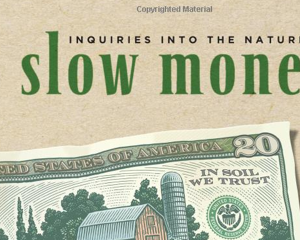
Slow Money Book Cover – Copyright Woody Tasch
Woody Tasch, author of Slow Money, introduced social changemakers that have accomplished systemic changes in their communities though years of persistence. An interesting example was organic farming and various other resource-accountable organizations that are working to sustain resources. The point that I took away from his presentation is that everyone needs to be aware of what impact everything we do has on our resources. Putting this knowledge in numbers that we can actually imagine and visualize is key. Let’s not talk in billions anymore, let’s break it down and talk in the amount we can all comprehend.
The type of ideas that Dr Parkinson and other social change agents have are what organizations like Ashoka, All Day Buffet, and Echoing Green invest in. Ashoka, based out of Washington DC, encourages and invests in social entrepreneurs. They offer them invaluable resources and a network that will allow them to stay sustainable.
New Orleans is a fertile ground for startups, nonprofit and profit alike, the plea I heard today is: as NOLA starts to take off, let’s keep our mission’s identity in mind. Let’s create a mission that changes the world because our entire city is working together to create social change. Let’s set the example of how social change innovation should be done for the rest of the world. Let’s create the social change industry that revolutionizes the way businesses, government, and public organizations operate.
I spent the last 2 days at a fantastic conference — the kind we need more of around here — WordCamp NOLA.
Day 1 was a bit of a Social Media day, more introduction than implementation.
Day 2 was, if I do say so myself, much more full of actionable stuff including my presentation on WordPress SEO.
I drew on our own experience working with clients and borrowed from some of the best in the industry.
For your viewing pleasure, here is the presentation:
I have to say, there’s something a little scary about in-conference twitter feeds but it turns out most of the commentary was complimentary and I want to thank all in attendance for their support and appreciation.
Following are some of the comments from the twitter feed:
Must be a lot of locks in all those tall buildings to need so many locksmiths.
This is an interesting development which makes me wonder about the statistical likelihood of one moving from the main search engine results to the maps view.
If I had to guess i’d say it seems likely that this will lead to a wider implementation which will lead to stronger calls to action from the main search engine results page.
UPDATE:
So, funny story – I’m in New York for Search Engine Strategies and find myself invited to dinner by Yelp with my friend Mat Siltala (in all honesty they would have never invited me without him :)).
The yelpers brough along a couple of happy customers. One was the guys who run the Big Gay Ice Cream Truck – an only in NY kind of thing – and the other was, drumroll please, a Locksmith! NYC is famous thanks to this post and a couple others for Locksmith spam. But here’s this guy, an honest and dependable practitioner having dinner with us in the East Village NY. Locksmiths, to hear him tell it, may deserve their bad rap, but Jay publishes prices right on his site and has nothing but 5 star reviews on Yelp.
I have been meeting a bunch of great local people thanks to my association with our local Net Squared group Net2NO . (update: in town? come out tomorrow night: http://netsquared.meetup.com/27/)
And one of them, David Robinson , who heads the local Adobe Multimedia Users Group asked me to speak to his group all about website promotion . It was a lot of fun, and I met even more great local folks and got to work on a much longer talk than I’m accustomed to.
The talk was an SEO 101 of sorts and was a lot of fun. We ended with a site clinic in which I reviewed and made some recommendations for some of the attendees.
I always say that I’d love to teach. I think there is too little real-world tactical online marketing eduction for the masses.
Holy cow it’s taken me a long time to write this! But that’s good news because I’ve been adding to my own understanding in the meantime.
I have been intending to post on this since before my friend Chris Schultz wrote his “10 Tips for Launching Your Startup” in which he brushed on the core concept, the Customer Engagement Cycle: A C I P R (Awareness, Consideration, Inquiry, Purchase and Retention (Referral)).
Take for instance the “Referral” above, I’ve come to realize that this is as valuable as “Retention” in the model. And sometimes is more effectively leveraged toward referral than repurchase.
Chris Schultz and I were both reminded of this at a recent Net2NO meeting (New Orleans Net Squared Group) by Chris Skinner, a New Orleans local and a big-brand search pioneer.
Being an entrepreneur trying to lead our business, with a little tunnel vision, I tried to apply it to my own recent experience, and below I’ll share that with you.
At the time, “awareness” seemed a heady concept but I’ve since come to recognize how it applies to what we do. Often as not, our customers’ “Customer” is already Aware. They know the product exists. There are clearly times, however, when it behooves us to drive awareness as well, and I’ll close with that story. As you think about these, their meaning is pretty obvious but I’ll editorialize in case it’s not all the way there for you.
Customer Engagement Cycle Defined
Awareness
“Hey, check that out. I didn’t know that was an option. Wow, that’s kinda cool. Glad I saw that”
Consideration
“You know, that thing I saw might fill this need / desire. Hmmm”
Inquiry
“Hi, I heard about that thing, and I have a need. Do you guys have that thing? Do you think that thing fits my need? Could I come down and talk about that?”
Purchase
If anybody is unclear on “Purchase” raise your hand please.
Retention
“Hi Bob, this is Suzie down at widget-town. I wanted to check in and see how you’re enjoying that thing. Oh really, that’s great! Glad to hear it. Keep an eye on your inbox because we’ve signed you up for our newsletter with some great tips on maintaining that thing. Thanks again Bob, we appreciate you.”
So, Skinner gives his talk and I say “yeah, yeah, Awareness — big brand heady stuff”.
Consideration, I get that. That’s what keyword research is for, right? You’re thinking about it, you’re typing it into Google and I’m taking you where my client wants you to go.
Inquiry – that’s when conversion matters. You’re asking questions, I’ve got answers and I need you to know how to get those questions answered. Once you arrive, I need to get you in our funnel so we can make sure you make it to the next step.
Purchase…
… cha-ching!
Retention: or as my step-father always said it’s much easier to sell to someone who’s already bought from you.
But what about referral? Your customers can be your fans if you let them. My friend Mack Collier talked about social media as “Making Yourself a Rock Star” and I think it was taken in the wrong connotation. His intent was not that you should put yourself on a pedestal, engage in substance abuse and fly around in private jets, it was that if you made a point to make fans from your customers you would have all the free promotion that fanaticism brings.
I often reference my BNI membership and it proves the value of a good referral.
For instance, one of my BNI fellows recommended us to a friend who is having a reputation management issue. I met the guy for lunch on Friday, we talked for an hour and he signed for a nice sized one-time fee. I was pre-sold by the referral and it got us past the point of proving the value to discussing the issues.
Finally, back to Awareness and a couple recent stories which led me to my to rethink my perspective.
One of our clients is among a very few plastic surgeons in the US who have had special training in a combination procedure called Lipoabdominoplasty. This is, essentially a tummy tuck with upper abdominal liposuction. There are a number of benefits, which I’m not near qualified to talk about, but suffice it to say it’s a less invasive tummy tuck with shorter recovery time and, many would say, better looking outcomes.Week before last, they had an appointment scheduled by a patient from California. They’re in New Jersey! Do you think there aren’t any qualified surgeons in California, clearly there are, but by virtue of promoting this specialized procedure our guy was able to garner interest from the plastic surgery capital of the world.
This lady was ready to fly cross-country for a revolutionary procedure — that’s Awareness!
And really finally on Awareness, I had an epiphany about Twitter. How many of you have heard of Twitter ? Twitter is a micro-blogging platform used for quick messaging encompassing both broadcast and dialog. For those of you not using it, it’s like instant-messaging to hundreds at a time, with the occasional conversation breaking out. It’s definitely a bit of work to find out with whom you’d like to connect, but once you get going you’ll find it easy to grow those connections.
In thinking of Twitter and some of the things we’ve got going on with a couple clients I came to the realization that Awareness isn’t necessarily a big-brand issue. Awareness often applies to making a prospective customer Aware you exist.
So, we’ve got a couple customers who are building Twitter followings. In one case, the Twit (he he) is a young lady who is already enmeshed in social media and for whom it’s a natural form of communication. She is engaged in the community and sharing information and her follower base is growing quite nicely.Oh, and they’re also running the occasional giveaway — on Twitter.
The impact in links and mentions in blogs and real media is nothing short of amazing! People who never heard of these guys are getting exposed, becoming Aware and spreading the word.
Will it work for everyone? No, probably not as well. These guys have a consumer product which is ripe for giveaways and, given the demographics of Twitter, inherently viral.
These two instances the plastic surgeon and the retailer have completely changed my thinking about the Awareness component of the customer Engagement Cycle.
There is a place for us there, but it is more a function of PR then traditional website promotion in the search engines. Sure, these two cases have a search ranking perspective, but the bulk of the traffic, Awareness and interest is outside of the search engine results pages.
I find that as I look at the work we do for our customers it is helpful to think in terms of the Customer Engagement Cycle. Are we messaging appropriately? Do we have the tools we need to measure? And are we on a path to Purchase?
That last is the hardest question to answer when you’re thinking about Awareness, but our experience thus far indicates that the right kind of Awareness will definitely lead to Purchase.
How can/do you apply ACIPR to your actions with your customers (or prospects) today?
I’m proud to announce that I have been asked to take part in a new Local Search News site http://www.localsearchnews.net/ (note: Local Search News is dead and we’ve moved the Barnacle SEO post to the Search Influence blog.
And, my first post is live!
In this post I argue that with a judicious application of Barnacle SEO, even the smallest budgets can have an impact on small business website promotion.
Small business owners are generally a frugal lot.
Of course there are some who’ve got the budget to invest heavily as long as they see a return, but what about those who don’t?
A long time ago someone coined the phrase “Parasite SEO” talking about the abuse of Blogger and WordPress.com to get better search term positioning. I love the term, but “parasite” is just so ugly sounding. I prefer “Barnacle SEO.”
Barnacle SEO: attaching oneself to a large fixed object and waiting for the customers to float by in the current.
People also ask
Is SEO still alive?
Who is king of SEO?
How important is SEO?
I’ve been so busy with the turn of the year that I forgot to mention that I had a rare opportunity to contribute to Mike Blumenthal’s Loci 2008.
For those of you who don’t know, Mike is THE authority on Google Maps and Local.
I’m very proud to have been asked to take part and would gladly do it again!
My contribution is here, excerpt follows:
Search Influence has been in business since 2006 but 2008 is the year I realized there is a community of like-minded folks and engaged with that community.
I made an offhanded comment on Tim’s blog for which Mike called me out and the rest is history.
So, David asks, I contribute — surely not as knowledgeably as some and it leads to one of the most valuable events I’ve attended: The SLOMO Local Search Sit Down as chronicled in David’s conference recap. Talk about some heavy hitters — the biggest names in Local Search around one table for the evening.
The Yellow Pages Association has launched a blog .
I added it to my feed reader under Local Search. I put it there because I don’t have a category for Dinosaur or Dead Trees or Dying industry 🙂
I kid — I think the Yellow Pages has 5-10 years of life left in it.
There may be some consolidation and there will certainly be heroic efforts to save it, but ultimately it will completely lose relevance in a world of ubiquitous connection.
Trust: to have confidence or faith in Authority: the power or right to give orders or make decisions Yellow Pages: a telephone directory listing businesses by category
Often as Search Marketers we use words which have been redefined by our industry without thinking about how they’ll be understood by customers.
“Trust” however has the same meaning to marketers and customers. We just need to understand the differences in how trust is measured by our customers and the search engines.
When talking with clients I often slip into SEO-speak and use the term “authority” differently than above.
My use comes from the idea of “Authority Sites”, and “Hubs and Authorities” in the search algorithms.
But customers need an example, like: “The same phrase on YouTube has much higher likelihood to rank than on drkim.com because YouTube is an authority site“.
Really though it’s about Trust. How much do the search engines trust your site? What are the signifiers of trust? Are they the same for search engines and humans?
As it turns out, they are. When trying to describe the concept of Authority I often use the analogy of personal referrals. “It’s one thing for me to tell you how cool I am, but if you hear it from 30 other people you’re more likely to believe it, right”?
It’s the same for the search engines. Ultimately they’re looking for indications of your trustworthiness. There’s a great point here relative to off-page SEO but for today let’s talk about the Yellow Pages and what we can learn about human behavior from 100 + years of experience.
New Haven directory, November, 1878.
For many years, the Yellow Pages ad design process has been directed by adherence to what are called the “RASCIL Factors”.
RASCIL is a way of distilling down the elements of an effective add to communicate many of the most pertinent decision making factors for a Yellow Pages shopper.
What might not be wholly intuitive, however, is that many of these factors speak directly to the idea of building trust.
I’m reminded of my friend Jerry Kennedy of KAMS Construction who’s tagline is
“At KAMS, the first thing we build is your trust”.
Yellow Pages – Fingers Walking
The RASCIL Factors
RELIABILITYTime in Business, Affiliations, Memberships and Certifications, Guarantees, Size of Firm
SPECIAL FEATURES AND/OR SECURITYCredit Cards and payment options, Hours of operation, Special Services
COMPLETENESS OF SERVICEProduct Types, Pickup and Delivery, Buy, Rent and Lease
ILLUSTRATIONHigh Impact Pictures and Headline
LOCATION Location or Locations, Areas Served
As you can see, a lot of this actually makes for good web design too. Or as Tim Coleman says, Local Seo Is Easy… Just Create A Good .
Hard at Work Thanks to The Yellow Pages
Authority and Trust in Website Promotion
It’s unfortunate that small businesses no longer have such ready access to that friendly and helpful Yellow Pages sales agent.The great news is that many who are marketing online have little experience with traditional media, including Yellow Pages advertising.
Additionally, most of your competition don’t know how to appear trustworthy to the search engines.
Just as your web site (or any ad) needs to instill trust in humans, your online behavior needs to instill trust in the search engines. And interestingly, there’s a pretty strong correlation to theRASCIL factors.
Below are just a few examples:
Reliability: Time in business (domain age), Affiliations (links from chambers of commerce, BBB, professional accrediting organizations), Mentions in regional / national press
Authorization : Authorized brands (links from manufacturer / distributor web sites)
Location: Do you deserve to show up on that map result?
Illustrations: Does your site look professional? Does it match the marketing message which brought the visitor
Unfortunately, there are some things which are harder to affect. You can’t reset your domain registration age. It may be possible to buy an old domain but the chances of buying one relevant to what you do are very slim.
Simply put: trust = links.
And authority matters. A link from the BBB is worth 100 from a free links directory. If you’re a real business though, most of those authoritative, trustworthy, links are easy to acquire…
… just ask.
A Happy Customer
And best of all, many of the steps you take to appear more trustworthy to the search engines are equally valuable offline — to the human beings with whom you want to do business.






 , introduced social changemakers that have accomplished systemic changes in their communities though years of persistence. An interesting example was organic farming and various other resource-accountable organizations that are working to sustain resources. The point that I took away from his presentation is that everyone needs to be aware of what impact everything we do has on our resources. Putting this knowledge in numbers that we can actually imagine and visualize is key. Let’s not talk in billions anymore, let’s break it down and talk in the amount we can all comprehend.

 Inquiry
 Purchase…
 In thinking of
 When talking with clients I often slip into SEO-speak and use the term “authority” differently than above.