Blog

  • Hold Off on the Half-Baked Google+ Local Merge

    This weekend while shopping for Christmas presents, I found this ad at one of the booths. The flyer advertises a seminar that will teach business owners how to claim their Google Place Page and Google+ Business pages. While we do encourage small businesses to claim these pages, we recommend holding off on attempting to merge the pages into a Google+ Local page.

    Google+ Local Pages were released with the intention of replacing Google Places as an accessible enhanced business listing to be used across search, Maps, mobile, and Google+. Unfortunately, the transition has been anything but smooth. Months after the release, Google Places for Business has lost its functionality, Google+ Local is riddled with bugs, and the only advice we’ve received from Google is to “Sit tight!”

    Patience, however, is not a virtue on the Internet, so rather than sitting tight, bloggers are nudging Google towards action by adding to the list of problems with Google+ Local. Businesses who have attempted the merge have experienced issues such as:

    • Lost reviews
    • Inoperable PINs
    • Pages getting stuck as “In Progress” for more than a week after inputting the verification PIN
    • Limited business types

    When Google ran its beta testing for merges in July, Search Influence successfully merged our own place page with our Google+ local page by way of the manual verification request. While we were able to merge a few of our clients’ place pages and Google+ local pages using PIN verification, we have also experienced our share of problems.

    Upon merging the pages of one of our clients, the address number was removed. When we reported this issue to Google, a rep responded, “After investigating your problem, we’ve found that it is being caused by a technical issue and we are pursuing a resolution. At this time, we cannot say when the issue will be resolved and when you will see your reported problem fixed.” This incredibly vague “technical issue” and ever more vague resolution date epitomizes Google’s response to most of the ongoing Google+ Local problems.

    In August, we attempted to merge the Google+ Local with Google Places for a plastic surgeon in Orange County using Mike Blumenthal’s step by step guide. We took all of the steps necessary and input the PIN on November 8 — and the merge simply has not taken place. The page no longer says “”Unverified” or “In Progress,” and the link at the bottom of the postcard delivers the following message: “You have no businesses pending verification.”

    With no insights from Google on when the Google Local “veritable trainwreck for business listing management” will be resolved, Mike Blumenthal recommends that businesses refrain from attempting to merge their pages at all. While we appreciate Googler Jade’s recommendations for some of the more common merging issues, we have also grown accustomed to Google’s ability to provide us with answers. The fault lies in not only rolling out a product chock full of bugs, but in refusing to provide any guidance on how to prevent or resolve the issues. If Google expects page-holders to willingly convert and use Google+ Local, they need to hammer out the kinks, make it more user friendly, and keep businesses informed about their future plans.

  • Facebook User Vote Ends, Facebook Eliminates Voting

    Facebook VoteLast week, Facebook gave its users the ability to vote on a proposed set of changes to the site’s governance and privacy policy. The proposed changes specifically dealt with the sharing of your data with affiliates (specifically Instagram), how and what users can message you on the site, privacy and deletion concerns with photos, and last, the ability of users to vote on Facebook changes at all.

    While this vote had the highest turnout of any prior ones, Facebook required a remarkably high turnout (30% of users or 300 million) of voters for the vote to even count. In the end, 619,000 users voted on the proposed changes, with 87% of them voting to keep the current privacy policy. Because of Facebook’s near-unattainable 30% participation threshold, however, the participating users’ overwhelming opposition will only be held in consideration (read: ignored) while Facebook moves forward with its policy changes, which have drawn fire from online privacy organizations such as the Electronic Privacy Information Center and the Center for Digital Democracy. In short, the entire exercise was an unapologetic charade.

    What do these changes likely mean for the user? They mean that Facebook can share users’ gender, age, work history, etc. with its affiliates. This data will most likely be used to feed ads into Facebook’s recent acquisition, Instagram. The changes to Facebook’s privacy policy also mean that users will not be able to block people they do not know from contacting them, which means a whole lot more unsolicited spam in your inbox.

    This entire bread and circus act has the potential to seriously backfire on the ‘book as its policy flailing grows increasingly erratic. Are we seeing the beginning of a Myspace-esque fall from grace, or will the advertising revenue make up for users’ vocal opposition?

  • Read This! — December 2012

    Every month, our Read This! series brings you the best in practical web marketing and online presence-building pieces from across the net. Read on for this month’s selection:

    • Forget Linkbuilding, Do A Groupon — Local SEO Guide

    The Groupon system can have its headaches for the vendor when improperly-applied, but there’s a surprising SEO benefit that many people overlook. Andrew Shotland tells the tale of a company whose organic traffic drop was remedied with one wave of the Groupon wand.

    • 3 Tips for Email Gold — Search Engine Journal

    Direct email marketing is a powerful tool, one that can turn passive readers into active leads with one well-placed piece of quality targeted copy. This Search Engine Journal article takes us through tips on increasing your conversion rates, improving your local listings and activating dormant customers on your list!

    • 3 Examples of Companies Using Facebook as an Online Public Relations Tool — TopRank

    Facebook’s wide userbase and easy sharing options make it an ideal platform for public relations and exciting news that you may have saved for a press release in the past. Check out how these well-known brands have built community engagement and spread their name around by taking advantage of Facebook’s sharing options.

    • Discovering Local Citation Opportunities – Whiteboard Friday — SEOMoz

    Making sure that your citations are neat and squared away is a huge part of the local SEO game. In this week’s Whiteboard Friday, Rand Fishkin discusses some underutilized resources and best practices for taking advantage of them with your business.

    • The Eminem Guide to Becoming a Writing and Marketing Machine — CopyBlogger

    Inspiration can be found in the most unlikely of places, and CopyBlogger’s Sean Platt has found his muse in rapper-songwriter Marshall Mathers, AKA Eminem. Check out this article to find out how the rhythm, tenacity and brevity of Mathers’ work can find its way into your own content endeavors!

  • 5 for Friday — Links, Stories & Posts for Your Weekend

    • 7 Fun Ways to Inject Holiday Spirit into Your Social Media Campaign – Search Engine Journal

    It’s official: the holiday season is here. Get your social media in the spirit! Incorporating the holidays into your company’s online presence can create many business opportunities. During the holidays, people are spending more time online looking for gifts, decorating ideas, and other holiday inspiration. Make use of your already-existing connection to capitalize on the opportunity!

    • Why I Love Google Panda (and you should, too) – SEOMoz

    Love Panda? Why would anyone in the SEO industry love Panda when it has caused so many of our small business clients to take a hit in rankings? While there are some growing pains, these updates are making Google more user-friendly and providing us with valuable SERPs. As online citizens, that’s something we can all get excited about.

    • Facebook Users Have One Week to Vote on Policy Changes, Voting Rights – Mashable

    Facebook users hit the polls! All members are prompted to vote on the proposed changes to Facebook’s State of Rights and Responsibilities and Data Use Policy. Facebook has opened the voting to let members decide if they rather their proposed changes or wish to keep things the way they have been.

    • Google Adds New View to Local Searches on Ipad – Marketing Pilgrim

    Google has updated its iPad interface to promote local search results. Users will now be able to see several local places’ overall review scores, pictures, and addresses in the SERPs in a “horizontal carousel,” as Google is calling it. Users can swipe across the screen for more results.

    • Instagram and Twitter: The New Social Media Frenemies – Search Engine Journal

    On Wednesday, Instagram turned off support of Twitter cards, which allowed Instagram photos to display in-tweet, in order to turn Twitter users to viewing content exclusively their own site. Could this be due to Facebook’s recent acquisition of the company?

  • Google is Flip-Flopping on Practitioner and Practice Listing Quality Guidelines

    Back in June, Linda Buquet posted a great piece detailing Google’s new policy on practice and practitioner listings. In that piece, there was a direct email response from Google stating that “…at the moment we do not remove or merge individual practitioners.” Now it seems that there is a split from this policy if the practitioner is the sole practitioner at the practice. However, Google isn’t exactly being straightforward in how best to handle these particular practitioner and practice listings.

    Recently, we have had two instances where a doctor’s listing and their practice listings were merged together by Google. With both of these doctors, they were the sole practitioner at the practice, but there has never been (and still isn’t) a specific rule against listing a sole practitioner and their practice in the quality guidelines. The section that mentions practitioner and practice listings in the quality guidelines is as follows: “You may create one listing per practitioner, and one listing for the hospital or clinic at large.”

    To add to the confusion, the way that these issues were pointed out by [email protected] varied greatly from one another.

    With one of the doctors, we got this seemingly clear cut response:

    “Upon further review it appears that [doctor] is the only surgeon at [practice], as such, he can only have one listing on Google+ local since [practice] is his private practice.”

    While for the other doctor, after I pointed out there was no part of the quality guidelines that said anything about sole practitioners not being able to have a practice and practitioner listing, I got this response:

    “It is fine having 2 listings, one for regular business and one for the practitioner. But currently our system is combining your 2 listings into one because the data in each one is so similar (same address, same phone number etc.) If it is not important for you to have the practitioner listing, I would recommend only having one listing for this business.”

    While it ultimately seems that Google does not want sole practitioners to have a practice and a practitioner listing, it doesn’t mean that they have stopped creating what in this case would be a duplicate listing. Practitioner listings often show up on their own due to trusted citation sources like Healthgrades and WebMD having listings specifically for the practitioners. For both of our doctors with this issue, the practitioner listings were generated by Google and were claimed by us in order to clean up the NAP in the listing.

    So now that a sole practitioner listing would technically be considered a duplicate of the practice listing, does this mean that they should not be claimed and corrected, and should instead be reported as a duplicate? Because this goes against the previously-held best practice of claiming practitioner listings that are generated from niche citation sources.

    With Google sending mixed signals on how to correct this issue, not specifically stating that it is against quality guidelines, and automatically generating practitioner listings from niche citation sources, this is an area that needs to be ironed out and updated in the quality guidelines if it is to become the status quo.

  • SI Social: Hitman Social Media Game Shows How To Do It Wrong

    Social media is a fairly new medium, so it’s no surprise that people gaffe from time to time when they try to execute it right. Of course, there’s a varying degree of severity between “Whoops, I posted the wrong link!” to “Oh my, I’ve done something so bad that I need to dig a hole and crawl in.” You might expect the latter from individuals or smaller companies, but when a big company slips on that level, it comes as a bit of a shock. And that is just what happened yesterday when the enormously high profile video game publisher Square Enix tried to use a Facebook game to promote their newest title in the Hitman game series.

    Since the game itself depicts the adventures of an assassin, the Facebook game in question was a social device that allowed you to “put a hit” on friends. That’s already a little weird, but with the right comedic twist, I can see the potential for it. However, the faux pas came in the form of a drop down box that allowed you to specify the reason for the hit. The list included PC-unfriendly motivations such as “her muffin top” and “her bad hair,” but took the cake with “her small tits,” which is not only inappropriate language but sexist as hell to boot. Men weren’t left out of the insult war either, as “tiny penis” was also an option.

    As expected, social media exploded over the app — in exactly the opposite way that Square intended. The app was pulled within hours, apologizing and they issued a statement saying they did not mean to offend their audience. The campaign was created by Emmy-award winning ad agency Ralph, who apparently don’t that cruelly making fun of people before shooting them in the face with a sniper rifle is much of an objection given the game’s “mature” audience.

    Epic fail doesn’t even begin to describe the debacle here. While the newness of social media has made it a necessity for businesses to figure out how to connect with their consumers, it also means a lot of wandering into the creative unknown — which can yield stellar results or a landmine of bad PR. I keep trying to wrap my brain around how anyone greenlighted this thing, and no matter what angle I come at it from, I still can’t get a handle on it. Kudos to Square-Enix for reacting with lightning speed, removing the app less than an hour after it appeared, but how did it even get that far in the first place?

    If you are trying to think of ways to use Facebook to engage your client that are cool but not over the top, it’s best to have a checklist handy. “No racial, ethical, or sexist slurs” is probably a great place to start, followed by “know your target audience.” In this case, sadly, the target audience MAY have found this app funny, as the 2011 demographicfor gaming shows that 53% of the people playing games are between the ages of 18-54. In other words, lots of teenagers that might not think twice about picking on a classmate for physical flaws. Sexism in gaming has recently drawn huge amounts of criticism over the rampant and violent misogyny that the medium and its consumers have tacitly encouraged for years. The fact that the company was willing to put their seal of approval on such a blatant example of juvenile asshattery shows that they’re tragically out of touch with the contemporary climate — not to mention ignorant of the disastrous PR effects on a brand that wading into these issues can provoke.

    What do you think about Square Enix’s slipup? Can you think of any other social media disasters that have caused you to facepalm at the speed of light?

    (Image via Kotaku.)

  • New Orleans T-Shirts & More: Two Local Businesses Lure Culture Bearers with Loyalty Marketing


    I am a New Orleans t-shirt and jeans kind of person, and our eclectic “come as you are” culture certainly lends itself to dressing comfortably while slurping oysters, swigging Abita beer, or bobbing your head to the stylings of Kermit Ruffins or the Hot 8 Brass Band.

    Two (of many) local retailers, Dirty Coast and Storyville, create New Orleans t-shirt designs that pay homage to the traditions of Southeastern Louisiana with colorful artwork and regional turns of phrase that would only be understood by someone who has heard or experienced them. While the unique designs can spark conversations and essentially sell themselves on an aesthetic level, retailers of these witty t-shirts draw locals and tourists alike in with promises of discounts and extra goodies through information shared on social media.

    I do not restrict myself to shopping at just one of these New Orleans t-shirt stores because both Dirty Coast and Storyville have fabulous shirt designs. Also, each store uses an approach to loyalty marketing that allows the business to communicate with consumers while driving brand affinity and getting to know what interests are important to customers. These are great strategies that any business with a presence on social media can use to find out what motivates their customers to care and to buy. Hey, I’m sold!

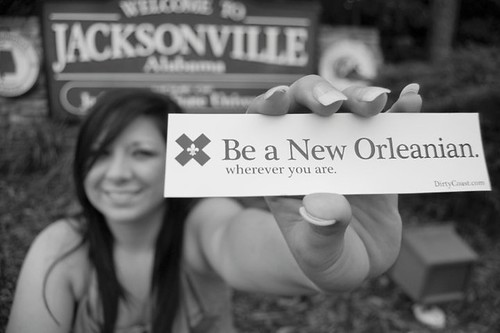
    Dirty Coast posts information on Twitter about contests they are hosting to win gift cards and gives a 10% discount for your check-in on FourSquare. They understand that the people that don their t-shirts are charitable folk, so Dirty Coast donates proceeds from the sale of certain shirt designs to benefit organizations like the LASPCA, the Gulf Restoration Network, and the New Orleans Musicians’ Clinic. They even make good on the local concept of lagniappe (a French word meaning small gift or little something extra) by giving away great stickers, including the now iconic car bumper staple that reads “Be a New Orleanian, Wherever You Are.” When a company is able to associate consumers’ buying power with the preservation of valuable culture and the promotion of “a greater good,” they earn brand loyalty that is exponentially multiplied when t-shirt wearers post pics on their cool duds on Instagram. They’ve even gotten some attention from the entertainment industry: actor Steve Zahn reps a new one of their shirts in almost every episode of HBO’s most recent season of Treme.

    Storyville rewards their staunch fans with opportunities to try their own hand at the apparel design game. Contests are hosted where the winning shirt designs are created and sold, along with a cash prize for the winner. This is just one way the store can establish a fan base and set itself apart from the competition — online shirt retailer Threadless has made a whole business model out of it. Storyville’s physical locations in Baton Rouge and Austin, TX receive glowing reviews from Yelpers. They use social media to inform followers of deals going on in-store, and even alert their Twitter followers to newsworthy information that their adoring public will care about. Most recently, the topic of conversation was the beloved Saints cheer “Who dat” and information about how many are fighting to keep the battle cry of the New Orleans Saints in the public domain.

    The bottom line is that it’s worth it to make time to study businesses that capture your attention online and through social media. The incentives these New Orleans t-shirt stores offer (discounts, coupon codes, contests) draw the consumer in and don’t even involve printing up a flyer or physically attracting the masses to a storefront to get big results. New Orleanians are a proud bunch, and we’re happy to show off our culture with these clever accoutrements — props to these retailers for getting it so very right with both their designs and their marketing approaches.

  • 5 for Friday — Links, Stories, & Posts for Your Weekend

    • What next for SEO? Five search trends for 2013 — The Drum

    There were some big changes in the search marketing landscape in 2012, and you’re likely to read all about them in an endless stream of “year in review” posts over the next month. This article focuses on forecasting the major developments of the next 12 months so you can get a jump on the trends of 2013.

    •  Glogou Launches Products To Help US Companies Do Search Marketing In China — Search Engine Land

    China is the fastest growing market in almost every industry, and it’s no different in Internet marketing. Baidu, China’s version of Google, is partnering with Silicon Valley-based Glogou to create an English-language ad market. As the second largest search engine in the world, Baidu will be a highly sought after marketplace in the near future.

    • IBM Study: How to Make Social Work — Marketing Pilgrim

    A recent study by IBM may be able to help you improve your efforts in social media marketing. The report defines the three basic goals that marketers should be striving for and illustrates each with helpful tips to get you there.

    • Master Google AdWords in 3 Steps With the 80/20 Rule — Search Engine Watch

    Can you master the complex world of AdWords in a week, a month, or even a year? Don’t count on it. However, this author has a strategy that can help you jump right in and get positive returns on your efforts. By focusing on what matters most, you can get results like a master.

    • The Importance of Marketing Analytics — SEOMoz

    This author encourages you to spread your commitment to number crunching analytics beyond the performance of your websites. Here are some tools to help you look past simple web results to measure the performance of your campaign. You’ll be able to answer the question “How did that marketing campaign really go?” with specific data instead of broad strokes.

  • Medium: Twitter’s Founder Develops WYSIWYG Blogging

    mediumAs an avid Tweeter, I’ve been excited about the launch of Medium since I first learned about the new site this summer. The promise of a service that bridges the gap between the 140 characters I already love and a more traditional blogging platform is one that excites both my passion for social media and my desire for a more directed writing channel. A traditional blog often seems like an exercise in futility for your average writer, but a system that is designed specifically for uncovering interesting posts — optimized for quality, rather than popularity — is one that I can certainly get behind. Medium founder Ev Williams took to the platform this week to discuss his new service’s functionality, and how editing and writing will work in the system.

    Ev describes the service as truly a “what you see is what you get” interface, as opposed to the creation vs. preview mode favored by so many other blog publishing systems. I’ve used both Blogger and WordPress extensively for blogging and I can tell you with certainty that neither system comes even close to presenting a seamless WYSIWYG interface. The frustration that arises when you click “Preview” for the tenth time while attempting to align a photo just right is one that I am sure all novice bloggers are familiar with. The idea of eliminating that frustration entirely is immensely appealing.

    Screen Shot 2012-11-28 at 1.48.00 PM Medium seeks to do more than just make blogging easier: it aims to reinvent digital publishing altogether. Beyond the aesthetic wonder of being able to edit the exact page you will publish, the service offers up a flexible range of post styles — you can publish just photos, just essays, or somewhere in between. My inner 13-year old envisions meaningful lines from my favorite songs attached to beautiful photos, and my slightly more rational (and significantly more jaded) 20-something self wants intelligent and argumentative pieces about why airlines should charge for carry-on luggage. Ev utilizes both of these styles in his own Medium collections, with topics ranging from “This Could Be Better” to “When I Was a Kid”. The options are virtually endless.

    The platform was recently released to all Twitter employees, which hopefully indicates that they are moving toward letting more users into the beta platform. There has been no official launch date released yet, but as they add increased functionality and grow the user base, Medium will hopefully be ready for a universal launch in the coming months.

    What do you think of Medium’s aims? Will they successfully revolutionize the digital media and blogging industry? Let us know your thoughts in the comments!

  • Did Social Fall Flat on Black Friday and Cyber Monday?

    Black Friday & Cyber Monday Sales DataThe weekend after Thanksgiving was one of the most aggressive marketing blitzes in recent memory. News reports had three shopping holidays to choose from: the venerable Black Friday, which started around 1961 but didn’t gain the influence it now has until as late as 2005; Small Business Saturday, a American Express-backed venture that took advantage of a Twitter hashtag in 2010 supporting local brick-and-mortars; and Cyber Monday, coined by the National Retail Federation in 2005. These three days have only been increasing in search volume and clout, and are now at the forefront of the holiday business season.


    The IBM Reports

    In today’s Big Data world, it’s easier than ever to analyze huge data sets and IBM was one of the first to get out a report on the buying weekend. Their Black Friday and Cyber Monday Reports are troves of information, giving website analytics data for e-commerce sites across a wide swath of industries. We were hipped to this data by Mashable, who curiously reported that Twitter yielded no revenue to these clients. It seems that despite massively ramped-up social advertising spending this year, leading BIA/Kelsey to project a 19.2% compound annual growth rate to 2016, social media sites only offered .34% of referrers on sales on Black Friday and .41% on Cyber Monday. Representing a loss in revenue of 35% and 24% respectively, it might seem that social was a dud.

    However, between the three shopping days, over 447,000 people used the related hashtags, and millions more used less tech-savvy terms to talk about the events. Twitter, Facebook, and other social media sites have become utterly ubiquitous, combining with the adoption of social media by people who are wealthy enough to buy the majority of gifts for the holidays — that is, parents. Was all that marketing a waste? Or was social media part of a wider sales strategy that led to an annual e-commerce sales growth of 20% on Black Friday and 30% on Cyber Monday?

    Black Friday & Cyber Monday Sales Data

    Did View-Through Traffic Matter?

    Black Friday & Cyber Monday Sales Data My immediate thought when looking at this data was that social media was being discounted, as it often is an intermediary step between product research and buying that product. Especially during sales, users will shop around, compare products, and come to the same retailer through a variety of advertising channels. Much like paid search and organic social media posts, the buying cycle can be particularly long, especially when all of your competitors are also vying for your customers.

    But even clicks aren’t particularly valuable as a metric, as many saw these deals passively through advertisements and posts in their feed. Social media acts similarly to television ads, giving snippets of information to raise interest. This kind of passive brand-building is hard to track, but certainly affects users by letting them know that there’s a sale and they should check out the site for more deals, leading to businesses over-valuing direct rather than social media traffic. While this kind of analysis is difficult, businesses have to use impression-based attribution to track the ROI of social media.

    The Power of Email

    Also left out of IBM’s analysis is email. We’ve all seen our inboxes swell with bacn as the buying season approached, warning us of the deals to come on all the sites that have acquired our email at some point. Major retailers carpet-bombed our inboxes, leaving hundreds of subject lines for us to click or ignore. Many marketers champion email as a much more effective use of marketing spend that users prefer to social media advertising. Why did IBM choose to ignore the direct-mail campaigns in their study?

    Did You Know?

    Regardless of their flaws, the IBM reports are a wealth of data for marketers both in e-commerce and keeping track of the information to strengthen their own marketing campaigns. Some key takeaways:

    Black Friday Year-Over-Year Stats

    • Average Order Value is down 5%
    • Average Session Length is down 10%
    • Mobile Sales and Traffic are up 66%
    • Sales Peaked at 8:45am PST (11:45 EST)
    • Secondary Sales Peak at 7:35pm PST (10:35 EST)

    Cyber Monday Stats

    • Average Order Value is down 7%
    • Average Session Length is down 5%
    • Mobile Sales and Traffic are up 96% and 71%
    • Sales Peaked at 8:05pm PST (11:05 EST)
    • Secondary Sales Peak at 8:25am PST (11:25 EST)

    A Quick Poll

    Please take this quick poll to see an unscientific review of the data points from the IBM reports.

    Results