Category: Social Media

  • Pinterest Announces Analytics for Business Profiles

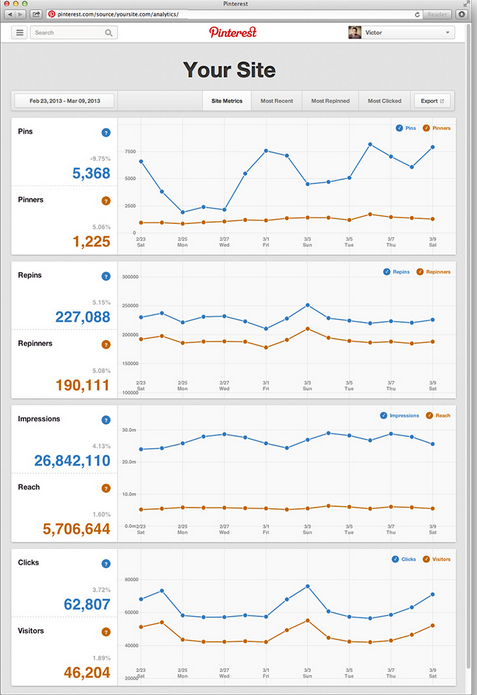
    Recently, Pinterest launched its Web Analytics, allowing for businesses with verified accounts to track how many users are pinning from their site, the number of impressions from each pin, and incoming site traffic that is being generated directly from Pinterest.
    pinterest

    Outside of SEO and social media campaigns, many may argue that there is no way to successfully tracking branding and traditional advertising efforts.  Pinterest will argue this as this data now allows businesses to successfully track how users are interacting with their pins, products, and most importantly – how they are most likely to convert.

    The launch of Pinterest for Business in late 2012 welcomed businesses to develop professional profiles and the implementation of “pin-it” widgets. Naturally this has been great for businesses across the board! Not only does having a professional Pinterest board increases brand awareness and a brand’s social presence, but also provides another avenue in generating site traffic.

    By implementing social sharing widgets on a new product page, allows for users to quickly view a product they are interested in, and repin this great finding to the world of Pinterest.

    So, yes we know how great Pinterest is, but what we really need to know is how it can make us money! As a business owner, our job is to create shareable content to promote products, and Pinterest’s job is to push it out. With this tool, we can track exactly how our marketing content is being socially pushed out! Businesses can now track how many pins are being pinned from the site, the impressions generated by each pin, and the number of repins generated by the original pin.  Tracking of clicks and social reach is also available.  Pretty cool we can now track the click through rate (CTR) for a specific product or pin!
    pinterest1

    Successfully tracking how customers pin their favorite blouse to a board where all their followings can see it (impression), allowing for new followers to visit your site (traffic), and potentially buy that same blouse (conversion), is a dream come true for e-commerce sites!

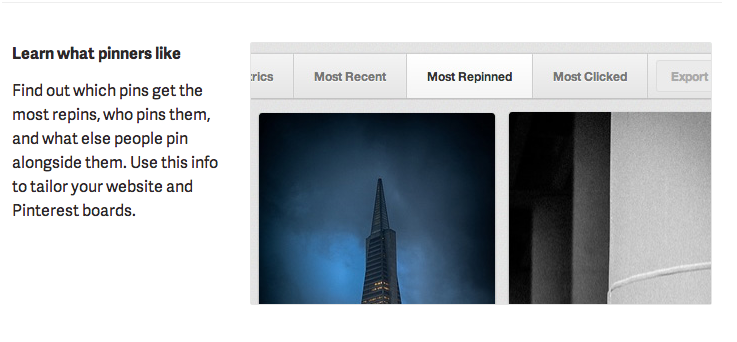
    From a business perspective this allows us to really understand what our target market is interested in.  Tracking which pin is the most successful allows us to analyze specific, engaging content that may lead to a higher conversion rate.

    With social media constantly growing and changing, and the need to market businesses on social platforms only increasing, the launch of this new tracking device may even convince other business to get on board with Pinterest.

    Now, how much longer until we see ads on Pinterest?

  • 5 Tips for Proper Hashtag Usage


    I love social media. I also love staying organized. The great thing about hashtags is they bring the two together. For those who don’t know, hashtags are a way to categorize a post on social media platforms, like Twitter and Instagram, by tagging it with descriptive words or phrases. Hashtags are also helpful for businesses running specific campaigns to monitor what followers are saying about their company. Although we all love reading about the latest social media blunders, we never want to fall victim to them ourselves. That is why I’ve compiled a list of questions to ask yourself when choosing a hashtag.

    1. Is this hashtag trending?

    Trending hashtags are a great way to get your message out there, and even help you brainstorm interesting, relevant tweets. If you can seamlessly incorporate your message with a trending topic, others will be able to see your post when browsing that hashtag. Although trending topics are a great first step in choosing a good hashtag, you should be careful to understand why the hashtag is trending. This takes me to the next question…

    2. How is this hashtag currently being used?

    Before hitting the submit button, you absolutely want to see how the hashtag is being used. Learn a lesson from Entenmann’s. Back in 2011 when Casey Anthony’s trial ended with a verdict of “not guilty,” Entenmann’s tweeted the following using a trending hashtag:

    Angry, Entenmann’s followers made their disapproval known causing the company to delete the message and issue an apology.
    3. Is this hashtag concise, yet descriptive

    You want to make sure your audience can read and understand the hashtag, whether you are posting for a business or your own personal account. This is important if you are a business trying to start a hashtag campaign, like Dominos or Edge shave gel, or simply telling friends about your new shoes. While it may seem funny to have a long hashtag (example: “Gabrielle stole my favorite sweater AGAIN #mysisterdrivesmecrazy”) it is not easily read at first sight. One way to make hashtags easier to read it to capitalize the first letter of each word in the hashtag. However, if you find your hashtag looking something like an excerpt from a Charles Dickens novel, you should probably just shorten the whole thing altogether. If your hashtag is easily read by your audience, it has a greater chance at being effective.

    4. Is this hashtag too broad?

    While it may be topical to your message, broad hashtags are generally not searched. If you are a business, ideally you would like your hashtags to be interesting and search-worthy, as this could bring new eyes to your message. If your hashtag is not searched, it will not help you reach new audiences. Another problem with broad hashtags, for both business and personal profiles, is that they do not add additional value to your message.


    In this example, the hashtag #hat does not offer any additional insight, and causes the tweet to become repetitive.

    5. Does the place I am posting to recognize hashtags?


    As funny as it may seem, it is important to know that the hashtag you send your friend via text is not recognized online. That being said, here is a list of a few places that do and do not recognize hashtags.

    These places DO recognize hashtags
    -Twitter
    -Instagram
    -Google+
    -LinkedIn
    -Pinterest

    These places DO NOT recognize hashtags
    -Text messages
    -Facebook (although they are working on incorporating hashtags now)


    Whether your posts are seen by millions of viewers or just your closest friends, the important idea here is to think before you post. Let’s make 2013 a year with no social media mistakes!

  • 2013: The #YearoftheTweet

    Tweet-of-the-yearAlthough some consider Twitter the redheaded stepchild to the social media behemoth that is Facebook, brands are beginning to recognize and harness the “real time value” of Tweeting. No one can deny that Twitter is growing in both users and usage. The number of tweets per day has increased from 95 million in 2010 to a staggering 340 million per day in 2012, that’s 236,111 tweets per minute! Brands have started advertising on the fly, attempting to engage and interact with their audiences via #Twitter.
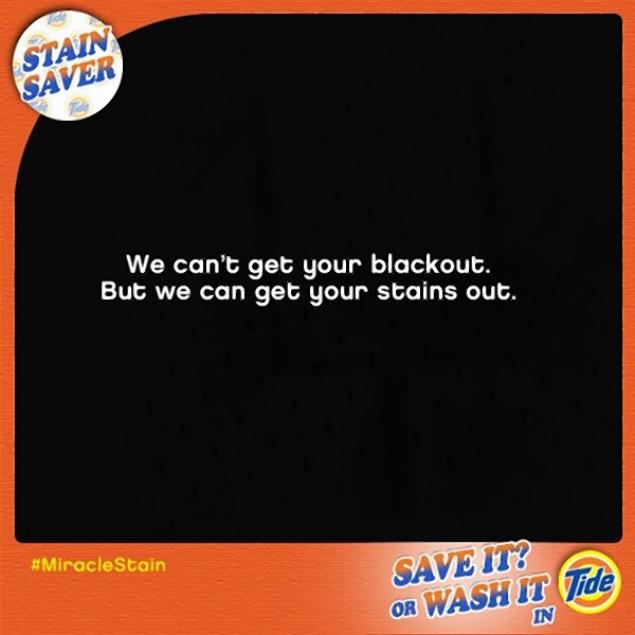
    A picture may be worth 1,000 words, but a tweet is worth 140 characters, and brands are capitalizing on spontaneous televised hiccups (such as Blackout Bowl of 2013) and classic entertainment award shows (like the Oscars). This type of instantaneous and off the cuff marketing is a new and exciting frontier in the advertising world. Many brands, such as Oreo and Tide, dedicate entire teams to audience interaction via social media and specifically Twitter. The relevance and quick wit both brands displayed during the 2013 Super Bowl black out generated thousands of retweets and responses in an organic and viral way.

    dark5n-5-web


    Seeing how far brand advertisements have progressed in the Twittersphere, it’s easy to forget that the first hashtagged Super Bowl spot appeared on television only three years ago. The 2013 Super Bowl saw over half of the ads display a hashtag call to action. Yet, Twitter isn’t only for the young and hip brands. Older skewed organizations, such as AARP, are also taking advantage of the social site. AARP used the State of the Union address and appropriate hashtags to lobby for retirement protection. At one point, President Obama singled out a 102-year-old retiree in the audience, Desiline Victor, and AARP immediately began Twitter promotions on Desiline’s name.

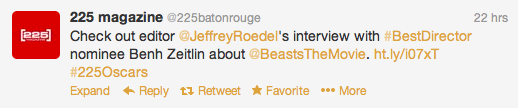
    Local brands fear not! While we all saw how JCPenney had a strong Twitter presence during the Oscars,  Twitter’s real time advertising isn’t just for the big boy advertisers. Local businesses customized their hashtags in order to stay relevant within their geographic market. For example, Baton Rouge tweeters used #225Oscars during the awards ceremony, and the Baton Rouge magazine, 225, used the opportunity to promote an interview with an Oscar nominee found on the magazine’s web site.

    Screen Shot 2013-02-25 at 3.21.35 PM

    As a brand looking to capitalize on your tweeting demographics, it’s important to keep in mind a few key points about the platform. It’s important to tweet about relevant events or topics, and timeliness is of the upmost importance. Witty observations or comical tweets may generate the most audience interaction, and including a link to your site will generate web visits. Marketers are still analyzing whether these viral tweets deliver revenue, but the brand awareness of a well-crafted hashtag may just be priceless.

  • The New Facebook News Feed – What Brands and Users Need to Know

    8539089499_eb76f0393d_b Facebook announced a new look to their News Feed yesterday, which aims to streamline its appearance and cut down on irrelevant stories. In fact, the tagline on their announcement reads “Goodbye Clutter… Hello bright, beautiful stories.” The new version will focus on images, and they will appear much larger and richer than they had previously. To many reviewers, the updated feed looks like a cross between Google+ and the Facebook Mobile app. For the first time, the platform will look virtually the same across different devices. This leaves just one big question for both Facebook users and brands… Where will the ads go?

    Never fear, Facebook advertisers, this update looks poised to deliver even larger and more effective ads than those that are available on the current version of News Feed. The three column design of the new layout allows for larger images and stories from your friends, but also allows for richer, more striking sponsored stories from advertisers. And in the end, isn’t that what Facebook shareholders are demanding? The new update downplays and shrinks the traditional right side bar ads, which seems designed to push brands to utilize creative content and sponsored stories to target potential fans.

    The updated News Feed may impact businesses’ organic reach significantly. And truthfully, this may be a deliberate plan to get more brands to utilize sponsored stories in order to reach a wider audience. Facebook quietly released a “Pages” feed several months ago, which has been popping up more and more on my News Feed in the last few weeks to highlight brands I rarely click on. With the new update comes an “All Friends” feed, which allows you to only see people you are friends with in real life on your News Feed. Although Facebook claims the News Feed algorithm will not be changing, its not hard to imagine many users will be clicking “All Friends” rather than viewing their entire feed.

    Mashable has some great tips on some ways brands and publishers can get a jump start on succeeding in the new News Feed, many of which are as simple as updating your brand’s cover photo. The biggest takeaway from Facebook’s new look is that brands need to focus more intently on sharable, high quality images, videos, and links rather than plain text updates. For some this might take a bit of adjustment, but it has been a known fact for some time that posts with photos or links get far more interaction on the social media network than text-only statuses.

    Screen Shot 2013-03-07 at 3.52.03 PM For the average user, this update seems like an overall positive design change. The look of the News Feed hasn’t been updated in over two years, and quite frankly seems overrun by apps and useless stories. Personally, if the top story on my News Feed is never about “Candy Crush Saga” again (a game I don’t play, for the record) I will be one happy girl. With this redesign, Facebook seems to be getting back to what matters, content from people you actually care about. In the end, isn’t that the point of social media?

  • WTF Facebook?

    On Friday, I received an email from Facebook regarding their Page Insights. My initial reactions were “Great! They’ve finally realized how horrible their reporting system is and are making changes!” Boy, was I wrong. The email in its entirety is below, but the man gist is that they have been incorrectly reporting on the number of total, organic, and paid impressions and reach as reported through their Page Insights. Supposedly, the Ad Insights and Billing Data reporting tools are not affected, not that those are great anyway.

    They promise that these issues will be fixed by today and “moving forward, your impressions and reach numbers in Page Insights will reflect these updates.”

    The real kicker however, is that these issues impacted their “logging system,” so they will not be able to provide accurate historical data for organic and paid reach and impressions (in Page Insights). I mean, come on! Not only is Facebook’s reporting platform not intuitive, but your historical data is now inaccurate or missing.

    Facebook’s reporting platforms have continued to disappoint, and this is no exception. It would be great if they spent some time gathering data about what their users want and need, and how best to display that data. I guess I have to give them some props for admitting their mistake and fixing it ASAP, although I was hoping for more.

    What data would you find interesting for Facebook to report on? Let us know!

  • TV’s Next Social Media Superstar Is…

    In 2012, the number of people using social media grew to 1.43 billion users. This stark increase in tweeting, posting, and pinning has grabbed the attention of traditional marketers – most notably: Television. TV shows are not only leveraging social to increase brand awareness and interactions but to increase ratings. While some shows are “duh, winning”, there have been some shows that are just doing it all wrong. This post is going to take a look at my winner and loser of TV social media in 2012.

    Winner: RuPaul’s Drag Race

    Before everyone started mopping their marketing, THE BEST REALITY SHOW EVER, RuPaul’s Drag Race, realized the importance of social media. In 2011, they started watermarking the Twitter hash tag #DragRace during the show. This humble hash tab would eventually birth such memorable hash tags as:
    #SnatchGame
    #TheLibraryIsOpen
    #RuPocalypse
    #RuPologize

    And my personal favorite…

    #indabuttru
    “That’s #InDaButtRu”

    Drag Race’s use of hash tags is genius because it encourages interesting conversations between fans and generates social buzz in real-time.

    But of course like any good lover, RuPaul’s Drag Race is versatile. The show encouraged viewers to vote on Twitter and Facebook who would be the winner at the end of the season. By including viewers on multiple social media platforms in the decision making process, Drag Race season 4 finale was up 33% the previous year’s.

    In a sentence: RuPaul’s Drag Race really know how to burn rubber get the most out of its social media MPG and leave others in the dust.

    I apologize for the racing puns…

    Loser: America’s Next Top Model

    RuPaul isn’t the only supermodel of the world using social media. In an attempt to generate its former success, America’s Next Top Model decided to include a “social media score” in their 19th cycle. While I’m not sure how one averages catty comments about terrible makeovers and catalog poses, ANTM has managed to get its remaining audience more involved. Unfortunately Top Model saw their ratings take a tumblr (urgh more puns) down to 1.22 million viewers.

    It’s not surprising that ANTM’s attempts at social media went so poorly. If you are going to declare the new judge is “social media”, it should actually be social media. You know, Twitter, Facebook, etc. Instead Ty-Ty put together a small select group of viewers and passed this off as social media.  This bothers me (and about 1.22 million teenage girls) for three reasons:

    1. Being selective on whose opinions matter isn’t social, its fascist. Not that I expect Tyra to know the difference, you can bank on that (oh god another pun).
    2. The comments from social media were filled with so many Tyra-isms you would think they were excerpts from Modelland and instead of real people.
    3. A numeric voting system used to vote on physical appearance isn’t social media, it’s hotornot.com

    Also Bryanboy was a poor choice to present “results”.  His delivery was Sahara (RIP). The numero uno rule of social is to be sharable (i.e. fun, interesting, and outlandish) which BB simply was not.  This media boner could have actually worked if you had one of the Jays – it would have at least been entertaining to watch.


    I think calling it social media was Tyra’s way to continue to live in her fantasy world that her show is relevant and people are still hopeful it will produce a supermodel.

    Hate to do this Tyra but here is what social media is really saying about your show:

    I think the lesson TV shows should learn is social media is like ballroom culture. If you are serving “realness,” the children will live and you will be legendary.  You can’t make grandiose claims about the viewer having control over programming when in reality the show has been taped, shipped, and ready for airing months before the premiere. Good or bad, encouraging discussion on social media will reward your show and organically grow your audience, just look at GLEE.

  • Super Bowl Social Media: A Touchdown Pass for National Brands

    Super Bowl advertising spots are one of the most sought after 30 seconds in television each year. With the event having an estimated viewership of well over 110 million, many national companies view the hefty $4 million dollar price tag as money well spent. In fact, the New York Times reported that the ad spots were already sold out on January 8th, almost a full month before the big event. In recent years many companies have amped up their traditional television campaigns to include YouTube sneak peeks, dedicated websites, hashtags, Facebook campaigns, and apps designed to garner appeal and catch their audience’s attention on the second screen. Social media is a growing factor in many major corporation’s 2013 Super Bowl advertising campaigns, which is a huge change from the surprise element and secretive campaigns of years past.

    The YouTube teaser video is a popular move by many major national brands. This year, one of the most viral involves model Kate Upton “washing” a Mercedes-Benz, a clip that has already been viewed by over 5 million people. The video directs the audience to the Mercedes USA Facebook page, where more teaser clips of their Super Bowl promo are linked. This method of social integration leads to viewers interacting with the brand on several different forms of media, all well before the Super Bowl kickoff, and creates a great deal of buzz for the 30 second ad spot.

    Coca-Cola was the first brand to launch their Super Bowl campaign this year, which features a gamified “choose your own ending” storyline that asks viewers to vote on the official Super Bowl commercial. Like the Mercedes campaign, Coke has also expanded the storyline on their Facebook page. With polls, character bios, additional video clips and more posted on their Timeline, Coca-Cola also seeks to engage with their audience in an unpaid, organic manner. The use of polls and competition between the three video endings adds an additional level of interaction and has fans gunning for their favorites.

    Other companies have taken a social approach to the entire advertising process. Popular deodorant company Speed Stick ran a contest through its Twitter profile with the hashtag #handleit to solicit pitches for its very first Super Bowl spot. The winning tweets are all already up on Tongal and lead to a funny and viral campaign for an everyday product. They’ve tied the campaign in to their Youtube Channel, which features dozens of “Handle It” moments. It’s definitely a nontraditional move to release a full Super Bowl ad ahead of the big weekend, but it works for Speed Stick’s entirely social campaign.

    Major corporations’ Super Bowl social media campaigns extend their advertising buzz well beyond the big game. By harnessing organic user interest on multiple channels, the expense of a 30 second ad spot seems almost worth it. Do you like the modern trend of brands releasing their Super Bowl commercials ahead of the big game? Let us know in the comments!

  • 5 for Friday — Links, Stories & Posts For Your Weekend, 5pecial Graph 5earch Edition!

    In a special edition of 5 for Friday, we’ve compiled the best articles about Facebook’s new Graph Search, which was released for beta testing on January 15!

    Facebook SEO Comes to Life as Graph Search Launches — Social Media Today

    Facebook’s newest addition, Graph Search, blurs the line between social and search, gearing towards a new type of search behavior that combines relevant and timely content. Rather than provide the same results as Google or Bing, Graph Search provides personalized results including individuals, photos, places, and interests.

    Facebook Graph Beta Offers Multidimensional Social Search, New Networking Capabilities — Search Influence

    Normally I avoid our own blog in the 5 for Friday recap, but I LOL’d at this flashback to the good ol’ days when an .edu email address was required to have a Facebook account and created a “25-and-under wonderland of location-based dating.” Now with Graph Search, we can search friends of friends who have similar interests, thus making connecting a whole lot easier!

    New Tumblr Blog Raises Privacy Concerns Over Facebook Graph Search — Search Engine Land

    Graph Search has already raised questions regarding the loss of privacy. The discovery tool has the potential to take a very creepy turn — Tom Scott’s Tumblr blog includes searches such as “Single women who live nearby and who are interested in men and like getting drunk” to demonstrate the lurking possibilities. Fortunately, Facebook has improved their privacy settings and included tips on how to control what others see. Our tip? If you wouldn’t want your newly “Internet-savvy” grandmama to see it, keep it off of the ‘book.

    Four Things Marketers Can Do with Facebook Graph Search — AllFacebook

    While businesses cannot optimize their pages for Graph Search, they can take advantage of the new “third pillar.” According to AllFacebook, Graph Search delivers advertising tools to businesses, including higher click through rates, sponsored results, advanced targeting and demographic research.

    Facebook Graph Search MANIA! Must-Read Resources, UI Tour & Review — AimClear

    AimClear is already looking to the future, questioning where Facebook will take Graph Search next:
    Graph Search PPC?
    Event categories?
    Specific posts?
     
     
    Share your predictions for the future of Graph Search in the comments section below!

  • The Bluths Take On Social Media: Arrested Development, Netflix, and the Importance of the Banana Stand

    This Is The Story of a Wealthy Family Who Lost Everything, and the Social Media Campaign That Got Them Back Together.

    While social media marketing is a useful and effective means of interacting with your customer base, not every campaign has the moxie to make your efforts take off — but one recently-revived cult television show is pulling out all the stops. Arrested Development has long been known for actively engaging its fanbase with inside jokes, subtle callbacks and clever Easter eggs. Cancelled after just two and a half short but brilliant seasons, AD accumulated such a devoted fanbase that the outcry prompted a full-scale resurrection over eight years later. Now that Netflix has revived the show for another 14 episodes, the show has dedicated its online efforts to getting fans excited all over again. By leveraging the show’s trademark subtle callbacks and absurdist humor, Netflix is keeping its userbase and its desires in mind — the first and most important rule of any social media campaign.

    Some Fake Landing Pages, Raw Veggies, Cup-A-Soup — Baby, You Got A Social Media Stew Going

    The first Easter egg Netflix launched in anticipation of the new episodes was to create fake Netflix landing pages for all the television shows and movies that have been mentioned on the show, from the titillating Les Cousins Dangereux to the schlocky Mock Trial with J. Reinhold. Upon clicking the link to the film, the user is taken to the Arrested Development scene where the title appeared.

    The show has a history of creating websites and landing pages for running gags that occur in the narrative, one of the first television acts to do so all the way back in Ye Olde Internete of 2005. During AD’s original run, you were able to visit the Bob Loblaw Law Blog and ImOscar.com, both websites that were mentioned in multiple episodes of the series. It’s a hilarious meta-promotion of the kind of absurd, deadpan humor that made the show so beloved. Breaking or blurring the fourth wall between advertising and the product it’s promoting can be highly effective when you’re trying to reach a variety of Web-savvy users.

    Yeah, You’re Gonna Get Some Walk-Ons

    The most engaging of ways Netflix is attempting to drum up excitement for the new “don’t call it a season” season of the show is by holding a contest to have a walk-on role on the new episodes. Gamification, when used wisely, can really heighten user engagement by creating competition while attracting attention with the prize of ultimate fan fulfillment. Netflix asked fans to create a tribute of some sort to the show. Fans responded by dressing as different characters, creating different crafts or songs, and even creating an entire website with original artwork. The winning entries were amazing, and showed a dedication that genuinely warranted a walk-on role to the show.

    I Just Blue Myself!

    Certainly the most clever and subtle of Netflix’s Easter eggs has to do with a season-long running gag about Tobias Fünke becoming an understudy for the Blue Man Group. During the course of season 2, the blue paint from Tobias’ “costume” would rub off on pretty much every surface in the Bluth’s model home. Now searching anything with “blue” in the title, such as “Blue Velvet,” will lead you to a search page with blue smudges and handprints along the side. When you click on a handprint, Netflix serves you a now-infamous scene from the show where Tobias utters the phrase, “I just blue myself!” By creating a subtle but noticeable gag, Netflix creates both an accessible reference point for the show’s fanbase as well as conjuring up curiosity and interest in people unfamiliar with the show.

    More Touching!

    Engaging your customers via social media and viral marketing can be a great way to create a casual and fun appeal for your product, as well as cultivate brand loyalty from your base. It also gives new customers a great jumping-off point in how to interface with your brand. It’s important to show your users that your brand is in-tune with what their particular kind of chicken dance, and a well-crafted and executed social media campaign will put that message front and center. By carefully incorporating so many of the now-iconic callbacks and running gags of the original series, Netflix has done a superb job appealing to fans and drawing in new viewers alike. Keep your eyes peeled for new episodes in May 2013 — and for God’s sake, don’t forget to leave a note.

  • Facebook Graph Beta Offers Multidimensional Social Search, New Networking Capabilities

    Facebook’s Graph search introduces a new multi-dimensional tool for discovering people, places and things filtered by your personal friends and likes. The concept isn’t entirely new — Bing has been integrating social data into its results for over a year now now, and the Google Hotpot experiment (failed though it was) featured location- and personal recommendation-based place discovery, as well as a host of Foursquaresque features such as check-ins and reviews. However, Graph offers social search on an unprecedented scale, with access to likes, posts and preferences of users’ entire social network.

    It’s been said that Facebook has become something like a search engine for people, and they’re moving into direct competition with Google with Graph. The levels of refinement are remarkable (from geographic location to employer to relationship status to hometown and more). Music preferred by people who live in Austin and Like “Motown”? Television shows for engineers over 35? No problem. Your friends with friends who work at Google? Start flexing those networking muscles.

    Local search promises to be another strong point: if you need a plumber or a doctor, you’d trust your friends to make recommendations. With Graph, you can simply discover professionals in the area with a high rating from your network. It’s going to be important for small business owners to start owning their Facebook presence harder than ever.

    Of course, the value of Graph is going to depend heavily on the extent of a user’s personal network — even the most dedicated of social networking addicts would be hard-pressed to Like their accountant on the ‘book. But it’s a self-fulfilling cycle: the more things that a user Likes, the more extensive and accurate their data becomes, providing better recommendations, which lead to more Likes, which grows the data further.

    Users will also be able to view a comprehensive backlog of the things they’ve Liked over the years — useful for search, but not so much for the nostalgia and/or procrastination-inclined among us. Tom Stocky, director of product management at Facebook, characterizes the new capability as a “third feed” for users: you have Timeline, which allows you to see your own activity, and the News Feed, which allows you to see others’ — now the “search feed” allows you to see an archived history of what you Like (and like, for that matter).

    We can only hope that “Looking For: Random Play” will make a resurgence in 2013.
    But enough about search ramifications and local business: let’s talk about how this is Facebook going back to its roots as a people engine. I’m of the generation that started using the ‘book when it required a .edu email address, producing a 25-and-under wonderland of a location-based dating site (or hookup machine, if that’s what you’re into). These days, it’s positively weird to get a message or request from a stranger who saw your profile and wants to get all up ons. However, with Graph, the networking potential is enormous — I’ll be surprised if the increased access to data doesn’t lead to a massive uptick in communication specifically via Facebook, or at least reduces the stigma of having an inquiry slotted into the dreaded “Other” box.

    Facebook Graph is the company’s first “beta” product, with a waitlist that will slowly open to English-speaking users first, then other languages. It’s tough to offer a value judgment on something so new, but personally, I’m optimistic. Graph’s potential is enormous to users (who doesn’t love getting personal recommendations without the effort of actually making a phone call?), businesses (who stand to gain a lot of notoriety if they play their social media cards right) and marketers (who have access to a veritable treasure trove of incredibly specific demographic targeting data) alike.

    Of course, Graph will be most valuable to those who are fully immersed in the service and have friends who do the same — but with Facebook’s 800 million-strong base and the heavy-engagement nature of the service, that’s a hell of a sample size. It’s a smart move for Facebook as a company and a potentially incredible tool for its users. Keep your eyes on this space for further reports as details roll out!