Category: SEO

  • Best of the Best of Canadian Citations – Canada Business Directory

    Canada Business Directory Image

    The choice of local citation sources in Canada is sparse, especially when comparing the sheer amount available for use in America. Here at Search Influence, we figured we’d do our part and help out our neighbors to the north by doing a bit of research into the most valuable directories available to them. Before we get to the list, let’s first explain a little about the method we used to rank them.

    PageRank

    PageRank is a complicated algorithm that Google uses to measure the relative importance of a site when determining how it should rank within search results. The way it does this is by analyzing how many sites link to it and, more importantly, the strength of these sites. In other words, a site with one high-ranking site linking to it can have a higher PR than one that has multiple lower ranking sites pointing to it.

    If I were a math wiz, I might be able to explain how this algorithm works. Unfortunately I’m not, so I’ll just trust Wikipedia’s explanation: “The PageRank conferred by an outbound link is equal to the document’s own PageRank score divided by the normalized number of outbound links L( )” Or in other words,

    Canadian Business Directory Image

    mozRank

    mozRank and PageRank both measure the same thing. However, mozRank is generally said to be more accurate in its results. For example, a directory with a PR of 7 may have a mR of 6.15. Generally, any site that has a PR above 5 will typically be undervalued in its mR, as displayed above.

    Citations

    A citation is any time a business’s name, address, and phone number are listed on the web. Similar to PR, it’s not just about the number of citations a business has, but the trust of these citations as well. Using the local citation finder from WhiteSpark, we used three different keywords to crawl high-ranking local listings and found how many times these directories were listed as citation sources.

    Now, on to the findings! The top 10 Canadian citation source according to Search Influence:

    YellowPages.ca

    This one is the clear winner, and this should come as no surprise. It’s tied for the highest PageRank with 8, and has the second highest mozRank with 6.8. The reason this one is chosen for the top spot is because it has way more citations than the number two position. Its high Page and mozRank, coupled with the citations you’ll receive from it make this an invaluable source for your business’s listing. Only thing required to get listed is a business line registration from the Canadian YellowPages.

    BBB.org/Canada

    This directory isn’t specific to Canada, but it still holds high value due to its PageRank of 8, as well as its mozRank of 7.38. However, it has a comparatively pitiful number of citations with only 10. The sheer weight that a link and/or citation from the Better Business Bureau provides makes for a great resource.  The only way to get listed is by contacting the Vice President for Business Relations.

    CanPages.ca

    Very similar to look and layout of YellowPages, this directory is nearly as distinguished. PangeRank of 7 and mozRank of 6.15, we found a whopping 40 citations using WhiteSpark. Sign up here.

    WebLocal.ca

    With a PageRank of 6, a higher mozRank (which is pretty rare, I’ve found) of 6.5. and 27 citations found, this is another notable directory. Sign up now.

    411.ca

    Similar to America’s use of 411. PageRank – 7; mozRank – 5.63; Citations – 14. It may have a higher PageRank than WebLocal, but it gets beat out in the other two stats. Still, I wouldn’t pass the chance to get listed here.

    GoldBook.ca

    Another one trying to follow in the footsteps of YellowPages. PageRank – 7; mozRank 6.4; Citations – 7. It’s on the lower-end of the number of citations, but it’s the only other one with rankings that can compare to the above.

    Yelp.ca

    PageRank – 6; mozRank – 4.23; Citations – 17. Just as in the States, every business should be listed on Yelp. No doubt about it. Get listed now.

    iBegin.com

    PageRank – 6; mozRank – 6.05; Citations – 12. Submit you business here.

    ProfileCanada.com

    PageRank – 6; mozRank – 6.12; Citations – 5. You have to complete a downloadable form to sign up.

    ZipLocal.ca

    PageRank – 5; mozRank – 5.06; Citations – 16. High citations number. Too bad we can’t say the same for the rankings. Still, a valuable directory that I would not hesitate to get listed in.

    So that’s it! Submit your business to these directories and watch your rankings climb!

  • Google Privacy Settlement is Just Strange

    The other day, every Google Mail user got the same message in their inbox:

    Just kidding. This is the actual message:

    Google rarely contacts Gmail users via email, but we are making an exception to let you know that we’ve reached a settlement in a lawsuit regarding Google Buzz (http://buzz.google.com), a service we launched within Gmail in February of this year.

    Shortly after its launch, we heard from a number of people who were concerned about privacy. In addition, we were sued by a group of Buzz users and recently reached a settlement in this case.

    The settlement acknowledges that we quickly changed the service to address users’ concerns. In addition, Google has committed $8.5 million to an independent fund, most of which will support organizations promoting privacy education and policy on the web. We will also do more to educate people about privacy controls specific to Buzz. The more people know about privacy online, the better their online experience will be.

    Just to be clear, this is not a settlement in which people who use Gmail can file to receive compensation. Everyone in the U.S. who uses Gmail is included in the settlement, unless you personally decide to opt out before December 6, 2010. The Court will consider final approval of the agreement on January 31, 2011. This email is a summary of the settlement, and more detailed information and instructions approved by the court, including instructions about how to opt out, object, or comment, are available at http://www.BuzzClassAction.com (no longer available).

    Again, to be clear, no Gmail or Buzz user can get money from the settlement because, as the class action notice states, “few, if any, Class members suffered compensable actual damages and because a pro-rata distribution of the fund to the class would not be feasible due to the size of the Class.”

    First filed around February 17 by Harvard law student Eva Hibnick, about a week after Google announced Buzz as an expansion of Gmail, the lawsuit almost seems like a class exercise. The complaint cites violations of the Federal Wiretap Act, the Federal Computer Fraud and Abuse Act, the Federal Stored Communications Act and California common law.

    None of the plaintiffs mentioned in the Class Action Complaint claim to have any palpable damages, all saying “Google automatically activated the Buzz program on [the plaintiff’s] email account, as a result of which Buzz broadcast her personal information to other Gmail users and/or made this information publicly viewable on the Internet.” In addition, the plaintiffs’ already liberal use of privacy-compromising internet apps, such as Facebook, doesn’t help their case.

    However, that litany lacking damages leads to a list of media accounts. Despite the cries of quelle horreur, the first example simply looks like good reporting and increased governmental transparency and the second only gives more credence to the use of COPPA. Later examples are more effective, but the question in my mind centers around the lawyers and their lack of willingness to contact more damning plaintiffs, such as a medical or legal office or the woman mentioned in the Times piece.

    The plaintiffs are concerned about the personal contact information automatically released by Buzz, such as place of residence, occupation, and email address. Furthermore, Google collected pictures and video from other Google-owned sites and showed them in Buzz, allowing anyone to view them. Finally, Google automatically created “Follow” lists, allowing Buzz to show a user’s list of contacts. These on their own would probably be a welcome change from the standard friend-finding on other social networking apps, but Buzz’s automatic enrollment ruined the experience for users.

    While it is a mystery how the privacy settings were missed in development—possibly it was a feature, not a bug—over four days, Google made 5 major edits noted in the settlement, and re-publicized the privacy setting change in April. These actions were clearly mitigating to the charges, and likely avoided any sizable penalty for the Company.

    So what is the penalty? Google publicizes an $8.5 million slush fund for internet privacy awareness, education, and policy formation. What they don’t tell you upfront is that the two attorneys for the suit, Gary E. Mason and Michael Ram, received 1/4 of the fund, $2.125 million, between them. In addition, each of the 7 named plaintiffs got $2500 each, leaving about $6.4 million for the fund.

    It’s clear Google wants to show they’re on top of privacy issues and certainly wants to keep the mindset of “Don’t be Evil,” despite officially dropping the motto. The question remains if the public will buy it. The public doesn’t really seem to care about privacy.

    Google’s share was up by 60¢ (.1%) after the emails went out two days ago, and was up $2.18 (.35%) at the time of writing. Looks like the public bought it–will those who were truly affected by the privacy leak feel the same way?

  • New Google Local Changes Everything

    Google is rolling out a nationwide update that drastically changes the way prospective customers see you and your competitors through what Google calls “Place Search.”

    The new integrated results combine your organic and local rankings in a new Google algorithm intended to make finding businesses easier.

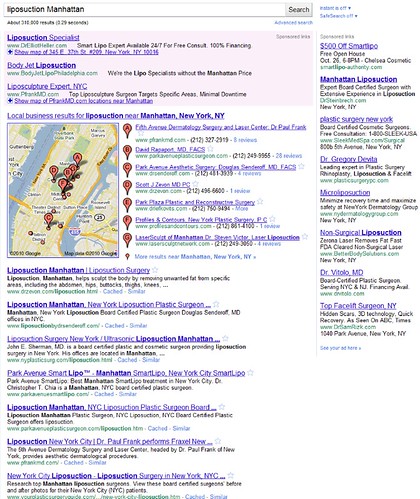
    Old results:

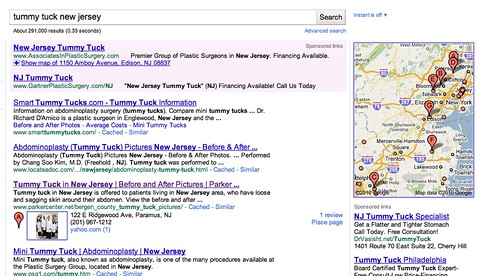
    New results:

    A site which ranks well organically (below the map) has always had a better chance of ranking on the map. Those who weren’t strong organically could sneak on the map provided a low level of competition.

    This update hurts those businesses with strong local/maps presence and so-so organic presence. We do see, in some cases, that local prevails. A business with a strong local listing may be ranked within the organic results with just their listing data – not with any search specific information in the result.   The good news is that clients with strong local presence might get pushed up in the results.  The bad news is there is no search specific information in the result so click through might not be great.

    In the past businesses in suburbs who wanted to rank for “the big city” had a hard time getting on the map. This may continue to challenge suburban based businesses with this new Google update. Those with strong organic rankings who previously ranked organically for their targeted “big city” could count on traffic from the searchers who ignored the map and went straight to find what they wanted in organic rankings. This update, though, adds an additional factor to what Google considers relevant in regards to geography, which may pose a problem for suburban-located businesses.

    The new Google update stresses the importance of maintaining a strong presence in all aspects of the web.

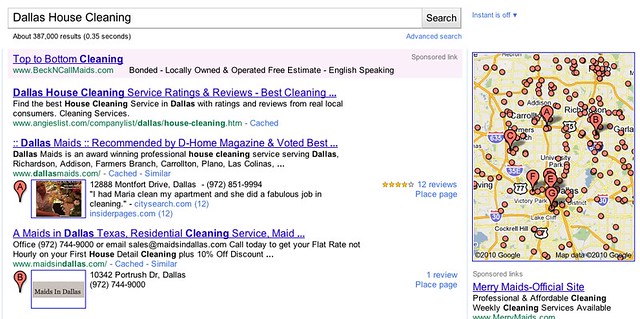
    Rest assured, it appears an extremely strong organic ranking site will remain top of page even without a strong local listing attached to it, as in this picture:

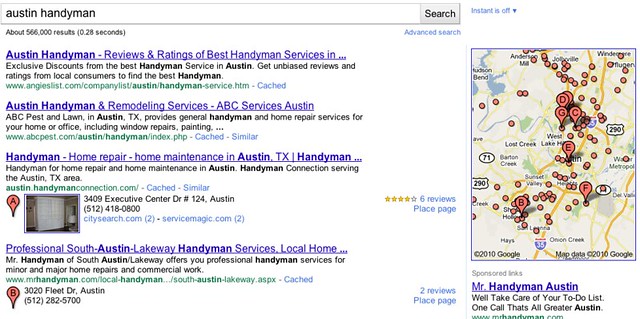
    Angie’s List, a directory of service providers, remains strong despite its lack of relation to a Place Page, as seen here for Dallas House Cleaning and Austin Handyman:

    New Google Local Results - Dallas House Cleaning

    New Google Local Results - Austin Handyman

    The new integrated results shows the importance of reviews, in particular on third party review sites such as Citysearch and Yelp by linking straight out to those sites from the main search engine results page.

    As seen in many of these screen shots shared above, If your Google Place page has pictures, your position on the search engine results pages will also be more prominent.

    There’s much more to be seen and discovered regarding this update. We look forward to working with our clients sites to be sure they maintain strong rankings.

    For further information on the subject, check out these blogs:

    Place Search: a faster, easier way to find local information – from the Official Google Blog
    What are the implications of the new integrated Local Search results? – by Mike Blumenthal on Understand Google Maps & LOcal Search
    5 Quick Impacts of Google’s New Local Search Results
    – by Matt McGee on Small Business Search Marketing
    Meet the New Google Local SERPS
    – by Andrew Shotland on Local SEO Guide
    New Place Search Shows Google’s Commitment to Local
    – by Greg Sterling on Search Engine Land

  • The Art of War for the SEO

    Sun Tzu wrote the handbook for how to achieve success in war in the 6th century BCE, and nothing has taken its place since. He established rules of battle that are still used to this day. Why am I writing about the Art of War in a blog belonging to an SEO company? Well, because the strategies used for one can also be used for the other. Follow these rules and your business can be well on its way to winning the game of global domination.

    Australia’s the key to the whole game.


    “The art of war is of vital importance to the State. It is a matter of life and death, a road either to safety or to ruin. Hence it is a subject of inquiry, which can on no account be neglected.”


    OK sure, SEO isn’t of vital importance to the state, nor is it a matter of life and death. It’s called a metaphor, alright? In this technology-based society, to ignore Internet marketing is to ensure failure. The most popular method of finding businesses- or any information, for that matter- is through Google. As stated by Sun Tzu, this cannot be neglected. If you’re buried underneath your competition, it’ll likely lead to your business’s ruin.


    “He who knows when he can fight and when he cannot will be victorious.”


    What Sun Tzu is essentially saying is that it is pointless to fight a losing battle. It wastes your resources, which you’ll need in the long run. Now, I’m not saying that you shouldn’t try to take on your competition. I’m saying to pick your battles wisely. This is where thorough keyword research comes in. Find out how many people are searching for targeted search phrases, and then find where your competition ranks for them.  If they rank number 1 for a really high-ranking keyword, it may be more beneficial to attack them using slightly lower ranking keywords; ones that you can take more easily. From there, you can start slowly overtaking them on the larger ones as your site gains more trust in the eyes of Google. It may be a slow process, but it’s better than losing before you begin.

    “The general who wins the battle makes many calculations in his temple before the battle is fought. The general who loses makes but few calculations beforehand.”

    Strategy is everything in SEO. Don’t just go into it blindly with your guns blazing. For every new client we receive, we have a detailed strategy that we employ to ensure a quick and fast climb in rankings. Keywords, optimization, metadata, internal/external linking, and directories are all necessary for a successful campaign. However, all of this means nothing if you are missing a well-organized plan of attack.


    “Management of many is the same as management of few. It is a matter of organization.”


    It doesn’t matter how many strategies you have if you aren’t organized in your application. Same goes with your number of clients. If your strategy is well organized and followed, number isn’t an issue. It becomes a simple matter of execution. Don’t become too comfortable in this process, though. New strategies always arise and adaptation is just as necessary as organization.


    “Opportunities multiply as they are seized.”


    The more you adapt to new opportunities, the longer you’ll last. SEO is an ever-evolving practice and Google is constantly changing their algorithms. The more you stay on top of these changes, the more new strategies you’ll end up learning.  When new opportunities arise, it is imperative not to neglect them.

    “One cannot afford to neglect opportunity.”


    We’re living in some tough times and businesses are struggling left and right. If you know your competition is one of these businesses, exploit this knowledge. If you can afford to, run some specials that will draw more customers away from them, and use SEO- specifically pay-per-click- to bring them to you. It sounds cruel, but your success hinges on the failures of others.


    “Secret operations are essential in war; upon them the army relies to make its every move.”


    This tip is more for us more than it is for you. We enjoy educating our clients and readers to some of the ins and outs of SEO, but we don’t want to give away all of our secrets. That could be the difference between a thriving SEO company and a dead one.

    Special thanks to blogger extraordinaire, Anthony Coleman, for the great concept of this blog.


  • Professional SEO: Are You Bringing the Right Traffic to Your Customers?

    As I was watching college football on Saturday, a commercial for a new show on ABC grabbed my attention. Detroit 1-8-7 is new series on ABC about the homicide detectives in Detroit, one of the most violent cities in the U.S. On the surface this sounds like your typical dramatic detective show that we have seen done a hundred times before. There is just one problem with the show; it’s Title!

    1-8-7 is a common police code for homicide reports; unfortunately the writers at ABC failed to realize the police code for homicide in Detroit is 3-2-8.

    OOPS!

    Getting the right information from the beginning is also important as an SEO professional. There are many SEO companies who fail to take the time to research and understand the clients they represent.

    Just last week, I was on a call with a business owner whose previous SEO company did not understand his business. His previous SEO company was optimizing for terms like “cheap”and inexpensive.  He was ranking for these terms, but was not seeing an improvement in sales. Why? His service was based on quality not price.

    The ultimate goal of an SEO company should not be to increase unwanted traffic to the customer’s site; the ultimate goal of a professional SEO organization should be conversions. As an SEO organization are you bringing the kind of traffic that will convert to sales? These are questions that should be asked by any SEO professional.

    Understanding the business represented is imperative as an SEO professional. Obtaining the correct information about a city before airing a TV show is also imperative. Somebody should inform ABC!

    Probably this guy…

  • Google SEO Guide UPDATE!

    Honestly, I never even knew the original Google SEO guide existed. If I did I would have blown away the boss during my interview with my vast knowledge of the SEO world. Well, it would have been a little out of date considering it was originally released in 2008.

    On September 28, they released a new version with clues that help us better understand the updated algorithm and a glossary of terms (something desperately needed in the original). It covers everything from SEO basics to effectively promoting your site on the web. Plus you get to stare at a cute little robot with sod for hair, flowers for a right hand and missing the left one that he no doubt lost in an epic lightsaber battle with his creator.

    What I don’t get is why Google is still a slave to paper in this day and age! Wouldn’t this information benefit from- oh, I don’t know- a website? That way it could have updates regularly as opposed to a major one every two years. I’m just spit-balling here…

    I know this can be a bit overwhelming, but that’s what we’re here for! Now you can be as well informed as possible before you get frustrated and come to us to do it for you.

    Click to download the .pdf

  • Old Google Keyword Tool Gone – Oh My!

    New Google Keyword Tool vs. the Old Google Keyword Tool – that is the question, or at least it was before the legacy tool, that I kept bookmarked ever since Google started encouraging SEOs to use the “new” tool, suddenly disappeared this past Friday.  We knew the day would come. We knew we wouldn’t like it, but now we’re forced to use it.

    The biggest internal debate I’ve had with myself is which one to trust.  No doubt you’ve noticed by now the vast difference in the keyword values that it displayed. Many wonder what is the cause of this. Now that the legacy tool is gone, I am even more curious, as I previously simply ignored the other tool’s existence. After digging through blogs and forums, I finally found “Google’s Answer” to this question. AdwordsPro shares this in the Google Help Forum.

    “If you use both the previous and updated versions of the Keyword Tool to search for keywords, you may notice differences between the tools for statistics on Global Monthly Searches and Local Monthly Searches. This is because the previous version of the Keyword Tool provides search statistics based on Google.com search traffic and traffic from search partners, while the updated version of the Keyword Tool provides search statistics based on Google.com traffic only.  We’ve updated these statistics based on user feedback, and hope you find them helpful for keyword selection.”

    User feedback showed they wanted less data instead of more data? While many SEOs, myself included, tend to use Google as the tool by which we measure all, I still don’t want to ignore the other engines. In addition, as with any research, I’d rather have data coming from a larger sample than a smaller sample, so we can get a bigger piece of the pie.

    While now we don’t have the luxury of choosing which one to trust, we’re just going to have to stick with what we’ve got.

    Google Adwords Keyword tool is a hot-button topic around here at Search Influence. In fact, as I write this, I received a ping from collegue Melanie Aleman: “Is the Google AdWords tool working for you?” While I knew it was likely giving her some sort of error in this case, I thought to myself how many different ways I could take that question. No, in fact, the Google AdWords tool doesn’t seem to be working for me, but working against me.

    Another issue with the keyword tool that I have yet to even mention in this post is the disparity between numbers when you are logged in vs. logged out. Stay tuned for a post that digs deeper into this question, if we can ever get to the bottom of it, that is, as the answers posted on forums don’t quite seem to be right on the money.

    I found this question and answer in the sidebar Help section on the new keyword tool.

    “Why do search traffic statistics vary between keyword tools?

    Search Traffic Variations

    The Keyword Tool combines search data across Google.com and all affiliated search properties. Data from the tools may vary due to the ad group you’ve selected to research, or whether you’ve accessed the tools from outside of your account. Numeric data between the tools may also differ due to rounding.”

    But why…

    “Data from the tools may vary due to … whether you’ve accessed the tools from outside of your account.”

    I attempted to do a quick test to see just how different the numbers are displaying today, but currently Adwords is returning an error and I’m unable to even log in.

    So while we may have the answer to why the new tool displays different results than the old, the question remains if it’s going to be beneficial, and only time will tell.

    Thanks to Caitlinator and BenedictFrancis for the great photos!

  • The Dangers of Duplicate Content

    So you have decided to take your business’s marketing to the next level and you hire a company that guarantees you a functional Web site, which will attract customers and grow your business. Seems flawless, right? Not necessarily.

    The next thing you know, the site does not rank on any search engine and you turn to a SEO company to see what can be done. After implementing SEO tactics, if your site is still not ranking when searched organically, you may have the great problem of duplicate content.

    Many times, companies that create Web sites tailored to particular industries (such as Internet Dental Alliance and Mentor Solutions) use template site layouts and content. All of the information filling your Web site about your procedures or services are not unique and are most likely being used for another client somewhere in the country and what’s worse: it may be used for another client in your area.

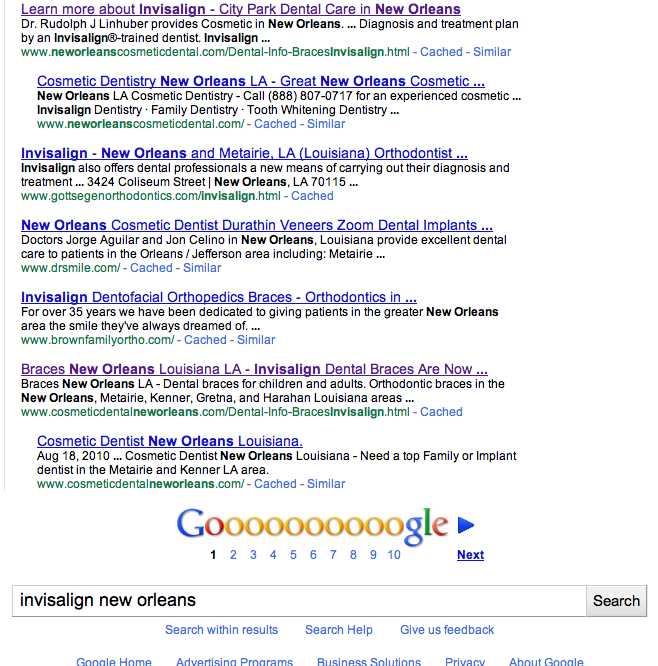
    In a market as small as New Orleans,  you may still rank on the first page of Google – along side your competitors – in spite of the duplicate content. This is the case for certain New Orleans dentists that have used Internet Dental Alliance to create their Web sites: City Park Dental Care (neworleanscosmeticdental.com), Today’s Dental Cosmetic and Family Dentistry (cosmeticdentistneworleans.com) and  NOLA Dental Care (cosmeticdentalneworleans.com). However, there still has to be a winner and a loser and the winner in the search for  “Cosmetic Dentist New Orleans” is City Park Dental. (Click to enlarge.)

    Superficially, all these sites look somewhat different, but they all have a similar structure. Although, there is not duplicate content on every page of these sites, the two dentists above that offer the Invisalign procedure do enter the duplicate content zone. Check out their sites:

    City Park Dental Care
    NOLA Dental Care

    In some ways, the sites are different visually,  but the images are the same and, most importantly, so is the text. The problem of duplicate content has nothing to do with plagiarism, by the way, but search engines can tell when content is duplicated and will grant authority to a site through a varying combination of factors including which has the “original” content, which is has an older domain, or which the greater number of authoritative inbound links. If scales don’t shift in your site’s favor, then you will be pushed down the rankings, especially if your market is highly competitive.

    Though there are several factors that deem a site “authoritative,” any way you search for it, NOLA Dental Care does not rank as well as City Park Dental Care for the invisalign procedure. In this case, the only solution is to rewrite and completely restructure the page and its content to increase in rank.

    Search Influence Account Manager, Eva Moran, recommends that business owners or staff members write their own unique content capturing their particular voice, sentiment and expertise on the subject and then passing it off for optimization review.

    Also, you may think twice before using a service that guarantees you (and everyone else!) an effective Web page. It is worth investing on a Web site that isn’t generated from a template to avoid duplicate content and gain visibility on search engines.

    For more information on duplicate content in other situations, Google has some great insights here.

  • Top 5 SEO Apps for Your iPhone

    With the recent release- and my more recent acquisition- of the new iPhone 4, I decided to do a little digging and compiled a list of the best SEO apps offered by the App store. My goal here is to make your productivity folder as cramped and overflowing as mine.

    1) Domainer

    This was one of the first SEO apps offered back in 2008 and it’s incredibly simple, which isn’t necessarily a bad thing. Just enter the URL for the page you want to check and Domainer provides the PageRank on Google, as well as some basic history. Free.

    2) Poke SEO

    This app does what the previous one does, plus a bit more. Not only does it check PageRank, it also checks backlinks for Google, Bing and AOL. The best feature of this app is the ability to email the reports you dig up. It’s no longer available in the App store because they are busy working a new version, which will be released in the future. Keep an eye out!

    3) iSEO Tools

    iSEO Tools has three great functions. It contains a SERP Analyzer that lets you know what page your keyword ranks on Google. It also has an inbound links analyzer that utilizes the Yahoo Site Explorer service to see how many links are associated with your domain. Last, there is a function that shows a list of directories. This option is fantastic because it allows you to submit a link right from the app! $0.99.

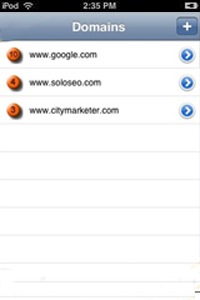
    4) SEO Ranking

    This app allows you to monitor an unlimited number of domains and keywords, and uses a graph SERP analyzer to monitor your current and past rankings on Google. A great on the go tool. $1.99

    5) Analytics App

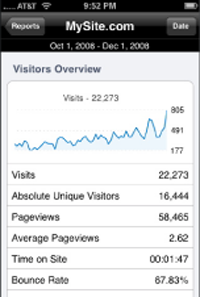
    This isn’t from Google Analytics, but it’s the closest thing you’ll find to it on the iPhone.  It allows you track all your basic stats in Analytics, including visitors, traffic and content. It allows multiple accounts and even has the ability to create event tracking and custom reports. It’s pricier than the rest, but is well worth it. $6.99

  • The Bing and Yahoo alliance means the end of Yahoo Local, right?

    As we reported in an earlier post, there are things to consider now that the Bing and Yahoo alliance is coming so near. Starting sometime in August or September, Yahoo’s organic search results will be fully provided by Bing, which will increase their organic search market share from 11% to 27%. Wouldn’t it be great if this meant an end to Yahoo Local, leaving you with only Bing and Google local listings to worry about?

    Sadly, that is not going to happen. Yahoo plans to maintain control of the search experience, and it includes Yahoo Local as a part of that. As Yahoo quotes here, it will be “Providing you with rich results that display the most relevant information from Yahoo!’s rich content properties, as well as other great product, local, entertainment, reference, social and tech sites.”

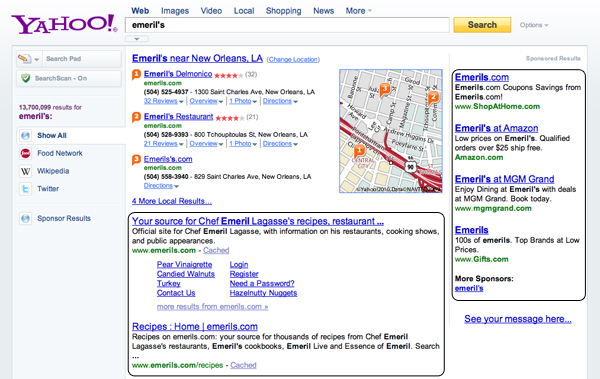
    Look at the picture above and you will see boxes around the organic and paid search results—these will be provided by Bing, the rest will be provided by Yahoo, including local listings.

    If you are a local business owner this might not mean much to you, but if you’re an SEO that cares about local listings you won’t get any of the relief you might have anticipated and will still need to claim your listings on all 3 search engines.