Category: SEO

  • Should I renew my yellow pages ad?

    Last week I was asked by one of my client’s about her yellow pages ad which was up for renewal.  Hmmm … my response was half-hearted and I waffled a little.

    Yes, the yellow pages industry is dying, some would argue it’s dead.

    Unused and unwanted.

    But a part of me hesitates at completely dropping out of the book.

    What I would love to say is “keep your ad or an ad because the yellow pages gives you a free backlink in their online product with any paid ad,” but this is not the case.  It is my personal experience in my local market and my observation in other markets that the yellow pages sales people are not offering a free backlink in the online product with the purchase of an ad in print book. One must pay to be in the print book and pay to be included in the online directory too.

    And even if you pay for it, how valuable is that backlink from deep within the yellow pages online directory?  Apparently, not very.  I checked a few different tools for the online directory page where my client would appear if she paid to be included in the online directory, and the page has a 0 (zero) value.

    Also, the backlinks are nofollowed. Wow.  Talk about about a waste of advertisers money and about a wasted opportunity by the teleco.

    So my suggestion to the client was half-hearted … decrease your big expensive display ad for a smaller in-column ad so you’re not totally out of the book just for the few people who are still using the print product.  She looked at some internal data, and came back with feedback saying she has gotten no patients from a yellow pages referral so she was dropping her yellow ages ad.  I have no data to advise her otherwise, and really, it’s probably a sound move.

    In LA too they throw the printed phonebook right away to the trash

    Yellow pages sales people have always offered call tracking, but on a limited basis – only to those clients who were waffling on renewing that giant display ad.  What they could be doing is dropping a call tracking number in the every ad over some benchmark value (say $1,500.00 because that would include some of the more elaborate in-column ads) and adding a tracking website URL into the ad.  Together, these tracking mechanisms would give some real data for advertisers to make this renewal decision.  But I know that the real data is probably more hurtful to the renewal rate than having no data.

    In comparison, at Search Influence (where a few of us grew up in yellow pages a few years ago),  we understand the need for tracking, for constant proof of our value.  We track form data.  We track phone calls from organic traffic and from paid traffic.  We track all kinds of stuff so we can give real ROIs.  We do this all of the time, and at least every month.  Proving our value every month, month after month, definitely keeps us on our toes, and we share the successes with our clients because of that accountability.

    Thanks to Sabrina Tang and lejoe for the great pictures!

  • The Many Faces of Google Maps

    Google Maps… the Local Business Center… Google Places… so many faces, so many problems. While it brings me great happiness once an issue is resolved, when trying to work them out, it seems like it’s never going to end. In the past, I’ve used a puzzle as an analogy for local search. I never really did like puzzles, and if Google Maps was a puzzle it would be a 2,000 piece box full of 1 inch pieces, 50 of which have been eaten by your kitten and thrown about the house by your children.

    So, being that I’ve spent countless hours digging in the sofa cushions for lost pieces of the puzzle, so to speak, and still haven’t gotten them all laid out on the table, I can imagine small business owners often have the same issues.

    Here’s a rundown of some of our latest challenges of Google Maps:

    1. Disappearing Citations

    Disappearing citations = drop in rankings. While citations aren’t essential to beating our your competitors in some markets, in others it can make or break you. When a client came to us for help with Maps rankings on particular search phrases, he was ranking for a number of “money phrases,” despite the listing breaking numerous quality guidelines. We rapidly cleaned everything up on our quest to come out in the end with a clean, strong listing. Then, numerous citations were disassociated with the listing – what! We followed the rules and the listing was ultimately penalized.

    2. The Importance of a Clean Listing – your listing as well as your competitors’

    It is true, the success of your listing can be dependant upon the cooperation of your competitors. In particularly competitive markets, we see a lot of keyword stuffing in titles and all throughout the listing. We’ve learned that the more muddled up the market gets, the less Google trusts the information businesses are including in their listings, and in some cases, penalizes the whole market by removing the map results from the SERPs.

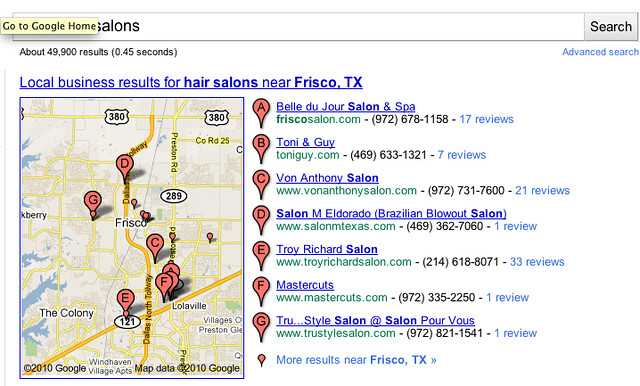
    Let’s use the market of hair salons, Frisco, TX:

    About a month ago, this is the map that was being pulled by the search “Frisco hair salons”

    and now, about a month later:

    As you can see, there’s been quite the mix up of whose listings Google is favoring.  Your best bet is to stick with correct information and avoid anything spammy in order to maintain a strong listing.

    3. Duplicate Listings

    While the recommended strategies have changed over time, one thing is clear: duplicates are bad!  It’s likely that when you search your business’s phone number, you see more than one listing –  they may or may not have correct information, and in either case, you should address the extra listings in order to reinforce your own. For this issue, Google has handed us a couple of pieces to the puzzle, and let us on to the best way to deal with it. First, only claim your main listing. For all others, you should “report a problem” and tell Google that “This Place has another listing.” While it won’t be instant, this should help clean up your market’s cluster of listings AND help your customers find you and your real information more easily.

    So, whether you are a single location of a business that’s moved a few times, or Matt Dillard Hair Salons, Frisco, TX, Google Places could be your best friend, or it could make you crazy trying to put together all the pieces of the puzzle.

    Thanks to plasticrevolver for the great kitty image!

  • SEO Optimization Tips for the Yahoo-Bing Merge

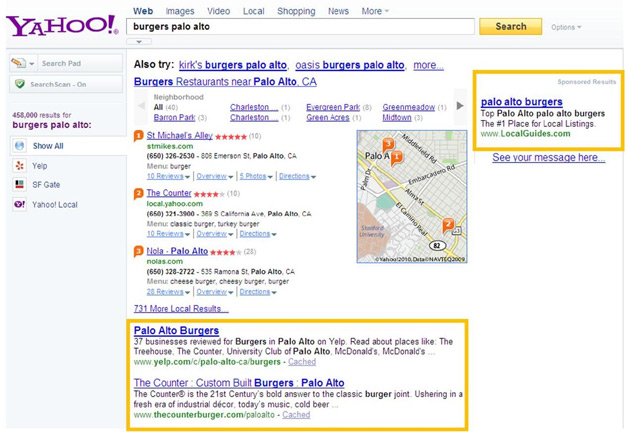
    While Google has reigned supreme when it comes to optimization, now may be the time to reassess your Bing strategy. As we mentioned in an earlier post, Yahoo anticipates that their organic search results will be fully powered by Microsoft sometime in August or September. However, Yahoo has already begun testing Microsoft’s organic and paid listings. Up to 25% of their current organic search results come from Bing, while up to 3.5% of paid listings can be from their AdCenter.

    While the results may be coming from Microsoft, Yahoo assures that they will retain their familiar format. They offer up the following image, where the boxed areas are those that come from Microsoft:

    They also offer up the following tips for SEO:

    • Compare your organic search rankings on Yahoo! Search and Bing for the keywords that drive your business, to help determine any potential impact to your traffic and sales
    • Decide if you’d like to modify your paid search campaigns to compensate for any changes in organic referrals that you anticipate
    • Review the Bing webmaster tools and optimize your website for the Bing crawler, as Bing results will be displayed for approximately 30%* of overall search query market share after this change

    These tips- along with many more- can be found here. Not much work will have to come from you, but it’s best to familiarize yourself with the changes now in order to be better prepared.

  • Fall 2010 Yahoo Will Show Bing Organic Results

    Yahoo!Last week, Yahoo sent out emails explaining how the merger with MSN/Bing would effect paid search advertiser.  The most interesting piece of information the email provided was about the transition to Bing search algorithm in early Fall.

    Organic Search Transition
    To date, we’ve focused most of our communications to you on the paid search transition to adCenter. However, another key aspect of the Yahoo! and Microsoft Search Alliance is the transition of Yahoo! organic search results (those found on the main body of the page). Assuming our testing continues to yield high quality results, we anticipate that our organic search results will be powered by Bing beginning in the August/September timeframe.

    Frankly Yahoo’s effectiveness at generating leads has been on a slow decline for years.  I completely blame this fact on Yahoo’s refusal to evolve. They spent so many development hours creating Yahoo Messenger, Yahoo Games, and Yahoo Groups, they forgot to focus on the quality of their search results. While I’m not thrilled by the merger, I am excited that SEOs will have one less search engine to optimize.

  • White, Gray, and Black Hats of SEO

    What’s the Difference Between White, Gray, and Black SEO Hats?

    When I was starting out in SEO, I was so confused by what the best practices were and I remember at my first search conference a speaker (I want to say it was Matt Cutts but it probably wasn’t) started explaining the “hats”. There are three different hats a SEO can wear and each color represents how clean they are with their  search engine tactics.

    Nice Hat.

    White Hat SEO

    A simple way to explain white hat SEO is making content for people, not search engines. Instead of worrying about keyword density and h1 tags, you worry about visual appeal and readability. When I think of white hat SEO I usually visualize my mother trying to start a website that is highly revelant to her demographic (middle-aged women who like enjoy natural food receipes, spiritual sessions with lightly muscled tan men, and designer leather handbags). She’s not worried about the order of keywords or what the h1 tags should say – she just wants to make a site that people like her will love. In fact, most professional SEOs aren’t white hat. If a SEO firm promises you page one listing and they say they strictly adhere to search engine guidelines, don’t believe it.

    To be effective at optimizing a site, you have to be conscious of how search algorithms work and how you can manipulate them to give your client the best results. In today’s search hustle, there is no way achieve first position in Google (because frankly it is the only search engine anyone cares about) simply by creating great content and having well designed site.

    Black Hat SEO

    What is exactly is black hat seo? “Black hat SEO attempts to improve rankings in ways that are disapproved of by the search engines, or involve deception,” according to Wikipedia.

    At the beginning of my search marketing career, I always believed black hat SEO was the most effective way to rank well. It’s fast and highly effective. However I soon realized that cloaking content on the page and creating link-spamming bots got me to the top, but I always fell further than I had previously and would get flagged.

    Search engines are smarter now and most legitimate businesses stay clear of these tactics. So if a search firm is suggesting you “hide” the h1 or use deceptive redirects, they likely have dealings with overseas internet pornsites or contact form spam for clients.

    Wearing a black hat isn’t a good look for any professional SEO.

    Gray Hat SEO

    Those who wear gray SEO hat, largerly obey search engine rules but know that in order to beat a competitor, you have to bend the rules. You can think of gray hats SEOs as risk takers who were once white hats but decided getting a little dirty never hurt anyone. They practice the necessary precaution, they develop highly relevant content and webpages, but they use some darker methods to ensure the highest possible ranking.

    Whether the SEOs uses link schemes or aggressive keyword stuffing, most search internet marketers are gray hats. It’s just the nature of the beast. Being a white hat only gets you so far and once you’ve put on the black hat you might as well start all over again because you’re going to be banned.

    Bottom line, you have to be successful but be aware of the repercussions, you have to take risks… and that’s why gray hats exist.

    Image from: http://www.flickr.com/photos/nationaalarchief/

  • Link Building Strategies Compared to Body Building Strategies: Strangely Similar

    One of the most important and oft-overlooked aspect of SEO is link building. Link building strategies are one of the simplest concepts, but most make it more difficult than it needs to be. For instance, Sage Lewis defines link building as, “The integration of useful elements into a whole Web site to allow for the accretion of links through natural means.” Sage obviously doesn’t follow one of the mottos I live my life by: Make things as simple as possible, but no simpler.

    Basically, what he’s saying is link building is the process of creating inbound links to your site from other sources. There are a variety of  link building strategies one can use to accomplish this, some of which include article submissions, directories, newsletters, and back links. In fact, just look above for an example! By linking to Mr. Lewis’ article, we’ve just strengthened his site and maybe even drove a little traffic there as well.

    For those of you reading who may not be familiar with the SEO process, I may have just confused you more than I helped. So let me put it this way: Link building is incredibly similar to body building. Don’t believe me? Through following these exercises, you add strength to your website and bulk up your legitimacy and visibility.  Didn’t think I could do it, did you? Yay puns!

    Just as focusing your workout to target specific muscles will increase body mass, focusing link building from relative sources will increase your site’s exposure and visits. The submission of articles to outside sources is one of the easiest ways of doing this. Make it relative to your site, throw in a few keywords that link to specific pages, and you’re on the fast track to becoming one of the strongest sites on Google!

    Another way link building is beneficial is that it makes your site seem like a valuable resource. With enough links, your site could be the first to appear in search engines, just like a body builder is the first person people ask to help them move furniture.

    …or be their state's governor.

    The more your pages appear in places other than your own site, the more exposure it’ll receive, which makes it appear more legitimate. It turns your site from just another pale, puny face in the endless crowd to a bronzed, powerful, incredibly hard to miss shaven gorilla.

    Don’t think you can do it all on your lonesome, though. Body builders need spotters to make sure they don’t drop dumbbells on their dumb bell, and reciprocal links serve the same purpose for you. These are basically agreements between two sites to link back to each other, like a partnership of sorts. This will not only add legitimacy, but you’ll surely get a few views directly from the other site.

    So that’s link building in a nutshell!

    **Note to body builders** Please don’t take my insults seriously. No harm intended. Please don’t beat me up! Seriously, it wouldn’t be any fun. I look like this guy:

    Thanks to d_vdm and Marcus Q for the great pics!

  • 2010 Local Search Ranking Factors

    Putting Together the Pieces of the Local Search Puzzle

    Search Influence is honored to have once again been invited by David Mihm to take part in his annual study on Local Search Ranking Factors. The best part of this collaboration is that the questions have remained fairly constant from year to year in order to study the change from year to year that SEOs have observed in Google’s local algorithm.

    2010 Local Search Factors Released

    The 2010 Local Search Ranking Factors results, which were published early this week, feature input “from 34 prominent bloggers and practitioners.” While my personal local search experience began just a short 6 months ago, it’s been a whirlwind of claiming, verifying, re-verifying, suspending, categorizing, picture-adding, and detail-tweeking. Working with local listings has been an interesting and patience-testing experience, and reading the comments of fellow SEOs has certainly helped calm my anxiety. Luckily, everyone seems to have problems! I also believe it was beneficial after that period of time to sit down and analyze which aspects of our optimization efforts had been working and which may have turned into a waste of time.

    The 2010 Top 5 Local Search Ranking Factors:

    1. General Importance of Claiming Place Page / Local Listing
    2. Business Address in City of Search
    3. Associating Place Page with Proper Categories
    4. Volume of Citations from Major Data Providers + IYP Portals
    5. General Importance of Off-Page / Off-Listing Criteria

    My biggest take-away from the report confirms a thought I’ve had for a few months now: there is no end-all be-all trick to increasing rankings. The top two ranking factors: claiming your listing and having a business address in the city in which you desire to rank, each has its respective caveats. While claiming your listing is of high importance (4.40 according to the study), I’ve often seen un-claimed listings trump claimed ones.

    Putting Together the Pieces of the Local Search Puzzle

    In regards to the number two ranking factor, if you’ve been in a business location for 20, or even 2 years, outside the city limits and don’t have a business address in the city for which you desire to rank, you obviously wouldn’t change that just for your listing… or maybe you would?

    That said, I wouldn’t assume one distinct factor would influence rankings, because that’s just not how these search algorithms work, but I felt it was worth it to point out for those of you who don’t deal with search rankings on a daily basis. So, when you are working on your listing, follow the rules, all of them, and work with as many elements available. Just remember – when testing out a new feature – keep an eye on your listing, or better yet, check out the blog of anyone who participated in this study and you’ll find some tips on whether or not the feature is ready for mainstream use.

    Thanks to myklroventine for the puzzle photo!

  • Top 10 for the Weekend

    Once again we’ve collected some handy links that we thought you’d find enjoyable and useful. Have a look and maybe you’ll get some ideas for what to do on Monday when the clients and customers start calling…

    1. GoogleSpeak – “We currently do not support the location” = Banished?

    As much as we love Google Maps… it’s got a long way to go until it’s a fully reliable business tool. It works perfectly for many, but some businesses end up with a problem-laden listing or market and just can’t seem to get it straightened out. If you’re a small business struggling to get your business details out there, you are not alone! Stay tuned for future posts on how to manage it!

    2. ComScore: Now 30% Browsing Mobile Web

    ComScore’s finding that approximately 75 million people are surfing the web on their mobile phones proves the importance of the tool mentioned in the link above. With the Maps application available for all Andriod, Blackberry, iPhone, Palm, and Windows Mobile, that means it’s available to 97% of smartphone users as of February 2010.

    3. Facebook Posied to Enter the LBS Game

    From the company who only first turned a profit just over 6 months ago, comes another reason why their long-awaited IPO is going to have investors running to Wall Street when it finally comes up. If you haven’t heard of LBS, or “location based service,” you certainly will soon, and you’re probably already using one: Google Maps, Foursquare, and soon 400 million people will be using one: Facebook. It seems they’ll be integrating advertising like no other into their location-based status updates that will roll out later this month.

    4. Three for Thursday

    Mobile seems to be the hot topic this week… Tom Martin details three mobile services or overall ideas that will help some daily tasks just a bit easier: ordering and paying for your lunch via your mobile, the location-based app answer to Craigslist’s “Missed Connections,” (too bad I’m not single), and a possible solution to trying to schedule a call with a potential client on your boss’s jam-packed schedule, which has proven itself a challenge lately.

    5. Buying Yelp Reviews is BAD for Business

    There’s been a lot of talk about proper social media use these days. Yelp seems to usually be at the center of such discussions. This blog by fellow Search Influencer Amy Arnold shows the varying degrees of small businesses’ attempts to “buy” reviews and if you should or shouldn’t do it.

    6. How to Use Facebook for Business and Marketing

    What would a collection of internet marketing posts be without a mention of how to create a fabulous Facebook Page that everyone will want to visit?? Tamar Weinberg explains here how while the typical Facebook user really is on there only for personal use, it is possible to sneak a little marketing in here and there.

    7. Linkbait: The Most Linked to Articles

    Trying to get links back to your site or blog? Often even the most well constructed posts don’t get all the linking attention they deserve. The SEO Doctor shares some research he found about some of the most linked-to blogs AND shares the golden resources and tools he used to conduct it.

    8. Is your blog chasing numbers or dollars?

    Your blog may be attracting readers, but is it attracting them in such a way that they want to buy your product of service? Mack Collier points out something we’ve probably all committed as SEOs. Sorry, potential customers, we’ll be sure to dial down the use of the search lingo!

    We’re not the only ones who love to share the knowledge we come across. See below for Matt McGee’s round up of the best posts in April, and Search Engine Land’s SearchCap, a daily collection of posts.

    9. Matt McGee’s April ’10: Best Search/Marketing Posts

    10. Search Engine Land’s SearchCap for May 6, 2010

  • Will Scott Interview on Search Engine Journal

    A quick thanks and a link, for your information, to an interview Mat Siltala did with me on Search Engine Journal.

    Picture of Mat Siltala and Will Scott at SMX West
    Picture of Mat Siltala and Will Scott at SMX West

    Mat and I often speak about search, local, social media and his favoriteviral marketing. I appreciate the opportunity for the exchange of ideas and am always happy to spend time with Mat.

    In the interview we talk about some of the Top Local Business Listing questions we receive.

    For those who don’t know Mat Siltala, his Internet Marketing Firm Dream Systems Media is one of the best in the industry. With customers ranging from small businesses to some of the biggest names on the Internet, Mat and his team are a worthy choice for any business, seriously thinking about online marketing who recognizes that Investment is the first part of Return on Investment.

    Again, a big thanks to Mat and the Search Engine Journal team for helping spread the word about the value of Local search for small business.

    Written at 38,000 ft somewhere over Indiana

  • How much does SEO cost?

    How Much Does SEO Cost?

    In this business, just like any business really, one of the greatest compliments we can receive is a referral. We love referrals and we were delighted when one of our clients referred a fellow colleague over to us. The potential new client had a practice in a very competitive and fairly large market.  When she inquired about our SEO cost, she was a bit surprised to hear that our proposed monthly fees were more than what our existing client had been paying – $300 more. No, no, we were certainly not trying to pull a fast one on her or take advantage that we had been highly recommended as being “worth the money”.  We explained that what set her monthly fees apart from her friend, our client, was her location. We do offer different level of services at different pricing points, but one of our lower pricing points would not impact her website’s ranking as we collectively desired.

    To further explain, take a look at this map. Let’s just say our client was located in one of the orange-circled cities and her friend in a green-circled city. Naturally, the competition is much greater in a larger city where you generally have more of everything – more gas stations, more restaurants, more options.  You also have to consider the characteristics of the targeted market in the particular city. Sure, San Diego and St. Louis may appear to have a similar sized population, but I get the feeling there are probably a greater number of plastic surgeons in the So Cal area than there are St. Louis Plastic Surgeons, just as there are Taco Trucks.

    Simply put, we could not put the same level of effort on her website that we had been placing on our established client’s, who is in a smaller market, and have the same fantastic results.  More effort would be required.

    Do keep in mind that while location is a huge factor in our pricing, there are several other important factors to be considered such as how long a website has been established, how much content is currently on it, images, etc.

    On the topic of competition and SEO cost, we recently stumbled upon a proposal sent to one of our clients by a competing SEO company.  When comparing a similar package that we offer at $1200 per month, our competitor was offering it at $2100….hmmmmm…speaking of economical search engine optimization…did I mention we love referrals 😉 ?

    Thanks to stevelyon for the image!