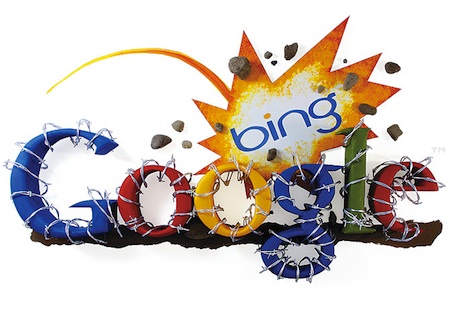
If you keep up with what’s in the news in the world of search engines, you know that there’s been a bitter little rivalry between Bing and Google for some time. In early February, Bing accused Google of stealing their search results. It didn’t help Bing’s case that they didn’t deny the claim either, instead saying, “…we use multiple signals and approaches when we think about ranking, but like the rest of the players in this industry, we’re not going to go deep and detailed in how we do it.”
Fast forward to now, where Microsoft was recently the topic of discussion in a lengthy article in the New York Times about Bing’s profitability — and how long it may take them before they have any chance of breaking even. Other reports claim that Microsoft has claimed 30% of the search market and that Google is “slowly sinking”, even though it still controls roughly 65% of the search market.
Bing has made respectable strides since its launch two years ago, but even so, it hasn’t been able to match the brute force of Google, which was the leading search engine among ten competitors back in 2002, only two years after its launch. Surely, Bing will continue to grow, but even if can find itself on equal footing with Google, can that be considered success?
Microsoft’s Qi Lu says, “To break through, we have to change the game. But this is a long term journey.” He’s right … but how long will that journey be? Sources seem to think that Bing will need to demonstrate some sort of clear success before its tenth birthday to remain a contender.
How can Microsoft accomplish this? Voices all over the web have tons of ideas, but several of the key ones seem to stick out. Some suggest that Bing work both ends of the user spectrum, finding a way to appeal to every age range (much like Nintendo did with the launch of their Wii videogame console). Since Google tends to appeal to a young, tech savvy audience, this could be a valid approach for Bing. Microsoft should also focus carefully on their acquisitions, and try to see what could work best for them (here’s a hint: buying Skype for $8.5 billion might not have been the best choice).
Personally, I’m a fan of Google’s products, so until Bing can offer something better, I’m staying put. How do you feel about it?
San Francisco’s Topsy.com is poised to become the new leader in social search with the holiday weekend closing of Google Realtime. The Google service, which displayed results garnered from Twitter and Facebook feeds, was eliminated after Google’s contract with Twitter expired; however, Google claims that the shutdown is temporary and the feature will soon be integrated into the still-nascent Google+, its new social service. While the streamlined Realtime feature has been eliminated, though, all public information on Twitter that is available to web crawlers will still be discoverable via Google searches.
Topsy.com's user interface upon searching for a trending topic.
Topsy.com boasts an impressive searchable index of data, having served real-time social web search returns since 2006. The three year-strong index of Twitter data is the largest of its kind on the web and continues to grow every day, with numerous options for identifying relevant web content. The secret sauce comes in the form of a sophisticated set of dynamic algorithms that serve to filter the “firehose” of tweets, updates and other socially-generated media. As this constantly-generated, stream-of-consciousness data is subject to large amounts of irrelevant noise when attempting to search for a specific term, Topsy has come up with an elegant solution to accurate real-time search results by monitoring the influence of its users and making this influence a large part of their ranking system. Only approximately 0.2% of Twitter users are ranked as “highly influential” and 0.5% as “influential,” so the standards are obviously exacting. Additionally, trackback pages are provided for all indexed items, allowing you to see what everyone is saying about your specific query. Trending items are also given the same consideration, with bonus syndication options for you to insert relevant realtime content into your page. (If you’re interested in checking out what goes on from the tweet-to-search-result process, check out this blog post on their V2 platform and plans to index 100 billion status updates.)
While Topsy isn’t perfect — Akismet and other comment monitoring programs often flag its trackbacks as spam, and the top-trending features for those simply looking to browse could use some work — it seems to be the most elegant solution for the matter available. However, Microsoft’s Bing.com has been publishing recent tweets as long as Google, since late 2009, and does not appear to be facing the same kind of contractual disputes that eliminated Google’s partnership with them.
In addition to search capaiblity, Topsy also offers trend analytics with the ability to compare up to three keywords.
Will this development push Bing further into the realm of being a purely social search engine, or will the inevitable integration of real-time search into Google+ make this social media package deal too good for users to pass up? What do you think?
Google announced today that they received official notification from the U.S. Federal Trade Commission that it has started an investigation into allegedly unfair business practices.
Google announces official FTC Investigation
The monster search and advertising company has been called many things over the years related to their monopoly-esque control of the search market. In the past, search engine marketers and optimizers have said “we just have to deal with it” when it comes to the toughest challenges with certain Google products, and moved on to find inventive and round-about ways to combat the issue at hand.
In Search Influence’s road map to serving clients, Google Places is stand-out problem child, often presenting data problems, mix-ups, and merges that have been costly, time-consuming, and frustrating to fix. It goes almost without saying that this move was inevitable, as Google has undergone similar scrutiny in other nations of the world, including China and Italy. A Tech Crunch article from early last year reports that various Google products and content are blocked in one fourth of countries in which it offers products.
While the investigation and following proceedings will almost certainly take years to be resolved, search marketers and the small businesses they help succeed online can rest easy with some solace that one day, there may be some changes that make your website promotion just a little bit easier.
For a while now, Google has been showing “Related Places” AKA “The Competition in places view.
Google Related Places – AKA The Competition
While looking at the results for one of our clients who has recently opened a new office for his law practice in a New Orleans LA suburb I came across this.
Paginated Google Places Results
Clearly Google is trying to offer some alternative results for “Metairie Divorce” than our guy Will Beaumont at 3814 Veterans Memorial Blvd #302, Metairie, LA 70002 – (504) 834-1117.
You’ll have to click through as I can’t figure out how to link directly.
Beyond going down the page to look at the “Related Places” (AKA “The Competition”) you can now conveniently scroll through them. And, better still, hovering over your searched for phrase at the top of the page gets you this drop-down list.
Select Your Competitor – Google Places Drop-Down List
Google held their “Inside Search” event this week, and as usual, the announcements were innovations worth getting excited about. Then again, we’ve come to expect that as the norm from Google.
Voice Search has been a part of mobile phones for a while now, but Google announced that it would be bringing the feature to Chrome. Rather than type into a search bar, the user can simply speak the term and watch Google do the magic. At the conference, more complex sentences such as “How do I say How do I get a cheeseburger in this neighborhood in Spanish?” were used successfully. On a cell phone, the feature seems more functional to keep people’s hands on the wheel while driving, but on the computer it seems more like a novelty than anything else. That, and I’m sure it won’t be long before the videos of guys yelling inappropriate terms at their computers starts showing up on YouTube.
Image Search also got a new feature: users can drag a picture from their desktop into the search bar and Google will try to pull info from the photo. For example, if it’s taken in a location Google recognizes, it will pull information on that place and give you results on it. Stalking just got that much easier. Thanks, Google. That wasn’t it for images, though — Google Instant will also pull results as you type a picture into Google Image Search, just like it does when you do a regular web search. It may only save a few seconds, but those seconds may add up to valuable time saved. Instant brags that it brings results faster, and an example at the conference showed some pages loading in under a second. I like hearing that!
What do these new innovations mean for SEO? As image search becomes more powerful, website owners may have to carefully consider how they name the photos they use on their sites, as they may also be turning up in Google Image Searches and may draw the attention of a potential customer.
On the whole, Instant means that people will rely on faster web searches as the norm. The bottom line here: this means you only have a few seconds during a web search to capture a user’s attention, so SEO is more important than ever to ensure that your website is at the top of the list when Google does it’s search-at-the-speed-of-light trick. As the tech around us continually evolves, we must do the same to keep up with it, or risk being left behind.
It’s always interesting to see the outcome of the annual “Local Search Ranking Factors” study. As contributors we have strong opinions about many elements, and like you, we’re always learning as well.
Now that we’ve had a chance to review, we’ve identified:
Places where we agree
Criteria where, for us, the jury is out
Things we question
The Top Ten from This Year’s Local Search Ranking Factors Study:
Physical Address in City of Search
Manually Owner-verified Place Page
Proper Category Associations
Volume of Traditional Structured Citations (IYPs, Data Aggregators)
Crawlable Address Matching Place Page Address
PageRank / Authority of Website Homepage / Highest Ranked Page
Quality of Inbound Links to Website
Crawlable Phone Number Matching Place Page Phone Number
Local Area Code on Place Page
City, State in Places Landing Page Title
Identified Factors We Are Totally Behind
Pure Local – This is defined as results in maps.google.com and on Google.com when a 2, 3 or 7 pack exist
Place Pages criteria – those changes you can make to your Place Page
Sara Tweedy: ”A business’s Place Page is the foundation of a business’ online local presence. {don’t love this image: http://www.flickr.com/photos/matsuyuki/198736304/} The targeted, specific criteria on the Place Page is essential to Google understanding what your business does”. These criteria include:
proper categorization of services/products your business provides
explicit, developed usage of the details section
basic optimization including pictures and video.
A complete Place Page sets the groundwork for a stellar local presence, which will then allow for higher rankings.
Off Site / Off Place Page
Sara Tweedy: Volume of citations is an integral component of any local presence. Citations reinforce a business’s name, address and phone number to Google. It is a necessity to obtain many authoritative citations to back up a Place Page. Without these citations, Google won’t give the deserved credibility to your business. Tweedy says, “When discussing the most recommended factors in the results of the survey, I was a little concerned that NAP consistency did not make the list. Ask anyone that works here, I am a consistency pusher. It is imperative that a business’ NAP is consistent EVERYWHERE it is seen online, and it should all feed back to the Place Page. When this does not happen, it could lead to a convoluted local presence, and will ultimately wreak havoc on rankings. “
Reviews
Amy Arnold comments, “We found that velocity, in other words, a consistent review pattern over time, is much more important than sheer volume, i.e. loading in a whole bunch at the beginning and never having reviews after that.”
Reviews are an important Local Search Ranking Factor, but in our experience website criteria may play a stronger role than volume of reviews. By no means do we suggest Reviews are unimportant. But perhaps not as strong a factor in our collective minds as website criteria. Paula Keller states, “With the new integrated or “blended” results Google rolled out in October 2010, the organic strength of your website and the correlation between the information it displays and your Place page is more important than ever in local.”
Website Criteria
In going through the Local Search Ranking Factors 2011 from David, we discussed website factors passionately! One opinion put forth was that if your phone number on site is crawlable, it best match the Place Page. I think we can all agree on this. The preference is to have the phone number crawlable on-site and accurate match.
To have the City, State in the landing page appears to be a strong factor. We have done some testing on this; it’s not 100% conclusive, but it seems to be a positive move with some qualifications.
Clearly, there are dependencies on the client’s industry and market.
For example, besides the Pizza Hut, pizza places are not super competitive in a city of <100,000 population, so we have had some obvious success with this technique with a locally-owned-pizza-franchise client in moderate sized market. As soon as the City-State landing page rolled live, the client experienced a nice bump in rankings within 1 week:
keyword 1 jumped 4 positions in ranking from position 8 to 4
keyword 2 jumped 6 positions in ranking from position 12 to 6
keyword 3 was just added to the site and already stands at position 7
Fast and effective – we like.
However, a personal injury attorney (read: highly competitive) in one of the top 30 metro areas in the country (read: more highly competitive), didn’t see as much obvious success. It strengthened the attorney’s site and Place Page, but didn’t have as immediate and noticeable impact as the pizza place.
keyword 1 — 6th, was 7th
keyword 2 — 9th, was 10th
keyword 3 — 13th, was 16th
keyword 4 — 15th was nowhere
We do have some pretty strong feelings about the strength of the website and it’s influence on the total local-online package. Website strength has so many factors:
domain age (always good)
internal links
on-site optimization
external linking
diverse and unique content on-site, etc.
All of these factors have to be built over time, and a young business with a young domain may not have all of these elements created yet. Domain age is not directly the sole effect on site authority; it’s all of the online authority that is built over time. With age comes wisdom, or … with age comes authority.
I was having a conversation today with one of our clients for whom we do Yellow Pages SEO, and I swear I was transported back to the year 2000. It’s amazing to me that more than a decade after Yellow Pages companies first started getting their feet wet on the internet, they still don’t quite get it.
“Trading print dollars for Internet dimes,” they say.
But it doesn’t have to be that way. The online opportunities are immense for well established brands like the Yellow Pages for SEO, websites, paid search advertising, social media. With feet on the street combined with the power of SEO, the Yellow Pages, if they could ever get their act together, would eat our lunch.
Some of you may not be aware of my history. In fact, I’ll bet that the majority of you aren’t aware of my history.
First things first – I’m old. I’m over 40, live my life on the Internet, and I’m an avid user of Social Media. I represent a growing demographic online. And I remember when the Yellow Pages were a valued and viable advertising medium.
For the first six years of the Internet as we know it, I built websites. I put my first website online in 1994.
At first it was simple sites for individual clients who thankfully knew less than I did. They must have, because they paid me. And then I built database driven sites used for things like distance learning, e-commerce, digital uploads, and much more functional uses.
Then I got to lead a team. We cranked out literally 2,500+ websites in the span of two or three years. In fact, we built a very early content management system, and I personally wrote the code for the first CRM I ever worked on. That content management system is actually still running today, believe it or not.
Oh yeah, that company, it was founded by a guy who got his start in Yellow Pages. In fact, my boss at the time was a visionary. He knew the internet was hurtling toward print media like a meteor. He was just a little ahead of his time.
Oh Yellow Pages, Wither Goest Thou?
After my boss, later my partner, successfully blew through $1 million with little to show for it, we had to switch gears. We built Yellow Pages online. We took the data files from those old dusty books and turned them into the online Yellow Pages.
It seemed to us at the time that the best way to transition publishers from print to online was to make an online version of the book that looked just like the Yellow Pages. SEO barely existed in those days. This was pre-Google. Our idea of optimizing for search included renaming the domain name 1A-whatever.com, submitting to directories, and stuffing the keywords meta-tags with anything even vaguely relevant.
And then came Google.
We had to figure out how to make those big fat sites that looked like Yellow Pages rank well in Google. And we did it.
Our team took the Sprint Yellow Pages from 0 to 1 million unique visitors a month in 18 months. We were so good we were actually profitable. And along came another company who, interested in our customers and our profitability, bought our company.
Yellow Pages companies of the day realized, many as early as the late 90s, that print was dying. They realized that to remain viable businesses they had to take advantage of their one real asset.
Yellow Pages have feet on the street and long relationships with advertisers. IRL.
Sellin' Yellow Euro Style
So first we sold online Yellow Pages, then we built online Yellow Pages. Yes, that’s right, we sold them before we built them. So what came next for the Yellow Pages? SEO.
We sold them, we built them, and now we had to get them traffic. And now they’re all hooked. They can’t walk away from the Internet. In some cases it’s about all they’ve got.
So a decade later, I’m talking to one of our Yellow Pages customers, and he’s got his sales force in the field trading print dollars for Internet dimes.
If only he’d come to us when he was pricing the product. We could have shown him how Yellow Pages SEO and websites can be profitable. We know from experience that, if done well, our customers trade print dollars for Internet dollars.
And the Yellow Pages knows how to sell the value! Yellow Pages have been proving the value through call tracking numbers and metrics for decades. But here again, in this “new” medium, they forget what they’re good at.
My favorite slogan from the Yellow Pages was “making phones ring and doors swing”. With those six words they told the merchant “we’re here to bring you new business”. And they weren’t afraid to prove it.
These days, the Yellow Pages, SEO, and websites are really just an extension of the old message. With 60% of searches demonstrating some kind of the local intent, it’s still about making phones ring and doors swing.
Tell me I’m wrong. Tell me Yellow Pages sales reps can’t sell online marketing.
What’s that sound? Sounds like phones ringing and doors swinging.
Never Forgive, Never Forget The Meteor
What do you think? Can the dinosaur get out of the way of the meteor?
With a little SEO sauce, your website can go from air-guitar…
If you’re involved in any kind of creative endeavor, chances are you’re waiting to be discovered. The duty of the artist is not just to make art, but to share it with others; this goes doubly for musicians, whose opportunities for media expansion have exploded in the last several years.
Getting discovered by an agent who happens to be at your show is so 90’s. With sites like Myspace, BandCamp, Twitter, Last.fm, Facebook, Soundcloud and others, bands now have a wealth of tools to choose from to stay in touch with their audience, as well as personal sites and blogs where they have full control over the message. While maintaining all of these entities can be an overwhelming amount of work, practicing basic SEO and maintaining a strong, cohesive media profile throughout a few selected ones can be just as or more effective than spreading yourself thin.
It’s important to remember that people aren’t just searching text these days; make sure that your music samples, videos and other media knick-knacks are available for your audience. Allowing for streaming makes your music accessible for the casual web-surfer, while putting up a selection of singles for download can increase loyalty and brand retention among those who enjoy your sound enough to hang on to it. And please — if you’re making tracks available for download, make sure your ID3 tag ducks are in a row. You don’t want your listeners to download a track, listen to it once and delete it a few days down the line because they have no idea where it came from. Everything should be consistently titled and formatted for maximum ease of consumption.
On-page SEO is a must, particularly if you’re a hometown outfit. This doesn’t have to be an involved, link-intensive campaign, but covering your touring area is necessary if you want to be seen by the casual Googler. Basic keyword research from AdWords can help with this. Additionally, backlinking from community sites such as Digg, Reddit and various music forums (both local and non-), while not particularly weighty as far as pagerank, can contribute to visibility and drum up community interest — your music connecting with the real ears it needs to find. Similarly, maintaining an active profile on Youtube is a must. Even if you don’t have a full-on music video, the ‘tube is another place to put up tracks and offers more opportunity for keyword insertion.
… to rock star!On the more tech end of things, hreviews are a new and trendy kind of metadata that’s easy-to-implement and offers more bang for your buck than the traditional flavor. Avoid Flash whenever possible, as Google doesn’t index it (and everyone hates unnecessary Flash interfaces anyway), and consider making your site mobile-friendly with HTML5. Making the switch is less difficult than it sounds, particularly for less complex sites, and it allows for the possibility of listeners checking out your product anywhere — on the street, at the gym, and on the way home from the (hopefully) impressive gig you’ve just played. If you’re a smaller band, chances are you’re friendly with other acts in your immediate hometown and greater touring area. Find out whose links are worth more and offer to swap — this will both boost your pagerank and draw in new views from areas you may not have made a significant impression on yet.
Once your flagship .com site is up and running, utilize the wealth of free tools at your disposal to figure out where your traffic is coming from. Google Analytics and Urchin are invaluable to help figure out what you’re doing wrong, what you’re doing right and where to concentrate your efforts. Sonicbids will allow you to connect with the right promoters for your sound, as well as develop an EPK — electronic press kit — which will lend you a great deal of professional appearance and credibility.
Lastly, blog blog blog your little heart out. Besides being an excellent way to stay in touch with fans and a good creative outlet in general (stimulating the old writing muscles can only help your lyrics!), blogging is a fantastic way to continually update your site with fresh information — which, as we all know, Google loves. Let your home base languish with nary an update or new media for eight months and you’ll surely see a drop in both ranking and pageview.
The scary and exciting thing about contemporary music marketing is the immense egalitarianism that presents itself in the face of all these tools. A fledgling band should first and foremost know its audience; the younger and more tech-savvy your ideal crowd is, the more you should invest in your Internet presence. While a good marketing campaign won’t win you mass fan adoration or an instant record deal, it gets your product out there in the public eye (or ear!) to be reviewed, discussed and enjoyed.
Congratulations Dat Dog, you almost rank in the Top 3 for your own name!
Anyone who is aware of the most basic and fundamental tenets of SEO knows as long as you’re not screwing up your site too bad (using only flash, no content on home page, etc.), backlinks will be the most important factor determining how well your site performs organically. If you don’t believe me check out how much better Dat Dog performs after I gave them a link in my last Search Influence blog (it actually shot up 10 spots in a few days in spite of being new and having hardly any words on their home page). The problem is, Google may or may not be using all of your backlinks, so not all of them will have value to you.
Before any search engine can see your backlinks, it needs to index the page containing them. Consider that search engines are constantly scanning the web for new pages to include in their index, which will be available for searching. To be considered for any search you need to be in that engine’s index. So how do you know if you’re indexed? The easiest way is to search for the actual URL in any search engine, like you see below. In this case, this Scottsdale plastic surgeon‘s Thank You page is not in Google’s index (which is fine because it has no value being there).
When your page is not indexed, you get no results.
So back to your backlinks. You know they are out there, you know where they are, and you know whether they have been indexed or not, but do you really ever know whether Google, or any other search engine, is reading or ignoring the links pointed towards your site? Some people think as long as the page that your link came from is indexed, Google is reading all of the backlinks and boosting your page rank, but it’s not always the case. Let’s say your backlink was added to a page that a search engine has previously indexed: it’s possible that the Google Spider has not come back to visit the page, and doesn’t see your link yet. Beyond this, we just don’t always know what search engines are really doing, it’s highly possible that some may deem a given page worthy of indexing and only feel like visiting some of its links.
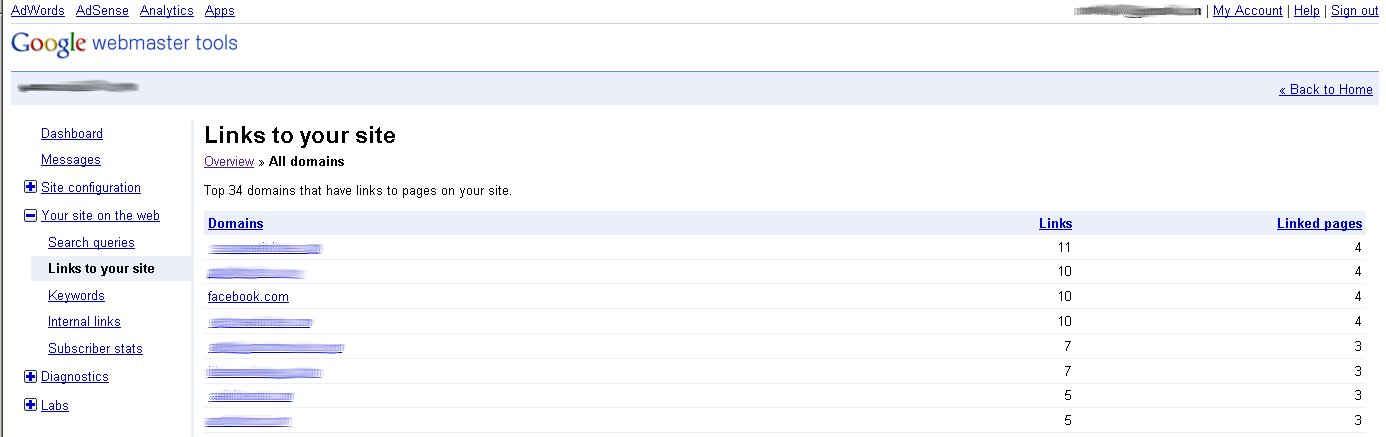
Here is the sure-fire way of knowing whether Google has even read a given link to your site: Webmaster Tools. If you haven’t registered for one of these accounts do it ASAP. Here you can submit your sitemap, get warnings about problems you’re having, and much more, including getting a list of your backlinks.
After you sign up and submit your site, your links won’t appear instantly, but will slowly accumulate. In the Dashboard, under Links to your site, click More. Then, under Who links most go to More and you can download a spreadsheet of all the links that Google is willing to admit to knowing about!
OMG look this site has a link from facebook.
This is far from fool-proof. As I read on Search Engine Roundtable, there have been some reporting issues with these links. The least you can do is pull your links from the dashboard and visit the sites that you’ve never heard of before and make sure you really have a link on that site. Many times content gets scraped by spam sites, which is not necessarily bad for you, depending on the reputation of the site and the content that it scraped. Another problem is this: just because the link is not mentioned in this report, doesn’t mean Google doesn’t care about it and has not viewed it, it’s just impossible to know, because the SEO dominatrix won’t tell us. The internet is gigantic and growing every day. Search engines do amazing things, but they can’t be perfect, especially with their free software. Just because you can’t find a link in this report doesn’t mean it is not there; you should be worried, however, if you know you have several different pages that link to you from a given domain, and none of them show up here after months. You might want to stop building links there.
In a world of fierce, undercutting, and faceless competition, Search Engine Optimization mixed with social media brings back to small businesses a much-needed breath of fresh air. It has been learned that you can’t fight big business on its own turf. Unlike the national chains that have dominated the first part of this century, small business owners cannot cut prices and run million dollar ads. The overhead of trying to compete in this manner has bankrupted many of Middle America’s small entrepreneurs.
Enter SEO and social media; suddenly this big bad world is more reminiscent of a classic ride at Disney World. You know, the one where all the little kids talk about how there isn’t that much difference between you and me regardless of language or location. That’s right, because it’s all about getting to know each other and figuring out how to communicate. This is exactly the purpose of using SEO and social media outlets to bring people to your business, except in our “big kid” world we call it public relations.
Okay, I understand that most of your pure business gurus out there believe that public relations is, and I quote, “just ass-kissing and party-planning.” Five to ten years ago they might have had a point, but in this contemporary economy the true principles of the craft are a huge part of why smaller companies have a fighting chance again. The consumer has a renewed interest in quality, and is willing to spend a little more for a more personable experience. While the bottom line is still net profit, they way to success lies within the methods you use to obtain your goals.
If Google and other search engines have replaced the YellowPages, then SEO has replaced the one-page ad. Sure, Adwords are still a highly profitable drive for visits and conversions, but the SEO in and of itself spans beyond the normal realm of marketing. A business owner takes special interest in what the consumer is looking for when they go searching. The use of these technologies can help a business mold their image into something much more appealing to the audience. They are interacting directly and specifically with their public through just a few small changes.
When you throw social media into the mix, then you are really getting some classic public relations action. The basic idea of the PR world is to promote goodwill for your company to its public. So a business going on Facebook to garner “likes” that convert to sales has to add things to this medium that will stir interest. Some of the typical things you will see in a business fan page are news, specials, and community projects. This is public relations! You are showing your consumer the good you do for them and the community. These simple acts inspire the kind of loyalty that results in a stronger bottom line.
In effect, established public relations principles mixed with cutting-edge marketing strategies not only gain customers, but implore them to be active members in the community that is your business. They feel a connection not only with what you do but also with the personal responses you show to your environment. This is the way small business regains its individual face, loyal customer base and larger profits. Now that’s something to plan a party for!








 Website strength has so many factors: