Category: SEO

  • Break Out of the Local Linking Same Old Same Old

    It has come to my realization that I am in a rut. An external linking rut.

    Well, I knew I needed to revisit linking strategies … it’s one of those things that I never sat down to research and really dig into because I have procrastinated incredibly well, but the past week has propelled me in that direction, not necessarily with my consent. But once I started digging into the data and ignoring the world around me, it was good.

    It was good to see what I have been doing right and to discover those little opportunities that I have missed but can now take advantage of.

    I have always used locally relevant linking in link building exercises to a certain extent. The links that are obvious have been submitted and published, but I’m really appreciating the value of these opportunities that I have not fully exploited:

    • Links from sites that are not top of mind but have a great trust value
    • Links from sites that may be local in 1 market but may not exist in another (i.e. local newspaper sites, local television news channel sites, etc. are truly local to a given market)

    From seomoz.org:

    “What is local authority? It’s the popularity (read: link popularity) of a particular site among sites in their topic community. So, a link from Wikipedia or Yahoo!’s directory, despite being on an on-topic page, will not count towards local authority, while a link (even a reciprocal link) from a website in your own industry that’s geared towards a related topic or the same topic as your own website, is a boost in local authority.”

    In my client linking profiles, I have always included local link building in the past but treated more as a side item rather than an entrée. This past week as I have been looking at many local sites trying to assess some level of value, and I am lovin’ the really specific, really local linking sites that I am finding. I knew I would find good stuff but didn’t expect to find as much as I have.

    If Google were looking only at quantity of external links, we could all submit our websites to low authority global directories all day long. But Google doesn’t work that way, so pretty quickly, we hit a point of diminishing returns. Consistently, over time, quantity of links has a consistency value, sure, but for the real trust building and local relevance, a website needs to be connected to the local online community.

    This post is certainly not to argue the value of locally specific search links. That subject is well covered by many more expert than I. The point is, don’t get lazy with your backlink strategy.

    It’s not a checkmark on the to-do list. It is not where you can say, “Local links … DONE!”

    Local Links: Can't just scratch it off the list.

    It should be looked at frequently. Look at what the local competitors are doing, where they are linking and see if those same are attainable, and search for the area’s local online directories and assess what level of value they offer.

    Really giving local linking a thorough and hopefully exhaustive review has been my procrastination project for some time, and I am happy to be tackling it and finding great opportunity.

    Image Credit: Thanks to koalazymonkey for the picture!

  • 15 Great Ways to Fail at Increasing Website Traffic

    We all know that one of the fundamental goals in designing a website is to provide information. Without an audience you might as well be a tree falling when no one’s around. So, how do you get an audience? As research shows the best way to get the best traffic is by telling your friends and family. They alone will get you all the traffic you need. That’s how the six degrees of separation works, right?

    WRONG. While it is still important, it takes a lot more work and effort to grow your business than just word-of-mouth.

    Here are other successful ways to make sure you fail at growing those daily visits:

    1.     Never consider your audience! Your site should make you happy. If it gives you a warm and fuzzy feeling, I’m sure they will love it.

    2.     All that matters is how pretty the site is.

    Increasing Website Traffic the Hard Way

    3.     Moving objects and loud music always bring the crowd.

    4.     Your audience and/or customer uses the same vernacular as you. There is no need for keyword research.

    5.     Never track or analyze your traffic. This only confuses things. It’s far more fun to bounce randomly around the web promoting yourself than to concentrate on what’s most effective. Besides, analysis is so boring.

    6.     Always use the largest format for all files. Everyone has a T1 these days. Your content will look and sound better than ever.

    7.     Content is not king! You’re content should be so minimal that it borders on shorthand.

    8.     Don’t worry about grammar, punctuation or clarity. Remember this is about you! Express yourself.

    9.     If you’re a localized company, do not claim your listings on sites like Google, MSN, local.com, hotfrog, etc… It’s just not hip.

    10.  Do not listen to your audience- they’ll only distract you from your goals. Twitter should be used for strictly pimping yourself.

    11.  Do not embrace and become part of a community. Facebook will go to the way side, just like Myspace. It’s all just matter of time. That stuff is for kids.

    Increasing Website Traffic through Facebook: That's stuff's for kids!

    12.   Bad reviews should be ignored. Out of sight, out of mind. Unless you just want to badmouth the reviewer. That’s ok and helps blow off some steam.

    13.  Never talk about your site. Self promotion is so passé. It’s like when a musician wears their own T-shirts on stage. Ugh!

    14.  Do not network or make friends. If you meet someone who does something similar to you they are the enemy. Unless you roll mafia style… then, keep them close by. Know what I mean?

    15.  Don’t worry about your brand. Keep things fresh. Change up your logo and tag line as frequently as possible. As soon as it seems old to you, it’s old to your audience.

    Hopefully these tips will help keep you and your site pumping in fresh visitors daily. Just remember: It’s all about you.

    If for any reason the facetious nature of this blog isn’t apparent, please refer back regularly to gain better insight and proper development techniques. “Same bat time, same bat channel!”

  • DANGER! Your Google Business Listing Is at Risk

    You need to watch out! I was just reading the Google Lat Long Blog and they’re telling people to edit YOUR Google business listing.

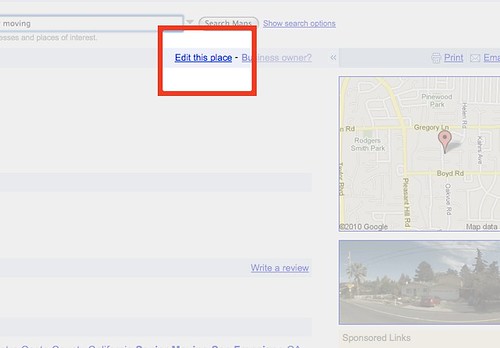
    This is really, really, bad. Look at this picture. I didn’t want to steal the image from the Google blog post so I made my own which shows a business listing on Google in grave danger.

    Your Google business listing is in danger!
    Your Google business listing is in danger!

    We’ve talked in the past about the importance of claiming your Google. It’s critical. Do it now!

    It’s so simple to claim these listings and even though Google is advertising like crazy too many businesses are leaving it up to some random visitor to edit their Google business listing?

    I mean, think of it this way, if you were a main street business would you let some kid, no matter how artistic, re-craft your signage with a spray can? Heck no! Don’t let that kid edit your Google places page either.

    Your Google business listing is the first step toward local search dominance and Google’s trying to tell someone else how to take control.

    Don’t let them. Own your Google business listing before someone else does.

    For instructions on claiming your Google business listing, read this blog post about getting your small business listing on the map.

  • Learn from Local SEO Leaders at Local Search Summit

    Local search experts share secrets, tips and tools to dominate local on March 23, 2010 at SES New York.

    Local search marketing is a different animal than typical search engine optimization. (Is there such a thing as “typical search engine optimization”?)  The semi-annual Local Search Summit will be held March 23, 2010 at the Hilton New York, and provides an opportunity to listen in as the top thought leaders in the industry discuss the most up-to-date local search techniques and tricks.

    Super SEO secrets being shared …

    Local search ranking factors can rock the search results.

    Ideas on how to use Google’s algorithms to your advantage. Put these ideas to work for your clients’ websites to achieve better ranking in local search results.

    iStock_000005224688XSmall

    Use it or lose it:  leverage social media to expand your local market.

    How does a business take full advantage of social media for new leads?  Twitter, Facebook for business and more – listen in and learn how these social tools can be as in integral part of your marketing effort.  Search Influence’s own Will Scott will be leading the panel as moderator, joined by some of the brightest minds in social media.

    iStock_000010936244XSmall

    Get the straight scoop from the search engines themselves.

    We will have discussion time with representatives from each of the top search engines.  Get all of your local questions answered straight from the experts!

    iPhones, Androids and other mobile devices.

    With a small but growing percentage of visits to websites, mobile devices are getting the attention of marketers.  What do marketers and small business owners need to start thinking about to maximize this opportunity?

  • Is it really important to get on the Google map? and … How does a SMB get on the Google Map?

    One of the first road blocks we often have to get around is the belief that the Google Local 7-Pack map listing is the “whole enchilada.”

    The Whole Enchilada

    Yeah, the Google 7-Pack is definitely a positive listing for a local business, gets your listing featured at the top of the page with your primary competition.   It’s good stuff, sure.  This is not an exact quote, but it comes from Steve Espinosa: “With a #1 map ranking and #1 organic ranking, organic get’s 1.8 times the traffic.”  Of a potential 100% combined traffic, 30% would come from the map listing.

    A presence on the Google map is NOT going to guarantee a flood of new business to your door.  It’s NOT going to guarantee total search domination.

    Bottom line: it is absolutely valuable to get listed on the Google map for your primary local keyword … but it should not be the total focus of your website promotion efforts.

    (Some good reading:  “Google Making More Pronounced Effort to Reach SMBs”)

    Sooo … how do you get your listing on the Google 7-Pack?

    #1 – go Google yourself: Find your listing as it exists in Google Maps; then claim it as your own, and edit the listing with as much data as you can provide to Google.  This is the good stuff.  Add as much as you can about your business.  Browsers searching for your widget want to know when you’re open, what payments you accept, and what your building looks like or what YOU look like.  Add pictures.  Add videos.  Add everything – even the kitchen sink!

    And choose your category carefully.  David Mihm: “Properly categorizing your business at Google Maps is one of the most important Local Search Ranking Factors.”

    When you get to the verification page, (yeah!  the verifications page!  you’re coming up to the finish line!) you can get a postcard mailed to your business or have a phone call.  I highly recommend the phone call.  It’s immediate so it might take a little coordinating with the client’s front line person answering the phone, but it’s well worth it because you’re done in 5 minutes.  A post card takes WEEKS to get to the office if it arrives at all:  Here is an on-going Google forum for some folks not receiving verification post cards.  They are still waiting…

  • Your Designer Does Not Do SEO

    Have you ever asked your mechanic to reupholster your seats? Have you asked your aesthetician to give you a face lift? Probably not and with good reason. It isn’t their job. There may be mechanics out there who know a lot about upholstery and some who can actually do it. I’m sure somewhere out there there is an aesthetician who knows all about plastic surgery but that doesn’t mean they are qualified to perform it.  I thought it was funny the first time I saw a clause in a designer’s contract stating that they are not IT and will not teach HTML to the recipient of site design.  The longer I’ve been in the industry the more I understand why.

    Too Many Hats Lead to a Sore Neck
    Too Many Hats Lead to a Sore Neck

    We see this reoccurring problem of people assuming that search engine optimization and marketing are the same as good design or coding.  Admittedly, there is a gray area.  A nice cross over exists somewhere between W3C compliance, proper use of H1 tags and whether to use bold or strong. For the most part, web design and search engine optimization and marketing are two different jobs and functions.

    I see three major problems with this. The first problem is what I like to call the “Cliff notes pro syndrome.” A company buys a book something like “SEO for (fill in adjective of inexperienced individual)” and they now have in-house SEO.  Everyone should study complementary trades on their own. A book or class however does not provide new trade credentials. Daily steady practice does. So, unless your designer is Jarod from The Pretender and can execute on anything they read as if they’ve been practicing since birth then one book does not provide in-house SEO.  There is a difference between understanding it and practicing it.

    5 Mistakes That Will Ruin Your SEO Rankings Image - Search Influence

    The second issue, focusing on freelance designers can be seen in this comment “our designer did a good job we don’t need that.” I love this one. It’s like saying “my car’s well made… no oil changes for me.”  Optimization isn’t a one shot deal. It’s an ongoing development like any good marketing effort .

    The third flaw in this logic is the first step in proper optimization – strategy. Planning and strategy are fundamental in the success of search optimization as it is in any business plan or marketing campaign. If you don’t identify your goal and plan the road to get there your success is probably going to be about as nonexistent as that strategy. Chances are your designer did not spend time doing a competitive analysis and determining the best way to reach your target demographic.  This would be essential for any SEO to help steer you down the path.   It’s always best to have a designer and an SEO work in tandem from the beginning.

  • Will the Real Google Places Page, Please Stand Up, Please Stand Up?

    Your Google listing and its Google Place page is a great central depository for all information about your business.  It is the compilation of business owner provided data as well as user-generated reviews. The Place page is an incredibly valuable tool for a small or medium size business owner.  The Places page URL is friendly to users, easy to share, and easy to find …

    You will want to search for your company + geo modifier.

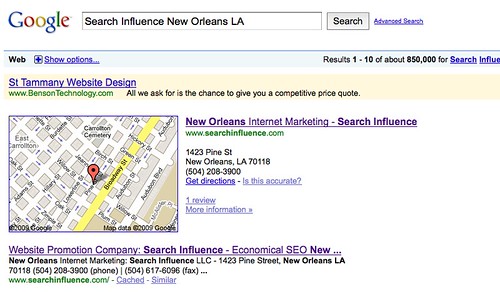
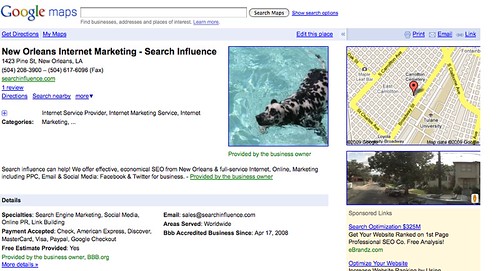
    For example, “Search Influence, New Orleans, LA” will get me here:

    When I click on “More information,” I land on the business’ Google map listing with all manner of data that consumers love:

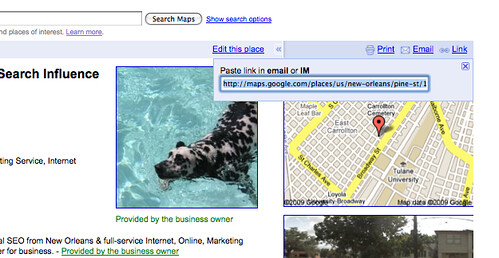
    Click on “Link” in the upper right corner – it’s small, but it’s there – and the popup box indicates the Place page link:

    Did all of that and still don’t find your Places link?

    If you followed the steps above, and your Places link is not a friendly URL, your listing likely is not yet the authoritative one.  It should look like the model – http://maps.google.com/places/us/city/name-st/#/-full-business-name –

    The first thing you need to do, is look for other listings in your business name.  These can be …

    1)   another business squatting on your company name (dirty dogs!)

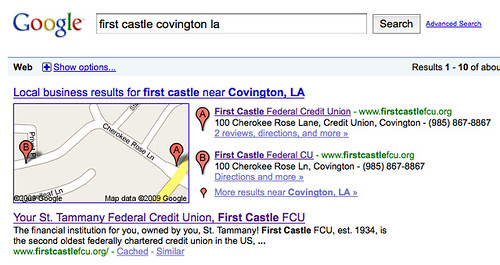
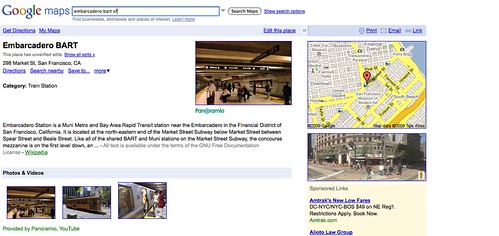
    2)   forgotten listings that are simply duplications:

    Either way the least authoritative listing needs to be suspended in the Google Local Business Center to make the real listing stand up.  To paraphrase the immortal word of Eminem, “Will the real Google listing, please stand up, please stand up, please stand up?”

    simpsons-slim-shady

    If you don’t have duplicate listings on any variation of the name or duplicates on address, you should try to manually create the Places page using the standardized format per Mike Blumenthall:

    http://maps.google.com/places/us/city/name-st/#/-full-business-name

    Watch for derivatives of Street, St, Lane, Ln, etc.

    It may take a little of your time to get it straight in Google Local Business Center, but to be the authority on your Google map listing and to own your friendly Places page URL is invaluable to a small business, and well worth a little effort.

  • The Pros and Cons of Google Place Pages

    Google’s idea of giving small businesses their own page through their project, Place Pages for Google Maps, has got local search buzzing with the SEO implications of this move for small business websites. Could Place Pages provide competition in the SERPS for the small business website? It’s possible. Will they be bad for business? That’s not so clear.

    For one, a business without a high ranking or optimized website would benefit from the obvious boost of having Google display “all the information for that place in one place” on its very own Place Page. On the other hand, the fact that Place Pages also provide user-generated content, in the form of reviews, has just made the task of online reputation management that much harder.

    Local businesses put a lot of stock in review sites like Yelp to boost their local search rankings in Google, and Place Pages are likely to provide significant competition to Yelp, especially since it seems to be pulling information – on everything from hours of operation to a restaurant’s price range – from sources such as Citysearch and Zagat, but not from Yelp.

    Some bloggers have noted that Place Pages could become a powerhouse for local business owners and users, as well as the go-to pages for numerous facts about all kinds of places. Will they encourage more local businesses to claim their listings? Google believes they will.

    Since Place Pages are likely to have a unique URL, it’s possible they will be indexed in the organic results. As one blogger observed, Google’s obsession with testing landing pages has ensured that Place Pages double up as well-optimized landing pages.

    Contrary to the fears that Place Pages will eliminate the need for small business websites, we believe they will only complement our optimization efforts. As far as business benefits and search listings go, Google has just offered local business owners another avenue to reach their customer, and that can’t be all bad.

    Since it seems inevitable that Place Pages will have a significant presence in the search listings, it would seem wise to use them to “leverage advanced image and video tagging, push Barnacle SEO to a new level and leverage the heck out of them” to claim a bigger slice of the local search pie.

    If you’re a local business owner, providing Google with information for your Place Page can only facilitate your overall business goals of reaching out to your customer. Whether you require the help of an SEO firm to achieve this, or not, Place Pages will involve more, not less, work for local SEO firms.

  • Six Ways To Get Customer Reviews That Boost Your Local Search Rankings

    SEO experts are almost unanimous in their agreement that customer reviews play a crucial role in boosting visibility and rankings in the local search results. So how can you use this information to leverage local search rankings for your own business?

    In a previous post, we discussed how a pro-active approach to customer service and feedback can boost your business reputation online. Positive reviews are a sign of trust, and that carries a great deal of weight in search rankings. Happy customers are an excellent source of positive feedback and reviews.

    For businesses trying to boost their visibility in local search, online customer reviews on Google Maps pages and third-party review sites are crucial to higher rankings. Although negative reviews can hurt your overall business reputation, they don’t adversely impact your search rankings.

    If you’re worried about negative reviews, take comfort in the knowledge that search engines don’t really differentiate between positive and negative reviews. As local search expert, Matt McGee, points out, “There’s no such thing as a negative rating. There are only degrees of positivity.”

    So, how do you go about getting your customers to post reviews on Google? Yes, you could outsource that to a company that handles SEO and reputation-management for its clients. But as local search expert, Mary Bowling notes, “It helps with trust that the review is legitimate and not gamed.”

    Here are six tips on getting more customer reviews than you can handle and leveraging the ones you have to boost your local search rankings.

    1. Ask and You Shall Receive

    Taking a pro-active stance is the best approach where customer reviews are concerned. When a client or customer offers praise or positive verbal feedback, ask whether they would be willing to be quoted online and email them a link where they can post a review. You’d be surprised how many of them are happy to recommend a product or service they really like.

    2. Offer Incentives – Not Bribes

    For those customers who get a little lazy with filling out forms online, a little incentive could give them the push they need to get that review posted. Ethically, this must be approached carefully. You can offer coupons, discounts or freebies to those customers who post a review online. It should not be stipulated that it must be a positive review. If worded “leave us a great review, and you can get 20% off your next purchase,” it’s a bribe.

    You could even have a monthly draw for customer review/feedback. Mike Blumenthal offers tips on using Leavefeedback.org, a site created by Michael Jensen of SoloSEO that facilitates review creation.

    3. Complete The Sentence…

    One trick that many companies use to get customers to write a review is to give them a feedback form on the way out. One section of the form is usually devoted to asking for comments. Customers who have trouble filling that section in, are more likely to do it if you use a “complete the sentence” format in that area.

    For instance, “I love (Your Business Name) because ____________”. If this form is available on your website, you could email them and ask for feedback anytime while offering incentives for those who do give it. Always ask your customer for permission to post their comments on your website and on review sites online, along with their name (or initials) and location.

    4. Use Social Proof

    When you first create your local business listing on yellow pages, review sites and business listing sites, a blank review page could keep many potential reviews away. People are more likely to post reviews for a business that already has a number of reviews online.

    As long as they’re legitimate and you create a separate profile for each review, you can use customer reviews from your website and feedback forms to populate these sites and provide social proof for the hesitant ones.

    5. Cut Down On Negativity

    Companies have little control over what is posted about them online, but by engaging directly with your public, you can respond to negative reviews quickly and minimize their impact.

    Almost every business creates a couple of dissatisfied customers, and the more malicious ones could post negative reviews that harm your business reputation. The best way to minimize their impact is to get many more positive reviews than negative ones.

    6. Engage With Your Audience

    Don’t let the conversation online go unanswered. Respond to feedback promptly and appropriately and thank users for positive reviews posted. Contact reviewers who post negative comments with an incentive to change their review. Offer them a coupon for your products or special service that will help them change their opinion about your company.

    Feel free to use these tips to get more customer reviews. It’s a great way to improve your visibility and rankings in the local search results.

  • Now Post Reviews Directly to Facebook and Twitter

    For online businesses that depend on customer reviews to improve visibility in local search, social media engagement has become even more relevant with companies like Yelp giving reviewers the option to seamlessly broadcast their Yelp reviews to Facebook and Twitter.

    According to the official Yelp blog, any photos that reviewers upload to Yelp.com will also be included when sharing reviews for that business via Facebook Connect. Users also have control over which reviews they want shared and which ones they don’t.

    So if your local search visibility matters, let your customers know how they can share their feedback of your business with all their Twitter and Facebook friends with a one-time signup at Yelp and watch your rankings rise.