Category: Healthcare Marketing

  • 2020 Medical Search Trends: Medical Searches Met and Exceeded Pre-COVID Levels Across Specialities

    2020 Medical Search Trends: Medical Searches Met and Exceeded Pre-COVID Levels Across Specialities

    This post was updated by Paula French on March 4, 2021 to reflect refreshed statistics and analysis. It was originally published in October 2020. 

    Key Insights:

    • Monitoring search trends can make your campaigns more effective because you can adjust your strategy based on the latest information.
    • As of January 2021, several medical practice areas, including cardiology, neurology, urology, and gynecology, have seen their search volumes return to pre-COVID levels.
    • Cosmetic procedures saw a short-lived dip in search interest for liposuction, rhinoplasty, breast augmentation, and face lifts in March. By the end of May 2020, interest exceeded pre-COVID levels for 3 of the 4 procedures: liposuction, rhinoplasty, and breast augmentation. Face lift interest exceeded pre-COVID levels in late July.
    • Addiction treatment searches didn’t drastically dip as much as other medical specialties and have been slowly rising to their pre-COVID levels. The most recent data indicates they have now exceeded early 2020 interest.
    2020 Medical Search Trends

    Monitoring search trends is a critical piece of managing a productive digital marketing strategy. It can inform your need to adapt your marketing strategy, whether that is away from search to other mediums or to invest more heavily in search engine optimization and paid search.

    2020 has seen shifts in search trends unlike anything I’ve seen in my 11 years working in SEO. It’s no surprise given the “pivots” and “unprecedented” year we’ve had. In a recent conversation with a colleague in the medical industry, we discussed expectations for 2020 healthcare revenue and what we’ve seen so far in the return of patient confidence.

    I was interested to see how search trends on Google mapped with what we had seen with the practices and hospitals with which we work, so I took a look across several practice areas and assessed the data.

    How do I read the Google Trends charts below?

    Each chart that shows the change in the amount of interest in a given topic based on the number searches during a time frame. Specifically, Google calls this metric “Interest over time” and defines it as “search interest relative to the highest point on the chart for the given region and time. A value of 100 is the peak popularity for the term. A value of 50 means that the term is half as popular. A score of 0 means there was not enough data for this term.”

    For more on how Google calculates Trends, see here: FAQ about Google Trends.

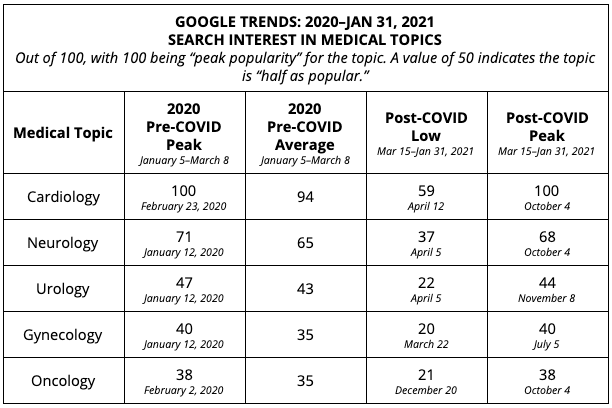
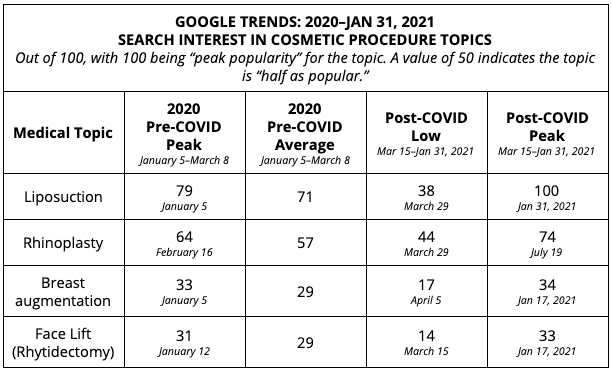
    I have included a table of my own analysis of the numerical data, looking for highs, lows, and averages both “pre-COVID” and “post-COVID.”

    In some analyses below, we look at “Topics” which looks across several ways people could be searching to gauge searchers interest level at a point in time. In others, we look at “Search terms” which is used when it makes sense to compare to similar search terms that would otherwise fall under the same topic (such as “drug rehab” & “alcohol rehab,” as they both fall under the topic of “addiction treatment”).

    Medical Specialities: Cardiology, Neurology, Urology, Gynecology, Oncology

    Summary of findings for medical speciality search trends:

    • By October 2020, searches were either at or right below pre-COVID levels, and saw a similar peak in January 2021.
    • Cardiology, neurology, urology, and gynecology all follow the same pattern: initially, searches for these specialties dipped in March 2020, but people were still searching for these terms, even in the earliest days of the shutdowns.
    • The lowest point of searches for these topics was around mid-April, which is when the public started to recognize that this stay-at-home life was going to become our new normal for much longer than we originally thought.
    • Since April 2020, searches have been on the rise, with dips during the holiday weeks of July 4, Labor Day, Thanksgiving, and Christmas.
    • Oncology saw a lower level of variation throughout the year. Interest levels dipped slightly after the shutdown and remained steady afterward, with an interest level ranging from 21-38, averaging around 30.
    2020 Google Trends for Medical Specialties

    Cosmetic Procedures: Liposuction, Breast Augmentation, Rhinoplasty, Rhytidectomy (Facelift)
    2020 cosmetic surgery trends chart

    Summary of findings for cosmetic procedure search trends:

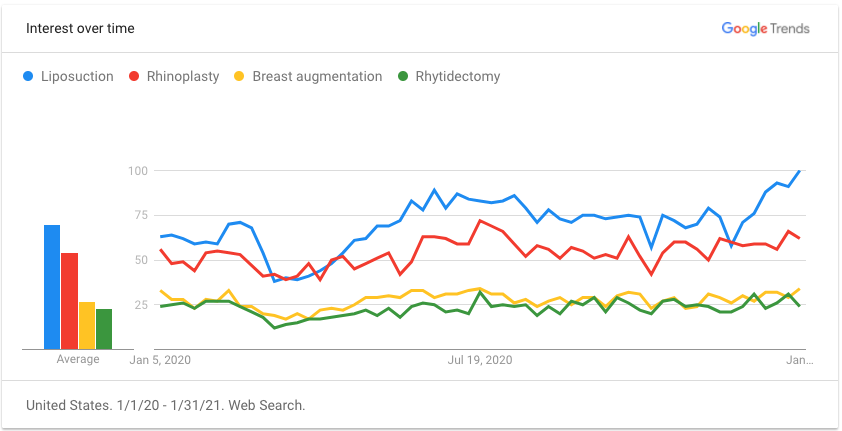
    • There was an initial, short-lived dip in search interest for liposuction, rhinoplasty, breast augmentation, and face lifts (rhytidectomy). This dip spanned across the end of March and into April.
    • After the dip, there was a surge in interest, with the number of searches actually exceeding pre-COVID levels at the end of January 2021 for liposuction, rhinoplasty, breast augmentation, and face lifts.
      After the dip, there was a surge in interest, with the number of searches actually exceeding pre-COVID levels at the end of January 2021 for liposuction, rhinoplasty, breast augmentation, and face lifts.
    • By late January 2021, liposuction saw peak interest (100), significantly exceeding pre-COVID interest levels, when the peak was 79.
      Rhinoplasty interest also peaked in July and remains above the pre-COVID average.
    • Breast augmentation search interest met and then exceeded pre-COVID interest in the summer of 2020, and has peaked above the pre-COVID high in January 2021.
    • Face lift interest initially peaked in July at 36, decreased a bit through the fall, and peaked again in January 2021, with an interest level of 33, which is higher than the pre-COVID peak of 31.
    2020 Google Trends for Cosmetic Surgery industry

    Addiction Treatment: Drug rehab, Addiction treatment, Alcohol rehab
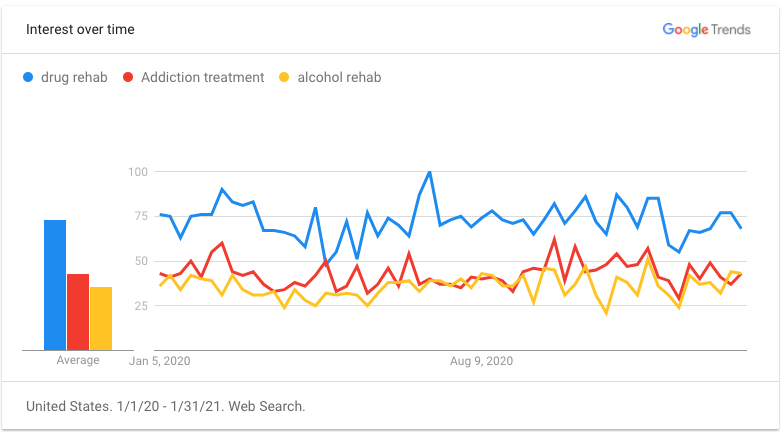
    2020 addiction treatment google trends chart

    The addiction treatment search interest analysis is based on specific “search term” interest, whereas medical and cosmetic graphs above were based on topic interest. This is a result of the availability of data for topics vs. search terms.

    Summary of findings for addiction treatment search trends:

    • There was also a significant dip in addiction treatment search terms, but interest has risen to varying degrees in comparison to pre-COVID peaks.
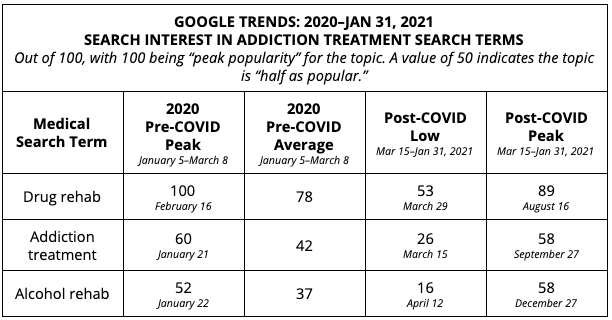
      The search term “Drug rehab” saw it post-COVID peak interest (89) in the week of August 16, which is only slightly less than the pre-COVID high on February 16 (100).
    • The pre-COVID 2020 average for “addiction treatment” was 60. During the heaviest shutdown period (March 15–May 10), the average interest was 44, with the lowest point being 26 on March 15. The post-COVID peak was September 27, with an interest level close to pre-COVID levels (58).
    • “Alcohol rehab” searches reached their peak (58) during the week of December 27, exceeding the pre-COVID 2020 high of 52 in late January.
    Addiction treatment data chart

    How can search trends help us help more patients?

    I assume that by now you’ve compared this data to what you see at your practice or hospital. The goal of monitoring search trends (along with your own campaign-level data) is to inform necessary adjustments to your medical marketing strategy.

    During the early months of shutdowns, we were hyper-focused on looking for shifts in consumer behavior to adjust our strategies. In the best-case scenarios, we were able to shift budget to the channels where our clients’ audiences were spending their time and away from the channels where they weren’t as active (and produced some really awesome results). Then, we made additional changes when that activity returned.

    There are several reasons we can attribute to the overall return of searches and why in many cases, medical searches are exceeding their pre-COVID levels. Whatever the reasons, this is a critical time for businesses to analyze their marketing mix closely to assure they are both

    • carefully spending their marketing budget
    • confident they’ll understand the outcomes of their marketing investment

    If you’d like some support in analyzing where you’re currently investing in marketing, want some fresh ideas, or are interested in partnering with an agency like ours, reach out. Our dedicated team of strategists will work with you to understand your goals for 2021 and provide recommendations to help you build your patient pipeline.

    P.S. If you are looking for more insights, check out our recent post “How Hospitals and Healthcare Practices Can Adapt to Google Updates” and follow along with us on our Healthcare & Medical Marketing Blog for future industry updates.


  • 3 Actionable Ways to Make Your Creative More Diverse

    Example of diverse photo assets for ad campaigns

    Key Insights

    • Diverse creative does not stop at just photography—companies should diversify their videos, illustrations, and voiceovers.
    • Companies who do not have the resources to create their own assets can purchase existing diverse photos and videos and edit existing illustrations to be more representative of diverse audiences.
    • The presence of POC in creative is not enough; designers and marketers must be thoughtful of how minorities and POC are portrayed across all mediums.

    In a perfect world with a bottomless budget and endless hours, companies would always be able to hire skilled photographers, illustrators, videographers, and actors to acquire custom creative assets that represent the company and their target and aspirational demographics for every marketing campaign. A lot of companies, however, must rely on existing stock assets due to varying limitations. The problem with stock photography, illustrations, videos, and audio, however, is that most of what is available depicts white men and women. Does this even matter? Maybe not as much to people who look like the subjects of these photos.

    By excluding people of different races, genders, body types, ages, and abilities, marketers are ignoring and erasing members of these communities. If that isn’t reason enough to prioritize the inclusion of diverse assets in marketing campaigns, Google and The Female Quotient conducted a survey in 2019 concluding “that people are more likely to consider, or even purchase, a product after seeing an ad they think is diverse or inclusive.” Specifically, “64% of those surveyed said they took some sort of action after seeing an ad that they consider to be diverse or inclusive. 69% of black consumers say they are more likely to purchase from a brand whose advertising positively reflects their race/ethnicity.”

    The study also states that “71% of LGBTQ consumers said they are more likely to interact with an online ad that authentically represents their sexual orientation,” and data shows that LGBTQ households spend 35% more on online purchases each year than non-LGBTQ households.

    #1 Use Diverse Stock Photography and Video Resources

    As marketers, we should strive to not only include minority groups and POC in our creative, but we should also be thoughtful about how these communities are portrayed in photos and videos. Who is leading the meeting? Who is teaching the class? Who is in handcuffs? If the answer to these questions could perpetuate any stereotypes—no matter how subtle—consider skipping those assets and continuing your search.

    The mere presence of underrepresented communities is not enough; we must make sure they are represented positively and in a way that would make members of said communities proud. Nappy.co is an excellent free resource for photos of Black and Brown people and a great jumping off point for diversifying your photo library.

    Example of diverse vector art for a marketing campaign

    #2 Adapt Vector Art

    Illustrations may seem more straightforward, but will actually require the designer to be just as, if not more, thoughtful as when selecting stock photos. Whether starting from scratch with an illustration or purchasing stock vector art, the considerations are the same. Just as with stock photography, we want to:

    • Avoid perpetuating any stereotypes, not only in subject matter, but also in more subtle ways.
    • Pay extra attention to how facial features, hair, or skin tones are depicted.

    Even in anthropomorphized objects, these considerations need to be prioritized. A design choice may be unintentional or innocuous, but they can have serious implications and reveal damaging subconscious biases. In 2017, a Kellogg’s Corn Pops box depicted a community of corn pops, and the one brown corn pop in the entire group was depicted as a janitor. Kellogg’s understandably faced serious backlash for the illustration and quickly corrected and reprinted the box.

    Luckily, illustrations (unlike photography) are adaptable. Obviously creating vector illustrations from scratch allows the designer to create any scene they want, but stock vectors are also fully customizable, too.

    • These file types usually include .ai, .eps, or .svg files that can be edited in graphics editing software like Adobe Illustrator.
    • Body types, skin tones, facial features, clothing, positioning, and so much more can be edited to represent people of all races, genders, body types, ages, and abilities in various settings.

    #3 Expand Audio Talent Search

    Marketers can’t deny the prevalence and effectiveness of video in marketing and advertising, so a company’s journey to diversifying their creative should not stop at visual assets. In recent years, there has been a push in Hollywood to cast POC voice actors to play non-white characters. While this is a move in the right direction, diversity in voice acting for marketing can be taken a step further.

    Traditionally, women were hired for voice-overs about fashion and beauty, and men were hired for voice-overs about beer and cheeseburgers. We are seeing a cultural shift in household dynamics, where men and women are making important decisions together.

    Adweek estimates that today, 85-90% of voice-overs are done by women across categories, reinforcing that women have more power over the wallet and decision making than originally thought. No matter the industry, marketers should seek out POC voice actors if their videos contain POC characters, and should keep in mind that actors of any gender can be persuasive and appropriate for their videos.

    Purchasing existing diverse creative assets can seem like a daunting task for companies on a budget, but becoming aware of what resources are out there and leveraging additional options for inclusivity is key.

    Stock assets are often thought of as cheesy, unnatural, and overwhelmingly white, but this is not always the case! Marketers must explore diverse stock photo and video options, edit purchased or custom illustrations to be more diverse, and hire diverse voice actors if they want their campaigns to be more effective and reach a wider audience.

    Every organization is different, and not everyone has a dedicated marketing team with the expertise needed to source or create diverse assets. When you work with Search Influence, you’ll leverage our team’s expertise to create diverse and inclusive content for your marketing campaign. Connect with our experts today to discuss your digital marketing goals.

    Sources

    nappy.co

  • Healthcare Marketing Laws: Language to Keep Your Ads Legal

    This post was updated by Jordan Polhemus on December 21, 2020 to reflect recent trends and refreshed statistics. It was originally published on November 26, 2019.

    Key Insights

    • Review your current Facebook targeting strategies to determine how the recent changes to Facebook’s targeting options will impact your campaign’s performance.
    • Review your entire messaging and targeting strategy with your legal team before launching any marketing campaigns.
    • Prepare for more health regulations within the Facebook advertising platform.

    Doctor's stethoscope on desk next to laptop

    The healthcare industry, unlike almost any other industry today, has incredibly strict advertising regulations that both individual physicians and large hospitals must follow. Violating these regulations could lead to anything from ads not being permitted on certain platforms to legal action—or even a revocation of a physician’s license.

    This post covers the do’s and don’ts for ad copy and demographic targeting to keep your ads legal in an ever-changing healthcare marketing landscape. Please note that this is not an exhaustive list of everything you should and shouldn’t do for medical marketing. It’s an overview of advertising best practices within the medical industry. Additionally, these recommendations do not include all the specifics for every state.

    Changes to Facebook Advertising Targeting

    Facebook has made several changes to their targeting options since 2019.

    The Removal of Third-Party Information

    The most impactful difference is the removal of third-party information that gave organizations the ability to target users based on personal information, such as (but not limited to):

    • Income
    • Cars owned
    • The age of user’s house
    • The age of the people in the user’s household

    Before this update, many data providers partnered with Facebook to create a more descriptive profile of their users that allowed marketers to create extremely detailed and specific targeting.

    After the Cambridge Analytica scandal, Facebook decided it didn’t want to be responsible for the data that third parties brought in, so it eliminated Partner Categories and other third-party data programs.

    The Removal of Potentially Discriminatory Targeting

    Facebook has worked to remove potentially discriminatory targeting to prevent misuse of the ad platform in the future, including:

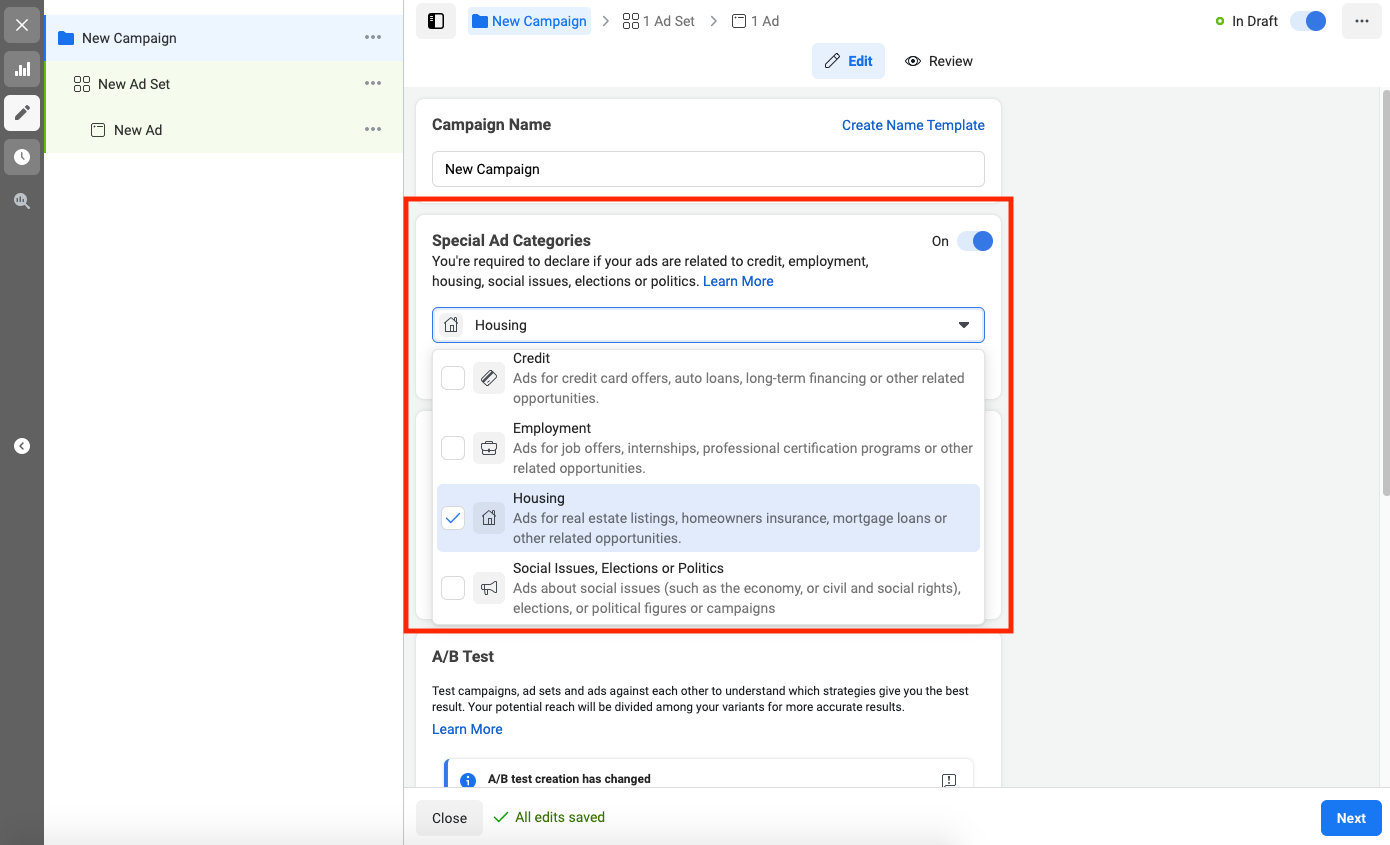
    Facebook’s “Special Ad Categories”

    In the last few years, we’ve seen a considerable tightening in what marketers can do when promoting organizations in certain industries. The types of ads impacted include:

    • Housing
    • Employment
    • Credit card
    • Political

    Screenshot showing Facebook's special ad category options

    Predictions for the Medical Industry

    Although this isn’t the case yet in the medical industry, we believe that Facebook will move in this direction soon and require all medical providers to follow additional guidelines, which will place further restrictions on their targeting and messaging. Although not currently in place, you will likely have to choose a “special ad category” to advertise in the medical industry on Facebook in the future.

    For example, if you are running ads for any political organization, such as a political candidate, PAC (political action committee), or even for small local elections, the advertiser and the ads must comply with a very strict set of rules, including:

    • Verifying the page
    • Providing special documentation proving the identity of the page manager
    • Complying with specific messaging guidelines

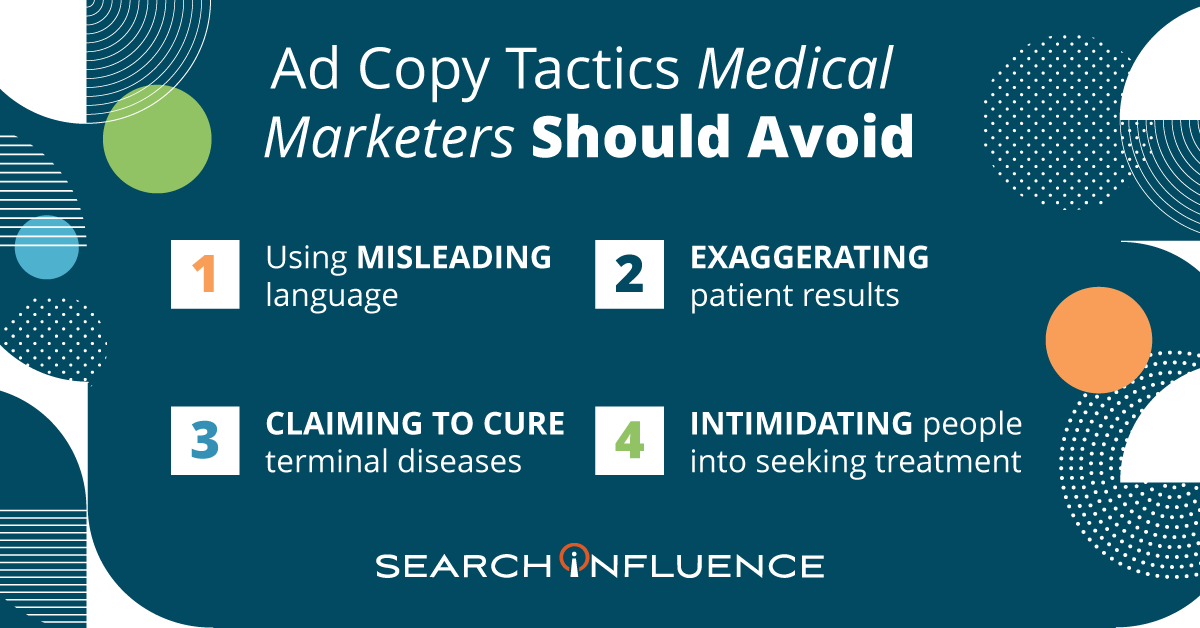
    Ad copy tactics medical marketers should avoid

    Advertising Language Do’s and Don’ts

    Advertising cannot be misleading in any way

    Misleading or deceitful language is strictly forbidden in all medical advertising. This includes implications that would cause a reasonable person to misunderstand or be deceived. Consider the impact of the words you choose in your Healthcare SEO strategy as well.

    Examples:

    • “This procedure will heal you.”
    • “You will look just like Kim Kardashian.”
    • “You will never need to see another doctor again”.

    Don’t use words like “best” or “superior”

    Unless there is objective evidence to support the claim, practices cannot claim professional superiority in any way.

    Examples:

    • “We are the best plastic surgeons in the world.”
    • “You will be under the care of the greatest ophthalmologist in your area.”
    • “Make an appointment with the most talented doctor.”

    Don’t use hyperbole when describing your techniques or results

    A potential patient’s health should be discussed factually and without embellishment, so using exaggerated statements or claims (even if they’re not meant to be taken literally) can be seen as deceptive and misleading.

    Examples:

    • “Your skin will be softer than silk.”
    • “Make an appointment for the best day of your life.”
    • “You’ll be as skinny as a toothpick.”

    Don’t assure a permanent cure for an incurable disease

    Don’t use intimidation or undue pressure for services, products, or procedures

    Examples:

    • “If you don’t get this procedure done by ____doctor, then you will die”
    • “If you don’t see Dr. X, then you are doing a disservice to your children”

    Don’t make any scientific claims unless you provide a reliable, peer-reviewed study as evidence

    Because of the amount of trust patients put in their healthcare providers, physicians are required to provide truthful information when making healthcare decisions and recommendations.

    Therefore, it would be an ethical violation for any practice to claim results or benefits that cannot be scientifically proven, whether or not that physician is talking to their own patient.

    Example:

    • “Getting X surgery will extend your life by 15 years”

    Don’t show before and after photos without the proper disclaimers

    Because before and after photos can influence a patient’s decision-making process, each practice must clearly state that results may vary and the results shown are not guaranteed. Otherwise, patients could reasonably expect to see similar outcomes.

    Practices must include disclaimers alongside perceived claims, even if the claims are direct quotations from past patients.

    Don’t reveal patient details

    Anonymizing patient information isn’t as simple as changing a name. Under HIPAA, there are more than 18 categories of personal health information (PHI) that can result in patient identification.

    It is best to either create a fictional scenario in your messaging or work with your attorney to secure a no-compensation, signed patient release before using any of their PHI in advertising.

    Don’t make any claim about the cost of a service or product that your practice cannot substantiate

    Due to differences in medical coverage based on health insurance, advertisements should never include prices—unless the practice can ensure that all patients receive that price regardless of their healthcare coverage.

    Don’t use a competitor’s name or any other trademarked name in ad copy or advertising without written permission

    If you wouldn’t say it in the elevator, don’t put it online

    Try reading the content of a post out loud and to others before posting. If it sounds like something you wouldn’t say in an elevator (where you can be overheard), then it shouldn’t be something that you put in advertising.

    Have your marketing plan, including ad copy, reviewed by an attorney to confirm that no laws are being broken in any of the states your ads will appear.

    By working with both large hospitals and small private practices, we’re well-versed in medical marketing and have years of experience running successful campaigns for our clients. Our digital marketing agency keeps up to date with the latest medical search trends, as well as updates to regulations and best practices.

    As a Google Premier Partner, the majority of Search Influence’s employees are certified in Google’s advertising platforms, including Search, Video, Mobile, and Display, just to name a few.

    For more information about how we can help promote your practice on Facebook and other social media platforms, start a conversation with us today.

    Resources

    Images

    Stethoscope

  • Graphics Checklist: High-Quality Assets You Need to Promote Your Business

    Key Insights

    • Businesses need current and high-quality location, team, event, product, and service photographs and logos to establish trust and authority on their websites and across digital and print campaigns.
    • With a well-thought-out plan of action, building out a high-quality asset library does not have to be expensive, time consuming, or intimidating.
    • You cannot use low-resolution photos across all platforms. Marketers need original, high-quality photo, video, and logo files.

    Person behind a video camera gathering assets for a business

    One of the biggest challenges businesses face when developing marketing campaigns is not having enough high-quality photography and video assets for the products, services, or events they want to promote.

    It might be tempting for a company to use whatever photos or videos they have on hand, but low-quality assets are unlikely to attract a steady stream of qualified leads. Using consistent, quality visual assets across all platforms and social channels communicates authority, trust, and professionalism to customers and prospects.

    This post will help businesses understand what visual elements are required in order to create an effective online presence, and how to use those assets effectively in a variety of campaigns. Use our checklist to audit your visual library and understand where and how to make improvements.

    What Are the Minimum Requirements for High-Quality Assets?

    Businesses should use their logos, videos, and photos throughout their websites and across all digital and print campaigns. This includes social media profiles, directories, and ads.

    As a general rule of thumb, it’s always better to have images and videos that are as large and high-resolution as possible! Assets can always be scaled down, but enlarging a photo or video that’s too small isn’t possible without pixelation or distortion. Contrary to popular procedural dramas, if a photo is low-resolution, there is no way to magically “enhance” this photo and render it usable across all platforms.

    1. For any digital campaigns, photos, and videos should be at least 1,080X1,080 px (pixel) with a 72 ppi (pixels per inch) resolution.

    • We recommend 1,080 pixels since we often run Facebook ads, and this size aligns with their minimum image size requirements.
    • Facebook ads have the largest minimum size requirements of any ad platform. By meeting these minimum requirements, businesses can cover their bases everywhere.

    2. Your website should have a hero image—a large visual element (either photography or video) that a visitor sees on your homepage. It should represent the site’s most important content.

    • The hero image can be static or dynamic, such a set of rotating images.
    • Your website’s video or photo hero image should be a minimum width of 1,600 pixels, but ideally 2,000+.

    3. For print assets, photos need to be 300 dpi (dots per inch).

    • Since images displayed on the web are 72 ppi, the only way to print them at full resolution is to print them very small.
    • A 600×300 px image from the web at 72 ppi, for example, can only be printed at 2×1 inches.

    4. Logos are an exception to the rules above.

    • The largest that a logo will appear in a campaign is 1200×1200 px, so we recommend a logo that will be easily viewed at this size without having to scale it up to avoid distortion.
    • Logos with transparent backgrounds are more versatile; plus, Google Responsive Display Ads specifically recommend logos in this format.
    • GIF, PNG, and SVG file formats support transparency.

    What Makes an Asset Relevant for Your Business?

    1. Photos should cater to a business’s target audience. Photos of products on plain backgrounds are great for an online shop, but photos and videos of people actually using the promoted products or services make for much better ads.

    2. Interior and exterior shots of the business’s physical location are ideal for search engine listings, directories, ads, and websites.

    • These photos can also help users find a storefront while using Google Maps, especially if the default street view is somehow obstructed or inaccurate.
    • 360 photos allow potential customers to interact with Google Maps listings, and they can be taken professionally or with a special camera.

    3. Having photos of the current staff as a group and individually with the same background is necessary for “About Me” pages and helps potential customers connect with your business on a more personal level.

    Keep in mind that most campaigns will need fresh images rotated over time, so depending on the goals of the campaign and what’s being promoted, more photos or videos may be needed every three to six months.

    Cartoon of person checking off giant list with a giant pencil

    Checklist

    Determine the assets needed by campaign:

    1. All campaigns need a logo file.

    • Ideal file formats are AI, EPS, SVG, PSD.
    • A PNG with transparent background is acceptable, and JPG/JPEG files are OK.
    • The minimum size should be 1,200 x 1,200 pixels.

    2. SEO campaigns require external and internal photos/videos of your location(s), as well as photos of your team.

    • The minimum size required in an SEO campaign will vary, but the bigger, the better!

    3. Facebook Display, Google Display, social media management, email, and blog campaigns require photos/videos related to the products, services, or events being promoted and photos/videos that are applicable to the audience being targeted.

    • Product photos are best when taken on a plain background at the same angle.
    • Team photos are best when taken with the same background.
    • Larger photos are always preferred, and these campaigns typically require a minimum size of 1,080 by 1,080 pixels.

    4. Print campaigns require any relevant product, location, event, service, or team photos with at least 300 dpi resolution.

    Gather existing assets:

    1. Have you worked with a photographer or videographer in the past? Make sure all of these assets are easily accessible and organized.

    2. What types of assets do you have?

    • Take inventory of your assets by organizing them into categories.

    Make arrangements to acquire additional assets if your current assets do not meet the above criteria:

    1. Logo files can usually be recreated in a more scalable or higher resolution file format, but this is harder with more complex logos.

    2. Thumbtack is a great resource for affordable professional portrait, location, 360, event, and product photography.

    3. If professional photography is still not within scope, head to free stock photography sites like Pixabay or Pexels.

    High-quality visual assets elevate not only your digital and traditional marketing campaigns, but also your overall online presence. You can easily arrange for professional photography and videography, or contact Search Influence to discuss asset creation and developing your asset library.

    Images

    Camera

  • How to Prompt Customers to Leave High-Quality Reviews That Influence SEO

    Key Insights

    • Businesses can prompt reviews and testimonials that include beneficial keywords to support ranking in the Search Engine Results Pages (SERPS).
    • Three benefits to providing review prompts:
      • Encourages high-quality, specific reviews
      • Influences more people to find you when searching for degrees, products, services, and experiences you offer
      • Themes in reviews help those who skim search results understand your value
    • Creating a list of prompts your customers can use when crafting their review helps make sure their reviews benefit both prospective customers and your search rankings!

    Customer reviews and testimonials are crucial to your business. They provide you with feedback on your products and services and help potential customers gain insights from your current ones. Additionally, reviews and testimonials that include beneficial keywords can support ranking in the Search Engine Results Pages (SERPS).

    Graphic of a hand using a tablet to read online reviews of a business

    When your business has reviews on important sites, like Google My Business (GMB), Google sees your business as authoritative and is likely to reward you for this. Greg Gifford, an experienced SEO consultant, created a video for LinkedIn with a suggestion that inspired this post: provide prompts so customers leave reviews with keywords that benefit your rankings.

    In this post, we’ll walk through the steps you should take to prompt your customers (without specifically asking them) to leave beneficial keywords in their reviews and testimonials. Not only can you prompt them to leave a review, but you can also give them some questions they can use to get started. This helps customers leave high-quality reviews with details that will benefit your rankings and also gives them a baseline to get started in writing their review.

    Benefits to Providing Review Prompts

    #1 – Encourages high-quality, specific reviews

    • When you request a review after a customer has experienced your services, it can be intimidating for them to start off with a blank screen. When you prompt your customers with questions about their experience, it helps them feel more comfortable and helps you earn more detailed reviews.

    #2 – Influences more people to find you when they search for the degrees, products, services, and experiences you offer

    • Reviews help influence rankings in the SERPs. If you use prompts that include the keywords you’re targeting, your customers are more likely to use those terms in their reviews, which makes you more likely to rank for them.

    #3 – Themes in reviews help those who skim search results understand your value

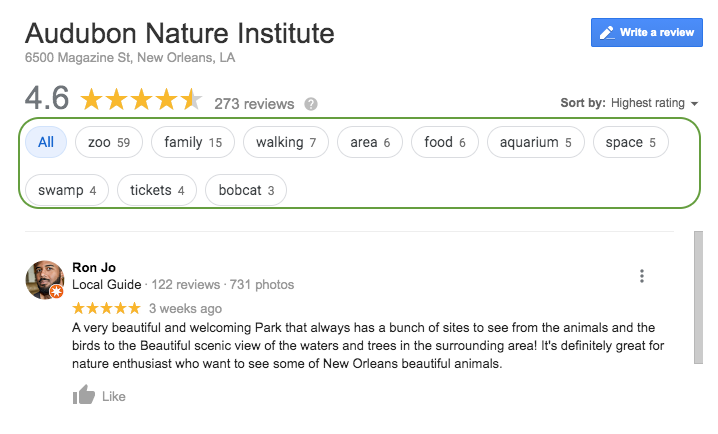
    •  Google aggregates common themes in reviews. This helps if someone searches for something in the immediate area of your business.
      • Example: Here you can see that Google has aggregated keywords and phrases throughout the reviews to make it easier for a potential customer to see reviews that include venues they may want to visit. If a consumer wanted to see all the reviews that included the keyword “zoo,” they could select it and read up on the experiences others have had.

    Screenshot of reviews from Google My Busiess for Audubon Nature Institute in New Orleans, LA

    • Also, when searchers see the themes of your reviews called out, they can more quickly understand what your business offers. In the example above, it’s helpful to know that the business has a zoo, aquarium, and swamp attraction they could visit while in town.

    Questions to Prompt Reviews

    Sample questions you can use to foster specific, high-quality reviews:

    Medical / Healthcare Questions to Prompt Detailed Customer Reviews

    • Which treatment did you receive?
    • What brought you into the practice?
    • Why did you choose our practice or a specific doctor?
    • Which location did you visit?

    Tourism & Attractions: Questions to Prompt Detailed Customer Reviews

    • Which attractions did you visit?
    • How were your interactions with the staff?
    • What were the amenities like?
    • What did you enjoy most about your experience?

    Restaurants: Questions to Prompt Detailed Customer Reviews

    • Which food and drink items did you have?
    • Which restaurant location did you visit?
    • How do we compare to other restaurants you’ve been to in the past?
    • How were your interactions with the staff?
    • How was the ambiance?

    Education: Questions to Prompt Detailed Customer Reviews

    • Which campus did you visit/attend?
    • Which degree or program are/were you interested in?
    • Do you have any tips for future prospects?
    • How did this experience prepare you for life after graduation?

    Bonus Tip for Bringing Reviews Into Other Marketing Efforts:

    • Feature the most called out benefits of your business in your website copy, imagery, and social media posts and ads

    How Can You Get Started?

    • Gather any email addresses you have of past and present customers.
    • Write an email that prompts them to leave a review for your business.
    • Within the email, include prompting questions that will get them thinking about their experience and ultimately help them produce a thoughtful review that will benefit everyone!

    Now that you’ve got a leg up on your reviews and testimonials, it’s time to start thinking about improving other aspects of your SEO. If you’re not sure where to start, ask for a digital marketing analysis of your website from our team of experts at Search Influence.

    Images

    Tablet

  • How Hospitals and Healthcare Practices Can Adapt to Google Updates

    Key Insights

    • Google decides what websites show as local and organic results by considering the business and it’s website’s relevance, prominence, and distance.
    • Keywords, content, and connections continue to be required to earn trust with google and keep your website relevant. However, the WAY you think about keywords or the WAY you write content may need to adapt over time to Google’s changes.
    • Google trusts up-to-date, accurate, and user-friendly content.

    Google is continuously updating their algorithms. These changes are usually small, but now and then, a significant update affects the way marketers have to approach search engine optimizations. It’s crucial for marketers in the medical industry to promptly adjust to these updates because Google has additional regulations for healthcare websites.

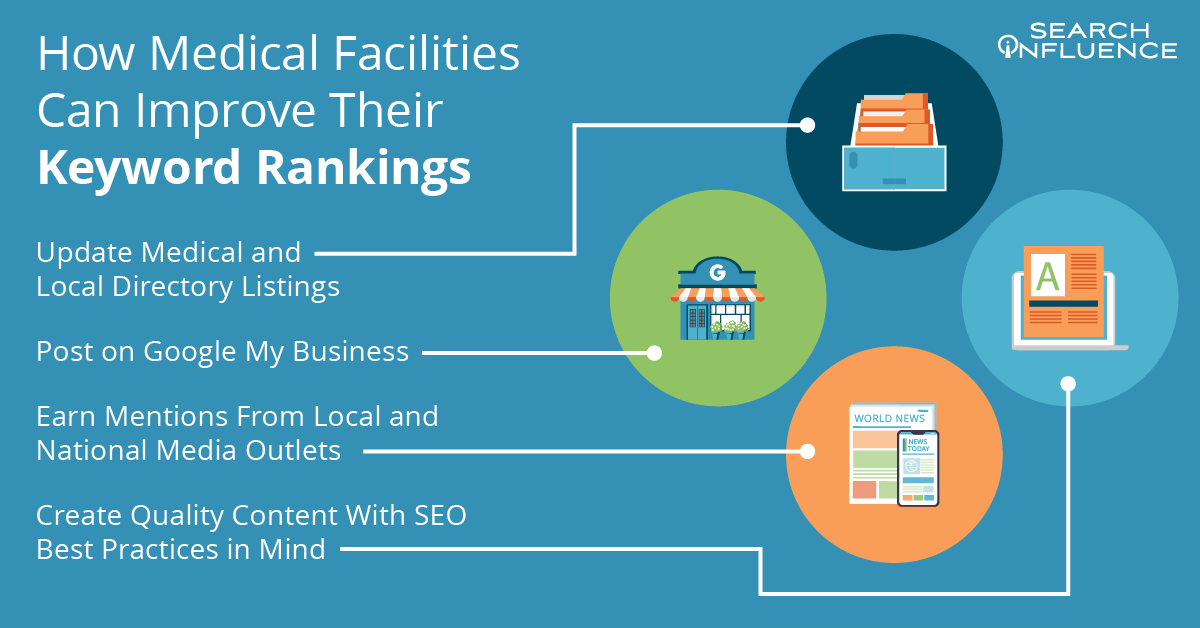
    How medical facilities can improve their keyword rankings

    The Basics of Google Search and SEO

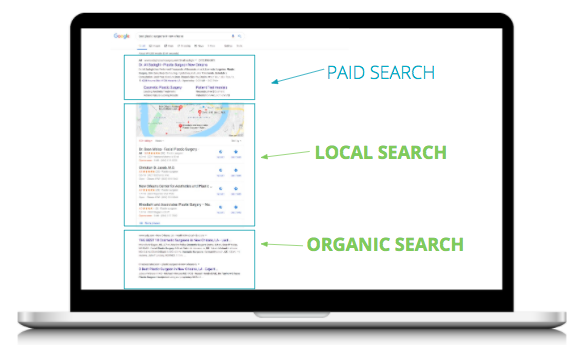
    Before diving into the algorithm updates, medical practices should understand a few optimization basics. Before a user searches for a keyword, Google has already analyzed and organized information from millions of webpages in its Search Index. When a search begins, Google’s algorithms sort through the index using hundreds of different factors to find relevant results. These results are then displayed in different formats so that people can find exactly what they’re searching for. Here is what the results most often look like:

    A screenshot of Google's search results showing the difference between paid search, local search and organic search results

    This blog is all about making an impact in local and organic results, not paid search. Organic search refers to unpaid search results that appear because they are relevant. Local search refers to organic results for businesses or places that are in the same area as the searcher. These are often displayed as map results.

    Google decides which websites to show as local and organic results by considering three factors:

    • Relevance
    • Authority
    • Distance from the searcher

    Relevance is how well a business profile matches a consumer’s search results. Authority is determined by a business’s presence online (links, articles, or directories) and offline (landmarks or locally known brick and mortar businesses). Distance from the searcher is, well, relatively straightforward.

    Medical marketers must ensure that their practice’s online presence meets these three important Healthcare SEO ranking factors, which is where search engine optimization, or “SEO,” comes in.

    There are three key components to having a successful SEO strategy:

    • Keywords: What are people searching for? Which words or phrases do they use to find a new healthcare provider or information on a procedure?
    • Content: Does the content on a website truly answer the question the searcher was asking?
    • Connections: Does this website have backlinks or mentions from other, authoritative websites? Is there accurate information on the faculty, practice, or doctor listed on relevant directories like Google My Business or Healthgrades?

    Despite periodic updates to Google’s algorithms and how they rank search results, these three components continue to be the basis of earning Google’s trust and keeping your website relevant. However, the way medical marketers think about keywords or write content has to adapt over time.

    How Do Google Updates Impact Hospitals and Healthcare Practices?

    A stethoscope sitting on top of a keyboard representing online healthcare

    Google is extra critical of health-related websites and has defined a specific content category for pages with content that could impact a person’s happiness, health, financial stability, or safety. These are called YMYL (Your Money, Your Life) pages and include hospitals and medical practices. The “Medic” update in August 2018 reflected the level of scrutiny Google uses when reviewing websites that deal with health or healthcare. Their goal is to discourage misleading information and ensure that searchers find trustworthy advice.

    The credibility of the organization that runs the website impacts its rating, which is good news for large hospitals and other well known institutions. Hospitals are often considered a trusted source of information in their communities. On the other hand, smaller practices may have to work a little harder to prove their authority. But to rank well, it isn’t enough to be a trustworthy organization. The website must also have high-quality content.

    How to Create Good Content

    When writing content for a medical website, it’s vital to think about what Google considers good content and what information potential patients include in their searches. All content should be up to date, accurate, and user friendly. Marketers need to consider the following:

    • Be Specific and Substantive: Websites should have detailed, in-depth information. Try to avoid lightly touching on a subject without providing any useful information. Searchers look for clear answers to their questions.
    • Directly Answer Common Questions: Survey the medical staff to see the most common questions patients ask before, during, and after an appointment. Then, provide direct answers to these questions on the site.
    • Use Subheadings: Use subheadings as a way to guide the reader down the page and direct a searcher to the section of the content that has the information they’re looking for.
    • Use Bullet Points & Numbers: Break the information out into lists that are easier for readers to digest.
    • Look at Top Ranking Pages: When in doubt, see what the top results for targeted keywords are doing and borrow some of their ideas. What type of information do they provide? How are their pages organized?

    When considering what to write about, think of the keywords people are searching for and what information they expect to find. In the medical industry, there are typically two categories for searches: general health and healthcare. When someone searches a health term, they are looking for information about an ailment such as symptoms, causes, and treatments. Sites that rank for general health searches usually belong to large institutions, like the Mayo Clinic, which would be difficult to outrank.

    It is important to have local content to leverage Google Maps and Google My Business. When someone searches for a doctor or specialty, like an orthopedic surgeon, they’re looking for healthcare and are considering going to a doctor. Healthcare searches are typically local because people tend to look for treatment in their area.

    How to Rank in Local Search and on Google Maps

    The earlier discussion about relevance, authority, and distance ties back in here. For Google Maps results, distance is the biggest factor. The physical location of the searcher determines the range of results they see. There’s no easy way to move closer to a searcher, so marketers have to focus on the factors they can control:

    • Relevance:
      • Have quality content for each specialty or procedure the practice offers
      • Establish backlinks from trusted directories and other high ranking websites and local organizations
    • Authority:
      • Links pointing back to the practice’s site also improve authority
      • Earn media mentions and directory listings
      • Obtain and share as many quality reviews as possible with Google

    Remember that the MOST important directory to update is Google, and information in Google My Business should always be up to date! With a verified hospital or medical practice category listing, marketers can set up specific hospital information (such as the different departments or doctors) to give patients a more direct search result.

    If you’re ready to start improving your healthcare practice’s ranking for vital keywords in Google, Search Influence knows how to help. We help businesses grow online by developing SEO and digital marketing gameplans tailored for each of our clients. Request your marketing proposal and let’s make it happen today.

    Images:

    Stethoscope

  • Search Influence to Host Healthcare Marketing Webinar, “4 Ways Digital Marketing is Evolving”

    Take advantage of the changes in digital marketing to reach prospective patients!

    Search Influence has teamed with the Louisiana Hospital Association to bring you a webinar all about change! We’ve all been through so much this year, and change is something to which the digital marketing industry is incredibly accustomed.

    Join Search Influence Director of Sales and Marketing, Paula French, and Account Supervisor, Jordan Polhemus, for the free webinar, 4 Ways Digital Marketing is Evolving.

    Paula and Jordan will share knowledge from real-world examples and first-hand experiences to demonstrate you can leverage changes in the digital landscape to attract more patients. The webinar will also include dedicated time to address your questions.

    You will learn:

    • Tactics to adjust your medical marketing strategy in light of COVID-19 user behavior
    • Opportunities to reach your patients despite changes to Facebook Advertising Targeting
    • How to adapt to updates in Google’s Algorithm
    • Methods to capitalize on the shift to mobile devices

    *Note: Due to hurricane preparation, Search Influence and the Louisiana Hospital Association have rescheduled the webinar from its original August 25 date.

    If registered before this reschedule, your registration will automatically carry over to this new date. You do not need to re-register. You will receive a personalized link to join the day before the webinar.

    Louisiana Hospital Association logo

  • In Uncertain Times, Stretch Your Budget with Online Advertising

    In Uncertain Times, Stretch Your Budget with Online Advertising

    Throughout these past few months, our industry has experienced roadblocks, challenges, and changes that alter the way we look at the work we do for our clients. We will take a look at three clients and how their experiences measure up to what the experts say about advertising and marketing in the current landscape.

    March/April 2019 vs. March/April 2020

    • All cost metrics have improved across the board—aligning with the fact that experts say it is cheaper to advertise right now.
    • Campaigns with Brand Awareness, Lead Gen, Reach, Traffic, and Video View objectives perform especially well.
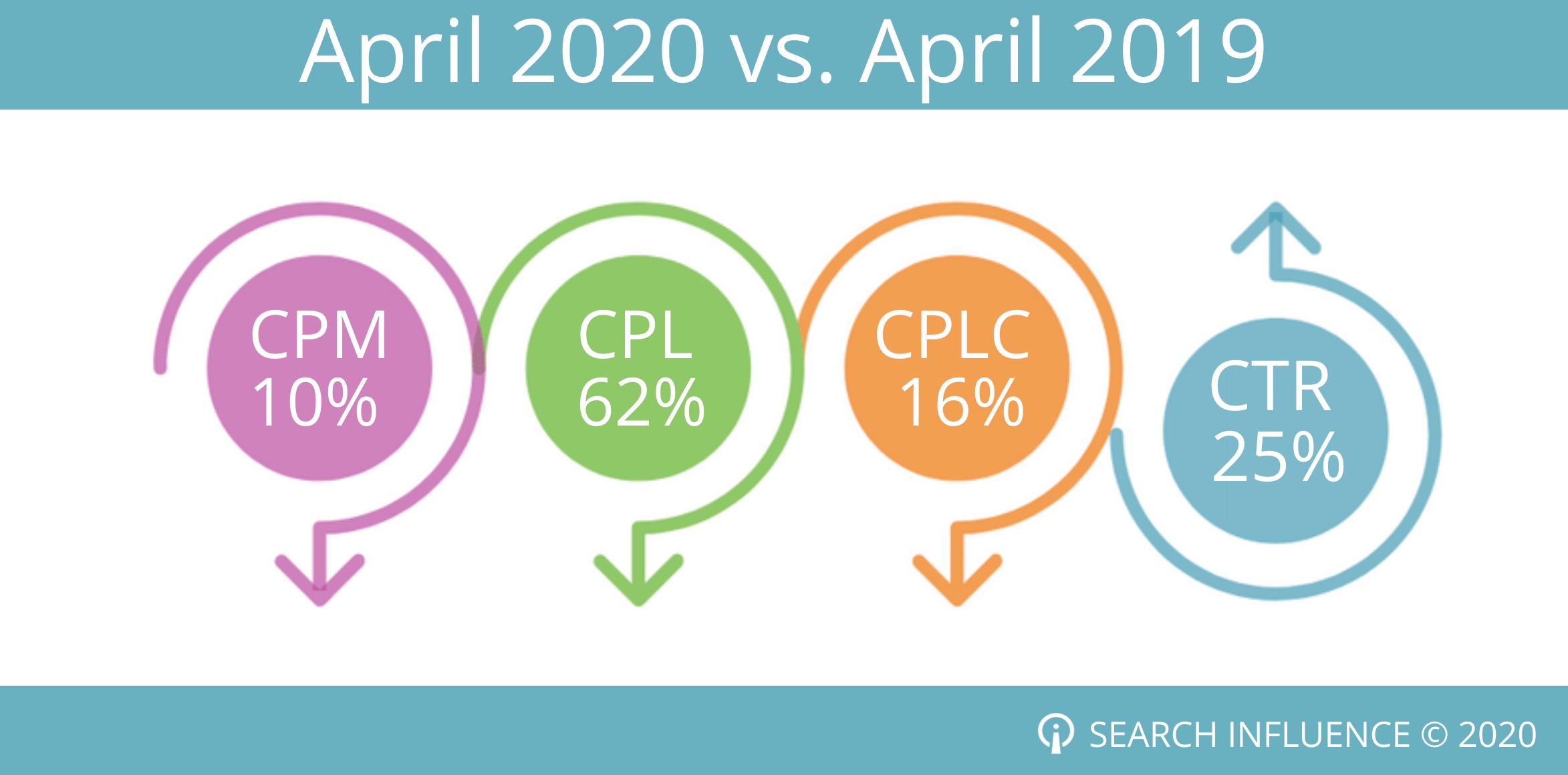
    • Engagement has increased, demonstrated by a 25% improvement in Click-Through-Rates (CTR)—the percent of impressions who clicked on an ad.

    March/April 2019 vs. March/April 2020
    We see that increased digital ad inventory and lower competition generate low-cost ads. Digital media and social media usage are up with advertiser competition down, which means it costs less than ever right now to reach larger audiences.

    • Campaigns leveraging video ads, Cost per ThruPlay decreased 64%.
    • Cost Per Engagement has decreased for every objective, which demonstrates a higher level of engagement.
    • CPM and Cost Per Click (CPC) decreased for every objective.
    • 32% in Cost Per Lead (CPLs) for conversion campaigns.

    A Search Influence branded graphic showing CPM, CPL, PCLC, CTR from April 2019 to April 2020

    Client Impacts

    Audiology and Speech Therapy Client

    Since the start of COVID-19, an audiology and speech therapy client found itself in flux due to restrictions on non-emergency medicine & procedures. The practice was quick to adopt teletherapy and virtual speech therapy options for its patients. New services and forced closures of the physical clinics created an urgent need to inform existing patients of these new services. It was also imperative to continue the acquisition of new prospective patient leads. The client needed a new gameplan.

    Strategy & Tactics

    • Communicate clearly on the website and via email marketing for current patients.
    • Implement Facebook and Instagram Display Network ads with careful monitoring & adjusting.
    • Change advertising creative quickly to promote teletherapy options.
    • Pause all other messaging.

    The client found success running advertising in March. The campaign hit a new performance threshold and exceeded the typical monthly lead volume by 69%, at the lowest CPL to date. In April, the lead volume grew an additional 25% and CPL reduced further, by 16% month-over-month. This indicates that the campaign budget is being spent more efficiently than ever on the Facebook Ads platform, with a highly engaged audience.

    Higher Education Client

    This client offers degree programs and continuing education for a non-traditional student with a focus on online classes. The client was poised for potential growth due to the online nature of their product, but new uncertainties surrounding the future of higher education and the traditional in-person instruction created potential problems.

    Our client had to focus on yield while building their pipeline for future semesters. Also, the non-traditional student decision cycle and the journey are typically a long one.

    Strategy & Tactics

    • Transition remaining courses online.
    • Play up financial aid, transfer policies, credit for life/work experience messaging.
    • Continue digital advertising—no spending reduction.
    • Leverage client-produced Facebook Live Series for top-of-funnel.
    • Shift blog post strategy focus to online learning & other timely topics.

    In March, Facebook Display generated the highest number of inquiries in a single month since its launch, primarily from our lead generation campaign. We saw a 111% increase in inquiries from Google Smart Display month-over-month. In Q1 of 2020, our client achieved 47% of 2019’s inquiries and spent only 29% of the budget.

    Reconstruction Surgery Client

    A multi-physician cancer reconstruction client with national and international clients had their operations limited by state restrictions on non-emergency medicine. Unfortunately, cancer doesn’t stop in a pandemic, but with fewer people attending routine medical appointments, we wondered if the diagnosis would slow down? With restrictions in place requiring the practice scale back, the client also had to figure out how to be productive and build the pipeline for the future. It was clear we needed to keep their medical marketing plan running full-steam.

    Strategy & Tactics

    • Communicate clearly on the website and via email marketing for current patients.
    • Add to top-of-funnel strategy.
    • Continue paid advertising with careful monitoring and adjusting.

    During the month of March, our client continued advertising in paid search and saw its lowest CPL in three years on Google Ads and patient inquiries were up 27% in March compared to February 2020 (on Google). In April, based on a drop of impressions, we decided to redirect the budget from Google Paid Search to Facebook Advertising while still keeping the Google Paid Search campaign on.

    After this adjustment, we hit our lead volume goal and reduced the CPL acquired via Facebook by 14%. All-in-all, this resulted in exceeding our pre-COVID-19 stated goal for leads from Facebook & Google advertising.

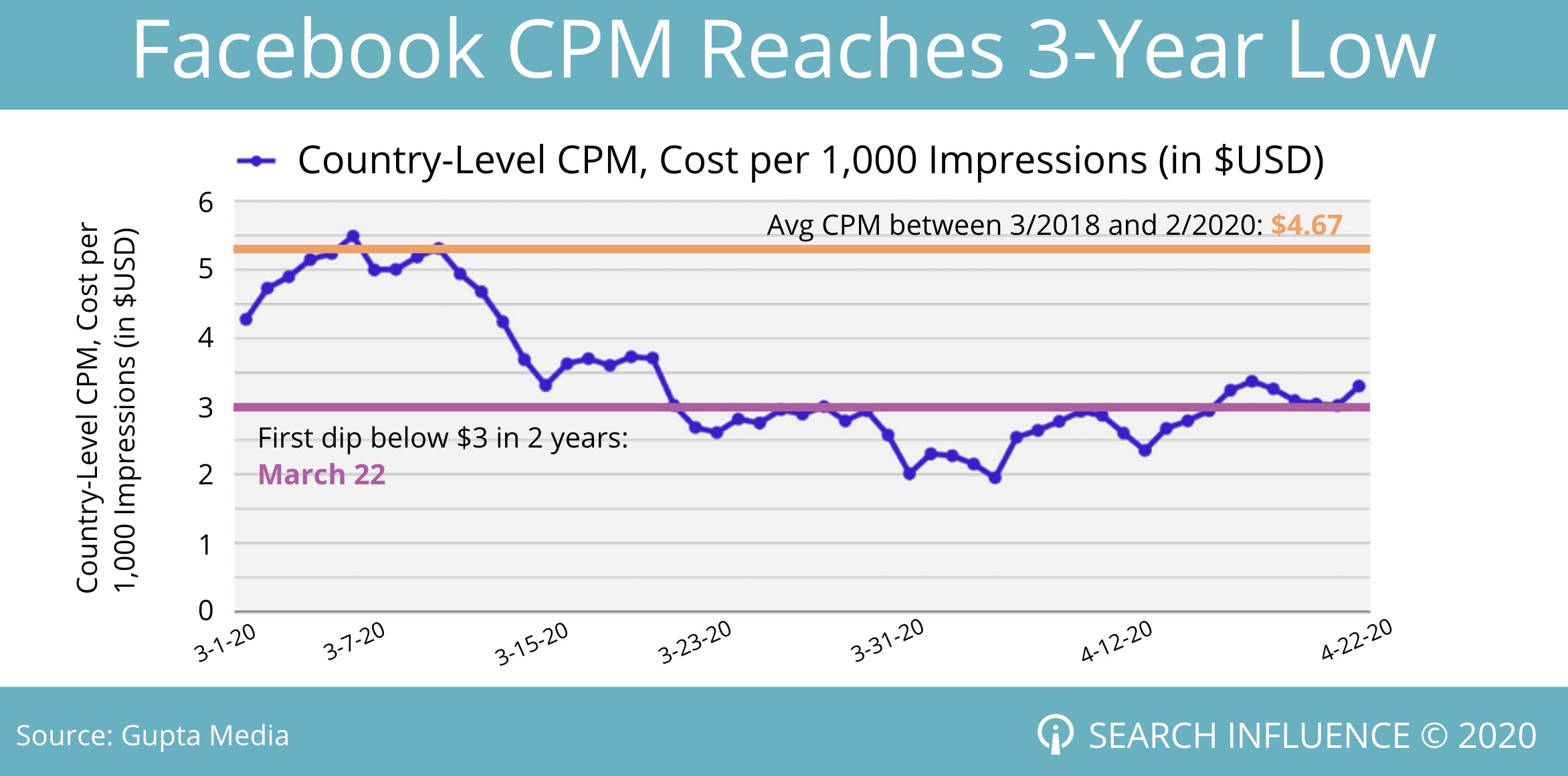
    Search Influence branded graphic showing Facebook CPM totals between March 2020 and April 2020

    Lessons

    • Rapid pace of technology adaptation among the greater population has changed consumer behavior for the long haul—those who already offered online options and services see growth.
    • The low cost of Facebook Ads make budgets stretch farther than ever. On Google, while search volume is down, those who search have high intent.
    • Online courses within your industry could offer new revenue stream opportunities. Do you have a special way of doing something that you can share with others in your industry?
    • Facebook lead generation campaigns are making up for volume drops in other lead gen avenues, due to a massive increase in usage of Facebook’s platform.
  • A Physician’s Guide to Choosing Target Audiences on Facebook

    One of the most important assets in any physician’s marketing strategy is knowing your potential patients. In a field as diverse as medicine, this can mean the difference between success and failure. Therefore, we’ve put together a helpful guide to Facebook’s targeting tools to help build and improve your online audiences.

    Define Your Patients

    The first step in any successful strategy is defining who you want to get in front of. Imagine the type of patient you’d like to attract and jot down every characteristic about them that you can think of. For example, if you’re a plastic surgeon who would like to do more tummy tucks, then what are some general attributes of a typical tummy tuck patient? Here are some questions to help you get started:

    • Are they women or men?
    • How old are they?
    • Are they married or single?
    • What is their household income?
    • How much disposable income do they have?
    • Do they have children? If so, how many and how old are they?
    • What kind of car do they drive?
    • What do they do for a living?
    • Which schools did they attend? What level of education did they reach?
    • What are their hobbies?
    • What types of clubs or organization are they typically involved in?
    • How do they spend their free time?
    • Have they ever had plastic surgery?
    • Have their friends had plastic surgery?

    Once your ideal patient has been defined, review Facebook’s guidelines to see which targeting options are available, or you can see all of Facebook’s Ad Targeting Options in one epic infographic.

    Locate Your Patients

    After your ideal patient has been profiled, the next step is to determine where they are. One of the biggest mistakes in marketing is casting your net too wide and spending advertising dollars on people who won’t turn into patients. Physicians must check their pride at the door and determine how far patients would realistically travel for their services. For example, a patient might travel 30 miles to see a specialist or surgeon but would likely never travel farther than 15 miles for primary care. Once you’ve determined how far a patient would be willing to travel to visit your practice, use Facebook’s tools to limit your targeting to these areas.

    Refine Audience Size

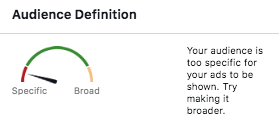
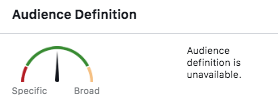
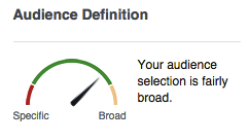
    Once your audience had been defined, take a step back to consider the size of the group. Review the  “Audience Definition” meter along with the “Potential Reach” number within Facebook’s campaign manager. The ideal audience has fairly specific targeting, but not so specific that the number of potential viewers is under 1,000. This ideal audience size is broad enough to be inclusive to anyone who shares the targeted interests but specific enough that the impressions aren’t wasted. You can tell that you’ve reached the ideal audience size once all of the necessary layers have been added and the numbers aren’t fluctuating as much.  

    Very specific Facebook audience targeting for Search Influence in New Orleans, LA

    Less specific, more general Facebook audience targeting for Search Influence in New Orleans, LA

    Very broad audience targeting for Facebook campaign done by Search Influence in New Orleans, LA

    Medical Industry Audience Limitations

    Due to ever-evolving privacy laws worldwide, specifically in the medical field, physicians must operate (pun intended) under more strict targeting regulations. This is especially true on Facebook. One of Facebook’s most useful features allows business to upload email addresses or phone numbers directly into the platform and create custom audiences from these lists. You can then create a wide variety of custom audiences based on those lists. However, businesses in the medical industry are not permitted to create such audiences through an upload or pixel users who have visited their site because it violates medical privacy laws. Therefore, medical practices must give their targeting even more thought to serve up ads to their ideal audience.

    With the tips outlined in this helpful guide to thoughtful audience creation, you, too, can be on your way to increasing engagement and building your online presence! At Search Influence, we have extensive experience working with clients in the medical industry. For more information about how we can help promote your practice on Facebook and other social media platforms, start a conversation with us today.

    Images

    Doctor

  • Growing Your Practice on Facebook, Part 6: A Facebook Success Story

    Part 6 of The Ultimate Guide for Growing Your Medical Practice Using Facebook

    Welcome to the final installment of our series on using Facebook to promote your medical practice. Now that we’ve covered best practices, we’ll show you how we put them in action using one of our own clients as a case study—Donaldson Plastic Surgery.

    Remember, if you want more information about using Facebook for your medical practice, make sure you download our e-book.

    But First, Let’s Recap

    Before we show you how to put everything together, here’s what we’ve learned so far:

    Part 1: Why Facebook Matters – The introduction to our blog series showed how Facebook can be used for medical practices in particular, and why it’s an important tool for engaging with patients and creating a personal connection with them.

    Part 2: Shareable Content – We gave easy-to-follow tips for creating shareable content as well as advice on the often forgotten second step of Facebook: engaging with your followers in response to their interest in you.

    Part 3: Advertising – Taking a slightly different approach, we went into detail about paid promotions, discussing the difference between promoted posts and ads, and laying out Facebook’s restrictions that govern medical advertising.

    Part 4: Reaching Your Audience – We explained how to leverage Audience Insights to target your ads to your ideal patient, making them more effective, and how to bridge the gap between your online audience and the real patients who walk through your door.

    Part 5: Patient Confidentiality Concerns – This blog brought it all home with clear examples of how to stay HIPAA-compliant while posting on social media.

    Now, it’s time to see how all of these elements work together with a real medical practice.

    Facebook Campaign in Action: Donaldson Plastic Surgery

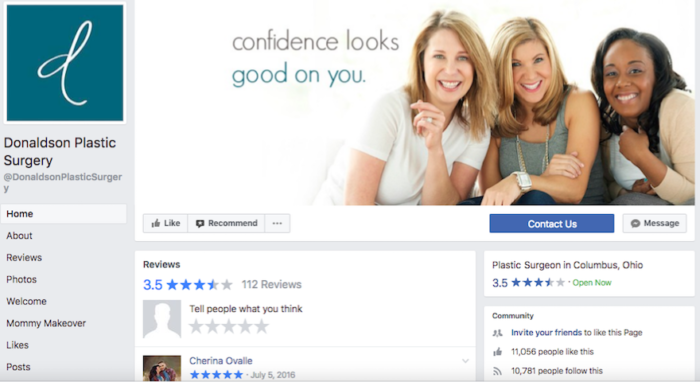
    Dr. Donaldson has been our client since 2009, the year he opened his practice. Since he was just starting out, there was a lot of work that needed to be done in terms of digital marketing, including a new Facebook page that had a grand total of zero Likes. Since launching his Facebook campaign in 2011, Dr. Donaldson’s page Likes have increased to over 11,000. This was accomplished through a comprehensive Facebook marketing campaign.

    This campaign was comprised of Facebook management, fan building, and Facebook display ads. We created posts that established Dr. Donaldson’s professional brand and consistently published engaging, informational, and promotional posts that appealed to current and potential patients throughout the area. We also created ads that increased brand awareness, brought Dr. Donaldson’s practice to those who didn’t know him already, and promoted the full range of his services, all utilizing Facebook’s targeting abilities.

    Image Of Facebook Page Likes For Donaldson Plastic Surgery - Search Influence

    Combining paid ads with an increased frequency of organic posts expanded the practice’s fan base. A large chunk of Dr. Donaldson’s Facebook fans, totaling 11,000+ Likes, have come from annual fan building campaigns (over 6,400 of the Likes, in fact). Campaigns such as Likes for Lives encourage Facebook users to Like your page in exchange for a donation to a charity organization. These campaigns increase followers while also giving insight into your practice’s values and the importance of giving back to your community.

    Dr. Donaldson is proof that a well-managed Facebook page, full of engaging posts and targeted ads, can work to create a campaign strategy that gets patients through the door and establishes your practice as the medical resource in your area.

    Armed with the best practices we’ve covered in our blog series, you can accomplish results like this for your medical practice as well! If you have any strategic questions or need help growing your practice on Facebook, contact one of our experts here.