This blog post was updated by Ren Horst on November 4, 2025 following the webinar event.
50% of prospective students use AI tools at least weekly to research information online. 79% read Google’s AI Overviews, and more than half say they’re more likely to trust the institutions AI cites.
These search behaviors are no longer emerging trends. They’re the new reality for enrollment marketing.
On October 23, UPCEA and Search Influence hosted the live webinar “AI Search in Higher Education: How Prospects Search in 2025,” unveiling findings from the AI Search Research Study.
The session explored what’s shaping prospective student behavior today, plus how higher ed marketers can adapt their visibility strategies for AI-driven search.
How AI Is Changing Institutional Visibility
The new research highlights a fundamental shift in how students discover, evaluate, and ultimately choose higher education programs. Traditional search engines remain important, but AI-driven platforms are shaping decisions in ways that enrollment marketers can’t ignore.
For higher ed institutions, the implications are clear: If you’re not present in AI-powered search experiences, you may be invisible to a significant portion of your prospective students.
“AI Search in Higher Education: How Prospects Search in 2025” unpacked the study findings, explained why they matter, and showed you how to position your institution for visibility in 2026 and beyond.
Key Takeaways From the Webinar
SEO then and now
Search strategy has evolved from keyword targeting to context and credibility. AI engines understand meaning through entities, relationships, and trusted citations, not just keyword density. The webinar discussed how this shift changes on-page SEO priorities, emphasizing entity optimization, structured data, and semantically rich content to help AI engines interpret institutional expertise.
Authority and content signals
Institutional visibility depends on demonstrating trust through structure, accuracy, and reputation. AI platforms prioritize content that’s organized, verifiable, and supported by credible references. The webinar explored tactics for improving these signals, like incorporating earning links, highlighting faculty expertise, and securing third-party mentions that reinforce authority beyond your own website.
Measuring AI visibility
Understanding your reach in AI search is becoming possible through emerging analytics. Tools such as Google Analytics 4, Search Console, and Scrunch can reveal AI-driven traffic, question-based visibility, and citation frequency. The webinar covered how marketers are starting to quantify AI exposure, sharing practical ways to integrate early visibility tracking into institutional reporting.
The Opportunity Ahead
AI is fundamentally changing how students search and how institutions are seen. Yet, many schools haven’t updated their strategies to reflect how AI engines surface information.
Those who act now will gain visibility in AI and Google, positioning their programs to be found, considered, and chosen.
Search Influence presents “The Great Resignation: How to Stabilize and Even Boost Your Marketing in this Uncertain Time” in partnership with the Louisiana Hospital Association (LHA) on Thursday, Sept, 22, 2022. This is Search Influence’s fourth time partnering with the LHA for a virtual training exclusively for the organization’s members.
Established in 1926, the LHA is a not-for-profit association representing all types of hospitals and healthcare systems throughout the state. The LHA carries out its mission by providing services and resources to members through advocacy, education, research, representation and communication.
About the Virtual Training:
The Great Resignation is impacting every industry, especially the medical industry. A recent survey by Marketing Hire News found that marketers are not an exception to this trend. But how can medical practices ride the wave of this turnover and still continue to push their marketing objectives forward? How can your in-house mar comm be prepared for turnover whether that is now or later? How can medical practices take advantage of the Great Resignation on the marketing front?
The Great Resignation sounds scary but let HR handle the comings and goings of staff and deep dive on the marketing engine driving your company’s objectives and revenue. Best practices and strategic line of sight can keep marketing tactics such as third party review sites, patient testimonials and storytelling in motion while staff positions are vacant.
Shore up four key areas of focus within the marketing communications function that can position your company to excel even without being fully staffed in-house.
SEO is a critical component of any digital marketing strategy, but it can particularly help healthcare organizations expand their online reach.
Investing in a strong SEO strategy for your healthcare organization can increase your website traffic, lead to a higher local search volume, and attract new patients.
To really witness the results of your healthcare practice’s SEO efforts, you’ll need to take actionable steps, such as creating a mobile-friendly site, choosing the right targeted keywords and making efforts to rank locally.
Search engine optimization (SEO) is the modern-day digital marketing pillar of an organization’s successful and compelling online presence. Today, countless businesses across industries use SEO efforts to rank higher in search engine results, with goals of driving traffic to their websites and giving their company’s name more word-of-mouth benefits.
Your healthcare organization should be no different.
By implementing robust healthcare SEO strategies, your medical business can expand its online reach, build brand awareness, improve user experience—and attract new, engaged patients. In this post, we’ll take a look at some of the benefits of medical SEO and how providers can utilize it effectively in their digital marketing strategy.
What Is Healthcare SEO?
The term healthcare SEO describes a range of search engine optimization strategies that providers and medical facilities use to enhance their online presence and organic reach, which includes strategically selecting keywords to craft high-quality, engaging content. Because search algorithms prioritize surfacing relevant, authoritative pages in order to provide users with an efficient search experience, a successful healthcare SEO strategy can make the difference in how high your pages rank in the search results. And the higher your pages rank, the higher the degree to which curious leads convert into patients.
We believe the myriad of benefits of a comprehensive SEO strategy is the most impactful for providers aiming to become more visible, valuable, and available to their patients.
What Are the Benefits of Healthcare SEO?
The primary goal of a healthcare SEO strategy is to draw more patients to a practice’s web presence, content, and, ultimately, products and services. By enhancing your practice’s brand awareness, healthcare SEO can help you acquire those patients who otherwise would opt for a competing provider—simply because of that provider’s accessibility and presence on the web. At Search Influence, we advocate for strategies that drive higher patient volumes and increase your website’s traffic.
Higher patient volumes
It’s a no-brainer: consumers are more likely to buy a product or pay for a service if they know about a business in the first place. Healthcare SEO helps to bring awareness to prospective patients about certain providers and inform them of the practice’s services, unique qualifications, and products. The more awareness the general public has about a medical facility, the more likely that practice will see new patient numbers rise.
Improved search results increase website traffic while also organically enhancing a company’s brand identity. When more people visit a company’s website, the chances increase of that business’s name becoming a topic of conversation and users sharing its content across social media platforms.
If you want to be sure you get the maximum value from the targeted healthcare SEO services you’re paying for, be sure your provider gives you access to Google Search Console and Google Analytics.
Actionable Healthcare SEO Tips
You can apply this SEO expert advice and best practices to all businesses, regardless of their specific products, services, or industries. However, with an action plan tailored to your distinct marketing goals, healthcare providers, in particular, can utilize these tried-and-true strategies to drive clinical success. To maximize the potential of your practice’s web presence, we recommend following these five effective and proven healthcare SEO tips:
Choose the correct keywords
Keywords play an essential role in every SEO strategy, no matter if you’re a start-up clinic or a reputable specialty hospital. Choosing the right keywords to target depends on several fundamental insights, such as:
Knowing your audience and their unique needs
Researching what potential patients plug into search engines
Understanding the dynamics of how, when, where, and why people search for healthcare services on the Internet
Using keyword research tools, SEO experts can determine which keywords generate the most traffic, have the least competition, and drive the best results for a practice depending on their specific marketing goals.
Create and update listings to improve local search
When generating results, mobile devices, applications, and search engines often take the geographical location of the searcher into consideration. As a way to increase your reach and competitiveness in your target region, location-based SEO helps your content appear to audiences in a specific area. Without a website adequately optimized for location, your healthcare organization may get lost in the search engine shuffle, with potential patients opting to find services closer to where they live.
Create unique, high-quality content for your website
Posting new, engaging content regularly keeps potential clients invested and clicking. Maintain steady traffic streams and provide useful information about your product and services through various content types, such as blog posts, white papers, videos, and podcasts.
Encourage your patients to leave online reviews
Healthcare providers and businesses should encourage patient feedback—especially if the reviews are enthusiastic and positive.
According to data from ReviewTrackers, a staggering 63.6% of consumers report that they prioritize checking Google reviews before visiting a business’s location. Aside from increasing your practice’s credibility, outside patient interaction also helps healthcare websites with search engine rankings. When patients review a company, that business’s online presence is effectively elevated in the search engine algorithms.
Make your website mobile-friendly
Mobile web traffic has gone up more than 200% in the last seven years, indicating that potential patients prefer to use their smartphones over desktop or laptop computers when searching for healthcare services. Poorly built and user-unfriendly websites come across as cold and act as red flags to prospective patients. Healthcare SEO can help your medical business present itself as more relatable while showcasing its professionalism, authority, and trustworthiness.
The Knowledgeable SEO Experts at Search Influence
If you want to increase organic traffic to your medical practice’s website, create engaging and original content, and ultimately draw more potential patients to your healthcare products and services, start with honing in on your healthcare SEO strategies. Search Influence’s team of SEO professionals have been developing SEO strategy for doctors since 2007, and we can help you take your practice’s search engine marketing to the next level and increase your online traffic and engagement.
Unexpected events are just that — unexpected. Despite this, your healthcare practice can properly prepare for any unprecedented conditions by remaining proactive in pre-planning patient/provider communication strategies.
Keep your messages in touch with current events. Adjust automated and pre-scheduled messages, social media posts, and newsletters to fit the context of the current climate. In other words, don’t be tone-deaf!
In times of uncertainty, keep patients informed by reviewing all digital platforms for opportunities to regularly send out updates. No site or profile is too small for an update regarding office closures or changes to your hours of operation.
Keep messages, details, and updates across platforms accurate. There’s no quicker way to lose a patient’s trust than to send out information that seemingly contradicts itself.
Pre-planning communication strategies help your team save time, delegate responsibilities, and understand expectations when weather or pandemic-related events strike. It’s never too soon to start pre-planning your medical marketing strategies to circumvent a potential crisis.
Picture this — it’s the height of a worldly crisis, and your healthcare clinic has no choice but to temporarily close its doors to patients. You’re rushing to get your office’s updates written, approved, and posted, on top of trying to figure out which marketing team member will update which platforms to keep patients informed and engaged with your clinic. You haven’t even decided how to release your updates, and you’re already overwhelmed.
This scramble to release timely, accurate, and relevant information to the public signals the need for your team to plan cohesive communication strategies. Proactive communication — as opposed to reactive responses — helps anticipate what your patients most want to know, as well as how and when they prefer to receive updates regarding your facility.
From adjusting automated messages and updating your office’s primary platforms to enhancing reader trust through accurate messaging, pre-planning your medical marketing strategies contributes to a more confident and patient-centered workflow. In this post, we’ll cover some healthcare marketing ideas to drive effective patient/provider communication during unpredictable times.
Benefits of Proactive Communication for Patients and Staff
No matter if your clinic is bracing for the rampaging effects of a Category 3 hurricane or a global pandemic, environmental threats are a direct segway to stressed hospital systems. Unexpected events and catastrophes often lead to last-minute office closures, causing an increase in delays in care and, ultimately, a decline in provider satisfaction. On the contrary, if your office remains open while other healthcare clinics in your area face closures, front desk staff may field relentless phone calls from patients inquiring about your hours of operation and whether they should even show up for their appointment.
If you communicate proactively, you may be able to increase your show rate for those uncertain days and prevent less rescheduling — which can otherwise be a headache for staff and doctors alike. Streamlining communication between patients and staff begins with implementing agile practices in otherwise turbulent environments. In doing so, not only is patient experience improved, but care staff can relish the efficiencies of a more seamless and adaptive work environment.
Once your patients trust that your digital platforms will provide them with critical information, you’ll start to really see these benefits. But to reap these rewards, your team will first need to adopt strategies that center your clinic as a reputable and dependable source of information.
Adjust Automated and Pre-scheduled Messages
We live in an automated world — pre-scheduled posts and emails help us run our marketing communications smoothly on a daily basis. So, what can you do to make sure that automation doesn’t hurt your brand? If patients receive or see messages contradictory to what they expect or heard through another channel, they may question what is accurate. During a crisis, adjusting all pre-planned messages before they reach your intended audience is the backbone of consistent and reliable patient-provider communication.
Halt automated messages
Your team is likely already in the habit of updating your office’s phone tree. Beyond that, your team should be turning off any automated appointment reminders. If a patient receives a message while the office is closed, that can cause questions regarding whether they have missed an important appointment — reducing their confidence in the communication they are receiving.
Reevaluate pre-scheduled posts, emails, and newsletters
Next, you should review any pre-scheduled social media posts and defer or cancel any that would appear tone-deaf or not make sense given the current climate. Even if it’s an engagement-driven evergreen post, if your audience sees that while they are in the middle of a natural disaster, it may look like your company isn’t paying attention to what’s going on in the world.
The same principle applies to marketing emails or newsletters that you may have pre-scheduled or that go out on an automated cycle; if patients receive those during a time of crisis, then the messages will, at best, fall on deaf ears and not get the attention they deserve. In a worst-case scenario, they could insult a patient who might wonder why they are receiving an email about a non-timely topic during an emergency situation. No matter the type, reviewing and adjusting all pre-scheduled messages prevents the likelihood of insensitive content surfacing and tainting your brand’s empathetic reputation.
Update Information on Primary Platforms
Now that you’ve covered the basics and paused any messaging that may not make sense to your receivers, it’s time to shift focus to where patients might expect to find pertinent information. According to a survey conducted by Redpoint Global, a staggering 80% of patients report preferring to use digital channels to communicate with healthcare providers at least part of the time, which highlights the criticality of keeping digital content updated across all online platforms.
To begin, you’ll want to review your healthcare system’s most influential platforms to suggest any updates be made to hours of operation, facility safety standards, or other relevant expectations patients may expect to have. While the breadth of your digital footprint may be more than you realize when first building a list of profiles to update, some of the most important platforms that will require reviewing include:
Your website
Email/text
Patient portal
Facebook
Instagram
Google My Business
Google Search
Any other websites that come up when someone searches your hospital or medical office’s name
Install a website notification bar
If you don’t already have a website notification bar, it’s a good idea to install a feature that puts a banner at the top of your site with your clinic’s latest updates. Before using this functionality, your team should be sure to complete a test run on your site to ensure it accurately delivers timely notifications. Because your staff may be limited in emergency or last-minute scenarios, it’s also important that 2-3 team members are trained and have access to update this, as well as create a new page with more details if necessary.
Assure Patient Confidence With Accurate Messaging
How can you assure your patients trust the information you’re delivering in the updates? Establish confidence in the accuracy of your messages by:
Dating the updates: Keeping a time record of updates helps your patients know the information you’re putting out is fresh. This can be especially important if the situation lasts longer than a day or two.
Communicating often: Keep the updates coming. Daily updates may make sense on some channels, particularly in the days of the most uncertainty.
Keeping it consistent: Be sure the messages and details across each platform refrain from contradicting one another. Consistent messaging is key to long-standing patient trust!
Being clear about patient expectations: Don’t make your patients assume — proactively communicate what they can expect from your staff and clinic.
Relaying information about future updates: Finally, note when and how patients can receive the next update.
Strategies to Pre-plan
So, you’ve reevaluated all automated and pre-scheduled messages, updated your primary platforms with accurate information, and now you’re looking at how to pre-plan your medical marketing strategies in times of crisis. Some of the most essential components of an effective pre-plan strategy include:
Delegating responsibility for updating platforms: Be sure there are 1-2 backups, just in case a staff member isn’t in a location with reliable internet access.
Implementing a shared password system: Store passwords in a secure management system like Passpack or Last Pass to ensure that the right people have access to the proper channels for updating.
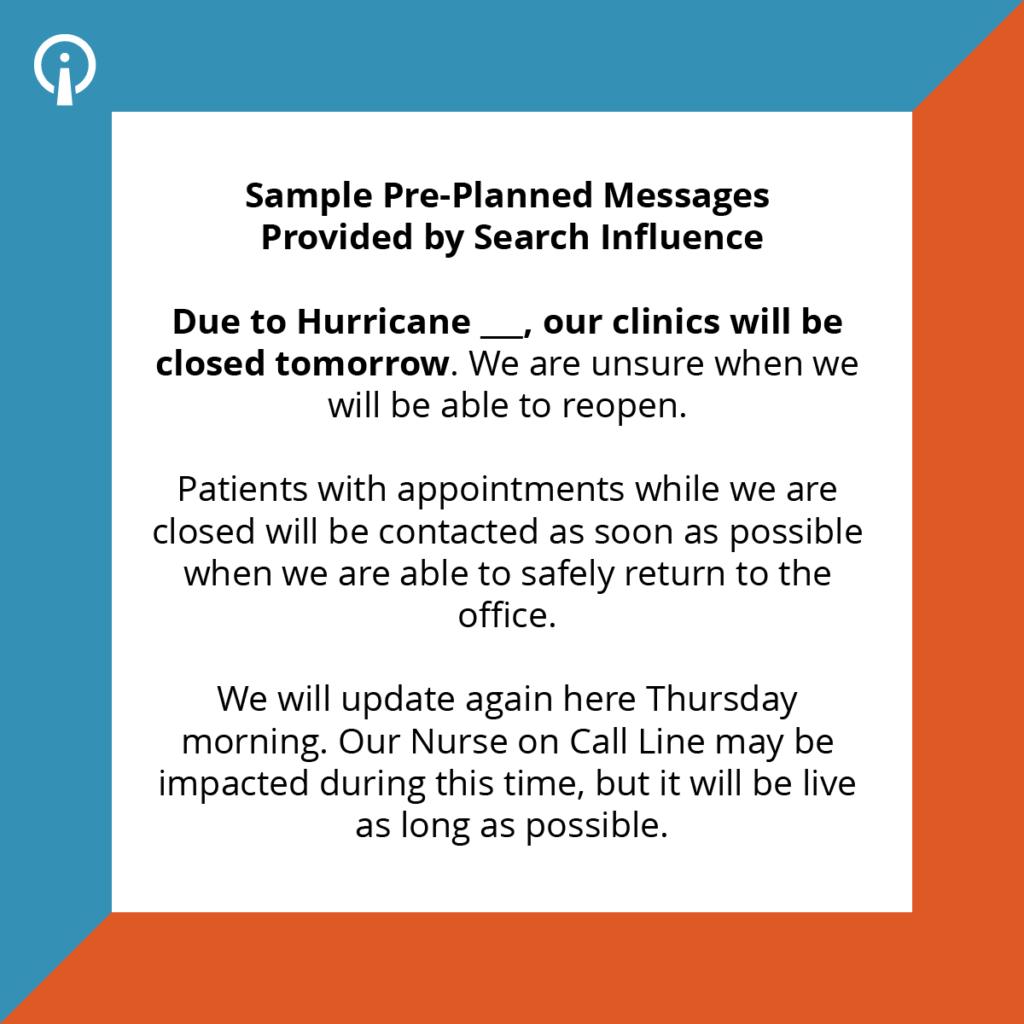
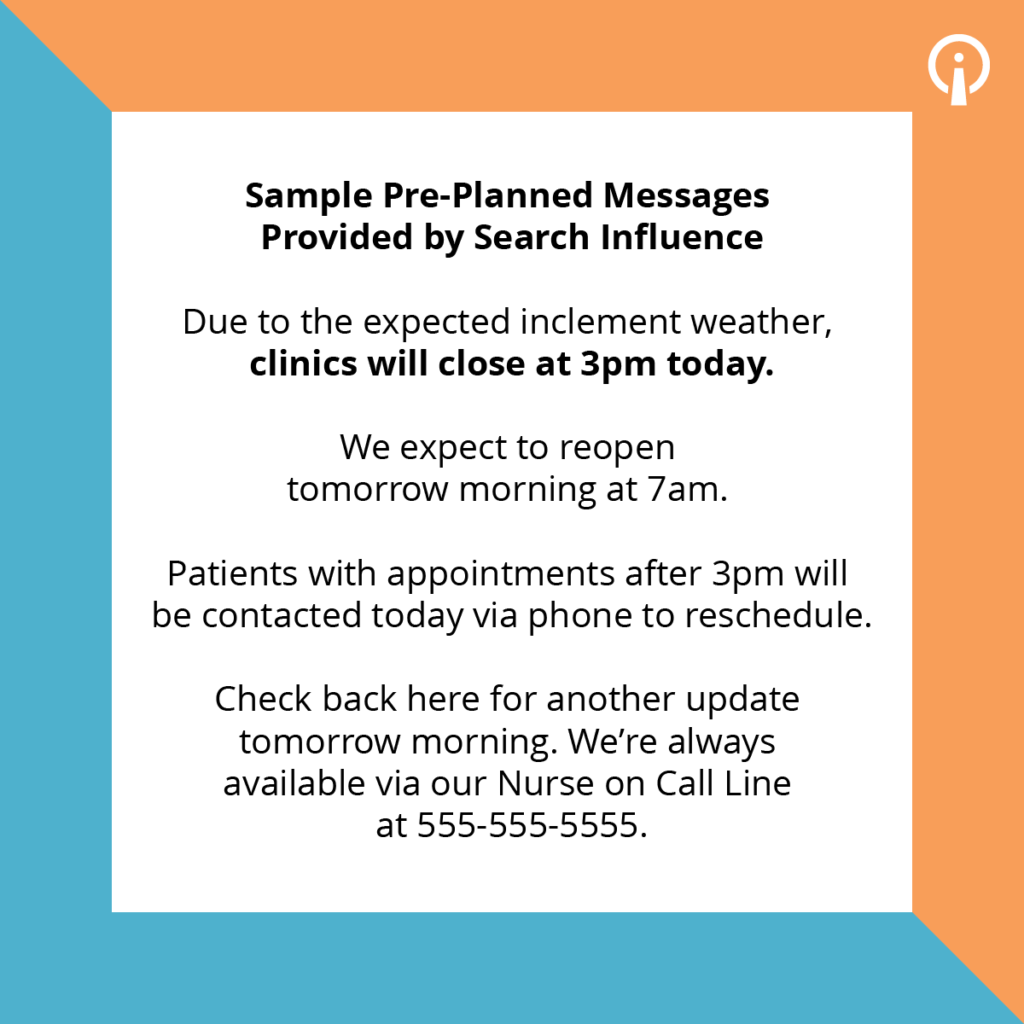
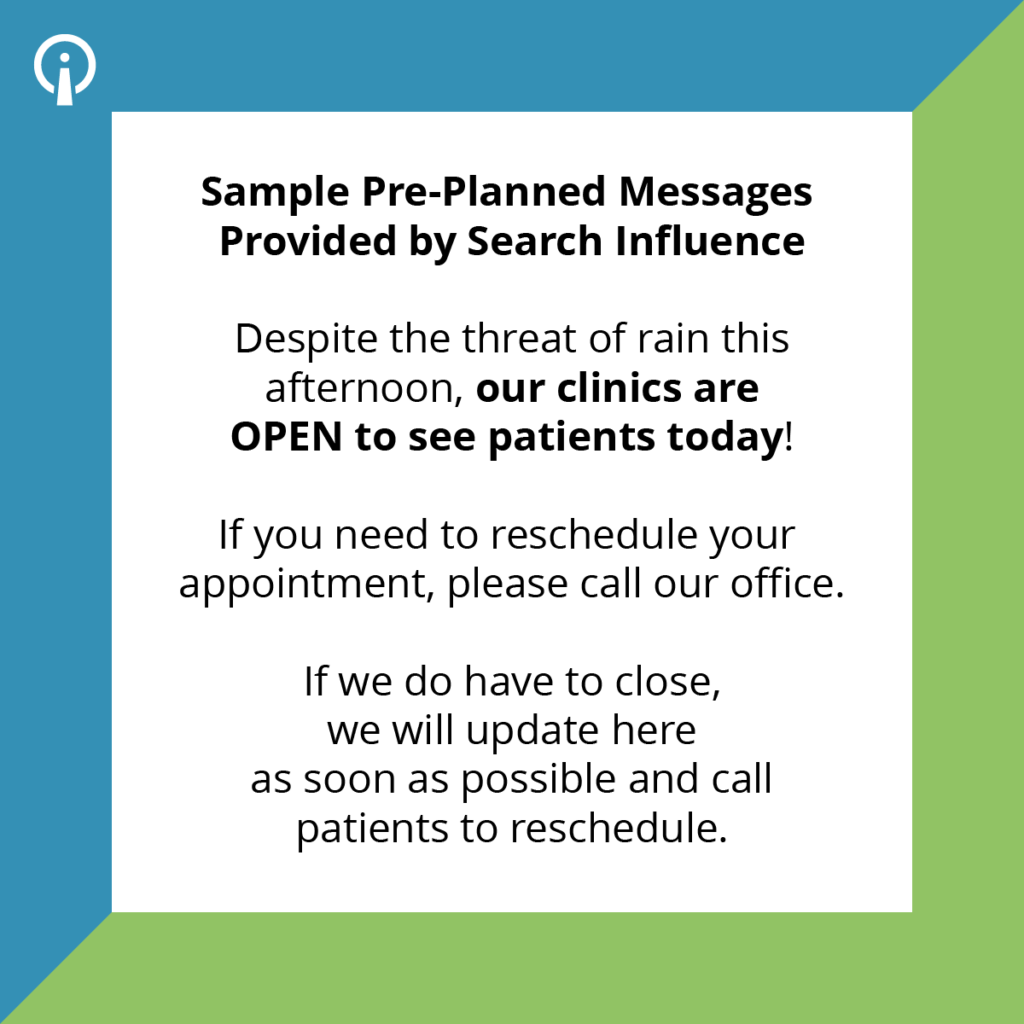
Writing and gaining approval for sample messages: Sample messages can be used as a basis for your real-time messages and demonstrate the most important points of all of your healthcare marketing ideas. This strategy can help save your team writing time while also ensuring communications get out quickly.
Pre-creating social media graphics and email templates: Just like pre-writing sample messages, pre-creating graphics and emails accompany the same benefits of saving your staff time in periods of urgency.
Carrying out a crisis communication drill: Take an hour or two to present a scenario to your team and have them “execute” the plan all the way up until posting or sending any messaging. This will pressure test if they are able to write the messages, access the platforms, and work the relevant systems. It will also force all the pre-organization to happen by making sure everyone has access to the plan.
Anatomy of pre-planned messages
Whereas we may be quick to assume communication is solely required for office closures, it’s almost equally as important to communicate that you are open if things are happening in your community that may be causing others to close. Ideally, pre-planned messages for office openings and closures are composed using the following anatomical focal points:
What’s the situation?
How are hours impacted?
How will existing appointments be handled?
When can patients expect the next update?
How can patients be helped while you are closed
So, How Do You Get Started?
With hurricane season fully underway and COVID-19 numbers still on the rise, now is the time to enact these medical marketing strategies and meet your business growth goals. Here’s a quick recap on how to get started:
Establish and gather your team of 2 or 3 people minimum so that you have coverage.
Compile and prioritize the list of communication channels and platforms. Then, define owners and set up access, logins, and training.
Pre-plan messages and get those approved.
Finally, conduct drills to make sure your team can execute the plan as intended without any preventable basic issues.
Now that you’ve mastered the basics of proactive healthcare communication strategies, it’s time to set your plan into motion. At Search Influence, our digital marketing agency can help you create a communication plan that keeps your patients informed, engaged, and returning. To learn more, contact us today for help getting started on all of your healthcare marketing ideas.
SEO is a marathon, not a sprint. Spending time to create an SEO game plan is crucial in identifying key items to work on to support website growth.
Take time to identify the signs your website needs a checkup, diagnosis the issues that be added to your SEO gameplan, and begin tackling the items on your list.
SEO takes time. Continuing to optimize your medical website over time will show long-term benefits to your rankings and ROI.
Your website should represent your practice’s brand and demonstrate your expertise in the industry. Traditionally patients turn to Google for the closest and best option when looking for a new medical practitioner. With that in mind, your practice should have a website that appeals to your target audience and is properly set up on the back end to support ranking on Google.
Having well-optimized content on procedures and services provided, before and after galleries, and reviews/testimonials all support the overall experience of a user when visiting your site. Optimizing your site will give your medical practice higher quality leads which can support growing your practice.
Yet, a great front end doesn’t always mean the backend is optimized to its fullest potential! It can be overwhelming to begin creating an “SEO game plan.” During this process, it’s important to remember that SEO is a marathon, not a sprint. Google wants to see consistent improvement and engagement from website owners. It takes time for Google to process and give your website credit for all the improvements you’ve made (generally a couple of weeks to 1 month per change).
In this post, we’ll provide the steps to take and consider when reviewing your medical website and optimizing it to improve your business’s visibility in search engine results page (SERPs).
Symptoms: Signs Your Website Needs a Checkup
You have a visually appealing website and layout, but your medical practice isn’t crushing goals and generating leads as you’d like. Do any of these resonate with your medical practice?
Leads don’t come in from the website
Patients can’t find you on search engines
Patients can’t find your office(s)
Your website loads slowly
If you answered yes to any of the above, you’ve come to the right place! Let’s dig into the common causes of these challenges.
Diagnosis: Common Causes of Website and SEO-related Issues
Duplicate content
Having high-quality and unique content is crucial to SEO and rankings. It is especially important as a medical professional to have unique content to show authority and overall expertise in the industry.
However, duplicate content means the content displayed on your site also is displayed somewhere else on the internet. When this happens, Google has a hard time knowing which site is more relevant to a search query. This, in turn, forces search engines to determine which site’s content is more relevant to a specific search query.
Incorrect Directory Information
You must have your name, address, and phone number (NAP) consistent across the internet. Since many medical offices share one main address with unique suite numbers, ensure you have your suite numbers outlined in all listings online to keep your NAP consistent.
As medical offices move to new buildings or expand, updating directories online to display correct information is a step sometimes missed in the move. This can add to the challenge of your patients having trouble finding your practices’ office because Google will display outdated information.
Clunky, outdated websites that don’t load quickly
Data suggests lower load times lead to a drop in overall conversions because a patient will bounce off a slow loading site to find another provider.
There are plenty of free tools to utilize to consistently monitor your site speed. When partnering with a Healthcare SEO team, this is something that is included within your campaign and monitored for improvements.
User experience
A common reason a user leaves a website is that they can’t find what they were looking for. When a user visits your medical website, is it user-friendly? Is your navigation easy to digest and navigate?
Website Responsiveness
Your website should be a responsive website that is mobile-friendly and works seamlessly across all devices, whether a user is visiting it on a mobile device or tablet. Having a responsive website means your layout is flexible to screen size and adjust accordingly depending on the device. This is important to have as it offers a user a good experience regardless of what device they decide to visit you on.
Contact form is missing, buried, or lacks a call to action
When a patient visits your website, they should have a clear call to action (CTA) along with steps to follow after the CTA is complete. It is common that a patient would hesitate to fill out an on-site form due to unclear required fields.
Treatment: Procedures Needed and Expected Outcome
Just as each patient is different and has different priorities, so do websites. There are many ways to diagnose your website and create an “SEO Game Plan.” You should triage website issues on a case-by-case basis.
Taking a step back and completing a full SEO needs analysis is crucial to begin your SEO journey. Our team reviews a site’s health and identifies strategic areas of opportunity for improvement in the following areas:
As mentioned, SEO is a marathon, not a sprint. Typically, executing tactics happen over time. As each medical practice has its own priorities and time budgets to support these efforts, it can take time to get everything in place to begin seeing results. This all depends on the time and effort the medical practice is willing to put in.
Generally, the tactics below are a standard of care for a website that needs the full treatment:
Re-write and expand website content for priority services and procedures. As website content goes live on your site, you may see an improvement in rankings in 2-3 weeks for that given topic.
Creating clear call-to-actions across the site for conversions
Redesign website (long term play)
It is important to recognize that all websites can utilize optimizations from a user and technical perspective. Allocating time and resources to spend on analyzing your medical site’s needs is crucial in making sure you are set up for success.
For more information on optimizing your medical website, contact the experts at Search Influence.
Your prospective patient could be in any of the three patient funnel phases, and so it’s important to meet them where they are with the information and communication provided.
Responding quickly and in a valuable way to inbound patients can be the differentiating factor between booking an appointment and losing that appointment to a competitor.
Sometimes, even if your marketing strategy does all the “right” things, some inbound patients don’t take the next step and book that appointment. But, by providing them valuable, various touch points throughout their journey, you can put yourself in a position to further nurture them.
Every inquiry has the potential for a new patient to make the jump from interested to committed. However, in the healthcare industry, competition is high. Patients may be willing to travel great distances for the right provider—but that prospective patient may just move on to the next option if they don’t hear from you quickly or get the right answer. If you do not respond quickly enough, this could mean you run the risk of losing potential new patients.
In this post, we will walk through the three different phases your prospective new patients can fall within the marketing funnel, the most valuable ways to communicate with those patients in each of those phases, and a few platforms to aid in nurturing these newly formed relationships.
Top of the Funnel Marketing
Top of the funnel marketing (also known as the awareness phase) refers to any marketing efforts with the goal of improving a business’s online presence and overall brand awareness. Your initial touchpoints should align with where the potential patient’s place in the marketing journey. At the top of the funnel, the patient seeks educational information. They will conduct research online for relevant, valuable information related to the issue and/or illness they’re navigating.
Key metrics to consider in a brand awareness campaign include impressions (or views) on your paid advertisements and/or website traffic.
Types of content to offer:
A website that houses clear, search engine optimized content so that patients can find your website and understand that your offerings are relevant to their needs
Testimonials from previous patients advocating about their pleasant experience/results
A frequently asked questions page to help resolve any often-asked questions, such as insurances accepted, office hours, or office location
Paid advertising efforts, such as Facebook Display, with high-level messaging that has the goal of building brand awareness
Middle of the Funnel Marketing
Once this prospective patient has some initial education, they move from the top of the funnel to the middle (also known as the consideration phase). Marketing efforts within the consideration phase use metrics such as increases in: clicks on paid advertisements, the average session duration on the website or views on videos.
In this phase, the patient seeks a deeper level of information and spends more time absorbing content. Similar to the awareness phase, the types of content offered should provide answers and insight for the patient.
Types of content to offer:
Expansive, detailed website and/or blog content that speaks to your office’s specialty, the types of options you offer patients, etc.
Option for patients to schedule a complimentary education call with a member of the staff to ask any questions and learn more
Paid advertising efforts, such as Facebook Display and Remarketing, with more targeted messaging that has the goal of driving a conversation
Bottom of the Funnel Marketing
The last and final stage is the bottom of the marketing funnel, also known as the decision phase. Once a patient has entered this stage, they’ve absorbed information about their symptoms and options (likely both online and via education calls), and feel ready to make a decision on next steps. Most likely, these next steps will come in the form of a booked appointment. This means, more than ever, it is important to respond quickly. Ideally, you have an appointment management system that conveniently allows patients to book appointments.
According to The Lead Response Management Study conducted by Dr. James Oldroyd of MIT, the odds of qualifying an inquiry (potential patient) are 21 times less likely when comparing a response rate of 5 minutes vs. 30 minutes. Additionally, the odds of successfully scheduling a qualified inquiry (potential patient) decrease by over six times in the first hour. Because that patient likely identified a few options during their consideration phase research, failing to quickly reach out could result in them scheduling their appointment with another doctor/office.
Once the patient has scheduled their appointment, you can still provide valuable content, such as:
Outreach confirming the appointment, location, and other useful details
Downloadable PDFs that include information about what to bring and what to expect during the initial appointment
Success stories and testimonials from previous patients who had similar symptoms, underwent similar procedures, etc.
Paid advertising efforts, such as Facebook display & remarketing, with messaging that includes a very clear call-to-action
How to Nurture Past, Current, and Prospective Patients
Sometimes, regardless of how effectively you provide value to prospective patients, it may not result in a newly scheduled appointment or surgery. However, even if they don’t convert at the time, another benefit to providing avenues for potential patients to engage (e.g., downloadable PDFs, Facebook display advertisements) is the opportunity to identify them and further nurture them.
The most important thing to consider when developing a nurture strategy is that any efforts deployed are HIPAA compliant. There are some limitations here, and so it’s important the strategy adheres.
A few HIPAA compliant nurturing methods:
Email Marketing
There are a few different tactics that can be deployed through this avenue depending on the ultimate goal and quite a few different email marketing platforms that can be used to ease the creation and distribution.
Newsletters to past, current, and potential patients highlighting updates to the office, any changes in personnel, etc.
Messaging to past, current, and potential patients promoting upcoming specials to help entice appointments booked, reminders about upcoming appointments and/or that appointments are due to be scheduled
Outreach that includes more information about the office or testimonials to potential patients who have previously shown interest
Facebook Display & Remarketing
Remarketing to users on Facebook is HIPAA compliant and a beneficial way to get back in front of potential patients. When creating this strategy, consider:
These two elements should look and sound different to patients in different funnels. Identifying what types of questions could be answered within each phase, the types of content that would be beneficial to consume, etc., are a few great ways to curate both the creative and messaging.
Targeting
Identifying and honing in on the target demographics, geolocations, and other relevant audience specifics will help see that advertising dollars are only spent where they are likely to produce more qualified inquiries.
Overall strategy
Facebook offers a variety of objectives (conversion, traffic, lead generation) to pursue. This effectively tells Facebook how to best optimize campaigns.
How to Ensure You Make an Impact
It can feel overwhelming to determine how to market your business online. With so many different best practices, strategy options you can make an impact by considering the phases of the marketing funnel and the most valuable ways to communicate with the patients in those phases. By providing your prospects with different valuable touchpoints, you put yourself in a great position to nurture them through the funnel.
Contact Search Influence for help with all your digital marketing needs. Our team of experts can help you implement all the best practices and strategies needed to turn inquiries into long-lasting relationships.
Consumers across all age groups have embraced streaming tv shows and movies.
Advertising on streaming services offers many benefits over traditional TV advertising, including robust targeting and measurement, including individual or household information.
By leveraging OTT, you can reach consumers with messages across multiple devices and platforms, truly running a full-funnel campaign with ads that talk to each other.
You can stretch your advertising dollars with OTT to reach consumers where they already watch content: their smart TVs, computers, and mobile devices.
Even if you are old enough to remember tuning in live for the Cheers finale live or parking in front of the television for “The One Where Ross Finds Out,” chances are you now stream most of your favorite TV shows. In 2020, Hulu found that 90% of all 13–54-year-olds watch TV on a streaming platform. That’s several generations of consumers who engage with TV, movies—and brands—in a streaming environment. The COVID-19 pandemic has increased watching habits, with the average American now spending nearly two hours a day watching subscription video on demand services.
Advertising on streaming television is an affordable way for businesses to fill their upper funnel while capitalizing on the creative flexibility, targeting, and measurement capabilities of digital advertising. Emerging brands can use streaming advertising to leverage the mass reach and advanced targeting capabilities of long-form streaming to help build awareness, while established businesses can use it to connect with coveted audience segments who do not engage with traditional media.
The industry term for streaming long-form content directly to viewers via the internet through TVs or devices is called OTT. This post will further define OTT and expand on its benefits, including targeting, measurement, and branding.
About OTT
Defining OTT
OTT stands for over-the-top and refers to content streamed on apps and services, such as Hulu, Discovery+, or Peacock.
You can watch OTT content on any device connected to the internet. The term originates from the now common practice of consumers going “over the top” of a cable box, bypassing cable/satellite subscriptions or broadcast TV to stream long-form, premium video (such as scripted TV shows).
Advertisers can also use the term OTT to distinguish streaming tv shows and movies from user-generated online video (for example, unboxing videos on YouTube made by an influencer is not OTT content.)
What is CTV?
CTV is a subset of OTT. CTV stands for connected television and refers to a device that delivers video by connecting to a TV.
CTV examples:
HDMI sticks: Amazon Fire TV, Apple TV, Roku
Gaming consoles
Connected television sets, such as smart TVs
It does not include tablets, computers, or other mobile devices.
An Example of OTT and CTV
You start binge watching the latest Hulu series of the moment through a Roku plugged into your TV.
You streamed OTT content over CTV.
You move to your bed and watch Hulu from the app on your phone (yes, yes, you know it’s not good for your sleep to watch TV in bed).
You streamed OTT content.
Benefits of OTT
OTT combines the power of digital media with the advantages of advertising on television. Your brand receives traction from the authority consumers assign to seeing your ad on a big screen with the targeting and measurement capabilities that allow you to optimize performance to maximize your ad spend.
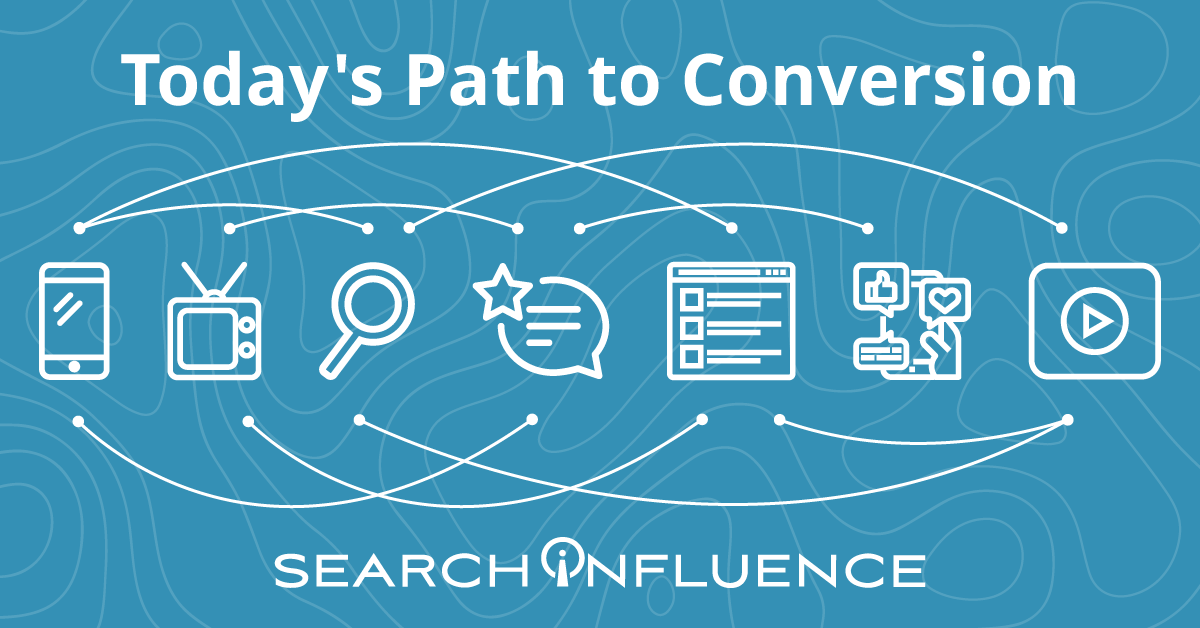
With all of the research options at our fingertips, consumers’ path to conversion evolves each year. Product research and shopping takes consumers across many online and offline touchpoints. By leveraging OTT, you can reach consumers with messages across multiple devices and platforms, truly running a full-funnel campaign with ads that talk to each other.
OTT Targeting Capabilities: First and Third-Party Sources
OTT first and third-party sources enable businesses to build detailed segments beyond the typical options found on other digital marketing platforms.
First-party data: The advertising platform learns about audiences through device-level viewer data, which it takes from users’ IP addresses. Targeting options vary by OTT provider. Some options include:
Location tracking and geofencing
Home page visits
Third-party data: Third-party vendors provide consumer data and customer attributes that enable more precise targeting definitions. Some options for third-party data targeting include:
Purchase behaviors (online and offline)
Age/gender composition
TV viewership and media consumption
Retargeting
A prospect’s viewing behavior becomes part of their digital footprint. If a prospect views an ad, OTT’s retargeting capabilities lets you follow this prospect across all ad-supported streaming services and devices. You can capture brand impressions with video and then prompt an action on a device where it’s easy to convert.
For example, a healthcare practice can target an upper-funnel ad promoting a new procedure to a household’s smart TV. Later, the practice can display a lower-funnel ad that encourages the prospect to fill out a form for a free consultation for this new procedure to a mobile device in that same household. A prospect is much more likely to fill out a form on a mobile device than if the ad appeared on a smart TV, encouraging prospects to go onto their website and fill out the form.
OTT Targeting Capabilities: Addressable Geo-Fencing aka Household Targeting
Through OTT, you can target multiple prospects under one roof.
When several devices are connected to the same router, they form a network and have the same external IP address. As a result, advertising platforms can identify multiple devices in the same household by looking at whether they have the same IP address.
OTT advertising platforms can match a smart TV to a series of desktop and mobile devices, creating a “digital household,” which allows advertisers to target individuals across different devices. This extends the opportunity to customize your ad based on the user’s device.
Examples of What You Can Do with OTT Targeting
OTT’s multiple targeting options allow you to specify as much as your campaign needs.
If a prospect searches a website for events in their area, you can use keyword search retargeting to show them an ad for your event as they stream their favorite TV show.
A small business could target residents over 35 years old in a specific zip code.
If you want to target adults for your continuing education program, you can leverage information such as education level, areas of interest, and browsing history to customize ads down to which educational programs might be most attractive to a given prospect.
Measurement and Attribution
OTT’s sophisticated measurement and attribution capabilities give businesses the tools to evaluate the ROI of their campaigns and understand which segments, platforms, and content deserve further investment.
The capability to match consumers to their devices means you can see which specific prospects watched your ad, how much they watched, and the outcomes of watching the ad (such as purchase, website visit, or store visit). With the flexibility to test audiences and content variations, you ensure your advertising remains relevant, so you don’t waste ad dollars on a consumer unlikely to take action.
Branding
OTT’s multiple platform options help establish legitimacy for your brand. With OTT, your brand ad can appear on a big-screen TV, streaming right after a national brand. This way your ad receives the afterglow of playing right after a Tide commercial on a 70” screen rather.
Ready to put OTT into practice?
To drive performance with target consumers, small and medium businesses should consider including OTT as a component of their cross-platform strategy. Emerging brands can use it to build awareness with new consumers, and established companies can use OTT to remain relevant.
Unsure of where to start with OTT? Contact the experts at Search Influence to discuss how you can use these tactics as part of a full-funnel strategy to drive leads for your business.
This post was updated by Marissa Wehrer on August 24, 2021 to reflect updated news. It was originally published on January 20, 2021.
Key Insights
Apple’s iOS 14.5 privacy update has had an industry-wide impact on businesses that use web conversion events to optimize, target, and report using Facebook’s business tools, such as the Facebook Pixel.
The update will allow users to opt-out of having their activity tracked across other companies’ apps and websites.
Take these four steps to adapt to this industry-altering change and run conversion campaigns in the future.
Complete domain verification to configure pixel conversion events for Aggregated Event Measurement.
Prioritize up to eight conversion events that are most important to your business.
Understand how reporting changes will affect your ability to measure success and optimize your campaign.
Identify new campaign strategies and best practices.
How Does the Apple iOS 14 Update Impact My Digital Ads?
On April 26, 2021, a significant update came to iOS 14 devices that asked users if they would like to “Allow Tracking” or “Ask Apps Not to Track” their activity across other companies’ apps and websites. The general consensus is that the majority of iOS 14 users will opt-out of tracking, thus preventing marketers from sending personalized advertising to those who opt-out.
Apple’s new policy has an industry-wide impact on personalized advertising.
This update will impact businesses that use web conversion events to optimize, target, and report using Facebook’s business tools, such as the Facebook Pixel. Effects include, but are not limited to, the inability to do the following:
Target the right audience with the right message at the right time
Allocate budget efficiently to produce the lowest cost per acquisition or return on ad spend
Get the same amount of data and granularity of reporting to inform decision-making
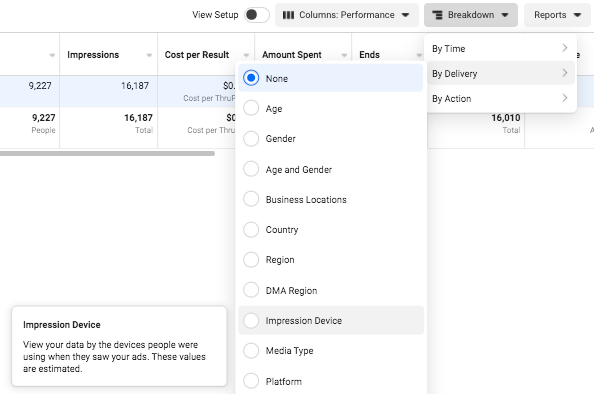
Understand the scale that your campaign performance could be impacted by reviewing your ad account’s Impression Device delivery breakdown. This will help you analyze the percentage of your impressions served to Apple devices.
Despite these daunting changes, personalization is not at a total loss. Facebook Ads will remain an effective advertising channel if you rethink your current strategies and best practices.
If you plan to use Facebook Advertising as a lead driver and revenue generator, the following four steps will be vital to run conversion campaigns due to Apple’s upcoming AppTrackingTransparency framework for iOS 14.5 users.
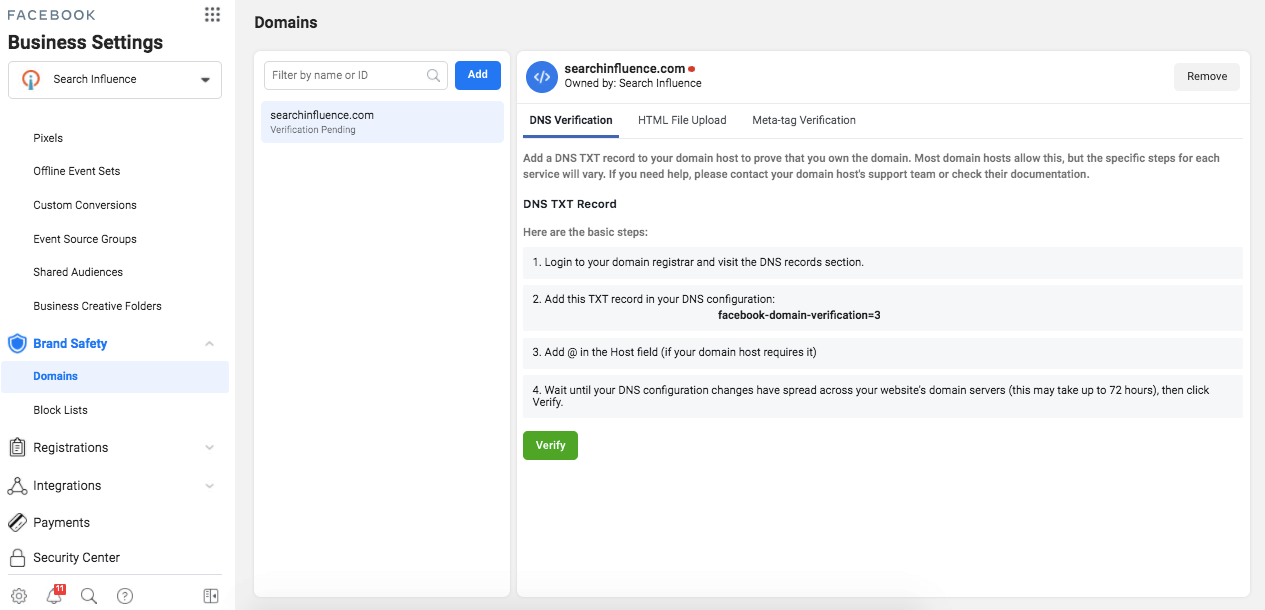
Step 1: Complete domain verification to configure pixel conversion events for Aggregated Event Measurement.
Aggregated Event Measurement is a new Facebook tool that “processes pixel conversion events from iOS devices” in compliance with Apple’s new policy while ensuring advertisers can still run effective campaigns. This tool can only be accessed once your domain is verified.
As a new best practice for all businesses, you must complete domain verification. Domain verification is a way for you to claim ownership of your domain in Business Manager.
Following Facebook’s instruction, “Domain verification needs to be done at the effective top-level domain plus one (eTLD+1). For example, for www.books.jasper.co.uk, books.jasper.co.uk, and jasper.co.uk, the eTLD+1 domain is jasper.co.uk. This can help ensure that your domain verification will encompass all variations.” (Source)
Step 2: Prioritize the Eight Conversion Events That Are Most Important to Your Business.
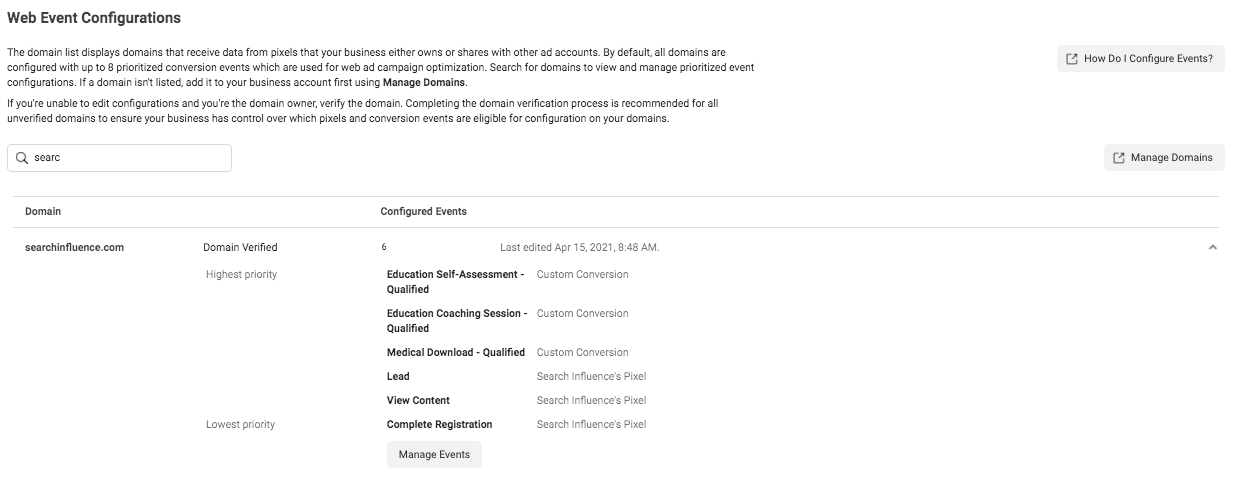
Once domain verification is complete, you must use the Aggregated Event Measurement tool within Events Manager to set up the events that you want to track and their corresponding priorities. As a reminder, events allow Facebook’s machine learning to better target, optimize, and measure campaign performance.
With the Aggregated Event Measurement tool, Facebook is requiring you to define up to eight conversion events, whether standard events or custom conversions, per domain (this includes subdomains) and to put them in order of priority.
When it comes to prioritizing the events, you are going to put the most valuable action first and the least valuable action last. When a user completes multiple actions within a conversion window, only the highest priority event will be counted, and the conversions for the lower-prioritized events will not be counted.
If your campaigns are currently optimizing for over eight events across the same domain, make it a priority to strategize and select the eight events you will optimize for moving forward. If you are currently operating under the limit of eight events, then prioritizing your events is quite simple.
Once you have prioritized your events, adjust your conversion campaigns’ ad set optimization events accordingly. You’ll also need to ensure your conversion ads are attached to the proper domain at the ad level in the Tracking section.
Step 3: Understand how reporting changes will affect your ability to measure success and optimize your campaign.
There are new reporting limitations that you should note, as they may affect how you measure campaign success and optimize campaign performance.
Delayed reporting:
Data may be delayed up to 3 days, which could severely impact optimizing short-run campaigns. Another key difference is that conversions will now be reported at the time the conversion actually happened, instead of getting attributed to the last ad impression or click.
Estimated results:
Statistical modeling may be used to account for conversions from iOS 14 users.
No support for breakdowns:
Delivery and action breakdowns, such as age, gender, region, and placement will not be supported. This could greatly impact how you review and optimize campaign performance.
To test theories based on delivery and action, you will need to manually run tests, likely by creating more targeted ad sets. However, be mindful that this directly goes against Facebook’s best practice to use broad targeting to improve machine learning. (Source)
Changes to account attribution window settings:
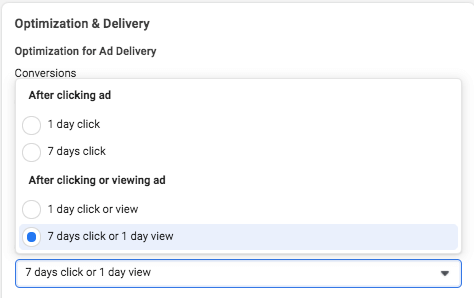
First, the attribution window for all new or active ad campaigns is now set at the ad set level to ensure that the conversions measured are the same ones used to optimize ad delivery.
Additionally, the new default window is a seven-day click attribution window, and 28-day attribution will not be supported for new or active campaigns. The following windows will be supported under the new attribution setting:
1-day click
7-day click (default after Apple’s prompt enforcement in April)
1-day click and 1-day view
7-day click and 1-day view
As of January 2021, we saw a decrease in conversions due to the new attribution window settings set by Facebook.
Step 4: Identify new campaign strategies and best practices.
Optimizing: Test new optimization events
By being limited to only eight events, this may force you to determine new best practices on how to optimize your campaigns. If you previously optimized your campaign with low-funnel custom conversions, you may need to test broadening your optimization events to less-granular or higher-funnel actions to encompass more website touchpoints.
And if you haven’t switched to Campaign Budget Optimization (CBO) yet, then now may be a good time to let Facebook’s machine learning take some of the guesswork out of optimizing your campaign.
Targeting: Test new audiences and targeting
Our ability to target and remarket to your ideal customer with personalized ads will be severely limited. Mitigate the effects of the iOS update first by leveraging in-app products such as Facebook and Instagram Shops, lead gen forms, and using video. On-Facebook, engagement tends to be remarketable, which could replace some of the website data you’ll lose.
Take advantage of the most available data by using customer list custom audiences to build remarketing and lookalike audiences with website audiences using the pixel.
You may also want to consider removing the Audience Network as a placement from your ad sets because Facebook is not confident in its ability to deliver personalized ads for this placement to iOS 14 users.
Facebook stated, “Ultimately, despite our best efforts, Apple’s updates may render Audience Network so ineffective on iOS 14 that it may not make sense to offer it on iOS 14.” (Source)
Reporting: Test new key metrics
If you currently report using breakdowns by delivery or action, determine how or if you will continue reporting on this granular data moving forward. Since these reporting breakdowns are no longer available for conversion data, you may need to determine new key metrics to report on.
Navigating a New Digital Landscape
Apple’s iOS 14.5 privacy update is transforming the digital advertising landscape. Campaign performance may see its biggest impact around Q4, which is the six- to nine-month mark from the iOS 14.5 update. This is mostly because audience sources using website tracking will shrink even more since we can’t collect the same amount of data we once did. We’ll also see more adoption of the updated iOS as people upgrade their phones.
Stay on top of the upcoming changes and create new best practices for optimizing, targeting, and reporting to maintain control of your accounts.
It’s okay to feel a bit confused about the effects on your Facebook Ads because no one has all of the information or answers yet. If you have questions about how you can still generate leads for your business despite these changes, one of the experts at Search Influence can help. Contact us today to learn more.
Search Influence presents “How to Gain CEO/Admin Trust & Buy-in on New Marketing Strategies” in partnership with the Louisiana Hospital Association (LHA) on Thursday, June 24, 2021. This is Search Influence’s second time this year partnering with the LHA for a virtual training just for the organization’s members.
Established in 1926, the LHA is a not-for-profit association representing all types of hospitals and healthcare systems throughout the state. The LHA carries out its mission by providing services and resources to members through advocacy, education, research, representation and communication.
About the Virtual Training:
As a medical marketer, it’s your job to help hospital CEOs and administrators understand how new marketing strategies will fuel patient growth.
Join Search Influence for a virtual training that demonstrates how to build a case for new marketing efforts, including tips on how to showcase how they’ll help you reach your audience and impact your hospital.
Learning objectives for this event:
How to use qualitative & quantitative goals to plan and pitch marketing strategies
Tactics to demonstrate how a given strategy will help you reach a specific target audience
Guidance to tailor your discussion based on personality styles and role
Opportunities to leverage data in your decision making and discussions
Set specific, attainable goals that are important to all stakeholders
Implement measurable tactics to monitor campaign performance
Track patient booked rate and patient lifetime value to analyze the quality of new business
Introduction
Without clearly identified goals or strategies to measure results, your healthcare marketing efforts may be met with this question, “What are we getting for our marketing investment?”
As a marketer, you should have the ability to point to well-structured, outcomes-focused data to answer this question each time it’s posed. Build ROI-focused marketing goals for your hospital or practice with this guide.
Step 1: Understand Your Needs and Goals
Typically, when stakeholders meet to discuss business growth and development, they discuss marketing needs and opportunities. Key points can include:
Patient retention
Filling the number of open beds
Building patient base to hire more physicians
Increasing utilization of surgical hours
Booking available appointment slots
Understanding not only the significance of every need but the opportunity cost of underutilized appointment slots or surgical hours (i.e., missed revenue) is an effective way to triage goals.
When setting goals, communication and accountability are imperative between marketing and operational stakeholders. The team should discuss campaign expectations, what success should look like, and how to measure results.
Some great questions to ask yourself as you’re creating goals are:
What does success look like?
What kind of growth do we want to see in 6 months/12 months/2 years?
What organizational metrics will we track to know if we’re successful? How often can we report on these metrics?
Step 2: Clarify the Product or Services You Want to Promote
Now, let’s connect the “need” to “services” we’ll be promoting. If the need is to increase the number of surgeries and the goal is to increase surgery revenue by 8%, identifying which surgeries have the highest revenue and the greatest opportunities for promotion can drive your campaign strategy.
You can also look at each of the needs in Step 1 by procedure/surgery to help understand the areas for growth.
By doing this, your team will ensure that marketing activity funnels patients to the areas that need and can handle the increased volume instead of funneling more patients to an already overbooked area of the business, where you risk creating unhappy patients.
Step 3: Determine Your Campaign Objectives
Your goals (from Step 1) are the destination of where you want to be, and your campaign objectives are the driving force that get you there. The goals above are big picture organizational impact goals (For example: “Increase appointment time utilization to 90%”), whereas campaign objectives are more specific to the marketing campaigns themselves (For example: “Achieve 50 patient inquiries”).
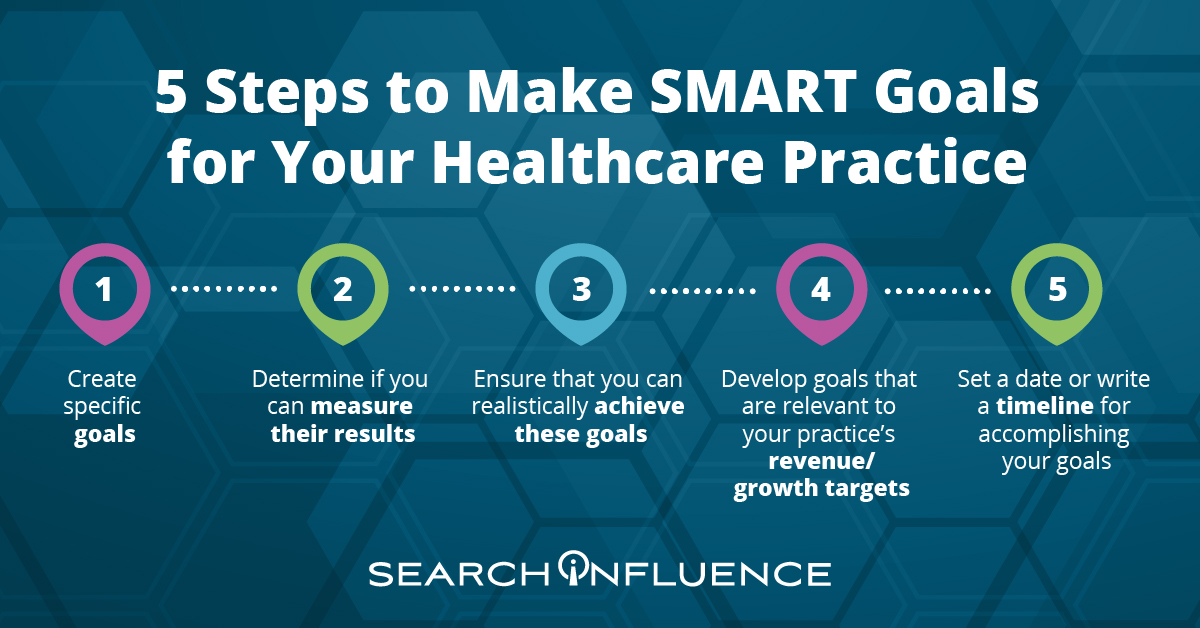
Objectives keep specific campaigns on track and serve as the foundation of every marketing strategy. At Search Influence, we’re BIG on SMART goal-focused campaign objectives.
S – Specific
M – Measurable
A – Attainable
R – Relevant
T – Time-bound
We found this to be one of the most productive ways to work toward an achievable goal and hold our campaigns accountable. The more specific you can be in defining your goal, the better.
For example:
A campaign objective: “Increase appointments booked.”
A SMART campaign objective: “By June 1, increase ENT appointments booked by 20 new patients a month by implementing a Google Paid Search campaign.”
To determine if your goal is attainable, compare your current state to where you want to be. Use any historical data or estimates that you can get your hands on.
Using the example above, historical data may show your practice is only seeing an average of 2 new patients per month; a campaign objective that targets 20 new patients within the same timeframe is likely too aggressive for you and your staff. Adjust to something more modest.
Consider how much more effort or how much you’re increasing your investment to drive those additional patients. If you know or can estimate your historical cost per new patient, that is the absolute best way to determine if it’s realistic to drive the number of new patients you want/need with the budget you are adding to your investment. This will help assure your goals are realistic AND profitable for your business.
Step 4: Establish How You’ll Measure ROI
Return on investment (ROI) can be looked at in several ways, with the calculation always being similar:
How you apply that calculation may be different. You can look at:
Overall increase in revenue compared to overall marketing budget
New patient revenue compared to overall marketing budget
Procedure-specific revenue compared to procedure-specific marketing budget
Individual patients acquired by marketing activity compared to the cost to acquire them
Additionally, some may choose to calculate ROI specifically by looking at profit as opposed to revenue. For others, that number may be far too complicated to obtain, so leveraging revenue is most often the more straightforward.
How can ROI help?
Justify next year’s marketing budget
Make your case for an increase in budget
Help you assess and report on improvements to marketing success for a given period and over time
Step 5: Calculate Your Patient Lifetime Value or Average Revenue Per Patient
You can look at Patient Lifetime Value and Average Revenue as a true average for your facility or you can look at it by department/unit. You can also look at year 1 value of a patient if that’s something that is important to you.
Your patient management system may either provide this information for you or provide you the info you need to calculate this data point.
If you want to come up with an estimate, you can do a simple equation of average cost per visit multiplied by # of visits. If you cannot get actuals, use estimates based on your experience—using estimates is better than having no data at all!
For example, a pediatrician may expect to see a new patient at least 8 times within the first year. That frequency decreases as the patient ages—let’s say you expect 2 well visits and 3 sick visits in year 2. The estimate of sick visits could be based on actual numbers from your patient system, or you can estimate based on your experience. Let’s say the average revenue per visit is $200. This makes the value of the first 2 years is $2,600 (13 visits x $200 per visit). Even if this isn’t exact, it’s helpful to know the value of the patients that marketing is driving in order to use this figure in ROI calculations.
If you really want to use exact numbers, pick a time period, say, the last 2 or 5 years, and pull data and find an average.
One ROI measuring strategy is to center your ROI goals around new patient value. You can use this patient value number as a proxy for revenue in your ROI calculation. This is one way of getting around the need to have access to real revenue data.
Step 6: Consider Your “Close Rate“ or Patient Booked Rate
Now you understand the importance of attainable goals and factoring this into lead acquisition. However, does the number of patient inquiries matter if they aren’t converting via consultations, scheduling surgeries, or attending their follow-up appointments?
Understanding your patient booked rate can build confidence in the attainability of your campaign objective.
To find your patient booked rate, ask yourself:
If you had 10 inquiries last month, how many of them ended up visiting your facility?
What factors may have prevented someone who called your office or scheduled an appointment online from qualifying as a good candidate for a procedure?
Are there internal opportunities to improve how many inquiries turn into in-office visits?
After evaluating the patient booked rate, consider the probability of your team booking 20 new patients a month before finalizing your goal. For example, a practice with a close rate of 80% would need fewer new inquiries to increase their in-office visits than a practice with a 20% close rate. You can also find opportunities internally to increase your booked rate so that you can book more of the inquiries that you want marketing campaigns to deliver.
Understanding these data points will help you have informed, concrete discussions about marketing. They are helpful in budget, performance, and growth conversations.
Search Influence builds your patient pipeline and helps you stay productive. We work with you to set measurable and transparent campaign goals to help you understand how your medical marketing activity impacts your healthcare practice’s success.
Gain professional insight into how to calculate these metrics and set yourself up for success by calling (504) 208-3900 or filling out our form to get the conversation started!