Author: Paula Keller French

  • 5 Higher Education Marketing Challenges Solved by SEO and Paid Digital Advertising

    5 Higher Education Marketing Challenges Solved by SEO and Paid Digital Advertising

    Key Insights

    • SEO and paid digital advertising works. And because they are trackable and measurable, we assure you they do.
    • Drive more qualified leads with SEO and paid digital advertising, which will help you capture prospects actively looking for your offerings.
    • Reach your audience at all stages of the funnel with SEO through broader, career-growth topics in the awareness stage and more specific, branded searches in the decision stage.
    • With the flexibility of these tactics, you can quickly adjust your marketing plan when it isn’t working.
    Prioritize SEO and paid ads to make the biggest impact on your marketing plan

    Education marketing leaders need reliable strategies to drive results. If you don’t know which strategy to favor to meet your enrollment goals, we are here to let you in on something — SEO and paid digital advertising will make the biggest impact on your marketing plan. And because they are trackable and measurable, we assure you they do. (When we refer to paid digital advertising, we mean paid search and display ads. Throughout the rest of the blog post, I’ll refer to paid digital advertising as paid digital ads.)

    While marketing leaders see SEO as important, we at Search Influence don’t believe that they have prioritized it as a key part of their strategy. We also know marketing teams spend a lot of money on paid digital ads but believe they don’t optimize their campaigns to their fullest potential because they don’t look at the data from the right angle.

    In this post, we’ll detail how SEO and paid digital ads can solve the top five challenges we hear from education marketing leaders. Overall, you’ll see that SEO and paid digital ads address the number one goal of a successful higher education strategy: qualified inquiries (at an acceptable cost) that turn into students.

    #1: How Do I Get More Qualified Inquiries?

    Most often, higher education marketing plans have both a quantity and quality issue when it comes to inquiries.

    • You don’t have enough new prospects entering the funnel
    • You receive a decent number of inquiries but not enough high-quality inquiries
    • It seems like you receive high-quality inquiries, but you don’t know how to evaluate their quality

    SEO and paid digital ads help you capture prospects actively looking for your degrees, programs, and certifications, which means you’ll receive more qualified inquiries.

    A comprehensive SEO strategy improves your rankings, which drives more website traffic and more inquiries. When these prospects inquire, you should expect higher quality leads because they got to your site through a search that indicates they are actively considering a solution and want to learn about your educational offerings. Similarly, paid digital ads fuel qualified inquiries in the same way — by driving website traffic from people actively searching for your programs.

    Paid display advertising (i.e., Facebook and LinkedIn advertising) helps you drive more qualified inquiries by targeting the RIGHT audience. Other tactics, such as organic social media, could reach a variety of people. However, when you specifically target your audience through paid digital advertising, the data gives you confidence that your messages reach the right people.

    Graphic showing magnifying glass over marketing metrics

    #2: I Know My Audience Is Out There. How Do I Reach Them?

    SEO and paid digital ads help you reach your audience in distinct ways.

    When people think about SEO, they usually think about reaching audiences that directly search for your programs. Less often, they think about the impact SEO can have at the top of the funnel — when prospects are not yet aware that education may be their answer.

    By writing blog posts about more general topics that your audience may be searching, you can be one of the first organizations to reach them and lead them to consider education. For example, higher funnel topics like “Most Popular Programming Languages for a Career in Web Development” or “How to Launch Your Freelancing Career in 3 Steps” can drive traffic from prospective students who are looking for career growth advice but might not yet have considered a degree. Yes — this is SEO!

    Although higher education marketers generally include paid digital ads as part of their strategy, we often hear from them that their campaigns don’t drive enough inquiries. This isn’t a problem with paid digital ads as a tactic. This suggests there’s an opportunity to adjust your campaigns, which means testing your target audience and/or fine-tuning the creative messaging.

    Campaign adjustments, through both expert human optimization as well as machine learning optimization, help you better reach your audience. For example, a campaign might drive very few inquiries or the wrong types of inquiries because your campaigns target either too narrow or too broad an audience. By making these types of adjustments, paid digital advertising can drive leads at an appropriate cost.

    #3: How Do I Drive Prospects Down the Funnel?

    Some higher education marketing leaders are surprised to hear that both SEO and paid digital ads can drive prospects down the funnel.

    A robust higher education SEO strategy includes a full-funnel approach to content that speaks to prospects in each stage of their decision-making process. Recommended content for each part of the funnel:

    • Top of the funnel: Career growth topics
    • Middle of the Funnel: Program/degree-specific content
    • Bottom of the funnel: Branded search engine optimization, which allows you to capture searches specific to your school/unit and assure that prospects find their answers quickly — and on your website

    Branded SEO is often overlooked and is one of my favorite tactics! Branded searches in the decision phase include application deadlines, reviews, tours, and tuition costs.

    Paid digital advertising allows you to tweak your creative messaging to fit your prospect’s place in the marketing funnel. With the proper campaign segmentation, you can:

    You can also run multiple ad variations to speak to more people. Over time, you will see which messages work more than others and switch them out.

    As you segment your messaging down the funnel, you can create specific messaging you wish your audience knew about. You don’t have to worry about overall/introductory messaging because your audience has already engaged with your institution and knows you. For example, a single ad could focus on:

    • A student’s success story
    • An alumni career achievement stat
    • An award, or special pricing

    #4: What Am I Getting for My Budget?

    The clear accountability of paid digital ads and SEO is a key reason many have moved the lion’s share of their budget to the digital arena.

    SEO and paid digital ads enable you to see the source of the prospect on an inquiry-by-inquiry basis, which means you can track the cost per inquiry and cost per application from each source and overall. Ultimately, this means you can tie ROI back to your campaigns.

    These direct metrics enable you to compare your stats to industry benchmarks and to peer organizations which both give you confidence your results stack up and tell you clearly what you get for your budget.

    Graphic showing a coin being put into a piggy bank

    #5: Can I Quickly Adjust My Marketing When My Plan Isn’t Working?

    The beauty of SEO and paid digital ads is that you can make adjustments along the way.

    With SEO, you can increase your emphasis on optimizations for a given program or degree if the work so far hasn’t been aggressive enough. If one program outperforms the others, you can pivot your time spent to another program.

    Contrary to traditional marketing or longer-term media buys that lock you into a specific time frame, with paid digital ads, you can make adjustments after you have specific data. Optimizations can range from creative/messaging updates to changes to where the ads run to who sees the ads.

    If a campaign has not met your goals, you can actually turn it off and reinvest that money into a campaign that drives results at an acceptable cost. For example, if you have campaigns on Facebook and paid search, and the paid search campaign drives quality leads, you can reallocate your budget from Facebook to paid search.

    Prioritizing SEO and Paid Digital Ads Will Have an Impact on Your Higher Education Marketing Plan

    As a digital marketing agency that started out as a search engine optimization agency, it may not be surprising that we have this point of view. Yet, we think it’s worth repeating: Higher education marketing teams know they should prioritize SEO in their marketing plans, but they often don’t.

    We also believe that universities that invest heavily in paid digital ads and don’t see expected results have not leveraged data to make the best optimizations.

    If you are ready to learn how SEO and paid digital ads can make the biggest impact on your marketing plan, please reach out to the Search Influence team via our contact us form or give us a call at (504) 208-3900.


     

  • 5 Actionable Healthcare SEO Expert Tips for Providers

    5 Actionable Healthcare SEO Expert Tips for Providers

    Key Insights

    • SEO is a critical component of any digital marketing strategy, but it can particularly help healthcare organizations expand their online reach.
    • Investing in a strong SEO strategy for your healthcare organization can increase your website traffic, lead to a higher local search volume, and attract new patients.
    • To really witness the results of your healthcare practice’s SEO efforts, you’ll need to take actionable steps, such as creating a mobile-friendly site, choosing the right targeted keywords and making efforts to rank locally.

    doctor in white coat holding a stethoscope

    Search engine optimization (SEO) is the modern-day digital marketing pillar of an organization’s successful and compelling online presence. Today, countless businesses across industries use SEO efforts to rank higher in search engine results, with goals of driving traffic to their websites and giving their company’s name more word-of-mouth benefits.

    Your healthcare organization should be no different.

    By implementing robust healthcare SEO strategies, your medical business can expand its online reach, build brand awareness, improve user experience—and attract new, engaged patients. In this post, we’ll take a look at some of the benefits of medical SEO and how providers can utilize it effectively in their digital marketing strategy.

    What Is Healthcare SEO?

    The term healthcare SEO describes a range of search engine optimization strategies that providers and medical facilities use to enhance their online presence and organic reach, which includes strategically selecting keywords to craft high-quality, engaging content. Because search algorithms prioritize surfacing relevant, authoritative pages in order to provide users with an efficient search experience, a successful healthcare SEO strategy can make the difference in how high your pages rank in the search results. And the higher your pages rank, the higher the degree to which curious leads convert into patients.

    We believe the myriad of benefits of a comprehensive SEO strategy is the most impactful for providers aiming to become more visible, valuable, and available to their patients.

    What Are the Benefits of Healthcare SEO?

    The primary goal of a healthcare SEO strategy is to draw more patients to a practice’s web presence, content, and, ultimately, products and services. By enhancing your practice’s brand awareness, healthcare SEO can help you acquire those patients who otherwise would opt for a competing provider—simply because of that provider’s accessibility and presence on the web. At Search Influence, we advocate for strategies that drive higher patient volumes and increase your website’s traffic.

    Higher patient volumes

    It’s a no-brainer: consumers are more likely to buy a product or pay for a service if they know about a business in the first place. Healthcare SEO helps to bring awareness to prospective patients about certain providers and inform them of the practice’s services, unique qualifications, and products. The more awareness the general public has about a medical facility, the more likely that practice will see new patient numbers rise.

    Increase your website’s traffic

    More traffic means more visibility, which, in healthcare, attracts new patients.

    Improved search results increase website traffic while also organically enhancing a company’s brand identity. When more people visit a company’s website, the chances increase of that business’s name becoming a topic of conversation and users sharing its content across social media platforms.

    If you want to be sure you get the maximum value from the targeted healthcare SEO services you’re paying for, be sure your provider gives you access to Google Search Console and Google Analytics.

    Actionable Healthcare SEO Tips

    You can apply this SEO expert advice and best practices to all businesses, regardless of their specific products, services, or industries. However, with an action plan tailored to your distinct marketing goals, healthcare providers, in particular, can utilize these tried-and-true strategies to drive clinical success. To maximize the potential of your practice’s web presence, we recommend following these five effective and proven healthcare SEO tips:

    Choose the correct keywords

    Keywords play an essential role in every SEO strategy, no matter if you’re a start-up clinic or a reputable specialty hospital. Choosing the right keywords to target depends on several fundamental insights, such as:

    • Knowing your audience and their unique needs
    • Researching what potential patients plug into search engines
    • Understanding the dynamics of how, when, where, and why people search for healthcare services on the Internet

    Using keyword research tools, SEO experts can determine which keywords generate the most traffic, have the least competition, and drive the best results for a practice depending on their specific marketing goals.

    healthcare digital marketers pointing at laptop screen

    Create and update listings to improve local search

    When generating results, mobile devices, applications, and search engines often take the geographical location of the searcher into consideration. As a way to increase your reach and competitiveness in your target region, location-based SEO helps your content appear to audiences in a specific area. Without a website adequately optimized for location, your healthcare organization may get lost in the search engine shuffle, with potential patients opting to find services closer to where they live.

    Practices can optimize for local search by creating and updating listings on the most important listing websites. Some practice types are more hyper-local than others. For instance, urgent care SEO experts will focus on local listings and presence across the local search ecosystem. Review the local search ecosystem for a dynamic overview of the listing websites.

    Create unique, high-quality content for your website

    Posting new, engaging content regularly keeps potential clients invested and clicking. Maintain steady traffic streams and provide useful information about your product and services through various content types, such as blog posts, white papers, videos, and podcasts.

    Encourage your patients to leave online reviews

    Healthcare providers and businesses should encourage patient feedback—especially if the reviews are enthusiastic and positive.

    According to data from ReviewTrackers, a staggering 63.6% of consumers report that they prioritize checking Google reviews before visiting a business’s location. Aside from increasing your practice’s credibility, outside patient interaction also helps healthcare websites with search engine rankings. When patients review a company, that business’s online presence is effectively elevated in the search engine algorithms.

    Make your website mobile-friendly

    Mobile web traffic has gone up more than 200% in the last seven years, indicating that potential patients prefer to use their smartphones over desktop or laptop computers when searching for healthcare services. Poorly built and user-unfriendly websites come across as cold and act as red flags to prospective patients. Healthcare SEO can help your medical business present itself as more relatable while showcasing its professionalism, authority, and trustworthiness.

    The Knowledgeable SEO Experts at Search Influence

    If you want to increase organic traffic to your medical practice’s website, create engaging and original content, and ultimately draw more potential patients to your healthcare products and services, start with honing in on your healthcare SEO strategies. Search Influence’s team of SEO professionals have been developing SEO strategy for doctors since 2007, and we can help you take your practice’s search engine marketing to the next level and increase your online traffic and engagement.

    Ready to attract new patients and improve your online presence? Contact our team today by filling out our online form. We’d love to help you get started.

    Images

    Doctor

    Laptop


  • Healthcare Marketing Ideas: How to Communicate Through Severe Weather Events

    Healthcare Marketing Ideas: How to Communicate Through Severe Weather Events

    Key Insights

    • Unexpected events are just that — unexpected. Despite this, your healthcare practice can properly prepare for any unprecedented conditions by remaining proactive in pre-planning patient/provider communication strategies.
    • Keep your messages in touch with current events. Adjust automated and pre-scheduled messages, social media posts, and newsletters to fit the context of the current climate. In other words, don’t be tone-deaf!
    • In times of uncertainty, keep patients informed by reviewing all digital platforms for opportunities to regularly send out updates. No site or profile is too small for an update regarding office closures or changes to your hours of operation.
    • Keep messages, details, and updates across platforms accurate. There’s no quicker way to lose a patient’s trust than to send out information that seemingly contradicts itself.
    • Pre-planning communication strategies help your team save time, delegate responsibilities, and understand expectations when weather or pandemic-related events strike. It’s never too soon to start pre-planning your medical marketing strategies to circumvent a potential crisis.

    Healthcare worker typing on laptop at desk

    Picture this — it’s the height of a worldly crisis, and your healthcare clinic has no choice but to temporarily close its doors to patients. You’re rushing to get your office’s updates written, approved, and posted, on top of trying to figure out which marketing team member will update which platforms to keep patients informed and engaged with your clinic. You haven’t even decided how to release your updates, and you’re already overwhelmed.

    This scramble to release timely, accurate, and relevant information to the public signals the need for your team to plan cohesive communication strategies. Proactive communication — as opposed to reactive responses — helps anticipate what your patients most want to know, as well as how and when they prefer to receive updates regarding your facility.

    From adjusting automated messages and updating your office’s primary platforms to enhancing reader trust through accurate messaging, pre-planning your medical marketing strategies contributes to a more confident and patient-centered workflow. In this post, we’ll cover some healthcare marketing ideas to drive effective patient/provider communication during unpredictable times.

    Benefits of Proactive Communication for Patients and Staff

    No matter if your clinic is bracing for the rampaging effects of a Category 3 hurricane or a global pandemic, environmental threats are a direct segway to stressed hospital systems. Unexpected events and catastrophes often lead to last-minute office closures, causing an increase in delays in care and, ultimately, a decline in provider satisfaction. On the contrary, if your office remains open while other healthcare clinics in your area face closures, front desk staff may field relentless phone calls from patients inquiring about your hours of operation and whether they should even show up for their appointment.

    If you communicate proactively, you may be able to increase your show rate for those uncertain days and prevent less rescheduling — which can otherwise be a headache for staff and doctors alike. Streamlining communication between patients and staff begins with implementing agile practices in otherwise turbulent environments. In doing so, not only is patient experience improved, but care staff can relish the efficiencies of a more seamless and adaptive work environment.

    Once your patients trust that your digital platforms will provide them with critical information, you’ll start to really see these benefits. But to reap these rewards, your team will first need to adopt strategies that center your clinic as a reputable and dependable source of information.

    Adjust Automated and Pre-scheduled Messages

    We live in an automated world — pre-scheduled posts and emails help us run our marketing communications smoothly on a daily basis. So, what can you do to make sure that automation doesn’t hurt your brand? If patients receive or see messages contradictory to what they expect or heard through another channel, they may question what is accurate. During a crisis, adjusting all pre-planned messages before they reach your intended audience is the backbone of consistent and reliable patient-provider communication.

    Halt automated messages

    Your team is likely already in the habit of updating your office’s phone tree. Beyond that, your team should be turning off any automated appointment reminders. If a patient receives a message while the office is closed, that can cause questions regarding whether they have missed an important appointment — reducing their confidence in the communication they are receiving.

    Reevaluate pre-scheduled posts, emails, and newsletters

    Next, you should review any pre-scheduled social media posts and defer or cancel any that would appear tone-deaf or not make sense given the current climate. Even if it’s an engagement-driven evergreen post, if your audience sees that while they are in the middle of a natural disaster, it may look like your company isn’t paying attention to what’s going on in the world.

    The same principle applies to marketing emails or newsletters that you may have pre-scheduled or that go out on an automated cycle; if patients receive those during a time of crisis, then the messages will, at best, fall on deaf ears and not get the attention they deserve. In a worst-case scenario, they could insult a patient who might wonder why they are receiving an email about a non-timely topic during an emergency situation. No matter the type, reviewing and adjusting all pre-scheduled messages prevents the likelihood of insensitive content surfacing and tainting your brand’s empathetic reputation.

    Update Information on Primary Platforms

    Now that you’ve covered the basics and paused any messaging that may not make sense to your receivers, it’s time to shift focus to where patients might expect to find pertinent information. According to a survey conducted by Redpoint Global, a staggering 80% of patients report preferring to use digital channels to communicate with healthcare providers at least part of the time, which highlights the criticality of keeping digital content updated across all online platforms.

    To begin, you’ll want to review your healthcare system’s most influential platforms to suggest any updates be made to hours of operation, facility safety standards, or other relevant expectations patients may expect to have. While the breadth of your digital footprint may be more than you realize when first building a list of profiles to update, some of the most important platforms that will require reviewing include:

    • Your website
    • Email/text
    • Patient portal
    • Facebook
    • Instagram
    • Google My Business
    • Google Search
    • Any other websites that come up when someone searches your hospital or medical office’s name

    Install a website notification bar

    If you don’t already have a website notification bar, it’s a good idea to install a feature that puts a banner at the top of your site with your clinic’s latest updates. Before using this functionality, your team should be sure to complete a test run on your site to ensure it accurately delivers timely notifications. Because your staff may be limited in emergency or last-minute scenarios, it’s also important that 2-3 team members are trained and have access to update this, as well as create a new page with more details if necessary.

    Assure Patient Confidence With Accurate Messaging

    How can you assure your patients trust the information you’re delivering in the updates? Establish confidence in the accuracy of your messages by:

    • Dating the updates: Keeping a time record of updates helps your patients know the information you’re putting out is fresh. This can be especially important if the situation lasts longer than a day or two.
    • Communicating often: Keep the updates coming. Daily updates may make sense on some channels, particularly in the days of the most uncertainty.
    • Keeping it consistent: Be sure the messages and details across each platform refrain from contradicting one another. Consistent messaging is key to long-standing patient trust!
    • Being clear about patient expectations: Don’t make your patients assume — proactively communicate what they can expect from your staff and clinic.
    • Relaying information about future updates: Finally, note when and how patients can receive the next update.

    Strategies to Pre-plan

    So, you’ve reevaluated all automated and pre-scheduled messages, updated your primary platforms with accurate information, and now you’re looking at how to pre-plan your medical marketing strategies in times of crisis. Some of the most essential components of an effective pre-plan strategy include:

    • Delegating responsibility for updating platforms: Be sure there are 1-2 backups, just in case a staff member isn’t in a location with reliable internet access.
    • Implementing a shared password system: Store passwords in a secure management system like Passpack or Last Pass to ensure that the right people have access to the proper channels for updating.
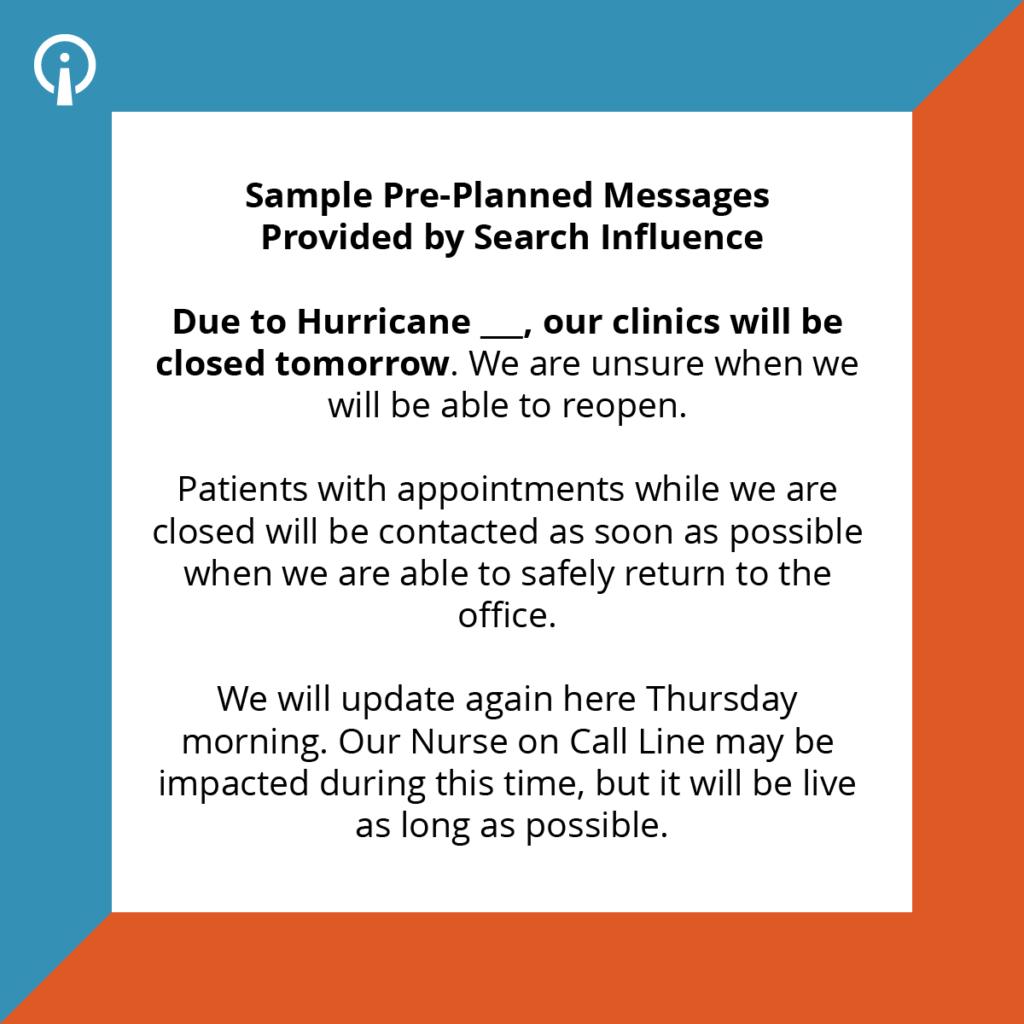
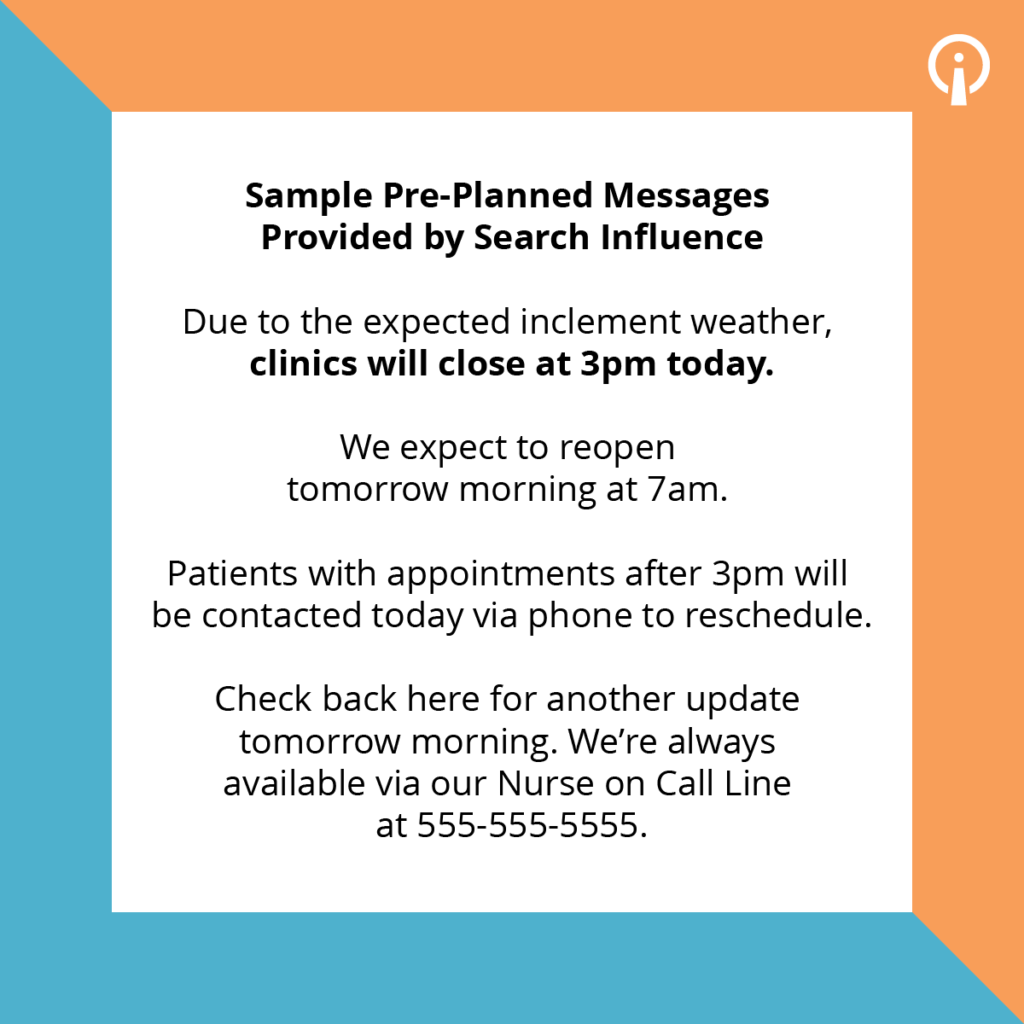
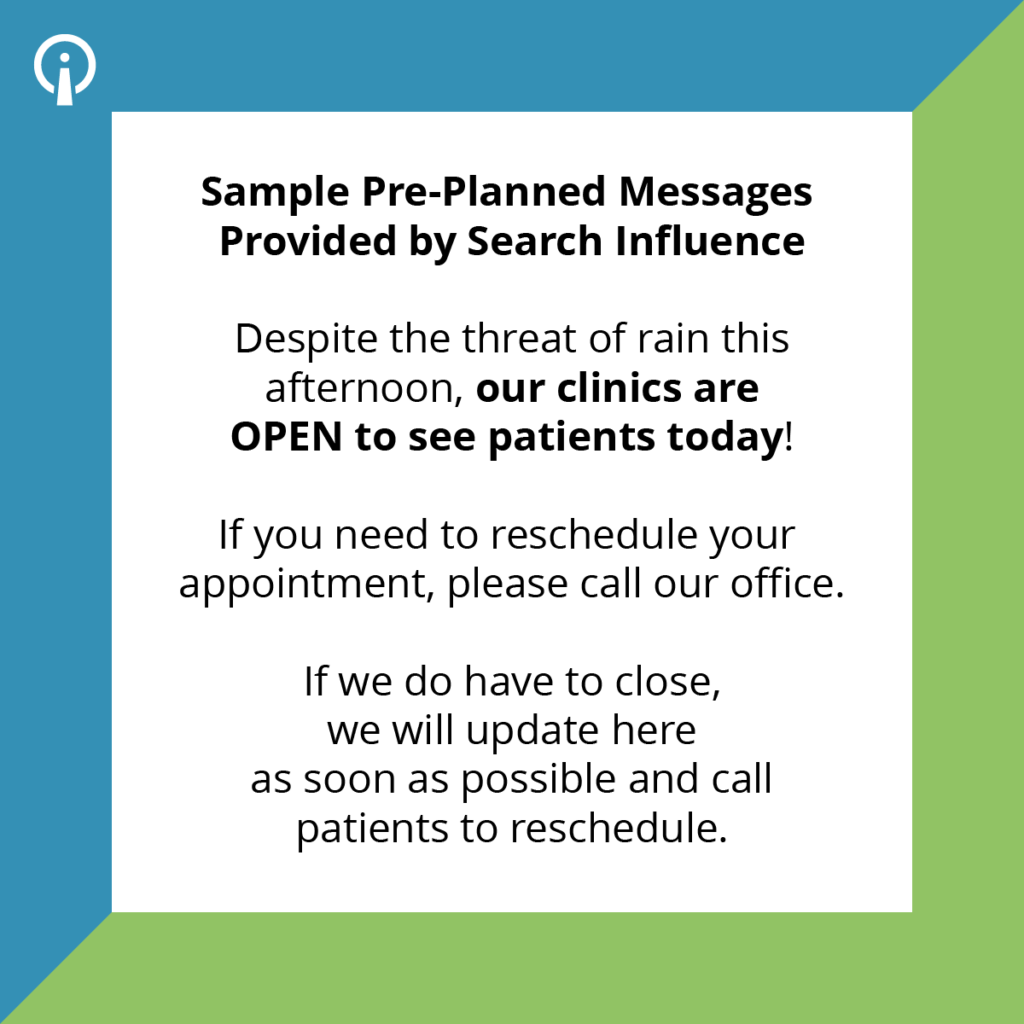
    • Writing and gaining approval for sample messages: Sample messages can be used as a basis for your real-time messages and demonstrate the most important points of all of your healthcare marketing ideas. This strategy can help save your team writing time while also ensuring communications get out quickly.
    • Pre-creating social media graphics and email templates: Just like pre-writing sample messages, pre-creating graphics and emails accompany the same benefits of saving your staff time in periods of urgency.
    • Carrying out a crisis communication drill: Take an hour or two to present a scenario to your team and have them “execute” the plan all the way up until posting or sending any messaging. This will pressure test if they are able to write the messages, access the platforms, and work the relevant systems. It will also force all the pre-organization to happen by making sure everyone has access to the plan.

    Anatomy of pre-planned messages

    Whereas we may be quick to assume communication is solely required for office closures, it’s almost equally as important to communicate that you are open if things are happening in your community that may be causing others to close. Ideally, pre-planned messages for office openings and closures are composed using the following anatomical focal points:

    • What’s the situation?
    • How are hours impacted?
    • How will existing appointments be handled?
    • When can patients expect the next update?
    • How can patients be helped while you are closed

    So, How Do You Get Started?

    With hurricane season fully underway and COVID-19 numbers still on the rise, now is the time to enact these medical marketing strategies and meet your business growth goals. Here’s a quick recap on how to get started:

    • Establish and gather your team of 2 or 3 people minimum so that you have coverage.
    • Compile and prioritize the list of communication channels and platforms. Then, define owners and set up access, logins, and training.
    • Pre-plan messages and get those approved.
    • Finally, conduct drills to make sure your team can execute the plan as intended without any preventable basic issues.

    Now that you’ve mastered the basics of proactive healthcare communication strategies, it’s time to set your plan into motion. At Search Influence, our digital marketing agency can help you create a communication plan that keeps your patients informed, engaged, and returning. To learn more, contact us today for help getting started on all of your healthcare marketing ideas.

    Images
    Stethoscope and Laptop Computer

  • 2020 Medical Search Trends: Medical Searches Met and Exceeded Pre-COVID Levels Across Specialities

    2020 Medical Search Trends: Medical Searches Met and Exceeded Pre-COVID Levels Across Specialities

    This post was updated by Paula French on March 4, 2021 to reflect refreshed statistics and analysis. It was originally published in October 2020. 

    Key Insights:

    • Monitoring search trends can make your campaigns more effective because you can adjust your strategy based on the latest information.
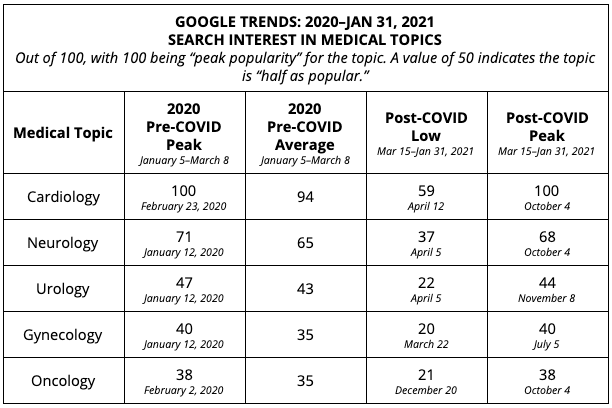
    • As of January 2021, several medical practice areas, including cardiology, neurology, urology, and gynecology, have seen their search volumes return to pre-COVID levels.
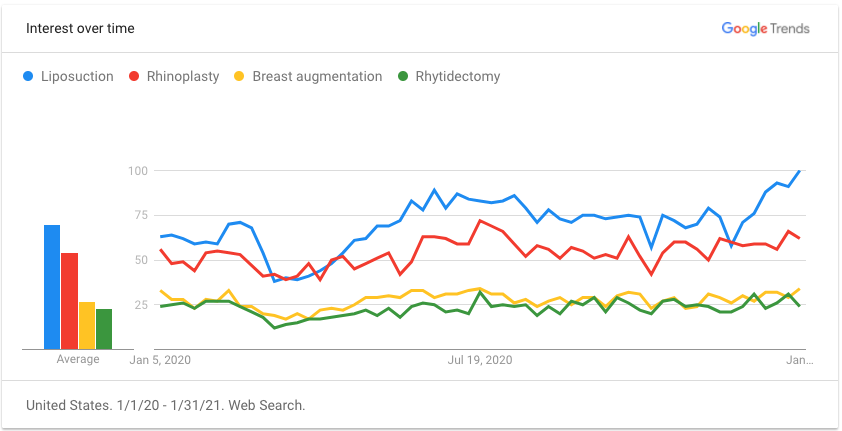
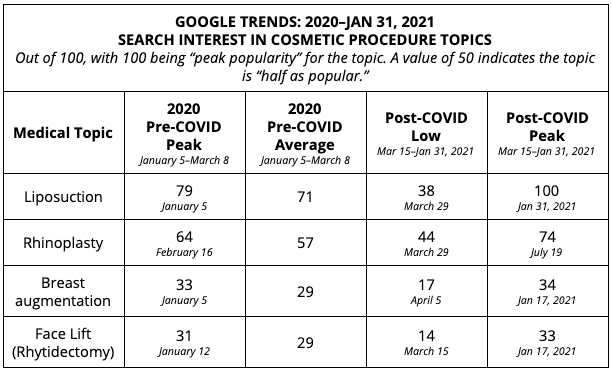
    • Cosmetic procedures saw a short-lived dip in search interest for liposuction, rhinoplasty, breast augmentation, and face lifts in March. By the end of May 2020, interest exceeded pre-COVID levels for 3 of the 4 procedures: liposuction, rhinoplasty, and breast augmentation. Face lift interest exceeded pre-COVID levels in late July.
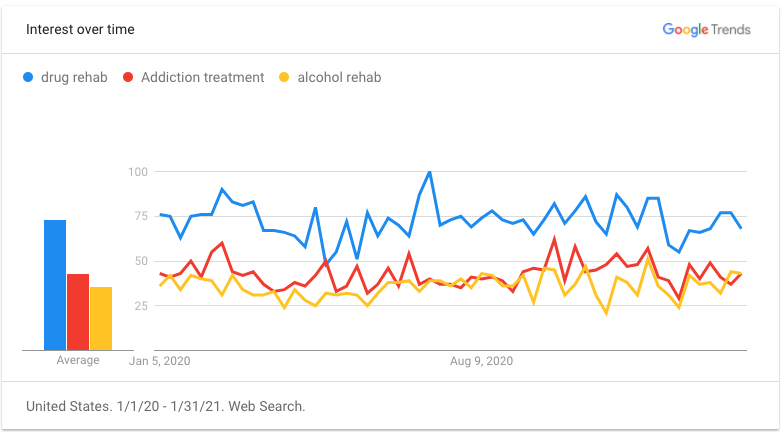
    • Addiction treatment searches didn’t drastically dip as much as other medical specialties and have been slowly rising to their pre-COVID levels. The most recent data indicates they have now exceeded early 2020 interest.

    2020 Medical Search Trends

    Monitoring search trends is a critical piece of managing a productive digital marketing strategy. It can inform your need to adapt your marketing strategy, whether that is away from search to other mediums or to invest more heavily in search engine optimization and paid search.

    2020 has seen shifts in search trends unlike anything I’ve seen in my 11 years working in SEO. It’s no surprise given the “pivots” and “unprecedented” year we’ve had. In a recent conversation with a colleague in the medical industry, we discussed expectations for 2020 healthcare revenue and what we’ve seen so far in the return of patient confidence.

    I was interested to see how search trends on Google mapped with what we had seen with the practices and hospitals with which we work, so I took a look across several practice areas and assessed the data.

    How do I read the Google Trends charts below?

    Each chart that shows the change in the amount of interest in a given topic based on the number searches during a time frame. Specifically, Google calls this metric “Interest over time” and defines it as “search interest relative to the highest point on the chart for the given region and time. A value of 100 is the peak popularity for the term. A value of 50 means that the term is half as popular. A score of 0 means there was not enough data for this term.”

    For more on how Google calculates Trends, see here: FAQ about Google Trends.

    I have included a table of my own analysis of the numerical data, looking for highs, lows, and averages both “pre-COVID” and “post-COVID.”

    In some analyses below, we look at “Topics” which looks across several ways people could be searching to gauge searchers interest level at a point in time. In others, we look at “Search terms” which is used when it makes sense to compare to similar search terms that would otherwise fall under the same topic (such as “drug rehab” & “alcohol rehab,” as they both fall under the topic of “addiction treatment”).

    Medical Specialities: Cardiology, Neurology, Urology, Gynecology, Oncology

    Summary of findings for medical speciality search trends:

    • By October 2020, searches were either at or right below pre-COVID levels, and saw a similar peak in January 2021.
    • Cardiology, neurology, urology, and gynecology all follow the same pattern: initially, searches for these specialties dipped in March 2020, but people were still searching for these terms, even in the earliest days of the shutdowns.
    • The lowest point of searches for these topics was around mid-April, which is when the public started to recognize that this stay-at-home life was going to become our new normal for much longer than we originally thought.
    • Since April 2020, searches have been on the rise, with dips during the holiday weeks of July 4, Labor Day, Thanksgiving, and Christmas.
    • Oncology saw a lower level of variation throughout the year. Interest levels dipped slightly after the shutdown and remained steady afterward, with an interest level ranging from 21-38, averaging around 30.

    2020 Google Trends for Medical Specialties

    Cosmetic Procedures: Liposuction, Breast Augmentation, Rhinoplasty, Rhytidectomy (Facelift)

    2020 cosmetic surgery trends chart

    Summary of findings for cosmetic procedure search trends:

    • There was an initial, short-lived dip in search interest for liposuction, rhinoplasty, breast augmentation, and face lifts (rhytidectomy). This dip spanned across the end of March and into April.
    • After the dip, there was a surge in interest, with the number of searches actually exceeding pre-COVID levels at the end of January 2021 for liposuction, rhinoplasty, breast augmentation, and face lifts.
      After the dip, there was a surge in interest, with the number of searches actually exceeding pre-COVID levels at the end of January 2021 for liposuction, rhinoplasty, breast augmentation, and face lifts.
    • By late January 2021, liposuction saw peak interest (100), significantly exceeding pre-COVID interest levels, when the peak was 79.
      Rhinoplasty interest also peaked in July and remains above the pre-COVID average.
    • Breast augmentation search interest met and then exceeded pre-COVID interest in the summer of 2020, and has peaked above the pre-COVID high in January 2021.
    • Face lift interest initially peaked in July at 36, decreased a bit through the fall, and peaked again in January 2021, with an interest level of 33, which is higher than the pre-COVID peak of 31.

    2020 Google Trends for Cosmetic Surgery industry

    Addiction Treatment: Drug rehab, Addiction treatment, Alcohol rehab

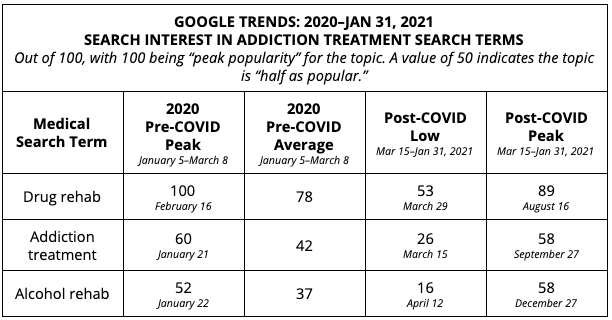
    2020 addiction treatment google trends chart

    The addiction treatment search interest analysis is based on specific “search term” interest, whereas medical and cosmetic graphs above were based on topic interest. This is a result of the availability of data for topics vs. search terms.

    Summary of findings for addiction treatment search trends:

    • There was also a significant dip in addiction treatment search terms, but interest has risen to varying degrees in comparison to pre-COVID peaks.
      The search term “Drug rehab” saw it post-COVID peak interest (89) in the week of August 16, which is only slightly less than the pre-COVID high on February 16 (100).
    • The pre-COVID 2020 average for “addiction treatment” was 60. During the heaviest shutdown period (March 15–May 10), the average interest was 44, with the lowest point being 26 on March 15. The post-COVID peak was September 27, with an interest level close to pre-COVID levels (58).
    • “Alcohol rehab” searches reached their peak (58) during the week of December 27, exceeding the pre-COVID 2020 high of 52 in late January.

    Addiction treatment data chart

    How can search trends help us help more patients?

    I assume that by now you’ve compared this data to what you see at your practice or hospital. The goal of monitoring search trends (along with your own campaign-level data) is to inform necessary adjustments to your medical marketing strategy.

    During the early months of shutdowns, we were hyper-focused on looking for shifts in consumer behavior to adjust our strategies. In the best-case scenarios, we were able to shift budget to the channels where our clients’ audiences were spending their time and away from the channels where they weren’t as active (and produced some really awesome results). Then, we made additional changes when that activity returned.

    There are several reasons we can attribute to the overall return of searches and why in many cases, medical searches are exceeding their pre-COVID levels. Whatever the reasons, this is a critical time for businesses to analyze their marketing mix closely to assure they are both

    • carefully spending their marketing budget
    • confident they’ll understand the outcomes of their marketing investment

    If you’d like some support in analyzing where you’re currently investing in marketing, want some fresh ideas, or are interested in partnering with an agency like ours, reach out. Our dedicated team of strategists will work with you to understand your goals for 2021 and provide recommendations to help you build your patient pipeline.

    P.S. If you are looking for more insights, check out our recent post “How Hospitals and Healthcare Practices Can Adapt to Google Updates” and follow along with us on our Healthcare & Medical Marketing Blog for future industry updates.

  • 6 High School Interns Join the Search Influence Team as Part of YouthForce NOLA Partnership

    YouthForce & Search Influence - Partners since 2015Search Influence welcomed a cohort of six interns from YouthForce NOLA. YouthForce NOLA is a nonprofit organization that collaborates with businesses to prepare young people from underserved communities in New Orleans for fulfilling careers in high-demand industries. Search Influence and YouthForce NOLA have had a long-standing partnership that dates back to the internship program’s inception in 2015. Since that time, Search Influence has hosted more than 10 interns, with two continuing to work at the agency after completing their internships.

    Search Influence and YouthForce NOLA are working together to safely resume their partnership during the coronavirus pandemic. Currently, Search Influence’s employees are working remotely, and the YouthForce NOLA intern cohort will join the team virtually. The six high school students participating in the internship program attend public charter schools in New Orleans: Booker T. Washington High School, Livingston Collegiate Academy, and the New Orleans Military and Maritime Academy.

    As a digital marketing agency that is actively involved in developing local talent, being a part of this program is a wonderful feeling,” said Search Influence co-founder and COO Angie Scott. “For our interns, understanding how to navigate and thrive in professional environments will be critical to their success in the future.”

    The interns who are joining Search Influence will learn about many aspects of digital marketing, including:

    – Account management
    – Editing websites and web content
    – Quality assurance processes
    – Sales

    Each YouthForce NOLA intern will be paired up with a mentor who will guide them throughout the experience. The mentor coordinates training with agency subject matter experts and offers feedback as they progress through the program.

    “I love working with the interns because I recognize how important professional experience is for a young person trying to navigate what their career and ‘adult life’ will look like,” said Teri Murphy, an account coordinator at Search Influence and second time YouthForce mentor. “I think it’s impactful for the interns to have someone relatable they can work with to see what’s possible for them.”

    Welcome, YouthForce interns! We can’t wait to see you grow into CHARGED members of our team.

  • “Support Parks & Recreation” Campaign Wins “Best Strategic Use of Social Media” from US Social Media Awards

    “Support Parks & Recreation” Campaign Wins “Best Strategic Use of Social Media” from US Social Media Awards

    The 2020 US Social Media Awards selected Search Influence as the first-place winner of “Best Strategic Use of Social Media” for the digital marketing agency’s Together for Parks Alliance millage campaign. See the full list of 2020 winners here.

    In 2019, Search Influence ran a successful digital marketing campaign in support of a property tax millage reallocation that will provide critical funding to a coalition of New Orleans parks and recreation organizations.

    The Together for Parks Alliance was comprised of Audubon Nature Institute, New Orleans City Park, New Orleans Parks & Parkways, and New Orleans Recreation Development (NORD).

    With almost a decade of experience promoting Audubon Nature Institute through digital advertising, the Search Influence team’sbackground helped them strategize and create an impactful campaign that drove online action from advocates and voters.

    The millage passed with over “overwhelmingly” positive response—75% of voters voted YES on May 4, 2019!

    The Alliance’s organizations will begin to receive the approved funding in 2021, which will make New Orleans an even better place to live and visit.US Social Media Awards 2020

    The Search Influence team is thankful to be recognized for the great work of an amazing team for this award-winning campaign. Award judges’ feedback indicated “this was a beautiful example of a coordinated, cross-channel effort.”

    Thank you, US Social Media Awards, for recognizing this campaign for Best Strategic Use of Social Media!

  • Search Influence to Host Webinar “Digital Marketing in the Times of COVID-19: What We’ve Learned and What’s Next”

    April 14 marks the 30th day under the stay-at-home directive for New Orleans, where Search Influence’s headquarters are located. As we look to the future, we want to share learnings from a month of client status changes, closures, and postponed events.

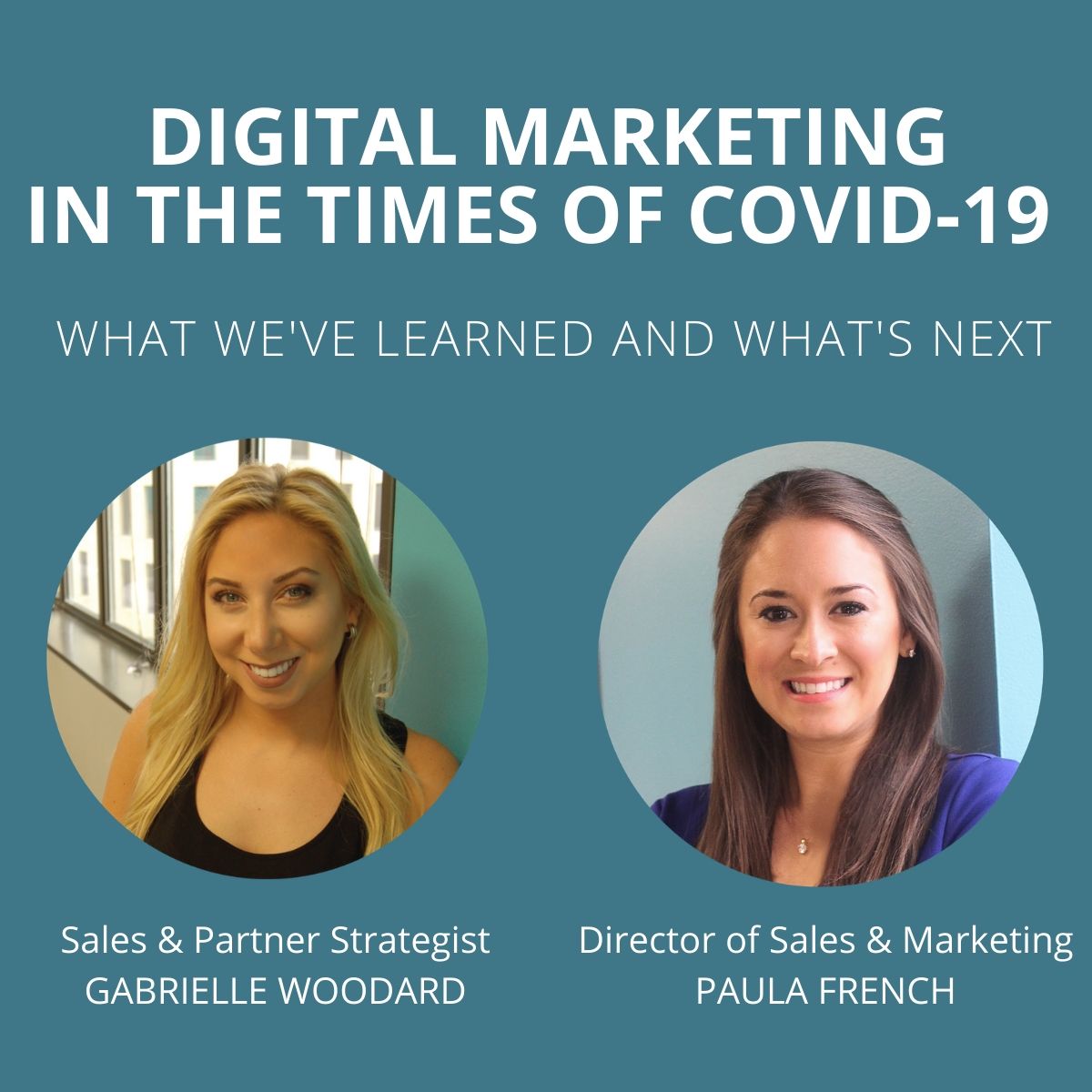
    Join me (Paula French) and our Sales & Partner Strategist Gabrielle Woodard on Tuesday, April 14 for the free webinar, Digital Marketing in the Times of COVID-19: What We’ve Learned and What’s Next. Gabrielle and I will share best practices for executing campaigns during a crisis and the steps needed to ramp back up when the economy looks more certain. We’ll also include time to address your questions.

    We look forward to connecting with you soon!

  • Search Influence Offers Free Consulting Sessions to Businesses Impacted by COVID-19

    If there’s one thing we can expect toSearch Influence - Free Marketing Consulting Sessions for COVID impacted businesses be constant during this time, it’s that the landscape is changing rapidly. The past few weeks have been a whirlwind of fast decisions and agile updates to operations, marketing, and of course, our personal lives.

    We know some companies have been able to move their services and operations online while others have had to cancel events and close, with no idea of when they’ll reopen. These changes to operations (and likely marketing budgets) create a lot of questions:
    – How can I stay relevant during this time?
    – Does it make sense to advertise right now?
    – What forms of free marketing can I be doing?
    – Is advertising less expensive right now?
    – What are my competitors doing?
    – How can I best use this time to plan for when we are able to resume normal operations?

    We spent the last two weeks figuring out how to move forward and discovered some really impactful learnings. We want to share these tactics to help more businesses move forward with confidence.

    Our team is available for strategy sessions to help you answer your questions. We’re offering a free hour of consulting so you can move forward with a plan for your unique situation.

    The consulting sessions are intended to help businesses understand how they can market during the current economic climate and how to plan for the future when consumer behavior begins to normalize. Search Influence strategists will discuss the following with each business:

    Goals: Define what each business can accomplish in this time.
    Audience: Identify target consumers best to engage with in the short-term.
    Messaging: Determine the value each business can offer at this moment.
    Tactics: Solidify the free and paid actions needed to spread that message.

    This offer has now expired, but we would still love to help. If you are ready to chat now, call (504) 336-3422 and press 1 to reach our Sales & Strategy team.

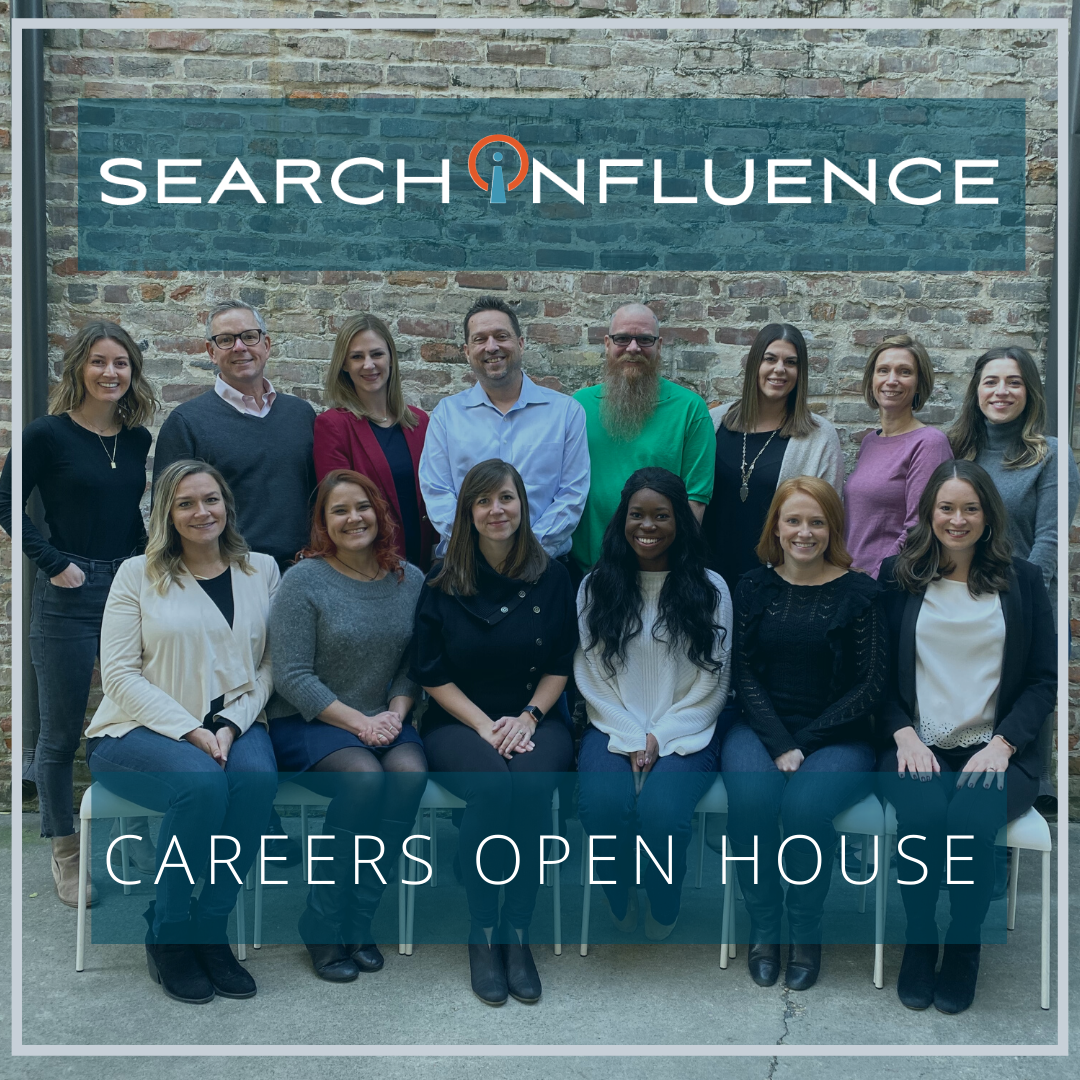
  • Search Influence Hosts Careers Open House December 10 and January 14

    Potential candidates are invited to meet the team, learn about open positions and company benefits.

    Search Influence Careers Open House Recruiting EventWe invite interested applicants to the office for an evening of networking, followed by presentations about the company, various departments, open positions, and company benefits.

    We are hiring for six open positions across four departments and experience levels, including director, mid, and entry-level. Open positions include:
    – Director of Operations
    – Account Manager
    – Account Coordinator
    – Product & Marketing Manager
    – Sales Executive

    Job postings can be found in our careers section.

    “We know that finding the right fit at work is key to professional growth,” says Angie Scott, COO & Co-Founder. “We are opening our doors to potential applicants and community members in hope of making it easier to find the right fit for both the company and employees. We know applying for a job is as much about interviewing our team as it is about us learning more about the candidate. We want to make sure candidates get to experience our genuine and collaborative environment of which we are so proud.”

    “We have been lucky to see growth in both new and existing clients over the last year. We are also lucky our clients drive us to grow and improve. Our success is defined by their success. We are looking for CHARGED individuals who are committed to both customer success and their own professional growth,” says Will Scott, CEO and Co-Founder.

    Attendees will get a preview of the new Search Influence offices which offer unique and personalized spaces to deliver the needs of each department. Search Influence offices provide the space in which the team excels. “This new office space allows us to create an environment that fosters creativity and sets us up for success,” added Scott.

    Careers Open House

    Tuesday, December 10, 2019 and Tuesday, January 14, 2020
    5:30 – 7:00 p.m.

    Schedule of events:
    5:30: Arrival and networking
    6:00: Brief presentations about Search Influence, values, benefits, and open positions, including the responsibilities of each department.

    1610 Oretha Castle Haley Blvd., New Orleans, LA 70113
    (504) 208-3900.

    Advance registration is recommended via EventBrite

    For any questions about the event, email [email protected].

    Hope to see you there!

  • Free Search Tools to Find the Best Deals for Black Friday and Cyber Monday

    Free Search Tools to Find the Best Deals for Black Friday and Cyber Monday

    Ariel Tusa, Account Supervisor at Search Influence, kicked off the holiday shopping season by sharing online shopping tips with WVUE. Make the most out of your Black Friday and Cyber Monday with these money-saving tools:

    Person shopping using mobile device during Black Friday

    SlickDeals: Find the best in-store or online prices for items on your list. Users can up-vote or down-vote items other people share on the site, so the best deal will be at the top! Push notifications even alert you about fast-selling items that are on sale.

    Honey: No more avid coupon-searching—this free Chrome Extension automatically finds and applies available promo codes when you shop online. On some websites, Honey even alerts you if there is a better deal out there. Get rewarded with cash back when you shop with the extension turned on.

    Camelizer: Download this extension for Mozilla Firefox or Google Chrome to track product price history on Amazon and other popular retailer sites to compare and find the best online deals.

    Rakuten: Shop your favorite brands and stores on this retail site with automatic promo codes applied to items, plus cash back. Getting paid to shop? Yes, please.

    And our favorite part about these tools? They’re all FREE! Search Influence not only wants to optimize your holiday shopping experience, we want to optimize your customers’ online experience. Our online advertising services can help your business get found by potential customers looking for the products and services you provide. Let’s start a conversation today.

    Images

    Shopper