
Author: Paula Keller French

  • Why Hire a Digital Marketing Agency? Outsource for Faster Growth

    Why Hire a Digital Marketing Agency? Outsource for Faster Growth

    A graphic of an agency growing due to outsourcing digital marketing

    Key Insights

    • Hiring a digital marketing agency gives in-house marketers access to a team of experts with specialized skills and knowledge. Companies benefit from advanced marketing techniques without ongoing in-house training and investment in expensive tools.
    • Outsourcing digital marketing to an agency frees up time for businesses and internal teams to focus on their core operations.
    • Hiring and managing an in-house marketing team comes with risks, such as turnover and unmet expectations.

    If your online growth is slowing because your advertising strategies fall short…

    Who you gonna call?

    A digital marketing agency!

    Taking on all aspects of marketing in-house is scary, especially when you lack the time, expertise, and resources to create campaigns that connect with potential customers.

    A good digital marketing agency helps you reach your target audience with results-driven campaigns that meet your business goals. It also requires less commitment while adding more overall capacity to your business.

    Hiring an experienced digital marketing company will offer a fresh perspective and help grow your business online.

    Why Hire a Digital Marketing Agency?

    When you hire the right digital marketing agency, their team becomes an expansion of your own. A great digital marketing agency is an invaluable asset, from handling your social media advertising and paid digital advertising to helping you create marketing materials and optimizing your website for search engines.

    There’s no need to spend the time, effort, and money on building an in-house marketing team when the benefits of hiring a digital marketing agency are abundantly clear.

    1. Expand your resources, skills, and capabilities

    Outsourcing your digital marketing services allows you to access more specialized skills, knowledge, and tools without the long-term commitment of hiring an in-house team.

    Digital marketing agencies stay updated on the latest marketing trends and strategies. This allows you to reap the benefits of the most advanced marketing campaigns without committing time and resources to keep up with this constantly evolving industry.

    And with those trends comes a rollout of new (and expensive!) tools and skills you must master to stay in stride with the industry.

    Do you have time to learn about Google’s AI overview rollout and choosing the right attribution model for GA4? Of course not. You have other priorities — like setting strategy and planning budgets.

    2. Gain greater capacity for increased productivity

    We get it; we’re marketers, too. You take pride in your adaptability and knack for learning new skills on the fly.

    But there is hardly enough time in a day to complete all your to-dos, much less become an experienced SEO professional, creative copywriter, and detail-oriented digital ads manager.

    You’re wearing more hats than an MLB dugout!

    Hiring a digital marketing agency allows you to be the manager without having to play first base and shortstop too.

    This helps you focus on your other daily responsibilities, freeing you up so you can be more effective.

    3. Receive a shortcut to solutions

    An agency solves your marketing challenges fast and with proven expertise.

    Like any industry, digital marketing is full of its own quirks. Digital marketers are well aware of these oddities and are prepared to anticipate and navigate them.

    For example, say you’re struggling with rising online advertising costs in 2024. The right agency would pinpoint that online advertising costs are rising because it’s an election year and then pivot your marketing strategy to a more cost-effective solution.
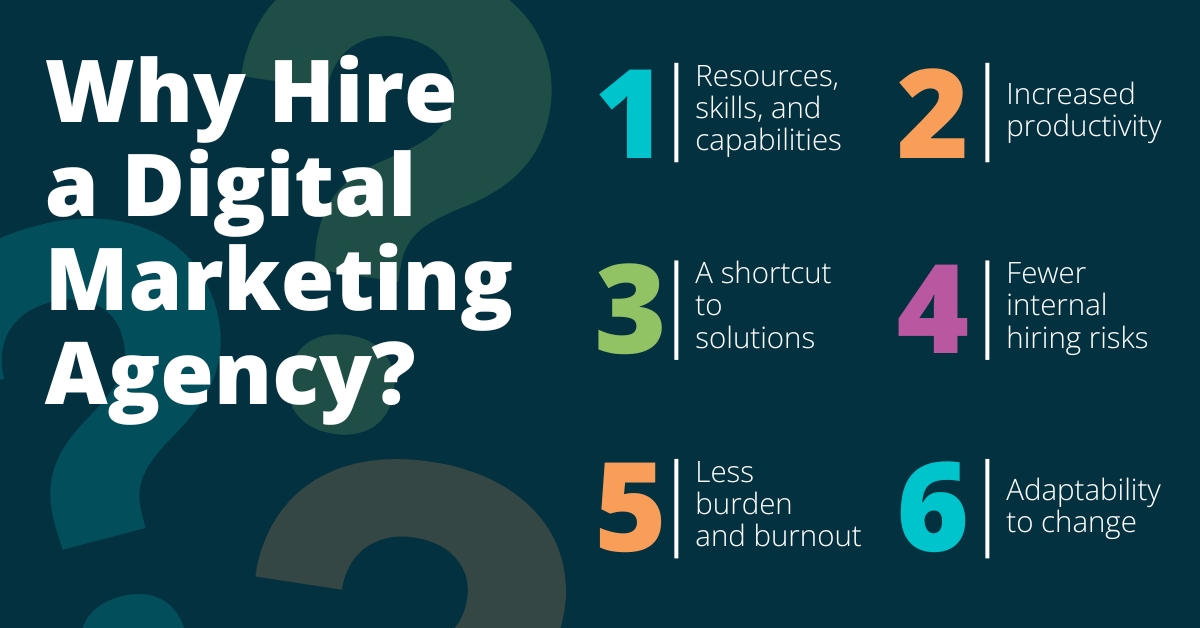
    A list of reasons why to hire a digital marketing agency

    4. Mitigate common risks associated with internal hiring

    Hiring a digital marketing agency to expand your team requires less commitment and time than building one in-house team while delivering greater lead generation in return.

    Building a full-service in-house team is no small task.

    You have to spend time and money on recruiting and training new employees, all while risking turnover or not meeting expectations.

    Why gamble on an in-house marketing team when you can pay for what you need when you need it with a digital marketing agency?

    The answer is clear.

    5. Decrease burden and burnout

    Being a marketing manager is hard enough. Don’t add to your burden by hiring and overseeing a full-on team to manage your marketing process. Your time should focus on the broader marketing picture, not nearing burnout because you’re trying to master new digital advertising techniques.

    6. Adapt quickly to change

    You must be a campaign chameleon to ensure longevity in your marketing efforts, always ready to adapt to new environments and circumstances.

    But if you’re not much for reptiles, a knowledgeable digital marketing agency brings a similar knack for adaptability.

    A marketing agency can pivot your strategy at a moment’s notice. Whether your key performance indicators are down or you need to update your social media platforms, your agency is there.

    Why Businesses Choose Digital Marketing Agencies Over In-House Teams

    At this point, you might be thinking, “Of course, a blog written by a digital marketing agency recommends hiring a digital marketing agency.”

    While your skepticism is understandable, we aren’t the only ones who recommend hiring a digital marketing agency. Our clients do, too.

    • An hour’s worth of your research goes beyond what we can come up with in a week” – B2B SaaS Company
    • “With not even a full year together, we are already seeing the impact of SI’s expertise on our program awareness and engagement.” – Private Research University
    • “Search Influence offers the expertise of a large and long-established organization with the culture and adaptability of a small boutique shop.” – State University
    • “Knowledgeable, professional staff who are leaders in their field.” – Regional Cultural Venue
    • “The overall turnaround time from the first meeting to the deliverables was quick, and they were always communicative.” – State University
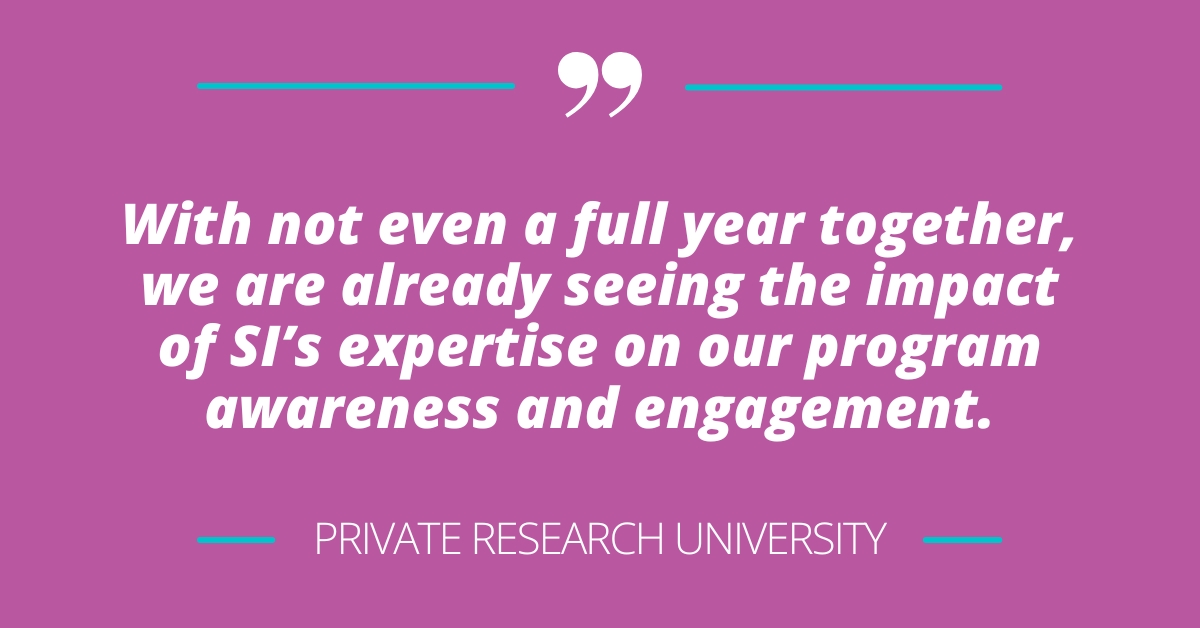
    'With not even a full year together, we are already seeing the impact of SI’s expertise on our program awareness and engagement.' - Private Research University

    The payoffs in action

    Below is a perfect example of how partnering with an agency can elevate your marketing efforts.

    The marketing team at a continuing education school at a large university had the skills to build their website and write content, but they needed guidance on how to build the site with SEO in mind from the start.

    Search Influence completed an SEO audit and UX audit for them. This client brought us in at the start of the website redesign so we could offer extra guidance on what was good and not so good about their current website.

    Since completing the audit, the school partnered with us on six months of consulting to ensure our recommendations were carried out during the redesign.

    This is a perfect example of how partnering with an agency can elevate your marketing efforts. With our recommendations, the client’s website is expertly built to dominate the SERPs from day one.

    Take Our Higher Ed SEO Quiz to Find Your Best Approach

    Making decisions about managing your SEO strategy in-house or outsourcing it to an agency can feel overwhelming.

    Fortunately, tools and frameworks exist to streamline this process — like Search Influence’s Quiz: Higher Ed SEO – In-House or Outsource?

    Our Higher Ed SEO Quiz simplifies the decision-making process for university marketers by helping you determine the best approach for managing your SEO — whether that’s keeping it in-house, outsourcing, or adopting a hybrid model. In just a few minutes, you’ll gain customized recommendations that align with your institution’s goals and resources.

    These actionable insights empower you to make smarter staffing decisions, maximize your team’s potential, and enhance the effectiveness of your SEO strategy.

    The Higher Ed SEO Quiz is designed with busy higher education professionals in mind, offering quick and actionable results.

    By integrating this decision-making framework into your broader marketing strategy, you can make informed decisions about your staffing choices, ultimately boosting your SEO efforts and your institution’s ability to connect with prospective students in a highly competitive marketplace.

    Take our Higher Ed SEO Quiz for custom recommendations.

    Experience the Benefits of Hiring a Digital Marketing Agency

    Search Influence has helped businesses create ROI-focused marketing strategies since 2006.

    With our expertise and commitment to staying ahead of industry trends and research, we’re here to help you optimize your digital marketing efforts.

    Ready to find the best approach for your higher ed SEO strategy?

    Take our Quiz: Higher Ed SEO – In-House or Outsource? to get personalized insights, or contact Search Influence today to see how we can help you navigate the complexities of digital marketing with confidence.


  • Not Tracking Cost Per Inquiry? Expect Budget Waste

    Not Tracking Cost Per Inquiry? Expect Budget Waste

    A woman looking out over her peers after graduation - Search Influence - Higher Education CPI

    Key Insights

    • Tracking and optimizing CPI is crucial for higher education marketers to ensure budget efficiency and maximize return on investment.
    • Failing to track CPI can make it difficult for higher ed marketers to correlate marketing success with enrollment, justify budget allocations, and optimize campaigns.
    • Tracking CPI empowers higher ed marketers to forecast conversion rates accurately, allocate resources cost-effectively, and refine strategies to attract the right audience.

    In the competitive realm of higher education marketing, efficiency is critical.

    Higher education marketers that understand cost per inquiry (CPI) will significantly influence the success of advertising campaigns, when the metric is leveraged properly. CPI, which measures the cost to acquire each inquiry is the first step to budget efficiency and maximum return on investment.

    Failing to track CPI can lead to you missing out on valuable insights that enable you to streamline your marketing efforts and better engage your target audience.

    Search Influence, in collaboration with (UPCEA), The Online and Professional Education Association, has conducted extensive research on the benefits of CPI tracking in higher education marketing.

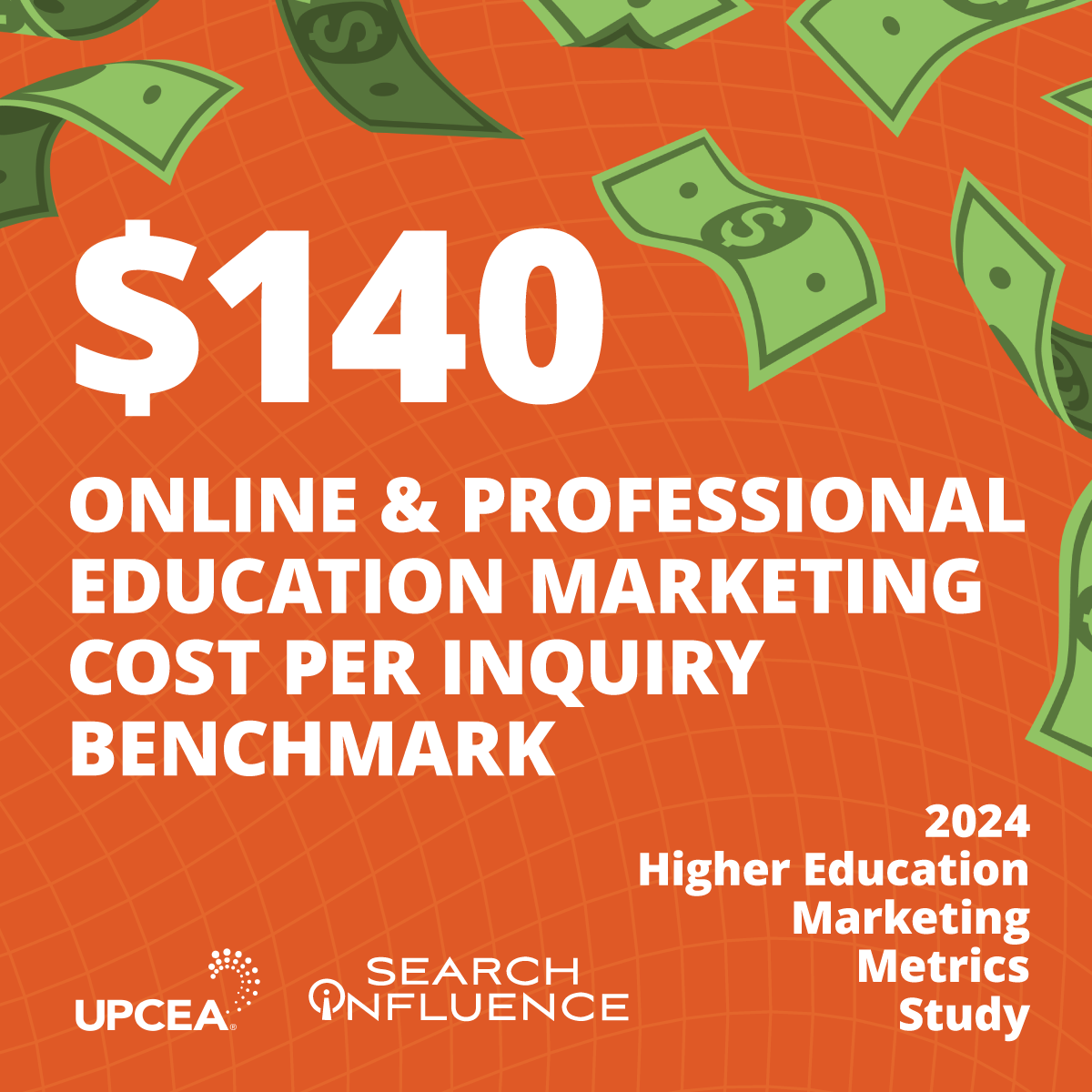
    Through a comprehensive survey collecting data from industry leaders, we established the first higher ed cost per inquiry benchmark of $140. This initiative is part of a broader, multi-year goal to encourage higher education institutions to measure CPI diligently and consider all factors included in advertising costs.

    In this post, we’ll discuss how to successfully track your campaigns using CPI.

    The Importance of Tracking Cost Per Inquiry in Higher Education Marketing

    In higher education marketing, failing to track cost per inquiry results in inefficient budget use and an incomplete understanding of your marketing efforts. Without CPI tracking, higher ed marketers struggle to correlate marketing success to enrollment, making it challenging to justify budget allocations and optimize campaigns effectively.

    When you don’t track CPI, you risk:

    • Spending money on campaigns that drive clicks but no conversions
    • Making decisions solely on metrics like cost per click and click-through rate, rather than focusing on which campaigns are actually driving inquiries
    • Funneling money into underperforming campaigns based on the wrong metrics
    • Discontinuing campaigns that effectively generate leads because you’re not focusing on the right metrics

    Tracking CPI offers numerous benefits, including empowering higher ed marketers to:

    • Make data-driven decisions
    • Forecast conversion rates accurately
    • Allocate resources more cost-effectively

    By understanding the cost and quality of inquiries, institutions can refine their strategies to attract the right audience, thereby improving overall campaign performance. Metrics like CPI are vital for evaluating marketing health and success, enabling institutions to enhance enrollment processes and achieve a better return on investment.

    Insights from our higher ed marketing research study

    Our Higher Education Marketing Research Study, conducted in partnership with UPCEA, reveals critical insights that demonstrate the importance of tracking cost per inquiry.

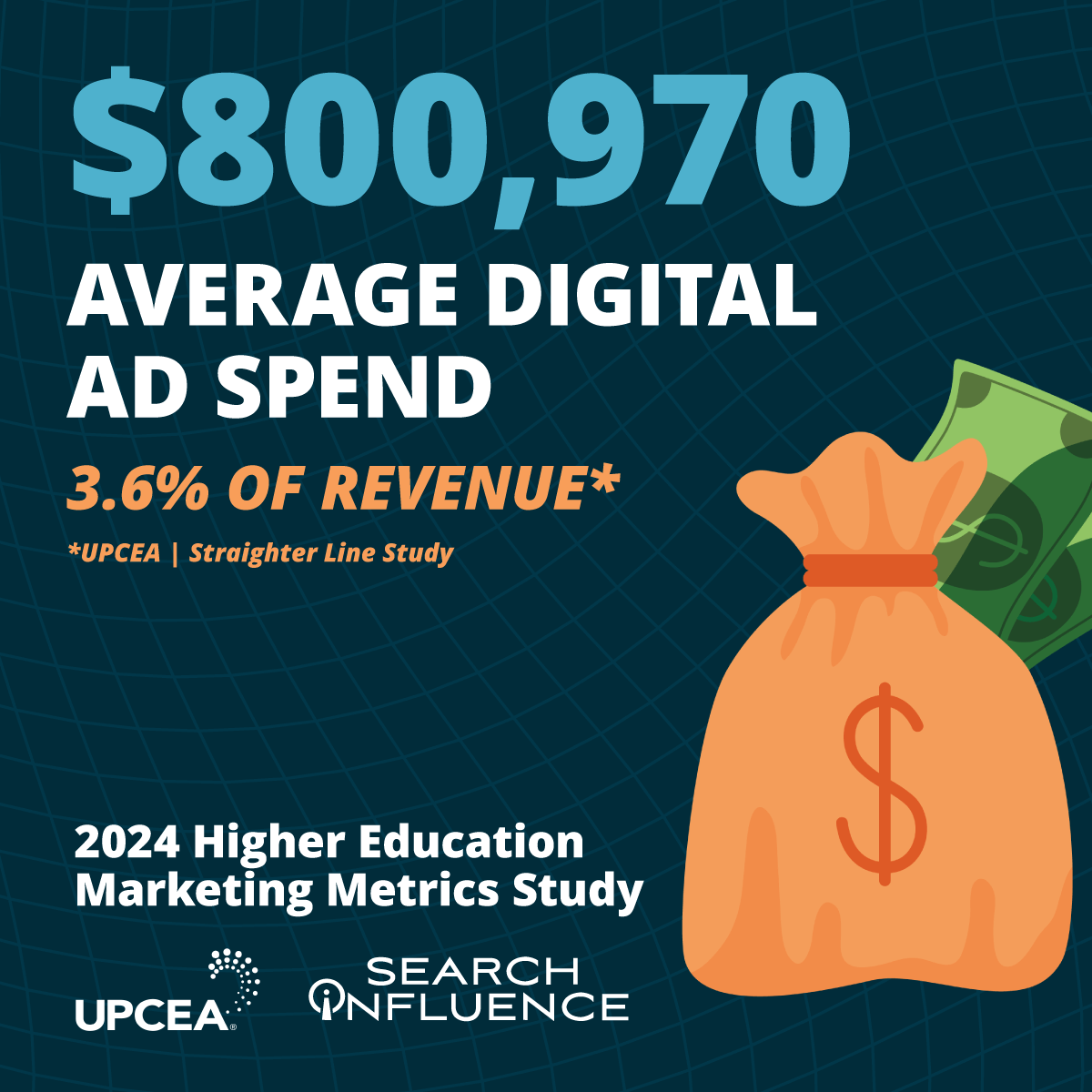
    Higher education institutions spend an average of $800,970 on paid ads each year.

    Without tracking CPI, higher education marketers can’t be sure they’re allocating their resources effectively and getting the appropriate results for the amount they’re spending.

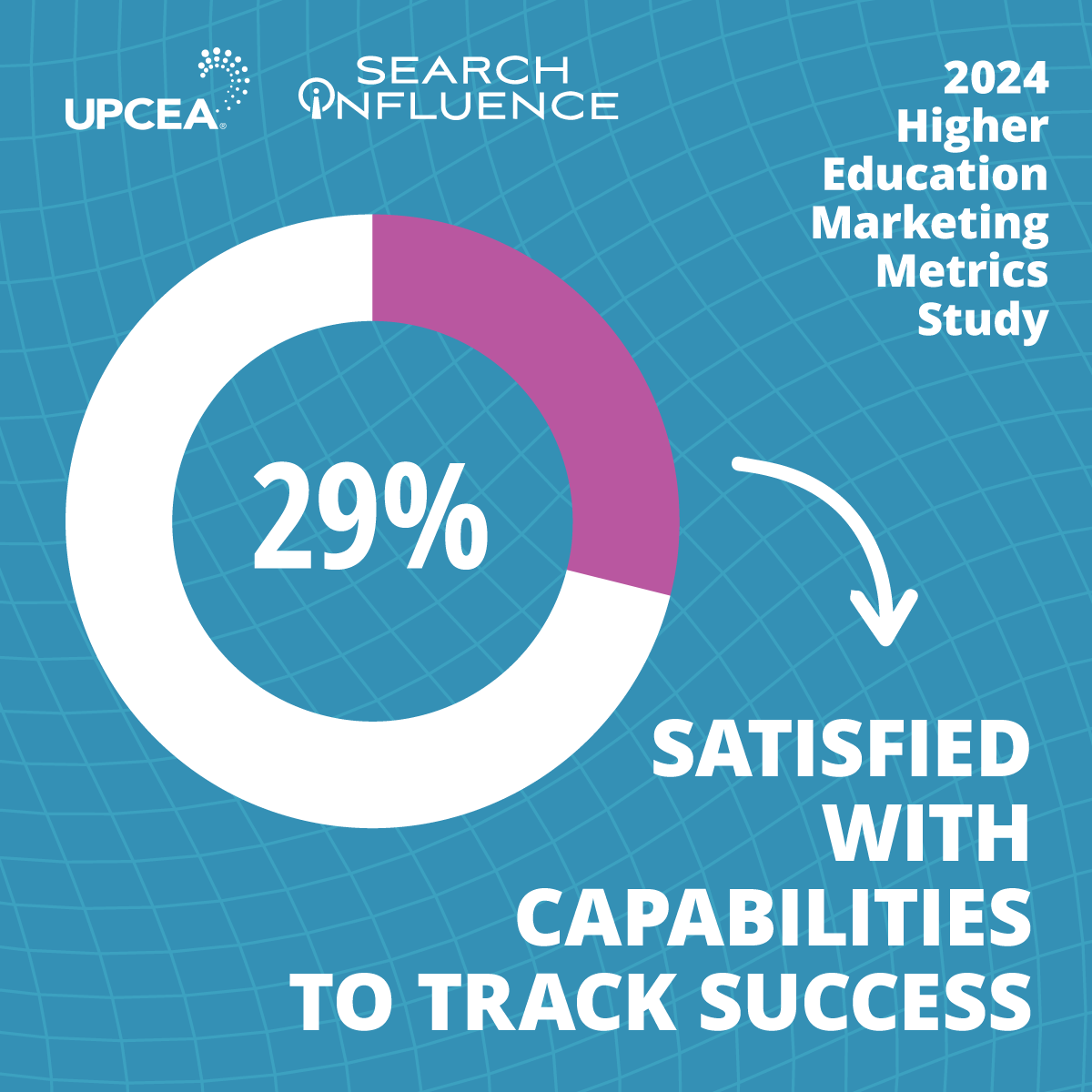
    Only 29% of higher ed marketers are satisfied with their capabilities to track the success of their campaigns. This is a frighteningly low percentage, considering the average higher ed marketer spends nearly a million dollars on paid ads yearly.

    You can achieve your enrollment goals more efficiently by focusing on tracking and reducing CPI.

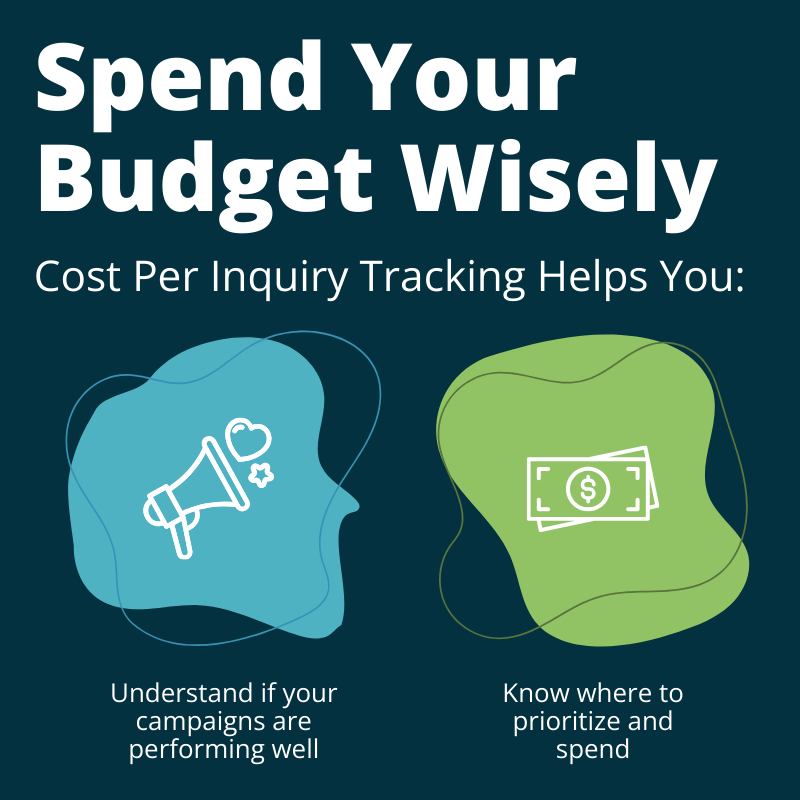
    Tracking cost per inquiry allows you to:

    • Have confidence that you’re driving an appropriate amount of inquiries and yielding the desired results
    • Direct where to optimize your budget to make it more efficient
    • Understand how adjustments, including targeting and budget changes, impact results
    • Establish a jumping-off point that allows you to look at deeper metrics — such as the lead quality driven by these channels and conversion ratios as these inquiries move through the enrollment funnel

    By establishing a CPI benchmark, we encourage universities to track key metrics and be aware of all factors included in your advertising costs. This benchmark serves as a tool for your institution to compare its results with similar schools and programs, giving you confidence in your efforts by truly demonstrating how much you’re spending — no more guessing games.

    At Search Influence, we know these insights will empower institutions to improve their marketing strategies and achieve better results.

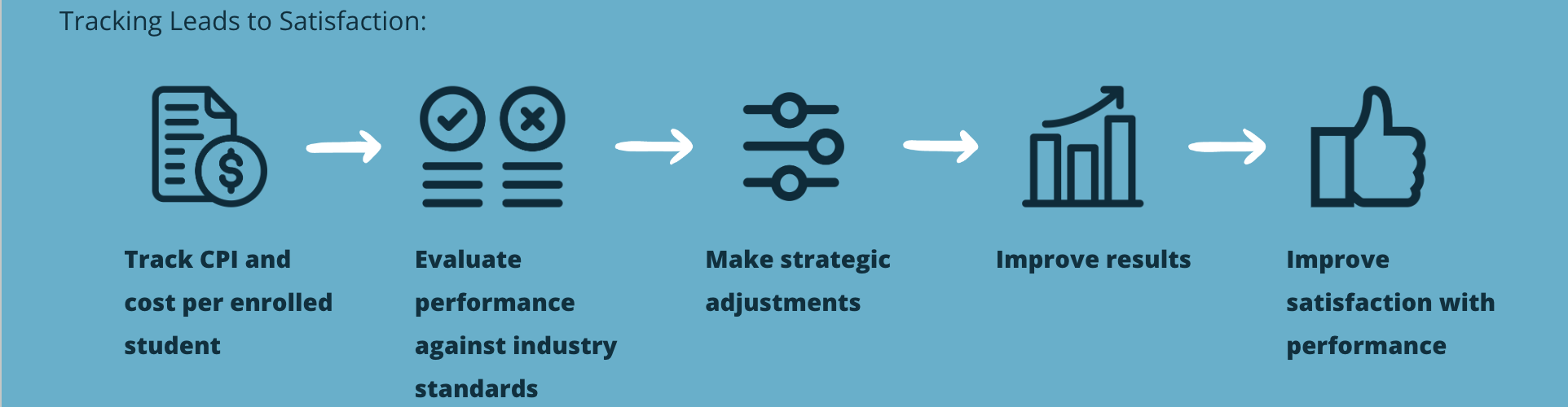
    Tracking leads to satisfaction - Search Influence

    Are You Able to Truly Track the Success of Your Ad Campaign?

    Universities investing in paid advertising must be setup to effectively track the success of their campaigns. Without the necessary information and strategies in place, you risk wasting significant portions of your budget. This underscores the true necessity of tracking cost per inquiry for higher education institutions.

    Some universities suffer from lack of data. Some universities suffer from an overabundance of data spread across disparate systems. Both scenarios hamper effective measurement.
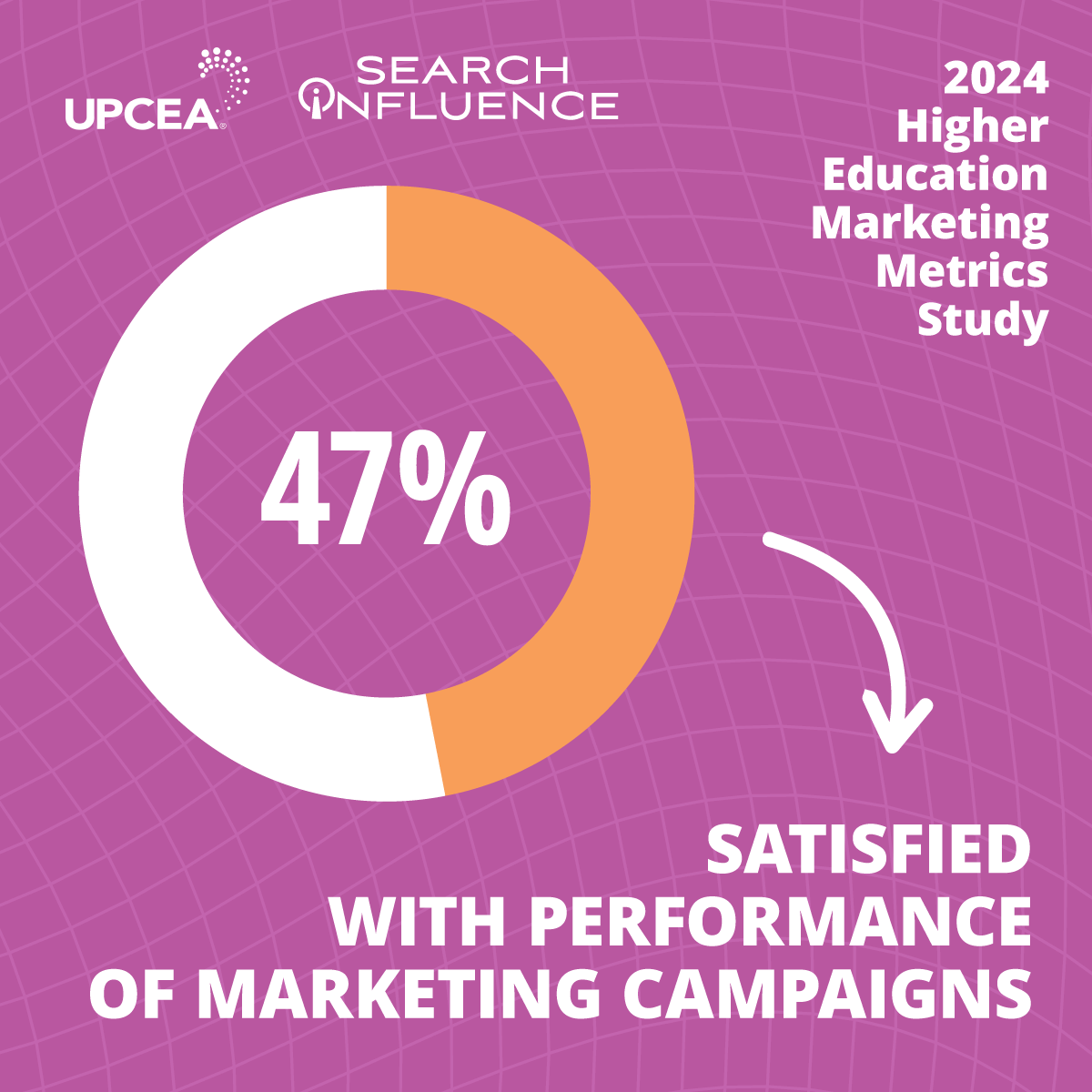
    You need readily available information to make timely adjustments to your strategies, and a process that ensures you regularly analyze cost data and adjust your marketing strategy accordingly. Unfortunately, our research indicates that many institutions struggle in this area. Fewer than half (47%) of marketers are satisfied with their campaign performance, and only 29% are satisfied with their ability to track success. This dissatisfaction highlights a significant gap in campaign efficiency and effectiveness.

    CPI allows you to truly measure the success of your campaigns because your true success is measured by the number of students filling seats at your institution. By focusing on CPI, you get exactly what you pay for, ensuring your budget is used wisely and efficiently to boost enrollment.

    This correlation between tracking ability and campaign satisfaction reinforces the importance of CPI in driving higher ed marketing success.

    According to our research study, 92% of those who are satisfied with their ability to track also report they agree or strongly agree that they are satisfied with the performance of their marketing campaigns.

    Track Cost Per Inquiry With Confidence

    Don’t waste your budget — utilize CPI to achieve precise, measurable results and ensure every dollar spent on advertising contributes to your institution’s enrollment goals.

    At Search Influence, we advocate for robust CPI tracking to help you optimize your strategies and achieve the best possible outcomes. Our team has years of experience assisting higher ed institutions to maximize their marketing results including helping Tulane SoPA exceed its inquiry goal by 58%.

    Need support creating cost-effective campaigns with definitive KPIs?

    Download our Higher Education Marketing Research Study for further insights, or contact us directly to learn more about all our digital marketing services.


    Image Credits: Unsplash

  • 2024 Higher Education Marketing Benchmarks: Get Past Your Blindspot

    2024 Higher Education Marketing Benchmarks: Get Past Your Blindspot

    Key Insights

    • A shifting higher education playing field is causing universities to reevaluate their results and the costs associated with them.
    • Despite increased competition and an evolving modern learner, higher education marketing departments can still reach their enrollment goals by tracking the right metrics to inform future strategies.
    • New Search Influence and UPCEA research reveals a blind spot in higher education marketing tracking: cost per inquiry and cost per enrollment.
    • Cost per inquiry and cost per enrollment are compasses that help you determine your marketing budget’s efficiency and effectiveness. By tracking these key metrics, you can see what’s working and what’s not as part of the bigger picture.
    • Marketers who keep a pulse on their campaigns via in-depth tracking are more satisfied with their overall marketing performance.

    Changing demographics, limited resources, and increased competition in higher education are making university leaders rethink their marketing strategies.

    Colleges and universities need to pinpoint where to invest their resources for the best return — and where to trim the fat.

    This starts with tracking the right higher education marketing metrics.

    While overall marketing metrics offer valuable insights, the ability to analyze the data at the program level will ultimately determine which institutions meet enrollment goals and which fall behind.

    In “What Gets Measured Gets Managed,” our 2024 higher education marketing benchmark research conducted in partnership with UPCEA, we analyzed whether professional, continuing, and online (PCO) units are tracking two key metrics that could inform critical outcomes: cost per inquiry (CPI) and cost per enrollment.

    See the state of tracking in higher education marketing and how your institution compares to others in the industry.

    Key Findings of the UPCEA Research Study

    The average annual digital ad spend on PCO units is nearly $900k

    The modern learner has gone digital, and the higher education marketing sector rightfully followed suit.

    Professional and online education units spend an average of $800,970 each year on digital advertising spend, including paid search, social advertising campaigns, and connected TV (CTV) streaming ads.

    Average digital ad spend was $800,970 - Search Influence Higher Education Marketing Benchmarks

    As the new learner searches for higher education programs online, digital advertisers must meet inquirers where they are in their enrollment journey.

    This involves continuous learning, adapting, testing, and re-testing — a process that starts with tracking the right campaign data, like cost per inquiry.

    Less than half of higher ed marketers track cost per inquiry

    Cost per inquiry is the most important metric to track to reduce the expenses of driving your prospects to take action. But if you aren’t tracking this key metric, the good news is you’re not alone.

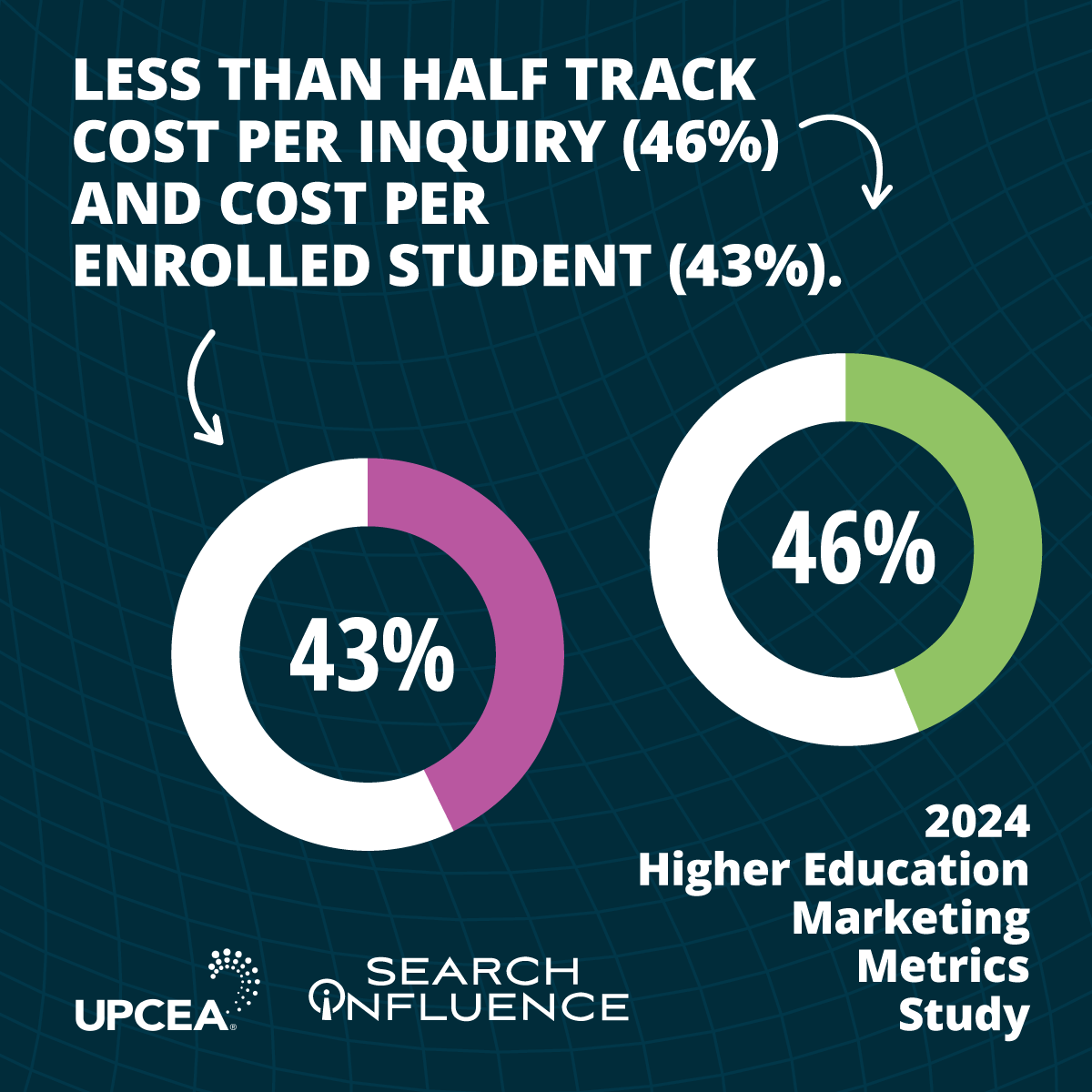
    Today, most higher education marketers have a fairly strong grasp of the source of their inquiries — not necessarily the costs associated with them. Nearly three-quarters (73%) of marketing units track inquiry sources for their PCO programs, while less than half track cost per inquiry (46%) or cost per enrolled student (43%).

    And, for nearly one out of five research survey respondents (17%), metric tracking isn’t even on their radar.

    Less than half track cost per inquiry and cost per enrolled student - Search Influence Higher Education Marketing Benchmarks

    The average cost per inquiry (CPI benchmark) for professional and online education is $140.

    Of the 46% of PCO units that track cost per inquiry, the average CPI for the 2022-2023 fiscal year was $140, with a median of $106. Roughly one-third (32%) of PCO units had a CPI between $50 and $100, 15% between $101 and $150, and 15% over $200.

    The expenses associated with this CPI benchmark for marketing varied but most often consisted of:

    • Media spend (88%)
    • All marketing expenses, excluding salaries (46%) and agency management fees (39%)

    Result satisfaction is fairly low, with 38% of survey respondents reporting they’re content with their school’s CPI, and 27% not sure.


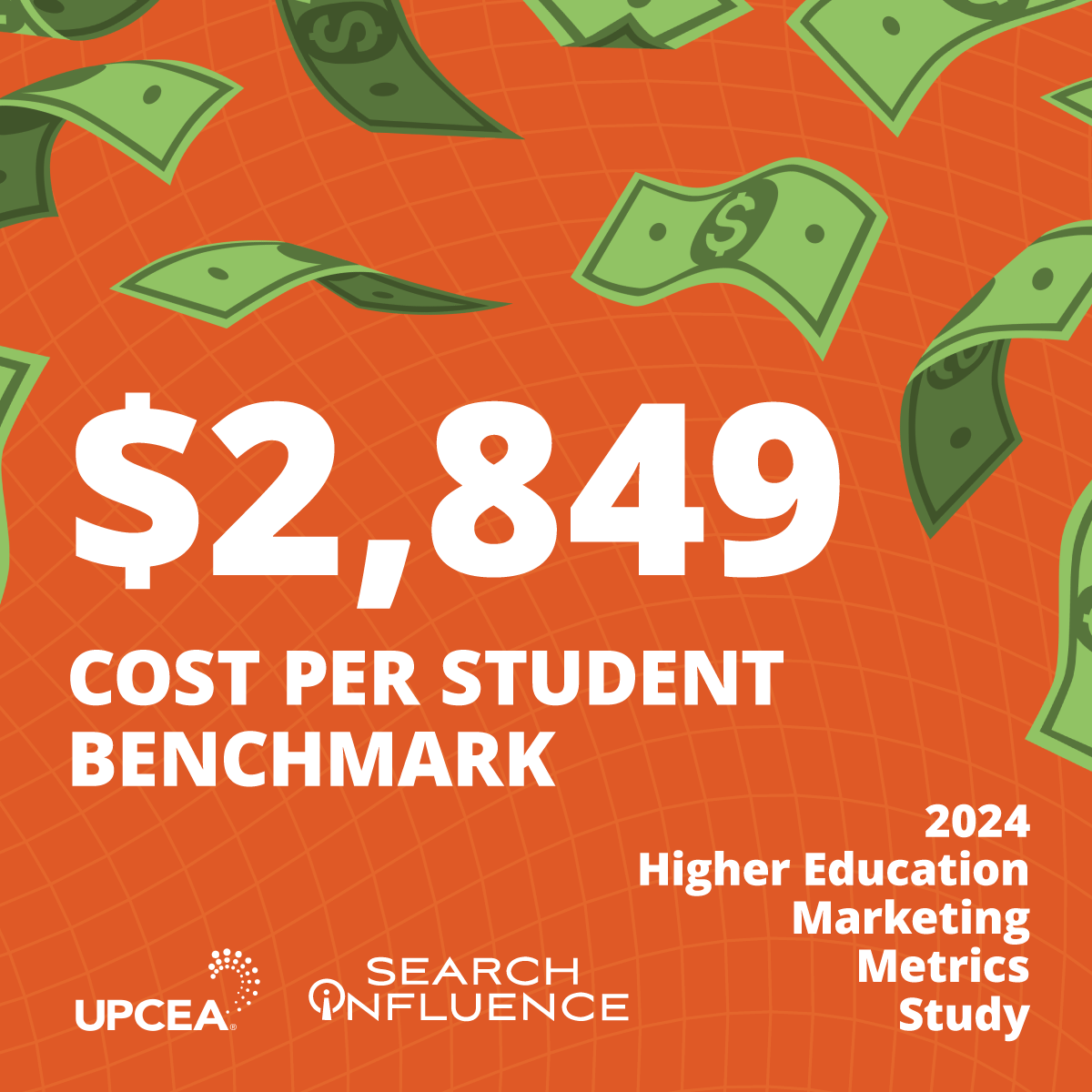
    The average professional and online education cost per enrolled student is $2,849.

    Of the 43% of PCO units that track cost per enrolled student (43%), the average cost per enrolled student for the 2022-2023 fiscal year was $2,849, with a median of $1,173. 27% of PCO units had a cost per enrolled student under $500, and an additional 27% had a cost per enrolled student of over $3,000.

    $2,849 cost per student benchmark - Search Influence Higher Education Marketing Benchmark

    Email marketing is most often managed in-house, while digital advertising is most often outsourced

    Nearly three-quarters (73%) of higher ed email marketing and half of search engine optimization (44%) efforts are entirely managed in-house. However, digital advertising remains an item ripe for outsourcing, with half of the survey respondents exclusively outsourcing their Google paid search campaigns to experienced agencies.

    Whether it’s due to budget constraints or simply just a preference to keep things internal, most PCO units mix and match what is outsourced and what is managed in-house. However, it’s important to note that managing any marketing campaigns in-house requires universities to have the time, skills, and resources to monitor campaigns and stay up to date on trends.

    If you’re unsure whether partnering with an agency is the best option for your university, start a conversation with us today.

    Marketers who track their campaigns are more happy with performance

    Tracking campaign performance has a direct link to overall marketing satisfaction.

    According to our research findings, those who are satisfied with their back-end campaign tracking capabilities are more likely to be satisfied with how those campaigns perform in the wild.

    Despite this, many marketers lack the know-how, resources, and time to keep a steady pulse on their campaigns, leaving key metrics to fall to the wayside — entirely overlooked. Fewer than half (46%) of survey respondents report satisfaction with their campaign’s performance, and only 29% are satisfied with their ability to track such success.

    This blind spot then creates a grueling cycle of campaign launch → result dissatisfaction → repeat, with no guide for improving results.

    29% of companies were satisfied with capabilities to track success - Search Influence Higher Education Marketing Benchmark

    How Higher Education Marketing Benchmarks Drive Marketing Outcomes

    There’s an old saying by British mathematician Lord Kelvin that goes, “To measure is to know.” 

    When thought of strategically, digital advertising is data for dollars. Within a single campaign, you can gain insights into its effectiveness, ranging from lead quality to cost per inquiry, without hours of tedious pen-to-paper calculations. And, with industry-wide higher education marketing benchmarks, you can compare how you’re doing with competitors and determine ways to refine your budget and outcomes.

    Going beyond basic metrics like cost-per-click and leveraging more granular metrics like cost per inquiry helps you:

    • Have more confidence in your inquiry quality and quantity
    • Know which campaigns are performing or underperforming, and which optimizations to make to improve results
    • Assess how adjustments like budget and targeting changes affect campaign results
    • Establish a starting point to dive deeper into metrics like conversion rates as prospective students move through the enrollment funnel

    Armed with a well-rounded understanding of each inquiry, you can drive home campaigns that resonate without wasted ad spend.

    How to utilize cost per inquiry

    Cost per inquiry isn’t a metric exclusive to higher education institutions. Healthcare, hospitality, and B2B marketers have long relied on this measurement to assess the state of their incoming inquiries.

    Why? Because CPI is a direct measurement of budget efficiency and effectiveness.

    Your institution’s CPI is calculated by dividing how much you’ve spent on marketing and advertising by the number of inquiries received. In higher education, inquiries commonly originate from emails and college websites, specifically:

    • Request for information forms
    • Brochure request forms
    • Request a visit forms

    Utilizing a CPI metric gives your marketing department valuable insights into your advertisements’ impact. It helps you examine your performance and provides guidance on budgeting and refining your marketing strategy.

    But, just like any marketing metric, CPI works best when it’s evaluated as part of the bigger picture. Building your data stack with additional key metrics, like cost per enrolled student, helps you visualize the cost of the entire conversion process, from the initial inquiry to final enrollment.

    How to utilize cost per enrolled student

    Cost per inquiry is a leading indicator of success.

    Cost per enrollment is the most definitive metric you can review to see how much you are spending to get a new student.

    This metric encompasses the total costs invested in securing a student’s enrollment, factoring in expenses from the initial marketing efforts and campaign launch all the way to the student’s matriculation. Most often, these include:

    • Media spend
    • Agency management fees
    • University marketing team salaries
    • All other marketing undertakings

    When analyzing cost per enrollment over time, or comparatively within your programs, you can get a sense of where you need to make the biggest changes – either budget, resource allocation, or overall strategy.

    Leveraging cost per inquiry and cost per enrollment in tandem can lead you down the right path to campaign effectiveness. Ideally, by adopting these metrics into your tracking tool kit, your higher education institution can prioritize the digital marketing campaigns that yield the most inquiries at the lowest costs.

    Not sure how to calculate your school’s cost per inquiry or cost per enrollment? See our new CPI Calculator or download our free worksheet for help getting started.

    Gain Insights Into Your Higher Ed Marketing Performance With Search Influence

    The bottom line: Tracking cost per inquiry and cost per enrollment is an untapped opportunity for many schools looking to maximize every marketing dollar invested. These often neglected, yet incredibly insightful, metrics help you understand what’s working, what isn’t, and how to allocate your budget accordingly for the best results.

    We hope that, with this new industry-wide benchmark, your college or university will better judge the performance of your professional and online program marketing.

    If you’re unsatisfied with your digital advertising performance, tracking these key performance metrics can get you past your blind spot. After all, you can’t improve what you don’t measure, and what gets measured gets managed.

    Download the full 2024 higher education marketing benchmark research study with UPCEA today.

  • Search Influence Earns 2024 Google Premier Partner Badge

    Search Influence Earns 2024 Google Premier Partner Badge

    We’re thrilled to share that Search Influence has been awarded 2024 Google Premier Partner status — for the 9th year in a row!

    Recognized by the Google Partners Program, this honor places us in the top 3% of digital marketing agencies in the United States, reflecting our commitment to excellence.

    See what this distinguished title means for our team and our clients.

    The Path to Premier Partnership

    Search Influence earns Google Premier Partner badgeThe Google Partners program recognizes and rewards top-performing digital marketing professionals and agencies in a given country and year. Active in over 60 countries, the exclusive program comprises three levels: Member, Partner, and Premier.

    Achieving Premier status, the highest tier, involves a rigorous set of criteria and demonstrates an agency’s advanced skills and expertise in managing Google Ads.

    Premier Partner Qualifications:

    • Robust Optimization and Performance: Agencies must consistently maintain a high optimization score in their Google Ads Manager accounts, indicating that they are maximizing campaign effectiveness.
    • Substantial Ad Spend: Agencies are required to demonstrate significant ad spend levels, maintaining a minimum ad spend 90-day period, which showcases their ability to handle large-scale campaigns.
    • Professional Certification: To qualify, more than half of the strategists managing the account must hold Google Ads certifications.
    • Exceptional Agency Performance: Premier status is reserved for agencies that rank in the top 3% in their country in terms of performance metrics such as client growth, retention, product diversification, and annual ad spend.

    Benefits of Working With a Google Premier Partner Agency

    The Google Partners program doesn’t just benefit honored agencies and marketing moguls — it also offers significant advantages to their clients. When you work with Search Influence as a Premier Partner, you benefit from:

    • Access to Advanced Tools and Resources: We receive early access to new Google features, updates, and tools, keeping your campaigns miles ahead of your biggest competitors.
    • Dedicated Support from Google: Direct support from Google helps us optimize our strategies and improve your outcomes without delay or technical hassle.
    • Continuous Learning and Development: Ongoing training and insights on industry trends ensure that our team remains on the cutting edge of digital marketing — directly impacting your bottom line.

    Achieving 2024 Google Premier Partner status is a milestone for Search Influence, reinforcing our dedication to digital advertising success. Let us share the benefits of this honor with you, helping you enrich your campaigns with exclusive resources and superior insights.

    Your SEO and Digital Marketing Agency

    Ready to see what a Google Premier Partner can do for your campaigns?

    Search Influence specializes in all aspects of online advertising, including campaign research, development, tracking, and reporting. We have decades of experience mastering the art of Google advertising, and we’re here to put our expertise to work for you.

    Get in touch with our SEO and digital marketing agency today for results you can trust.

  • Effective SEO Strategy Must-Haves: Why Partner With Search Influence

    Effective SEO Strategy Must-Haves: Why Partner With Search Influence

    seo best practices

    Key Insights

    • Not all SEO strategies are created equal. Effective SEO strategies demand a customized approach that takes into account the unique goals and challenges of a business.
    • Search Influence uses three pillars to drive SEO strategy: boosting search rankings, empowering local SEO, and enhancing technical SEO.
    • Partnering with a skilled SEO agency can make all the difference in your online advertising success.

    Search Influence isn’t just part of the SEO industry — we helped shape it.

    Since bursting onto the SEO scene in 2006, we have helped clients across countless industries climb search engine results pages and reach their goals. We maintain a firm hold as thought leaders in the digital advertising industry by speaking at conferences, writing guest blog posts, and sharing insights on podcasts.

    Our team fuels growth by constantly seeking inspiration from the many other prolific thinkers in the digital marketing and SEO world.

    After reading What Does “Strategy” Actually Mean to CMOs?, our thoughts returned to our recent SEO research study with UPCEA, where we learned that 51% of universities don’t have an established SEO plan.

    In this blog post, we’ll share the benefits of a true, customized search engine optimization strategy and pull the curtain back on our process.

    Search Influence’s SEO Best Practices

    At Search Influence, we value increasing your website’s traffic and search volume. However, we know that the bottom line for your business is a strategy that converts those visitors into inquiries and revenue.

    Through a medley of strategies, we help you gain more organic traffic.

    Our four pillars of a successful SEO strategy:

    1. Boosting topical relevance: Our team conducts thorough keyword research to identify the most relevant keywords for your business. We then optimize your web pages with these targeted, conversion-friendly key topics, ensuring that your website appears prominently in search results when potential customers seek your products or services.
    2. Empowering local relevance: We strengthen your online presence by focusing on local SEO strategies. By optimizing your website to reinforce your physical location, we ensure your business remains competitive in local search results. This approach makes it easier for nearby customers to discover and connect with your company.
    3. Driving authority: We bolster your website’s credibility and influence through strategic link building. By linking to reputable websites within your industry and adding internal links from across your own website, we signal to search engines that your content is valuable and authoritative. This practice helps to satisfy Google’s E-E-A-T requirements.
    4. Enhancing discoverability through technical SEO: We pay close attention to the technical aspects of your website to improve its overall performance. This includes many technical settings that help Google better access your site, as well as optimizing your website for mobile users, because a positive user experience is crucial for encouraging conversions. A user-friendly interface ensures that visitors can effortlessly navigate your site, increasing the likelihood that they will take a desired action.

    Effective SEO Strategy Step 1: Needs Analysis

    The first step in Search Influence’s process is getting to know you, your website, and your competition.

    In house, we call this a needs analysis.

    In this crucial step, we delve into understanding your unique requirements and challenges, ensuring that our SEO efforts align seamlessly with your goals and objectives.

    Our needs analysis process forms the bedrock upon which we build our SEO strategy, providing valuable data and context for optimizing your online presence.

    Our needs analysis process:

    • Learning your goals and objectives: By aligning our efforts with your goals, we ensure our actions contribute directly to your success. We collaborate with you to define what you want to achieve with your SEO endeavors. This may include enhancing online visibility, driving more targeted traffic, or increasing conversion rates.
    • Competitor analysis: We conduct a comprehensive competitor analysis to outperform your competition in the digital landscape. By identifying areas where your competitors excel and areas where they fall short, we can employ strategies and tactics that will help to set your website apart.
    • Technical audit: Our team conducts a meticulous technical audit of your website. By uncovering any technical issues or areas of improvement, we pave the way for a smoother user experience and improved search engine rankings. This audit thoroughly examines your website’s internal links, on-page optimization, and overall technical SEO health.
    • Content assessment: We assess your existing website content for its quality, relevance, and keyword optimization. Ensuring that your content aligns with your target audience’s interests and is optimized for relevant target keywords is crucial for attracting organic traffic and retaining user engagement.
    • Link profile analysis: Our team dives deep into your link profile, evaluating the quality and quantity of your inbound links. A strong and reputable backlink profile enhances your online authority and search engine rankings. We identify opportunities for acquiring high-quality backlinks and eliminating toxic links that may harm your SEO efforts.

    This process enables us to tailor our SEO strategy to your specific needs and maximize the impact of our efforts, ultimately catapulting your website content to new heights of online visibility.

    Effective SEO Strategy Step 2: Keyword Research

    Conducting keyword research is pivotal to understanding how users search for products or services related to your business.

    Our steps:

    • Brainstorm seed keywords: We create a list of core or seed keywords directly relevant to your products or services. These keywords are the foundation upon which we will build your keyword strategy. We discover these initial keywords through discussions with you about your industry and products to learn the words you use and the words your audience uses.
    • Utilize keyword research tools: Keyword research allows us to cast a wider net and capture a broader audience for your business. We leverage tools that uncover an array of related keywords and keyword phrases that users commonly enter into search engines.
    • Analyze search volume: During this step, we closely examine each keyword’s search volume to understand its popularity and potential impact. This data helps us prioritize the keywords more likely to drive significant traffic to your website.
    • Assess keyword relevance: We assess keyword relevance to ensure that the chosen keywords align with your audience’s search intent. This alignment verifies that visitors arriving at your site are genuinely interested in your products or services — leading to conversions, not just clicks.
    • Select targeted keywords by topic: We organize your selected keywords by topic, making it easier to create content that resonates with users’ interests. This strategy improves your website’s ranking on search engines and enhances the overall user experience by providing cohesive and informative content.
    • Balance keyword volume and competition: Our goal is to identify keywords that offer a favorable balance for your specific objectives. Highly competitive keywords may require more time and effort to rank for, while low-competition keywords may not drive enough traffic.

    Effective SEO Strategy Step 3: Creation of the Strategy

    Every client is unique, and your SEO strategy must reflect your distinct goals and challenges.

    Search Influence understands this diversity and crafts individualized strategies that align with your requirements.

    While the specifics may vary, here are some examples of tactics that we might include in your strategy:

    Keyword and on-page SEO optimization

    At Search Influence, we optimize your on-page SEO by ensuring that relevant keywords are seamlessly integrated into your website content, meta tags, and headers.

    Additionally, we create high-quality, keyword-rich content that directly addresses user intent, improving your website’s visibility on search engines.

    By including keywords and structuring your content for skimmers, swimmers, and divers, we improve your website’s readability and search engine ranking.

    Technical SEO

    We fine-tune technical settings that make it easier for Google to access your site, like implementing proper HTML markup and sitemaps, and configuring robots.txt files. We improve your website speed and mobile-friendliness to enhance the overall user experience of your website.

    Link building

    Our team builds high-quality, relevant backlinks from authoritative websites to boost your domain authority. Links are like votes for your website, and you must have more to win!

    We also avoid low-quality or spammy backlinks that could harm your site’s reputation.

    Content marketing

    Our content marketing strategy revolves around creating informative, engaging, and shareable content. We also employ social media and email marketing to increase content visibility and reach.

    Local SEO

    Local SEO is especially important for businesses with physical locations.

    For businesses targeting a local audience, we optimize your Google Business Profile listing and local citations. Encouraging customer reviews and ratings helps enhance your local reputation.

    User experience (UX)

    We focus on enhancing website usability and navigation to reduce bounce rates and improve user satisfaction. Additionally, optimizing for mobile devices caters to a mobile-first audience and ensures adherence to mobile SEO best practices.

    Schema markup

    Implementing schema markup provides search engines with structured data about your content, enhancing the appearance of rich snippets in search results.

    Search Influence employs all the tools at our disposal, including Google Analytics and other industry-leading SEO tools, to craft these individualized SEO strategies. We align each strategy with your specific goals, target audience, and unique challenges.

    Whether it’s optimizing page titles, improving page speed, or fixing broken links, we harness our expertise to ensure your website ranks higher for Google searches and provides an exceptional user experience.

    Search Influence’s Effective SEO Strategies for Higher Education

    As discussed earlier in this blog post, a majority of higher education institutions across the country lack a proper SEO strategy.

    Search Influence and our higher education marketing partners at UPCEA believe improving SEO must be a top priority for universities. We help universities build and deliver better SEO strategies through original research studies and our SEO Roadmap for higher education institutions.

    Our team of experts has years of experience helping universities boost their SEO rankings.

    Tulane SoPA + Search Influence = SEO Strategy Success

    When Tulane SoPA came to us looking for ways to boost organic traffic for their recently launched human resources program, we dove straight into our process to identify the strategy.

    We implemented five common tactics to increase their SEO rankings:

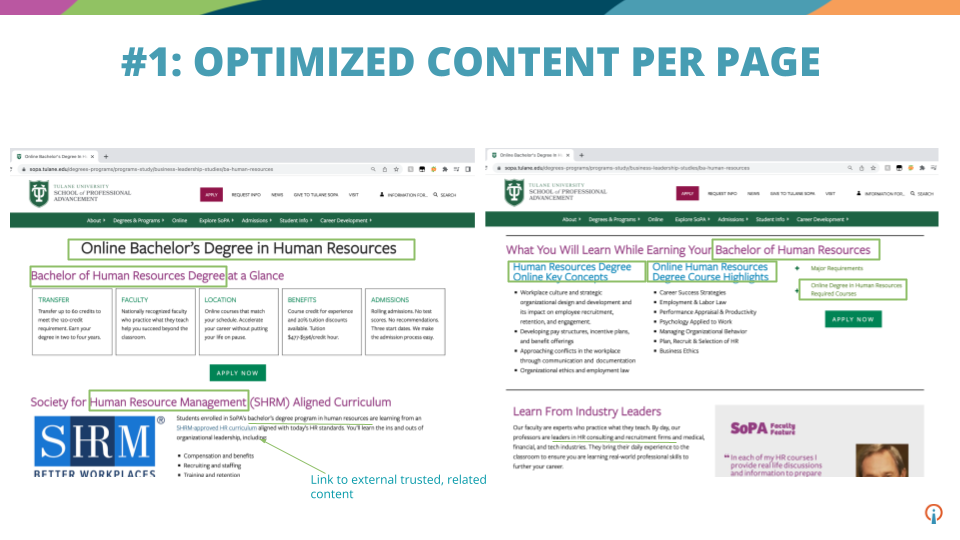
    #1: We optimized the degree page content

    optimized content per page

    Search Influence always prioritizes including the primary keyword and related keywords in headlines because they are an SEO ranking factor. This small attention to detail, amongst others, can help you get to the first page of the SERPs.

    In the example above, you can see where we included the keyword “online bachelor’s degree in human resources” and similar variations throughout the content. All the keywords are closely aligned to the program name, as they often will be.

    We incorporated keywords into the headings, the on-page content, and other related linked pages.

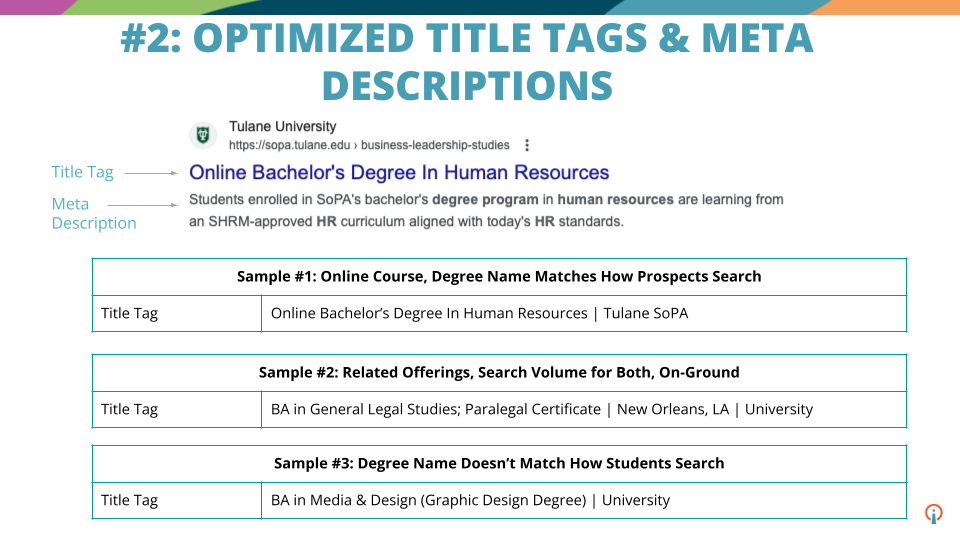
    #2: We optimized metadata with targeted keywords

    optimized title tags and meta descriptionsTitle tags and meta descriptions are closely related to content but are not shown directly to a user on the web page. A searcher will see them when your webpage appears in a Google search.
    Google search sees your title tag as the page title and uses it to learn what your page is about.

    Therefore, it’s the most important tag to optimize with keywords while avoiding keyword stuffing.

    Meta descriptions influence CLICKS to your site, but they do not influence RANKING.

    A well-optimized meta description will include the brand name, keyword, geo, if necessary, and relevant information about the program.

    Let’s go into more detail by reviewing the title tag examples for different Tulane SoPA programs above.

    Sample 1: This is for an online course, where the degree name closely matches how prospects search, and the wording is specifically tuned to variations of the particular keyword “human resources degree” — pretty straightforward.

    Sample 2: This page is about general legal studies, but there’s also info about Tulane SoPA’s paralegal certificate since the degree helps you get your paralegal certificate. It’s crucial here to optimize this title tag for both topics.

    Sample 3: Let’s say your degree name doesn’t match how prospects search. In that case, you can naturally work in the keyword, like in the example here.

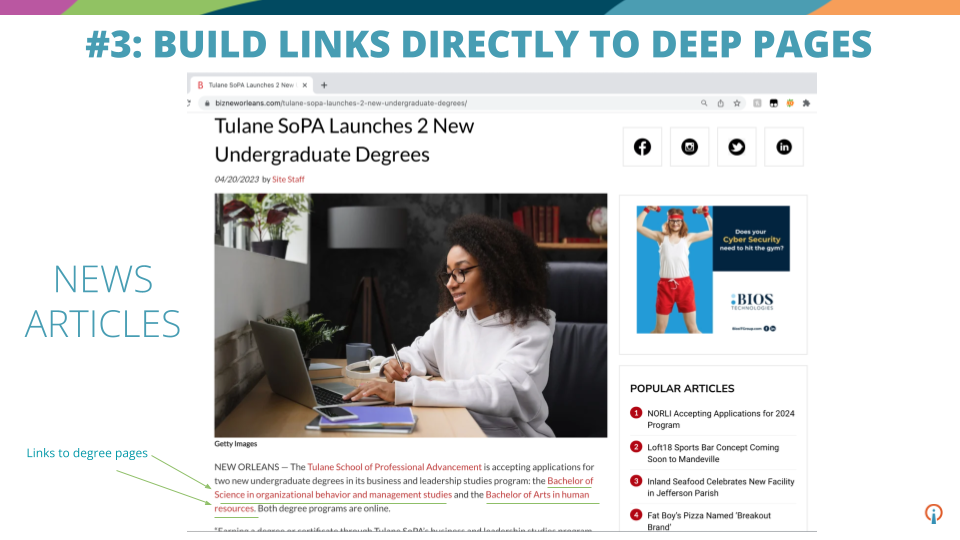
    #3: We built links directly to deep pages across Tulane SoPA’s website

    build links

    The above example is a news article in a local business publication. This was published as the result of a press release. You’ll see a link to the school’s homepage and specific degree pages.

    Another place you can build deep links is through profiles on sites like niche.com. The above example shows links to the overall degree/program page and directly to key the degree pages.

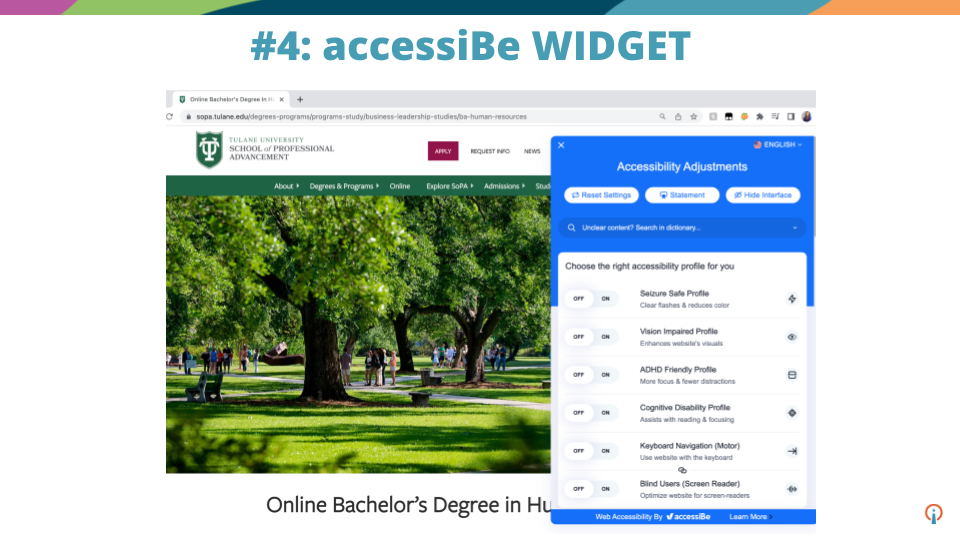
    #4: We used accessiBe to improve Tulane SoPA’s website accessibility

    accessiBe widgetMaking your site accessible to all is of the utmost importance.

    To do this for Tulane SoPA, we utilized accessiBe to make their website fully compliant and accessible to those with disabilities.

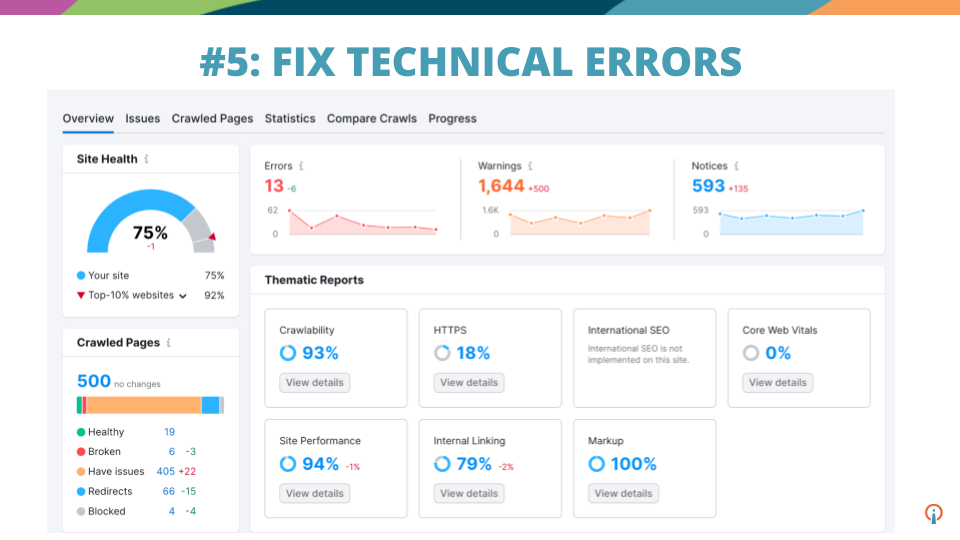
    #5: We fixed technical errors on Tulane SoPA’s website

    fix technical errors

    Technical errors can include a wide variety of things, such as 404s/broken links, crawlability issues, HTTPS, speed, and schema errors.

    We used Semrush and Google Search Console to identify and fix these issues for Tulane SoPA.

    Learn More About Effective SEO Strategies With Search Influence

    In digital marketing, the distinction between an SEO strategy and an effective SEO strategy can be the difference between existence and success.

    Partnering with an experienced SEO agency helps you build the powerful online presence your business needs.

    At Search Influence, we understand that crafting a genuinely effective strategy requires expertise, dedication, and a deep understanding of the ever-evolving digital landscape.

    Contact us today to learn more about our digital marketing services.


    Image sources:

    Image 1: https://images.unsplash.com/photo-1523875194681-bedd468c58bf?q=80&w=2942&auto=format&fit=crop&ixlib=rb-4.0.3&ixid=M3wxMjA3fDB8MHxwaG90by1wYWdlfHx8fGVufDB8fHx8fA%3D%3D

  • UPCEA Webinar Highlights: The Power of CPI in Measuring Higher Ed Marketing Success

    UPCEA Webinar Highlights: The Power of CPI in Measuring Higher Ed Marketing Success

    SI Cost Per Inquiry

    Key Insights:

    • Search Influence and UPCEA have teamed up to create a nationwide benchmark for cost per inquiry (CPI) specifically for professional, continuing, and online education institutions.
    • With an industry-standard benchmark, higher education institutions can better understand how effective their marketing efforts are in attracting prospective students and the factors influencing their success, from media spending to agency fees.
    • To truly harness the power of calculating your CPI, you need a team/system in place that can properly interpret your data.

    Search Influence recently co-hosted a webinar with UPCEA titled “The Power of CPI to Measure Higher Ed Marketing Success.”

    UPCEA is a leading online and professional education association whose members constantly push higher education to new heights. Through everything from professional development to conferences and seminars, UPCEA and its members are diligently working to improve educational access and outcomes.

    Since partnering in 2022, Search Influence and UPCEA have hit the ground running with webinars, research studies, and countless blog posts.

    In our latest collaborative webinar, we stressed the importance of measuring CPI.

    Cost per inquiry (CPI) is the ratio between the amount spent on your online advertising campaign and the actual inquiries made. You can utilize this in your higher education marketing toolkit to measure your campaign’s effectiveness.

    But to truly master the art of measuring cost per inquiry in higher education, you’ll need more details from the experts.

    Watch the recording from our CPI Webinar for a roadmap to guide you through the challenges of calculating CPI for your institution.

    Hear from UPCEA’s Chief Research Officer Jim Fong, Senior Director of Research Bruce Etter, and UPCEA Platinum Partner Search Influence as they provide their insights on the best place to start and how to remove common roadblocks to keep you on your path.

    In this blog post, we’ll summarize the webinar’s highlights and help you determine the best way to utilize cost per inquiry in higher education.


    On-Demand: Cost Per Inquiry Higher Ed Webinar

    What Makes Cost Per Inquiry in Higher Education Important?

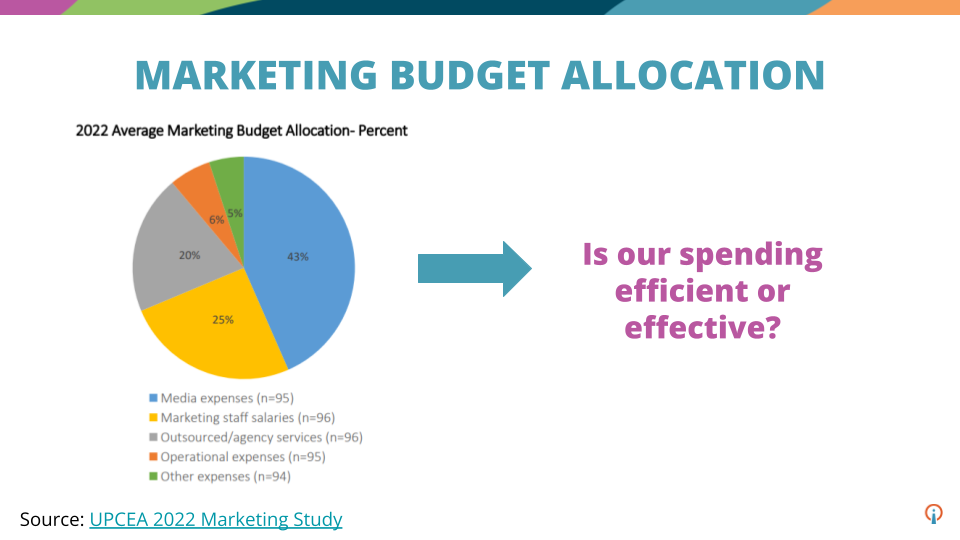
    marketing budget

    In higher education marketing, CPI is a vital metric that helps you understand how effective your marketing efforts are in attracting prospective students.

    CPI provides a clear, quantitative way to assess the efficiency and quality of your marketing strategies in engaging with your target audience. It refers to the cost of generating a single inquiry or lead from a prospective student through advertising or promotional campaigns.

    Multiple dimensions of CPI

    When diving into the world of CPI, it’s crucial to consider the various dimensions through which you can examine this metric, including:

    1. Media Spend: This dimension focuses on the direct advertising expenses incurred in generating inquiries. It helps institutions analyze the cost-effectiveness of their digital advertising campaigns, ensuring they allocate resources wisely to reach prospective students. This is most common.
    2. Media Spend and Management Fees: This accounts for both internal and external costs associated with marketing efforts. In addition to direct media expenses, including management fees provides a more comprehensive view of the total investment required to generate inquiries. This is less common than looking at just media spend.
    3. All Marketing Leads and All Leads From Marketing Efforts: Institutions more accurately understand their marketing funnel by considering all leads, not just those that ultimately enroll. This broader perspective allows for the evaluation of the entire journey, from initial inquiry to the conversion of prospective students into enrolled students. This is the least common way to calculate cost per inquiry.

    Benefits of Measuring CPI in Higher Education Marketing Campaigns

    cost per inquiry


    Cost per inquiry holds significant importance for colleges and universities:

    1. Confidence in Inquiry Generation: A calculated CPI instills confidence that an institution’s marketing efforts drive an appropriate volume of inquiries from prospective students. Assurance is vital for ensuring institutions’ marketing campaigns align with their goal of attracting high-quality leads.
    2. Benchmarking Against Industry Standards: CPI allows colleges and universities to benchmark their performance against industry standards. By comparing their CPI to broader industry metrics, higher education marketers can assess whether their outcomes align with expectations and identify areas for improvement.
    3. Vendor Assessment: When working with third-party vendors or partners in higher education marketing, having a clear CPI enables institutions to evaluate the realism of promises made by these vendors.

    Top CPI Questions From the Webinar Audience

    Q. What is the first step in trying to calculate CPI?

    It all starts with the tracking. Most institutions have CRM (customer relationship management) systems and know their spend.

    CRMs can determine the source of the inquiry (which marketing channel brought in that inquiry), but that data isn’t always leveraged, or isn’t viewed in aggregate. If you’re unfamiliar with how to pull this data, seek admin support.

    Determining the source, and pulling high-level reports, will allow you to get more granular with your CPI.

    But data is just data until you have a skilled marketer to interpret it.

    Similar to the need for a thoughtful editor to adjust AI-written copy, a human touch is necessary to truly get nutrition from the data salad your CRM prepares.

    Not interpreting the data from your online advertising campaign is like having a gold mine in your backyard but never buying a rock hammer and picks.

    Utilize tracking data to optimize your future campaigns and help inform decision-makers on the proper next steps for your institution.

    Q. When will the results of the CPI benchmark survey be published?

    Search Influence and UPCEA anticipate publishing the results of our higher ed research survey in Spring 2024.

    Q. How often should schools analyze CPI?

    It depends on your campaign strategy and consistency. Monthly, at a minimum.

    If your school has a more aggressive digital marketing strategy with ads running consistently throughout the year to attract students, analyzing CPI monthly might work best.

    If you are making adjustments and watching them closely, and your spend is large enough, you may look at CPI just a few days after a change.

    You do want to take a step back and look at quarterly, yearly, and monthly trends. Perform seasonal comparisons (YOY) and compare to the same semester the prior year.

    Q. What’s the relationship between cost per enrollment and cost per inquiry?

    Unfortunately, we don’t always have access to cost per enrollment because it can be complicated, especially in the online and professional education world, where adult learners might take a while to decide if they want to go through with the application process and return to school.

    That being said, we have seen that when cost per inquiry is optimized down, your cost per enrollment should also decrease — assuming quality is maintained.

    Search Influence & UPCEA CPI Benchmark Survey

    si & upcea benchmark survey

    According to UPCEA, higher ed institutions had an average marketing budget of $1,294,630 in 2022.

    No matter your institution’s budget, you need some standardized measurement to know exactly what your ad spend is getting you.

    That’s why Search Influence and UPCEA have partnered to create a nationwide benchmark for cost per inquiry. This initiative seeks to standardize the measurement of CPI, ensuring uniformity and consistency in how higher education professionals evaluate this critical metric.

    UPCEA and Search Influence believe this metric can help democratize success in higher education marketing.

    Our latest endeavor with UPCEA is a response to the industry’s long-standing need for a credible, industry-specific benchmark for measuring success. The foundation of this benchmark is the CPI Benchmark Survey, an initiative designed to collect diverse insights and data from digital marketers across higher education.

    This initiative is poised to elevate the landscape of higher education marketing strategies, fostering a community of shared knowledge and best practices for engaging new students and optimizing the enrollment funnel.

    With the implementation of an industry-standard benchmark, our shared goal is to enable universities to measure their CPI accurately and gain comprehensive insights into the myriad factors that influence it. From media spend to agency fees, each component plays a pivotal role in determining CPI, and these variables vary from institution to institution.

    If you’re uncertain about your institution’s CPI or are seeking ways to optimize your marketing budget, we designed a CPI Worksheet. You can use it to calculate your CPI and, in the near future, compare it to the broader industry standard we are diligently working to establish.

    Gain a Better Pulse on Your CPI

    With nearly two decades of experience in digital marketing, including higher education digital advertising and search engine optimization, Search Influence is your trusted partner for understanding your institution’s cost per inquiry.

    Our experts simplify CPI analysis, allowing you to effectively assess marketing efforts, evaluate lead generation, and enhance your enrollment funnel.

    Contact Search Influence today to learn more about our lead tracking, reporting, and data analytics services.

    And be sure to watch our recording of The Power of CPI to Measure Higher Ed Marketing Success to gain more valuable insights.

  • What is Cost Per Inquiry (CPI) in Higher Ed Marketing?

    What is Cost Per Inquiry (CPI) in Higher Ed Marketing?

    What is CPI?

    Key Insights

    • Cost per inquiry is the most important metric to measure and drive the efficiency of campaigns.
    • Cost per inquiry is most frequently tracked as a KPI for digital marketing channels (i.e., CPI from paid search or CPI from organic), and it can also measure the effectiveness of digital marketing spend across all platforms.
    • Search Influence and UPCEA’s 2024 research established a reliable industry benchmark for cost per inquiry and cost per enrolled student in online and continuing education.
    • The joint study found a strong link between metric tracking capabilities and overall campaign performance satisfaction.

    As the education sector evolves and marketing programs — especially to adult learners — become more complex, understanding and harnessing the power of cost per inquiry (CPI) is essential for staying competitive and achieving your institution’s goals.

    CPI is the definitive key performance indicator for higher education marketers to track advertising campaign success. Serving as a dual compass, this metric guides your higher education marketing endeavors toward optimal campaign performance and strategic budget spending. It also empowers you to gauge your efficiency, optimize your ad spend, and make data-driven decisions.

    For far too long, higher education digital advertisers haven’t had a benchmark for this critical metric, and certainly not one specific to professional, continuing, and online (PCO) education.

    That’s why Search Influence and our higher education partners at UPCEA (the leading online and professional education association) collaborated to establish the first industry-wide benchmark for CPI — to the tune of $140.

    An infographic courtesy of Search Influence detailing CPI information when doing Higher Education marketing

    In our 2024 study, “Search Influence and UPCEA Higher Ed Marketing Metrics Research Report: What Gets Measured Gets Managed,” we took a look at the state of CPI tracking among PCO units and what marketers need to know to get the most value from their budget spend.

    Before you dive into the research, here’s what to know about CPI in digital marketing, how it’s calculated, and why it should be your school’s top tracking priority.

    What is Cost Per Inquiry in Higher Education Marketing? How Do You Calculate Cost Per Inquiry?

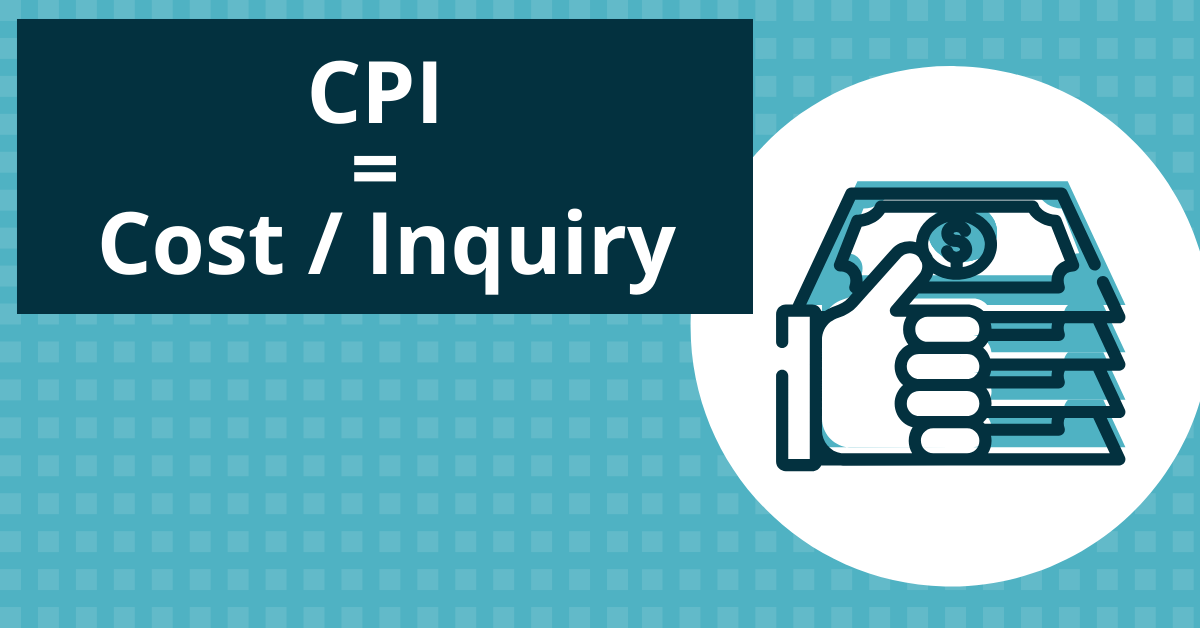
    Cost per inquiry is a fundamental metric that plays a pivotal role in higher education marketing. CPI measures the financial investment required to generate a single inquiry or lead.

    CPI = Cost / Inquiry

    SI CPI Blog

    In the context of higher education digital marketing, an “inquiry” refers to a prospective student expressing interest in your institution’s programs, courses, or services. This expression of interest could manifest as filling out a contact form, requesting a brochure, or making direct inquiries via email or phone.

    The “cost” in the calculation depends on what marketing campaigns you are trying to measure, your marketing mix, and tracking technology (for example — are you able to track an inquiry back to the source?).

    Cost per inquiry is most frequently tracked as a KPI for:

    • Digital marketing channels (i.e., CPI from paid search or CPI from organic)
    • Digital marketing spend across all platforms

    Some may look at it:

    • CPI per program
    • Organic CPI (leads from organic search visitors)
    • Overall CPI across all marketing expenses

    Different ways to calculate CPI in marketing
    Cost Per Inquiry Worksheet for Higher Education Websites

    In our CPI worksheet, we provide two foundational calculations to help you get started:

    • Digital Advertising Media Spend ÷ # of Inquiries Attributed to Digital Advertising = Digital Advertising Cost Per Inquiry
    • Marketing Expenses ÷ Total Inquiries (All Sources) = Overall Cost Per Inquiry

    This industry-standard cost per inquiry calculation creates an “apples-to-apples” comparison, helping institutions like yours know the real cost and payoff of your marketing efforts.

    Why Measure Cost Per Inquiry in Higher Education Marketing?

    SI CPI Budgeting

    The significance of measuring CPI cannot be understated for marketers.

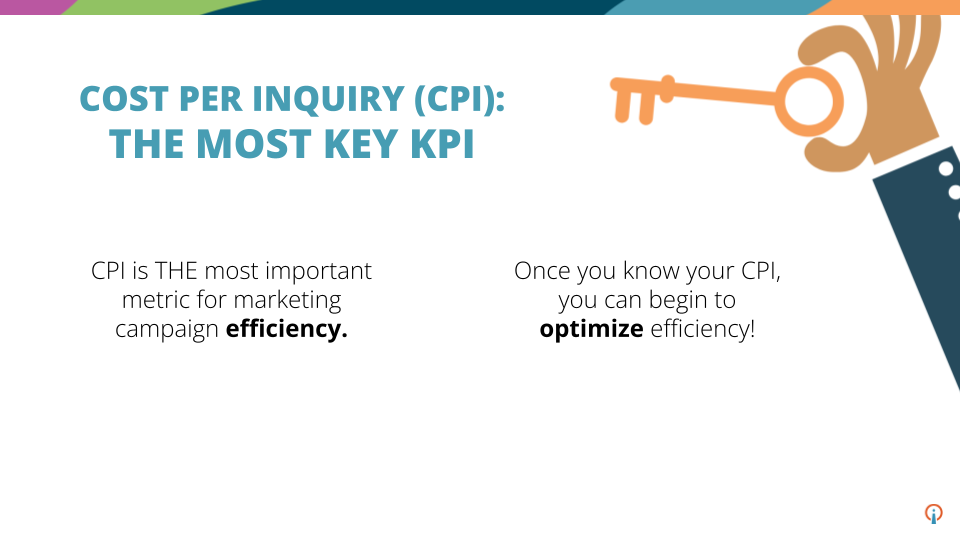
    CPI in advertising is THE most important metric for campaign efficiency.

    Once you know your CPI, you can begin to optimize your efficiency!

    When you consistently measure cost per inquiry in your higher ed marketing campaigns, you can:

    • Have confidence that you’re driving an appropriate amount of inquiries and yielding the desired results
    • Evaluate your outcomes against broader industry standards
    • Project your marketing results and how quickly you can generate necessary inquiries
    • Judge if the promises from third-party vendors are realistic

    Research Numbers at a Glance

    In our 2024 Marketing Metric Research Study, we examined not only whether PCO units tracked cost per inquiry but also their level of campaign performance satisfaction. Our findings yielded a strong correlation between CPI tracking and perceived campaign success — thus bringing to life the old adage, “What gets measured gets managed.

    Key Research Findings:

    • Less than half of PCO units track cost per inquiry (46%) and cost per enrolled student (43%).
    • Nearly one out of five (17%) higher ed marketers do not track the source of their inquiries, nor CPI or cost per enrolled student.
    • Among the PCO units that track cost per inquiry, the average CPI is $140, with a median of $106 and a range of $29.03 to $450.
    • 92% of those satisfied with their tracking capabilities also express satisfaction or strong satisfaction with the effectiveness of their marketing campaigns.

    For further insights into CPI, how it works, and why it works, be sure to check out our full research study. For more tactics to improve your marketing results, take a look at our Higher Education Marketing Resources & Guides.

    Learn More About CPI in Higher Education Marketing

    What is CPI?

    Search Influence and UPCEA are committed to elevating strategy standards in higher education marketing. We hope that, with this industry-wide benchmark for measuring cost per inquiry, you can implement practical strategies for achieving efficient ad spend.

    And, in a world where nearly one in five dollars of programmatic advertising goes to waste, this pivot to efficiency is much needed.

    Ready to see how you measure up to others in the sector? Download the Marketing Metrics Research Study today to take the guesswork out of CPI in advertising.

    Image Sources:

    Image 1: Unsplash

    Image 4: Unsplash

  • UPCEA MEMS Conference Insights: SEO Strategy for Higher Education

    UPCEA MEMS Conference Insights: SEO Strategy for Higher Education

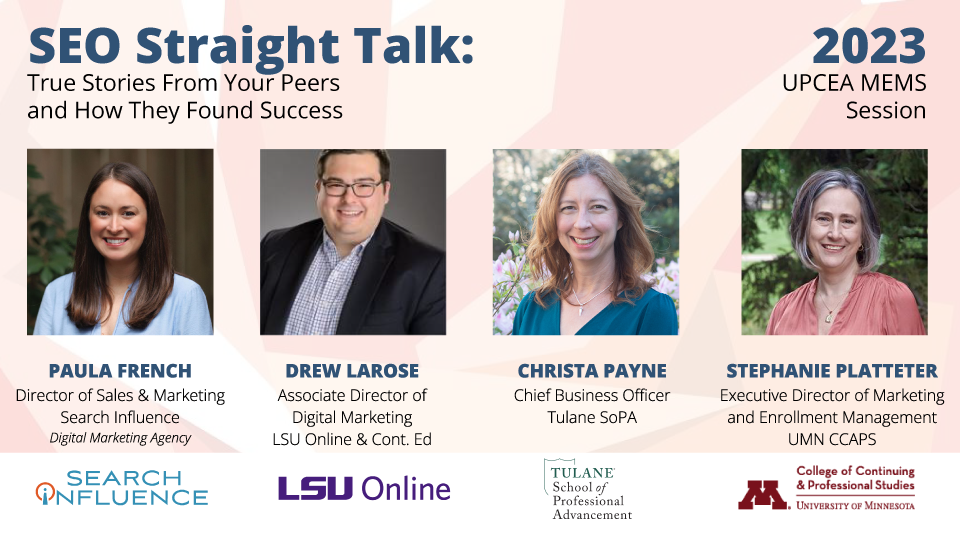
    SI MEMS Conference

    Key Insights:

    • Research indicates that most people’s first interaction with a brand occurs through a search. This makes it critical to optimize your university’s online presence for SEO.
    • Despite 84% of marketing departments considering SEO as a core part of their strategy, 51% of institutions surveyed still lacked an established SEO strategy. This gap in readiness can result in missed opportunities to attract prospective students and increase enrollment numbers.
    • Building a successful SEO strategy for higher education starts with understanding search intent, conducting keyword research, and creating high-quality content that addresses these keywords. It’s also important to build authoritative links both internally and externally.
    • Beyond content, universities must focus on website architecture, user-centric design, site speed optimization, and mobile responsiveness to improve discoverability and enhance the user experience.

    For the second year in a row, Search Influence presented at UPCEA’s MEMS (Marketing, Enrollment Management, and Student Success) conference.


    The UPCEA MEMS conference serves as a watering hole for higher education marketers, specifically those within professional, continuing, and online education.

    At Search Influence, we help higher ed institutions ride the ever-changing waves of SEO strategies. We’ve spent years working on higher education SEO strategies that support universities nationwide in increasing organic traffic and attracting prospective students.

    This dedication to building high-level SEO strategies for educational institutions led us to partner with UPCEA to connect with like-minded individuals.

    Search Influence and UPCEA collaborated on a three-part research study to look at institutional and marketing leaders’ perspectives on SEO and evaluate the readiness of PCO (professional, continuing, and online education) units.

    Our findings shaped our 2023 MEMS presentation. Armed with the understanding that universities need guidance in their higher education SEO strategies, we wanted to show real examples, from multiple schools, of what they have done to improve their visibility in search engines. It was important for us to show not just what the tactics are, but how they drove results. We partnered with 3 great institutions who we knew were effectively executing SEO to share how they have found success.

    Keep reading to learn about our in-depth higher education SEO research and real-world SEO strategies you can implement on your university’s website.

    Search Influence / UPCEA SEO Research Study: Key Findings

    Our collaborative SEO for higher education research study with UPCEA began with a readiness audit of 100 UPCEA member institutions. This audit led to some surprising findings.

    When those surveyed were asked, “How would you rate the SEO capabilities of your PCO unit on a scale of 1 to 5, where a 1 is not very capable and a 5 is extremely capable?,” 3.5 was the average capability rating. 41% of those surveyed rated their SEO capabilities as average or below.

    An even more surprising finding is that 84% of marketing departments see SEO as a core part of their marketing strategy, but 51% do not have an established SEO strategy.

    This missed opportunity leads to fewer clicks from prospective students and lower enrollment numbers for your higher education institution.

    So, how can you improve your higher ed website’s SEO?
    What are the first steps you should take to create an established SEO strategy for your higher-ed website?

    Search Engine Optimization 101


    You must utilize these strategies to keep search engines happy: keywords, content, and links. Think of these three things as your university website’s building blocks.

    Keywords – what are people searching for when looking for your offerings?
    Content – how well does your website provide information that speaks to those keywords?
    Links – how well do other websites reinforce that you are an authority on those keywords?

    Let’s talk through how that might look when you actually do this foundation work:

    Every SEO for higher education strategy must start with determining a prospective student’s keywords (in other words, what terms do they search?).

    For example, say you do some digging in Google Search Console and see your website receives a lot of website traffic for the phrase “online master’s programs.” Recognizing your audience is searching “online master’s programs” is your first win.

    Now that you know your prospective students are scanning through search engines for “online master’s programs,” it’s time to do some keyword research to dial in your strategy.

    You choose to use one of the many SEO tools (even a free tool will work) on the market to take an in-depth look at the search volume of “online master’s programs.”

    Search volume looks good, but your SEO tools inform you this keyword will likely take much work to rank for. Not to worry, “flexible online master’s programs” has a similar search volume but will be much easier to rank higher for.

    After thorough keyword research, it’s time to write high-quality content that uses your focus keyword, “flexible online master’s programs.”

    You decide the best action is to write a 1,400-word blog titled “The Benefits of Flexible Online Master’s Programs for Working Adults.”

    While you’re writing, you link to the pages you want to be associated with this idea, which are the degree pages that offer flexible online master’s programs. You also include links from highly authoritative external sites — you’re really getting the hang of things!

    At the end of this process, you have an informative blog that answers your students’ search intent.

    Now to earn authority, you leverage online profiles, media and PR mentions, and partners to build links back to this blog post as well as related program / degree pages.

    Lather, rinse, and repeat this process continually. Over time, you’ll see your site’s search traffic rise.

    After you’ve mastered SEO 101, it’s time to move on to the next course.

    Search Engine Optimization 201

    You’ve established relevance with your high-quality content.

    You’ve taken the steps to earn authority with link building.

    Now, it’s time to improve your discoverability by focusing on your higher-ed website’s architecture.

    To earn rankings on a search engine, higher education websites must address three things: relevance, authority, and discoverability.

    Fixing the foundation of your virtual storefront

    Think of your website as a virtual storefront that welcomes and engages visitors. Sometimes, you need to fix things inside the walls or under ground to create a welcoming place for visitors, or perhaps improve signage to make it easier for visitors to find their way around. On a website, this is akin to the technical foundation and settings as well as the navigation and user experience.

    Similar to how a brick-and-mortar retail operation would welcome a walk-in customer, the virtual storefront should prioritize the visitor’s experience and ensure that it is user-friendly, informative, and tailored to their needs.

    One common pitfall many universities fall into is designing websites that prioritize their institution’s programs over the potential student’s needs. Additionally, while aesthetically pleasing, overly creative websites might lack a clear target audience, ultimately hindering their effectiveness.

    To succeed in the competitive landscape of higher education, universities must shift their focus and design their websites around students, as well as break down technical barriers that may prohibit a site’s performance.

    A few ways you can design your website around prospective students include:

    • Creating a user-centric design
    • Removing all broken links
    • Creating clear navigation
    • Ensuring your website is easily navigable when used on mobile phones (not just desktop)
    • Prioritizing site speed optimization

    Increase Lead-to-Application Conversion With Blogs — LSU Online

    Our MEMS conference presentation partners at LSU Online increased their lead-to-application conversions with blogs.

    The challenges they navigated included:

    • Their programs’ official names are “distinguished” (not what people actually search for).
    • They competed with on-campus version pages of the same degree.
    • Many adult learners don’t know what degree they want to pursue.

    LSU Online tested varying blog topic strategies to see results on search engine results pages, including:

    • Start your career blogs
    • Comparison content for two programs
    • Faculty/director authored blogs
    • Online student tips blogs
    • Student story blogs

    While these blog topics worked with varying success, this influx in targeted content led to an app increase of 17% in just one year. Moral of the story — high-quality content works.

    Search Influence/LSU Online - Lead to Application Conversion

    Leveraging SEO audit tools for direction and monitoring

    Like any other journey, you need a map to travel to the top of search engine rankings.

    LSU Online found success using site audit tools to guide their rise in organic search traffic. Their SEO audit revealed broken links, broken pages, and program pages missing basic meta information (title tag, meta description, etc.)

    These tools allowed LSU Online to bring their site audit score from 72% all the way up to 90%+.

    Keywords + Content When Launching New Degrees — Tulane SoPA

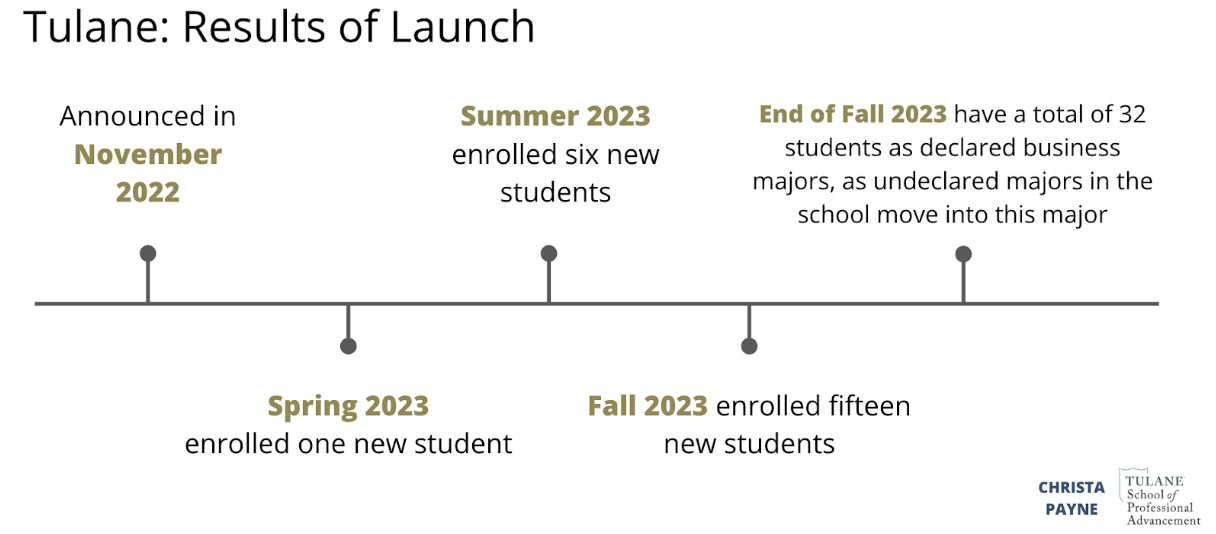
    In November of 2022, Tulane SoPA launched two new online bachelor degrees: An Online BS in Organizational Behavior & Management Studies and an Online BA in Human Resources.

    SoPA went all in on SEO, primarily content creation and smart optimization, for these two programs as the primary means of promotion, as there was no specific paid advertising budget.

    In one year, Tulane SoPA published 12 blogs that had high SEO value, including: “5 Reasons Every Business Needs An Organizational Management Professional,” “4 Key Legal Considerations for Starting a Small Business.”

    As a result of these higher education strategies, Tulane SoPA had 32 students declared as business majors in just over a year.

    Search Influence Keywords + Content When Launching New Degrees — Tulane SoPA

    Profiles and public relations to build links

    Search Influence also assisted Tulane SoPA in finding sites with premium (paid) placement for external link building that had value – meaning, they were both authoritative and relevant.

    We went through over 20 sites to help Tulane SoPA find the ones that might be worth it. In the end, Niche and Peterson’s had a fair price, high page and domain authority, and a relatively high percentage of followed links.

    These backlinks helped to build Tulane SoPA’s authority.

    Search Influence Backlink Authority - Tulane SOPA

    Tulane SoPA also used public relations and earned media to enhance online visibility.

    Tulane SoPA faculty completed over 100 earned media appearances in a year. Each appearance is shared on the Tulane SoPA news site, optimized for SEO value, as well as on social media.

    The above content strategy helped Tulane SoPA rise in search rankings, thus increasing their visibility to potential students.

    Drive New Website Users With Blogs — CCAPS at the University of Minnesota

    CCAPS (College of Continuing & Professional Studies) at the University of Minnesota used blogs to drive web traffic.

    Their content strategy goals:

    • Generate brand awareness
    • Increase web traffic and, ultimately, inquiries
    • Earn backlinks from other sites and pass link authority to program pages through internal links
    • Gain featured snippets

    To do this, CCAPS did the following:

    • Partnered with a digital marketing agency
    • Posted 2–3 blogs per month
    • Completed keyword research and targeting
    • Combined content with schema markup, internal links, and backlinks to improve authority
    • Amplification

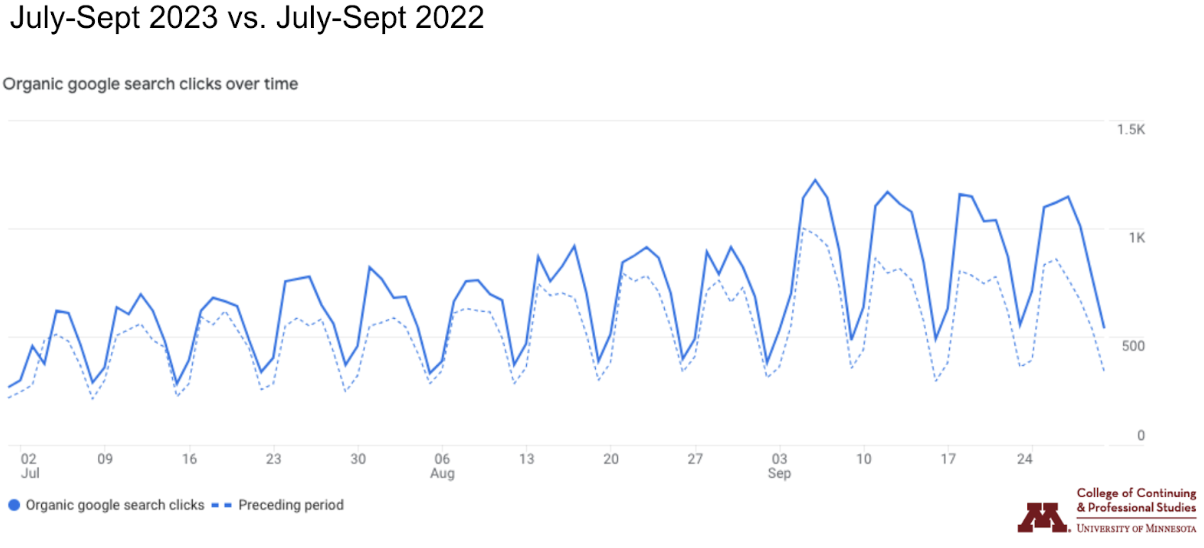
    Search Influence CCAPS Blog Content Performance

    Since July 2022, CCAPS published over 40 blogs, generating over 50,000 users by September 2023.

    Core web vitals for SEO health

    To climb search engines like Google Search, you must dive deeper into core web vitals for SEO health.

    CCAPS used LCP (Largest Contentful Paint) to measure website load speed, TBT (Total Blocking Time) to measure their website’s interactivity, and CLS (Cumulative Layout Shift) to measure their website’s stability.

    All of these web vitals allowed CCAPS to gauge their SEO health and adjust their strategies to rank higher on search results.

    Learn More About SEO for Your Higher Education Strategy With Search Influence

    Search Influence has helped organizations boost their search engine results and organic traffic for over 15 years.

    From our years of driving results for Tulane SoPA to helping our partners at Palo Alto University exceed their expectations, we understand the factors that can help you rank on Google search and beyond.

    Are you ready to identify keywords and Google trends on your own? Download our SEO Workbook for Higher Education Websites for SEO tips you can implement yourself.

    Need a little more hands-on help to understand Google Analytics and local SEO? Contact the higher education marketing moguls at Search Influence to learn more about successful strategies.

  • SEO for Higher Education Institutions: Invest Now Or Pay Later

    SEO for Higher Education Institutions: Invest Now Or Pay Later

    Key Insights:

    • Institutions need to maintain a well-optimized online presence to ensure they connect with students effectively.
    • Even though SEO is foundational for digital marketing, 51% of universities lack a well-defined SEO plan, representing a significant missed opportunity for increased visibility and engagement.
    • SEO can’t be sidelined or delayed, especially with the increasing number of educational programs and the stagnant or declining pool of potential students.
    • Online platforms, boot camps, and micro-credential programs challenge the traditional models of education. As these alternative educational models gain traction, traditional institutions must leverage SEO to differentiate themselves and maintain their competitive edge.

    In a world where undergraduate college enrollment is on a 10-year decline, according to Brookings, higher education deans and marketing managers are searching for ways to get their programs in front of prospective students.

    Yet, they often overlook SEO (search engine optimization). It’s one of the basics of digital marketing — and digital marketing and institutional leaders know this!

    According to the Search Influence and UPCEA Higher Ed Research Study, digital marketing and institutional leaders see SEO as foundational but admit their PCO units lack an SEO strategy.

    In the same study, we found that 51% of universities don’t have an established SEO plan.

    This is a massive missed opportunity.

    But not to worry!

    SEO has been here waiting — knowing that you’d soon realize what you always needed was right in front of you the whole time.

    Still, SEO won’t wait forever.

    To take advantage of SEO, you need to invest in it now — rather than later. In this blog post, I’ll share why.

    Image of a laptop, backpack, and notebook indicating that higher Education SEO is doesn't have to feel like homework.

    The Importance of SEO for Higher Education

    In our digital world, a well-optimized website is no longer a luxury; it’s a necessity.

    As UPCEA Chief Research Officer Jim Fong said in our Spring 2023 webinar, “SEO is not something institutions can kick the can down the road on. It’s going to become increasingly important, especially as the number of programs increases and the number of potential students stays the same or even decreases.”

    SEO for higher education can impact your enrollment in a multitude of ways, including:

    • First touchpoint: Many students first encounter institutions via online search, making visibility crucial for first impressions.
    • Positive digital footprint: A well-optimized educational website offers more than visibility — it establishes trust and credibility.
    • Building credibility: High search rankings not only boost visibility but also enhance institutional reputation in the eyes of prospects.
    • Actionable insights: SEO analytics reveal what potential students seek, allowing institutions to fine-tune their offerings.
    • Engaging prospects: Beyond visibility, an SEO-driven content strategy can guide students through their decision-making process.
    • Adapting to change: With the dynamic nature of SEO, institutions can stay relevant in shifting search landscapes.

    Why You Need to Invest in Higher Education SEO Now

    As the UPCEA and Search Influence Research Study asserted, “A poor foundation for an SEO strategy creates cracks in the larger infrastructure of your website. And just like the potholes in an old city make the roads challenging to navigate, when SEO doesn’t receive the attention it deserves, websites become difficult to navigate and can slip through the cracks — overlooked by search engines and prospects.”

    higher ed

    The growing competition in higher education

    “As the choices for potential students grow, the challenge for educational institutions to differentiate themselves intensifies.”

    In the past decade, the higher education landscape has witnessed a radical shift. Traditional brick-and-mortar institutions now share the educational stage with many other online platforms. From Coursera to Udemy and edX, the options for acquiring knowledge have become vast, decentralized, and more accessible.

    These alternative education models offer specialized training and often come with the backing or endorsement of industry giants, making them immensely appealing to students searching for immediate value and application.

    As the choices for potential students grow, the challenge for educational institutions to differentiate themselves intensifies.

    One major trend increasing this competition is the growth of online classes and degrees. Previously, an institution’s reputation might have been enough to draw in students from local or even international areas. Today, the boundaries have blurred.

    Additionally, the rise of college and university “boot camps,” certification programs, and micro-credentials have reshaped the way we think about education.

    These flexible programs that teach work-ready skills at a lower price have students thinking:

    “Why commit to a four-year degree when a six-month boot camp promises practical skills and potential job placements?”

    This education evolution has left higher ed institutions searching for new ways to remain in contention.

    SEO can help you cut through the competition.

    SEO helps universities reach their target audience in a crowded market, whether it’s for popular courses or specialized subjects. Having a strong online presence and using SEO helps universities gain credibility and meet the changing search habits of younger generations.

    The changing landscape: no longer a growth market

    “Yet, amidst this backdrop of challenges lies untapped potential. A significant demographic of 40.4 million people have college experience but no degree, as highlighted by the NSC Research Center. This segment represents a ripe opportunity for institutions.”

    Higher education has had difficulties in the last ten years, no longer growing as quickly as before. Key among these challenges is the decline in enrollment.

    According to Brookings, from 2010 to 2021, undergraduate enrollment in the U.S. decreased by 2.6 million students, with the most significant drops observed between fall 2019 and 2021.

    Brookings attributes this decline to a mix of factors. The burgeoning student loan debt, especially prevalent in the U.S., planted seeds of doubt in the minds of many about the return on investment for a college degree.

    When combined with the soaring tuition costs in numerous regions, it’s not hard to see why potential students might be deterred from higher education or pivot to more affordable alternatives.

    Furthermore, the rapid pace of technological advancements challenges the relevance of specific degree programs, with potential students questioning the longevity of what they’re learning.

    Yet, amidst this backdrop of challenges lies untapped potential. A significant demographic of 40.4 million people have some college experience but no degree, as highlighted by the NSC Research Center. This segment represents a ripe opportunity for institutions.

    With the right SEO strategies, universities can specifically target this group, offering them tailored programs and opportunities to complete their education.

    Understanding and Catering to the Modern Student

    higher ed seo

    “From researching courses and reading reviews to watching virtual campus tours and even enrolling, these tasks are increasingly being done on the go. Recognizing this, it’s paramount for universities to offer a robust mobile experience. It’s not just about aesthetics; it’s about efficiency.”

    The face of the modern student has transformed.

    A steady decline in the traditional 18-22-year-old demographic enrolling in universities is proven.

    However, when one door closes, another one opens. Universities have an opportunity in the growing demographic of adult learners — specifically those with some credit but no degree. These learners seek innovative, stackable online programs catering to their unique needs and life situations.

    Beyond this, the modern student desires holistic experiences encompassing practical knowledge, hands-on experiences, and a tangible path leading to employment.

    This calls for a departure from the traditional way universities craft their programs. Modern students want an educational model that respects their time and commitments, allowing them to juggle work, family, and studies. This is where online courses or hybrid models come into play, offering them the flexibility they seek.

    Properly harnessed SEO tools offer insights into the digital behavior of these students.

    What courses do they search for?

    What kind of educational content engages them?

    Understanding these patterns and trends enables institutions to fine-tune their offerings and higher education marketing strategies to resonate more effectively with their target audience.

    Parallel to this is the shift to mobile. The modern student’s relationship with mobile devices is not just about staying connected — it’s about consumption and convenience.

    From researching courses and reading reviews to watching virtual campus tours and even enrolling, these tasks are increasingly being done on the go. Recognizing this, it’s paramount for universities to offer a robust mobile experience. It’s not just about aesthetics; it’s about efficiency.

    Maximizing Exposure with Search Engine Optimization

    search engine results pages, google search console, google search, search engine results, search volume, higher ed website, technical seo, organic search results, organic search traffic, relevant keywords, website traffic, search engine crawlers, local seo, broken links, organic search, comprehensive digital marketing strategy, organic search keywords, seo strategies centralized control, higher education websites, online visibility, higher education seo strategies, higher education seo agency, search engines understand, higher education seo strategy, seo efforts, voice search, university websites, web traffic, seo audit, target keywords, site's search traffic, university website, thorough keyword research, search intent, google search recommendations, higher ed websites, qualified leads, maximize online visibility, free tool, more prospective students, online degree program, department specific web support, college directory listings, marketing strategy, inbound links, technical aspects, website optimization, student's search intent, mobile first indexing, seo success, meta description

    In the digital era, institutions must recognize the power of SEO to amplify their visibility among potential students. Institutions can ascend in search engine rankings by skillfully blending keywords, ensuring excellent content, and optimizing site structure. This not only boosts online presence but also fortifies credibility in the eyes of prospective students.

    Universities can employ several SEO tactics and tools to achieve this heightened exposure:

    • Keyword research: Utilizing platforms like Google Keyword Planner or SEMrush allows institutions to discern the terms that resonate most with potential students, ensuring that their content speaks directly to these queries.
    • On-page SEO: This encompasses the meticulous optimization of individual web pages. It means refining content to be supremely relevant and ensuring meta tags, URLs, and images meet the gold standard.
    • Link building: Curating authentic, top-tier backlinks to an institution’s website can significantly boost SEO standings.
    • Analytic tools: Solutions such as Google Analytics offer valuable windows into visitor interactions, spotlighting potential areas of enhancement.

    Engaging Potential Students: More Than Just Visibility

    “SEO seamlessly links sudent’s ambitions and curiosities with educational institutions’ diverse offerings and promises”

    While it’s easy to perceive SEO merely as a tool for visibility, its potential is far more encompassing.

    Beyond driving an institution to the top of search results, SEO plays a critical role in aligning with and appealing to the genuine interests of potential students.

    Effective SEO delves deeper than the superficial metrics of rankings and algorithmic nuances.

    At its heart, SEO is attuned to the pulse of user intent. When institutions fine-tune their content based on SEO insights, they aren’t just adhering to search engine protocols. They’re reshaping their narratives and offerings to resonate with what potential students are earnestly seeking.

    SEO seamlessly links students’ ambitions and curiosities with educational institutions’ diverse offerings and promises.

    Learn More About SEO for Educational Institutions With Search Influence

    The competition for prospective students is fierce in higher education — waiting is not an option. Every moment an institution delays leveraging the power of SEO, they potentially lose out on a student, a connection, or an opportunity to make an impact.

    Investing in SEO sooner rather than later isn’t just a proactive step — it’s a strategic necessity. Early adoption ensures a competitive edge, allowing institutions to engage and resonate with potential students in real time.

    Ready to rank higher on SERPs and increase your university’s organic traffic?

    Still not sure whether you should do your SEO in-house or outsource it? Take Search Influence’s In-House vs. Outsourcing SEO Quiz to get quick, custom recommendations today.

    Our higher education digital marketing agency has been helping universities nationwide for years.

    Including helping our longtime partner, Tulane SoPA, increase their organic traffic by 90%.

    Download our research study we conducted with UPCEA to learn more about our work in SEO for higher education.


    Image Sources: 

    Image 1: https://images.unsplash.com/photo-1535982330050-f1c2fb79ff78?ixlib=rb-4.0.3&ixid=M3wxMjA3fDB8MHxwaG90by1wYWdlfHx8fGVufDB8fHx8fA%3D%3D&auto=format&fit=crop&w=1074&q=80

    Image 2: https://images.unsplash.com/photo-1519452575417-564c1401ecc0?ixlib=rb-4.0.3&ixid=M3wxMjA3fDB8MHxwaG90by1wYWdlfHx8fGVufDB8fHx8fA%3D%3D&auto=format&fit=crop&w=2070&q=80

    Image 3: https://images.unsplash.com/photo-1519389950473-47ba0277781c?ixlib=rb-4.0.3&ixid=M3wxMjA3fDB8MHxwaG90by1wYWdlfHx8fGVufDB8fHx8fA%3D%3D&auto=format&fit=crop&w=1470&q=80

    Image 4: https://images.unsplash.com/photo-1560472354-b33ff0c44a43?ixlib=rb-4.0.3&ixid=M3wxMjA3fDB8MHxwaG90by1wYWdlfHx8fGVufDB8fHx8fA%3D%3D&auto=format&fit=crop&w=2151&q=80

  • From the Minds of Higher Education Marketing Experts: Highlights From the UPCEA SEO Research Study

    From the Minds of Higher Education Marketing Experts: Highlights From the UPCEA SEO Research Study

    Key Insights

    • Universities are investing in paid search, which demonstrates they see search as an important part of the prospect’s journey.
    • However, SEO does not get this same level of investment.
    • SEO is an underleveraged opportunity for schools to increase enrollment.
    • SEO is critical in reaching prospective students and the new adult learner.
    • Performing SEO at an expert level, backed by a strategy, could improve results.

    Search Influence joined forces with the University Professional Continuing Education Association (UPCEA) to release our highly anticipated Higher Education SEO Research Study.

    This three-part research study aimed to understand institutional and marketing leaders’ perspectives on search engine optimization (SEO) and evaluate the SEO readiness of professional, continuing, and online education (PCO) units within higher education institutions.

    We have now spent a few months discussing the results and understand how our findings could be useful to a variety of professionals — even beyond the scope of higher education. To get some fresh perspectives on our research, I sought the insights of several industry leaders, including Search Influence Co-Founder and CEO Will Scott, Search Influence Co-Founder and COO Angie Scott, Search Influence Director of Account Management, Alison Zeringue, UPCEA Chief Research Officer, Jim Fong, and Co-Founder and CEO of SearchLab, Mark Bealin.

    Graphic of a group of digital marketers coming up with a great paid search advertising campaign for higher education

    Investment in Paid Search Shows Importance of Search Overall
    Alison Zeringue, Search Influence Director of Account Management, Alizon Zeringue

    Our Director of Account Management Alison Zeringue noticed the stark contrast in investment between paid advertising campaigns and organic search amongst higher education institutions. Alison has spent the last six years developing her higher education SEO expertise (on top of many years prior in SEO and marketing).

    91% of respondents indicate they integrate paid search into their SEO strategy. Anecdotally, almost all higher education institutions we’ve encountered run some type of paid search advertising (usually on Google). With so many universities investing in paid search, we know that they see the value in search overall as part of the prospective student journey.

    So, why do 51% of universities indicate that they don’t have a strategic SEO plan?

    We attribute the disparity in investment in paid search over SEO to a few things:

    1. SEO is harder to understand (but a well-crafted paid search campaign can also be quite complex if you take advantage of all features available).
    2. SEO takes continual human effort over time (although paid search needs continual optimization to be most effective).
    3. Paid search can be easier to tie to enrollment (but it is possible to do this with SEO too).
    4. Paid search results can be more tangible (and if you know what metrics to track and how to report on SEO success, SEO results can be tangible as well).
    5. SEO can be seen as something that is part of the ongoing website work and doesn’t need a dedicated investment in budget (but in order to assure you are truly able to compete on Google, a dedicated SEO investment is as critical as your paid search investment).

    “Wow, What an Opportunity!”
    Mark Bealin, Co-Founder and CEO at SearchLab and Host of Search and Suds Podcast

    I recently appeared on Suds and Search, the popular digital marketing podcast hosted by Co-Founder and CEO of marketing agency SearchLab Mark Bealin. As an SEO industry veteran, Mark was blown away by the amount of headroom there is for professional, continuing, and online departments to leverage SEO as a tactic.

    The study showed that these institutions don’t take advantage of SEO at the pivotal moment when they need to appeal more to adult learners. Basic SEO strategies and tactics are easily overlookable. Reports aren’t always reliable or understood.

    This presents a big opportunity for universities and colleges that recognize the disconnect in their digital strategies.

    SEO metric reporting was a significant theme throughout the report and demonstrated leaders aren’t well-informed about SEO metrics.

    The data indicates that 62% of higher education institutional leaders want reporting on SEO metrics, but just 31% receive regular updates. This, and other data points in the study, highlight a self-perpetuating pattern:

    Institutional leaders don’t hear regular reporting updates about marketing’s SEO efforts and outcomes. Therefore, they don’t push for or support SEO resources, and, consequently, they don’t get SEO results. 

    No SEO reporting means no SEO resources for your business

    Greater Higher Education SEO Expertise Could Improve Results
    Angie Scott, Co-Founder and COO at Search Influence

    Our Co-Founder and COO Angie Scott, in addition to her financed-focus, heads our HR operations — meaning she’s in tune with the skills and capabilities needed to perform a job well.

    Angie found it interesting that institutions graded their SEO capabilities an average of 3.5 on a scale of 1 to 5, where a 1 is not very capable and 5 is extremely capable.

    She wondered: Wouldn’t you want something this important performed at an expert level?

    What skills are needed to perform higher education SEO effectively?

    • Research and analytical abilities
    • Technical website development expertise
    • Copywriting
    • Graphic design
    • Public relations/media outreach
    • Strategic thinking and creative problem solving

    The skills needed to perform SEO well in the higher education industry are not likely to be found in one single individual, or even two. Beyond having the baseline skill set of each, higher education SEO marketing experts must be able to stay up-to-date with trends and work closely with evolving technology to keep their strategies ahead of the curve.

    Executing SEO Tactics Without a Strategy Is a Missed Opportunity
    Will Scott, Co-Founder and CEO at Search Influence 

    Co-Founder and CEO Will Scott pointed out that, although many institutions are doing tactics that are part of SEO, they don’t perform them strategically. This means they miss valuable opportunities for the tactics to have the greatest impact on enrollment success.

    Others don’t necessarily perform SEO tactics with intention. This was evident in the study from the assessment of 100 websites, in which universities had an average score of 58.6. Less than half (47%) of UPCEA members had a score above 60.

    What does it look like to perform SEO strategically in higher education?

    1. Targeted keywords per program/degree/certificate page (based on research)
    2. Content plan for each offering (pillar pages with cluster content, including related blog posts, videos, and/or graphics)
    3. Linkbuilding plan for each targeted program or degree
    4. Cadence for monitoring technical site health
    5. Identified key performance indicators (KPIs) and reporting plan

    Learn more about how to apply these strategies and tactics in the replay of our webinar, UPCEA Higher Education SEO Research Study: How to Impact Your Enrollment.

    SEO Is Critical to Reach the New Adult Learner
    Jim Fong, Chief Research Officer at UPCEA

    Last but not least, let’s summarize the takeaways from UPCEA’s Chief Research Officer Jim Fong. If you are in higher education marketing and haven’t yet heard of or from Jim, you’re in for a treat. He’s a legend and a treasure trove of knowledge and insight for higher education leaders and marketers alike.

    Jim has heavily researched and analyzed changing demographics and how that ties into the need for colleges and universities to focus and lean into new offerings for the adult learner. He also speaks to unique challenges in the fact that the new adult learner is much younger than some may picture, can be harder to reach, and, is much savvier than students of the prior generation. The new adult learner spends more time researching educational opportunities in their evaluation process — which includes using search engines to look at their options. (Read more about Jim’s perspective in his blog post, Greeting the Student of the Future on their Terms at the Digital Storefront.)

    Jim’s preface to the full higher education research study prescribes four clear actions and observations:

    1. PCO units need to abandon legacy and focus more on the new adult learner in the design of their websites.
    2. There needs to be more emphasis on search engine optimization, as opposed to locked-in institutional templates and over-design and creativity.
    3. Metrics should play a bigger part in the continuous improvement and planning process.
    4. Institutions need to have a clear strategy for their websites and how to integrate the needs of the adult learner into the process.

    The data is clear — SEO is an underleveraged tactic for universities to boost enrollments.

    To me, this is very exciting. While many may think “we’re doing everything already,” this data shows that a lot actually aren’t. And that translates to new ways to reel in even more students that you may not have already explored in your other enrollment marketing efforts.

    To view all of the data from the three-part study, download our Higher Education SEO Research Report. There’s also a webinar replay available, which gives you highlights of the study in addition to best practices on how to address the opportunities in our findings.

    You can also learn even more about higher education digital advertising and marketing services with Search Influence here.