Author: Search Influence Alumni

  • Facebook Advertising Delivers Low Cost Per Lead

    In the middle of August we started testing Facebook Advertising for one of our plastic surgeon clients.  The surgeon wanted to reach potential tummy tuck and breast augmentation patients.  We selected a number of stock images and loaded the ads.  However, Facebook rejected all of our ads (The Downsides) because they did not follow the Facebook advertising guidelines.

    Facebook Advertising Rejection

    Facebook Advertising Early Lessons

    This was a shock to me, the surgeon and the 5 other people who saw the Facebook advertising mockups, because we thought we used:

    • relevant and appropriate images and language
    • correct grammar
    • spelling and punctuation
    • proper sentence structure
    • and targeted the ads appropriately

    After trying many Facebook ad combinations, I realized Facebook was rejecting the images, so we decided to try the practices’ logo instead.

    Facebook Advertising Effectiveness

    Is facebook advertising effective?  I had run an unsuccessful Facebook advertising campaign in early 2008 that turned out to be a waste of money!

    So, I wasn’t very optimistic going into the campaign. We decided to start out by testing $150 in August.  After several days of looking at the impressions, click through rate and cost, I was still discouraged.  However, when I logged into Google Analytics, I noticed that Facebook was referring a decent percentage of the sites visitors and these visitors were completing contact forms at a very high rate.  At the end of August, I calculated that of the almost  $150 spent in August on Facebook Ads, there were 11 completed forms, which is about a $13.63 cost per lead.

    Facebook Advertising ROI

    WOW! A $14 cost per lead for plastic surgery is amazing! So, for September we decided to increase the budget to $200.   Again, I noticed a lot of activity in September and, as of Sept 30th, Facebook advertising had referred 17 completed forms for a total cost per lead of  $11.76.

    Low cost per lead means more money in your pocket

    Overall, $350 was spent on Facebook ads and 28 contact forms were completed during August and September, averaging a total of  $12.50 cost per lead.

    I am pleasantly surprised at how well it all worked, and I am very excited to explore more Facebook advertising opportunities in the future!

    Related Posts:


  • Duplicate Content: Bad News for Rankings

    Recently, I received the phone call that no one in SEO ever wants to receive. In a nutshell, our clients’ site had completely fallen off the rankings. I, of course, began scrambling for what could have possibly happened within a week- the final result…..duplicate content! (Disclaimer: We did not place duplicate content up. It was a franchise site.)

    Acceptable Reasons for Duplicate Content

    Duplicate content is not looked upon highly by Google, and can either hurt your rankings or make them disappear completely. According to Google Webmaster Tools, there are a few places duplicate content is acceptable.

    – Discussion forums that can generate both regular and stripped-down pages targeted at mobile devices

    – Store items shown or linked via multiple distinct URLs

    – Printer-only versions of web pages

    Ways to Correct Duplicate Content

    If you come across an instance that could be duplicate content, here are some actions that can be taken to prevent it.

    – 301 Redirects: redirect all of your duplicate pages to one page. The duplicate content and redirected URLs will work themselves out in Google.

    – Robots.txt: Place this in your code on the pages you don’t want Google to index. In the case of the printable text, place it on those pages.

    – Rewrite Content:  If you have two sites that work together for one business, then edit one site so that the content reads the same, but will be indexed differently. You can also put a small blurb on one site and link to the site with all of the information.

    Various methods exist to correct duplicate content based on different scenarios. A great article I found when researching was in the Google Webmaster Tools. The easiest way to manage duplicate content is to avoid overusing.

  • Is it really important to get on the Google map? and … How does a SMB get on the Google Map?

    One of the first road blocks we often have to get around is the belief that the Google Local 7-Pack map listing is the “whole enchilada.”

    The Whole Enchilada

    Yeah, the Google 7-Pack is definitely a positive listing for a local business, gets your listing featured at the top of the page with your primary competition.   It’s good stuff, sure.  This is not an exact quote, but it comes from Steve Espinosa: “With a #1 map ranking and #1 organic ranking, organic get’s 1.8 times the traffic.”  Of a potential 100% combined traffic, 30% would come from the map listing.

    A presence on the Google map is NOT going to guarantee a flood of new business to your door.  It’s NOT going to guarantee total search domination.

    Bottom line: it is absolutely valuable to get listed on the Google map for your primary local keyword … but it should not be the total focus of your website promotion efforts.

    (Some good reading:  “Google Making More Pronounced Effort to Reach SMBs”)

    Sooo … how do you get your listing on the Google 7-Pack?

    #1 – go Google yourself: Find your listing as it exists in Google Maps; then claim it as your own, and edit the listing with as much data as you can provide to Google.  This is the good stuff.  Add as much as you can about your business.  Browsers searching for your widget want to know when you’re open, what payments you accept, and what your building looks like or what YOU look like.  Add pictures.  Add videos.  Add everything – even the kitchen sink!

    And choose your category carefully.  David Mihm: “Properly categorizing your business at Google Maps is one of the most important Local Search Ranking Factors.”

    When you get to the verification page, (yeah!  the verifications page!  you’re coming up to the finish line!) you can get a postcard mailed to your business or have a phone call.  I highly recommend the phone call.  It’s immediate so it might take a little coordinating with the client’s front line person answering the phone, but it’s well worth it because you’re done in 5 minutes.  A post card takes WEEKS to get to the office if it arrives at all:  Here is an on-going Google forum for some folks not receiving verification post cards.  They are still waiting…

  • Your Designer Does Not Do SEO

    Have you ever asked your mechanic to reupholster your seats? Have you asked your aesthetician to give you a face lift? Probably not and with good reason. It isn’t their job. There may be mechanics out there who know a lot about upholstery and some who can actually do it. I’m sure somewhere out there there is an aesthetician who knows all about plastic surgery but that doesn’t mean they are qualified to perform it.  I thought it was funny the first time I saw a clause in a designer’s contract stating that they are not IT and will not teach HTML to the recipient of site design.  The longer I’ve been in the industry the more I understand why.

    Too Many Hats Lead to a Sore Neck
    Too Many Hats Lead to a Sore Neck

    We see this reoccurring problem of people assuming that search engine optimization and marketing are the same as good design or coding.  Admittedly, there is a gray area.  A nice cross over exists somewhere between W3C compliance, proper use of H1 tags and whether to use bold or strong. For the most part, web design and search engine optimization and marketing are two different jobs and functions.

    I see three major problems with this. The first problem is what I like to call the “Cliff notes pro syndrome.” A company buys a book something like “SEO for (fill in adjective of inexperienced individual)” and they now have in-house SEO.  Everyone should study complementary trades on their own. A book or class however does not provide new trade credentials. Daily steady practice does. So, unless your designer is Jarod from The Pretender and can execute on anything they read as if they’ve been practicing since birth then one book does not provide in-house SEO.  There is a difference between understanding it and practicing it.

    5 Mistakes That Will Ruin Your SEO Rankings Image - Search Influence

    The second issue, focusing on freelance designers can be seen in this comment “our designer did a good job we don’t need that.” I love this one. It’s like saying “my car’s well made… no oil changes for me.”  Optimization isn’t a one shot deal. It’s an ongoing development like any good marketing effort .

    The third flaw in this logic is the first step in proper optimization – strategy. Planning and strategy are fundamental in the success of search optimization as it is in any business plan or marketing campaign. If you don’t identify your goal and plan the road to get there your success is probably going to be about as nonexistent as that strategy. Chances are your designer did not spend time doing a competitive analysis and determining the best way to reach your target demographic.  This would be essential for any SEO to help steer you down the path.   It’s always best to have a designer and an SEO work in tandem from the beginning.

  • Practical Ways to Combat Potential Negative Publicity

    I am super excited! After weeks and weeks of searching, I finally found the red, snakeskin platform pumps I have been looking for! Of course, before I make the purchase (and part with that amount of money for a pair of shoes), the first thing I do is Google them and look at customer reviews to see what other users have to say…”Worst shoes ever bought”…”Heel broke after one wear”…”Leather stretched”…”Strap punctured”.  Shockingly, they are all negative!

    WOW! This company truly needs some online reputation management. Online reputation management is simply the process of monitoring a brand online, dealing with anything negative and understanding how to be pro-active to prevent negative content. The tactics are mostly used by companies to pro-actively protect their reputation from damaging content found online, unfortunately some companies use online reputation management to reactively “fix” the damage that is already done.

    Reputation management is more important than ever in how your company is positively or negatively perceived. Think about the popularity of search engines, emerging social media and blogging. These things make it easier than ever for the public to voice their opinions – good or bad – to a very large group of people.

    So, how can you maintain control of your online presence? Here are 4 ways:

    1. Create new pages to rank higher

    In other words, create positive content to replace negative content. This will help push any negative content further down.

    2. Create pages on other sites

    Set up a lens on Squidoo and send some links back to it. Start a blog on wordpress.com or blogger.com. Keep up with posts, add some links and watch it climb. Set up social networking profiles on Facebook, Twitter, Linked In or My Space.

    3. Respond to the issue if a blog or forum post

    One day, someone is going to find the page so why not respond. If the person is genuinely upset, don’t get defensive, just apologize and try to resolve the issue. If the post is false, contact the site, even though there is no guarantee it will be removed.

    4. Encourage happy customers to post positive reviews.

    It is not as motivating to make a happy customer leave a review, as it is an irate customer. Make it easy for them to share their experience. Offer a link to a review site in e-mails to your customers, and perhaps even some sort of incentive.

    The above four ways are a great start to managing your online presence. There is always something that can be done to work on this. Take the time to find where your company is mentioned or listed, and be sure to check back every so often. Reputation management isn’t a one-time thing, it’s an ongoing process!

  • Online Reviews Rule With Google’s Sidewiki

    The reason testimonials and reviews are so powerful is because they provide a third-party (and hopefully, unbiased) opinion of what actual users think about products and services. Google knows this and considers reviews and citations an important factor in local search rankings.

    Studies have shown that not only do long customer stories (2.5 times longer than reviews) lead to increased, more relevant search results, but increasing website interactivity with fresh, real-world content like customer questions and answers can increase sales conversions and lower customer service costs. For some business owners online reviews have become far more useful than the traditional print yellow pages and savvy business owners have figured out proactive ways to use online review sites.

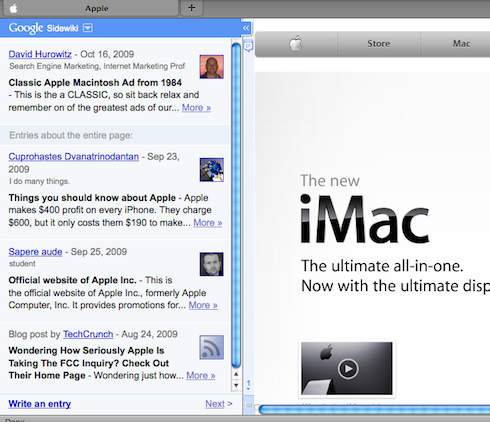
    But there are concerns that Google is now trying to dominate the local search landscape with new developments, some of which place user reviews at the heart of their new features. Google’s new browser add-on called “Sidewiki” allows anyone to contribute comments about any web page. According to Google, Sidewiki entries use an algorithm that promotes the most useful, high-quality entries. It takes into account feedback from users, previous entries made by the same author and many other signals developed.

    How Google uses these entries to rank web pages remains to be seen, but most marketers agree that the impacts of this are far reaching, because it includes every web page on the internet in Google’s own social network, with consumer opinion – both positive and negative – displayed every time a user opens a web page. With this new feature, Google has shifted power firmly away from corporate web teams and placed it in the hands of the consumer.

    applesidewiki

    The good thing is that Sidewiki entries are tied to a Google profile. There’s no guarantee that the profile isn’t bogus, but the advantage is that no anonymous entries are allowed. Also, Google will analyze language so that “stupid comments” are automatically discounted or removed.

    Some marketers surmise that user profiles will be moderated by a quality algorithm, so more influential, active or powerful users, with more powerful Google Profiles or Personal PageRank, will have more influence in the comments. This is very likely the case, as measurements of Twitter influence have demonstrated in the past. It’s usually a small minority of influencers who create the most comments and influence the majority of users.

    So how do businesses make use of this feature? The same way they bring newly-created linkbait to the notice of influential bloggers – by cultivating customer evangelists and monitoring social networks for influential voices and alerting them to content that is interesting and valuable. Sidewiki is just another way for Google to introduce a new feature of quality control into its already formidable algorithm and ensure that SEO and website promotion experts don’t get too complacent with their efforts.

  • Will the Real Google Places Page, Please Stand Up, Please Stand Up?

    Your Google listing and its Google Place page is a great central depository for all information about your business.  It is the compilation of business owner provided data as well as user-generated reviews. The Place page is an incredibly valuable tool for a small or medium size business owner.  The Places page URL is friendly to users, easy to share, and easy to find …

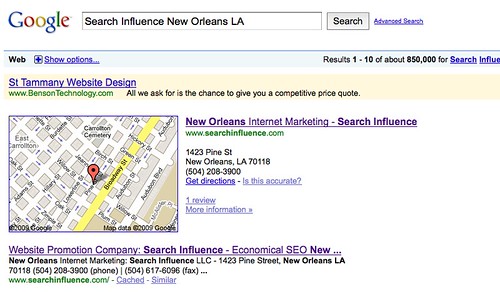
    You will want to search for your company + geo modifier.

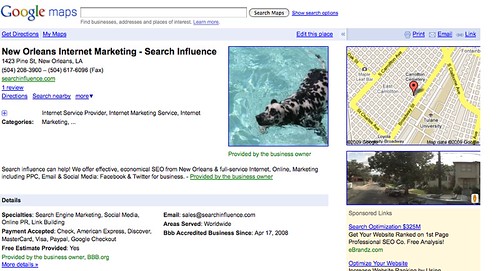
    For example, “Search Influence, New Orleans, LA” will get me here:

    When I click on “More information,” I land on the business’ Google map listing with all manner of data that consumers love:

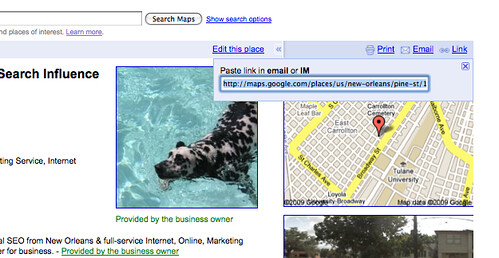
    Click on “Link” in the upper right corner – it’s small, but it’s there – and the popup box indicates the Place page link:

    Did all of that and still don’t find your Places link?

    If you followed the steps above, and your Places link is not a friendly URL, your listing likely is not yet the authoritative one.  It should look like the model – http://maps.google.com/places/us/city/name-st/#/-full-business-name –

    The first thing you need to do, is look for other listings in your business name.  These can be …

    1)   another business squatting on your company name (dirty dogs!)

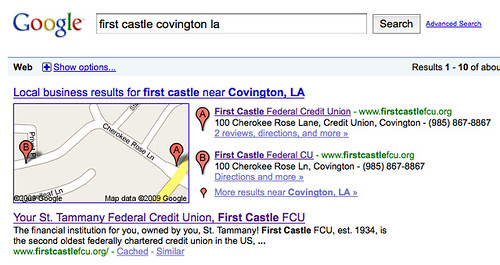
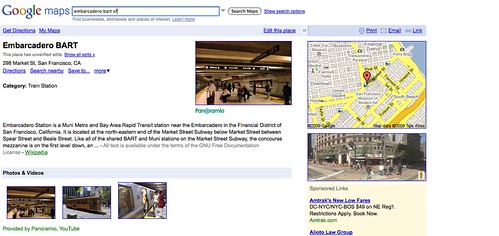
    2)   forgotten listings that are simply duplications:

    Either way the least authoritative listing needs to be suspended in the Google Local Business Center to make the real listing stand up.  To paraphrase the immortal word of Eminem, “Will the real Google listing, please stand up, please stand up, please stand up?”

    simpsons-slim-shady

    If you don’t have duplicate listings on any variation of the name or duplicates on address, you should try to manually create the Places page using the standardized format per Mike Blumenthall:

    http://maps.google.com/places/us/city/name-st/#/-full-business-name

    Watch for derivatives of Street, St, Lane, Ln, etc.

    It may take a little of your time to get it straight in Google Local Business Center, but to be the authority on your Google map listing and to own your friendly Places page URL is invaluable to a small business, and well worth a little effort.

  • The Pros and Cons of Google Place Pages

    Google’s idea of giving small businesses their own page through their project, Place Pages for Google Maps, has got local search buzzing with the SEO implications of this move for small business websites. Could Place Pages provide competition in the SERPS for the small business website? It’s possible. Will they be bad for business? That’s not so clear.

    For one, a business without a high ranking or optimized website would benefit from the obvious boost of having Google display “all the information for that place in one place” on its very own Place Page. On the other hand, the fact that Place Pages also provide user-generated content, in the form of reviews, has just made the task of online reputation management that much harder.

    Local businesses put a lot of stock in review sites like Yelp to boost their local search rankings in Google, and Place Pages are likely to provide significant competition to Yelp, especially since it seems to be pulling information – on everything from hours of operation to a restaurant’s price range – from sources such as Citysearch and Zagat, but not from Yelp.

    Some bloggers have noted that Place Pages could become a powerhouse for local business owners and users, as well as the go-to pages for numerous facts about all kinds of places. Will they encourage more local businesses to claim their listings? Google believes they will.

    Since Place Pages are likely to have a unique URL, it’s possible they will be indexed in the organic results. As one blogger observed, Google’s obsession with testing landing pages has ensured that Place Pages double up as well-optimized landing pages.

    Contrary to the fears that Place Pages will eliminate the need for small business websites, we believe they will only complement our optimization efforts. As far as business benefits and search listings go, Google has just offered local business owners another avenue to reach their customer, and that can’t be all bad.

    Since it seems inevitable that Place Pages will have a significant presence in the search listings, it would seem wise to use them to “leverage advanced image and video tagging, push Barnacle SEO to a new level and leverage the heck out of them” to claim a bigger slice of the local search pie.

    If you’re a local business owner, providing Google with information for your Place Page can only facilitate your overall business goals of reaching out to your customer. Whether you require the help of an SEO firm to achieve this, or not, Place Pages will involve more, not less, work for local SEO firms.

  • Twitter: Fad or Essential Business Communication Tool?

    From those who claim that Twitter is just a fad, to internet experts who believe that the impact of Twitter is being felt in ways never imagined, the news is abuzz with reports of this social media website.

    Love it or hate it, Twitter is here to stay, with its user numbers having grown at the rate of 752 percent in 2008 alone. Facebook is still the #1 networking site in terms of numbers and user loyalty and not all businesses might need to get into the social networking sphere.

    Social Media One Hit Wonder?
    Social Media One Hit Wonder?

    But a social media presence is no longer considered ‘optional’ for businesses with an online audience. Here are some of the ways in which Twitter is changing the marketplace.

    • Source of Breaking NewsIn the recent past, Twitter has proven it’s mettle as a source of breaking news, especially with the death of Michael Jackson, and continues to be a leading source of real-time news stories.
    • New Exclusive ContentAs a WebProNews story noted, Twitter features new content, created on the fly and accessed in real time. More importantly, this content is exclusive to Twitter and not available through search engines like Google, Bing or Yahoo.
    • Sales Booster While Twitter has helped Dell rake in the sales, New Orleans-based Naked Pizza, has seen a sustained 20 percent of sales dollars from its Twitter presence. It is primarily using Twitter to market to an area with a 3 mile radius and has now replaced its “call for delivery” billboard in favor of one displaying its Twitter handle.

    As the article on Twitterrati notes, for any company that deals with consumers, Twitter is must-use tool simply because it’s another way to communicate with existing and prospective customers.

    Image courtesy of: keiyac

  • Six Ways To Get Customer Reviews That Boost Your Local Search Rankings

    SEO experts are almost unanimous in their agreement that customer reviews play a crucial role in boosting visibility and rankings in the local search results. So how can you use this information to leverage local search rankings for your own business?

    In a previous post, we discussed how a pro-active approach to customer service and feedback can boost your business reputation online. Positive reviews are a sign of trust, and that carries a great deal of weight in search rankings. Happy customers are an excellent source of positive feedback and reviews.

    For businesses trying to boost their visibility in local search, online customer reviews on Google Maps pages and third-party review sites are crucial to higher rankings. Although negative reviews can hurt your overall business reputation, they don’t adversely impact your search rankings.

    If you’re worried about negative reviews, take comfort in the knowledge that search engines don’t really differentiate between positive and negative reviews. As local search expert, Matt McGee, points out, “There’s no such thing as a negative rating. There are only degrees of positivity.”

    So, how do you go about getting your customers to post reviews on Google? Yes, you could outsource that to a company that handles SEO and reputation-management for its clients. But as local search expert, Mary Bowling notes, “It helps with trust that the review is legitimate and not gamed.”

    Here are six tips on getting more customer reviews than you can handle and leveraging the ones you have to boost your local search rankings.

    1. Ask and You Shall Receive

    Taking a pro-active stance is the best approach where customer reviews are concerned. When a client or customer offers praise or positive verbal feedback, ask whether they would be willing to be quoted online and email them a link where they can post a review. You’d be surprised how many of them are happy to recommend a product or service they really like.

    2. Offer Incentives – Not Bribes

    For those customers who get a little lazy with filling out forms online, a little incentive could give them the push they need to get that review posted. Ethically, this must be approached carefully. You can offer coupons, discounts or freebies to those customers who post a review online. It should not be stipulated that it must be a positive review. If worded “leave us a great review, and you can get 20% off your next purchase,” it’s a bribe.

    You could even have a monthly draw for customer review/feedback. Mike Blumenthal offers tips on using Leavefeedback.org, a site created by Michael Jensen of SoloSEO that facilitates review creation.

    3. Complete The Sentence…

    One trick that many companies use to get customers to write a review is to give them a feedback form on the way out. One section of the form is usually devoted to asking for comments. Customers who have trouble filling that section in, are more likely to do it if you use a “complete the sentence” format in that area.

    For instance, “I love (Your Business Name) because ____________”. If this form is available on your website, you could email them and ask for feedback anytime while offering incentives for those who do give it. Always ask your customer for permission to post their comments on your website and on review sites online, along with their name (or initials) and location.

    4. Use Social Proof

    When you first create your local business listing on yellow pages, review sites and business listing sites, a blank review page could keep many potential reviews away. People are more likely to post reviews for a business that already has a number of reviews online.

    As long as they’re legitimate and you create a separate profile for each review, you can use customer reviews from your website and feedback forms to populate these sites and provide social proof for the hesitant ones.

    5. Cut Down On Negativity

    Companies have little control over what is posted about them online, but by engaging directly with your public, you can respond to negative reviews quickly and minimize their impact.

    Almost every business creates a couple of dissatisfied customers, and the more malicious ones could post negative reviews that harm your business reputation. The best way to minimize their impact is to get many more positive reviews than negative ones.

    6. Engage With Your Audience

    Don’t let the conversation online go unanswered. Respond to feedback promptly and appropriately and thank users for positive reviews posted. Contact reviewers who post negative comments with an incentive to change their review. Offer them a coupon for your products or special service that will help them change their opinion about your company.

    Feel free to use these tips to get more customer reviews. It’s a great way to improve your visibility and rankings in the local search results.