Author: Search Influence Alumni

  • Mobile Marketing No Longer Means Slapping Your Ad on a Bus

    Mobile marketing no longer means sticking your ad on a bus

    Imagine you just pulled into the mall parking lot with your three antsy children who are complaining that they are hungry, need to go to the potty and want to go to the Disney Store… Amidst all of the chaos of getting them out of the mini van and making sure you have your purse (and your sanity), you accidentally lock your keys in the car.  And, the car is still running.  This is so not what you needed!  But, fortunately, you have your smart phone in your purse!  You quickly log onto the internet and search for “locksmith.”  You come across the first listing – A company called 911 Super Ultra Emergency Locksmiths.  You get them on the phone and they are in the mall parking lot within minutes to save you!

    Or, {a less dramatic scenario}… You and a buddy are at a conference out-of-town and you have a break for lunch.  Where is the nearest place to grab some sushi?  Thank goodness you have that smart phone to look up “sushi restaurant.”  Ten minutes later, you and your buddy are pigging out on some tuna sashimi and crunchy rolls at the local sushi hot spot!
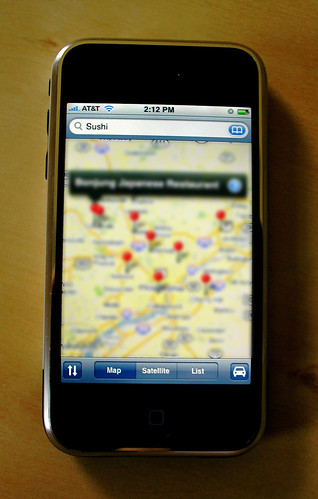
    Mobile Marketing increases in relevancy as mobile local search takes a larger share of market

    With the continuous advancements in technology today, small businesses need to stay abreast of the emerging ways to reach their target market.  One of the new ways that small businesses can connect with their customers is Mobile Marketing.  According to Google, “You can easily expand your reach to customers who are on-the-go. Audiences are increasingly stepping away from their desktop computer and searching and browsing the web from their phone.”

    In this blog post, we are going to introduce Mobile Marketing rookies to some interesting facts and ideas to consider when budgeting for your next campaign.

    In a recent study conducted by comScore that was featured in an article by Jason Kincaid on TechCrunch.com, it was discovered that “45.4 million people in the United States were using smartphones” over a period of 3 months ending in February 2010, “which is a 21% increase” over the 3 month period of time studied ending in November 2009.  In layman’s terms, that’s a whole lotta potential customers…

    Mobile Marketing: number of smart phone users up 21% in just one year

    Google – Go Mobile! recommends some strategies that small businesses can utilize to better reach their ‘local-mobile-searching’ potential customers:

    1. Create a version of your website that can be used and viewed more smoothly by a mobile device.  The ‘regular’ version of your website might not load as quickly or be as easy to view and use on a mobile device.

    2. Think local by offering information on local events in your area and maps showing locations nearby where customers can purchase your products.

    3. Engage your customers by offering a game that they can play while waiting in the doctor’s office waiting room or an application that they can download and use on their mobile device.

    4. Make them an offer they can’t refuse.  You have to know who you are competing against.  Give your small business the competitive advantage. “Including an incentive, such as a coupon, really does make the difference when searchers are looking for local businesses,” says Anthony ColemanSearch Influence’s resident Paid Search Marketing veteran.  He further explains, “It is also a good alternative, because many local businesses don’t have the resources to create games or applications.”

    5. Go viral.  Create a way for your customers to easily share your business’s information with friends via the click of a button.  As they say, the best publicity and marketing is by word of mouth (or by the click of a button 🙂

    6. Get found with mobile advertising.  Create ads that show up when a customer searches for something relevant to your business on their mobile device.  “With smart phones becoming more integrated with local search, Google Adwords is allowing advertisers to display paid ads into mobile searches – by appearing first in a local search, you increase your exposure.” explains Anthony Coleman.  “They are even offering a ‘click-to-call’ option, which allows searchers to call phone numbers listed in paid ads, making it easier for leads to connect with advertisers.”

    * A great way to think local, offer specials and get found for no cost is by participating in applications such as FourSquare.  According to FourSquare.com, “Foursquare aims to encourage people to explore their neighborhoods and then reward people for doing so… As a business owner, you can use foursquare to engage your increasingly mobile customers with foursquare “Specials,” which are  discounts and prizes you can offer your loyal customers when they check in on foursquare at your venue.”  All you have to do is “claim your venue” and get started!
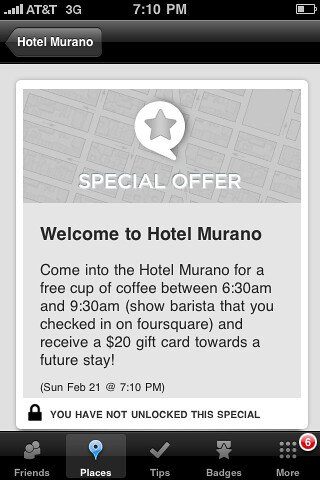
    Mobile Marketing: Foursquare makes it easy!

    You can even keep track of how many users are finding your business by searching via their mobile device, as well as where they are located, what they are searching for to find you and much more!

    In the blog post, “How Much Google Traffic Comes From Mobile Devices – A Quick Study” by Tim Coleman of A Second Opinion, Tim studied a set of local small businesses’ Google traffic from mobile devices.  He wanted to determine the importance of mobile search in relation to his clients, as well as the “percentage of traffic that came from mobile” and if “the percentage of traffic from Mobile varied in different parts of the country.”  He looked at 7 garage door companies across the nation over a span of 2 months and made some conclusions of importance:

    • “The small data set follows the general pattern that people in bigger cities (more population) are going to use mobile devices a higher percentage of the time.”
    • “Interestingly, Westchester County is the oldest population in this set. Could be that age trumps income when it comes to selecting a small business on a mobile handset.”
    • And, “For different types of businesses Mobile is going to be more or less important but overall it’s likely to be less than 5% of overall traffic. Again, this is a small study but Adwords and Google Analytics both provide easy segmentation of mobile traffic. Look in your analytics or call your PPC provider to see what percentage of your traffic is mobile.”

    So, the amount of traffic that your site gets from local search via mobile devices depends upon variables such as the age, location, income, etc of the user and, all of this can be tracked and documented via tools such as Google Analytics and Google Adwords.

    Small businesses have a lot on which to stay up-to-date, and online marketing and mobile marketing are no exception.  More and more people are buying and using smart phones and it is worth your time and money to consider marketing to your potential customers on-the-go.  There are a plethora of tips to choose from to get your website “mobile device ready.”  And, you can see where your customers are coming from and how they are locating you!  How can you not be interested?!
    Resources:

    Images:

  • Pace Yourself. Online Marketing Messages: When Less is More.

    “Everything in Moderation,” the saying goes. This can be attributed to everything and anything, almost. It’s important to acknowledge this, especially with such easy and immediate access to your audience. The only thing that comes to mind that this would not apply to in online marketing is link building and networking, if done sincerely.

    Online Marketing Messages

    Over saturation seems to be all the rage and it’s not helping anyone. Like that friend that talks too much- it starts off good, you’re interested and responsive… and then after a while, it’s just noise.  You nod, smile or frown accordingly and pray they shut up.

    A few sources that come to mind immediately are Email marketing, Facebook and Twitter. Recently I’ve received so many messages from the same sources I stopped reading them. They are no longer effective. They are annoying. On the other hand, there are so many others that I never hear a peep from. This can be a challenging balance. You need to communicate enough to be seen but not so much that you reach that point of oversaturation.

    Here are a few things to consider in the repetition of your message presented in the stylistic fashion an antiquated and overused joke:

    You might be reaching over saturation if

    1. You loose fans, subscribers and followers like your account was the origin of the plague

    2. Your fans, subscribers, and followers walk in your place of business point at their phone and sneer at you (obscenities and other gestures count too)

    3. The effectiveness of your message on a bar chart looks like a sliding board

    4. You get public responses like “I don’t care” or “Stop it”

    5. You can message something completely absurd and no one bats an eyelash

    6. You’re used as an example of oversaturation in an article by some smart alec. (If you just looked for yourself in this article you’re probable guilty.)

    7.     The folks that run the email blacklist organizations know you by name.

    8.     The United Spammers Association nominates you as next years president

    9.     Guy Kawasaki is jealous cause he can’t pump out as much as you.

    Sincerely, it is a difficult task at times to understand at what point effectiveness weans off. With proper analysis you can get a better view of how to take corrective action. You are tracking everything, right? Hopefully you haven’t lost or lost the attention of too many fans, followers and subscribers.

    Stay tuned for Part 2: How to Do it Right (title to come)

  • For the Rookie Jet-Setter: 10 Tips to NOT Being Late for an Early Morning Work Flight

    (… and some things to know if this does happen to you)

    Imagine you are a new hire for a company.  Your boss schedules your first work day-trip for an important meeting with a client – and even better – it is to New York City (oh…and you have never been there before!)  You are so excited and ready to show your boss why he/she hired you!

    The night before your 7:00 a.m. flight, you create the meeting agenda for the next day.  You get your briefcase packed.  You iron and lay out your outfit.  You take your shower.  You set your cell phone alarm clock for 4:00 a.m.  You are set and ready to go, so you head to bed.

    6:08 a.m. your spouse wakes you up from a deep sleep frantically saying, “Do you know what time it is?!”  Your first thoughts:  “WHAT HAPPENED?!  Why am I not sitting in the airport waiting for my flight to board?!”

    This is a true story.  This exact situation {unfortunately} happened to me.

    “What did I do next?” you might be asking yourself…

    The very first thing I did was call my boss and let him know right away what happened and what was going on.  He seemed pretty optimistic that I would make it to the airport on time (even thought I live a half hour away from the airport on a good day.)  I brushed my teeth, tossed my makeup bag into my briefcase, threw on my clothes and ran out the door to my car.  I sped all the way to the airport (I am not promoting speeding.  I am only giving you a play-by-play report of exactly what happened.)

    After parking my car and running all the way into the airport, I arrived to the airline’s check-in counter at exactly 6:50 a.m. (panting and sweating profusely, of course.)  The not-so-friendly man at the counter pretty much told me that there was no way in hell I would be getting on that 7:00 a.m. direct flight to NYC.  The last text I got from my boss before the flight (that I was supposed to be on) took off read something like “Do whatever you have to do to get there.”

    Ok.  The pressure is piling on.  Next, I begin running to every airline counter (in heels) begging to let me onto a flight that will get me to NYC in time for the client meeting.  From one wing of the airport to the next, I am having no luck.  {This is a scene straight out of a movie, if you ask me.}  There are airport employees rooting for me and trying to help me out.  Finally, the last airline left (who’s workers were not at the counter until now) agrees to get me onto a flight that has one layover.  At least I will be getting there at a decent time.  Things are looking up!

    Until I realize that I have no cash, no debit card, and only one check left in my checkbook.  In the hectic rush I was in this morning, I must have left my debit card at home (and I never carry any cash on me, ever.)  Luckily, the airline agreed to take my check!  Little did they know, I did not even have enough money in my bank account to cover the check!  However, I was aware that my boss graciously planned to reimburse me for any of these unnecessary expenses that I was incurring because of these desperate circumstances.  I planned to deposit the money into my account before the airline could even cash the check.  (I later found out from my hubby that this act is considered a felony – so please do not try this at home!)

    I have my new (one-way) ticket, made it through security and I am in the sitting area waiting to board my flight.  Now I am noticing that my cell phone battery is close to dead.  So, I am emailing my hubby and my mother to let them know what is going on.  My mom insists that I cannot go to NYC with zero cash.  So she took a collection of cash from her charitable coworkers and got her boss to (once again) speed her to the airport.  She jumped out of the car and went up to the security guards near the exit of the terminal.  She asked if she could give me the cash, and the security guard took it from her, inspected it and then handed it over to me.  What can I say?…My mom is the best!

    Now I am really all set to make it to the client meeting!  I had never flown alone before.  And I actually really enjoyed it, once all of the running and worrying was over with.  I turned my phone off for the flight (because they make you and because my battery was dying.)  Once I landed in NYC, I turned my phone on and had a text from my boss with a phone number and confirmation number to a town car company.  The driver knew exactly where to take me.  My boss said that once I got there, to call or text him and he would come down and pay for the fare.

    The whole ride there, the driver was pointing out landmarks to me and explaining the 5 Burroughs of the city.  When we were nearing the client’s building, I began calling and texting my boss.  He wasn’t responding.  Thank the good Lord for my mom!  If she had not rushed me that cash, I would have had to sell my soul to get out of that town car!  I finally made it up to the meeting and all went well. What a day!

    Thank goodness for:
    A) My hubby for waking me up when he did.  I still have no idea what happened with my cell phone alarm and why it did not go off.  And, maybe it did, and in my sleep I turned it off…who knows?!
    B) My mother and her coworkers and boss for donating and rushing me some cash.
    C) My boss for being completely understanding and admitting that he has gone through similar circumstances.  He reminded me that no one is perfect and that it can happen to the best of us.
    D) And, last, but certainly not least, God – for getting me through the whole fiasco!

    In the end, this was a great experience because I learned a lesson.  Here are some tips so that you do not have to learn the same lesson I did…

    1. First of all, if you know that you are not an early morning person and it is in your control to choose when to take your flight, do not choose an early morning flight that requires you to wake up at the break of dawn.

    2. Set 2 alarms – Give yourself enough time to arrive at the airport about 2 hours in advance of your flight.  If your flight leaves at 7am and you get to the check-in desk at 6:50, they are not going to let you on the flight. Airport security can take a while to get through, especially if it is an early morning flight.  Think of rush hour on the highway.  The same concept applies to flights.

    3. Ask someone to give you a wake-up call, who you know will already be awake – a parent, a friend, or even a coworker that you may be traveling with.

    4. Get to bed early so that you are not tempted to hit the snooze button on your alarm.

    5. Take your shower the night before.  It takes me a solid 40 minutes to blow dry my hair (I know – high maintenance.)  Can you imagine if I had not taken a shower the night before my flight?

    6. Have everything laid out for you ready to go in the am: Your outfit, briefcase, etc.

    7. Make sure you have enough gas in your car the day before so that you do not have to make a stop in the morning before your flight.

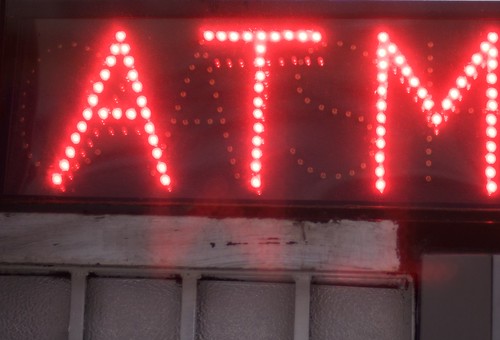
    8. Make sure you go to the ATM the day before so that you do not have to make a stop in the morning before your flight.

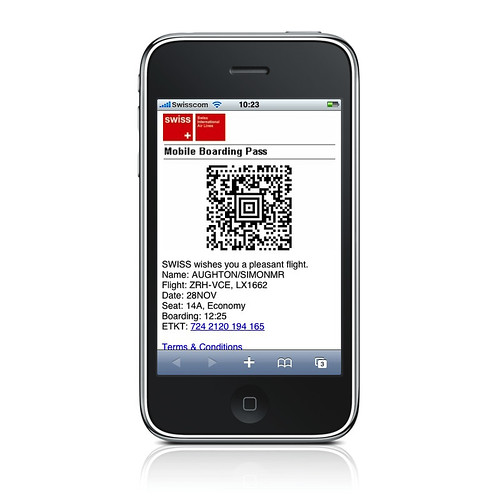
    9. Check-in online or on your smart phone.  According to Delta.com, “Mobile check-in saves time at the airport by letting you check in and get your eBoarding Pass right from your PDA or web-enabled phone within 24 hours of your departure. It’s the fastest, most convenient way to check in.”


    10. Have all of your identification and tickets in a handy place so that you do not have to spend time searching through your things.

    *If you do happen to miss your first flight of your round-trip ticket, do be aware that some airlines will cancel your entire itinerary.  This means – do not try to purchase a 1-way ticket to your destination, assuming that you can still use your original ticket back.  Check with the airline first.  You may need to purchase a whole new round-trip ticket.  (I discovered this important piece of information on my way back to New Orleans from New York City.

    **Know where you are going once you get to your destination airport.  Waiting for a taxi may add to your late-ness.  Have a list of phone numbers on-hand to local town car services.  These companies sometimes cost less than cab fare.  Call and make a reservation before your flight takes off.

    I hope that these tips come in handy for you.  Have you had a similar experience?  Do you have any additional tips?  Thanks for reading!

    ——————-

    PHOTO CREDITS:

  • Twitter SPAM can get you BANNED!

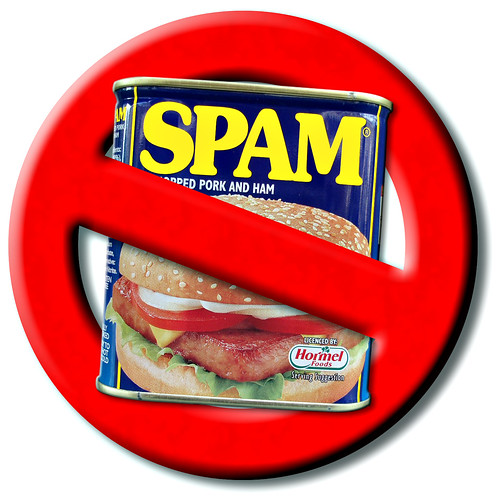
    No one likes SPAM! I’m not talking about the canned meat product. I happen to like the stuff myself. It reminds me of camping when I was a kid. What I am talking about is that which clogs our inboxes, dilutes and degrades the integrity and usefulness of … well, pretty much every new form of communication that arises.

    No Twitter Spam

    In Twitter’s blog post “State of Twitter Spam” they identify

    Twitter SPAM as “behaviors that range from insidious to annoying. Posting harmful links to phishing or malware sites, repeatedly posting duplicate tweets, and aggressively following and un-following accounts to attract attention”

    Their progressive and aggressive approach to taking down the spammers has been a good fight. I’ve had numerous odd accounts follow me who seems to disappear due to “suspicious behavior” before I even got around to seeing who it was. I don’t know about you but I like that, a lot. It gives me confidence that I won’t be completely inundated with crap – I mean spam.

    Some forms of Spam as identified under Twitter’s rules are (as quoted from their forum):

    • If you post duplicate content over multiple accounts or multiple duplicate updates on one account;
    • If your updates consist mainly of links, and not personal updates;
    • If you repeatedly post other users’ Tweets as your own;
    • If you have attempted to “sell” followers, particularly through tactics considered aggressive following or follower churn;

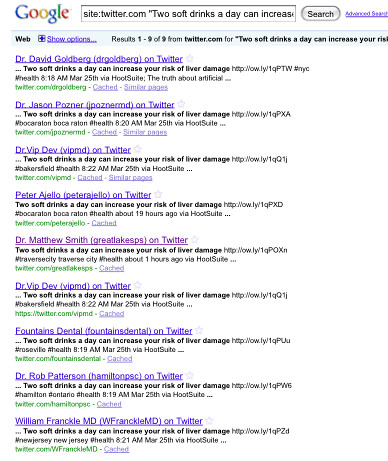
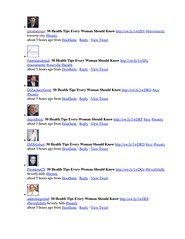
    Here are a few perfect illustrations of Twitter SPAM “duplicate content over multiple accounts”

    Twitter Spam Example

    and the next one ….

    Twitter Spam Example

    And another….

    Twitter Spam-50 Health Tips Every Woman Should Know

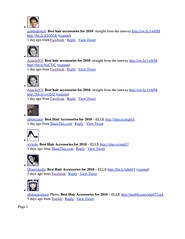
    And another…

    Twitter Spam - Best Hair Accesories

    If you were to partake in this sort of evil for yourself or on the behalf of clients, the consequence could be an immediate termination of the account or accounts in question. 

    Obviously, as marketers we need to consider the consequences of what we do for our clients. Ignorance of rules and policies does not exclude anyone from the repercussions of not following or understanding them.

    If your client’s account is terminated, you put them at risk. Your efforts to create your Twitter brand awareness and embrace their customer base will alienate those customers and tarnish their name.

    In the least, a lot of time and effort is lost. All of your building then has to start from over step one. If you did this in a client’s name, I would say it’s a safe bet their Twitter rebuilding efforts will be with someone else.

    As users and viewers we can practice vigilance. If you see this type of behavior, flag it! Let Twitter know. If you’re not sure how, find out here. By all means, don’t follow the links or buy the products. Sometimes it’s hard to spot, but it’s important to be prudent in your clicking and buying.

    Remember, every action is a vote. Don’t vote in favor of spam …

    … unless it’s the salty, occasionally delicious, when-sitting next-to-a-campfire meat product.

    Related reading:

    Internet Marketing for Plastic Surgeons – Less Scary than You Think

    You Can Buy Brand Love on Twitter?,

    The Secret of Small Business Social Media – You Must be Present to Win

    (Thanks for the pics! “hegarty_david” and “pabo76“)

  • Buying Yelp Reviews Is BAD for Business

    Yelp is intended as a review site where users can write and read reviews for local businesses to help make informed buying decisions. It’s a powerful tool in that users trust the real opinions and feedback from their friends and neighbors. Yelp’s user-driven reviews allow everyone to add in their opinions of products and services at local clubs, restaurants, and businesses in all forms.

    There is obvious value to a small business owner in getting users to leave positive reviews. The question is how much should a business pay for a review? No, no, no … I’m joking. The question really is how do you encourage customers to leave Yelp reviews naturally and organically without abusing the intent of the site?

    To Solicit or not to Solicit

    Yelp is clear about incentives for reviews: “Yelp has advised business owners not to offer incentives for reviews. For starters, paying people to write reviews about your business is another form of shilling and that’s just wrong. Second, very often you’ll offend a customer and the offer will be quickly outed in your reviews, resulting in unintended negative reviews and/or negative publicity. Finally, it’s typically a fruitless exercise.”

    It’s a fruitless exercise because of the Yelp review filter.  Yelp knows their site is a great opportunity for illegitimate behavior, and they have built tools to attempt to minimize the spam and attempt to maintain the authenticity of the site. They haven’t been entirely successful. Says Luther Lowe of Yelp,

    ‘It’s very tough to design algorithms that can tell the difference between the guy who’s cranking out a fake five-star review about himself, and the guy who’s flipped that laptop around and handed it to his customer and said, “Hey, write a five-star review about me.” So, you know, I know that businesses are going to ask people to write reviews. If you do that, you need to be prepared for pretty violent review fluctuation.”

    From Yelp Common Questions: “Some reviewers are more credible than others. For the most part, users can decide for themselves which reviewers they trust the most. We remove some of the guesswork by filtering out reviews that are written by less established users. We do this in order to provide more trustworthy and useful content to our users and to help protect against fake reviews from malicious competitors and disgruntled former employees.”

    Control Yourself on Yelp

    Every small business wants testimonials to help drive traffic. Yelp is tremendously trusted by real world users. (Isn’t it more encouraging to try the new restaurant in town after you read 10 great reviews online?)

    And Yelp is tremendously trusted by search engines, and being so trustworthy makes it ripe for abuse by some businesses and internet marketers. The prime example is Google Local map rankings, which are influenced by some degree by the presence of online reviews on select review sites.

    But Yelp advises you to control yourself:

    “Should I ask customers to write reviews for my business?

    While we understand that there is a temptation to solicit reviews from your customers, it is not something we encourage. The most successful businesses on Yelp have had their reviews come organically. This is for a couple of reasons:

    1. Potential customers can sometimes have an adverse reaction to a business that looks like it has solicited reviews.

    2. Quite often those solicited reviews will be filtered out (see above) based on the activity level of those users within the Yelp community.

    If you do ask your customers for reviews, please be prepared for the review number fluctuation that might follow.

    Also, keep in mind — success on Yelp is primarily measured by the number of people who view your page and thus walk in the door or set an appointment, not the number of reviews you have. Yelp users are savvy: they care about quality — not quantity — when it comes to your business reviews.”

    To be completely genuine, solicitation of reviews even without incentive is frowned upon. And incentivized reviews (buying Yelp reviews) are absolutely unethical …

    This picture taken in the store suggests completing a review, and not only a review … but “as good as it gets” review, to get 20% off the next purchase. One reviewer complains on this business’ Yelp profile about the incentivized review request in the store; Mel T comments on Yelp:

    “How would they base the authenticy of a Yelp review? What if I just claimed ownership of Jane D.’s (as in Jane Doe – I’m not trying to impersonate any fellow Yelpers here) review? How would they know if I was really Jane D.?

    – Would I still get a discount if I had written a review, but it wasn’t “raving?”

    Well, I’m sorry, Pure Beauty. You cannot buy a five star Yelp review from me. Instead, your blantant bribary is going to cost you two whole stars. Yep, that’s right; I’m knocking you down TWO full stars. Had it not been for your sign, I would have given you three stars – an A-OK for decent employees during my visits, a relatively clean shop, and reasonable prices.

    But, again, I will not stand for your bribary. Hmph. (Hmm..wonder if I can get 20% off with this review..?)”

    This beauty supply store has bigger issues than their Yelp spamming. There are quite a few reviews blasting their customer service. Perhaps, they should consider better ways to combat negative publicity.

    Asking for Help on Yelp

    One self-proclaimed newbie small business on Yelp asks help of the Yelpers, Greg “GSKChicago” K., asks, “I am relatively new to Yelp and still learning my way around … What do Yelpers look for from a business owner on Yelp?”

    The answers:

    Miguel “the Coach” R. says: “honesty!”

    Lauren “Order” H. says: “if you do anything related to your own busines, disclose that you are the owner. and don’t use the talk boards or other parts of the yelp site as free promo or spam.”

    nikki c. says: “just be real, honest and your own worst critic.”

    Seems legitimate enough. This business owner wants to do the Yelp thing correctly, but Miguel “The Coach” R. comes back later to point out some problems, and all of Greg’s good intent evaporates:

    Miguel “the Coach” R.:  “Greg -No offense but after reading the reviews for your business, I am a little disappointed. Everyone who did a review on your business – only did a review on your business. So, that means that you either made several profiles, had your friends make profiles, somehow convinced your customers to make a profile and only rate your company – or – some combination of the three.

    If you want my opinion. No company will EVER completely 100% satisfy each and every customer. And to see nothing but 5 stars for each review is flat out unbelievable.

    As of right now I feel as though you have already been dishonest by doing what you did, and that will eventually hurt your business rather than help it.”

    Using Social Media to Drive Fans over to Yelp Profile

    (Some text has been edited from original post.)

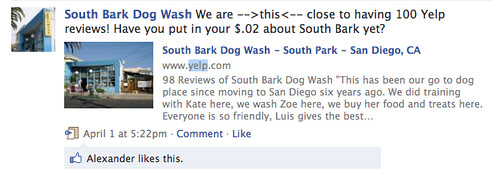
    If your small business has a strong Facebook Fan base, you can attempt drive Fans over to your Yelp profile and hope that some percentage of them will actually leave reviews. These businesses on Facebook are technically soliciting reviews but offering nothing in return, so their Yelp review building may be considered more legitimate. They are still soliciting, but they aren’t buying Yelp reviews.

    This Facebook-er is more blatant. The Lone Star Salon tells Fans if they leave a review on a review site, Lone Star Salon will give them $10.   Totally buying a review.

    And ….

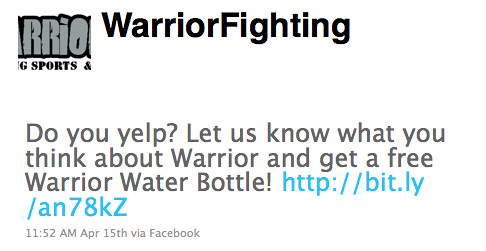
    And …

    We’re talking about pretty low value transactions here – a water bottle, a free cookie, etc. – but any incentive can be enough for a reviewer to take a few moments to drop a review into a Yelp profile that they would not have done if not incentivized.

    Raffle Your Incentive … is Still Incentive

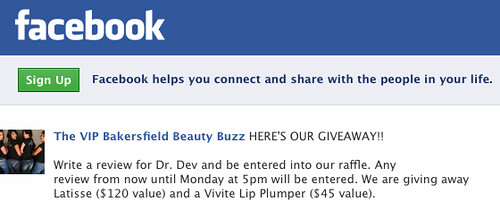
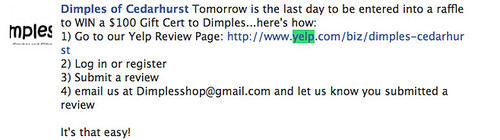
    Another way to buy a review is a little more subtle, but it is still crossing Yelp’s guidelines for good Yelping. Essentially it is offering a chance to win a free product or gift certificate in a raffle. It’s not a direct exchange like Lone Star’s program, but these are still incentive for leaving a review.

    Any reviews on Yelp from these campaigns are not the natural and organic reviewing that is Yelp has struggled to maintain. From Yelp Terms of Service:

    “You agree that you will not, and will not assist or enable others to: use the Site in a manner that may create a conflict of interest, such as trading reviews with other business owners or writing or soliciting shill reviews”

    And there are a few abusers on Twitter too …

    Again, offering a chance to win free product or discount is not directly buying a Yelp review, but it is definitely incentive for the reviewer, warranting the review as forced.  Not natural behavior for Ramona Family Naturals.

    They tweeted on the 14th and got 2 5-star reviews on the 15th. (I wonder who won the box of organic produce?  They should tweet that.)

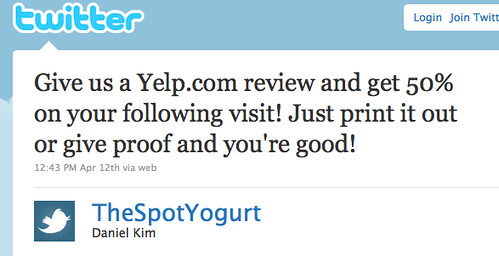
    And The Spot Yogurt in Santa Monica appear to be naively direct in their request.

    And before that, they requested on March 31st too.

    Of course, we know that ignorance of the rule is not exception from it.  Yelp says of this type of false reviewing:

    “very often you’ll offend a customer and the offer will be quickly outed in your reviews, resulting in unintended negative reviews and/or negative publicity”

    Luther Lowe on business owners aggressively soliciting reviews from customers:  “it just looks spammy and decreases the authenticity of your overall presence. That can turn the customers off to you.”

    Charles Grumblemouse O. has a more virtuous Yelper attitude. He says of being Paid to write reviews:

    “… the impetus for writing reviews is surely different if you’re paid than if you were just doing it for the love right?”

    And finally, it’s important to be creative and sincere. Here’s a great case study of a New York Locksmith. He’s got a great perspective on how to get Yelp reviews without direct solicitation.

    Image credits: Thanks to “twonjosh,” “Silver Smith,” ZDNEt, and Steve Rhodes for the images!

  • How much does SEO cost?

    How Much Does SEO Cost?

    In this business, just like any business really, one of the greatest compliments we can receive is a referral. We love referrals and we were delighted when one of our clients referred a fellow colleague over to us. The potential new client had a practice in a very competitive and fairly large market.  When she inquired about our SEO cost, she was a bit surprised to hear that our proposed monthly fees were more than what our existing client had been paying – $300 more. No, no, we were certainly not trying to pull a fast one on her or take advantage that we had been highly recommended as being “worth the money”.  We explained that what set her monthly fees apart from her friend, our client, was her location. We do offer different level of services at different pricing points, but one of our lower pricing points would not impact her website’s ranking as we collectively desired.

    To further explain, take a look at this map. Let’s just say our client was located in one of the orange-circled cities and her friend in a green-circled city. Naturally, the competition is much greater in a larger city where you generally have more of everything – more gas stations, more restaurants, more options.  You also have to consider the characteristics of the targeted market in the particular city. Sure, San Diego and St. Louis may appear to have a similar sized population, but I get the feeling there are probably a greater number of plastic surgeons in the So Cal area than there are St. Louis Plastic Surgeons, just as there are Taco Trucks.

    Simply put, we could not put the same level of effort on her website that we had been placing on our established client’s, who is in a smaller market, and have the same fantastic results.  More effort would be required.

    Do keep in mind that while location is a huge factor in our pricing, there are several other important factors to be considered such as how long a website has been established, how much content is currently on it, images, etc.

    On the topic of competition and SEO cost, we recently stumbled upon a proposal sent to one of our clients by a competing SEO company.  When comparing a similar package that we offer at $1200 per month, our competitor was offering it at $2100….hmmmmm…speaking of economical search engine optimization…did I mention we love referrals 😉 ?

    Thanks to stevelyon for the image!

  • New Website Allows You to Directly See the Effect of Your Donations

    See Your Impact

    There are a ton of reputable charities out there and donating to anyone of them is admirable, but many of these organizations have no way of showing you the effect that your donation has had on the life of its recipient. SeeYourImpact is a network that enables visitors to make small donations to reputable charities and directly see the impact they have made on the world through the use of testimonials, photos and videos.

    Sonal, a member of the BPA Table Tennis Team

    Their goal is to impact billions of people one donation at a time. The technology they use transforms giving into a joyful and fulfilling experience by enabling charitable organizations to show the connection of each donor’s gift to the actual end beneficiary in an authentic and transparent manner. 100% of your donation goes to the charitable organization of your choice. As of now, their reach extends only to India, but as they grow will make their services available to Africa, Latin America, and the rest of the world.

    I really admire and respect not only what they are attempting to do, but also the means in which they are achieving their goals. Gone are the days of Sally Struthers and mail-in updates. SeeYourImpact utilizes current technological advances to deliver personal and real stories of the people who receive your much-needed donations.
    The impact is vast, as you can see in this video of Madavan’s Story. Some of the causes supported are tuition fees for schooling, solar lanterns to provide electricity, Braille lessons for the blind, and even cataract surgery to restore someone’s vision. The donation size is also easily affordable to most people. I may be coming across as a salesman for these guys, but that’s just a testament to their impact and how much I support what they’re doing. I’ve never given to a charity before, believing I was a charity case myself. However, after reading how far simply $12 can go (a month of tuition for a needy child), I felt obligated to contribute. I mean, it’s twelve bucks. Who can’t afford to swing that? There I go being a salesman again. Just stop my ramblings and at the very least become their fan on Facebook. Even if you aren’t able to give directly, maybe you could indirectly inspire someone who can.

  • Break Out of the Local Linking Same Old Same Old

    It has come to my realization that I am in a rut. An external linking rut.

    Well, I knew I needed to revisit linking strategies … it’s one of those things that I never sat down to research and really dig into because I have procrastinated incredibly well, but the past week has propelled me in that direction, not necessarily with my consent. But once I started digging into the data and ignoring the world around me, it was good.

    It was good to see what I have been doing right and to discover those little opportunities that I have missed but can now take advantage of.

    I have always used locally relevant linking in link building exercises to a certain extent. The links that are obvious have been submitted and published, but I’m really appreciating the value of these opportunities that I have not fully exploited:

    • Links from sites that are not top of mind but have a great trust value
    • Links from sites that may be local in 1 market but may not exist in another (i.e. local newspaper sites, local television news channel sites, etc. are truly local to a given market)

    From seomoz.org:

    “What is local authority? It’s the popularity (read: link popularity) of a particular site among sites in their topic community. So, a link from Wikipedia or Yahoo!’s directory, despite being on an on-topic page, will not count towards local authority, while a link (even a reciprocal link) from a website in your own industry that’s geared towards a related topic or the same topic as your own website, is a boost in local authority.”

    In my client linking profiles, I have always included local link building in the past but treated more as a side item rather than an entrée. This past week as I have been looking at many local sites trying to assess some level of value, and I am lovin’ the really specific, really local linking sites that I am finding. I knew I would find good stuff but didn’t expect to find as much as I have.

    If Google were looking only at quantity of external links, we could all submit our websites to low authority global directories all day long. But Google doesn’t work that way, so pretty quickly, we hit a point of diminishing returns. Consistently, over time, quantity of links has a consistency value, sure, but for the real trust building and local relevance, a website needs to be connected to the local online community.

    This post is certainly not to argue the value of locally specific search links. That subject is well covered by many more expert than I. The point is, don’t get lazy with your backlink strategy.

    It’s not a checkmark on the to-do list. It is not where you can say, “Local links … DONE!”

    Local Links: Can't just scratch it off the list.

    It should be looked at frequently. Look at what the local competitors are doing, where they are linking and see if those same are attainable, and search for the area’s local online directories and assess what level of value they offer.

    Really giving local linking a thorough and hopefully exhaustive review has been my procrastination project for some time, and I am happy to be tackling it and finding great opportunity.

    Image Credit: Thanks to koalazymonkey for the picture!

  • You Can Buy Brand Love on Twitter?

    Need Twitter Followers for Your Client’s Brand? Buy Quality Twitter Followers Now!

    This is a Twitter Post If this statement appealed to you, you want to read what I have to say. If you read this statement and wondering what’s Twitter, stop reading right now. I’m serious – Go! This post isn’t for you. This post if for the Twitter marketing elite – the Twitterati.


    This post will reveal the TRUTH about buying Twitter followers. The TRUTH is…

    (more…)

  • 15 Great Ways to Fail at Increasing Website Traffic

    We all know that one of the fundamental goals in designing a website is to provide information. Without an audience you might as well be a tree falling when no one’s around. So, how do you get an audience? As research shows the best way to get the best traffic is by telling your friends and family. They alone will get you all the traffic you need. That’s how the six degrees of separation works, right?

    WRONG. While it is still important, it takes a lot more work and effort to grow your business than just word-of-mouth.

    Here are other successful ways to make sure you fail at growing those daily visits:

    1.     Never consider your audience! Your site should make you happy. If it gives you a warm and fuzzy feeling, I’m sure they will love it.

    2.     All that matters is how pretty the site is.

    Increasing Website Traffic the Hard Way

    3.     Moving objects and loud music always bring the crowd.

    4.     Your audience and/or customer uses the same vernacular as you. There is no need for keyword research.

    5.     Never track or analyze your traffic. This only confuses things. It’s far more fun to bounce randomly around the web promoting yourself than to concentrate on what’s most effective. Besides, analysis is so boring.

    6.     Always use the largest format for all files. Everyone has a T1 these days. Your content will look and sound better than ever.

    7.     Content is not king! You’re content should be so minimal that it borders on shorthand.

    8.     Don’t worry about grammar, punctuation or clarity. Remember this is about you! Express yourself.

    9.     If you’re a localized company, do not claim your listings on sites like Google, MSN, local.com, hotfrog, etc… It’s just not hip.

    10.  Do not listen to your audience- they’ll only distract you from your goals. Twitter should be used for strictly pimping yourself.

    11.  Do not embrace and become part of a community. Facebook will go to the way side, just like Myspace. It’s all just matter of time. That stuff is for kids.

    Increasing Website Traffic through Facebook: That's stuff's for kids!

    12.   Bad reviews should be ignored. Out of sight, out of mind. Unless you just want to badmouth the reviewer. That’s ok and helps blow off some steam.

    13.  Never talk about your site. Self promotion is so passé. It’s like when a musician wears their own T-shirts on stage. Ugh!

    14.  Do not network or make friends. If you meet someone who does something similar to you they are the enemy. Unless you roll mafia style… then, keep them close by. Know what I mean?

    15.  Don’t worry about your brand. Keep things fresh. Change up your logo and tag line as frequently as possible. As soon as it seems old to you, it’s old to your audience.

    Hopefully these tips will help keep you and your site pumping in fresh visitors daily. Just remember: It’s all about you.

    If for any reason the facetious nature of this blog isn’t apparent, please refer back regularly to gain better insight and proper development techniques. “Same bat time, same bat channel!”