Author: Search Influence Alumni

  • 5 For Friday — Links, Stories & Posts For Your Weekend

    Mr. Spock’s guide to out-of-this-world SEO copywriting — SucessWorks

    Attention, Starfleet: the indubitable wisdom of Mr. Spock rings true even in the contemporary world of SEO. Join SuccessWorks’ director and lifelong Trekkie Heather Lloyd-Martin as she discusses some of her favorite Spock quotes and how everyone’s favorite half-Vulcan has wisdom to be applied to even the thorniest of search engine dilemmas.

    Miss The Live Q&A With Google’s Matt Cutts? Here It Is. — Search Engine Roundtable

    Matt Cutts, senior Google Search Quality expert and all-around SEO dominatrix, took a few minutes before the anti-trust hearing on Wednesday to answer live-tweeted questions from users all over the world. In case you weren’t there for the live stream, SER has you covered with a hard copy of the Q&A session that includes a brief rundown of Cutts’ recent movements and several timely questions about webmaster concerns and the state of the SEO world. Sign of Google’s openness with its users or last-minute PR stunt — what do you think?

    Mining YouTube for Keyword Research — SEOChat

    While it’s not the first place many of us think to look when it comes to keyword research, YouTube is a veritable bonanza of information to the savvy marketer. While many SEO professionals prefer to work within a specific subfield and pride themselves on their personal knowledge, countless others are faced with the problem of exploring new territories without the help of SEO-minded experts in the area. However, as titles, tags and text belonging to videos are by their nature relevant keywords, YouTube can be an excellent resource for filling in the gaps left behind by Google’s provided tools.

    Social Media is Sucking the Life Out of My Business! — Search Engine Guide

    Are you a small business owner who wants to break into social media, but are concerned with the time and resource investment it takes to run a campaign? Search Engine Guide’s Stoney deGeyter takes a look at the most common complaints from overwhelmed would-be media butterflies and addresses them with aplomb to help you get the most from your online efforts instead of pouring away the hours into them.

    Political Advertisements Invade Twitter: A Vote for Revenue — Search Engine Journal

    Twitter, that longtime proponent of egalitarian media sharing, has thrown its hat into the ring of political venue by opening up “promoted tweets” to political campaigners. These items will be distinguished via color coding and “sponsored by” markers that appear via hover box, appearing in the “top tweets” section of the site.

  • Facebook announces ‘Timeline’, redefines the social media experience


    This past Wednesday, Facebook rolled out a couple of new updates such as a ticker in the top right hand corner of the site showing live activity and a tab that allows you to control what gets shown in your top stories. As the internet is known to do on occasion, people flipped out, complaining about how much they hated the new changes. Someecards summed it up best in their e-cards on the subject (and those guys are always on top of the game, by the way), but the complainers had no idea just how much change they were going to have to cope with … and what was to come.

    This morning, Mashable posted a teasing article talking about the “new” Facebook, which was slated to be unveiled today at the F8 developers conference. The author of the blog said, “I have seen what Facebook is launching on Thursday, and it’s going to change the world of social media. And while I won’t talk about the mind-boggling things Facebook will be launching, I will say this: The Facebook you know and (don’t) love will be forever transformed.”

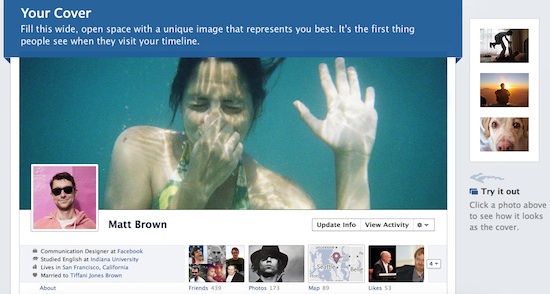
    Whether or not you agree with him is a matter of personal preference, but one thing is for sure: Facebook is going to be very different. The new format is called Timeline, and Mark Zuckerberg explained the thought process behind it as a way to stop losing the timeline of our lives in the social media format that scrolls past us on a day-to-day basis with no way to really accurately access the history. By adding the ability to click a year on the far right of your profile, you can easily go back to the past and see everything from photos to memorable moments. And that’s only the tip of the iceberg.

    By starring certain things you post, like a set of photos from a trip or an update, you can full screen them, contributing to a new profile page that’s reminiscent of the layout of the iPad app Flipboard. Apps are also highlighted on the profile, showing off everything from the movies you watch (directly pulled from your Netflix) and the music you play obsessively (culled from your Spotify account). Other companies such as IMDb, Flixster, DirecTV and Miso were also mentioned as partners, so you don’t have to feel left out no matter what you use.

    A search of the Facebook tag on Twitter shows that the haters are still at work, but I have a feeling that it’ll be harder to complain about a new user experience that is as innovative and interesting as this one. If anything, Facebook has shown that they don’t intend to fall into the graveyard that myspace and Friendster ended up in — because they are determined to evolve. Will users to choose to evolve with it? We’ll see soon enough.

  • Netflix splits into two companies, says they ‘messed up’


    It’s safe to say that Netflix pissed off a lot of people when they announced major changes to their pricing structure this past July. The new setup went something like this: $7.99 a month for unlimited streaming and $7.99 a month for one DVD out at a time. However, if subscribers didn’t actively go in and select a new plan, they would be automatically subscribed to both. The price increase, which was 60% higher than the previous prices, did not go over well. Netflix stocks plummeted, and the company found themselves with several million less subscribers than they bargained for, not to mention the massive internet backlash that followed.

    What to do? Well, desperate times call for desperate measures, and any good business owner knows it. In a major move, Netflix CEO Reed Hastings sent an email to every Netflix subscriber (which is also now posted on their blog) announcing that Netflix would separate into two businesses: One called Qwikster, which would handle physical DVDs and will also add video games, and Netflix would remain as an all-streaming service. But here’s the catch — If you want to use both, you need a separate account at both websites. Inconvenient? Just a bit.

    However, there are some advantages to the situation, as each business will have its own dedicated team, and Hastings promises that improvements for each service are on the drawing board. I’m sure that many users appreciate a forthcoming apology from a business of this size, and perhaps people will find this system works better for them. What is notable is that so much of the results of Netflix’s downfall in the eyes of the public was geared by social media: Within minutes of the price change announcements, people were in an uproar all over Facebook and Twitter, swearing they would drop their Netflix accounts and move to Hulu. Those people told their friends, and so on and so forth, and the chain continued. Whether businesses like it or not, they know that social media is powerful enough to literally cause a mass exodus, so they must consider carefully when it comes to making major decisions such as this.

    Speaking of Twitter, you may want to hold off on going to follow the @qwikster Twitter account for now, should you be interested to do so. Why? Well, apparently it’s being squatted on by a guy who is not exactly the epitome of class. He does have over 11,000 followers, however, who are probably getting just the show they bargained for. And he’s enjoying the attention, because he won’t give up the account. Hopefully Quikster has a gameplan to fix that messy little issue….


  • 5 For Friday — Links, Stories & Posts For Your Weekend

    The SoLoMo Landscape — Outspoken Media

    Are you one of the lucky search marketing professionals who’s experiencing SMX East in the Big Apple? For those of us following along at home, Outspoken Media’s Lisa Barone provides a thorough and thought-provoking overview of the topics discussed at SMX’s latest SoLoMO (social media, local and mobile search) panel with Gib Olander, Gregg Stewart and 15 Tips To Optimize Your LinkedIn Initiative — Techipedia

    Although LinkedIn doesn’t have the sheer weight of user numbers as its more socially-focused brethren like Facebook, its usability in the business world makes it an ideal source for adding contacts, keeping up with the latest industry news and exploring new business opportunities. If you’re interested in leveraging all that you can out of your presence in the online business world, these 15 handy tips should get you well on your way to sparkling content and increased interaction with colleagues and contacts.

    Google Places: Now Permanently Closed with 2 clicks — Blumenthals

    In another head-scratching move from the Google Places team, it’s now apparently even easier to get a business listed as closed without owner confirmation. With one experimental click, Mike Blumenthal saw his business listed “permanently closed” with twelve hours and received no notification of any sort. While Google has promised a fix “in coming days,” this experience is troubling for many business owners and we’ll be keeping an eye on the developing story.

    Google Launches First Google+ APIs — Mashable

    The first application programming interfaces for Google+ have at long last been unleashed, to the exultations of hoards of enthusiastic developers. While the APIs themselves are fairly bare-bones — limited to public data, with the ability to query a single person or activity on the network — developers have expressed great enthusiasm, with the majority surveyed expressing the opinion that G+ has what it takes to go toe-to-toe with Facebook.

    Why Zagat might be a smarter purchase for Google than Yelp — Search Engine Guide

    As we noted last week, Google’s acquisition of restaurant review giant Zagat is bound to make some waves as they hone in on Yelp’s local review market. Search Engine Guide’s Mike Moran presents this nuanced argument as to why this is a smart move for Google — perhaps even more savvy than their previous plan.

  • Influencer Profile: Kate Voisin

    After the ringing success of her Google acquisitions infographic, we’re proud to debut Kate Voisin as this week’s Featured Influencer! Kate is an illustrator and graphic designer who, before joining the SI team, worked as a freelancer. Like just about every New Orleanean, she spends much of her off-time writing what she hopes will turn into a novel, or browsing the stacks at Tulane’s library (where she is not actually a student). Her interests include coffee, dystopian novels, and cartoons.

    Hard-hitting question time: if you were an amphibian, what kind of amphibian would you be?

    A newt! (I’d get better.)

    Tell us about yourself! Are you a NOLA resident originally?

    I’m from a town a little south of New Orleans, but I’ve been living in and around the city for the past 6 years or so. If I lived on Sesame Street, I’d relate the most to Burt… Although in real life, I’m probably more of an Ernie.
    Apparently, I am pretty terrible at answering the question “tell us about yourself.” I don’t know how I got this job.

    You’re one of our newer employees — how long ago did you start? How’s SI been so far?

    I started at the beginning of August, so I’ve been at SI for a month and half now. It feels like I’ve been here longer, but in a good way. I really like my job– the work is challenging, and there is always coffee. And now that the hazing has stopped, I’m almost completely healed! Just kidding. The hazing was gentle.

    What do you find yourself doing around the office? Any particular favorites or disliked tasks?

    I do all the usual stuff that IMAs do, like submissions and lots of copying and pasting. But lately, I’ve been getting a lot of graphic design tasks.
    I was a freelance designer off and on for about 7 years, and any freelancer will tell you that it’s soul crushing. Designing at SI is heaven. Everyone’s been really open and supportive, and I’ve done everything from massive infographics, to logo retouching, to making a baby-on-board Photoshop of one of our (male) co-workers. (I still feel like I have to apologize for that every time I see him, too. Luke, I’m sorry!)

    How did you get into graphic design? Any favorite tools of the trade? Do you do fine art as well?

    I think I’ve been using Photoshop to make graphics for my various websites since version 5.0, maybe? That was in the 90s. I know Photoshop better than I know most people, and we’ve come a long way together.
    My favorite nerd tool of all time is my Wacom tablet (an Intuous4). I bought it last year, and it’s completely changed the way I think about design. It’s like drawing with pen on paper… but, like, way more amazing. I could go on and on about layers and tilt sensitivity, but I also still want to sound interesting, so… yeah. Wacom tablet. It’s awesome.
    And I draw all kinds of stuff! I have a Tumblr that gets seasonally neglected, but I post illustrations and doodles when I’m in the mood. And I’m almost always scribbling on something.

    Thanks to Kate for her tireless work making SI’s projects beautiful inside and out! Keep an eye on this space for many more informative and innovative graphic pieces in the near future.

  • 5 For Friday — Links, Stories & Posts For Your Weekend

    How Small Businesses Can Use Google Plus — Expand2Web

    While Facebook is an excellent resource for small business social media engagement, Google+ is an up-and-comer that as of yet doesn’t allow business profiles. However, hope is on the way: winter of 2011 will yield the first allowed G+ commercial accounts, so if you’re a media-savvy business owner now’s the time to start formulating your strategy. Expand2Web’s Daniela Baker has the scoop on what you should be thinking about in the upcoming months to optimize your establishment’s chances on Google’s mean streets.

    Friday Five: Optimizing Content & Visibility with SlideShare — Edelman Digital

    In their own Friday Five tradition, the wizards at Edelman share their tips & tricks for using SlideShare, a cutting-edge “YouTube for documents” that offers a platform for information sharing and discussion.

    Facebook Debuts Smart Lists: Is Google+ in Trouble? — Search Engine Journal

    The G+/FB war continues with Facebook’s institution of “smart lists,” algorithmic sorting that automatically categorizes one’s friends into set groups. In addition to introducing the automatic methods of sorting, the ‘book is also pushing a lesser-known feature that allows one to manually separate out groups for maximum ease of social sharing. Combined with the updated privacy settings of last week, seems like Facebook is gearing up to address Google+’s emphasis on user privacy and share filtering.

    Why not updating your Core, Themes & Plugins is Stupid — Yoast

    We’re all guilty of it: when the upgrade alert appears on anything from our music players to website modules, it’s tempting to say “not now” and ignore the problem in favor of more immediate concerns. Joost de Valk has a blog up at Yoast warning of the perils of ignoring vital core, theme and plugin updates.

    50 Can’t-Fail Techniques for Finding Great Blog Topics — Copyblogger

    Finding it hard to crank out blog after blog to keep your site full of fresh content? Use these fifty useful prompts to generate dynamic, juicy topics that will keep the entries coming.

  • Google Absorbs Zagat in Their Quest for World Domination

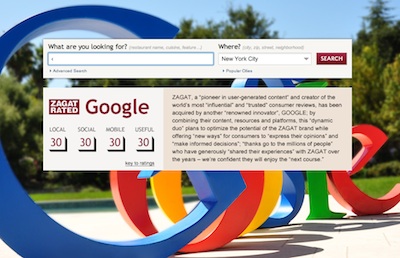
    Google has had a busy year. The launch of “Facebook killer” Google+ surely had many of their available hands busy, but apparently not too busy to keep working on acquisitions: It was announced today that Google has purchased Zagat, the well-known publisher of restaurant and business ratings.

    Marissa Mayer, Vice President of Local, Maps and Location Services for Google, shared in a Google blog post that she was “thrilled” to announce the acquisition. She says: “Moving forward, Zagat will be a cornerstone of our local offering—delighting people with their impressive array of reviews, ratings and insights, while enabling people everywhere to find extraordinary (and ordinary) experiences around the corner and around the world.”

    Mayer also mentions that Google search and Google Maps will now be integrated into Zagat, making it an even more powerful tool.

    Google clearly hopes to capitalize on the expertise of Zagat, which has been in the business of gathering and processing user-generated content for 32 years, long before Yelp! (and even the internet itself). Google has already tried to purchase Yelp! in the past, but this seems like a better bet by far, as Zagat carries the reputation of their name and pedigree and seem like a better match for what Google wants to achieve.

    If Google was to consider the same route OpenTable is promoting and combine it with Zagat, they could be looking at one of the most powerful user generated tools out there — and one sure to elicit a powerful reaction from users. Yelp! allows me to look up user ratings and find an address on a restaurant, but what if I could also make a reservation from my phone, without having to wait on hold on a busy Friday night? It’s genius, and not only that, it’s what tech-savvy users are coming to expect.

    What do you expect from Google’s latest acquisition? Do you think that Zagat will become bigger and better thanks to this buyout?


  • 3 PPC Keyword Research Strategies to Break Free From Organic

    ppc keyword research strategies
    Battle for the Planets? The Difference is more Power Rangers.

    Organic and paid search are both, at the core, about the search queries. These queries are, of course, sought by optimizing for or bidding on certain keywords. These keywords, found using keyword research tools such as Google’s or Wordstream’s and then turned into a comprehensive list using your favorite keyword expansion tool.

    Organic keyword research focuses on traffic, looking for quality descriptors for the products, service, or content offered to the visitor. These descriptors are filtered for the search phrases that are the best fitting and for “low-hanging fruit,” ones with low competition and high value to the business.

    However, strategies for paid research must be different, because the mediums are used in a different way. In addition to search traffic, competition and metrics that might be overlooked or generalized, like average CPC, must be included in the research. Furthermore, these three additional discovery strategies can help create a more robust keyword profile.

    Three Keyword Discovery Strategies

    General

    Unlike in organic search, general keywords play a central role. Organic keywords, especially for businesses, tend to be of the general pattern *geographic area* *keyword*. However, because a paid search campaign can geotarget its ads, any search using the non-geomodified keyword from the targeted area would also trigger the ad. Thus, someone in Montana searching {window cleaner} will see ads targeted to Montana Window Cleaner.

    General keywords focusing on the domain name and business name are also useful for brand marketing. There is a bit of a debate over whether PPC clicks cannibalize organic clicks for this kind of keyword. A few theories and strategies have arisen, with of course the best answer being “What’s best for you,” though problems can arise with attribution.

    Long-Tail

    Long-tail keywords, searches like {cost of criminal lawyer} or {home security free installation}, while relatively low traffic, are specific searches that strengthen the depth of the research. This way, deep searches you wouldn’t optimize for organic search can be explored and taken advantage of. These deep searches are largely of two types, researching and buying. Phrases like {cost of …}, {buy …},  or client-specific long-tail terms like car models can be used to serve ads leveraging the search intent of the viewer.

    Match Types

    The three match types are Broad, [Exact], and “Phrase.” These three types are even more important to the research than for organic search, as it can affect CPC.

    Broad keywords would trigger on longer-tail searches, synonyms, common misspellings, and word reversals. The broad keyword Criminal Lawyer would show ads on the queries {criminal law}, {attorney for criminal case}, or {criminal lawyer new orleans}.

    To save on CPC, [Exact] keywords will run ads on the keywords only in that order, so [criminal lawyer] would trigger on the searches {cost of criminal lawyer} but not {lawyer for criminal case}.

    “Phrase” Keywords display ads solely on the phrase entered. The keyword “criminal lawyer new orleans” would show solely on that term, and none others. This one is less necessary for PPC research.

    Facebook and Display

    The final addendum for any PPC keyword research is that you have to take into account for display ads, whether through Adsense or social media platforms. These ads, though not for paid search, are the bread and butter for retargeting and remarketing or brand awareness. Approaching this match types as keywords may not yield much, but treating broad keywords as categories or thinking laterally and approaching the keywords from demographics and related interests could solidify a bland targeting spectrum.

    With the “reimagining” of Keyword Research strategies focused around these three concepts (and one quick point), your ROI will skyrocket from the CTR and quality score increases that come with a well-curated keyword list. What tricks have you used to get the most out of your keywords?

  • 5 For Friday — Links, Stories & Posts For Your Weekend

    Rethinking Deals After Facebook and Yelp Pullbacks — BIA/Kelsey

    Hot on the heels of the Facebook and Yelp deal eliminations, Peter Krasilovsky offers this nuanced and insightful view of the situation — as well as the suggestion that the trend may have already peaked.

    Twitter, YouTube, Facebook And Foursquare: Social Media Marketing By The Numbers [INFOGRAPHIC] — Media Bistro AllTwitter

    This Mashable infographic displays the numbers on some of the most successful social media marketing campaigns, from clicks and retweets to subscribers and fans.

    9 Reasons Why Your Content Is Not Shared on Social Networks: New Research — Social Media Examiner

    Having trouble getting your content to stick out in a tumultuous sea of data? Interested in getting it out there via the social sphere, or in understanding why some pieces get shared but not others? Phil Mershon of Social Media Examiner is on the case with this handy list of nine reasons why your audience may not be publicizing your product and what to do about it.

    Optimize The Google +1 Button — Blind Five Year Old

    After Google’s rehaul of the +1 button for increased shareability on Google+, it seems like a logical conclusion that the feature will now be more or less a Like button in functionality (if not in form). AJ Kohn of Blind Five Year Old leads the charge in optimization endeavors using this new feature on a self-hosted WordPress blog with an eye on speed, placement, snippet richness and more.

    Condensing & Repositioning SEO Copy with Jquery Sliders — Graywolf’s SEO

    Breaking content up into digestible chunks that are still content-rich and won’t penalize your optimization or conversion rates is as easy as pie with Michael Gray’s guide to Jquery sliders.