Author: Search Influence Alumni

  • What’s the REAL Organic Search Market Share?

    If you work in interactive marketing, you’re are probably familiar with comScore and its monthly estimate of the United States search market share that consistently looks like the following graph, reflecting data collected September 2011. It’s safe to assume that these numbers apply to the websites that you promote as well, right? Not really.
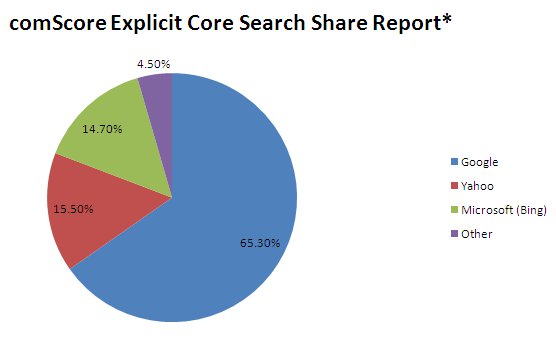
    comscore search market share for September 2011

    For the past few years, it seems like every dataset that I’ve seen contradicts these market share reports, so I decided to dig a little deeper and see what I can find.

    comScore’s numbers:

    comScore is extremely thorough in its calculations. It obtains this information by installing software on the devices of a large number of paid users, which tracks and records all the searches performed on that device. In the month of September 2011, the company recorded over 17 billion search results. It claims to get data from a variety of users that is representative of the market share of major ISPs in the U.S., but other than that, I’m not sure how they pick users. Either way, 17 billion intuitively seems like a big enough sample to come to firm conclusions.

    My Tiny, but Interesting Dataset

    To find numbers that I thought would be representative of the search engine market share for our clients and sites, I created a custom report in Google Analytics that provides the number of site visits from organic searches, and breaks them down by each particular search engine, over the last month (10/2/11 – 11/1/11). To figure out which sites to use, I exported data for the first 75 sites I found that I was certain were active and received organic search visits. The total number of visits was approximately 350,000, so it’s a relatively small sample. There was one site that I excluded because its total visits exceeded all other sites by 3!
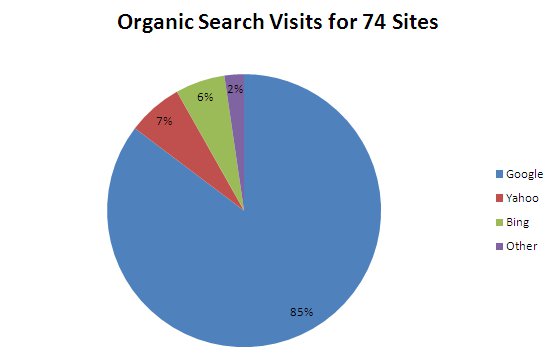
    organic search market share for search influence clients

    As you can see in the chart, Google searches account for a whopping 85% of the organic visits! Like the comScore data, Yahoo and Bing are about even. This is pretty amazing, right? Even though these numbers are too small to make comparisons to the U.S. market share as a whole, the information is representative of Search Influence clients and therefore important to us.

    Industry Segments

    Most of the sites we looked at are small businesses throughout the country. 40% of the results come from 2 medium sized yellow pages directories–but when you take these two sites out, the share is virtually the same. We also see big numbers from Health Care & Beauty and Non-profit. The Non-profit is actually one large organization and the Health & Beauty segment is mostly composed of dentists and plastic surgeons. Two of the sites included are informational sites that attract national visits. Those two sites alone, which represent about 1% of the total visits in this set, received on average 94% of their organic visits from Google.
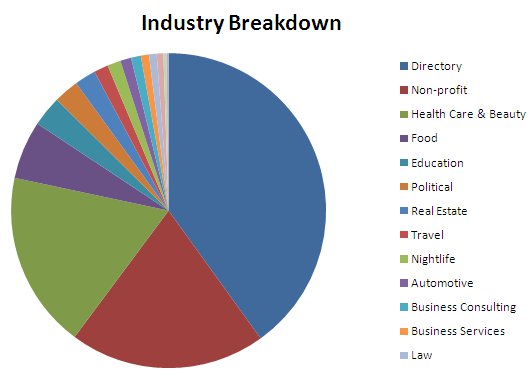
    industry breakdown for market share information

    Why the Numbers are Different

    The numbers differ for many possible reasons, but none that I have been able to completely pin down. Obviously the set of websites used here is not representative of sites on the Internet as a whole. Another reason could be that Google inaccurately reports referrals from other search engines, or perhaps small businesses rank better on Google, so our small business clients get more visits from Google. Another factor may be that none of these sites target American users that search in a language other than English. Whatever the case may be, it’s obvious to me that Google has an even bigger impact on our small business clients than the comScore numbers suggest.

    What about you? Feel free to share your data, do a similar study, speculate on these results, or tell me why I’m full o’ bull.

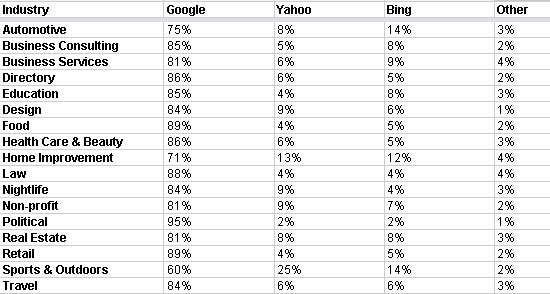
    Oh, and if you’re interested in a more detailed breakdown of the results in a particular industry, here it is. Here is a link to the spreadsheet.
  • Google Places Page Redesign — Local Search Goes Minimalist

    Hot on the heels of big redesigns to a whole suite of Google services, including Docs, Reader and Gmail, searchers will soon see shakeups in the way local listings are displayed on their results pages. Instead of the familiar red pin of Google Maps, searchers looking for businesses matching a given term such as breast augmentation Maryland will now be greeted with a row of grey icons which can be expanded with a click to show a highlighted popout with site preview, map and reviews:

    Google Places results page when no selection is highlighted.
    Results page with mini-Place page expanded.

    This is a noteworthy move for Google Local, given the powerful results that the “red pin” logo has attained over the last few years. The mini-Place Page embedded within search results seems to agree with the growing shift toward minimalism the company has encouraged in its recent redesigns, such as the sleek-and-clean new Google Reader. Additionally, the new system serves an important purpose in helping searchers find the things they’re looking for (location, directions, reviews, pictures and details, et cetera) without actually leaving the SERPs. Google is also making it easier on its searchers to review and edit local places listings by placing a feedback link (visible in the second, expanded screenshot) directly in the foldout, thus helping prevent problems like the infamous potential to mess with competitor’s listings via maliciously reporting a business as “closed.” With this error seemingly remedied or at least remediated, it will be interesting to see if other Google bugs such as the appearance of potentially inappropriate photos on Place pages will be given attention as well.

    Given the increased power of many browsers and the capability offered by new tools such as HTML5, it’s clear that most users’ browsing capabilities can handle the change — but is it an innovative way to get the data you need without having to trawl through multiple unique pages, or a confusing overload of information? What do you think?

  • 5 For Friday — Links, Stories & Posts For Your Weekend

    StumbleUpon: Where Should You Share? [Infographic] — Social Times

    StumbleUpon is one of the most powerful sharing vector services out there, allowing users to “stumble” to your page based on their set of stated interests. This Social Times infographic provides some valuable data on how sharing your content via stumbling can work for you, from hard numbers on how much social media traffic the service actually drives to comparisons of the “half-life” of links distributed via different venues (Twitter, Facebook, et cetera).

    Microsoft Wants You to Search the Web Like Miley Cyrus — Search Engine Watch

    Microsoft has applied for a patent on the “persona” model of search results, essentially allowing users to search as their favorite celebrity. Read on to learn about some of the potential ramifications of this new system and the advantages it can lend to everyday searchers.
    How Much Money Do Viral YouTube Videos Make? — Social Times

    As much as we may deride the uninspired lyrics of Rebecca Black or giggle at the uncoordinated antics of Afro Ninja, there’s no denying that the viral video phenomenon can net its stars some serious notoriety. But how about fortune to go along with the fame? Social Times takes a look at the cold hard cash generated by these Internet phenomena.

    How Big is Your Long Tail? – Whiteboard Friday — SEOMoz

    Optimizing for “long tail” or ultra-specific keywords can be rough, and the individualism in the way people search for things (according to Google, an astounding 20% of search queries at any given time are completely unique) is fascinating. Understanding the art of the long-tail keyword is key, and Rand is here to enlighten you on the basics of this integral part of product-specific SEO.

    8 More Habits of Highly Effective Bloggers — CopyBlogger

    As a follow-up to her previous set of good blogging practices, CopyBlogger’s Annabel Candy offers up yet another group of tips on how to make your content the belle of the blog.

  • Influencer Profile: Megan Lindsey

    Today we’re proud to profile Junior Account Associate Megan Lindsey! Megan was born and raised in Lafayette and is a graduate from the University of Louisiana, Lafayette in Mass Communications. She has a background in media, including commercial broadcasting, film and television production, and Account Management. She loves living in New Orleans and makes it out to as many live music shows and festivals as possible.

    How did you get into marketing? Were you interested in online models or SEO from the start?

    After I moved out here to New Orleans, I was really interested in being a part of a new and growing field. I have a background in Communications, so I knew that I wanted to be in a field that involved collaborating with people and businesses of various backgrounds. Search marketing is something that I think is often over-looked and a little unknown. It feels pretty great being a part of a field that is constantly evolving. Everything I learn here is a really valuable part of growing business and brand awareness.

    How’s the transition to SI been? Picking up any new tips and tricks?

    The transition with Search Influence has been really nice. It’s a fairly laid back and collaborative environment that prides itself on getting things done correctly. I’m learning more here than many jobs I have had, and I enjoy the challenge. I’m also enjoying the fact that I am being taught new things and taking on new tasks with each different client project I work on.

    As far as tips and tricks, I can’t share the “secret sauce” — but it’s cool knowing that I’m a part of it!

    What do you find yourself doing around the office? Any particular favorites?

    On a normal day, I find myself picking up where I left off from the day before and making sure my “To Do” list has lots of crossed out tasks! Having our clients stay on schedule and increase in rankings is priority. I try my best to make sure we keep things moving in the right direction.

    My favorite thing would probably be collaborating with my co-workers. It’s a really great feeling when we all work towards one main goal and succeed, knowing that our work paid off. I think we all work well together and respect each others’ ideas and strengths. It makes me feel lucky to be working with such a smart and dynamic group. — Oh! And I really love randomly making my co-workers laugh. I’d like to think they find me funny, so I try to keep things pretty light as often as possible.

    In a perfect world, what would you be doing all day?

    In a perfect world, I’d probably be working as a Production Manager for a really awesome, successful comedic sitcom — or a ghost hunting show — or a reality show. A movie? Anything to keep me laughing… or crying. There’s something about knowing that you’re part of such a large outlet that reaches out to so many people. And your name is there for the credit. Oh, and Ebay. Can’t forget my small Ebay obsession.

    Most important of all: if you were an 80’s teen pop sensation, which 80’s teen pop sensation would you be?

    Tiffany. She was a teenage pop sensation that did a mall tour! You can’t get any cooler than that. Stone-washed Jordache jeans, denim jacket, big earrings and teased hair: awesome! Thousands of terribly dressed screaming fans: amazing! 20 years later you have immortal songs to prove it: oh yeah!

  • Can’t Touch These Metrics: MC Hammer Announces His Own Search Engine

    When it comes to the world of SEO and general web technology, some of us are so jaded we think we’ve heard of everything. Phones we talk to? Check. Virtual reality? Won’t be long until we’re standing on the holodeck. And as far as SEO, everyone and their mom is on deck calling themselves “social media experts” and promising they can make your business blast to the top of the search results.

    No matter how out-there the current trends are, I feel quite sure that nothing compares to the hard, cold fact that MC Hammer has just announced he will be launching his own web browser, which will be focused on “Deep Search.” No disrespect, Hammer, but before you get busy on that search engine you might want to hire someone to make your blog look less like a Blogspot nightmare. Just sayin’.

    Anyway, I’ll keep the dissin to a minimum, since it’s clear that Hammer’s too legit to stop at ministries and lifestyle clothing lines, so why stop at SEO? The search engine will be called WireDoo (I’ll leave that there for you to make cracks your own) and is about “finding the relationship beyond just the keywords,” as Hammer put it on stage at his presentation at the recent Web 2.0 Summit in San Francisco. He also claims that Google and other big-name search engines are not as skilled at connecting keywords to related topics. So is this the magic that WireDoo claims it will be able to perform?

    That’s all we know for now — that and that Hammer’s team has been working on the engine for the past two years. It can’t be denied that the rapper has come up with some ingenious ideas in the past — not to mention those cool 50 million albums he sold. But, you have to wonder what he’s got up his sleeve at this point. Taking on a beast like Google takes some serious balls, but as Hammer has repeatedly proven in the past, he’s got the cajones to try anything. And hey, he has well over 2 million Twitter followers.  He’s got to know something about how to make people listen to him … right?


  • 5 For Friday — Links, Stories & Posts For Your Weekend

    7 Technical SEO Wins for Web Developers — distilled

    Working with outside web developers is an integral part of SEO, but some of us less technically-minded folk may be confused as to where to start. Technical SEO, defined by Paddy Moogan of distilled as “elements of a page that the user can’t see without looking at the source code,” can be a tricky field to master. In this article, Moogan elucidates some of the most important things to know about this aspect of optimization, including how to keep an eye on your site speed and get a firm grasp on crawler access.

    Non-Profits: How to Get More Online Donations — Outspoken Media

    While “save the whales” isn’t the first thing that comes to mind when one thinks of search engine optimization, it’s vitally important for nonprofits to maintain an online presence in order to gain maximum exposure and precious monetary donations. Michelle Lowery, a copywriting professional and volunteer SEO master for her local animal shelter, shares some tips for online do-gooders to optimize their fundraising campaigns, make donations easy and publicize their cause.

    Content Marketing In The Echo Chamber — Content Marketing Institute

    The Internet has opened up a whole new world of possibility for the independent, the unestablished and the avant-garde to spread their ideas far and wide. However, the downside has been an “echo chamber” of sorts, where those who can speak the jargon pass themselves off as a social media expert, professional marketer or even the dreaded “guru” without any real experience or expertise to back it up. Here, Content Marketing Institute’s Keith Blanchard provides you with five handy points to “kick the tires” of your potential content marketing service and make sure you’re getting the bang for your buck.

    Don’t be afraid of fake reviews — Search Engine Guide

    While Yelp, Places and other review engines are excellent resources to learn more about the local world around you, fake reviews are the bane of every Yelp establishment’s public wall. In this informative SEG article, you’ll learn about the fake review phenomenon, how to respond to a rating you suspect is duplicitous and the possibility that, in the future, we won’t even have to worry about it at all.

    Evidence: Print Is Not Dead — B2B Bloggers

    While we may bemoan the diminishment of traditional publishing models, there’s no reason to be writing a funeral dirge for the printed book just yet. In a recent media usages study by Readex Research, a whopping 74% of the 2,095 professionals surveyed said that they regularly use print publications. Print as a medium is still a relevant and important part of the mix: the study seems to indicate that, instead of favoring one form of media over another, people are consuming more and more of all different kinds. Interesting stuff!

  • Naughty, naughty: Google Places turns up risqué photos for cosmetic surgery businesses


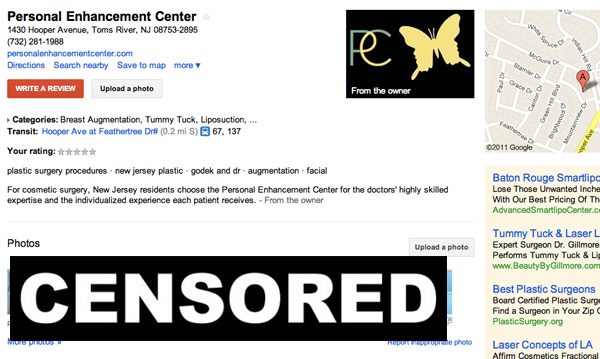
    Google has a crackerjack team of people helping to make their products bigger and better all the time, or at least, that’s the impression we get from them. I just might have caught an embarrassing typo in Google Docs last week, but otherwise, they seem to be pretty much on the ball. That is, unless you visit their Places page, which apparently is hot to show you photos of women’s bare breasts and much more — if the place you’re looking for happens to be a cosmetic surgeon’s office.

    Of course, the websites for most cosmetic surgeons feature a before and after page, but traditionally it takes some clicks to get to and obviously are not plastered all over the landing page. I’m sure some people would be impressed if they went to a doctor’s site and the first thing they saw was a pair of surgically-perfected double D’s, but most medical professionals prefer a subtler approach. And who can blame them?

    Speaking of class, Google, where’s yours? SafeSearch protects what images we see (although, admittedly, even Moderate can be a bit racy at times), but surely businesses will be less than pleased to see that they are being represented by a wall of women without their tops. Not that the images themselves are shameful, mind, but that’s the type of thing that should be taking place behind several layers of clickthrough. On the other hand, surely cosmetic surgeons will feel compromised if they have to pull their before and after galleries from their websites, as potential clients will want to see what the final products of their work looks like.

    It’s a little faux-pax … but nothing Google can’t remedy. Still, will they fix it? Since the images are clinical and not sexual in nature, they may have slipped through SafeSearch’s protocols. If Places automatically pulls the most viewed images, as intelligent as Google may seem, this still proves it to be a modern machine — not quite capable of thinking for itself just yet. We may have to wait a few more years until our networks can provide the same thoughtful attention to detail that humans do. Maybe we’ll be useful for a while longer after all!

  • INFOGRAPHIC: We Come From The Future

    For people born of a certain generation, “The Kids Are Alright,” is mainly a reference to a seminal work by The Who, which they originally heard on vinyl.  For a later generation, this phrase was likely linked to The Offspring’s “The Kids Aren’t Alright,” passed around via mix CD. And in five years, “The Kids Are All Right,” will probably be remembered as a groundbreaking film most people will see after they’ve downloaded or streamed it online.

    This sort of generational reference gap is being carefully– and often humorously– tracked by Beloit College’s faculty in The Mindset List, an annual compilation of political and pop culture references that the year’s college freshmen probably won’t get.  One anecdote on The Mindset List shows that people born before 1983, entering college around 2005, might not realize that the precise location of the Titanic’s final resting place wasn’t always known.  People born after the mid-1990s might not remember that OJ Simpson was once famous for his sports acumen, and wasn’t always a career trial defendant.

    One of the more startling trends on the Mindset List is technological: freshmen who will enter college in the year 2015 have no concept of what life was like before the Internet.  This is a generation for whom media has been, and forever will be, easily accessed by a few keystrokes and the touch of a button.

    Of course, since the advent of the Internet, no one has to stay completely in the dark about past pop culture or political events.  In fact, while taking away a kid’s Encyclopedia Brown books and making them read an actual encyclopedia was once considered a punishment (just me?), one could spend an entire day browsing Wikipedia and YouTube to find evidence of such ancient cultural touchstones of our peoples like the original McDonald’s sign (http://en.wikipedia.org/wiki/McDonald%27s_Sign_(Pine_Bluff,_Arkansas) ) or the Dick Van Dyke Show (http://www.youtube.com/results?search_query=dick+van+dyke+show).

    And while I’m grateful to live in a world where Diet Coke has “always existed” (#12, 2005) or where ATMs spit out my money (#16, 2004), I’m really interested to see how this list will look in ten more years.  For instance, my step-kid was shocked to find out that there was an animated version of Alice in Wonderland before Tim Burton laid his paws on it, and has often asked to “play” with my iPhone (or, as she views it, the Angry Birds device).

    And if you’re feeling really old or disparaged after reading this, worry not.  Kids these days still find the Three Stooges and Amelia Bedelia totally hilarious, so the future generation’s probably going to be all right.

    —-

    Kate Voisin is a graphic designer and IMA at Search Influence who carefully cobbled together this infographic using magazine clippings and paste.  Just kidding.  She did it in Photoshop and wouldn’t have it any other way.

  • INFOGRAPHIC: Why Content Marketing Matters

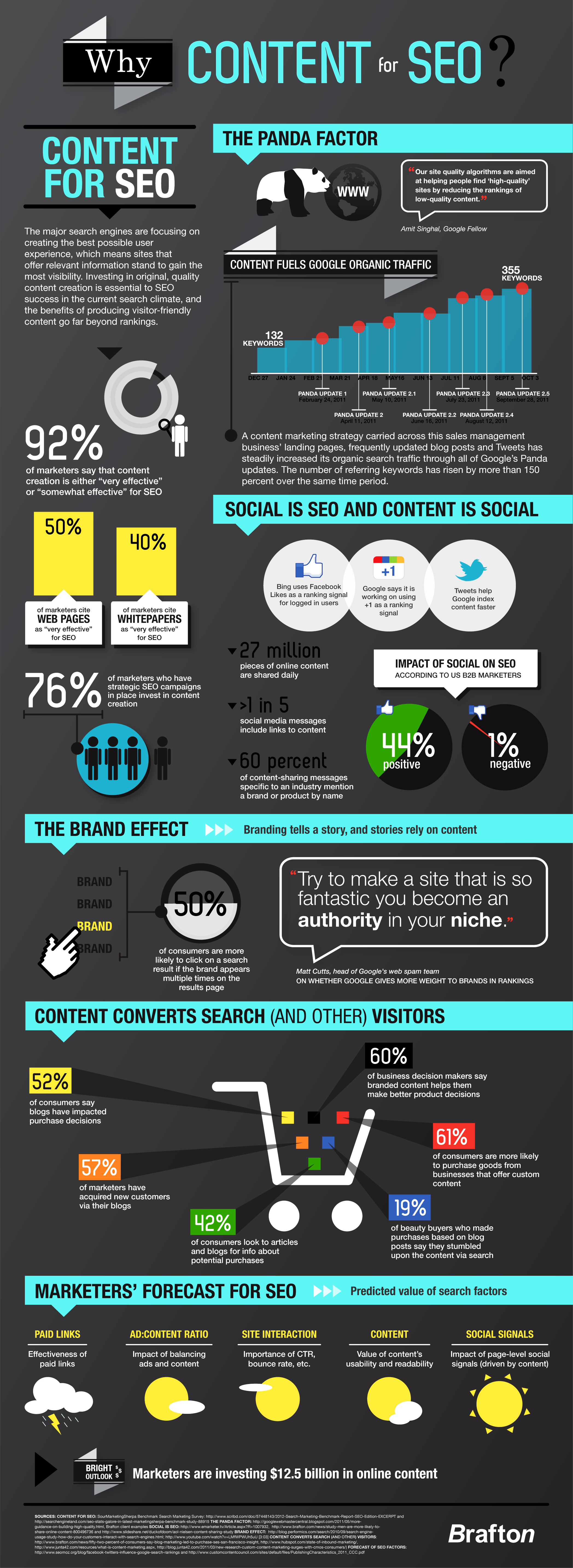
    Our friends at BraftoN have put together a great infographic on the importance of content in the world of SEO. It’s an established fact that search engines give preferential ranking to sites with the freshest and most pertinent content, but it’s eye-opening to really dig into how important content really is.

    As Google Fellow Amit Singhal is quoted as saying, “Our site quality algorithms are aimed at helping people find the ‘high-quality’ sites by reducing the rankings of low-quality content.” That quote alone should make everyone with any kind of Internet presence at all scramble for fresh, high quality content.

    Here are some other incredibly interesting facts from the infographic that deserve some consideration:

    • Ninety two percent of marketers say that content creation is either “very effective” or “somewhat effective” for SEO. The same percentage of Americans believe in God. Correlation, or causation?
    • Twenty seven million pieces of online content are shared daily. The same number of people eat at McDonald’s every day.
    • Sixty percent of content-sharing messages specific to an industry mention a brand or product by name. Sixty percent of adults can’t digest milk.
    • Fifty two percent of consumers say blogs have impacted purchase decisions. The same percentage of Americans don’t know who Pippa Middleton is. They obviously don’t read the blogs.
    • Marketers are investing $12.5 billion in online content. We could have just bought Motorola Mobility for the same price.

    So take a detailed look at the content you are offering on your website. Will it make Google jump for joy, or bump you 20 spots down the rankings? The quality of your online content is simply too important to ignore.

    Not sure what to do about your content? Contact us. We’re here to help.