Author: Search Influence Alumni

  • Infographic: New Orleans Hotels on the Parade Route

    The Mardi Gras Survival Guide and New Orleans Hotels on the Parade Route, Courtesy of NewOrleans.com


    It’s your first time in New Orleans for Mardi Gras, you say? Oh, dear. It’s likely that you’ll be overwhelmed by the spectacle, even if you’ve seen many celebrations in many other countries before. After all, everywhere you look there are parades, costumes, beads being hurled, and all other manner of unfamiliar customs. You know, like women taking their shirts off at a moment’s notice in exchange for small trinkets. Yes, hide the children (or at least be prepared to shield their eyes at the speed of light!)

    Jokes aside, New Orleans is a fantastic destination for adults and children alike, and your experience of celebrating carnival here can vary quite a bit depending on where you camp out. For instance, the Mardi Gras experience in the uptown area of New Orleans, near Napoleon Avenue is considered more of a family-friendly spot to watch the parades, and it’s where locals like to hang out as well.  At the start of the parade on Napoleon, parade goers can expect light to moderate throws, as most float riders are still too sober to be generous. If you can find a cute baby, you may be able to convince riders to throw you a stuffed animal or two. A little past Napoleon on St. Charles is where most younger locals catch the parade. These include college preps and high school kids who think they are in college. Drink of choice: Red Bull.

    If you want to catch the parade in this area, New Orleans hotels such as the Royal St. Charles and Avenue Plaza Resort offer all the charm one would expect from the sound of the names, but are also conveniently located within walking distance of the routes of the most spectacular parades, such as Bacchus and Orpheus.

    Venture further down the parade route, between Louisiana and Jackson, and you’ll come across a more family oriented area. Young local families and young adults will occupy most of the area. College freshman who are too afraid to get drunk in front of their visiting parents will carry around a flask, usually filled with Captain Morgan. In this area, float riders primarily throw to their friends and family, in order to save throws for later in the parade.

    Between Jackson and Lee Circle are a variety of locals. Hipsters, food cart vendors, and grumpy bike commuters who didn’t leave work early enough to avoid the congestion. The locals are relaxed and enjoying locally brewed Abita beer. The float riders begin to panic that they didn’t buy enough throws to last until the end of the parade, and they get conservative. New Orleans hotels on this part of the parade route are close to the action. Avenue Plaza Resort and the Prytania Park Hotel can offer an area of refuge for bathroom breaks and to rest your feet.

    If you prefer to be situated closer to downtown so you can easily access uptown and downtown on foot, The Hotel Modern (formerly Hotel Le Cirque) and Maison St. Charles are excellent choices for New Orleans hotels. All the parades you want to see will be within walking distance, and it’s an ideal way to situate yourself near all the excitement without jumping feet first into the middle of the French Quarter, just on the edge of crazy town. While this area will mostly be tourists exploring the area, you’ll still see a few courageous locals sporting their costumes and dancing in the streets. You can also explore the city’s central business district and enjoy food and cocktails at some fantastic spots. Float riders have now become so drunk, that they lose their inhibitions and begin tossing throws overboard.

    But wait — you say you came here because you couldn’t resist the call of Bourbon Street on Mardi Gras day? Well, Lord help you, but it’ll be interesting at the very least. As long as you don’t value sleep, you can stay right in the middle of the action at well-known New Orleans hotels like Royal Sonesta, Hotel Monteleone and W French Quarter. You won’t have to walk a few blocks to find the action if you stay here, as it’s more likely happening right outside the hotel, or possibly on your neighboring balconies. Be warned that this is the heart of the Mardi Gras debauchery, so be ready for anything.

    Whether you’re in need of New Orleans hotels uptown or downtown for your first time celebrating Mardi Gras, or you do it every year, there’s plenty to choose from. Just make sure you come prepared with a stomach of iron if you plan to keep pace with the locals!

    For more information on New Orleans hotels on the Parade Route, please see information below:

    Avenue Plaza Resort
    2111 Saint Charles Ave.
    New Orleans, LA 70130
    NewOrleans.com Reservation Hotline: 1-855-639-6756

    Hotel Monteleone
    214 Royal St.
    New Orleans, LA 70130
    NewOrleans.com Reservation Hotline: 1-855-639-6756

    Maison St. Charles
    1319 St. Charles Ave.
    New Orleans, LA 70130
    NewOrleans.com Reservation Hotline: 1-855-639-6756

    Royal Sonesta
    300 Bourbon St.
    New Orleans, LA 70130
    NewOrleans.com Reservation Hotline: 1-855-639-6756

    Royal St. Charles
    135 Saint Charles Ave.
    New Orleans, LA 70130
    NewOrleans.com Reservation Hotline: 1-855-639-6756

    The Hotel Modern
    936 St. Charles Ave.
    New Orleans, LA 70130
    NewOrleans.com Reservation Hotline: 1-855-639-6756

    W French Quarter
    316 Chartres St.
    New Orleans, LA 70130
    NewOrleans.com Reservation Hotline: 1-855-639-6756

    Inn on Bourbon
    541 Bourbon St.
    New Orleans, LA 70130
    NewOrleans.com Reservation Hotline: 1-855-639-6756

    Prince Conti
    830 Conti St.
    New Orleans, LA 70112
    NewOrleans.com Reservation Hotline: 1-855-639-6756

    W
    333 Poydras St.
    New Orleans, LA 70130
    NewOrleans.com Reservation Hotline: 1-855-639-6756

    Westin New Orleans Canal Place
    100 Rue Iberville
    New Orleans, LA 70130
    NewOrleans.com Reservation Hotline: 1-855-639-6756

    Best Western
    3636 St. Charles Ave.
    New Orleans, LA 70115
    NewOrleans.com Reservation Hotline: 1-855-639-6756

    Doubletree
    300 Canal St.
    New Orleans, LA 70130
    NewOrleans.com Reservation Hotline: 1-855-639-6756

    Sheraton
    500 Canal St.
    New Orleans, LA 70130
    NewOrleans.com Reservation Hotline: 1-855-639-6756

    Harrah’s Hotel & Casino
    8 Canal St.
    New Orleans, LA 70130
    NewOrleans.com Reservation Hotline: 1-855-639-6756

    LaFayette Hotel
    600 St. Charles Ave.
    New Orleans, LA 70130
    NewOrleans.com Reservation Hotline: 1-855-639-6756

    Hilton Riverside
    2 Poydras St.
    New Orleans, LA 70130
    NewOrleans.com Reservation Hotline: 1-855-639-6756

    Bourbon Orleans Hotel
    717 Orleans St.
    New Orleans, LA 70116
    NewOrleans.com Reservation Hotline: 1-855-639-6756

    Hotel Royal
    1006 Royal St.
    New Orleans, LA 70130
    NewOrleans.com Reservation Hotline: 1-855-639-6756

    Prytania Park Hotel
    1525 Prytania St.
    New Orleans, LA 70130
    NewOrleans.com Reservation Hotline: 1-855-639-6756

    Parc St. Charles Hotel
    500 Saint Charles Ave.
    New Orleans, LA 70130
    NewOrleans.com Reservation Hotline: 1-855-639-6756

  • Why You Want to Claim Your Business on Google Maps: An Object Lesson

    Recently, I decided that life would be simpler if I got a Mohawk — but a nice Mohawk, one carefully mown and primped into shape by a professional.  I looked up my options with Google maps. This way, I could see where the salon my friend recommended me was located, how far it was out of my daily route, and what other closer options were. Google Maps gave me a pincushion map of the New Orleans area, and I started browsing each salon along my route from work to home.

    Some listings had scant information and required me to turn to a Yelp page for the pertinent information. It’s not a huge inconvenience, but really, there aren’t many reasons you shouldn’t claim your business on Google Maps and fix up the listing with all the basic information. Most people turn to this tool for directions from point A to point B, and many take it for granted that whatever they need to find in the world will somehow be notated accurately on there already.

    For example, Osama Bin Laden’s Hideout got its own little thumbtack on Google Maps’ canvas almost instantly its location was revealed to the public (yes, Google finds everything). Its corresponding Places page, though not a business, has acted as the Internet’s gathering point to gaze upon the building in question and post roughly 1600 snarky reviews about its interior and past owner.

    However, if Osama’s hideout had been a business of inviting snipers to give their best go at him, he would have had a tough time getting any visitors to his locale.  Here is a side-by-side comparison of what his location tag looks like compared to a bonafide business listing.

    comparison

    Three things to note. First, Osama’s hideout does not have his street address listed. This would make (and did) him very hard to find. Second, he has no contact information. How would potential customers ever know his business hours or rates? They can’t even visit his website, since that is the third thing he does not have listed.

    If Osama had felt like optimizing his search results, he would have probably endeavored to go through the admittedly involved process of claiming his business on Google Maps.  The effort is worth it, since most people looking for a business will inevitably want to know your location and get driving directions. Might as well make it convenient for your potential clients before they even set foot through the door.

  • Are Online Reviews More Influential Than Advertising?

    When it comes to how we consume, things have dramatically changed over the last twenty years. For instance, if your mother and father wanted to go to a restaurant in the seventies, it was probably because they heard it was good from friends or neighbors or simply wanted to give it a shot. 1979 brought about the debut of the Zagat guide, which of course gave people more of a guideline than ever before. Fast forward a few decades, and there’s suddenly more information than you could imagine available for everything from eateries to shopping for clothing. Because of the popularity of the internet as a means of sharing information, people can now log on and leave reviews for all sorts of experiences, making it that much harder to pass off a bad meal or a sleazy transaction than it used to be. In some ways, it’s great. But how is it affecting us as consumers?

    If numbers are to be believed, the effect is greater than you might think. In fact, it seems as if user reviews are the method of choice when it comes to consumers making decisions in the modern age. Financial agency Deloitte were recently quoted as saying that:

     “82% (of consumers) say their purchase decisions have been directly influenced by the user reviews, either influencing them to buy a different product than the one they had originally been thinking about purchasing or confirming the original purchase intention.”

    Naturally, Deloitte aren’t the only ones noticing the trend. Media Planning company EXL Media also tells us that the numbers are rising when it comes to advertising versus consumer review:

    “55% of U.S. consumers believe strongly/somewhat that online consumer reviews and ratings influence their buying decisions more than any type of online advertising.”

    These are no small figures! So I guess all those people logging into Yelp from their phones and madly blogging about their experiences aren’t just a voice after all. Collectively, we form something stronger — a body of opinions that has enough klout to get people reading and making choices. In fact, making choices that disdain traditional advertising. In other words, the system is changing yet again — and advertisers will be forced to reinvent themselves if they want to compete with the voices of the common people.

    This movement isn’t limited to finding a good place to eat, either. Even doctors are included, as there are websites such as Vitals that allow you to find and rate doctors. Deloitte tells us that home electronics rate among the items people seek out online reviews for most often, with personal electronics, games and toys and kitchen appliances close behind.

    Because of these new perimeters, every business faces a new challenge: To not only provide good service and leave customers impressed, but to also properly address unhappy ones and help to resolve their concerns. Otherwise, a bad review or two could smudge your name and drive away potential clients. Gives a whole new meaning to “Honesty is the best policy,” doesn’t it?
  • Five for Friday—Links, Stories, and Posts for Your Weekend

    Google’s New Privacy Policy May Violate HIPAA, Congresswoman Says – Search Engine Land
    Because Google’s new privacy policy intends to make its services more user-friendly by integrating all of its privacy policies into one.  Some members of Congress, however, fear that this single new policy will violate HIPAA, the Health Insurance Portability and Accountability Act. Google states that ads will not be associated with sensitive issues, such as religion, sexual orientation or health, but should Google be forced to comply with HIPAA regulations?

    Hear No Evil, See No Evil: Google and Twitter’s Free Society is Crumbling – Huffington Post
    Are social networking and Google responsible for the civil unrest around the world? While riots and Occupy movements are not a result of social networking, the ideas behind these movements are certainly propagated via tweets and posts, and it would appear that governments feel directly threatened by its strength.  Unfortunately, Twitter and Google have both agreed to repress content that does not comply with ‘local laws.’ Sounds to me like they are feeding the protest fire.

    Google Panda in Plain English – Single Grain
    The introduction of the Google Panda algorithm in February 2011 left many SEO experts Internet marketers and BAMBOOzled about how to defend your site against this spam filter. Single Grain has provided an effective timeline infographic to inform you of new link building rules and how to revamp post-panda.

    AHREFS Review: An In-Depth Look at a New Link Research ToolSEOBook
    A new tool, similar to SEOMoz’s Open Site Explorer, has hit the link research scene. Ahrefs asserts that their own index is updated every half hour and that they have a ranking database of approximately 45 million keywords.  Prices increase and decrease based on the amount of data you have. It includes special features such as new links, referring domain breakdown, and SERP positions.

    SEO: Are you Relevant, or Are You Vital?Small Business Search Marketing
    Vital is the new relevant.  According to Small Business Search Marketing, it is no longer enough to produce relevant content and title tags. While they don’t provide the answers, SMB proposes a vital question: “If you were a search engine, what kind of pages would you want to show the searchers?”

  • Google Free Europe

    Google France
    LeGoogle

    Google has landed in hot water in France after offering its Google Maps product for free in the country. America is known as the land of the free, and we all know big businesses get to do pretty much whatever they want. The idea of a government stepping in to say a business can’t give away a service for free strikes me as particularly French.

    But while this move may not slow down the Google machine, it could open the door to similar lawsuits as Google sets its sights on new markets in previously un(Google)mapped countries. Could this be the beginning of a real life game of Risk that Google might not want to lose?

    France Fines Google for Flying Free

    French officials allege that the search engine giant is unfairly leveraging its massive size to crush smaller French competitors who offer similar services to paying customers – specifically Bottin Cartographies, who initiated the lawsuit in 2010. A 500,000 Euro fine was leveled against Google as the result of the lawsuit, coupled with an additional 15,000 Euro fine.

    A smaller company — maybe Bottin Cartographies — would take this as a huge and potentially disastrous setback after they sunk an untold sum into digitally mapping a new market, but something tells me Google isn’t losing too much sleep over this. To illustrate how much money Google made in 2010, SEOMoz deconstructed what Google’s reported 2010 earnings of $29.3 billion could buy.

    Let’s just say no one needs that many Justin Bieber albums. Ever.

    Quoi?

    So what’s the big fuss over the relatively small fine?

    Aside from the ongoing anti-trust legislation facing the company in more than half a dozen different jurisdictions, Google has had a relatively straightforward plan of attack since its inception, and charging for services like Google Maps isn’t part of that plan. Generally speaking, Google offers a free service that few can match in quality – search, maps, email – and then sells ads connected to that free service. Advertising is what makes Google’s world turn, and it’s much more difficult to sell ads for a service people have to pay to use than one anyone can access anytime they want to.

    So if this French incident is an indicator of what Google can expect to see as it expands overseas, it could find itself on the slippery slope of charging some users for a service that is free in other parts of the world.

    I guess what it boils down to is this: would you pay for Google Maps? What about anything else Google offers for free?

  • What to Expect From Your Email Marketing Campaign

    No joke, this is what my wife’s inbox looks like.

    I’ve sent out a few newsletters in my time at Search Influence, and I’ve had to curb the client’s expectations more than once. Email marketing can be a time-consuming, arduous process and returns what seems to be very little. While email marketing is becoming more obsolete in this social media-dominated world, it’s still worth pursuing. Your expectations just need to be adjusted (read: lowered). Below I’ll break down the different metrics, what they mean, if you should care about them and what you should be expecting out of a successful campaign.

    Open Rate
    The Open Rate is exactly what it sounds like… well, sorta. It measures how many recipients opened the newsletter, but beware. These numbers are usually vastly underreported. For instance, if the recipient’s email blocks images, it will not count as an open unless they click to display them. Many people (including myself before learning this information) choose not to display these images, so I wouldn’t put much stock in this metric.

    If you do, however, here is what you should expect. I’ll use an industry familiar to me – Beauty and Personal Care. I had a client express disappointment with the performance of a particular Mother’s Day campaign. It went out to roughly 1,500 recipients and had an Open Rate of 19%, which looks pretty terrible on the surface; however, MailChimp reports that the average Open Rate for this industry is 14.94%. It might not be something to write home about, but after delivering this information to the client they were much more impressed with their campaign.

    Click Rate
    Good thing these names pretty much define themselves. Saves me some time. The Click Rate (click-thru rate or CTR) is how many people click a link from your campaign. This metric is going to be drastically lower than your Open Rate. It’s possible to get into a double-digit percentage here, but not likely. In fact, The Click Rate average for most industries is less than 5%.

    Bounce Rate
    In email marketing, the Bounce Rate is determined by the number of email addresses that failed to receive the message sent. There are two types of Bounce Rate: hard and soft. A hard bounce occurs when the recipient email address does not exist or is unrecognized. This is generally anywhere from 1% – 5% for most industries. It’s important to purge the incorrect addresses when this occurs, as it can bring down your sender reputation.

    A soft bounce is when the message is sent back from a valid email due to an issue with the server, such as an inbox that has reached capacity. There’s not much you can do about these, but the average is typically less than 3% so it doesn’t have a negative impact.

    Abuse Complaint Rate
    One of my biggest pet peeves is also one of the most ridiculous. I cannot stand it when someone abuses the “Abuse Complaint” function in eblasts. Its intended purpose is to mark spam or emails to which you may not have subscribed. If you use an eblast client like MailChimp, it will automatically remove these emails from your list. If you’re sending out your own, you could be blocked from the ISP if too many complaints are received, so constant vigilance is needed.  The industry averages are mostly below 0.01% for this, so if yours is higher than that I don’t know what to tell you. Delete all emails in your list? Wipe your harddrive? Burn your computer? I don’t know, I’m just spit-balling here. This feature is not intended to be used as a quick way to stop receiving annoying emails because you hastily forgot to uncheck the “send me news and specials” box of a form. That’s what the next section is for!

    (Sorry, I know I can get unnecessarily worked up over something so trivial. My therapist and I are working on it. For the time being I’ll shift my hatred to those who are more deserving of it, like people who leave shopping carts in parking spaces or in the middle of the lot because they’re too lazy to walk the 30 feet to the cart corral.

    People who leave shopping carts in parking spaces. People who leave shopping carts in parking spaces. People who leave shopping carts in parking spaces)

    Unsubscribe Rate
    …is, again, exactly what it sounds like. It’s the rate of people that unsubscribe from your newsletter. This is what most people intend to do when reporting you as spam, but are too lazy to find out the proper way to do so and end up doing unwarranted damage to your campaign stats.

    I’m just going to stop here before a tirade ensues.

    People who leave trash in movie theaters. People who leave trash in movie theaters. People who leave trash in movie theaters…

    These are the basic factors that you’ll be looking at when running an email marketing campaign — remember, while your success can be tracked with some measure of accuracy, it’s all relative. Next time you send out a newsletter or special email offer to your subscribers, take a look at your metrics. You might be pleasantly surprised!

  • Be Semantic: How to Install Microdata

    Search engines are designed to do one thing — make sense of the various documents found on the Web. Originally using just on-page factors like content and meta information contained in specialized tags, search engines moved to analysis of links in the late 90’s with the advent of the PageRank algorithm. This new method treated links as “votes” for websites, using anchor text and website clout to determine what is relevant to a search query. Recently, though still relying on links as the main source for determining a page’s worth, search engines and other Internet spiders are returning to on-page factors to find information that’s meaningful to users.

    “New” On-Page Meta

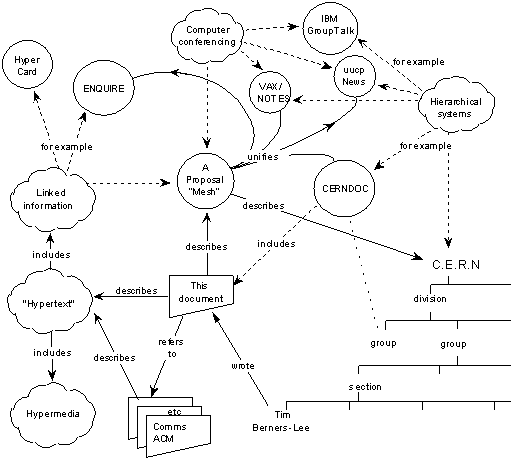
    These “new” on-page factors are the culmination of work dating back to the beginning of the modern Internet. The original diagram showing the basics of how the Web would work devotes much of its space to showing the connections between pages, but one corner lays the foundation for what is now known as the semantic web. This image shows a few of the basic properties in the semantic web: rel=author and other relationship markups, Schema’s breadcrumbs and on-page descriptions, and the hCard microformat.

    Each of these more recent formats are designed to expand on what’s called POSH — “plain old semantic html” — that is, using <p> tags for paragraphs, <ul> or <ol> tags for lists, and <table> tags for tables of data instead of as layout and design elements. The two most common microdata formats, Schema and Microformats, are each based on pure HTML, codifying the use of HTML5’s itemscope and HTML4’s class and ID attributes respectively. In this way, microformats seek to make standard web coding easier for computers to find and use the various data visible on the page.

    Implementing Microdata

    The four most common formats of microdata: XFN, OpenGraph, Microformats, and Schema, make an alphabet soup unwelcoming to newcomers. Part of microdata’s charm is its ease of installation. But while some ways to tell search engines and other scrapers how to index a page are somewhat more arcane, microdata sits on top of the code, easily being added to existing pages.

    Microformats and XFN require relatively little extra knowledge, while Schema and Open Graph assume a little bit of forward-thinking HTML5.

    Microformats & hReview

    hReview, like many compound Microformats, is based around hCard, which was designed to mimic the electronic business card format vCard. With hReview, you can easily mark up reviews to show in Google’s SERPs using standardized classes and IDs.

    In order to do this, there are two steps to the markup. The first is the hReview-Aggregate markup which gives the data shown in the SERP: number of reviews and overall ranking. The second are the actual reviews. Both use hCard to describe about or by whom the review is written.

    Here’s the hReview-Aggregate code from that page:

    <div>
    <h1>Patient Reviews for Columbus, Ohio Plastic Surgeon<br>
    <span id="donaldson-plastic-surgery">
    <span>Donaldson Plastic Surgery – Dr. Jeffrey Donaldson</span>
    <span>
    <span><span title="4661 Sawmill Rd #100"></span></span>
    <span><span title="Columbus"></span></span>
    <span><span title="OH"></span></span>
    <span><span title="43220"></span></span>
    </span>
    </span></h1>
    <p>
    <span>
    <span><span title="4.8"></span></span>
    <span><span title="5"></span></span>
    <span><span title="20"></span></span>
    </span>
    </p></div>

    Much of this example code won’t show, which is against Google’s rich snippets documentation; however, as you can see, the snippet shows in the SERPs. The class=”value-title” syntax follows the microformat specs from their site. But should invisible content be used? Or is it spam? More on that later.

    For the single hReview, the code is clear and most sections are visible. Again, use the value-title syntax to hide any data that’s not meaningful to the user.

    <div>
    <span><span><span title="Donaldson Plastic Surgery - Dr. Jeffrey Donaldson"></span></span><br>
    <span><span title="Tummy Tuck, Columbus, OH"></span><br>
    <span>
    <p>DESCRIPTION</p>
    <p><em>- <span>DM</span> / Columbus, OH </em></p>
    <p><span><span title="4.8"></span></span></p></span></span></span></div>

    XFN & rel=author

    Like microformats, there are other microdata formats that use HTML 4 entities, which keeps the code accessible to most levels of website owners. XFN establishes personal relationships between pages on the Internet and is one of the easiest microformats to install. Prepackaged in many basic WordPress installations, XFN has one major use: establishing your identity using rel=author.

    Using the XFN markup rel=”me”, which relates web pages about someone with social media and other profiles, and the microformat rel=”author”, which associates posts with other web pages about the author, you can let Google and other spiders know who wrote the post. While Google requires further steps and whitelisting to show up in the SERPs,

    For an example, take a look at our authorship markup.
    <a title="Posts by Julia Ramsey" href="http://www.searchinfluence.com/author/jramsey/" rel="author">Julia Ramsey</a>

    This links to Julia’s author archive page, which in turn has a link to her Google+ profile.
    <a href="https://plus.google.com/u/1/104804485354016147497?rel=author" rel="me"><img src="https://townsend.bunksite.com/wp-content/themes/si-dec10/images/g-plus-icon-32x32.png" alt="Find Julia Ramsey on Google+" width="30" /></a>

    There’s some other magic going on, but overall the rel=”me” XFN markup shows who wrote the page and connects it to a social network to grab more information.

    Open Graph

    Moving from connecting with to interacting with social networks, Open Graph is meta information for Facebook. While much of the Semantic Web is about marking up body content, Facebook’s meta information is in the header as tags.

    Using our site as an example:

    <meta property='og:title' content='SOPA Dope &#8211; Today&#8217;s &#8220;Blackout&#8221;, Tomorrow&#8217;s SEO Audit' />
    <meta property='og:site_name' content='Website Promotion Company: Search Influence -  Economical SEO New Orleans, LA SEO / Internet Marketing' />
    <meta property='og:url' content='http://www.searchinfluence.com/2012/01/sopa-dope-todays-blackout/' />
    <meta property='og:type' content='article' />
    <meta property='fb:app_id' content='197784673584291'>
    <meta property="og:image" content="http://graphics.nytimes.com/images/promos/politics/blog/23thompson-nbc.jpg" />
    <meta property="og:locale" content="en_US" />

    There are 7 required tags, mostly named logically. Two that are confusing are og:type and og:locale. The first should be “article” for most pieces of content. The “article” type is for anything that’s a single written post. Necessary, and not always included in Open Graph plugins, is og:locale, which refers to the language and location of the site.

    Schema for Music

    Finally, we come to Schema, the search engines’ attempt to standardize semantic microdata. Schema is deeper and more customizable than any of the other formats, however at the expense of clarity. It uses the itemprop, itemscope, and itemtype attributes from HTML5.

    Of all places to find a modern web example, MySpace’s band profiles use schema for music. Check out the music player on this band’s page.

    The code’s a little less clear because of the flexibility of Schema, but you’ll see by looking at the itemprop attribute that there is a wide variety of meta information categorized and sectioned in that small block of text. In the SERPs, it outputs as a rich snippet, linking to the individual song pages. Needless to say, while extremely niche, this power is invaluable for musicians and bands. All of Schema is this niche, but the benefits are massive, as seen here:

    Is it Spam?

    There comes a point where a marketer could easily see the potential for abuse. Hidden data, which we touched on before, is only one aspect. Certainly, there can be hidden data that is misleading, however it’s clear that some data doesn’t need to be for the end-user. Google’s guidelines say to not hide any data that is a rich snippet, but for things like a strict star rating for a text post and repeating the subject of the review, there’s good reasons to hide structured content.

    However, that hidden data quandary bleeds over to reviews in particular. No website owner is going to be happy about his own site showing his products and services to be low-quality. There is a clear directive for a business owner to cull bad reviews from his own site, and therefore the reviews may be less than perfectly accurate to their customers’ feelings. One way to avoid this would be to take advantage of user-generated content, with safeguards for malicious spam and abuse. Another would be to show accurate ratings based on a rubric, though that could easily become difficult for the website owner to get through.

    For social meta data, often a marketer will use different descriptions and titles to target better on a given social network. This can be used for a sly bait-and-switch, similar to some ads that use a voluptuous beauty to make you click on a much less interesting post.

    However, in most cases a high-powered sniff test and tummy check are all that are necessary to determine if something is spam. Certainly the tools would not be recognized by major search engines if semantic data were considered with the same level of scorn as some marketers have for pure meta keywords. If the reviews selected are glowing, why not give them all 5 stars? If the page is enhanced and not weakened by different social and search meta data, who would mind that?

    The Internet is best served by a semantic, rich web. A vibrant search page, a web that’s easily crawlable for information, and a social experience enhanced by relationships and attribution are all at the core of microdata: make the most of your site today with these techniques.

  • Read This! — February 2012

    Much like our weekly 5 For Friday series, Read This! is a monthly feature on our blog that collects all the practical guides and how-to’s you could ever want to help your business compete online. What’s on the roster for this month? Check it out:
     

    StumbleUpon: A Forgotten Social Media Goldmine — Nifty Marketing

    With the proliferation of people tumbl’ng, digging, tweeting and sharing, it’s easy to forget about one of the classics of link sharing: StumbleUpon. This powerful little tool has been around for years, and it may be time for you to think about utilizing it for your business.

    >How to Write Blog Posts For Your Existing and Repeat Customers — Graywolf’s SEO

    While maintaining a regularly-updated blog chock full of sparkling content is a great way to keep your link-rank high and attract new customers, don’t forget that your former and current clients are reading as well. Michael Gray provides a look at what will keep them coming back.

    Number Crunching: The Top 51 stats for Generation Y marketers — Next Web

    Generation Y, or the Milennials, connect to their surroundings via social technology on an unprecedented level. Check out these facts and figures to get a better handle on exactly where and how you should be focusing your efforts.

    5 marketing tips for putting customers first — iMedia Connection

    In order to bridge the gap from concept to plan to execution, marketing professionals must take great care to promote client satisfaction above all else. These handy tips provide a pitch-perfect guideline to putting your best foot forward when it comes to customer service on all levels.

    Things the Movie “Army of Darkness” Can Teach Us About Internet Marketing — Marketing Pilgrim

    Get your chainsaw-arm gassed up and at the ready, because Kerry Lee Gorgone of Full Sail University is here to tell you about how the teachings of everyone’s favorite zombie-slaying checkout boy can improve your online presence and increase customer interaction.

  • Mobile Search and Marketing – Catch the Wave, Surf With Style & Learn What The Path of Least Resistance Can Do For You

    Welcome to the Internet — but look up, you’re about to crash! If you are surfing the web today, it’s likely that your surfboard of choice is your phone. Hopefully you’re not multi-tasking behind the wheel of a car, but smartphones can provide most people with extremely useful tools for everyday life. As for marketers, surf’s up!  Phone marketing is the new big wave.

    The dawn of the Internet brought a whole new meaning to the desktop. Instead of a work machine/second-rate gaming station, we gained a window into the whole world, with access to new games, programs, ideas, music, arts, niche news outlets, and fascinating people. There are free games, for surf’s sake! And no longer do free games mean Hearts, Mine Craft and Solitaire.  We now have whatever we can get our downloads on to. And even if we want a game with a little more oomph, we no longer have to pay what now seems like a rip-off premium at our local retail national chain. We no longer have to buy what the retailers in our neighborhood are contracted to sell — the Internet lets us seek out what we want with hyper-specificity.

    For marketers, these are vehicles for their product. Web page after web page is filled with banners, popups and text-based ad campaigns. Spam emails flood our inbox every morning. Of course there are some more appealing and friendly avenues, including blog content campaigns and the ever-important SEO; the potential for abuse is there, but there are subtle ways to do it. All of these tactics have been frequented by marketing professionals for the past fifteen years, and they have produced extremely successful results for businesses independent, corporate and all between.

    The desktop is regaining its position as a work machine/game station, except every aspect of the desktop is now souped-up with the addition of the Internet. We may have a desktop that has a free copy of Open Office we grabbed online with a few clicks of the mouse, rather than a $249 copy of Microsoft Office. Even though Open Office is free, this very blog is being drafted on a licensed copy of Microsoft Word, because it’s already installed on my Mac. Why would I bother downloading what may or may not be sub-quality when my employer has already payed for this licensed copy of Microsoft Office on my machine? I could if I’d like, but again, why bother? Open-source is a draw, certainly. Maybe you will just prefer to use Open Office unless you’re in an environment where it is mandatory. I’d say that defies the path of least resistance. And that leads us to the trait we love about the Internet: it embraces the path of least resistance. It also has a pretty solid record of rewarding those individuals and entities that also embrace said path. So where am I heading with all this? Well, the path of least resistance: the mobile phone.

    In 2012, the Internet is on our phone. If I’m riding along in a car with my friends and we want to know what’s on the menu at a restaurant we’ve never been to, are we going to stop at a friend’s house to use the computer or, worse, go there ourselves? Oh no. There are mobile phones in our pockets that will be telling us what’s on that menu. Even if the restaurant’s website (if they have one) is not mobile-friendly, there are a slew of menu sites out there that are optimized for people in our exact situation. The question is, which site is optimized for our phones? That is the question you need to ponder as well, even in the context of your own website or marketing campaign.

    If you think that the Internet on the phone is only for those who are away from home, then you forget about the path of least resistance.  If I want to know who plays “Spartacus” in the new season premiere, my friend on his Evo already has the answer before I’ve even lifted my laptop from the coffee table in front of me. With the phone, the Internet is either already in your hand or less than a foot away. Desktops are becoming less and less the vehicles of surf, regaining their position as just workstations and game systems. The mobile phone is the new vehicle of surf. It’s small. It’s simple. It’s easy. And if you care about your bottom line, you better hop on this wave, or find yourself on the rocks.

    There are ways to prepare yourself for mobile phone marketing, like optimizing your website for mobile phones. To get into the real game, you can start testing out text marketing campaigns which are a real treat for bottom line as they are quick and easy for you to deploy. You can also engage with mobile phone-focused search engines. We will get into this and more in our next installment!

  • 5 For Friday — Links, Stories & Posts For Your Weekend

    The Difference between Good SEO and Great SEO — Search Engine Guide

    Are you one of the many business owners who’s decided to start a business during this challenging economic time? Competing online right out of the gate can be a deciding factor in your establishment’s survival. You’re probably already investing in your online presence to some degree, but check out this handy guide by Stoney deGeyter on the areas to maximize the potential of your efforts!

    Getting More Clicks On Twitter (Infographic) — Marketing Pilgrim

    Have you devoted serious thought to your content plan, scheduled your tweets in a timely manner and established a solid follower base, but still just aren’t getting the traction you want from Twitter? Optimize your tweets’ potential with this handy info graphic.

    Walking The “Be Human” Line In Social Media — Outspoken Media

    No matter how big the brand or careful the marketing team, nobody is entirely immune from a social media gaffe. When these events occur, however, the most important part is the response on the brand officials’ parts. Outspoken Media’s Lisa Barone takes us through a notable incident, and gives a few pointers on conducting oneself with grace via social media. Which segues nicely into…

    Using Social Media Profiles for ORM [Online Reputation Management] — Graywolf’s SEO Blog

    Online reputation management is as simple as making sure that positive chatter around an individual or establishment becomes more notable and relevant than potentially pre-established negative sentiment. Here, Michael Gray gives a network-by-network rundown of what you can do to make sure your brand is out there, established and buzzed-about.

    How To Respond To Negative Reviews — ProNet Advertising

    If you run a business, then chances are you’ve experienced a negative online review or two in your time. Valid or not, these reviews can really sting both on a personal level and potentially negatively impact your business. Here, Pronet’s Jen Williams gives some advice on how to best respond to a less-than-glowing evaluation in the online sphere.

    And as a bonus, here’s a reminder: if you haven’t seen it yet, our new Google+ for Business ebook, Seven Steps to Social Media Heaven, is now available for download! Check it out and get all the best tips on building up a circle, promoting your business and tracking your success with the fastest-growing social network out there.