Author: Search Influence Alumni

  • Search Influence Welcomes 4 New Guys & Ghouls To Our Legion of The Undead

    Search Influence Welcomes 4 New Guys & Ghouls To Our Legion of The Undead

    Search Influence is growing, growing, growing! Since we moved to the CBD, we have rapidly expanded. For us, though, it’s not all about the numbers. We’re just excited to welcome incredible people to our team. Get to know our newest influencers:

    Aubrey-AhmedAubrey Ahmed – Junior Internet Marketing Associate

    Born and raised in New Orleans, Aubrey completed her undergrad at Loyola University, where she majored in English and French. While working toward her master’s in education, she spent a year teaching in France before returning to her hometown for a change of pace. She is passionate about books, art, traveling, and writing. She is looking forward to beginning this new chapter at Search Influence!

    Drew-RoweDrew Rowe – Junior Account Associate

    Drew grew up in in a small beach town in Los Angeles, but went to LSU for college. She graduated in May with a major in communications. Even though she loves California, she decided to move to New Orleans because she loves how friendly the people are here. She also loves the food, of course. Fun fact about Drew: all through high school, her ID said Mr. Drew Rowe because they assumed, based on her name, that she was a guy.

    Jessica-KerseyJessica Kersey – Junior Internet Marketing Associate

    Like most military kids, Jessi spent her formidable years all over the country. She has lived in two countries, five states, and one island. In 2014, she graduated from Cedarville University with a B.A. in journalism. New to New Orleans, she hopes to discover all the amazing secrets the city holds. Jessi is also a hardcore pop culture and canine enthusiast.

    Mathieu-GalyMathieu Galy – Junior Internet Marketing Associate

    Originally from Toulouse, France, Mathieu graduated from the Business School of Paris in 2013 with an M.A in International Marketing and Communication. After graduating, he moved to New Orleans to follow his spouse. Since then, he has been enjoying everything that New Orleans has to offer and he has been giving his time to help Audubon Zoo as a volunteer. Mathieu loves baking French pastries, making his friends happy, and their dietitians a bit less! He is totally fond of his English bulldog, Fluffy.

    Welcome Aubrey, Drew, Jessi, and Mathieu, we look forward to all of the great things you will accomplish with Search Influence.

  • The Saints Fan’s Guide To Schema

    Saints season is underway as our boys in black and gold try to bring another Super Bowl win back to the Bayou. Fall season isn’t just a time to enjoy football accompanied by ice cold bevs, a few Lit’l Smokies, and a seven-layer dip, it’s also the best time to ask yourself if you’re getting the most out of schema – one of the most untapped resources in online marketing.

    QUARTER ONE – SCHEMA, BUT WHAT IS IT?

    First off, Who Dat. Secondly, schema is an HTML markup that you can add to web pages to make them more easily readable by search engines. Schema is essentially a type of label similar the numbers on a player’s jersey. Schema gives the crawler an idea of what the content on a page can be categorized as, sort of like how numbers on a jersey can tell you what position a player is (btw, go number 9!!! #breesus).

    QuarterOne

    QUARTER TWO – OKAY…SO, WAIT, WHAT?

    Trust me, schema is great. Still don’t believe me? According to a Searchmetrics case study, pages with schema.org integration on average rank four positions higher compared to pages without schema. Not to mention Google officially recognizes schema in the same way that coors light Bud Light is recognized as the official beer of the NFL.

    QuarterTwo

    HALFTIME – STAND UP & GET CRUNK!

    Also, time to dispose of a few soft pretzels and tray of N’awlins Nachos.

    QUARTER THREE – I AM PRETTY FULL, BUT WHISTLE MONSTA IS HERE, SO LET’S DO THIS.

    Now that you are all in on the schema bandwagon, you need to figure out what kind of schema you should be using. This is where you need to develop your schema playbook. There is an incredible amount of schema out there – and that is an understatement. To get started, try checking out the local business schema on schema.org. If you have reviews on your page, another good starting place may be schema.org/Review.

    QuarterThree

    QUARTER FOUR – CLEAR HIERARCHY, FULL HEARTS, CAN’T LOSE

    Time to implement schema and bring home that elusive win. Schema markup is added within HTML tags on site pages. Both HTML and the schema are structured according to a clear hierarchy, which is important to remember when choosing which schema properties to use for markup.

    QuarterFour

    0:00 4TH QTR – FINAL SCORE: SAINTS WIN! SAINTS WIN!!!!

    And most importantly, you win too. Schema is often misunderstood, but if used correctly, it can be one of the most powerful tools in an online marketer’s arsenal. Thanks for reading, and GO SAINTS!

    Take a more in-depth look at schema with this blog from SI web developer, David Fransen.

  • Is Apple Pay Keeping Google Wallet Away? Yelp Gets Posh + More!

    1. Apple Pay Launches as a part of iOS 8.1
    – Mashable

    On Monday, one of iOS 8’s most anticipated features, Apple Pay, went live. iPhone 6 and iPhone 6 Plus users only had to download the iOS 8.1 update and add a credit card to Passbook to start using the feature. In theory, a user only need connect a card, hold their iPhone to a pay terminal, use their personalized Touch ID and be on their way.

    Apple Pay does not link with loyalty cards, nor can it bypass the seemingly never ending prompts you encounter at supermarkets and drugstores. The near field communications (NFC) feature can work with most payment terminals, with most major banks and the list of participating merchants is expected to continue to grow.

    ApplePayImage-SearchInfluence

    2. Google was here first with Google Wallet
    – Mashable

    Although Apple Pay has greatly overshadowed it, Google has had a similar system since 2011 called Google Wallet. But if Google really was the hipster of cellular device tap and pay, why is Apple getting all the credit (pun intended)?

    Apparently, it’s the service providers such as AT&T, Verizon, and T-Mobile that have been obstructing the visibility of Google Wallet for the past three years. While Google controls the Android software that carries Google Wallet, the service providers control the hardware and carried minimal phones capable of using the feature. Apple, on the other hand, controls the hardware and software of their devices.

    Google hopes to gain more media and user attention following the launch of Apple Pay because unlike Apple, Google Wallet is compatible with any bank and any credit card.

    3. Drivers for Uber Protest Company Policies
    – Business Insider

    Drivers for the ridesharing service, Uber, are not happy this week. On Tuesday, drivers organized across the country to protest the company’s policies, including those on reduced fares, tipping, the driver rating system, and driver safety.

    Drivers say that because of Uber’s reduced fares, they are losing money and find shorter trips not worth the cost of gas they require. They feel the company’s automatic tipping policy, that requires drivers to deny cash tips from customers that wish to give one, is only adding to their struggles. Drivers also face concerns over their personal safety when dealing with disgruntled or intoxicated passengers.

    Uber has yet to comment on the matter.

    UberProtestImage-SearchInfluence

    4. Yelp Adds Hotel & Winery Reservations to Business Pages
    – MarketingLand

    Remember last year when Yelp teamed up with OpenTable to make booking a restaurant reservation as simple as a tap of a button? Instead of food, this time it’s rooms and wine. Early on Monday, the company announced that business pages would now do hotel bookings, via Hipmunk, and winery reservations, via CellarPass. Yelp has also expanded its booking services to a number of other third party delivery and reservation services.

    While Yelp does not charge businesses directly for access to these features, the third party providers do and give Yelp a share.

    5. Maps Connect – An Aspirin for the Maps Corrections Headache
    – Search Engine Land

    On Tuesday, Apple launched Maps Connect, a free service that allows small business owners to manage listings on Apple Maps via their Apple ID. The process requires a one-step verification phone call. After that, the business owner is free to manage their listing or listings seamlessly. Updates or newly created listings show up within a week or sooner.

    The service does require an Apple ID, so those without it will need to download it. It also is intended for small business owners themselves, or authorized representatives, but not third party agencies.

    Currently, Maps Connect is only available stateside, but Apple plans to expand overseas in the future.

    AppleMapsUpdateImage-SearchInfluence

    Image Sources:

    Thanks to Mashable for the Apple Pay photo, Maya Kosoff of Business Insider for the Uber protest photo, and Search Engine Land for Apple Maps Self-Service photo.

  • Google Gives Answers To Life, Love, & The Universe

    As you may or may not have noticed, prevalence of Google’s answer boxes among search results has increased dramatically. Google’s algorithm updates have always pushed the search engine to more closely mirror the human searchers, aiming to provide the best answer to each question. With the collection of Google’s Knowledge Graph (their personal database of information and the interconnectivity of ideas), they have announced their goal of transforming from an “Information Engine” to a “Knowledge Engine.”

    From Google’s Knowledge Graph, a new item has emerged in search results: the answer box.

    If you haven’t seen them (and have no idea what I am talking about), let me back up. According to Moz, Google now displays a direct answer in 3.5% of search results, as opposed to the standard 10-pack of results, sprinkled with some PPC ads.

    These direct answer results have been around for well over a year (I found posts introducing them in August of 2013). However, answer boxes are being seen in 44% more search results after the rollout of Panda 4.1. So, more people are seeing them and more people are talking about them!

    Answer Box 1.0

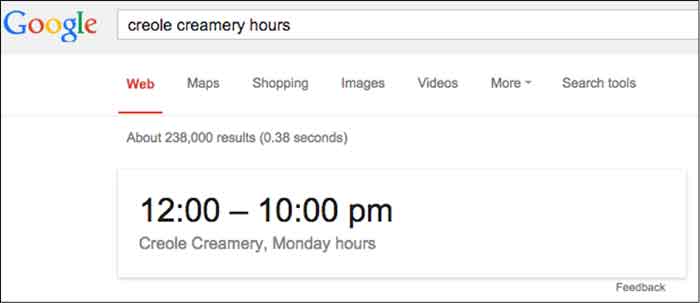
    The first generation answer box was a Google SERP feature. These early answer boxes provided short, direct snippets of information that were concise and, ultimately, limiting. Below is a perfect example that still holds this early answer box format:

    Google Answer Box Hours Of Operation Image - Search Influence

    Dr. Peter J. Meyers provides 101 other examples of early answer boxes in this blog. Quickly scrolling through them, you’ll notice they all look pretty similar and pretty boring.

    Answer Box Evolution

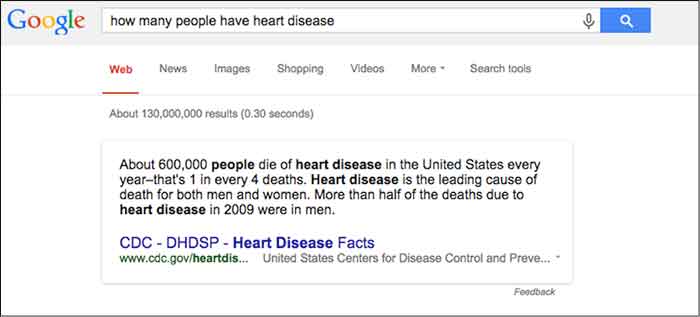
    Over time, the answer box has drastically evolved. Google quickly realized that it could not index every possible answer to every possible question. Spoiler alert, Google doesn’t like to be limited. So, instead, Google used its vast index of the Internet to pull results from sites, creating a completely different answer box that looks more like:

    CDC Information Pull Google Answer Box Image - Search Influence

    This, however, can pose problems. Sometimes, Google pulls answers from long-outdated websites, which can provide an incorrect or inappropriate answer.

    There are going to be instances where Google provides an insufficient or incorrect answer. When this happens, rejoice because even Google is imperfect. One example (and, yes, I’m being excruciatingly picky here) cropped up while I was doing research for one of our clients.

    HowManyHeartDiseaseGoogleAnswerImage

    Initially, my reaction was “Cool, that’s some information that I could use,” but then I realized it wasn’t the information I was looking for.

    StarWarsJediMindTricksImage

    Nice try Google. I was looking for how many people have heart disease, not how many people die from heart disease.

    But, you’ll notice that there is this handy “Feedback” button at the bottom. Here, you can write a personal message to Google telling them to get their act together. Yes, you can be a part of the Google movement.

    Other issues can occur when Google pulls from sites that are out-of-date. So be on the lookout, and when you find inaccuracies provide concise feedback, and be on your merry little way.

    Other Answer Box Speciation

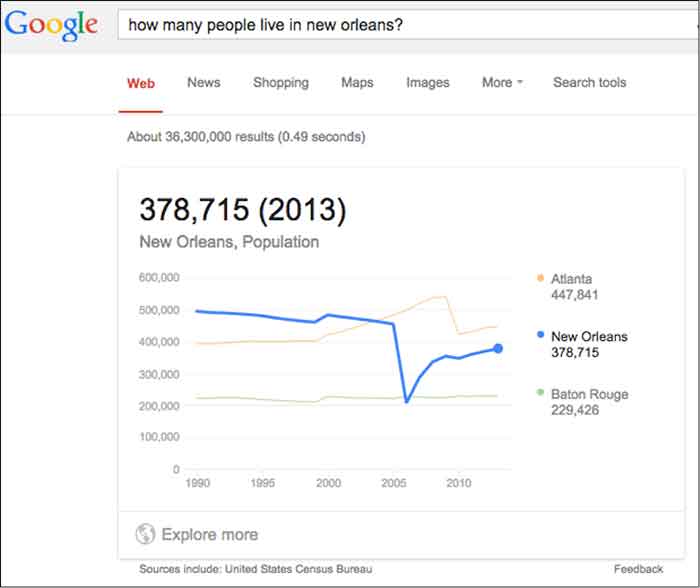
    Population – This one is actually interactive and will show the population anywhere along the measured domain.

    Interactive Population Google Answer Box Image - Search Influence

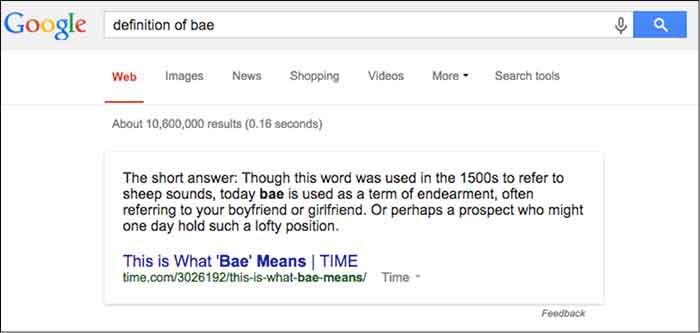
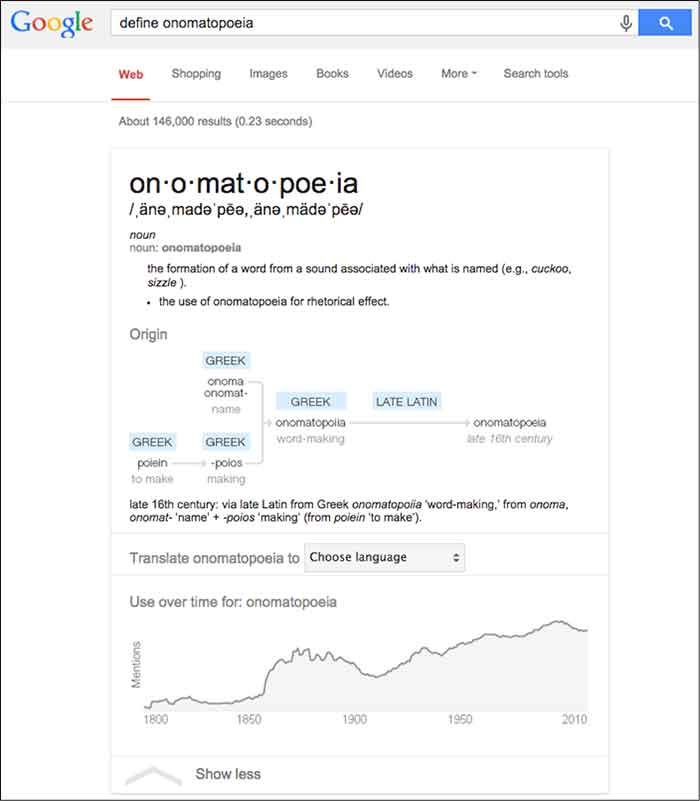
    Etymology & Definition – As a copywriter, this is a personal favorite of mine. I imagine this will do wonders for future linguists and English majors as they can find definition and historical context, all in one search.

    Definition Google Answer Box Image - Search Influence

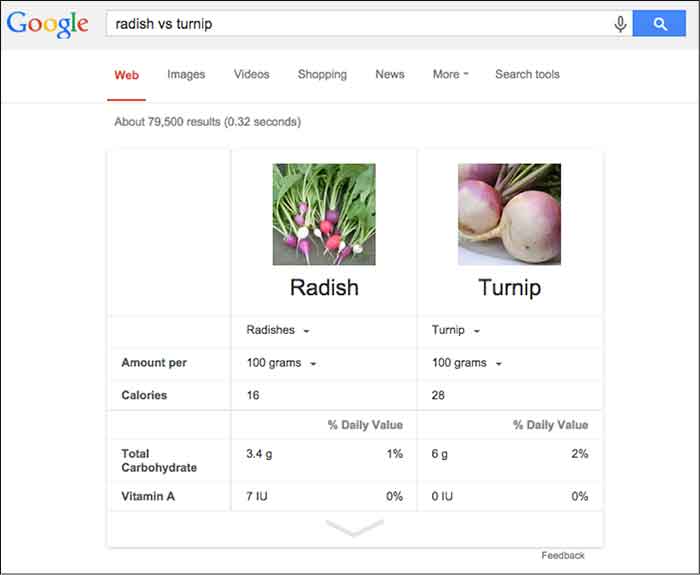
    General Knowledge – What is a thing? Compare and contrast objects or see a specific object defined across a wide array of variables.

    Comparison Google Answer Box Image - Search Influence

    These are just a few examples of an infinite amount of possibilities and I expect Google to only further diversify its answer boxes as its Knowledge Graph continues to expand. However, you’ll notice that, in general, the newer answer boxes seem much more comprehensive, colorful, and engaging. It seems fairly certain the we will continue to see these answer boxes more often as Panda stays on patrol.

    Why Now, Google?

    Plain and simple: mobile search is on the rise. Mobile users already account for more than half of all site traffic. The percentages are even more staggering for social sites such as Facebook and Twitter. Google is in tune with the mobile trend.

    The mobile searcher is a completely different animal than the traditional laptop user. Personally, when I am searching on my phone, I am looking for something very specific. That could mean any number of things — hours of operation, contact info, a trivial fact… The point is, I’m not in the mood to sift through a second layer to find that information. Google appeals to the mobile user in all of us with these answer boxes.

    Also, Google’s answer boxes are another push for clear, concise, valuable information. Google is, afterall, a search engine. Users are searching for information. Google continually updates its algorithms to effectively provide the best possible information.

    On its own site, Google says, “Get answers no matter where you search. Information from the Knowledge Graph is available on your desktop, tablet, and smartphone. So wherever you search on Google, you’ll find that answers and discovery are at your fingertips.”

    What Does This Mean For Your Site?

    In theory, if you’ve earned enough authority points from Google, your site could be a source included in the answer box. Unfortunately, unless you are the CDC or Times.com, this is highly unlikely for broad searches. To get pulled into more localized questions, there are things you can do to signal to Google, “Hey, this is an important piece of information.”

    One such way is schema, which classifies bits of information so that it is easier for search engines to digest. You can learn loads more about schema here and in an upcoming blog post.

    What kinds of answer boxes have you seen? Have you come across any issues with terrible (or terribly funny) Google answers? What do you think of them? Let us know!

    Image Source:

    Thanks to Tina Grimes for sharing the Star Wars mind trick gif.

  • What’s Black and White and Impacts 3-5% of Search Queries? Panda 4.1!

    In the last two months, Google has been busy improving the Panda. In early August (Aug. 8, 2014, to be exact), there was a lot of chatter from the SEO community seeing the flux in Google Analytics accounts, which was generally accepted as an unconfirmed monthly Panda data refresh.

    In early September, there was a large Panda data refresh, and on Sept. 25, Google’s Pierre Far announced yet another Panda algorithm update, (the previous Panda algo update was May 19).
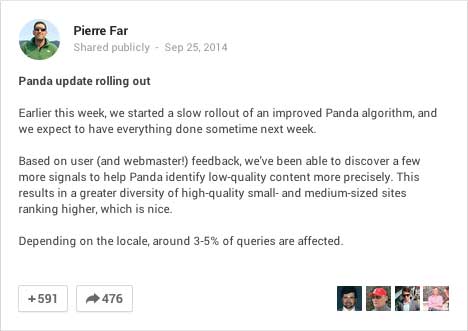
    GooglePlusPostPandaAnnoucedImage

    And just to keep you on edge, ceaselessly examining your Analytics data, the rollout of this Panda has been sloooowwwwslothlike. Google confirmed that some Google data centers were not updated until “October 6 or later.” So, your website could have seen the algorithm at some point before Sept. 25 and after Oct. 6 – that’s a two-week time frame to analyze!

    What is Panda?

    There are so many blog posts out there describing the Panda algorithm, I will just summarize it briefly. If you’re interested in reading about it in more detail, here’s a good blog post, and some excellent reading here.

    Panda is an algorithm that filters the search results to:

    1. Reward high-quality content with more presence
    2. Push sites with thin content down to rank lower

    Google says low quality or thin content is text that

    •   Is very short in length
    •   Offers very little useful information to the consumer
    •   Is unoriginal or copied

    Your website content should not be self-serving; it’s all about providing information to the consumer to educate them with detailed and authoritative information.

    PandaContentPullQuoteImage

    This most recent Panda is an algorithm update, which is supposed to reward more high-quality small and medium-sized websites. From Par’s G+ post:

    “Based on user (and webmaster!) feedback, we’ve been able to discover a few more signals to help Panda identify low-quality content more precisely. This results in a greater diversity of high-quality small- and medium-sized sites ranking higher, which is nice.”

    This update is significant because it added more signals to better identify lower quality sites. Earlier algo updates have rewarded big directories for local searches, so this update is exciting because small- and medium-sized websites have a fighting chance for ranking in their local markets.

    Google Updates vs Data Refreshes

    To paraphrase, an update is a change in the algorithm. A data refresh is when the algorithm has not changed, and new data that is pushed through the data centers, such as new crawl data, is updated in the various data centers across the Google universe.

    Updating the data centers is one reason why updates are seen at different times for different geographies.

    I am quoting this really old Matt Cutts blog post here:

    Algorithm update: Typically yields changes in the search results on the larger end of the spectrum. Algorithms can change at any time, but noticeable changes tend to be less frequent.

    Data refresh: When data is refreshed within an existing algorithm. Changes are typically toward the less-impactful end of the spectrum, and are often so small that people don’t even notice. One of the smallest types of data refreshes is an:

    Index update: When new indexing data is pushed out to data centers. From the summer of 2000 to the summer of 2003, index updates tended to happen about once a month. The resulting changes were called the Google Dance.”

    What are data centers? Google crawls the websites out there and caches those in their gigantic index. That index is huge and is stored on thousands of machines. Those thousands of machines live in various Google data centers around the world. To truly geek out, read more about Google data centers here – these centers are where the Internet exists.

    Did Panda Help or Hurt Your Site?

    When you look in Google Analytics, it may be easy to see a drop off or dramatic increase. For example in the graphic below, I’m guessing Panda rolled out in the business’ local area around Oct. 6, and it didn’t go well for the site:

    Panda rolled out Oct 6, 2014

    And on Sept. 29, this site was Panda-happy:

    increase in Google organic traffic after Panda September 2014

    For most of the sites I looked at, the visual changes were more subtle, so I usually toggle between the data by week vs. the daily data. The weekly data shows me a week where the decreases started, which correlates to the earlier rollout dates:

    weekly analytics view to pinpoint Panda rollout

    When I switch to the daily data, I can clearly see the dips in traffic. I have to pinpoint Saturday, Sept. 20t or Wednesday, Sept. 24 as the day this site got the Panda.

    daily Analytics shows dips in Google organic traffic after Panda

    The Sept. 20 might be a little early to fit in the Panda time frame, and I am accustomed to seeing a spike immediately before an algo filter, so I’m going for Sept. 24. Using Sept. 24 as the before and after date, this website has seen 12% decrease in Google organic traffic.

    12% decrease in Google organic traffic after Panda Sept 2014

    This website with the 12% decrease in Google organic traffic after Panda is a good website for an authoritative local business. What this drop tells us is even if the content on the site offers really great information for the consumer as this one does, it might be old and/or thin. Someone may have copied it over the years. We might need to add other content to our pages with images and videos. Content is not just text. We need to take a good look at the age of the text and the variety of the content on the page. With this review, we can create a strategy for improving the content for the next Panda data refresh.

    What to Do Now

    PandaImageWebsite owners or managers who see a Panda smack really need to take a critical look at the content on the site. To succeed, the content needs to be information rich, and not self-serving.

    An example of self-serving content is content that is stuffed with keywords, abundant keyword use on a page not only in the body text, but also in the URL and alt tags. This is also sometimes referred to as over-optimization.

    Self-serving can also mean the content talks too much about the business instead of talking about the product or service the consumer is trying to learn about. Talking about the business is great as long as it’s on the About page or the home page. Leave products or service pages to be about those topics.

    This is a great list compiled by Josh Bachynski “The Complete Google Leaked PANDA Do & Don’t LIST – 2011 to Present.”  This list really dives into the aspects of good and not-so-good content.

    Google published a list of questions to ask when writing content. The full list is here. I have chosen some to republish below:

    • Would you trust the information presented in this article?
    • Is this article written by an expert or enthusiast who knows the topic well, or is it more shallow in nature?
    • Are the topics driven by genuine interests of readers of the site, or does the site generate content by attempting to guess what might rank well in search engines?
    • Does the article describe both sides of a story?
    • Does this article provide a complete or comprehensive description of the topic?
    • Are the pages produced with great care and attention to detail vs. less attention to detail?

    Diversity of content and freshness of content are also factors to consider.

    Diversity of content helps readers in various ways. Content can mean images. Original images are best rather than stock images, but stock images work. Content can also mean videos, charts, calculators, and reviews. Content is anything that helps the consumer learn more to make well-informed decisions.

    For content freshness, a blog is probably the easiest approach to keep the website updated regularly without having to rewrite your page’s content too often.

    If you have a specific owner or practitioner who is the authority on the information, claim that using Author markup – authorship thumbnails are gone from SERPs but that doesn’t mean the Author authority is gone.

    There are so many tactics for coming back after a Panda smack, and the best strategy is a mix of tactics. It will likely take time to create really good content and build back your website credibility, but it is a necessary investment for your site’s success.

    If you think your site is suffering from the Panda, give us a call. We would be glad to help.

  • Five For Friday: Paging Dr. Google, Panda 4.1 Is On The Loose, And More!

    GoogleKneePainAnswerImage

    1. Google Gets a Medical Degree
    -Mashable

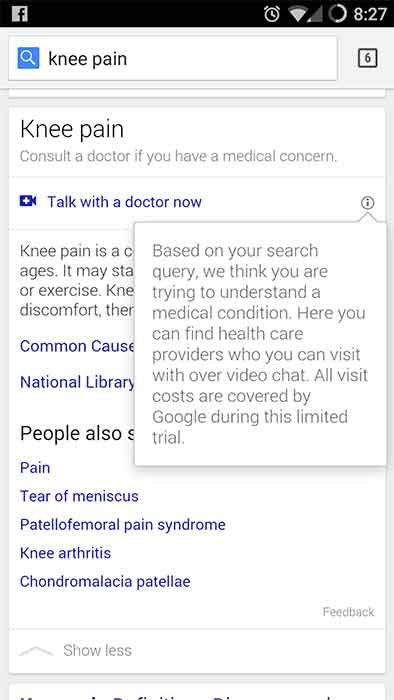
    In what may prove to be the coolest Google project all year, reports have surfaced that the search engine plans to implement a feature to their already lauded Helpouts initiative. The new project will attempt to take health-related symptomatic searches and connect users with real doctors online. All costs are being covered by Google during the limited trial period, however it may cost you as the service is refined. The impact this will have on health professionals is exciting, and could transform an entire industry. The opportunities this service poses are truly endless, especially when you consider the degree of Google’s philanthropic endeavors.

    2. The Forgotten Curriculum
    -Moz

    Carla Dawson of MobyDigital discusses the pros and cons of teaching SEO at universities.

    As a recent graduate frustrated with the absence of tech-related courses being taught at my alma mater, I strongly believe in this move to educate the average university student on the subject of SEO. The article poses quite a few points of contention and agreement, here are a few that stuck out:

    1) Pro: Everyone says they know SEO. Without a standard for learning SEO, there can be no true credibility among firms. Teaching these skills at universities will quell [most] questions about a persons knowledge base.

    2) Pro: Today’s student is tomorrow’s potential client. Students who learn SEO in a formal setting will be able to sell [and be sold] SEO services more effectively.

    3) Con: Google algorithmic changes are frequent, and transform the industry.  The single most significant obstacle to teaching a standard course on SEO is the fluid nature of the industry.

    3. Panda Does Not Approve of Average Content
    -Business 2 Community

    The most recent tweak to the Panda Algorithm is in full swing. Nothing about this update is drastically different from what we have seen before, but Google is making it clear that authentic, well-vetted content from small and medium sized businesses remains a staunch priority.

    This checklist, provided by Google, is a great resource for those writing content for their business:

    • Would you trust the information presented in this article?
    • Is this article written by an expert or enthusiast who knows the topic well?
    • Does this article have spelling, stylistic, or factual errors?
    • Does the page provide substantial value when compared to other pages in search results?
    • Was the article edited well, or does it appear sloppy or hastily produced?

    TheAngryPandaCommercialSquareGifImage

    4. The Semantic Future of Link Building
    -Moz

    In his most recent submission to the MOZ Blog, Paddy Moogan discusses the impact on link authority, as Google continues to prioritize semantic search over exact-match keywords. As Google continues to understand search intent more and more, the rules surrounding link building will change. Paddy argues that the quantity of links, the anchor text of the links, and deep linking will matter less and less in the coming years.

    5. What Is Your Take on B2B Marketing Strategy?
    -Search Engine Land

    The recent banishment of the Google Authorship markup inspired annoyance in people like Derek Edmond, of KO Marketing. The impact on B2B Marketing from this discontinuation is very real to a certain niche, but as the wild world of SEO ebbs and flows, Derek reminds us of four tactics employed by B2B marketers that have had success in the past. Will marketers continue to build on these tactics, or abort them entirely?

    1) Purchasers prioritizing “thought leaders” in their industry. This tactic was primarily employed by the use of Google Authorship and Derek believes some kind of platform will fill this void in the future.

    2) Infographics are well respected, and oft-cited, however the market for infographics is so saturated that it is becoming increasingly difficult to create effective infographics.

    3) Derek argues that guest-blog posting is tricky game. The useful expertise provided by credible commenters can boost your authority as a business. On the contrary, Google considers guest blogging to be spammy, and it is easy to have unreliable sources hurt your authority.

    4) Derek warns against the dangers of spammy content, and questions the SEO usefulness of using Twitter to market your business. Matt Cutts of Google has stated that the search engine does not consider social signals when it comes to rankings. However, Derek argues that using Twitter as a tool to build relationships proves to be invaluable.

    Thank you to Panda Cheese for the great angry panda commercial!

  • Here Comes Fun: The ONLY Time A High Bounce Rate Is A Good Thing

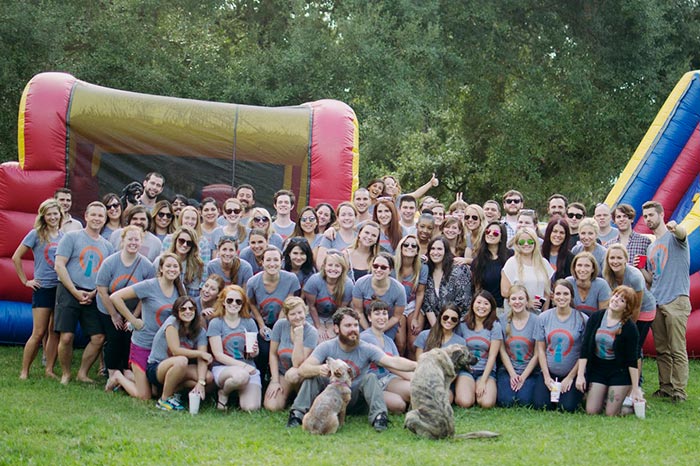
    Any employee at Search Influence will tell you we take our company team-building events very seriously. I have experienced two of these events since I started at Search Influence less than a year ago, and each one has brought the employees of our company closer together. This event was no exception. After all, who wouldn’t bond over inflatable jousting?

    SI-FAMILY-PIC

    It is 3:00 pm on a beautiful Friday afternoon, and everyone begins arriving at New Orleans City Park. With some help from our friends at Space Walk, we created an inflatable fun-zone, complete with an inflatable obstacle course, water slide (sans the water – let’s keep City Park clean!), and the overall favorite – jousting.  In between some friendly inflatable competition, everyone enjoyed the carnival-style concessions we had set up, complete with hot dogs, cotton candy, popcorn, and a variety of cold refreshments.

    SI-FUN-COLLAGE

    While enjoying the entertainment and food, we were thrilled to recognize the three expecting mothers and one expecting father on our team! Maggie Emerson, Erica Rench, Tracy Stoller, and Justin Scott all received Search Influence onesies for their mini Google expert’s arrival. We can’t wait to meet them!

    SI-ONESIES-IMAGE

    Overall, it was another successful team-building event for Search Influence. Everyone had a great time, and the newer members of our quickly growing team got to see what this group is all about. I can’t wait to see what our next quarter team building committee comes up with next!

    SI-JSLL-IMAGE

  • SI: Taking Care of Business and Working [Out] Overtime

    Rates of obesity are plateauing, healthy eating is up, and work fitness programs are on the rise. Fitness isn’t a fad or a trend, it’s a lifestyle change that a large part of the country is starting to value. But is your regular exercise regimen enough if you spend eight or more hours sitting per day? According to Time Magazine’s review of 43 studies on sitting, a sedentary lifestyle can increase your likelihood of getting cancer, along with a slue of other health problems.

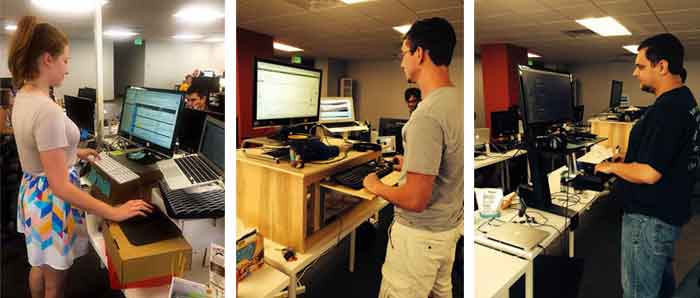
    With this in mind, some influencers have taken advantage of our company’s team spirit and new downtown location’s extra office space to incorporated some office fitness into their daily routines. Here are a few ways you can incorporate a little more movement and little less sitting into your daily work flow.

    Trek to Work:

    SIBikeToWorkImage

    Your trek to and from work can be a great time to squeeze in some cardio. Biking or walking to work can help energize you in the morning and give you a boost of endorphins after a long day at work. Exercise before work can also help your memory and recollection, according to the New York Times.

    “Biking every morning is a really great way to start and end the day! It wakes me up and keeps me energized throughout the day, while also saving parking money! It’s a quick and easy way to get some exercise in a busy 9-5 schedule.” – Sabrina Mohsenin

    “Moving downtown made it worth the ride for me. From my house, after dropping my 12 year-old, it’s a little less than 5 miles. On my ambitious days I’ll extend it and go out and around city park which is 15 miles or more. Everybody was excited when we moved that we had a gym in the building. I’ve never used the gym, but I use the locker room shower plenty!” – Will Scott.

    Live too far from your office to walk or ride your bike? Parking at the edge of the parking lot or choosing a parking garage a few blocks from work can help add valuable steps to your pedometer and get your heart pumping.

    Climb the Stairs:

    SIClimbTheStairsImage

    Incorporating some cardio into your day can help you shake off pent up energy and increase concentration. Try ditching the elevator and taking the stairs.

    Not willing to climb the stairs with your purse, lunch box and computer in hand during your morning and evening commute? Try Chris Dopper’s ‘Crush the Stairs and Kill Some Calories’ challenge.

    “After reading the article ‘The War on Sitting’ on Time.com, I realized we are sitting WAY too much. Every place you go, there is an invitation to sit down; in the car, on the subway, at work, at home. Therefore I set up ‘Crush the Stairs and Kill Some Calories’ and invited the whole company to join me in walking up the stairs three times a week. We are located on the thirteenth floor, so we walk up 13 flights of stairs and each week we add one floor. Around 10% of my colleagues accepted this ‘challenge’. Out of breath, but satisfied, we give each other an awkward high five on top of the stairs. According to Business Insider, your brain shows more activity after exercise, so working on the physical also does wonders for the mental. What’s not to like!?” – Chris Dopper

    Build a Standing Desk:

    SIAllStandingDeskImage

    Standing is one of the more obvious solutions to sitting too much at work. While that may seem unrealistic or like an expensive investment in office furniture, there are simple ways to build a standing desk with items you can find around the office. Make sure your monitors are high enough so that you don’t need to crane your head down. Also, make sure your keyboard is high enough to keep your arms at a 90 degree angle.

    “Standing instead of sitting for 3 hours a day at your desk for a year is the equivalent (in calories burned) to running 10 marathons! My posture has been better and I’m using my abs and back more. My core area has been sore, because I’m using it so much more now and was probably not using it at all before.” – Cory Badeaux

    Sit on an Exercise Ball:

    SIExcerciseBallImage

    Using an exercise ball as a chair in increments throughout the work day can help with core stabilization and posture.

    “Since I’ve started using my exercise ball at work, I’ve noticed a big improvement in my posture. I’m standing straighter and have noticed that I have a lot less tension in my shoulders and back!” – Erika Karas

    As general rule of thumb, people under 5’3” should use a ball that is 55 cm in diameter. If you are between 5’3” and 6’ try a 65 cm ball. If you’re taller than 6’, you should use a ball that is 75 cm. You can also measure the height of your chair and go from there. Try to maintain a 90 degree angle at your elbow with your arms slightly extended towards your keypad. For more info on how to use the exercise ball, check out this article.

    Not ready to commit to a full exercise ball? Some influencers have started using the discball to help their balance and posture while sitting in an office chair. The discball provides many of the same benefits of the full exercise ball without the bulk.

    SIDiscBallPostureImage

    “Sitting on the discball has really helped me maintain my posture throughout the day.” – Andrea Hernandez

    Participate in Group Exercise:

    SIHappsRunningClubImage

    Utilizing your support system at work is a great way to keep yourself accountable for your fitness goals. Participating in scheduled and structured exercise with your colleagues after work can keep you motivated to attend and to push yourself. Taking part in running clubs, yoga classes or other exercise groups that meet at the end of the work day is a fun way to be both social and active.

    Influencers have been attending Happy’s Running Club on Wednesday after work for a leisurely jog through downtown New Orleans and 2-for-1 beers to hydrate after.

    “Anyone who runs knows the running community is one of the most welcoming and supportive groups. A few years back we started the SI Running Club to help everyone train for some of the big races around NOLA. At the time, our office was Uptown and the team ran from Oak to Audubon and back to finish at Carrollton Station for a beer. Even though many of the members in the running club were more walkers than runners, I noticed something on that first run. I saw so many of our runners (daily runners, race runners, half and full runners) running with the slower ones to help encourage them and push them to the finish. For those five miles we weren’t Account Managers, or Developers, or Production members but a true team. This is still by far my favorite team building exercise yet! Even with the move downtown, the running group still goes on, but now we meet at Happy’s Running Club on Wednesdays. I’m still working on getting the team to run from the new office to the old office for old times sake!” – Gabrielle

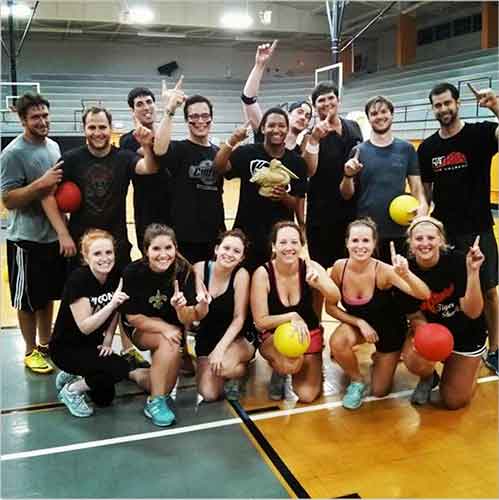
    Play Team Sports:

    SIDodgeBallImage

    Team sports are another fun way to get some exercise while building camaraderie with your colleagues. This summer Search Influence participated in the New Orleans Dodge Association’s League. The team worked together by combining their strengths and strategy to win the championship.

    “As much as the culture in New Orleans dictates great happy hours with your co-workers, breaking a sweat playing a team sport can be even more beneficial for your relationships and certainly better for your health. Dodgeball has been exactly that for the team at SI. It’s a great change of pace and good opportunity to see your coworkers in a new light.” – Scott Holstein

  • Putting The 8 In Teammate: Search Influence Welcomes 8 New Influencers

    Putting The 8 In Teammate: Search Influence Welcomes 8 New Influencers

    Search Influence is happy to introduce its eight newest members. Every month, our team continues to grow!

    Andrea-Siegel-ImageAndrea Siegel – Junior Account Associate

    Originally from Miami, FL, Andrea moved to New Orleans to attend Tulane University. She majored in marketing and loved every second of her Tulane Experience. Andrea decided to stay because she loves the food, music, and culture that New Orleans has to offer. She has danced her whole life. So, if there is a dance floor, you will 100% catch her busting a move (and even sometimes when there isn’t one).

    Courtney-Cummings-ImageCourtney Cummins – Junior Quality Assurance Specialist

    Courtney grew up in Oxford, North Carolina and graduated from the University of North Carolina Wilmington in 2011 with a B.A. in Communication Studies. After graduating, she worked as an estimator for a precast construction company. Courtney worked in construction for two years before deciding to embark on a new adventure in New Orleans. In her free time, she enjoys playing in different sports leagues, going out with friends, and checking out live music. Courtney is excited to call New Orleans her new home and to be joining the Search Influence team!

    Kaitlyn-Levy-ImageKaitlyn Levy – Junior Internet Marketing Associate

    Kaitlyn Levy currently attends Loyola University of New Orleans pursuing a bachelor of arts in graphic design. Before working at Search Influence, she worked at the Mayan Import Company, a cigar shop, and We Are Constance, an indie print shop. Kaitlyn can speak French fluently and, on a good day, can stumble through German. She is known for her giant, toothy smile and good humor, which she looks forward to sharing with all of Search Influence.

    Lucy-Stratton-ImageLucy Stratton – Internet Marketing Associate

    Originally from northern Virginia, Lucy moved to New Orleans to pursue her bachelor’s degree at Tulane University. She graduated a full academic year early with a double major in English and Political Science. Lucy’s writing has appeared in OffBeat Magazine, Art + Design, Generation Progress, GovLoop, The Tulane Review, and the Tulane Hullabaloo. From NOVA to NOLA, Lucy has spent countless hours in hot pursuit of new mac n’ cheese recipes to try and new happy hours to attend. She is excited to continue her cheese-fueled journey with the support of Search Influence.

    Ryan-Schulze-ImageRyan Schulze – Junior Account Associate

    Ryan, originally from Atlanta, graduated from the University of Georgia in May 2013. Two days after graduation, he got married. Two months later, he moved down to New Orleans to serve as the Administrative Director for a church plant in the Lower 9th Ward called Rebuild. Ryan has a 120-pound English Mastiff puppy named Marvin who recently had his 1-year birthday. In addition to playing in the backyard with Marvin, Ryan enjoys playing any sport, listening to any music, and taking walks on the levee in the Holy Cross neighborhood of New Orleans where he and his wife live.

    SarahJane-Lowery-ImageSarah Jane Lowery – Junior Internet Marketing Associate

    Born and raised in Jackson, MS, Sarah Jane went to college at the University of Mississippi before returning to Jackson for a couple of years. After realizing Jackson was just too far north for her taste, she decided to move to New Orleans. As a new transplant, she is still looking for the best french fries in the city. She also likes the color blue.

    Sarah-Tan-ImageSarah Tan – Internet Marketing Associate
    Originally from New York, Sarah completed her undergrad at Johns Hopkins University in Baltimore, where she majored in English. She then got a master’s in journalism, moved to New Orleans in 2012, and subsequently fell in love with the city. Prior to joining Search Influence, she was an education reporter, but is excited to transition to a slightly different field of communication at SI. She enjoys all things pizza and cat related.

    Steven-deBrueys-ImageSteven de Brueys – Account Associate

    Born in Kenner, LA (America’s City), Steven spent all of his childhood in New Orleans. Steven graduated from Louisiana State University with a major in sports administration and business. Before working for Search Influence, Steven worked in New York City co-running an independent film production company while doing script analysis with Warner Bros., Circle of Confusion, and other independent film companies around the U.S. and Europe. During his free time, Steven likes to travel, go on camping trips, and attend music festivals.

    Join us in welcoming Andrea, Courtney, Kaitlyn, Lucy, Ryan, Sarah Jane, Sarah, and Steven. We are ecstatic to have them on the team and to see them progress as Influencers!

  • 5 For Friday: Winning at Local Search, Snippets in Search, & Investing in Content

    1. Google Structured Snippets Officially in Search Results
    – Search Engine Land

    Schema markup and other forms of structured data are being used by webmasters to display Google structured snippets, but this isn’t the only way more data is pulled into the search results. Google has been testing out new forms of this “structured data.” Data for a particular search result is now being pulled from “Knowledge Graph and other data sources.” Google is pulling more and more information from sites to show in search results in order to “provide the most relevant information to the user.”

    2. Be Careful of Switching to HTTPS to Improve Google Rankings: The Buffer Story [UPDATE]
    – Search Engine Land

    In early August, Google announced they would be putting more trust in secure sites as a ranking factor. One particular case in which a site adopted this practice early actually saw a major drop in traffic immediately following. This was an issue on Google’s part during the roll out of this new algorithmic adjustment. It has since been corrected, but the moral of the story is: Be cautious before making such a big website change.

    GoogleAlgoImage

    3. How to Win at Local SEO with Reviews, Citations, and Local Events
    – Search Engine Journal

    Recent Google algorithm updates have local businesses panicking trying to react to these new updates. While it is not time to panic, it is time to make sure you have all your local SEO basis covered. Make sure you are still completing all of the long lasting local search practices – consistent local listings, social media presence, and on-page optimizations. Make sure to take things to the next level by optimizing your local listing and reaching out to customers for reviews. This article takes local search even further by explaining how to leverage your local events online!

    pinslocalbusinessimage

    4. How to Use Keyword Research to Find New Landing Page Testing Ideas
    – Search Engine Watch

    Deciding on which elements of a landing page to test can be difficult and the options are endless. This article describes a shortcut for coming up with winning test ideas, which is competitive keyword research. Many available tools online allow you to view the landing page for given keywords your competitors are using. By viewing different competitors and their landing pages, you can get many different A/B testing ideas to improve your paid search campaign.

    5. Don’t Forget to Invest in Content (Not Just “Content Marketing”)
    – Search Engine Watch

    Businesses are jumping on board with the idea of content marketing, but many are solely investing in content creation. They know they need to be using content in their marketing strategy but they are getting their intern to work on it. Business owners need to be focused on the actual content creation process and what is being published because anyone can write but it may not be representing your brand in the best way. This article focuses on 4 main reasons business owners need to invest in content, not just “content marketing.”

    Image Sources:

    Google Algorithm Image

    Local Business Pin Image