Author: Search Influence Alumni

  • Five for Friday: Is Your Social Media In Good Hands? Link-Dieting & More

    1. New Year, New Link Takedown – Search Engine Land

    As we all know, many sites were put on Google’s naughty list thanks to Penguin’s distaste for bad links. Their next move? Request, request, request. Looking back on 2014, Google certainly got a lot of action. Torrent Freak reports that Google received a 75% increase in link removal requests in 2014 as compared to the previous year. We’re talking highs of 12 million URLs requested for removal per week. 2014 was clearly the year of cleanup.

    2. Project Share Aware: Sugar Bowl Not So Sweet For Some – MarketingLand

    An unsuspecting real-life couple, dubbed “oversharers” by Allstate, was burglarized during their outing to the Sugar Bowl. You might be wondering why an insurance company would do such a thing. Allstate’s latest campaign, Project Share Aware, aimed to alert the public to encroaching social media-savvy burglars. Long story short, if you’re telling people where you are in a public sphere, those without your best interest in mind (aka burglars) can take advantage of your oversharing. The event went as far as holding a fake online sale of the couple’s property using #MayhemSale on Twitter. Many claim this was just another ploy of Allstate’s fear-mongering advertising tactics, but it certainly made a few rethink their privacy settings. Although rattled, the couple did walk away a little sweeter with free Sugar Bowl tickets.

    MayhemImage

    3. Modern Family: Device Edition – Search Engine Land

    This may not come as a surprise, but if it’s not on a modern advertiser’s to-do list, it certainly needs to be. What am I referring to? Cross-device advertising. We’re talking about your new modern family, each member gazing at their device of the moment, whether it’s a PC, mobile, or tablet. John Crosley, Bing Columnist, argues that households engaging with multiple devices within one day tend to be more receptive to advertising. The overall goal? Reaching your audience, wherever they are and on whatever device they may be using at the moment. Let’s just say cross-device advertising is the Lily of Modern Family.

    ModernFamilyLionKingImage

    4. New Year’s Resolutions: Cutting Carbs or Social Media? – Community2Business

    Which did you pick? If you picked social media, you’re probably in the right place. As you step into 2015, take some time to rethink how you’re reaching your audience. Some top tips include boosting visuals, knowing when the time is right, and monitoring your #HASHTAG.

    First things first, if your post lacks engaging visual content such as images, memes, or infographics, your audience will likely yawn and pass through. Also, consider donning those visual-friendly social media platforms like Pinterest or Instagram. Tick, tock – we’re talking about time. Although articles regarding the perfect posting times abound, don’t forget you’re unique! Pay mind to your particular market or industry and play around with tools to measure what time is actually best for you to post. Finally, it’s time to discuss the beloved hashtag. While this is an incredibly relevant and useful tool, it can be abused. Make sure you are picking appropriate wording and wisely follow the rule of no more than three hashtags per post!

    MeanGirlsButterImage

    5. Boost Your Newsworthy-ness! – Business2Community

    Based on an analysis of 2014 search trends, the most searched items were Robin Williams-related. This was followed up by the World Cup, ISIS, Frozen, and more. What can we take away from this? People want news! Alongside your SEO efforts, focus on making your business reflect the most recent, exciting news in the industry. As an added bonus, if you regularly update this information, it will be new news. And as we all know, Google loves to bask in fresh, updated content. Now, that’s killing two birds with one stone!

    Image Sources:

    Mayhem Last Item 4 Sale Tweet

    Modern Family Gif

    Mean Girls Gif

  • I’m So Trendy. You Already Know… Using Google Trends on YouTube

    The last time I wrote about Google Trends, I explained how it could be useful in your keyword research process. I am now going to explore how this tool can be used to create a strategically optimized YouTube video.

    Note: As mentioned in my previous blog, keep in mind that the numbers on the graphs presented are not absolute numbers. They are relative to each other to reflect a trend.

    Search by Keyword

    If a client already has a YouTube video featuring a general overview of their business, then we typically try to match up another one of their keywords with a YouTube topic centered around that keyword. Google Trends has a section of the site dedicated to finding trends in search results on YouTube only, so you can see if that keyword is trending and if there are related phrases to consider adding to the title and description of the video.

    Here’s how to get there:

    1. Visit http://www.google.com/trends.

    2. Change your search setting in the top right drop down box in the top navigation from “Web Search” to “YouTube Search.”

    YouTubeSearchImage

    3. Type in the root of the keyword(s) you want to use in the search box under “Compare.” You can compare up to five keywords at a time. This can be used to help you decide between keywords to use as a video topic.

    CompareChartImage

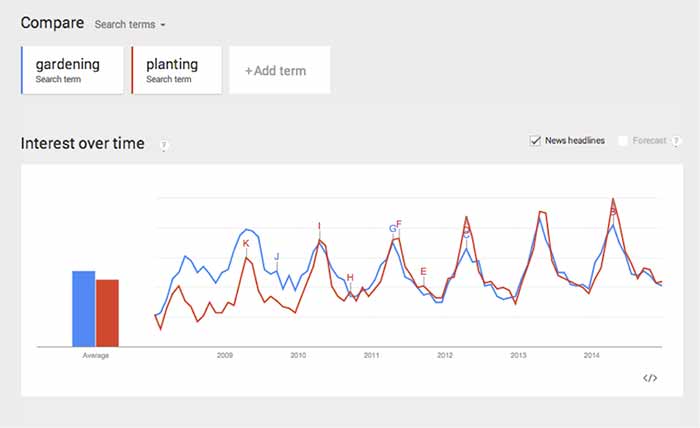
    In this case, both search terms fluctuate at the same time, so seasonality wouldn’t be a factor, but it could be in other instances. This chart tells me that “gardening” used to be a more popular search trend than “planting” on YouTube, but the gap has closed, and “planting” is actually trending more now. It’s interesting that both of the trends dropped so steeply in 2014.

    Because of this, we should look at similar phrases that could have a stronger trend. This is easy to do when you scroll down the page to “Related Searches.”

    Related Searches

    4. Scroll down the page to “Related Searches.”

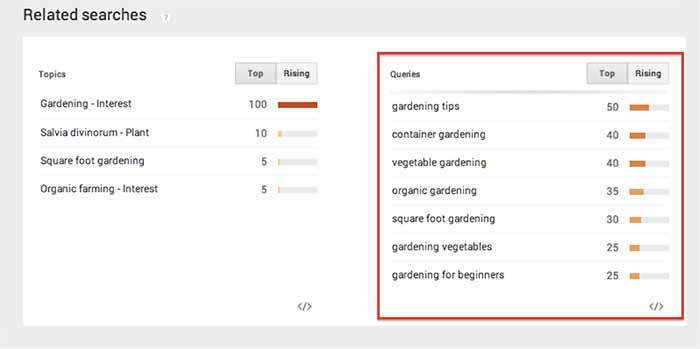
    5. Within “Related Searches” you will see a “Queries” box that shows the most consistently trending searches that are similar to your keyword(s). This is a good place to look for topics that are already popular on YouTube.

    RelatedSearchesImage

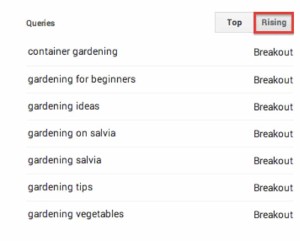
    6. Note the “Rising” column next to “Queries.” These are terms that have been searched for often recently and could become long-term trends.

    As you can see above, I searched for “gardening” and found “container gardening” and “gardening for beginners” as “Related Search” queries. If one of my keywords is “gardening livonia mi,” then I can use “container gardening livonia mi” in the title and description of the video, to optimize it for both terms.

    RisingImage

    Whether you are looking for a way to strategically choose a keyword to optimize a YouTube video or you just need an interesting video topic, Google Trends’ YouTube Search will be a handy tool to explore!

  • Big Results Can Come in Small (SEO) Packages

    tinygiftsimageMany small businesses fear that because they don’t have millions of marketing dollars at their disposal to build their SEO campaign, they simply won’t be able to compete with large corporations. However, there are many SEO tactics small businesses can employ to level the playing field and compete against large marketing budgets.

    If You’re Small, Focus Small

    If your small business offers many services but has a limited budget, it will be more effective to focus your SEO efforts on a small set of highly relevant keywords. For example, if you’re a hair salon and you offer haircuts, blow drying, hair coloring services, etc., it will be better for you to focus on the one service that you perform best. It’s more effective for you to try to be visible for a primary or specialty service than to try to be visible for all of your services—and not to be visible for anything in the end.

    pinonglobeimageYou’re Local, So Get Hyperlocal

    A big advantage you have as a small business is your attachment to the area. Focus your efforts on your local audience by hosting events, participating in your community, getting local reviews, and targeting your content to your locale. You can then leverage all of these hyperlocal efforts in your SEO campaign. That local event you hosted or local organization you helped can generate local content, local buzz, and website links back to your site, all of which tell search engines that you are locally relevant.

    Specific And Long Tail Is The Way To Go

    With limited funds, you need to be clever about the keywords you’re focusing your efforts on instead of going for the obvious ones. To go along with the hair salon example, instead of emphasizing keywords like “hair cut” or “hair coloring,” focus your efforts on more long tail phrases such as “tips to layer your hair” or “how to get an ombre effect.” It’s much easier to rank highly for these long tail, specific keywords than the obvious, broad keywords. While there may be less traffic, the traffic you do get will be highly relevant.

    The next time you think your SEO dollars and campaign efforts don’t stand a chance against giants in the industry, don’t forget that being small has its advantages. Leverage your nimble nature and cleverness for some easy wins!

    Thanks to Heiwa4126 for the globe image and to John Fingas for the tiny presents image.

  • Law & Order SEO: Finding The Culprit Behind Your Decreased Organic Traffic

    As digital marketers, we regularly analyze site traffic to ensure that our efforts are producing positive results. But what happens when you’re doing all the right things in your SEO campaign (high-quality website content, blogging, link-building, etc.) and your Google organic website traffic is consistently going down?

    1) Traffic Deep-Dive

    First, log into Google Analytics and narrow your search down to Google organic traffic over the largest date range possible. Look for trends of upward or downward traffic and make annotations of known changes that might have caused traffic to change (such as a new website launch or the installation of a blog). Also, check traffic by landing page to see if only certain pages were affected.

    TrafficDeepDive

    2) Compare to Algo Timeframes

    Next, see if any of the changes correspond to one of Google’s algorithm updates using the Moz algorithm timeline. Keep in mind that the date might not be exact, because the updates often take time to roll out. If you can attribute the traffic change to an algorithm update, take the necessary action depending on the update. Hit by Panda? Focus on your content strategy. Hit by Penguin? Take a close look at your inbound links and check for a manual action.

    AlgorithmChangeIssue

    3) Investigate Other Possible Culprits

    If your traffic change didn’t correspond to a Google algo update, this is when your analysis gets a little tricky, as there are many possible reasons for the change. Here are some things to check when searching for the source of your traffic change:

    • Rollout of a new website (setting up 301 redirects is essential to this process as well as carrying over all SEO optimizations)
    • Removal or adjustment of your content
    • Relocation of your business (your citations need major focus)
    • Discontinuation of an ad campaign that was generating traffic
    • Adjustment of technical elements of your site, such as meta-tags or robots.txt
    • Change or removal of your Google Analytics tracking code (surprisingly common)
    • Change in the marketplace or seasonality (like a decreased demand for your products/services in general or during a certain part of the year)—check out Google Trends
    • Messy directory profile (check your percentage of correct citations using Moz “Check My Listing”)

    These tips will hopefully help you get to the root of the issue and take the necessary action to achieve your SEO goals. If you need a professional team to do the work for you or to assist you in your efforts, you can always call us: we’ll be happy to discuss our SEO packages with you.

    Have any additional recommendations for things to check? This list is not exhaustive, so please help add to it!

  • Five for Friday: Facebook Ads Get a Facelift, Google’s Panda Goes into Hibernation, and More!

    Photo by Benson Kua

    1. Tips For Growing Traffic and Revenue Through Keyword Targeting – Search Engine Land

    It is widely known throughout the tech world that choosing the right keywords is important when trying to draw more attention to your website. Trond Lyngbø discusses how to do this by gathering relevant information, prioritizing your targets, and taking appropriate action. He goes through each of these steps in detail and offers advice on which tools to use and how to narrow down your targeted keywords. Finally, he goes through your options on how to take action through content marketing, personalization, and more. Trond Lyngbø offers advice and suggestions on taking action with high search volume keywords and turning those leads into conversions.

     2. What’s Next in SEO Trends – Venture Beat

    With the new year approaching fast, people are wondering what’s next in SEO trends. Yoav Vilner discusses how the focus in 2014 has been on honest and well-built link profiles, unique and informative content, and a compatible mobile site.

    In 2015, he expects the focus to shift in a number of ways.

    1. Addition of Social Layers: This will include putting faces on visitors and allowing them to get to know other visitors and even the website owners through social profiles like Spot.IM.
    2. Increase of Visual Content: Websites with engaging visual content such as BuzzFeed are showing us that users are becoming more engaged when aided by a visual rather than a plain text site.
    3. Defense Against Negative SEO: In 2015, businesses will need to work harder to protect themselves against negative SEO by securing a healthy link profile and proving to Google that the brand is legitimate.

    3. Panda Goes on Holiday Vacation Too – Search Engine Roundtable

    photo by Jrwooley6

    Panda has been one of Google’s most influential updates. Thanks to the update’s focus on quality content, advertisers have been striving to satisfy this furry animal since 2011. In this blog, Barry Schwartz discusses why we haven’t seen any updates or refreshes from Google’s Panda over the past month. He discusses how Panda has been known to go on vacation (or perhaps hibernation) during the holiday season and goes into more detail about when Panda was last updated.

    4. Insight Into Which Products Drive Store Visits – Search Engine Watch

    During the holiday season, advertisers are constantly trying to track their marketing efforts, asking questions like “What drives consumers to purchase?” and “How do we get customers to think of us first?” Yuyu Chen discusses a new Google AdWords metric called “store visit measurements,” which is added to its Estimated Total Conversions (ETC). Using data compiled from the company’s search ads, this tool tracks which products drive consumers to the store to make a purchase. Chen discusses privacy concerns as well as whether or not this feature will be available outside of the US.

    5. The Redesign of Facebook Ads Yield High Results – Marketing Land

    In April, Facebook redesigned its right rail ads by making them larger but less frequent. Ever since then, we have been awaiting the results of this redesign. In this blog, Martin Beck discusses Facebook’s announcement regarding the success of the redesign. He also discusses the success associated with these new ads and explains why they are cost efficient.

  • 12 Days of SEO (as Told by Christmas Movies)

    December is finally here, and you know what that means – Christmas SEO! Here are my 12 (Days of Christmas) tips for your small business’ online presence, as told by my favorite Christmas movies:

    1. Accept That SEO Is a Gradual Process

    It may take some time, but if you strategize and take things step-by-step, you’ll be able to improve your results on Google.

    2. Keep It Consistent

    Just like the Rockettes’ kickline, it’s important to keep your business’ name, address, and phone number consistent across the web. This includes your website, social media outlets, and directories!

    3. Work on Positive Reviews

    Getting positive reviews from positive customers can go a long way. Once you have five reviews on your Google+ page, your average star rating will begin to show in search results. Tip: you can give customers this nifty review link to make it really easy.

    4. Don’t Let the Big Guys Push You Down

    Directories and national chains can be intimidating, but play up your strengths as a locally owned business. You can strategically find keywords to target that feature a maps pack; you can also optimize your business listing on the directories that are ranking high.

    5. Feature Fresh, Original Content on Your Site

    Duplicate content can be harmful to your site’s SEO, and it can be boring for potential customers. Make sure that your site’s verbiage isunique and engaging. It’s okay to be different!

    6. Avenge Your Manual Actions

    A manual action from Google may seem worse than being trapped on the Island of Misfit Toys, but there are ways to earn back trust and get in Google’s good graces. With time, money, and effort, you’ll get there one day. Just like Santa, Google checks its list twice. Once you’ve put in the work, wait and see what happens during the next algorithm refresh.

    7. Trust the Keyword Research

    Sometimes it may seem as though the keywords we recommend are not how people are searching, but the numbers don’t lie. Just don’t forget to check for outliers such as news articles, branded searches, and weird town names (Cadillac and Bath, Michigan).

    8. Get Backlinks That Are Natural and Relevant

    Just because you have lots of backlinks doesn’t mean they are good for your site. They may be spammy or unnatural. When getting links back to your site, you should have a combination of quality and quantity. Ideally, you want lots of good links coming from strong, relevant websites.

    9. Pay Attention to the Technical Side

    Keep all of your sitemaps updated and make sure you submit them to Google and Bing Webmaster Tools. It’s also important to add schema so that Google can easily find helpful information about your business. Don’t forget about optimizing your site’s images and meta data; it’s a quick and easy way to get your “ticket” on the Google Express.

    10. Verify High Authority Directory Pages

    Don’t get “lost” in map results or directory searches. Get your listings verified (usually via phone, mail, or email) and optimize them. I suggest claiming your Google+, Yelp, Bing, Foursquare, and Moz Local listings. If niche sites such as Houzz, Avvo, or Edmunds are available for your business, claim those listings as well. P.S.: this helps you with the recent Pigeon update!

    11. Engage with Customers Through Social Media

    It isn’t enough to have social media accounts; you need to be active and interact with your customers. Keep your content interesting and reward fans for commenting on your page. It could be as simple as liking their comments, favoriting their tweets, or saying “Thank you!”

    12. Analyze, React, and Keep Calm after Google’s Algo Updates

    The landscape of Google can seemingly change in the blink of an eye. While it’s important to brace for the worst, don’t forget to check for the best. A lot of recent updates have been good for my clients! Think of the glass of milk as half full and the cookie plate as half empty; be prepared to take action on the latter.

    Image Sources:

    Rockettes

    Christmas Story

    Christmas Vacation

    Miracle on 34th Street

    Mean Girls

    Polar Express

    Grinch

    Santa Clause

    Lost in New York

  • What’s Black & White & May Have Killed Your Site in 2014? This Year’s Top 3 Algo Updates

    In 2014, there were numerous algorithm updates that changed the world of SEO—for the better. Google uses a finely tuned (and ever-changing) algorithm to sort search results in a way that best caters to the searcher. In order to perfect this art, Google turns out algorithm updates, both minute and massive, regularly (and sometimes not so regularly). As such, SEO is always evolving to match this quickly turning tide, which is why it’s best to focus on creating a site that will best benefit the end user.

    Looking back on the past year, there were many, many, MANY updates of note. So let’s just focus on the top three major hitters.

    Panda 4.0

    About

    Being in the top three is no small feat, and kicking off the list of top algorithm updates of 2014 is Panda 4.0. On May 19th, Panda 4.0 rolled out, affecting about 7.5% of English-language queries. Though there was another major Panda update in 2014, Panda 4.1, the effects of this second Panda update were less noticeable than those of its predecessor, “only” affecting about 3-5% of queries.

    Generally, Panda updates are geared towards high-quality content. Their goals are twofold:

    1. To stop sites with low-quality content from working their way into Google’s top search results
    2. To reward high-quality content with more presence by pushing sites with thin content down in SERPs

    What did it do?

    Panda 4.0’s effects did not stray from the Panda expectation. Some of the observed changes that occurred to sites as a result of Panda 4.0 were that it:

    • Penalized aggregated content
      • Aggregated content relates to sites that compile content from other sites. A well-known site that utilizes aggreged content is Buzzfeed, though Buzzfeed seemed to fare this update well.
    • Penalized thin content
      • There were 2 major types of sites with thin content that were affected:
        • Sites lacking quality, long-form content throughout
        • Sites with strong hierarchical structures that may contain quality, long-form content on key pages but contain thin content on higher-level category pages
    • Rewarded high-quality content
      • Sites with reputable, long form, user-friendly content

    How it changed SEO

    Quality content = good content + positive user experience. The major takeaway from Panda 4.0 is not a new one. User experience is always an important factor, but it’s one that can get lost in pursuit of developing long-form content. When developing quality content, an emphasis should also be placed on how the content is viewed.

    AddingCustomGraphic

    Images

    Paragraph after paragraph about your service offerings is likely a wasted effort without visual aids to break up text and give users a new means of understanding.

    Internal Links

    Do you have before and after images? Related blog posts? Anything to give the reader more info? Add links to give users a reason to click through more of your site.

    Mobile Experience

    Now have you considered mobile? Site visits from mobile users are always increasing. Are you providing mobile visitors a good viewing experience that is specific to mobile and easy to navigate and read?

    PizzaNewOrleans

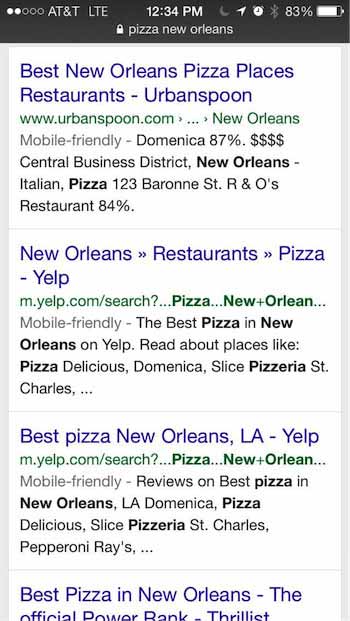
    Though not a part of the Panda update, Google is now providing information in SERPs stating whether a site is mobile-friendly or not. This effectively allows users to skip over results they know cannot be easily viewed on their device, and it furthers the importance of ensuring that your site provides a positive user experience for searchers on all devices.

    “Pigeon”

    About

    A few short months after Panda 4.0, a new breed of animal entered the circus of algo updates when Google rolled out “Pigeon.” Unlike Penguin and Panda updates, Pigeon was not a penalty-based update (aimed at cleaning the SERPs from low-quality sites), but a core change to the local search ranking algorithm. Many different types of businesses were affected by Pigeon. Some of the industries that saw a big effect from Pigeon were real estate, restaurant, hotel, retail, and more.

    What did it do?

    Overall, Pigeon dramatically altered some local results and modified how they handle and interpret location cues. This update is supposed to be a move toward a better user experience for mobile users, with results more concentrated in number and in proximity to your location. Google has also stated that Pigeon helped develop closer ties between the local algorithm and the core algorithms.

    How it changed SEO

    Some of the major changes that occurred as a result of this update were:

    • The disappearance of local listing packs from a large number of SERPs
    • A stronger emphasis placed on relevant directories in search results, leading more SERPs to become directory-heavy rather than heavy with individual businesses’ sites.
    • A switch in focus of local ranking factors
      • Local rankings are expected to depend more on website authority and less on traditional local ranking signals
    • A change to the way in which location cues are interpreted, with results more concentrated in number and in proximity to your current location

    Penguin 3.0

    About

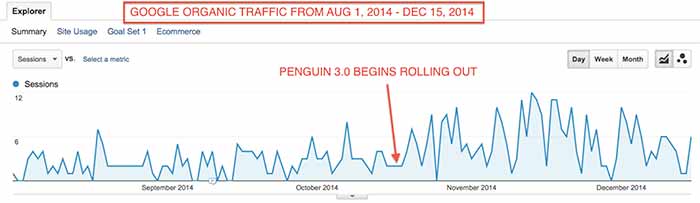
    Last, and certainly not least, this list would not be complete without mention of our long-lost “frienemy,” Penguin. This year, the story of our love/hate relationship with the Penguin algo update was mostly one of love and longing as we patiently awaited its arrival after a yearlong hiatus. Much like preparing for the arrival of Santa, webmasters spent their year diligently reviewing and cleaning up backlinks in an effort to wind up on Penguin’s “nice” list. Finally, Christmas morning came on October 17th when Penguin 3.0 began rolling out, initially affecting less than 1% of US/English queries. 

    What did it do?

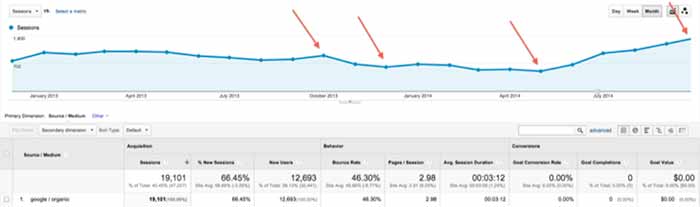
    Generally speaking, Penguin updates focus on the level of natural linking behavior. This filter primarily affects websites with a high volume of lower-quality links. For those sites who were affected by the Penguin updates of 2013 and took the initiative to clean up low-quality links in 2014, a positive effect was likely realized after Penguin 3.0.

    PenguinGoogleOrganicTrafficIncreaseImage

    Specifically, Penguin 3.0 also began a movement to begin regular refreshes, much like Panda. As a result, many webmasters have observed major changes since Penguin 3.0, dubbing these major changes Penguin 3.1, 3.2, 3.3, and 3.4.

    How it changed SEO

    Penguin 3.0 resulted in 2 major industry changes in how Penguin updates are processed and anticipated:

    1. Google has stated that they will move toward regular refreshes of Penguin 3.0, much as they have done with Panda. In the past, Penguin updates have been processed offline and pushed live on a specific date and time. With this new change, Google is indicating that they will be making changes to the algo within their live rankings processes.
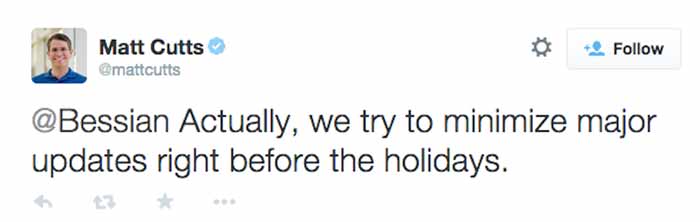
    2. Google broke its “no major updates during the holidays” promise on Thanksgiving Day when Penguin 3.1 occurred. Though Google considered this Thanksgiving Day fluctuation a part of their initial Penguin 3.0 rollout, rarely do updates take this long and cause major fluctuations late in the game.

    MattCuttsTweetHolidayUpdates

    Takeaways For 2015

    So whether Panda, Pigeon, or Penguin affected your site in during 2014, we hope you have been able to use the plethora of circulating information to bounce back. If not, you can always contact Search Influence to help you formulate a specialized plan.

    The big takeaway, however, is that algorithm updates are to be expected, so it’s best to prepare for them ahead of time by making your site as user-friendly as possible. We don’t know what’s headed for us in 2015, but rest assured, it will probably be as eventful as 2014.


  • Five For Fridays: How To Get Yourself an Assistant, Get Rid of Spammy Links, and Go Evergreen!

    Screen Shot 2014-12-17 at 3.26.46 PM

    1. Think Like a User – Search Engine Land

    Sometimes we can get so caught up in trying to get attractive links that we forget why we are writing a piece of content in the first place. We try so hard to get people to read it that we fail to remember who it’s for. In one of her latest columns, Julie Joyce describes the importance of thinking like a user when trying to integrate links to our content. She gives us tips of where users really want links and how it could be helpful to go offline to see things from a different perspective.

    2. Go EverGreen! – Search Engine Land

    Why is it that some pieces of content seem to get more traffic year after year, while others die away to Internet uselessness? Neil Patel shows us the benefits of incorporating evergreen qualities to your content. These qualities can help your content continue to gain traffic and readers regardless of how long ago it was published. Even though it might take some ongoing work, he stresses the importance of relevance and quality so that your content can be seen for ages.

    Screen Shot 2014-12-17 at 3.42.31 PM

    3. Penguin, What Have You Been Up To? – Search Engine Land

    There has been a lot of debate about what magnitude the new Penguin algorithm update is going to have. In this article, Philip Petrescu shares data on Penguin’s latests impact. His data shows the effect the algorithm has had on low ranking websites and how it’s affected other countries of the world. He argues that the impact the algorithm has had depends on the rankings you currently have, the industry you are in, and who you’re competing against.

    GoogleNow

    4. Say Goodbye to Spammy Links – Moz

    Recently, Marie Haynes wrote a handy guide on how to use Google’s disavow tool. Even though this tool has been around for a while, it can still be confusing to use. With the constant updates Google is doing on its algorithms, it’s imperative to be on top of getting quality links to your site. This guide shows a step-by-step process to get rid of those spammy and unnatural links that are pointing to your website.

    5. Stressed at Work? How About a Personal Assistant – Mashable

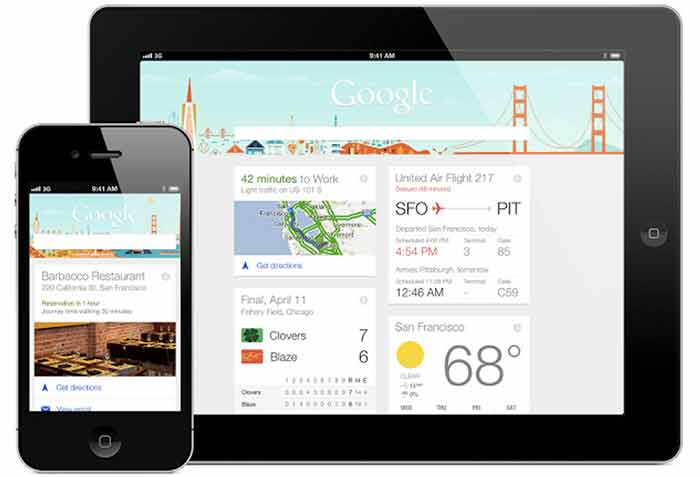
    In this hectic world that we live in, most of us could use a little help. I know that I would love to have my own little minion. These five apps are here to become your own digital personal assistants. They can help you get organized, check the best route to work, store boarding passes, remind you of tasks, vocalize your social media feeds, and much more. Who would you hire as your virtual assistant?

    Image Sources:

    Thanks to Bill Selak for the number five image, Maria Sarfraz for the Google now image, and Splatito8127 for the Sequoia National Park image.

  • Two Turtle Doves Join Search Influence’s Flock

    Two Turtle Doves Join Search Influence’s Flock

    We are very excited to announce two new members who have joined the ever-growing Search Influence team! What better holiday gift is there?

    Sarah-LedgerwoodSarah Ledgerwood – Internet Marketing Team Lead

    Born and raised in a small town in North Idaho right near the British Columbia border, Sarah graduated with a B.A. in Political Science from the University of Washington in Seattle, and she got her J.D. from American University in Washington D.C. A new resident of New Orleans, Sarah just recently moved from Seattle with her husband, three kids, and two basset hounds. Sarah is passionate about food and music, and she’s excited to join the team at Search Influence!

    Eric-KnoepflerEric Knoepfler – Junior Internet Marketing Associate

    Eric was born and raised in New Orleans and graduated from Loyola University in 2013 with a degree in journalism. He recently started a film production company with some friends, and they spend their weekends shooting weddings and original shorts. They’re finishing up a short horror film titled “Burial Mounds” that they hope to submit to a few festivals this coming summer. If there’s one fun fact to know about Eric, it’s that he has an irrational hatred for pickles.

    If you would like to join our team and pull our SEO sleigh (delivering good rankings to all), visit our careers page and apply! We look forward to hearing from you.

  • Five For Friday: Google Language 101 – Metas, SEO, & Link Building Without Content

    12507215604_e7408e02c4_z1. Link Building Without Content Creation  – Search Engine Journal

    A common misconception about link building is that content creation is a necessary part of it. While new content certainly helps, Jon Ball recently posted an article arguing that updating content is not always necessary, especially for small businesses that lack the resources to invest in new content. Small businesses, he claims, shouldn’t dismiss link building just because they think it is too costly or time-consuming. Fortunately, Ball offers five link building approaches that do not require content creation.

    2. Google+ Finally Lets Us Pin Posts! –  Marketing Land

    Finally, Google+ users can highlight certain posts to make them stand out. Early last week, Google+ announced that users can now pin posts to the top of their pages. Google+ is a little late on the trend, as Facebook and Twitter have already offered this feature to users. So far, Google+ pinned posts are only visible on a desktop or Android device. What does this mean for businesses? With this new feature, you can increase the visibility of posts you want your users to see.

    3. 2015: Over Half of Search Spending Goes to Mobile – Marketing Land

    5143183460_944dd8ac97_z

    A new study conducted by eMarketer shows that in 2015, spending on mobile paid search ads and SEO is predicted to be at 50.1%. This is due to a change in consumer behavior, which has veered away from searching on desktops to show a preference for searching on tablets and smartphones.

    4. Caution: Don’t Ignore Meta Descriptions – Search Engine Land

    Google has continually stated that meta descriptions do not impact search engine rankings, which has led many people to disregard them. However, Neil Patel argues that these descriptions are still important. While the content in a meta description is not considered in Google’s search ranking algorithm, the click-through rate (CTR) is part of Google’s search ranking algorithm. Instead of ignoring meta descriptions, businesses should write optimized meta descriptions to increase CTR and overall site rankings.

    5. Five “Googley” SEO Terms Explained – Search Engine Watch

    Misunderstanding search industry terms could cost you an entire SEO campaign. Kristine Schachinger discusses five commonly misunderstood Google terms that can lead to negative implications in the long run. In Schachinger’s opinion, the most commonly misunderstood Google terms are:

    1. Robots.txt
    2. Google DNS
    3. Penguin, Panda, Penalties
    4. Duplicate Content Filter
    5. PageRank

    To avoid accidental negative SEO implications, she offers the correct definition and usage for each commonly misunderstood Google term.

    Thanks to Christopher Sessums for the blue five and Trulia for the mobile app images!