Author: Search Influence Alumni

  • 4 Tips to Make Your Social Media Rock as Hard as Your Band Does

    Social media is vitally important to any musician group wishing to increase their recognition online. Facebook and Twitter both give way to expansive audiences and have become necessary in establishing an online presence. Band profiles have become a must-have for any local band wishing to increase its online presence. Amateur bands have been granted some great opportunities online, while the already-competitive industry has gained a new dynamic.

    Being in a band takes much more than talent and charisma. You also have to put in the time to gain recognition. There is no better way to do that than through social media. Here are some best practices for any band just starting out on Facebook and Twitter:

    1. Keep Connected

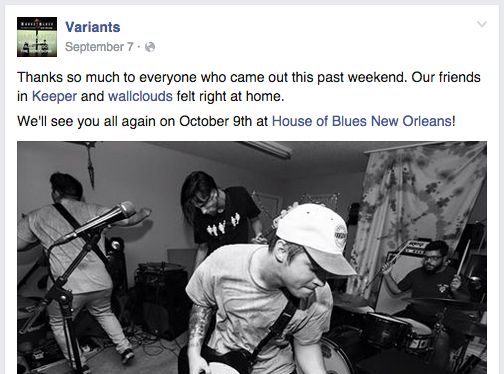
    Having a band profile on a social media channel isn’t just about promoting yourself. Of course you’re going to want to put your name out there to gain some attention, but no one wants to hear about your band every single time you post. One of the best ways to promote and actually develop solid relationships in the process is to connect with other local bands. If you’re familiar with a local band, you don’t have to be shy about it. Give them a shout out, tell your followers to check them out or even link to one of their videos. At the end of the day, they are trying to make it just like you, and they will no doubt appreciate the gesture. They might even return the favor.
    10:9 Anthony Armstrong

    2. Keep a Consistent Presence

    Even if it’s just a simple post to engage your followers, posting consistently reminds people that the band is still around and still active. No, you shouldn’t post three times a day about your upcoming shows or that one single you just released, but giving your followers and friends a bi-weekly update on what the band has been up to is a great way to seem active. You will also want to devote some attention to updates in your specific music scene. Post some of the latest video releases from popular bands, or link to related articles. This shows that you are keeping up with the most recent developments and trends, giving your band a sense of professionalism. It also helps to follow the 70-20-10 rule.
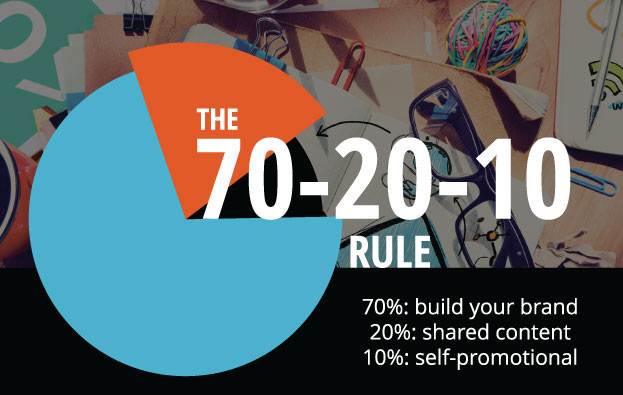
    Social Media 70-20-10 Rule Image

    3. Keep It Lean

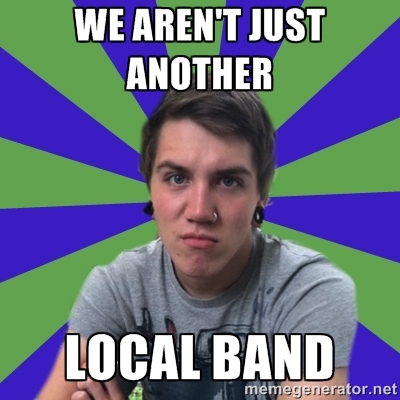
    Many times, local bands will approach their social media channels with a bit of overkill. This comes from the common belief that any social media activity is good activity. The simple fact is that no one wants to scroll through 800 pictures of your band’s last few shows, the reason being that those shows probably don’t seem very different, and a few good pictures of one show are a lot more digestible than a mass upload from your SD card. Another mistake bands often make is attaching an excessively long biography. Your followers are not going to commit to reading a lengthy bio about your rise from nothing in the mean streets of your hometown. This makes you sound delusional and self-absorbed. Let’s try for a little more humble!
    10:9 Anthony Armstrong 2

    4. Keep On Keeping On!

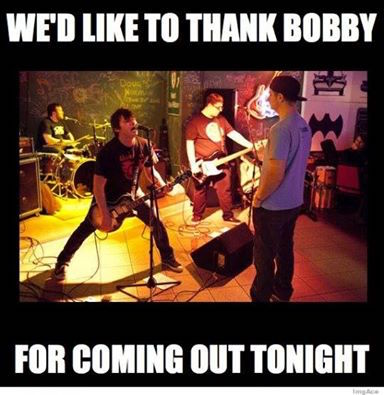
    Over-promoting your band isn’t the best way to develop an online presence, but that doesn’t mean you shouldn’t still promote. Consistently releasing material is crucial to the process. One of the hardest struggles of being in a local band is how quickly your band can fall under the radar. Your followers are only interested if you are interested. Releasing a song every few months and adding it to your band profile is a great way to show that your band is still prominent. If your band has developed merchandise (shirts, accessories, etc.), then post about this with visual representations. Your followers are more likely to pay attention to these types of posts, and it will continue to increase your credibility.
    10:9 Anthony Armstrong 3

    Social media offers some of the best outlets for local bands who want to become more than that. Properly utilizing these features can bring significant change to a band’s presence and overall recognition. So be consistent, be original, and have fun with it!


  • Workplace Wellness Helps Your Waistline and Your Bottom Line

    When pondering the thought of working in an office, several defining factors come to mind quite promptly. One of these components is the sedentary aspect of the job’s general environment. Often, active and health-conscious individuals will refrain from taking office jobs for this reason, because sitting all day long is not exactly healthy.

    yogauned

    A Modern Focus on Wellness

    Changing mindsets have altered the way office spaces are set up today, and many companies have rearranged their once-traditional setups with wellness in mind. As it turns out, this new perspective results in benefits far greater than just the health of employees. In fact, having a health-driven workplace is conducive to overall productivity and satisfaction in the workplace.

    Search Influence has incorporated several health-driven components to the company’s office in order to benefit its employees. Yoga balls replace desk chairs, and standing desks are available alternatives to sitting. Search Influence also provides frequent healthy snacks to its employees, such as fresh fruit and unsalted, raw nut blends, along with filtered water and fresh coffee daily.

    couchsuned

    Saving Money by Saving Your Health

    The US Department of Labor notes that company health programs can not only help promote healthier behavior, but also help increase employees’ overall health knowledge and skills. In addition, creating a corporate wellness program, environment, or even a fitness challenge for employees can pay off collectively, from improved health to the overall company culture. For example, co-workers who come together to eat healthy meals and focus on fitness goals work better as a team at work, too. Healthy employees typically also have fewer missed days of work due to illness, as having a healthy lifestyle and healthy habits translates to stronger immune systems. In fact, many employers have found that implementing a wellness program significantly decreased the costs of both health insurance and workers’ compensation insurance. Studies have reported company-wide insurance cost reductions of up to 30 percent.

    Companies can maximize on this change from the traditional office space by presenting their employees with the chance to enhance their health and fitness and by following up with a reward for their employees’ efforts. This type of program has proven to boost collective morale, making companies more inviting to potential employees when looking to expand.

  • NOLA’s Mama Maji Leverages Online Relationships to Fight Global Water Crisis

    MamaMaji

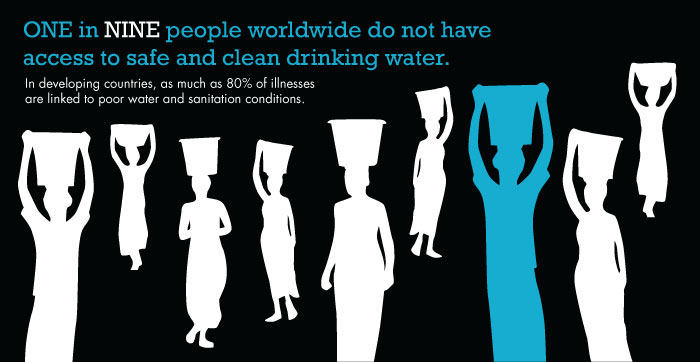
    Based in New Orleans, Mama Maji is a nonprofit organization that works globally to connect and empower women to address the global water crisis. Every day, women lose 152 million hours collecting the water necessary to drink, cook, clean, and bathe. In spite of the need for clean water access in villages, water projects are notoriously prone to failure. Pumps need maintenance, and even well-funded projects encounter unforeseen difficulties or fail to take local preferences into account. Mama Maji works to help with health training and water access abroad, and the organization also hosts seminars in New Orleans.

    SI-Blog-KG-A-03

    Work Abroad and at Home

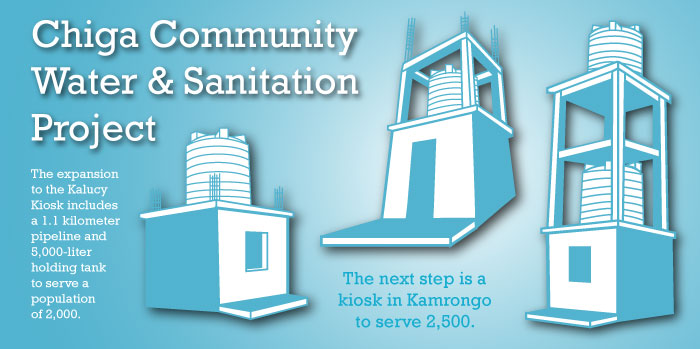
    The Chiga Community Water and Sanitation Project started with a deep well to support food production for a rescue center in Chiga, a community near Kisumu in Kenya. The rescue center serves as a temporary home for at-risk children until permanent homes can be found. Mama Maji has helped to expand the project’s impact by building pipelines and kiosks in nearby communities. Training community members in health, water, and sanitation helps to maximize the impact of clean water access. Meanwhile, in New Orleans, Mama Maji facilitates professional development seminars for women.

    Getting Online

    Active since 2012, Mama Maji now has a presence across several social media platforms, including Facebook, Twitter, LinkedIn, Pinterest, and Instagram. Founding Director Sydney Gray explains that Instagram has been useful as a convenient place to upload photos that will then appear on other social media like their Facebook and Twitter pages. Twitter has been valuable during campaign periods like World Water Week, when tweets have allowed the relatively small nonprofit to engage in international dialogues.

    Inspirational People

    With over 500 likes, Mama Maji’s Facebook page features project updates, fundraisers, and inspirational success stories. Sarah, a resident in Obino village in Kenya, is one of those stories. She was one of thirty volunteer women from 14 villages who trained with Mama Maji in April, learning the basics of water, health, and sanitation. In the following three months, not only did Sarah train over 300 people, but she also managed to prevent a cholera outbreak before it started. She recognized the symptoms while volunteering at a local health fair and mobilized the Kenyan Department of Public Health. The government rushed ambulances to the village for the four people who were already sick and screened the rest of the village.

    Getting Noticed

    “People connect to people, not organizations,” explained Sydney, who has found that people relate to personal stories more than they relate to statistics. Getting people to engage with the content by liking, commenting, and sharing is great, but the ultimate goal is getting donations. Emails, quarterly newsletters, and videos seem to have the biggest impact on donations, but Mama Maji has also developed a detailed guide to crowdfunding.

    The Catalyst 500 Challenge

    The challenge takes Catalysts who have pledged to raise $500 toward the Chiga Community Water and Sanitation Project, and it shows those pledges how to use their social media and email contacts to crowdfund on a three-week schedule. By finding about 10 contacts who will relay the message to their own networks and contacts, a Catalyst’s message is greatly amplified. Expanding this same concept and preparing for a month and a half, one volunteer was able to raise $4,000.

    SI-Blog-KG-B-03

    The Catalyst 500 Challenge, Mama Maji’s crowdfunding program, uses these week-by-week guides for those interested in raising funds. For more information, contact Sydney Gray and the Mama Maji team to learn more about the program. To help, connect with Mama Maji on social media to help spread their message.

  • Rebuilding Together: New Orleans Nonprofit Celebrates 25 Years of Service

    Next weekend kicks off the 25th annual October Build for local nonprofit Rebuilding Together (RT). Comprised of two weekends of service on homes for low-income families, the elderly or disabled, and military veterans, October Build is the organization’s largest event and hosts hundreds of volunteers both from New Orleans and all over the country. I’m pretty excited to be one of them.

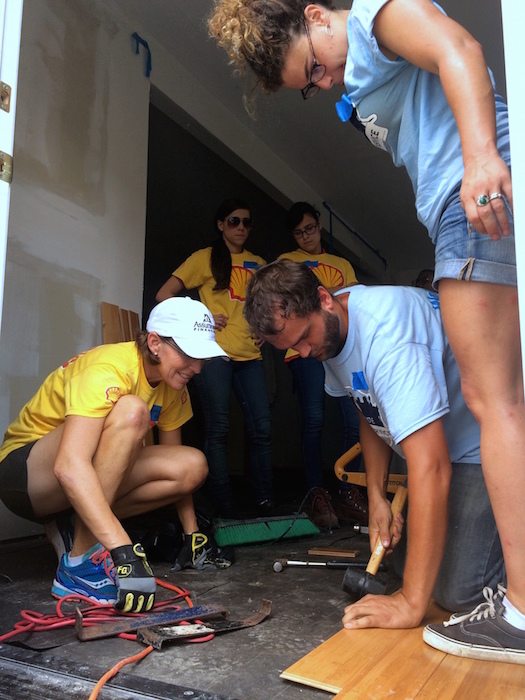
    My first hands-on experience with Rebuilding Together was during the Citywide Day of Service for Katrina 10. I, along with about 20 Tulane, Chevron, and other corporate volunteers, met a woman named Ms. Fernanda in St. Roch, and we all worked on removing lead paint and priming her home. Hers was one of five sites that RT worked on that day, from painting to building new stairs and helping with other more intensive carpentry projects.

    Shell Volunteers and RT Staff Member at K10 Service Day, Photo Credit: Jon Skvarka
    Shell Volunteers and RT Staff Member at K10 Service Day, Photo Credit: Jon Skvarka

    Needless to say, I really enjoyed the experience of volunteering and seeing a new side of New Orleans. So it seemed fitting to write about my experience and about the organization that facilitated it. To learn more about Rebuilding Together and put it in an online marketing scope, I interviewed Executive Director Jon Skvarka.

    We met at RT headquarters in the Resource Preservation Center on Tchoupitoulas and sat down at a conference table on the ground level, surrounded by an exhibit of the historic neighborhoods of New Orleans.

    The Origins of Rebuilding Together New Orleans and October Build

    Rebuilding Together was formed in 1988 in tandem with its sister program, Operation Comeback. Operation Comeback, says Jon, began in order to preserve and restore historic homes in New Orleans in preparation for sale. Conversely, Rebuilding Together would preserve and maintain homes of lower income, but long-standing, homeowners in order to preserve neighborhoods.

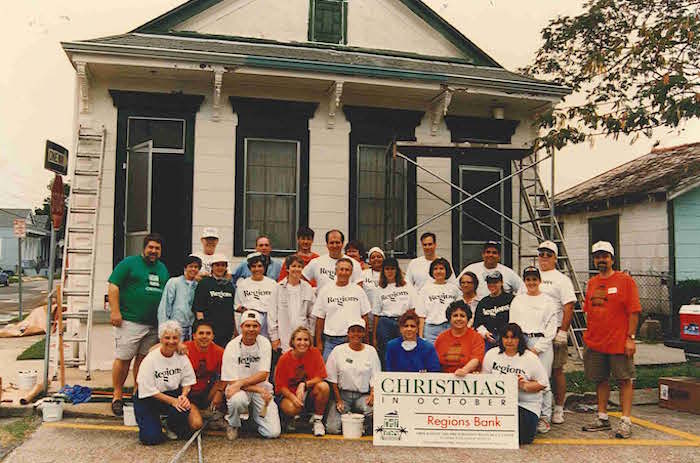
    Volunteers from Regions Bank - Christmas in October 1992, Photo Credit: RT Staff Member
    Volunteers from Regions Bank – Christmas in October 1992, Photo Credit: RT Staff Member

    Originally called Christmas in October, October Build formed out of the original service day that Rebuilding Together produced. It’s continued to grow since its inception and now services seven neighborhoods with the help of individual and corporate volunteers and a team of Americorps members.

    Leveraging Their Online Presence

    Social media and an online presence aren’t always the highest priority for nonprofits, but Rebuilding Together maintains a simple but updated website, along with profiles on Facebook, Twitter, and Flickr. These, says Jon, are meant primarily to “thank and engage” volunteers for their help, with before-and-afters, sponsor shout-outs, and volunteer photos available to the public. Updated and rebranded in 2008, the website serves more as a landing for potential and current national volunteers. According to Jon, the site is invaluable for those looking for volunteer opportunities outside of the more well-known national organizations like Habitat for Humanity.

    And in terms of online marketing, they send out one or two emails per year to volunteers and focus heavily on maintaining quality content for their website. Though they may try to focus more on building their online presence in the future, RT has been steadfast in keeping up with basic online and digital trends, and, as Jon says, it shows with how well they’ve been able to retain and build their volunteer base, both for October Build and year-round projects.

    The New Orleans Experience

    As something of an Americorps groupie, I’ve noticed that New Orleans has a high retention for its members. This includes Jon, who first started at RT in 2007 as an Americorps member, and most Rebuilding Together staff are former Americorps members as well. Jon explains that it was the opportunity to participate in preserving New Orleans culture and community that first led him to stay with RT, and I think this is the case for many volunteers, too.

    One of the organization’s future goals is to build their base of local volunteers, which falls in line with their focus on sustainable post-Katrina funding. The challenge, Jon says, is getting them on-site. Once they’re there, it’s hard not to be hooked. I can most definitely attest to that; I’ll be on-site for all four days of October Build.

    If you’re interested in learning more, visit the Rebuilding Together website. October Build takes place October 2nd, 3rd, 9th and 10th!

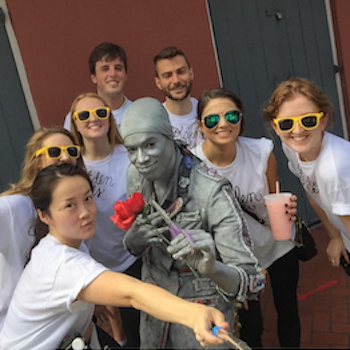
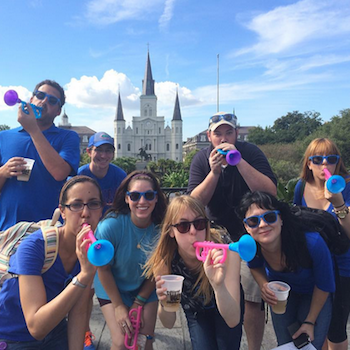
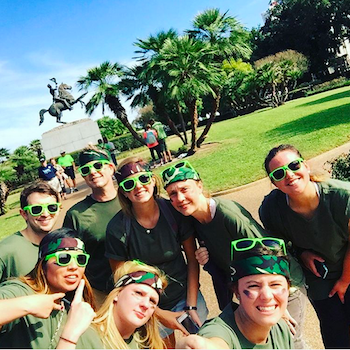
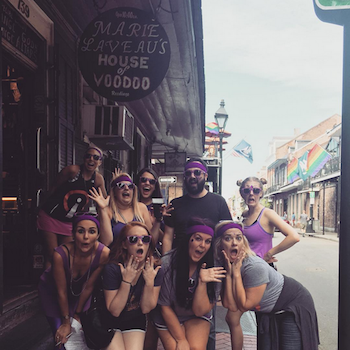
  • Why Were 80 Adults Running Around The Quarter With Selfie Sticks? Find Out!

    1511-SI-BlogImage-E-01

    What sets Search Influence apart from other companies is a deep appreciation for its employees. SI embraces the generosity and culture of the city around it, planning a little lagniappe during each quarter in the form of team building events.

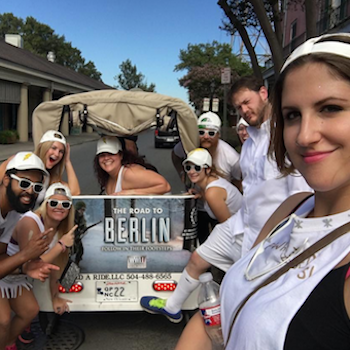
    These events are put on by different departments in the company. Events held in the past include crawfish boils, SI Field Day, inflatable obstacle course fun, and an afternoon at the ballpark to cheer on the Zephyrs. This quarter, SI held the first SI Scavenger Hunt in the French Quarter.

      White Team Red Team

    Preparing for the Hunt

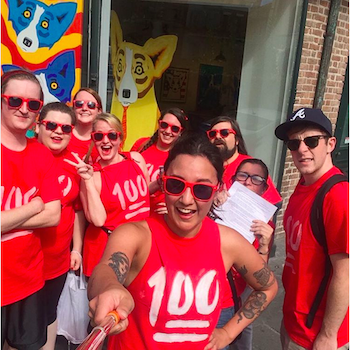
    For the scavenger hunt, the company was divided into nine color-coded teams, mixing the different departments. Each team came up with a team name and a team hashtag to use in addition to the event hashtag, appropriately named #ScavengeDat.

    The rules of the hunt were simple: solve as many riddles as possible during the hunt, and post a team selfie to Instagram at each of the different stops.

    Gold Team  Blue Team

    Time to #ScavengeDat

    The morning of the hunt, Friday, Sept. 25, started out with anticipation, as the office was filled with different team colors and props. By the afternoon, people were in and out of the bathrooms painting and glittering their faces (note: the hallway to the bathroom still looks like the floor at the end of a rave). When 2 p.m. hit, the teams were ready to begin.

    Green Team Purple Team

    The Results

    After making their way through the city with selfie sticks and lists of riddles, the teams met back at the Roosevelt Hotel Bar for pizza, drinks, and of course the results of #ScavengeDat.

    Once the photos were tallied, the navy team—Team Ship Faced—came out on top of the SI French Quarter Scavenger Hunt!

    For more from #ScavengeDat, check out all of the fun on Instagram!

  • Triple Threat: Search Influence Adds Three to the Team

    1509-NewInfluencers-BlogImage

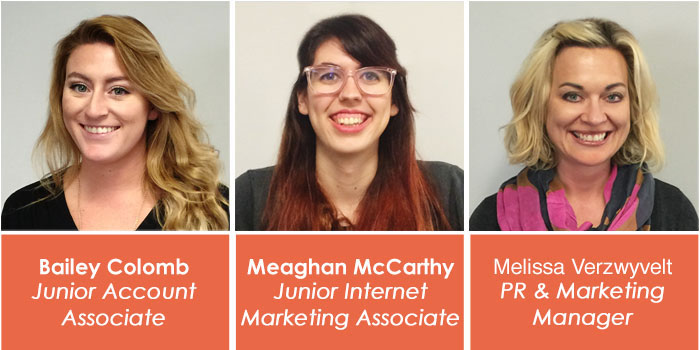
    Bailey Colomb – Junior Account Associate

    Bailey graduated from the University of Southern Mississippi last May. While she enjoyed her time in Hattiesburg, she’s glad to be back home in New Orleans and living with her current roomies—her mom and step-dad. Awesome, right? She is a sarcasm enthusiast, Netflix binger, and lover of all things Bruce Springsteen. She is very excited to join the SI team and looks forward to getting to know everyone!

    Meaghan McCarthy – Junior Internet Marketing Associate

    Meaghan McCarthy is a recent grad from Tulane University, though she is originally from Cleveland, OH, the birthplace of rock n’ roll. She studied English and history, both focused on Irish studies. She is a part-time wedding florist and an amateur traditional jazz dancer. She is excited to start her first ‘grown-up’ job at Search Influence!

    Melissa Verzwyvelt – PR & Marketing Manager

    A Louisiana native and self-professed multi-tasking queen, Melissa comes to Search Influence with 15 years of experience in marketing and PR. She has worked at ad agencies in three states, handled public relations for a city, and launched successful campaigns for local start-ups as well as global brands like Sherwin-Williams and Cessna Aircraft. She grew up in Thibodaux, enjoys watching videos of cute kids and puppies, can wiggle her second toe without moving the others, and was her class valedictorian. When not watching football on the weekend, Melissa enjoys spending time with her two kiddos and her three-toothed Chihuahua.

    Join us in welcoming Bailey, Meaghan, and Melissa to the team! We’re glad to have you on the team.

  • Franchise Marketing: If You Aren’t Following These 4 Tips, You Aren’t Doing It Right

    1508-SI-Custom-KL-C-02-featured

    Franchise opportunities and the franchise sector grew by a whopping 28,800 jobs in June 2015, according to the latest report from the ADP Research Institute. It’s true: franchises in the U.S. are growing at a powerful rate. With this growth comes a need for specific digital marketing solutions to deliver optimal franchise marketing results for companies with multiple locations.

    A strong local Web presence that is consistent with the franchise or corporate brand is proven as one of the most effective lead sources. In fact, local franchisee websites were voted among the most effective customer lead sources behind only customer referrals, according to the 2015 Franchise Local Marketing Trends survey conducted by franchise software company FranConnect.

    Strategize to Succeed in Online Marketing

    Local website marketing strategies are a necessity for success, yet many franchisors are not providing any support to ensure their franchisees succeed online. Consider this: nearly half (48.2 percent) of franchisees manage local marketing, including franchise SEO, by themselves without corporate support. Another 44.6 percent manage their local marketing through corporate support, according to data from the survey.

    Set your franchisees and multi-locations up for successful Internet marketing and franchise SEO with this local marketing checklist.

    1. Create location landing pages for every location within your multi-location business.

    Each business location or franchise should have its own location landing page on the brand website. This strategy allows major search engines like Google, as well as your customers, to better decipher the different locations in specific geographic areas.

    1508-SI-Custom-KL-C-02-a

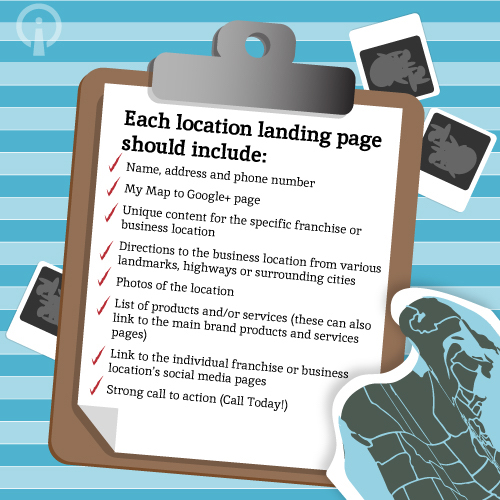
    2. Each location landing page should include the following for successful SEO for franchises:

    • Name, address, and phone number
    • My Map to Google+ page
    • Unique content for the specific franchise or business location
    • Directions to the business location from various landmarks, highways, or surrounding cities
    • Photos of the location
    • List of products and/or services (These can also link to the main brand products and services pages.)
    • Link to the individual franchise or business location’s social media pages
    • Strong call to action, such as “Call us today,” “Schedule an appointment,” or “Get a free case evaluation” for a law firm, for example.

    3. Leverage online directory listings for new franchisees.

    More than half of franchise CEOs and marketing execs have said that online directory listings for new franchisees are often created by corporate (some with agency and franchisee support). At the same time, 16.7 percent stated that new listings are simply not established, according to the Local Marketing Trends survey mentioned above.

    1508-SI-Custom-KL-C-02-b

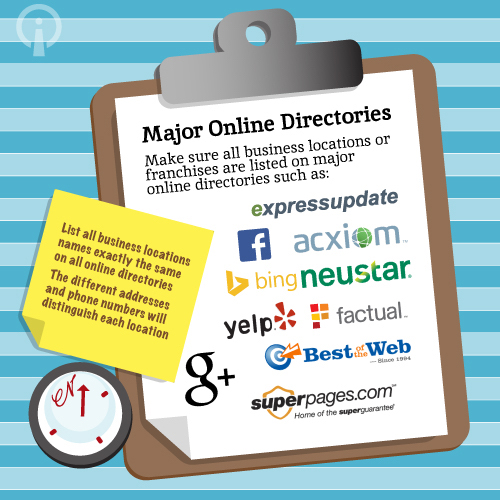
    4. Confirm that all business locations or franchises are listed on major online directories, such as the following:

    • Google
    • Bing
    • Yelp
    • Facebook
    • ExpressUpdate
    • Localeze
    • Acxiom
    • Factual
    • Best of the Web
    • Superpages

    Be sure to list all of your business locations’ names exactly the same way on all online directories instead of “Company Name – Specific Location.” The different addresses and phone numbers will distinguish each location.

    The secret to setting up every franchise or business location for local marketing success is that it takes work. The fact is that 60 percent of corporate franchise offices have marketing teams of only one to three people, according to the Local Marketing Trends survey. Search Influence provides online marketing solutions for franchise and multi-location businesses, whether they consist of two business locations or several hundred. Contact us to find out how we can maximize your franchise marketing online, including franchise SEO and more.

  • One Brand to Rule Them All: Unite Your Franchise Fellowship on Social Media

    Web

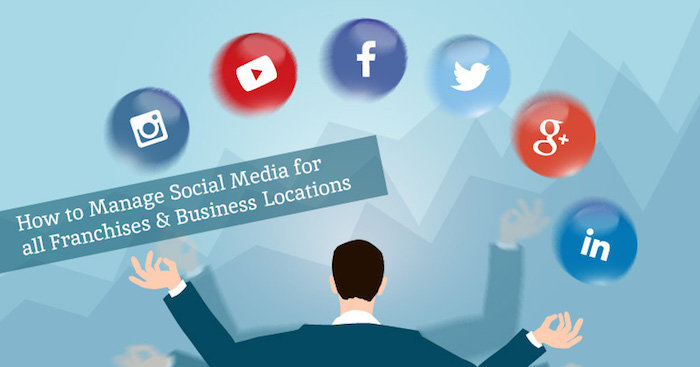
    So you want to be successful in online marketing? Well…your franchise needs to get social.

    More than 70 percent of franchise CEOs and marketing executives voted Facebook as the most effective social media channel for franchises, according to the 2015 Franchise Local Marketing Trends survey conducted by franchise software company FranConnect. In fact, franchises are giving their customers close attention and spending more time on social media compared to other small businesses overall. That’s according to this year’s report on franchises from market research firm BIA/Kelsey.

    But who is managing that social media voice? In 2013, 23 percent of franchisees said their franchisors were “somewhat involved” with their social media presence, BIA/Kelsey reports.

    “We encourage franchisees to take a role in community through clubs or sponsoring baseball teams, but we supplement that through posting activity on Facebook to communities near the restaurant. We localized that but from the central base,” Mark Hardison, vice president of marketing at El Pollo Loco told BIA/Kelsey at its national conference in March.

    One Search Influence client manages the overall brand voice on social media for its 10 locations while also allowing each location to supplement with additional localized social media posts. This not only ensures a consistent social media brand voice, but it also ensures that all locations have frequent social media posts with no gap in activity.

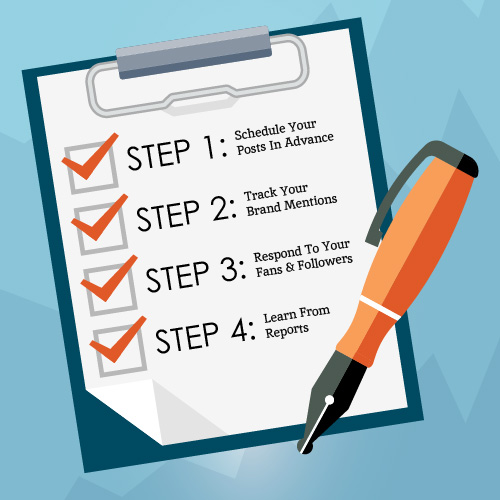
    So how can franchisors and multi-location businesses manage social media posts from a central base? What’s the best way to manage a consistent social media message across multiple business locations? Follow these four steps to take the headache out of managing a consistent social media message, no matter the number of business locations.

    Blog-Blog Graphic-KG-B-01

    Step 1 – Schedule Your Posts in Advance

    It can be hard to keep track of one social media account, much less a whole slew of franchised business accounts. Fortunately, there are a number of web tools available to help you out. Specifically, websites like HootSuite and Sprout Social allow for users to schedule posts across a number of profiles and platforms in advance. That way, you can easily craft and lay out the meat of your social media campaign in a single, unified stream without scrambling to make sure you post to every page.

    Step 2 – Track Your Brand Mentions

    First, let’s talk about what a brand mention is. Basically, whenever someone (with a public account) mentions either your company name or another one of your “brand keywords” (more on those later) on a social media platform, that’s a brand mention, and you should probably know about it. By keeping an ear to the wind, you can know what your fans do and don’t like about your business, which in turn gives you the opportunity to better cater to the needs of your customers.

    So how do you pick your brand keywords? We recommend selecting your brand keywords based on variations of your business name or specialized, branded products and services you offer. Some online services allow you to target these branded keywords to specific locations so that you can see what people are saying about you in certain areas. So, for example, if Search Influence were a franchise throughout Louisiana, we would want to include branded keywords for “Search Influence” that are targeted in New Orleans, Baton Rouge, Lafayette, etc. It’s worth noting that if the user has not updated their settings to allow for location services to locate them, this feature will not apply.

    Some online services, like Sprout Social, even allow you to monitor for the tone you’re interested in hearing. So if we only wanted to know the positive things people were saying about our company (which is not necessarily recommended), you could change your settings accordingly with the simple addition of a “:)” at the end of your brand keyword.

    Step 3 – Respond to Your Fans and Followers

    Your customers are bound to have questions, complaints, and praise for you. At times, this may feel like a lot to respond to, but the best way to garner a strong following is to build a relationship with your customers.

    In fact, a recent study found that customers who engage with companies via social media spend 20–40 percent more money with those companies, and that nearly one-third of customers turn to branded social media pages on Facebook to ask product questions. Further, 71% of people who have a positive customer service experience through social media recommend the brand to their peers.

    So what’s a franchise to do? Tracking mentions helps, but having all of your direct messages, wall posts, and Tweets in one unified stream can take the stress out of being a responsive company. Perhaps one of the best features of Sprout Social is their convenient Smart Inbox, which is found under the “Messages” tab of the website. Here, you can view all “messages” from your connected profiles on a single screen. Messages, in this case, can consist of Twitter mentions, Twitter direct messages, retweets, new Twitter followers, Facebook wall posts, Facebook comments, and Facebook private messages on any and all of your profiles. Their filtering options allow for you to adjust which profiles, brand keywords, and types of messages you want to see.

    Step 4 – Learn from Reports

    As with all aspects of business, it’s important to know your clientele. A number of online services offer ways for you to keep track of how your franchise’s social media pages are doing through monthly reports. Reports allow you to dig into profile and post-level insights, and they also let you see trends across messages and responsiveness to better understand your brand’s performance.

    There are a number of different reports out there, so you can choose to focus on the exact parts of your social media campaign that you’re most interested in. For instance, certain profile reports allow you to dive into some specific statistics on your specific platforms and pages. They can also provide information on your total likes/retweets, amount of new fans/followers, the breakdown of your impressions, fan demographics, how people are sharing your content, and a breakdown of each piece of content you post.

    Other reports focus more on the trends related to your Twitter accounts and offer insight into what’s being said to your brand on Twitter—and who’s saying it. See the topics and hashtags that are frequently mentioned with your brand, chart relationships between them, and keep an eye on the people and brands that frequently mention you—as well as those that are mentioned with you.

    Get Social

    Managing your brand’s voice on social media can seem overwhelming at first, but it only takes a few steps to ensure a more consistent voice—and the best part is that these steps can be taken right from your central base. If working through the complex process of multi-location and franchise marketing still seems overwhelming, contact Search Influence to streamline your marketing strategy.

  • Patience Is A Virtue, But If You Don’t Have It, Use Google’s Popular Times

    As a naturally impatient person, I struggle with the following: people who take forever to text me back, traffic, and long lines. Thankfully, Google Search’s newest feature called Popular Times lets impatient people like myself know when a restaurant, business, or venue is busiest so we can avoid rush hour. Intrigued? Read on!

    What Is “Popular Times?”

    According to Google, Popular Times “uses data from users who have chosen to share their location” in order to keep track of when businesses are at their busiest and slowest. Although this search feature is only available on mobile devices and for select businesses, it can prove helpful for people looking to maximize their time during certain days of the week.

    Popular Times in Action

    I’m not a heavy coffee drinker, but there are some days when I am in desperate need of a caffeine boost. I commute from the Northshore to New Orleans, so I have to be fairly strategic about when and where I get my cup of joe if I choose to get it in the morning.

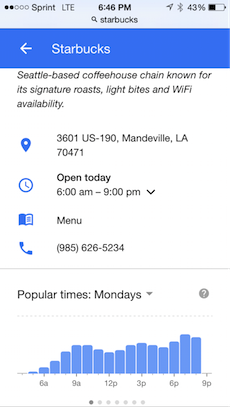
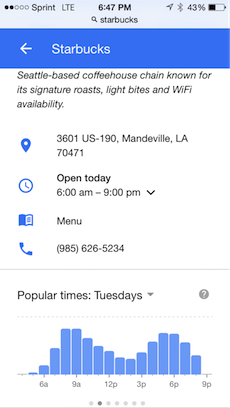
    This weekend, I had a craving for a Starbucks Pumpkin Spice Latte (#dontjudgeme), so I thought I’d check out Popular Times to see if I could stop by the Starbucks drive-thru nearest to me before heading to work one day this week.

    These were the results for the first few days:

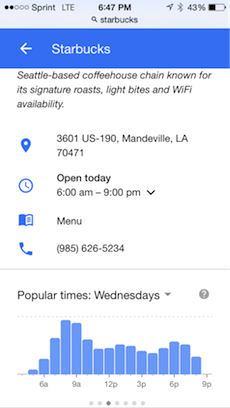
    PopularTimes1  PopularTimes2  PopularTimes3

    Monday at 7 a.m. seemed to be when Starbucks got the least amount of traffic, so I now know when to stop by if I need to get my PSL fix. Now to just stop pressing the snooze button…

    What do you think of Popular Times? Do you think it’s got potential, or is it just another a superfluous Google search feature? Let us know in the comments below!

    Image Credit:

    Pumpkin Spice Latte GIF

  • Write Content Worth Reading: 3 Listicle Hacks from the Pros

    Listicles have infiltrated our culture with a gusto that can only be compared with that of the emoji. It is now a common occurrence for one to set a 10 p.m. bedtime only to get lost in the depths of BuzzFeed, furiously clicking on any headline that references some obscure 90s Nickelodeon cartoon until the bleary-eyed consumer looks at the clock in the corner of their computer screen and sees what they feared the most: 3:30 a.m.

    9-11 image 1

    BuzzFeed and similar websites have been selling real estate on their homepages for businesses to pay to display their own listicles. This attracts a lot of eyes, but in order for these listicles to gain traction and have as much reach as possible, they must be compelling. And in order to be compelling, the listicle must provide three essential elements.

    1. A Click-Worthy Topic

    Not every topic is fit to put into listicle form. A rote display of the new models of heating equipment could be a list, but it is not something that many people would click on. Successful topics communicate shared experiences across a wide variety of people. Say a company did want to advertise heating equipment; instead of showing a series of heater models, it would be a better idea to make the topic something more click-worthy, such as “15 Dogs Trying to Stay Warm.” This is a click-worthy topic because it promises the reader at least 15 pictures of dogs enacting human emotions. Once the listicle is written, the company can then go back and subtly insert hyperlinks into the content and direct the reader to their heating equipment.

    9-11 image 3

    2. Relevant Pictures and GIFs

    The genius behind listicles is how they are able to communicate abstract thoughts and feelings through a series of short sentences and images. It is essential that the images used in a listicle perfectly align with the ideas that they are trying to convey. Take for example a recent BuzzFeed post by Dave Stopera entitled “16 Things That Will Instantly Destroy Any Friendship.” Stopera expertly uses a photo of someone holding a Draw 4 Wild card during a game of Uno with the simple subheading of “2. AND THIS.” What makes this such a strong image is that those who are intimately familiar with Uno have been on both sides of that situation before, either having to draw four cards or causing someone to draw four cards.

    9-11 image 2

    It is important to travel the depths of the Internet and keep an eye out for relevant images and GIFs. In fact, keeping a folder full of the best GIFs and images found on the Internet is a highly recommended practice this day and age. That way when an idea for a listicle or even a social media post pops in one’s head, the perfect image is already there to be utilized.

    3. An Irresistible Title

    Even with a compelling topic and charming content, a listicle is nothing without a perfectly crafted headline. The headline is the first thing the reader sees about the listicle, and it should create a Pavlovian response that makes the reader click no matter what they are in the middle of doing. But what constitutes a title that an Internet user will compulsively click?

    Think about the crux of the topic. An article about candies that are no longer available in stores can get away with a simple title that expresses exactly what it is about, such as “Ten Candies No Longer Sold In Stores.” That might get some users to click on it out of curiosity, but a little more creativity—and the use of a few popular words—may increase the article’s reach.

    Going back to the “16 Things That Will Instantly Destroy Any Friendship” BuzzFeed post, there are a few things the title has going on. For one thing, there is a number at the beginning. This lets the reader know how much time they will have to devote to the post as well as how much enjoyment they will garner from it. The title also effectively conveys the topic, allowing the reader to gain insight into what the post will contain. The last element is the implementation of hyperbole. The contents of the article do not actually contain anything that would instantly end a friendship, but the hyperbole defines the shared anger amongst the players of the games featured.

    With this information, a better title for the candy post would be something such as “Ten Candies You Will Cry To Learn Are No Longer In Stores.” This title effectively communicates the loss the fans of these candies will feel when they learn that they are no longer being produced. Then when the reader clicks the link they will engage with the listicle in two ways; they will either reflect and enjoy the nostalgia on the candy or they will vehemently argue about the listicle’s contents. Either emotion is likely to elicit shares on social media.

    Keeping those essential elements in mind will allow businesses to create effective listicles that get spread across social media platforms, making this a great way to bolster your business’s online marketing strategy.