Tag: website

  • The Infectious Spread of New gTLDs: Good For Your .Business?

    Over the last year and a half, the Internet Corporation for Assigned Names and Numbers, or ICANN, has been releasing more than 1,300 new gTLDs, or generic top-level domains. During this time, there has been a growing conversation amongst business owners as to whether or not they should make the switch to an industry-relevant TLD or stick with their current .com.

    Remind me again … what exactly is a TLD?

    Though you may not realize it, every time you type in a URL in your browser, you are using a TLD. It is everything that follows the dot in a website address. The macdaddy of TLDs is, of course, .com (used by 51.6 percent of all websites), with a few hundred others taking up the rest of the market share. These little identifiers help give a piece of information about the website itself, such as its purpose or geographical area. Because of TLDs, we know that websites that end in .gov are government related and websites that end in .edu are education related.

    So why are they rolling out new TLDs?

    Before June 20, 2011, there were only 22 gTLDs available. But on that day, the board of directors at ICANN almost unanimously voted to stop restricting generic top-level domain names. The chairman of the board, Peter Dengate Thrush, explained it like this in The Guardian: “Today’s decision will usher in a new Internet age. We have provided a platform for the next generation of creativity and inspiration. Unless there is a good reason to restrain it, innovation should be allowed to run free.”

    icann-image-searchinfluence

    Alright, I understand now … but should I get one for my business?

    More than likely, no. In almost all cases, it is completely unnecessary, and switching over to one of these new top-level domains may actually hurt your company’s website more than help it. When the announcement of the rollout came in 2012, Matt Cutts, head of the Web spam team at Google, said on his Google+ page that, “Google has a lot of experience in returning relevant web pages, regardless of the top-level domain (TLD). Google will attempt to rank new TLDs appropriately, but I don’t expect a new TLD to get any kind of initial preference over .com, and I wouldn’t bet on that happening in the long-term either. If you want to register an entirely new TLD for other reasons, that’s your choice, but you shouldn’t register a TLD in the mistaken belief that you’ll get some sort of boost in search engine rankings.”

    So if you are a bank and think that registering for a .bank TLD will benefit your search engine optimization strategy, think again. As Cutts stated, a website will rank because of its relevancy for a search, not because of the letters after the “.” in its URL. In fact, because the age of your domain is an important ranking factor in Google’s algorithm, switching to that new .bank domain may actually hurt your website’s relevancy in the eyes of Google and other search engines.

    I have a new business and am just getting a website. What about me?

    In the case of new websites, it is totally up to your preference. One important thing to remember is that these new domains are extremely new, and most people are not used to seeing them. Because of this, you will want to consider registering for the more common versions (.com, .net, .org, etc.) of your domain in addition to the new gTLD before redirecting customers to your .bank website, for example. This way, if a consumer ever types in your website but makes the assumption that it is .com, they will be redirected to your actual site.

    Image sources:

    ICANN image

  • Healthy Content: 4 Tips to Drive Conversions in the Medical Industry

    Healthy Content Marketing Image - Search Influence

    In the medical and plastic surgery industries, it can be hard to get past the medical jargon and engage with readers online. But despite these challenges, building up an online presence is vital in this day and age. Everyone online wants to gather information quickly, and they seek immediate gratification when it comes to scheduling appointments and learning about procedures. To keep their interest, you have to present your content in a user-friendly, engaging and attractive way. Let go of the olden days of long-winded explanations and paragraphs upon paragraphs of medical terminology that no one can understand. Step into the 21st Century with these four types of content:

    1. Infographics

    We all want something that is nice to look at and easy to understand. Infographics are not only engaging, but they can also be super informative! The medical terminology that your current and prospective patients need to know can be easily explained in shorter phrases and pictures or guidelines. Infographics help your patients connect with you and your practice.

    Infographics are also more likely to be shared by your customers. People love sharing fun and interesting infographics on their own social media pages, so this will ensure more conversions and potential new clients! Find out more about how infographics can give your content marketing strategy a facelift.

    2. Videos

    Videos are another great visual way to engage your website visitors. You could explain your processes and surgical procedures easily without scaring visitors off with long, complicated paragraphs. This is also a great way to introduce yourself and your practice to potential patients.

    You don’t have to do a stand-up; you could make a slideshow video with voiceover narration, or if your budget allows, an animated video. Make sure you include a call to action at the end so the viewer can take the next step in becoming a patient!

    3. Lists

    Lists are great. You’re reading one now! Putting the number of listed items in the title is especially helpful so people know exactly what they’re getting into. Readers are more likely to click through and take the time to read if there are 10 or fewer items. They’ll think it will only take a couple of minutes, then BAM! They’re hooked. They’re converting, and they’re your next patient!

    Make sure to write lists that are interesting and preferably not common knowledge, such as “10 Things You Didn’t Know about ____” or “5 Ways to Look Younger Without Surgery.” You could even promote your products or services with a list of great products for this, that, or the other thing. Keep it short, sweet, and to the point.

    4. Guides

    Because you specialize in a certain medical field, you have knowledge that is credible, useful, and interesting. Write it down! Guides can be about absolutely anything, and they’re excellent sharing material for those who want to stay informed and keep their social media followers/friends informed. For an example, check out the Search Influence guide on how your online presence can win and lose patients.

    An excellent way to drive up conversions is to make your guide a downloadable file and request information from the reader before they can download. This allows you to add them to your email newsletter list, which will make them more likely to become a patient in the future.

    Deciding how you want to present yourself online can be time-consuming and frustrating, but these four winning types of content are fun, engaging, and can help your conversion rates. Play around with some ideas and be sure to use different content on different pages to keep people wanting more!

    Interested in more content marketing tips for medical marketing? See how natural content can help your practice’s website attract patients.


  • How Infographics Can Give Your Online Strategy a Facelift

    Infographics Facelift Image - Search Influence

    No industry knows the importance of image more than plastic surgery. Before and after pictures are worth a thousand words, and prospective patients heavily rely on visual information derived from those pictures when deciding which cosmetic procedures to explore. However, plastic surgery websites do not have to restrict themselves to just pre- and post-op imagery.

    Introducing Infographics

    Simply put, infographics are images that visualize information or data in a compelling, creative, and colorful way.

    Businesses are increasingly turning to infographics to present their industry contributions. For example, Web company Unbounce, estimates that the use of infographics has seen a huge surge in recent years—an 800 percent increase from 2010 to 2012. Research conducted by AnsonAlex, a tech company specializing in producing tutorials, found that publishers with ample infographics grow website traffic 12 percent faster than those with no infographics.

    Infographics are clearly more than a passing trend; they are a strategic marketing opportunities upon which the plastic surgery industry can capitalize.

    Infographics Make Eye-Catching Websites

    If you are looking for a new way to promote your plastic surgery clinic’s webpage, infographics are a surefire strategy for keeping eyeballs glued to your site. A single infographic has the potential to reach as many as 15 million Internet users through web searches, according to an infographic by Top Marketing Schools.  In fact, searching ‘plastic surgery infographic’ yields 283,000 results on Google. Create and post infographics on your site to take advantage of this pool of interested users.

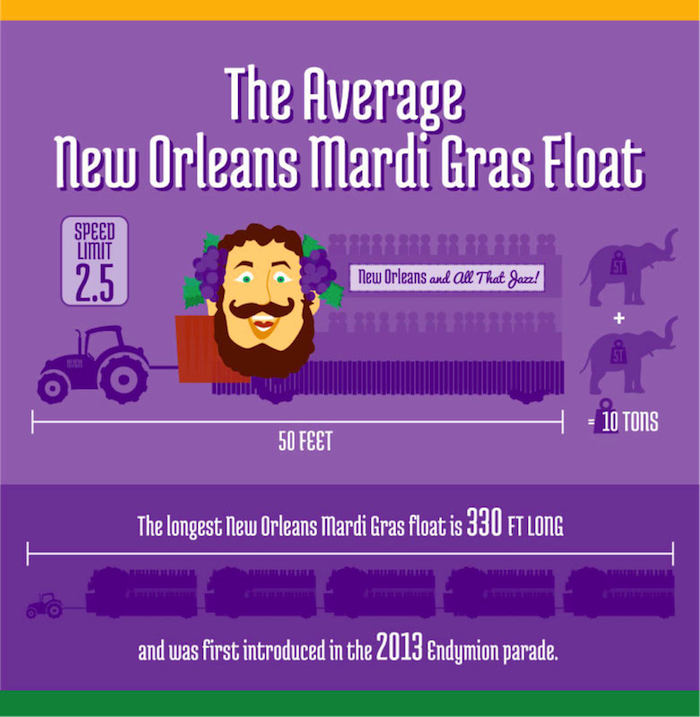
    The average page visit lasts under a minute, but an infographic can keep a user reading for longer. In fact, a Search Influence-produced infographic detailing the legendary New Orleans Mardi Gras renewed interest among people that visited the official New Orleans tourism guide website. While visitors to the website typically spend an average of two minutes browsing, visitors to the Mardi Gras infographic page were spending upwards of eight minutes.

    Infographic Content Marketing Image Search Influence

    Ninety percent of the information processed by our brains is visual, so it’s only logical that we are more drawn to vibrant images than walls of text. Readers are likely to skim the infographic, absorb the information, and then explore the site further to learn what else you have to offer.

    Be sure to add some written content outside the graphic. Site crawlers cannot scan images, so your optimized content must also appear elsewhere on the page in order to attract search engine hits.

    To keep your users on your website, it is vital that your infographic loads quickly! The average user expects a page to load in under three seconds and will not hesitate to close a window that does not deliver fast enough. The quicker your site loads, the better your conversion rates will be.

    Infographics Boost Social Media Reach

    Your plastic surgery clinic can also use infographics to attract more social media followers and shares. That’s because images perform well on Twitter—even better than videos! For example, images get 128 percent more retweets than video tweets, according to Quicksprout. Similar to web pages, our eyes are instinctively drawn to tweets with alluring images.

    To properly post your infographic on social media, however, you have to make sure it is shareable and easily traced back to your site. Use an embed code in the infographic so other industry professionals can easily add it to their sites. On the graphic, place your website address and the name of your clinic in bold letters. If your link or commentary is deleted through sharing, your clinic name will still remain. Using easy share links such as ow.ly or bit.ly can also make it easier to share on Twitter, Facebook, and Pinterest.

  • More Locations, More Problems? Optimize Your Franchise SEO—Part 2

    Franchise SEO tips image - Search Influence

    In part two of this two-part series about how to successfully optimize your franchise SEO, you will find three more winning strategies and steps for multi-location or franchise SEO.

    It’s All About Location

    The effort to have each location found in its own market is often perceived as the most challenging part of multi-location SEO. In part one of this series, we discussed the importance of building the central brand. Now we will tackle how to deal with individual location information, and the ways your franchisees can help to best optimize your franchise marketing and location SEO.

    1. On-Site Location Pages

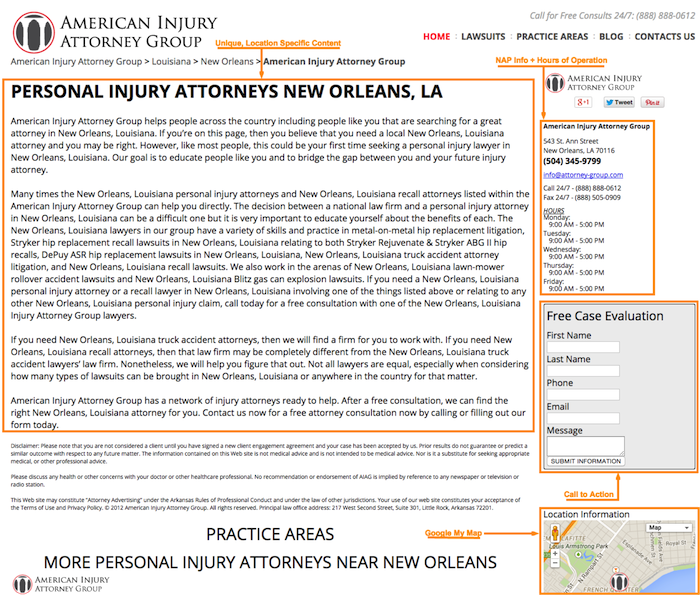
    Now that you have built up your central brand, it is time to focus on your individual franchises. Each franchise location should have its own location landing page on your company’s website. Taking extra care to create separate location pages allows search engines to better understand that you have individual locations in specific geographic areas. It also gives you an opportunity to tell users about the unique products and services offered at each different location.

    Here is a list of the necessary elements for an effective location page for Internet franchise opportunities:

    • My Map to Google+ page
    • Unique content for the specific location
    • Directions to the location from different landmarks, highways, surrounding cities, etc.
    • Photos of the location
    • Reviews of the location (probably best to have a separate page for these)
    • List of products and/or services (should link back to the main products/services pages)
    • Schema MarkUp to the name, address, and phone number
    • Link to the individual location’s social profiles
    • Link to staff member profile pages
    • Strong call to action

    Franchise SEO Tips 1 Image Search Influence

    As with all web pages, it is a best practice to implement unique, compelling content on your location landing pages. Users expect a rich experience when navigating your site, and bland content may turn them away. At the same time, content that is too dense with information or full of keywords may deter users from your web page. To keep site visitors interested, give them valuable information using bullet points in case they are in a hurry. Some multi-location businesses leave a portion of these elements to be completed by the individual franchise owners and managers. In an ideal world, this would be an effective solution, but knowing that these kinds of franchise marketing requests are often put on the backburner, it is best to have a solitary stakeholder in the corporate office responsible for these tasks.

    2. Citation Building

    Citation building is perhaps the most daunting exercise when approaching multi-location SEO. As it is with SEO for single-location businesses, consistency of name, address, and phone number in your online business listings is key. You will often see name formats including the location, such as “Company Name – Lakeview Location.” However, this is not a best practice for SEO purposes. Instead, remove the location information, and keep the business name exactly the same for all of the locations. The different addresses and phone numbers for each location will be enough to differentiate them for both Google and your potential customers.

    Each location should have a unique business description written for its online listings. This task may be best completed by individual franchisees, as it might be difficult for any one individual to write multiple, unique descriptions for essentially the same business.

    On the other hand, you should choose the same categories and logo for every location. Adding unique pictures of each location and its staff would be a nice touch, as well, but it may not be worth the trouble if you have upwards of 10 to 15 locations. Some directories will offer more fields than others. It is in your best interest to provide as much information as possible.

    Rather than taking on the incredibly time-consuming task of doing this for each individual business directory for every single location, consider using Moz Local. This tool makes pushing out each location’s name, address, phone number, categories, business descriptions, etc., to major directories as easy as a simple click of your mouse.

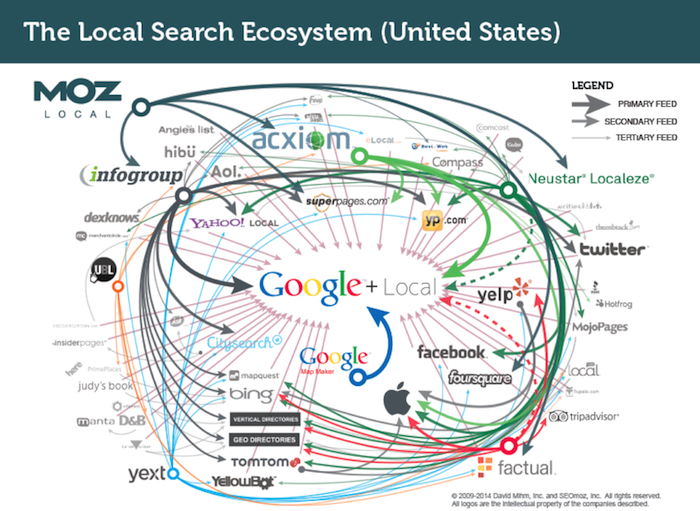
    As you can see below, the major online data feeds and directories share their information with each other, which should allow Moz to take care of most of your citation building and cleanup. Just 90 days after you submit the listings to Moz, go back and see where you stand. Some manual cleanup may be required.

    Local Search Ecosystem Image

    Expanding your search for niche directory opportunities for your company’s industry and each franchisee’s market is also highly recommended. By getting listed in these hyper-specific and hyper-local directories, you are giving search engines that much more information about what you offer and where your business should be found.

    3. Enlist the Help of Your Franchisees

    Enlisting the help of your franchisees may be a time-consuming task for some, which is why everything preceding this recommendation can be taken care of by one single source.

    Allowing each of your locations to manage its own social presence can be both empowering and helpful for your visibility in search engine results. To help manage the challenges that may arise, you should create a clear social media policy outlining what is and what is not acceptable. Make your branding and the content of the posts a top priority when creating this social media manifesto. You will also want to make this a working document just in case someone finds a loophole that needs closing.

    Each location should also be responsible for collecting positive reviews and testimonials from their customers. I would highly recommend incentivizing this effort and coaching your managers on the proper way to approach their customers. Written testimonials on the website serve as phenomenal selling tools. Reviews on Yelp, Google+, and other third-party review sites are even better.

    Getting everyone on the same page with webinars can also be advantageous to the cause. Some topics that you will definitely want to cover include social media branding, social media posting, social media interaction, and how to ask customers for reviews. Break each of these up into bite-sized chunks, and keep your focus on the industry’s top three social media platforms. Side note: record all of your webinars, and make them available to your franchisees at their leisure.

    Get Started!

    As you can see, there is plenty of work to be done in order to achieve success with multi-location SEO. As your franchise grows and brings on new franchisees, use the above recommendations as a checklist for each new location. You can get most of this done within a week’s time for each new franchise location. Doing so will save you a lot of trouble down the road. It may be in your best interest to contact Search Influence for your online marketing needs, especially including the complicated maze of managing multi-location SEO and franchise marketing.

    Image source:

    Local Search Ecosystem image

  • More Locations, More Problems? Optimize Your Franchise SEO—Part 1

    Franchise SEO tips image - Search Influence

    Do you ever feel like your efforts to market your business with more than one location are ineffective? Do you live with the constant doubt about whether or not you did as much for one location as you did for another, or if your franchisees are doing something counterproductive that will painfully squander your efforts? You may also be wondering how to get users from all of your markets to find their corresponding local franchise business. How much is too much when it comes to overstuffed keywords for franchise SEO and duplicate web pages with franchise marketing?

    You don’t need to be an industry professional to know that comprehensive search engine optimization (SEO) requires a balance of more than a dozen simultaneously active elements. From consistently monitoring your targeted keywords to constantly generating new, compelling website content, maintaining high search engine rankings proves to be a multidimensional effort. It seems like all it takes is one surprise update or manual action from Google, and your entire SEO strategy can collapse like a house of cards. For multi-location businesses and franchises, this balancing act becomes even more complex, which is why Search Influence is here to help you not only maintain, but maximize the results of your Internet marketing and digital franchise efforts.

    In this two-part series, you will receive a five-step guide that should answer all of your questions about multi-location or franchise SEO. This first piece will focus on building the corporate brand—a frequently forgotten necessity in effective franchise marketing for any business, regardless of the number of locations.

    Build Your Brand

    This may seem logical, but many times, webmasters and marketers get so caught up in the challenges that come with the individual locations that they forget they have a brand to promote. These recommendations have nothing to do with location-based information; however, they are just as significant to your franchise SEO and Internet marketing success.

    1. Focus on the Main Pages

    When I refer to the main pages, I am referring to the homepage, the “about us” page, your blog, and your products and services pages—in other words, any page that contains content that is applicable to the brand and its offerings.

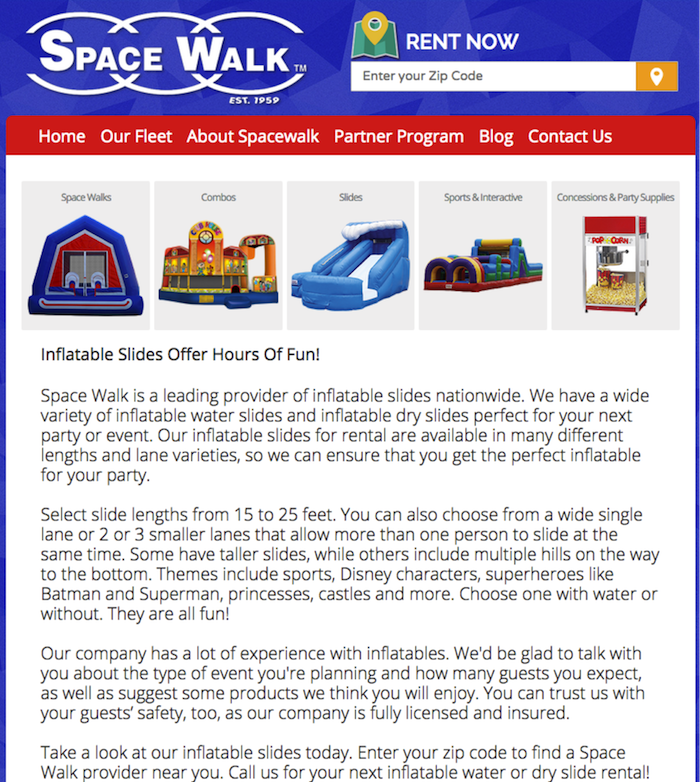
    These pages need to contain the best content on your site, as they will likely be the most visited. Depending on how many locations you have, you may want to include each location in the title tags of these pages, but I would avoid this practice if you have more than three, as title tags should not appear forced or spammy.

    Space Walk Franchise SEO Image Search Influence

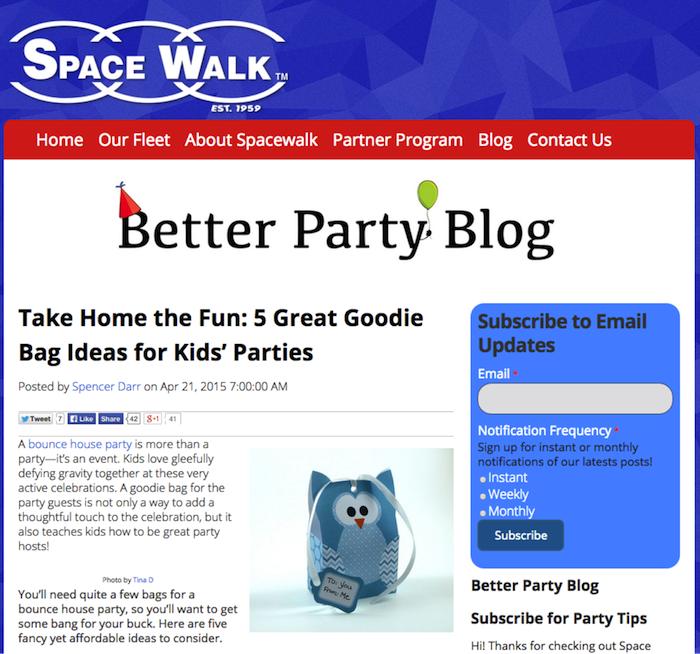
    The blog, on the other hand, can be more versatile with regards to the content that you create. Your blog should be focused mainly on industry-specific topics, but it should also have a touch of personality. Things like showcasing your community involvement or a franchisee’s achievement are both great blog topics. Search engines love active blogs, because they show that you are keeping your site up to date by offering the latest and greatest industry knowledge in a timely fashion.

    Better Party Blog Space Walk Fanchise Image - Search Influence

    Having a mobile-friendly site is important to your franchise’s digital marketing efforts, especially with our heavy reliance on smartphones today. As Google rolled out one of its most significant algorithm updates in April 2015, your site could have been practically wiped off the map if it was not mobile-friendly, and the same is just as true today.

    2. Off-Site Authority for Your Brand

    Since Google’s more recent Penguin updates, the link building game has changed. Instead of worrying about getting links to your website and becoming keyword obsessed, we need to be thinking about building authority and a stronger overall presence for the brand.

    The simplest way to do this is by creating social profiles for your brand. This is not to say that franchisees cannot or will not create their own individual pages, but you should own the brand and its voice by claiming and being active on the major social channels.

    What are the major social channels, you ask? Google+, Facebook, and YouTube are all surefire winners here. But why Google+ and YouTube? One, they are both owned by Google, and you always want to make friends with the decision maker. Two, YouTube is the second biggest search engine in the world. By regularly posting content to these profiles, search engines will get a better sense of what you offer and, in turn, what you should be found for. Note: you will have to rely on your franchisees to help you verify their individual Google+ listings.

    Listing your company in categorical directories can also help the cause of brand building. If there is a relevant directory for the product or service you offer, your business should be listed, along with all of the details of your offering. In this scenario, becoming a part of industry associations can have as much of a benefit online as off.

    There is nothing that can beat real, newsworthy press. Whether it be a press release, a magazine article, or a blog post, when your brand is mentioned online, Google is going to recognize it and correlate the content around it to your website. A link back to the site in these cases can prove helpful as well.

    Now that you have a better sense for basic brand building, stay tuned for part two of this blog series, which will explain how to manage the optimization of all of your individual locations. At Search Influence, we are best equipped to help you succeed with your franchise marketing plan and franchise SEO efforts. Contact us today with any inquiries regarding how we can guarantee a successful online marketing strategy for your company.

  • Googleplasty: How to Reshape Your Search Results (Part 2)

    As more businesses begin to take efforts to improve their online presence, standing out in search results of highly competitive markets and areas becomes even more difficult—and nowhere is this perhaps more true than in the cosmetic medicine industry.

    In order to reshape your search results through the art of “Googleplasty,” you must know what factors make your business rank high in a Google search. Since we now know all about the different types of search results from part one of this two-part blog series, let’s talk about the most important factors that play a role in how high your practice ranks.

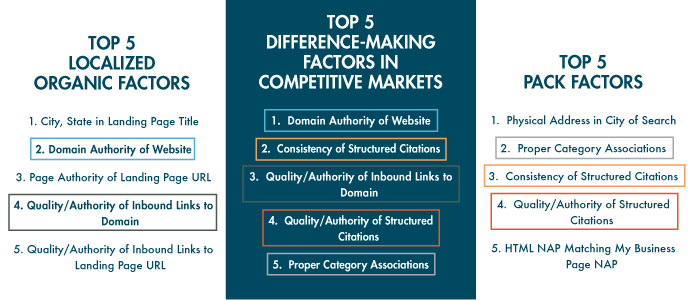
    The following three “Top 5” lists of factors are from from Moz’s 2014 Local Search Ranking Factors survey. The information came as a result of surveying 40 industry experts to determine what had the most influence on ranking in Google search results.
    top 5 search ranking factors

    As you can see, all of the factors that are integral in competitive markets also play a part in either localized organic or maps pack results. Due to their repeat importance, I think they’re the five factors most worthy of discussing in detail.

    1. Domain Authority of Website
    domain authority

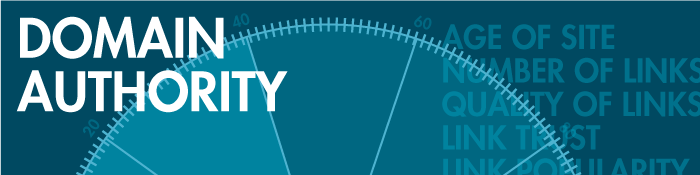
    First up on our list as the most important factor in competitive markets is Domain Authority, which isn’t much of a shocker. Domain Authority is a proprietary measurement (created by Moz geniuses) of a domain’s power within a 100-point scale. This score can be used to predict if a site is likely to rank in Google’s search results and can also be used to track a site’s growth and increase in strength.

    It is a metric that combines other metrics such as age, number of links, and quality of links, so it’s not easy to manipulate through singular or direct efforts. As it is directly put on Moz’s site, “The best way to influence this metric is to improve your overall SEO.”

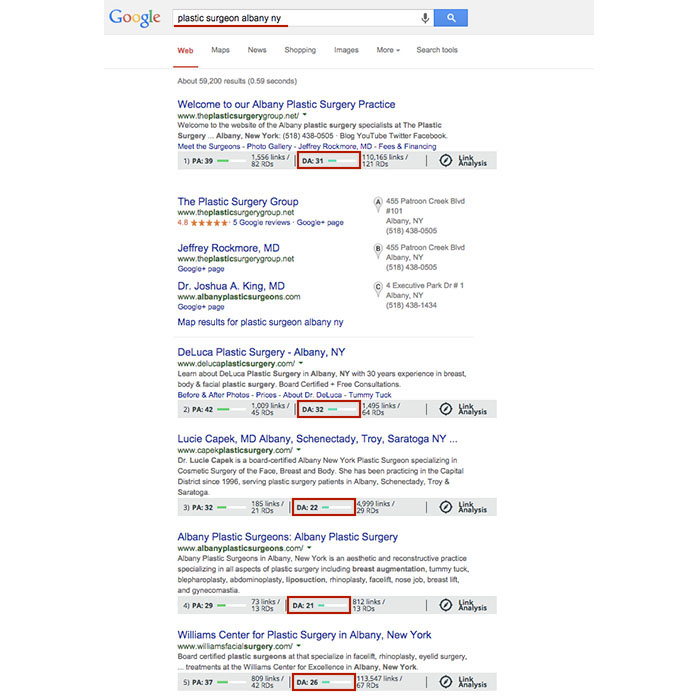
    Using Moz’s MozBar to see domain authority of pages in search results, you’ll see that the top five business sites in the localized organic results for “plastic surgeon albany ny” have Domain Authorities of 31, 32, 22, 21, and 26, respectively. As you can see here, having a score that is higher by a single point won’t guarantee that you rank above your competitor, but in this search example, business sites past the first page of results tended to have Domain Authorities lower than 20.
    Domain Authority Search Results

    2. Consistency of Structured Citations

    structured citation consistency

    While this factor isn’t as high ranking for localized organic results, it is third for the top maps pack factors and second here in the top factors for competitive markets. One reason for this is that in many competitive markets, such as plastic surgery or cosmetic dermatology, you’ll find maps packs in search results.

    To start, a citation is a place on the Web where a business’ name, address, phone number, and often website can be listed (sometimes referred to as the NAP of a business – name, address, phone). Any combination of the NAP, with or without all parts, listed on a site is considered a citation. A structured citation in particular is a listing of business information found on a directory website (e.g. YellowPages.com and Yelp.com). On the other hand, an unstructured citation can be business information on non-directory sites like newspaper sites, press release sites, and blogs, to name a few.

    By increasing the number of matching information sources (and therefore matching signals) to Google, you also increase your chances in having Google match this information to search queries, according to a recent webinar with Google’s Heather Wilburn. So if you want to be matched with potential patients searching for businesses like yours in your area, consistent business information across the Web is one of your best bets, especially in competitive industries like cosmetic surgery.

    3. Quality/Authority of Inbound Links to Domain
    inbound links to domain

    An inbound link to your domain (aka inlink or backlink) is exactly what it sounds like, a link leading to your website. The relevance to your industry or location and the authority of a website linking to yours in and of itself are the two best traits for quality links. Buying links or having links from random, spammy sites will hurt, not help you. Links from local sites and popular sites are a pretty safe bet. You can seek out local sponsorship opportunities as a good link-building effort or help other sites clean up their broken backlinks by using your working ones.

    To differentiate between natural link building versus spammy link building, remember that it’s all about user experience and what makes sense to the user. If your efforts don’t uphold the ideal of providing the best user experience possible, then they’re probably not good.

    4. Quality/Authority of Structured Citations

    structured citation quality

    As mentioned above, a structured citation can be any directory site that lists any variation of your business’ NAP or website. While consistency is most important, you also want to make efforts to build high-quality, authoritative citations in directories.

    Just like there are many factors to improve your own site’s authority, there are also many factors to determine the quality of a directory. You can delve into Whitespark’s blog on how to identify quality citation sources for a detailed breakdown, but basically a good rule of thumb is to look for high domain authority and human moderation in directory sites. Examples of human moderation include how DMOZ requires submission review by its team before a link goes live or how Google Plus, Yelp, and Bing listings all require verification via phone call or a postcard sent to the business.

    Google also considers niche directories highly authoritative. A niche directory is an industry-specific or location-specific directory. Since the Pigeon algorithm update, this kind of citation building has become especially important, and searching for your industry’s keywords will often help you identify these niche directories. If you search for “plastic surgeon columbus oh,” you’ll see that the directories healthgrades.com, vitals.com, and smartplasticsurgery.com appear on the second page of search results. Often, these types of directories require either verification or payment for those seeking to be listed on their site. If you understand the concept of barnacle SEO, you know that being listed on these types of big, authoritative sites is a great way to improve your own visibility to potential customers. Use your discretion to decide if the opportunity cost of getting on a directory isn’t too high to be worth the effort.

    Warning: If a site ever requests a “reciprocal link” to its site on your site in order to be listed, this is NOT A GOOD practice, and they are not worth your time.

    5. Proper Category Associations
    category associations

    Having proper category associations is another important factor for ranking in the maps pack that can set you apart from the rest in a competitive market. It’s a pretty simple concept, and it basically boils down to the part of the guidelines for representing your business on Google that tells businesses to “Choose categories that are as specific as possible, but representative of your main business.” A cosmetic surgeon with the primary category on the Google Plus local listing set to “surgeon” is less likely to rank above one with a primary category set as “plastic surgeon” in the maps pack, for example.

    Though this is a lot to grasp and take action on all at once, having the foundation and understanding of best practices to improve user experience and to better your business online will greatly improve your successes online in the long run.

  • YourCompany.Sucks – Dealing with the Future of Domains

    When I first read that .sucks domains would be launching in 2015, I chatted with a friend of mine about it. This friend is not in the search engine optimization industry, but he does have a website for his established local business. The whole .sucks conversation boiled down to this: it is a big money grab, he told me. How is he supposed to build his local brand and defend it online when really, he has to focus his marketing budget on offense, not defense?

    I can imagine a lot of small businesses having similar reactions, and I assured Angry Friend that this is not a priority for him as a small, locally owned business. If he buys the .sucks of his domain, then he has to invest in domain-squatting for all negative versions of his domain, and he has better things to do with his limited marketing dollars.

    Who are “They?”

    After repeating a few different variations of “they are just creating a money grab,” Angry Friend asked “and who the hell are ‘they?!’

    The mysterious “they” are the Internet Corporation for Assigned Names and Numbers, or ICANN. It is responsible for the domain name system, among other things. This means ICANN establishes policies for the domain system and for introducing new top-level domains (TLDs) like .com, .net, .info, .org, .sucks, etc.

    Management of most top-level domains is assigned to specific organizations by ICANN. In the .sucks controversy, Vox Populi Registry Ltd. is the manager and registry of the .sucks domains. It set .sucks domains at prices that are being denounced as exorbitant and predatory. It is a subsidiary of Momentous based in Canada.

    .Sucks Domains are Rolling out Now

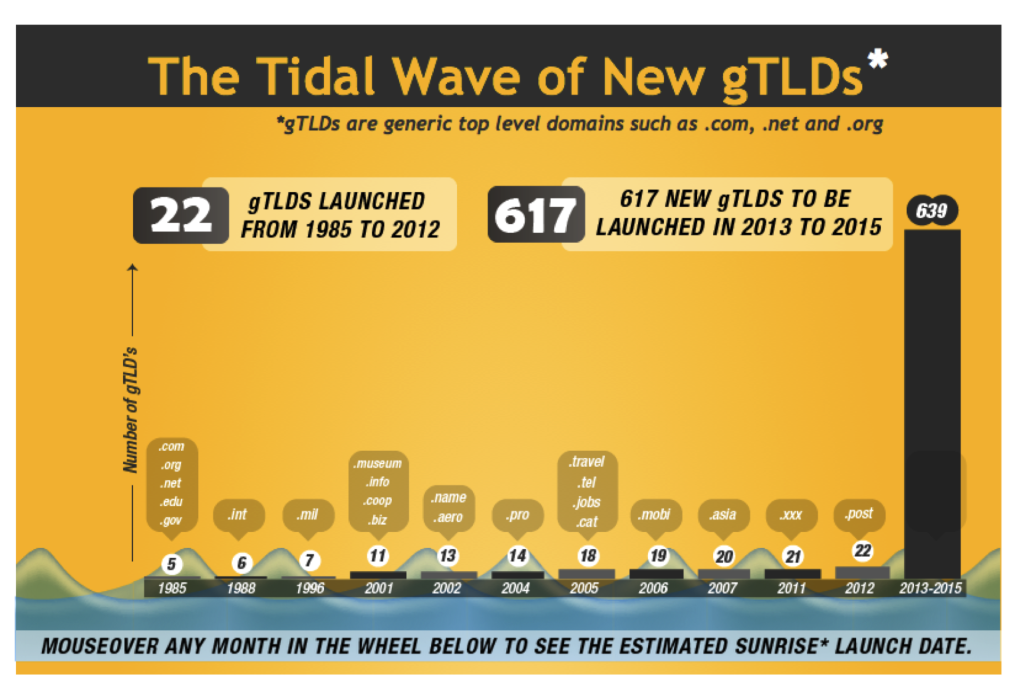
    New Domain Tidal Wave Image - Search Influence

     ICANN will have introduced 600+ new TLDs slowly, a few each month, starting in 2013 and going through 2015. This is a pretty cool interactive infographic that allows you to see which TLDs have rolled out/will roll out each month.

    Some of the more controversial TLDs are .porn and .adult and .xxx. And .fail and .wtf. You can imagine the scramble by brands and celebrities to grab their names with these extensions as a defensive measure against slam sites.

    Per Vox Populi Registry (nic.sucks), these domains are already registered:

    • burberry.sucks
    • tommybahama.sucks
    • eharmony.sucks
    • urbanoutfitters.sucks
    • beats.sucks
    • hersheys.sucks
    • tupperware.sucks
    • hyatt.sucks
    • mac.sucks
    • internetexplorer.sucks

    According to CBS, these .sucks domains have also been claimed:

    • Youtube.sucks
    • Bing.sucks
    • Visa.sucks
    • Yahoo.sucks

    Obviously, these corporations and brands have deep pockets and a significant advantage in controlling these domains themselves.

    Getting Your .Sucks Domain Is Expensive

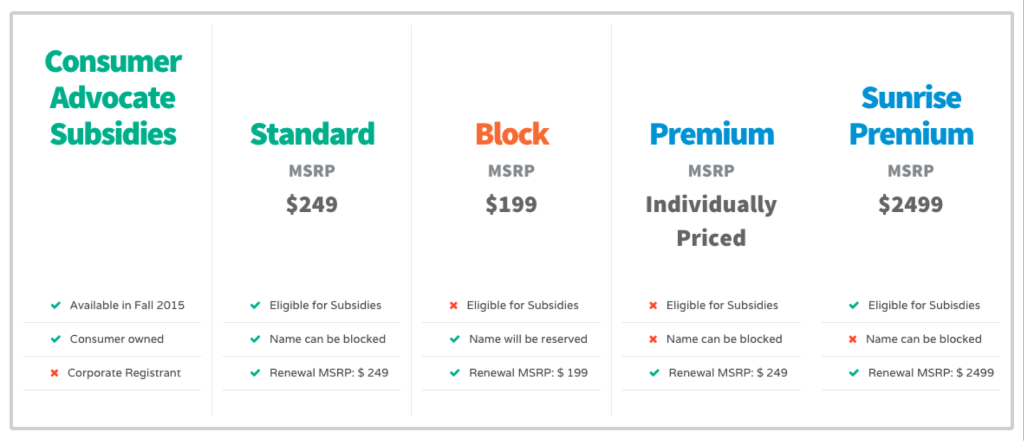
    A “Sunrise Claim” is an early registration of any new TLD by holders of registered trademarks. Sunrise Claims are usually a few hundred dollars; however, the money grab is afoot with .sucks. Some would say the shakedown has started. The .sucks TLD starts at $2,499—that’s right, starts at.

    If a trademark brand opts to not claim anything in the Sunrise period, it may still have to pay the $2,499 or more. Vox Populi has created a “premium” list for trademark brands, and those will have to pay the premium even during the general availability period. For “premium” brands, Vox Populi has ensured the .sucks price will be $2,499 or more no matter when the registration is made, and domain renewals will cost the same as the Sunrise prices.

    Consumer Advocate Subsidies Image - Search Influence

    The .sucks Sunrise period is March 30, 2015 – May 29, 2015. General availability (or the land rush), which is on a first-come, first-served basis, starts June 1, 2015.

    Then, when the land rush starts, an average business .sucks domain will cost $249/year. You can get a blocked domain for $199/year, which means it won’t resolve, you can squat on the domain, and no one else can register it either. EasyDNS says, “It is quite the controversy and our advice to anybody on the verge of getting caught up in all this is quite simply not to play. ”

    Really, anybody who wants to complain about a brand or a business has plenty of opportunity to do so already with the variety of legitimate ratings and reviews sites, complaint sites such as ripoffreport.com, the ability to create sucks domains such as yelp-sucks.com, and the availability of .fail and .wtf. If you really felt passionate about defending your brand, you would need deep pockets to defend on the domain front. Those dollars would be a much better investment if used for quality online presence strategies.

    Fighting Back

    ICANN approved .sucks when it announced the plan to introduce the 600+ TLDs from 2013 through 2015. Big brands such as Verizon and eBay make up an advisory panel that has recently complained about the .sucks availability. Trademark lawyers for Intellectual Property Constituency sent ICANN a forceful letter describing the .sucks scenario as “predatory” and requested a halt to the rollout.

    The IPC letter calls into question Vox Populi’s plans to (this is quoting from the letter):

    (1) categorize TMCH-registered marks as “premium names,”

    (2) charge exorbitant sums to brand owners who seek to secure a registration in .sucks, and

    (3) conspire with an (alleged) third party to “subsidize” a complaint site should brand owners fail to cooperate in Vox Populi’s shakedown scheme.

    Under pressure, ICANN has now asked the U.S. Federal Trade Commission and Canada’s Office of Consumer Affairs to comment on the legality of the high-priced process used by Vox Populi. If the Vox Populi pricing strategy is found to be illegal, ICANN will be able to declare them in breach of contract, request changes to its policies, and breathe a sigh of relief with the public eye turned to Vox Populi as the bad guy.

  • Don’t Be Afraid To Stop & Ask For Directions: Making Google My Maps for SABs

    As promised in my last blog about the new Google My Maps, I’m here today to teach you how to how to create My Maps for service area businesses (often referred to as SABs) that have highlighted boundaries of what counties or parishes they service.

    Before we delve into this guide, let’s start with the basics like what exactly is a KML file. KML is the file format used to show geographic data in mapping programs. It is an XML based format and stands for Keyhole Markup Language. Now that you know what this file type is, let’s see how you can use it.

    How to Use Old 2011 KML Files

    Fun Fact: The U.S. Census Bureau holds kml files for all county guidelines here!

    As you can see, they’re from December 2011, so any boundaries that have changed since then will be incorrect. In a very general sense however I’ve found these codes very useful in the past. Each file contains all county boundaries in one state, but the tricky part is that they don’t tell you what state it is in the file name. I went ahead and downloaded them all a long time ago and updated the file names to reflect the state they contain. It’s pretty closely in alphabetical order so if you just use a list of US states in alpha-order next to the list of files in numerical order it should match pretty closely.

    Once you’ve figured out which file contains the state you’re looking for, find the county or counties that you want to display in your map, and move it’s entire code for each county (should start with “Placemark” attribute and end with the closing of the “Placemark” attribute) just below the “Document” attribute. Once you’ve moved the boundaries you want to keep to the top of the KML file, remove all the excess counties and leave the closing attributes for “Document” and “kml” at the bottom.

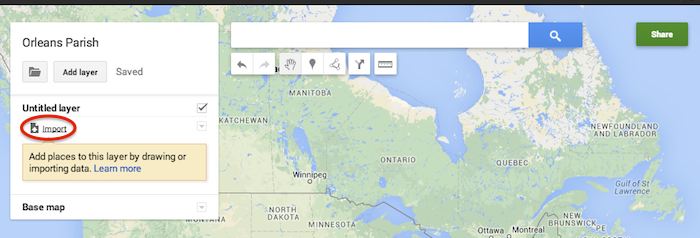
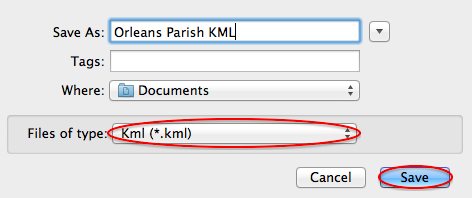
    Now that you’ve successfully prepared your KML file, in My Maps, click Import on the left and choose your KML file from your computer.

    Import A KML File To My Maps - Search Influence

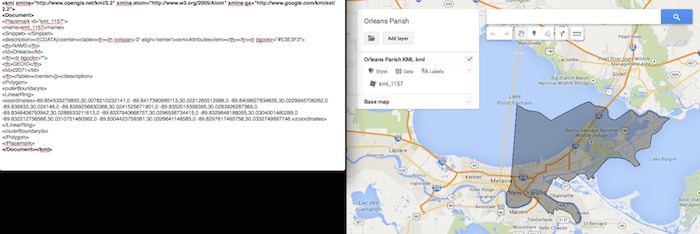
    See the screenshot below for an example of how your KML file should generally look if you’ve done it correctly. The screenshot shows the file for Orleans Parish of Louisiana in TextEdit and then what said file looks like imported into My Maps. (NOTE: In order to show a not so massive screenshot of the KML code, I removed about 3/4 of the coordinates. There are a massive amount of coordinates used to make up these detailed boundaries.)

    Preparing Viewing A KML File In Google My Maps - Search Influence

    How to Use New 2013 KMZ Files

    The U.S. Census Bureau also has the most up to date 2013 files, which are KMZ format (note the .kmz instead of .kml extension). This is essentially zipped KML files with a .kmz extension, but if you use a Mac like me, unzipping or unpacking the zipped file is not easily achieved. The 500k file contains the most detailed boundaries out of the 3 options.

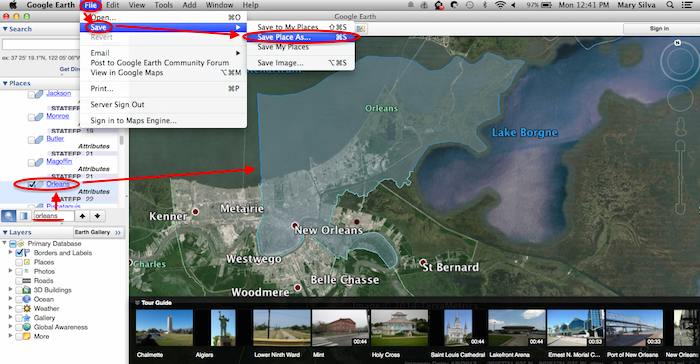
    So, the way I handle this KMZ file is to open the entire file in Google Earth and export just the KML file of the areas I want displayed. To do so you’ll use the search feature of Google Earth on the left at the bottom of the “Places” window to search for and select the areas you want displayed. Since many counties have the same name you’ll want to make sure it’s showing up in the state and location it’s supposed to. Also, note that if you’re trying to add multiple counties in the same state, the Attribute number to the right of the county will be the same for all counties within the same state. This should help you easily identify the counties you’re looking for when adding multiple.

    Once you’ve selected the geographic areas you want displayed on your map in the “Places” section, then save the file as a KML file by clicking File>Save>Save Place As….

    Saving A KML File from Google Earth for Google My Maps - Search Influence

    My Maps will not accept a KMZ file, so make sure to save as a KML.

    Saving a Map in Google Earth As a KML File to Use in My Maps - Search Influence

    Once you’ve saved your file, follow the same steps mentioned above to import the KML file to My Maps. I’m not sure if the paid My Maps Pro is any different, but it appears to me that you cannot import multiple KML files to one My Map. So, in the event that you want to represent multiple service areas in one My Map, you’ll want to have all of the geographic area codes in one KML file.

    This Google Earth process can also be used instead of manually editing the older KML file codes as shown in the first instructional section in case you don’t want to delve into the coding via text edit. It’s definitely an easier route, but for me, Google Earth can sometimes run slow when trying to handle these files and I don’t mind manually editing code.

    Hopefully these steps and screenshots help out a fellow My Mapper!

  • 5 for Friday – Google SSL Warnings, Twitter & Amazon Collab, and more!

    1. Twitter and Amazon Link Up, Add Items To Your Shopping Cart With A Single Tweet – Buzzfeed

    452416003

    Amazon is using Twitter to drive sales with the new #AmazonCart feature. This may be a major breakthrough for ecommerce businesses. It’s super simple:

    1. The business tweets out a link for a product.

    2. Interested consumers can then reply to that tweet with the hashtag #AmazonCart.

    3. The product will instantly appear in the consumer’s Amazon cart.

    The consumer’s Twitter has to be linked to their Amazon account in order to do this, but the new feature should drive sales for E-commerce businesses with products on Amazon. Twitter users can also search the hashtag #AmazonCart to see what other people are buying. Isn’t technology great?!

    2. Become Your Own Rumpelstiltskin: Spinnin’ Crappy Online Reviews Into a Better Business – Search Engine Journal

    This is a great article on how to approach negative reviews. There are bad reviews from people who genuinely had a bad experience and bad reviews from people who are just plain irrational.

    How do you tell the difference between these people?

    If you look through an irrational person’s profile it’s full of negative reviews and they usually make overly dramatic and sadistic statements. People that genuinely had a bad experience  usually have a mix of positive and negative reviews if you look through their profile, there are some positive comments within their negative review and they make rational statements about their experience.

    How do you deal with this?

    Respond to the irrational reviewer with a generic, but genuine message without addressing specific points of concert. If they respond back, don’t respond again. Respond to the rational reviewer by addressing their specific concerns quickly and assuring the reviewer that steps have been taken to ensure that this will not happen again.

    3. New App Reveals How Much Information You’re Giving To Facebook – Search Engine Journal

    FacebookScaryScary! A new app, called Digital Shadow, was launched as a promotional tool for the upcoming video game Watch Dogs. It uses data you’ve given to Facebook to guess your location, your income, and your passwords. They use algorithms to predict your interest, desires, and fantasies. We live in an era where we like to document everything online from how we’re feeling to what we purchased to where we are in the world. It’s an eye opener to find out that there are people in the world that can use that information against you to hack your computer or to be more influential in their sales tactics towards you.

    4. Google Pauses Webmaster Tools SSL Warnings In Order Clarify Them In Future – Search Engine Roundtable

    Google recently sent out mass SSL warnings via Google Webmaster. They decided to pause the warning after they realized they were causing mass confusion. Now, Google is working on making the warnings clearer and tweaking the criteria before restarting them.

    Google is simply providing information about the server response for HTTPS access to your URL. If it responds, but the SSL cert does not match the domain, the warning lets you know. Basically, Google wants the hosts to either serve content via HTTPS properly, or not serve content there at all. Serving content via HTTPS without a valid TLS/SSL certificate will result in users seeing browser warnings. Avoiding this makes sense, no matter how many site users actually see the warning.

    5. Announcing Schema.org Actions – Schema Blog

    LegosAction

    Schema.org introduced vocabulary that allows websites to describe the actions they enable and how these actions can be invoked. You can use action schema to play a video, review a movie, or purchase a product. The new schema adds context to a link or content. It is a way of interpreting content to cite sources and authors and the type of activity that happened between the two. From what was said in the press release, the actions schema is still a work in progress and will be enhanced as more users use action schema and provide feedback.

  • Why I Hate Your Website: A Guide to Good Web Content

    Hopefully you’ve read some of our other great blogs on sharable content and you’re sending out all those valuable signals that lead people back to your website. These leads are great and all, but what good are great signals and roadmaps if they lead you to something… disappointing?

    Imagine your favorite childhood adventure movie: A six-pack set of friends, perhaps accompanied by a talking animal of some sort, follow the strange, convoluted clues of an ancient map they found in someone’s grandfather’s attic. What if these young adventurers followed this map to the very end only to find a great big chest full of nothing?

    HeavilyGuardedContent

    That would be the worst movie ever.

    So, just to clarify, your website is that chest, and you’ll want to make sure that there’s some treasure up in there. How? Treasure = good content.

    Sidenote: I recently heard an interview on NPR with Pixar Animation Studio’s president Ed Catmull that relates to this topic. The interview was introduced with “content is king” so, you know I was tuned in. In the interview, Catmull downplayed the importance of technology in Pixar’s movies. “It’s not about the technology,” he says.  “We use the technology, we develop it, we love it, [but] it’s about the story.” So, if Pixar believes in content, you should too!

    So, what makes good web content?

    From a broad perspective, here are four characteristics that can guide you to good content.

    Infographic

    Useful

    Your viewers have jumped down the rabbit hole in search for something. It’s your job to know what that something is. Have they arrived at this page looking for contact information? For pricing? To make a purchase? — Make sure you know why the viewer has made it to this point. Then, and only then, can you provide the solution.

    Be as detailed as possible, but also be concise. My number 1 rule: no fluff. Aaron Wall of SEOBook puts it perfectly, “Good writing does not add extra words for the sake of word count. Each word carries purpose and meaning.”

    Clear

    Make it easy for your visitors to find what it is they are looking for. Your site should not be iSpy, Contact Info Edition. Organization of your content is paramount. The longer your visitors have to search for information, the more likely they are to jump to another site. Make the information easy to skim.

    ispy-meme

    A major issue I see is vanity capitalization. If the intent is to highlight important information, the tactic has the opposite effect. With so many Capitalized words throughout the Content, it becomes Unclear why You are Capitalizing anything at all? See how difficult it was to read that one sentence? Capitalize words within your subheadings, headings, navigation bars, etc. all you like, but don’t go cap-crazy within your content. Sending too many signals to your reader that THIS or THIS or THIS or THIS and THAT are important throughout your page can become confusing. If everything is important, nothing is important.

    Pro Tip: Subheadings are a great way to point your site visitor in the right direction. But don’t go overboard.

    Unique

    Duplicate content is something I see a lot of. It’s not just a personal pet peeve; it’s bad for SEO. So, don’t fill out multiple pages with the same content just for the sake of having multiple pages. Not only is this confusing for your site visitors, but it is confusing for search engine crawlers as well. So, you’d think if it’s bad for your viewers and it’s bad for your ranking, people wouldn’t do it. However, you’d be surprised how many sites I see with duplicate content on top of duplicate content. Make sure each page has content unique to that section. If the two pages are too similar, find a way to combine them. Otherwise, reword things to show the unique purpose and perspective of that specific page.

    Accurate

    Make sure your hours of operation, your address, your pricing, promotional deals – any information that may fluctuate – is up-to-date. The more active you are on updating your site’s information, the more accurate your site will be. This is not only good for your visitors, but good for search engines. Being up-to-date on information makes you a more reliable source.

    I can’t count how many times I’ve wondered if a site was open on a particular day—whether it was due to an obscure holiday (Hey, it’s New Orleans, places close their doors for seemingly no reason whatsoever), or due to conflicting information—and their site was anything but helpful. Letting your site visitors know what’s what ultimately gives them the information they need to be customers. And that’s the point, isn’t it?

    Whether you’re adjusting old content or starting from scratch, think from the perspective of your site visitors. It’s also good practice to examine the sites you visit frequently. What are some frustrating aspects of navigating the site? What is some information you wish they displayed? The key aspects of good content are all around you, take note of them! Observing the successful (and less successful) aspects of other sites, whether they are related to your industry or not, can help you navigate your own site’s content.

    So, how about it? What are some examples of good content that you see on a regular basis?

    GoogleSearch