Tag: small business

  • Growing Your Practice on Facebook, Part 6: A Facebook Success Story

    Part 6 of The Ultimate Guide for Growing Your Medical Practice Using Facebook

    Welcome to the final installment of our series on using Facebook to promote your medical practice. Now that we’ve covered best practices, we’ll show you how we put them in action using one of our own clients as a case study—Donaldson Plastic Surgery.

    Remember, if you want more information about using Facebook for your medical practice, make sure you download our e-book.

    But First, Let’s Recap

    Before we show you how to put everything together, here’s what we’ve learned so far:

    Part 1: Why Facebook Matters – The introduction to our blog series showed how Facebook can be used for medical practices in particular, and why it’s an important tool for engaging with patients and creating a personal connection with them.

    Part 2: Shareable Content – We gave easy-to-follow tips for creating shareable content as well as advice on the often forgotten second step of Facebook: engaging with your followers in response to their interest in you.

    Part 3: Advertising – Taking a slightly different approach, we went into detail about paid promotions, discussing the difference between promoted posts and ads, and laying out Facebook’s restrictions that govern medical advertising.

    Part 4: Reaching Your Audience – We explained how to leverage Audience Insights to target your ads to your ideal patient, making them more effective, and how to bridge the gap between your online audience and the real patients who walk through your door.

    Part 5: Patient Confidentiality Concerns – This blog brought it all home with clear examples of how to stay HIPAA-compliant while posting on social media.

    Now, it’s time to see how all of these elements work together with a real medical practice.

    Facebook Campaign in Action: Donaldson Plastic Surgery

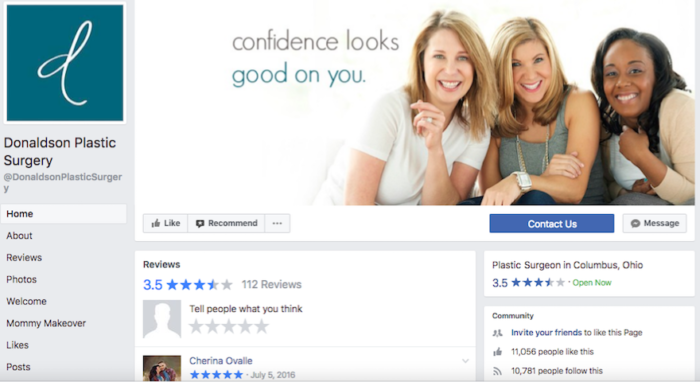
    Dr. Donaldson has been our client since 2009, the year he opened his practice. Since he was just starting out, there was a lot of work that needed to be done in terms of digital marketing, including a new Facebook page that had a grand total of zero Likes. Since launching his Facebook campaign in 2011, Dr. Donaldson’s page Likes have increased to over 11,000. This was accomplished through a comprehensive Facebook marketing campaign.

    This campaign was comprised of Facebook management, fan building, and Facebook display ads. We created posts that established Dr. Donaldson’s professional brand and consistently published engaging, informational, and promotional posts that appealed to current and potential patients throughout the area. We also created ads that increased brand awareness, brought Dr. Donaldson’s practice to those who didn’t know him already, and promoted the full range of his services, all utilizing Facebook’s targeting abilities.

    Image Of Facebook Page Likes For Donaldson Plastic Surgery - Search Influence

    Combining paid ads with an increased frequency of organic posts expanded the practice’s fan base. A large chunk of Dr. Donaldson’s Facebook fans, totaling 11,000+ Likes, have come from annual fan building campaigns (over 6,400 of the Likes, in fact). Campaigns such as Likes for Lives encourage Facebook users to Like your page in exchange for a donation to a charity organization. These campaigns increase followers while also giving insight into your practice’s values and the importance of giving back to your community.

    Dr. Donaldson is proof that a well-managed Facebook page, full of engaging posts and targeted ads, can work to create a campaign strategy that gets patients through the door and establishes your practice as the medical resource in your area.

    Armed with the best practices we’ve covered in our blog series, you can accomplish results like this for your medical practice as well! If you have any strategic questions or need help growing your practice on Facebook, contact one of our experts here.

  • Growing Your Practice on Facebook, Part 4: Reach Your Audience

    Now that you’ve gained valuable insights on the many uses of Facebook paid ads, the importance of engaging with your followers, and why all of this matters in the first place (spoiler alert: yes, social media is worth your time), we’re going to get into the specifics of understanding and capturing your audience. After all, if you don’t understand your users, how are you ever going to reach them?

    We’ll share how to use the Audience Insights tool on Facebook to analyze when your users are active and what’s catching their attention. Then, we’ll share some surprisingly easy ways to update your Facebook page and grow your followers—as well as your actual patients.

    Ready for the PhD-level course on using Facebook to grow your medical practice? Download our free e-book today.

    How Can You Use Audience Insights to Grow Your Reach on Facebook?

    With nearly 2 billion monthly users on Facebook, it’s important to narrow the scope and understand who is engaging with your practice, as well as what they are looking for from your page. That’s where the Audience Insights tool plays a vital role. Audience Insights allows page administrators to understand their users and target their reach according to demographics, purchase behaviors, geography, and activity on Facebook.

    By creating a custom audience using this tool, you can target your ads to a specific group of users on Facebook. Say you know that your typical patient is a female in greater New Orleans with an average household income of $150-250K and a bachelor’s degree or higher. You can create a new custom audience using these demographics and build an ad campaign on Facebook to target that audience. While that’s a pretty narrow scope for a medical practice that isn’t quite so sure of their ideal patient, experimenting with a few different test audiences to gather data on successes and misses is a great first step.

    On the other end of the spectrum, you can also use Facebook insights to gain more knowledge about your active users and cater your posts and ads to the types of demographics that are most engaged with your page. You can even learn the best times of the day and week to post and the type of content that achieves the highest engagement. Perhaps you see a spike in engagement when you post patient testimonial videos on your page and dedicate more marketing spend on creating videos. Or, maybe your analytics show that users are more engaged in the mornings, so you schedule your posts in advance for time slots between 8 a.m. and 11 a.m. to capitalize on your users’ behaviors.

    These insights can all inform your future social media marketing strategy to focus on what works and build on your successes.

    Picture Of A Medical Doctor's Desk - Search Influence

    How Can You Connect Your In-Person Audience With Your Social Presence?

    While tools like Audience Insights allow you to understand your online audience, it’s just as important to understand and connect to the people visiting your office and living in your community. The more you can bridge these two segments, the better your chances of building a loyal fan base and creating meaningful social media content.

    Events are a great option for bridging these two audiences. If you’re hosting an event at your office, like a drive for flu shots or a fundraiser for a local nonprofit, be sure to create a Facebook event so guests can RSVP, invite friends, and receive reminders as the date approaches. If your event is public on Facebook, the platform will also suggest it to other users based on friends who are attending. Now your online users also have a reason to visit your office and speak with you in person about a subject they are already interested in.

    Community events that focus on the values of your practice are also important for building trust and humanizing your online presence. By showcasing the causes that are important to your industry, work, or community, users can connect with your page through those similar interests. For example, if your company is participating in a community event like March of Dimes or you have a team participating in a local 5K, share updates on your fundraising efforts, highlight photos from the event, and link to informational articles about the cause. All of these strategies help create dynamic social media content while also connecting you to the broader community of users with shared interests and passions.

    How Can Fan-Building Campaigns Help Engage & Grow Your Audience?

    Now that you have a better understanding of who your target audience is and how to build a bridge between your online and IRL communities, it’s time to increase the number of actual fans connected with your page. The first step may seem obvious, but it can’t be overlooked. You have to have an active, established page with helpful content and consistent posts. Make sure you’re dedicating time to posting new content as well as responding to inquiries to build engagement.

    Image Of Stethoscope With Breast Cancer Ribbon At Medical Practice - Search Influence

    Another great tactic to generate new followers is through a fan-building initiative such as a “Like for Lives” campaign. Remember when we said that connecting your social media content to your values and industry is important? “Likes for Lives” does just that. The basic premise is that for each additional Like that your page receives for a set period of time, your medical practice will make a donation or take an action to help save a life. This could be a monetary donation to a charity, a volunteer commitment, or any other creative action your practice can take to help others.

    The goal is to generate excitement on your page and in your office, giving you plenty to post about in order to raise awareness about your campaign and encouraging your fans to share your initiative with their friends in support of a good cause. Be sure your staff is informed of the campaign, and encourage or incentivize them to share the information within their own networks on Facebook. If you work with a nonprofit to raise money, they may also want to share the content, further increasing your reach.

    With a combination of tactics like these and consistent posts on your Facebook page, you’ll start seeing your audience steadily grow. By targeting the right demographics, you can also see this growing audience translate to more patients. Remember, social media is here to stay, and leveraging its power and reach can have a big impact on your medical practice.

    Stay posted for the next update in our series where we’ll discuss the importance of patient confidentiality on Facebook.

    Eager for more tips and tricks to grow your social media IQ, or ready to get started with digital marketing campaigns for your business? Contact an expert from our team.

  • Growing Your Practice on Facebook, Part 2: Shareable Content

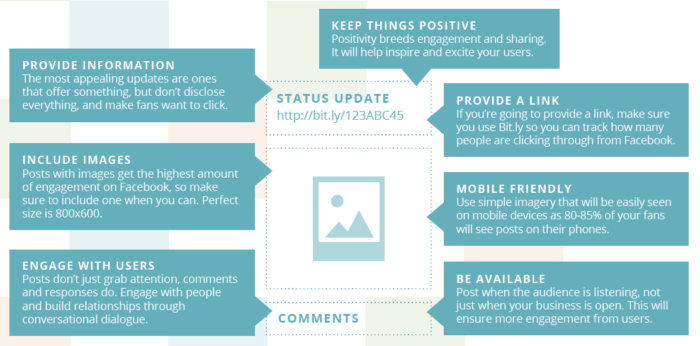
    Now that you’ve learned why Facebook is such a crucial tool for your practice, it’s time to master one of the most important aspects of Facebook: engagement. Facebook is all about conversation and interaction. If you aren’t creating compelling content and engaging with your followers on a regular basis, your social media campaign will fall flat—making the next steps in this series much harder for you. Here’s how to polish up your content and keep your followers invested on Facebook.

    1. Create Shareable Content

    At one point or another, we’ve all come across a Facebook post that just speaks to us; one we couldn’t help but share with a friend or add to our timeline. The act of sharing a Facebook post seems simple enough, but for your business, these shares are crucial to your social media campaign.

    According to Kissmetrics, more than 30 billion pieces of content are shared on Facebook each month. Facebook shares are powerful stuff for business because they help your message to grow exponentially. Friends share content with Facebook friends in a way you couldn’t have managed organically on your own. So, how do you help make this happen?

    Well, if your practice wants to be included in those 30 billion pieces of shared content, it’s essential that you start writing interesting and relevant posts your fans will really want to read. If you’ve followed our blog for a while, you’ve probably heard us quote the great Bill Gates saying “Content is king.” This saying holds true across websites and platforms, and Facebook is no exception. Compelling, authentic, and viral content is what earns you those valuable shares, which in turn means more fans and more social influence.

    Just one thing to clarify: we’re not saying Likes aren’t valuable in their own way. They can be a sign of popularity, a mark of agreement, or a note that “I agree,” or “I’m with you.” However, if your goal is to get your content in front of more potential patients, you should always be on the hunt for the ever-elusive Share. Got it? Let’s get started.

    How to Create Shareable Content

    The tricky thing for medical practices is that you’re busy, and your staff might not always have the time or expertise to sit down and brainstorm ideas for compelling content. But don’t worry—here’s a list of tips to get you on the road to those shareable posts.

    • Keep it short and sweet. The ideal length for Facebook is around 40 characters.
    • Don’t use too much industry jargon. The medical industry is notorious for its jargon. Just don’t forget to consider your audience when posting. Complex terms can be off-putting, and your busy readers will appreciate your effort to break things down.
    • Don’t make every post promotional. Patients will find it helpful to know your biggest and most relevant updates, including new staff members, upcoming events, and special deals. But keep in mind that no one wants to read a revolving door of the same products and services your practice offers. This type of repetitive content is unlikely to be shared.
    • Know when to post for best results.
    • Use images whenever possible. According to Hubspot, Facebook posts with images get 2.3x more engagement than those without images. Consider adding more personal images as well, such as photos of your office, your team, or your patients. This lets readers get a glimpse at the faces behind the computer, and it adds a personal, familiar touch to your posts that can’t be gained with stock images alone.
    • Consider creating a weekly themed post. This gives your fans something unique and interesting to look forward to on a regular basis. Maybe you want to highlight a recent article you read, inspirational images, or products your practice recommends.
    • Share or repost interesting updates from other businesses. Give your readers a range of information by sharing relevant information posted by other practices, industry leaders, or medical associations. This can also be a good way to help build a referral network.
    • Share something silly every now and then. It’s true that the medical industry has a reputation for being serious, but adding silly content to your page just for the sake of sharing the joy can make you more relatable. Funny yet relevant comics, relatable e-cards, cute videos, and even animated reaction GIFs might seem off-topic, but these types of posts are often widely liked and shared. These can be great for extending your reach if your practice’s name is attached to the content.
    • Come up with interesting topics. Don’t be afraid to change things up! If you need help with this, try one of our favorite tools, Answer The Public, which can help you get an idea of what your patients might be searching for or interested in.

    Image Of The Ins And Outs Of Shareable Content - Search Influence

    These tips can go a long way in shaping your existing Facebook posts into something your fans will naturally be interested in. It can take time to master all of this, but even small steps can help increase your content’s shareability—and don’t forget that we’re always here to help!

    2. Engage With Your Audience

    Now that you’ve created your shareable posts, it’s time to sit back, relax, and watch the Shares and Likes roll in. Just kidding! The hidden “Part 2” to your shareable content journey is the engagement factor. Your audience will react and respond to your content, and they’ll also voice their own questions, comments, and concerns. Everyone wants to feel like they’re being heard, and responding to these inquiries shows your patients and potential patients that you’re invested in the discussion.

    One thing to keep in mind with Facebook is that if you’re in the habit of responding quickly, users will see your estimated response time right on the page. This estimate shows your attentiveness, which can be a great signal for potential patients on Facebook. So, don’t forget that taking even a few minutes to respond to your followers can go a long way.

    With the skills you’ve learned in this post, you’re already on your way to growing your medical practice on Facebook. Next time in our blog series, we’ll teach you how to enhance your Facebook campaign with promoted posts!

  • Growing Your Practice on Facebook, Part 1: Why Facebook Matters

    It’s no secret that Facebook isn’t going away anytime soon. Even with predictions a couple of years ago that the social media giant would lose a significant portion of its users to other contenders like Instagram, Twitter, WhatsApp, and Snapchat, they’ve managed to see steady growth. Since that prediction in 2015, they’ve gone from 1.2 billion monthly users to nearly 2 billion.

    So, let’s address the elephant in the digital room here. Is your practice on Facebook?

    In this series, we’ll break down the ins and outs of the best ways to reach your patients through Facebook, going over everything from advertising and shareable content to privacy rights and how to find the right images.

    Before we get into details of using Facebook to bring in more patients, let’s break down a broader question: Why is Facebook so important for your practice?

    Social Media Humanizes Medical Practices

    When’s the last time you talked with your patients outside of the office? In a report from the Health Research Institute, Ed Bennett, who oversees social media efforts at the University of Maryland Medical Center, notes, “If you want to connect with people and be part of their community, you need to go where the community is.”

    By using Facebook to interact with patients, physicians can create a dialogue that builds trust. Some patients may feel uncomfortable scheduling an appointment when all they wanted was to ask a personal medical question. Sometimes questions are just easier to ask through a direct message or comment rather than over the phone or in person.

    Medical Patient Sitting On Treatment Couch - Search Influence

    By commenting on, responding to, and answering questions directly through Facebook, unforeseen walls begin to break down. The best part? That starts to become what your practice is known for. Your medical office gets a reputation for being the place to go where people won’t feel afraid to ask about a diagnosis or procedure, how it affects them, or what their options are. It becomes the ideal venue for open communication. You’re no longer just a resource for patients when they come to your practice; you’re there for them at any time.

    Think about it this way. The average user checks their Facebook account daily. Will your practice be there to start a conversation when they log on?

    Expertise, Industry Experience, Specializations—Go Ahead and Tout It

    To go along the philosophical questioning of whether the falling tree in the forest makes any sound, are a physician’s best certifications and qualifications of value to patients if nobody knows about them?

    According to Search Engine Watch, nearly 90% of respondents aged 18–24 said they would trust medical information shared by others on their social media networks. This is also coming from a demographic that is more likely to share this information. Facebook gives physicians the tools to share their specific knowledge and expertise. Got a recent press release or blog post about a new technique offered exclusively at your practice? Put it on Facebook. It will demonstrate your expertise in your field while providing a great avenue for your patients to engage with and share this information.

    Also, in a time where anyone can share information and claim it as fact or scientifically true, physicians have the capability and responsibility to make sure accurate, helpful information is reaching their current and potential patients.

    Medical Patients Waiting In The Physician's Office On Facebook - Search Influence

    It’s All About Relevance

    Just as you shouldn’t make updating your Myspace page or LiveJournal your top priority anymore, you should be posting and staying up-to-date on Facebook to make your medical practice more relevant to what’s going on in your patients’ lives. It shows you’re a part of the online community, and ideally, it garners more traffic to your website and office.

    Ultimately, Facebook is more than just a place to share family pictures, an exciting recipe, or an awkward political conversation with an uncle. It’s a powerful resource for medical practices to reach their patients on a more personal level. Your patients are already there. We can show you how to utilize social media to find them and make them advocates for your practice. Reach out to us to learn how to implement a social media plan for your practice.

    For more information, stay tuned for our next blog post, which will teach you how to create and share content that moves your audience.

  • NEW ORLEANS, May 24, 2017 — The Plastic Surgeon’s Guide to Press Releases

    Search Influence has done a little blogging about press releases in the past, but now it’s time to kick things up a notch—or 16 billion notches. According to the American Society of Plastic Surgeons, Americans spent roughly $16 billion on plastic surgery in 2016, which is an all-time high. With thousands of plastic surgeons vying for a place in this lucrative industry, your practice should be using every tool at its disposal to keep up with the competition. One such tool is the press release.

    All About Press Releases

    The press release is THE classic public relations tool. It’s over 110 years old, but don’t worry—it’s still very relevant. The modern press release is published online and distributed through networks like PRWeb. A press release can inform media outlets about a newsworthy event related to your practice. Not only is this great for publicity, but it also helps with SEO. When reputable news sites run your press release or write a story about it, they provide authoritative backlinks to your website, which makes your website more authoritative in turn.

    Now, if you’re low-key panicking about what PRWeb, SEO, and backlinks even are, stop. Take a deep breath. Then, contact Search Influence to get all your questions answered.

    Image of a woman trying to decipher the workings of the internet - Search Influence

    If you’re already an SEO pro, great! Let’s move on to exactly what you should talk about in your practice’s press releases.

    Good, Newsworthy Topics

    Step one of writing a good a press release is choosing a newsworthy topic to write about. You should think of it as an announcement, not an advertisement. Press releases are not intended to hype your friendly customer service, compassionate care, or other unique selling propositions. They should not include a personal point of view, like “we” or “you,” and they should not include any promotional language. You probably are an exceptional surgeon who provides stunning, natural results, but PRWeb will probably reject your press release if you say as much. Instead, focus your press release on important recent events or developments.

    Here are some great ideas for topics to write about, courtesy of InboundMD:

    • Celebrating Milestones or Anniversaries
    • Participating in Community Events
    • Hiring New People
    • Acquiring New Equipment
    • Offering New Services or Treatments
    • Opening a New Location
    • Winning Awards or Honors
    • Speaking at a Conference
    • Publishing a Study

    All of these topics let you announce a new event or development that might capture readers’ attention. They also all provide the opportunity to frame your business as an objective leader in your field. A lot of practices could run ads claiming top-of-the-line equipment, but fewer practices could back up their claim with an objective and authoritative news story about acquiring new equipment. Press releases are a factual way to set yourself apart from other practices and stand out to potential patients.

    Sections of a Press Release

    Now that you have an idea of what to write about, let’s move on to some practical how-tos. Press releases follow a very specific format, and the sections are as follows:

    • Title
    • Summary
    • Body
    • Boilerplate

    The title should concisely announce your newsworthy topic. It should include your company name and an action verb.

    The summary should build on your announcement with engaging details to draw in the reader. For example, if the title announces that you published a study, the summary can explain how that study might impact surgical procedures or medical treatments in your field.

    The body is where the majority of the writing takes place. It should begin with a dateline, formatted like the image below:

    Image of a standard press release dateline example - Search Influence

    The dateline should be followed by a strong hook or lead to capture the reader’s attention. Then, the rest of the introduction paragraph should provide the reader with all the key details they need to know about your announcement. The following paragraphs should build upon these core details, until the final paragraph, which should briefly include your contact information.

    The body should be written in the third person, and language should remain objective, rather than promotional. However, you can include one or more quotations, from yourself or another knowledgeable figure, that can bend these rules a bit. A quotation can say, “I am proud of my practice’s dedication to technological advancements.” The rest of the body cannot. This is because the quotation is clearly attributed to an individual and framed as an opinion.

    The final section is the boilerplate, which is a brief, objective description of your practice.

    Pitfalls to Avoid

    Unfortunately, no list of things to do is complete without a list of things NOT to do. Press releases have fairly strict editorial guidelines, and as you know, the medical industry is heavily regulated. The following are some common mistakes made in plastic surgery press releases and how you can avoid them.

    It’s been mentioned several times already, but do not use promotional language or treat your press release like an ad. Objective language will not only get your press release accepted by PRWeb and news outlets, but it will also lead to more compelling writing. Again, tons of doctors claim that their practice offers experienced, well-trained care. You can prove that your practice offers such care by running a press release about the impressive experience and credentials a new hire brings to your practice.

    Don’t include general business information, except for your contact information and the boilerplate. It isn’t news that your practice offers Juvederm, Radiesse, and other injectable fillers. A lot of practices offer that. It is news, however, that your practice is the first in your area to offer a brand new line of injectable fillers. If you find yourself filling space with general business information, it might be a sign that you should choose a more in-depth topic.

    Don’t make any promises unless they are backed up by studies and statistics. This is not only because such promises can be too promotional for a press release, but also because everyone from Google to the American Medical Association has strict rules against misleading patients. Even seemingly innocuous claims about natural-looking or proportionate results can be flagged as misleading, as results can vary based on a large number of genetic and situational factors. To be safe, include reputable citations for all claims, and it doesn’t hurt to follow up with a disclaimer like “results may vary.”

    Ready to Start?

    This information should put you well on your way to writing the perfect press release for your plastic surgery practice. If you still have questions, or would rather leave the writing work to us, contact Search Influence! We’re happy to help.

    Images:

    Deciphering the Internet

  • Grow Your LinkedIn Network With These 3 Optimizing Tips

    With over 400 million users, LinkedIn has become a social networking must for companies large and small. While other platforms like Facebook and Twitter are commonly used in marketing and SEO campaigns, LinkedIn can have a significant impact on online visibility and SEO opportunities. Instead of neglecting your LinkedIn account, utilize it to grow your business’ traffic and network.

    1. Be Consistent

    The Devil Wears Prada Who Are You - Search Influence

    For your traffic to increase, customers have to know it’s you. One of the biggest mistakes a company can make is not maintaining brand consistency across all marketing platforms. LinkedIn provides you with the opportunity to upload banners, background images, videos, and photos. Utilize all of these to tie back into your brand, logo, tagline, and color scheme.

    This also applies to the written content on your LinkedIn profile. If your business’ website uses a formal tone, don’t be overly casual on your social media. This creates brand confusion and can lead to customers not connecting with you because they think you’re someone else. Don’t lose out on growing roots with a client because someone can’t figure out if your profile is the right one.

    2. Engage Your Network

    Parks And Recreation Aziz Ansari On Social Media - Search Influence

    While you may have a lush profile, if it’s not active, no one is looking at it. It’s important to create, share, and like fresh and relevant content to your industry. Shower your followers with content at least twice a day and watch your network grow. This keeps your profile engaging as well as current. When creating or sharing content, make sure to add variety. For example, it can be good to post an interesting article in the morning and then ask an engaging question in the evening. This allows for different types of client interaction and can make a profile look more personable.

    As I’m sure you’re aware, blog posts are great when it comes to a site’s SEO. By posting your company’s blog posts on LinkedIn, you not only help your profile, but you also improve your website’s ratings, which can lead to more business.

    3. Let Your Keywords Shine

    SEO Friendly - Search Influence

    While your company can be searched on LinkedIn by name, it can also be found by keywords. The keywords used in your SEO campaign are the same words you should be using on your social media platforms. Your keywords should shine through your content from your posts, to your description, and to your headline. While it’s still important to stay natural, try to fit in a keyword or two in the first 156 characters of content on your profile. Google previews these first characters, and with the help of keywords, your profile can be more easily found.

    LinkedIn Superman - Search Influence

    By not growing your LinkedIn network, you’re leaving opportunities like referrals and website traffic in the dust. Social media platforms are crucial to interacting with current and potential clients. As LinkedIn’s numbers grow, so can yours. Make sure your profile is the cream of the crop and optimize.


    Image Sources:

    Devil Wears Prada Image

    Aziz Ansari On Social Media

    LinkedIn Superman


  • Grow Your Business With These 7 Digital Marketing Tactics

    Members of the Search Influence team gave their insight on tried and true digital marketing strategies. These strategies apply to every industry, from plastic surgeons to attorneys, and many can be implemented across different channels of marketing. Using a mix of or all of the 7 tactics below is a sure-fire way to optimize your business’ online potential.

    1. Mobile

    Before updating the aesthetics or adding content to your site, it’s of the utmost importance that you make sure your site is responsive and functions properly on both desktop and mobile. More than half of users say they wouldn’t recommend a business if they encountered a poorly designed mobile site.

    “To me, the biggest trend (and this is as much a wish as it is a prediction) is that small businesses begin to take mobile optimization more seriously. I’m still surprised by the number of businesses I see in my day-to-day life that haven’t reacted to the continuous uptick in mobile search by having their site optimized for mobile users.

    My main focus, in terms of a trend, is the expansion of mobile search as a primary source of information. The trend will be more companies utilizing tools like Google AMP in order to improve the mobile user experience. Currently, far too many don’t take the number of leads they can get from a mobile-optimized site.” – Cory Agular

    Later in this post, I’ll go over AMPs and some more specific mobile moves, but I really want to emphasize that mobile should be incorporated in every aspect of your online marketing campaign. Google has stated that not only are 60% of users unlikely to revisit a mobile site they had difficulty visiting, but also 40% will then go on to visit a competitor’s site. You’re not supposed to judge a book by its cover, but if you can’t open the book, you’re not even going to try reading it.

    Image Of A Cell Phone Searching - Search Influence

    2. Schema Markup

    Schema markup, coding that can be added to a page on your site, makes information more easily readable to search engines like Google. This code labels pieces of important information on the page. Search engines not only understand the information better but they can also provide richer search results to users.

    “As far as I’ve noticed, Schema’s been underutilized… however I’m seeing a lot more talk acknowledging it for its on-site SEO value and correlation with rich snippets and Google’s knowledge graph. And as we’ve seen, Google’s been working to improve its algorithm and knowledge graph to really ‘understand’ content to better predict user trends.” – Kiersten Kampschroeder

    “It’s been increasingly popular to integrate schema into your content. I think that providing meta information using schema markup not only helps SEO, but it also aids the programmer and contributes to making better semantic websites. 2017 will be the year where instead of thinking how we can ADD schema to existing sites, we instead shift toward creating websites with schema markup baked into their design and writing content with schema markup in mind. I’d compare thiscoming year with what happened with responsive design 3–4 years ago. That was the shift where everything became mobile first. 2017 will be the year schema is integrated into the general development workflow.” – Member of Web Development Team

    A search for “breast augmentation new orleans” shows how review schema implemented on Dr. Kinsley’s site appears in results:
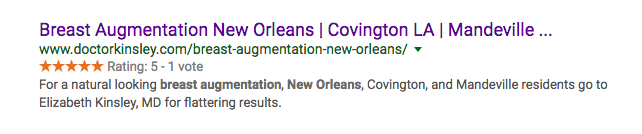
    Image Of Dr. Kinsley's Search Results - Search Influence

    3. GIFs

    While 2016 saw a rise in GIFs, an acronym for Graphics Interchange Format, they were first debuted by Steve Wilhite of Compuserve in 1987. They are the epitome of #thirtyflirtyandthriving. These dynamic, digestible pieces of content are easy to create and share and provide a more engaging user experience than a single static image.

    “GIFs are important to any brand aesthetic, be it personal or public, because they offer a truncated version of the desktop’s fluid experience (i.e. video).

    GIFs are a better option now since they’re more pervasive and different social media platforms accept them or give you a way to use them easily. Instagram, Twitter, Facebook, and Facebook Messenger are all compatible with GIFs now.

    Twitter actually integrated, similarly to Facebook, a GIF search within the post tool. [It has] allowed for a closer relationship between Facebook and Twitter, as well. You’ve always been able to link the two accounts, … [but] now, it looks like Twitter, when auto-posted to Facebook, is fully integrated into Facebook’s platform and presents the post as it would be presented on Twitter.” – Member of Graphics Team

    There are so many reasons you should incorporate GIFs into your marketing strategy this year. As mentioned, the fluidity of GIFs can make the creation of cross-platform content so much easier. They’re easy to create and even easier to share. Most of all, it’s a fun and unique way to reach your consumers!

    So, why not shake things up a bit?

    4. Social and Mobile Paid Advertising

    In 2016, we saw a rise in mobile advertising, but this year, with more than half of searches on mobile devices, it will be an essential component of an effective and well-rounded search engine marketing campaign. Expanded ads are now easily translatable between desktop and mobile, but it’s almost important to mobile users’ needs when determining the content, location, and timing of your paid ads.

    Social advertising like Facebook Paid Ads are showing increased popularity and effectiveness. The level of granularity continues to rise with Facebook audience targeting, and we have seen an increase in conversions even as CPCs remain low.

    “With the introduction of ‘new’ campaign objectives, such as lead generation and local awareness, Facebook really does seem to be a place for lots of growth. With Facebook trying to essentially phase out Fan Building campaigns, local awareness campaigns present an interesting opportunity for smaller budget clients who want to focus on a local market.” – London Fougerousse

    While Facebook ads are more cost-effective than traditional paid ads, that’s not a reason to rely on them solely. The decision to use Facebook vs. Google Adwords or a mixture of the two is truly dependent on a variety of factors, such as your location, industry, and goals. I recommend hopping on the mobile train sooner rather than later. Forecasters are predicting that by 2019, 72% of digital ad spend will be on mobile advertising!
    Image Of Smiley Face Emojis - Search Influence

    5. Google’s Accelerated Mobile Pages

    As I mentioned at the beginning of this post, mobile should be a consideration for all of your online marketing efforts. Google’s Accelerated Mobile Pages (AMPs) are a way to take that focus even further. AMPs are not a ranking factor in Google (for now) but they can positively impact impressions, clicks, and user experience.

    “Since the rollout of AMPs in mobile SERPs this past spring, pages have typically only been found at the top of the results page in a carousel—which is still prime real estate—however, Google recently announced that AMPs will soon also begin showing in the organic results and supporting more content types. We’ve all heard the mobile-friendliness search stats, and adopting AMPs is another way to bring content to your consumers instantly and on the go.

    “Historically, AMPs have been utilized mainly by news publishers, but with the expansion to the organic results, I can see a future for almost every type of industry. Shopify, eBay, and Fandango recently announced their integration of AMPs, so this is a good trend for e-commerce clients especially to be conscious of. And Google also hinted that they will begin supporting more content types like live videos, galleries, etc., which can also open more doors for clients to take advantage of.” – Member of Account Management Team

    Image Of Google Search Of Presidential Debate - Search Influence

    The increased speed of Accelerated Mobile Pages leads to a better user engagement, and those (potential) customers/clients are more likely to return to your site if it was able to quickly provide them the information they were looking for. A recent study shows that with AMPs, The Washington Post saw a 23% increase in mobile search users who return in 7 days. If you’re a business receiving the majority of your site traffic from mobile devices, AMPs could be a strategic way to boost your online presence above and beyond your competitors.

    6. Video

    Video is not just for YouTube. It should be incorporated into as many of your online marketing efforts as possible: product/procedure pages on your site, email marketing, display ads, social platforms, and everything in between!

    “For online marketing rich content could include native video content and paid video ads on both YouTube and Facebook Video Display ads. Also, I think brands will begin to utilize Facebook Live more for events and branded content to engage their fans.

    “I believe these videos will be prominent cross-device! Today, people are constantly moving between devices throughout the day and advertisers need to be innovative and streamline their message to engage users across all devices.

    “For Facebook Live, I would recommend this for brands and businesses that have a strong Facebook following. Facebook Live is a tool to engage your audience, not necessarily build an audience. These videos are best for events, conferences, speaking engagements, big company announcements, etc. There are so many options to deliver creative, curated content!” – Sophie Kirk

    Rich video content is content that keeps on giving. One video can apply organic, paid, and social campaigns across devices, and can be broken down and repurposed to create a number of assets. Videos are not only attention-grabbing, but are also a great way to establish your brand’s message and have lasting effects in terms of brand recall.

    7. Links

    Links might not be the most exciting item on this list, but they’re certainly one of the most important. Link building is an essential aspect of a well-rounded SEO strategy! When the search engines crawl pages on your site, links are used to identify how it relates to other internal pages and other sites. Links connecting one site to another can indicate that a particular page/site is the authority on a given topic. But, as you should know, not all links are created equal!

    Google first launched its Penguin Update in spring of 2012 and rolled out its final update, Penguin 4.0, this past fall. Penguin is Google’s effort to catch sites that are using “black-hat SEO” techniques like spammy link acquisition to affect search rankings.

    “In 2017, ‘link’ will no longer be a dirty 4-letter word. For far too long, bad link building has been lumped in with quality link earning. Everyone got freaked out by Penguin and the industries either shied away from “linkbuilding,” or, if they were doing it, were hush-hush about it.

    “Google’s initial differentiator was to focus on links as votes, which is at the core of PageRank. Google has, in the past, described their foundational algorithm by stating: PageRank works by counting the number and quality of links to a page to determine a rough estimate of how important the website is. The underlying assumption is that more important websites are likely to receive more links from other websites.” – Paula French

    Google truly is looking for quality over quantity when it comes to link building, but that’s just part of the SEO puzzle. If your site is suffering from technical issues or lacking rich, natural content, links will not save you. Make sure your online marketing strategy includes both on and off-site efforts.

    Image Depicting Online Marketing Tactics - Search Influence

    These 7 online marketing tactics are an inexpensive way to boost awareness of your practice and bring in new, revenue-generating patients. With a little strategy and effort, you can have a comprehensive SEO campaign that brings your practice’s website up to speed!

    Image Resources:

    Cell Phone Image

    Facebook Emojis Image

    Social Network Image
  • How a Debate About Onions Showed Google Might Not Be Infallible

    A couple of weeks ago, I was driving to meet a friend for dinner when I heard a segment on NPR’s Marketplace that featured Tom Scocca talking about his article on Gizmodo about caramelized onions. At first, it seemed like many a segment on NPR we’ve come to expect—interesting and mildly entertaining. It wasn’t until the segment got to the point of the matter that I was hooked. When people were searching on Google for “how long does it take to caramelize onions?” they were getting misinformation. How could such a simple question turn up a false response from the world’s largest, and arguably smartest, search engine? I wondered, are there other moments like this that have happened between users and Google?

    How Did Google Misinterpret What Is Common Knowledge to Most Chefs?

    To be fair to Google, this wasn’t entirely their fault. The initial blame goes back to the thousands of recipes that live on the internet telling readers how to caramelize onions, from an at-home amateur cook’s blog to the New York Times. For whatever reason, instead of telling home cooks to patiently take their time to cook the onions on a low to medium heat for upwards of 30-45 minutes, a lot of recipes listed the expected cooking time as 5-10 minutes. If you’ve ever attempted to caramelize onions in this amount of time, I’ll go ahead and break it to you—it’s impossible. To save you from a bunch of food chemistry, I’ll just say that it has to do with the sugar content in onions.

    Purple Onion Cut In Half - Search Influence

    So, why is there so much content online that gives users, and in turn Google, misinformation? The simplest answer is that writers of recipes were trying to simplify a process that would turn an ordinarily easy recipe for a weeknight meal, like French Onion Soup, into a 1 ½ –2-hour ordeal. In Scocca’s Slate article written in 2012, he gave many different examples of well-known chef’s attempts and failures at trying to achieve caramelization in less than 20 minutes. The article is littered with keywords Google would love and came from a highly reputable source. At its beginning, he references the 5-10 minute myth, and for a while, this had a positive response—The New York Times changed their language when talking about caramelization in their recipes, and even the Wikipedia page was updated as a result.

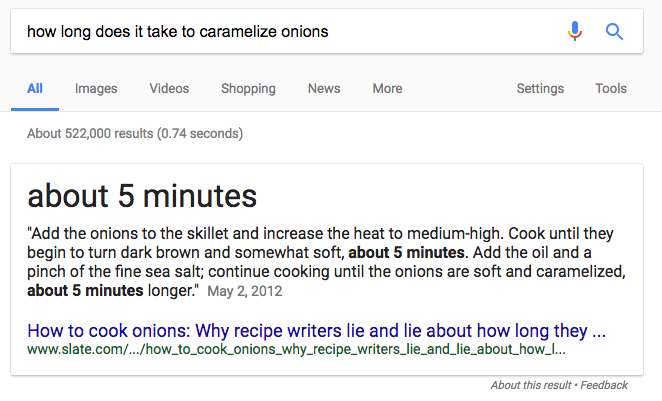
    But, when people typed “how long does it take to caramelize onions” into Google, they continued to see the false expected cooking times appear in Google’s search result box that is supposed to give users “one true answer,” a term coined by Danny Sullivan, founder of SearchEngineLand.

    How Long Does It Take To Caramelize Onions Google Search - Search Influence

    It turns out, Google was looking at Scocca’s Slate article, with all of its high word count and keyword-laden, well-written text, as the authoritative source. The only problem was that its algorithm focused on and crawled the first paragraph that referenced the 5-minute cooking time. The myth Scocca was trying to debunk ended up getting “bunking,” to use his inverse take on the word.

    Users Push for Quick Answers

    Google hasn’t always answered questions. Users typed in what they were looking for, and they got a list of web pages that may help them find it. But Google realized people wanted short, quick answers to questions, so they developed the short answer box. It’s virtually set apart from the search results and has a slight drop shadow.

    This also isn’t the first time Google has had issues with its short answer box. About a month ago, if you were to ask “Is Obama planning a coup d’etat against the U.S. government?” the response was that he indeed was planning a communist coup at the end of his term. Ask why a fire truck is red and you got a Monty Python joke. While the latter could lead to some harmless John Cleese quotes passed around the office, the former could actually misinform the public in a harmful way.

    Why Are Firetrucks Red Google Search - Search Influence

    Google’s Response and Their Plan to Fight False Information and Fake News

    Google has been dealing with this for a couple of years now. In 2015, they announced that they were using RankBrain, an artificial intelligence algorithm, in combination with Knowledge Graph, which pulls information for short queries from sources like Freebase, Wikipedia, and the CIA World Factbook—very reputable sources. It currently contains 3.5 billion facts. And, with all of these instances of inaccurate snippet responses, Google was quick to fix the issues. Searching for the cooking time for caramelizing onions now brings up the correct answer. Also, along with Facebook, Google also upped their fight against fake news by using fact check systems in their searches and feeds. So the big question is, how does all of this relate to your small business, practice, firm, bakery, brewery, insurance agency, etc.?

    The Importance of Rich, Accurate Content

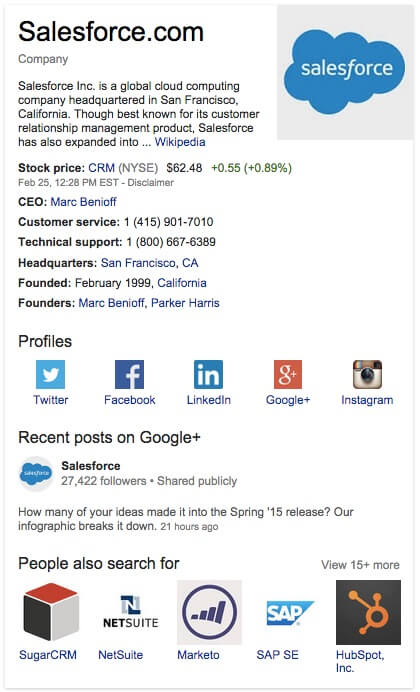
    Whether you’re working on new content or need on-site or local search optimization, the importance of producing educational, on-point, authoritative content is key. The Knowledge Graph’s “panels” pull information from your “about us” page, including contact information. These show up in the sidebar of searches and can include photos from your Google+ page as well as any reviews of your business. So, it should be a no-brainer that your Google+ page should be up to date and any reviews of your company are responded to promptly. Above all, make absolutely sure that your NAPs are consistent and current; an incorrect address showing up in a panel is not the quick answer that potential customers want.

    Salesforce Google Plus Account Screenshot - Search Influence

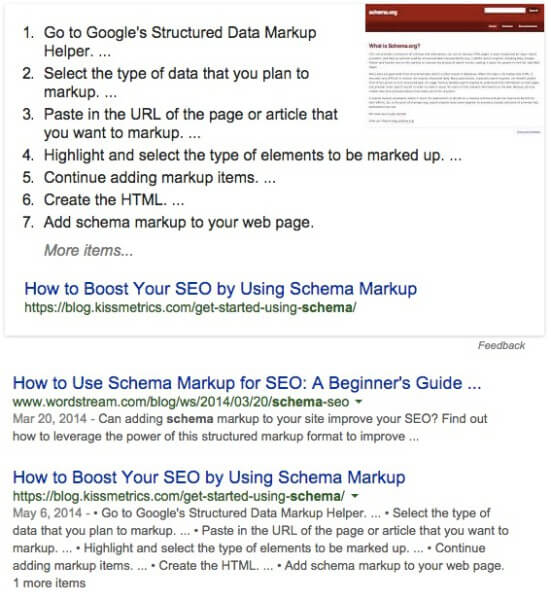
    There’s also the chance that your longer content could be pulled into a short answer box. At first, Google’s Knowledge Graph was pulling just short answers to questions, but it has since gotten smarter at pulling answers from longer content, like how-to guides with 20-point checklists or in-depth, 1,000+ word content that gives users lots of useful information to peruse. As always, make certain your content is not only accurate but also engaging enough to pull viewers deeper into your site and actually convert.

    Does This Completely Change SEO?

    In short, no. As this article from SearchEngineLand points out, in most cases, “the source getting pulled into the Knowledge Graph is already in the first few organic search results anyway.”

    How To Boost Your SEO Using Schema Markup Screenshot - Search Influence

    Good SEO will improve your ranking regardless and will, in turn, improve your chances of showing up in a short answer box. But even if your business never shows up there, your target audience is still searching for more than just a quick answer. They’ll want to dive into your site for in-depth, relative information. Similar to previous algorithm updates with Hummingbird and Panda, there may be some minor ups and downs in organic search numbers. But if your content is consumer-focused, educational, expertly written, and optimized, then your SEO plan will help out Google’s Knowledge Graph as well.

    If anything, these inaccuracies in Google’s AI have taught us that the search begins and ends (ideally in conversion) with the user. Keep in mind the unique relationship between your business and your potential client.

    Make It Easier for Google

    So, what are some additional steps you can take to make sure your site is up to current SEO best practices? Check out our recent white paper on things to avoid when building or optimizing your website. It includes valuable information, like configuring your URLs and making sure you’re mobile-friendly. Have any more questions on how to increase website traffic? Reach out to us at any time.

    Images

    Onions

    Short Answer Box via Gizmodo

    Fire Truck via TheOutline.com

    Knowledge Graph Panel via SearchEngineLand

    Short Answer Box via SearchEngineLand

  • Marketing to Males: How Can Your Cosmetic Surgery Practice Draw in More Men?

    In a society that remains focused on physical appearance, plastic surgeons have plenty of healthy competition to appeal to the audience in their community. Because plastic surgery procedures are being purchased overwhelmingly by women—in 2016, women purchased 90.7% of plastic surgery procedures compared to 9.3% purchased by men—most marketers target female prospects. However, research shows that doctors could be doing a lot more with their marketing strategies when it comes to targeting men.

    A New York University Medical Center study demonstrated the highly female-centric marketing campaigns being implemented by plastic surgeons. After analyzing 453 websites and 4,239 images on plastic surgeons’ websites, only 5% of the pictures included males, and 0.9% depicted both men and women together—not to mention that only 22% of these websites included any services related directly to males. In fact, some plastic surgeons completely ignore the male market in online marketing efforts or minimize them significantly.

    While popularity in some procedures has risen in male patients, plastic surgeons are seeking appealing and effective ways to market their services to men. What exactly is drawing in the men who are getting these procedures? Research shows that the following factors could help influence men to feel comfortable undergoing plastic surgery procedures for issues they want to resolve, ultimately helping them to gain more confidence.

    Dos Equis Man Jazzed About Plastic Surgery - Search Influence

    Pay Attention to What’s Already Popular

    When it comes to marketing to male consumers, it’s important to note trends. At the top of the list of surgical procedures performed on men in 2016 were liposuction, breast reduction, eyelid surgery, nose surgery, and facelifts. Popular non-surgical cosmetic procedures included injectables like Botox and Sculptra, as well as skin rejuvenation procedures like dermabrasion. Choosing to focus on these procedures and providing a plethora of before-and-after photos of men who have had these procedures done could prove beneficial to your plastic surgery ad campaign. Plus, the images can demonstrate the natural results that men may be seeking if they associate cosmetic procedures with highly noticeable and dramatic results.

    Focus on Youth and Energy

    The last thing that any male—or person, for that matter—wants to hear is that they look “tired.” Appearing to lack energy can be detrimental in a lot of ways, especially in a busy workplace that may be riddled with young people vying for the next promotion. By decreasing wrinkles and folds through plastic surgery, the fatigued look improves dramatically. Many men want to restore that youthful, energetic look that they had in their twenties, and this could provide effective fuel for your ad campaign. Again, consider highlighting before-and-after photos that demonstrate the great results men might not know they’re looking for!

    Target the Dads

    After years of raising kids, it’s hard for the stress and work not to take a toll on the body and appearance in general. Child raising years are common for the appearance of wrinkles and weight gain. Fathers are an excellent and relatively untapped market for plastic surgeons, in a similar way that mothers have been an effective marketing target. Try changing the dialogue in your ads to focus on hardworking fathers who deserve to treat themselves to a naturally younger look—a.k.a. the “Daddy Do-Over.”

    New Girl's Schmidt Celebrating Himself - Search Influence

    Emphasize a Natural Yet Rugged Look

    While many men may attribute plastic surgery to women and femininity, in reality, strong, masculine features can be enhanced with procedures that can provide natural-looking results. Some of Hollywood’s most notable and masculine heartthrobs haven’t come by their looks completely naturally. Even Dwayne “The Rock” Johnson confessed to having liposuction performed on stubborn flab, and George Clooney admitted to having an eyelid lift to help achieve his youthful glow. Men’s grooming is increasingly popular and less taboo than it has been in previous years, and the idea of shaving off ten years is now a highly acceptable idea.

    Beauty And The Beast Gaston Showing Off His Manly Chest - Search Influence

    Market to Couples

    Perhaps one of the more effective tactics is to reach men through their girlfriends or wives. It isn’t uncommon for a husband or boyfriend to use his girlfriend’s or wife’s products and to become hooked on the results. This can translate to cosmetic procedures as well: if a female significant other comes back from a cosmetic treatment with a refreshed glow, this becomes a recommendation in itself. Target your marketing to couples by age, encouraging them to enhance their bodies together or to reclaim their youthful looks.

    Pay Attention to Male Shopping Trends Online

    Men are increasingly turning their shopping experiences into social experiences, comparing prices and discussing them with others via social media. While this type of online behavior has been typically associated with women in the past, it is becoming increasingly popular among males. An online study from ManScan shows that 72% of men compare prices online, 56% read reviews of products and services, and 44% share this information with others. In many cases, the products and services discussed involve health and wellness. This information bodes well for the sharing of information about potential surgical procedures. By using a cost/benefit analysis with cosmetic procedures, plastic surgeons may see positive results with the male market.

    The male market provides an excellent opportunity for cosmetic surgeons to grow their practice through online advertising. By focusing on trends and behaviors, targeting men in ads can prove highly beneficial when done well. Consider these ideas and get more clicks to your website.

  • Home Sweet Home: Think of Your Website Like a House to Help Your Business

    It’s the American dream: work hard, build your business up, start a family, and buy a house with a white picket fence. Most of us are cruising for the same kind of idyllic dream for our business as well, even if we have a harder time figuring out how to get there. But what if I told you that one of the biggest factors contributing to business growth was, basically, a house? One you don’t need a mortgage to buy.

    Ok, so it’s not really a house: it’s your website.

    Image Of A House Working Like A Website - Search Influence

    But a website is a lot like a house. Its construction and design both build on top of each other and work to create a structure that is your business’s online home where people come to visit you. If you need a general contractor to make sure your house isn’t going to cave in, you can request a site analysis from us. But if you’re unsure if that’s necessary, or you’re just really obsessed with House Hunters and need to see where this is going, read on.

    Building From the Ground Up

    Your realtor wants you to see a new house on the market. First things first: you have to drive to it. The road you’re on is like the internet. You can get pretty much anywhere, and each road feeds off into more roads, creating the path you take (or the black hole you find yourself in when you’re “taking a five-minute break”). To avoid following random roads and hoping you get where you want instead of the Arctic, you need to know what your destination is. For a house, that’s the address. For a website, that’s the domain, also called the web address. See, I’m not making this all up; they’re completely related. The domain name in the example URL www.exampleswag.com is “exampleswag.”

    Image Of Floating House From Disney's Up - Search Influence

    So you know how you’re getting there, and you know the address, but what are you going to? Houses don’t float in the sky, and it would be very difficult for municipalities to enforce building regulations if they did.

    Just as a house sits on a physical lot, so too does a website have a physical home—the hosting and server. The server is a physical machine that sits somewhere out in the world, storing all the files that comprise your website onto its hard drive. Your hosting administrator owns and maintains the servers. When you pay someone like GoDaddy or HostGator to host your site, you’re asking them to host your website’s files on their servers, essentially renting land from them to build your house on. Sketchy real estate practice, but totally normal and secure for websites.

    Front End and Back End

    So you roll up to the house with your realtor for the walk-through. What exactly are you looking at as you’re exploring the property? On a website, there are essentially two different halves: the front end and the back end. The front end is everything a visitor to your site can see and interact with, similar to the walls, furniture, and doorknobs in your house. The back end involves the more structural aspects of the site: the wiring, plumbing, and framing of your house. When you’re buying a house, you want it to look nice on the front end and to have all the features you need (clawfoot bathtub, anyone?), but you also need it to function well on the back end. It doesn’t matter how beautiful the granite countertops are if the roof leaks every time it rains. This is why it’s so important to ensure your website has good bones. You can request a site analysis from us to find out where yours stands.

    The Foundational Platform

    Your website is built on a platform just like your house is built on a foundation. Popular platforms include WordPress and SquareSpace, but there are others. These two, in particular, are so popular because they are CMSs (content management systems) with really user-friendly interfaces. Once you get your CMS “key,” meaning the CMS platform has been installed on your site, you get easy access to all the contents of the house and can move furniture around and paint walls to your heart’s content.

    You could, of course, build your house without a foundation, or build your website from scratch one line of code at a time instead of using a CMS. It’s a pretty big job, and it really only works best for websites with few, static pages. Best to leave the roughing it to the survivalists and Mainer moose hunters.

    Bricks and Mortar: What Is Your Site Actually Made Of?

    The first known use of lime mortar was in 4th century BC Greece and Egypt. The first publically available description of HTML was in 1991. Times are a-changing, but structural integrity never goes out of style. HTML stands for HyperText Markup Language, but essentially it’s just the basic coding language used to create a website. Its primary use is to create each page of the site. It’s the framework that holds all of your stylish branding and outstanding content. Speaking of style…

    External Stylesheets Are the New Black

    HTML can be used to add some style to your website, but it’s a bit limited to tinted plaster and popcorn ceiling—think of the oldest website you can remember visiting because it was probably all HTML. The reason it looks so basic is that HTML is also what makes the bones of the house, so it ends up being a bit like trying to use the insulation of your house to create the wall color when that’s just not the insulation’s job.

    CSS (cascading style sheet), however, exists outside of the construction of the functional aspects of the site. All the CSS code is accessed separately from the HTML, so the style is rendered on top of each page as it loads. If HTML is the framework, CSS is the paint, wallpaper, and fancy flooring of your house. You can go crazy with customization and design whatever you can envision (I’m thinking mauve, personally).

    CSS can be housed above the fold content, the chunk of code that fits within the frame you see when the page first loads, but it’s better when it’s kept on an external stylesheet. An external stylesheet is a separate file from the page file and is accessed from the server individually to render a given page. When your site keeps the styling on an external stylesheet, search engines can clearly distinguish between style and substance as they go through the page code, leading to faster and more accurate crawls.

    Bringing In Personal Style

    The house has been bought and built, it’s all spruced up with trendy finishings, and now it’s time to fill it with furniture. Website copy is your site’s furniture. Having stellar copy is important for two reasons: it gives function and form. Each room in your house is divided into different functions by the furniture. Having content on each page of your site that is focused on the topic of the page tells visitors what information they should be expecting from that page and makes it easier to navigate to the information they want. When a guest comes to your house looking for a bathroom, for example, they’ll know which room is the bathroom because they will see bathroom furniture, and they will skip over the room with a bed because they know beds don’t live in bathrooms.

    In addition to having informational and focused content, you need to have strong content. If your copy is full of typos, lacks value, or has a tone that is off-putting to your readers, they’re going to leave, no matter how well the rest of your site functions. Would a guest notice your stunning parquet floors if they’re covered in dirty rugs and chairs that probably aren’t safe to sit on?

    Putting All the Pieces Together

    In the end, each piece of your website ends up working with the others to create the site, and if one isn’t receiving top marks, the whole site isn’t meeting its potential. After all, it only takes one dealbreaker to turn a dream house into a fixer-upper. But you can make your dream house work for you and your business. Take a good hard look at how your website looks now (or use the audit you’ve cleverly gotten from us as a guide), and decide what work needs to be done. If you’re not the DIY home improvement type, don’t worry—Search Influence has master carpenters on staff, so reach out to us for help!

    Image Of A Beautiful House Revealed - Search Influence