Tag: small business

  • Diversity in the Workplace: Why Who’s at the Table Matters

    In the corporate landscape, it’s easy to overlook words like diversity or inclusion, which often get tossed out as buzzwords lacking real meaning. But building an inclusive workplace where employees with different backgrounds, viewpoints, and identities can succeed is a benchmark for company success as well. In fact, a 2015 McKinsey report found that ethnically diverse companies are 35 percent more likely to outperform the national industry median and 15 percent more likely to have better financial returns.

    But let’s be real—diversity in the workplace is far from the norm.

    According to the New York Times, there are more male CEOs at S&P 1500 companies named John or David than the total number of female CEOs. And of the CEOs at Fortune 500 companies, only five are African American.

    This issue isn’t just for leadership either. A study from the Society for Human Resource Management found that 41 percent of managers surveyed said they were “too busy” to create structured diversity efforts in the workplace. Even so, more than half of employees surveyed by Glassdoor said they think their companies should be doing more to increase diversity.

    This data shows that there’s immense work to be done. But we can look to companies who have successfully incorporated diversity into their operational ethos as an example for what works—both for the employees and for the bottom line.

    Defining D & I in the Workplace

    Teenagers Young Team Together Cheerful Concept Diversity - Search Influence

    Diversity and inclusion can’t be achieved without first setting a clear definition for what these words mean, how they align with the business’ values and mission, and what systems are in place to create them. Building an inclusive workplace means being accepting and accommodating for gender and race, but also for sexual orientation and identity, religious affiliation, disabilities, age, and even thinking styles or backgrounds.

    By creating a workplace with diversity of thought—as in, collaboration among people with vastly different perspectives and viewpoints to solving problems—organizations can create systemic change. A study from Deloitte found that diversity of thought can help prevent “groupthink,” allowing for more creativity and more thoughtful decision making.

    But how does diversity of thought become a reality in the workplace?

    It Starts at the Top

    If diversity is built into the company ethos, then its leaders should be advocates on the frontline. For example, Arne Sorenson, president of Marriott International, regularly advocates for LGBTQ equality in the workplace. Marriott was ranked #7 on the 2016 Best Workplaces for Diversity list and scored a 100 on HRC’s 2017 Corporate Equality Index. Ethnic minorities make up 64 percent of Marriott’s workforce, with 2.7 percent of employees identifying as LGBTQ. Sorenson has fought for LGBTQ rights publically, even writing an open letter on his LinkedIn account about diversity in government and business.

    You can also include the LGBTQ community at large in your brand’s marketing efforts. Take a look at these ideas.

    Offer Benefits That Enhance Inclusivity

    On an operational level, businesses can also build inclusion into the brand identity by offering benefits that defend their stance on diversity. Rather than just relying on an annual cultural sensitivity class or a blanket statement in the employee handbook on diversity, companies should take a multi-faceted approach that includes diversity in the training, communication methods, and employee benefits.

    For example, AT&T offers Employee Resource Groups (ERGs) and Employee Networks (ENs) connecting over 130,000 members from across the company’s global workforce. The ERGs are nonprofit organizations that support, mentor, and advocate for communities in the company, including ethnic groups, the disabled, women, LGBTQ employees, and military veterans. The ENs are more informal, employee-led initiatives that convene around specific professional development issues.

    Groups like this give a voice to individuals who might feel marginalized and help individuals find common interests—both key for building a culture of inclusivity.

    Other ways to help enforce and validate inclusivity include offering English as a Second Language classes for foreign employees, providing benefits for employees with same-sex partners, and working with other companies that share the same values (or saying no to companies that don’t).

    Make Diversity Measurable

    Think Tank Around Measuring Diversity - Search Influence

    While meeting quotas doesn’t determine your company culture or employee morale, it does make a difference. Including diversity goals in annual reviews for managers and building it into hiring practices can help set the baseline for what diversity really looks like in your company’s daily operations.

    Some companies have even created positions dedicated solely to diversity. Abbott, ranked #10 on DiversityInc’s 2017 Top 50 Companies for Diversity, has a Director of Next Generation Recruitment, Diversity, & Inclusion who focuses on using technology to hire and retain employees with diverse perspectives. While not every company has the budget to devote an entire position to D & I, small businesses can still make diversity part of the recruiting, hiring, and review processes in order to measure success.

    When diversity is measurable, employees feel accountable and empowered to make it a priority. Give employees outlets to share feedback anonymously about the success of diversity initiatives, and be transparent about what is working and where the company can still improve.

    In today’s globalized economy, a diverse workforce can better reflect the needs and wants of a much bigger, much more varied consumer base. By building diversity and inclusion into every facet of your company, you’re building a workforce that is more empowered, innovative, and ready to take on the complex problems of our ever-changing, increasingly-connected world.

    At Search Influence, we realize that we still have a long way to go in order to foster an inclusive and diverse community—especially in the tech industry. Learn some ways we fight for women in the workforce and read more about our company culture.


     

  • ‘Tis the Season to Get Creative: Using Social Media for Holiday Marketing

    Many of your customers are gearing up for numerous holiday festivities that involve family, friends, and coworkers. This time of year also inspires lots of shopping. According to a study done by Deloitte, the average American will purchase 15 gifts during the holidays with the months of November and December generating 30 percent more revenue than non-holiday months. With all the gift giving and celebration, a stellar online presence, particularly on social media, is key to your business having a shining season. Keeping your customers engaged and informed of specials, events, and general happenings in the behind-the-scenes aspect of your business builds trust but also can build sales. In 2015, 75 percent of shoppers used the internet to research which gifts to purchase. So, don’t be afraid to get creative and light up your customers’ timelines with compelling copy. Need a little inspiration of your own? Here are some social media marketing tips that will get you in the holiday spirit.

    Christmas gift giving from 22 minutes - Search Influence

    Deck The Halls…With Lots Of Images

    Photos, videos, and other images are paramount to a healthy social media presence and they also present the perfect opportunity to engage potential shoppers on all levels. Create an Instagram video and show quick, behind-the-scenes clips of your store or showcase a new product or one of your lesser-known services. According to Wyzowl, 74 percent of shoppers who watched a demonstration video about a product or service subsequently bought it. So, show off your Spielberg skills and put together a product video to demonstrate how a featured item in your store is used. Remember, this doesn’t have to be a costly high-tech venture; just use a smartphone and tell a short and sweet story about how your shop is preparing for the holidays. Upload to your social media or even YouTube. If stills are more your thing, take some high-quality photos using your iPhone or a more professional camera and post images of employees who are in the holiday spirit. You can even include some shots of that huge order fulfillment you and your crew are working tirelessly on. Make the images personal and easy to share. If you are running low on your own photos, try incorporating user-generated photos from your customers.

    Tinsel Everything From Wall to Wall

    In other words, cover your bases when it comes to social media. Since your potential customers are more than likely shopping for other people, you are not necessarily trying to gain the attention of your traditional customer base. You may be trying to appeal to a mother buying a gift for her 20-year-old son, or a 30-something purchasing something for his niece. If dad is buying something for his daughter and your business has the perfect gift, let him know. Facebook has proven to be a wonderful resource that really does appeal to pretty much every demographic. With tools like Facebook ads, it’s becoming easier to target your potential shopper, so make sure the language that you’re using in your content speaks directly to your audience.

    Tinsel being placed on a tree in It's a Wonderful Life - Search Influence

    Spread the Joy of Your Business

    Today’s consumers want to know the ethics behind the companies they are shopping with. According to a 2015 Nielsen report, 66 percent of respondents were willing to pay more for products and services that came from companies who were committed to positively impacting social and environmental issues. So, tell your customers who you are and what you stand for. Are you doing any fundraising or charity events for the holidays? Share it! Are you participating in a food drive or giveaway? Tell us about it! Does your company’s mission align with the spirit of the season? Even better. These are positive events that can not only create a space for your company to give back but also encourage trust with your customers and impact sales, too.

    Give the Gift of Hashtags

    Added to the Oxford Dictionary in 2010, the hashtag is social media’s way of organizing ideas, keywords, and campaigns. Search some of the current trends and see if an existing hashtag fits your company’s voice or vision for the season. If not, jump start your own! Consider running a promotion based on your customers reposting or sharing a specific photo or post. Have them use a catchy hashtag you’ve created that is personal to your holiday messaging. To incentivize their repost or share, offer participants a small discount.

    Jimmy Fallon and Justin Timberlake using hashtags - Search Influence

    Embrace All the Holidays

    Facebook is a wonderfully diverse platform that will surely get you views from people of all walks of life, so don’t narrow your focus on just one holiday. Show love to each one of them and give them a shout out on your page. Let everyone know how inclusive you are across age groups, interests, and religious and cultural holidays alike. Take the time to wish your current and potential customers a happy holiday season and welcome them to your store.

    This time of year, after all, is about love, celebration, and gratitude. Let your customers know you care with a thoughtful social media campaign that will inspire them. If you need assistance with creating a holiday strategy and managing your social media, contact our team. We are happy to help you deck the halls with holiday content that will get your customers into the spirit of the season!

    Images:

    Gift Giver

    Tinsel

    #Hashtag

  • Meet & Greet : Your Buyer Personas and What You Should Know About Them

    When you ask a small business owner what kind of customers they want to attract, it’s not uncommon to get an answer like “everyone” or “anyone who can use our service.” When you’re creating marketing content, however, it’s not often possible to create something that will appeal to every single person on the planet—some people simply won’t be interested. For example, it doesn’t make a lot of sense to try and convince a college-age renter to install a new roof. It’s a more efficient use of your marketing resources to zero-in on people who are most likely going to be your customers. The best way to do this is to create buyer personas. Doing this will help you to define exactly who you are trying to reach.

    Zoolander Who Am I Image - Search Influence

    What is a buyer persona?

    A buyer persona is the Everyman of your customers. It combines all the characteristics your customers have in common and puts them into one fictionalized person who represents your average consumer. The buyer persona is based on real information about your clientele, and it defines their age range, gender, income, common pain-points, and what they’re hoping to get from your product. It also combines your demographics with psychographics to build a buying character that is pretty much human.

    Why are buyer personas important?

    Having a well put-together buyer persona helps two people: you and your potential customer. According to a survey by Rapt Media, 63% of consumers would think more positively about a brand that gave them content they found valuable, interesting, and relevant. Whether you’re reaching out via a direct mail campaign, emails, or Facebook, no one wants to be stalked by content they’re not interested in.

    Wedding Crashers Image Of Gloria Saying I'd Find You - Search Influence

    By focusing your marketing efforts on your buyer persona, you’re ensuring your message gets in front of people who are most likely interested, without alienating those who aren’t.

    At the same time, knowing your buyer persona means you can give your customers exactly what they’re looking for, ensuring they trust you when it’s time to make a decision. For example, if your buyer persona is an on-the-go business traveler who doesn’t want to waste time during the research stage, you can present them with content in an easy to digest infographic. The potential customer is now more likely to engage with your content and come back to you next time they need a problem solved.

    How can I build a persona for my business?

    Your buyer persona should be based on who your real customers actually are. You can do this by directly surveying your current or past customers. Ask them about their background and demographics, as well as more probing questions like how they heard about your product, why they bought it, how they’re using it, and what (if any) difficulties or reservations they’ve had since their purchase.

    Talking directly to your customers is the preferred method, but if you’re not getting enough information, supplement it with searches on sites like Quora and industry forums to see what kinds of information people are seeking. Content Marketing Institute recommends you ask these three questions when searching: 1) What is the first thing my customer thinks of in the morning; 2) What are their last thoughts at night; and 3) Why is this so. The first thoughts they think about will reflect their daily to-dos and frustrations.

    Image Of Titus Telling Kimmy That He Already Did Something Today - Search Influence

    By the end of the day, they’ll start considering the macro level of what they’re doing with their life. The ‘why’ gives context to the first two questions. If you end up getting a couple of different answers for some of the above questions, that’s totally okay. It just means you probably have more than one buyer persona.

    What does a great buyer persona look like?

    A strong buyer persona will read much like a character description from a play or TV show. Describe Olivia Pope from the TV show “Scandal.” What does she do for a living? How old is she? Does she live in a city, the country, or a suburb? East Coast, West Coast, the South, or Midwest? What kind of clothes does she wear and what is her favorite pastime? With her line of work and hobbies, what kind of products would she be most interested in and find to be most helpful? This is a short list, but you get the picture. Buyer personas completely flesh out your customer base, creating what may look like a complete person or personality. The more detailed, the better. The sharper your assessment of your client base, the better targeted your marketing and the more likely you will attract your most likely customer.

    Image Of Scandal's Olivia Pope Saying It's Handled - Search Influence

    Need an expert to help you build your buyer persona? We offer a variety of great services to target your customers and engage them online. For help creating a digital marketing campaign that speaks directly to your potential customers, contact our team!


    Images:

    Zoolander

    Wedding Crashers stalker

    Titus To-Do List

    Olivia Pope

  • “Where You At?” 4 Attractions That Are Owning and Winning the Social Media Game

    If you’re anything like me, you’re likely to experience an immediate rush of nostalgia when you hear the phrase “where you at?” Probably because you can recall the early 2000’s when Boost Mobile coined the famous tagline. However, with updates to technology happening all around us, the popular tagline has never been more applicable. Thanks to social media, we’re no longer limited to experiencing some of the world’s greatest wonders and destinations through a fashion magazine or a dusty book at the neighborhood library. Now, with a finger scroll, you can experience live snaps from the Louvre in Paris by night and wake up to astounding images of Tokyo’s Imperial Palace by morning.

    Travel Glasses - Search Influence

    Although some attractions have found the path to social media enlightenment challenging, enticing content can generate the right kind of attention and turn your historic venue or neighborhood candy store into the next viral sensation. Here’s a look at four different attractions that have used social media to help skyrocket their brand’s popularity and engage audiences.

    The Tate Collective

    It’s not every day that you see dancing art from the 1840s, but The Tate Collective, a collection of four UK art galleries, managed to change the way millennials saw classical art with their 1940s GIF party. Using their wide reach in the area and the innovation of a growing young population, their site saw one GIF re-blogged over 100,000 times, increasing the Tate Collective’s Tumblr followers by 25,000 users throughout the campaign.

    Grand Central Station

    While it’s not your typical attraction, Grand Central Station provides a great example of an entity whose making the most of social media. With 750,000 people trekking through the station every day, this travel hub has turned into a true social experience. Creating their own easy to remember hashtag (#ShareGCT), their Instagram, @GrandCentralNYC encourages visitors to share the sights and sounds of one of the world’s busiest travel stations. Not only does this provide visibility through user sharing but it also creates great content for them and an awesome way for travelers to occupy their time.

    The Metrograph

    Utilizing a cool backdrop to attract visitors, the Metrograph has made the most of their newly acquired foot traffic by also using it as a teaching experience. Metrograph’s designer accidentally created one of New York’s hottest new Instagram backdrops by “Sharing the magic of cinema beyond the rectangle of the movie frame.”

    New Orleans Tourism and Marketing Corporation

    Last but not least, we have the city of New Orleans. The city has perfected its social media campaigns just in time for its tricentennial celebration. With what’s slated to be one of the city’s largest celebrations, the New Orleans Tourism and Marketing Corporation (NOTMC) took to social media to coin the giant fête’s theme and slogan, “One Time In New Orleans.” Having had ample time, they’ve perfected the pitch using their captivating #FollowYourNOLA campaign across all social media platforms. NOTMC has set the precedent for how an entire city can showcase itself to the world!

    The Bachelorette Second Line - Search Influence

    Although you may lack the budget of an entire city, not to worry—you too can generate revenue simply by capturing engaging photos and videos from some of your city’s most unique landmarks and busiest hubs.

    How to Make Yourself #Instagrammable

    Becoming a viral sensation doesn’t require in-depth knowledge of string theory, but it does take some strategic planning in order to execute it effectively. So, how can you do it? We’ve gathered a few simple tips:

    Pay Attention!

    Make sure to pay close attention not just to the trends on social media, but also your customers’ behaviors. If you notice that your visitors are drawn to a particular window or centerpiece, then encourage them to share it on their social media! Whether it’s a cool Instagram frame prop or your own clever hashtag, encourage avid and amateur photographers to capture and share their vision with the world. Consistency is key here—the more engaging the content the better!

    Keep It Simple, Silly!

    Social media, while ever-changing, has always stayed true to one principle: Everyone can do it.

    Ease of access to social media has made networks like Twitter and Instagram catapult to the forefront of experience sharing. Don’t believe me? Try social listening to gauge just how many users are on board with Instagram’s change in chronology, or Twitter’s new testing feature that now allows users to tweet with a 280-character limit.

    #DontOverkillTheHashtagTitle

    When curating your hashtag, make sure it’s easy to remember. The last thing you want is for a spelling error to donate your hard earned traffic to another profile. Not only will your hashtags generate lots of attention, but also the constant onslaught of user-generated content will make for weeks of recyclable posts! You’ve filled your content calendar without even having to schedule a professional photo shoot. Keep it simple yet provocative, and you, too, can be #Instagrammable.

    Time to Empty Your Plate

    Got the creativity but don’t have the time? Or, have the time and not the creativity? There’s a professional for that! Let our team at Search Influence help you create a social media campaign that will engage your clients and potential customers.

    Here at Search Influence, we’ve established ourselves as leaders in digital marketing by executing social media strategies for the likes of The National WWII Museum and the Audubon Nature Institute. Learn more about how you can Up Your Social Media Game!


    Image:

    Sunglasses

    Bachelorette

  • Rookie Website Mistakes, Part 6: You Abandon Good Work When Replacing an Old Site

    So, you’re launching a new spiffy, user-friendly website? Or, maybe you’re migrating your site from an HTTP to HTTPS secure domain? To make the launch as successful as possible, there are a few important steps you (or more likely your web developer) should take on the backend to facilitate a seamless transition.

    Changing your URL requires a strategic plan. Without it, you could end up with lost links, dreaded 404 errors, and annoyed customers. If you’ve built some authority for your site, you also need to manage your page rankings during the process. No one wants to watch traffic plummet when they launch a new site.

    While it may not be as exciting as creating the design or building out new pages, here are four absolutely necessary administrative steps to take during the launch of your new site.

    Set Up 301 Redirects

    A 301 redirect will automatically transfer users from the old URL to the new page on the website that replaces it. So, when someone types in your old domain they will still end up on your beautiful, newly-designed (or newly-secure) website.

    While there are other options for redirecting links, 301 redirects are the safest and most trusted way to permanently redirect pages without diluting PageRank on Google. In fact, Moz estimates that 90–99 percent of ranking power will pass from the old page to the new one with the use of a 301 redirect. This is because Google bots recognize 301s as a permanent change, indicating that the original content from the old URL has found a new home on the redirected page.

    There is no limit to the number of 301s you can use per site, so you can (and should) redirect all of your old, viable content to new URLs for your new site in order to retain all of the rank power (also known as link juice) from your old site.

    To make this happen, extract all the URLs from your content management system or export the URLs from Google Analytics to create a list of the URLs on your existing site. Don’t forget to include landing pages from any paid search campaigns you’re running, as Google will lower your quality score for running ads with broken links.

    Once you have this list, you can proceed to the next item on our list, mapping out your new site.

    Image of Lost Duck With Map - Search Influence

    Update Site Maps

    As you learned in part four of this series, you’ll obviously want to have more than one page on your new site. An updated sitemap should be the foundation for your new site design. Start by creating a list of all the pages you know you want to include in your new site. Your old site’s URL list (see above) can provide a foundation for essential pages that you know you want to keep, especially the pages on the old site with inbound links that help improve rankings.

    Map out all planned pages that correspond to pages on your old site so you can set up redirects for all of those pages. You’ll also want to take note of key analytics on legacy pages to use for comparison once the new site is launched.

    The following are some ideas for what you should track for your benchmark:

    • Organic traffic and page visits
    • Bounce rate
    • Page loading speed
    • Conversions per page
    • Rankings for priority keywords

    From here, you’re ready to create a robots.txt file and an XML sitemap to give Google and other search engines the right information to crawl your new site. If any of the steps so far have left you scratching your head or frantically googling SEO jargon, one of our friendly tech gurus can help you out!

    Recycle Existing Content & Optimize for SEO

    Creating a new website from scratch is already a big undertaking—don’t recreate the circle. Be sure you bring over your existing title tags, meta descriptions, and page headings and ensure all new content includes these essential SEO elements. This is also the perfect time to audit your existing content to ensure that it meets the latest best practices. Are multiple pages using the same headline (h1) or meta descriptions? Do pages have broken internal or external links? Are images too big and slowing download time?

    Use what works, fix what doesn’t. Your content for each page should be unique, use keywords naturally (without stuffing), and include logical internal links.

    Don’t Forget About Google Analytics

    As you launch the new site, it will be more important than ever to track analytics and ensure that everything is functioning like it should. Migrating to a new domain is a huge, detailed undertaking, and little problems are likely to arise.

    Image of Graphs, Charts, and Analytics - Search Influence

    Make sure that the Google Analytics tracking code is properly installed on each page of the new site and collecting data. With your collected benchmark data, you can compare traffic and rankings for the new site and check and adjust as needed. Tools like Screaming Frog can also help you check for 404 errors on the new site and alert you to any issues with pages being indexed improperly via your robots.txt file.


    Images:

    Lost Duck

  • Rookie Website Mistakes, Part 5: Weak Content

    Welcome to Part 5 of our series on Rookie Website Mistakes. In Part 4, we learned about single page website design and how they often put form over function much to the detriment of your SEO and the user experience. While we all want a shiny new website with all the bows and whistles, it’s more important to focus on quality content that will give the users what they want. Having weak content can prevent search engines from exploring your site and leave visitors with more questions than answers. Avoid this mistake by following the tips below.

    Hit the Sweet Spot of Content Length

    Unfortunately, there’s no magic number for how long your content should be. Because I can’t tell you that precisely 253 words will make your page number one, I’ll instead give you the frustrating advice my high school English teacher gave me–your content should be as long as it needs to be. Obnoxious, right? But, what it comes down to is that your content should provide all of the related information on the given topic you’ve chosen for the page.

    Very broad topics, like ‘what is family law,’ are going to be longer, while very specific topics, such as ‘features of Victorian-style roofing,’ might not have as many relevant details. Generally, more technical content like a plastic surgery procedure outline will be 500–700 words, while an ‘About Us’ page will be more around 250.

    If you’re not sure how much you should write on a given topic, scope out your competitor’s pages to see how much they’ve written. If they’ve written 500 words, chances are you can build out your own content to be more competitive than theirs.

    That being said, you don’t want to over-inflate your content just to make it longer. The other half of ‘as long as it needs to be’ is that it shouldn’t be any more than necessary to make your point. At Search Influence, we’ve named this superfluous content ‘fluff”; it provides the same amount of nutrition to your content as fluffy cotton candy. Fluffy content makes you sound less authoritative on the subject and doesn’t actually provide the reader with important or new information.

    Focus on EAT Content

    Google uses the acronym EAT to describe the characteristics of high-quality content: Expertise, Authoritativeness, and Trustworthiness. The opposite of fluff is EAT content. Producing EAT content gives you a better reputation in the eyes of Google, and it can help you rank above competitors writing on the same topic who don’t meet the EAT requirements.

    Of all the EAT qualifications, expertise sounds the scariest. When you’re a marketer or a small business owner, you might not feel like an expert on everything you want to write about, and you may not have a degree or certificate that proves you’re an expert. For some topics, like medical and financial, Google expects that you have some sort of formal training to back up your knowledge on the subject. But for most industries, “everyday expertise” that you’ve acquired from working in the field or having a first-hand experience is sufficient. Google evaluates expertise by looking at how useful and detailed the content is, so the goal should be to write what you know, and your expertise will shine through.

    You can also increase your EAT levels by incorporating specific statistics, studies, and other information from reputable sources. Make sure to cite the source and explain the findings in your own words if you can. You don’t need to be overly formal about this, either; saying something like “According to the CDC, 43 percent of sudden, unexpected infant deaths are caused by SIDs” would be sufficient.

    Save Your Spam for Quick Lunches

    Keyword stuffing is an old SEO practice that involves using a keyphrase as many times as humanly possible in the content, even if it doesn’t make sense in context. Sometimes, the keyphrase would even be hidden in the page footers and the background of the page! Google has caught on to this and will penalize sites they think are providing a poor user experience by being spammy. Focus on writing clear content that is centered on a theme and answers the reader’s potential questions. Then you can go back and naturally incorporate a few keyphrases throughout the content.

    Image of SPAM on a conveyor belt - search influence

    Try to pick long-tail keywords that are more specific. For example, instead of using the broad keyphrase ‘botox,’ you could use variations of the long-tail keyphrase ‘does Botox work on crows feet.’ Google is clever enough to pick up on variations, so you can use the exact match long-tail keyword from the example above, and then use ‘Botox for crows feet,’ ‘crows feet Botox,’ ‘treating crows feet with Botox,’ and even ‘Botox around the eyes’ throughout the content to keep things natural.

    If you’re unsure what keyphrases you should be using and trying to rank for, Search Influence can build you build a keyword strategy, track your keyword rankings, and even write content for you. Call us to discuss your content goals!

    Put Some Words Behind the Scenes

    While putting keywords in all sorts of nooks and crannies of your site is considered spam, there are some parts of the backend of your website where you should optimize for keyphrases. Make sure you check out this previous blog for an explanation of what the backend of the site means if you’re unsure what I’m talking about.

    Readers can’t see the metadata of a page when they’re viewing your content, but search engines can see it. It works as a sort of behind the scenes shortcut to what your page is about. Your title tag, meta description, and image alt text should all have relevant keyphrases to solidify ‘this is what this page is about.’

    But metadata is useful for people, too. The title tag and meta description appear in the search results; they encourage the viewer to click through to the page by showing them what kind of information they should expect from your content. Alt text on images will appear in place of an image if for some reason the image won’t display. It is also used by screen readers to describe an image to visually-impaired users. Without alt text, users and search engines could be missing out on crucial information.

    Craft a Killer Call-to-Action

    The final piece of really strong content is a great call-to-action. Now that visitors have read your content, what do you want them to do? This should be a specific action and related to the content they’ve just read. If you’re a cobbler and I’ve just read your page on all the different styles of shoes you can cobble, I should have a pretty clear idea if my shoes can be cobbled. So now, I may want to learn more about the process, what it will cost, or how I can go about making an appointment to have my specific shoe assessed. The call-to-action will direct me to something I will find useful and that will still serve your business needs and entice me to eventually come in to the shop. The goal is to use the call-to-action to convert.

    Strong content will build trust with the reader, provide them with valuable information, and help drive them to buy your product or service. Putting words on the page just for the sake of it could actually drive them away. Download our whitepaper for more information, and tune in next time to learn about mistakes made when going to replace an old website.

    Image Of 6 Rookie Mistakes White Page Graphic For Search Influence - Search Influence


    Images:

    SPAM

  • Nine Brands Who Have Mastered Instagram

    Each social media has its distinct character, but Instagram is a beast that many small businesses aren’t familiar with. Twitter is quick and to the point, Facebook friendly, and Linkedin professional. But what about Insta? We can look at these nine companies that are effectively using Instagram to uncover the secrets to its members’ hearts.

    Beautiful Images Are the Core

    Instagram is an image based platform. It’s where hobby photographers, style setters, food artists, and more come together to show off their photos. If your business wants to get noticed, you have to have images that resonate.

    Boutique-style online fashion retailer ModCloth uses magazine quality photos that feature their staff members wearing some of the pieces they carry. Some are more glam and others silly, but they are all well lit and intentionally shot.

    ModCloth Instagram screenshot

    Let Your Hashtags Run Wild

    On Twitter, it is best practice to keep your hashtags to a minimum, and most people only use them on Facebook when they’re being glib. Nothing could be further from the way hashtags are used on Instagram. It’s not uncommon to have 10-20 hashtags on a single image, covering every different way you can describe the image.

    Inspirato uses multiple variations such as #luxuryhome and #luxuryvilla to widen the scope and make it more likely someone searching will find images of their vacation homes. They also use trendy hashtags like #travelgram to make sure they are part of the greater conversation.

    Inspirato Instagram screenshot

    In addition to using hashtags to be found by potential customers, hashtags can help you find your customers. Camp Brand Goods created the hashtag #keepitwild and encouraged their followers to use it when they took photos with their products. They then “regramed” those photos, showing off the testimonial while building a relationship with their customers. Customer spotlights are a creative way to build hype and fan loyalty, and they’re easy to leverage using hashtags.

    Campbrand Goods Instagram screenshot

    Build an #Aesthetic

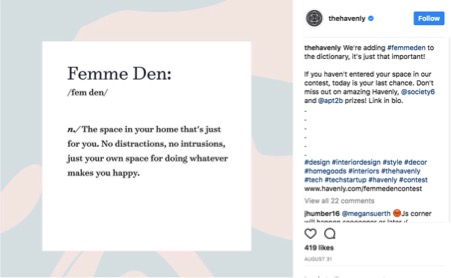
    The most popular Instagram feeds have a coherent theme or aesthetic that appears in each of their photos. This doesn’t mean you need to have your logo in every single photo (but if you can find a creative way to do that, then go for it!). However, having a consistent color scheme, lighting, and subject matter will help to solidify your brand identity. While the three images below from Havenly all have different subjects, the color scheme ties them all together. They all invoke the same feelings and reveal what the brand is all about—decorating spaces with a sense of calm and modern femininity.

    The Havenly Instagram screenshot

    Screenshot of The Havenly Instagram post

    TheHavenly Instagram post screenshot

    Sell a Lifestyle

    Your brand identity is who you are as a company, but the lifestyle you depict in your images is who your customers are. If you’re a car dealership, what kinds of people buy from you, and what do they value? All things USA, the outdoors, family BBQs? Then show those things in your images.

    You don’t have to limit your posts to just pictures of your products. Four Barrel Coffee shows images from the coffee-creation process, as well as the final product. They also post images that appeal to their hipster demographic, such as this photo of their new record player.

    FourBarrelCoffee Instagram screenshot

    If you want to show your products, take a page out of Sphero’s book and showcase some of the features and unique selling points of your business. Their little toy robots roll around all sorts of obstacles, and their photos and videos actually catch them in action.

    Screenshot of Sphero's Instagram post

    ‘Gram in Real Time

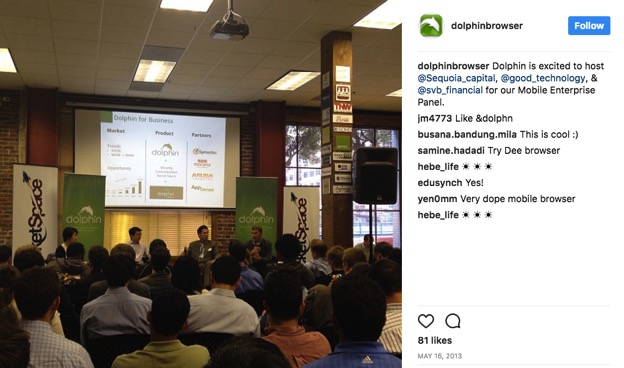
    In addition to sharing staged and styled photos, Instagram can be great for showing off things that are happening at the moment. Testing a new prototype? Take a short video of it in action to use as a teaser. You can also share photos from events, like Dolphin Browser did. This is especially great if you’re hosting an open house, since it can show people how much fun they’ll miss if they don’t head over right away!

    Dolphinbrowser Instagram post screenshot

    You can also share photos of your office, a day in the life, or other images of your energetic, smiling employees! It’s something we do here, as well, so you know it’s got to be a great idea 😉  Make sure you follow us on Instagram for updates.

    Search Influence Instagram post screenshot

    Get Local With It

    Small businesses often have close connections with their local community. Take advantage of that by following other local businesses, Little League teams, and other community organizations you want to foster a relationship with.

    Kawaii NOLA is a New Orleans clothing and novelty store that specializes in Japanese imports. In addition to showing pictures of their products, they often share flyers and other information for small businesses, local artists, and Japanese cultural events throughout the city.

    Kawaiinola Instagram post screenshot

    By cross-promoting other nearby businesses, you can unlock a new potential audience.

    In this example, classic anime and film fans can learn more about Kawaii NOLA, and Kawaii NOLA customers may choose to see another film at this theatre after this event is over. Everybody wins!

    Instagram is a brave, beautiful new world for businesses. At the center of all of the examples above is one simple piece of advice: be authentically you. Whoever you are as a company and brand, show that off, and you’ll find the customers you’re looking for.

    If you want help managing your social media accounts, reach out to us to see how we can help!

    Images:

    All screenshots by Meaghan McCarthy. Taken September 2017.

  • Rookie Website Mistakes, Part 1: Slow Loading Speed

    74 percent of customers will leave a website if it fails to load within 5 seconds. And the numbers don’t look too great even if your site is noticeably faster—according to Google engineers, anything slower than the blink of an eye, 400 milliseconds, can cause users to leave a page and search elsewhere. Google released their Caffeine update in 2010, placing importance on site speed for search ranking factors. With such a demand on site performance, it’s more important than ever that business owners and their partners understand not only why page speed is important but also what affects it and how to remedy a sluggish site.

    Snail crossing an asphalt road - Search Influence

    Why Is Speed Important for Search Factors?

    Overall site speed is based on a sample of different pages from the site. “Page speed” can be broken down either as “time to first byte” or “page load time.” The first of these, the time it takes for a browser to receive the first byte of information from the server, has been shown to correlate to search rankings. “Page load time” more noticeably affects the user experience, but it can also impact SEO.

    All of that hard work you’ve put into developing and designing your new site, implementing beautiful images, creating an intuitive navigation, and writing and implementing pages of content for users to scour—it can all mean nothing if your pages take longer to load than what has come to be expected. The longer someone waits for a page to load, the sooner he or she begins to look for other avenues to find a product, purchase a ticket, or make a reservation. And with the magnitude of resources available today, it’s only a matter of time until they leave your slow-loading site (bounce) and seek their information elsewhere via a new search.

    The average user doesn’t have time for your slow page to load, and rightly so. We shouldn’t be subjecting potential customers to a dull experience. We wait in traffic. We wait on elevators. We wait on our bread in the toaster. But when it comes to our web experience, we aren’t stuck in the ‘90s with pages that can’t possibly load any faster than 10 seconds. There are tools and practices at our fingerprints that can make your flashy new website lightning fast and more easily crawlable by search engines.

    Open exposure capture of cars driving on a road at night - Search Influence

    Page Performance Impacts User Experience

    Now, a slow loading page isn’t the be-all-end-all factor for search rankings. In fact, there are over 200 factors that go into search rankings. However, it can impact conversions and sales due to a poor user experience.

    When’s the last time you sat and waited for a page to load? How long until you gave up and tried a competitor that sells the same type of product or service? It’s worth repeating that users expect speed. Whether they’re searching on desktop or mobile (and most have been on mobile for close to two years), an inefficient website can frustrate users and result in lost business. So, what are some easy ways to make the user experience more friendly and eliminate high bounce rates that result from slow load times? Our developers can help diagnose more specific problems, but here are a few tips to get started:

    • Eliminate multiple pop-ups or spammy widgets used for sales on your site
    • Create smart site navigation to give users a clear path to a purchase
    • Implement direct calls to action with forms or buttons throughout your site

    There are other steps that can be made on the backend of your site that can help with load time, like limiting redirects, organizing your HTML, and compressing your images, but the above-mentioned tips are a step in right direction toward enhancing the way users will interact with your site.

    Co-workers sitting around a wooden table with electronic devices in hand - Search Influence

    Regain Potential Lost Conversions and Sales

    While load time might not be the biggest contributing factor to a poor search ranking, it can certainly contribute to a lower conversion rate. According to surveys done by Akamai and Gomez.com, 79 percent of web shoppers who have trouble with website performance say they won’t return to the site to buy again, and around 44 percent of them would tell a friend if they had a poor experience shopping online.

    In the same survey, they found that a 1-second delay in page response can result in a 7 percent reduction in conversions. To put that in a sales perspective, if an e-commerce site is making $100,000 per day, a 1-second page delay could potentially cost $2.5 million in lost sales every year. That’s a huge number for a 1-second delay. To give another example of a direct ROI, for every 1 second of speed improvement to Amazon’s website, their conversion rate went up 2 percent.

    For your landing pages to convert visitors into customers, you need to give them an enjoyable experience. The nice thing about doing technical work to decrease page load time is that it simultaneously benefits your bottom line. A faster, cleaner site means a higher likelihood that visitors will stay, peruse your content, fill out a form, and eventually convert into a customer.

    A Faster Site Helps You Serve Your Customers Better

    While there are many mistakes that rookies make when building a website, starting a marketing campaign, and attempting to grow their brand, not recognizing key SEO factors that slow down their pages’ load times is one of the more frequent culprits.

    Stay tuned for our next entry in our blog series: Rookie Mistakes, Part 2: Not Allowing Your Site to Be Found by Search Engines.

    Contact an expert from our team if page load time has been an issue for your business’s or institution’s website.

    Images:

    Snail

  • Success Story: ALCC American Language

    Learn how we helped ALCC American Language new inquiries while delivering higher site traffic and more frequent engagement on social media.

    The Situation

    The client is a language school located in New York City whose mission is to help international and local students learn English in a supportive atmosphere. The client’s goal was to increase the number of enrolled students and increase their number of fans on Facebook.

    The Approach

    Our strategy included a mix of campaigns that would ultimately increase the volume of leads via forms, calls, and social media engagement by making the client more visible and accessible online.

    We did this using the following campaigns:

    The Outcome

    Paid Search:

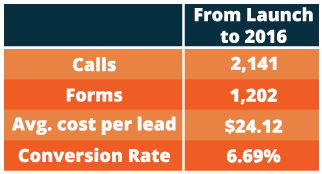
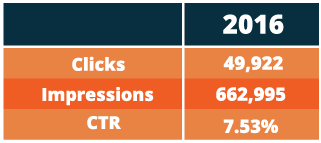
    When analyzing their paid ads campaign, even 2 years after initial launch, ALCC American Language saw continued growth in new student inquiries and conversion rate. During 2016, they averaged 279 new inquiries per month (179 calls and 100 website contact form submissions). Testing and tuning the campaign resulted in a conversion rate of 6.69%, which is an increase from the start of their campaign in 2013 at 2%. Additionally, in 2016 the paid ads averaged 55,250 impressions and 4,160 clicks per month.

    Graphic image of increased inquiries - Search Influence

    Graphic image of increased clicks, impressions, and CTR - Search Influence

    Facebook:

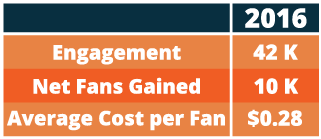
    Looking year over year from 2015 to 2016, the client saw a significant rise in Facebook engagement. Their fans increased from 10,000 to 18,000 fans and the engagement, which includes reactions, comments, and shares, increased from 34,000 to 42,000.

    Graphic image of social media engagement increase - Search Influence

    Search Engine Optimization:

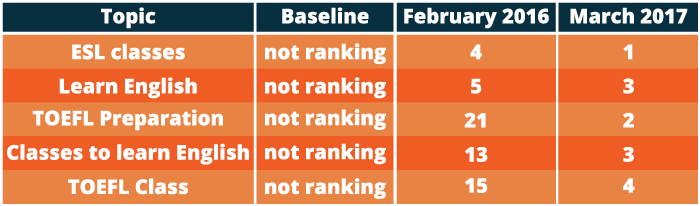
    Through methods such as monthly blogging, press releases, user experience improvements, authority building, and helpful website content, the client gained increased Google rankings for top key search terms and overall website traffic. At the start of ALCC American Language’s campaign, they weren’t ranking for industry relevant keywords and common search terms. As of this year, they are ranking in the top 5 positions of Google for the majority of their important keywords. Additionally, they saw a 57% increase in their goal conversion rate from their total website traffic and a 38% increase in web page visits per session from their organic website traffic when comparing 2015-2015 to 2016-2017.

    Graphic image of keyword ranking for ALCC - Search Influence

    By using a comprehensive, custom strategy, we were able to help ALCC American Language bring in more prospective students so that they can continue to do what they do best—help those striving to learn English. Interested in learning how we can help improve your online presence? Reach out to us at any time.

  • Why Do Digital Agencies Have Setup Fees for Online Ads?

    Why Do Digital Agencies Have Setup Fees for Online Ads?

    We often get the question from prospective clients of why we have setup costs for our online advertising programs. They ask this question because some of the companies that they speak with either don’t seem to have setup costs or don’t communicate a setup cost as such. Even those who say they don’t have setup fees have some costs associated with building campaigns, but the extent to which they are or are not thinking strategically on behalf of their customers is a big factor in whether or not they will indeed charge for it.

    How Can a Media Company Not Charge a Setup Fee?

    Often, media companies choose not to charge setup costs. Sometimes this is because they use a third party that automates the process for them, eliminating some of the complexity and control of digital media buying.

    In other cases, a media company (TV, Radio, Newspaper or Cable outlet) may choose not to charge a setup cost because the difference between what they’re spending on advertising and what you’re paying is sufficient—they know they will make up whatever their actual costs are in a very short period. In other words, they may be keeping excessively high margins for what is, in essence, a commodity.

    The challenges of these perspectives are not very different

    In short, the advertiser—the merchant, the customer, the office—who is buying advertising services or other digital offerings doesn’t realize that in order to have those setup costs, the actual money spent on advertising has to, by definition, be lower. And, if the amount spent on advertising is lower, unless there are significant efficiencies in automation—which there seldom are—one will have a less effective advertising program.

    So, there really is no such thing as a “free lunch”

    When deciding how to advertise online, the most important thing to consider is whether or not your ads are going to be seen by your targeted prospects. With less money to spend on advertising, you have a choice of either targeting less precisely or displaying fewer ad impressions over time. With those two options, it’s easy to see how your campaign is less effective when a greater amount of the dollars are going to fat margins rather than the management of the campaign.

    Automation can be good

    In fact, we use automation to assure we don’t overspend and to do some interesting things like changing ads in the case of weather changes and special circumstances. But, there’s a dark side as well. For all the good automation does, it can also lead to irrelevant traffic, i.e. people who will never become customers but are still targeted by the automated ad buys. And, if not managed well, automation can lead to overspending the budget.

    To allow automation to work efficiently, the companies that use automated platforms for management of online advertising must, in the main, set and forget the campaigns. They are hopeful they will be able to deliver results through automation, not through active management.

    How Is Search Influence Different?

    We typically don’t think of ourselves as competition to traditional media companies who’ve decided to launch a digital agency arm. When we think of competitors, it’s typically the traditional agencies— traditional marketing agencies and pure-play digital marketing agencies. The reason that we identify these as the potential competitors is that within their advertising programs, there’s typically a focus placed on strategy.

    Strategy requires people. Digital and traditional agencies have grown over time based on the expertise of their team members. They are therefore able to deliver strategic plans rather than just automated processes. We have the people in place to deliver. Every one of our online advertising team members goes through a rigorous training process and must be certified in multiple areas of expertise before they get to own campaigns.

    As traditional media companies have come to realize that people are buying much less television, radio, newspaper, and Yellow Pages advertising, they need a replacement product. They have seen the value of digital advertising as an item of sale. As an item of sale, it’s not something in which they have invested significant strategic knowledge and development. The agencies with whom Search Influence competes have invested in at least some strategic development in their teams, whether it be through continuing education, certification, or years of experience.

    We are always looking for ways to optimize the potential of our clients and our team members, and that’s why we review automation systems with some frequency. We have yet to find one that delivers the results we can achieve with our human intervention. Of those we’ve tested, they may hit target budgets and costs per click (CPC), but they don’t deliver the same results. Again, what we’re after is not just traffic, not just customers, but the right traffic and the right customers. That said, we’ll always keep looking and exploring.

    As such, while we often find ourselves selling against traditional media “agencies,” we do not think that, when it comes to digital, they represent real competition or the value we know we can deliver.

    How Search Influence Helps Digital Advertising Clients

    Our core purpose at Search Influence is to Optimize Potential.

    So before anything, we engage in a thorough review of your existing assets, both digital and traditional analog media. We also engage in an equally comprehensive business review to assure we understand your goals for your possible future campaigns. This way, we can strategically map all of the relevant information to an effective digital campaign to deliver the best results.

    When thinking about what goes into the business decisions around advertising, we know that it’s much more than clicks or even calls. It’s about the right click and the right call at the right time. The goal is to deliver that refined prospect to your business with the expectation that they will move from prospect to customer. Before we spend one dollar on Google or Facebook, we will have investigated all of the facets of your needs and how they might impact our execution of your campaign.

    Charged Employees of Search Influence

    Why You Should Care How About How We Get It Done

    You may think to yourself, “It doesn’t really matter how it gets done, as long as I get more traffic to my website, more calls, and more inquiries coming through.” The unfortunate truth is this: the wrong kind of contacts can cost you time and money.

    As the Pareto Principle implies, 20% of the prospects who might get in touch with you are going to be responsible for 80% of the business you will ultimately do.

    If you could tailor your marketing and advertising so that you only spoke to the 20% of customers who were going to drive the greatest value to your business, wouldn’t you have a much more successful business? Wouldn’t your team be more engaged if they knew that each client engagement, or patient interaction, was putting them with the right customers?

    We know it’s a lot of work to get this right, and only when you work with a strategic partner can you have an expectation that you will get what you need as early in the process as possible. When we work with clients, whether they’re spending $1,000 or $100,000, we work strategically to assure them we’re delivering the greatest value possible for their advertising dollars.

    Wouldn’t you rather spend your money on the most valuable customers? We think you should, and that’s why we believe that we are not competing with the mass-market automated systems that don’t deliver the kind of value you need. With a fundamental understanding of technology-enabled marketing and the expertise and know-how to back it up, we can be true partners to our clients regardless of their budget.

    If you’d like to learn more about the why and the how, we’d love to hear from you. Please fill out our contact form or give us a call. We’ll be glad to review your current situation and come up with some strategic recommendations.