SEO is critical for higher education institutions, yet only 51% have an established SEO strategy.
If your institution isn’t investing in SEO, you’re missing opportunities to reach prospective students and keep up with your competition.
Understanding and communicating the long-term benefits of SEO to your higher-ups can help your institution make the case for more resources.
Pitching the value of SEO to your boss doesn’t have to be a massive undertaking. All you need is a little bit of industry insight, institutional data, and the right angle.
For today’s tech-savvy students, the quest for higher education starts with a simple Google search.
Prospective students are looking for your institution online, but will they find you? Search engine optimization, or SEO, is a term often tossed around in marketing meetings, and it’s never been more relevant.
So, how do you move it from a buzzword to a budgeted line item?
And, more importantly, how do you get your decision-makers to hop on board?
In this blog post, we’ll show you how to convince your boss to invest in SEO and make bigger waves in the search engines with a proper strategy.
Benefits of SEO in Higher Education Marketing
You’ve likely heard that a quality SEO strategy leads to better search performance.
Increased Visibility: A well-optimized website can dramatically increase your institution’s visibility in the search engines. This makes it easier for prospective students and their families to find you while searching for educational opportunities.
Higher Quality Traffic: Effective SEO efforts attract users actively seeking information related to higher education, thereby improving the quality of organic traffic to your website. These high-intent visitors are more likely to take desired actions, such as applying or requesting more information.
Better User Experience: SEO is not just about pleasing search engines; it’s also about providing a good user experience. A well-optimized website is generally more user-friendly. This positively impacts metrics like time spent on the site, bounce rate, and conversion rate, which in turn can boost your SEO rankings.
Competitive Advantage: A strong SEO strategy can give you a crucial edge over competitors. If your institution ranks higher in search results than other schools, students are more likely to visit your site first, giving you the first shot at making an impression.
Analytics and Insights: SEO tools provide valuable data on visitor behavior, popular content, and more. This data can be used to make informed decisions about your marketing strategy, academic programs, and even campus facilities.
Improved ROI: SEO allows you to reach the right audience at a lower cost by focusing on target keywords most relevant to your institution and its programs. This offers a better return on investment (ROI) than other marketing channels.
Despite all the benefits, SEO in higher education lags. As we found in our Higher Education SEO Research Study conducted with UPCEA, 51% of universities don’t have a strategic SEO plan.This means over half of participating universities miss out on opportunities to grow their awareness, analytics, and applications.
Luckily, it’s not too late to make the financial case for SEO investment and start climbing the search engine results.
But, if you keep pushing off investing in SEO, you just might pay later — in losses.
How to Convince Your Boss to Invest in SEO
While the merits of SEO are evident to those immersed in the digital realm, making them resonate with leadership is a different ballgame.
Approaching the conversation with a combination of data, foresight, and understanding can be the key to unlocking the coveted resource you need: SEO buy-in from your boss.
Follow this blueprint to advocate for SEO services in your marketing budget.
Build a Strong Case
Decision-makers want facts before dishing out dollars.
Presenting an audit or analysis of your institution’s current website and online marketing strategy can highlight the areas where you’re falling short.
You can tap tools like Sitebulb, Screaming Frog, Semrush, and Ahrefs for handy website analysis insights. But if you’d prefer to pass the baton to experts, you also could lean on an experienced SEO agency to conduct a professional-grade audit for you.
Maybe you’re missing meta descriptions. Or you’re dealing with poor site speed and insufficient keyword research.
Your task at hand is to show how SEO bridges these gaps.
Leverage Competitor Analysis
You may not invest in SEO. But your competition does.
It’s one thing to understand the benefits of SEO. It’s another to see competitors already capitalizing on them.
Creating a competitive analysis can be a strong motivator, especially if those competitors are outranking your institution in organic search results.
Doing keyword searches of certain degrees or programs is one easy way to get started on your competitive analysis. Take note of who ranks in the top positions, compared to where you rank, and you have a baseline of where you currently stand — and where you need to go.
Demonstrate to your higher-ups what SEO is doing for your rivals, and you increase your chances of seeing what it can do for you.
Offer Scalable Solutions
Don’t bite off more than you can chew. Present a phased SEO strategy that starts small and expands as you show results.
A scalable approach ensures that initiatives will mature, evolve, and provide value over time.
Your decision-makers are more likely to approve budgets if they see this sense of scalability.
Scalability is sustainability. The SEO strategies that can adapt and grow are the ones that endure.
Use Real-World Examples
For the higher-ups, seeing is believing.
Don’t just talk about what SEO can do for your university. Show its potential, armed with solid proof.
Bring out higher education case studies and results from other institutions who’ve invested in SEO. Take, for example, New Orleans-based university Tulane SoPA, which saw a 569% increase in keyword ranking in the top 1-3 spots on Google — with help from frequent blogging.
These real-world SEO examples can make the concept more relatable, compelling, and actionable.
Connect SEO to Broader Initiatives
SEO isn’t an isolated tool; it’s a cog in the larger machinery of a higher ed digital marketing strategy.
It works best when used in tandem with paid search marketing, like Google ads or other well-performing marketing efforts. Therefore, it fits — not trumps — your institution’s broader marketing and outreach initiatives.
This can make it easier to get buy-in if decision-makers see SEO as a component of a larger strategy rather than a stand-alone effort.
Break down the big-picture, complementary value of SEO, and you may just seal the deal.
Common Objections From Decision Makers
Every proposal faces scrutiny, and SEO is no exception. It’s a natural part of the advocacy process.
However, preparing for and addressing these objections head-on can turn potential setbacks into stepping stones.
Prime yourself to deal with these common objections before setting up the proposal:
Objection: SEO is expensive! Think of the initial setup, the ongoing monitoring, and the potential need for hiring an external SEO company.
Counter-Argument: While SEO is an investment, the effects and impact on our website traffic are long-term, versus paid advertising, where once we stop paying, the traffic stops coming.
Objection: SEO typically doesn’t provide immediate results, so what’s the point?
Counter-Argument: SEO is a long-term strategy that requires time to yield results, but once it does, the benefits endure. A well-optimized website can maintain high rankings for a long time, ensuring a consistent inflow of targeted traffic.
Objection: SEO doesn’t align with our institution’s core goals and objectives.
Counter-Argument: Improved online visibility and targeted traffic can directly impact key performance indicators like student recruitment, donor contributions, and brand reputation — a goal any institution wants to reach.
Objection: We’re already ranking pretty well without investing in SEO.
Counter-Argument: There’s no way all of our web pages rank #1, or even on the first page, of the organic search results. Plus, there’s always the opportunity to increase our rankings for keywords that our competitors currently rank for.
The Consequences of Neglecting SEO
Ahrefs data shows that 90.63% of webpages receive no organic search traffic from Google.
Why?
They don’t prioritize SEO. Or, at least, they don’t prioritize it the right way.
If your institution turns a blind eye to all that SEO has to offer, you risk:
Loss of Visibility: With numerous higher education institutions vying for the attention of prospective students and parents, failing to invest in SEO means your institution may not show up in search engine results. This results in lost opportunities to drive students to your website.
Decreased Enrollment Rates: Students nowadays often begin their college or university search online. If your institution isn’t visible during these crucial moments, you’re missing out on a large number of potential applicants, affecting your enrollment rates.
Increased Marketing Costs: Without a solid SEO strategy, your school may rely more heavily on paid advertising channels, which can be significantly more expensive in the long term. In contrast, organic search traffic generated through SEO is essentially free.
Losing Ground to Competitors: Other institutions that invest in SEO will take the top-ranking spots in search results, garnering more attention and credibility. This competitive advantage can result in a cycle where they continue to attract more students, donors, and faculty, widening the gap between you and them.
Damaged Reputation: A poorly optimized website that doesn’t rank well may be perceived as less reputable or authoritative. It’s a psychological factor — many people equate high search engine ranking with credibility.
Missed Opportunity for Data-Driven Decisions: SEO tools like Google Analytics provide valuable data that can help your higher ed institution understand what prospective students are looking for. Without this insight, you won’t be able to make more informed decisions on everything from course offerings to campus facilities.
Be sure to drill these risks into the minds of your decision-makers. No one likes consequences or the act of underperforming, and these looming threats can help accelerate their decision.
Higher Ed SEO Leads to Greater ROI
UPCEA Chief Research Officer Jim Fong summed it up perfectly in our Higher Ed SEO Research Study webinar: “SEO is not something institutions can kick the can down the road on. It’s going to become increasingly important, especially as the number of programs increases and the number of potential students stays the same or even decreases.”
As SEO industry veterans, Search Influence has the skills, expertise, and bandwidth to take on all of your SEO initiatives. Convince your higher-ups to invest in SEO, and we’ll take the heavy lifting off your plate with our expert SEO services.
Ready to get started with SEO? Contact us today to learn about our SEO Roadmap and see how we’ll put our higher education marketing experience to work for you.
I can’t believe I’m sharing this, but after doing it a few times, I realized that the Skyscraper Technique, when paired with ChatGPT data mining, is too good to keep to myself.
But look, don’t tell anyone else, alright?
[ez-toc]
Everybody’s afraid of the impact of derivative content. I say, if you can’t beat ’em, join ’em.
[bctt tweet=”Everybody’s afraid of derivative content. I say, if you can’t beat ’em, join ’em.” username=”w2scott”]
Lean into the power of derivative content and take a lesson from Brian Dean in the Backlinko heyday.
At the time, I was getting back from Pubcon, having presented on AI content (as much as we understood at the time), and was super pumped about the opportunity.
I started experimenting with sampling existing content to build personas for voice and tone, but it was nothing like we’re able to do now. With updates to the core OpenAI GPT, both in the underlying technology and in the size and scope of content one can process, we can go both deep and wide on topics.
The more recent ability to execute a web search with plugins and the expanded data exploration enable summarization and understanding of exceptionally long and complex topics.
The machine learning models and artificial intelligence technology are amazing in and of themselves. The killer app, in my experience, is the ability to analyze the aggregated content of those articles you’re summarizing and glean really useful information.
ChatGPT As a Data Analysis Engine
In a recent experiment, I had ChatGPT summarize the top ten articles on a topic, including highlighting unique positions. This use of natural language processing makes ChatGPT a much more valuable tool to perform tasks where the data collection and correlation analysis are themselves a competitive edge.
It’s simple to get started — search Google for your target keyword. The answer will give you a ton of new ideas and more links than you know what to do with.
Then, use ChatGPT data mining to extract common elements. In this case, we’re talking about the most commonly cited higher education marketing strategies.
[bctt tweet=”Search Google for your target keyword. You will get a ton of ideas and more links than you know what to do with. Then, use ChatGPT data mining to extract common elements.” username=”w2scott”]
It’s these kinds of classification tasks where I think ChatGPT really shines.
I’m looking forward to the very near future, where AI image tools like Midjourney and Dall-E can take the language model output and turn it into data visualization. Obviously, getting accurate responses from the code can lead to a better piece of content.
This is just one of many factors that must be addressed before data scientists can rely on this powerful tool.
Will this work for every subject? Maybe not, but for any topic with abundant informational content available, it should be effective.
What Is the SEO Skyscraper Technique?
The Skyscraper Technique was popularized by Brian Dean at Backlinko. As you would imagine, it’s been imitated, misquoted, and SEO’d beyond belief.
Step 1: Find link-worthy content.
Step 2: Make something even better.
Step 3: Reach out to the right people.
[bctt tweet=”The Skyscraper Technique was popularized by @brianedean at @backlinko. As you would imagine, like most tactics that work, it’s been imitated, misquoted, and SEO’d beyond belief” username=”w2scott”]
Note that the first filter is about links. Links are great and a strong signal of authority, but since Dean’s original article, Google has moved much further down the road toward a semantic, entity-based web.
Links are still critical to ranking, but it’s widely acknowledged they are also very manipulable.
This means that the page’s content and its relationship to already recognized entities can be as important as the links pointing to it.
In fact, if you believe Kyle Roof or Koray Tuğberk Gübür, you might think you can own the SERP without links at all.
So, the difference in this approach is that, instead of looking at a single piece or a small set of content, we look at all the content to which Google is giving the love.
[bctt tweet=”Instead of looking at a single piece or a small set of content, we look at all the content to which Google is giving the love.” username=”w2scott”]
Another difference is the respect we show the other ranked articles we’re referencing. We’re not just trying to one-up them — we’re giving them their dues with a summary and a link.
And yes, by including the summary, we’re assuring we include all those juicy semantic entities and keywords in our article, too. We’re, therefore, also relieved of the challenge of keyword research because we know these articles rank. Look at a great number of sources and build the tallest skyscraper, and you win.
And finally, by syndicating the content we’ve created, with derivative content enabled by AI, we’re presenting a 360-degree view of both the content and the link universe.
And we’re setting ourselves up so that the first links pointing back are both super authoritative and, potentially, linkable assets in their own right.
How Do You Use ChatGPT for Data Mining?
In the last six months, ChatGPT has become a fantastic tool for data mining. With the addition of web crawling and integrations to third-party data sources like Google Sheets, what was previously just a content regurgitator is now a proper data analysis tool.
In my original article on ChatGPT data mining, ChatGPT didn’t have live web crawling ability and was still giving out a lot of information it shouldn’t have been. In fact, it was giving me email addresses — accurate or not — for Pubcon speakers, past and present.
But, as that article showed, you can’t trust ChatGPT to tell the truth, and there’s a fair likelihood that some of those addresses are made up.
[bctt tweet=”You can’t trust ChatGPT to tell the truth, and there’s a fair likelihood that some of the information is made up.” username=”w2scott”]
And just like that, it went away.
From the earliest days of ChatGPT, you could ask it to identify frequency, relationships, and even format information in tabular form. But you still couldn’t trust it.
Now, with ChatGPT ingesting data from web crawling and Google Sheets, for instance, it’s the content that gets ingested one has to worry about, not ChatGPT’s famous hallucinations.
[bctt tweet=”I’m human, I’m helpful, some of this is AI, and that’s OK.” username=”w2scott”]
The Prompt I Used to Summarize the Articles
As anyone familiar with the ChatGPT language patterns knows, you must ask follow-up questions to produce great content:
Please write a synopsis for each of the articles at the following URLs.
Please use the article’s HTML title as the heading and include enough detail that I don’t need to actually read the article.
If an article references multiple strategies, please list them.
Please identify any unique or noteworthy positions taken by the author.
Please include the URL immediately below the HTML title.
I used the Access Link plugin and pasted the URLs of Google’s top 10 ranking entries.
In prior iterations of this idea, pre-ChatGPT plugins, I have copied and pasted the whole article or used BingGPT — pour one out for BingGPT, y’all.
Now, I know some of you prompt engineering pros will find ways to improve this. If so, please share.
Keep in mind that I wasn’t trying to have ChatGPT write my whole article. I needed it to extract and present information from other articles that I could review and comment on.
The Prompt I Used to Extract the Top 10 List
As often happens with prompt engineering, I had to iterate my way to the final, golden output.
I started with:
Please identify the most common strategies cited in the articles synopsized below:
[Text of ALL of the synopses from the prior exercise]
[bctt tweet=”Please identify the most common strategies cited in the articles synopsized below – and then copy in the text of all the synopses” username=”w2scott”]
This gave me a long list that didn’t seem to have any prioritization, so I asked for the top three, then the top five, and finally:
Top 10 in order of frequency?
And that was the money. From that, I got a great list with brief descriptions of the top 10 higher education marketing strategies. Given the iteration and the clarification in the prompt, I was also more inclined to believe the output.
If you are going to use this technique for something more serious than SEO, please be sure to fact-check both the source articles and ChatGPT’s interpretation of them.
Some Examples of ChatGPT Data Analysis for the SEO Skyscraper Technique
For this exercise, I used the following prompt:
Please write a synopsis for each of the articles at the following URLs.
Please use the article’s HTML title as the heading.
Please include enough detail that I don’t need to actually read the article.
Please include any background resources cited in the article, the actual strategies used, and the steps in order.
Please identify any unique or noteworthy positions taken by the author.
Please include the URL immediately below the HTML title.
Articles:
[List of articles to analyze]
Once all the articles were summarized, I asked ChatGPT to help identify some recurring themes.
Most Cited Methods for Keyword Research in an SEO Skyscraper Link Building Strategy
[bctt tweet=”Most Cited Methods for Keyword Research in an SEO Skyscraper Link Building Strategy” username=”w2scott”]
Based on the articles reviewed, the most frequently cited methods for keyword research, in order of frequency, are:
Use SEO Tools: Most articles emphasized the importance of using specialized SEO tools to identify high-performing content and relevant keywords. The most frequently mentioned tools were:
Ahrefs: Especially its “Content Explorer” and “Keywords Explorer” features.
Semrush: Known for its keyword research and domain overview capabilities.
Analyze Competitor Content: Many articles recommend examining content from competitors or top-performing content in the niche. This method helps identify what topics or keywords are already successful and where there might be gaps or areas for improvement.
High vs. Low Competition Keywords: There was a notable emphasis on the strategy of choosing between high and low-competition keywords. While traditional approaches often focus on low-competition keywords, some methods, like the Shotgun Skyscraper, suggest targeting high-competition keywords due to their potential for more backlinks.
Google’s “Searches Related to” Section: A significant number of articles pointed to the utility of Google’s own search results. The “Searches Related to” section at the bottom of search results can provide insights into related keywords and topics that users search for.
Long-Tail Keywords: Several articles highlighted the importance of targeting long-tail keywords. These are longer, more specific keyword phrases that might have lower search volumes but can be easier to rank for and attract a more targeted audience.
While these methods were the most frequently cited, it’s worth noting that the effectiveness of each method can vary based on the specific goals of the content and the niche in which one is operating.
Most Cited Methods of Outreach for SEO Skyscraper Link Building
[bctt tweet=”Most Cited Methods of Outreach for SEO Skyscraper Link Building” username=”w2scott”]
Based on the articles reviewed, the most frequently cited methods for link outreach, in order of frequency, are:
Personalized Email Outreach: Almost all articles emphasized the importance of personalizing outreach emails. This involves:
Addressing the recipient by name.
Mentioning specific details about their content or website.
Explaining why your content would be valuable to their audience.
Use of Outreach Tools: Many articles mentioned the use of specialized outreach tools to streamline and automate the process. Some of the most frequently cited tools include:
Hunter.io: For finding email addresses associated with a particular domain.
Mailshake: For automating and tracking outreach campaigns.
Respona: For acting as an all-in-one PR and link-building tool.
Snov.io: For finding email addresses and conducting email outreach.
Follow-Up Emails: Several articles highlighted the importance of sending follow-up emails if there’s no response to the initial outreach. This can increase the chances of getting a reply, but it’s crucial to strike a balance to avoid being too pushy.
Offering Value: Many articles emphasized the need to offer value in the outreach email. This could be in the form of:
Sharing your superior content as a resource.
Suggesting specific improvements or updates to their existing content.
Offering to share their content on your platforms in return.
Segmentation and Targeting: It’s essential to segment your list of prospects and tailor your outreach accordingly. This involves:
Identifying websites or blogs that are relevant to your niche.
Targeting sites that have linked to similar content in the past.
Avoiding sites that are unlikely to link back due to competitive reasons or misalignment in content themes.
In addition to these methods, building genuine relationships and networking in your industry was a recurring theme. Gaining trust and rapport can significantly increase the chances of securing backlinks.
So, You Want to See the Synopses?
Since this is more of an explanatory article, I’m only going to include a handful, rather than the full top 10.
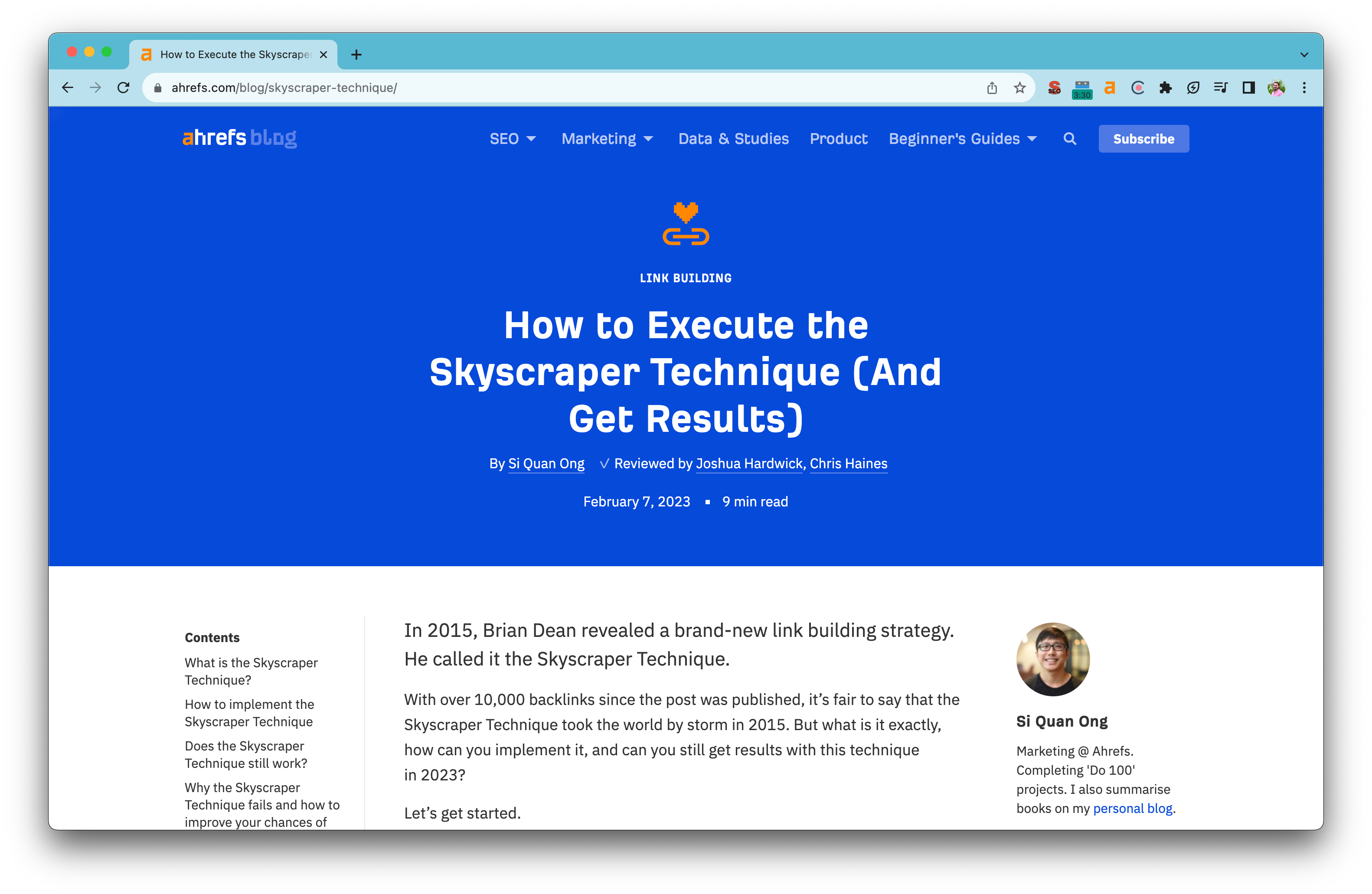
Ahrefs: The Skyscraper Technique: How to Build High-Quality Backlinks to Your Content
[bctt tweet=”Synopsis: Ahrefs: The Skyscraper Technique: How to Build High-Quality Backlinks to Your Content” username=”w2scott”]
Synopsis: The article begins by referencing Brian Dean’s introduction of the Skyscraper Technique in 2015, which quickly gained popularity. The technique works by improving upon existing popular content and replicating its backlinks.
Steps to Implement the Skyscraper Technique:
Find Relevant Content With Lots of Backlinks:
Use Ahrefs’ Site Explorer to identify pages with a high number of referring domains.
Use Ahrefs’ Content Explorer to search for content on a broad topic related to your niche.
Use Ahrefs’ Keywords Explorer to identify high KD score keywords and the top-ranking pages for them.
Make it Better:
Improve the content’s length, freshness, design, and depth.
Reach Out to the Right People:
Use email outreach to contact those who have linked to the original content you’ve improved upon. Find these people using Ahrefs’ Site Explorer.
Does the Skyscraper Technique Still Work? While the technique has been oversaturated over the years, many SEOs and marketers still believe in its effectiveness. However, only 18% of SEOs still use it, as per Aira’s Annual State of Link Building report.
Reasons the Skyscraper Technique Might Fail & How to Improve:
Sending Only Brian’s Email Template: Many SEOs used Brian’s original email template verbatim, leading to its overuse and decreased effectiveness.
Not Segmenting Your Prospects: Tailor outreach emails based on the context in which prospects linked to the original content.
Not Reaching Out to Enough People: A link building strategy is a numbers game. Expand the list of link prospects by also considering backlinks from other top-ranking pages on the same topic.
Thinking Bigger Equals Better: Simply increasing the length or number of items in content doesn’t necessarily add value. Curation and quality are key.
Not Considering Brand: Content quality isn’t the only factor; the reputation of the content creator or brand also plays a role.
Final Thoughts: The Skyscraper Technique can be effective if executed correctly. It’s essential to focus on quality, value, and consistent content creation.
Comparison With the Original Article by Backlinko:
Both articles emphasize the importance of improving existing content and reaching out for backlinks.
Ahrefs provides specific tools and methods to find and analyze potential content for the Skyscraper Technique.
Ahrefs highlights the potential pitfalls and oversaturation of the technique, suggesting that its effectiveness might be limited in the current landscape.
The Ahrefs article emphasizes the importance of brand reputation in the success of the Skyscraper Technique, which is not heavily discussed in the original Backlinko article.
Unique or Noteworthy Positions:
The article suggests that the Skyscraper Technique’s popularity might have decreased because SEOs are now focusing more on content than links.
The emphasis on the importance of brand reputation and the potential pitfalls of the Skyscraper Technique provides a more nuanced perspective on its effectiveness.
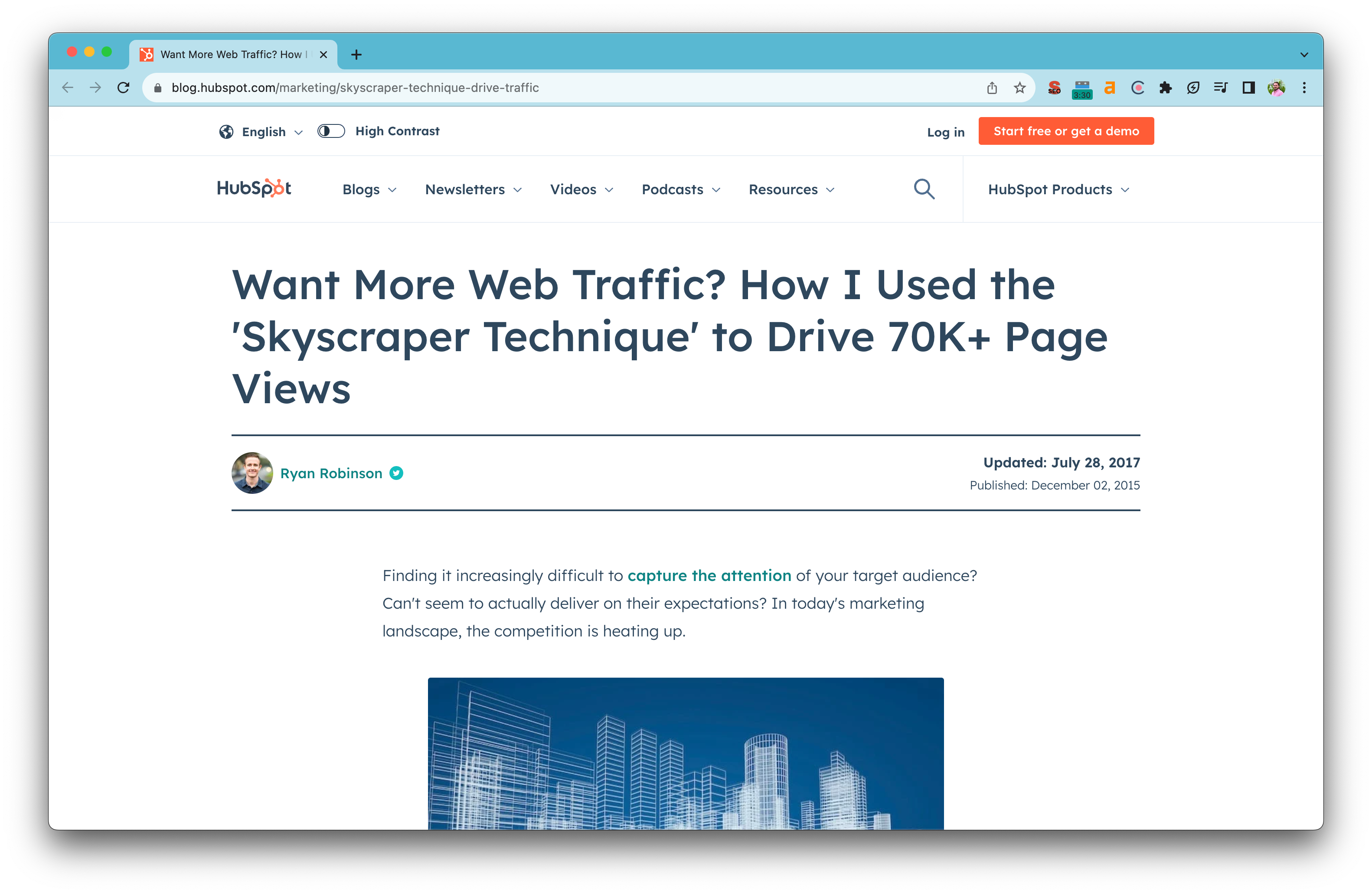
HubSpot: How to Use the Skyscraper Technique to Drive Traffic
[bctt tweet=”Synopsis: HubSpot: How to Use the Skyscraper Technique to Drive Traffic” username=”w2scott”]
Synopsis: The article discusses the increasing difficulty of capturing audience attention in the current marketing landscape. It introduces the Skyscraper Technique as a solution, detailing its creation by Brian Dean of Backlinko. The technique involves improving existing popular content and then reaching out for backlinks.
What’s the Skyscraper Technique?
It’s a method for turning content into high-quality backlinks.
The process involves researching popular content, creating a better version, and then reaching out to those who linked to the original content.
Reasons for its effectiveness include:
Proven demand for the content topic.
Engaging an already primed audience.
Potential for high search rankings.
How HubSpot Used the Skyscraper Technique:
The author shares a personal experience where they saw a similar article from Fast Company about a freelance hourly rate calculator.
They created a visually appealing infographic on the same topic and promoted it.
The result was over 8,200 shares, 72,000+ page views, and 3,648 new email subscribers.
6-Step Checklist for Using the Skyscraper Technique:
Research and Uncover Opportunities: Use tools like Google Alerts, BuzzSumo, HubSpot’s Keyword App, and Google’s Keyword Planner.
Build a List of Potential Distribution Partners: Start with known contacts and expand using BuzzSumo.
Create Better Content: Consider different content mediums and focus on delivering more value.
Promote to Your Audience: Share on social channels, email lists, and internally.
Reach Out to the Right People: Contact influencers, brands, and bloggers who share related content.
Stay Current: Update content to ensure it remains relevant over time.
Comparison With the Original Article by Backlinko:
Both articles emphasize the importance of improving upon existing content and reaching out for backlinks.
HubSpot provides a personal case study to showcase the effectiveness of the technique.
HubSpot offers a step-by-step checklist, making the process more actionable for readers.
Unique or Noteworthy Positions:
The article emphasizes the importance of staying current and updating content over time.
HubSpot’s personal case study provides a tangible example of the Skyscraper Technique’s success, highlighting the potential benefits when executed correctly.
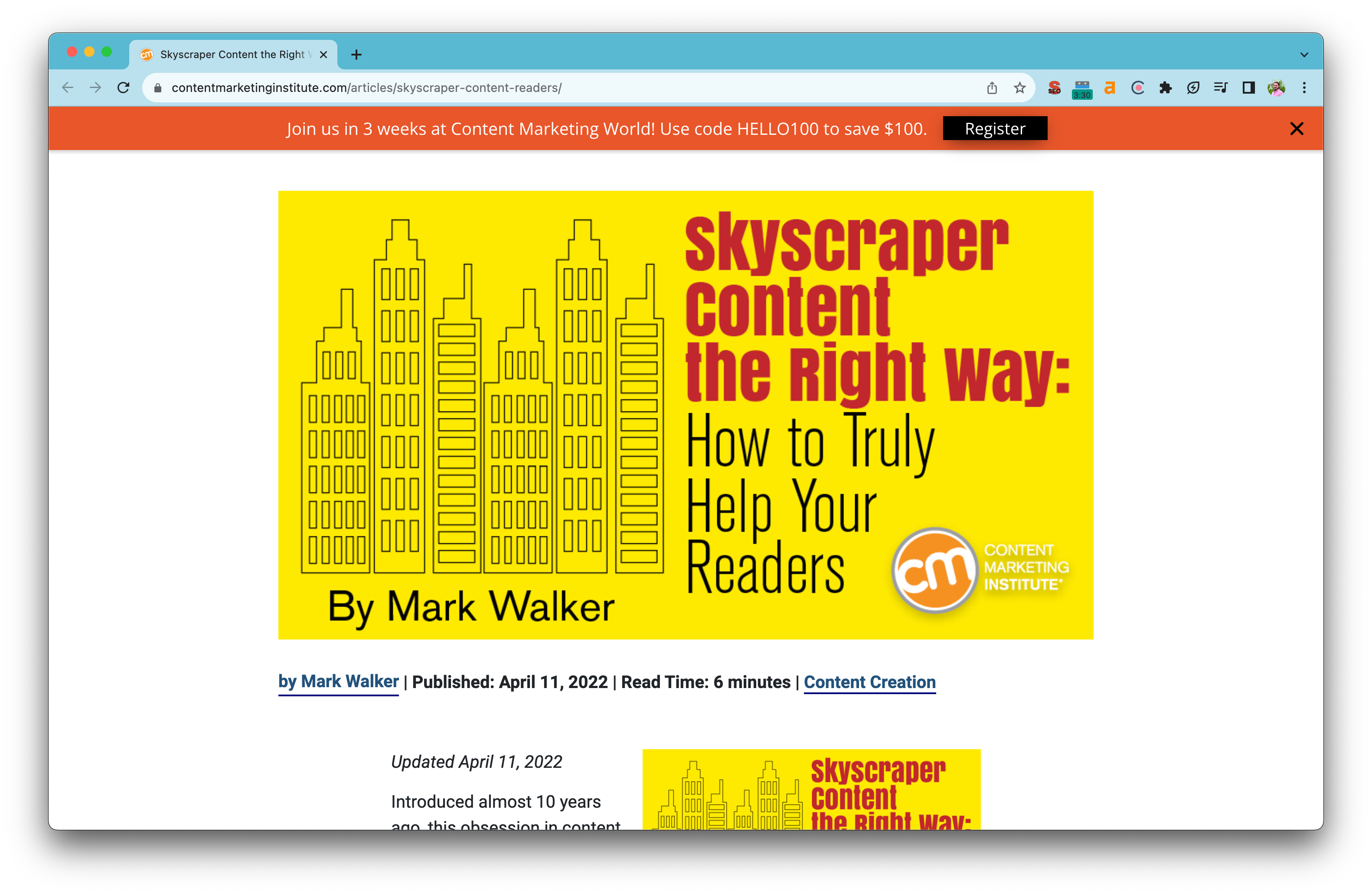
Content Marketing Institute: Skyscraper Content the Right Way: How to Truly Help Your Readers
[bctt tweet=”Synopsis: Content Marketing Institute: Skyscraper Content the Right Way: How to Truly Help Your Readers” username=”w2scott”]
Synopsis: The article critiques the overuse and misuse of the Skyscraper Technique in content marketing. While acknowledging the original brilliance of the concept, the author argues that many content creators equate the technique with producing longer content, rather than more valuable content.
What Is Skyscraper Content?
It involves finding successful content, reverse-engineering its success, creating a better version, and replicating its distribution strategy.
The author encourages readers to refer to Brian Dean’s post on Backlinko for a good example of the methodology.
What’s Wrong With Skyscraper Content?
Many content creators mistakenly believe that longer content equates to more value.
The focus on length can lead to padding posts with unnecessary information, making it difficult for readers to find valuable insights.
Skyscraper content can become inaccessible if it’s always lengthy and doesn’t consider the reader’s experience.
Google’s algorithm prioritizes content that meets readers’ needs, so skyscraper content that doesn’t prioritize readers may not rank well.
Unoriginal Content:
Skyscraper content can lead to unoriginality, as creators model their content after existing successful pieces.
The challenge is to find a unique angle and add value to the original topic.
Merely adding more words without offering a fresh perspective can make the content redundant.
How to Make Skyscraper Content Work:
Genuine Need: Update content that’s outdated or full of broken links.
Unique Angle: Offer a new perspective or personal account on a familiar topic.
Focus on Value, Not Text: The goal is to create content that’s more valuable, not necessarily longer. For instance, transform a long article into a video or an interactive tool.
Conclusion: While the Skyscraper Technique can be powerful, it’s essential to use it correctly. Content creators should prioritize value over length and ensure they’re genuinely helping their readers. If the content doesn’t add value, it’s better to create something original that delights the audience.
Comparison With the Original Article by Backlinko:
Both articles discuss the Skyscraper Technique’s methodology.
The Content Marketing Institute article critiques the overuse and misuse of the technique, emphasizing the importance of value over length.
The article suggests that many content creators misunderstand the Skyscraper Technique, leading to redundant and unoriginal content.
Unique or Noteworthy Positions:
The article offers a critical perspective on the Skyscraper Technique, highlighting its potential pitfalls.
It emphasizes the importance of originality and value in content creation, rather than merely replicating successful content.
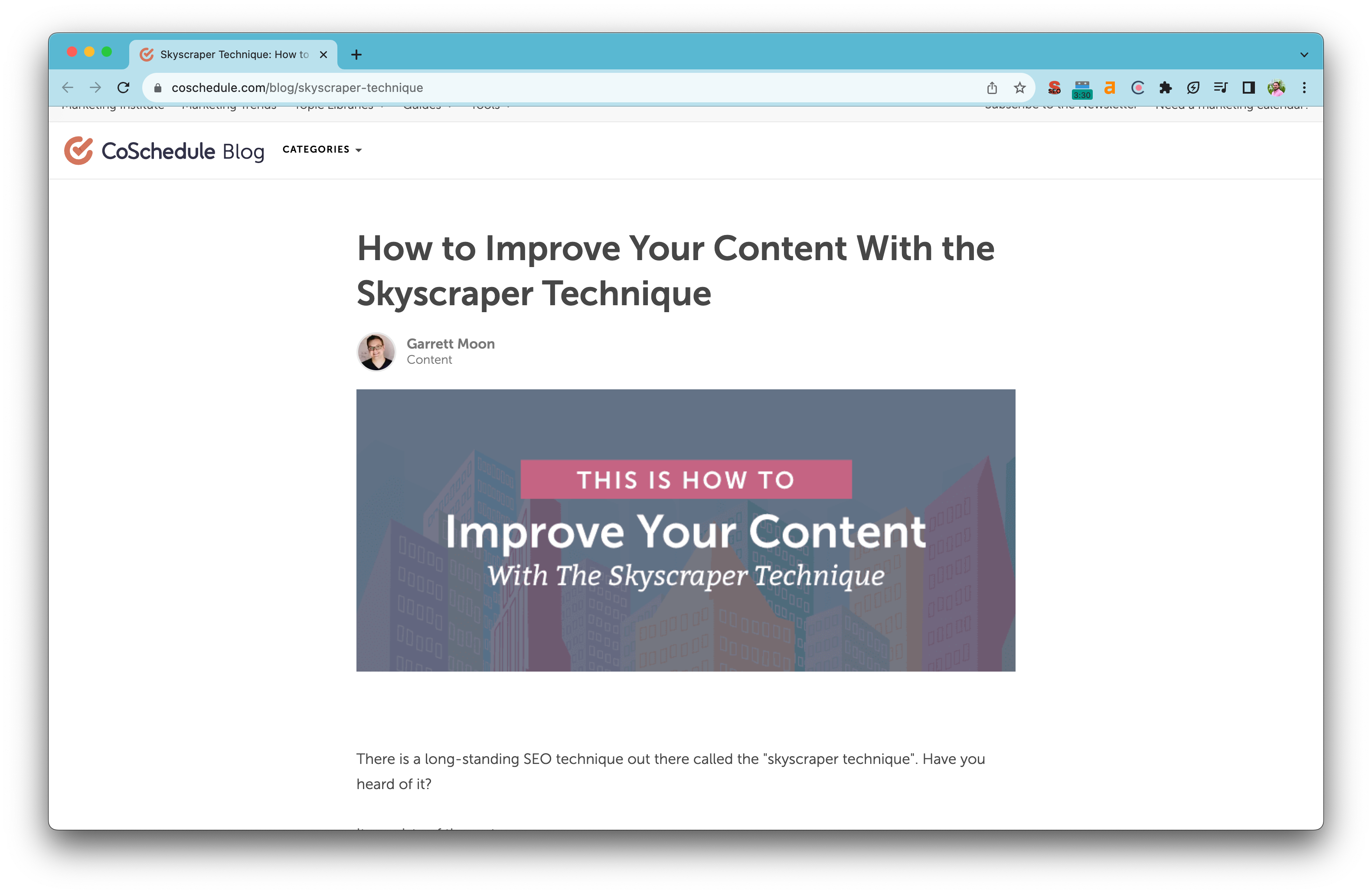
CoSchedule: The Skyscraper Technique: Why You Should Use It
[bctt tweet=”Synopsis: CoSchedule: The Skyscraper Technique: Why You Should Use It” username=”w2scott”]
Synopsis: The article introduces the Skyscraper Technique, a three-step SEO method that involves finding top-performing content, creating better content, and then promoting it to gain backlinks. The author emphasizes that while the technique is rooted in SEO, it’s beneficial for all content marketers, not just SEO experts.
Understanding the Skyscraper Technique:
It’s not exclusively an SEO strategy.
It’s not a license to steal or replicate someone else’s content without adding value.
How to Use the Skyscraper Technique:
Find Top-Performing Content:
Use tools like BuzzSumo to identify popular content based on keywords.
Analyze the top content to understand its themes, content length, number of images, and overall quality.
Use tools like the Moz Toolbar to gather backlink information and understand the authority of the content.
Create Better Content Than Current Top Performers:
Make content longer and more in-depth.
Incorporate rich content like images, videos, and infographics.
Delve deeper into the topic to provide more value.
Think strategically about SEO and keyword usage.
Get People to Link to Your Content:
While promoting with social media marketing is a start, the key is to earn backlinks by producing superior content.
The focus should be on generating better content ideas and improving content quality.
Conclusion: The Skyscraper Technique provides insights into what content is performing well and what’s being shared the most. It’s a valuable method for generating new content ideas and improving content marketing strategies. The ultimate goal isn’t to replicate but to innovate and produce better content.
Comparison With the Original Article by Backlinko:
Both articles describe the Skyscraper Technique’s methodology.
CoSchedule emphasizes the technique’s applicability beyond just SEO experts and highlights its broader benefits for content marketing.
The article provides specific tools and methods to implement the technique effectively.
Unique or Noteworthy Positions:
The article stresses that the Skyscraper Technique is not just for SEO experts but is a valuable strategy for all content marketers.
It underscores the importance of adding value and not merely replicating existing content.
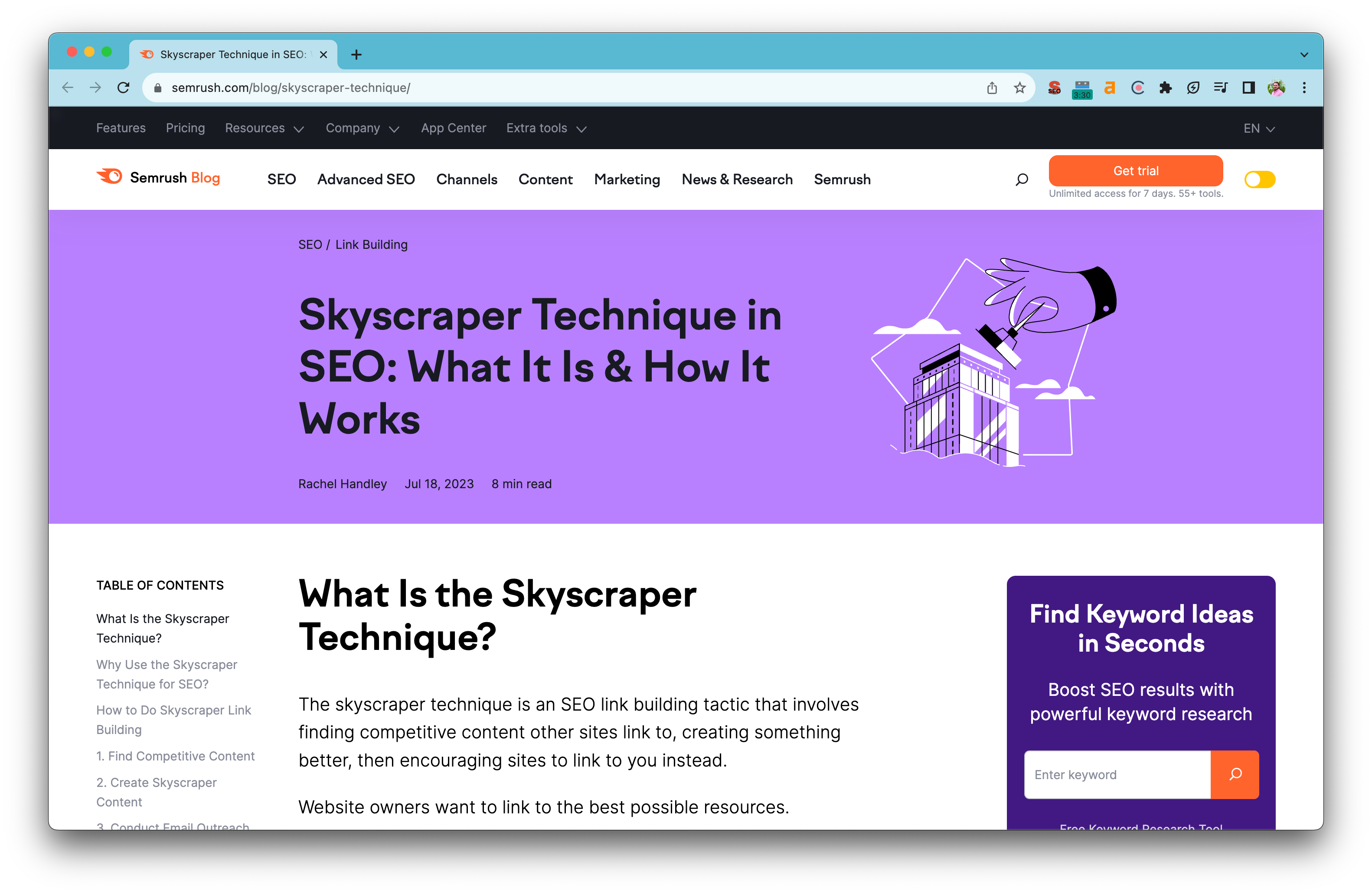
Semrush: What Is the Skyscraper Technique?
[bctt tweet=”Synopsis: Semrush: What Is the Skyscraper Technique?” username=”w2scott”]
Synopsis: Semrush provides a comprehensive guide on the Skyscraper Technique, emphasizing its role in SEO link building. The article breaks down the technique’s definition, its benefits for SEO, and a step-by-step guide on its execution. It also discusses the importance of skyscraper content and the factors that make it stand out.
Key Points:
Definition of the Skyscraper Technique: A method that involves identifying competitive content with many backlinks, improving it, and then encouraging sites to link to the superior content.
Skyscraper Content: Content crafted as part of the Skyscraper Technique, designed to be a superior version of a widely linked resource. It should be more comprehensive, up-to-date, credible, and presented effectively.
Benefits of the Skyscraper Technique for SEO:
Inheriting links that previously pointed to competitors.
Earning backlinks on pages with established traffic and authority.
Encouraging the creation of quality content.
Scalability.
Implementation Steps:
Find Competitive Content: Identify content types suitable for the Skyscraper Technique, such as how-to guides, comparison guides, listicles, and more.
Analyze Competitors’ Content: Use tools like Semrush’s Backlink Analytics to find competitors’ most linked pages.
Review Backlink Opportunities: Determine the potential and value of inheriting specific backlinks.
Create Skyscraper Content: Outdo the competition by being more comprehensive, adding unique insights, improving user experience, establishing credibility, and incorporating images and videos.
Optimize Content for Search: Ensure the content is optimized for relevant keywords and follows on-page SEO techniques.
Conduct Email Outreach: Identify link building prospects and send personalized pitches to encourage them to link to your content.
Conclusion: The Skyscraper Technique is a targeted approach to link building that can yield significant SEO benefits when executed correctly.
Unique or Noteworthy Positions:
Semrush provides a detailed breakdown of the types of content suitable for the Skyscraper Technique, offering clarity on content selection.
The article introduces tools and resources available within the Semrush platform, guiding readers on how to optimize their skyscraper content and conduct effective outreach.
It emphasizes the importance of personalizing email outreach and provides a sample skyscraper email pitch to inspire readers.
Brian Dean Didn’t Have Today’s Software
Yes, machine learning and natural language processing are making the collection and production of website content more approachable. Data analysis is also helping with optimization. With tools like SurferSEO, Frase, and others, you can ensure your content isn’t just longer and more comprehensive, but also better optimized.
Link builders know that one of the best ways to get new links is for your site to be the answer to what people are searching for.
There is an explosion in data exploration products for on-site optimization. The challenge isn’t finding one — it’s limiting yourself to just one.
[bctt tweet=”There is an explosion in data exploration products for on-site optimization. The challenge isn’t finding one — it’s limiting yourself to just one.” username=”w2scott”]
No lie, I currently actively use at least five machine learning-enabled SaaS products.
Concluding Thoughts: No, It’s Not Data Science
Hopefully, you see how incredibly powerful this technique can be.
Like many users of AI content — consistent with human nature, you may be tempted to take shortcuts.
SEO tactics, when abused, lose effectiveness. So, please don’t abuse this.
The SEO Skyscraper Technique with ChatGPT Data Mining will be most useful when a human, knowledgeable in the topic, is making a good AI Sandwich. If you copy and paste and perfunctorily add the non-AI bits, you won’t be adding value to the internet and will eventually see any rankings you did gain disappear.
Something noteworthy in this example is that I’m seeing more sites that aren’t accessible to ChatGPT. I wonder if this is due to those webmasters blocking the OpenAI crawler.
[bctt tweet=”I’m seeing more sites that aren’t accessible to ChatGPT. I wonder if this is due to those webmasters blocking the OpenAI crawler.” username=”w2scott”]
Also, ChatGPT has some words that show up again and again. You should be on the lookout for these so you can edit them where appropriate. “Delve” and “boost,” particularly in the context of SEO, come up again and again.
You’ll notice I tend to be polite when I’m making requests of ChatGPT. This is for two reasons. First, I’m generally a polite person. Politeness counts. Second, when the robots take over, I want every advantage I can get. I would rather they see me as a collaborator 🙂
Finally, as the list of articles to analyze gets longer, you may need to prompt ChatGPT to “continue.”
If you’ve already been using this technique, please hit me up on Twitter and show me some examples, @w2scott.
If you’re just getting started, I hope you find it as useful as I have.
[bctt tweet=”SEO Skyscraper Method + ChatGPT Data Mining = Winning the SERP” username=”searchinfluence”]
Proper search engine optimization (SEO) increases the chances your website will rank highly in search engine results, which could introduce more people to your brand.
Keyword research, content writing, SEO-focused web development, link building, and analytics are all key SEO skills that work together to give you greater results.
Do-it-yourself SEO presents several pitfalls and challenges that waste time, money, and resources. Having a dedicated team of SEO specialists is a more reliable way to achieve long-term search success.
Imagine a world where over half of your website’s traffic comes purely from organic search (i.e. the unpaid listings that appear on a search engine results page).
In reality, it’s not that far-fetched, considering 53.3% of website visits originate from this digital marketing channel.
But, ranking at the top of search engine results and reeling in more website traffic isn’t just about having an online presence. It’s about leveraging the magic touch of search engine optimization (SEO) to rank high and stay ranked high.
It takes many different skill sets — technical, creative, strategical, and analytical — to truly “win” at SEO and markedly increase website traffic. As an under-experienced SEO practitioner, proper SEO can be difficult to successfully implement.
You need an experienced team to maximize your SEO campaigns and enjoy the benefits of a well-optimized, high-traffic site.
5 Essential SEO Skills to Boost Website Rankings
Research and analytical skills for effective SEO
Every search starts with a keyword or search term.
Consequently, every SEO strategy starts with keyword research.
Keyword research is the process of identifying words, phrases, and queries that users search for and incorporating them into your website’s content to improve your site’s rankings on search engine results pages. It entails analyzing what you currently rank for, what your competitors rank for, and what you should rank for.
Performing thorough keyword research means better understanding users’ search intent, which is what they are trying to get out of a particular search. But, for more novice SEO practitioners, pinpointing intent can be tricky. Many phrases and queries can be interpreted in multiple ways.
For example, a higher education institution would have to consider the many possible meanings behind the keyphrase “how to go back to school.” An SEO specialist can cater to each niche search, tailoring strategies to capture where prospective students are on their path to enrollment.
Content writing for keyword optimization
After identifying high-value keywords and phrases, you need to integrate them into the written content on your website.
SEO experts use relevant keywords to create compelling title tags and meta descriptions for each page, as well as in longer sections of text, such as blog posts and descriptions of products and services.
Using these SEO copywriting skills for engaging content creation ensures that your site contains the right keywords and phrases. This improves your on-page SEO and your rankings in search engine algorithms.
But, including keywords is only half the battle. First and foremost, your content needs to include all the important information on the topic and meet Google’s E-E-A-T standards (Experience, Expertise, Authority, and Trustworthiness). With an SEO specialist’s content and research expertise, both users and search engines will know what your business is about and the services you provide.
Technical SEO expertise for site health
Having a slow, clunky, user-unfriendly website will quickly drive potential customers away.
A professional digital marketing team has the SEO knowledge and technical SEO skills for site speed optimization, which includes:
Implementing a responsive and easy-to-use design
Crafting readable and logical URLs
Optimizing image sizes
Proper technical SEO means anticipating the unique challenges that a site presents and using the toolkit of skills to mitigate them.
Link-building skills for off-page SEO
Backlinks are links to your website that exist on sites other than your own. They help build your web pages’ quality, relevance, and credibility, which ultimately aids with gaining Google’s trust and ranking higher in search.
Seasoned SEO specialists use a number of strategies to grow the number of backlinks to your website, including link building and link earning.
Link building involves manually placing links to your site on social media platforms and directories such as Yelp and Google Maps. With link earning, an SEO professional pinpoints other websites to link to yours organically. This “earned” backlink often occurs because the external site finds your content helpful and engaging to its users.
Analytics and data analysis for SEO
Analytics and data analysis help you learn more about your website’s audience and whether your SEO efforts work as intended.
SEO professionals use tools like Google Search Console and Google Analytics to gather information about visitors to your site, including their age, location, gender, and interests. They can also learn how long visitors stay on your website, click-through rates, which pages are viewed the most, and which features and pages are getting ignored.
This information is incredibly valuable for revising and improving your overall SEO strategies moving forward.
Challenges and Pitfalls of DIY SEO
Unless you have the resources and budget for a robust in-house SEO team, you’ll need to partner with an outside SEO-focused agency. One unexpected pitfall or neglected search tactic could lead to missed conversion opportunities and rankings well past the 10th+ page in the search results.
The cost of subpar SEO efforts isn’t just financial. When you settle for less, you can face costly mistakes and consequences like:
MISTAKE: Only focusing on on-site SEO and missing out on opportunities to build backlinks.
IMPACT: Hinders your site’s authority and ranking potential, limiting its reach and effectiveness in attracting a wider audience.
MISTAKE: Neglecting to create and optimize page titles and meta descriptions.
IMPACT: Leads to suboptimal search engine rankings, reduced click-through rates, and a missed opportunity to attract users through relevant queries.
MISTAKE: Not regularly adding fresh, relevant content to your site.
IMPACT: Results in under-optimized and insufficient content that fails to interest users, which can negatively affect search engine rankings.
MISTAKE: Lack of comprehensive keyword research and proper keyword targeting.
IMPACT: Ends in fewer keyword rankings, which leads to less visibility in search engines and decreased site traffic.
MISTAKE: Viewing SEO as a one-time task instead of continuously improving existing strategies and trying new ones.
IMPACT: Results in stagnant or declining search rankings, reduced web traffic, and missed opportunities for growth and adaptation in a constantly evolving digital landscape.
MISTAKE: Failing to meet Google’s E-E-A-T requirements (Experience, Expertise, Authority, and Trustworthiness) for on-site content.
IMPACT: Leads to useless, under-performing content that is unlikely to engage users or generate backlinks.
Why You Need an SEO-Focused Agency in Your Corner
Expertise is your greatest ally
Choosing an SEO-focused agency means tapping into years of cross-industry expertise. Their holistic teams master everything from the intricacies of technical SEO to content strategy and analytics. Plus, they’re always on the pulse of search’s ever-evolving best practices and SEO industry standards.
You get help tracking leads and overall performance
With an SEO-specialized agency, tracking leads and assessing overall performance become seamless. By mastering platforms such as Google Analytics, they map out user trends, traffic flow, and conversion points. Equipped with a constant pulse on keyword performance, you’re kept in the loop about rankings, search prevalence, and click metrics.
Scaling efficiency is the standard
With an SEO-attuned agency by your side, you get efficiency that’s geared to scale. Their prowess ensures marketing techniques ebb and flow with your growth and diversifying needs, always on the lookout for new market horizons and untapped customer sectors.
It’s cost-effective in the long run
Partnering with an SEO-driven agency is a strategic move for long-term cost savings. Their expertise ensures the best search ROI — making every dollar count to drive maximum value from your investment. Proficient teams maintain efficient resource use, eliminating unnecessary expenditures to achieve the best possible results. In addition, their arsenal of specialized SEO tools, often expensive to procure independently, becomes yours.
Our New Orleans SEO Agency Is Here to Help
Using SEO successfully takes a lot of skill and patience, but the payoff is well worth the effort. From higher search rankings and boosted web traffic to increased revenue, the rewards are transformative — and imperative — for your overall performance.
An experienced and dedicated SEO specialist can do the heavy lifting for you and help you see real-world, real-time results.
Search Influence is an SEO-focused, full-service digital marketing agency with the tools, expertise, and driven professionals you need to build your business through SEO. Our designers, developers, writers, and campaign strategists will work together to help you reach and grow your online audience with greater ease than ever before.
Ready to craft a winning SEO strategy? Contact us today to learn more about our SEO services and results.
Research shows that 93% of Americans think they are better drivers than average, 90% of teachers think they are more skilled than their peers, and this overestimation is pervasive across many skills — including logic tests.
For the typical higher education institution, effective marketing strategies are like that.
Mathematically speaking, it’s not possible for a majority to be “above average.”
We analyzed the top 10 results in Google for “Higher Education Marketing Strategies” and extracted some really useful learnings. First, I’ll share the most commonly cited strategies, and then give you a skimmable summary of each article.
Top 10 Higher Education Marketing Strategies
These strategies are the most frequently cited in the following articles, in order of prominence.
SEO (Search Engine Optimization): Emphasized across multiple articles. Ensuring high visibility on search engines is critical for Higher Education SEO.
Social Media Marketing: Highlighted in almost all articles for engaging authentically on each social media platform preferred by younger generations.
Email Marketing: A recurring theme emphasizing personalization, automation, and AI-powered programs.
Video Content: Both short-form and long-form videos, including live streaming and platforms like TikTok and YouTube, are great ways to educate prospective students.
PPC (Pay-Per-Click) and Digital Advertising: Discussed in multiple articles for targeted advertising on platforms like Facebook Ads and Google Ads.
Content Marketing: The importance of creating engaging and informative content, such as blogs, podcasts, and videos.
Branding: Consistent branding across all marketing channels, including a recognizable voice and image.
Chatbots and Conversational Marketing: Highlighted in several articles for real-time, one-to-one connections and instant answers.
Data-Driven Strategies: Using data to inform marketing decisions, track KPIs, and understand the audience.
Digital Marketing and Marketing Strategy Opportunities
What we learned in the UPCEA SEO research study was that there are some big gaps in the university marketing strategy and the typical higher education website for attracting prospective students.
When we got deeper into the data, we saw that the higher education industry is overly reliant on certain digital marketing channels. A good marketing campaign addresses the full funnel. To attract students, you must increase search engine visibility, maintain a strong social media presence, and ensure you’re doing all you can to target prospective students.
So, with all the great tactics and technologies to attract prospective students (virtual campus tours, student ambassadors, and taking advantage of digital technology to highlight student activities), one has to wonder why other higher ed institutions seem to be attracting more new students.
As I’m sure you’re aware, Google and the other search engines know everything, right? So, I thought, why not let Google guide me? I wanted to see how other higher ed marketers were thinking about the strategy to build brand awareness and get in front of prospective students.
I think it’s important to take content created by marketers talking about a marketing strategy with a grain of salt. We can, however, learn a lot when we analyze the frequency with which these articles cite specific tactics, platforms, or strategies to get in front of prospective students for educational institutions.
My perspective: It’s surprising to see this continued focus on the pandemic. From what we’ve seen, things are different — the pandemic is done in most people’s minds, and we’re now in the “new normal.”
The article discusses the challenges faced by university marketers due to the pandemic and the downturn in undergraduate student enrollment. It provides 12 strategies for higher education marketing:
Centralize Strategy and Reporting: Emphasizes the importance of centralizing marketing expenditures and standardizing KPIs.
Track the Right KPIs: Highlights the importance of tracking call-to-action conversion rates, traffic sources, social media engagement, and cost of acquisition.
Use Marketing Automation: Discusses the benefits of tracking digital interactions with prospective students.
Optimize Your Email Program With AI: Offers email deliverability and engagement solutions.
Improve SEO: Stresses the importance of using relevant keywords and answering prospective students’ queries.
Build a Digital-Friendly Brand: Talks about updating branding to be more digital-friendly.
Live Streaming: Suggests using live streams as an authentic way to connect with potential students.
Personalized Communication: Emphasizes the importance of segmenting audiences and tailoring communication.
Higher Education Marketing on Social Media: Provides various strategies to maximize social media efforts.
Personalized Mobile-Friendly Website: Highlights the importance of a responsive and personalized website.
Chatbots for Higher Education Marketing: Discusses the benefits of using chatbots for immediate responses.
Don’t Forget Visuals and Aesthetics: Emphasizes the importance of appealing visuals for the Gen Z audience.
Unique Positions:
The article emphasizes the importance of data-driven strategies, especially in the context of the challenges posed by the pandemic.
It highlights the significance of understanding and catering to the preferences of Gen Z, who are the next in line for higher education.
Conclusion: The article concludes by emphasizing that marketing shouldn’t be stagnant but should evolve with the university’s overall goals.
Higher Education Marketing: Strategies and Trends to Know
My perspective: It’s interesting to see a focus on the rise of Instagram. TikTok is more timely and clearly the place where Gen Z and beyond are starting their product experiences.
The article emphasizes the importance of refining marketing strategies for higher education institutions, especially in light of decreasing college enrollments.
It provides insights into current higher ed trends and offers strategies to enhance student recruitment.
Key Questions for Your Higher Education Marketing Plan:
Identifying target audience and personas.
Determining KPIs for engagement.
Establishing the cornerstone of the marketing plan.
Differentiating from other institutions.
Platforms to Market Your Educational Offerings:
Text messages, especially during the student enrollment process.
Social media platforms like Twitter, Facebook, LinkedIn, Instagram, and Snapchat.
Email, direct mail, phone calls, and websites.
Higher Education Marketing Strategies:
Use a CMS Built for Higher Education: Implement a quality web content management system (CMS) tailored for educational institutions to address challenges like outdated content, complicated coding, inconsistent branding, and low search rankings.
Get Current Students Involved: Engage existing students to provide authentic insights into campus life.
Choose a CMS With an Email Module: Emphasizes personalized and targeted email marketing.
Focus on Video Content: Highlights the importance of integrating video content into marketing strategies.
Keep Track of Your Brand: Monitor the digital image and reputation of the institution.
Use the Power of Social Media: Utilize a mix of social media platforms for effective messaging.
Use Videos and Images on Social Media: Emphasizes the growing preference for visual content on platforms like Instagram, YouTube, and TikTok.
Personalize at Scale: Deliver personalized content across various platforms.
Include SEO and Conversion in Your Program Pages: Optimize program pages for search engines and conversions.
Target Parents: Recognize the influential role of parents in students’ college decisions.
Unique Positions:
The article underscores the importance of authenticity, especially when involving current students in marketing efforts.
It highlights the shift in the relevance of different social media platforms, noting the rise of Instagram and the decline of Facebook in the context of college planning.
Conclusion: The article concludes by emphasizing the significance of a quality website and the potential of a CMS to fine-tune a college or university’s marketing strategy.
My perspective: I wonder if the author’s suggestion of the value of traditional marketing is pandering to the old guard. Sure, brochures, commercials, etc., may appeal to the parents, but the students are on social media and search.
The article delves into the unique challenges of marketing in the higher education sector, emphasizing the need for institutions to create a superior academic environment while facing intense competition.
It underscores the importance of an effective marketing strategy blending traditional and digital methods to achieve institutional goals.
Why Is it Important to Prioritize Marketing?
Higher education institutions need to maximize enrollment and diversify their student and faculty demographics.
They must cater to various stakeholders: students, parents, faculty, and donors.
Traditional Marketing in Higher Education:
Print: Newspaper or magazine ads, billboards, and stationery.
Mail: Targeted ads, imagery, and product samples.
Radio: Over-the-air ads, jingles, and testimonials.
Television: Video ads, customer reviews, and product demonstrations.
Unique Assets: Campus tours and visits, research and development, arts, music, and sports.
Digital Marketing Strategies:
Email Marketing: Deliver branded messages, newsletters, and offers.
Social Media Marketing (SMM): Disseminate content across channels and engage with influencers.
Content Marketing: Use blogs, podcasts, videos, etc., to enhance branding.
Search Engine Marketing (SEM): Utilize paid placement and digital ads.
Pay-Per-Click (PPC): Cost-effective advertising where payment is made only when the ad is clicked.
Ideal Marketing Strategy for Higher Education:
Blend traditional and digital methods.
Maintain a dynamic website showcasing institutional value.
Engage in SEO and SEM efforts.
Execute a comprehensive digital advertising strategy.
Implement a multifaceted SSM plan.
Produce diverse content across various media.
Secure advertising spots in local, regional, and national media.
Leverage unique assets like research, campus visits, arts, music, and sports.
Highlight notable faculty and alumni.
Unique Positions:
The article emphasizes the two-way nature of digital marketing, allowing institutions to have meaningful conversations with interested parties.
It suggests that, while traditional marketing methods remain relevant, digital marketing has taken precedence in the modern age.
Conclusion: The article concludes by promoting the benefits of joining the American Marketing Association (AMA) for institutions looking to elevate their marketing strategies.
The Ultimate Guide to Higher Education Marketing Strategies
My perspective: Ultimate is a bit of a stretch, but I do appreciate the view on good copy and the needs of various university stakeholders, like advancement, athletics, and current students.
The article addresses the challenges higher education marketers face in today’s digital age. It emphasizes the shift from traditional mass marketing methods, like glossy brochures, to more personalized strategies that resonate with modern students.
Defining the Goals of Your Higher Education Marketing Strategies:
Marketing for Enrollment: With declining enrollments, targeting prospective students and their parents using digital channels is crucial. Strategies include:
Publishing informational blog posts and podcasts.
Engaging authentically on social media.
Collaborating with micro-influencers.
Creating video content, including live streams.
Adopting a mobile-first marketing approach.
Marketing for Advancement: This focuses on building relationships with alumni and friends of the institution, often for fundraising purposes.
Marketing for Athletics: Promoting athletic programs to boost interest, spirit, and revenue.
Marketing for Student Involvement: Inform enrolled students about on-campus activities and opportunities.
The Role of Email in Higher Education Marketing Strategies:
Email marketing offers a high return on investment (ROI) across various aspects of higher education marketing.
Effective email strategies include automation, mobile-friendliness, relevant content, inclusion of images and videos, and personalization.
Using Segmentation and Personalization for Prospective Students:
Personalized email subject lines are more likely to be opened.
Segmentation ensures content relevance, further increasing open rates.
Consistent Branding:
Emails should maintain consistent branding, using recognizable colors, fonts, and logos.
Killer Subject Lines and Captivating Content:
Subject lines should be personable, actionable, and unique.
Content should be relevant and valuable to the reader.
The Importance of Testing:
A/B testing or split testing is crucial to determine the effectiveness of email campaigns.
Testing provides data to refine campaigns for optimal results.
Conclusion: Higher education marketing strategies are essential for institutions to overcome challenges and achieve their goals. Email marketing, in particular, is a powerful tool that can be tailored for various purposes, from boosting enrollment to promoting athletic programs. The article emphasizes the importance of personalization, segmentation, and consistent branding in email campaigns to engage and convert recipients effectively.
My perspective: I find the idea of marketing “Higher Education” as a concept compelling. I recently had a conversation with one of our summer interns in which he asked, “Do I even need a degree?”
There are definitely fields, like computer science, for instance, where we’re learning that degrees don’t necessarily separate the wheat from the chaff.
The article emphasizes the long-term changes in higher education institutions due to the pandemic, highlighting the importance of distance learning programs, local student outreach, and improved campus safety. It presents 12 techniques for an effective higher education marketing strategy:
Branding: Focuses on crafting an identity that represents both the school and its student body. Authenticity is key.
Search Engine Optimization (SEO): Highlights the importance of high rankings on search engines and lists several SEO techniques.
A Great Website Experience: Stresses the importance of mobile-first design, speed, and ease of use.
Social Media Marketing: Discusses the significance of authentic engagement on social media platforms, especially for Gen Z and millennials.
Live Streaming: Emphasizes the use of platforms like Facebook Live, Instagram Live, and YouTube for events, Q&A sessions, and classes.
Email Marketing: Highlights the preference of students for email communication and the importance of personalization and segmentation.
Interactive Advertising: Describes the potential of interactive ads, such as games and story-based video ads.
Leveraging Alumni and Students: Discusses the power of word-of-mouth marketing and the importance of reviews and testimonials from current and former students.
Distance Learning: Highlights the increasing demand for distance learning options post-pandemic and the opportunities it presents for institutions.
Pay Per Click Advertising: Discusses the benefits of targeted advertising on platforms like Facebook, Google Ads, and Bing Ads.
Short-Form Video Content: Emphasizes the importance of platforms like TikTok, Instagram Reels, and YouTube Shorts in engaging potential students.
Focus on Positive Career Outcomes: Addresses the ongoing discussions about the value of higher education and the importance of showcasing the tangible benefits of a college education, such as high-paying jobs after graduation.
Unique Positions:
The article stresses the need for institutions to market themselves and the very idea of higher education in light of recent discussions questioning its value.
It highlights the blend of traditional and modern marketing strategies, emphasizing the importance of authenticity in all communications.
Conclusion: The article concludes by promoting ComboApp as a full-cycle higher education marketing agency that can assist institutions in crafting a comprehensive digital marketing strategy.
8 Higher Ed Digital Marketing Tactics & Trends for 2023
My perspective: Social will continue to be a tremendous way to get in front of future university students. Even though we’re no longer talking about the “Zero moment of truth” (thank goodness), students will continue to be exposed to our schools and programs before they even know they’re looking.
The article sheds light on the evolving landscape of higher education marketing in 2022, emphasizing the need for institutions to adapt to the digital age and the unique preferences of Gen Z.
Understanding the Crowdsourcing Habits of Gen Z: Gen Z’s decision-making is described as “crowdsourcing,” where they seek opinions from peers, influencers, and reviewers. Institutions should involve them in conversations and connect with their sense of humor, especially on platforms like TikTok.
Reaching Gen Z With Conversational Marketing: The trend of “conversational marketing” is growing, emphasizing real-time, one-to-one connections to answer questions and assist consumers. University websites should incorporate a human voice and chat opportunities.
Data Insights Shedding More Light on Higher Ed Audiences: Research indicates that understanding the audience leads to better marketing outcomes. Universities are using CRM systems and other software to analyze the student journey and understand their motivations.
Growing Emphasis on Personalized Messaging: Digital content engages young people, but they are wary of overt marketing. Personalized, targeted messaging helps universities connect with students and boost conversions.
Growing Preferences for Short-Form Video: Universities should incorporate short-form videos (around 90 seconds) into their marketing strategies. Examples include video campus tours, answers to FAQs, and student-guided mini-tours.
Unique Positions:
The article emphasizes the importance of understanding and connecting with Gen Z’s unique preferences, especially their reliance on crowdsourcing for decision-making.
It highlights the significance of conversational marketing and the need for human interaction, even in the digital age.
Conclusion: The article concludes by promoting Unibuddy, a platform designed for students that offers tools to enhance higher education marketing strategies in line with current trends.
My perspective: It’s not surprising Penji would focus on social and ad creative since they are a marketplace for creative work. I’m not familiar with Penji, but it looks like a new-style iteration of a “99 Designs” concept.
The article underscores the importance of marketing in universities, especially given the competitive nature of higher education marketing. It provides a comprehensive list of strategies to enhance university branding and appeal to a younger audience.
Social Media: Emphasizes the shift from traditional mail to social media platforms to engage with prospective students. Universities should be present where students are active and ensure their content aligns with the platform’s audience.
User-Generated Posts: Encourages universities to monitor and engage with content created by students about the institution. This provides insights into the university’s perception and offers opportunities for authentic engagement.
Define Your Brand Image: Universities should have a consistent voice and image across all marketing channels. This helps in creating a recognizable and trustworthy brand.
Focus on the Students: Marketing strategies should prioritize the needs and interests of students, both current and prospective. This includes promoting events, assistance, and showcasing the university’s supportive environment.
Video Marketing on All Platforms: Highlights the increasing importance of short-form video content on platforms like YouTube. Videos offer a dynamic way to showcase campus life, events, and more.
Statistics: Using data to showcase the university’s achievements, such as high graduation rates, can be a compelling marketing tool.
Promote Sitting in Classes Before Enrolling: Offering prospective students the chance to experience lectures can help in their decision-making process.
SEO (Search Engine Optimization): Ensuring the university’s website ranks high on search engines is crucial for visibility.
Showcase Success: Highlighting the achievements of alumni can serve as a testament to the quality of education provided.
Use Infographics: Visual representations of data can be more engaging and easier to digest than text-heavy content.
Paid Traffic: Utilizing paid ads, especially on platforms like Instagram, can help in reaching a wider audience.
Interactive Webinars: Hosting webinars can provide valuable information to prospective students and give them a taste of the university’s teaching style.
Downloadable Guides: Offering resources to help students prepare for college can be a valuable tool in the decision-making process.
Email Marketing: Automated email series tailored to the student’s application process stage can provide personalized guidance.
Unique Positions:
The article emphasizes the importance of understanding the younger generation’s preferences and adjusting marketing strategies accordingly.
It highlights graphic design’s role in enhancing marketing campaigns’ effectiveness.
Conclusion: The article concludes by promoting Penji, a graphic design service, as a valuable tool for universities looking to enhance their marketing strategies with quality designs.
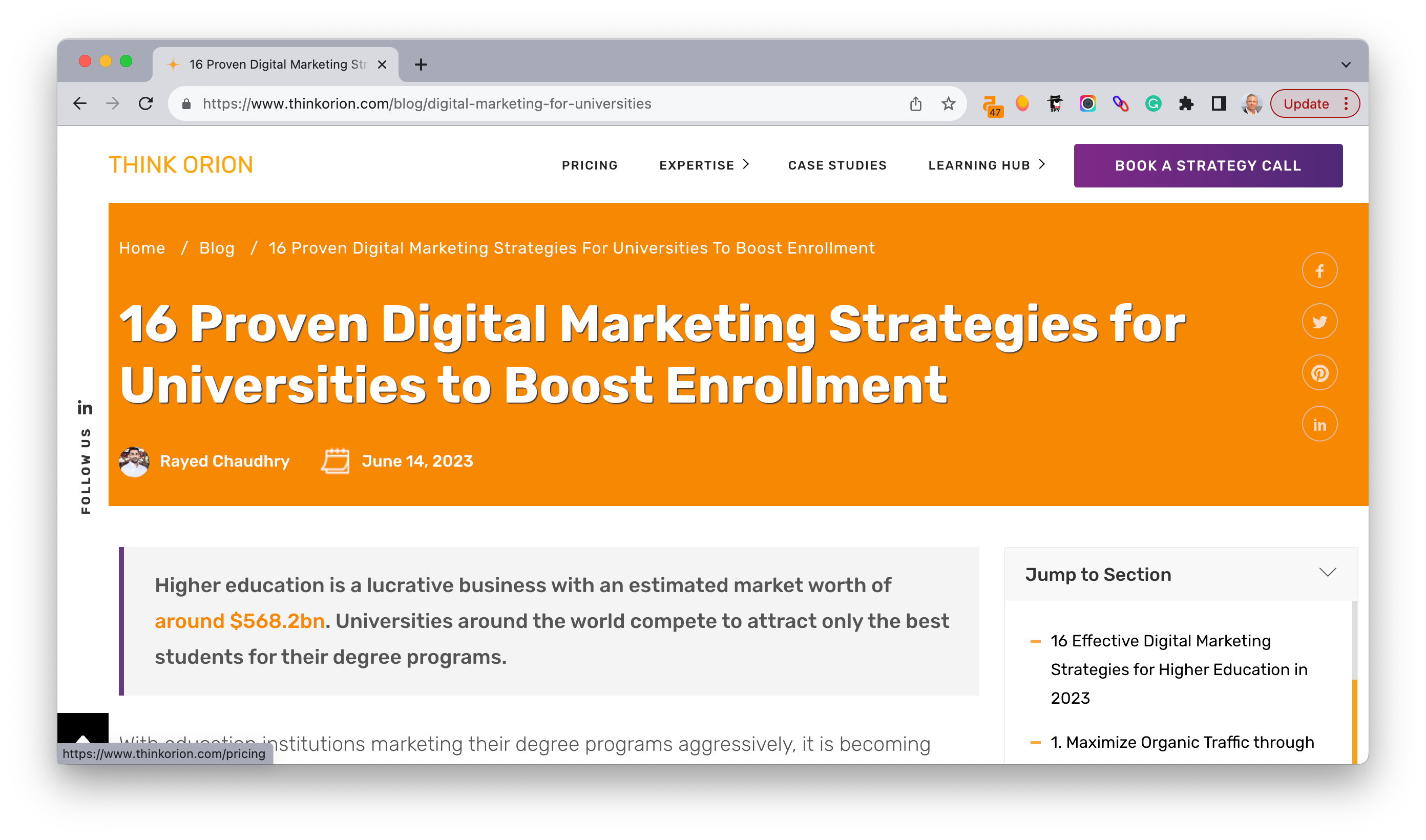
16 Effective Digital Marketing Strategies for Higher Education in 2023
My perspective: I appreciate the focus on real-time and alumni engagement. We’ve been spoiled by instant responses and always on media. And, students want to know what’s out there after attainment of that degree or certificate. Alumni can help tell this story much better than administrators or (gasp) marketers.
The article delves into the competitive landscape of higher education marketing, emphasizing the importance of standing out to attract the best students. It provides a comprehensive list of strategies to enhance university visibility and appeal:
Maximize Organic Traffic through Optimized SEO Techniques: Emphasizes the importance of SEO for attracting the right students. It covers aspects like keyword research, internal linking, backlinking, technical audits, and on-page optimization.
Accelerate Your Sales With Proven PPC Techniques: Discusses the benefits of pay-per-click advertising for promoting university programs and increasing web traffic.
Attract, Engage, and Retain Students With a Winning Content Marketing Strategy: Highlights the importance of creating engaging and informative content to resonate with potential students.
Elevate Your Brand Visibility With Google Display Advertising: Discusses the effectiveness of digital display ads over traditional billboard ads, especially on Google’s Display Network.
Unlock the Power of Social Media: Explores the role of social media platforms like Twitter, Instagram, LinkedIn, and Facebook in connecting with potential students.
Use Exclusive Email Marketing Campaigns to Promote: Emphasizes the continued relevance of email marketing, stressing the importance of personalization and using AI-powered email programs.
Make Informed Decisions With Advanced Analysis and Tracking: Discusses the importance of setting specific tracking goals beyond what Google Analytics provides.
Utilize Video Marketing to its Fullest Potential: Highlights the engagement potential of video content, both in long and short formats.
Inspire Student Success With Real-Life Stories: Advocates for sharing student success stories to showcase the value of the university’s programs.
Maximize Your Reach With Influencer Marketing: Discusses the power of influencer marketing, especially leveraging successful alumni.
Boost Engagement With Short and Snappy Video Content: Emphasizes the importance of short video content, especially in the wake of reduced on-campus visits due to COVID-19.
Optimize for Featured Snippets: Discusses the importance of ranking in Google’s featured snippet for increased visibility.
Reach Your Ideal Customers With Lookalike Audience Targeting: Highlights the benefits of using lookalike audience models to improve brand reach.
Improve Customer Service With Chatbots Integration: Discusses the rise of conversational marketing and the effectiveness of chatbots in providing instant answers.
Build Connections With Live Streaming: Emphasizes the engagement potential of live streaming over traditional content.
Hire a Professional Higher Education Digital Marketing Agency: Advocates for seeking professional assistance if universities lack the resources or expertise for effective digital marketing.
Unique Positions:
The article emphasizes the blend of traditional and modern marketing strategies, highlighting the importance of adapting to the evolving digital landscape.
It underscores the importance of personalization, real-time engagement, and leveraging alumni for effective marketing.
Conclusion: The article concludes by emphasizing the importance of current marketing strategies for universities to attract future leaders. It also suggests hiring a higher-ed marketing agency for those lacking the time or resources to run effective campaigns.
My perspective: OK, I know it’s shallow, but I like the look and feel of this site. It’s got a very medium-esque vibe.
On a more serious note, the authors point out one of my constant refrains: The decentralized nature of a higher education marketing strategy is costing universities dearly. Very few schools have central oversight and are therefore cannibalizing their own messaging and budgets.
The article delves into the complexities of marketing in higher education, highlighting the unique challenges faced by universities. One of the primary challenges is the siloed nature of marketing in universities. While universities typically have a central marketing team focused on boosting student enrollment and driving donations, there are also numerous smaller teams across various academic departments and schools, each with slightly different target audiences.
These smaller teams often work independently on their marketing strategies, employing a wide range of tactics such as social media, SEO, email marketing automation, PPC campaigns, live streaming video content, direct mail, in-person events, and even chatbot scripts. This decentralized approach can lead to several issues:
Dilution of the Brand: Inconsistent application of messaging and brand guidelines can weaken the overall brand identity.
Missed Opportunities: Due to weak communication channels, potential marketing opportunities might be overlooked or not fully capitalized upon.
Decreased Morale: Teams or individuals working in isolation can experience reduced morale.
Despite these challenges, the article offers hope by suggesting nine strategies to promote more cohesive and effective higher education marketing. While the specific strategies aren’t detailed in the provided excerpt, the article emphasizes the importance of cohesive marketing efforts across the institution.
Unique Positions:
The article highlights the unique challenges higher education institutions face due to the decentralized nature of their marketing efforts.
It underscores the importance of a unified approach to marketing to ensure consistent branding and messaging.
Noteworthy Mentions:
The article references recent engagement examples related to the pandemic, suggesting that universities have proactively created content around COVID-19.
The University of Queensland is highlighted for its digital publication, “Contact,” which offers an engaging and interactive user experience while catering to those who prefer traditional print magazines.
Final Thoughts
As you can see, there are a number of ways to get in front of students for your school.
The consensus seems to be that SEO, social media marketing and advertising, email, and PPC are great ways to invest your marketing dollars.
It’s surprising to see how little attention is paid in the articles to analysis, tracking, and reporting, given how many of the UPCEA Higher Education SEO Study respondents indicate this is lacking.
As management icon Peter Drucker is famously quoted, “What gets measured gets managed.” All the landing pages, tactics, and strategies in the world won’t make us successful if we don’t know what’s working.
For more tips to create a winning higher education marketing strategy, check out our Higher Education Marketing Resources & Guides. For more information about higher education marketing – and to learn more about services like our SEO Roadmap for universities, contact our team at Search Influence today.
Update from the “Correlation is not Causation” file.
While investigating more, I noticed this in Google Search Console. A client who has historically had consistent #1 ranking for a specific phrase showed significant volatility in the last month. That volatility roughly coincides with the finalization of the March Core Update.
Original Post: May 5th, 2023
On a monthly basis, we look at various data for some, not all, clients to include in what we call “Highlights and Insights,” or H&I as I like to call them.
Among the things we look at are:
Traffic
Ranking
Pages getting traffic
Recent work (i.e., deliverables)
SMART goals, if applicable
I have personal responsibility for the SEO strategy of a small number of clients. I know it’s funny — the CEO is doing SEO strategy. But, with maternity leaves, hiring, research and development, and personal relationships, it’s important to me.
This means I’m responsible for three clients’ H&I. I was surprised as I was preparing them to see that their April 2023 Google organic and paid search traffic is universally down month-over-month.
So I wondered, is it me? Are we doing something wrong? But, no.
It turns out that all of them have seen increases in ranking, both in our keyword tools and in Google Search Console. We’re also seeing individual pages we’ve been optimizing or promoting get more prominence relative to the site as a whole.
I feel a little bit vindicated.
So I took my confusion to Twitter.
The first to chime in was Brett Tabke of Pubcon fame.
Zero click Serps are up again. The amount of spam Google is throwing on Serps continues to grow unabated.
Next was Susan Staupe, LocalU Superfan and a great marketer in her own right.
Im seeing organic and ads down across the board! ugh.
— Susan M. Staupe – Beyond SEO, LLC (@SusanStaupe) May 5, 2023
And I was reminded of Cindy Krum’s presentation at the recent Zenith Conference in Duluth, where she talked about Google features pushing her client out of the entire space above the fold during the World Cup for Football (aka Soccer) related searches.
So, of course, I mentioned that, and Cindy contributed.
Yup – Zero-click or a Google-mediated click, where they send to Product Knowledge Graph/Merchant Center/Doorway pages.
And finally, though he gave a “hard to say” on this one, Barry Schwartz suggests this may be related to the April 2023 Reviews Update:
why did you include my post about an unconfirmed update from this week (i.e. May 2023) in regards to a traffic drop in April… If anything, maybe it is related to the April 2023 reviews update (which I assume you know about?) https://t.co/buiUYyh0FU
Or perhaps, for “I’m wondering” kind of questions people are going to ChatGPT.
The masses know about ChatGPT — the headlines are everywhere. And as I showed in my AI content presentation at Pubcon and Zenith, Google Trends data demonstrates that ChatGPT is in the consciousness of everyday Americans.
Who knows?
I’m just glad it’s not just us, and I’m hopeful Google gets its act together for the sake of all those businesses who rely on that traffic.
And our outlier — because there’s always one — Lawn and Garden. It’s springtime, you know.
AI is analyzing medical images, optimizing energy grids, personalizing education, and driving cars. It is also moving quickly into SEO. ChatGPT is the most newsworthy of these tools, but there are many more..
ChatGPT can render programming code, such as PHP code to write the html for an ascii cat face.
AI can be used for good, but it can also be used for evil. Cybersecurity researchers are already finding instances of bad actors posting functional malware code to cybercrime forums.
ChatGPT and other AI-enabled tools shine in examples like the code above, where they’re either completely doing the work of humans or significantly shortcutting the process.
For prototyping, confirming assumptions, and initial fact checking ChatGPT, as an AI writing tool, works well – though a manual review is still advised.
There are also a number of established AI writing tools such as Jasper, Writer, and QuillBot.
Additionally, there are an equal number of AI image-generation tools, such as Dall-E, Midjourney, and Stable Diffusion.
AI tools being used for SEO: ChatGPT, Jasper, and other OpenAI-based tools can be useful in the process of building content.
However, there are concerns that the use of AI tools will lead to content being deemed “unhelpful”. Search Quality Raters are human beings who review Google search results and give feedback on the quality of the results, and they are looking for signals such as Expertise, Authority, and Trust.
In order to support the quality guidelines and their human raters, the best use of AI tools may be an “AI sandwich” where humans write prompts, AI does its thing, and then humans edit and fact check.
However, if we want to produce helpful, trustworthy content, the output of the AI content generation tools will need to be like parts on the shelf that together make the whole.
We are about to see an explosion in AI-generated content, and legitimate content creators will use it to create better content, develop great ideas, and serve their organizations and clients more effectively.
As an old-school SEO, ChatGPT and its peers are a great opportunity for testing and tuning.
As a client-serving marketing organization, we are excited about the ways in which these tools and those still to come will help us produce better, more engaging content.
However, we may see things get worse before they get better.
SEO is a critical component of any digital marketing strategy, but it can particularly help healthcare organizations expand their online reach.
Investing in a strong SEO strategy for your healthcare organization can increase your website traffic, lead to a higher local search volume, and attract new patients.
To really witness the results of your healthcare practice’s SEO efforts, you’ll need to take actionable steps, such as creating a mobile-friendly site, choosing the right targeted keywords and making efforts to rank locally.
Search engine optimization (SEO) is the modern-day digital marketing pillar of an organization’s successful and compelling online presence. Today, countless businesses across industries use SEO efforts to rank higher in search engine results, with goals of driving traffic to their websites and giving their company’s name more word-of-mouth benefits.
Your healthcare organization should be no different.
By implementing robust healthcare SEO strategies, your medical business can expand its online reach, build brand awareness, improve user experience—and attract new, engaged patients. In this post, we’ll take a look at some of the benefits of medical SEO and how providers can utilize it effectively in their digital marketing strategy.
What Is Healthcare SEO?
The term healthcare SEO describes a range of search engine optimization strategies that providers and medical facilities use to enhance their online presence and organic reach, which includes strategically selecting keywords to craft high-quality, engaging content. Because search algorithms prioritize surfacing relevant, authoritative pages in order to provide users with an efficient search experience, a successful healthcare SEO strategy can make the difference in how high your pages rank in the search results. And the higher your pages rank, the higher the degree to which curious leads convert into patients.
We believe the myriad of benefits of a comprehensive SEO strategy is the most impactful for providers aiming to become more visible, valuable, and available to their patients.
What Are the Benefits of Healthcare SEO?
The primary goal of a healthcare SEO strategy is to draw more patients to a practice’s web presence, content, and, ultimately, products and services. By enhancing your practice’s brand awareness, healthcare SEO can help you acquire those patients who otherwise would opt for a competing provider—simply because of that provider’s accessibility and presence on the web. At Search Influence, we advocate for strategies that drive higher patient volumes and increase your website’s traffic.
Higher patient volumes
It’s a no-brainer: consumers are more likely to buy a product or pay for a service if they know about a business in the first place. Healthcare SEO helps to bring awareness to prospective patients about certain providers and inform them of the practice’s services, unique qualifications, and products. The more awareness the general public has about a medical facility, the more likely that practice will see new patient numbers rise.
Improved search results increase website traffic while also organically enhancing a company’s brand identity. When more people visit a company’s website, the chances increase of that business’s name becoming a topic of conversation and users sharing its content across social media platforms.
If you want to be sure you get the maximum value from the targeted healthcare SEO services you’re paying for, be sure your provider gives you access to Google Search Console and Google Analytics.
Actionable Healthcare SEO Tips
You can apply this SEO expert advice and best practices to all businesses, regardless of their specific products, services, or industries. However, with an action plan tailored to your distinct marketing goals, healthcare providers, in particular, can utilize these tried-and-true strategies to drive clinical success. To maximize the potential of your practice’s web presence, we recommend following these five effective and proven healthcare SEO tips:
Choose the correct keywords
Keywords play an essential role in every SEO strategy, no matter if you’re a start-up clinic or a reputable specialty hospital. Choosing the right keywords to target depends on several fundamental insights, such as:
Knowing your audience and their unique needs
Researching what potential patients plug into search engines
Understanding the dynamics of how, when, where, and why people search for healthcare services on the Internet
Using keyword research tools, SEO experts can determine which keywords generate the most traffic, have the least competition, and drive the best results for a practice depending on their specific marketing goals.
Create and update listings to improve local search
When generating results, mobile devices, applications, and search engines often take the geographical location of the searcher into consideration. As a way to increase your reach and competitiveness in your target region, location-based SEO helps your content appear to audiences in a specific area. Without a website adequately optimized for location, your healthcare organization may get lost in the search engine shuffle, with potential patients opting to find services closer to where they live.
Create unique, high-quality content for your website
Posting new, engaging content regularly keeps potential clients invested and clicking. Maintain steady traffic streams and provide useful information about your product and services through various content types, such as blog posts, white papers, videos, and podcasts.
Encourage your patients to leave online reviews
Healthcare providers and businesses should encourage patient feedback—especially if the reviews are enthusiastic and positive.
According to data from ReviewTrackers, a staggering 63.6% of consumers report that they prioritize checking Google reviews before visiting a business’s location. Aside from increasing your practice’s credibility, outside patient interaction also helps healthcare websites with search engine rankings. When patients review a company, that business’s online presence is effectively elevated in the search engine algorithms.
Make your website mobile-friendly
Mobile web traffic has gone up more than 200% in the last seven years, indicating that potential patients prefer to use their smartphones over desktop or laptop computers when searching for healthcare services. Poorly built and user-unfriendly websites come across as cold and act as red flags to prospective patients. Healthcare SEO can help your medical business present itself as more relatable while showcasing its professionalism, authority, and trustworthiness.
The Knowledgeable SEO Experts at Search Influence
If you want to increase organic traffic to your medical practice’s website, create engaging and original content, and ultimately draw more potential patients to your healthcare products and services, start with honing in on your healthcare SEO strategies. Search Influence’s team of SEO professionals have been developing SEO strategy for doctors since 2007, and we can help you take your practice’s search engine marketing to the next level and increase your online traffic and engagement.
SEO is a marathon, not a sprint. Spending time to create an SEO game plan is crucial in identifying key items to work on to support website growth.
Take time to identify the signs your website needs a checkup, diagnosis the issues that be added to your SEO gameplan, and begin tackling the items on your list.
SEO takes time. Continuing to optimize your medical website over time will show long-term benefits to your rankings and ROI.
Your website should represent your practice’s brand and demonstrate your expertise in the industry. Traditionally patients turn to Google for the closest and best option when looking for a new medical practitioner. With that in mind, your practice should have a website that appeals to your target audience and is properly set up on the back end to support ranking on Google.
Having well-optimized content on procedures and services provided, before and after galleries, and reviews/testimonials all support the overall experience of a user when visiting your site. Optimizing your site will give your medical practice higher quality leads which can support growing your practice.
Yet, a great front end doesn’t always mean the backend is optimized to its fullest potential! It can be overwhelming to begin creating an “SEO game plan.” During this process, it’s important to remember that SEO is a marathon, not a sprint. Google wants to see consistent improvement and engagement from website owners. It takes time for Google to process and give your website credit for all the improvements you’ve made (generally a couple of weeks to 1 month per change).
In this post, we’ll provide the steps to take and consider when reviewing your medical website and optimizing it to improve your business’s visibility in search engine results page (SERPs).
Symptoms: Signs Your Website Needs a Checkup
You have a visually appealing website and layout, but your medical practice isn’t crushing goals and generating leads as you’d like. Do any of these resonate with your medical practice?
Leads don’t come in from the website
Patients can’t find you on search engines
Patients can’t find your office(s)
Your website loads slowly
If you answered yes to any of the above, you’ve come to the right place! Let’s dig into the common causes of these challenges.
Diagnosis: Common Causes of Website and SEO-related Issues
Duplicate content
Having high-quality and unique content is crucial to SEO and rankings. It is especially important as a medical professional to have unique content to show authority and overall expertise in the industry.
However, duplicate content means the content displayed on your site also is displayed somewhere else on the internet. When this happens, Google has a hard time knowing which site is more relevant to a search query. This, in turn, forces search engines to determine which site’s content is more relevant to a specific search query.
Incorrect Directory Information
You must have your name, address, and phone number (NAP) consistent across the internet. Since many medical offices share one main address with unique suite numbers, ensure you have your suite numbers outlined in all listings online to keep your NAP consistent.
As medical offices move to new buildings or expand, updating directories online to display correct information is a step sometimes missed in the move. This can add to the challenge of your patients having trouble finding your practices’ office because Google will display outdated information.
Clunky, outdated websites that don’t load quickly
Data suggests lower load times lead to a drop in overall conversions because a patient will bounce off a slow loading site to find another provider.
There are plenty of free tools to utilize to consistently monitor your site speed. When partnering with a Healthcare SEO team, this is something that is included within your campaign and monitored for improvements.
User experience
A common reason a user leaves a website is that they can’t find what they were looking for. When a user visits your medical website, is it user-friendly? Is your navigation easy to digest and navigate?
Website Responsiveness
Your website should be a responsive website that is mobile-friendly and works seamlessly across all devices, whether a user is visiting it on a mobile device or tablet. Having a responsive website means your layout is flexible to screen size and adjust accordingly depending on the device. This is important to have as it offers a user a good experience regardless of what device they decide to visit you on.
Contact form is missing, buried, or lacks a call to action
When a patient visits your website, they should have a clear call to action (CTA) along with steps to follow after the CTA is complete. It is common that a patient would hesitate to fill out an on-site form due to unclear required fields.
Treatment: Procedures Needed and Expected Outcome
Just as each patient is different and has different priorities, so do websites. There are many ways to diagnose your website and create an “SEO Game Plan.” You should triage website issues on a case-by-case basis.
Taking a step back and completing a full SEO needs analysis is crucial to begin your SEO journey. Our team reviews a site’s health and identifies strategic areas of opportunity for improvement in the following areas:
As mentioned, SEO is a marathon, not a sprint. Typically, executing tactics happen over time. As each medical practice has its own priorities and time budgets to support these efforts, it can take time to get everything in place to begin seeing results. This all depends on the time and effort the medical practice is willing to put in.
Generally, the tactics below are a standard of care for a website that needs the full treatment:
Re-write and expand website content for priority services and procedures. As website content goes live on your site, you may see an improvement in rankings in 2-3 weeks for that given topic.
Creating clear call-to-actions across the site for conversions
Redesign website (long term play)
It is important to recognize that all websites can utilize optimizations from a user and technical perspective. Allocating time and resources to spend on analyzing your medical site’s needs is crucial in making sure you are set up for success.
For more information on optimizing your medical website, contact the experts at Search Influence.
Local U Advanced, in Denver on September 19, 2019, was a great event. It was the biggest Local U Advanced yet and jam-packed with great learnings for the assembled marketers.
Local U has a few different formats for conferences. There are industry-specific conferences on demand, locally focused SMB conferences under the Local U banner and the flagship, Local U Advanced where the Local U faculty share advanced knowledge with in-house and agency marketers.
I would be remiss if I didn’t start this post with the biggest bombshell of the day:
With personal priorities and conflicts, the full-time faculty (a.k.a. owners) have had varying levels of commitment but have always brought knowledge from their respective professional areas.
Special recognition is due to Carrie Hill for her more recent role as chief cat herder.
There was too much knowledge dropped to share it all, but I’ll share a few of the takeaways I found most actionable.
We Have Been Wrong All This Time about < Title > Length
Joel Headley, a former Googler, now works with PatientPop, an online marketing platform for physicians. At PatientPop, Joel has access to thousands of websites on which he can test theories about ranking.
Let’s stipulate that the HTML title tag is one of the most important pieces of text on any web page. Feel free to disagree, but you’re wrong. For the longest time, SEOs have believed that to include any more text than is displayed in Google’s blue links was redundant and potentially harmful to ranking.
Through his testing, Joel shows unequivocally that this thinking is incorrect.
In his presentation, Joel demonstrates that it is absolutely possible to appear in searches for terms that are not displayed in Google’s desktop SERP (search engine results page). Additionally, and perhaps more interesting in the coming “mobile first” world, Joel shows us that including more information can be extremely helpful in mobile where more characters from the title tag are shown.
Why does the mobile thing matter? There is less real estate available on screen, so any additional space you can grab increases your prominence.
Google Is Eating Yelp’s Lunch (and Dinner and … ) in Review Volume
Mike’s presentation showed us that our wish is finally coming true. Yelp is becoming irrelevant.
Given Yelp’s historical reputation with small businesses I’m sure this will be well received. Yes, Google is often too big to care, but at least they’re not perceived as predatory and capricious in their application of their own rules. Mike shares in his presentation a number of interesting facts about reviews then and now:
Consumer trust in reviews is leveling off over the last few years.
After increasing from 2014-17, the number of people who leave reviews appears to be leveling off as well.
Consumers don’t believe in perfection. A 5 star business is less trusted.
The magic number appears to be 4 – 4.5 stars for highest trust (and revenue).
There are a lot fewer review sites being used today.
Yelp has historically had the greatest depth in restaurants and hospitality. Even in this area of historical strength, it appears Google is not just winning but crushing Yelp.
You Probably Aren’t Taking Full Advantage of GMB (Google My Business)
David presents some pretty amazing data. The team at ThriveHive created a GMB grader that provides them with great insight into a variety of businesses and their adoption of GMB services.
David presents so much data it’s hard to pull highlights, but I’ll try.
It appears that Q&A is not getting significant traction with business managers.
As you can see, 91% of questions are going unanswered. Imagine if the proprietor of a business you were standing in just ignored your questions. It is absolutely critical for businesses to discover and engage with this feature.
A great strategy that’s often talked about is seeding your Q&A. As a business manager, if you know there are common customer questions, you really ought to take advantage of your knowledge and have some friendly users ask a few of them so that you can provide an answer.
There is a bunch of junk in Q&A from folks who want to answer but can’t quite add value.
David’s data also shows us that for many of the searches where GMB data is prominent, the searcher doesn’t necessarily have a business in mind. In other words, GMB is where discover searches are happening.
And finally, reinforcing the importance of GMB as discovery search, David shares data from Rand Fishkin’s SparkToro which demonstrates the scarily high number of no-click searches. If searches are getting their final answer from the Google SERP it is critical that data reflects your business accurately.
It’s time, folks. No more hoping it’s just a fad, we’ll need to integrate GMB into our marketing plans.
Yes, Reviews Schema Is Dead, but It Probably Doesn’t Matter
Marketers get really excited over small advantages—incremental gains. And historically, the data shows that those schema driven review stars in the SERPs do drive a higher click-through-rate.
But guess what. They’re gone. Say goodbye. Will they come back? Who knows. If Google determines that users are suffering without them, perhaps. But, given they take attention away from the Google owned features, they’re probably not coming back.
Mike B. says it best. If you want to have great reviews, don’t suck. Sucking is not a marketing issue. It’s an operations issue.
Aaron points out that the best reason for making it easier for clients to give you reviews is to hear from them. If you are only asking for reviews to get five stars, you’re doing it wrong.
And, in regard to Schema, they’re the sprinkles on the donut. They’re a perk at best and perhaps even a distraction from what really matters—hearing the voice of your customers.
In line with hearing the voice of your customers, GatherUp has recently added a feature that allows you to see the words used alongside sentiment analysis. So you can view the difference between the words happy and unhappy clients use.
It’s a feature that’s early in its development, but you can see how it enables a bunch of good stuff. You get to know your customer even better, and you have an opportunity to sculpt the way you talk about your product. What if your team, your marketing, and everything else only used words that were associated with happy customers?
One of Aaron’s really important points is that reviews don’t fix anything. They give guidance to operations on how to fix things.
Cleaning Up Maps Spam Will Improve Your Ranking
I’ve heard Joy talk about this a few times, but what made this session really stick for me was her examples of how to really get rid of spam and junk listings.
As I’ve often said about duplicate content on the web, it’s not that you’re being penalized, per se, it’s that Google is confused. If you want good rankings, confusing Google is bad. It’s the same with junk and spam listings. Giving Google more data to choose from makes it more likely that the machines will choose the wrong data.
And, there’s a crapton of “fake” listings in maps.
A couple of really useful pieces of knowledge are:
Google doesn’t want to show a residential address on maps. If you identify these as residential listings, they’ll be removed.
Because of the way Google ingests data, there are lots of unverified listings with no address. Report that these businesses don’t exist, and they’ll be removed.
If it’s really spam, like a lead-gen listing, report it, and it will be removed.
Imagine how much better your listings will look when 8 out of their 10 competitors for rankings are gone.
Working with this team has been one of the highlights of my career, and I’m a little melancholy thinking about the end of an era. The Local U faculty are among my best friends in Local Search, as well as being great educators and business partners.
Joy is one of the smartest, hardest working folks in Local Search. She and her team at Sterling Sky are well respected and have a history of doing the right thing.
I’m excited to see how Local U evolves, and I look forward to my continued involvement, in whatever form it takes.
Do you have any thoughts on the Local U sale or the ideas presented above? Please share in the comments below.
Edited 10/7 to correct omission of Mike Ramsey from initial founders list.