Tag: local search

  • Top 5 SEO Apps for Your iPhone

    With the recent release- and my more recent acquisition- of the new iPhone 4, I decided to do a little digging and compiled a list of the best SEO apps offered by the App store. My goal here is to make your productivity folder as cramped and overflowing as mine.

    1) Domainer
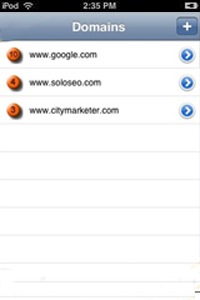
    This was one of the first SEO apps offered back in 2008 and it’s incredibly simple, which isn’t necessarily a bad thing. Just enter the URL for the page you want to check and Domainer provides the PageRank on Google, as well as some basic history. Free.

    2) Poke SEO

    This app does what the previous one does, plus a bit more. Not only does it check PageRank, it also checks backlinks for Google, Bing and AOL. The best feature of this app is the ability to email the reports you dig up. It’s no longer available in the App store because they are busy working a new version, which will be released in the future. Keep an eye out!

    3) iSEO Tools

    iSEO Tools has three great functions. It contains a SERP Analyzer that lets you know what page your keyword ranks on Google. It also has an inbound links analyzer that utilizes the Yahoo Site Explorer service to see how many links are associated with your domain. Last, there is a function that shows a list of directories. This option is fantastic because it allows you to submit a link right from the app! $0.99.

    4) SEO Ranking

    This app allows you to monitor an unlimited number of domains and keywords, and uses a graph SERP analyzer to monitor your current and past rankings on Google. A great on the go tool. $1.99

    5) Analytics App
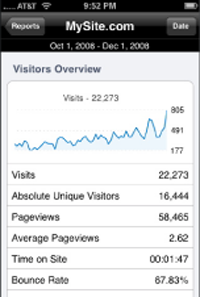
    This isn’t from Google Analytics, but it’s the closest thing you’ll find to it on the iPhone.  It allows you track all your basic stats in Analytics, including visitors, traffic and content. It allows multiple accounts and even has the ability to create event tracking and custom reports. It’s pricier than the rest, but is well worth it. $6.99

  • Top 10 for the Weekend- August 13

    We’re back with another thrilling installment of our bi-monthly series: Top 10 for the Weekend! Keep reading to find out tips and tricks, as well as what’s new in the world of SEO

    Great Apps to Customize Your Facebook Fan Page

    Facebook recently hit a new milestone: 500 million users! With this high volume it is a perfect platform for marketing, and people are already taking advantage of this opportunity. Here is a list of great apps that allow you to customize your fan page to its fullest potential.

    35 of the Best Facebook Fan Pages

    To go along with the above link, here is a fantastic list of fan pages that have taken full advantage of Facebook’s customizable applications. Some examples include pages from the likes of Skittles, Red Bull, and Harley Davidson.

    Forrester to Advertisers: Hold Off on Foursquare

    Forrester Research recently came out with a study that revealed 84% of people polled are not familiar with location-based applications, a la foursquare. This is useful information, but they conclude that businesses should hold off on using these FREE services because of it. This article explains why their conclusion should not follow their results.

    Foursquare Means Businesses: Have you checked-in yet?

    We’ve never been shy in our support for foursquare, and this link is a perfect follow-up to the previous one. The article just lists some more of the many advantages to utilizing this and other location-based applications.

    10 Sources For Better Conversion

    Getting people to your site is only half the battle. Once they’re there, you need to get them do whatever it is you want them to do. In the SEO world, this is known as conversion. This is a list of 10 resources that explain how to get better conversions on your site.

    Local Citation Finder: Must-Have SEO Tool

    From the article: “The tool looks at the businesses ranking for your keyphrase, grabs their phone numbers, and then does a Google.com search (or .ca or .co.uk) for those numbers, collecting and collating all of the mentions/citations that it finds.” In other words, you can get a list of citation sources your competitors use, and mimic them. Nice and easy!

    10 Great Local Search Tools That Don’t Exist Yet

    It’s pretty clear what this article is about, so I won’t bore you with an explanation. I will say that these tools would be incredibly easy to make, and some of these developers need to get on the stick!

    On-Site SEO: How to Optimize Your Blog Posts

    A blog is a great tool for SEO, but simply posting one every week or so won’t be that great of a help. This is a great guide on how to optimize your blog to maximize your exposure on the web.

    Using Bing’s New Webmaster Tools For SEO

    Bing recently released a new version of their Webmaster Tools. Upon being asked by Bing to give feedback on how to improve it, Chris Smith decided to provide this advice via blog post for the world to see.

    Google’s New Local UI Proving Conspiracy Theorists Right

    In our last installment of Top 10 for the Weekend, we discussed some changes Google made to their SERPs and Places listings. It looks like the conspiracy theorists were right. This article explains why.

  • The Bing and Yahoo alliance means the end of Yahoo Local, right?

    As we reported in an earlier post, there are things to consider now that the Bing and Yahoo alliance is coming so near. Starting sometime in August or September, Yahoo’s organic search results will be fully provided by Bing, which will increase their organic search market share from 11% to 27%. Wouldn’t it be great if this meant an end to Yahoo Local, leaving you with only Bing and Google local listings to worry about?

    Sadly, that is not going to happen. Yahoo plans to maintain control of the search experience, and it includes Yahoo Local as a part of that. As Yahoo quotes here, it will be “Providing you with rich results that display the most relevant information from Yahoo!’s rich content properties, as well as other great product, local, entertainment, reference, social and tech sites.”

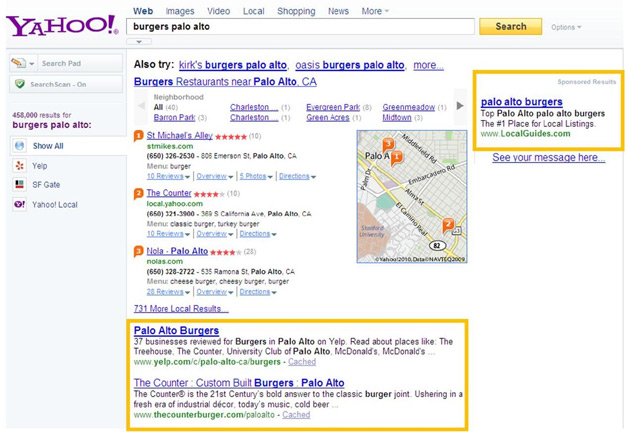
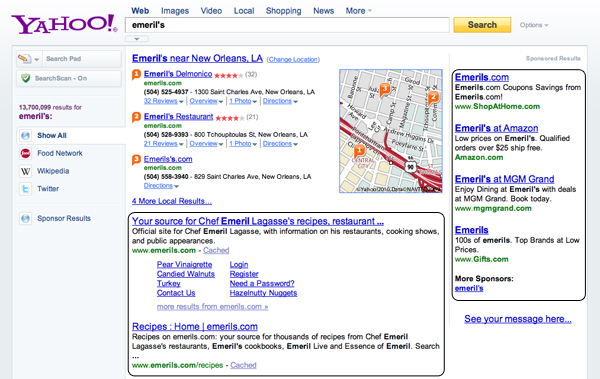
    Look at the picture above and you will see boxes around the organic and paid search results—these will be provided by Bing, the rest will be provided by Yahoo, including local listings.

    If you are a local business owner this might not mean much to you, but if you’re an SEO that cares about local listings you won’t get any of the relief you might have anticipated and will still need to claim your listings on all 3 search engines.

  • Top 10 for the Weekend- July 30

    We’re back with this week’s latest thrilling installment of Top 10 for the Weekend! What do we have in store this week?

    Google Testing New, More Integrated Local Search SERPs

    Looks like Google is busy experimenting with some new layouts to their main SERPs. Blumenthal’s shares the findings of Linda Buquet of Catalyst eMarketing, including such changes as making the Places listings bigger and more like organic results (the only difference being the inclusion of a Map pin) and having the map scroll down the page as you do. Not sure if this will be a permanent change, but what I am sure of is that this will no doubt lower traffic results to individual websites while increasing them to review sites. Not cool, Google.

    Google Takes More Real Estate For Business Name Search

    Ah, Google. Why are they doing this to us? Not only did they potentially make some pretty lame changes to their SERPs, they also started linking to the business’s Places page for these searches as opposed to the actual website. The article lists a few possible reasons they may be making this change, none of which are very appealing.

    Google brings a Facebook rival

    We’ve posted about Google’s latest social networking platform endeavor in the past, but the news was sparse. Here we get another hint at the tactics Google may be using to bring down the Goliath that is Facebook. Recently, they’ve been meeting with big name game developers for Google Me. What this means is anybody’s guess, but I hope it means less lame Farmville updates and decent games for a change!

    Is Google Watching You? New Plugin Will Let You Know!

    Boy, this Top 10 is a little Google heavy this week, eh? Don’t worry, there’s more! Here’s an article about an awesome new browser plugin that lets you see when your personal information is being sent to Google’s servers. Not only that, but it alerts you using a vuvuzela-like alarm.  How great is that?

    Why You Need to Monitor and Measure Your Brand on Social Media

    If you read these lists of ours often, you’d know we’re no strangers to the social media game. Once you make the leap, it’s imperative to keep your presence known. This article gives a couple of great tips to monitoring and measuring your brand to make sure you can use these great utilities to their utmost advantage.

    How to Get Top Search Engine Optimization and Placement Results with Google Caffeine

    In our last edition of Top 10 for the Weekend, we posted an article outlining the differences between Google’s Mayday and Caffeine. Well, here is a handy article on how to make Caffeine work for you to achieve results at the top of the ranks.

    Should I renew my yellow pages ad?

    Here is our most recent blog about whether or not remaining to advertise with Yellow Pages is beneficial to your site from an SEO standpoint. Want to know the answer? Read to find out!

    The Google Sewage Factory, In Action: The Chocomize Story

    A great article on how sites pollute Google’s news section by taking advantage of some specific editorial criteria, and their lack to police these actions. A very interesting read about Google contributing to the pollutants that make the internet a “cesspool,” according to one of their CEOs.

    Google Places Police

    We’re no strangers to the confusing and oft arbitrary guidelines Google seems to enforce on their Places accounts, and we’re not the only ones! This is a fantastic article highlighting the hair-pulling experience that Google can induce for businesses and SEO companies alike.

    8 New Link Types That Exist On The Web

    A hilarious article outlining some of the insane practices that SEO companies and many others use for link building. Check them out and see if you are guilty of any of them. I know I am!

  • Should I renew my yellow pages ad?

    Last week I was asked by one of my client’s about her yellow pages ad which was up for renewal.  Hmmm … my response was half-hearted and I waffled a little.

    Yes, the yellow pages industry is dying, some would argue it’s dead.

    Unused and unwanted.

    But a part of me hesitates at completely dropping out of the book.

    What I would love to say is “keep your ad or an ad because the yellow pages gives you a free backlink in their online product with any paid ad,” but this is not the case.  It is my personal experience in my local market and my observation in other markets that the yellow pages sales people are not offering a free backlink in the online product with the purchase of an ad in print book. One must pay to be in the print book and pay to be included in the online directory too.

    And even if you pay for it, how valuable is that backlink from deep within the yellow pages online directory?  Apparently, not very.  I checked a few different tools for the online directory page where my client would appear if she paid to be included in the online directory, and the page has a 0 (zero) value.

    Also, the backlinks are nofollowed. Wow.  Talk about about a waste of advertisers money and about a wasted opportunity by the teleco.

    So my suggestion to the client was half-hearted … decrease your big expensive display ad for a smaller in-column ad so you’re not totally out of the book just for the few people who are still using the print product.  She looked at some internal data, and came back with feedback saying she has gotten no patients from a yellow pages referral so she was dropping her yellow ages ad.  I have no data to advise her otherwise, and really, it’s probably a sound move.

    In LA too they throw the printed phonebook right away to the trash

    Yellow pages sales people have always offered call tracking, but on a limited basis – only to those clients who were waffling on renewing that giant display ad.  What they could be doing is dropping a call tracking number in the every ad over some benchmark value (say $1,500.00 because that would include some of the more elaborate in-column ads) and adding a tracking website URL into the ad.  Together, these tracking mechanisms would give some real data for advertisers to make this renewal decision.  But I know that the real data is probably more hurtful to the renewal rate than having no data.

    In comparison, at Search Influence (where a few of us grew up in yellow pages a few years ago),  we understand the need for tracking, for constant proof of our value.  We track form data.  We track phone calls from organic traffic and from paid traffic.  We track all kinds of stuff so we can give real ROIs.  We do this all of the time, and at least every month.  Proving our value every month, month after month, definitely keeps us on our toes, and we share the successes with our clients because of that accountability.

    Thanks to Sabrina Tang and lejoe for the great pictures!

  • The Many Faces of Google Maps

    Google Maps… the Local Business Center… Google Places… so many faces, so many problems. While it brings me great happiness once an issue is resolved, when trying to work them out, it seems like it’s never going to end. In the past, I’ve used a puzzle as an analogy for local search. I never really did like puzzles, and if Google Maps was a puzzle it would be a 2,000 piece box full of 1 inch pieces, 50 of which have been eaten by your kitten and thrown about the house by your children.

    So, being that I’ve spent countless hours digging in the sofa cushions for lost pieces of the puzzle, so to speak, and still haven’t gotten them all laid out on the table, I can imagine small business owners often have the same issues.

    Here’s a rundown of some of our latest challenges of Google Maps:

    1. Disappearing Citations

    Disappearing citations = drop in rankings. While citations aren’t essential to beating our your competitors in some markets, in others it can make or break you. When a client came to us for help with Maps rankings on particular search phrases, he was ranking for a number of “money phrases,” despite the listing breaking numerous quality guidelines. We rapidly cleaned everything up on our quest to come out in the end with a clean, strong listing. Then, numerous citations were disassociated with the listing – what! We followed the rules and the listing was ultimately penalized.

    2. The Importance of a Clean Listing – your listing as well as your competitors’

    It is true, the success of your listing can be dependant upon the cooperation of your competitors. In particularly competitive markets, we see a lot of keyword stuffing in titles and all throughout the listing. We’ve learned that the more muddled up the market gets, the less Google trusts the information businesses are including in their listings, and in some cases, penalizes the whole market by removing the map results from the SERPs.

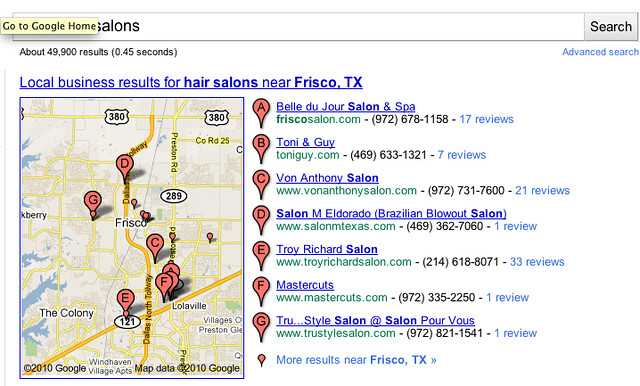
    Let’s use the market of hair salons, Frisco, TX:

    About a month ago, this is the map that was being pulled by the search “Frisco hair salons”

    and now, about a month later:

    As you can see, there’s been quite the mix up of whose listings Google is favoring.  Your best bet is to stick with correct information and avoid anything spammy in order to maintain a strong listing.

    3. Duplicate Listings

    While the recommended strategies have changed over time, one thing is clear: duplicates are bad!  It’s likely that when you search your business’s phone number, you see more than one listing –  they may or may not have correct information, and in either case, you should address the extra listings in order to reinforce your own. For this issue, Google has handed us a couple of pieces to the puzzle, and let us on to the best way to deal with it. First, only claim your main listing. For all others, you should “report a problem” and tell Google that “This Place has another listing.” While it won’t be instant, this should help clean up your market’s cluster of listings AND help your customers find you and your real information more easily.

    So, whether you are a single location of a business that’s moved a few times, or Matt Dillard Hair Salons, Frisco, TX, Google Places could be your best friend, or it could make you crazy trying to put together all the pieces of the puzzle.

    Thanks to plasticrevolver for the great kitty image!

  • SEO Optimization Tips for the Yahoo-Bing Merge

    While Google has reigned supreme when it comes to optimization, now may be the time to reassess your Bing strategy. As we mentioned in an earlier post, Yahoo anticipates that their organic search results will be fully powered by Microsoft sometime in August or September. However, Yahoo has already begun testing Microsoft’s organic and paid listings. Up to 25% of their current organic search results come from Bing, while up to 3.5% of paid listings can be from their AdCenter.

    While the results may be coming from Microsoft, Yahoo assures that they will retain their familiar format. They offer up the following image, where the boxed areas are those that come from Microsoft:

    They also offer up the following tips for SEO:

    • Compare your organic search rankings on Yahoo! Search and Bing for the keywords that drive your business, to help determine any potential impact to your traffic and sales
    • Decide if you’d like to modify your paid search campaigns to compensate for any changes in organic referrals that you anticipate
    • Review the Bing webmaster tools and optimize your website for the Bing crawler, as Bing results will be displayed for approximately 30%* of overall search query market share after this change

    These tips- along with many more- can be found here. Not much work will have to come from you, but it’s best to familiarize yourself with the changes now in order to be better prepared.

  • Facebook Local Search: Facebook Declares War on Google’s Empire

    Is Facebook the next evolution of Local Search?

    We all knew it was a matter of time before Facebook started expanding into web search and they’ve finally done it by unveiling their own Facebook local search option: Open Graph search engine. What is Open Graph, you might ask, here’s what Facebook reps are saying, according to an allfacebook.com story:

    “all Open Graph enabled web pages will show up in search when a user likes them”

    Why is this important? Imagine a more personalized web experience where community feedback drives interaction and search position. You can search for a cosmetic surgeon or dentist and immediately be able to contact his patients for real feedback. This is huge! No longer will you type in “Atlanta dentist” and dozens of sleek websites – you’ll be able to find information on the dentist, his office location, and talk with his clients. As Facebook continues to develop this open graph search, you will see Facebook profiles and page results as well as websites being ranked by user feedback from REAL people.

    If this catches on, not only will the face of SEO change, how people think about searching will change as well. It’s like Facebook is developing Deathstars and photon rifles, while Google is reloading the Spaniard cannons.

    Do I think this is the end of Google local search? No, but I do think that Facebook is moving in the right direction. Users having control over results and ranking seems like a no-brain. My only concern is potential spammers hindering the evolution of search.

  • Top 5 Chrome Plugins for Search Marketing

    As a Search Marketing professional I’m always looking for new browser tools to help me with optimization. Over the last few months, I’ve become a huge fan of Google Chrome. It’s fast, light-weight, and  has tons of user generated extensions for SEO, PPC, and SMO. Here is a list of the top 5 Chrome plugins any Internet marketer should have.

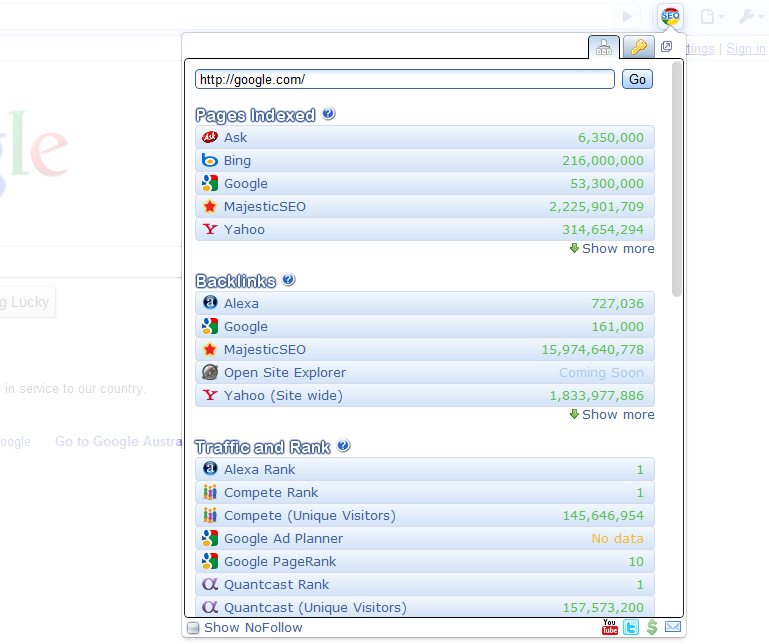
    1) Chrome SEO – Probably one of the best free SEO add-ons I’ve used. It provides backlink info, as well as, keyword research tool, domain age, and traffic and rank. It has everything. Unlike some other SEO plugins, I never find myself disabling it because it’s chugging resources or constantly crashing.

    Chrome SEO Screenshot
    Chrome SEO Screenshot

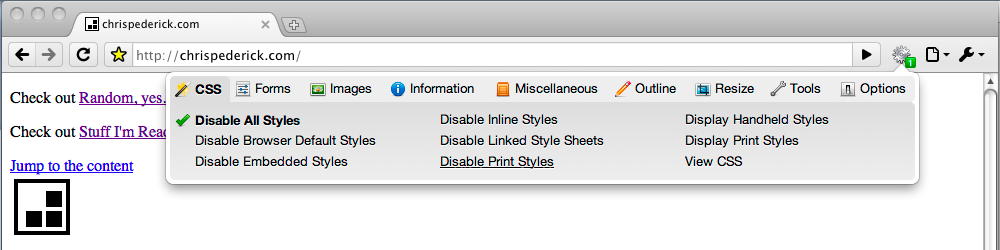
    2) Web Developer – A port of the Firefox Web Developer plugin, this extension has help me several times with identifying useless and broken CSS, as well as,  large graphics and elements on the page that were slowing it down.

    Web Developer
    Web Developer

    3) Google Analytics Opt-out Add-onNothing is more important to me than accurate site data and this plugin stops the JavaScript (ga.js) from sending information back to Google Analytics
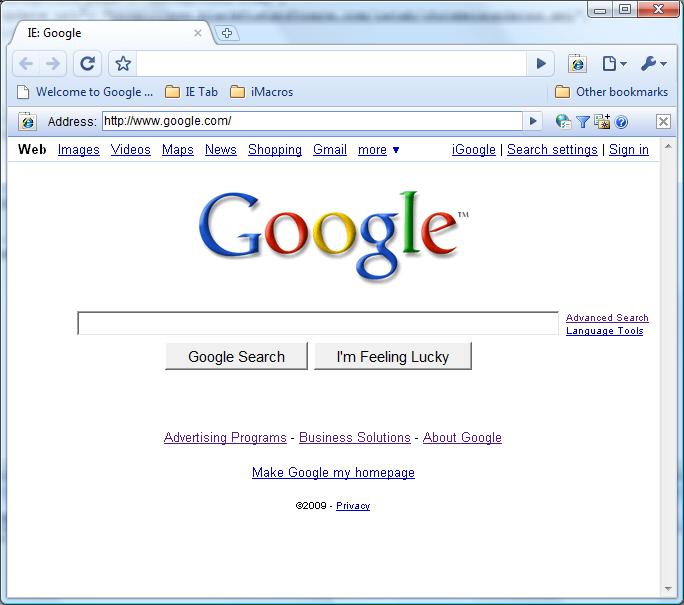
    4) IE TabWant to see what your site looks like in Internet Explorer but you don’t want to install? Download IE Tab.  This extension has helped me identify elements that work in Chrome and Firefox but do not work in IE.

    IE Tab
    IE Tab
    Google Similar Pages
    Google Similar Pages

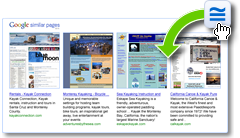
    5) Google Similar Pages – Want to know who your competition is? Google Similar Pages provides urls and visual information on sites that are similar to the page you’re currently browsing based on keyword and traffic information.

    Honorable Mentions:
    Google Voice – I’m always losing or turning off my phone, so with Google Voice I never miss a voicemail and can easily return the call at my leisure.  Works great when you are busy and affording those pesky calls from Mom.


    Gmail Mail Checker Plus – I hate e-mail programs and constantly logging in and out of different email accounts to check my e-mail. With Gmail Mail Checker Plus I can have access to all of my email with a simple click on the toolbar.


    Panic Button – Have you ever been on sites that aren’t exactly work friendly? The Panic Button extension is for you. With one click you can hide what you were surfing and replace it with your start page.

  • 2010 Local Search Ranking Factors

    Putting Together the Pieces of the Local Search Puzzle

    Search Influence is honored to have once again been invited by David Mihm to take part in his annual study on Local Search Ranking Factors. The best part of this collaboration is that the questions have remained fairly constant from year to year in order to study the change from year to year that SEOs have observed in Google’s local algorithm.

    2010 Local Search Factors Released

    The 2010 Local Search Ranking Factors results, which were published early this week, feature input “from 34 prominent bloggers and practitioners.” While my personal local search experience began just a short 6 months ago, it’s been a whirlwind of claiming, verifying, re-verifying, suspending, categorizing, picture-adding, and detail-tweeking. Working with local listings has been an interesting and patience-testing experience, and reading the comments of fellow SEOs has certainly helped calm my anxiety. Luckily, everyone seems to have problems! I also believe it was beneficial after that period of time to sit down and analyze which aspects of our optimization efforts had been working and which may have turned into a waste of time.

    The 2010 Top 5 Local Search Ranking Factors:

    1. General Importance of Claiming Place Page / Local Listing
    2. Business Address in City of Search
    3. Associating Place Page with Proper Categories
    4. Volume of Citations from Major Data Providers + IYP Portals
    5. General Importance of Off-Page / Off-Listing Criteria

    My biggest take-away from the report confirms a thought I’ve had for a few months now: there is no end-all be-all trick to increasing rankings. The top two ranking factors: claiming your listing and having a business address in the city in which you desire to rank, each has its respective caveats. While claiming your listing is of high importance (4.40 according to the study), I’ve often seen un-claimed listings trump claimed ones.

    Putting Together the Pieces of the Local Search Puzzle

    In regards to the number two ranking factor, if you’ve been in a business location for 20, or even 2 years, outside the city limits and don’t have a business address in the city for which you desire to rank, you obviously wouldn’t change that just for your listing… or maybe you would?

    That said, I wouldn’t assume one distinct factor would influence rankings, because that’s just not how these search algorithms work, but I felt it was worth it to point out for those of you who don’t deal with search rankings on a daily basis. So, when you are working on your listing, follow the rules, all of them, and work with as many elements available. Just remember – when testing out a new feature – keep an eye on your listing, or better yet, check out the blog of anyone who participated in this study and you’ll find some tips on whether or not the feature is ready for mainstream use.

    Thanks to myklroventine for the puzzle photo!