In a June guest blog for B-Corp certified digital marketing agency Seer Interactive, Search Influence Co-Founder and CEO Will Scott breaks down a fundamental, yet often overlooked, higher education SEO tactic: schema markup.
Schema markup for higher education websites is a form of microdata added to a website’s HTML to help search engines better understand the content. It uses a semantic vocabulary (i.e., code) known as Schema.org to annotate various webpage elements with metadata. By crawling your schema, search engines can get a better sense of who you are and surface your site in the SERPs in response to relevant search queries.
Schema markup is the back-end roadmap for your higher ed website. It guides search engines, like Google, Bing, and Yahoo, through the campus of your content via structured data that’s easy to understand and follow. This helps streamline your site’s crawlability, boost your chances for rich snippets, and improve your visibility in the search engine results pages (SERPs).
Key Takeaways From “Higher Education Schema – How Your School Can Win Google”
Schema is much beyond just simple code. In “Higher Education Schema – How Your School Can Win Google,” Will goes deep into this core technical SEO concept, offering insights on:
The Fundamentals of Schema Markup: Understand the basics and why it’s essential for higher education websites.
Step-by-Step Implementation: Detailed instructions (with a template) on how to apply schema markup using Schema.org, tailored specifically for educational institutions.
Practical Examples: Real-world applications and examples to illustrate how schema markup can be effectively used.
Impact Analysis: Insights on how schema markup can grow your institution’s online presence and drive more prospective students to your enrollment funnel.
Dive Deeper Into Higher Education Schema
2024 research from Schema App found that 1 in 5 digital marketers have trouble showing the value of their schema markup. If you’re unsure whether your school’s schema is truly search engine fluent, do your part in helping Google to translate it.
A shifting higher education playing field is causing universities to reevaluate their results and the costs associated with them.
Despite increased competition and an evolving modern learner, higher education marketing departments can still reach their enrollment goals by tracking the right metrics to inform future strategies.
New Search Influence and UPCEA research reveals a blind spot in higher education marketing tracking: cost per inquiry and cost per enrollment.
Cost per inquiry and cost per enrollment are compasses that help you determine your marketing budget’s efficiency and effectiveness. By tracking these key metrics, you can see what’s working and what’s not as part of the bigger picture.
Marketers who keep a pulse on their campaigns via in-depth tracking are more satisfied with their overall marketing performance.
Changing demographics, limited resources, and increased competition in higher education are making university leaders rethink their marketing strategies.
Colleges and universities need to pinpoint where to invest their resources for the best return — and where to trim the fat.
This starts with tracking the right higher education marketing metrics.
While overall marketing metrics offer valuable insights, the ability to analyze the data at the program level will ultimately determine which institutions meet enrollment goals and which fall behind.
In “What Gets Measured Gets Managed,” our 2024 higher education marketing benchmark research conducted in partnership with UPCEA, we analyzed whether professional, continuing, and online (PCO) units are tracking two key metrics that could inform critical outcomes: cost per inquiry (CPI) and cost per enrollment.
See the state of tracking in higher education marketing and how your institution compares to others in the industry.
Key Findings of the UPCEA Research Study
The average annual digital ad spend on PCO units is nearly $900k
The modern learner has gone digital, and the higher education marketing sector rightfully followed suit.
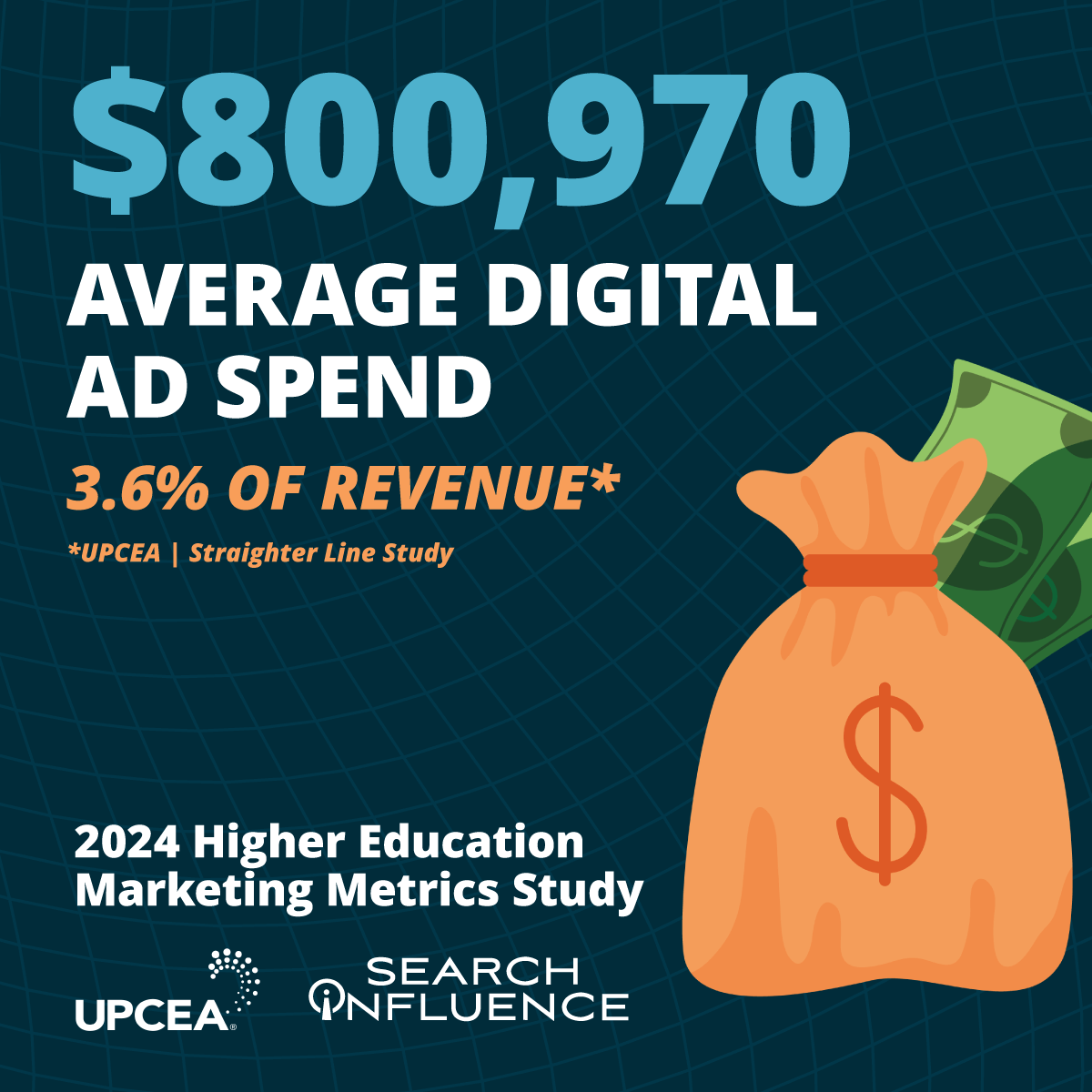
Professional and online education units spend an average of $800,970 each year on digital advertising spend, including paid search, social advertising campaigns, and connected TV (CTV) streaming ads.
As the new learner searches for higher education programs online, digital advertisers must meet inquirers where they are in their enrollment journey.
This involves continuous learning, adapting, testing, and re-testing — a process that starts with tracking the right campaign data, like cost per inquiry.
Less than half of higher ed marketers track cost per inquiry
Cost per inquiry is the most important metric to track to reduce the expenses of driving your prospects to take action. But if you aren’t tracking this key metric, the good news is you’re not alone.
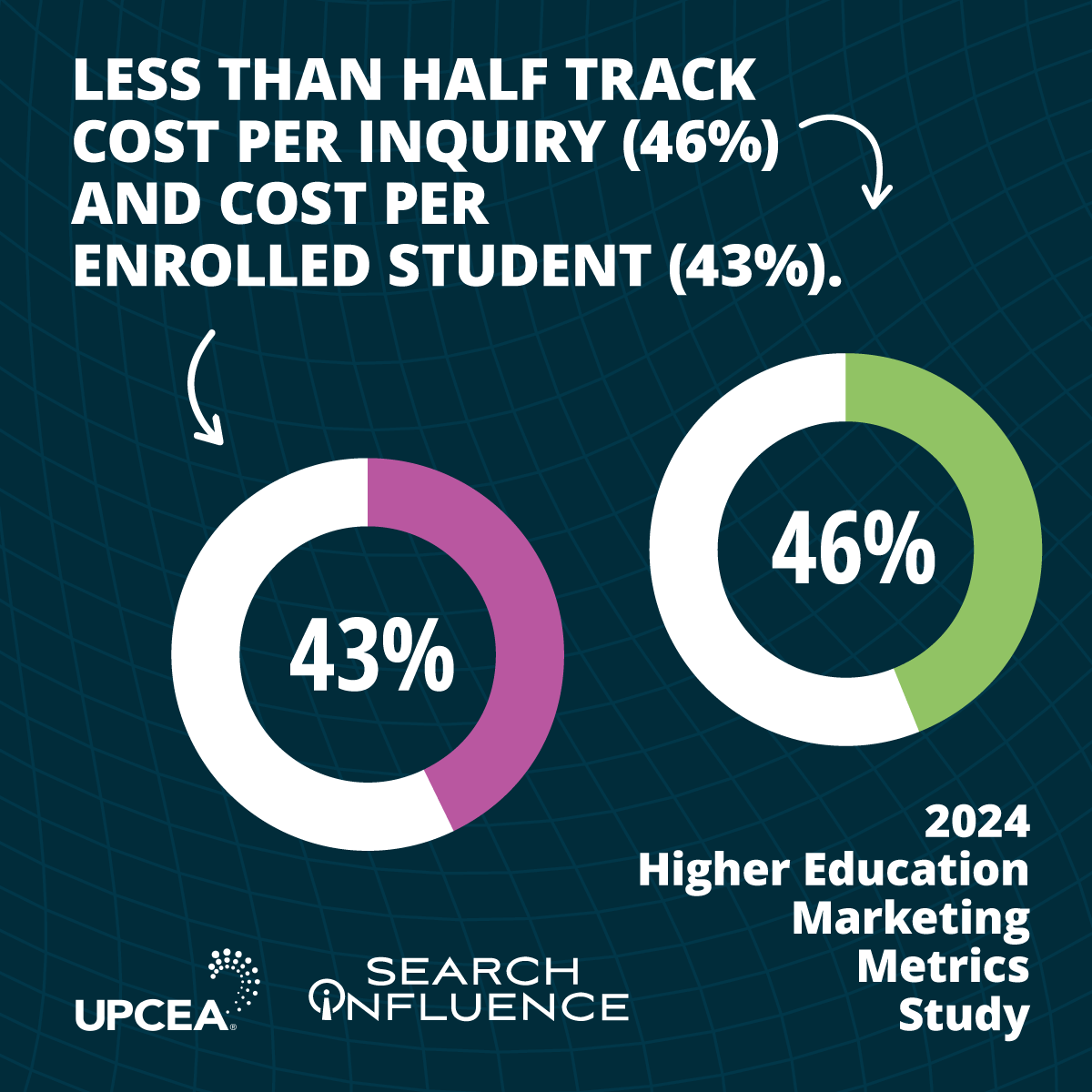
Today, most higher education marketers have a fairly strong grasp of the source of their inquiries — not necessarily the costs associated with them. Nearly three-quarters (73%) of marketing units track inquiry sources for their PCO programs, while less than half track cost per inquiry (46%) or cost per enrolled student (43%).
And, for nearly one out of five research survey respondents (17%), metric tracking isn’t even on their radar.
The average cost per inquiry (CPI benchmark) for professional and online education is $140.
Of the 46% of PCO units that track cost per inquiry, the average CPI for the 2022-2023 fiscal year was $140, with a median of $106. Roughly one-third (32%) of PCO units had a CPI between $50 and $100, 15% between $101 and $150, and 15% over $200.
The expenses associated with this CPI benchmark for marketing varied but most often consisted of:
Media spend (88%)
All marketing expenses, excluding salaries (46%) and agency management fees (39%)
Result satisfaction is fairly low, with 38% of survey respondents reporting they’re content with their school’s CPI, and 27% not sure.
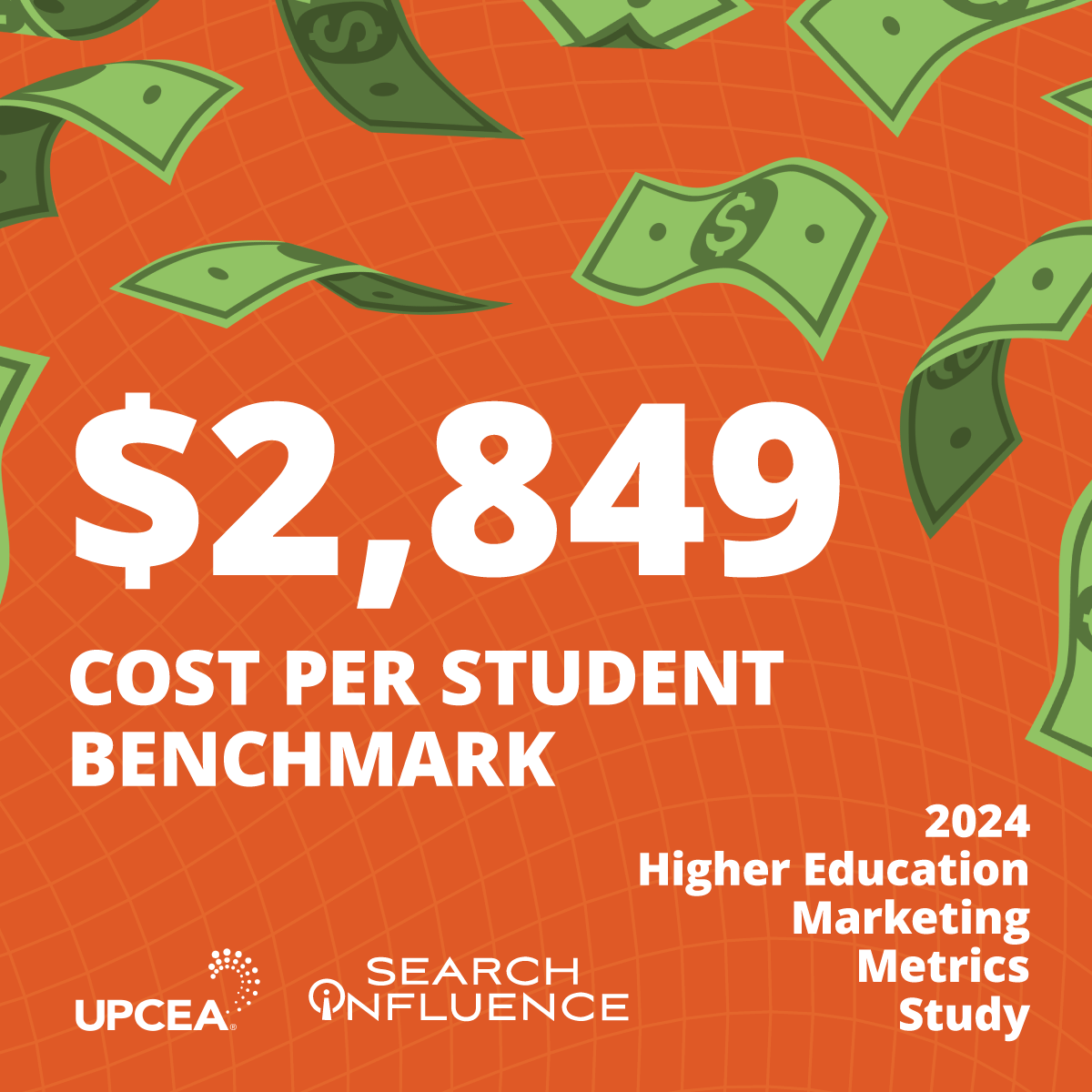
The average professional and online education cost per enrolled student is $2,849.
Of the 43% of PCO units that track cost per enrolled student (43%), the average cost per enrolled student for the 2022-2023 fiscal year was $2,849, with a median of $1,173. 27% of PCO units had a cost per enrolled student under $500, and an additional 27% had a cost per enrolled student of over $3,000.
Email marketing is most often managed in-house, while digital advertising is most often outsourced
Nearly three-quarters (73%) of higher ed email marketing and half of search engine optimization (44%) efforts are entirely managed in-house. However, digital advertising remains an item ripe for outsourcing, with half of the survey respondents exclusively outsourcing their Google paid search campaigns to experienced agencies.
Whether it’s due to budget constraints or simply just a preference to keep things internal, most PCO units mix and match what is outsourced and what is managed in-house. However, it’s important to note that managing any marketing campaigns in-house requires universities to have the time, skills, and resources to monitor campaigns and stay up to date on trends.
If you’re unsure whether partnering with an agency is the best option for your university, start a conversation with us today.
Marketers who track their campaigns are more happy with performance
Tracking campaign performance has a direct link to overall marketing satisfaction.
According to our research findings, those who are satisfied with their back-end campaign tracking capabilities are more likely to be satisfied with how those campaigns perform in the wild.
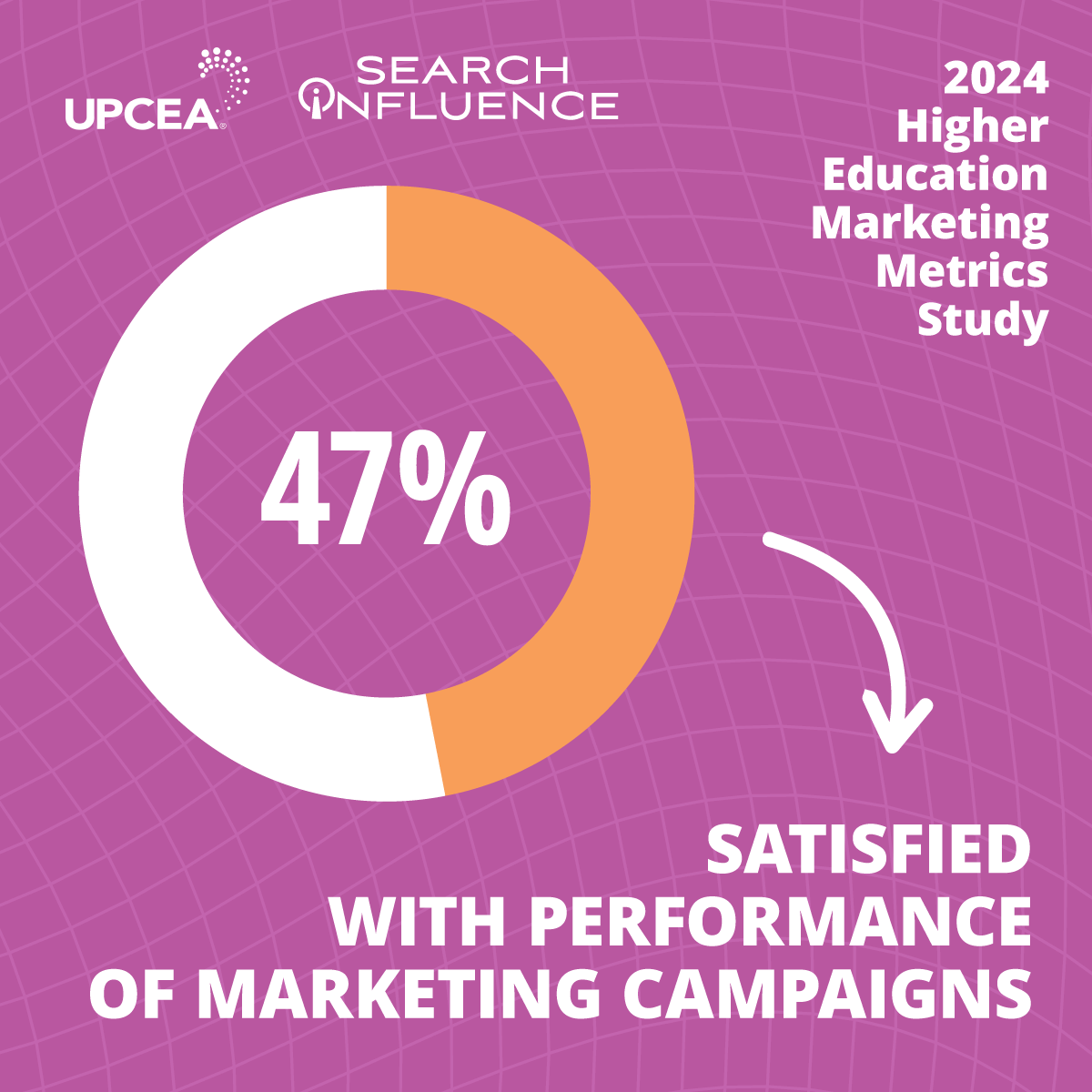
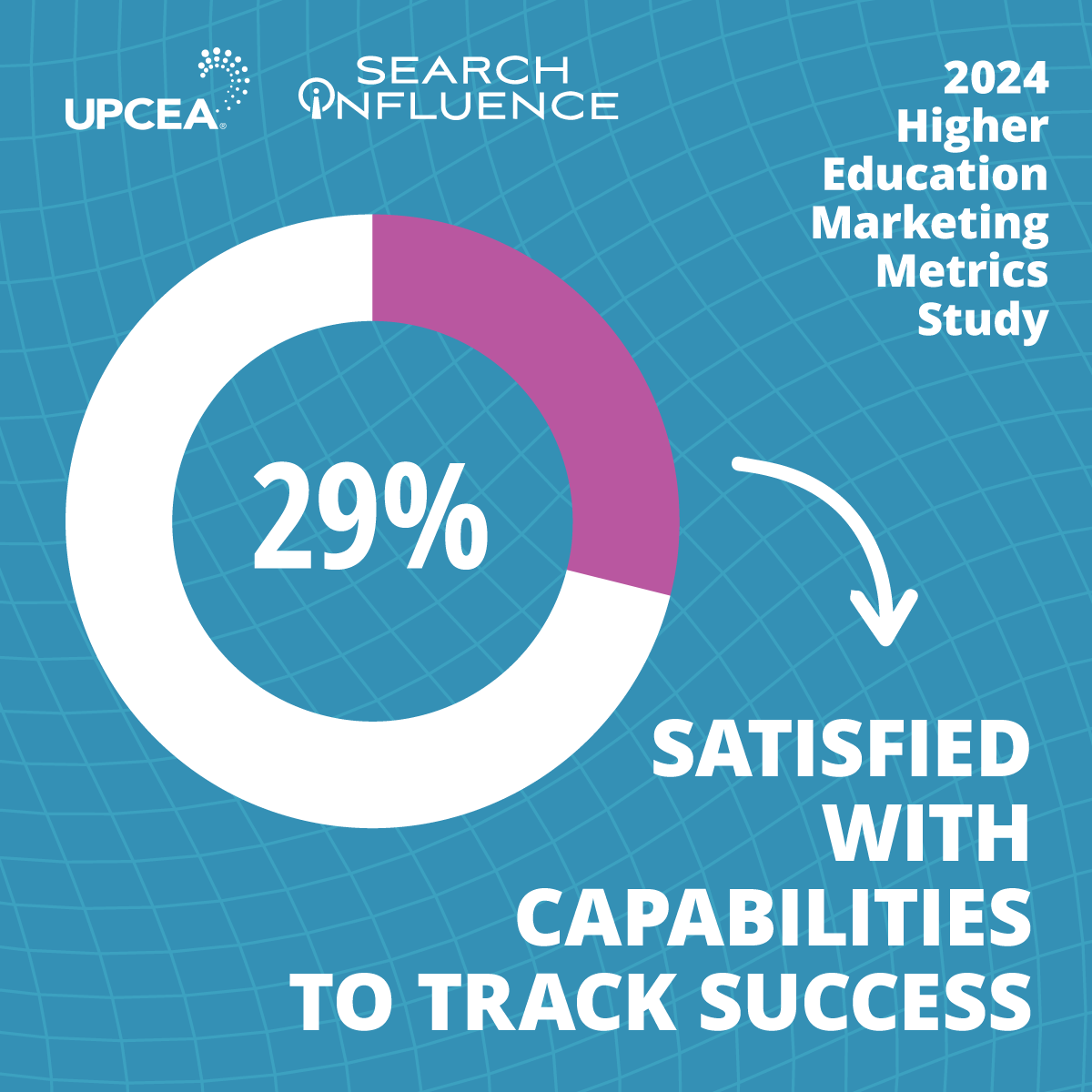
Despite this, many marketers lack the know-how, resources, and time to keep a steady pulse on their campaigns, leaving key metrics to fall to the wayside — entirely overlooked. Fewer than half (46%) of survey respondents report satisfaction with their campaign’s performance, and only 29% are satisfied with their ability to track such success.
This blind spot then creates a grueling cycle of campaign launch → result dissatisfaction → repeat, with no guide for improving results.
How Higher Education Marketing Benchmarks Drive Marketing Outcomes
There’s an old saying by British mathematician Lord Kelvin that goes, “To measure is to know.”
When thought of strategically, digital advertising is data for dollars. Within a single campaign, you can gain insights into its effectiveness, ranging from lead quality to cost per inquiry, without hours of tedious pen-to-paper calculations. And, with industry-wide higher education marketing benchmarks, you can compare how you’re doing with competitors and determine ways to refine your budget and outcomes.
Going beyond basic metrics like cost-per-click and leveraging more granular metrics like cost per inquiry helps you:
Have more confidence in your inquiry quality and quantity
Know which campaigns are performing or underperforming, and which optimizations to make to improve results
Assess how adjustments like budget and targeting changes affect campaign results
Establish a starting point to dive deeper into metrics like conversion rates as prospective students move through the enrollment funnel
Armed with a well-rounded understanding of each inquiry, you can drive home campaigns that resonate without wasted ad spend.
How to utilize cost per inquiry
Cost per inquiry isn’t a metric exclusive to higher education institutions. Healthcare, hospitality, and B2B marketers have long relied on this measurement to assess the state of their incoming inquiries.
Why? Because CPI is a direct measurement of budget efficiency and effectiveness.
Your institution’s CPI is calculated by dividing how much you’ve spent on marketing and advertising by the number of inquiries received. In higher education, inquiries commonly originate from emails and college websites, specifically:
Request for information forms
Brochure request forms
Request a visit forms
Utilizing a CPI metric gives your marketing department valuable insights into your advertisements’ impact. It helps you examine your performance and provides guidance on budgeting and refining your marketing strategy.
But, just like any marketing metric, CPI works best when it’s evaluated as part of the bigger picture. Building your data stack with additional key metrics, like cost per enrolled student, helps you visualize the cost of the entire conversion process, from the initial inquiry to final enrollment.
How to utilize cost per enrolled student
Cost per inquiry is a leading indicator of success.
Cost per enrollment is the most definitive metric you can review to see how much you are spending to get a new student.
This metric encompasses the total costs invested in securing a student’s enrollment, factoring in expenses from the initial marketing efforts and campaign launch all the way to the student’s matriculation. Most often, these include:
Media spend
Agency management fees
University marketing team salaries
All other marketing undertakings
When analyzing cost per enrollment over time, or comparatively within your programs, you can get a sense of where you need to make the biggest changes – either budget, resource allocation, or overall strategy.
Leveraging cost per inquiry and cost per enrollment in tandem can lead you down the right path to campaign effectiveness. Ideally, by adopting these metrics into your tracking tool kit, your higher education institution can prioritize the digital marketing campaigns that yield the most inquiries at the lowest costs.
Not sure how to calculate your school’s cost per inquiry or cost per enrollment? See our new CPI Calculator or download our free worksheet for help getting started.
Gain Insights Into Your Higher Ed Marketing Performance With Search Influence
The bottom line: Tracking cost per inquiry and cost per enrollment is an untapped opportunity for many schools looking to maximize every marketing dollar invested. These often neglected, yet incredibly insightful, metrics help you understand what’s working, what isn’t, and how to allocate your budget accordingly for the best results.
We hope that, with this new industry-wide benchmark, your college or university will better judge the performance of your professional and online program marketing.
If you’re unsatisfied with your digital advertising performance, tracking these key performance metrics can get you past your blind spot. After all, you can’t improve what you don’t measure, and what gets measured gets managed.
SEO is critical for higher education institutions, yet only 51% have an established SEO strategy.
If your institution isn’t investing in SEO, you’re missing opportunities to reach prospective students and keep up with your competition.
Understanding and communicating the long-term benefits of SEO to your higher-ups can help your institution make the case for more resources.
Pitching the value of SEO to your boss doesn’t have to be a massive undertaking. All you need is a little bit of industry insight, institutional data, and the right angle.
For today’s tech-savvy students, the quest for higher education starts with a simple Google search.
Prospective students are looking for your institution online, but will they find you? Search engine optimization, or SEO, is a term often tossed around in marketing meetings, and it’s never been more relevant.
So, how do you move it from a buzzword to a budgeted line item?
And, more importantly, how do you get your decision-makers to hop on board?
In this blog post, we’ll show you how to convince your boss to invest in SEO and make bigger waves in the search engines with a proper strategy.
Benefits of SEO in Higher Education Marketing
You’ve likely heard that a quality SEO strategy leads to better search performance.
Increased Visibility: A well-optimized website can dramatically increase your institution’s visibility in the search engines. This makes it easier for prospective students and their families to find you while searching for educational opportunities.
Higher Quality Traffic: Effective SEO efforts attract users actively seeking information related to higher education, thereby improving the quality of organic traffic to your website. These high-intent visitors are more likely to take desired actions, such as applying or requesting more information.
Better User Experience: SEO is not just about pleasing search engines; it’s also about providing a good user experience. A well-optimized website is generally more user-friendly. This positively impacts metrics like time spent on the site, bounce rate, and conversion rate, which in turn can boost your SEO rankings.
Competitive Advantage: A strong SEO strategy can give you a crucial edge over competitors. If your institution ranks higher in search results than other schools, students are more likely to visit your site first, giving you the first shot at making an impression.
Analytics and Insights: SEO tools provide valuable data on visitor behavior, popular content, and more. This data can be used to make informed decisions about your marketing strategy, academic programs, and even campus facilities.
Improved ROI: SEO allows you to reach the right audience at a lower cost by focusing on target keywords most relevant to your institution and its programs. This offers a better return on investment (ROI) than other marketing channels.
Despite all the benefits, SEO in higher education lags. As we found in our Higher Education SEO Research Study conducted with UPCEA, 51% of universities don’t have a strategic SEO plan.This means over half of participating universities miss out on opportunities to grow their awareness, analytics, and applications.
Luckily, it’s not too late to make the financial case for SEO investment and start climbing the search engine results.
But, if you keep pushing off investing in SEO, you just might pay later — in losses.
How to Convince Your Boss to Invest in SEO
While the merits of SEO are evident to those immersed in the digital realm, making them resonate with leadership is a different ballgame.
Approaching the conversation with a combination of data, foresight, and understanding can be the key to unlocking the coveted resource you need: SEO buy-in from your boss.
Follow this blueprint to advocate for SEO services in your marketing budget.
Build a Strong Case
Decision-makers want facts before dishing out dollars.
Presenting an audit or analysis of your institution’s current website and online marketing strategy can highlight the areas where you’re falling short.
You can tap tools like Sitebulb, Screaming Frog, Semrush, and Ahrefs for handy website analysis insights. But if you’d prefer to pass the baton to experts, you also could lean on an experienced SEO agency to conduct a professional-grade audit for you.
Maybe you’re missing meta descriptions. Or you’re dealing with poor site speed and insufficient keyword research.
Your task at hand is to show how SEO bridges these gaps.
Leverage Competitor Analysis
You may not invest in SEO. But your competition does.
It’s one thing to understand the benefits of SEO. It’s another to see competitors already capitalizing on them.
Creating a competitive analysis can be a strong motivator, especially if those competitors are outranking your institution in organic search results.
Doing keyword searches of certain degrees or programs is one easy way to get started on your competitive analysis. Take note of who ranks in the top positions, compared to where you rank, and you have a baseline of where you currently stand — and where you need to go.
Demonstrate to your higher-ups what SEO is doing for your rivals, and you increase your chances of seeing what it can do for you.
Offer Scalable Solutions
Don’t bite off more than you can chew. Present a phased SEO strategy that starts small and expands as you show results.
A scalable approach ensures that initiatives will mature, evolve, and provide value over time.
Your decision-makers are more likely to approve budgets if they see this sense of scalability.
Scalability is sustainability. The SEO strategies that can adapt and grow are the ones that endure.
Use Real-World Examples
For the higher-ups, seeing is believing.
Don’t just talk about what SEO can do for your university. Show its potential, armed with solid proof.
Bring out higher education case studies and results from other institutions who’ve invested in SEO. Take, for example, New Orleans-based university Tulane SoPA, which saw a 569% increase in keyword ranking in the top 1-3 spots on Google — with help from frequent blogging.
These real-world SEO examples can make the concept more relatable, compelling, and actionable.
Connect SEO to Broader Initiatives
SEO isn’t an isolated tool; it’s a cog in the larger machinery of a higher ed digital marketing strategy.
It works best when used in tandem with paid search marketing, like Google ads or other well-performing marketing efforts. Therefore, it fits — not trumps — your institution’s broader marketing and outreach initiatives.
This can make it easier to get buy-in if decision-makers see SEO as a component of a larger strategy rather than a stand-alone effort.
Break down the big-picture, complementary value of SEO, and you may just seal the deal.
Common Objections From Decision Makers
Every proposal faces scrutiny, and SEO is no exception. It’s a natural part of the advocacy process.
However, preparing for and addressing these objections head-on can turn potential setbacks into stepping stones.
Prime yourself to deal with these common objections before setting up the proposal:
Objection: SEO is expensive! Think of the initial setup, the ongoing monitoring, and the potential need for hiring an external SEO company.
Counter-Argument: While SEO is an investment, the effects and impact on our website traffic are long-term, versus paid advertising, where once we stop paying, the traffic stops coming.
Objection: SEO typically doesn’t provide immediate results, so what’s the point?
Counter-Argument: SEO is a long-term strategy that requires time to yield results, but once it does, the benefits endure. A well-optimized website can maintain high rankings for a long time, ensuring a consistent inflow of targeted traffic.
Objection: SEO doesn’t align with our institution’s core goals and objectives.
Counter-Argument: Improved online visibility and targeted traffic can directly impact key performance indicators like student recruitment, donor contributions, and brand reputation — a goal any institution wants to reach.
Objection: We’re already ranking pretty well without investing in SEO.
Counter-Argument: There’s no way all of our web pages rank #1, or even on the first page, of the organic search results. Plus, there’s always the opportunity to increase our rankings for keywords that our competitors currently rank for.
The Consequences of Neglecting SEO
Ahrefs data shows that 90.63% of webpages receive no organic search traffic from Google.
Why?
They don’t prioritize SEO. Or, at least, they don’t prioritize it the right way.
If your institution turns a blind eye to all that SEO has to offer, you risk:
Loss of Visibility: With numerous higher education institutions vying for the attention of prospective students and parents, failing to invest in SEO means your institution may not show up in search engine results. This results in lost opportunities to drive students to your website.
Decreased Enrollment Rates: Students nowadays often begin their college or university search online. If your institution isn’t visible during these crucial moments, you’re missing out on a large number of potential applicants, affecting your enrollment rates.
Increased Marketing Costs: Without a solid SEO strategy, your school may rely more heavily on paid advertising channels, which can be significantly more expensive in the long term. In contrast, organic search traffic generated through SEO is essentially free.
Losing Ground to Competitors: Other institutions that invest in SEO will take the top-ranking spots in search results, garnering more attention and credibility. This competitive advantage can result in a cycle where they continue to attract more students, donors, and faculty, widening the gap between you and them.
Damaged Reputation: A poorly optimized website that doesn’t rank well may be perceived as less reputable or authoritative. It’s a psychological factor — many people equate high search engine ranking with credibility.
Missed Opportunity for Data-Driven Decisions: SEO tools like Google Analytics provide valuable data that can help your higher ed institution understand what prospective students are looking for. Without this insight, you won’t be able to make more informed decisions on everything from course offerings to campus facilities.
Be sure to drill these risks into the minds of your decision-makers. No one likes consequences or the act of underperforming, and these looming threats can help accelerate their decision.
Higher Ed SEO Leads to Greater ROI
UPCEA Chief Research Officer Jim Fong summed it up perfectly in our Higher Ed SEO Research Study webinar: “SEO is not something institutions can kick the can down the road on. It’s going to become increasingly important, especially as the number of programs increases and the number of potential students stays the same or even decreases.”
As SEO industry veterans, Search Influence has the skills, expertise, and bandwidth to take on all of your SEO initiatives. Convince your higher-ups to invest in SEO, and we’ll take the heavy lifting off your plate with our expert SEO services.
Ready to get started with SEO? Contact us today to learn about our SEO Roadmap and see how we’ll put our higher education marketing experience to work for you.
Research shows that 93% of Americans think they are better drivers than average, 90% of teachers think they are more skilled than their peers, and this overestimation is pervasive across many skills — including logic tests.
For the typical higher education institution, effective marketing strategies are like that.
Mathematically speaking, it’s not possible for a majority to be “above average.”
We analyzed the top 10 results in Google for “Higher Education Marketing Strategies” and extracted some really useful learnings. First, I’ll share the most commonly cited strategies, and then give you a skimmable summary of each article.
Top 10 Higher Education Marketing Strategies
These strategies are the most frequently cited in the following articles, in order of prominence.
SEO (Search Engine Optimization): Emphasized across multiple articles. Ensuring high visibility on search engines is critical for Higher Education SEO.
Social Media Marketing: Highlighted in almost all articles for engaging authentically on each social media platform preferred by younger generations.
Email Marketing: A recurring theme emphasizing personalization, automation, and AI-powered programs.
Video Content: Both short-form and long-form videos, including live streaming and platforms like TikTok and YouTube, are great ways to educate prospective students.
PPC (Pay-Per-Click) and Digital Advertising: Discussed in multiple articles for targeted advertising on platforms like Facebook Ads and Google Ads.
Content Marketing: The importance of creating engaging and informative content, such as blogs, podcasts, and videos.
Branding: Consistent branding across all marketing channels, including a recognizable voice and image.
Chatbots and Conversational Marketing: Highlighted in several articles for real-time, one-to-one connections and instant answers.
Data-Driven Strategies: Using data to inform marketing decisions, track KPIs, and understand the audience.
Digital Marketing and Marketing Strategy Opportunities
What we learned in the UPCEA SEO research study was that there are some big gaps in the university marketing strategy and the typical higher education website for attracting prospective students.
When we got deeper into the data, we saw that the higher education industry is overly reliant on certain digital marketing channels. A good marketing campaign addresses the full funnel. To attract students, you must increase search engine visibility, maintain a strong social media presence, and ensure you’re doing all you can to target prospective students.
So, with all the great tactics and technologies to attract prospective students (virtual campus tours, student ambassadors, and taking advantage of digital technology to highlight student activities), one has to wonder why other higher ed institutions seem to be attracting more new students.
As I’m sure you’re aware, Google and the other search engines know everything, right? So, I thought, why not let Google guide me? I wanted to see how other higher ed marketers were thinking about the strategy to build brand awareness and get in front of prospective students.
I think it’s important to take content created by marketers talking about a marketing strategy with a grain of salt. We can, however, learn a lot when we analyze the frequency with which these articles cite specific tactics, platforms, or strategies to get in front of prospective students for educational institutions.
My perspective: It’s surprising to see this continued focus on the pandemic. From what we’ve seen, things are different — the pandemic is done in most people’s minds, and we’re now in the “new normal.”
The article discusses the challenges faced by university marketers due to the pandemic and the downturn in undergraduate student enrollment. It provides 12 strategies for higher education marketing:
Centralize Strategy and Reporting: Emphasizes the importance of centralizing marketing expenditures and standardizing KPIs.
Track the Right KPIs: Highlights the importance of tracking call-to-action conversion rates, traffic sources, social media engagement, and cost of acquisition.
Use Marketing Automation: Discusses the benefits of tracking digital interactions with prospective students.
Optimize Your Email Program With AI: Offers email deliverability and engagement solutions.
Improve SEO: Stresses the importance of using relevant keywords and answering prospective students’ queries.
Build a Digital-Friendly Brand: Talks about updating branding to be more digital-friendly.
Live Streaming: Suggests using live streams as an authentic way to connect with potential students.
Personalized Communication: Emphasizes the importance of segmenting audiences and tailoring communication.
Higher Education Marketing on Social Media: Provides various strategies to maximize social media efforts.
Personalized Mobile-Friendly Website: Highlights the importance of a responsive and personalized website.
Chatbots for Higher Education Marketing: Discusses the benefits of using chatbots for immediate responses.
Don’t Forget Visuals and Aesthetics: Emphasizes the importance of appealing visuals for the Gen Z audience.
Unique Positions:
The article emphasizes the importance of data-driven strategies, especially in the context of the challenges posed by the pandemic.
It highlights the significance of understanding and catering to the preferences of Gen Z, who are the next in line for higher education.
Conclusion: The article concludes by emphasizing that marketing shouldn’t be stagnant but should evolve with the university’s overall goals.
Higher Education Marketing: Strategies and Trends to Know
My perspective: It’s interesting to see a focus on the rise of Instagram. TikTok is more timely and clearly the place where Gen Z and beyond are starting their product experiences.
The article emphasizes the importance of refining marketing strategies for higher education institutions, especially in light of decreasing college enrollments.
It provides insights into current higher ed trends and offers strategies to enhance student recruitment.
Key Questions for Your Higher Education Marketing Plan:
Identifying target audience and personas.
Determining KPIs for engagement.
Establishing the cornerstone of the marketing plan.
Differentiating from other institutions.
Platforms to Market Your Educational Offerings:
Text messages, especially during the student enrollment process.
Social media platforms like Twitter, Facebook, LinkedIn, Instagram, and Snapchat.
Email, direct mail, phone calls, and websites.
Higher Education Marketing Strategies:
Use a CMS Built for Higher Education: Implement a quality web content management system (CMS) tailored for educational institutions to address challenges like outdated content, complicated coding, inconsistent branding, and low search rankings.
Get Current Students Involved: Engage existing students to provide authentic insights into campus life.
Choose a CMS With an Email Module: Emphasizes personalized and targeted email marketing.
Focus on Video Content: Highlights the importance of integrating video content into marketing strategies.
Keep Track of Your Brand: Monitor the digital image and reputation of the institution.
Use the Power of Social Media: Utilize a mix of social media platforms for effective messaging.
Use Videos and Images on Social Media: Emphasizes the growing preference for visual content on platforms like Instagram, YouTube, and TikTok.
Personalize at Scale: Deliver personalized content across various platforms.
Include SEO and Conversion in Your Program Pages: Optimize program pages for search engines and conversions.
Target Parents: Recognize the influential role of parents in students’ college decisions.
Unique Positions:
The article underscores the importance of authenticity, especially when involving current students in marketing efforts.
It highlights the shift in the relevance of different social media platforms, noting the rise of Instagram and the decline of Facebook in the context of college planning.
Conclusion: The article concludes by emphasizing the significance of a quality website and the potential of a CMS to fine-tune a college or university’s marketing strategy.
My perspective: I wonder if the author’s suggestion of the value of traditional marketing is pandering to the old guard. Sure, brochures, commercials, etc., may appeal to the parents, but the students are on social media and search.
The article delves into the unique challenges of marketing in the higher education sector, emphasizing the need for institutions to create a superior academic environment while facing intense competition.
It underscores the importance of an effective marketing strategy blending traditional and digital methods to achieve institutional goals.
Why Is it Important to Prioritize Marketing?
Higher education institutions need to maximize enrollment and diversify their student and faculty demographics.
They must cater to various stakeholders: students, parents, faculty, and donors.
Traditional Marketing in Higher Education:
Print: Newspaper or magazine ads, billboards, and stationery.
Mail: Targeted ads, imagery, and product samples.
Radio: Over-the-air ads, jingles, and testimonials.
Television: Video ads, customer reviews, and product demonstrations.
Unique Assets: Campus tours and visits, research and development, arts, music, and sports.
Digital Marketing Strategies:
Email Marketing: Deliver branded messages, newsletters, and offers.
Social Media Marketing (SMM): Disseminate content across channels and engage with influencers.
Content Marketing: Use blogs, podcasts, videos, etc., to enhance branding.
Search Engine Marketing (SEM): Utilize paid placement and digital ads.
Pay-Per-Click (PPC): Cost-effective advertising where payment is made only when the ad is clicked.
Ideal Marketing Strategy for Higher Education:
Blend traditional and digital methods.
Maintain a dynamic website showcasing institutional value.
Engage in SEO and SEM efforts.
Execute a comprehensive digital advertising strategy.
Implement a multifaceted SSM plan.
Produce diverse content across various media.
Secure advertising spots in local, regional, and national media.
Leverage unique assets like research, campus visits, arts, music, and sports.
Highlight notable faculty and alumni.
Unique Positions:
The article emphasizes the two-way nature of digital marketing, allowing institutions to have meaningful conversations with interested parties.
It suggests that, while traditional marketing methods remain relevant, digital marketing has taken precedence in the modern age.
Conclusion: The article concludes by promoting the benefits of joining the American Marketing Association (AMA) for institutions looking to elevate their marketing strategies.
The Ultimate Guide to Higher Education Marketing Strategies
My perspective: Ultimate is a bit of a stretch, but I do appreciate the view on good copy and the needs of various university stakeholders, like advancement, athletics, and current students.
The article addresses the challenges higher education marketers face in today’s digital age. It emphasizes the shift from traditional mass marketing methods, like glossy brochures, to more personalized strategies that resonate with modern students.
Defining the Goals of Your Higher Education Marketing Strategies:
Marketing for Enrollment: With declining enrollments, targeting prospective students and their parents using digital channels is crucial. Strategies include:
Publishing informational blog posts and podcasts.
Engaging authentically on social media.
Collaborating with micro-influencers.
Creating video content, including live streams.
Adopting a mobile-first marketing approach.
Marketing for Advancement: This focuses on building relationships with alumni and friends of the institution, often for fundraising purposes.
Marketing for Athletics: Promoting athletic programs to boost interest, spirit, and revenue.
Marketing for Student Involvement: Inform enrolled students about on-campus activities and opportunities.
The Role of Email in Higher Education Marketing Strategies:
Email marketing offers a high return on investment (ROI) across various aspects of higher education marketing.
Effective email strategies include automation, mobile-friendliness, relevant content, inclusion of images and videos, and personalization.
Using Segmentation and Personalization for Prospective Students:
Personalized email subject lines are more likely to be opened.
Segmentation ensures content relevance, further increasing open rates.
Consistent Branding:
Emails should maintain consistent branding, using recognizable colors, fonts, and logos.
Killer Subject Lines and Captivating Content:
Subject lines should be personable, actionable, and unique.
Content should be relevant and valuable to the reader.
The Importance of Testing:
A/B testing or split testing is crucial to determine the effectiveness of email campaigns.
Testing provides data to refine campaigns for optimal results.
Conclusion: Higher education marketing strategies are essential for institutions to overcome challenges and achieve their goals. Email marketing, in particular, is a powerful tool that can be tailored for various purposes, from boosting enrollment to promoting athletic programs. The article emphasizes the importance of personalization, segmentation, and consistent branding in email campaigns to engage and convert recipients effectively.
My perspective: I find the idea of marketing “Higher Education” as a concept compelling. I recently had a conversation with one of our summer interns in which he asked, “Do I even need a degree?”
There are definitely fields, like computer science, for instance, where we’re learning that degrees don’t necessarily separate the wheat from the chaff.
The article emphasizes the long-term changes in higher education institutions due to the pandemic, highlighting the importance of distance learning programs, local student outreach, and improved campus safety. It presents 12 techniques for an effective higher education marketing strategy:
Branding: Focuses on crafting an identity that represents both the school and its student body. Authenticity is key.
Search Engine Optimization (SEO): Highlights the importance of high rankings on search engines and lists several SEO techniques.
A Great Website Experience: Stresses the importance of mobile-first design, speed, and ease of use.
Social Media Marketing: Discusses the significance of authentic engagement on social media platforms, especially for Gen Z and millennials.
Live Streaming: Emphasizes the use of platforms like Facebook Live, Instagram Live, and YouTube for events, Q&A sessions, and classes.
Email Marketing: Highlights the preference of students for email communication and the importance of personalization and segmentation.
Interactive Advertising: Describes the potential of interactive ads, such as games and story-based video ads.
Leveraging Alumni and Students: Discusses the power of word-of-mouth marketing and the importance of reviews and testimonials from current and former students.
Distance Learning: Highlights the increasing demand for distance learning options post-pandemic and the opportunities it presents for institutions.
Pay Per Click Advertising: Discusses the benefits of targeted advertising on platforms like Facebook, Google Ads, and Bing Ads.
Short-Form Video Content: Emphasizes the importance of platforms like TikTok, Instagram Reels, and YouTube Shorts in engaging potential students.
Focus on Positive Career Outcomes: Addresses the ongoing discussions about the value of higher education and the importance of showcasing the tangible benefits of a college education, such as high-paying jobs after graduation.
Unique Positions:
The article stresses the need for institutions to market themselves and the very idea of higher education in light of recent discussions questioning its value.
It highlights the blend of traditional and modern marketing strategies, emphasizing the importance of authenticity in all communications.
Conclusion: The article concludes by promoting ComboApp as a full-cycle higher education marketing agency that can assist institutions in crafting a comprehensive digital marketing strategy.
8 Higher Ed Digital Marketing Tactics & Trends for 2023
My perspective: Social will continue to be a tremendous way to get in front of future university students. Even though we’re no longer talking about the “Zero moment of truth” (thank goodness), students will continue to be exposed to our schools and programs before they even know they’re looking.
The article sheds light on the evolving landscape of higher education marketing in 2022, emphasizing the need for institutions to adapt to the digital age and the unique preferences of Gen Z.
Understanding the Crowdsourcing Habits of Gen Z: Gen Z’s decision-making is described as “crowdsourcing,” where they seek opinions from peers, influencers, and reviewers. Institutions should involve them in conversations and connect with their sense of humor, especially on platforms like TikTok.
Reaching Gen Z With Conversational Marketing: The trend of “conversational marketing” is growing, emphasizing real-time, one-to-one connections to answer questions and assist consumers. University websites should incorporate a human voice and chat opportunities.
Data Insights Shedding More Light on Higher Ed Audiences: Research indicates that understanding the audience leads to better marketing outcomes. Universities are using CRM systems and other software to analyze the student journey and understand their motivations.
Growing Emphasis on Personalized Messaging: Digital content engages young people, but they are wary of overt marketing. Personalized, targeted messaging helps universities connect with students and boost conversions.
Growing Preferences for Short-Form Video: Universities should incorporate short-form videos (around 90 seconds) into their marketing strategies. Examples include video campus tours, answers to FAQs, and student-guided mini-tours.
Unique Positions:
The article emphasizes the importance of understanding and connecting with Gen Z’s unique preferences, especially their reliance on crowdsourcing for decision-making.
It highlights the significance of conversational marketing and the need for human interaction, even in the digital age.
Conclusion: The article concludes by promoting Unibuddy, a platform designed for students that offers tools to enhance higher education marketing strategies in line with current trends.
My perspective: It’s not surprising Penji would focus on social and ad creative since they are a marketplace for creative work. I’m not familiar with Penji, but it looks like a new-style iteration of a “99 Designs” concept.
The article underscores the importance of marketing in universities, especially given the competitive nature of higher education marketing. It provides a comprehensive list of strategies to enhance university branding and appeal to a younger audience.
Social Media: Emphasizes the shift from traditional mail to social media platforms to engage with prospective students. Universities should be present where students are active and ensure their content aligns with the platform’s audience.
User-Generated Posts: Encourages universities to monitor and engage with content created by students about the institution. This provides insights into the university’s perception and offers opportunities for authentic engagement.
Define Your Brand Image: Universities should have a consistent voice and image across all marketing channels. This helps in creating a recognizable and trustworthy brand.
Focus on the Students: Marketing strategies should prioritize the needs and interests of students, both current and prospective. This includes promoting events, assistance, and showcasing the university’s supportive environment.
Video Marketing on All Platforms: Highlights the increasing importance of short-form video content on platforms like YouTube. Videos offer a dynamic way to showcase campus life, events, and more.
Statistics: Using data to showcase the university’s achievements, such as high graduation rates, can be a compelling marketing tool.
Promote Sitting in Classes Before Enrolling: Offering prospective students the chance to experience lectures can help in their decision-making process.
SEO (Search Engine Optimization): Ensuring the university’s website ranks high on search engines is crucial for visibility.
Showcase Success: Highlighting the achievements of alumni can serve as a testament to the quality of education provided.
Use Infographics: Visual representations of data can be more engaging and easier to digest than text-heavy content.
Paid Traffic: Utilizing paid ads, especially on platforms like Instagram, can help in reaching a wider audience.
Interactive Webinars: Hosting webinars can provide valuable information to prospective students and give them a taste of the university’s teaching style.
Downloadable Guides: Offering resources to help students prepare for college can be a valuable tool in the decision-making process.
Email Marketing: Automated email series tailored to the student’s application process stage can provide personalized guidance.
Unique Positions:
The article emphasizes the importance of understanding the younger generation’s preferences and adjusting marketing strategies accordingly.
It highlights graphic design’s role in enhancing marketing campaigns’ effectiveness.
Conclusion: The article concludes by promoting Penji, a graphic design service, as a valuable tool for universities looking to enhance their marketing strategies with quality designs.
16 Effective Digital Marketing Strategies for Higher Education in 2023
My perspective: I appreciate the focus on real-time and alumni engagement. We’ve been spoiled by instant responses and always on media. And, students want to know what’s out there after attainment of that degree or certificate. Alumni can help tell this story much better than administrators or (gasp) marketers.
The article delves into the competitive landscape of higher education marketing, emphasizing the importance of standing out to attract the best students. It provides a comprehensive list of strategies to enhance university visibility and appeal:
Maximize Organic Traffic through Optimized SEO Techniques: Emphasizes the importance of SEO for attracting the right students. It covers aspects like keyword research, internal linking, backlinking, technical audits, and on-page optimization.
Accelerate Your Sales With Proven PPC Techniques: Discusses the benefits of pay-per-click advertising for promoting university programs and increasing web traffic.
Attract, Engage, and Retain Students With a Winning Content Marketing Strategy: Highlights the importance of creating engaging and informative content to resonate with potential students.
Elevate Your Brand Visibility With Google Display Advertising: Discusses the effectiveness of digital display ads over traditional billboard ads, especially on Google’s Display Network.
Unlock the Power of Social Media: Explores the role of social media platforms like Twitter, Instagram, LinkedIn, and Facebook in connecting with potential students.
Use Exclusive Email Marketing Campaigns to Promote: Emphasizes the continued relevance of email marketing, stressing the importance of personalization and using AI-powered email programs.
Make Informed Decisions With Advanced Analysis and Tracking: Discusses the importance of setting specific tracking goals beyond what Google Analytics provides.
Utilize Video Marketing to its Fullest Potential: Highlights the engagement potential of video content, both in long and short formats.
Inspire Student Success With Real-Life Stories: Advocates for sharing student success stories to showcase the value of the university’s programs.
Maximize Your Reach With Influencer Marketing: Discusses the power of influencer marketing, especially leveraging successful alumni.
Boost Engagement With Short and Snappy Video Content: Emphasizes the importance of short video content, especially in the wake of reduced on-campus visits due to COVID-19.
Optimize for Featured Snippets: Discusses the importance of ranking in Google’s featured snippet for increased visibility.
Reach Your Ideal Customers With Lookalike Audience Targeting: Highlights the benefits of using lookalike audience models to improve brand reach.
Improve Customer Service With Chatbots Integration: Discusses the rise of conversational marketing and the effectiveness of chatbots in providing instant answers.
Build Connections With Live Streaming: Emphasizes the engagement potential of live streaming over traditional content.
Hire a Professional Higher Education Digital Marketing Agency: Advocates for seeking professional assistance if universities lack the resources or expertise for effective digital marketing.
Unique Positions:
The article emphasizes the blend of traditional and modern marketing strategies, highlighting the importance of adapting to the evolving digital landscape.
It underscores the importance of personalization, real-time engagement, and leveraging alumni for effective marketing.
Conclusion: The article concludes by emphasizing the importance of current marketing strategies for universities to attract future leaders. It also suggests hiring a higher-ed marketing agency for those lacking the time or resources to run effective campaigns.
My perspective: OK, I know it’s shallow, but I like the look and feel of this site. It’s got a very medium-esque vibe.
On a more serious note, the authors point out one of my constant refrains: The decentralized nature of a higher education marketing strategy is costing universities dearly. Very few schools have central oversight and are therefore cannibalizing their own messaging and budgets.
The article delves into the complexities of marketing in higher education, highlighting the unique challenges faced by universities. One of the primary challenges is the siloed nature of marketing in universities. While universities typically have a central marketing team focused on boosting student enrollment and driving donations, there are also numerous smaller teams across various academic departments and schools, each with slightly different target audiences.
These smaller teams often work independently on their marketing strategies, employing a wide range of tactics such as social media, SEO, email marketing automation, PPC campaigns, live streaming video content, direct mail, in-person events, and even chatbot scripts. This decentralized approach can lead to several issues:
Dilution of the Brand: Inconsistent application of messaging and brand guidelines can weaken the overall brand identity.
Missed Opportunities: Due to weak communication channels, potential marketing opportunities might be overlooked or not fully capitalized upon.
Decreased Morale: Teams or individuals working in isolation can experience reduced morale.
Despite these challenges, the article offers hope by suggesting nine strategies to promote more cohesive and effective higher education marketing. While the specific strategies aren’t detailed in the provided excerpt, the article emphasizes the importance of cohesive marketing efforts across the institution.
Unique Positions:
The article highlights the unique challenges higher education institutions face due to the decentralized nature of their marketing efforts.
It underscores the importance of a unified approach to marketing to ensure consistent branding and messaging.
Noteworthy Mentions:
The article references recent engagement examples related to the pandemic, suggesting that universities have proactively created content around COVID-19.
The University of Queensland is highlighted for its digital publication, “Contact,” which offers an engaging and interactive user experience while catering to those who prefer traditional print magazines.
Final Thoughts
As you can see, there are a number of ways to get in front of students for your school.
The consensus seems to be that SEO, social media marketing and advertising, email, and PPC are great ways to invest your marketing dollars.
It’s surprising to see how little attention is paid in the articles to analysis, tracking, and reporting, given how many of the UPCEA Higher Education SEO Study respondents indicate this is lacking.
As management icon Peter Drucker is famously quoted, “What gets measured gets managed.” All the landing pages, tactics, and strategies in the world won’t make us successful if we don’t know what’s working.
For more tips to create a winning higher education marketing strategy, check out our Higher Education Marketing Resources & Guides. For more information about higher education marketing – and to learn more about services like our SEO Roadmap for universities, contact our team at Search Influence today.
In her blog post, the digital marketing veteran shares her expertise on higher education SEO and the findings of Search Influence and UPCEA’s three-part Higher Education SEO Research Study.
“As an SEO marketer for more than 12 years, I’ve seen the broader marketing world’s knowledge of SEO grow over time, but there remains a gap in knowledge in many industries, including higher education. Our research study results confirmed this.”
Alison points to one of the leading indicators of this knowledge gap: While 91% of higher education marketing survey respondents integrate paid search into their SEO strategy, only 27% implement keyword optimization and link building.
She believes this disparity between SEO prioritization and paid search reveals the fundamental issue in higher ed SEO: Higher education marketers need education on:
how paid search and SEO differ
how they are connected
which tactics they should implement to support both.
Throughout the blog, Alison explains how higher ed marketers can begin investing in SEO to bridge this gap and bolster their higher education digital marketing strategy.
The Search Influence UPCEA Partnership
In 2022, Search Influence and UPCEA partnered to create a comprehensive research study that looks at higher ed marketing leaders’ perspectives on SEO and evaluates the SEO readiness of professional, continuing, and online education (PCO) units.
The study revealed good news for higher education marketers — they have an underutilized tactic that can significantly impact their recruitment ecosystem.
For many higher education institutions, SEO is an untapped goldmine.
Despite reigning in higher website visibility, user traffic, and conversion rates, colleges and universities overlook SEO as part of their digital marketing strategy. Why?
They don’t see SEO as a tactic that will deliver a solid return on their investment.
To challenge this widespread misconception, Search Influence CEO and Co-Founder Will Scott wrote a blog for UPCEA, demonstrating the profitability of SEO can be for higher ed institutions.
Will Scott’s UPCEA Blog Talks Higher Ed SEO Payoff
On June 23, Scott had the opportunity to contribute a blog post for UPCEA (University of Professional Continuing Education Association).
Titled “How to Quantify Higher Education SEO ROI — ‘Show Me the Money,’ Says the Dean,” Scott’s blog post keys higher ed institutions in on what the true SEO ROI looks like: increased enrollment of prospective students.
See the full blog post to understand:
What SEO means in higher ed
How paid search and SEO work better in tandem
The impact of higher ed SEO on ROI — the proof is in the pudding
Tricks for making SEO work for you
Search Influence’s Partnership With UPCEA
In 2022, Search Influence become a Platinum Partner of UPCEA to share its higher education marketing expertise and help institutions understand the value of SEO and paid ads in driving more prospects to their schools.
So far in their two-year partnership, the pair have collaborated on a Higher Ed SEO Research Study, which reveals the need for solid SEO strategies across institutions. Search Influence will also publish industry-relevant articles and blog posts, host webinars, and attend UPCEA conferences to continue to help this partnership flourish.
Make Your SEO Efforts Count With Search Influence
As Scott puts it, “SEO is an investment, not an expense.”
If you’re trying to plant your roots in effective SEO for higher ed and watch your ROI grow, Search Influence can help you take the first step.
Contact us today to see how our ROI-focused agency can wow your doubtful deans with real results.
Universities are investing in paid search, which demonstrates they see search as an important part of the prospect’s journey.
However, SEO does not get this same level of investment.
SEO is an underleveraged opportunity for schools to increase enrollment.
SEO is critical in reaching prospective students and the new adult learner.
Performing SEO at an expert level, backed by a strategy, could improve results.
Search Influence joined forces with the University Professional Continuing Education Association (UPCEA) to release our highly anticipated Higher Education SEO Research Study.
This three-part research study aimed to understand institutional and marketing leaders’ perspectives on search engine optimization (SEO) and evaluate the SEO readiness of professional, continuing, and online education (PCO) units within higher education institutions.
We have now spent a few months discussing the results and understand how our findings could be useful to a variety of professionals — even beyond the scope of higher education. To get some fresh perspectives on our research, I sought the insights of several industry leaders, including Search Influence Co-Founder and CEO Will Scott, Search Influence Co-Founder and COO Angie Scott, Search Influence Director of Account Management, Alison Zeringue, UPCEA Chief Research Officer, Jim Fong, and Co-Founder and CEO of SearchLab, Mark Bealin.
Investment in Paid Search Shows Importance of Search Overall Alison Zeringue, Search Influence Director of Account Management, Alizon Zeringue
Our Director of Account Management Alison Zeringue noticed the stark contrast in investment between paid advertising campaigns and organic search amongst higher education institutions. Alison has spent the last six years developing her higher education SEO expertise (on top of many years prior in SEO and marketing).
91% of respondents indicate they integrate paid search into their SEO strategy. Anecdotally, almost all higher education institutions we’ve encountered run some type of paid search advertising (usually on Google). With so many universities investing in paid search, we know that they see the value in search overall as part of the prospective student journey.
So, why do 51% of universities indicate that they don’t have a strategic SEO plan?
We attribute the disparity in investment in paid search over SEO to a few things:
SEO is harder to understand (but a well-crafted paid search campaign can also be quite complex if you take advantage of all features available).
SEO takes continual human effort over time (although paid search needs continual optimization to be most effective).
Paid search can be easier to tie to enrollment (but it is possible to do this with SEO too).
Paid search results can be more tangible (and if you know what metrics to track and how to report on SEO success, SEO results can be tangible as well).
SEO can be seen as something that is part of the ongoing website work and doesn’t need a dedicated investment in budget (but in order to assure you are truly able to compete on Google, a dedicated SEO investment is as critical as your paid search investment).
“Wow, What an Opportunity!” Mark Bealin, Co-Founder and CEO at SearchLab and Host of Search and Suds Podcast
I recently appeared on Suds and Search, the popular digital marketing podcast hosted by Co-Founder and CEO of marketing agency SearchLab Mark Bealin. As an SEO industry veteran, Mark was blown away by the amount of headroom there is for professional, continuing, and online departments to leverage SEO as a tactic.
The study showed that these institutions don’t take advantage of SEO at the pivotal moment when they need to appeal more to adult learners. Basic SEO strategies and tactics are easily overlookable. Reports aren’t always reliable or understood.
This presents a big opportunity for universities and colleges that recognize the disconnect in their digital strategies.
SEO metric reporting was a significant theme throughout the report and demonstrated leaders aren’t well-informed about SEO metrics.
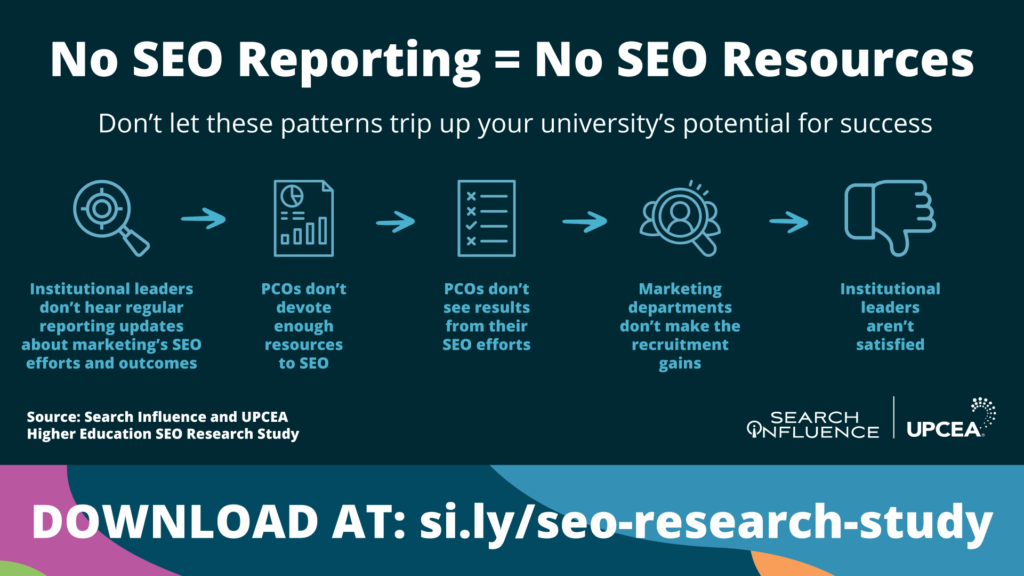
The data indicates that 62% of higher education institutional leaders want reporting on SEO metrics, but just 31% receive regular updates. This, and other data points in the study, highlight a self-perpetuating pattern:
Institutional leaders don’t hear regular reporting updates about marketing’s SEO efforts and outcomes. Therefore, they don’t push for or support SEO resources, and, consequently, they don’t get SEO results.
Greater Higher Education SEO Expertise Could Improve Results Angie Scott, Co-Founder and COO at Search Influence
Our Co-Founder and COO Angie Scott, in addition to her financed-focus, heads our HR operations — meaning she’s in tune with the skills and capabilities needed to perform a job well.
Angie found it interesting that institutions graded their SEO capabilities an average of 3.5 on a scale of 1 to 5, where a 1 is not very capable and 5 is extremely capable.
She wondered: Wouldn’t you want something this important performed at an expert level?
What skills are needed to perform higher education SEO effectively?
Research and analytical abilities
Technical website development expertise
Copywriting
Graphic design
Public relations/media outreach
Strategic thinking and creative problem solving
The skills needed to perform SEO well in the higher education industry are not likely to be found in one single individual, or even two. Beyond having the baseline skill set of each, higher education SEO marketing experts must be able to stay up-to-date with trends and work closely with evolving technology to keep their strategies ahead of the curve.
Executing SEO Tactics Without a Strategy Is a Missed Opportunity Will Scott, Co-Founder and CEO at Search Influence
Co-Founder and CEO Will Scott pointed out that, although many institutions are doing tactics that are part of SEO, they don’t perform them strategically. This means they miss valuable opportunities for the tactics to have the greatest impact on enrollment success.
Others don’t necessarily perform SEO tactics with intention. This was evident in the study from the assessment of 100 websites, in which universities had an average score of 58.6. Less than half (47%) of UPCEA members had a score above 60.
What does it look like to perform SEO strategically in higher education?
Targeted keywords per program/degree/certificate page (based on research)
Content plan for each offering (pillar pages with cluster content, including related blog posts, videos, and/or graphics)
Linkbuilding plan for each targeted program or degree
Cadence for monitoring technical site health
Identified key performance indicators (KPIs) and reporting plan
Learn more about how to apply these strategies and tactics in the replay of our webinar, UPCEA Higher Education SEO Research Study: How to Impact Your Enrollment.
SEO Is Critical to Reach the New Adult Learner Jim Fong, Chief Research Officer at UPCEA
Last but not least, let’s summarize the takeaways from UPCEA’s Chief Research Officer Jim Fong. If you are in higher education marketing and haven’t yet heard of or from Jim, you’re in for a treat. He’s a legend and a treasure trove of knowledge and insight for higher education leaders and marketers alike.
Jim has heavily researched and analyzed changing demographics and how that ties into the need for colleges and universities to focus and lean into new offerings for the adult learner. He also speaks to unique challenges in the fact that the new adult learner is much younger than some may picture, can be harder to reach, and, is much savvier than students of the prior generation. The new adult learner spends more time researching educational opportunities in their evaluation process — which includes using search engines to look at their options. (Read more about Jim’s perspective in his blog post, Greeting the Student of the Future on their Terms at the Digital Storefront.)
Jim’s preface to the full higher education research study prescribes four clear actions and observations:
PCO units need to abandon legacy and focus more on the new adult learner in the design of their websites.
There needs to be more emphasis on search engine optimization, as opposed to locked-in institutional templates and over-design and creativity.
Metrics should play a bigger part in the continuous improvement and planning process.
Institutions need to have a clear strategy for their websites and how to integrate the needs of the adult learner into the process.
The data is clear — SEO is an underleveraged tactic for universities to boost enrollments.
To me, this is very exciting. While many may think “we’re doing everything already,” this data shows that a lot actually aren’t. And that translates to new ways to reel in even more students that you may not have already explored in your other enrollment marketing efforts.
To view all of the data from the three-part study, download our Higher Education SEO Research Report. There’s also a webinar replay available, which gives you highlights of the study in addition to best practices on how to address the opportunities in our findings.
You can also learn even more about higher education digital advertising and marketing services with Search Influence here.
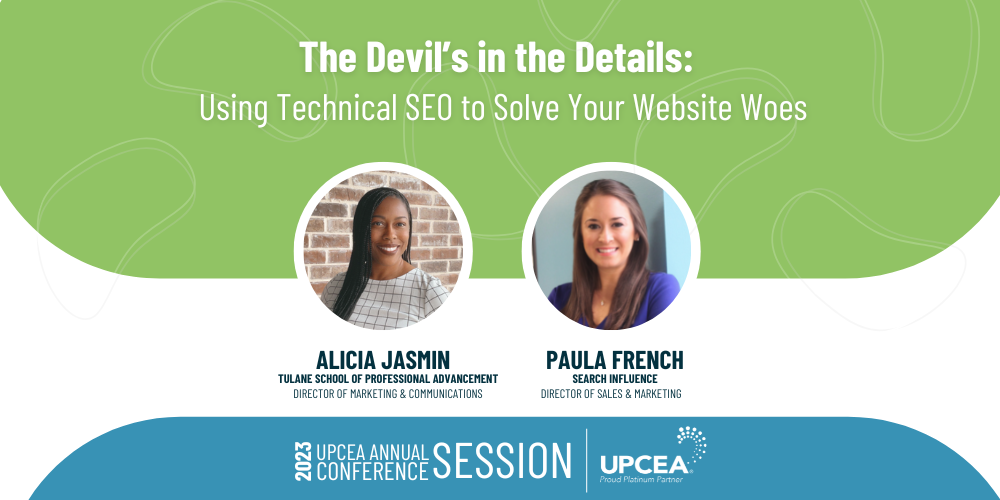
Higher Education Technical SEO to Solve Your Website Woes at #UPCEA2023
As higher education institutions continue to evolve, it’s more important than ever to ensure that their websites are up to date and optimized for organic traffic and search engine performance. To accomplish this, universities must be aware of best practices for higher education technical SEO, the implications of changes made to their websites, and the impact of subdomains and OPM microsites.
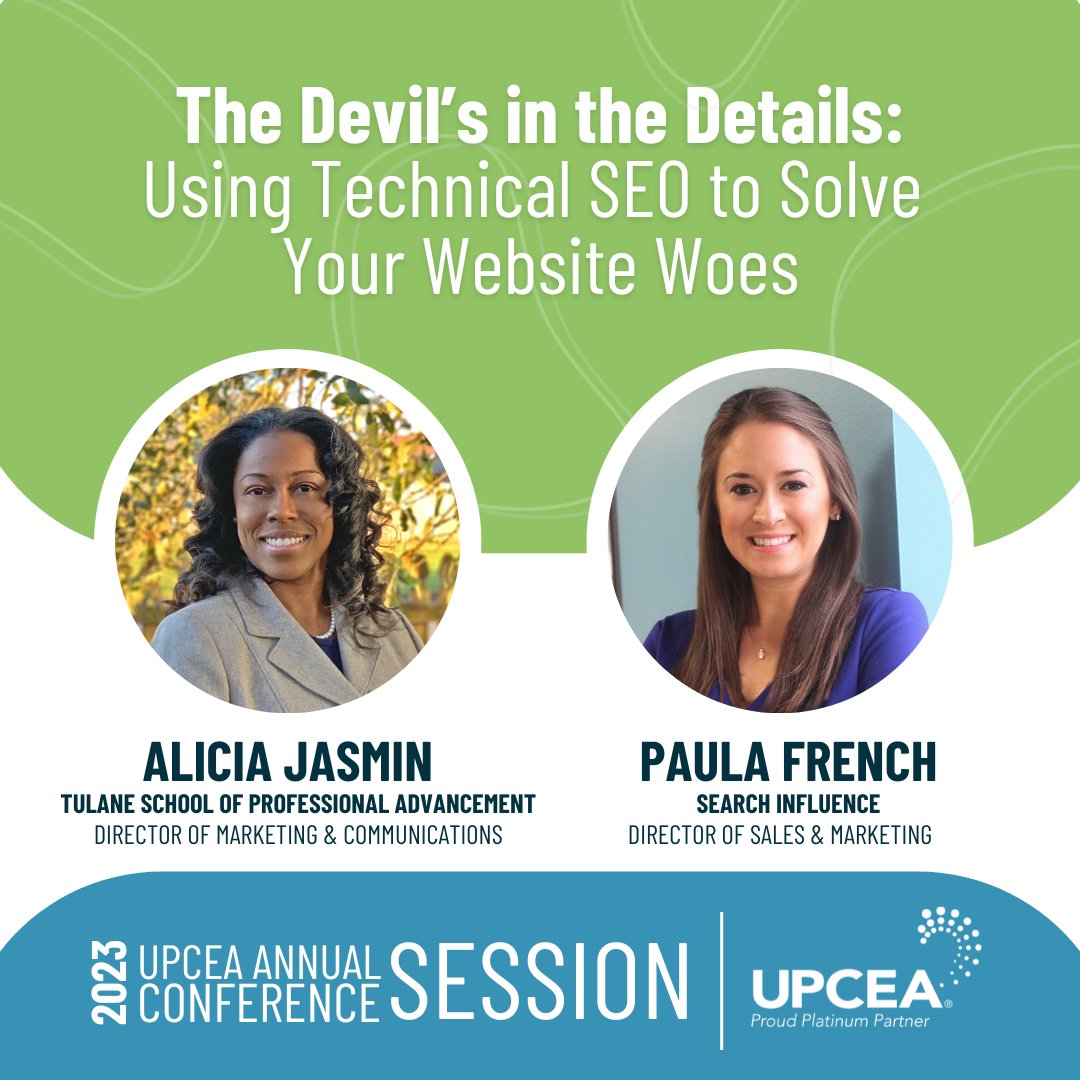
At the 2023 UPCEA Annual Conference, Paula French of Search Influence and Alicia Jasmin of Tulane SoPA will share their hard-won knowledge to help you avoid the most costly mistakes.
What is Technical Search Engine Optimization?
Technical SEO is the process of optimizing a website’s structure and internal elements to improve its rank on search engines.
This starts with an SEO audit aimed at fixing technical issues that could be negative ranking factors that commonly hold education websites back from their full potential. Some of these technical SEO issues also make for a bad user experience, such as broken links, duplicate content, and lack of internal links.
You know how important it is that your digital strategy and your school website are supportive of student search intent. But all that hard work will be for naught if the search engine crawlers can’t find your great content.
You owe it to yourself to understand the common (technical) issues that many schools – and even some SEO agencies – miss when doing SEO for education websites.
If you are serious about reaching potential students with your education SEO strategies, technical SEO is as important as your content strategy.
What Will You Learn in “The Devil’s in the Details: Using Technical SEO to Solve Your Website Woes?”
Attendees will learn how technical SEO, when part of their digital marketing strategy, will help you:
keep the search engine crawlers happy
stay ahead of the constantly updating search algorithms
most importantly: reach their intended audience: students
Gain insight into how website structure can affect search rankings, the impact of subdomains and microsites, and the steps needed for a successful website migration.
FAQs
Q: What is SEO?
A: SEO stands for search engine optimization, which is the process of optimizing a website’s structure and content to improve its ranking on search engines. As we learned in the Search Influence and UPCEA Higher Ed SEO Research Study it is not a given that your educational institution even has an SEO strategy.
Q: What is the difference between technical SEO and other forms of SEO for higher education?
A: Technical SEO focuses on the elements of a website’s infrastructure and coding that can affect its performance on search engine result pages (SERPs). This includes optimizing the website’s structure, fixing technical issues, and assuring the structure supports the keyword strategy.
Other forms of higher education SEO, such as on page SEO, content optimization and link building, focus on improving the quality and relevance of higher education websites’ content for users.
Q: How does technical SEO benefit universities and search engines?
A: Technical SEO is a critical piece of higher education digital marketing that can help universities maximize their organic search ranking and improve their visibility on search engines, including Google search. This helps universities reach their target audiences, including prospective students, more effectively and efficiently.
Also, technical SEO can help universities ensure their website content is of the highest quality and relevance to the user, making it more likely to be featured on the SERPs.
Q: What will I learn in Alicia and Paula’s technical SEO session?
A: You will gain insight into how website structure can affect search rankings, the impact of subdomains and microsites, and the steps needed for a successful website migration.
Additionally, you will learn about the latest tools available to gauge your search engine visibility, as well as tips and tricks to ensure your website is up to date and optimized.
Q: Who should attend this session at UPCEA?
A: This session is ideal for higher ed marketers and marketing teams who are looking to understand the technical SEO implications of recommendations for their websites from their education marketing agency.
It is also beneficial for those who wish to learn more about tools, processes, and strategies to make sure their SEO efforts truly optimize their online visibility for organic search traffic.
At UPCEA’s 31st Annual MEMS Conference, Search Influence’s Director of Account Management Alison Zeringue will co-present “Beat Brand Boredom: Aligning Brand With Student Experience to Reinvigorate Interest in Your School,” alongside Alicia Jasmin, Shiela Flatz, and Nico Rose — higher education marketing experts from the Tulane School of Professional Advancement (Tulane SoPA) and the University of Florida Online.
For over 100 years, UPCEA has been the leading association for the advancement of Professional, Continuing, and Online Education (PCO) for public and private higher ed institutions across North America.
Attendees will get an insider glimpse into how to combat today’s higher-ed digital marketing challenges and grow student enrollment with data-driven strategies and proven tactics.
Higher Education Digital Marketing Session Description
Today, prospective students expect a minimum of flexibility, connection, and communication from their school.
With student learning expectations continuing to steepen, the pressure is on digital marketers to adapt their brands and quickly catch up to speed.
In “Beat Brand Boredom: Aligning Brand With Student Experience to Reinvigorate Interest in Your School,” higher education marketing firms and universities will learn how to put the student experience at the forefront of their marketing tactics. When equipped with a student-centric approach, marketers will better connect with prospects in all stages of enrollment to drive digital advertising success.
“Digital advertising success can have a huge impact on your marketing plan, but it can be challenging for marketers to navigate the nuances of advertising technology,” said Search Influence’s Director of Account Management Alison Zeringue. “We’re excited to share our knowledge with the continuing education community so they can benefit from our experience.”
Learn from higher education marketing specialists at Search Influence, the Tulane School of Professional Advancement, and the University of Florida Online to see how you can beat brand fatigue and boost enrollment with updates to your:
Brand messaging
Brand positioning
Media mix
Visual identities
UPCEA MEMS 2022 Conference Speakers
In the 2022 UPCEA MEMS session, “Beat Brand Boredom: Aligning Brand With Student Experience to Reinvigorate Interest in Your School,” attendees will learn higher education marketing strategies from:
Alison Zeringue, Director of Account Management, Search Influence
Alicia Jasmin, Director of Marketing & Communications, Tulane School of Professional Advancement
Sheila Flatz, Assistant Director, Operations, University of Florida Online
Nico Rose, Chief Operating Officer and Associate Director, University of Florida Online
UPCEA and Tulane Partnerships
UPCEA and Tulane Partnerships
In 2022, Search Influence became a Platinum Partner of UPCEA. Through this partnership, Search Influence shares how higher education marketing institutions can optimize, measure, and track their search engine optimization and paid ad strategies to drive more qualified prospects to their marketing channels.
For six years, Search Influence has worked with Tulane SoPA to improve their online visibility and drive quality inquiries, providing services including search engine, paid digital ads and email marketing.
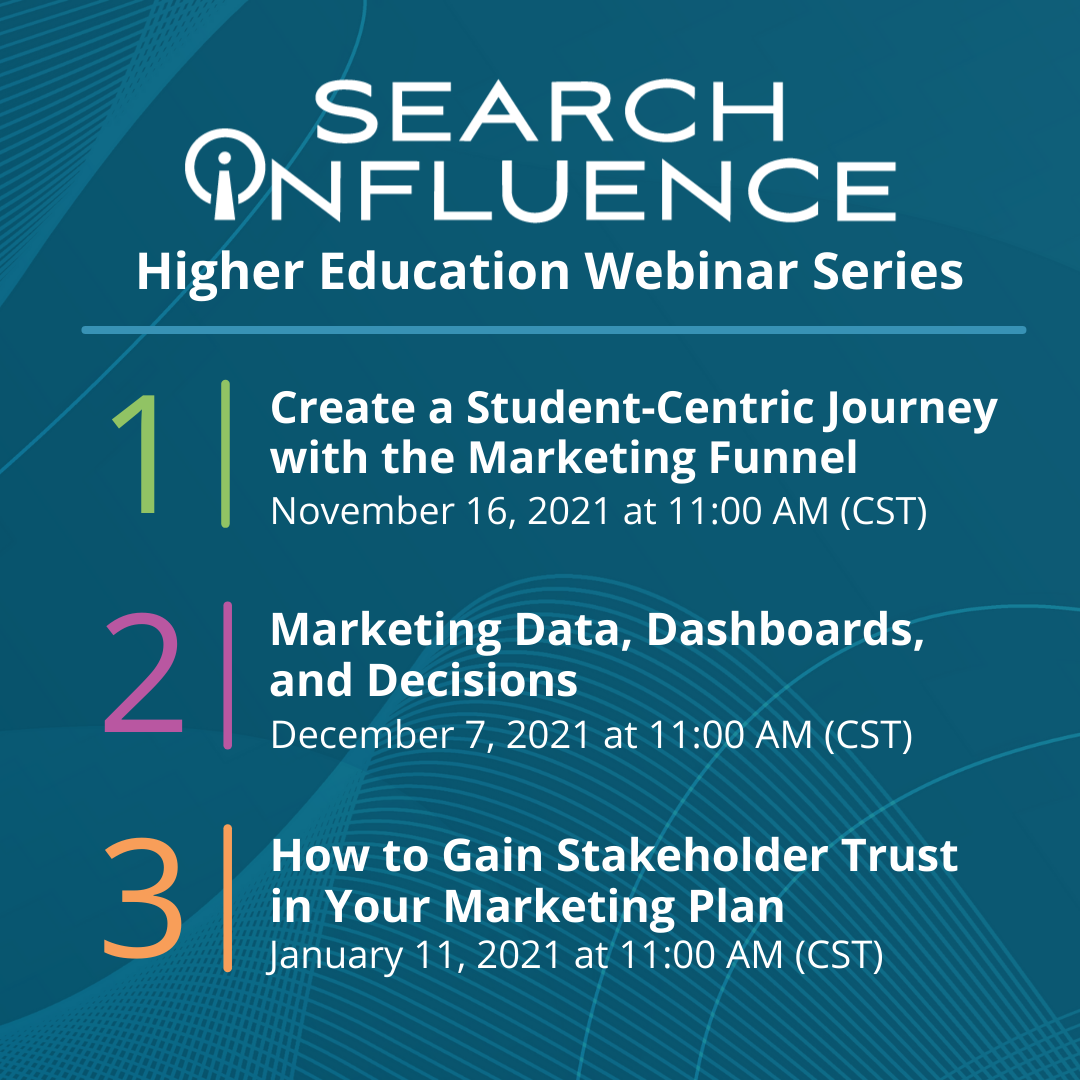
Search Influence will host Plan, Track, and Earn Buy-In for Your Higher Education Marketing Strategy, a free, three-part training series. The series is designed to help higher education marketers create a strategic and measurable marketing plan and build excitement for the plan among stakeholders.
Session 1: Create a Student-Centric Journey with the Marketing Funnel
Tuesday, Nov 16 | 12PM ET/11AM CT
Watch the recording here.
In this Higher Education Strategy Session, Search Influence will walk you through how to nurture prospects with tactics that align to the marketing funnel and student journey.
Learning objectives:
How to look at the marketing funnel from the student’s perspective.
The ideal formula and structure for content that converts on your program and degree page.
Opportunities to create innovative conversion website points that help you qualify leads.
Upcoming Sessions
Session 2: Marketing Data, Dashboards, and Decisions
Tuesday, Dec 7 | 12PM ET/11AM CT
Watch the recording here.
Discover how to unlock powerful insights by using quantitative data to tell a story about the performance of your institution’s recruitment and marketing strategies.
Learning objectives:
Suggestions for tools and high-level processes to use when integrating disparate data into a dashboard.
How an integrated reporting dashboard can improve efficiency.
Methods to tie marketing and enrollment data together to communicate your work to non-marketing people.
Session 3: How to Gain Stakeholder Trust in Your Marketing Plan
Tuesday, Jan 11, 2022 | 12PM ET/11AM CT
Watch the recording here.
As an education marketer, it’s your job to help deans, admissions, and other stakeholders understand how new marketing strategies fuel student growth.
Search Influence will guide you through how to build a case for new marketing efforts, including ways to demonstrate how your strategies impact your institution.
Learning objectives:
How to use quantitative goals to plan and pitch marketing strategies.
Tactics to demonstrate how a given strategy will help you reach a specific target audience.
Guidance to tailor your discussion based on personality styles and role.