Tag: higher education marketing

  • Higher Education AI Search Strategy: What Students Expect vs. How Institutions Must Adapt

    Higher Education AI Search Strategy: What Students Expect vs. How Institutions Must Adapt graphic

    Key Insights

    • Students have shifted how they search.
      Prospective learners now use AI tools alongside traditional search, making structured, consistent program information essential for visibility.
    • Institutional readiness lags student behavior.
      Many colleges recognize the influence of AI search but still lack the systems and processes to monitor and improve their presence in generative results.
    • An AI search strategy requires core operational alignment.
      Institutions must unify program data, structure pages for AI readability, reinforce entity signals, and maintain ongoing data hygiene to stay competitive.

    Half of prospective students use AI tools weekly. Nearly 80% read Google’s AI Overviews before clicking a single search result. 

    For most higher education institutions, that means students are forming opinions about your programs before they ever reach your website. If your information isn’t structured for AI retrieval, you’re invisible during the moment that matters most.

    The UPCEA x Search Influence AI Search in Higher Education Research Study tracked how students search for programs in 2025. A parallel Snap Poll of 30 UPCEA members measured institutional readiness. Together, they reveal a sector-wide gap: students have moved to AI-assisted search faster than colleges have adapted their content strategies.

    This guide breaks down how students search today and outlines the four operational components institutions need to compete for visibility in AI search.

    The New Student Discovery Model and Its Impact on AI Search Visibility

    Higher ed has spent decades optimizing solely for traditional search engines. The challenge now is optimizing for how students actually gather information. That behavior looks much different today than it did even two years ago.

    Students want direct answers, quick comparisons, and credible signals, and they toggle between tools to get them. Generative AI fits naturally into that pattern because it delivers instant interpretation without requiring students to click through multiple pages or sift through fluffy marketing copy.

    AI tools have become routine

    What once felt like experimental search is now embedded in the routine research process.

    • 50% of prospective students use AI tools weekly
    • 79% read AI Overviews before clicking a single blue link

    AI compresses the “orientation” phase of search, the stage where students try to understand what a program involves and which institutions align with their goals. Historically, that moment used to happen on your website. Now it happens in a summary box before a student decides whether your program is worth investigating further.

    If that summary box is inconsistent or simply missing your institution entirely, you’ve lost visibility at a moment that shapes early impressions.

    Students layer Google, YouTube, & AI together

    Even with all the AI buzz, students aren’t abandoning traditional search engines in their search for professional and continuing education (PCE) programs. They’re simply supplementing them.

    • 84% still use traditional search for core information
    • 61% use YouTube to explore programs visually
    • 50% use AI tools for context and comparison

    This creates a layered research journey where each channel serves a specific function:

    1. AI platforms provide the first pass of understanding — condensing program details and requirements, and fitting them into digestible summaries
    2. Google (and other search engines) expand the options — surfacing alternative programs, comparison articles, and third-party reviews
    3. YouTube shapes expectations and emotional resonance — showing campus life, faculty interviews, and student testimonials
    4. Institution websites verify credibility — confirming details, checking accreditation, and exploring outcomes data

    Consistency in presence and messaging across each channel is the new baseline for visibility.

    Universities still hold trust, but AI sets the stage

    Despite the rise of new tools, institutions remain the source students trust most. 77% rely on university websites to verify program information.

    But in many cases, students don’t start with you. They end with you.

    A very typical sequence now looks like this:

    1. AI-generated overview or citation → Initial understanding and shortlist formation
    2. Verification on .edu pages → Credibility check and detail confirmation
    3. Shortlist decisions → Final comparison and enrollment consideration

    AI shapes the expectation. Your website proves (or disproves) the details. Accuracy and clarity must exist in both places for a student to move forward. (Example: If the AI search results say your MBA is 18 months and your program page says 24 months, the friction kills momentum.)

    This reversed discovery model has profound implications for content strategy. You can no longer afford to treat your website as the sole first impression. It’s now the verification step. And if AI has already set the wrong expectation, your website becomes a correction tool instead of a conversion tool.

    Source: UPCEA x Search Influence — AI Search in Higher Education: How Prospects Search in 2025

    Institutional Readiness: Where Colleges Stand in 2025

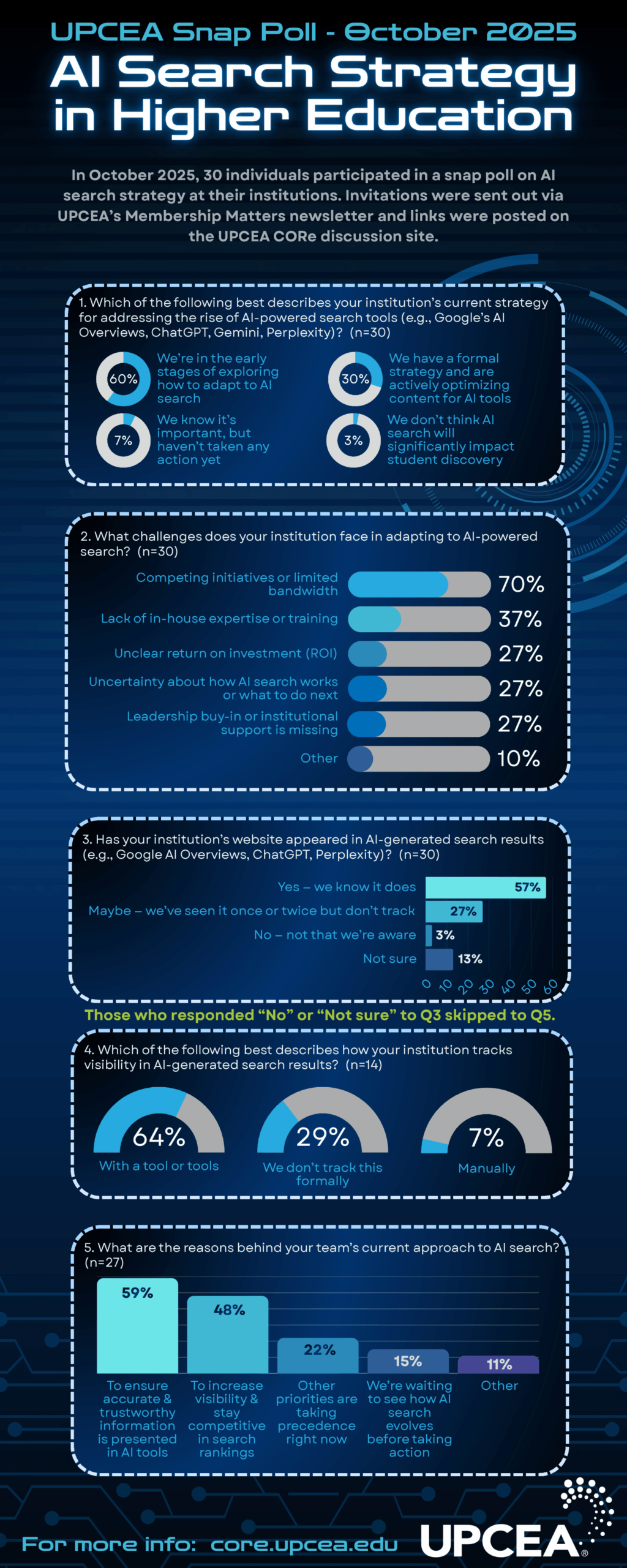
    If student search trends are moving quickly, institutional readiness is moving much slower. Conducted with 30 UPCEA members, the UPCEA x Search Influence Snap Poll reveals a sector that understands the importance of AI search but lacks operational capacity to support it.

    Most institutions know AI matters. The question is whether they have the bandwidth, expertise, and internal alignment to respond.

    Awareness is high, execution is thin

    The majority of institutions recognize that AI is reshaping the discovery process. But knowing and acting are two very different things.

    • 60% are in the early stages of “exploring” AI search
    • 30% have a formal AI search strategy
    • 10% haven’t started or don’t believe AI will impact program discovery

    “Exploring” signals curiosity, but not implementation. A formal strategy requires solid infrastructure (ownership, processes, consistency), and that’s where many institutions are falling behind.

    Without clear ownership, AI search becomes everyone’s concern and no one’s responsibility. Marketing assumes IT will handle technical implementation. IT assumes marketing will define content standards. Enrollment assumes someone else is tracking whether programs appear accurately in AI summaries. Meanwhile, competitor institutions with defined workflows are reinforcing their visibility signals daily.

    The barriers are structural, not philosophical

    No one is debating whether AI-driven search matters. The bottlenecks are operational:

    • 70% cite limited bandwidth or competing priorities
    • 36.67% cite lack of in-house expertise or training
    • 26.67% cite unclear ROI or uncertainty about AI mechanics

    AI systems evolve monthly. Waiting six months to decide “what to do” means falling behind institutions that have already begun reinforcing their information. Every month your program data remains inconsistent is another month AI models learn to trust competitor sources instead of yours.

    Visibility tracking is still inconsistent

    When asked whether their institution appears in AI-generated answers:

    • 56.7% said “yes”
    • 26.7% said “maybe”
    • 13.3% said “uncertain”

    Only 64.29% of those tracking use structured methods, like formal AI SEO tracking tools.

    If institutions don’t know when or how they’re appearing, they also can’t know:

    • Whether AI summaries are accurate
    • Whether competitors appear more frequently
    • Whether certain programs are misrepresented

    Guessing is not a visibility strategy. Without structured monitoring, institutions can’t identify which programs underperform in AI search, can’t track whether content updates improve citation frequency, and can’t benchmark their visibility against regional competitors.

    Early movers are motivated by accuracy & competition

    Among the institutions already adopting an AI search strategy:

    • 59.26% want to ensure the accuracy of AI-generated information
    • 48.15% are focused on visibility and competitive positioning

    Meanwhile:

    • 22.22% say other priorities rank higher
    • 14.81% are “waiting to see what happens”

    The difference between these groups is trajectory. Early adopters move ahead while others accumulate visibility debt, the long-term disadvantage that forms when AI systems learn from competitors instead of from you.

    Institutions waiting for clearer ROI data or more mature tracking tools are making a strategic bet that the cost of delay is lower than the cost of early action. For some, that bet may prove correct. For most, it won’t.

    Source: AI Search Strategy in Higher Education — Snap Poll, October 2025
    AI Search in Higher Ed infographic

    Core Components of a Modern Higher Education AI Search Strategy

    Generative search engines don’t reward creativity. They reward clarity. Winning page one and the AI Overview depends on whether a program’s information is consistent, structured, and reinforced everywhere a student or AI tool might encounter it.

    1. Establish program data consistency as the institutional source of truth

    AI models may “misstep” when foundational information is inconsistent. If your academic catalog lists a different cost than the program page, or if PDFs still reference old admissions cycles, AI defaults to whichever source appears most stable, and that isn’t always your institution.

    Your information cleanup has to start with the facts:

    • Cost — tuition, fees, financial aid opportunities, and total program investment
    • Duration — credit hours, typical completion time, and pace options
    • Modality — online, hybrid, in-person, or flexible formats
    • Requirements — prerequisites, application materials, and admission standards
    • Outcomes — employment rates, salary data, and career paths

    When these details are aligned across catalogs, PDFs, program pages, and third-party listings, AI no longer has to choose between conflicting answers. Consistent facts increase trust, and trust improves visibility.

    Program pages can’t be accurate until the underlying data is

    Data consistency isn’t a content problem. It’s a governance problem. Most institutions store program information in multiple systems: student information systems, content management systems, PDF repositories, third-party directories, and marketing automation platforms. Each system may reflect different update cycles, approval processes, and data owners.

    The solution isn’t consolidating all systems into one platform. It’s establishing a single source of truth for core program attributes and building workflows that propagate updates across all systems simultaneously. When tuition changes, that change should flow to every digital property within hours, not weeks.

    2. Build an AI-readable content architecture on program pages

    Even perfectly aligned information can underperform if the page structure makes it hard for AI to interpret. Generative tools scan for clarity, hierarchy, and explicit answers to common user queries.

    Pages are strongest when the essentials sit in predictable, machine-readable patterns:

    • Clean headings that signal structure and topic boundaries
    • Modular sections focused on single topics without mixing concerns
    • Concise explanations that answer specific questions directly
    • Scannable details formatted for quick extraction (tables, lists, definition blocks)

    Students prefer this structure, too. Clear sections for cost, schedule, outcomes, and requirements shorten the time between interest and understanding. AI prefers the same format because it speaks its “language” and reduces ambiguity.

    When program pages feel like reference material rather than brochure copy, visibility improves

    AI-readable architecture doesn’t mean stripping personality from your content. It means organizing information so both humans and machines can extract what they need quickly. You can still include testimonials, brand messaging, and storytelling, but those elements should supplement structured information, not replace it.

    Consider how AI extracts content. It doesn’t read your page top to bottom like a human. It scans for semantic patterns, identifies chunks that answer specific queries, and evaluates whether those chunks are self-contained and coherent. A program page that buries cost information in the middle of a narrative paragraph underperforms compared to one that lists cost in a clearly labeled section with supporting context.

    3. Strengthen program entities through cross-site signals

    AI search isn’t keyword-based. It’s entity-based.

    Models build their understanding of a program by connecting signals across your entire ecosystem. If terminology shifts from page to page, if key details appear in one place but not another, or if older content contradicts newer versions, entity confidence drops.

    Cross-site reinforcement matters:

    • Consistent terminology across all digital properties
    • Internal linking that clarifies relationships between programs, departments, and requirements
    • Schema markup that defines program attributes in a machine-readable format
    • Repetition of essential facts across relevant pages to reinforce entity stability

    The more stable and coherent the entity, the more likely AI is to cite it.

    This is how institutions move from “we sometimes appear” to “AI consistently references us”

    When a student asks an AI tool, “What are the prerequisites for the MBA program at [your institution]?”, the AI doesn’t just check your MBA page. It checks every page where those prerequisites might be mentioned: department pages, catalog entries, PDF documents, and FAQ sections. If those sources conflict, AI either omits your institution or presents the information with lower confidence.

    Schema markup amplifies entity strength by explicitly defining relationships. When you mark up your MBA program with structured data that identifies its parent department, associated faculty, duration, and cost, you help AI understand not just what the program is but how it fits into your institutional structure.

    4. Implement ongoing AI visibility monitoring & data hygiene

    AI visibility is not a one-time project. Models update frequently, and each update reshapes which programs they surface, how they phrase details, and which institutions they trust.

    Monitoring needs to be ongoing and structured around:

    • Citation frequency — how often your programs appear in AI responses
    • Accuracy of summaries — whether AI-generated descriptions match your current information
    • Sentiment and positioning — how your programs are characterized relative to competitors
    • Competitor visibility — which institutions are appearing when yours aren’t

    This level of tracking enables institutions to identify patterns early, correct inaccuracies quickly, and establish authority over time. 

    About Search Influence’s support with AI visibility tracking

    Unsure where to start? Our team provides structured AI traffic reporting that shows how your programs appear across generative platforms and where inconsistencies may be affecting trust. As your tracking partner, we can help your institution gain clear visibility into patterns, changes, and gaps, helping you prioritize the data and content updates that strengthen your position in AI search engines.

    Get the research shaping modern AI search. → 

    FAQs About Higher Education AI Search Strategy

    How does AI decide which programs to cite?

    AI looks for information that is consistent, structured, and verifiable across multiple pages and sources. Programs with aligned facts and clear architecture are more likely to appear.

    How can leadership be convinced to prioritize AI search visibility?

    Show the connection between visibility and enrollment. Students are forming opinions before they reach institutional websites, and institutions that don’t appear in AI-generated search results lose those early moments of influence.

    How often should institutions audit program pages for AI readiness?

    Quarterly, if not more. AI models update rapidly, and audits ensure that key information remains up to date, content structure remains clean, and external listings don’t drift out of alignment.

    What KPIs indicate improvement in AI discoverability or trust?

    Citation frequency, accuracy, sentiment, and competitor comparisons. These KPIs signal whether AI considers your institution a stable source of truth.

    Students Have Shifted Their Discovery Habits. Your AI Search Strategy Must Catch Up.
    AI isn’t a future threat. It’s an active influence in how prospective students search for programs and decide which institutions to trust. 

    Your student search guide

    Based on survey data from 760 prospective adult learners, the UPCEA x Search Influence AI Search in Higher Education Study offers the most comprehensive view of how prospects utilize AI for program research.

    Use the data to:

    • Align leadership around AI search priorities
    • Identify priority programs for content optimization
    • Plan FY26 content investments with confidence
    • Benchmark readiness against peer institutions
    • Strengthen your visibility signals across search engines and AI tools

    AI search is already shaping enrollment. Institutions that build their strategy now will lead the next phase of visibility.

    Download the full study to get the complete data set and a clearer view of how to modernize your AI search strategy.
  • UPCEA Guest Blog: Paula French on AI Search Trends in Higher Education

    AI Search in Higher Education

    When prospective students begin researching programs, their first stop may no longer be your website…. or even Google

    Many now use generative AI platforms like ChatGPT, Gemini, and Perplexity to ask questions, compare options, and find fast answers. These tools influence what students see, what they trust, and which institutions they choose to explore further.

    In her latest guest blog for UPCEA, “AI Search in Higher Education: The Student Search Trends You Can’t Ignore,” Director Paula French breaks down what this shift means for enrollment marketers. 

    Drawing on insights from the new UPCEA x Search Influence research study, AI Search in Higher Education: How Prospects Search in 2025, Paula shares a data-backed look at how students search today — and what your team can do to improve visibility across every touchpoint.

    Top AI Search Trends in Higher Education 

    The study surveyed 760 adult learners aged 18–60 who are actively exploring educational opportunities. Their responses point to a growing reliance on digital tools that extend far beyond search engines.

    • 50% of students use AI tools weekly
    • 79% read Google’s AI Overviews
    • 56% are more likely to trust institutions cited in those Overviews
    • 61% use YouTube like a search engine
    • 77% consider university websites to be highly trustworthy

    Together, these numbers reflect a major shift in how trust is built and how options are evaluated during the early stages of the enrollment process.

    How to Improve Visibility Where It Counts

    Paula’s guest blog offers clear, actionable strategies for improving performance in AI and traditional search, including:

    • Structuring content with clarity using headings, bullet points, and schema markup
    • Including factual, up-to-date program details that AI tools prefer to cite
    • Publishing trust-building content like faculty bios, accreditation info, and student outcomes
    • Monitoring your presence in AI tools like ChatGPT, Gemini, and Perplexity to see what students are seeing
    • Auditing your site’s search performance to make sure you’re showing up where students begin their research

    Students are forming impressions earlier in the decision-making process, and they’re doing it in spaces many institutions aren’t actively monitoring. That’s a missed opportunity, and one that’s becoming harder to ignore.

    For a closer look at the data (plus tips on how your institution can adapt), read Paula’s full guest post.

    See Paula and the Team at MEMS 2025

    Attending UPCEA’s 34th Annual MEMS: Marketing, Enrollment Management, and Student Success Conference in Boston this December? Stop by the Search Influence booth to connect with Paula French, Jeanne Lobman, and Will Scott.

    Paula will also co-present with Emily West of UPCEA in a featured session titled:
    “How to Optimize for AI Search: What Students Trust & What Marketers Must Do” on Wednesday, December 3rd at 3:30 PM.

    The discussion will dive deep into student behavior and outline a strategic approach to visibility built around the pillars of AI SEO.

    View session details →

  • [Search Influence x UPCEA] Unpacking New Research on AI Search in Higher Education

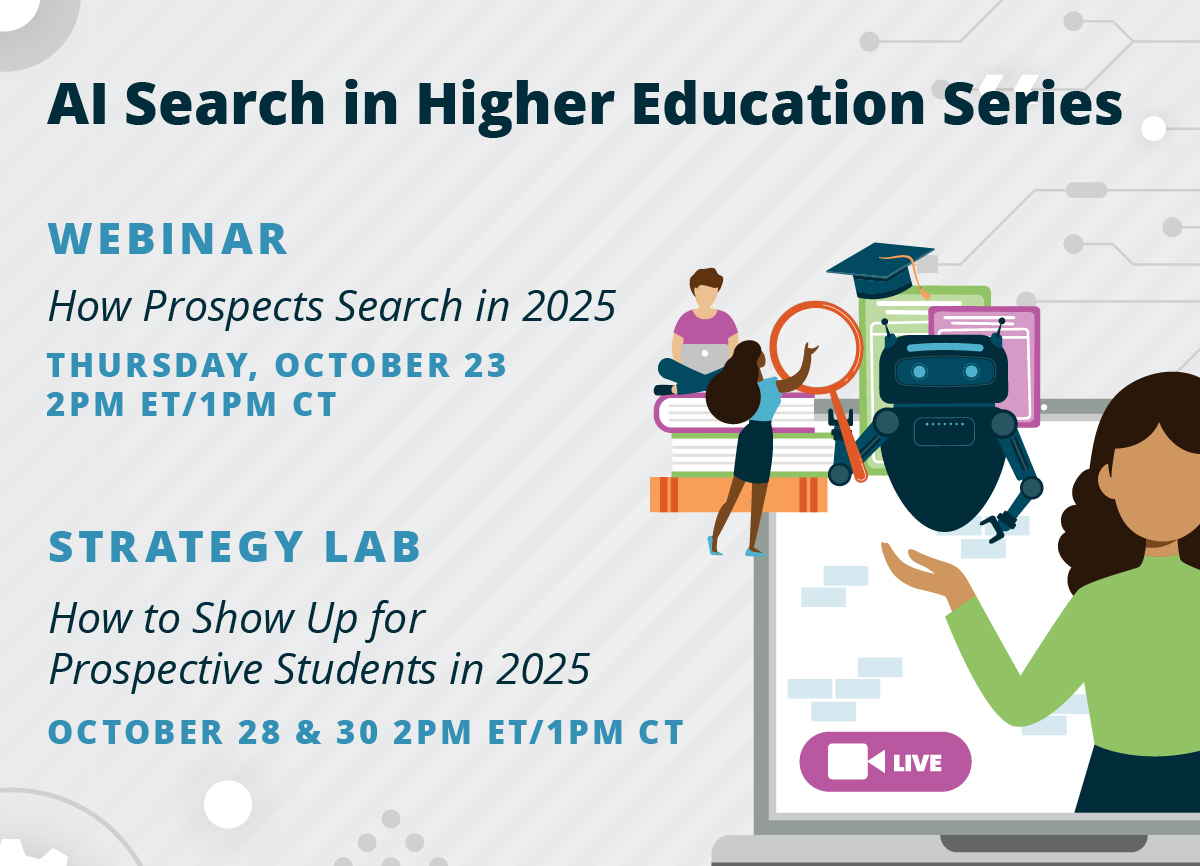
    AI Search in Higher Education Series image for webinars and labs

    This blog post was updated by Ren Horst on November 4, 2025 following the webinar event.

    50% of prospective students use AI tools at least weekly to research information online. 79% read Google’s AI Overviews, and more than half say they’re more likely to trust the institutions AI cites.

    These search behaviors are no longer emerging trends. They’re the new reality for enrollment marketing.

    On October 23, UPCEA and Search Influence hosted the live webinar “AI Search in Higher Education: How Prospects Search in 2025,” unveiling findings from the AI Search Research Study.

    The session explored what’s shaping prospective student behavior today, plus how higher ed marketers can adapt their visibility strategies for AI-driven search.

    How AI Is Changing Institutional Visibility

    The new research highlights a fundamental shift in how students discover, evaluate, and ultimately choose higher education programs. Traditional search engines remain important, but AI-driven platforms are shaping decisions in ways that enrollment marketers can’t ignore.

    For higher ed institutions, the implications are clear: If you’re not present in AI-powered search experiences, you may be invisible to a significant portion of your prospective students.

    “AI Search in Higher Education: How Prospects Search in 2025” unpacked the study findings, explained why they matter, and showed you how to position your institution for visibility in 2026 and beyond.

    Key Takeaways From the Webinar

    SEO then and now

    Search strategy has evolved from keyword targeting to context and credibility. AI engines understand meaning through entities, relationships, and trusted citations, not just keyword density. The webinar discussed how this shift changes on-page SEO priorities, emphasizing entity optimization, structured data, and semantically rich content to help AI engines interpret institutional expertise.

    Authority and content signals

    Institutional visibility depends on demonstrating trust through structure, accuracy, and reputation. AI platforms prioritize content that’s organized, verifiable, and supported by credible references. The webinar explored tactics for improving these signals, like incorporating earning links, highlighting faculty expertise, and securing third-party mentions that reinforce authority beyond your own website.

    Measuring AI visibility

    Understanding your reach in AI search is becoming possible through emerging analytics. Tools such as Google Analytics 4, Search Console, and Scrunch can reveal AI-driven traffic, question-based visibility, and citation frequency. The webinar covered how marketers are starting to quantify AI exposure, sharing practical ways to integrate early visibility tracking into institutional reporting.

    The Opportunity Ahead

    AI is fundamentally changing how students search and how institutions are seen. Yet, many schools haven’t updated their strategies to reflect how AI engines surface information.

    Those who act now will gain visibility in AI and Google, positioning their programs to be found, considered, and chosen.

    Turn AI into an opportunity, not a threat. Watch the full webinar replay and download the AI Search Research Study to understand what this shift means for your enrollment goals.

  • Search Influence to Present on AI Search in Higher Education at AMA Symposium 2025

    Search Influence to Present on AI Search in Higher Education at AMA Symposium graphic

    AI-driven discovery is rewriting the rules of visibility for universities. As prospective students increasingly rely on tools like Google’s AI Overviews, ChatGPT, and Perplexity, the traditional SEO playbook is no longer enough. 

    The next era of visibility requires a strategy built for recognition and trust within AI ecosystems, not just rankings on search results pages.

    Presentation Slides

    At the 2025 AMA Symposium for the Marketing of Higher Education, Paula French, director at Search Influence, and Tara Pope, director of marketing at Tufts University College, will explain how institutions can thrive in this new environment. 

    Their presentation, “How to Win AI Search: Three Pillars for Success,” will be held on Tuesday, November 11, from 2:50 to 3:40 p.m. in National Harbor, Maryland.

    The Evolving World of AI Search in Higher Education

    Recent findings from the new UPCEA + Search Influence research study, AI Search in Higher Education: How Prospects Search in 2025, reveal that generative AI is transforming how students find and evaluate programs:

    • 50% of prospective students use AI tools weekly.
    • 79% read AI-generated summaries when available.
    • 56% are more likely to trust a site featured in an AI Overview.

    These numbers highlight a pivotal shift. Visibility in AI search is now visibility with students. 

    Institutions that fail to appear in AI-generated answers risk being overlooked entirely, even before a prospective student reaches a search results page.

    Inside the Framework: Three Pillars of AI SEO

    In their AMA Higher Ed session, French and Pope will introduce a practical framework that helps institutions strengthen their visibility and authority within AI-generated environments.

    1. Entities

    AI systems interpret structured data and networked entity relationships. By using schema markup, entity-rich language, and consistent identifiers, institutions can help AI better recognize programs, faculty, and departments.

    2. Semantic relevance

    AI favors content that mirrors how people naturally ask questions. Structuring content in concise Q&A form, using natural language headings, and speaking clearly to student intents makes it easier for AI to parse and surface your content.

    3. Citations

    Trust is a currency in AI. When content is cited or linked from reputable sources (media, academic directories, “best of” lists), AI is more likely to elevate it. PR and content teams should actively integrate link building and authoritative mentions into the SEO strategy.

    Together, these three pillars form the foundation of a sustainable AI SEO strategy that builds visibility across traditional and generative search experiences alike.

    About the Speakers

    Tara Pope serves as director of marketing at Tufts University College, where she oversees marketing and communications for a diverse portfolio of programs, including Pre-College, Professional Education, and the Osher Lifelong Learning Institute. With more than 25 years in digital marketing and communications, her career spans technology, e-commerce, and higher education.

    Paula French, director at Search Influence, is a digital marketing leader with 15 years of experience helping higher education institutions enhance their online visibility and enrollment outcomes. She frequently contributes insights on SEO, analytics, and strategy to national audiences and industry publications.

    About the 2025 AMA Symposium for the Marketing of Higher Education

    The AMA Symposium for the Marketing of Higher Education brings together higher ed marketers and communicators from across the country to exchange insights and shape the future of education marketing.

    For more than 30 years, the Symposium has served as one of the field’s leading events, offering peer-reviewed sessions that inspire collaboration, innovation, and actionable learning. The 2025 Symposium will take place November 9–12, 2025, in National Harbor, Maryland, helping institutions refine their strategies, strengthen their reputations, and drive meaningful impact.

    Why This Conversation Matters

    As generative AI continues to influence how students research, compare, and decide on programs, institutions must adapt their content strategies accordingly. Optimizing for AI search in higher education means focusing on recognition, structure, and authority, not just visibility.

    Paula French and Tara Pope’s framework offers higher ed marketers a clear path forward: one grounded in data, built on collaboration, and ready for the AI-driven future of discovery.

    Learn More About the Research

    Want to explore the trends shaping student search behavior in the age of AI? 

    The new UPCEA + Search Influence research study, AI Search in Higher Education: How Prospects Search in 2025, reveals how students use AI, search engines, and university websites to make enrollment decisions.

    Download the study today to learn how your institution can adapt.

  • Higher Education SEO Checklist for Nontraditional Programs

    Higher Education SEO Checklist for Nontraditional Programs graphic

    Key Insights

    • Nontraditional programs are driving enrollment growth. These offerings now provide working adults and lifelong learners with accessible routes to advance their skills and careers.
    • Your real competition isn’t just other universities. Private bootcamps, online platforms, and credentialing providers are dominating search results and targeting the same students you are.
    • High-intent traffic requires high-intent content. Prospective students aren’t always searching for institutions. They’re searching for outcomes, credentials, and career alignment. Your web pages must reflect those priorities to convert.
    • Visibility in search starts with proper SEO. Content must be structured, helpful, and authoritative to appear in traditional search engines, Google’s AI Overviews, ChatGPT, and other generative tools.

    The future of higher education isn’t confined to traditional four-year degrees. Certificates, bootcamps, and microcredentials have increasingly become pathways for career switchers, adult learners, and professionals who need quick, targeted upskilling.

    But high demand alone doesn’t guarantee enrollment.

    Universities now compete not just with peers but with corporate training providers, digital learning platforms, and alternative credentialing organizations. And with AI-driven search like Google’s AI Overviews and ChatGPT shaping how people find information online, visibility determines who wins attention and who gets overlooked.

    Prioritizing search engine optimization (SEO) ensures your programs surface in traditional search results and AI-generated answers, giving your institution the edge it needs.

    Not sure where to start? This higher education SEO checklist outlines essential steps to capture visibility and convert interest into enrollment.

    Why Nontraditional Programs Are Surging

    More adults are returning to education

    A growing number of learners today are 25 and older, many of them balancing work, family, and other responsibilities. To them, educational convenience is non-negotiable. These students are drawn to programs that offer flexibility, affordability, and credentials that directly support career advancement.

    That’s why online, hybrid, and evening/weekend formats continue to gain traction. These formats allow adult learners to continue working and managing daily responsibilities while investing in their future, without the need to pause their lives.

    Employers need rapid reskilling

    Workforce disruptions and rapid technological change are creating urgent skill gaps across nearly every industry. In response, employers are embracing skills-based hiring, prioritizing specific competencies over traditional degrees.

    This shift has elevated the credibility of certificates, microcredentials, and bootcamps. Programs that align with industry-recognized certifications (ex: project management, cloud computing, continuing education in healthcare) help learners meet employer expectations and compete in fast-moving job markets.

    Learners want faster ROI

    Many students today are motivated by outcomes they can act on quickly — a promotion, a licensure renewal, or a career pivot. Nontraditional programs offer a shorter, more focused timeline that aligns with these goals.

    Most last weeks or months rather than years, and they clearly map to real-world results. For busy professionals weighing the cost of time and tuition, programs with defined outcomes and immediate career relevance offer a much stronger return on investment than traditional long-term degree tracks.

    Why SEO Matters for Nontraditional Programs

    Different search behavior requires different SEO

    Prospective students for nontraditional programs often search differently than traditional undergrads. Their queries focus on outcomes, credentials, and convenience, not necessarily institutions.

    Terms like “online certificate in digital marketing”, “CEU courses for teachers in Florida”, or “best coding boot camps near me” reflect a clear intent to act.

    If your program pages aren’t built to match these kinds of searches, you’ll miss the opportunity to connect with the very students your programs are built for. SEO makes those connections possible by aligning your content with how and what people are actually searching for.

    Competition extends beyond universities

    More and more top-ranking results for nontraditional programs don’t come from universities. Instead, they come from private bootcamps, online platforms, and credentialing providers that build SEO directly into their business models. Companies like Coursera and Udemy publish detailed, optimized pages for nearly every course and often outrank universities on the same terms.

    These providers are targeting the same prospective students, using content that speaks directly to their goals and matches exactly how they search. Without a focused SEO strategy, even the strongest university programs can be overlooked.

    Search is evolving with AI

    Prospective students no longer look for answers solely on search engine results pages. AI-driven tools like Google’s AI Overviews, ChatGPT, Gemini, and Perplexity reshape how information surfaces and which sources get visibility.

    These platforms favor content that’s clearly structured, built around recognizable entities, and written with authority. Pages that anticipate common questions and offer well-organized details are far more likely to be referenced or cited in AI-generated responses.

    To compete in this environment, nontraditional program content must be optimized for traditional rankings and conversational discovery. That means thinking beyond just keywords and writing for how both humans and machines understand relevance.

    Higher Education SEO Checklist for Nontraditional Programs

    A journal with plan written on the front

    Step 1: Understand the nontraditional searcher

    Before shaping any SEO strategy, start by understanding who you’re targeting. Nontraditional students often have very different motivations and decision-making processes than traditional undergrads, and those differences shape how they search.

    Most are working adults with specific goals in mind. They’re focused on outcomes, timelines, and credentials, not student life or campus culture. Your content and keyword strategy should reflect that.

    Keep these traits in mind as you develop your SEO approach:

    • They want programs that support career advancement, a pivot into a new field, or the renewal of a professional license.
    • They tend to move quickly with shorter enrollment cycles and a strong need for fast, measurable ROI.
    • They prioritize flexibility, often searching for online, part-time, or evening/weekend options that fit into full schedules.
    • They search with intent, using job titles, certifications, or credential-specific queries.

    When you build content that speaks directly to these priorities, search engines understand the relevance, and potential students see the value immediately.

    Step 2: Target high-intent keywords and long-tail queries

    To attract qualified leads, your keyword strategy must reflect how prospective students search. Generic degree terms like “business program” or “computer science major” won’t surface certificate or bootcamp content, and they can cannibalize SEO for your other academic programs.

    Instead, build keyword sets around:

    • Program type + skill + career outcome (e.g., “online UX certificate for working adults”)
    • Credential-based terms (e.g., “PMP certification training,” “teacher CEUs online”)
    • Conversational queries aligned with voice search and AI (e.g., fastest cybersecurity certificate with job placement)

    Be sure to group keywords by intent (exploratory vs. ready-to-enroll) and format (certificate, bootcamp, CEU, etc.). Then map those keywords to optimized landing pages that speak directly to each audience segment. You can use Google Search Console and other free keyword research tools to track performance and identify gaps in your content strategy.

    Step 3: Optimize dedicated program pages

    Every nontraditional program should live on its own page, not be buried under a general “Continuing Education” tab or lumped into a degree overview. When each certificate, bootcamp, or CEU has a dedicated, well-structured page, users, search engines, and AI platforms can find what they’re looking for faster.

    Strong program pages answer real questions and guide prospective students toward the next step. They should include:

    • A clear program overview, including what it is and who it’s for
    • Timeline and start dates
    • Admission criteria, tuition, and any financial aid details
    • A list of courses or skills taught
    • The outcome: what students can do or qualify for after completion

    Make sure the page is easy to scan. Use clear headings, bullet points, and internal links that help users move between related content.

    And yes, it should load fast, work on mobile, and follow accessibility best practices. Search engines notice when a page respects users’ time.

    Step 4: Build a content cluster for each program

    Your program page shouldn’t stand alone. Develop a content cluster around each nontraditional program to build authority and improve search visibility. This strategy helps search engines understand the depth and relevance of your content and gives prospective students multiple entry points to engage.

    Start with the program page as your pillar. Then support it with content that speaks to different aspects of the student decision-making process, like:

    • Blog posts answering common questions (e.g., “How long does it take to complete a UX certificate?”)
    • Faculty perspectives on industry trends and credential relevance
    • Alumni success stories highlighting real-world impact
    • Employer endorsements or partnerships

    Interlink this content back to the pillar page to establish topical authority. A well-structured cluster signals relevance to search engines and helps students explore without hitting dead ends.

    Step 5: Build enrollment-stage resources that support decision-making

    Beyond discoverability, prospective students need tools to evaluate your programs and decide whether to apply. These enrollment-stage resources address common concerns, support advisor conversations, and give learners the confidence to move forward.

    Create assets like:

    • Downloadable program guides with curriculum, cost, timelines, and FAQs
    • Credential comparisons (certificate vs. degree, CEU vs. bootcamp, etc.)
    • Career outlook PDFs mapping skills to job titles and salary ranges
    • Webinar slides or follow-up one-pagers for info sessions

    Once created, make these resources easy to find and repurpose:

    1. Feature them on LinkedIn and program pages
    2. Share via email campaigns and lead nurture flows
    3. Use them in admissions conversations and webinars

    These tools help students compare options and understand outcomes, and they provide additional SEO value when hosted and linked properly.

    Step 6: Use strategic calls to action (CTAs)

    Once your program pages and supporting content are optimized, guide visitors toward the next step with CTAs that reflect their stage in the decision-making process. A generic “Learn More” or “Apply Now” won’t always cut it, especially for prospective students browsing during a break between shifts or researching late at night after putting kids to bed.

    Your CTAs should match the user’s intent and readiness:

    • Early-stage learners are gathering information. Use CTAs like:
      “Download the Certificate Guide,” “Explore the Curriculum,” or “What Can I Do With This Credential?”
    • Mid-funnel users are comparing programs. Guide them to:
      “Sign Up for a Live Info Session,” “See Career Outcomes,” or “Compare Certificate and Degree Options.”
    • High-intent students are ready to take action. Prioritize:
      “Register for the Next Session,” “Start Your Application,” or “Speak With an Enrollment Coach.”

    Make each CTA specific and time-sensitive. Embed them in multiple places: the top of the program page, within FAQ sections, after testimonials, and in blog content.

    Step 7: Leverage multimedia for SEO impact

    Multimedia isn’t just decorative. It’s a core part of your higher education SEO and conversion strategy. Videos, audio snippets, and visuals like infographics give prospective students more ways to connect with your program, and they can also be featured in AI-generated responses (especially YouTube videos).

    Start with the program page. Add:

    • Faculty introductions explaining course content or how the program connects to industry needs
    • Alumni testimonials sharing what they gained, where they work now, and how quickly they saw a return on their investment
    • Short videos explaining the format (e.g., how a weekend-only bootcamp works) or answering FAQs

    Upload any videos to YouTube with optimized titles, descriptions, and tags. Then, organize them into playlists grouped by category, like “Healthcare Certificates,” “Business Microcredentials,” or “IT Bootcamps.” These playlists become assets you can embed across pages, emails, and social posts.

    Always include captions and transcripts for accessibility and indexing. Pages with embedded, captioned video can help with higher time-on-page and reduced bounce rates.

    Step 8: Prioritize technical SEO and user experience

    You can have the most relevant content on the web, but if your site is slow, confusing, or inaccessible, it won’t matter. Technical SEO ensures your content performs well across devices and platforms, while a thoughtful user experience keeps prospective students engaged.

    Start with a mobile-first design. Nontraditional learners often research on the go — between meetings, during commutes, or late at night on their phones. Make sure all program pages are responsive, load fast, and avoid unnecessary pop-ups or clutter.

    Run regular audits to assess:

    • Page speed using Core Web Vitals (especially Largest Contentful Paint and Cumulative Layout Shift)
    • Broken links and redirect loops
    • Schema markup to support AI and rich results
    • Navigation clarity, especially for programs not housed under “Degrees”

    Adhere to accessibility best practices like alt text for images, proper heading structure, keyboard navigation, and ARIA labels. This benefits all users while improving search engine visibility.

    Step 9: Track the right KPIs with UTMs and event tracking

    For fast-moving programs like bootcamps and CEUs, you can’t wait six months to evaluate performance. Use an analytics infrastructure that tracks behavior in real time and ties specific campaigns to measurable outcomes.

    Start by defining clear KPIs that go beyond keyword rankings, such as:

    • Program brochure downloads
    • Webinar registrations
    • Inquiry form submissions
    • Applications/registrations started or completed

    Set up UTM parameters on every paid, organic, and email campaign. These tags help you segment traffic by source and determine what’s actually driving engagement in your SEO efforts.

    Use event tracking (via Google Tag Manager or another tool) to monitor:

    • Clicks on CTAs
    • Video views
    • Form submissions and dropdown interactions
    • Time on page for high-converting content

    With a consistent and comprehensive approach to analytics tracking, you’ll quickly see which programs have strong momentum and which need refinement.

    Step 10: Build authority and citations

    Search engines have long used backlinks to evaluate trust, but AI platforms are increasingly relying on citations (mentions of your institution in trusted spaces) to determine authority. While links still carry weight, visibility in Google’s AI Overviews, ChatGPT, and Perplexity often depends more on who references you, not just where you’re linked.

    To build citation-worthy authority:

    • Publish faculty insights in trade publications, industry blogs, or local news outlets
    • Collaborate with employers or associations to be named in workforce training directories
    • Secure alumni coverage in media stories, awards lists, or “Where Are They Now?” features
    • Submit your programs to credible rankings or curated resource lists (e.g., “Best Data Analytics Bootcamps”)
    • Strengthen internal linking between programs and thought-leadership pages to reinforce topical relevance

    Each citation builds trust, not just with humans, but with AI engines scanning the web for reliable answers to user queries.

    A person working on a laptop in an office

    Nontraditional Program SEO Checklist FAQs


    Is SEO still relevant today?

    Yes. SEO is essential for online visibility, especially in higher education, where competition is growing. Even as AI tools reshape search behavior, traditional search engines remain a major discovery channel for prospective students. SEO ensures your programs rank for relevant keywords, appear in AI-generated results, and meet the expectations of search engines and users alike.

    How does AI search change SEO for higher education?

    AI search favors structured, authoritative content that directly answers questions. Platforms like AI Overviews and ChatGPT look for well-organized pages, strong citations, and recognizable entities to inform their responses. This means the most effective SEO strategy must go beyond keywords, prioritizing AI SEO fundamentals like semantic relevance, entity-rich content, and citation-building to stay visible in both AI and traditional search.

    How is SEO different for nontraditional programs?

    Nontraditional students search with different goals and intent, so SEO must reflect that. They often use career- or credential-focused queries like “online project management certificate” instead of institutional brand names. Optimizing for these long-tail, high-intent searches and providing fast, mobile-friendly, easy-to-navigate pages helps you reach this audience effectively.

    Does page speed affect SEO?

    Yes. Slow loading times negatively impact search rankings and user experience. Google’s Core Web Vitals prioritize fast, stable performance across devices, especially mobile. For higher ed sites serving adult learners on the go, optimizing load speed and reducing layout shift can improve both visibility and conversion.

    What content works best for nontraditional program SEO?

    Detailed, outcome-driven content performs best for nontraditional programs. Pages should clearly explain the program’s purpose, who it’s for, what it costs, and what students can do after completing it. Supporting assets like alumni stories, FAQs, and videos boost engagement and help your pages surface in AI-generated answers.

    How do I measure SEO success?

    Measure SEO success by tracking both visibility and conversions. Look at keyword rankings, organic traffic, and AI citations, but also monitor form fills, brochure downloads, and webinar signups. Tools like Google Search Console, Google Analytics (with UTM tags and event tracking), and Scrunch AI offer the full picture of what’s working and what needs refinement.

    Build Smarter SEO Strategies for Nontraditional Programs

    Search is the front door to your programs, and today, that door opens in more places than ever. From Google’s AI Overviews to voice assistants and generative platforms, visibility depends on how well your content performs across both traditional and AI-powered search.

    SEO isn’t just a checkbox. It’s your edge in a competitive market.

    The higher education SEO checklist above gives you the foundation. The next step? Putting it into action.

    Download our free SEO Workbook for Higher Education Websites to:

    • Focus on the SEO strategies that move the needle for nontraditional programs
    • Assess your current visibility in both search engines and AI-generated responses
    • Build a practical, three-month roadmap to boost traffic, engagement, and conversions

    The future of enrollment starts with being seen. Put your revamped SEO strategy in motion today.

    Images:
    Unsplash
    Unsplash

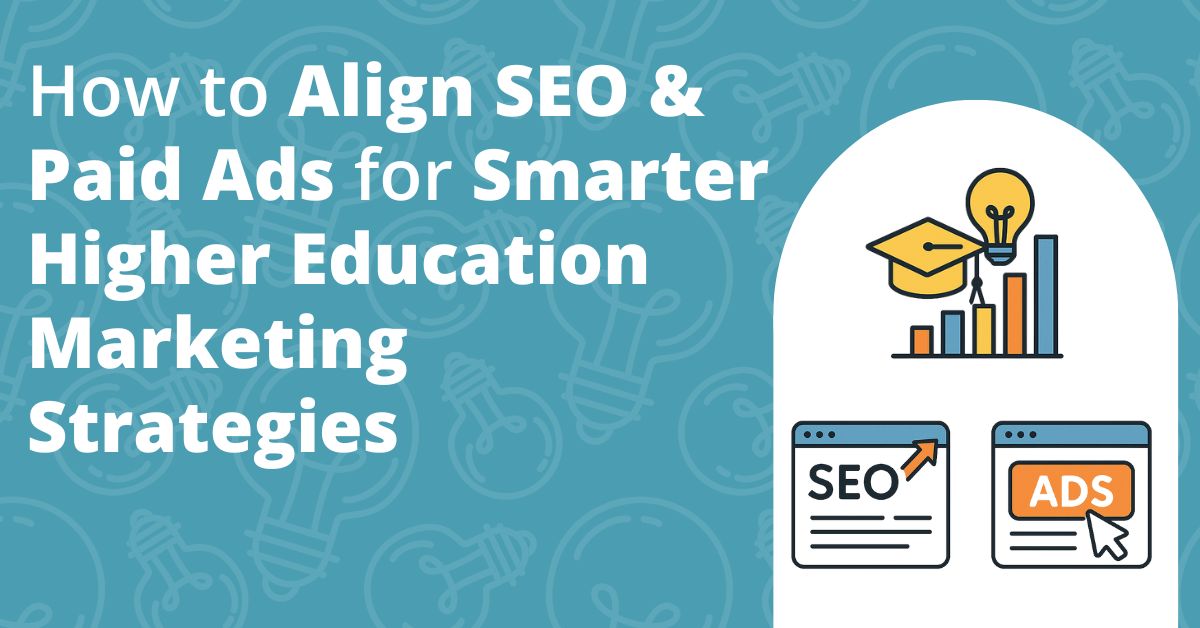
  • Higher Education Marketing Strategies: Align SEO & Paid Ads for Smarter Results

    Higher Education Marketing Strategies: Align SEO & Paid Ads for Smarter Results

    Higher Education Marketing Strategies: Align SEO & Paid Ads for Smarter Results

    Key Insights

    • The modern student journey is multi-channel: Your marketing efforts must span search engines, social platforms, and AI tools.
    • SEO builds long-term visibility: SEO is a key strategy for sustaining awareness and reducing overall acquisition costs over time.
    • Digital ads deliver speed and precision: Paid ad placements boost visibility during critical enrollment windows and for time-sensitive offers.
    • Together, SEO and ads drive better results: Aligning both helps you maintain visibility and adapt to changing search behaviors.

    Today’s prospective students are intentional researchers in their college search.

    They explore degree programs, admissions requirements, and career outcomes on platforms like Google, ChatGPT, TikTok, and YouTube, often before visiting your website. To reach them during these early moments of consideration, your higher education marketing strategies must prioritize visibility across search engines, social platforms, and AI-driven tools.

    This is where SEO and digital ads work in tandem to keep your institution present, credible, and competitive.

    When aligned well, these tactics guide prospective students from first search to final enrollment with greater efficiency and impact.

    Search Engine Optimization (SEO) at a Glance

    Search Engine Optimization (SEO) at a Glance

    What is SEO?

    SEO stands for search engine optimization. It’s a long-term strategy that improves your website’s visibility in organic (non-paid) search results. This involves refining your content, technical structure, and site authority so your pages appear more prominently when prospective students search on platforms like Google, ChatGPT, and other AI-driven tools.

    In higher education, visibility at key points in the decision-making process directly impacts who finds your programs and who doesn’t. SEO helps your institution show up across the enrollment journey, from early awareness to application. When your site is optimized effectively, it becomes easier for students to find the information they need and easier for you to convert interest into action.

    Why is SEO important for higher education institutions?

    SEO is important for higher education institutions because it helps your programs appear where student intent begins. Research shows that 68% of online experiences start with a search engine, making visibility in those early interactions critical for attracting qualified prospects.

    Today’s students are self-directed and often explore degree options, admissions requirements, and tuition costs on their own, sometimes weeks or months before they ever reach out to an academic institution. If your content doesn’t surface during that initial research phase, your school may never make the shortlist.

    By investing in SEO, higher ed institutions build lasting authority, credibility, and trust. It reinforces your brand presence without relying entirely on paid channels and sets the foundation for long-term enrollment growth.

    What are the benefits of higher education SEO?

    A strong SEO strategy does more than drive traffic. It brings the right traffic. In aligning your content with what prospective students search, you improve visibility and engagement at every stage of the recruitment pipeline.

    Some of the leading benefits of higher education SEO include:

    • Capturing high-intent search traffic from students actively searching for programs like yours
    • Supporting content marketing by making blogs, guides, and admission web pages more discoverable
    • Improving user experience through technical SEO that enhances site speed and mobile responsiveness
    • Boosting credibility with higher rankings, rich snippets, and inclusion in AI Overviews and other AI-powered search features
    • Enabling smarter decisions through keyword research and user behavior analytics
    • Strengthening long-term visibility as ad costs rise and search algorithms evolve

    SEO is not just a marketing add-on. It’s a strategic asset that improves performance across digital channels. When done well, it strengthens your institution’s credibility and reaches students where they’re actively searching.

    What does higher education SEO entail?

    Higher education SEO requires a strategic approach that reflects how 1) students search and 2) how modern search engines and AI platforms process content. It focuses on clarity, structure, and alignment with user intent.

    Key elements of a higher education SEO strategy include:

    • Conducting keyword research based on student goals, questions, and decision-making stages
    • Using entity-based and semantic SEO to match how AI systems interpret and connect information
    • Optimizing on-page elements like meta tags, headers, and image alt text
    • Creating evergreen content such as program pages, tuition details, and frequently asked questions
    • Improving technical performance through mobile-friendly design, fast load times, and structured data
    • Strengthening internal linking and earning high-quality citations from trusted sources
    • Monitoring performance metrics and adjusting tactics to respond to algorithm changes and user behavior

    This ongoing work creates a structured foundation that helps your institution remain relevant across traditional and AI-driven search platforms.

    Digital Advertising (Paid Ads/Pay-Per-Click) at a Glance

    Digital Advertising (Paid Ads/Pay-Per-Click) at a Glance

    What are digital paid ads/PPC?

    Digital paid advertising refers to any online campaign where you pay to promote your content, programs, or brand across platforms where prospective students spend time. These ads can appear in search results, on social media feeds, within videos, or across websites through display networks.

    PPC, or pay-per-click, is one of the most common payment models used in digital advertising. Instead of paying for impressions, you’re charged only when someone clicks your ad. In this way, paid advertising describes the strategy, while PPC refers to how you’re billed.

    Common platforms include Google Ads for search and display, Meta (Facebook and Instagram) for interest-based targeting, YouTube for video promotion, and programmatic networks for broader reach. Each offers a different way to connect with prospective students based on their behaviors, demographics, and intent.

    Why should digital advertising be part of your higher ed marketing strategy?

    Digital advertising is a vital tool for reaching students during critical decision-making windows. Unlike organic strategies, which take time to gain traction, paid ads offer “immediate” visibility in high-traffic environments like search results and social feeds. This immediacy is especially valuable during application pushes, event promotions, or when organic rankings fluctuate.

    For colleges and universities competing for attention in crowded markets, digital ads offer the agility to respond to shifting trends and student behavior in real time. They also create a clear path to visibility when SEO alone can’t secure top placement, especially for high-volume, high-competition keywords.

    When time-sensitive goals are at stake, paid ads allow you to act quickly, focus your message, and precisely reach your target audience.

    What are the benefits of digital ads?

    Digital ads offer a level of control, speed, and insight that is difficult to achieve through other channels. With the right setup, you can run targeted campaigns that respond to real-time behavior and performance data.

    Benefits of digital ads include:

    • Fast results, bringing qualified traffic to your site shortly after a campaign launches
    • Trackable performance that allows you to connect ad spend to inquiries and applications
    • Targeting precision based on factors like location, age, device, interests, or behavior
    • Budget efficiency through dynamic allocation based on campaign performance
    • Seasonal flexibility to scale campaigns up or down as enrollment cycles shift
    • Campaign testing to compare messages, creative formats, and calls to action
    • Retargeting power to re-engage visitors who left your site without taking the next step

    Well-executed campaigns go beyond visibility gains. They deliver measurable insight into which messages and channels are driving potential students to act.

    What does a digital advertising strategy entail?

    A strong digital advertising strategy involves setting clear goals, targeting a well-defined audience, and choosing ideal platforms for delivery. This helps your institution stay adaptable while reaching students where they spend their time online.

    Key elements of a digital advertising strategy include:

    • Identifying high-intent keywords and audience segments by program, location, age, and behavior
    • Choosing platforms that align with campaign goals, such as Google, YouTube, Meta, LinkedIn, or display networks
    • Writing ad copy, headlines, and landing pages tailored to each platform and audience
    • Designing creative assets that reflect your brand and support campaign objectives
    • Setting budgets, bids, and targeting rules by geography, demographics, or device
    • Launching campaigns with tracking to measure clicks, inquiries, and conversions
    • Adjusting creative, targeting, and spend based on performance
    • Retargeting visitors who viewed your site but didn’t convert

    This coordinated approach helps higher ed marketers reach the right students at the right time while maintaining full visibility into campaign success.

    Why SEO and Digital Paid Ads Work Better Together

    Why SEO and Digital Paid Ads Work Better Together

    When used together, SEO and digital ads give you better control over how and when students discover your programs. They serve different purposes but share the same goal: helping your institution show up, build trust, and guide prospective students toward taking the next step.

    Maximize visibility in search results

    Running both SEO and paid search campaigns lets your institution appear in multiple positions on a single results page. This increases your visibility, reinforces brand credibility, and reduces the likelihood of competitors taking that spot instead.

    Drive traffic while SEO gains traction

    SEO is a long-term, yet sustainable, investment. Paid ads help you stay visible in the meantime, especially when launching a new program or entering a competitive market. While your organic rankings build, ads keep inquiries flowing.

    Test messaging before you commit

    Digital ads allow you to quickly test headlines, descriptions, and offers. The best-performing messages can then be applied to SEO page titles, meta descriptions, and even on-page content, improving both click-through rates and relevance.

    Validate keywords with real results

    Paid search shows you which keywords actually drive clicks and conversions. This data can guide your SEO strategy by helping you focus on the terms students search most often and respond to rather than relying solely on keyword tools.

    Retarget prospects who leave

    SEO may attract the initial visit, but not every student is ready to apply right away. With paid ads, you can retarget those visitors and keep your institution top of mind, especially during high-stakes decision windows.

    Lower CPC with better landing pages

    SEO principles like clear structure, fast load times, and relevant content can improve your ad landing pages. This often leads to higher Quality Scores in Google Ads, which reduces your cost-per-click and increases return on ad spend.

    Share data to make smarter decisions

    When SEO and paid ad teams work together, both channels benefit. Search terms, audience behavior, and performance metrics from one can shape strategy for the other, leading to stronger messaging, better targeting, and higher conversion rates.

    How to Align Your Strategy and Budget with Goals

    A thoughtful, comprehensive marketing plan considers how SEO and paid ads contribute at different points in the recruitment cycle. While both digital marketing strategies play a unique role, aligning your investment with your institutional goals (rather than dividing tactics by default) helps you make more strategic, data-informed decisions.

    Use SEO for:

    Building visibility for evergreen content

    Program pages, admissions FAQs, and degree outcomes are high-interest assets that students search for year-round. SEO ensures these pages consistently rank and remain discoverable across enrollment cycles.

    Answering long-tail, high-intent questions

    Students often search with specific phrases like “best online MPH programs for working adults.” Optimizing for these longer queries helps your content meet students at key decision-making moments.

    Strengthening authority over time

    Search engines and AI platforms reward content that demonstrates expertise and trust. By publishing helpful, on-topic SEO content regularly — and earning backlinks and citations from reputable sources — you signal authority over time and improve your chances of ranking across high-impact search terms.

    Supporting decision-making after inquiry

    SEO helps prospective and admitted students find the content they need after expressing interest, such as financial aid resources, enrollment steps, and orientation details. Optimizing this type of content ensures your institution remains visible and helpful beyond the initial click.

    Reducing long-term CPI

    Unlike paid ads, organic traffic doesn’t require a cost per click. A strong SEO foundation lowers dependency on paid placements over time, driving qualified leads while keeping cost per inquiry (CPI) in check.

    Use digital ads for:

    Accelerating time-sensitive goals

    Campaigns tied to deadlines, events, or scholarships need instant visibility to drive action. Paid ads allow you to deliver focused, high-priority messages exactly when timing matters most.

    Launching new programs or locations

    New academic offerings or secondary campuses often lack the organic search authority to rank well early on. Paid ads help you build awareness and attract early interest while SEO efforts gradually take hold.

    Competing on high-volume search terms

    For highly competitive keywords where top rankings are difficult to secure, paid ads keep your institution visible. This ensures you’re not missing out on critical traffic during peak search activity.

    Testing and refining your message

    Digital campaigns offer a fast, low-risk way to test headlines, offers, and positioning statements. Use this performance data to gain insights, inform future updates, and shape messaging across other channels.

    Reaching segmented or niche audiences

    With detailed targeting options, paid ads let you focus on specific groups, like adult learners, out-of-state students, or those interested in a particular program. This helps extend your reach beyond what organic search alone can deliver.

    Questions to help allocate budget

    Before deciding how much to invest in SEO or digital ads, it’s important to clarify the goals, timeline, and audience of each initiative. Use the following questions to guide a smarter, more intentional allocation of resources:

    • Is this a short-term campaign or a long-term visibility play?
    • Do you already rank organically for target keywords, or are you starting from scratch?
    • Are you trying to increase awareness, generate inquiries, or drive completed applications?
    • What is the lifetime value of the program or student audience you’re targeting?
    • Do you need geographic or behavioral targeting that SEO alone can’t deliver effectively?
    • What insights from past campaigns can inform your channel mix for this initiative?

    Think of SEO as the groundwork for sustained visibility and trust, while paid campaigns offer speed and flexibility. By evaluating timing, audience intent, and program priorities, you can allocate budget where it makes the most impact.

    Create a Stronger Higher Education Marketing Strategy

    The most effective higher education marketing strategies don’t rely on a single channel. They align tactics to meet student expectations at every stage of their search journey.

    By pairing long-term organic visibility through SEO with the immediacy and precision of digital advertising, your institution will reach more prospective students, guide them through complex decisions, and support better outcomes from first search to final enrollment.

    If you’re looking for a more intentional way to prioritize your marketing efforts and budget, we’d be honored to help. Download “Solve Your Higher Ed Marketing Puzzle With SEO and Paid Digital Ads” to learn how to:

  • Focus on the tactics that make the biggest enrollment impact
  • Reduce wasted spend and improve lead quality
  • Increase conversions with personalization, testing, and retargeting
  • Tie campaign performance to ROI metrics that matter to leadership
  • See how you can integrate SEO and paid advertising to power your enrollment pipeline today.


    Image Credits:

    Unsplash , Unsplash and Pexels

  • UPCEA Guest Blog: Alison Zeringue on Using SEO + PPC in Higher Ed Marketing

    UPCEA Guest Blog: Alison Zeringue on Using SEO + PPC in Higher Ed Marketing

    Table of Contents

    Search Influence’s Director of Account Management, Alison Zeringue, is helping higher education marketers rethink their digital strategies in her latest UPCEA guest post: “Digital Marketing Strategy for Higher Education: Drive Enrollment With SEO and PPC.”

    In the blog, Alison highlights why schools can no longer rely on SEO or paid ads alone.

    Today’s student search behavior is fragmented across AI Overviews, social media platforms, and traditional search engines.

    To compete, institutions must build integrated campaigns that engage prospective students, wherever discovery happens.

    A magnifying glass

    Reaching Students in a Fragmented Search Landscape

    The modern student search journey is no longer linear. Students may watch a TikTok video, ask ChatGPT for degree comparisons, browse Google AI Overviews, or click a retargeted Instagram ad, all within the same day.

    Without a unified digital strategy, schools risk losing visibility at critical touchpoints. Alison explains how aligning SEO and PPC helps institutions close those gaps.

    SEO builds brand authority and improves organic visibility in both traditional search results and AI-generated summaries. Paid ads provide guaranteed placement in high-intent moments, supporting awareness, lead generation, and enrollment conversion.

    When combined, these tactics ensure your institution shows up consistently, guiding prospective students through every stage of their decision-making process.

    Building an Integrated Strategy That Drives Results

    A graphical representation of connections

    In her guest post, Alison offers actionable advice for bringing SEO and paid efforts into alignment. She covers how to:

    • Structure SEO content for AI-driven search
    • Build funnel-specific paid campaigns that match student intent
    • Use cross-channel insights to refine targeting and messaging

    As she emphasizes, schools that take a siloed approach will struggle to compete as AI-powered search and social search reshape how prospective students explore their options.

    Build a Smarter Enrollment Funnel

    If your team is ready to bring its marketing strategy in line with today’s search behavior, Alison’s blog is a valuable starting point.

    To go deeper, download our white paper: 7 Strategies to Create a Successful Education Marketing Campaign. It expands on many of the same themes, offering a practical, student-centered framework to help you:

    • Map the full enrollment funnel based on how students actually search
    • Align website content, paid media, and email nurturing to engage prospects at each stage
    • Build a cross-channel marketing strategy that drives more inquiries and conversions


    The white paper is built for higher ed marketers looking to drive measurable enrollment outcomes, not just traffic. If you’re ready to rethink your strategy, this is the resource to guide your next steps.

    Download the white paper to start building a stronger enrollment marketing foundation.

    Images:
    Unsplash
    Unsplash

  • How to Market Microcredentials for Maximum Program Visibility

    How to Market Microcredentials for Maximum Program Visibility

    How to Market Microcredentials for Maximum Program Visibility blog graphic

    Key Insights

    • Microcredentials are on the rise as adult learners, career changers, and working professionals seek faster, more affordable ways to gain in-demand skills.
    • Unlike traditional degrees, microcredential enrollment funnels are short, fast-moving, and often self-directed. Learners may enroll within days, not months.
    • Messaging that resonates with microcredential audiences emphasizes job relevance, flexibility, and immediate outcomes, rather than campus life or long-term learning.
    • A strong cross-channel strategy, spanning SEO, paid ads, social, and email, is essential to reach today’s learners where they are and convert interest into action.

    If your institution is offering microcredentials but struggling to fill seats, the issue might not be the program. It may be the marketing.

    Microcredentials are short, skills-based credentials built for speed, flexibility, and career impact. They appeal to learners seeking advancement without the commitment of a full degree. To meet rising market demand, many institutions have expanded non-degree offerings to accommodate microcredentials and stay competitive. 

    According to Coursera’s 2024 Micro-Credentials Impact Report, 51% of higher ed leaders globally now offer microcredentials as part of their curricula.

    Yet many are still applying degree-style marketing to a very different kind of learner.

    Microcredential audiences move quickly. They prioritize outcomes over campus life and expect easy, immediate access to information. Reaching them requires a distinct, streamlined strategy that reflects how they search, decide, and enroll.

    To boost your visibility and connect with these learners, follow these best practices for marketing your microcredentials.

    Why Are Microcredentials Gaining Popularity?

    People working on laptops and tablets at a coffee shop

    Shifting demographics are reshaping higher ed

    The traditional college-aged population is declining, creating enrollment challenges for institutions that have long relied on recent high school graduates. As the demographic cliff approaches, colleges and universities are looking to expand their reach to a new target audience, especially adult learners, career changers, and working professionals seeking practical options.

    Millions are seeking an accessible path forward

    According to UPCEA, more than 40 million adults in the U.S. have some college credit but no credential. Many of these individuals face external pressures (full-time employment status, financial strain, and family responsibilities) that make returning for a traditional bachelor’s degree difficult. Microcredentials, especially affordable and stackable ones, offer a flexible alternative for advancing professionally.

    Economic pressures are driving new priorities

    Over the past few years, rising education costs and mounting student debt have changed how people evaluate their learning investments. Many learners now prioritize programs that are affordable, low-risk, and lead to near-term career benefits. Microcredentials check all three boxes, offering focused, skill-based continuing education without the long-term commitment of a degree.

    Employers are hiring for skills, not just degrees

    Employers are increasingly prioritizing job-ready skills over traditional credentials. Microcredentials allow learners to gain and showcase specific, in-demand abilities that align with job market needs. Morning Consult research found that 81% of employers believe they should consider skills versus degrees when hiring. In many industries, demonstrable competencies are more valuable than academic transcripts. 

    Marketing Microcredentials vs Traditional Degrees

    Marketing funnel differences

    Microcredentials attract a different kind of learner, which means the path to enrollment also looks different. While traditional degrees involve extended timelines and multiple stages of engagement, microcredentials often require quick, outcome-driven decisions.

    Traditional degree funnels typically involve:

    • Long consideration periods, often spanning several months to a year
    • Fixed application windows and admissions cycles
    • Emphasis on relationship-building, exploration, and multiple touchpoints before enrollment
    • Decisions influenced by long-term academic or personal goals

    Microcredential funnels, by contrast, are defined by: 

    • Short decision-making windows — learners may enroll within days of discovering a program
    • Rolling or frequent start dates that demand consistent promotion
    • Higher expectations for fast outcomes, affordability, and convenience
    • Learners motivated by immediate career needs, not long-term campus experiences

    The enrollment process also plays a role. Some microcredential offerings are self-serve, allowing learners to register and start immediately without applying. Others still involve an application or review process. Knowing which type you’re marketing, application-based or on-demand, will shape how you message urgency, availability, and next steps. 

    Marketing messaging differences

    Microcredential learners are goal-oriented, and your messaging needs to match that mindset. Unlike traditional students who may be drawn in by campus culture or the promise of a four-year journey, microcredential prospects are focused on immediate, practical learning outcomes.

    Traditional degree marketing often emphasizes:

    • Institutional reputation and academic prestige
    • Campus life, student community, and support services
    • Long-term growth and personal development
    • Deep subject immersion over multiple years

    This messaging supports a slower decision cycle where students take time to explore, attend events, and speak with admissions counselors.

    Microcredential marketing requires a different focus. Your content should highlight:

    • Clear career relevance and targeted skill development
    • Fast, flexible online learning formats that fit into real life
    • Tangible ROI, like job advancement, new credentials, or salary increases
    • Social proof and real-world outcomes through testimonials or employer partnerships

    Concise, career-focused messaging is key to building trust and driving action, especially when your audience is ready to move.

    Since many microcredential learners bypass traditional touchpoints like info sessions or one-on-one meetings, your digital content must do more heavy lifting. Messaging across your website, ads, and email campaigns needs to quickly answer core questions such as: Is this relevant to my goals? How quickly can I start? What will this do for my career?

    Aligning Your Microcredential and Graduate Program Marketing

    To market microcredentials effectively, you need to understand how they relate to your existing graduate programs. Are they meant to stand alone, or are they part of a larger academic pathway?

    Start by defining the relationship

    Clarifying the purpose of each offering helps avoid mixed messaging and ensures that your marketing reflects the learner’s intent.

    Microcredentials often appeal to learners exploring a field, building targeted skills, or seeking quick career advancement. These are typically short-term career goals. Graduate programs, by contrast, attract those ready to invest in long-term academic or professional growth.

    Connect the path when it makes sense

    If both options fall under the same subject area, consider framing your marketing around the learner’s goals rather than the credential type. 

    Positioning microcredentials as an on-ramp, not just an alternative, helps fuel engagement across all your program types. It reinforces long-term value while meeting learners where they are now.

    For example: Instead of promoting a “Digital Marketing Microcredential” and an “MS in Marketing” as separate tracks, position them together as “Marketing Programs for Every Stage of Your Career.” This approach helps prospective students understand how various educational programs fit into a broader professional path.

    There’s still value in marketing each program individually, but building cross-awareness can strengthen both funnels. If your microcredentials are stackable, make that progression clear in your messaging and visuals. Show how learners can move from a single course to a certificate or a digital badge, and eventually to a master’s degree if they choose.

    How to Market Microcredentials With a Cross-Channel Approach

    A chess piece being moved on a chess board

    To reach today’s fast-moving, outcome-driven students, you need a coordinated presence across search, social, and email. Microcredential learners don’t follow a single path to enrollment, so your marketing strategy shouldn’t rely on a single channel. 

    SEO

    Roughly 68% of online experiences begin with a search engine, according to Ahrefs. For prospective learners, that makes SEO the natural first touchpoint, and a critical one. Whether they’re comparing options, looking for a specific skill, or exploring career next steps, your program pages need to rank and resonate.

    Start by creating dedicated pages for each microcredential, and structure them around what your audience cares about most:

    • What new skills they’ll gain
    • How the program is delivered (online, hybrid, self-paced)
    • How long it takes and how much it costs
    • Who’s teaching it and what kind of outcomes students can expect

    Include strong, clear CTAs and support your value proposition with testimonials, employer recognition, or career placement stats when available.

    To improve visibility, optimize for long-tail keywords that reflect specific intent, such as:

    • “How to earn a microcredential in [topic]”
    • “[Topic] online course for working professionals”
    • “Affordable short-term certificate programs in [industry]”

    You should also support your SEO efforts with blog content that answers common questions and reflects search intent. Topics like career outcomes, comparisons to bootcamps, or time and cost advantages can help draw in qualified traffic while positioning your institution as a helpful resource.

    Paid search

    While SEO builds long-term visibility, paid search helps you capture demand in the moment, especially from learners who are ready to take the next step. By targeting high-intent keywords, you can reach prospective students actively searching for fast, flexible learning options.

    Focus your campaigns on search terms that reflect urgency and career motivation, such as:

    • “[Topic] certificate online”
    • “Short course in [field]”
    • “Learn [skill] online”
    • “Career-focused [topic] course”

    Ad copy should speak directly to what matters most to microcredential learners:

    • Career outcomes: What can they do or achieve after completing the course?
    • Time to completion: Use specifics like “Gain skills in 6 weeks” to set clear expectations
    • Cost transparency: Highlight affordability with phrases like “Only $399” or “Job-ready training for less”
    • Learning format: Reinforce convenience with “100% online education,” “Self-paced,” or “Evening-friendly” messaging

    When done well, paid search drives more than traffic. It drives action. Use your landing pages to reinforce the value promised in your ad, making it easy for learners to take the next step without unnecessary friction.

    Paid social & display

    Paid social and display advertising are powerful tools for expanding your reach and reinforcing program awareness. These channels connect you with prospective learners where they’re already spending time, whether they’re scrolling LinkedIn during a work break or browsing Facebook after hours.

    Use platforms like LinkedIn and Meta to deliver tailored messaging that reflects where someone might be in their decision process:

    Awareness

    • Target by job title, industry, or interests to reach learners who may not yet know about your program
    • Focus on big-picture benefits like career change, flexibility, or upskilling
    • Use headlines like “Break into tech without a degree” or “Get ahead in healthcare. No long-term commitment required.”

    Consideration

    • Highlight program features: length, cost, format, and career outcomes
    • Use short videos or carousels to showcase what learners can expect
    • Highlight learning from experienced faculty who double as industry leaders
    • Keep messaging focused and benefit-oriented: “Gain job-ready skills in just 8 weeks” or “Fully online, on your schedule, courses”

    Decision

    • Reinforce urgency with enrollment deadlines, limited-time offers, or next steps
    • Use testimonials, student quotes, or employer recognition to build trust
    • Retarget those who’ve visited your website or interacted with earlier ads but haven’t yet enrolled

    Well-timed, well-targeted social and display ads help keep your microcredential programs visible and relevant, especially for learners who need a few reminders before they’re ready to commit.

    Organic social

    Organic social media marketing plays a long game. It helps your institution stay present, build credibility, and create meaningful connections with prospective learners over time.

    With social search on the rise, platforms like LinkedIn, Instagram, and Facebook are becoming key discovery tools for those exploring career paths and educational opportunities. A strong presence here highlights the real value of your microcredential programs through authentic, relatable content.

    Share content that reflects learner goals, outcomes, and lived experiences:

    • Career wins: “How I landed a new job three months after earning my certificate”
    • Industry insights: “Top 3 skills employers want in [field] right now”
    • Behind the scenes: “What it’s like to take this course as a working adult”

    Short-form videos, alumni spotlights, and faculty features give your program dimension and authenticity. Focus on flexibility, support, and real-world impact, all core themes that resonate with busy professionals looking to level up.

    A thoughtful organic social presence reinforces the credibility of your program and helps prospective learners see themselves in the experience you offer.

    Email nurture campaigns

    Email marketing is one of the most effective ways to keep prospective learners engaged after their initial inquiry. With the right segmentation and sequencing, email nurture campaigns guide students from interest to enrollment, while reinforcing the value of your microcredential programs along the way.

    Start by segmenting your audience based on what matters most: program interest, learner intent, or stage in the decision-making process. Then build a sequence that delivers timely, relevant content with a clear next step.

    A sample 3-email sequence might look like this:

    • Email 1: Welcome + program overview: Introduce the microcredential, who it’s for, how long it takes, and how it’s delivered. Reinforce accessibility and flexibility.
    • Email 2: Career outcomes + student story: Focus on the real-world value. Share a testimonial or brief case study that shows how past learners applied the credential to advance their careers.
    • Email 3: FAQs + next steps: Address common questions about cost, deadlines, or course requirements. End with a strong, direct CTA that encourages action.

    Calls to action like “Start now,” “View your course options,” or “Get your questions answered” can make a big difference when timed right. The goal is to stay helpful, human, and focused, offering just enough information to move learners forward without overwhelming them.

    Turn Microcredential Interest Into Enrollment

    A successful microcredential marketing strategy doesn’t exist in a silo. It works best when it’s part of a larger, student-centered, cross-channel approach. 

    From SEO and paid search to social and email, your campaigns should reflect how today’s learners search, engage, and ultimately make decisions.

    Search Influence is a higher education digital marketing agency that helps institutions market everything from short-term certificates to full degree programs. We know how to tailor strategies based on learning format, audience intent, and funnel stage, so you can meet prospective students with the right message at the right moment.

    Not sure where to begin? Let’s start by evaluating what you’re already doing. 

    See where your microcredential marketing stands

    Our Self-Assessment for Higher Education Marketers includes seven proven strategies to strengthen your campaigns, covering everything from program pages and CTAs to video, lead generation, and remarketing.

    It’s designed to help your team build full-funnel, cross-channel campaigns that turn awareness into enrollment and position your institution for long-term success.

    Download the self-assessment and start identifying your next best opportunities today.

    Images:
    Unsplash
    Unsplash

  • How to Reduce CPI in Higher Ed Without Sacrificing Lead Quality

    How to Reduce CPI in Higher Ed Without Sacrificing Lead Quality graphic

    Key Insights

    • Not all inquiries are equal. Tracking lead quality ensures your budget supports those most likely to enroll.
    • Lowering cost per inquiry only works if you maintain your focus on lead quality.
    • When your targeting, messaging, and landing pages work together, you eliminate waste that inflates CPI.
    • Setting clear conversion goals and refining keyword strategies helps ad platforms deliver stronger leads at lower costs.
    • With a higher education marketing agency, you gain the strategic support needed to reduce CPI without compromising results.

    If you’re a higher education marketer already tracking and measuring cost per inquiry (CPI), you know the goal isn’t just spending less. It’s making every dollar count toward the right prospective students.

    However, the challenge is lowering CPI without losing the quality leads that fuel your enrollment pipeline. That means looking beyond quick fixes and closely examining lead quality, campaign performance, audience targeting, landing page experience, and how well your marketing efforts are aligned with student intent.

    Here’s how to reduce CPI with intention, while keeping your pipeline strong and your recruitment goals on track.

    The State of Higher Ed Cost Per Inquiry

    Driving down CPI starts with context. Without a clear understanding of where your institution stands, it’s impossible to know whether you’re optimizing effectively — or leaving budget on the table. 

    Do your campaigns match student intent? Are your landing pages converting efficiently? Are you capturing qualified leads, or just cheaper ones?

    Search Influence and UPCEA’s 2024 Higher Ed Marketing Metrics Research Report: What Gets Measured Gets Managed offers valuable insight into typical performance across program types.

    According to the report, professional and online education programs spend an average of $800,970 annually on digital advertising, representing about 3.6% of total revenue. The average CPI varies by program:

    • $140 for online and professional education
    • $128 for undergraduate programs
    • $157 for graduate programs
    • $51 for noncredit programs

    These benchmarks give higher education institutions a practical frame of reference. If your CPI is significantly above these figures, it’s worth digging deeper. 

    Once you have a clear baseline, the next step is knowing where to focus. Below, we break down how to reduce CPI without sacrificing the quality of your inquiries.

    How to Reduce CPI at Your University

    Money being taken out of a wallet

    Refine your conversion goals to capture more leads

    Defining success from the start helps your campaigns target the right audiences, improve efficiency, and generate quality leads that convert — setting the stage for a lower, more effective CPI. Ad platforms work best when they know exactly which action to optimize for, so setting the right conversion goals is essential.

    If your campaigns aren’t clearly aligned with inquiries, applications, or enrollments, you risk wasting spend on leads that look good on paper but don’t move the needle. 

    Tips for refining your conversion goals

    Align internally and with your agency on primary KPIs

    Start by building alignment across internal teams and agency partners on the key performance indicators (KPIs) that matter most in your current campaigns. Whether you’re focused on inquiries, applications, or enrollments, having shared goals ensures everyone is working toward the same outcomes. This clarity sets the foundation for smarter decision-making, more focused reporting, and campaigns that support institutional priorities.

    Define what counts as a true lead for your institution

    Once your KPIs are established, determine which actions reflect meaningful progress in your enrollment funnel. Brochure downloads, event registrations, contact forms, and applications each signal different levels of intent. While all have value, not all carry the same weight when it comes to lead quality. By identifying which actions qualify as a true lead, you can set smarter conversion goals and ensure your campaigns focus on attracting the prospects most likely to take the next step.

    Set and map conversion goals across the funnel

    With lead definitions in place, assign clear conversion objectives that align with each campaign’s role in the funnel. Awareness-stage campaigns might focus on brochure downloads or event sign-ups, while decision-stage efforts should optimize for inquiries or applications. Matching your goals to user intent gives ad platforms better direction and allows you to measure ROI more accurately across each stage of the enrollment journey.

    Help platforms optimize with consistent signals

    Focus on a small set of high-value conversion actions to give ad platforms the data they need to optimize effectively. When too many different actions (like clicks, page views, or form fills) are tracked as conversions, platforms like Google and Meta struggle to prioritize what matters the most. Their machine learning systems rely on clear, consistent signals to identify patterns, refine targeting, and improve delivery over time. The more reliable the inputs, the stronger your marketing performance and the more optimized your ad spend.

    Restructure campaigns to support focused goals

    As your conversion goals and targeting strategies evolve, make sure your campaign structure reflects those priorities. Grouping campaigns by funnel stage, audience segment, or program type gives platforms cleaner signals and helps you more easily evaluate performance. Taking the time to restructure upfront creates a more efficient optimization process and a clearer path to lowering costs without compromising lead quality.

    Track lead quality to reach the right students

    Tracking and acting on lead quality ensures your marketing budget is spent generating meaningful conversions, not just a higher volume of them. Fine-tuning your conversion objectives can increase volume, but without insight into lead quality, you risk filling the funnel with prospects who are unlikely to enroll. 

    When you monitor how inquiries perform beyond the first click, you can make data-driven decisions about targeting, messaging, and spending, ultimately improving efficiency and enrollment outcomes.

    Tips for tracking and leveraging qualified leads

    Start with a manual lead review

    Begin by manually reviewing individual lead submissions to evaluate quality up close. Ask yourself, “Is this the type of prospective student we want more of?” This quick exercise helps you spot patterns in form fills, like missing information, off-target program interest, or low engagement signals. It also gives you immediate feedback to refine targeting, messaging, or creative in real time, long before more complex attribution models kick in.

    Measure lead quality by campaign or platform

    Once you understand what makes a lead valuable, evaluate how each campaign or platform contributes. Go beyond volume and calculate the percentage of leads from each source that meet your quality criteria. Comparing cost per qualified lead (CPQL) gives you a more accurate picture of performance and helps you identify which channels drive meaningful inquiries — and which may inflate your numbers without adding enrollment value.

    Monitor enrollment outcomes, not just form fills

    An inquiry is only part of the story. To truly evaluate performance, track how leads progress through key stages like application submission and enrollment. This helps separate campaigns that generate lasting impact from those that attract surface-level interest. By focusing on outcomes that reflect your enrolled student goals, you can make more informed decisions about where to invest and where to pull back.

    Score and automate lead qualification in your CRM

    Manage, score, and qualify leads directly in your CRM software to make lead quality measurable. Start by assigning values based on criteria like program interest, verified contact details, or secondary engagement. This will help your team prioritize follow-up and identify which inquiries are most likely to convert. 

    Whenever possible, automate this process. Set up rules that flag high-quality leads in real time, reduce manual review, and ensure your best prospects don’t fall through the cracks. A smart qualification system speeds up decision-making and gives you a consistent framework for evaluating performance across campaigns.

    Use CRM insights to guide optimization

    After your leads have been scored and stored in your CRM, use that data to inform campaign decisions. Look for patterns among your most qualified inquiries. Where did they come from? What messaging resonated? Which programs attracted the strongest potential students? These insights allow you to refine your targeting and creative strategies with a focus on what’s working, not just what’s getting clicks.

    Feed qualified lead data back into ad platforms

    Take your insights one step further by feeding qualified lead data back into platforms like Google and Meta. By sharing first-party CRM data through tools like Google Offline Conversions or Meta Conversions API, you give platforms the signals they need to optimize for leads that match your enrollment goals, instead of just low-cost conversions. This can significantly improve targeting and reduce wasted spend.

    Build a closed-loop optimization system

    Integrate your CRM, lead scoring, and ad platforms to build a feedback loop that improves campaign performance over time. When qualified lead data flows both ways — from your campaigns into the CRM, and the CRM back into platforms like Google and Meta — you enable smarter targeting, faster optimization, and better use of your budget. 

    This closed-loop system requires effort to set up, but it’s one of the most effective ways to consistently lower CPI while improving lead quality.

    Identify where your Google Ads spend is going to waste

    Refining your keyword strategy avoids wasted spend in Google Search campaigns. Even well-targeted ads can lose efficiency if they’re triggered by irrelevant or low-intent queries. Fortunately, Google Ads shows you the exact terms users searched before clicking, giving you the insight needed to spot misalignment and adjust your targeting before your budget goes off track.

    Tips for finding and fixing wasted Google Ads spend

    Review the Search Terms Report regularly

    Take time to review the search terms triggering your ads to ensure your spend is aligned with your goals. The Search Terms Report reveals what users are typing, not just the keywords you’ve selected, making it easier to catch off-topic or low-intent traffic early. Regular checks help you identify patterns, remove distractions, and keep your campaigns focused on reaching the right target audiences.

    Spot irrelevant search matches

    Not every click is a good one. Look for queries that fall outside the scope of your programs or audience, especially those that suggest confusion about your offerings. For example, if you’re promoting a “sports management degree” and your ad shows for “sports chiropractic school,” that’s a mismatch worth correcting. Flag these terms and add them as negative keywords to prevent further waste.

    Watch for keyword match type issues

    Your keyword match types directly influence how precisely your ads are served. Broad match keywords can open the door to a wide range of loosely related queries, some of which may not reflect your intent. If you’re seeing too many irrelevant impressions or clicks, consider tightening your targeting with phrase or exact match. This change gives you more control over how and when your ads appear.

    Refine your keyword targeting

    Use performance data to expand and adjust your keyword list based on what’s working. Test new terms that better reflect how your prospective students search and remove those that consistently underperform. This kind of proactive refinement helps you reach more qualified users and improves the efficiency of your marketing campaigns over time.

    Double down on high-performing terms

    When certain keywords consistently drive qualified inquiries, treat them as strategic assets. Increase budget allocation, build dedicated ad groups, and explore related variations to expand your reach. Prioritizing high-performing terms helps you scale what’s working and maximize impact without adding unnecessary spend.

    Prune your campaigns consistently

    Keyword lists can grow stale or bloated over time, pulling your campaigns away from their original focus. Set aside time for regular cleanup — removing underperformers, eliminating overlap, and tightening targeting to stay efficient. Campaign pruning helps you avoid wasted impressions, reduce spend on low-value clicks, and keep your strategy aligned with enrollment goals.

    Optimize and test landing pages to boost performance

    Testing and refining your landing pages allows you to pinpoint what drives action, whether you’re using existing site content or building standalone pages tailored to campaign goals. A well-placed ad is only effective if the landing experience meets the user’s expectations. 

    If the page doesn’t match the intent behind the click, whether in content, clarity, or design, you risk losing prospective student engagement and driving up your CPI.

    Tips for optimizing and testing landing pages

    Match message and intent across ads and landing pages

    Landing pages should deliver exactly what your ad promised. When the headline, tone, and call to action on the page reflect the user’s expectations, you’re more likely to keep them engaged and guide them toward conversion. This landing page best practice doesn’t just improve performance. It can also boost your Google Ads Quality Score, helping your campaigns become more cost-effective over time.

    Focus on a single, clear conversion goal

    Each landing page should revolve around one primary action. Make the path obvious, whether you want users to schedule a tour, download a brochure, or start an application. Avoid cluttering the page with competing links or mixed messages that can distract from your main objective. A clear, focused call to action (CTA) keeps users moving in the right direction and increases your chances of conversion.

    Limit form fields to essentials only

    Asking for too much information too early can discourage prospective students from completing your form. Stick to the essentials — only ask for what’s needed to qualify the lead or move them forward in the funnel. In a study of over 40,000 landing pages, HubSpot found that the use of complex form fields like drop-downs and multi-line text areas significantly decreased performance. To keep conversions high, simplify your forms and save additional questions for later.

    Incorporate social proof and trust signals

    Confidence plays a major role in whether users take action. Reinforce your message by adding elements like student testimonials, graduation rates, job placement stats, or recognizable affiliations. These trust signals help validate your offering and reassure prospective students that your programs deliver real value.

    Tailor the experience to the campaign type

    Not all campaigns serve the same purpose, and your landing page should reflect that. For Google Search, ensure the page aligns with the keyword’s intent and delivers immediate relevance. For Display campaigns, match the tone and content to the audience’s funnel stage, offering helpful next steps rather than a hard sell. Aligning page content with campaign context improves user experience and overall campaign performance.

    Consider creating dedicated landing pages when possible

    If your institutional website is difficult to update or shared across departments, standalone landing pages can give you the control and flexibility needed for campaign success. Dedicated pages make it easier to test messaging, customize layout, and iterate quickly, all without disrupting other parts of your site. When built with purpose, these pages can dramatically improve engagement and conversion rates.

    Audit and update regularly

    Even well-built landing pages need regular attention. Over time, content can become outdated, or changes made by other teams can unintentionally affect page performance. Set a schedule to revisit your campaign landing pages to check for accuracy, brand alignment, and effectiveness. Ongoing audits ensure your pages stay relevant, consistent, and ready to convert.

    Dedicated landing page success story

    At Search Influence, we’ve seen the impact that dedicated landing pages have on campaign performance metrics. 

    With our support, one client, leveraging HubSpot, implemented ad-specific landing pages designed to align closely with each campaign’s messaging and intent. Within just over two weeks, they generated 56 qualified submissions and saw their CPI decrease by nearly 50% compared to similar campaigns using standard website pages. 

    The ability to tailor content, streamline the user experience, and iterate quickly played a key role in achieving these results.

    Why Should You Hire an Advertising Agency to Help Reduce Your CPI?

    People working together in a meeting

    Reducing CPI is a complex process that requires a coordinated effort across campaign structure, targeting, tracking, and landing page performance. Even with the best intentions, it’s easy to get bogged down in the details, especially without dedicated resources or specialized expertise.

    Our Marketing Metrics Report shows that only 47% of higher ed marketers in online and professional education are satisfied with campaign performance. 

    Just 29% are confident in their ability to track results. 

    The link between the two is clear: 92% of those who are satisfied with tracking also report satisfaction with performance.

    If your internal team is stretched thin or struggling to connect strategy with outcomes, a higher ed-focused advertising agency can help fill the gap. With access to advanced tools, deep platform knowledge, and the capacity to focus solely on improving results, the right partner can bring clarity and control to complex campaigns and help you lower your marketing expenses with precision.

    Let’s Make Your Higher Education Marketing Dollars Work Smarter

    At Search Influence, we’ve spent nearly two decades helping colleges and universities improve campaign performance while optimizing their marketing budget. 

    Our team has actively shaped how the higher education sector defines and measures cost per inquiry. From benchmarking results to uncovering inefficiencies and implementing data-backed digital marketing strategies, we work alongside educational institutions to lower CPI without sacrificing lead quality.

    Ready to see where your campaigns stand? 

    Download our free CPI Worksheet to calculate your current CPI, evaluate your ROI, and pinpoint where your resources will go furthest. This resource offers actionable instructions for calculating your CPI for all your programs, by program type, and even assessing your cost per enrolled student.

    With the right insights, you won’t just spend smarter — you’ll recruit smarter.

    Images:
    Unsplash
    Unsplash

  • How to Market a New Program: Make SEO the Foundation of Your Higher Ed Marketing

    How to Market a New Program: Make SEO the Foundation of Your Higher Ed Marketing

    A person taking notes on a video they are watching on their computer

    Key Insights

    • Alternative credentials and other innovative program offerings are reshaping higher education. To successfully launch these programs, your institution needs a strategic approach tailored to its unique structure, appeal, and audience.
    • SEO ensures your program is visible to prospective students at the start of their search, putting your institution on their radar early and making it a critical component of your launch strategy.
    • A well-executed higher ed SEO strategy drives sustained traffic, boosts enrollment, and amplifies the impact of your other marketing efforts, all while saving time and resources down the road.
    • Our SEO Roadmap provides a step-by-step plan to help you market your new program effectively. It ensures maximum visibility through proper keyword research, content strategy, technical SEO, and link building. 

    Higher education institutions are adapting to meet workforce demands and shifting learner interests. This evolution introduces entirely new offerings, including microcredentials — short-term programs designed to provide flexibility, affordability, and career-aligned skills.

    Despite their growing popularity, many universities lack a clear, institution-wide strategy for effectively marketing these programs. Unlike traditional degrees, marketing credentials require a different approach — one that reflects their shorter duration, lower cost, and the fact that they are often purchased directly rather than requiring an application.

    To successfully promote any new academic offering, whether it’s a four-year degree or an alternative credential, search engine optimization (SEO) must be the foundation. This ensures the program gains visibility where today’s learners begin their search: online.

    If you’re launching a new program, here’s how to market it using SEO as the framework.

    Why Use SEO to Promote New Academic Programs

    SEO is your marketing foundation

    SEO isn’t an optional tactic; it’s the cornerstone of a successful higher education marketing strategy. As highlighted in our UPCEA webinar, “Top Trends for Your 2025 SEO Strategy to Attract the Modern Learner,” universities must change their view of SEO and integrate it from the start. 

    At its core, higher ed SEO focuses on improving your website, which is the central hub for all marketing activities. The student journey always leads back to your site, whether students arrive through paid search, social media, or email campaigns. A strong SEO foundation aligns your website with institutional goals, helps prospects find the information they’re looking for, and delivers measurable outcomes. 

    Adding SEO later or tackling it piecemeal limits your program’s reach and engagement potential.

    When you prioritize SEO from the outset, you save time and resources, eliminating the need to retrofit a more expensive website later.

    SEO reaches learners at the beginning of their search

    Search engines are a prime starting point for most learners exploring education opportunities. For example, according to EducationDynamics research, 70% of online college students rely on search engines as their first source of information when researching higher education institutions. 

    Failing to invest in strategic SEO for your new program means missing out on early-stage prospects, leaving your competitors to dominate the organic search results.

    SEO puts your institution on your prospect’s radar during the awareness stage. In the consideration stage, it fills a critical gap in being present when your prospects are actively searching for educational offerings. 

    SEO supports long-term growth

    SEO is one of the most sustainable strategies for promoting new programs.

    Unlike paid advertising, which stops driving traffic when campaigns end, SEO continues to deliver long-term advantages. Strong search engine rankings drive consistent website traffic and leads, even after the initial optimization work is complete. 

    SEO also enhances the success of your advertising campaigns. Your paid advertising efforts drive traffic to your website, where strong SEO ensures users find valuable, well-optimized content that encourages them to take the next step. 

    Combine SEO with other marketing efforts to create a synergistic strategy that boosts enrollment and maximizes your ROI.

    For instance, a prospective student may see your ad, conduct a follow-up Google search for your program, and land on your well-optimized page. Without SEO, they might struggle to find your program in search results, reducing the return on your ad spend. 

    SEO sets the stage for site-wide success

    Optimizing your new program page benefits your entire website. 

    SEO improvements made for one program can inform strategies for other pages, creating a ripple effect of improved rankings and organic traffic. For example, a student researching a credential in digital marketing might discover related offerings like a certificate in data analytics, increasing the likelihood of enrollment in multiple programs.

    Start by optimizing your new program page and testing the results. Then, use the valuable insights gained to refine your approach and apply successful strategies to other program pages. 

    Over time, your collective SEO efforts will compound, leading to exponential growth in visibility and enrollment.

    How to Market a New Program FAQs

    SEO is the core of your new program launch, but getting started may lead to more questions than initially accounted for. If you’re finding it troubling to develop a marketing strategy that reaches prospective students, these FAQs may help.

    What marketing strategies do colleges use?

    Digital marketing for universities involves a myriad of strategies to attract students and guide them toward enrollment. Your new program marketing strategy should include:

    • SEO: Optimize your website so students can easily find programs through search engines.
    • Paid Search Advertising: Place targeted ads to reach prospective students actively searching for programs.
    • Social Media Marketing: Connect with students on the social media platforms they already use, such as Instagram and LinkedIn.
    • Email Campaigns: Share personalized updates about programs, deadlines, and events directly with prospects.
    • Content Marketing: Create blog posts, videos, and other resources that build trust and answer student questions.

    These strategies work best when combined with a cohesive marketing plan tailored to your audience and overall goals.

    How do I plan a marketing campaign for a single degree?

    Planning a campaign for one degree starts with understanding your audience. Who are you trying to reach, and what matters most to them? 

    For example, if you’re marketing microcredentials, focus on professionals and career changers who prioritize flexibility, affordability, and specific skills over prestige. Create program pages that cover key details like career outcomes, professional development opportunities, ROI, and other unique benefits. 

    Make sure your new program page is optimized for SEO so prospective students can find it online. 

    From there, build a funnel that matches the student’s journey and decision-making process. Include relevant marketing channels like digital advertising, social media, and email to build awareness and drive traffic. Your campaign should lead back to your program page or dedicated landing page, where students can take the next step.

    Then, ensure a nurture strategy is in place (with an automated email nurture strategy at a minimum), and ideally include texts and personal outreach. 

    How can my higher education institution optimize my website for SEO?

    Proper site optimization relies on a solid site structure. 

    Is it mobile-friendly, fast-loading, and free of broken links? Once the foundation is strong, focus on creating informative content that speaks directly to what students are searching for. Research relevant keywords they use and incorporate them naturally into your pages. Make navigation easy so students can find what they need without frustration, and build credibility by earning backlinks from trusted sources. 

    With these steps, your website becomes a resource students can count on — and a tool that drives enrollment.

    How can I create high-performing program pages?

    Think of a program page as more than just an information source. It’s ultimately where students decide if your program is right for them. 

    Start with the basics: Include program outcomes, costs, and timelines, but present them clearly and engagingly. If you’re marketing microcredentials, lean on testimonials and success stories that emphasize quick, tangible results (e.g., “Gain advanced coding skills in just 4 weeks!”) 

    Remember to use action-oriented CTAs to guide students down the funnel, whether that’s requesting more information or applying. For microcredentials, skip the long admissions cycle and simplify your sales funnel with direct CTAs like “Enroll Now.”

    Aligning your messaging with your audience’s specific needs ensures your program page converts interest into action.

    How can I measure the success of my new program marketing?

    Measuring your program’s marketing success is about seeing how well you connect with prospective students. 

    Do students find your program when they search online? Tools like Google Analytics can show you how much traffic your program page gets and what keywords drive it. Next, look at how students engage — do they spend time on the page, exploring other areas of your site, or clicking on CTAs? Most importantly, check if they take action, like filling out an inquiry form. 

    By monitoring these higher education metrics, you will see what’s working and what isn’t and make adjustments that bring you closer to your goals.

    A person pointing to SEO data on a screen

    SEO Roadmap for Marketing New University Programs

    Marketing a new program requires a strategic plan, but many institutions struggle to find the time or resources to develop one. Our SEO Research Study revealed that 51% of higher education institutions don’t have an established strategy — severely limiting their ability to compete online. 

    At Search Influence, our SEO Roadmap provides a clear and practical solution designed to address how to market a new college program. This three-month plan includes easy-to-implement recommendations for one top program, allowing you to build an SEO basis for your new launch.

    With your SEO Roadmap, you’ll receive an actionable higher ed SEO strategy from our team of seasoned strategists, covering:

    • Keyword Research: A comprehensive analysis of the terms prospective students use to find programs like yours.
    • Content Strategy: A framework for building a program page that resonates with your target audience.
    • Technical SEO: An assessment of site speed, mobile usability, and technical factors affecting search rankings.
    • Authority & Link Building: Recommendations for improving credibility and search visibility through high-quality backlinks.

    This Roadmap provides a focused starting point for improving your program’s visibility and impact online. Use it to test the waters, refine your approach, and expand the marketing tactics to your other program pages.

    Ready to market your new program in a way that effectively converts? Request your personalized Roadmap today to master SEO for college programs!

    Image Sources:

    Pexels
    Pixabay