Tag: higher education marketing

  • Paula French Hosts Webinar for Bay Path University’s Leading Edge Series

    Paula French Hosts Webinar for Bay Path University’s Leading Edge Series

    Search Influence’s Director of Sales and Marketing, Paula French, presents the guest webinar Digital Marketing in 2025: Best Practices for Higher Education on Wednesday, January 22 at 12 PM EST, as part of Bay Path University’s Leading Edge Thinking in Higher Education Series.

    In her webinar, Paula will explore three pivotal trends transforming enrollment marketing:

    Attendees will gain insights into leveraging AI to optimize SEO, adapting to evolving student behaviors on social platforms, and navigating new targeting strategies in a post-cookie world.

    Paula will also discuss Search Influence and UPCEA’s recent Marketing Metrics Research Report: What Gets Measured Gets Managed and share how to utilize cost metrics to improve marketing performance.

    This session offers a practical approach to understanding and implementing the latest advancements in higher education marketing.

    Bay Path University’s Center for Higher Education Leadership & Innovative Practice

    Bay Path University’s Center for Higher Education Leadership & Innovative Practice (CHELIP) serves as a dynamic hub for advancing innovation in higher education.

    Established in 2019, CHELIP leverages over 120 years of Bay Path’s leadership in teaching and learning excellence to foster bold ideas and collaborative solutions. Guided by a forward-thinking advisory board and reporting directly to the University President, the Center encourages research, scholarship, and creative approaches to address the evolving needs of students and institutions.

    Through initiatives like the Leading Edge Thinking in Higher Education Series, CHELIP continues to shape the future of academia.

    This webinar series invites leaders across the nation to discuss advancements and challenges in higher education.

    Past speakers include:

    • Vice President for Enrollment Management at RHB, Ken Anselment
    • Nationally renowned enrollment expert, Michael Ritter
    • Honorary Faculty Fellow in Innovation With CHELIP, David J. Staley, PhD

    About Paula French

    Paula French is a seasoned digital marketing expert with over 15 years of agency experience. Her passion for innovation makes her a trusted voice in navigating the complexities of modern digital marketing.

    Renowned for her ability to craft data-driven strategies, Paula has helped institutions like Tulane SoPA connect with and engage their audiences effectively. Her specialization in higher education marketing measurement ensures campaigns align seamlessly with institutional goals, driving meaningful results.

    A sought-after speaker, she regularly shares her insights at key industry events including UPCEA, Pubcon, MozCon, and LocalU, and her thought leadership has been featured in publications like University Business.

    Learn More About Digital Marketing Trends With Search Influence

    Stay ahead of the curve in higher education marketing by joining Paula French’s webinar, Digital Marketing in 2025: Best Practices for Higher Education.

    Ready to elevate your marketing strategy?

    Contact Search Influence for tailored digital marketing services that support your goals.

    From SEO to digital advertising, we’re here to help you connect with prospective students and drive meaningful results.

  • UPCEA Webinar Recap: Top Higher Education SEO Trends for 2025

    Key Insights

    • With enrollment trends shifting, target learners evolving, and search habits changing, your 2025 higher ed SEO strategy may need a refresh.
    • In a webinar with UPCEA, Search Influence shared tips and tricks for accommodating new search trends such as AI Overviews and social search to ensure your institution remains visible to prospective students.
    • As these trends shake up the higher ed playing field, your university must have an up-to-date SEO strategy in place to outpace the competition and reach your enrollment goals.
    • Search Influence and UPCEA hosted our webinar, “Top Trends for Your 2025 SEO Strategy to Attract the Modern Learner.”

      As SEO and Creative Manager at Search Influence, I joined Paula French, our Director of Sales and Marketing, alongside UPCEA’s Chief Research Officer Jim Fong, and Bruce Etter, Senior Director of Research and Consulting, to discuss the state of higher ed SEO going into 2025.

      In the webinar, we unpacked how the industry faces a seismic shift — one that universities must adapt to remain relevant in the eyes of prospective students.

      With enrollment decline upon us and a change in how students research potential schools, many marketing leaders are left to rethink their SEO strategy. Emerging trends like Google’s AI Overviews and the rise of social search are disrupting traditional search patterns, but they’re not without the promise of new possibilities to connect with prospects.

      Our webinar explored practical ways of thinking about the “new wave” of SEO and how your university can future-proof its strategy in the face of evolving search behavior.

      If you missed it live, here’s a recap of the top takeaways to help you build an SEO strategy that outlasts trends and attracts the modern learner.

      Higher Ed SEO Webinar: Top Takeaways

      The state of higher education

      The higher ed industry is reckoning with both a “demographic cliff” and changing perceptions of college’s value:

      • Only 36% of those surveyed have a “great deal” or ”quite a lot” of confidence in higher education, down 19% from 2015. (Gallup, 2023)
      • Though high school graduation rates are strong, fewer learners pursue college immediately after graduating, with the rate dropping from 70% to 62% over the past decade. (National Center for Education Statistics, 2024)
      • Undergraduate and graduate program enrollment has decreased by 2.5 million since peaking at 21 million in 2010. (National Center for Education Statistics, 2024)
      • In fall 2023, first-time student enrollment declined by 3.6%. Undergraduate enrollment rebounded during this time, mostly due to community college (+4.4%) and certificate growth. (National Student Clearinghouse, 2023)

      Despite justifiable concern for how this shifting student outlook may affect your institution, it opens the door to a new target demographic: the modern learner.

      This type of learner, often categorized by their interest in program flexibility, is exploring alternative pathways to achieving their career goals. They take an interest in non-traditional programs, including for- and non-credit training and certificates, as well as stackable undergraduate and graduate credentials.

      To stay competitive, university and marketing leaders must broaden their focus to develop and effectively promote diverse program types. Achieving this requires an SEO strategy that aligns with evolving trends in how students search for and choose schools.

      SEO higher education trends for 2025

      Impact of AI on SEO

      Generative AI platforms like ChatGPT are changing the way people find information online. According to 2024 Hubspot research, 1 in 3 (33%) of people use gen AI to complete their searches online, compared to just 12% in 2023.

      In the context of higher ed, this equates to a growing deviation from the search for programs in traditional search engines like Google or Bing. Students can learn about your institution and decide whether or not your programs are a good fit for them without ever having visited your website. (Note: ChatGPT’s paid version and Perplexity’s free version do include sources, so you may get referral traffic to your site if you are filtered into responses.)

      Though the mass movement is toward AI, traditional search engines still hold high prominence in the search journey, with Google processing 5.9 million searches each minute.

      However, the rise of AI-driven tools is reshaping user expectations for speed and relevance in search results. To stay ahead of these shifts, Google has responded by introducing its own AI-powered feature, AI Overviews (AIOs).

      AI Overviews

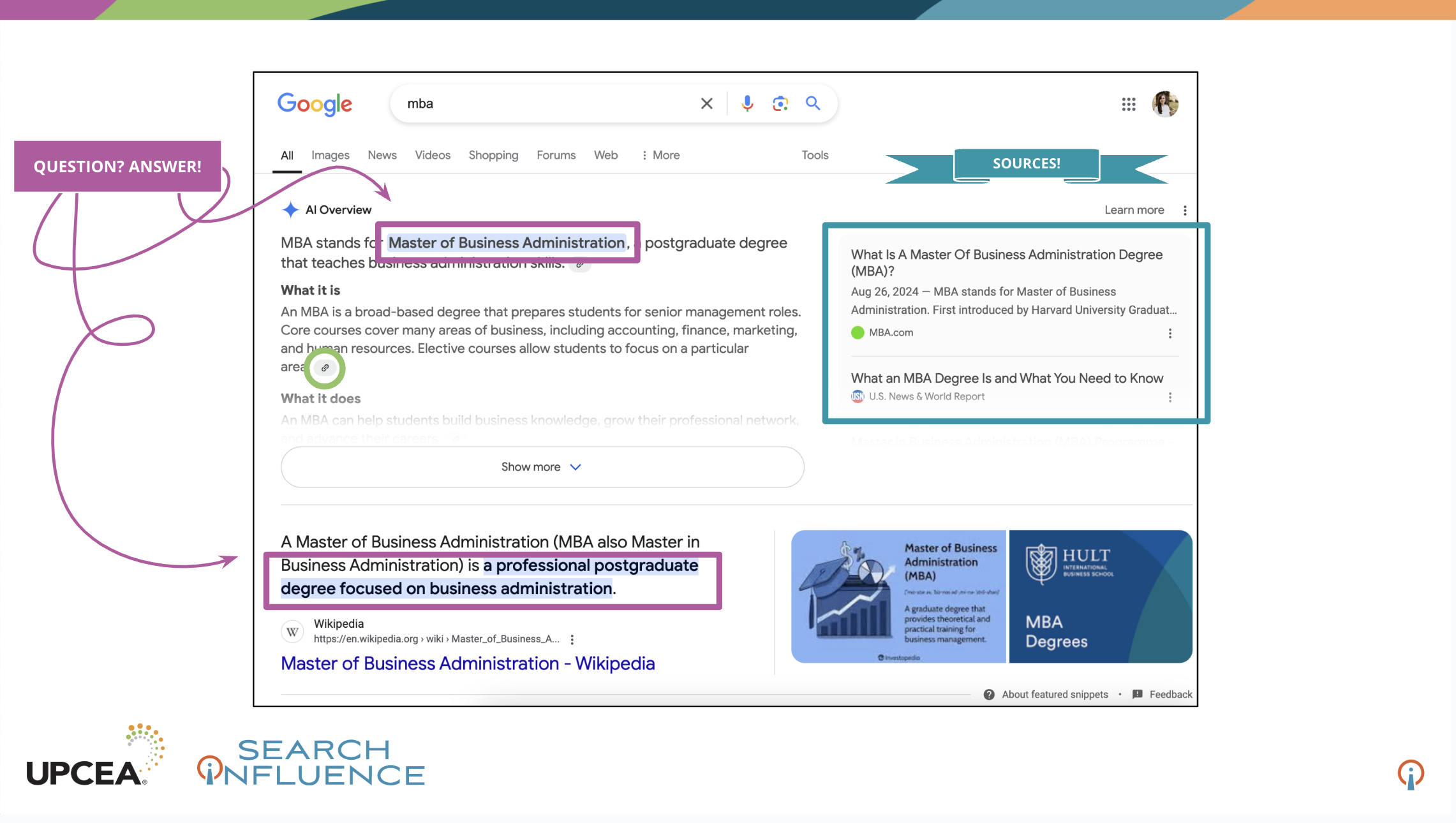
      Launched in May 2024, AIOs surface above organic search results to deliver quick, concise summaries of key information in response to queries. Each overview includes clickable sources, allowing users to explore the original content behind the summarized insights.

      Screenshot showing an AI search result

      While helpful for users, AIOs push organic listings further down, reducing visibility — even for top 5 rankings — as prospects may not scroll far enough to find your site.

      Research by Seer Interactive shows that the organic click-through rate (CTR) declines by roughly 70% when an AIO is present in the search engine results. For queries that do not generate an AIO, organic CTR trends around 2.94%. When an AIO is present, organic CTR declines to about 0.84%.

      On the positive side, organic CTR increases to 1.08% when a site is included as an AIO source.

      Adapting your strategy for AI

      While gen AI, whether ChatGPT or an AI Overview, is disrupting the search landscape, it doesn’t mean you should abandon focus on your SEO strategy. Instead, refine your university’s strategy to embrace AI and use it as a different opportunity to appear in front of prospects.

      To adapt your strategy to account for AI searches:

      • Optimize for commercial/transactional keywords: Informational-intent keywords (ex: “Why pursue an MBA?”) trigger an AIO 99.2% of the time. However, they only display 10% of the time for commercial and transactional-intent keywords (ex: “MBA program online”). Organic click-through rates are likely higher for these types of searches since they are less likely to be overshadowed by an AIO. While you shouldn’t deprioritize informational-intent keywords entirely, you should pay love to relevant commercial and transactional terms.
      • Evaluate search competition and how well you rank: Knowing how competitive your search phrases are and where your content ranks helps identify the changes needed to improve your visibility. If a search term does not have considerable competition and you rank well for it already, you may just need to optimize the content to potentially grab a spot in an AIO.
      • Look at search intent: Search intent informs how to develop your content. For example, if the search intent is informational, you’ll want to draft your content in the format that Google most often prefers for these types of searches (i.e., articles, videos, and guides). Step-by-step, “how-to” content generally ranks best, and thus gets pulled into an AIO, for informational content.
      • Develop question-based content: Google’s primary job is to help people find answers to their questions. Your content should always be positioned toward providing answers to those questions. If you’re unsure of the questions your prospective students are asking, you can perform a search of the root keyword term and look at the People Also Ask (PAA) section.
      • Make your content digestible: Your content should be clear and scannable for both prospects and search engines, using headings, bullet points, and short paragraphs. AI platforms like ChatGPT favor conversational, natural language, so optimizing for human-like speech can also boost your chances of being included in AI-generated responses.

      Impact of social search on SEO

      After AI, the second most disruptive search trend to consider in 2025 and beyond is social search.

      Social search refers to the use of social media platforms as search outlets, where users find information, recommendations, or content within platforms like TikTok, Instagram, or LinkedIn. This trend leverages the power of community-driven insights and visually engaging formats to connect users with information in a more interactive way.

      For higher education, social search means prospective students are increasingly using these platforms to explore programs, read reviews, and engage with content that shapes their enrollment decisions.

      To effectively reach these searchers, institutions must understand the different sides of social search and how each offers a new way of meeting prospects online.

      Types of social search

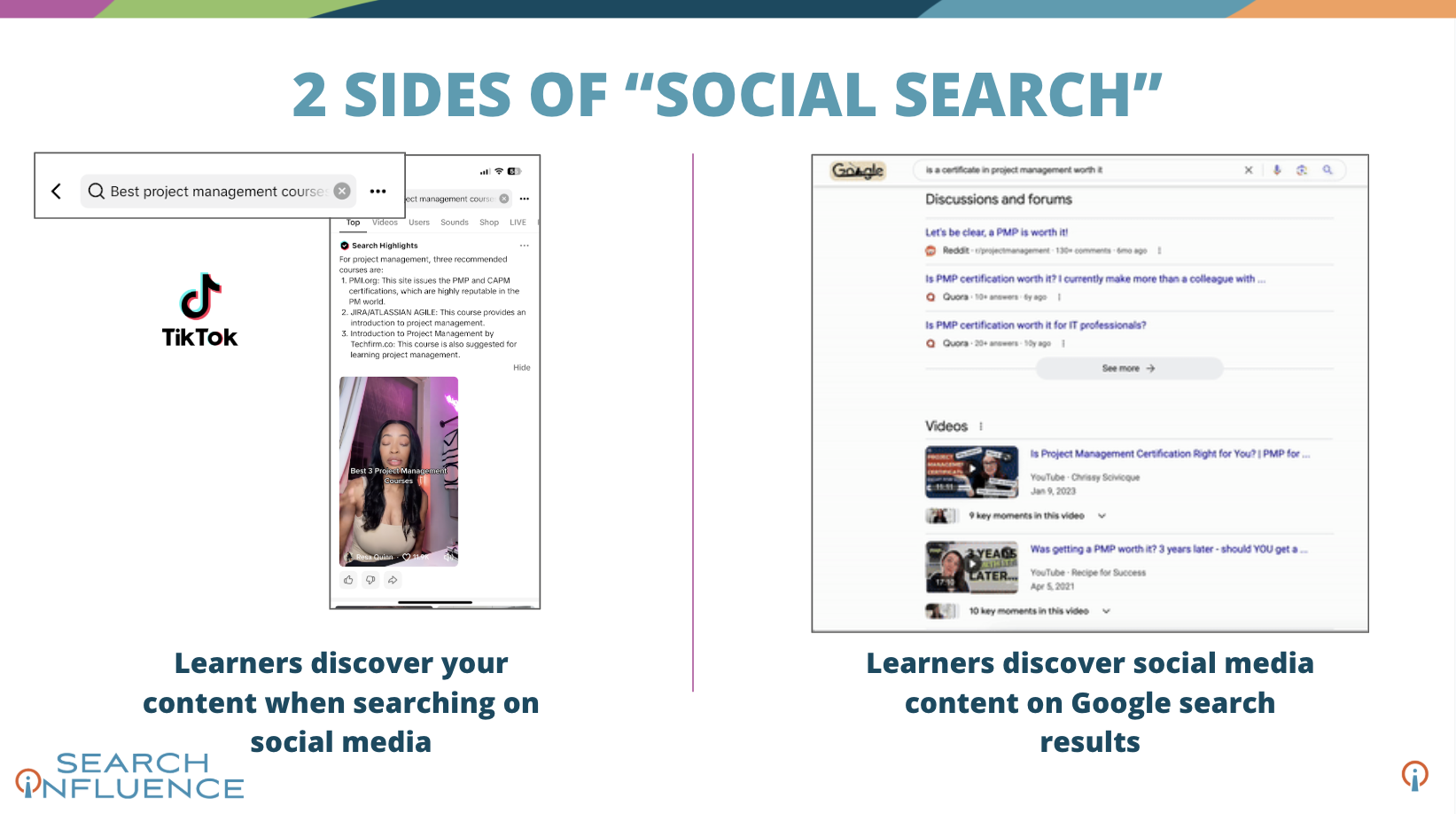
      There are two ways social search works. One involves prospective students searching for your content directly on social media, while the other happens when your social media content surfaces in search engine results

      Screenshot showcasing different types of social search

      The first side to social search is gaining steady favorability among searchers, primarily younger generations. According to Hubspot research, in 2023, roughly 15% of people preferred to search directly on social media over traditional search engines, with about 30% of Gen Z and Millennials most likely to use this method. However, in 2024, Hubspot found that the percentage of all generations that prefer to search on social media had increased, up from 15% to 21%.

      The other side of social search presents the opportunity to enhance your brand’s visibility directly within search engine results. More and more social sites, like LinkedIn and YouTube, are ranking on Google, and sometimes they even pull into AIOs. By optimizing your social profiles for search, you can increase the likelihood of appearing in these high-visibility spots, referring more prospects to your institution.

      Adapting your strategy for social search

      Since it offers more real estate for you to be found online, social search can have a considerable impact on your SEO strategy. When you prioritize building robust social media content, you can reach prospects both in traditional search engines and across highly trafficked social media platforms.

      To successfully integrate social search into your SEO strategy:

      • Repurpose your website content on social: The most efficient way to get started is to repurpose your high-performing content on your social accounts. You can do this by republishing videos from your site to your social account or publishing text-based articles on platforms like LinkedIn. Other ideas include adapting your blog content into videos or crafting video overviews of key program page information.
      • Expand your definition of social: When most people think of social media, they picture Instagram, TikTok, and Facebook. However, sites like YouTube, Quora, and Reddit are their own forms of social media and are often filtered into the search results, too. When you embrace all social search outlets, you can improve your visibility on social platforms themselves, potentially making you more visible in a Google search.

      Looking for more insights into the latest SEO trends for 2025? Check out our blog, “SEO Higher Education Trends in 2025: How to Compete,” for the full breakdown.

      Strategies to attract and enroll the modern learner

      Start investing in SEO now

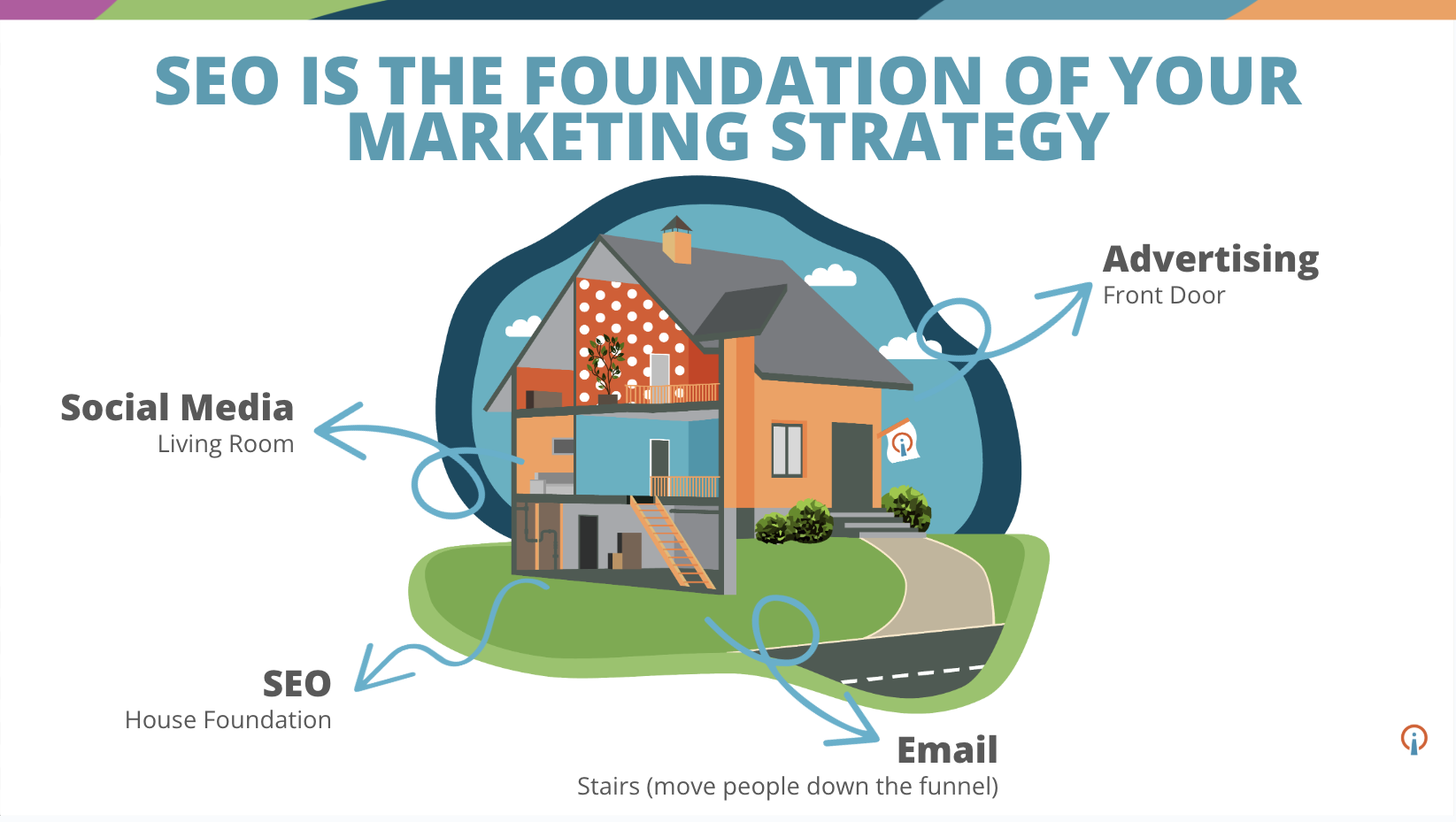
      The definition of SEO has broadened to include three mediums for meeting your audience online: traditional search engines, AI platforms, and social media. As a higher education marketer, you now have extra opportunities to nurture your prospects down the funnel, but it won’t happen without a solid investment in SEO.

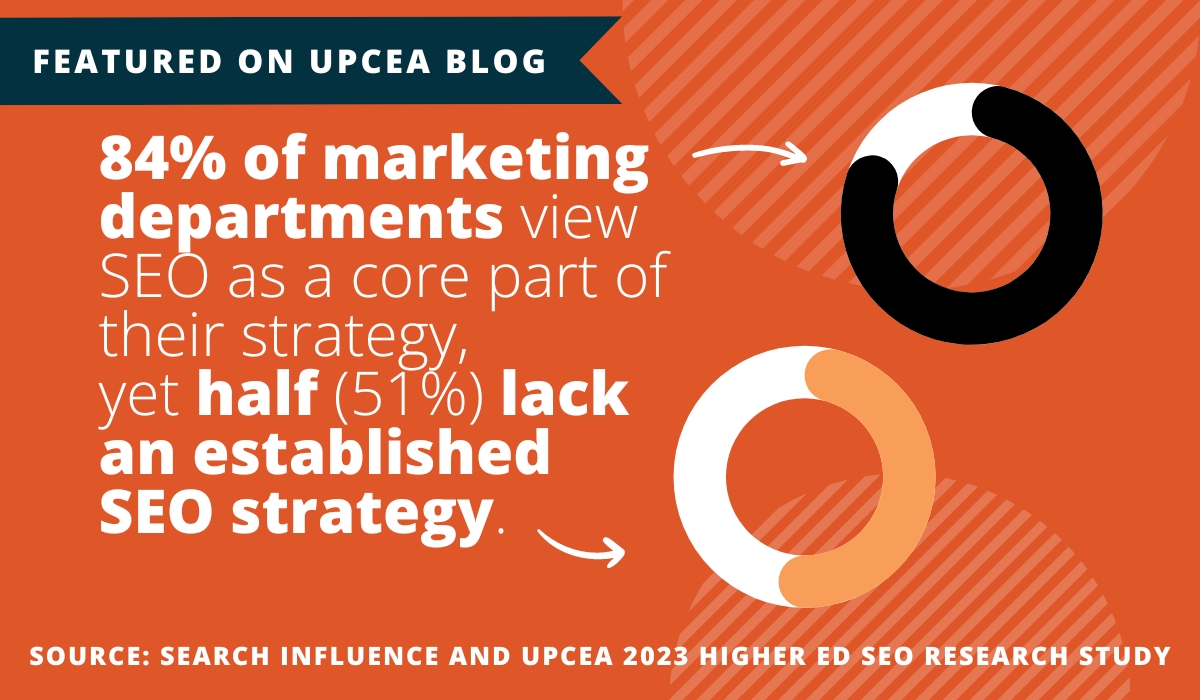
      While 84% of marketing departments view SEO as a core part of their marketing strategy, half (51%) do not have an established strategy in place. SEO is not additive or something to execute piecemeal when you have time or can just do the easy bits — it’s the foundation of your marketing strategy. Your website is where all your other marketing efforts lead, with SEO being the area of marketing that yields the most long-term results.

      A graphical explanation of SEO in marketing strategy

      Ranking high in search continuously becomes more complex with the latest trends, and the student journey is changing. If your university fails to adopt a comprehensive SEO strategy, it could result in losing prospects to more visible competitors.

      Develop the tenets of a solid SEO strategy

      Since SEO is foundational, it must serve as the solid framework upon which your entire marketing strategy is built. A strong SEO strategy prioritizes impactful tactics such as:

      • Targeted, relevant keywords tailored to each program, degree, or certificate page
      • Content plans for every offering, including pillar pages and cluster content
      • Link-building strategies that leverage profiles, directories, PR/media, and internal linking
      • Regular monitoring of technical site health to ensure peak performance

      Equally important is establishing key performance indicators (KPIs) and implementing a routine reporting process. Metrics such as organic inquiries, organic traffic, referral traffic from key sources, and rankings — including competitive comparisons — are essential for tracking success.

      Despite its importance, reporting is often overlooked. Our research with UPCEA reveals that while 62% of institutional leaders want regular updates on SEO metrics, only 31% currently receive them, leaving a critical gap in strategic oversight.

      If you lack the skills, time, and resources to execute a proper SEO strategy, consider working with an agency. They can help take much of the strategizing off your plate, while also granting you the confidence that your strategy is both up-to-date and optimized for success.

      Key Questions From the Webinar Audience

      Should we write in the first person when using question-based content since many users search using first-person wording?

      Using first-person language in question-based content can be effective but isn’t mandatory. FAQs and similar website sections typically adopt a second-person perspective, as it directly addresses the reader. Both approaches can rank well in search results, so the choice ultimately depends on your university’s style and tone. However, consistency across your content should always remain a priority.

      What’s the best way to find keywords to help with an SEO strategy?

      Begin by identifying root keywords related to your programs and understanding what prospective students are searching for. You can also utilize keyword research tools to expand this list and analyze metrics like search volume and ranking difficulty. Once you have a refined list, evaluate search intent to ensure the keywords align with your content’s purpose. A practical approach is to search for the keyword directly and review the top-ranking results to confirm its relevance to your target audience and content strategy.

      Should social media efforts focus on university accounts, personal accounts, or both?

      University accounts are often the primary choice for social media efforts. However, leveraging personal accounts, such as those of professors or staff who can act as influencers or thought leaders, can significantly enhance your strategy. Using both in tandem allows for broader reach and a more personalized connection with your audience.

      Guest writers tend to get better rankings within search engines. Is it wise to invest in such writers?

      The value of guest writers depends on their qualifications and expertise. Writers with specialized credentials or industry authority can enhance content ranking and credibility. Additionally, consider whether their content is well-optimized for SEO and aligns with your goals. Evaluating these factors will help determine whether guest writers are a worthwhile investment for your strategy.

      Is the shift to conversational content replacing keyword-centric strategies?

      While conversational content is becoming increasingly important, it doesn’t replace the need for keyword-centric strategies. High-value head terms and less conversational searches will always play a crucial role in driving visibility. A smarter approach balances both, integrating conversational content alongside targeted keywords to address diverse user intents.

      Discover More Higher Education SEO Best Practices

      Staying ahead of the latest trends in SEO is the most effective way to reach the modern learner and meet your enrollment goals in 2025. For deeper insights into the state of the industry and how you can adapt, be sure to watch the full recording of “Top Trends for Your 2025 SEO Strategy to Attract the Modern Learner,” linked here.

      Feeling stuck on implementing a strategy that moves the needle toward full-funnel success? Search Influence is here to help with higher ed resources to fuel your enrollment pipeline:

      • SEO Higher Ed Research Study: Read the latest on higher ed SEO, where marketing leader priorities lie, and the work that your university must do to outpace your competitors.
      • SEO Blog: Learn how to make a strong case for SEO to your higher-ups to ensure your university’s organic presence is optimized for success.
      • SEO Workbook: Gain access to exercises that help you develop three months of SEO techniques to boost your online visibility, from keyword strategy to technical SEO improvements.
      • SEO Roadmap: Rev up your SEO engine with snackable strategy recommendations for one top degree or program, plus dedicated time with our team to review and consult.

      Your higher ed SEO goals are within reach. Solidify your visibility in changing times with expert support today.

  • Search Influence Shares Higher Education SEO Insights at UPCEA MEMS 2024

    Search Influence - To share higher education SEO insights at UPCEA MEMS 2024

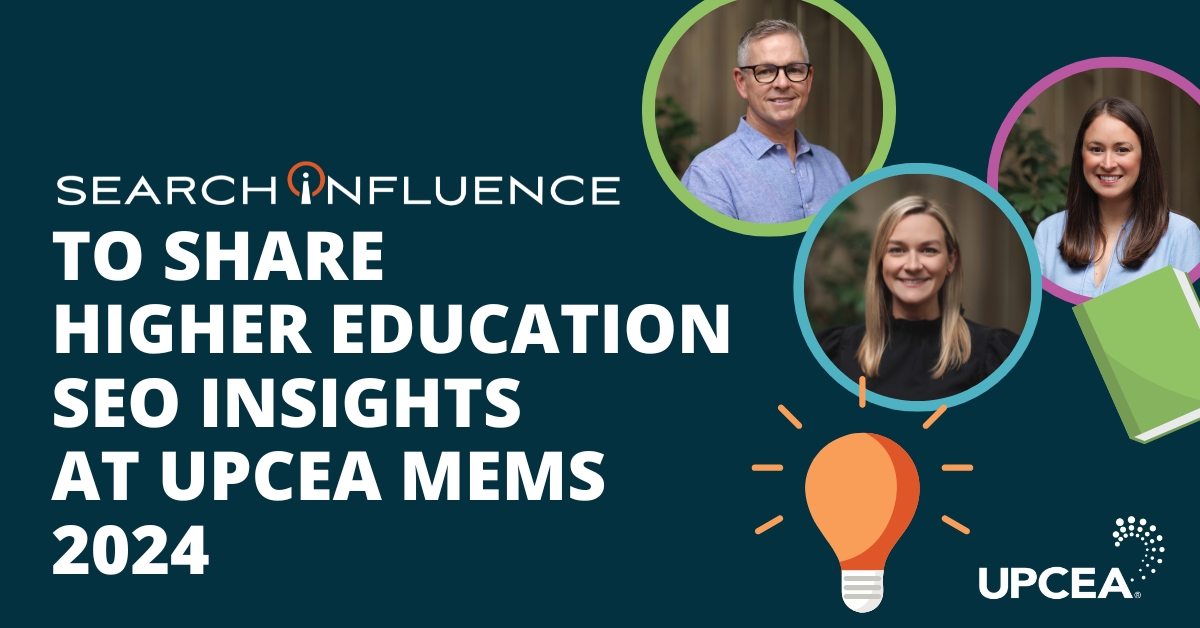
    Director of Sales & Marketing Paula French, Digital Advertising Manager Jeanne Lobman, and Co-Founder and CEO Will Scott represented Search Influence at the 33rd Annual UPCEA Marketing, Enrollment Management, and Student Success (MEMS) Conference in Philadelphia.

    The Search Influence team made a splash at our third appearance at the higher education marketing, enrollment, and student success conference.

    Paula introduced a Breakfast Briefing and led two insightful sessions on higher education SEO and higher education marketing metrics. Will and Jeanne connected with attendees at our booth and showed them how to use SEO to attract modern learners into 2025 and beyond.

    Paula French’s Higher Education SEO Sessions

    Practical Magic: How to Navigate 2025 SEO Trends


    In her first session, Practical Magic: How to Navigate 2025 SEO Trends, Search Influence’s Director of Sales and Marketing discussed the evolution of search behavior — specifically Google’s AI Overviews and the evolution of social search.

    Attendees walked away from this quickfire 10-minute session with practical strategies to implement to conquer these trends and future-proof their SEO strategy to attract more students through the enrollment funnel.

    Visibility is Vital: Maximize Enrollment by Tracking Marketing Metrics

    In Paula’s second session, Visibility is Vital: Maximize Enrollment by Tracking Marketing Metrics, the higher ed marketing expert co-presented a 30-minute roundtable discussion with UPCEA’s Senior Director of Research and Consulting Bruce Etter.

    This session provided an overview the key findings of UPCEA and Search Influence’s Higher Ed Marketing Metrics Research Study, highlighting one shocking finding in particular: The majority of professional and online education schools don’t track critical marketing metrics.

    Paula and Bruce discussed how marketers who don’t track key metrics, like higher education cost per inquiry (CPI) and cost per enrolled student, risk:

    • Poor campaign performance
    • Wasted budget
    • Reduced lead quality

    The session also showed attendees how they can use these key higher education marketing metrics to:

    • Optimize campaigns
    • Maximize budget allocation
    • Improve conversions

    The session showed how to boost adult learner enrollment by tracking the right costs.

    Driving Engagement: Marketing Strategies for Online Learning

    For Paula’s third presentation, she moderated Driving Engagement: Marketing Strategies for Online Learning.

    This session, presented by Auris Calvino and Cari Gold of The University of Texas at San Antonio, explored how UTSA Online’s multifaceted content strategy drives student attraction, engagement, and retention.

    At the Search Influence Booth

    Search Influence Digital Advertising Manager Jeanne Lobman and CEO & Co-Founder Will Scott joined Paula French to host the Search Influence booth.

    Jeanne recently presented her own session, Integrating SEO and Paid Search Strategies, at Pubcon 2024 in Las Vegas.

    Will is a recognized digital marketing leader who regularly presents and writes about the industry.

    Take our higher education SEO Quiz

    Booth visitors could take our new Higher Ed SEO In-House vs. Outsourcing Quiz, specifically designed for higher education marketers.

    This quiz provides personalized higher education marketing recommendations based on user input, categorizing them as “Outsourcing Whiz,” “In-House Hero,” or “Hybrid Hotshot.”

    In just minutes, you’ll be equipped with tailored insights to optimize your resources and make informed staffing choices, ultimately boosting your SEO strategy and student recruitment efforts.

    After taking the quiz, booth visitors received personalized feedback and recommendations from our experienced team about their current digital marketing approach.

    About MEMS

    UPCEA MEMS is the premier conference for online and continuing education marketers and enrollment managers worldwide.

    Held annually for over 30 years, MEMS offers strategically focused presentations and sessions that cover the tactical components of higher education marketing and enrollment management.

    Boost Your Higher Education Marketing Strategy With Search Influence

    Whether speaking at conferences or providing ROI-focused digital marketing services, Search Influence is dedicated to helping higher ed institutions meet their enrollment goals.

    Ready to get started?

    Take our SEO In-House vs. Outsourcing Quiz to learn whether working with a higher education digital marketing agency is right for you.

    Download our Higher Education Marketing Metrics Research Study for tangible insights from Paula’s presentation and to learn more about the power of cost per inquiry and cost per enrolled student.

  • The Kids Are All Doing It: Your Guide to Social Search [The Influencer – Oct 2024]

    Social Search: How Gen Z & Millennial Search Habits Are Changing

    Insights from Co-Founder and CEO Will Scott

    Social Search: How Gen Z & Millennial Search Habits Are Changing

    WILL SCOTT | 10-MINUTE READ

    Discover why Gen Z and Millennials are choosing social search over search engines. Learn how you can still use SEO strategies to capture their attention!

    Read More


    Track and Report the Right Higher Ed Marketing Analytics to Improve Your Strategy

    Track and Report the Right Higher Ed Marketing Analytics to Improve Your Strategy

    ALISON ZERINGUE | 8-MINUTE READ

    Discover how to leverage higher education marketing analytics to optimize strategies, boost enrollment, and track key metrics effectively.

    Read More


    What’s Included in Higher Education Cost Per Inquiry (CPI) for Marketing?

    What’s Included in Higher Education Cost Per Inquiry (CPI) for Marketing?

    FALLON MYERS | 6-MINUTE READ

    Tracking your school’s cost per inquiry leads to efficient budget spend and better marketing decisions. Learn how to track higher ed CPI costs with Search Influence.

    Read More


    Will Scott to Present on AI for Content Marketing at Pubcon 2024 in Las Vegas

    Will Scott to Present on AI for Content Marketing at Pubcon 2024 in Las Vegas

    COLLIN GUEDON | 3-MINUTE READ

    Search Influence CEO Will Scott presented on AI for content marketing at Pubcon 2024. Read the blog to learn how to use AI for content marketing to boost SEO, repurpose content, and drive traffic.

    Read More


    Search Influence Launches Higher Education Marketing Resources & Guides Page

    New Marketing Resources

    Search Influence Launches Higher Education Marketing Resources & Guides Page

    Our rich collection of resources serves new marketing professionals seeking foundational knowledge, seasoned marketers searching for innovative tactics, and higher ed leaders looking to support institutional goals.

    Read More

  • Track and Report the Right Higher Ed Marketing Analytics to Improve Your Strategy

    Track and Report the Right Higher Ed Marketing Analytics to Improve Your Strategy

    Track and Report t

    Key Insights

    • Many institutions don’t track crucial metrics like cost per inquiry (CPI) and cost per enrolled student, missing opportunities to optimize their marketing efforts and better allocate resources.
    • Higher education institutions need precise tracking and insights to enhance their marketing strategies, effectively engage prospective students, and drive enrollment.
    • Institutions that actively track key metrics like CPI and cost per enrolled student see higher satisfaction with their marketing campaign performance.

    In the high-stakes arena of higher education, every marketing decision counts.

    Without precise tracking and insightful analysis, your marketing efforts are like a ship navigating without a compass — directionless and bound to get lost in the sea of competition.

    For years at Search Influence, we’ve partnered with institutions like Tulane SoPA and Tufts University College, helping them leverage analytics to optimize their marketing campaigns.

    Our experience has shown that those satisfied with their ability to track success are also more likely to be satisfied with their campaign performance.

    To further underscore the importance of tracking, this year we collaborated with UPCEA on a research study, “Higher Education Marketing Metrics Research Report: What Gets Measured Gets Managed.

    This report provides valuable insights into how data-driven marketing can lead to greater accountability, smarter decisions, and, ultimately, success in attracting and retaining students.

    Read on to learn how tracking the right metrics can empower your institution to thrive in a crowded higher education market.

    Why Tracking Marketing Metrics Is Important for Higher Ed Institutions

    As higher education institutions face increasing competition and evolving expectations from prospective students, it’s essential to track and analyze key performance indicators (KPIs).

    Higher education marketing metric tracking allows institutions to:

    • Measure their return on investment (ROI)
    • Manage campaign performance
    • Allocate resources effectively

    Tracking key metrics provides a clear picture of what’s working and what’s not, enabling higher education institutions to make informed decisions that directly impact student recruitment.

    By focusing on data, institutions can:

    • Determine which marketing channels yield the highest engagement
    • Identify the content that resonates most with their audience
    • Adjust their strategies in real-time to enhance results

    This kind of accountability is critical for marketers, program managers, and faculty who need to develop courses and offerings that align with market demand and student interests.

    Effective higher education marketing tracking can also have a significant impact on resource allocation and budgeting. When institutions measure their efforts to engage adult learners, they create a framework of accountability that drives smarter decisions.

    Track and report the right higher ed marketing analytics to improve your strategy - Search Influence

    Search Influence and UPCEA’s Higher Education Marketing Metrics Study
    Higher Ed Marketing Metrics Research Study 

    To gain a deeper understanding of the marketing metrics and costs associated with online and professional education programs, Search Influence partnered with UPCEA to conduct a comprehensive study.

    The findings of this research highlight the importance of data-driven decision-making for higher education marketing strategies.

    Follow along as we break down key findings from this study that can help your institution boost online conversions.

    Less than half of higher ed marketers track cost per inquiry

    One of the study’s top takeaways is the critical role of tracking specific metrics like cost per inquiry (CPI) and cost per enrolled student.

    Despite the significance of these metrics, less than half of higher education marketers track them. While nearly three-quarters (73%) of marketing units track the source of inquiries, only 46% track CPI, and just 43% track cost per enrolled student.

    Shockingly, nearly 17% of institutions don’t track any of these metrics.

    This gap in metric tracking reveals a missed opportunity for many universities to optimize their marketing efforts and ensure they effectively reach their target audience.

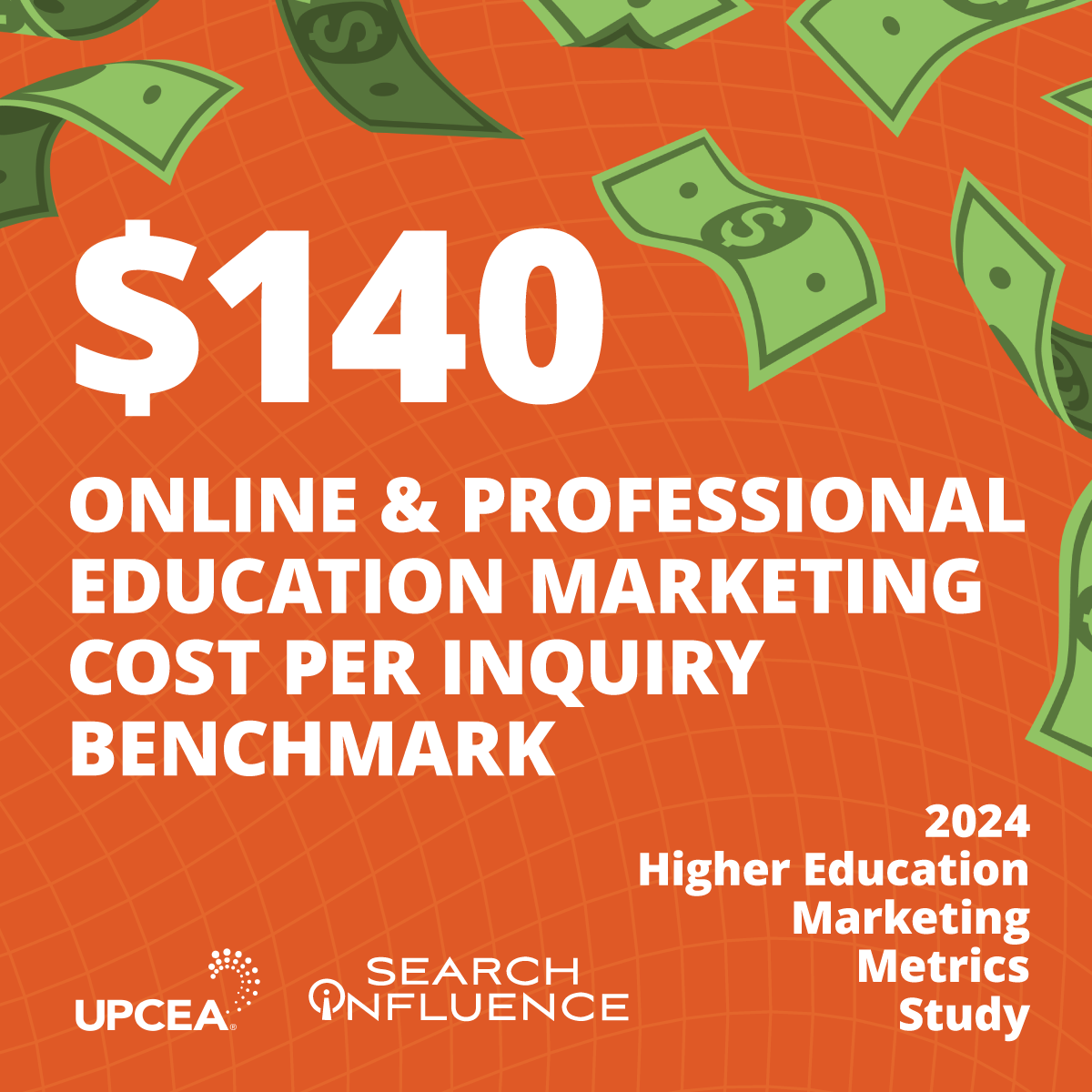
    The average professional and online education cost per inquiry is $140
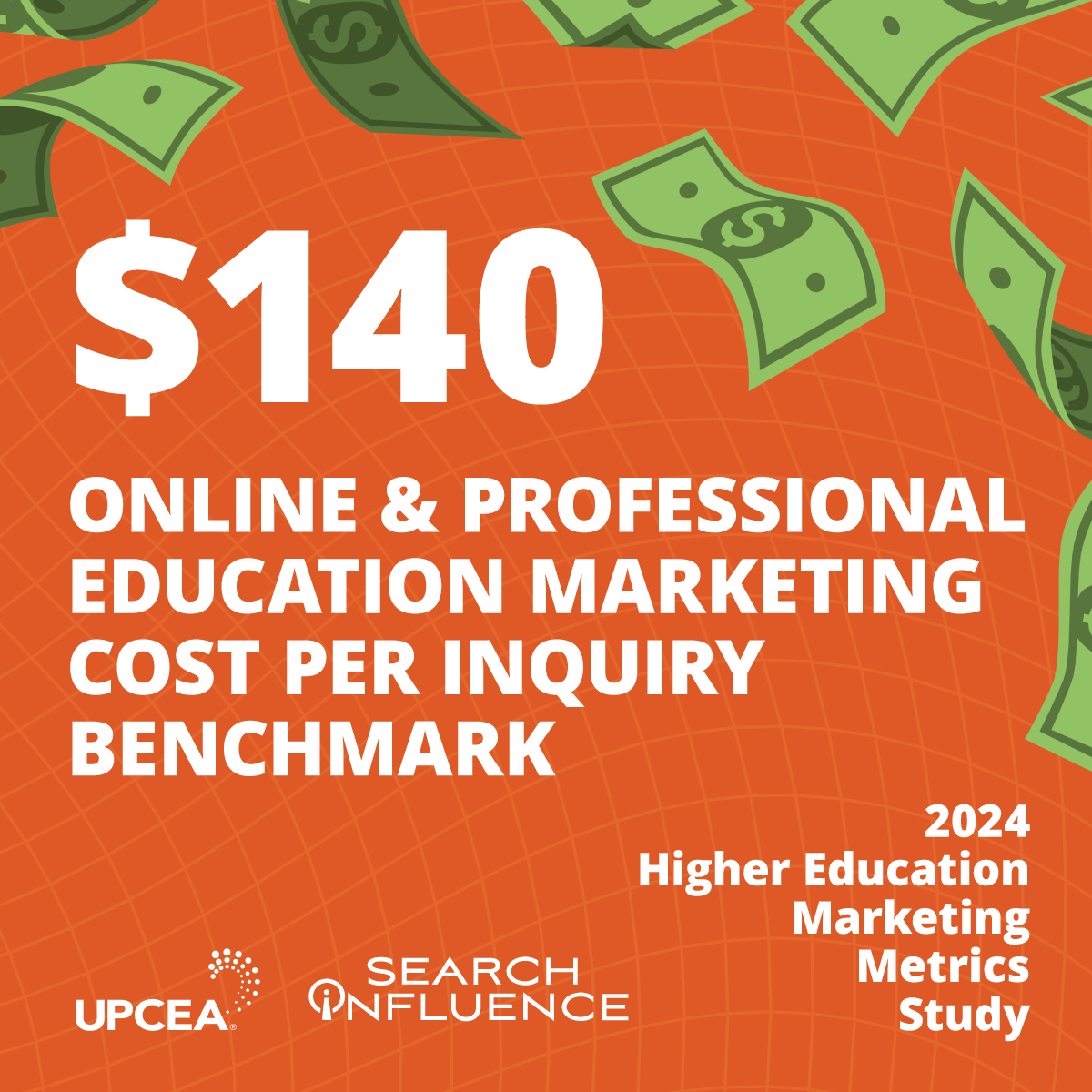
    Online and Professional Education Marketing Cost Per Inquiry Benchmark - Search Incluence

    For those tracking cost per inquiry, the study found that the average CPI for online and professional education programs is $140, with a median of $106.

    This metric is a crucial indicator of how well marketing dollars are being utilized to attract prospective students. Tracking these costs allows university marketing departments to make informed decisions about where to allocate their resources, ensuring that digital marketing efforts are cost-effective and impactful.

    Email marketing is most often managed in-house, while digital advertising is most often outsourced

    The study reveals that while 73% of higher education institutions manage email marketing in-house, half outsource their digital advertising (such as Google paid search) to external agencies.

    This trend indicates a potential missed opportunity for maximizing ROI, especially given email marketing’s high return of 36:1.

    When email campaigns and SEO are managed internally without adequate resources, universities may not fully optimize these channels, contributing to dissatisfaction with results.

    Conversely, outsourcing digital advertising allows for continuous tracking and optimization, often leading to better performance.

    Marketers who track their campaigns are more happy with performance

    Another significant finding is the correlation between tracking marketing metrics and overall satisfaction with campaign performance. Only 47% of respondents expressed satisfaction with their marketing campaigns’ performance, and just 29% were content with their ability to track campaign success.

    However, those who actively track metrics like cost per inquiry and cost per enrolled student report higher satisfaction levels, indicating that effective metric tracking is linked to better marketing outcomes.

    Analytics, Tracking, and Reporting Opportunities for Higher Education

    If you’ve read this far, we’ve made the case that it’s important and effective to track key metrics. You might be asking — what exactly are these key metrics?

    Below are the two most important metrics we recommend you track.

    Cost per inquiry

    By monitoring cost per inquiry, institutions can identify the most cost-effective methods for attracting inquiries and allocate resources accordingly, ensuring that marketing dollars are spent where they yield the highest return.

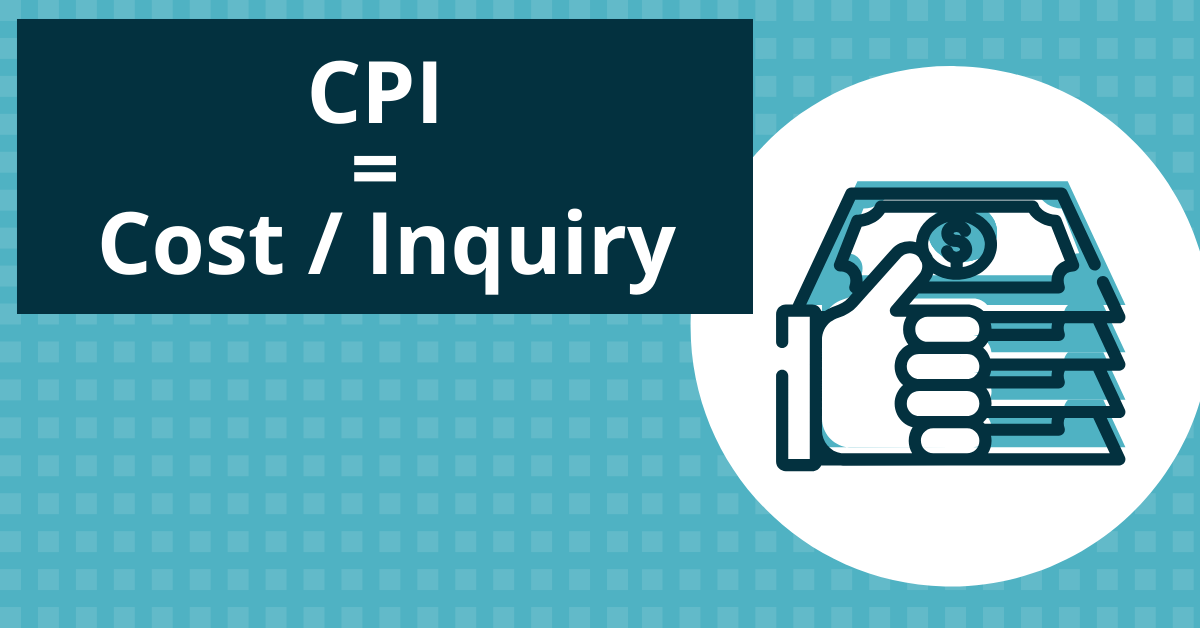
    CPI is a widely recognized metric, yet less than half of higher education marketers actively track it. This metric calculates the total marketing and advertising spend divided by the number of inquiries received, providing a clear measure of budget efficiency and effectiveness.

    Tracking CPI allows marketing teams to gain insights into which campaigns generate interest and drive students into the enrollment funnel.

    Cost per enrolled student

    Another crucial metric for higher education institutions is cost per enrolled student, which measures the total expenses involved in securing each student’s enrollment. This includes all costs from the initial marketing outreach through to the point of a student’s matriculation, encompassing media spend, agency fees, salaries, and other related marketing activities.

    Our study highlighted that less than half of higher education marketers track this metric, even though it offers invaluable insights into spending efficiency and the overall effectiveness of recruitment strategies.

    Understanding cost per enrolled student helps marketing departments optimize their strategies by identifying which campaigns are most successful at converting inquiries into enrolled students. This metric serves as a vital tool for aligning marketing efforts with enrollment goals.

    By integrating systems capable of tracking both cost per inquiry and cost per enrolled student, higher education institutions can make data-driven decisions that enhance the efficiency of their marketing plans and improve outcomes across the enrollment funnel.

    Tracking metrics can lead to new opportunities

    When you better understand your ad spend, you can reallocate funds to other areas of need.

    As our 2023 SEO research study found, 51% of universities don’t have an established SEO plan.


    Higher Ed SEO Research Study 

    Without a strong SEO focus, university websites may become challenging to navigate, leading to frustrated users who quickly leave the site. This can result in lower search engine rankings and less visibility among the target audience. By contrast, investing in SEO helps universities improve user experience, making it easier for prospective students to find information about programs, admissions, and campus life.

    For universities aiming to attract the modern adult learner, SEO offers a strategic way to capture attention and stand out in a competitive market. With an effective SEO plan, universities can ensure their websites rank higher in search results, making prospective students more likely to find them when searching for educational programs. This visibility is especially crucial as more students turn to online searches to explore their educational options.

    Reallocating budget and resources toward SEO could be a game-changer for universities. By gaining a deeper understanding of their website’s performance metrics and ad spend, marketers can identify gaps in their current strategy and shift focus to overlooked areas.

    Search Influence’s Higher Education Marketing Tracking Success

    Track and report the right higher ed marketing analytics to improve your strategy - Search Influence

    At Search Influence, our strategic approach to marketing tracking has consistently driven impressive results for higher education institutions.

    For Palo Alto University, we increased average monthly inquiries from 185 to 272 by expanding focus on key degree programs, optimizing paid advertising, and refreshing campaign messaging. This resulted in a 49% increase in leads within just two quarters.

    Similarly, we helped Tulane SoPA surpass its goal of 500 inquiries per month by implementing a full-funnel marketing strategy. Our efforts, including targeted paid advertising and optimized landing pages, led to an average of 791 inquiries per month — a 58% increase over the initial target.

    These successes demonstrate our commitment to helping higher education institutions enhance their enrollment strategies through effective marketing tracking and optimization.

    Learn More About Higher Education Marketing Analytics

    Accurate marketing tracking is essential for higher education institutions to optimize their campaigns, attract prospective students, and drive enrollment.

    Our UPCEA x Search Influence study sheds light on how universities can better measure the success of their marketing efforts through metrics like cost per inquiry and cost per enrolled student.

    By leveraging these insights, institutions can make data-driven decisions, improve resource allocation, and ultimately achieve their enrollment goals.

    Download our Marketing Metrics Research Study and SEO Research Study to gain valuable insights and start transforming your higher education digital marketing strategy today.


    Image Credits:
  • What’s Included in Higher Education Cost Per Inquiry (CPI) for Marketing?

    Search Influence discusses CPI - Coins scattered across a cluttered desk

    • Properly calculating CPI is vital for higher education institutions to gauge the effectiveness of their marketing efforts and avoid inefficiencies.
    • To gain a complete picture of their marketing costs and CPI, institutions must consider all related expenses, including media spend and staff salaries.
    • Implementing advanced tools like CRM systems can significantly improve the accuracy and effectiveness of CPI tracking, leading to more strategic decisions.
    • Utilizing resources like Search Influence’s CPI worksheet grants institutions more precise assessments of the state of their CPI.

    Every dollar spent on higher education marketing is a step toward shaping your institution’s future. But how do you know if those steps lead you in the right direction?

    Accurately calculating cost per inquiry (CPI) as a key performance indicator reveals the true impact of your marketing efforts and drives strategic decisions that shape your institution’s success.

    Despite the critical role of CPI tracking, our 2024 Search Influence x UPCEA Research Study found that fewer than half (46%) of the institutions surveyed actively monitor CPI for their professional, continuing, and online (PCO) programs. This oversight can lead to missed opportunities, wasted budgets, and stagnant enrollment numbers in the increasingly competitive educational sector.

    To help you assess the effectiveness of your marketing spend, we’ll explore what’s included in marketing CPI and how to accurately calculate higher ed CPI costs.

    All the Costs You Should Consider When Calculating Cost Per Inquiry

    Search Influence Discusses CPI - CPI = Cost divided by Inquiry

    To remain competitive, higher education marketing departments must be well-equipped to systematically track and analyze critical metrics like CPI. These insights are essential for making informed, data-driven decisions that optimize budget efficiency and fuel impactful strategies.

    At its core, CPI for higher education marketing is an invaluable measure of this efficiency, quantifying the amount spent on digital advertising to generate each student inquiry.

    Such inquiries typically come from various sources, such as request-for-information forms, brochure requests, or visit requests to your institution. They might also generate from your email campaigns.

    While it’s important to know the source of your inquiries, it’s equally important to measure the total investment required to secure a prospective student’s enrollment. These costs vary depending on your institution’s budget strategy, but most frequently entail:

    • Media Spend: The total cost associated with purchasing advertising space across various platforms to generate student inquiries.
    • Agency Fees: Payments made to external marketing agencies for their expertise and services in executing and managing digital marketing campaigns.
    • Marketing Team Salaries: The compensation provided to in-house marketing staff who plan, execute, and monitor marketing strategies aimed at driving inquiries.
    • Additional Marketing Efforts: Any other expenses related to higher education marketing activities, such as email and SMS campaigns, virtual events, and open houses.

    Why Is Tracking Higher Ed CPI So Important?

    Tracking CPI is a non-negotiable for institutions who want to enhance their marketing efficiency and align strategies with successful campaigns. Here’s why:

    • Gain Valuable Insights: By leveraging CPI metrics, your marketing department can identify which campaigns drive the most inquiries and enrollments, helping to focus efforts on the most effective strategies.
    • Identify Successful Trends: Tracking these metrics allows your institution to spot successful trends within its target audience. Recognizing these patterns enables you to replicate effective strategies, ensuring your campaigns are continuously refined based on fresh data.
    • Improve Budgeting Decisions: CPI metrics play a significant role in guiding budgeting decisions. By understanding which campaigns generate the most inquiries at the lowest cost, you can allocate resources to maximize your marketing budget.
    • Maximize Enrollment Success: Prioritizing campaigns that deliver high inquiry rates at a low cost optimizes your budget and increases the likelihood of meeting or exceeding your enrollment goals.

    However, without accurately tracking CPI, even the best strategies can fall short — leaving your institution stuck in strategy blindspots that hinder true growth and success.

    How to Accurately Calculate Higher Ed CPI Costs

    Accurately calculating CPI costs often involves utilizing advanced tools like customer relationship management (CRM) systems or applicant tracking systems. These technologies streamline the process of managing inquiries and tracking their progress through your enrollment pipeline.

    A CRM system is designed to manage interactions with potential and enrolled students. It offers a centralized platform to monitor essential metrics such as the source of inquiries, CPI, and cost per enrolled student. The data provided by a CRM is indispensable for understanding the full scope of your marketing efforts and ensuring that no inquiry falls through the cracks.

    In fact, 74% of businesses report that CRM technology provides better access to customer data, which, in turn, enhances decision-making processes. For higher education marketers, this means more precise tracking of where your inquiries come from and how much your institutions spends to generate each one.

    Benefits of using a CPI worksheet for higher education

    To assist institutions in calculating and managing their CPI, we offer a free CPI worksheet specifically for higher education. This tool can help you better understand your costs and streamline your tracking processes by providing:

    • Confidence in Results: By using a CPI worksheet, you’ll have confidence that you’re driving the right amount of inquiries and achieving the desired outcomes. It helps you quantify your marketing efforts and ensure that your resources are being utilized effectively.
    • Benchmarking: Our CPI worksheet allows you to evaluate your institution’s performance against broader industry standards. According to our Higher Education Marketing Metrics Research, the online and professional education CPI benchmark is $140. This benchmarking helps you identify areas where you may overspend or where there is room for improvement.
    • Vendor Evaluation: If your institution works with third-party vendors, you can use our CPI worksheet to assess whether their promises are realistic and then measure their performance against the actual results to make informed decisions about future collaborations.

    Ready to start calculating your school’s higher ed CPI? Download our free CPI worksheet for greater chances of more precise calculations.


    How Better CPI Tracking Can Boost Higher Ed Enrollment

    Despite the clear benefits of tracking marketing metrics like CPI, our research found that less than a third of higher education marketing leaders are satisfied with their ability to track the success of their campaigns.

    This lack of tracking can directly impact the effectiveness of marketing strategies and, ultimately, enrollment outcomes.

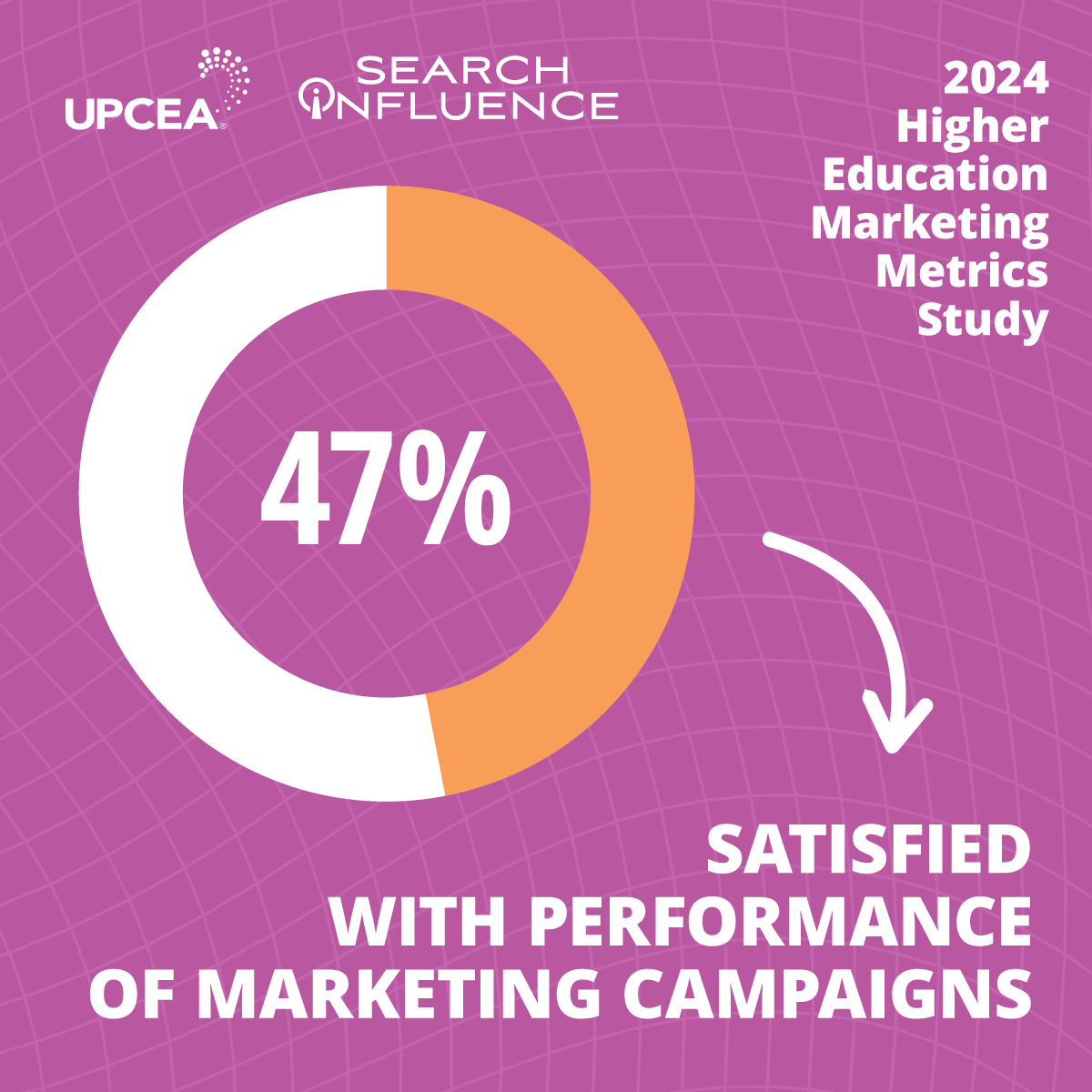
    Only 47% of our research survey respondents expressed satisfaction with their marketing campaigns’ performance, and a significant portion (31%) of marketing departments struggled to correlate their marketing success with enrollment numbers. This gap underscores the importance of tracking higher ed CPI costs effectively, which can provide the data needed to advocate for additional resources and optimize your budget.

    Search Influence discusses CPI - 47 percent satisfied with performance of marketing campaigns

    By improving CPI tracking, your institution will have more accurate forecasts and refine its marketing strategies to focus on efforts that yield the best results.

    Search Influence Can Help You Evaluate Your Higher Ed CPI Costs

    Without a clear understanding of CPI, it’s challenging to allocate resources effectively or measure the success of your campaigns.

    At Search Influence, we bring extensive experience in higher education marketing, helping institutions like yours achieve measurable results. In just one of our success stories, we assisted Palo Alto University in increasing its monthly inquiries by 49% in one quarter — well surpassing the institution’s initial goals.

    If you’re looking to optimize your school’s CPI and improve your marketing outcomes, let our experienced team help make it happen. Our tenure in higher education marketing, combined with tools like our CPI worksheet, can guide your institution toward more efficient and effective marketing.

    Download our CPI worksheet to gain valuable insights and start making data-driven decisions today.


    Image Credits: Pexels and Unsplash
  • Higher Ed Marketing Insights From Paula French’s Article for University Business

    Search Influence - Boosting Adult Learner Enrollment with University Business

    Search Influence’s Director of Sales and Marketing Paula French recently wrote an article for University Business sharing expert insights for higher education marketers.

    This article, titled “How to boost adult learner enrollment by tracking the right costs,” discusses the importance of establishing a metric-driven approach to efficiently attract the modern learner.

    What Is University Business?

    University Business is a leading news outlet that caters to top decision-makers in higher education.

    It provides insights and strategies to college and university leaders across the United States, addressing challenges and trends in the academic world.

    University Business helps higher education leaders make informed decisions through a combination of news analysis, exclusive interviews, and practical resources.

    Insights From Paula French’s University Business Article

    Paula French’s article in University Business highlights the crucial need for universities to shift their focus toward adult learners. This demographic presents a significant growth opportunity amidst declining traditional undergraduate enrollment. Adult learners are driven by professional outcomes, flexibility, and program reputation — making their needs distinct from those of traditional students.

    Featured on University Business - CPI and CPE are the true north metrics

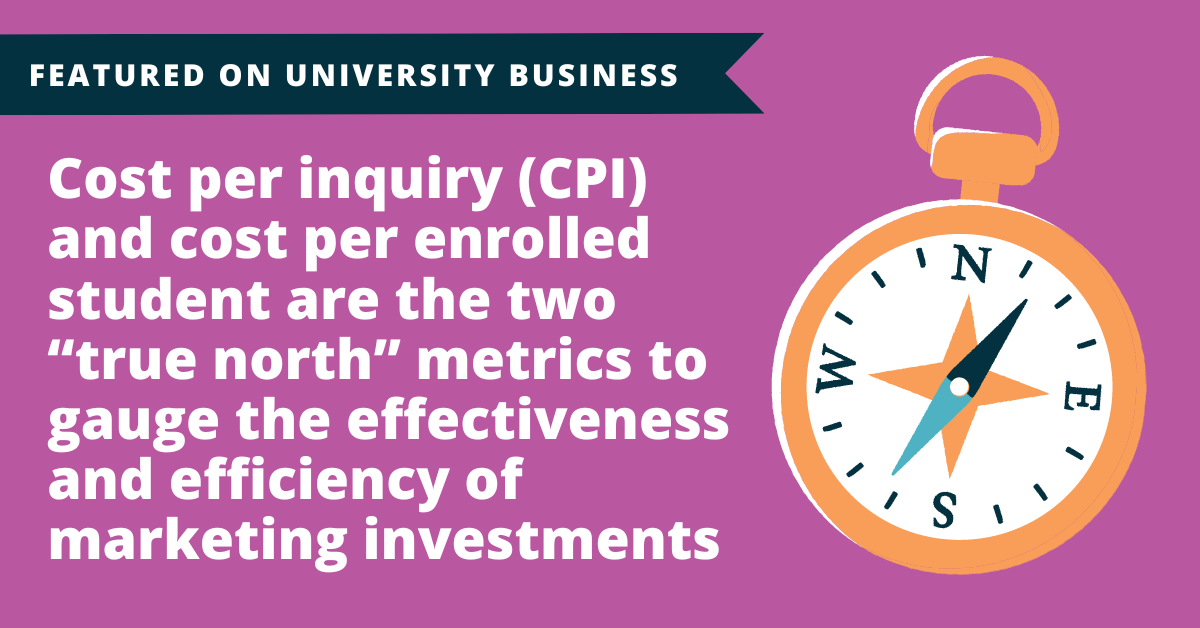
    To effectively market to this group, universities must prioritize tracking key metrics — namely, cost per inquiry (CPI) and cost per enrolled student. These “true north” metrics provide critical insights into the efficiency and effectiveness of marketing efforts, allowing institutions to allocate resources more strategically. Paula emphasizes that while campaign-level metrics like click-through rates are important, the ultimate goal is to drive enrollments, making CPI and cost per enrolled student the most valuable indicators of success.

    The article also notes that many institutions lack visibility into these metrics, presenting a missed opportunity to optimize marketing spend and improve ROI. By focusing on these metrics, universities can make data-driven decisions that enhance campaign performance, drive enrollment, and ensure long-term success in a competitive educational landscape.

    Read the full article for even more digital marketing for higher education insights.

    Contact Our Higher Education Marketing Agency

    Ready to strengthen your institution’s marketing strategy?

    At Search Influence, we specialize in helping universities optimize their potential.

    To get started, download our comprehensive research report, Higher Ed Marketing Metrics: What Gets Measured Gets Managed, created in collaboration with UPCEA.

    This report provides crucial benchmarks for CPI and cost per enrolled student, helping you track and improve your marketing outcomes.

    Contact us today to learn how we can help your institution achieve its enrollment goals with our higher education marketing services.

  • Not Tracking Cost Per Inquiry? Expect Budget Waste

    Not Tracking Cost Per Inquiry? Expect Budget Waste

    A woman looking out over her peers after graduation - Search Influence - Higher Education CPI

    Key Insights

    • Tracking and optimizing CPI is crucial for higher education marketers to ensure budget efficiency and maximize return on investment.
    • Failing to track CPI can make it difficult for higher ed marketers to correlate marketing success with enrollment, justify budget allocations, and optimize campaigns.
    • Tracking CPI empowers higher ed marketers to forecast conversion rates accurately, allocate resources cost-effectively, and refine strategies to attract the right audience.

    In the competitive realm of higher education marketing, efficiency is critical.

    Higher education marketers that understand cost per inquiry (CPI) will significantly influence the success of advertising campaigns, when the metric is leveraged properly. CPI, which measures the cost to acquire each inquiry is the first step to budget efficiency and maximum return on investment.

    Failing to track CPI can lead to you missing out on valuable insights that enable you to streamline your marketing efforts and better engage your target audience.

    Search Influence, in collaboration with (UPCEA), The Online and Professional Education Association, has conducted extensive research on the benefits of CPI tracking in higher education marketing.

    Through a comprehensive survey collecting data from industry leaders, we established the first higher ed cost per inquiry benchmark of $140. This initiative is part of a broader, multi-year goal to encourage higher education institutions to measure CPI diligently and consider all factors included in advertising costs.

    In this post, we’ll discuss how to successfully track your campaigns using CPI.

    The Importance of Tracking Cost Per Inquiry in Higher Education Marketing

    In higher education marketing, failing to track cost per inquiry results in inefficient budget use and an incomplete understanding of your marketing efforts. Without CPI tracking, higher ed marketers struggle to correlate marketing success to enrollment, making it challenging to justify budget allocations and optimize campaigns effectively.

    When you don’t track CPI, you risk:

    • Spending money on campaigns that drive clicks but no conversions
    • Making decisions solely on metrics like cost per click and click-through rate, rather than focusing on which campaigns are actually driving inquiries
    • Funneling money into underperforming campaigns based on the wrong metrics
    • Discontinuing campaigns that effectively generate leads because you’re not focusing on the right metrics

    Tracking CPI offers numerous benefits, including empowering higher ed marketers to:

    • Make data-driven decisions
    • Forecast conversion rates accurately
    • Allocate resources more cost-effectively

    By understanding the cost and quality of inquiries, institutions can refine their strategies to attract the right audience, thereby improving overall campaign performance. Metrics like CPI are vital for evaluating marketing health and success, enabling institutions to enhance enrollment processes and achieve a better return on investment.

    Insights from our higher ed marketing research study

    Our Higher Education Marketing Research Study, conducted in partnership with UPCEA, reveals critical insights that demonstrate the importance of tracking cost per inquiry.

    Higher education institutions spend an average of $800,970 on paid ads each year.

    Without tracking CPI, higher education marketers can’t be sure they’re allocating their resources effectively and getting the appropriate results for the amount they’re spending.

    Only 29% of higher ed marketers are satisfied with their capabilities to track the success of their campaigns. This is a frighteningly low percentage, considering the average higher ed marketer spends nearly a million dollars on paid ads yearly.

    You can achieve your enrollment goals more efficiently by focusing on tracking and reducing CPI.

    Tracking cost per inquiry allows you to:

    • Have confidence that you’re driving an appropriate amount of inquiries and yielding the desired results
    • Direct where to optimize your budget to make it more efficient
    • Understand how adjustments, including targeting and budget changes, impact results
    • Establish a jumping-off point that allows you to look at deeper metrics — such as the lead quality driven by these channels and conversion ratios as these inquiries move through the enrollment funnel

    By establishing a CPI benchmark, we encourage universities to track key metrics and be aware of all factors included in your advertising costs. This benchmark serves as a tool for your institution to compare its results with similar schools and programs, giving you confidence in your efforts by truly demonstrating how much you’re spending — no more guessing games.

    At Search Influence, we know these insights will empower institutions to improve their marketing strategies and achieve better results.

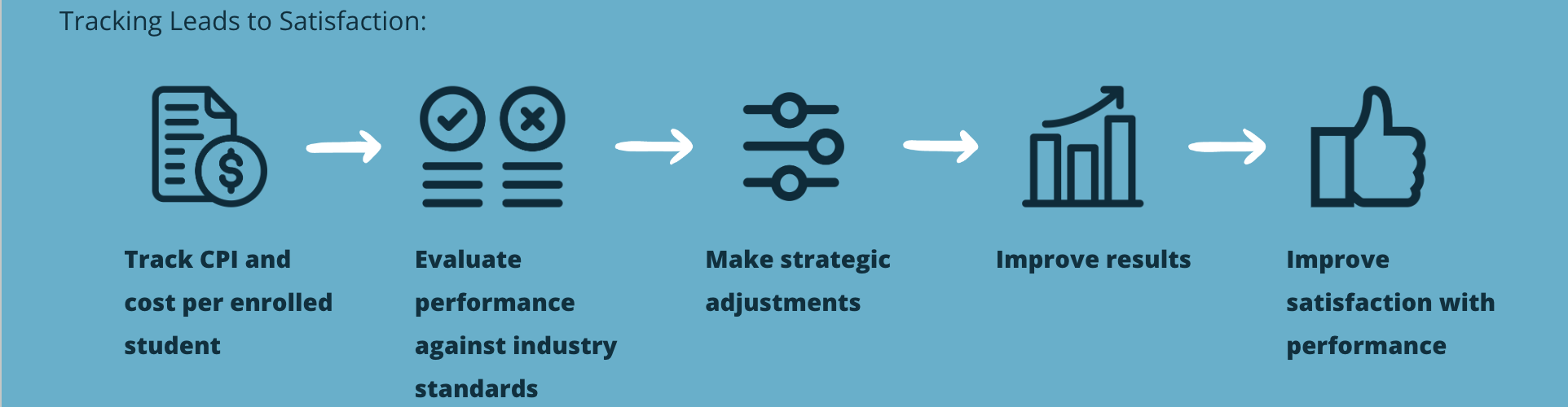
    Tracking leads to satisfaction - Search Influence

    Are You Able to Truly Track the Success of Your Ad Campaign?

    Universities investing in paid advertising must be setup to effectively track the success of their campaigns. Without the necessary information and strategies in place, you risk wasting significant portions of your budget. This underscores the true necessity of tracking cost per inquiry for higher education institutions.

    Some universities suffer from lack of data. Some universities suffer from an overabundance of data spread across disparate systems. Both scenarios hamper effective measurement.
    You need readily available information to make timely adjustments to your strategies, and a process that ensures you regularly analyze cost data and adjust your marketing strategy accordingly. Unfortunately, our research indicates that many institutions struggle in this area. Fewer than half (47%) of marketers are satisfied with their campaign performance, and only 29% are satisfied with their ability to track success. This dissatisfaction highlights a significant gap in campaign efficiency and effectiveness.

    CPI allows you to truly measure the success of your campaigns because your true success is measured by the number of students filling seats at your institution. By focusing on CPI, you get exactly what you pay for, ensuring your budget is used wisely and efficiently to boost enrollment.

    This correlation between tracking ability and campaign satisfaction reinforces the importance of CPI in driving higher ed marketing success.

    According to our research study, 92% of those who are satisfied with their ability to track also report they agree or strongly agree that they are satisfied with the performance of their marketing campaigns.

    Track Cost Per Inquiry With Confidence

    Don’t waste your budget — utilize CPI to achieve precise, measurable results and ensure every dollar spent on advertising contributes to your institution’s enrollment goals.

    At Search Influence, we advocate for robust CPI tracking to help you optimize your strategies and achieve the best possible outcomes. Our team has years of experience assisting higher ed institutions to maximize their marketing results including helping Tulane SoPA exceed its inquiry goal by 58%.

    Need support creating cost-effective campaigns with definitive KPIs?

    Download our Higher Education Marketing Research Study for further insights, or contact us directly to learn more about all our digital marketing services.


    Image Credits: Unsplash
  • How to Measure Paid Advertising Success in Higher Education—and Why an Agency Can Help

    A man sitting at a table working on data analysis from his Higher Education Marketing Research Campaigns - Search Influence

    Key Insights

    • Tracking, reporting, and analyzing are three pillars of a successful higher education advertising strategy.
    • From click-through rate to cost per inquiry, several metrics temperature check your paid ad campaign performance.
    • Search Influence and UPCEA collaborated to establish the first industry-wide cost per inquiry benchmark to help higher education marketers assess the state of their campaigns.
    • Tapping into the right metrics and data sources for your university unlocks insights that best optimize your campaigns.
    • When in doubt, partner with an experienced paid advertising agency that is proficient in turning data into decisions.

    According to 2023 research from Invoca, 87% of marketers feel that data is their most under-utilized asset.

    Like a gym membership, full of promise but often underused, data insights are what lead to the most gains in your higher education marketing campaigns.

    But the challenge lies in knowing which numbers matter and where to dig them up.

    Today, more universities than ever rely on paid advertising to attract the new tech-savvy adult learner. The global shift to digital marketing has opened doors to new metrics and tracking capabilities, all of which help gauge your campaigns’ success.

    If you’re a digital marketer, tracking and reporting on the right metrics ensures you use your resources effectively to reach your goals. Here’s what to know about measuring paid advertising success in higher education — and how an agency can help you uncover the metrics that truly matter.

    The Importance of Tracking & Reporting in Paid Advertising

    Diligently tracking and analyzing vital metrics empowers your higher education institution to assess the impact of your digital campaigns. By maintaining a vigilant oversight of the performance of your paid advertising initiatives, you gain the ability to:

    Understand your audience

    Data shows that 71% of consumers expect personalized marketing, and 76% feel frustrated when brands fail to meet this expectation.

    Achieving this level of personalization starts with knowing your prospective student. This goes beyond mere demographics, factoring in their aspirations, challenges, and the digital footprints they leave.

    Through a deep dive into audience analytics, you can segment your prospective students more effectively, crafting campaigns that address their specific needs and interests.

    Whether it’s highlighting flexible scheduling for working adults, showcasing success stories from similar backgrounds, or emphasizing support services for international students, tracking audience insights helps center your messaging around your core audience.

    Optimize your campaigns

    The digital advertising playing field is dynamic, with campaign performance varying by the minute.

    Real-time data analysis plays a critical role in optimizing your campaigns for the best results. It enables you to make immediate adjustments, such as pausing underperforming ads or reallocating the budget to more successful ones, which fosters a cycle of testing, learning, and optimization.

    Staying agile and responsive to campaign performance 24/7 through successful tracking keeps your advertising aligned with your marketing goals.

    Enhance the return on your investment

    The true value of tracking and analysis lies in its ability to reveal not just which channels and campaigns are performing but also why.

    By dissecting the elements of successful ads — be it the magic words, compelling visuals, or the right call-to-action — you can fine-tune your approach, guaranteeing every dollar spent is one working towards greater engagement and higher conversions.

    In doing so, you’ll demonstrate the value of your marketing campaign in ways you want the most: increased return on your investments.

    Effective Metrics for Measuring Paid Advertising Success in Higher Education

    Tracking the right marketing metrics can make the difference between campaigns that meet the mark and ones that fall flat. The following metrics act as vital signposts, indicating the health and impact of your advertising efforts:

    • Click-Through Rate (CTR): gauges the initial appeal of ad copy and visuals, signaling how well your ads grab attention and prompt click
    • Conversion Rate: measures the success of those clicks in achieving desired outcomes, like applications, spotlighting how ads translate interest into action
    • Return on Ad Spend (ROAS): assesses financial efficiency, comparing campaign costs against generated revenue to quantify your advertising investment’s return
    • Cost Per Acquisition (CPA): calculates the average expense of attracting a student via paid ads, offering insights into the cost-effectiveness of marketing strategies
    • Engagement Metrics: explores deeper interactions beyond clicks, revealing how compelling and relevant your content is to potential students

    Beyond these widely recognized metrics is a critical but often overlooked indicator: Cost per inquiry (CPI).

    This metric offers a nuanced view of the investment needed to generate a prospective student’s interest, providing a deeper layer of insight into campaign efficiency and the quality of engagement.

    Cost Per Inquiry in Higher Education Marketing

    In higher education marketing, CPI measures the financial investment needed to generate a single prospective student’s interest in your offerings, such as your programs, courses, or services.

    This metric uncovers exactly what it costs to catch the eye of a potential student, whether they’re signing up on your contact form, reaching out by email, or picking up the phone to learn more.

    The “cost” cost component varies based on:

    • The specific marketing campaigns
    • The mix of marketing channels used
    • The capability to track an inquiry back to its origin

    By focusing on CPI, your institution can pinpoint the effectiveness of your ad campaigns, guaranteeing that your allocated budget directly contributes to attracting potential students. This helps you achieve a favorable balance between the cost of attracting inquiries and the quality of interest generated.

    Benchmarking your CPI against the wider industry

    In collaboration with UPCEA, Search Influence established the first industry-wide CPI benchmark to help higher ed marketers like you better assess how you measure up to others in your industry.

    Our 2024 Higher Ed Marketing Metrics Research Report revealed that while 73% of marketers track the source of inquiries for their professional, continuing, and online (PCO) programs, less than half (46%) of higher education marketers track CPI.

    For those who are tracking this key metric, the average PCO CPI is $140, with a median of $106 and a range of $29.03 – $450.

    The research study also unveiled a strong link between metric tracking and satisfaction with results. In fact, 92% of those confident in their tracking abilities also report being satisfied or very satisfied with their marketing campaign performance. This finding reinforces the old adage that “what gets measured gets managed,” emphasizing the importance of diligent tracking in achieving impactful marketing outcomes.

    Key Data Sources to Track for Campaign Success

    Charts and graphs showing the results of Higher Education Marketing research results - Search Influence

    Where you track matters just as much as what you track. At Search Influence, we recommend leaning on the following data sources to keep a steady pulse on your campaign success:

    • Website Analytics: Tools like Google Analytics are indispensable for observing how users interact with your site. They offer a window into which paths lead towards inquiry or application and highlight the landing pages that work best.
    • CRM Integration: By syncing CRM data with your digital campaigns, you gain a comprehensive view of the prospective student’s journey, from first contact to enrollment, helping to pinpoint effective strategies.
    • Social Media Insights: The rich data from social platforms can inform you about engagement levels, reach, and which content types drive actions, allowing for agile strategy adjustments.
    • Other Prospect Data Sources: Don’t overlook additional touchpoints like email interactions, webinar participation, or content downloads. These can provide valuable insights into your audience’s preferences and behaviors.

    Tracking cost per inquiry

    Cost per inquiry is a more individualized KPI, with extra flexibility in how you can measure it to best fit your institution.

    Most marketers track CPI as a KPI for:

    • Specific Digital Marketing Channels: Differentiated CPI from paid search, organic search, etc., for precise adjustments to strategy and budget
    • All-Platform Digital Marketing Spend: Comprehensive CPI across all digital channels to understand the overall budget impact and guide comprehensive financial strategies

    However, some marketers may find it more fitting to track:

    CPI Per Program: Segmented CPI analysis for individual academic programs to enable targeted marketing enhancements

    Organic CPI: CPI exclusively from organic search to refine SEO and content tactics

    Overall CPI Across All Marketing Expenses: CPI from all marketing activities for a global perspective on investment efficiency

    Whichever way you look at CPI, it’s a versatile metric designed to suit the distinct objectives of your institution and unveil whether your marketing dollars are spent wisely.

    Maximizing Results Through Agency Partnerships

    Struggling to keep track of your paid campaign’s success? Partnering with an experienced advertising agency can help take the weight off your shoulders.

    With an agency’s robust tracking, reporting, and analysis capabilities, you’ll be equipped with the insights needed to make informed decisions and refine your strategies. You’ll gain the advantage of knowing:

    • Precisely what to measure
    • How to tailor your optimization efforts
    • The best ways to integrate these insights into your campaigns for enhanced performance

    Agencies are data specialists. They know how to interpret your school’s results, provide actionable next steps, and ensure your strategy always aligns with the latest industry and software changes.

    Are You Tracking the Right Metrics?

    At Search Influence, we pride ourselves on our ability to obtain results, track them, and report them back to your institution.

    We’re here to eliminate the guesswork from tracking the essential metrics that propel your success forward. To get you started, we’ve crafted a comprehensive, free worksheet designed to simplify the calculation of your CPI.

    Need more context on how you measure up to competitors? Download our 2024 Higher Ed Marketing Metrics Research Report to gain a clearer picture of your standing in the industry.


    Images Courtesy of Luke Chesser and Towfiqu Barbhuiya

  • Gain Recruitment SEO Insights From Will Scott’s Recent UPCEA Blog Post

    Will Scott on Higher Education SEO Strategies for UPCEA Guest Blog

    Search Influence Co-Founder and CEO Will Scott recently wrote a guest blog post for our higher education marketing partners at UPCEA.

    The blog post, titled “Drive Success: Using Recruitment SEO to Fill Higher Education Seats,” takes an in-depth look at how higher learning institutions can utilize recruitment SEO to adapt to evolving demographics and industry shifts.

    In his blog post, the SEO expert argues that traditional higher education marketing tactics are not enough. Today’s learners discover and explore educational programs differently, and institutions need to adapt their strategies accordingly.

    Takeaways from Will Scott’s UPCEA Blog

    • The Enrollment Funnel in the Digital Age: Today’s students research programs online throughout their decision-making process. Marketers must ensure a seamless online experience, from the initial discovery to application completion. This reiterates the importance of recruitment SEO, or optimizing websites for search engines.
    • A Shrinking Traditional Market: The number of high school graduates is declining, forcing universities to redefine their ideal students. Adult learners and non-traditional students present new opportunities, but also challenges, as they may not be aware of programs that can help them achieve their goals.
    • The Power of SEO: A well-crafted SEO strategy can significantly improve a university’s online presence. It can increase brand awareness, attract qualified leads, and move potential students down the enrollment funnel. Search Influence and UPCEA’s Higher Ed SEO Research Study shows that 84% of marketing departments view SEO as important, but only half have a defined strategy.
    • Beyond Discovery: SEO isn’t just about getting noticed. Prospective students often conduct follow-up searches to validate their initial impressions. Consistent presence in search results builds trust and credibility. Conversely, an absence can undermine an institution’s efforts and benefit competitors.
    • Challenges to Effective SEO in Higher Ed: Many universities lack the resources or expertise to implement a strong SEO strategy. Professional, Continuing and Online departments may be understaffed or underfunded, and institutional leaders may not understand the value of SEO. A Search Influence study revealed that marketing departments rated their SEO skills as just average, and website audits showed significant room for improvement.

    Infographic for Search Influence's Will Scott's UPCEA Guest Blog Post on Higher Education SEO Strategies

    Learn More About Recruitment SEO With Search Influence

    Prospective students are just a search away. Don’t let outdated marketing strategies hold you back.

    Search Influence has years of experience helping universities including Tulane SoPA and Palo Alto University attract qualified leads and fill seats with strategic SEO.

    Contact us today and learn how we can transform your website into a student discovery powerhouse.