Tag: higher ed marketing

  • Will Scott Named to UPCEA Board of Directors as Corporate Partner Representative

    Will Scott Named to UPCEA Board of Directors as Corporate Partner Representative

    Will Scott Named to UPCEA Board of Directors as Corporate Partner Representative graphic

    Search Influence is proud to announce that CEO and Co-Founder Will Scott has been named to the UPCEA Board of Directors as Corporate Partner Representative for a one-year term (2026–2027).

    His appointment reflects his leadership in higher education digital marketing and Search Influence’s longstanding collaboration with UPCEA, the leading association for online and professional education.

    Serving on the UPCEA Board

    UPCEA elected new officers and directors in November, with appointments taking effect at the conclusion of the 2026 UPCEA Annual Conference in New Orleans on April 17, 2026. As Corporate Partner Representative, Will will serve as a liaison between corporate partners and institutional members, contributing insight from the evolving landscape of higher education digital marketing.

    UPCEA leadership emphasized the importance of strategic, forward-thinking expertise during a pivotal moment for online and continuing education. As institutions adapt to AI-driven search behavior, enrollment shifts, and increased competition, the role of data-informed digital marketing has never been more essential.

    About Will Scott, AI SEO Expert

    Will Scott is a recognized leader in digital marketing and is credited with coining the phrase “barnacle SEO” in 2008. A founding faculty member of Local U, Will frequently presents at national conferences and contributes to major online marketing publications. With a Master of Architecture from Tulane University, he approaches marketing as a systems problem, solving for visibility, measurement, and long-term impact.

    Since launching his first website in 1994, Will has overseen teams that have developed thousands of websites, produced hundreds of thousands of directory pages, and generated millions of visits through search.

    Strengthening the Search Influence + UPCEA Partnership

    Will’s appointment to the UPCEA Board of Directors reflects more than an individual milestone. It represents the continued alignment between Search Influence and UPCEA’s shared commitment to research-driven innovation in higher education digital marketing.

    As a Platinum Partner of UPCEA, Search Influence has worked alongside the association to produce actionable, industry-leading research that helps institutions adapt to shifting search behaviors and evolving enrollment strategies. Together, we have collaborated on three major national studies:

    Through conference sessions, webinars, and ongoing thought leadership, the UPCEA x Search Influence partnership delivers practical frameworks for institutions looking to strengthen their visibility, improve ROI, and future-proof their higher education digital marketing strategies.

    Learn More About Higher Education Digital Marketing

    Will’s appointment reflects the deep alignment between Search Influence and UPCEA’s mission to expand educational access and outcomes.

    To learn more about our partnership or to discuss how your institution can strengthen its higher education digital marketing strategy, contact Search Influence today.

  • All of Your Higher Education Marketing Questions Answered

    All of Your Higher Education Marketing Questions Answered

    This post was updated by Paula French on 1/22/26 to reflect current best practices. It was originally published on 11/7/25
    Key Insights

    • Half of all prospective students now use AI tools daily or weekly, making AI-optimized content and entity SEO essential for institutional visibility.
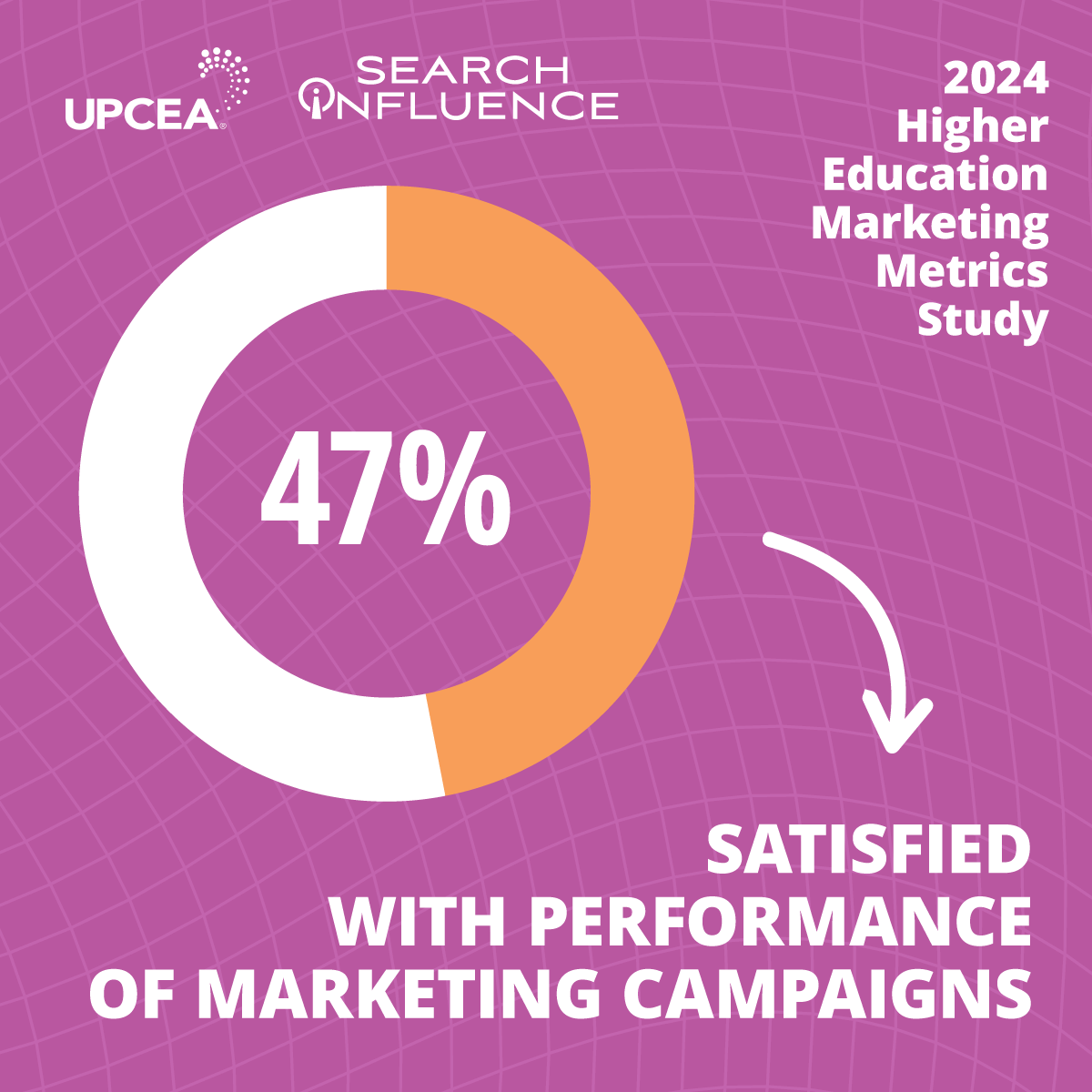
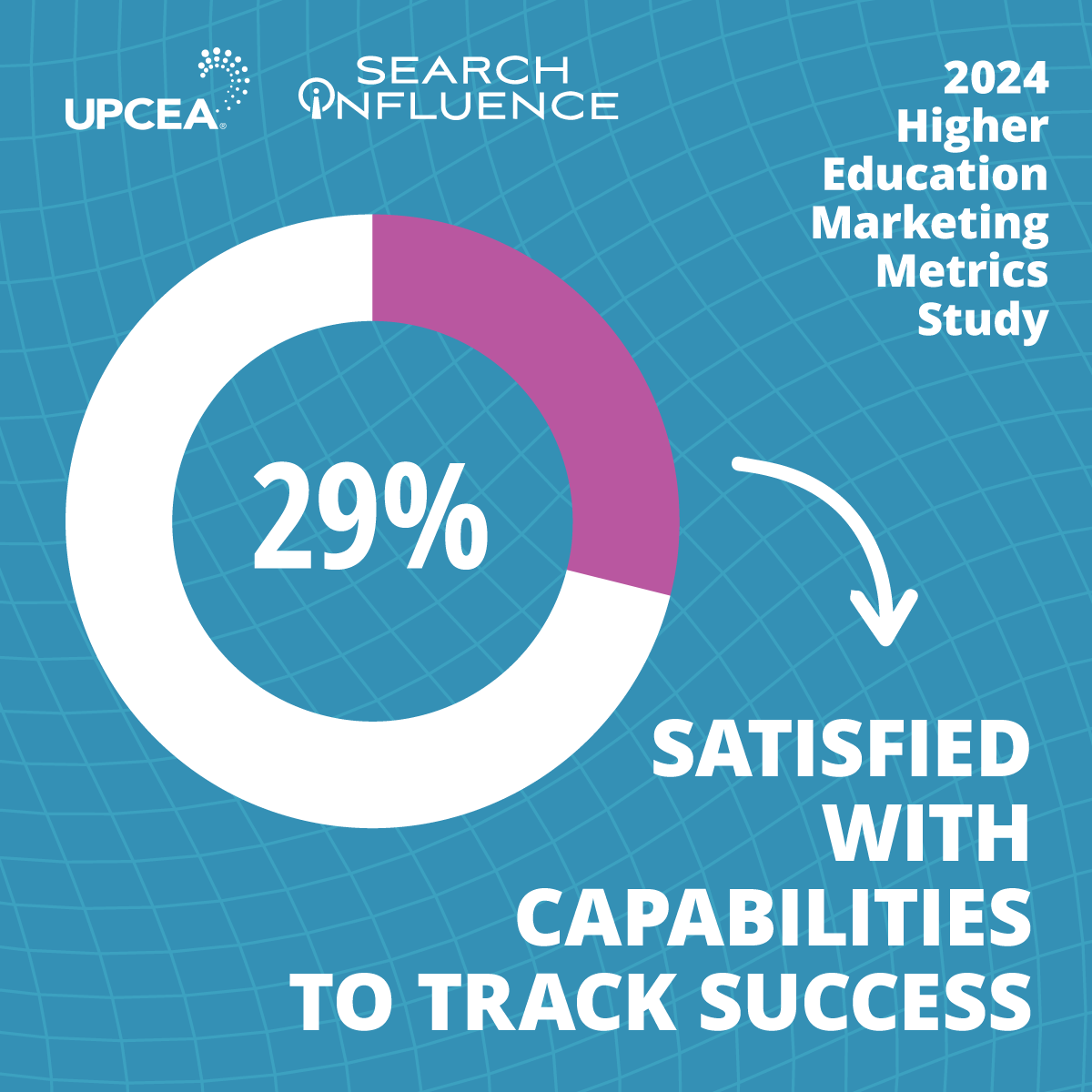
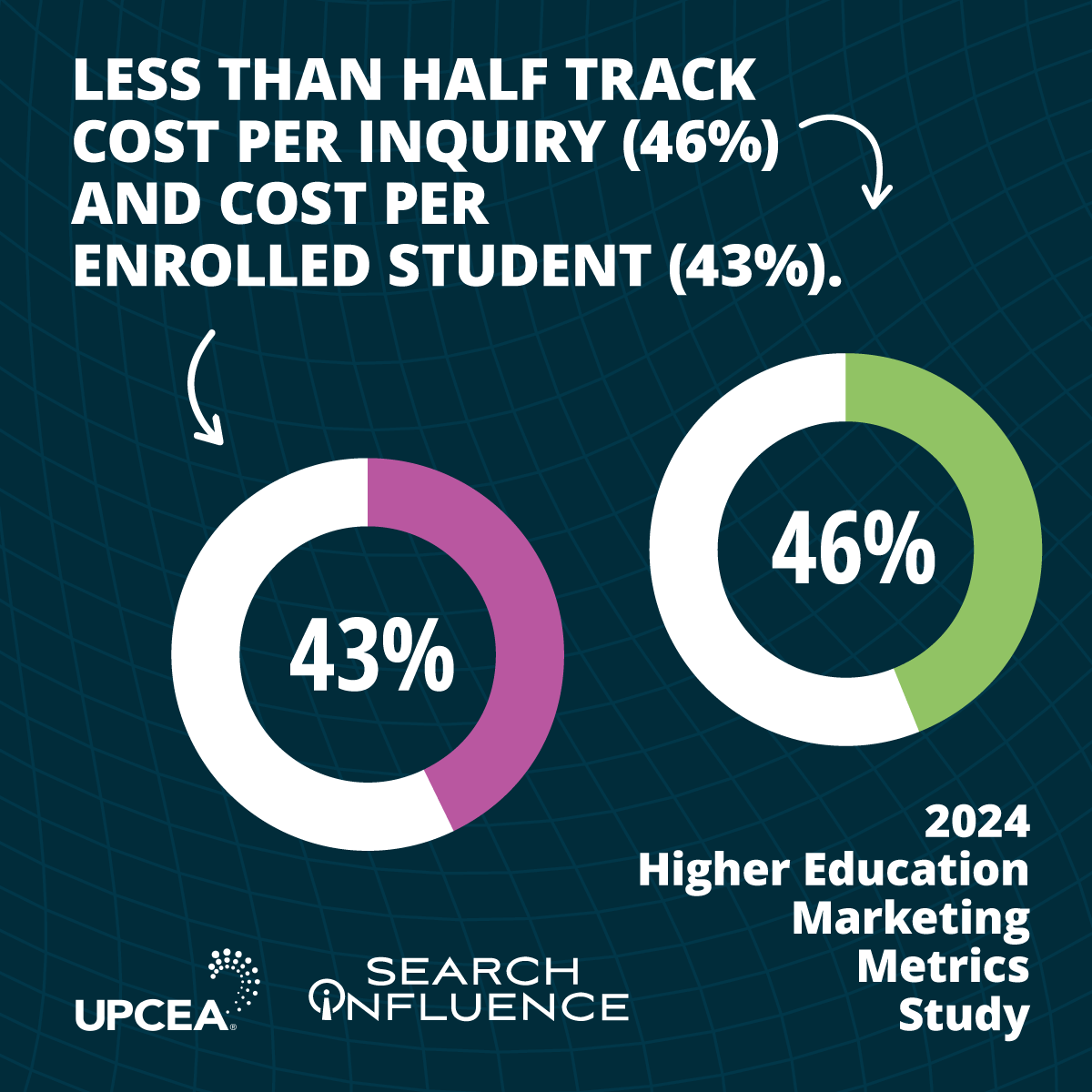
    • Fewer than 50% of higher ed marketers track cost per inquiry (CPI), even though those who do report stronger ROI and campaign satisfaction.
    • 82% of prospective students are more likely to consider programs that appear on page one of search results, underscoring the link between SEO investment and enrollment growth.
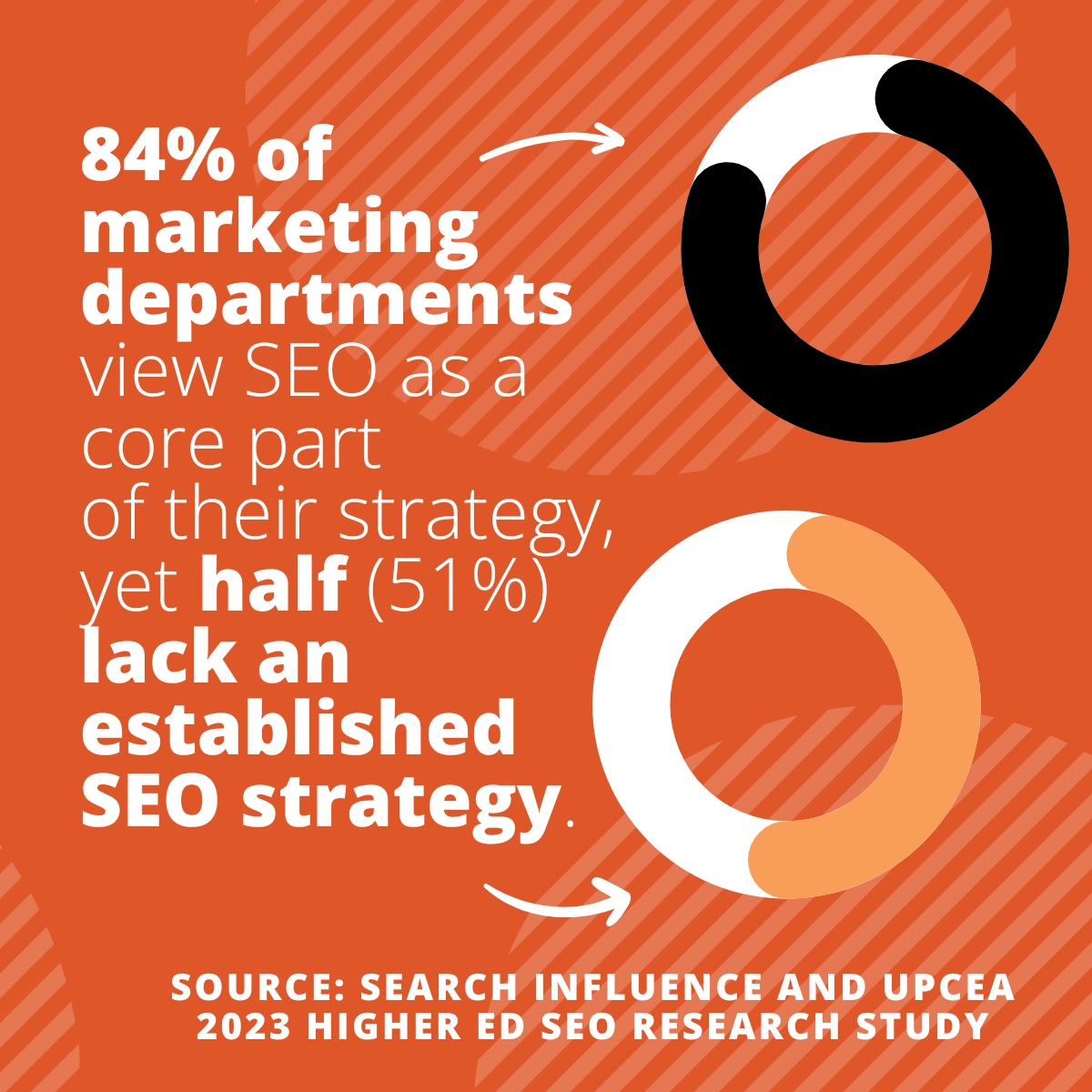
    • Most universities lack a formal SEO strategy. 51% admit they don’t have a defined plan, leaving major opportunities for early adopters to dominate AI and organic search.
    • Integrated, data-driven marketing across SEO, content, email, and paid media consistently outperforms siloed efforts by improving student engagement, retention, and brand trust.

    AI Overviews, social search, and shrinking applicant pools have rewritten how students discover programs.

    The old playbook won’t cut it; higher education marketers need clear, actionable guidance fast. This FAQ compiles the most-searched questions we hear from universities and colleges and gives concise, research-backed answers you can apply today.

    This guide draws on three cornerstone studies from Search Influence and UPCEA:

    Together, these reports reveal how today’s students search, how institutions measure success, and where colleges can strengthen their digital foundations. By applying these insights, your marketing team can build an integrated strategy that reaches prospective students across multiple channels and platforms.

    Ready to level up your visibility across digital marketing channels? Let’s start with the basics.

    General Higher Education Marketing FAQ

    What is higher education marketing?

    Higher education marketing is the process of promoting academic programs and institutional value to attract, engage, and enroll students.

    It helps higher education institutions communicate who they are, what they offer, and why they matter to students, families, and communities. Because prospective students make decisions over months or even years, higher ed marketing often targets multiple audiences, from high school students to alumni and employers.

    Success depends on building a unified digital marketing strategy that combines brand storytelling with recruitment goals across multiple platforms. By integrating search engine optimization (SEO), digital advertising, content marketing, email marketing, social media, and PR, institutions can reach students at every stage of their decision-making journey while reinforcing trust and brand recognition.

    What are common marketing mistakes colleges make?

    Common marketing mistakes include underfunding SEO, inconsistent messaging, and failing to track ROI.

    Many colleges focus heavily on awareness but neglect measurable outcomes like inquiries or conversions. Others overlook technical SEO, rely on outdated personas, or split marketing and admissions efforts into silos, causing disjointed communication.

    According to Search Influence and UPCEA’s Marketing Metrics Report, fewer than half of higher education marketers consistently track cost per inquiry (CPI), making it difficult to prove campaign performance.

    To avoid these pitfalls, institutions should refresh audience research, develop clear KPIs, and schedule regular SEO and accessibility audits to keep content relevant and visible.

    How can AI improve college marketing campaigns?

    AI improves college marketing campaigns by helping institutions analyze data, personalize outreach, and optimize performance.

    Artificial intelligence can identify which students are most likely to apply, surface trending keywords, and even predict when to re-engage inactive prospects. AI-powered chatbots and automation tools also allow universities to provide instant responses and tailor messaging to individual interests.

    Search Influence’s 2025 research found that 50% of prospective students use AI search tools weekly, and 1 in 3 trust those tools for program research. With proper oversight and brand alignment, colleges can use AI to streamline workflows, improve targeting, and stay visible in AI-driven search environments.

    How do colleges measure marketing success?

    Colleges measure marketing success by tracking metrics like inquiries, applications, conversion rates, and cost per inquiry.

    These indicators show how effectively marketing turns awareness into enrollment. A strong measurement plan tracks the full student funnel — from impression to click, inquiry, application, and enrollment — using tools like CRM systems, GA4, and Looker Studio dashboards.

    The most effective higher ed marketing teams use dashboards like Looker Studio, Power BI, or Tableau to create data visualizations and surface the metrics that matter.

    Search Influence’s Marketing Metrics study found the average CPI for professional and online education is about $140. Institutions that review KPIs monthly and adjust quarterly see better alignment between marketing efforts and enrollment goals, improving both efficiency and ROI.

    How has higher education marketing changed in 2025?

    Higher education marketing strategies in 2025 have shifted toward AI-driven search, conversational content, and data-informed decision-making.

    Students now rely on AI tools, social search, and short-form video to discover programs instead of just traditional search engines.

    As a result, institutions must create structured, citation-ready content that answers questions quickly and builds trust. With 1 in 3 students trusting AI for research, universities that adapt early with AI-optimized content, transcripts, and accessible multimedia will gain a lasting visibility advantage.

    What’s the role of marketing in student retention?

    Marketing supports student retention by maintaining engagement and strengthening community after enrollment.

    Consistent communication helps students feel informed, supported, and connected to campus resources and culture. When retention-focused marketing shares success stories, wellness initiatives, and career resources, it reinforces the value of the student’s decision to attend.

    Retention campaigns might include orientation emails, progress check-ins, and alumni outreach. By treating current students as an ongoing audience, institutions improve satisfaction, increase graduation rates, and build loyalty that lasts beyond commencement.

    How should universities balance brand awareness and program-specific marketing?

    Universities should balance brand awareness and program-specific marketing by distinguishing long-term reputation goals from short-term enrollment targets.

    Brand campaigns showcase the institution’s mission, faculty excellence, and campus life, while program campaigns speak directly to prospective students evaluating their next step.

    When both are managed under one unified digital strategy, the impact multiplies. Broad brand storytelling fuels recognition, and targeted program pages capture conversions. Shared messaging calendars and attribution tracking ensure that every channel, from video to search, contributes to the same institutional goals.

    SEO for Higher Education FAQ

    How is AI changing higher education search?

    AI is transforming higher education search by prioritizing context, authority, and trust signals over keyword repetition.

    According to our AI Search in Higher Education report, how prospective students search has become increasingly diversified: 84% use search engines, 61% use YouTube, and 50% use AI tools.

    Institutions that adapt to AI-first search behaviors will see stronger rankings, visibility, and engagement.

    How do universities benefit from search engine marketing?

    Search engine marketing helps universities reach qualified students through a blend of paid and organic visibility.

    SEO builds long-term authority and organic traffic, while paid search campaigns deliver immediate exposure for time-sensitive initiatives like application deadlines or open houses.

    When SEO and paid ads work together, they cover the full student journey, helping institutions lower costs per inquiry while improving overall visibility.

    What are common SEO mistakes colleges make?

    Common SEO mistakes include outdated or unstructured content, a lack of strategic links to program pages, and a lack of citations for programs.

    Next, we see weak internal linking and missed opportunities to drive prospects from blog pages to program pages.

    Many institutions overlook technical elements like schema markup or have a challenge with implementing it as deeply as needed.

    Search Influence’s SEO Readiness Research Study found that 51% of higher ed marketers lack a formal SEO strategy, and only 19% excelled in audits. Regular audits, technical maintenance, and clear governance can quickly improve performance and help colleges compete for attention online.

    How does ChatGPT or Gemini impact higher ed SEO?

    ChatGPT and Gemini are changing SEO by influencing how students consume information.

    Instead of clicking through multiple websites, users often receive summarized answers directly within AI-generated results.

    To stay visible, institutions must ensure their content is accurate, well-structured, and clearly attributed. Creating pages that answer student questions concisely, like tuition costs, outcomes, or requirements, increases the chances of being cited in AI Overviews.

    Why are student testimonials essential for SEO success?

    Student testimonials boost SEO by adding authentic content that reinforces expertise and trust.

    Testimonials create fresh, relevant text that both search engines and prospective students value.

    Featuring these stories on program pages, blogs, and video platforms supports Google’s E-E-A-T principles (Experience, Expertise, Authoritativeness, Trustworthiness) and helps potential students see themselves in your campus community.

    What’s the best approach to link building for higher education?

    The most effective link building approach focuses on authority and relevance.

    Universities can earn backlinks by publishing research, contributing expert commentary, and partnering with associations or media outlets.

    Quality always outweighs quantity; credible academic and industry sources signal trust to search engines. Regularly reviewing link profiles ensures ongoing improvement without the risks of spammy or irrelevant backlinks.

    How can universities appear in Google’s AI Overviews?

    Universities appear in AI Overviews when their content is credible, well-structured, and up to date.

    Successful universities create off-site citations through directories, earned media, and social channels that reinforce co-occurrence and co-citation.

    Pages that use schema markup, summarize information clearly, and cite trustworthy sources are more likely to be pulled into generative results.

    Updating program data quarterly, maintaining consistent branding, and writing in a clear, student-focused tone all improve a university’s ability to show in AI Overviews.

    What is entity SEO, and why does it matter for colleges?

    Entity SEO helps search engines understand a university’s identity, structure, and expertise. By marking up elements like programs, faculty, and events with schema and maintaining consistent naming conventions, institutions make it easier for search engines to recognize authority.

    Strong entity SEO enhances visibility in both AI and traditional results, ensuring your institution is accurately represented wherever prospective students search.

    Can Search Influence assist with social media as part of AI SEO?

    Yes, Search Influence integrates social media and AI SEO strategies to help colleges strengthen visibility across both traditional and emerging search environments. Our approach connects entity optimization, structured data, and content strategy with social engagement signals.

    Search Influence will guide your social media team or will produce optimized social media content in support of your SEO strategy.

    This integration ensures that universities build authority where students spend their time (on search engines, AI tools, and social platforms), resulting in greater reach and improved brand perception.

    Where can I find reliable recommendations for tracking competitor visibility in AI searches?

    Tools like RankScale, Scrunch, and Profound can help universities monitor how competitors appear in AI-generated search results.

    These tools track which websites are cited in AI Overviews, how often they’re mentioned, and what types of content earn inclusion. Using this data, marketing teams can identify content gaps, update program pages, and refine SEO strategies to stay competitive as AI-driven search continues to evolve.

    Higher Education Paid Search FAQ

    Can Search Influence help with paid digital advertising for universities?

    Yes, Search Influence manages digital advertising campaigns that are built to generate qualified leads and maximize ROI.

    Our team uses geo-targeting, remarketing, and deadline-based ad strategies to attract prospective students at key decision points.

    Aligning paid campaigns with SEO and landing page optimization ensures cohesive messaging and better conversion rates across your digital marketing efforts.

    What is paid search vs SEO?

    Paid search provides (mostly) immediate visibility through paid placements, while SEO builds organic authority over time.

    Both are essential to a balanced marketing strategy. Paid campaigns can drive quick results, while SEO ensures lasting presence.

    When integrated, they reinforce each other: paid search captures attention now, and organic SEO keeps your institution visible long after the ad spend ends.

    How can paid digital advertising (PPC) support enrollment campaigns?

    Paid digital advertising (sometimes called PPC) supports enrollment campaigns by driving traffic to high-value program pages during key application and decision periods.

    Ads highlighting deadlines, scholarships, or open houses meet students when urgency is highest.

    With tools like lookalike audiences and remarketing lists, colleges can re-engage previous visitors and nurture them toward inquiry and enrollment.

    What metrics matter most in higher ed paid digital advertising (PPC)?

    Conversion rate, cost per inquiry, and return on ad spend are the most important metrics in higher education paid digital advertising (PPC).

    Secondary indicators (like click-through rate, quality score, and impression share) help diagnose performance.

    Tracking inquiries and applications through CRM data gives institutions a full picture of what drives real conversions, ensuring that budgets support measurable enrollment growth.

    Should colleges bid on branded keywords?

    Colleges should bid on branded keywords to protect visibility and prevent competitors from appearing above their own organic listings.

    Branded campaigns are inexpensive, reinforce awareness, and ensure control over messaging.

    By occupying both paid and organic positions, institutions increase credibility and make it easier for students to find official information quickly.

    How does AI automation improve Google Ads performance?

    AI automation enhances Google Ads performance by dynamically adjusting bids, targeting, and creative based on real-time engagement data.

    Smart Bidding and Performance Max campaigns can optimize spend while identifying new audience opportunities.

    Marketers should still monitor automation closely, ensuring that AI-driven adjustments align with institutional priorities, brand tone, and geographic goals.

    Higher Education Content Marketing FAQ

    How does Search Influence approach content marketing?

    Search Influence approaches content marketing through a research-driven process that aligns every piece with SEO and audience intent.

    It starts with an audit to identify opportunities and ends with measurable results in search visibility and student engagement.

    Our strategy includes building content clusters, applying schema for clarity, and measuring outcomes like AI Overview inclusion and inquiry lift. The result is a scalable, data-informed system that helps institutions consistently publish high-performing, search-optimized content.

    What is content marketing in higher education?

    Content marketing in higher education uses educational storytelling to inform and inspire prospective students while building institutional trust. This approach includes creating program guides, faculty Q&As, alumni success stories, and student life videos, all tailored to different stages of the enrollment journey.

    Because prospective students spend significant time researching before applying, consistent, high-quality content helps position universities as credible sources of information. A well-organized content library improves search rankings, nurtures leads, and supports long-term brand awareness.

    What content helps convert prospective students online?

    Content that converts prospective students combines transparency, proof, and personality.

    Decision-making students look for information about tuition, career outcomes, accreditation, and campus culture. They also rely on authentic voices, such as student testimonials and alumni stories, to validate their choices.

    To increase conversions, universities should highlight outcomes, answer cost-related questions directly, and include clear CTAs such as “Request Information” or “Apply Now.”

    Research from Search Influence shows that 82% of prospects are more likely to consider programs that appear on page one, underscoring the link between optimized content and enrollment success.

    What tools are best for managing higher education content marketing campaigns?

    The best tools for higher education content marketing streamline planning, optimization, and reporting.

    Platforms like HubSpot, SEMrush, Clearscope, and MarketMuse allow teams to manage campaigns, track SEO performance, and measure engagement in one place.

    Paired with collaboration tools like Asana or Notion, these systems help marketing teams coordinate across departments and maintain consistent messaging. Monitoring AI search performance with tools like RankScale or Profound adds another layer of insight, helping institutions stay competitive in emerging search environments.

    How can universities repurpose existing content?

    Universities can repurpose content by adapting top-performing assets into new formats to reach different audiences.

    A student panel can become a blog post, a webinar can be turned into short video clips, or a research summary can be reimagined as an infographic for social media.

    Regularly updating and linking repurposed content increases its lifespan and search value. A quarterly refresh of stats, links, and calls to action ensures content remains accurate and relevant to prospective students.

    How do you create content that performs well in AI Overviews?

    Content performs best in AI Overviews when it’s concise, structured, and authoritative.

    Pages that clearly answer questions, include schema markup, and cite reputable sources are more likely to be featured in AI-generated summaries.

    Breaking long content into sections, adding TL;DR summaries, and maintaining up-to-date statistics all help AI tools recognize value and accuracy. Universities that optimize for clarity and structure are better positioned to appear in both AI and traditional search results.

    What role does accessibility play in higher ed content marketing?

    Accessibility ensures that every student can access and understand institutional content, regardless of ability or device.

    Accessible pages — those with alt text, transcripts, readable design, and proper heading structure — improve both usability and SEO.

    Beyond compliance, accessibility signals inclusivity and professionalism, strengthening brand trust. Accessible content also performs better in search because it’s easier for major search engines and AI systems to interpret.

    Email Marketing for Higher Education FAQ

    What is higher education email marketing?

    Higher education email marketing is the practice of nurturing relationships with prospects, students, and alumni through personalized communication at each stage of the student lifecycle. Unlike generic campaigns, effective email strategies deliver content that reflects the recipient’s goals and timeline.

    When emails are segmented by audience and behavior, such as application status or event participation, they create a sense of relevance that drives engagement and enrollment.

    What are the benefits of email marketing for colleges?

    Email marketing benefits colleges by providing a direct, measurable way to engage prospective and current students.

    It delivers high ROI, builds brand awareness, and reinforces trust by keeping communication consistent throughout the decision-making process.

    It’s also one of the most cost-effective digital marketing strategies available, allowing institutions to send targeted, timely messages that guide students from interest to enrollment.

    What’s the role of email in student conversion?

    Email plays a critical role in conversion by guiding students from awareness to action.

    Well-timed sequences can nurture interest with program highlights, student stories, and reminders about upcoming deadlines.

    Each message builds confidence, encouraging students to move from inquiry to application. When combined with personalized calls to action and responsive design, email becomes one of the most reliable conversion tools in enrollment marketing.

    How can universities improve email engagement rates?

    Universities can improve email engagement by segmenting audiences, personalizing content, and testing messages.

    Emails that reference a student’s program of interest or desired start term feel more personal and relevant.

    Short subject lines, strong preview text, and mobile-friendly formatting also improve open and click rates. Maintaining list hygiene and monitoring deliverability ensures that your most engaged contacts always see your messages.

    How should email integrate with other higher ed marketing channels?

    Email works best when it complements SEO, social media, and paid campaigns.

    When a prospect engages with a search ad or social post, follow-up emails can provide more detail, invite them to a virtual event, or connect them with an admissions counselor.

    This omnichannel approach keeps communication consistent across touchpoints and helps institutions track the full impact of their digital marketing strategies.

    How often should colleges email prospective students?

    Most colleges email prospects weekly during active recruitment seasons and scale back to biweekly or monthly when engagement naturally slows.

    Frequency should balance consistency with respect for inbox fatigue.

    Using preference centers or opt-down options allows prospects to control how often they hear from you, improving engagement while reducing unsubscribes.

    What’s a good open rate benchmark for higher ed?

    A good email open rate ranges from 17-28%, depending on audience size and message type. Smaller, more targeted lists usually perform best because they deliver content tailored to specific interests.

    Regularly testing subject lines, send times, and content length can reveal what resonates most with your audience and help refine your email marketing strategy.

    Snap Poll FAQ: AI Search Strategy in Higher Education

    In October 2025, UPCEA partnered with Search Influence to conduct a snap poll examining how higher education institutions are responding to the rise of AI-powered search usage. The poll was shared through UPCEA’s Membership Matters newsletter and the UPCEA CORe discussion site, reaching marketers and leaders across higher education.

    A total of 30 UPCEA members participated, offering a real-time snapshot of institutional readiness for AI search. The questions and response breakdowns below reflect current strategy, challenges, and tracking practices. Together, they highlight a consistent theme seen across Search Influence and UPCEA research: while awareness of AI search is widespread, execution, measurement, and infrastructure are still developing across many institutions.

    Which of the following best describes your institution’s current strategy

    for addressing the rise of AI-powered search tools (e.g., Google’s AI Overviews, ChatGPT, Gemini, Perplexity)?

    • 60%: We’re in the early stages of exploring how to adapt to AI search
    • 30%: We have a formal strategy and are actively optimizing content for AI tools
    • 6.67%: We know it’s important, but haven’t taken any action yet
    • 3.33%: We don’t think AI search will significantly impact student discovery

    What challenges does your institution face in adapting to AI-powered search? Select all that apply.

    • 70%: Competing initiatives or limited bandwidth
    • 36.67%: Lack of in-house expertise or training
    • 26.67%: Unclear return on investment (ROI)
    • 26.67%: Uncertainty about how AI search works or what to do next
    • 26.67%: Leadership buy-in or institutional support is missing
    • 10%: Other

    Has your institution’s website appeared in AI-generated search results (e.g., Google AI Overviews, ChatGPT, Perplexity)?

    • 56.67%: Yes — we know it does
    • 26.67%: Maybe — we’ve seen it once or twice, but don’t track
    • 3.33%: No — not that we’re aware
    • 13.33%: Not sure

    Which of the following best describes how your institution tracks visibility in AI-generated search results?

    • 64.29%: With a tool or tools
    • 28.57%: We don’t track this formally
    • 7.14%: Manually

    What are the reasons behind your team’s current approach to AI search? Select all that apply.

    • 59.26%: To ensure accurate and trustworthy information is presented in AI tools
    • 48.15%: To increase visibility and stay competitive in search rankings
    • 22.22%: Other priorities are taking precedence right now
    • 14.81%: We’re waiting to see how AI search evolves before taking action
    • 11.11%: Other

    Marketing for Higher Education Research

    Search Influence’s higher education marketing research helps universities make data-driven decisions and adapt to AI-era search. In partnership with UPCEA, these reports provide education marketing benchmarks leaders can act on. Supporting budget asks, KPI frameworks, and practical AI SEO ramp plans that align institutional priorities with enrollment marketing campaigns.

    AI Search in Higher Education: How Prospects Search in 2025

    This study shows how students increasingly use AI tools to explore and evaluate programs, and what that means for your visibility. We found that 50% of prospects use AI weekly, 1 in 3 trust AI for program research, and 82% prefer programs on page one of search results.

    The report explains which platforms students use most, how often, and why trust varies by task. You’ll also see how YouTube and university websites influence AI-assisted decisions and how early movers gain a durable edge.

    The takeaway is clear: SEO is a prerequisite for AI visibility, and institutions that operationalize AI-ready content now will win share.

    Download the Study

    Marketing Metrics Research Report: What Gets Measured Gets Managed

    This report details how tracking cost per inquiry and campaign performance improves marketing efficiency and team confidence. Benchmarks include an average CPI of about $140, with email commonly managed in-house and digital advertising more often outsourced.

    We highlight persistent gaps, fewer than half of teams track CPI consistently, and show how to fix them with standardized definitions, shared dashboards, and quarterly target setting. You’ll learn which metrics correlate with higher satisfaction and where to focus first to tighten attribution.

    Use these insights to build executive-ready reporting that unlocks smarter budget allocation.

    Download the Study

    2023 Higher Ed SEO Readiness Research Study

    This study reveals that most institutions view SEO as foundational but lack a formal plan and consistent reporting. Findings include 51% of universities are without an SEO strategy, only 19% excel in third-party audits, and just 31% of institutional leaders receive regular SEO updates.

    We outline concrete risks and map the fixes. Recommendations include governance models, entity maps, structured data, and content refresh rhythms tied to academic calendars.

    The study is a practical roadmap for building sustainable SEO operations.

    Download the Study

    Learn More About Our Higher Education Marketing Agency

    Search Influence is a higher education digital marketing agency that helps universities attract, engage, and enroll students through data-driven strategies.

    From AI-ready SEO and content to paid media and analytics, we partner with colleges and universities to extend reach, raise organic traffic, and convert interest into enrollments across multiple channels.

    Contact us to learn more about our integrated higher education digital marketing services.
  • AI Search Optimization for Graduate Education Marketing in 2026

    What 2025 Research Tells Us About AI Visibility, Zero-Click Search, and Enrollment Strategy

    Executive Summary

    Here’s the reality: the way prospective graduate students find and evaluate programs has changed faster than most of us anticipated. Research from across 2025 — including original survey data from UPCEA and Search Influence (n=705) — shows that half of all prospects now use AI tools weekly, while 82% are more likely to consider programs appearing on page one of search results. Zero-click searches have climbed to 69% of all Google queries. AI Overviews now appear on nearly half of search results.

    And this is just where we are today. The trajectory for 2026 is clear.

    Key Findings at a Glance

    Metric 2025 Finding Implication for 2026 Source
    AI tool usage (weekly+) 50% of prospects Expect 60%+ as tools improve UPCEA/Search Influence
    Page one consideration 82% more likely AI citations become equally critical UPCEA/Search Influence
    Zero-click searches 69% of queries Will exceed 75% for informational Similarweb/SparkToro
    AI Overview reach 1.5B monthly users Expanding to 80%+ of queries Google Q1 2025
    ChatGPT weekly users 800 million Continued exponential growth OpenAI September 2025
    AI in college search 23% (6x from 2023) 35-40% projected Carnegie 2025

    So what does this mean for 2026? Traditional higher education SEO and paid search remain foundational—that hasn’t changed. But they’re no longer sufficient on their own. Institutions that fail to invest in AI search optimization and AI visibility strategy risk disappearing from the consideration set entirely, before prospects ever visit a website.

    The institutions that act now on GEO for higher education will have a 12-month head start on those still debating whether this matters.

    The State of AI Search: Where We Are and Where We’re Headed

    The Adoption Curve Has Been Steeper Than Anyone Expected

    I’ll be honest: when we started tracking AI adoption in college search two years ago, I didn’t expect to see numbers like these so quickly.

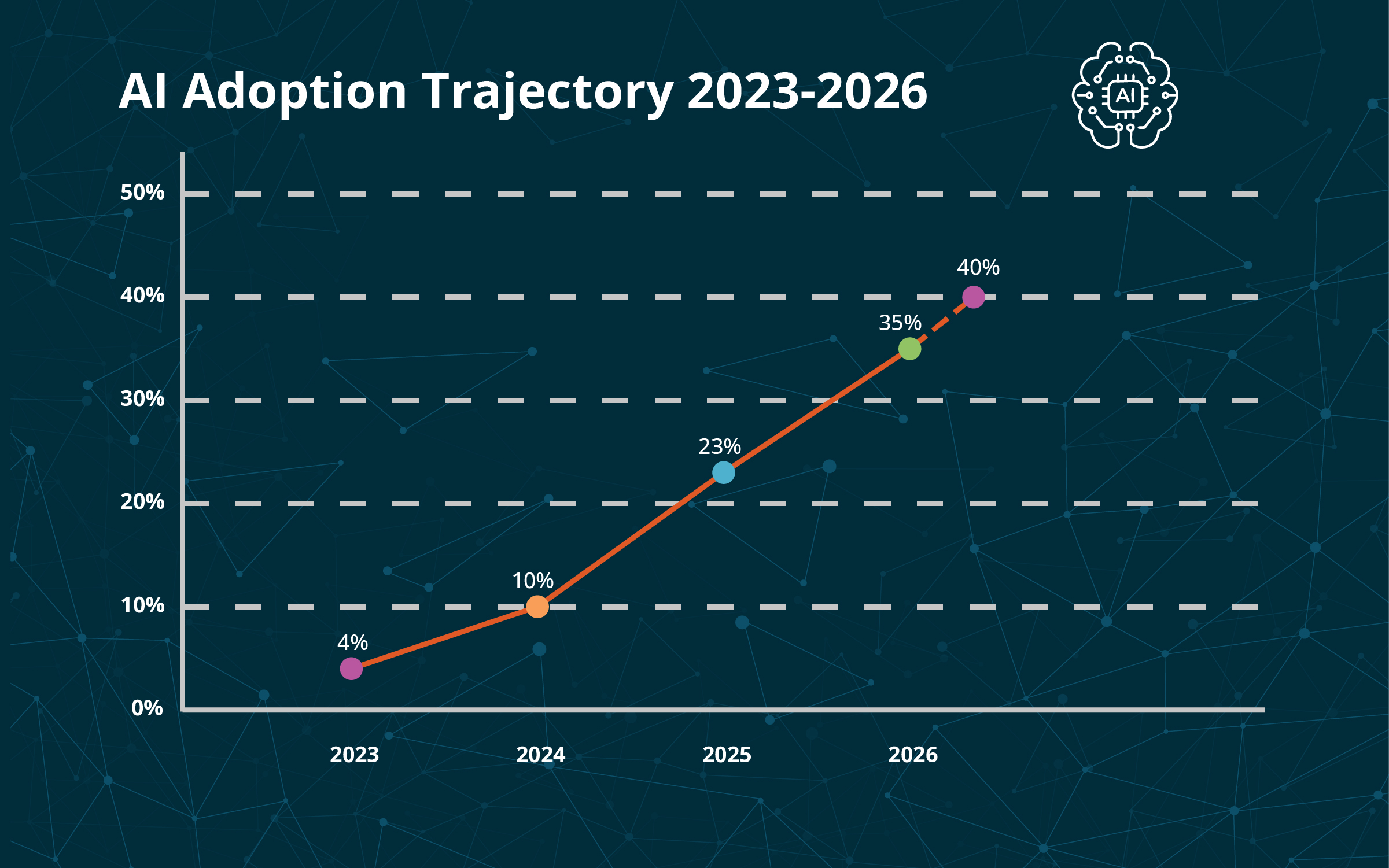
    According to Carnegie’s 2025 Summer Research Series, AI usage in the college search process jumped from 4% in 2023 to 10% in 2024 to 23% in 2025—nearly 6x in two years. Rising students show even higher adoption at 25%, while parents trail slightly at 21%.

    If this trajectory holds—and there’s no indication it won’t—we’re looking at 35-40% AI usage in college search by the end of 2026. For graduate and professional programs, where prospects skew older and more research-oriented, adoption may be even higher.

    The UPCEA/Search Influence study of 705 qualified respondents (March 2025) digs deeper into professional and continuing education prospects specifically:

    • 24% use AI-powered tools daily
    • 26% use them weekly
    • 18% use them a few times per month
    • 17% never use AI tools for search

    Younger prospects show higher daily and weekly usage, which isn’t surprising. But here’s what caught my attention: even among older demographics, the “never use” category is a minority. This isn’t a Gen Z phenomenon anymore. By 2026, the “never use” segment will likely shrink to single digits.

    Search Engines Still Dominate—But the Picture Is Getting More Complicated

    When researching professional and continuing education programs, prospects use multiple platforms, often in the same search session:

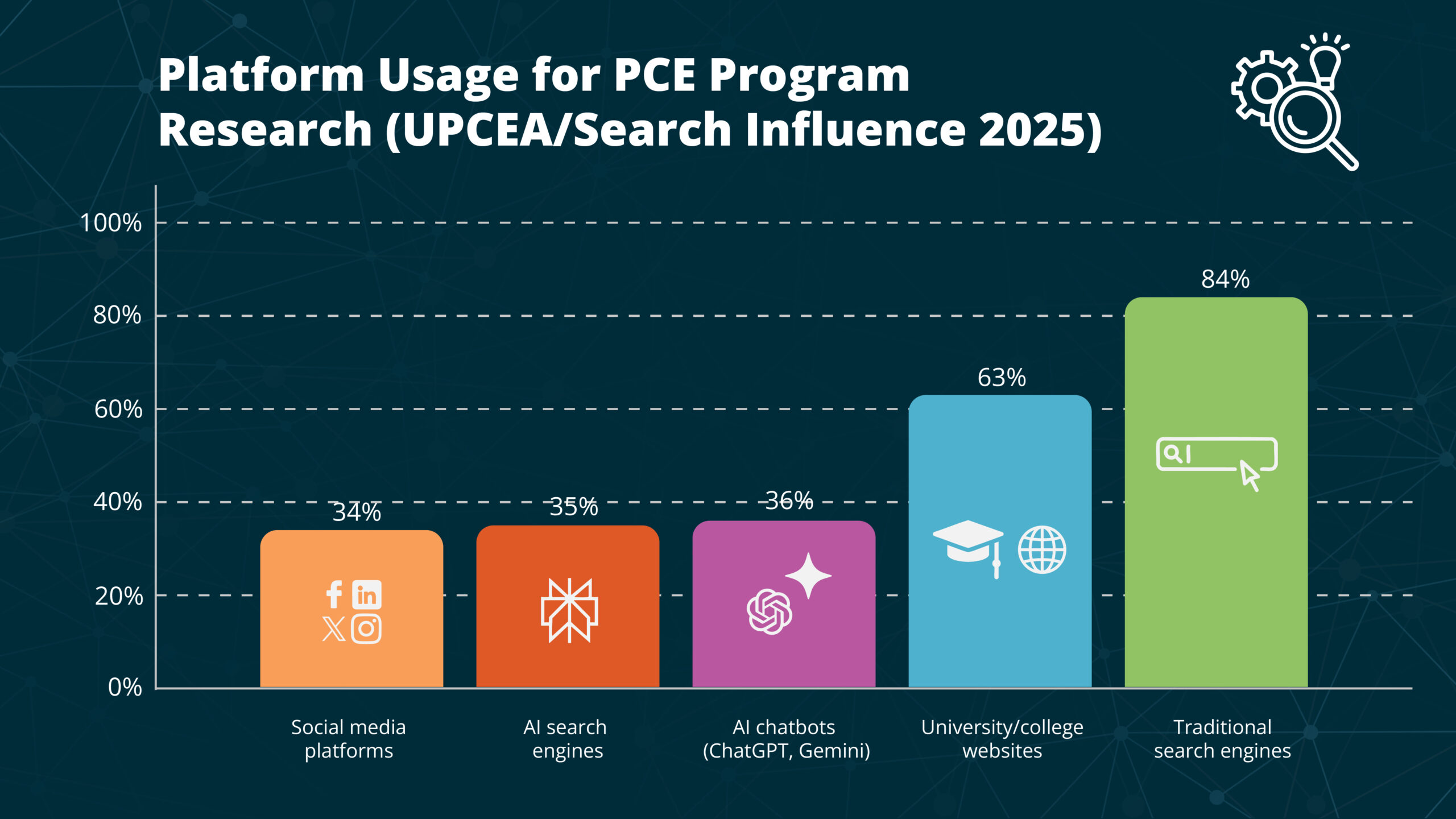
    Platform Usage for PCE Program Research (UPCEA/Search Influence 2025)

    Platform Extremely/Very Likely to Use
    Traditional search engines 84%
    University/college websites 63%
    AI chatbots (ChatGPT, Gemini) 36%
    AI search engines 35%
    Social media platforms 34%

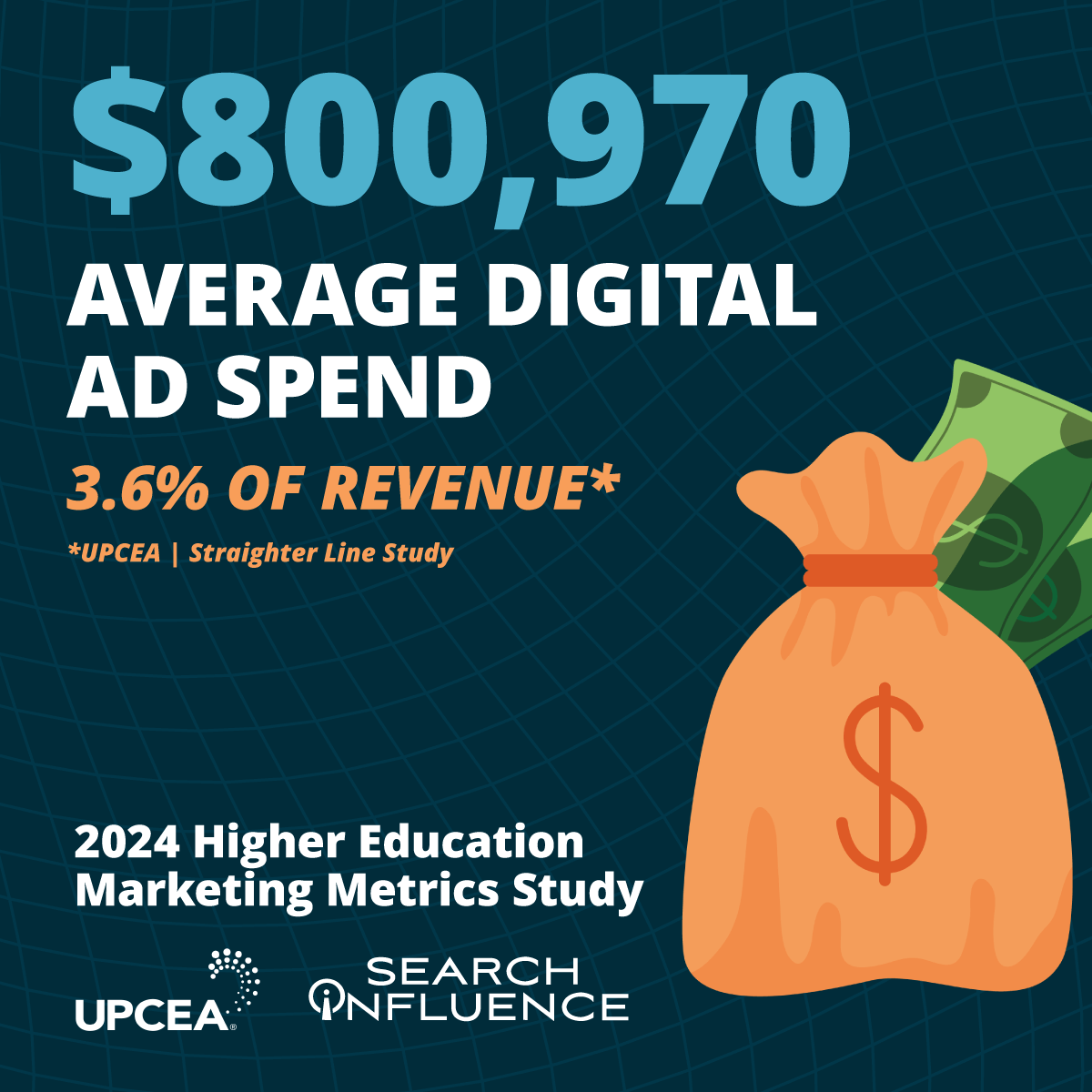
    Here’s the number that should get your attention: AI-assisted tools now warrant the same strategic investment as social media, where institutions spend an average of $166,303 annually on advertising, according to UPCEA’s 2024 Marketing Survey. Are you spending proportionally on AI visibility for your university? Most graduate enrollment marketing teams aren’t—yet. By 2026, that gap will separate the visible from the invisible.

    The Lines Between “Search” and “Browse” Have Blurred Permanently

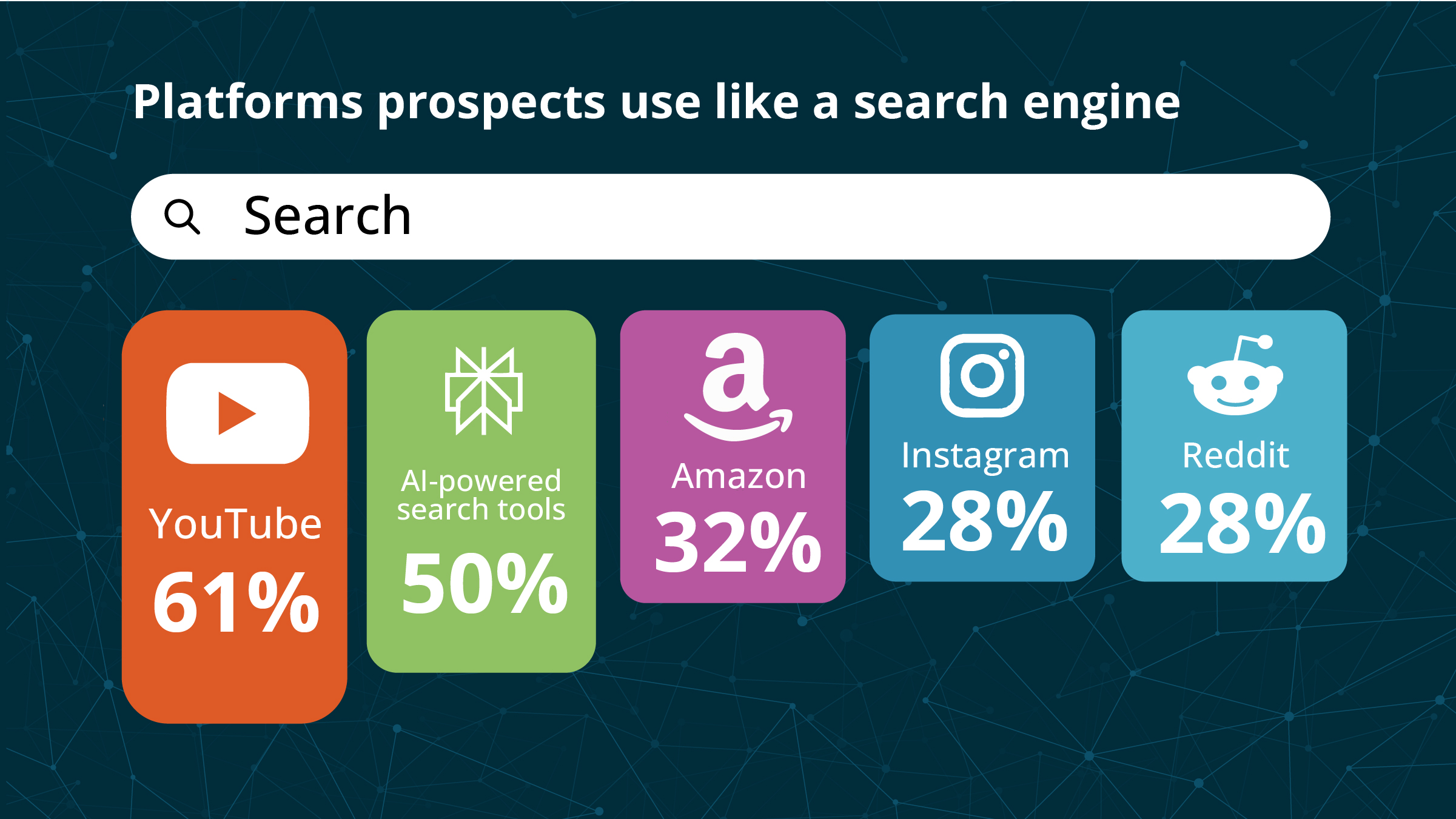
    We asked respondents which platforms they use “in a way similar to how you would use a traditional search engine.” The results tell us something important about how prospects actually behave:

    • YouTube: 61%
    • AI-powered search tools: 50%
    • Amazon: 32%
    • Instagram: 28%
    • Reddit: 28%

    Prospects don’t distinguish between “search” and “browsing” the way we do in marketing meetings. YouTube is a search engine to them. ChatGPT is a search engine. Instagram is a search engine. Your content has to work across all of them, or you’re only reaching part of your audience.

    For 2026 planning, this means content strategy can’t be siloed by platform. The same information needs to exist in formats optimized for each discovery channel.

    The Zero-Click Search Reality: Planning for a Post-Click World

    Most Searches Don’t Result in Clicks Anymore

    Zero-click searches—queries where users get answers directly from search results without visiting a website—have reached a tipping point:

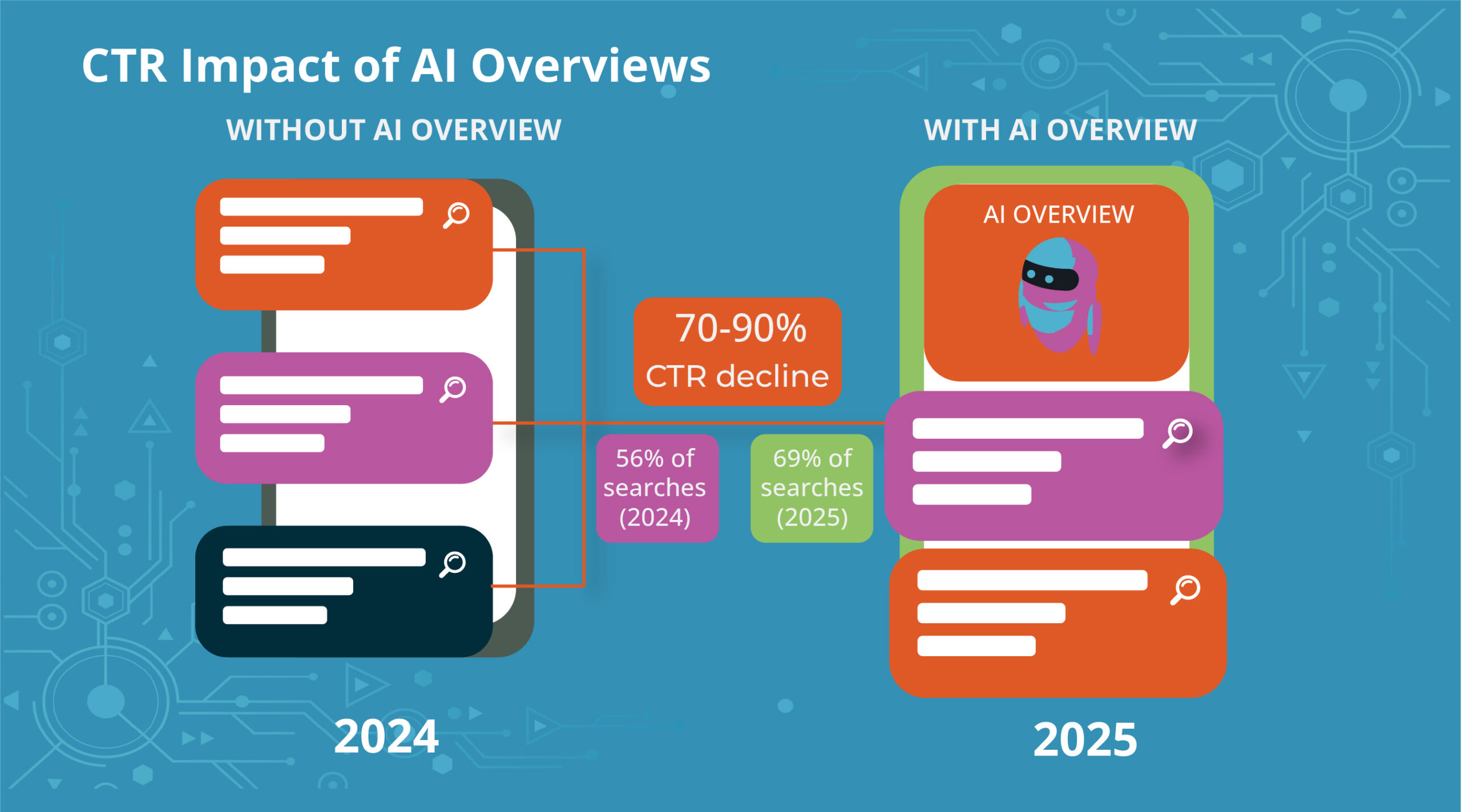
    • 69% of Google searches ended without a click (May 2025), up from 56% in May 2024
    • 60-63% of all Google searches result in zero clicks according to SparkToro/Similarweb
    • 70-90% click-through rate decline when AI Overviews appear

    Google’s AI Overviews now reach 1.5 billion monthly users as of Q1 2025. The feature appears on 47% of searches today, with Google’s internal testing suggesting this will exceed 80% for informational queries in the near future.

    For 2026 planning: Assume zero-click will exceed 75% for the informational queries that drive graduate program research. Questions like “What are the admission requirements for [Program X]?” or “How much does an MBA cost?”—exactly the queries your prospects are typing—will increasingly be answered without a click.

    What Zero-Click Search Means for 2026 Graduate Enrollment Marketing

    The implications for university marketing teams are significant, and I don’t think we should sugarcoat them:

    1. Traditional funnel metrics are becoming less reliable.

    If prospects get answers about tuition, deadlines, and program details from AI summaries, they may form opinions about your institution without ever reaching your website. Your analytics won’t capture that interaction. You’ll have incomplete data on what’s actually influencing enrollment decisions.

    2026 action: Build brand visibility metrics alongside click metrics. Track AI citations, brand mentions, and sentiment—not just traffic. This requires a different approach to higher education analytics.

    1. You’re paying more for declining performance.

    Everspring reports that the average cost-per-click for higher education terms has increased 45% year-over-year, while performance has declined. That’s a rough combination that will only intensify.

    2026 action: Rebalance paid media budgets. The ROI calculus on traditional higher education PPC is shifting. Organic AI visibility may deliver better long-term value.

    1. This is already disrupting adjacent industries.

    Learning platform Chegg reported a 49% decline in non-subscriber traffic between January 2024 and January 2025, coinciding with AI Overviews answering homework and study questions that previously drove site visits. Graduate enrollment marketing isn’t immune to the same dynamics.

    2026 action: Don’t wait for disruption to hit your specific program category. Invest in zero-click search strategy now.

    The Trust Signal Hidden in AI Overviews

    Here’s where the data gets interesting. The UPCEA/Search Influence study shows how prospects actually interact with AI Overviews:

    • 79% read the AI-generated overview when it appears
    • 51% click on sources most of the time or always
    • 43% click occasionally
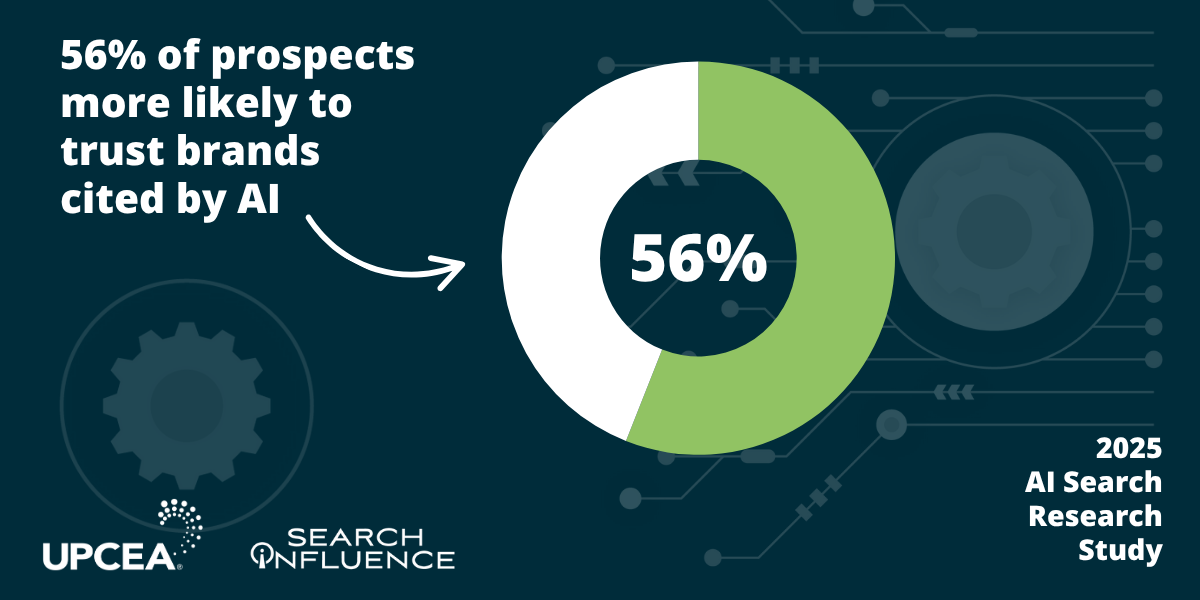
    • 56% are more likely to trust brands/websites cited in AI Overviews

    That last number matters enormously for 2026 strategy. Being cited in AI Overviews isn’t just about visibility—it’s a credibility signal. When prospects see your institution referenced in AI-generated content, they’re more likely to view you as trustworthy. Absence from those results may communicate the opposite.

    Rethinking Optimization: From Higher Education SEO to GEO

    SEO vs. GEO for Universities: A Different Kind of Target

    Here’s a useful way to think about the shift we’re navigating:

    Traditional SEO feels like optimizing for an algorithm—a system that scores and ranks based on signals (keywords, links, technical factors). It’s mechanical, pattern-matching. You’re essentially optimizing for a librarian: cataloging, indexing, and retrieval.

    GEO (Generative Engine Optimization) feels fundamentally different. It feels like optimizing for a reader who happens to have perfect memory and infinite patience—an entity that’s actually trying to understand what you do, synthesize it, and explain it to someone else. You’re optimizing for a research assistant: understanding, synthesizing, recommending.

    Put more directly: with GEO, you’re writing content that helps an AI form an accurate opinion about your institution—because that’s what it’s going to share with prospects.

    The practical difference:

    • SEO rewards structure and signals
    • GEO rewards clarity, accuracy, and citable claims

    You’re not just trying to rank anymore. You’re trying to be the source an AI would quote if it were writing an article about your program category.

    What This Means for University Content Strategy in 2026

    For 2026, your higher education content strategy needs to serve two masters simultaneously:

    1. Traditional search engines that still drive significant traffic and still reward keyword optimization, technical SEO, and backlink profiles
    2. AI systems that are reading your content to form an understanding of who you are, what you offer, and whether you’re worth recommending

    The good news: these aren’t entirely at odds. Clear, factual, well-structured content performs well for both. But the emphasis shifts. AI systems don’t care about keyword density—they care about whether they can extract accurate, citable information. This is the core of AI-ready website optimization for higher education.

    What Prospects Trust—and Don’t Trust

    The Trust Hierarchy Is Clear (and Stable)

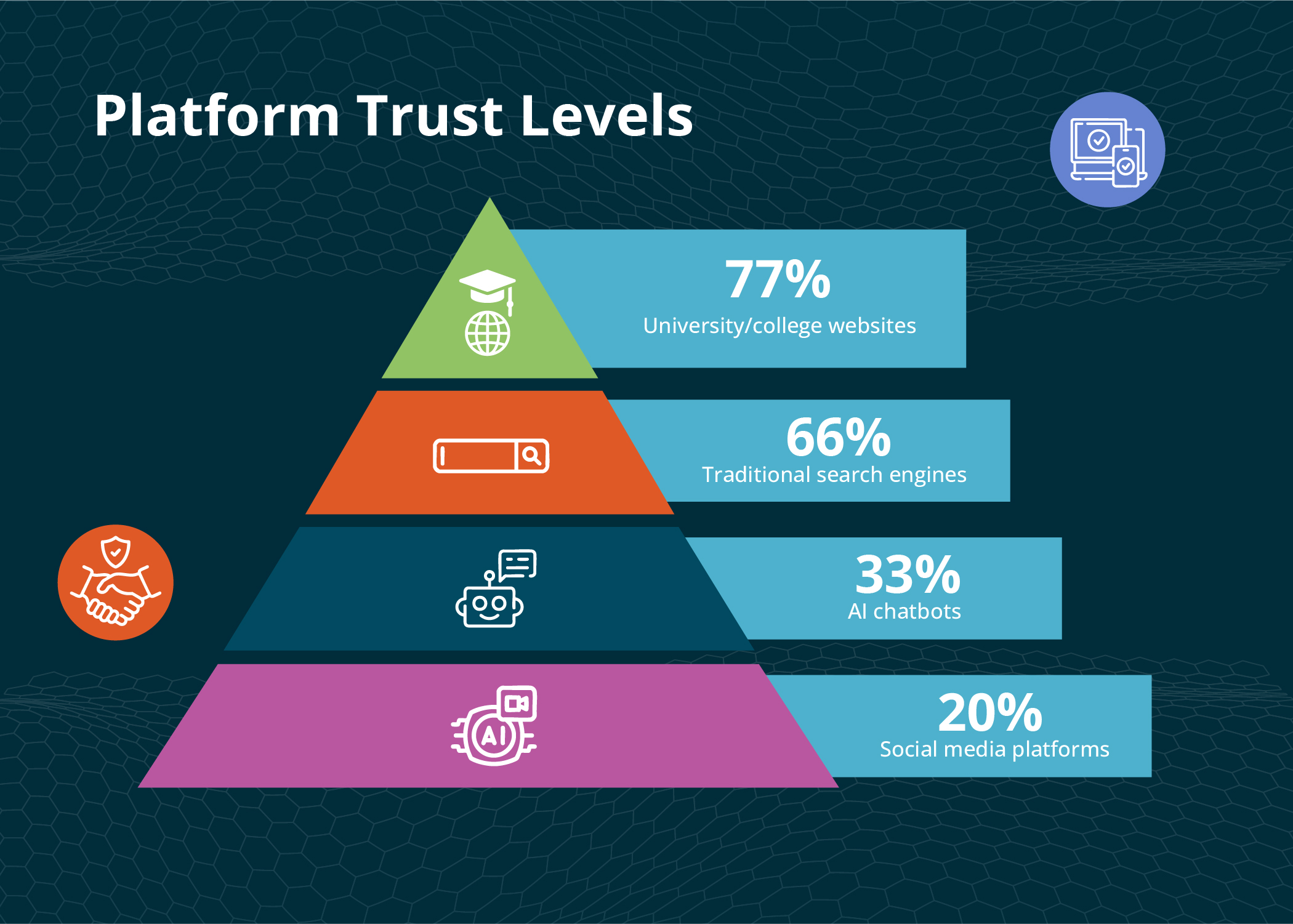
    When searching for professional and continuing education programs, prospect trust varies dramatically by source:

    Trust Levels by Platform (UPCEA/Search Influence 2025)

    Source Extremely/Very Trustworthy
    University/college websites 77%
    Traditional search engines 66%
    AI chatbots 33%
    Social media platforms 20%

    University websites are still the most trusted source by a wide margin. That’s actually good news for 2026. While AI tools are gaining usage, the destination of trust remains institutional websites. The challenge is making sure AI tools surface and cite your content accurately—so prospects who trust AI still end up trusting you.

    Think of it this way: AI is becoming the intermediary, but your website is still the authority. You need AI to accurately represent what’s on your site.

    Not Everyone Is Worried About AI Accuracy

    This surprised me a bit: nearly a third (32%) of respondents have no concerns whatsoever about using AI search tools for researching professional and continuing education programs.

    Among those who do have concerns:

    • 28% worry about validity, reliability, or accuracy
    • 7% cite privacy or security concerns
    • The remainder mention environmental impact, bias, and relevance

    So while accuracy concerns exist, a substantial portion of your prospect pool is comfortable taking AI recommendations at face value. That makes your AI presence even more critical—if AI gets your information wrong, a third of prospects won’t question it.

    What Would Build More Trust?

    When asked what features would be most valuable in AI-generated search results:

    1. Transparent sources for AI-generated recommendations: 51%
    2. AI-generated side-by-side comparisons of programs: 50%
    3. Emphasis on accredited institutions: 39%
    4. AI personalization based on interests: (favored by younger prospects)

    Prospects want AI to show its work. Transparent sourcing and comparison tools matter more than fancy personalization for most age groups.

    2026 implication: Structure your content with clear, citable claims. Include specific data points, credentials, and outcomes that AI can reference. Make it easy for AI to cite you accurately.

    Search Query Patterns: How Behavior Differs by Platform

    People Talk to AI Differently Than They Talk to Google

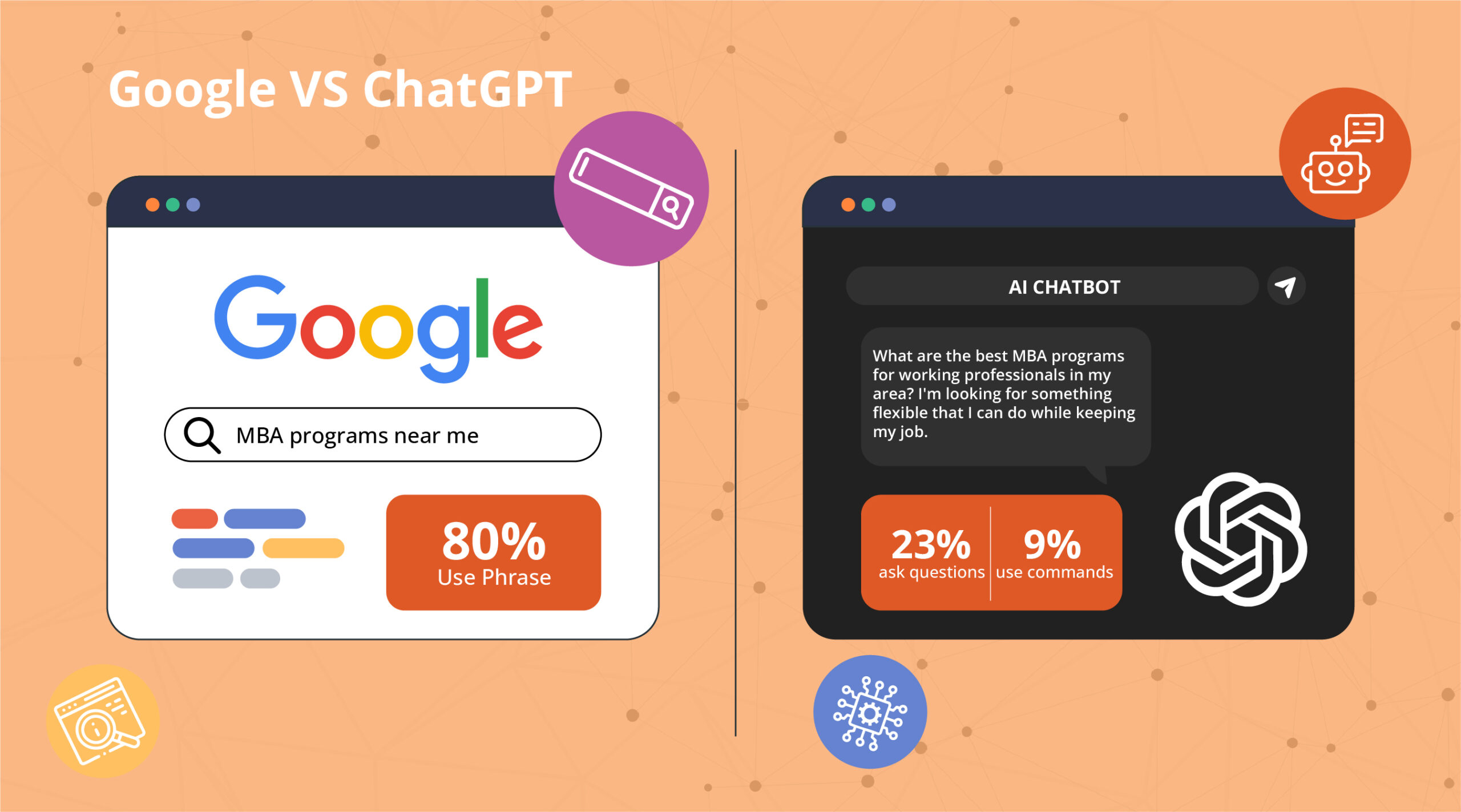
    This is one of the more actionable findings from the research. The UPCEA/Search Influence study asked respondents what they would type when searching for an MBA program across different platforms. The patterns are distinct:

    Query Type by Platform

    Query Type Traditional Search AI Search Engine AI Chatbot Social Media
    Phrase 80% 64% 55% 71%
    Question 12% 16% 23% 8%
    Command 1% 8% 9% 2%
    One-word 6% 6% 7% 9%
    Wouldn’t use 1% 5% 6% 10%

    On traditional search, 80% of prospects type phrases like “MBA programs near me.” On AI chatbots, that drops to 55%, while questions jump to 23% and commands to 9%.

    What this means for 2026 content: If you’re only optimizing for keyword phrases, you’re missing the conversational queries that dominate AI interactions. Content that answers questions directly—”What is the best MBA program for working professionals?” “Compare online vs. in-person MBA programs”—will perform better in AI contexts.

    The Core Keywords Still Matter

    Across all platforms, the most common search approaches for MBA programs included:

    • “MBA programs/degrees/courses/education” (27-31%)
    • “Best MBA programs/schools” (8-11%)
    • “MBA programs near me” (8-12%)

    The consistency across platforms tells us that core keyword targeting still matters. People are looking for the same information—they’re just asking for it differently depending on where they’re searching. Your content needs to address both the keyword and the question.

    Platform-Specific Behaviors: What to Prioritize for 2026

    ChatGPT Is the Default, But Don’t Ignore the Others

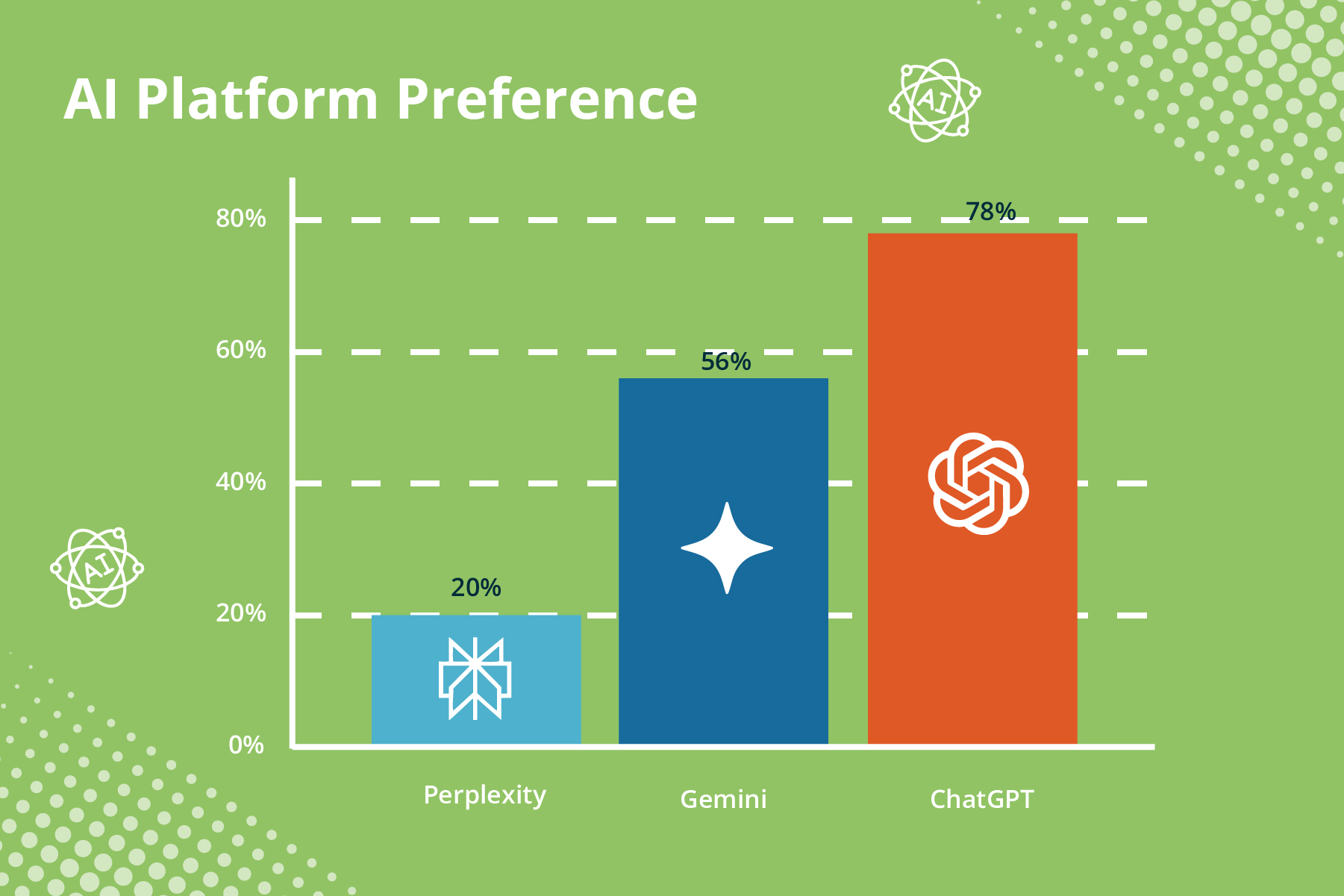
    Among prospects likely to use AI platforms for program research:

    AI Platform Would Use
    ChatGPT 78%
    Gemini 56%
    Perplexity 20%

    Here’s an interesting wrinkle: older age groups were more likely to use Gemini and Perplexity than younger prospects. My guess is this reflects different adoption pathways—Gemini through the Google ecosystem that older users are more embedded in, Perplexity through professional and research applications.

    2026 consideration: Your AI visibility strategy can’t focus on ChatGPT alone. Gemini is integrated into Google’s ecosystem (where 84% of your prospects still search), and Perplexity is growing fast among research-oriented users—exactly your graduate prospect demographic.

    The Scale of ChatGPT Is Hard to Overstate

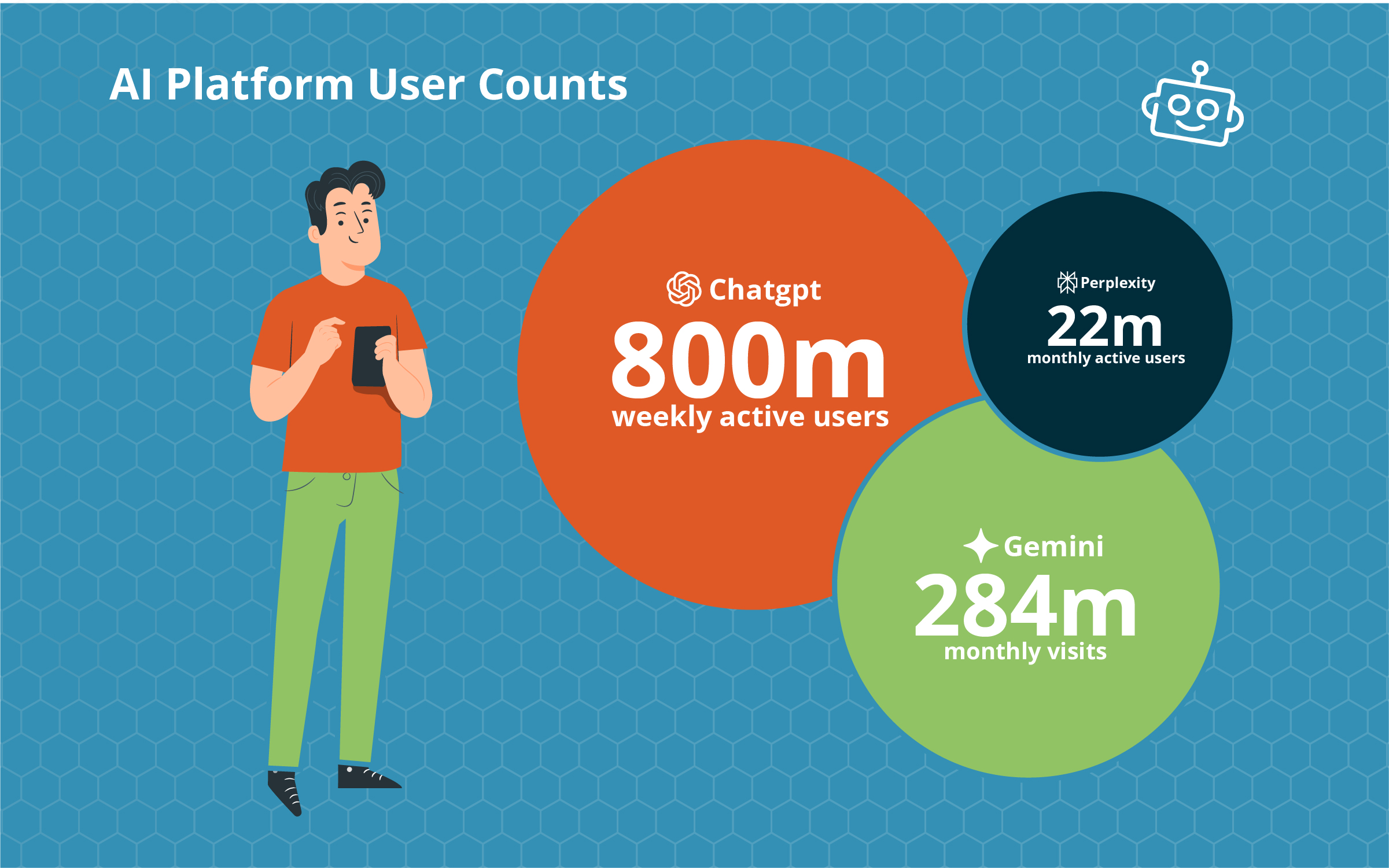
    As of late 2025, ChatGPT’s numbers are staggering:

    • 800 million weekly active users (September 2025)
    • 190 million daily active users
    • 5.72 billion monthly visits
    • 77.2 million monthly active users in the US alone
    • 46.7% of users are aged 18-24

    For context, Perplexity AI processes 780 million monthly queries with 22 million monthly active users—substantial and growing fast, but still an order of magnitude smaller than ChatGPT.

    Social Media Platform Preferences Vary by Age

    Among prospects likely to use social media for program research:

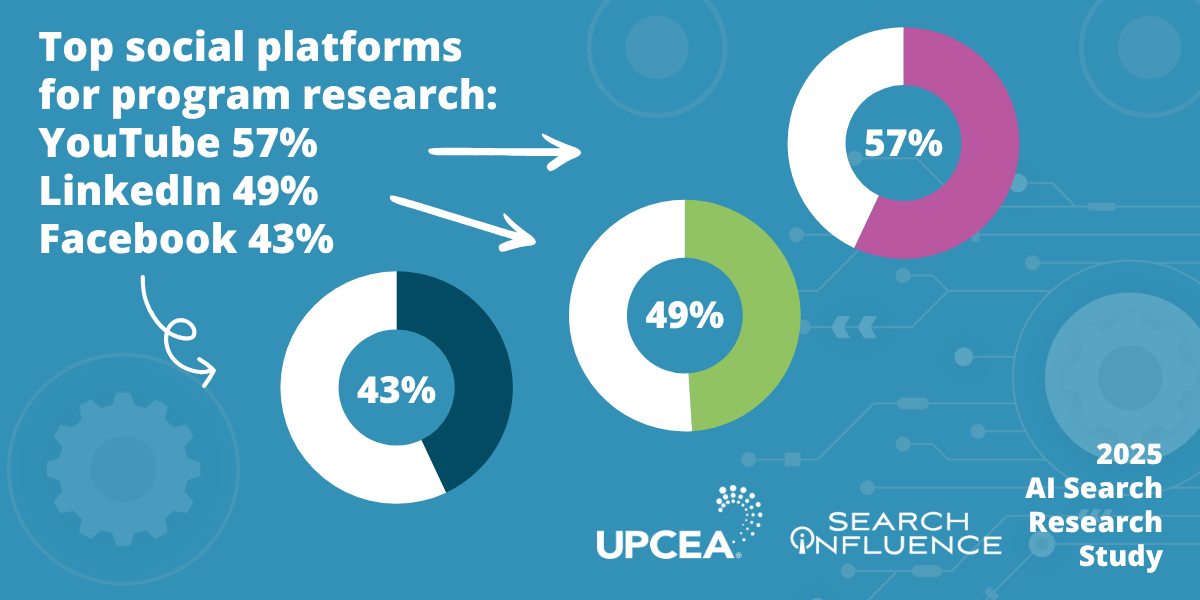
    Platform Would Use
    YouTube 57%
    LinkedIn 49%
    Facebook 43%
    Instagram 35%
    Reddit 31%

    The age patterns are predictable:

    • YouTube, Instagram, TikTok: Skew younger
    • LinkedIn, Facebook: Skew older
    • Reddit: Relatively consistent across age groups

    What Actually Works on Social

    When using social media to research programs, prospects find these content types most helpful:

    1. Program summaries or descriptions: 65%
    2. Career advice related to education choices: 54%
    3. Student testimonials: 50%

    One exception worth noting: for 18-22-year-olds, university/college advertisements ranked as the most helpful content type. Traditional advertising still resonates with the youngest prospects in ways it doesn’t with older demographics.

    The AI Tools Landscape: A Quick Reference

    Major AI Platforms by the Numbers (Late 2025)

    Platform Monthly Active Users Monthly Queries Key Demographics
    ChatGPT 800M weekly / 190M daily 5.72B visits 46.7% aged 18-24
    Google Gemini 284M monthly visits 18% education sector
    Perplexity AI 22M MAU 780M queries 57% aged 18-34
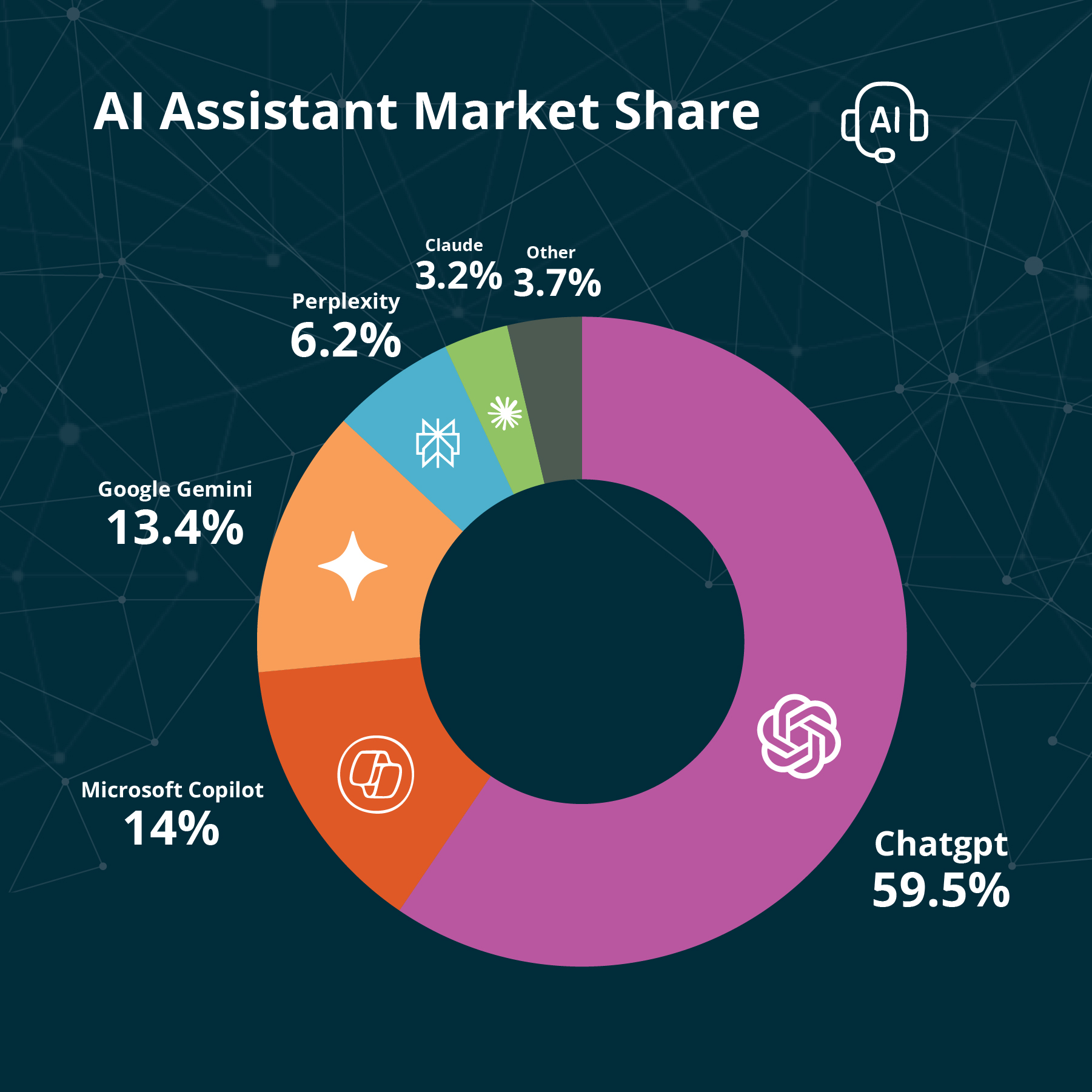
    Claude ~3.2% US market share Professional/technical skew

    US Market Share Context

    • ChatGPT: 59.5%
    • Microsoft Copilot: 14%
    • Google Gemini: 13.4%
    • Perplexity: 6.2%
    • Claude: 3.2%

    Strategic Roadmap: AI Search Optimization for Higher Education in 2026

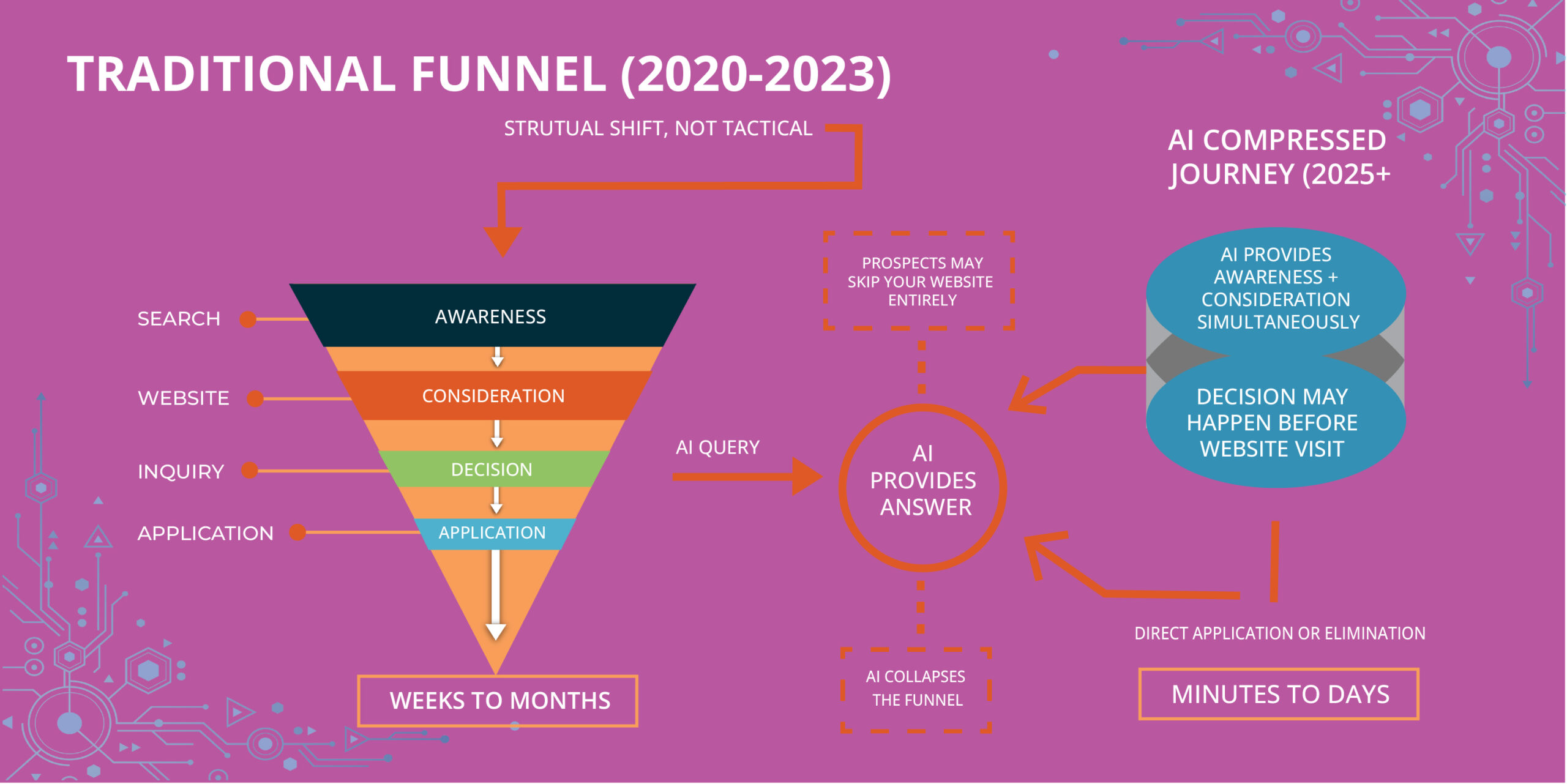
    The Shift Is Structural, Not Tactical

    Let me be direct about what the data is telling us about graduate enrollment marketing:

    1. Search behavior has diversified permanently.

    Prospects use 5+ platforms interchangeably for program research. If you’re only optimizing for Google, you’re reaching a shrinking portion of your audience. Single-platform strategies are increasingly risky.

    1. AI is compressing your funnel.

    Generative AI tools deliver answers about your institution—and your competitors—before prospects visit any website. The traditional “awareness → consideration → decision” funnel is collapsing. Prospects may move from “never heard of you” to “crossed you off the list” without a single website visit.

    1. Citation is the new ranking.

    Being referenced in AI Overviews and AI tool responses builds credibility. Absence from these results may signal irrelevance. For a generation that trusts AI to give them straight answers, not appearing in those answers is a problem.

    1. Your metrics are incomplete.

    Website traffic and click-through rates don’t capture AI-mediated discovery. Brand visibility and AI citation frequency matter, but most institutions aren’t tracking them yet.

    Your 2026 Action Plan for Graduate Enrollment Marketing

    Q1 2026: Foundation—AI Visibility Audit and Technical SEO

    1. Conduct an AI visibility audit. Query ChatGPT, Perplexity, and Google AI Overviews with the exact phrases your prospects use. Screenshot what appears. Document what’s missing or inaccurate. This is your baseline for AI search optimization.
    2. Review your website’s structure for AI readiness. AI tools favor content with clear headings, factual statements, and authoritative data that they can easily extract and cite. Does your program content deliver that, or is it buried in marketing language? An AI-ready website audit should be your first step.
    3. Check your technical SEO fundamentals. Crawlability and site speed matter more than ever for higher education SEO. AI engines are less patient than traditional crawlers. If they can’t see your content, they can’t cite it.

    Q2 2026: Content Development—GEO and Multi-Platform Strategy

    1. Develop a YouTube strategy if you don’t have one. 61% of prospects use YouTube like a search engine. Program overviews, student testimonials, and career outcome videos aren’t optional anymore for graduate enrollment marketing.
    2. Create content in multiple formats for AI optimization. AI chatbots favor Q&A formats. Traditional search favors keyword phrases. Social favors summaries and testimonials. The same information needs to exist in multiple expressions optimized for each platform.
    3. Build FAQ and comparison content. These formats are highly citable by AI systems and directly address how prospects query AI tools. This is core GEO for universities.

    Q3-Q4 2026: Infrastructure and Measurement Evolution

    1. Implement structured data and schema markup. Help AI tools understand your programs, faculty, outcomes, and accreditations through proper technical implementation. This is table stakes for AI visibility in higher education.
    2. Distribute content through authoritative channels. AI tools favor citations from recognized sources. Publishing through professional associations, research outlets, and established media increases the likelihood of AI citation—a key component of any higher education SEO strategy.
    3. Evolve your measurement approach. Start tracking brand mentions, AI citations, and sentiment alongside traditional metrics. The full picture of enrollment marketing visibility now extends well beyond clickable results.

    Methodology

    UPCEA/Search Influence Study (2025)

    Survey period: March 11-13, 2025

    Sample:

    • Total participants: 1,061 individuals
    • Qualified respondents: 760 (met all criteria)
    • Completed surveys: 705

    Qualification criteria:

    • Adults aged 18-60
    • Minimum high school diploma
    • Not currently enrolled in a PCE program
    • Interested in advancing skills through professional/continuing education

    Respondent demographics:

    • 55% female, 45% male
    • 68% employed full-time
    • Education: 32% bachelor’s degree, 19% some college, 18% master’s degree
    • Age: 25% ages 46-54, 19% ages 55-60, 17% ages 35-40

    Distribution: Internet panel

    Conducted by: UPCEA and Search Influence

    Carnegie Summer Research Series (2025)

    Sample: 3,400+ prospective students and parents

    Focus: College choice trends, AI usage in admissions, personality-driven communication

    Key longitudinal finding: AI usage in college search: 4% (2023) → 10% (2024) → 23% (2025)

    Additional Data Sources

    Platform statistics compiled from company announcements, third-party tracking services (Similarweb, SparkToro, Semrush), and industry research reports. All figures represent the most recent publicly available data as of November 2025.

    Glossary of Key Terms

    AI Overview: Google Search feature providing an AI-generated summary at the top of results, synthesizing information from multiple sources. Previously called Search Generative Experience (SGE).

    Zero-click search: A query where users find their answer directly in search results (featured snippets, AI Overviews, knowledge panels) without clicking to any website.

    Generative Engine Optimization (GEO): Optimizing content and digital presence to appear in AI-generated responses from tools like ChatGPT, Perplexity, and Google’s AI Overviews. Unlike traditional SEO (optimizing for algorithms), GEO focuses on helping AI systems accurately understand and represent your institution.
    Professional and Continuing Education (PCE): Post-secondary programs for working adults seeking to advance skills, change careers, or earn credentials—including graduate degrees, certificates, professional development, and continuing education.

    AI chatbot: Conversational AI interface (ChatGPT, Gemini) responding to queries in natural language, often synthesizing information from training data and/or real-time web search.

    AI search engine: Search tool (Perplexity, SearchGPT) providing direct answers by searching the web and synthesizing results, rather than returning a list of links.

    Frequently Asked Questions

    How are prospective students using AI tools in their program search?

    Half of prospects (50%) use AI-powered tools at least weekly for general information search. For program research specifically, 36% are extremely or very likely to use AI chatbots, and 35% likely to use AI search engines. ChatGPT dominates (78% of AI users would use it), followed by Gemini (56%) and Perplexity (20%).

    Do prospects trust AI-generated information about educational programs?

    It’s complicated. Only 33% rate AI chatbots as extremely or very trustworthy for program research, compared to 77% for university websites. But 32% have no concerns whatsoever about using AI for this purpose, and 56% say they’re more likely to trust brands cited in Google’s AI Overviews. Trust in AI is lower than traditional sources, but AI citations boost trust in the sources cited.

    What percentage of searches result in zero clicks?

    As of May 2025, roughly 69% of Google searches end without a click to any website, up from 56% a year earlier. When AI Overviews appear, click-through rates to top-ranking websites decline by 70-90%.

    Which platforms do prospects use to research graduate programs?

    Search engines dominate (84% extremely/very likely), followed by university websites (63%), AI chatbots (36%), AI search engines (35%), and social media (34%). But 61% also use YouTube “like a search engine,” and 50% use AI tools the same way. Platform diversification is the new normal.

    How do search queries differ between traditional search and AI tools?

    On traditional search, 80% use phrase-based queries. On AI chatbots, only 55% use phrases while 23% ask questions and 9% use commands. AI-optimized content should address conversational queries and direct questions—not just keyword phrases.

    What content types work best on social media for program discovery?

    Program summaries and descriptions (65%), career advice (54%), and student testimonials (50%) rate highest. Exception: for 18-22 year-olds, university advertisements were actually rated most helpful.

    What’s the difference between SEO and GEO?

    Traditional SEO optimizes for search algorithms—systems that score and rank based on signals like keywords and links. GEO (Generative Engine Optimization) optimizes for AI understanding—helping AI systems accurately comprehend and represent your institution so they can recommend you to prospects. SEO is like optimizing for a librarian; GEO is like optimizing for a research assistant who needs to explain you to someone else.

    About This Report

    This analysis synthesizes original research from the UPCEA/Search Influence study with data from Carnegie Higher Education, Everspring, EAB, and platform-specific metrics to provide a forward-looking view of how AI search optimization is reshaping program discovery in graduate education.

    The report is designed to help enrollment marketing leaders, higher education SEO professionals, and university marketing teams understand the AI visibility landscape and develop effective GEO strategies for 2026.

    Primary research sponsor: Search Influence

    Research partner: UPCEA (University Professional and Continuing Education Association)

    Report date: November 2025

    Sources and Citations

    Primary Research

    1. UPCEA and Search Influence. “AI Search in Higher Education: How Prospects Search in 2025.” Survey conducted March 11-13, 2025. n=705 qualified respondents.
    1. Carnegie Higher Education. “2025 Summer Research Series: AI Use in the College Search.” Survey of 3,400+ prospective students and parents.

    Industry Reports

    1. Everspring. “AI and the Collapse of Student Search: 2025 Higher Ed Trend Report.” May 2025.
    1. EAB. “Is Your College Website AI-Ready and Built to Drive Enrollment?” July 2025.
    1. EAB. “How Graduate Enrollment Leaders—and Prospective Students—Are Using AI.”
    1. Semrush. “AI Overviews Study: What 2025 SEO Data Tells Us About Google’s Search Shift.” May 2025.
    1. SparkToro and Similarweb. Zero-click search analysis, May 2025.
    2. EducationDynamics. “Engaging the Modern Learner: 2025 Report on the Preferences & Behaviors Shaping Higher Ed.”

    Platform Statistics

    1. OpenAI. ChatGPT usage statistics, August-September 2025.
    1. DemandSage. “ChatGPT Statistics” (November 2025).
    1. DemandSage. “Perplexity AI Statistics” (November 2025).
    1. Business of Apps. “ChatGPT Revenue and Usage Statistics” (2025).
    1. Business of Apps. “Perplexity Revenue and Usage Statistics” (2025).

    Additional Sources

    1. ICEF Monitor. “Students are switching to AI for search. Are you ready?” August 2025.
    1. EdTech Innovation Hub. “Universities face digital visibility crisis as students shift to AI search tools.”
    1. Search Engine Journal. “Google AI Overviews Impact On Publishers & How To Adapt Into 2026.”
    1. Bruce Clay. “How Google’s AI Overviews Are Changing Click Behavior and SEO Metrics.”
    1. Pew Research Center. AI usage survey, 2024-2025.
    1. McKinsey & Company. “The State of AI.”
    1. UPCEA. “2024 Marketing Survey Results.” (Social media advertising spend data—available to UPCEA members)
    2. Statista. “Share of Adults Who Would Switch to an AI-Powered Search Engine by Generation.”

    The landscape described here is evolving quickly. The 2025 data establishes clear trajectories, and the institutions that invest in AI search optimization and GEO for higher education now will have a meaningful advantage heading into 2026. AI-mediated discovery is becoming the norm, not the exception. The question for graduate enrollment marketing isn’t whether to adapt—it’s how quickly you can move.

  • New From Search Influence – AI Search in Higher Education: How Prospects Search in 2025

    AI Search in Higher Education: How Prospects Search in 2025 image on a tablet

    Artificial intelligence isn’t on the horizon for higher ed — it’s here. Half of prospective students already use AI tools weekly to search for information in the same way they use Google.

    To help institutions adapt, the Online and Professional Education Association (UPCEA), in partnership with Search Influence, has released the 2025 AI Search in Higher Education Research Study. This research sheds light on how prospective adult learners use AI, search engines, university websites, and other platforms to explore, trust, and select programs.

    Download the full AI Search in Higher Education Research Study

    About the AI Search in Higher Education Research Study

    The AI Search in Higher Education report surveyed 760 qualified adult learners between 18 and 60, all interested in advancing their skills or knowledge through online and continuing education. These respondents represent today’s prospective adult learners, a growth market for universities and an early indicator of broader enrollment trends.

    UPCEA led the research, bringing its deep expertise in online and continuing education, while Search Influence shaped the study with insights from our nearly 20 years as an SEO and AI search optimization agency.

    Together, we uncovered how AI, traditional search, and institutional websites are reshaping the way prospective students find, trust, and ultimately choose programs.

    Key Findings: How Prospects Search in 2025

    The results illustrate a rapidly diversifying student journey. Here are the top takeaways:

    • AI tools are an integral part of the enrollment funnel. 50% of prospective learners use AI platforms weekly, making them a standard part of the search process.
    • University websites anchor trust. 77% of respondents rated institutional websites as their most reliable source when exploring programs.
    • AI citations influence credibility. 79% of prospects read Google’s AI-generated overviews, and 56% say they are more likely to trust schools cited within them.
    • Search visibility drives consideration. 82% of students report they are more likely to consider programs that appear on the first page of search results.
    • Discovery spans multiple platforms. 84% of prospects use search engines, 61% use YouTube as a search engine, and 50% rely on AI tools in the same way they use Google.

    These findings confirm that students are moving fluidly between AI platforms, search engines, and video-based resources. Institutions cannot rely on a single channel. They must create content that performs across all of them.

    50% of prospects use AI tools at least weekly

    Why Online and Continuing Education Students?

    Online and continuing education students are often early adopters of new search behaviors, and their choices ripple outward to the broader higher ed market. They are career-focused, typically employed full-time, and actively researching programs that fit their personal and professional goals.

    By focusing this study on online and continuing education prospects, we’re able to capture a forward-looking snapshot of how AI search in higher education is shaping program discovery, trust, and enrollment decisions.

    What This Means for Higher Ed Marketers

    For higher ed leaders and enrollment teams, the implications are clear:

    • Multi-channel visibility is non-negotiable. Students expect to find you on Google, university websites, AI-generated responses, and video platforms like YouTube.
    • SEO is the connective tissue. Strong, authoritative SEO is the foundation that fuels visibility across both traditional and AI search engines. Without it, your programs won’t appear in the places students are looking.
    • Early movers will win. Many institutions have not yet adapted their strategies for AI search. Schools that act now will gain a competitive advantage in enrollment visibility and trust.

    Measuring Success in AI Search

    Success in AI search isn’t just about rankings. Institutions should track citations in AI Overviews, visibility across AI platforms, and engagement from AI-driven traffic, alongside traditional metrics like cost per inquiry (CPI) and ROI. By adding these benchmarks, schools can better understand how AI contributes to the enrollment funnel and make smarter investments in visibility and trust.


    top social platforms graphics

    Take Action: Be Visible in AI Search

    AI search is a core part of how students find and evaluate higher ed programs.

    The 2025 AI Search in Higher Education Research Study confirms what many institutions are beginning to notice: if you’re not visible in AI search, you’re not in the consideration set.

    The good news? Acting now puts you ahead.

    Download the full 2025 AI Search in Higher Education Research Study to explore the data and recommendations.

  • Higher Education Marketing Strategies: Align SEO & Paid Ads for Smarter Results

    Higher Education Marketing Strategies: Align SEO & Paid Ads for Smarter Results

    Higher Education Marketing Strategies: Align SEO & Paid Ads for Smarter Results

    Key Insights

    • The modern student journey is multi-channel: Your marketing efforts must span search engines, social platforms, and AI tools.
    • SEO builds long-term visibility: SEO is a key strategy for sustaining awareness and reducing overall acquisition costs over time.
    • Digital ads deliver speed and precision: Paid ad placements boost visibility during critical enrollment windows and for time-sensitive offers.
    • Together, SEO and ads drive better results: Aligning both helps you maintain visibility and adapt to changing search behaviors.

    Today’s prospective students are intentional researchers in their college search.

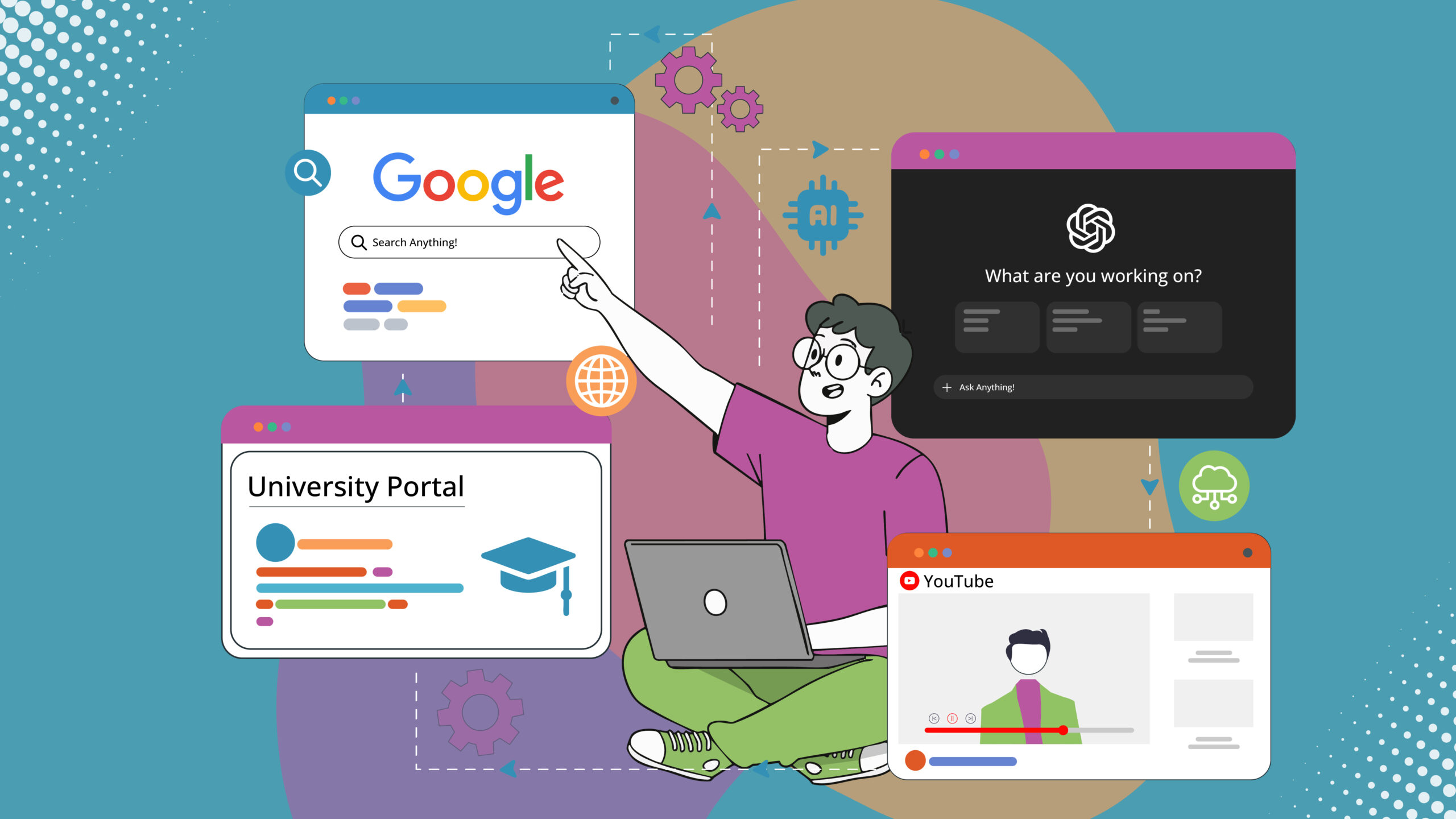
    They explore degree programs, admissions requirements, and career outcomes on platforms like Google, ChatGPT, TikTok, and YouTube, often before visiting your website. To reach them during these early moments of consideration, your higher education marketing strategies must prioritize visibility across search engines, social platforms, and AI-driven tools.

    This is where SEO and digital ads work in tandem to keep your institution present, credible, and competitive.

    When aligned well, these tactics guide prospective students from first search to final enrollment with greater efficiency and impact.

    Search Engine Optimization (SEO) at a Glance

    Search Engine Optimization (SEO) at a Glance

    What is SEO?

    SEO stands for search engine optimization. It’s a long-term strategy that improves your website’s visibility in organic (non-paid) search results. This involves refining your content, technical structure, and site authority so your pages appear more prominently when prospective students search on platforms like Google, ChatGPT, and other AI-driven tools.

    In higher education, visibility at key points in the decision-making process directly impacts who finds your programs and who doesn’t. SEO helps your institution show up across the enrollment journey, from early awareness to application. When your site is optimized effectively, it becomes easier for students to find the information they need and easier for you to convert interest into action.

    Why is SEO important for higher education institutions?

    SEO is important for higher education institutions because it helps your programs appear where student intent begins. Research shows that 68% of online experiences start with a search engine, making visibility in those early interactions critical for attracting qualified prospects.

    Today’s students are self-directed and often explore degree options, admissions requirements, and tuition costs on their own, sometimes weeks or months before they ever reach out to an academic institution. If your content doesn’t surface during that initial research phase, your school may never make the shortlist.

    By investing in SEO, higher ed institutions build lasting authority, credibility, and trust. It reinforces your brand presence without relying entirely on paid channels and sets the foundation for long-term enrollment growth.

    What are the benefits of higher education SEO?

    A strong SEO strategy does more than drive traffic. It brings the right traffic. In aligning your content with what prospective students search, you improve visibility and engagement at every stage of the recruitment pipeline.

    Some of the leading benefits of higher education SEO include:

    • Capturing high-intent search traffic from students actively searching for programs like yours
    • Supporting content marketing by making blogs, guides, and admission web pages more discoverable
    • Improving user experience through technical SEO that enhances site speed and mobile responsiveness
    • Boosting credibility with higher rankings, rich snippets, and inclusion in AI Overviews and other AI-powered search features
    • Enabling smarter decisions through keyword research and user behavior analytics
    • Strengthening long-term visibility as ad costs rise and search algorithms evolve

    SEO is not just a marketing add-on. It’s a strategic asset that improves performance across digital channels. When done well, it strengthens your institution’s credibility and reaches students where they’re actively searching.

    What does higher education SEO entail?

    Higher education SEO requires a strategic approach that reflects how 1) students search and 2) how modern search engines and AI platforms process content. It focuses on clarity, structure, and alignment with user intent.

    Key elements of a higher education SEO strategy include:

    • Conducting keyword research based on student goals, questions, and decision-making stages
    • Using entity-based and semantic SEO to match how AI systems interpret and connect information
    • Optimizing on-page elements like meta tags, headers, and image alt text
    • Creating evergreen content such as program pages, tuition details, and frequently asked questions
    • Improving technical performance through mobile-friendly design, fast load times, and structured data
    • Strengthening internal linking and earning high-quality citations from trusted sources
    • Monitoring performance metrics and adjusting tactics to respond to algorithm changes and user behavior

    This ongoing work creates a structured foundation that helps your institution remain relevant across traditional and AI-driven search platforms.

    Digital Advertising (Paid Ads/Pay-Per-Click) at a Glance

    Digital Advertising (Paid Ads/Pay-Per-Click) at a Glance

    What are digital paid ads/PPC?

    Digital paid advertising refers to any online campaign where you pay to promote your content, programs, or brand across platforms where prospective students spend time. These ads can appear in search results, on social media feeds, within videos, or across websites through display networks.

    PPC, or pay-per-click, is one of the most common payment models used in digital advertising. Instead of paying for impressions, you’re charged only when someone clicks your ad. In this way, paid advertising describes the strategy, while PPC refers to how you’re billed.

    Common platforms include Google Ads for search and display, Meta (Facebook and Instagram) for interest-based targeting, YouTube for video promotion, and programmatic networks for broader reach. Each offers a different way to connect with prospective students based on their behaviors, demographics, and intent.

    Why should digital advertising be part of your higher ed marketing strategy?

    Digital advertising is a vital tool for reaching students during critical decision-making windows. Unlike organic strategies, which take time to gain traction, paid ads offer “immediate” visibility in high-traffic environments like search results and social feeds. This immediacy is especially valuable during application pushes, event promotions, or when organic rankings fluctuate.

    For colleges and universities competing for attention in crowded markets, digital ads offer the agility to respond to shifting trends and student behavior in real time. They also create a clear path to visibility when SEO alone can’t secure top placement, especially for high-volume, high-competition keywords.

    When time-sensitive goals are at stake, paid ads allow you to act quickly, focus your message, and precisely reach your target audience.

    What are the benefits of digital ads?

    Digital ads offer a level of control, speed, and insight that is difficult to achieve through other channels. With the right setup, you can run targeted campaigns that respond to real-time behavior and performance data.

    Benefits of digital ads include:

    • Fast results, bringing qualified traffic to your site shortly after a campaign launches
    • Trackable performance that allows you to connect ad spend to inquiries and applications
    • Targeting precision based on factors like location, age, device, interests, or behavior
    • Budget efficiency through dynamic allocation based on campaign performance
    • Seasonal flexibility to scale campaigns up or down as enrollment cycles shift
    • Campaign testing to compare messages, creative formats, and calls to action
    • Retargeting power to re-engage visitors who left your site without taking the next step

    Well-executed campaigns go beyond visibility gains. They deliver measurable insight into which messages and channels are driving potential students to act.

    What does a digital advertising strategy entail?

    A strong digital advertising strategy involves setting clear goals, targeting a well-defined audience, and choosing ideal platforms for delivery. This helps your institution stay adaptable while reaching students where they spend their time online.

    Key elements of a digital advertising strategy include:

    • Identifying high-intent keywords and audience segments by program, location, age, and behavior
    • Choosing platforms that align with campaign goals, such as Google, YouTube, Meta, LinkedIn, or display networks
    • Writing ad copy, headlines, and landing pages tailored to each platform and audience
    • Designing creative assets that reflect your brand and support campaign objectives
    • Setting budgets, bids, and targeting rules by geography, demographics, or device
    • Launching campaigns with tracking to measure clicks, inquiries, and conversions
    • Adjusting creative, targeting, and spend based on performance
    • Retargeting visitors who viewed your site but didn’t convert

    This coordinated approach helps higher ed marketers reach the right students at the right time while maintaining full visibility into campaign success.

    Why SEO and Digital Paid Ads Work Better Together

    Why SEO and Digital Paid Ads Work Better Together

    When used together, SEO and digital ads give you better control over how and when students discover your programs. They serve different purposes but share the same goal: helping your institution show up, build trust, and guide prospective students toward taking the next step.

    Maximize visibility in search results

    Running both SEO and paid search campaigns lets your institution appear in multiple positions on a single results page. This increases your visibility, reinforces brand credibility, and reduces the likelihood of competitors taking that spot instead.

    Drive traffic while SEO gains traction

    SEO is a long-term, yet sustainable, investment. Paid ads help you stay visible in the meantime, especially when launching a new program or entering a competitive market. While your organic rankings build, ads keep inquiries flowing.

    Test messaging before you commit

    Digital ads allow you to quickly test headlines, descriptions, and offers. The best-performing messages can then be applied to SEO page titles, meta descriptions, and even on-page content, improving both click-through rates and relevance.

    Validate keywords with real results

    Paid search shows you which keywords actually drive clicks and conversions. This data can guide your SEO strategy by helping you focus on the terms students search most often and respond to rather than relying solely on keyword tools.

    Retarget prospects who leave

    SEO may attract the initial visit, but not every student is ready to apply right away. With paid ads, you can retarget those visitors and keep your institution top of mind, especially during high-stakes decision windows.

    Lower CPC with better landing pages

    SEO principles like clear structure, fast load times, and relevant content can improve your ad landing pages. This often leads to higher Quality Scores in Google Ads, which reduces your cost-per-click and increases return on ad spend.

    Share data to make smarter decisions

    When SEO and paid ad teams work together, both channels benefit. Search terms, audience behavior, and performance metrics from one can shape strategy for the other, leading to stronger messaging, better targeting, and higher conversion rates.

    How to Align Your Strategy and Budget with Goals

    A thoughtful, comprehensive marketing plan considers how SEO and paid ads contribute at different points in the recruitment cycle. While both digital marketing strategies play a unique role, aligning your investment with your institutional goals (rather than dividing tactics by default) helps you make more strategic, data-informed decisions.

    Use SEO for:

    Building visibility for evergreen content

    Program pages, admissions FAQs, and degree outcomes are high-interest assets that students search for year-round. SEO ensures these pages consistently rank and remain discoverable across enrollment cycles.

    Answering long-tail, high-intent questions

    Students often search with specific phrases like “best online MPH programs for working adults.” Optimizing for these longer queries helps your content meet students at key decision-making moments.

    Strengthening authority over time

    Search engines and AI platforms reward content that demonstrates expertise and trust. By publishing helpful, on-topic SEO content regularly — and earning backlinks and citations from reputable sources — you signal authority over time and improve your chances of ranking across high-impact search terms.

    Supporting decision-making after inquiry

    SEO helps prospective and admitted students find the content they need after expressing interest, such as financial aid resources, enrollment steps, and orientation details. Optimizing this type of content ensures your institution remains visible and helpful beyond the initial click.

    Reducing long-term CPI

    Unlike paid ads, organic traffic doesn’t require a cost per click. A strong SEO foundation lowers dependency on paid placements over time, driving qualified leads while keeping cost per inquiry (CPI) in check.

    Use digital ads for:

    Accelerating time-sensitive goals

    Campaigns tied to deadlines, events, or scholarships need instant visibility to drive action. Paid ads allow you to deliver focused, high-priority messages exactly when timing matters most.

    Launching new programs or locations

    New academic offerings or secondary campuses often lack the organic search authority to rank well early on. Paid ads help you build awareness and attract early interest while SEO efforts gradually take hold.

    Competing on high-volume search terms

    For highly competitive keywords where top rankings are difficult to secure, paid ads keep your institution visible. This ensures you’re not missing out on critical traffic during peak search activity.

    Testing and refining your message

    Digital campaigns offer a fast, low-risk way to test headlines, offers, and positioning statements. Use this performance data to gain insights, inform future updates, and shape messaging across other channels.

    Reaching segmented or niche audiences

    With detailed targeting options, paid ads let you focus on specific groups, like adult learners, out-of-state students, or those interested in a particular program. This helps extend your reach beyond what organic search alone can deliver.

    Questions to help allocate budget

    Before deciding how much to invest in SEO or digital ads, it’s important to clarify the goals, timeline, and audience of each initiative. Use the following questions to guide a smarter, more intentional allocation of resources:

    • Is this a short-term campaign or a long-term visibility play?
    • Do you already rank organically for target keywords, or are you starting from scratch?
    • Are you trying to increase awareness, generate inquiries, or drive completed applications?
    • What is the lifetime value of the program or student audience you’re targeting?
    • Do you need geographic or behavioral targeting that SEO alone can’t deliver effectively?
    • What insights from past campaigns can inform your channel mix for this initiative?

    Think of SEO as the groundwork for sustained visibility and trust, while paid campaigns offer speed and flexibility. By evaluating timing, audience intent, and program priorities, you can allocate budget where it makes the most impact.

    Create a Stronger Higher Education Marketing Strategy

    The most effective higher education marketing strategies don’t rely on a single channel. They align tactics to meet student expectations at every stage of their search journey.

    By pairing long-term organic visibility through SEO with the immediacy and precision of digital advertising, your institution will reach more prospective students, guide them through complex decisions, and support better outcomes from first search to final enrollment.

    If you’re looking for a more intentional way to prioritize your marketing efforts and budget, we’d be honored to help. Download “Solve Your Higher Ed Marketing Puzzle With SEO and Paid Digital Ads” to learn how to:

  • Focus on the tactics that make the biggest enrollment impact
  • Reduce wasted spend and improve lead quality
  • Increase conversions with personalization, testing, and retargeting
  • Tie campaign performance to ROI metrics that matter to leadership
  • See how you can integrate SEO and paid advertising to power your enrollment pipeline today.


    Image Credits:

    Unsplash , Unsplash and Pexels

  • UPCEA Guest Blog: Paula French Analyzes the Latest SEO Trends in Higher Ed

    Paula French Analyzes the Latest SEO Trends in Higher Ed blog

    Search is evolving fast. Is your institution keeping up?

    In her latest guest blog for UPCEA, “Higher Ed SEO Trends to Stay Competitive,” Search Influence’s Director of Sales and Marketing, Paula French, breaks down four key trends redefining SEO in higher education.

    She explores how AI Overviews are lowering organic results, why platforms like TikTok and YouTube are becoming primary search tools, and how Google’s “People Also Ask” and E-E-A-T signals are raising the bar for ranking.

    If you’re seeing organic traffic drop or struggling to reach qualified prospects, Paula’s blog is your guide to what’s happening and what to do next.

    The Latest SEO Trends in Higher Education, Unpacked

    AI Overviews are reshaping search results

    Google’s AI Overviews now provide quick, synthesized answers from multiple sources and display them at the top of many search results. While this shift can reduce organic traffic, Paula explains how universities can optimize for these summaries by writing detailed, concise content that invites clicks — and still positions the institution as a trusted resource.

    4 steps to optimize for AI-driven search

    Social search is gaining ground

    Today’s students are just as likely to search on TikTok, Instagram, LinkedIn, or even YouTube as on Google. That means institutions must think beyond traditional SEO to social search. Paula shares how repurposing website content and leveraging student-generated media can help schools appear where generations like Gen Z are already searching.

    “People Also Ask” is a missed opportunity

    Google’s “People Also Ask” section remains a powerful place to earn exposure, yet many institutions overlook it. Paula explains how answering common student questions — and structuring content with search in mind — can help universities appear in these high-traffic dropdowns, even as traditional rankings fluctuate.

    E-E-A-T matters more than ever

    With so much information being summarized or reinterpreted by AI, Google’s emphasis on trustworthy sources is only increasing. Paula reinforces why meeting Google’s quality standards, E-E-A-T (Experience, Expertise, Authoritativeness, and Trustworthiness), must remain central to any SEO and AI search strategy for better visibility.

    Across all four trends, Paula offers a strategic lens on what matters most right now: earning attention, trust, and action from the students who are most likely to apply. For more in-depth insights into each trend and how to make them work for you, check out Paula’s full blog post on UPCEA’s page.

    From Insight to Action: The SEO Workbook

    Reading about the latest SEO trends is one thing. Acting on them is another.

    To support higher ed marketing teams in building a competitive SEO foundation, Search Influence created the SEO Workbook, an easily accessible resource packed with hands-on exercises and strategy planning tools.

    Inside the workbook, you’ll find guidance on how to:

    • Evaluate your site’s authority and visibility
    • Build a content strategy around high-value academic programs
    • Strengthen your site’s technical foundation for search
    • Improve discoverability across search results so your organization ranks better in AI summaries, social platforms, and traditional search

    Completing the exercises will give you a prioritized action plan and three months of SEO techniques you can start using immediately.

    If your institution is ready to compete for attention in today’s search environment, this workbook will help you focus your efforts and start seeing real results. Download our SEO Workbook today to bridge the gap between what’s changing in search and what your team does next.

  • Accelerate Your Higher Ed Program Enrollment With Our SEO Roadmap

    Accelerate Your Higher Ed Program Enrollment With Our SEO Roadmap

    Get your SEO Roadmap for Universities by Search Influence

    Imagine this: You’re part of a university marketing team tasked with boosting visibility for a new program. You know SEO is critical, but with so many options and resources to consider, figuring out where to begin feels overwhelming. 

    You’re not alone — according to our higher ed research study we conducted with UPCEA, 51% of higher ed marketers report not having an SEO strategy in place.

    Here’s where Search Influence’s SEO Roadmap will help. Designed to provide a clear, actionable plan for your institution, our SEO Roadmap focuses on one top program or degree, delivering custom recommendations you can implement immediately.  

    The value of implementing an expertly developed SEO strategy cannot be understated. Consistent online visibility is the key to maintaining and growing enrollment for your programs. An SEO Roadmap gives you the tools you need to build that online presence while exploring the value of agency support without a long-term commitment.

    Our higher education SEO Roadmap is ideal for launching a new program or refreshing an existing one, providing a budget-friendly entry point that gives your institution a strategic edge in the crowded higher ed landscape. 

    Read on to discover how our SEO Roadmap will drive meaningful results for your program. 

    What Is an SEO Roadmap for Higher Education?

    Educational websites are large, complex entities, often involving many voices — from marketing teams to IT, communications, and even department heads. 

    Each team has its own ideas about how to increase enrollment and make an impact, leading to a multitude of directions without a unified strategy. 

    This is why a detailed, custom SEO roadmap is essential. You need an action plan tailored to the unique strengths and opportunities of your program, rather than a generalized report from a basic SEO tool. 

    Backed by a deep understanding of higher ed audiences and how they search, the SEO Roadmap from Search Influence provides actionable insights specifically designed to help you reach and connect with more prospective students.

    Stats about higher education marketing - Search Influence

    SEO Roadmap vs. Audit: Which Is Right for Me?

    An SEO roadmap may be right for you if…

    • You want to understand the SEO opportunities for a specific program, degree, or credential 
    • You recognize the need for external SEO support
    • You want to understand what expertise you are missing in your SEO strategy 
    • You want to make a case for SEO to your team or boss 
    • You want to see what it’s like to work with Search Influence 
    • You want to try working with an SEO agency without a long-term commitment

    Search Influence’s SEO Roadmap is ideal for higher ed marketers who recognize the need for dedicated SEO support but need a little extra help developing their strategy. 

    An SEO audit may be right for you if…

    • You have a strong in-house SEO team and want an expert opinion on your performance 
    • You want dedicated external SEO support and are ready to dive deep into improving your website as a whole as well as focus on program-specific enrollment
    • You have worked hard on your SEO, but the rankings and traffic aren’t improving 
    • You have concerns about the navigation and user experience on your site 
    • You believe your website setup may be holding you back 

    Search Influence’s SEO Audit is perfect for…

    • Experienced in-house marketers looking to refine their strategies and tackle challenges that limit their website’s SEO effectiveness
    • Marketers who want dedicated external SEO help to dive deep into improving their entire website as well as focus on program-specific enrollment

    A breakdown of what you get with Search Influence's SEO Roadmap

    Search Influence’s SEO Roadmap

    Experience the value of working with Search Influence through our SEO Roadmap — a targeted, customized strategy designed to elevate one of your institution’s top programs or degrees. This Roadmap provides a firsthand look at our proven SEO approach and delivers expert recommendations you can implement right away that will make a real impact on visibility and enrollment.

    Our SEO Roadmap covers the essential pillars of an effective SEO strategy, giving you a comprehensive taste of the results we will achieve together:

    • Keyword Research: Discover what prospective students are searching for and uncover the key terms that position your program front and center.
    • Content Strategy: Receive tailored insights to optimize your existing content, create engaging new pieces, and reach students on and off your website.
    • Technical SEO: Understand the technical steps needed to enhance your site’s performance, ensuring a smooth user experience that search engines reward.
    • Authority & Link Building: Build credibility through targeted link-building strategies and connections to trusted sources that strengthen your program’s authority online.

    This Roadmap is more than a one-off solution — it’s a glimpse into the level of expertise and dedication our team brings to every partnership. Powered by 20 years of SEO success, your Roadmap reflects our deep commitment to helping institutions like yours thrive in the digital arena.

    For only $1,497, you’ll get:

    • SEO Roadmap for 1 Key Degree or Program – A $3,000 value
    • Expert Review and Consultation – A $1,500 value
    • SEO Workbook – A $500 value
    • Bonus: Higher Ed SEO Research Study Report

    We’ll also schedule a one-on-one review meeting, to guide you through each recommendation and ensure you feel confident in implementing each step. 

    This Roadmap is an opportunity to see what’s possible when Search Influence is in your corner. Get started today, and together we’ll build a path to long-term success.

    Learn More About Our SEO Roadmap

    Search Influence has helped countless higher education institutions boost their online presence and attract more students.

    This includes longtime client, Tulane SoPA, who saw a 569% increase in keywords ranking in Google’s top spots and a 445% rise in organic traffic after working with us. 

    Our SEO Roadmap gives you an actionable plan to achieve top search rankings and greater visibility — just as we’ve done for Tulane SoPA and countless other higher ed institutions.

    We continue to research and adapt to the latest search trends, including the impact of AI-generated search and social search on student behavior. Watch our joint webinar with UPCEA for expert insights and recommendations on these subjects.  

    Get started on the Higher Ed SEO Roadmap with our easy online checkout, or reach out to schedule a call with our team to explore how we will support your goals.

  • 2024 Higher Education Marketing Benchmarks: Get Past Your Blindspot

    2024 Higher Education Marketing Benchmarks: Get Past Your Blindspot

    Key Insights

    • A shifting higher education playing field is causing universities to reevaluate their results and the costs associated with them.
    • Despite increased competition and an evolving modern learner, higher education marketing departments can still reach their enrollment goals by tracking the right metrics to inform future strategies.
    • New Search Influence and UPCEA research reveals a blind spot in higher education marketing tracking: cost per inquiry and cost per enrollment.
    • Cost per inquiry and cost per enrollment are compasses that help you determine your marketing budget’s efficiency and effectiveness. By tracking these key metrics, you can see what’s working and what’s not as part of the bigger picture.
    • Marketers who keep a pulse on their campaigns via in-depth tracking are more satisfied with their overall marketing performance.

    Changing demographics, limited resources, and increased competition in higher education are making university leaders rethink their marketing strategies.

    Colleges and universities need to pinpoint where to invest their resources for the best return — and where to trim the fat.

    This starts with tracking the right higher education marketing metrics.

    While overall marketing metrics offer valuable insights, the ability to analyze the data at the program level will ultimately determine which institutions meet enrollment goals and which fall behind.

    In “What Gets Measured Gets Managed,” our 2024 higher education marketing benchmark research conducted in partnership with UPCEA, we analyzed whether professional, continuing, and online (PCO) units are tracking two key metrics that could inform critical outcomes: cost per inquiry (CPI) and cost per enrollment.

    See the state of tracking in higher education marketing and how your institution compares to others in the industry.

    Key Findings of the UPCEA Research Study

    The average annual digital ad spend on PCO units is nearly $900k

    The modern learner has gone digital, and the higher education marketing sector rightfully followed suit.

    Professional and online education units spend an average of $800,970 each year on digital advertising spend, including paid search, social advertising campaigns, and connected TV (CTV) streaming ads.

    Average digital ad spend was $800,970 - Search Influence Higher Education Marketing Benchmarks

    As the new learner searches for higher education programs online, digital advertisers must meet inquirers where they are in their enrollment journey.

    This involves continuous learning, adapting, testing, and re-testing — a process that starts with tracking the right campaign data, like cost per inquiry.

    Less than half of higher ed marketers track cost per inquiry

    Cost per inquiry is the most important metric to track to reduce the expenses of driving your prospects to take action. But if you aren’t tracking this key metric, the good news is you’re not alone.

    Today, most higher education marketers have a fairly strong grasp of the source of their inquiries — not necessarily the costs associated with them. Nearly three-quarters (73%) of marketing units track inquiry sources for their PCO programs, while less than half track cost per inquiry (46%) or cost per enrolled student (43%).

    And, for nearly one out of five research survey respondents (17%), metric tracking isn’t even on their radar.

    Less than half track cost per inquiry and cost per enrolled student - Search Influence Higher Education Marketing Benchmarks

    The average cost per inquiry (CPI benchmark) for professional and online education is $140.

    Of the 46% of PCO units that track cost per inquiry, the average CPI for the 2022-2023 fiscal year was $140, with a median of $106. Roughly one-third (32%) of PCO units had a CPI between $50 and $100, 15% between $101 and $150, and 15% over $200.

    The expenses associated with this CPI benchmark for marketing varied but most often consisted of:

    • Media spend (88%)
    • All marketing expenses, excluding salaries (46%) and agency management fees (39%)

    Result satisfaction is fairly low, with 38% of survey respondents reporting they’re content with their school’s CPI, and 27% not sure.


    The average professional and online education cost per enrolled student is $2,849.

    Of the 43% of PCO units that track cost per enrolled student (43%), the average cost per enrolled student for the 2022-2023 fiscal year was $2,849, with a median of $1,173. 27% of PCO units had a cost per enrolled student under $500, and an additional 27% had a cost per enrolled student of over $3,000.

    $2,849 cost per student benchmark - Search Influence Higher Education Marketing Benchmark

    Email marketing is most often managed in-house, while digital advertising is most often outsourced

    Nearly three-quarters (73%) of higher ed email marketing and half of search engine optimization (44%) efforts are entirely managed in-house. However, digital advertising remains an item ripe for outsourcing, with half of the survey respondents exclusively outsourcing their Google paid search campaigns to experienced agencies.

    Whether it’s due to budget constraints or simply just a preference to keep things internal, most PCO units mix and match what is outsourced and what is managed in-house. However, it’s important to note that managing any marketing campaigns in-house requires universities to have the time, skills, and resources to monitor campaigns and stay up to date on trends.

    If you’re unsure whether partnering with an agency is the best option for your university, start a conversation with us today.

    Marketers who track their campaigns are more happy with performance

    Tracking campaign performance has a direct link to overall marketing satisfaction.

    According to our research findings, those who are satisfied with their back-end campaign tracking capabilities are more likely to be satisfied with how those campaigns perform in the wild.

    Despite this, many marketers lack the know-how, resources, and time to keep a steady pulse on their campaigns, leaving key metrics to fall to the wayside — entirely overlooked. Fewer than half (46%) of survey respondents report satisfaction with their campaign’s performance, and only 29% are satisfied with their ability to track such success.

    This blind spot then creates a grueling cycle of campaign launch → result dissatisfaction → repeat, with no guide for improving results.

    47% companies were satisfied with performance of marketing campaigns - Search Influence Higher Education Marketing Benchmark
    29% of companies were satisfied with capabilities to track success - Search Influence Higher Education Marketing Benchmark

    How Higher Education Marketing Benchmarks Drive Marketing Outcomes

    There’s an old saying by British mathematician Lord Kelvin that goes, “To measure is to know.” 

    When thought of strategically, digital advertising is data for dollars. Within a single campaign, you can gain insights into its effectiveness, ranging from lead quality to cost per inquiry, without hours of tedious pen-to-paper calculations. And, with industry-wide higher education marketing benchmarks, you can compare how you’re doing with competitors and determine ways to refine your budget and outcomes.

    Going beyond basic metrics like cost-per-click and leveraging more granular metrics like cost per inquiry helps you:

    • Have more confidence in your inquiry quality and quantity
    • Know which campaigns are performing or underperforming, and which optimizations to make to improve results
    • Assess how adjustments like budget and targeting changes affect campaign results
    • Establish a starting point to dive deeper into metrics like conversion rates as prospective students move through the enrollment funnel

    Armed with a well-rounded understanding of each inquiry, you can drive home campaigns that resonate without wasted ad spend.

    How to utilize cost per inquiry

    Cost per inquiry isn’t a metric exclusive to higher education institutions. Healthcare, hospitality, and B2B marketers have long relied on this measurement to assess the state of their incoming inquiries.

    Why? Because CPI is a direct measurement of budget efficiency and effectiveness.

    Your institution’s CPI is calculated by dividing how much you’ve spent on marketing and advertising by the number of inquiries received. In higher education, inquiries commonly originate from emails and college websites, specifically:

    • Request for information forms
    • Brochure request forms
    • Request a visit forms

    Utilizing a CPI metric gives your marketing department valuable insights into your advertisements’ impact. It helps you examine your performance and provides guidance on budgeting and refining your marketing strategy.

    But, just like any marketing metric, CPI works best when it’s evaluated as part of the bigger picture. Building your data stack with additional key metrics, like cost per enrolled student, helps you visualize the cost of the entire conversion process, from the initial inquiry to final enrollment.

    How to utilize cost per enrolled student

    Cost per inquiry is a leading indicator of success.

    Cost per enrollment is the most definitive metric you can review to see how much you are spending to get a new student.

    This metric encompasses the total costs invested in securing a student’s enrollment, factoring in expenses from the initial marketing efforts and campaign launch all the way to the student’s matriculation. Most often, these include:

    • Media spend
    • Agency management fees
    • University marketing team salaries
    • All other marketing undertakings

    When analyzing cost per enrollment over time, or comparatively within your programs, you can get a sense of where you need to make the biggest changes – either budget, resource allocation, or overall strategy.

    Leveraging cost per inquiry and cost per enrollment in tandem can lead you down the right path to campaign effectiveness. Ideally, by adopting these metrics into your tracking tool kit, your higher education institution can prioritize the digital marketing campaigns that yield the most inquiries at the lowest costs.

    Not sure how to calculate your school’s cost per inquiry or cost per enrollment? See our new CPI Calculator or download our free worksheet for help getting started.

    Gain Insights Into Your Higher Ed Marketing Performance With Search Influence

    The bottom line: Tracking cost per inquiry and cost per enrollment is an untapped opportunity for many schools looking to maximize every marketing dollar invested. These often neglected, yet incredibly insightful, metrics help you understand what’s working, what isn’t, and how to allocate your budget accordingly for the best results.

    We hope that, with this new industry-wide benchmark, your college or university will better judge the performance of your professional and online program marketing.

    If you’re unsatisfied with your digital advertising performance, tracking these key performance metrics can get you past your blind spot. After all, you can’t improve what you don’t measure, and what gets measured gets managed.

    Download the full 2024 higher education marketing benchmark research study with UPCEA today.

  • Search Influence to Present on Higher Ed Marketing Metrics at the 2024 Annual UPCEA Professional and Online Education Conference

    Search Influence to Present on Higher Ed Marketing Metrics at the 2024 Annual UPCEA Professional and Online Education Conference

    UPCEA Annual Conference

    This year at the 2024 Annual UPCEA Conference, Search Influence will present an informative session titled, “Secrets of Highly Successful Enrollment Marketing Teams: Proven Strategies to Set & Reach Goals and Maximize Budgets.”

    Join us as we uncover the secrets to supercharging your enrollment pipeline through efficient higher education marketing.

    Featured Session: A Deep Dive into Enrollment Marketing

    The 2024 Annual UPCEA Conference will take place from March 26-28 in Boston, MA, pooling industry thought leaders from across the globe.

    In their session, Search Influence’s Paula French, together with industry experts Val Fox, Alicia Jasmin, and Leo Rice, will delve into today’s challenges of achieving graduate and adult learner enrollment goals. Attendees will gain various tips and tricks for turning enrollment hurdles into opportunities through:

    • Effective enrollment goal-setting with stakeholders
    • Hands-on enrollment funnel management
    • Strategies to reduce cost per inquiry
    • Maximizing marketing budgets without losing lead quality
    • Keyword optimization and bidding strategies

    Participants will leave equipped with the knowledge and strategies to transform their enrollment processes, setting a new standard for success in higher education digital marketing.

    UPCEA: A Century of Educational Innovation

    Founded in 1915, UPCEA has long been a cornerstone in advancing professional, continuing, and online (PCO) education. Over the years, it has established itself as a vital network for higher education marketing teams, fostering innovation and collaboration across the sector.

    A Platinum Partner since 2022, Search Influence has routinely worked alongside the higher ed association to share industry expertise through insightful research and conference presentations.

    This year’s Annual UPCEA Conference marks just one more chapter in our work of advancing higher education through cutting-edge strategies and insights.

    Refine Your Higher Education Digital Marketing Strategy

    Whether you’re looking to refine your enrollment goals, optimize your marketing budget, or explore innovative digital marketing strategies, our 2024 Annual UPCEA Conference session
    is your gateway to success. Come see us in Boston for our exclusive look into the current state of enrollment marketing.

    Search Influence is here to help you maximize your strategy and results in SEO, paid search, and everything in between. Together, we can turn your marketing challenges into victories.

    Get in touch today and let us show you the way to measurable success and beyond.

  • Higher Education Digital Marketing – Your Key to Growth In 2024

    Higher Education Digital Marketing – Your Key to Growth In 2024

    Imagine you’re a ship captain embarking on a voyage in uncharted waters. That’s what it’s like navigating the ever-changing currents of Higher Education Digital Marketing.

    Higher education digital marketing in 2024

    As the deck shifts beneath you, you are steering your institution’s ship through the waves of change – hopefully toward improved enrollment and a better return on investment (ROI.)

    Mobile devices, social media, and the need to show value with data analytics are critical in your marketing efforts to attract, engage, and retain students.

    As we go deeper, you’ll learn to master the art of marketing in higher education, turning challenges into opportunities and ensuring your ship doesn’t just stay afloat but sails triumphantly toward the horizon of success.

    [ez-toc]

    Digital Marketing Strategy – What’s Working?

    For a more comprehensive look at what other schools and their agencies are thinking about for lead generation. Have a look at our blog roundup: 10 Winning Higher Education Marketing Strategies.

    Top 10 Higher Education Digital Marketing Strategies

    • SEO (Search Engine Optimization)
    • Paid Advertising (PPC, Pay-Per-Click, Display and More)
    • Content Marketing
    • Email Marketing
    • Social Media Marketing
    • Video Content
    • Personalization
    • Branding
    • Chatbots and Conversational Marketing
    • Data-Driven Strategy

    SEO: The Key to Visibility

    SEO is essential in your institution’s visibility online, bringing high-quality content to the forefront and establishing your authority. It’s a cornerstone of higher education marketing, offering a way to increase search engine rankings and maximize organic traffic.

    Good SEO is simple, not easy.

    In short, SEO is about relevance and authority. Or, another way, keywords, content, and links.

    An academic research paper is judged over time by the number of citations it receives, and your website is judged by the number of links, references, and citations, too.

    In Higher Ed, SEO basics can go a long way.

    Keyword Research Is Changing

    As Internet search engines move from “lexical” to “semantic” search, it is that much more important to create connections in a semantically relevant way. Keywords (or search terms) are still important, but equally important are the entities they represent.

    Hint: look for bolded text in this article. Most are entities – either Wikipedia or Google NLP. Some are just for emphasis.

    Consider the humble Hoagie. You don’t know what a hoagie is? It’s what people in Philly call a Sub or Hero. In New Orleans, we call it a Po-Boy.

    To Wikipedia, however, Sub, Hoagie, Grinder, and others are the semantic equivalent of “Submarine sandwich.”

    Constructivist learning theory suggests learners construct knowledge by integrating new information with existing knowledge and experiences. Search is like that.

    There are far too many “keywords” for search engines to catalog them all, and they must, therefore, index those keywords to known entities.

    A fun aside: Po’ boy gets its own Wikipedia page.

    Link Building Is Hard

    The good news for you, if you’re marketing higher ed institutions, is that most of your websites are very authoritative. They already have a lot of external links, and they get a lot of organic usage.

    Image of an interconnected web of laser-like lights intended to represent the importance of links in higher education SEO.

    In the SEO community, we’ve long believed that user signals, i.e., the way a visitor interacts with your website, are important. With students and other community members using your website as a resource, you can be assured that your user signals demonstrate engagement.

    But is it easy for them to find what they need? And if you were a search engine crawling your own website, would it be easy to navigate among related topics?

    When the World Wide Web first launched, hyperlinks were a radical departure. The idea we could jump from one document or passage to another was revolutionary.

    Site visitors want to move seamlessly from one idea to the next and from one page to another, as well. Search engines do, too.

    Chances are you don’t have enough internal links within the content of your website. If you want the search engines to really understand the relationship between areas of your site, you need to demonstrate those connections with links.

    Hopefully, your content management system supports easy internal linking. If you use WordPress, we’ve been enjoying the plugin LinkWhisper which automates much of the internal linking process.

    Does this mean you don’t need external links? Not at all, but you get to be more selective.

    Are you launching a new program? Highlighting a student or faculty story? These may need external links to get found, and those can be in the form of PR, social media, and other organic behaviors.

    Embrace Your Technical Side

    If your website doesn’t function properly, users and search engines will not be able to find what you want them to.

    Image of a robot head in a field of technology to represent the importance of technical SEO for higher ed.

    A broken website is obvious, but there are less obvious technical implementations that can add tremendous value:

    • Website load speed
    • Readability (important for accessibility as well)
    • Image size and format (relates to load speed)
    • Structured data

    A typical “SEO Audit” will highlight a number of irrelevant issues, like HTML code compliance, for instance. Today, however, having a fast, easy-to-read site that loads well on mobile devices and feeds the engine semantically relevant information is the starting point.

    Technical SEO doesn’t have to be scary if you focus on the handful of things that really matter.

    Paid Advertising: Extend Your University Marketing

    Search engines are attacking your organic search efforts on multiple fronts which makes online advertising that much more critical.

    The integration of AI results means your organic content is further down the search engine results page (SERP.)

    New social channels, like TikTok, Instagram, and Snapchat, are being used by the coming generations in place of search engines.

    Image of a laptop with a graduation cap (mortarboard) surrounded by a swarm of logos to indicate the importance of digital advertising channels for higher ed.

    PPC, Pay-Per-Click, and Search Ads

    You are likely familiar with paid search ads. They are one of the oldest forms of Internet advertising, dating back to the last century.

    They have come a long way. In the beginning, they matched ads to what a user searched for. Now, they can include multiple layers of targeting.

    In addition to the searched words, we can now layer demographics, searcher intent, and even retargeting. The humble search ad started as a sledgehammer and is now a laser-guided surgical instrument.

    With pay-per-click, you only pay when someone clicks your ad, making it a good way to manage budget and ROI.

    Digital Display Advertising

    Closely related to search advertising and often available in the same systems are digital display ads.

    Many channels have options for display advertising, including the Google Display Network and Meta (parent of Facebook and Instagram).

    There are also specialized advertising platforms that allow digital ads to be targeted based on third-party data. These can be subscribers to various services, demographics, or affinity, and in-market data.

    Social Media Advertising for Higher Ed

    Group of young people taking a selfie in front of an institution of higher learning with books and graduation caps floating in the background.

    Each platform has paid ads available. In addition to PPC and Display, there are platform specific options such as InMail on LinkedIn.

    When these advertisements are native to the platform, they often provide a better response rate.

    Television and Connected Devices DTV/CTV/OTT

    As in-home entertainment moves more asynchronous and digital, you can now reach prospects with digital advertising during leisure activities.

    These platforms share the audience targeting capabilities of digital display.

    Retargeting and Remarketing

    Each time a web searcher is exposed to messaging online, whether news sites, entertainment, or in the social media space, they become an opportunity for retargeting.

    You can target visitors to your website, those who’ve seen other ads or a specific landing page, and even by email and phone number. These technologies are available in most paid campaigns, even your existing Google ads.

    Whether you like it or not, if you want to reach your target market, you will sometimes need to pay for it.

    Content Marketing Drives Engagement

    At its best, content marketing is a storytelling opportunity. Regardless of the medium, you have an opportunity to engage your audience in entertaining and informative ways.

    Image of a group of students studying with electronic devices to indicate the importance of content marketing.

    Showcase your institution’s unique values, tell your story, and present your offerings in a way that appeals to your prospective students.

    Current students, campus life, and your degree program are all great topics. Your blog and video content allows for student-centered content with an integrated call to action for relevant leads.

    As higher education marketers, we have to wear a number of hats. Yes, we need to increase search engine visibility. And lead generation has to be a major focus of any marketing campaign focused on new students. But we also have to serve our faculty and administrators.

    The great news is our faculty are prolific content creators in their own right.

    This frees us from having to build brand awareness with new content. We can optimize existing content from our college website and degree programs to reach the prospective student.

    Content comes in many forms. Just as we can leverage the university website to get in front of prospects, we can take advantage of admissions materials like video campus tours to increase our university’s brand visibility.

    The smart marketer is making more with less. Any existing content that is supportive of your school’s brand is ripe for reuse.

    With new AI tools, we can even take a web page and turn it into a short-form video, social media posts, or pretty much anything we can dream up.

    Video content is particularly powerful in higher ed marketing, as it offers an engaging, dynamic way to showcase your institution and its offerings.

    But there are nearly endless ways to get your university noticed with content. Here’s a list to get you thinking:

    Written Content

    1. Blogs
    2. Articles
    3. E-books
    4. White Papers
    5. Case Studies
    6. Newsletters
    7. Infographics
    8. Press Releases
    9. Guides and How-To’s
    10. Checklists and Cheat Sheets

    Visual Content

    1. Images
    2. Videos
    3. Webinars
    4. Slideshows and Presentations
    5. Live Streaming
    6. Virtual Reality (VR) and Augmented Reality (AR)

    Audio Content

    1. Podcasts
    2. Audiobooks

    Social Media

    1. Facebook
    2. Instagram
    3. Twitter
    4. LinkedIn
    5. Pinterest
    6. Snapchat
    7. TikTok
    8. Reddit

    Interactive Content

    1. Quizzes and Polls
    2. Interactive Infographics
    3. Online Courses and Workshops
    4. Games and Interactive Experiences

    Hopefully, this shows that there are tons of ways to get in front of your audience, and in many cases, adapt existing material to new channels to do so.

    Effective Email Marketing

    There are three distinct types of email marketing every school or business unit should be engaged in.

    Image of diverse group of students at university with mobile devices and email icons.

    • Outbound or cold email
    • Nurture sequences (including email, SMS, social media)
    • Newsletter

    Outbound Email Marketing For Higher Ed

    The biggest challenge in lead generation is getting your school’s brand in front of a ready audience.

    Done well, outbound email opens up new audiences for your degree programs you might not reach otherwise.

    There are platforms focused on college students in various stages of decision-making.

    And, with email lists, you can access demographic data that is no longer available on traditional advertising platforms.

    Just like direct mail of old, email is a great way to test messaging and calls to action and to get a quick response.

    Nurture And Followup Email

    What a shame it would be for you to spend time, money, or both getting interested students to your web pages or landing page and then not following up. And if they’re getting there and not taking action you may want to consider conversion optimization.

    We help our clients build nurture sequences in HubSpot, Slate, and other customer relationship management systems (CRM), which include email, SMS, and social media contacts as well.

    The higher education buying cycle can be long, and it pays to stay in front of your prospects throughout that time.

    You can use nurture sequences to stay in front of your target audience, share valuable information, answer questions, and share the perspectives of current students.

    And email nurture is good customer service, too.

    Newsletters

    Newsletters are a great way to stay in front of your audience and communicate important news and events, even when they’re not actively engaged in a marketing campaign.

    For effective email:

    • Personalize: Use the recipient’s name and tailor content to their interests or actions.
    • Segment: Target groups based on course of interest, geography, and more.
    • Make Them Compelling: These are your first impressions. Make them count.

    Invest time in crafting thoughtful, relevant emails. Your prospective students deserve it, and your enrollment numbers will thank you.

    Social Media for Brand Awareness

    Harnessing the power of social media boosting brand awareness

    Harnessing the power of social media can significantly boost your institution’s brand awareness and forge stronger connections with potential students.
    By using popular social media platforms like TikTok, Instagram, LinkedIn, and Facebook, higher education institutions can effectively reach and engage their target audience.

    Sharing engaging content such as videos, experiences, and university events on these platforms can elevate your brand and increase its visibility. You’re not just marketing your institution; you’re building a community where students feel heard, seen, and valued.

    Consider platforms like YouTube and TikTok for sharing engaging video content. These platforms can significantly improve your reach and brand awareness.

    Influencer marketing can significantly increase brand visibility and foster trust with potential students. Consider your own students, some may be micro-influencers in your community.

    In addition to organic engagement, social media sites offer significant advertising opportunities.

    Video Marketing: A Powerful Tool

    Video content resulting in user engagement

    YouTube is the second most used search engine.

    TikTok and Youtube — video sites — earn around 50 minutes/day of users time and attention.

    This is significantly more than any other platform.

    Time spent on social media platforms in the US in 2023

    And, in each case, the platform algorithms are tuned toward engagement.

    Platforms like YouTube and TikTok are perfect for sharing short videos that showcase your university’s programs and lifestyle. These bite-sized pieces of content often result in better engagement and can be easily shared across various social media platforms.

    Consider crafting virtual tours of your campus facilities. Prospective students can experience your institution from the comfort of their homes, making it a unique selling point in your higher education marketing strategy.

    Additionally, you can link these short videos to longer, more detailed ones for additional information and engagement.

    Analytics & Reporting: Show Me The Money

    higher education analytics and reporting

    Analytics and reporting are an absolute must if you want to demonstrate your value.

    In our practice, we talk about analysis, tracking, and reporting ATR for short. We use that language for a couple of reasons. First, analytics is the brand of Google’s tracking system. More importantly, we believe that without analysis, the data is meaningless.

    For many of our clients, lead generation and cost per lead (or cost per inquiry/CPI) are the most important metrics.

    With every report, we’re making a case for our continued employment. In a recent UPCEA research study the data indicates that 62% of higher education institutional leaders want reporting on SEO metrics, but just 31% receive regular updates.

    There are many ways to view Google search data and other metrics relevant to your higher education website.
    Some of our favorites are:

    • Google Analytics
    • Google Search Console
    • Google Business Profile
    • Bing Webmaster Tools
    • Advance Web Ranking

    We bring all this, plus advertising and task data, together in custom reports built-in Google Looker Studio.

    If you’re trying to decide if a topic is worth pursuing, you can also look at Google search trends.

    It’s important to remember that any of these tools are directional, not exact. The numbers are always an estimate, and the best you can do is follow the trends.

    Prospective Students Aren’t The Only Target Audience

    Often, when we think of university marketing efforts, we think Generation Z enrollment. But there are many more constituencies to consider.

    When we focus on high school students and the younger generation, we may overlook some channels that are more appropriate to some of these other audiences. Just because those high school students aren’t on Facebook doesn’t mean they’re not influenced and financed by someone who is.

    diverse group of people smiling and showing thumbs up gestures and visible five-star review symbolizing positive feedback

    Parents

    At the undergraduate level, college marketing needs to consider parents in lead generation efforts.

    Whether they are paying, guaranteeing a loan, or simply supporting their student, you want to think about parents. They will approach information differently than their students.

    Community

    It’s unlikely that your school is on an island. The community in which you live and work is an important target for your marketing campaigns.

    Whether you are recruiting staff or simply trying to maintain a good reputation, your local community needs to know what is going on at your school.

    Peer Organizations

    Whether down the block or around the world, peer schools and organizations can be an important part of your efforts.

    You may not be trying to fill a faculty position today, but you will.

    Consider how you find “product” information. You ask someone who knows, and likely, your peers will be asked about you.

    Existing Students

    Our best prospect is a customer who’s already connected with us. Your existing students know who you are and, in many cases, are a captive audience on your campus.

    One of our client schools has even used yard signs to reach prospective students for summer graduate programs on campus.

    Your students are also uniquely qualified to create user-generated content that will be sure to resonate with prospects.

    Faculty And Staff

    Like some of these other examples, your employees can be some of your best ambassadors.

    You may have the opportunity to double your return on effort if your marketing campaigns also support your internal communications.

    Frequently Asked Questions

    Students and parents using digital media platforms

    What Is the Role of Digital Marketing in Higher Education?

    The role of digital marketing in higher education is growing. Prospective students and their influencers are turning to digital media first. Traditional media: publications, television, and radio are being overtaken by digital advertising.

    Can You Do Digital Marketing to High School Students?

    There are a number of platforms (TikTok, Snapchat, etc.) that are popular with high school students. You can also use programmatic advertising and email to target households likely to have high school students. You can also use professional sites like LinkedIn to target educators and counselors.

    Which Type of Digital Marketing Is Best for Students?

    The type of digital marketing that is best for student recruitment will depend on a number of factors. Are you targeting undergraduate, graduate, non-credit, community college, or something else?

    There is no one-size-fits-all.

    Who Does Marketing for Universities?

    Marketing for universities is typically a combination of the internal marketing team, external agencies — specialized firms who bring expertise in areas like digital targeting, enrollment campaigns, branding, and faculty and students. Faculty, staff, student achievements, and campus life stories enable compelling content.

    What Are the Functions of Marketing?

    The functions of marketing are understanding customer needs and creating value. Research, develop, price, promote, deliver, nurture, and measure success. It’s all about connecting products with happy customers.

    A computer rendering of an institution of higher learning with images of digital marketing related icons in the foreground.

    Conclusion

    There are countless ways to approach higher education digital marketing. After 18 years in business, we understand the value of focus.

    We specialize in search engine optimization and paid digital advertising because they’re the most reliable way to drive qualified inquiries and deliver a provable ROI.

    By implementing a comprehensive Higher Education Marketing Strategy, you can effectively reach and engage your target audience, nurture leads, and ultimately attract new students.

    By focusing on these key areas and tailoring your approach to your specific audience and goals, you can create Higher Education Digital Marketing Strategies that drive meaningful results.

    The key is to focus on a student-centric approach, utilize a variety of digital marketing tools, and continuously measure and optimize your efforts for maximum ROI.

    We hope this overview was useful. Some other areas you may want to spend time learning about are:

    • Optimizing landing pages for paid search campaigns.
    • Utilizing short-form video content for social media platforms like TikTok.
    • Implementing conversational marketing strategies to engage with prospective students directly.
    • Collaborating with student ambassadors to promote the university brand.
    • Integrating voice search optimization into your content strategy.

    We know it’s a lot. Search Influence has worked with higher education institutions for over a decade to attract prospective students. Get in touch and let’s see if we can help you, too.

    This article was mostly written by Will Scott, CEO of Search Influence with a little help from the robots.