The end of February brought another successful and informative Search Marketing Expo West, where yours truly triumphantly (and successfully, if I may brag) returned to present on another mobile panel. The presentation was so nice, I was named twice. Enough about that, as this post isn’t about me (sad, right?). If you want to read a bit about it, check out this blog from Erica Sendros and our best buds at aimClear. We also had a newb in our midst, with Joseph Henson making his SMX debut. This isn’t about him either, but Kathy Long and our other favorite friends at Bruce Clay Inc. wrote this cool post about it.
“So if this isn’t about you, what the hell are you on about?” you might ask. Well, you won’t be taking that tone once you walk (click) away from this blog with some awesome Facebook tips and tricks, thanks to me and only me. Actually, you can thank our feminine friend Tami Dalley (Geez, how many friends do we have? Most importantly, how many times can I alliterate when mentioning mates?) from Buddy Media, for presenting this amazing information at SMX. If you apply this not-so-inside information to your business’s Facebook page, your posts will receive greater likes and comments and you’ll be a ferocious foe (last time, I promise) to your competitors.
The most important thing is to keep it brief. Posts that clocked in at under 80 characters had a 30% higher rate of engagement than those with more. This rule is especially true for photos and videos. Photos should stick to the <80 character rule, while video descriptions should have less than 40. As we say at Search Influence, “Hemingway sentences, not Faulkner.” Another way to put it is, “Brevity is your Bosom Buddy” (I can quit when I want!).
If you only post once or twice a week, be sure to do so on Thursdays and Fridays. On average, fans are 18% more likely to engage on these days than others. Surprisingly, Thursday receives the most, with Friday right behind it. This is not a hard and fast rule, though. You should monitor your own fan engagement and do what works best for you.
When considering what type of content to post, photos are the way to go. They easily receive the most likes and comments, with plain status updates and videos trailing behind. Links and events have the worst rate of interaction. They can have the tendency to peeve your pals (nailed it), so use these sparingly.
Include clear calls to action in your posts, but the language used is important. Words such as “like,” “post,” and “take” are much more likely to receive engagement than “order,” “see,” and “become a fan.” Likewise, ask for the sell, but do it softly. “Event,” “winner,” and “offer” are better received than “save,” “free shipping,” and “sale.”
Lastly, posts that ask questions are a great way to spur comments and interaction on your page. When asking, place the question at the end of your post as opposed to the beginning. Posts framed in this manner are 15% more likely to be answered. The theory is that if you ask at the start, you’ve lost their interest by the time they get to the end. Fans can be a lazy lot (maybe I have a problem). As with the above, the way in which they’re asked matters. Use words such as “where,” “when,” “would,” and “should” and avoid using “why,” “did,” “what,” and “who.” Fill-in-the-blank posts are fan fodder, with a comment rate nine times higher than the average.
The study has even more information than what is provided in this post, and I’m going to make you work for the rest, which can be viewed on the Buddy Media site. You can’t have everything handed to you, my cordial comrades.
It’s always up for debate on what’s “newsworthy.” In the time before computers, newspaper and newscasts were the ones that dictated what was important in the world. What they considered “news” and a “must-know” became what was published and what we did know.
But now things are different — very different. With social media sites like Facebook, and Twitter, we are seeing more and more that the applications of social media as news source are quickly growing.
Let’s take the recent death of singer Whitney Houston, for example. Within the first hour of her death, over two and a half million people tweeted about the tragic story, averaging about 1,000 tweets per second. The traditional news outlet will not go live about such a story without proper verification, which takes precious time. By the time those outlets did go public, the story was “old news” to these two and a half million viewers: an entire 42 minutes late, in fact. Twitter was indisputably the first one to the finish line.
This is a prime example of the growing collective consciousness caused by these sites. Think about how many followers each person may have, then think about how rapidly a story as gripping as a long-beloved singer’s tragic death can spread from person to person. While this system has its advantages in quickly disseminating stories, though, its speed can be a double-edged sword; Twitter rumor-mongering can spread like wildfire, with false reports of celebrity deaths and other incidents gaining legs where traditional journalism’s insistence fact-checking would have prevented the publication of such a story.
Other “newsworthy” incidents that spread like fire at a gas station include the death of Michael Jackson, which averaged at about 493 tweets per second in 2009. The announcement of Grammy-winning chanteuse Beyoncé’s pregnancy had one of the highest ever with 8,868 tweets per second. Now let’s take something like the death of Osama Bin Laden, who is obviously not in the entertainment industry. This incident let to an average of about 5,000 tweets per second. The list can go on.
Can you imagine if another war would to start? How quickly the world would know. If Twitter was around in the 60’s, how fast would people Tweet about the death of JFK? The landing on the moon? The fall of the Berlin Wall? Single-source outlets and the “gatekeeping” of which stories are publicized are obsolete: all people need is a computer or a cell phone to have the entire web, with its intricacies and viewpoints and thousands upon thousands of stories at their fingertips.
These sites are not only used for the quick spread of breaking news, but for event gathering as well. For instance, the Occupy Wall Street movement seems to have popped up overnight across America. How did they do it? It wasn’t thousands of dollars of advertising: Occupy Wall Street was a completely Internet-based movement.
Using a great tagline, “We are the 99%,” Occupy Wall Street used tweets, Facebook events, and Youtube videos to get its message across. The effect of such a movement will definitely go down in future generation’s history books.
So let’s look at this from a business point of view: with the way that social media is evolving, how can marketers get themselves into the mix? The answer is that they must find a way to get people to tweet, Facebook share and interact with their product, service, or brand the same way the social media consciousness does for events and topics it finds important.
This is the future of getting your news heard and many successful businesses are already on top of this. They’re using these social media networks to get themselves talked about. Letting the consumer be the advertiser. The more a business’s product or service is shared and spoken about via these networks, the more brand targeting and awareness they get.
For example, on October 4th, 2011, millions tweeted and posted about the iPhone 4S. Over seven thousand people alone posted something about Siri, the new voice assistant application. Yes, Apple spent millions on advertising its obvious success — but a good chunk of the advertising work was being done for them by the social network community.
So where can this go? A stronger bond between companies and customers or celebrities and fans? A greater union between the citizens of Planet Earth? Time will tell, but the most important thing is to keep sharing, keep tweeting, keep posting, keep your place in social media — and the social web will evolve on its own.
Right now, we are in a crucial time in human communications, when the entire world is more connected than ever before and information spreads at the blink of an eye. Click like, share this post, or leave a comment — you’ll never know who you’ll connect with!
With the era of social media marketing only growing by the day, more and more business owners are realizing that maintaining a presence on websites such as Facebook or Google+ is not just an option anymore — it’s essential. Establishing a business page on these sites is the first step, but once you do, do you know how to make it interesting enough to keep readers returning for more?
A recent study posted on Mashable reveals some interesting information about how people view Facebook pages and what parts of them have the most influence. As you can see by the heat map pictured above on Starbucks’ Facebook page, people tend to look at a business’ wall first — and often for four times longer than any other part of the page.
The study also proved that images get attention too, as the page that had the most photos (PlayStation) made people stick around longer. It also taught us that having a person in your profile photos rather than just a photo of an item (a person drinking a Coke rather than just the can, for instance) elicited more of a response.
Another bit of common sense that popped up in the study was that content up top on your profile performs best — which falls perfectly in line with the studies about people’s general net attention span.
It is because of this element that the idea of keeping a page moving with consistent content is a good one. If people see the same thing at the top of your page every time they visit, they are likely to visit less, but seeing something new means the chance of them visiting more often to check out what’s new.
So now we know how to make our Facebook business pages that much better, but what about Google+ pages? Huffington Post recently offered some great tips on how to make the most of yours, including how to best set up your About page, create galleries, use Hangouts and more.
Do you have any tricks and tips that you feel are especially effective for you on your own business page? Or, when you visit another business’ page, what jumps out at you first or keeps you around?
Let’s face it: social media marketing jargon can sound like a different language, especially if you’re wrestling with the eternal question of “What do my Facebook fans want to see? How do I keep them happy?” You know your brand inside and out, so it can be helpful to think of your social media content in the same way you think about your business. Unless you’re a professional trapeze artist, chances are the day-to-day grind of your job can sometimes leave you bored to tears. The same applies to online communities in terms of marketing and promotion. For many of the 800+ million active Facebook users, logging on is habitual and something they’re doing multiple times per day. Facebookers who follow your page don’t want to see the same type of content over and over. That’s the fastest way to turn them off from interacting with your page in a positive way, or at all. The most successful Facebook pages have a give-and-take relationship with their fans. Three things to remember for growing and motivating your online communities:
Show them you care, you really care! Ensure your newest followers feel valued, appreciated and motivated to interact with your page. Welcome new fans personally, like you would a new co-worker, by tagging them in a welcome message or sending a quick and friendly (non-spammy, of course) direct message.
Beware of the disgruntled fan. When considering a Facebook contest as a way to gain likes, it’s important to keep in mind the resulting new “Fans” can easily turn on you should they be promised something that is not delivered. These are not the fans you want to attract to your page, as the wreckage they often leave can be detrimental to your brand’s reputation. Many a Facebook page has suffered when the competition gets ugly due to misunderstood rules. Fans can become aggressively competitive, rallying other fans around them. Remember, any competition on Facebook should comply with Facebook’s Promotion Guidelines, or you run the risk of having your page removed entirely. Don’t get me wrong, free stuff is awesome. Offering ‘added value’ as a way to gain more followers has proven successful in the past, but the lines between friendly competition and cut-throat rivalry can be blurred very quickly. There are tons of alternative ways to engage with people, and getting creative with your content doesn’t have to cost money but can work wonders for motivating your online community.
Image macro rewards such as this "Cyber High-5!" seem simple, but can be a great way to motivate interaction and connect with your audience.
Creative content is king. Organically grow your fan base my keeping existing fans engaged with your page. Think about how you might get your co-workers motivated in the office and apply the same tactics to your Facebook fans. In terms of contests, sometimes the big ticket prize items will only spark jealousy and animosity among the group. Often a much smaller scale pat on the back will do the trick. Consider running a weekly trivia contest with a funny, motivating and free (for you) prize like a “cyber high-5” or an original Internet meme. Instead of gaining a bunch of superficial ‘Likes,’ your fans will engage, comment and even share your content with their own friends.
Lighthearted, fun content will ensure you and your Facebook fans’ interactions are positive and mutually beneficial. Keep the fans you have engaged and your number of ‘Likes’ is bound to keep climbing.
The SI Blog sends a special thanks to Lauren Litwinka for her insight and contribution to this post. Lauren is an Account Manager at aimClear where she’s pretty awesome at online community management.
On August 11, Facebook was voted as the worst API for developers, in part due to “APIs that… break frequently.” Just the day before, a bug was reported regarding the function of landing pages on Facebook Fan Pages. Canvas Apps, the ones governing FBML and iFrame tabs, are becoming a common way to apply the same concepts as landing pages for PPC ad campaigns to your social media marketing toolset. These pages act as conversion funnels, acquiring social engagement through likes, which spread the brand through “organic” and “paid” social marketing — newsfeed stories and social reach for display of ads. However, highly desirable leads can come from these Facebook Canvas Apps because of a key function.
When a new visitor to the Facebook Page arrives, instead of visiting the page’s wall which may have a chaotic dialogue and brand message, he sees a branded tab with a clear call to action and a variety of “toys” to play with — videos, viral content, and user-generated content. When the user Likes the Facebook page (if it’s not bugged up), he’d stay on the tab to interact with more content before moving on. When he returns, the visitor would reach the Wall for the Facebook Page.
For slightly over a week, the user would Like the page on the Canvas App tab, then would immediately go to the Wall, bypassing the ability to immediately remarket to the user. A “Thank You for Liking Us” tab can have an immediate payoff for the visitor in the form of links, RSS feeds, or other sharable content, and solicit him for his information by filling out a contact form. This kind of progressive funneling drives highly desirable leads to a website: since they already were engaged enough with your brand to Like your page, they will be more likely to contact you for what they were searching on Facebook.
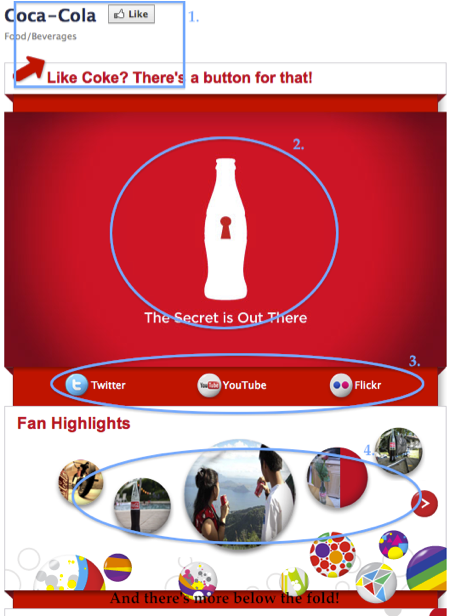
1. Call to action. 2. Pulled in by brand/mysteriousness 3. Share in other ways. 4. UGC
Using Coca-Cola’s page as an example, there are four features of a Canvas App tab that increase conversions for the first half of the funnel — the Like.
A direct call to action with a prominent arrow will bring attention to the point of conversion. Coke probably doesn’t need to focus so hard on getting people to Like them given the brand recognition, so more creative copy than that may be needed.
Offer some kind of secret sauce, a benefit for liking the page. I was fooled into hoping for at least an ad about the secret recipe — more direct benefits would be needed for a brand that isn’t already a 12-pack in my refrigerator.
Providing links to other social networks seems counter-intuitive as it takes the user away from the page. However, with opening the page in a new tab in the browser, you keep the viewer on the Facebook Page while offering a new place to share your brand message.
A set of editors picks of user-generated content reinforces brand interaction on Facebook. Coke’s prioritizing of this content above branding or further lead generation could a sign of their focus on social branding over other methods of funneling social action.
At the core of any news story is its effect on the reader’s business. As Facebook seems to count each Canvas App tab view before and after the like, you can find a rather direct metric of which tabs were affected worst under Insights>Users>Activity. Furthermore, if you’re tracking your Facebook tabs with cross-domain tracking or your tabs’ links with referral tracking encoded in the url, you’ll be able to look at Google Analytics or your tracking software and determine more specifically the effects on your campaign by searching the Content Drilldown.
At the core of any discussion of unexpected downtime is the allowance for such downtimes in your marketing and advertising plans. Either by focusing on long-term gains or by re- or proactively acting on the acknowledged bugs in the Facebook Bug List, you’ll be able to weather the storm of any accidentally lost functionality.
The Facebook page for the group is nothing more than a simple sales pitch for businesses becoming involved on the site. It’s tips for publishing, appeals to outmoded user statistics, and overall tone is clearly directed at the first-time Facebook advertisers. Promoting Sponsored Stories seems to be the main goal, though the ability for a small business to achieve such a close relationship with the company behind the site is not clear at first glance: Nike, American Express, and a page that can get 100 answers to the question “Blue or purple?” are featured, but no one just starting out with limited brand awareness. However, as you delve deeper into the videos, a number of case studies can be heard by the part-time Internet marketer to help understand the basics of the varied services Facebook offers, explained in a way that focuses on what makes social media advertising different from traditional venues.
But July 27th brought a new arena for the first-time marketer. The Facebook for Business site offers a set of introductory slides more like what one would expect on the Facebook page. The Best Practice Guide and other tips take the unedited rambling of the taped live webinars from the Facebook page and put them into clear slideshows (though inexplicably as unsharable and minimally-graphable PDFs). Discussing Pages, Ads, Sponsored Stories, and the “Platform,” Facebook lays out its basic services in an all-too-simple way.
The site is clearly for someone who doesn’t muck with websites, as just one tab describing the Open Graph protocol for a new marketer would show a whole new world, integrating on-site tagging with a need to contact a Preferred Developer to best take advantage of the depth of information one can provide, shape, and offer to their clients.
It’s easy, at least for the somewhat experienced marketer, to come up with counterexamples, glossed-over topics that are the core of Facebook advertising such as effective demographic targeting, and the just-seething disdain for squares who just haven’t gotten how cool Social Media is. But I applaud Facebook for their efforts; the only other major social media outlet for business is Twitter, which starts its Promoted links at $5,000 per month and provides little information for its non-paid business partners. Google+ recently purged business accounts, asking creators of those accounts to “hold off,” and have been “focusing on the consumer experience” — words that are hardly music to marketers’ ears.
What the shortcomings of the Facebook for Business and Facebook Marketing Solutions pages really show off is that a business needs dedicated social media management, whether through an SEO firm or internally. The waters are murky and best handled by someone who knows not just the sales pitch for getting involved, but also the mechanics of the process and what little stuff can greatly improve the social footprint of the small business. It’s too hard to sum up everything that should and could be done to optimally advertise using social media just on a few webpages or through a few taped webinars — the best thing is to call Ghostbusters and let Peter and Ray and Egon worry about the ghosts so business owners can get back to directly helping their customers.
Around here at the SI office we take our lunches seriously, and at the intersection of tasty food and a bunch of fun, hardworking SEO professionals comes our new “Lunch and Learn” series. This recently-debuted program is a biweekly tradition here at the office, where an Influencer will take the time to put together a humorous and educational presentation to embiggen the knowledge of even the most seasoned SEO veteran. Today, our very own Anthony Coleman kicked off the series with a superhero-tastic exploration of Facebook reveal tabs and newsletter sign-ups, as well as how iframes can be a boon to development, tracking and user interaction.
Since Facebook’s native markup of a combination of HTML and XML can be clunky and very limited (especially when it comes to more sophisticated elements like Javascript), iframes offer a sleeker approach to Facebook brand display. They pull content directly from a business’s site, so that traditional HTML and the aforementioned advanced elements can be utilized to create a much more multi-faceted approach to drawing in eyeballs both before and after the “like.” Additionally, multiple tabs can be created within the frame, allowing for a customized complexity not normally seen in the basic FB layout. These tabs can offer different aspects of the business such as a “thank-you for liking” display, locations, specials, and forms.
As most Facebook users simply “like and forget,” this kind of direct data can draw traffic to the business’s page instead of its Facebook. Since the third-party content exists on a familiar platform, though, it can function as a preliminary landing page, easing the users in to getting to know the brand or service. The more dynamic aspect of the frame tabs also makes it easier to track page views and user behavior. In turn, targeting demographics by aspects such as location, sex, age and interests is made simpler as well — something that anyone with an interest in Facebook marketing is surely invested in.
On a more surface-level aspect, this approach is simply more engaging to the user than passive newsfeed updates. There are over 750 million users on Facebook (150 million + in the US alone), and maintaining a strong presence is a must for any social media-savvy brand. The updates can be informational (such as special offers and exclusives shown directly from the website onto the viewer’s feed), but also allows for direct interaction in the form of contests, mailing list sign-ups and other conversion points from viewer to participator.
It was an educational afternoon at Search Influence, and we thank Anthony for his hard work putting together his presentation! He’s got an upcoming blog post on more Facebook tactics, and you can bet that future Lunch & Learns will be written up right here. In the meantime, you can check out his heroic (and informative!) presentation here.
I first discovered Quora just a few months ago, and quickly grew addicted. When searching for opinions, recent history, or even anything involving the tech world, Quora becomes my first stop. The site’s main strength lies in the quality of its users who also create quality questions and answers. Many of these users are Silicon Valley insiders, and for a while, Quora was the next big thing. Whether that is still the case can be debated, but Quora has a lot of collected knowledge that is easily accessible.
Quora looks similar to many other Q&A sites, and indeed, the basic format hasn’t changed. However, a few things Quora handles particularly well are the profile, the feed, and the search. When starting an account, Quora emphasizes ties to either Twitter or Facebook and insists that you use your real name. The real identity becomes especially important as your name and title accompany each answer. While anonymous answers and questions are an option, a real identity and relevant title greatly increase the answer’s credibility. This becomes particularly important when insiders answer questions about their company, often the case for questions about Quora itself, Twitter, or even Google.
Much like Facebook’s newsfeed (the two founders came from Facebook, after all), Quora provides questions and answers that should be relevant for each user. Not only can users follow topics, but they can also follow other users or particular questions to be notified of any new answers. As you develop your interests, the newsfeed becomes more interesting to explore as new things are constantly popping up.
The search bar at the top helps users find the content they need with suggestions much like Google’s, and by combining search with the question input field, redundant questions also get rooted out. Quora seeks to keep duplicate questions out, so users only have to find one place for the information they need. Once the right question is found, the answers are ranked by various up-votes and down-votes much like Digg, so the relevant information comes easily.
These features, an overall smooth performance, and a little bit of the right publicity have created a user experience that attracted many of the Silicon Valley insiders that laud the service. This emphasis has helped create valuable and high-quality content in a relatively niche subject. However, the scope of this subject has reached beyond just the tech world. Other topics such as politics, food, science, movies and business have good followings that have developed high quality answers. Already, I have found Quora to be a great way to learn about new topics such as cooking and real estate at a moderate depth. This way, you gain a little personality in your answers and also avoid much of the lower quality advice that can creep to the top of some Google searches.
I happen to eat through Quora’s content like candy, and there doesn’t seem to be an end to it in sight. However, I rarely feel guilty about spending my time there as I’m constantly learning new things, finding new viewpoints, or keeping up on relevant topics. If you are unfamiliar with this site, I strongly suggest you check it out. Chances are you’ll learn something.
Following advertisements for a contest where Facebook fans can enter to win a 60” 3D television, anchors’ guffaws at “The Facebook” and “The Twitter,” and the third run of a talk about how Facebook and social media peacefully brought down a dictator in 18 days, FOX8, our beloved Fox affiliate network channel, ran a special report on Facebook privacy which showed how confused people are about Facebook.
Stirring up fears about Facebook’s lackadaisical attitude towards users’ privacy is almost as old as the site itself, but really took off after the introduction of the news feed, prompting this post from Michael Cerahimself. But FOX8 reports that there yet is one more person who knows “everything” about you, even after 170 types of privacy options: the social media marketer.
We’ve determined a rough estimate of the gay population of the military using the tools they’re talking about. Dr. Kimberly Mason, cyber-bullying expert at UNO, claims:
“The majority of the individuals who use Facebook of course are on there to make their social connections and keeping in touch with friends and family. So looking at advertising and looking how they monitor that really is not in their realm of awareness.”
Strengthening this argument is the general concern about privacy that Facebook users have cultivated. Avoiding questions of survey design, there is no attempt by Gallup/USAToday to reconcile this data with the knowledge users displayed about the privacy settings even at an early stage of development for the site, nor with the skyrocketing membership and constant activity seen as the site has become the second-most-trafficked site on the web. Obviously we’re not dealing with an all-or-nothing situation, and maybe even analysis of risk perception could be appropriate, though of course not under the language of physical harm.
The FTC supports a browser-based “Do Not Track” system, while Rep. Jackie Speier (D-CA) offers a much more nebulous, but more proactive and far-reaching system. These proposals and recommendations are to protect the users of the site from their private lives being compromised.
But the privacy argument driving interest, polls, and media stories is too muddled to be coherent — there’s privacy, and then there’s privacy, and then there’s privacy. These three realms where users can unknowingly give out information — your network, the public, and advertisers — have different priorities and different interdependencies when it comes to blocking access.
The first kind of privacy — hiding your information from your own network — seems simply counterintuitive to me. Like having a private Livejournal, not using the social aspect of a social network seems a bit counterintuitive. There’s got to be some kind of control here — Reuben Foster of UNO says, “If I don’t want it to be public, then I won’t … click these things,” and that’s right on the money.
Found directly beneath the status box.
In addition, the News Feed is smart. That first variable, the affinity score, is user-controlled. If you don’t talk to someone, they won’t show up as often. To boot, the other variables, weight and time, simply fulfill the definition of a social network. Combined with easy to navigate deletion and blocking capabilities, it’s a hard sell to me that there isn’t enough privacy options for the user.
But that’s a straw man; privacy can be breached in other ways. While privacy settings can stop a lot, so many checkboxes to look at and discover over time might be overwhelming. Worse still, Facebook has a bad habit of resetting its users’ privacy settings when it updates its features. We’ve talked before about other people looking at your posts and online image branding. There are a number of news stories where someone posts something that unintentionally irritates the wrong people, all of which bring up the divide between what is or isn’t public speech.
While I’m not about to open that can of worms, two alternate court cases show the two likely outcomes of privacy issues: either an out of court settlement or a court siding with the company, who can probably show a solid link between loudly kvetching about work and “job performance.” The question on the level of privacy and anonymity of your Facebook profile has not been answered; best to tread with care, but not necessarily lightly.
Even with careful Facebook pruning, you still have your information going to advertisers, and it is this what puts Facebook in a unique position for privacy. Google doesn’t have the instant interest data to tailor their content offerings like Facebook does. Even Microsoft, whose use of Internet Explorer to strengthen Bing’s ranking pages is more insidious and less publicized, gets their data from Facebook
Obviously not the best tool for small fanbases…
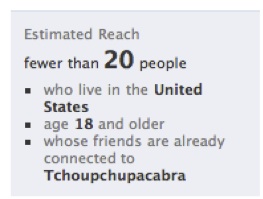
WVUE reflects the average Facebook user’s view when it refers to all ads as “Sponsored Stories.” Ads are ads — it’s neither Facebook’s intent nor in their interest to try to fool you into thinking they’re not, and you’d have to ignore clear headings to think they’re from your friends. There is a difference, though: Sponsored Stories refers to ads that look more like regular news feed posts; however, they again have the telltale heading. They also can only be shown to people “whose friends are already connected to” the Facebook page or post that they’re connected to. Similarly, fan page ads can only be shown to people not already connected to the fan page.
See, nothing terribly creepy here…
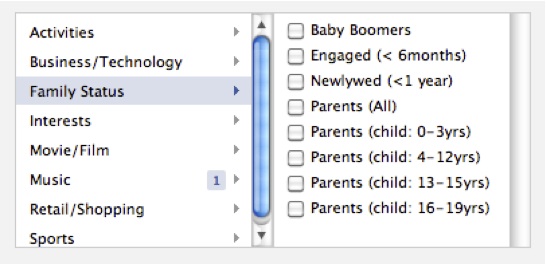
Facebook’s ad targeting is much less sinister than it seems. You can filter by age, sex, and broad category of interest. While the Family Status category under interests is on one hand a bit questionable, it can heavily influence relevance of ads; you wouldn’t want to be showing ads for singles sites if a member is married with kids.
You can then target by Connection to a Page, Event or App. The next section, the Advanced Demographics, provides advertisers with better opportunities to provide relevant content and avoid marketing gaffes. Finally, you can target by education level or workplace.
And that’s it, right? You get your broad information, and nothing’s even tracked deeply enough to cause any concern. That doesn’t seem so bad.
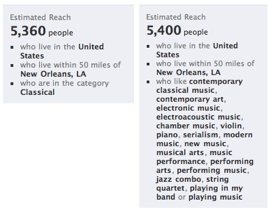
… But we could make this comparison much creepier. I just like music.
But when something* happens with your account, the advertiser gets access to Likes & Interests. This narrows the interests so that it is more like traditional keyword bidding. This isn’t unusual, and follows the traditions from Google pay-per-click advertising. The advertising platform provides vague statistics to give advertisers an idea of how many people are interested in ideas that are related to your link.
But not only does the advertiser get this information. Another privacy craze was raised over Facebook’s Open Graph Platform, which began the rash of “Like” buttons on the site. Extending the simplicity of the “Like” from every kind of “Edge” — the term Facebook uses for any post, link, comment, or ad — to web pages seems logical and extends not only the brand, but the whole social media mentality.
Open Graph allows a content provider to, like Google Analytics, track his links’ likes and clicks on Facebook, even without having a Facebook presence. While this might seem like nothing new to your loss of privacy, an important distinction has to be drawn between this and Google’s tracking programs. Facebook offers this information with your personal information like your friends list in the unseen data. Obviously, this is used not for advertisers, but for the inner machinery. However, the concern remains that someone with a bit of knowhow can get that information.
But that information isn’t useful for advertisers right now. A list of friends might be interesting on a massive level, but then again, the individual is lost looking at larger trends. The other factors, publicly displayed on your profile
Through these three realms of privacy, it seems that there’s good reason to be afraid of Facebook and its privacy issues. But here’s the catch — who’s really looking at this? Advertisers and content providers, even among the slimiest of content farms, simply want to provide a better user experience. They, including us, are looking for the most people clicking on ads and, more importantly, interact with the content behind the ads.
There’s a tendency for people versed in Facebook to blame the user — we all see the inner workings, we know how easy the whole system is if you turn off your brain. We know that all you have to do is click the “Like” button and you’re giving us good information that we can use to give you more of what you already, at least in a marketing sense, “Like.” Those that are trying to target you are trying to give you more of what you’ve already said you want, even if it’s an admittedly selfish gift, since advertisers obviously get benefits from you clicking the link.
But the Skinner box that is Facebook, and particularly the games and apps that tweak and complicate privacy settings beyond the basic problems described, is ultimately something from which its users benefit. The on-first-glance underhanded data-gathering techniques are ultimately the way that Facebook serves its users, by providing content relevant to them, as determined by them.
*We are looking into this. Check back for more info!
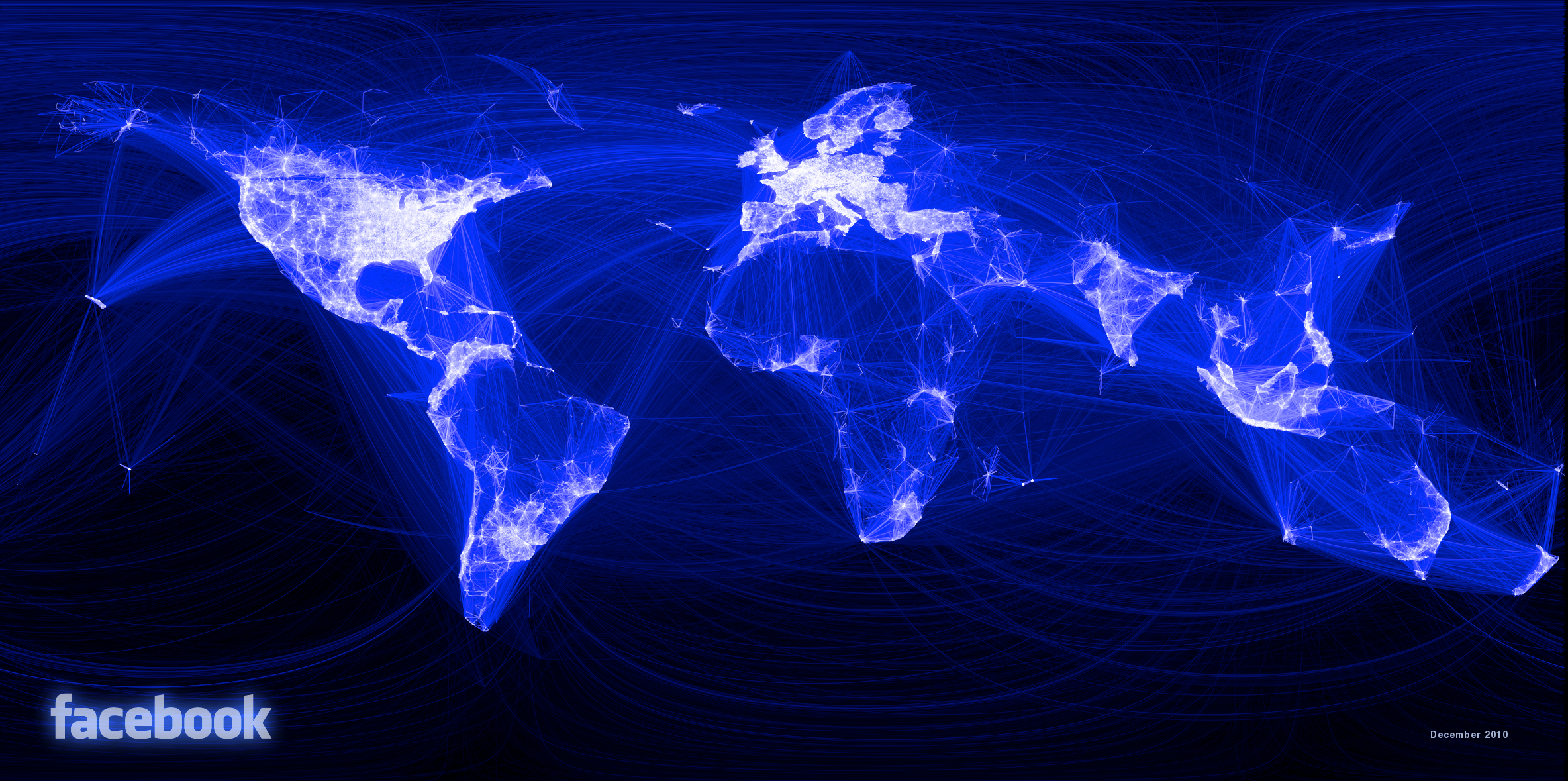
Picture Courtesy of the Facebook Engineering Blog
Don’t forget to “Like” this page. We promise to do every creepy thing we can with your information and show you what you’re sending to advertisers and content providers in an upcoming blog post.
Recently a slew of articles have been popping up about the ineffectiveness of Facebook advertising. While we recently touched on this subject in a previous blog post, I thought I would explain why this statement has little credence when Facebook ads are done properly. If you’ve read any of our previous FB blog posts, you are aware that for Search Influence, Facebook yields a low cost per lead making it one of our most effective ways to drive leads to clients’ sites. With that being stated, I can proceed to explain (in a Clarissa-esque manner) why Facebook is effective and ineffective for some online marketers and industries.
Are You a Facebook Friendly Business?
I’ve mentioned this before but Facebook ads follow the same methodology that magazine and television ads follow. While choosing images for your ads is important, determining whether your business is right for Facebook is the key to success. You would never hire a fertility specialist, carpal tunnel expert, or babysitter from a 30 second TV spot (well maybe you would. I would never trust my semen, wrist, or subsequent children in the hands of a stranger on TV, but I was raised right). I think that is the fundamental problem some advertisers have with Facebook. They’ve read a few cleverly written articles on online advertising on Facebook and they think they can create those successes for all their clients. However industries such as elective surgery, social causes, and the entertainment service industry fair considerably well for local businesses.
Facebook Ad Demographic
Is the Facebook Demographic Right for You?
Why do these previous mentioned industries succeed? Before I address that let me just get this out of the way – Facebook is not for everybody. If your business is a retirement home and a certified social media specialist tells you he can increase you fan base and leads from Facebook by some unthinkable number, he’s lying. Certain demographics just do not exist on Facebook, blame social media and technological darwinism. The largest demographic using Facebook are between ages of 18 – 34. They are the beauty obsessed, socially aware, fun-loving Youth of America. This is the age group your business must pander to in order to be truly effective. From an ROI perspective, the subgroup of the young professionals between the ages of 25 – 34 are where the disposable income is the ripest. By targeting this age group with the correct interests and properly crafted ads you can increase your leads stream significantly.
Are Facebook Ads Ineffective Because of Bad Advertising?
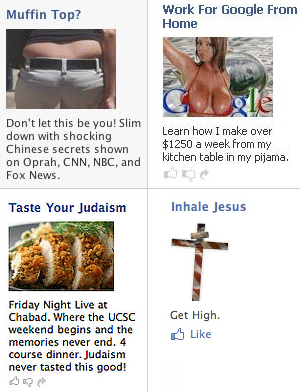
We have all seen these ads. The married man being shown dating site ads despite his status being “married”, the teenage boy being shown breast augmentation ads because he has “breast” as a interest. And my personal favorite, the work from home search marketing ads (as seen in the image below). I see these ads and I am filled with laughter, sorrow, and disdain. Is it such a surprise that Facebook is deemed ineffective with such a large percentage of ads misspelled, using irrelevant images, and just down right offensive ads running? I mean, get high on Jesus? Really?
Bad Facebook Ads are BAD
At the end of the day, the performance of Facebook advertising is directly tied to your business, the demographic you are targeting, and how well you compose your ads. People assume this is an ad space issue marketers and industries have dealt with since commercialization of goods. So instead of questioning whether Facebook is effective, social media marketers should be questioning whether Facebook fits their clients business model.
 The end of February brought another successful and informative Search Marketing Expo West, where yours truly triumphantly (and successfully, if I may brag) returned to present on another mobile panel. The presentation was so nice, I was named twice. Enough about that, as this post isn’t about me (sad, right?). If you want to read a bit about it, check out this blog from Erica Sendros and our best buds at aimClear. We also had a newb in our midst, with Joseph Henson making his SMX debut. This isn’t about him either, but Kathy Long and our other favorite friends at Bruce Clay Inc. wrote this cool post about it.