Tag: facebook ads

  • Facebook Privacy – New Orleans SEO Replies to FOX8

    Facebook Privacy - World Map
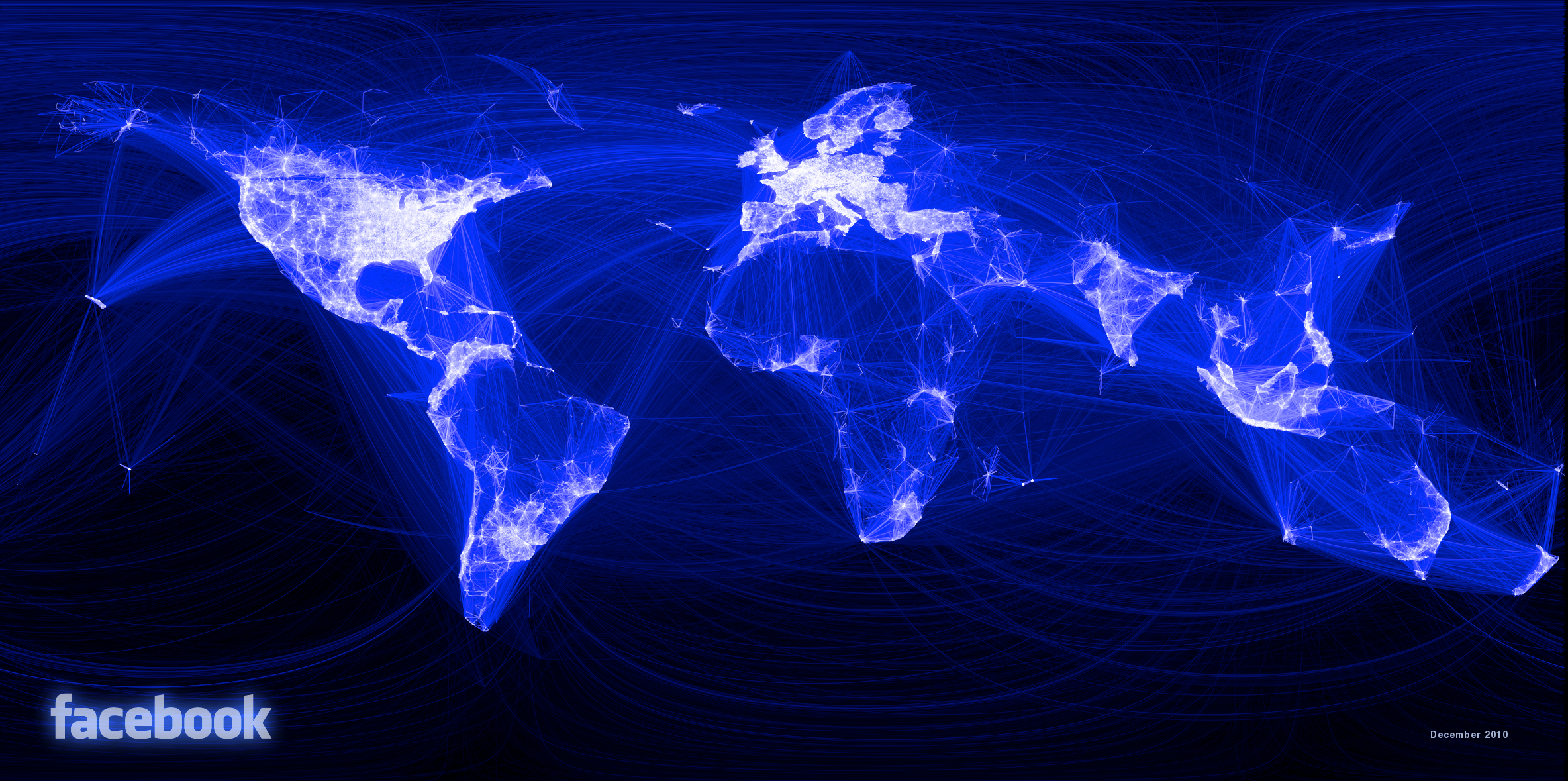
    The world according to Facebook.

    Following advertisements for a contest where Facebook fans can enter to win a 60” 3D television, anchors’ guffaws at “The Facebook” and “The Twitter,” and the third run of a talk about how Facebook and social media peacefully brought down a dictator in 18 days, FOX8, our beloved Fox affiliate network channel, ran a special report on Facebook privacy which showed how confused people are about Facebook.

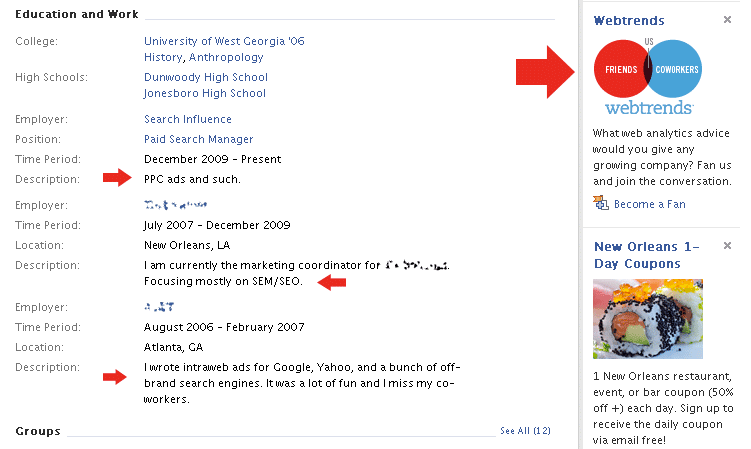
    Stirring up fears about Facebook’s lackadaisical attitude towards users’ privacy is almost as old as the site itself, but really took off after the introduction of the news feed, prompting this post from Michael Cerahimself. But FOX8 reports that there yet is one more person who knows “everything” about you, even after 170 types of privacy options: the social media marketer.

    We’ve determined a rough estimate of the gay population of the military using the tools they’re talking about. Dr. Kimberly Mason, cyber-bullying expert at UNO, claims:

    “The majority of the individuals who use Facebook of course are on there to make their social connections and keeping in touch with friends and family. So looking at advertising and looking how they monitor that really is not in their realm of awareness.”

    Strengthening this argument is the general concern about privacy that Facebook users have cultivated. Avoiding questions of survey design, there is no attempt by Gallup/USAToday to reconcile this data with the knowledge users displayed about the privacy settings even at an early stage of development for the site, nor with the skyrocketing membership and constant activity seen as the site has become the second-most-trafficked site on the web. Obviously we’re not dealing with an all-or-nothing situation, and maybe even analysis of risk perception could be appropriate, though of course not under the language of physical harm.

    The FTC supports a browser-based “Do Not Track” system, while Rep. Jackie Speier (D-CA) offers a much more nebulous, but more proactive and far-reaching system. These proposals and recommendations are to protect the users of the site from their private lives being compromised.

    But the privacy argument driving interest, polls, and media stories is too muddled to be coherent — there’s privacy, and then there’s privacy, and then there’s privacy. These three realms where users can unknowingly give out information — your network, the public, and advertisers — have different priorities and different interdependencies when it comes to blocking access.

    The first kind of privacy — hiding your information from your own network — seems simply counterintuitive to me. Like having a private Livejournal, not using the social aspect of a social network seems a bit counterintuitive. There’s got to be some kind of control here — Reuben Foster of UNO says, “If I don’t want it to be public, then I won’t … click these things,” and that’s right on the money.

    Facebook Privacy Setting
    Found directly beneath the status box.

    In addition, the News Feed is smart. That first variable, the affinity score, is user-controlled. If you don’t talk to someone, they won’t show up as often. To boot, the other variables, weight and time, simply fulfill the definition of a social network. Combined with easy to navigate deletion and blocking capabilities, it’s a hard sell to me that there isn’t enough privacy options for the user.

    But that’s a straw man; privacy can be breached in other ways. While privacy settings can stop a lot, so many checkboxes to look at and discover over time might be overwhelming. Worse still, Facebook has a bad habit of resetting its users’ privacy settings when it updates its features. We’ve talked before about other people looking at your posts and online image branding. There are a number of news stories where someone posts something that unintentionally irritates the wrong people, all of which bring up the divide between what is or isn’t public speech.

    While I’m not about to open that can of worms, two alternate court cases show the two likely outcomes of privacy issues: either an out of court settlement or a court siding with the company, who can probably show a solid link between loudly kvetching about work and “job performance.” The question on the level of privacy and anonymity of your Facebook profile has not been answered; best to tread with care, but not necessarily lightly.

    Even with careful Facebook pruning, you still have your information going to advertisers, and it is this what puts Facebook in a unique position for privacy. Google doesn’t have the instant interest data to tailor their content offerings like Facebook does. Even Microsoft, whose use of Internet Explorer to strengthen Bing’s ranking pages is more insidious and less publicized, gets their data from Facebook
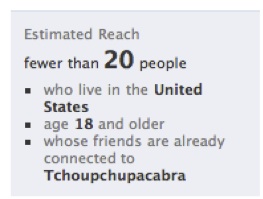
    Facebook Privacy - Fan Page Ad Reach
    Obviously not the best tool for small fanbases…

    WVUE reflects the average Facebook user’s view when it refers to all ads as “Sponsored Stories.” Ads are ads — it’s neither Facebook’s intent nor in their interest to try to fool you into thinking they’re not, and you’d have to ignore clear headings to think they’re from your friends. There is a difference, though: Sponsored Stories refers to ads that look more like regular news feed posts; however, they again have the telltale heading. They also can only be shown to people “whose friends are already connected to” the Facebook page or post that they’re connected to. Similarly, fan page ads can only be shown to people not already connected to the fan page.
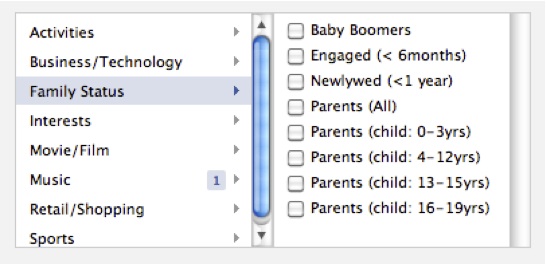
    Facebook Privacy - Basic Advertiser Interest Pane
    See, nothing terribly creepy here…

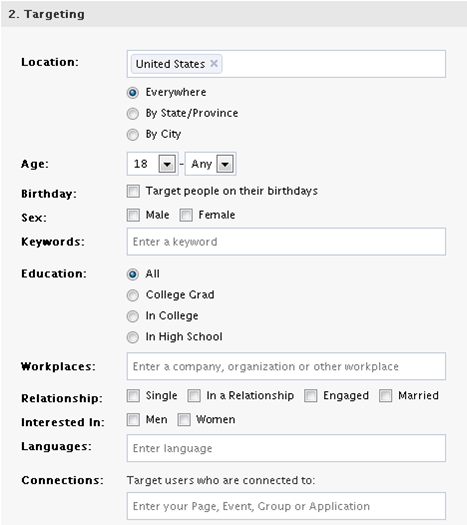
    Facebook’s ad targeting is much less sinister than it seems. You can filter by age, sex, and broad category of interest. While the Family Status category under interests is on one hand a bit questionable, it can heavily influence relevance of ads; you wouldn’t want to be showing ads for singles sites if a member is married with kids.

    You can then target by Connection to a Page, Event or App. The next section, the Advanced Demographics, provides advertisers with better opportunities to provide relevant content and avoid marketing gaffes. Finally, you can target by education level or workplace.

    And that’s it, right? You get your broad information, and nothing’s even tracked deeply enough to cause any concern. That doesn’t seem so bad.
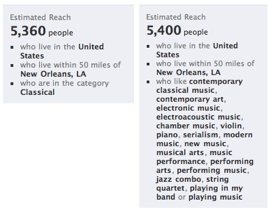
    Facebook Privacy - Targeting Comparison
    … But we could make this comparison much creepier. I just like music.

    But when something* happens with your account, the advertiser gets access to Likes & Interests. This narrows the interests so that it is more like traditional keyword bidding. This isn’t unusual, and follows the traditions from Google pay-per-click advertising. The advertising platform provides vague statistics to give advertisers an idea of how many people are interested in ideas that are related to your link.

    But not only does the advertiser get this information. Another privacy craze was raised over Facebook’s Open Graph Platform, which began the rash of “Like” buttons on the site. Extending the simplicity of the “Like” from every kind of “Edge” — the term Facebook uses for any post, link, comment, or ad — to web pages seems logical and extends not only the brand, but the whole social media mentality.

    Open Graph allows a content provider to, like Google Analytics, track his links’ likes and clicks on Facebook, even without having a Facebook presence. While this might seem like nothing new to your loss of privacy, an important distinction has to be drawn between this and Google’s tracking programs. Facebook offers this information with your personal information like your friends list in the unseen data. Obviously, this is used not for advertisers, but for the inner machinery. However, the concern remains that someone with a bit of knowhow can get that information.

    But that information isn’t useful for advertisers right now. A list of friends might be interesting on a massive level, but then again, the individual is lost looking at larger trends. The other factors, publicly displayed on your profile

    Through these three realms of privacy, it seems that there’s good reason to be afraid of Facebook and its privacy issues. But here’s the catch — who’s really looking at this? Advertisers and content providers, even among the slimiest of content farms, simply want to provide a better user experience. They, including us, are looking for the most people clicking on ads and, more importantly, interact with the content behind the ads.

    There’s a tendency for people versed in Facebook to blame the user — we all see the inner workings, we know how easy the whole system is if you turn off your brain. We know that all you have to do is click the “Like” button and you’re giving us good information that we can use to give you more of what you already, at least in a marketing sense, “Like.” Those that are trying to target you are trying to give you more of what you’ve already said you want, even if it’s an admittedly selfish gift, since advertisers obviously get benefits from you clicking the link.

    But the Skinner box that is Facebook, and particularly the games and apps that tweak and complicate privacy settings beyond the basic problems described, is ultimately something from which its users benefit. The on-first-glance underhanded data-gathering techniques are ultimately the way that Facebook serves its users, by providing content relevant to them, as determined by them.


    *We are looking into this. Check back for more info!
    Picture Courtesy of the Facebook Engineering Blog

    Don’t forget to “Like” this page. We promise to do every creepy thing we can with your information and show you what you’re sending to advertisers and content providers in an upcoming blog post.
  • Are Facebook Ads for All Businesses?

    Facebook Ads Image
    Facebook Ads. Are You Doing it Right?

    Recently a slew of articles have been popping up about the ineffectiveness of Facebook advertising. While we recently touched on this subject in a previous blog post, I thought I would explain why this statement has little credence when Facebook ads are done properly. If you’ve read any of our previous FB blog posts, you are aware that for Search Influence, Facebook yields a low cost per lead making it one of our most effective ways to drive leads to clients’ sites. With that being stated, I can proceed to explain (in a Clarissa-esque manner) why Facebook is effective and ineffective for some online marketers and industries.

    Are You a Facebook Friendly Business?
    I’ve mentioned this before but Facebook ads follow the same methodology that magazine and television ads follow.  While choosing images for your ads is important, determining whether your business is right for Facebook is the key to success. You would never hire a fertility specialist, carpal tunnel expert, or babysitter from a 30 second TV spot (well maybe you would. I would never trust my semen, wrist, or subsequent children in the hands of a stranger on TV, but I was raised right). I think that is the fundamental problem some advertisers have with Facebook. They’ve read a few cleverly written articles on online advertising on Facebook and they think they can create those successes for all their clients. However industries such as elective surgery, social causes, and the entertainment service industry fair considerably well for local businesses.

    Facebook Ads Image
    Facebook Ad Demographic

    Is the Facebook Demographic Right for You?
    Why do these previous mentioned industries succeed? Before I address that let me just get this out of the way – Facebook is not for everybody. If your business is a retirement home and a certified social media specialist tells you he can increase you fan base and leads from Facebook by some unthinkable number, he’s lying. Certain demographics just do not exist on Facebook, blame social media and technological darwinism. The largest demographic using Facebook are between ages of 18 – 34. They are the beauty obsessed, socially aware, fun-loving Youth of America. This is the age group your business must pander to in order to be truly effective.  From an ROI perspective, the subgroup of the young professionals between the ages of 25 – 34 are where the disposable income is the ripest. By targeting this age group with the correct interests and properly crafted ads you can increase your leads stream significantly.

    Are Facebook Ads Ineffective Because of Bad Advertising?
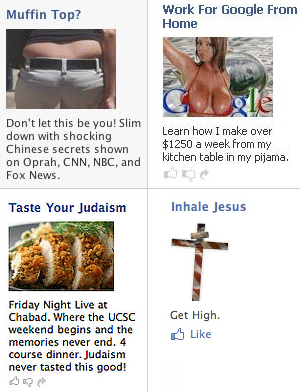
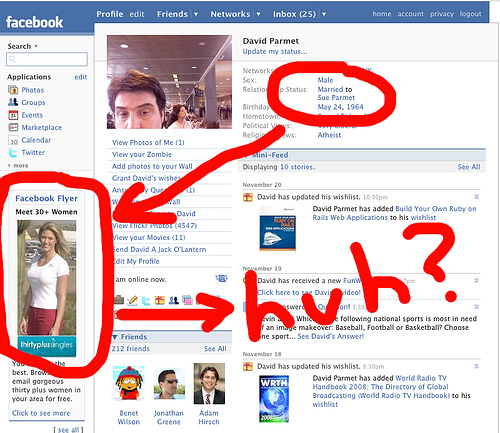
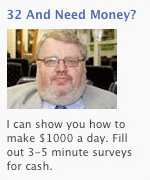
    We have all seen these ads. The married man being shown dating site ads despite his status being “married”, the teenage boy being shown breast augmentation ads because he has “breast” as a interest.  And my personal favorite, the work from home search marketing ads (as seen in the image below). I see these ads and I am filled with laughter, sorrow, and disdain. Is it such a surprise that Facebook is deemed ineffective with such a large percentage of ads misspelled, using irrelevant images, and just down right offensive ads running? I mean, get high on Jesus? Really?

    Facebook Ads Image
    Bad Facebook Ads are BAD

    At the end of the day, the performance of Facebook advertising is directly tied to your business, the demographic you are targeting, and how well you compose your ads.  People assume this is an ad space issue marketers and industries have dealt with since commercialization of goods. So instead of questioning whether Facebook is effective, social media marketers should be questioning whether Facebook fits their clients business model.

    Thanks to Salvo Vaccarella for the image.

  • Increasing Facebook Ads Performance with Images

    Choosing the Right Images for Your Facebook Ads

    From www.adrants.com
    Image from www.adrants.com

    In a previous Facebook Advertising blog post I mentioned the importance of selecting images for your Facebook ads. What I failed to do in that post was to fully explain that idea. Sure I threw out some fancy jargon about “magazine editorial ads”, but I wanted to take this time to show you three types:

    1) Contextually Relevant

    Facebook Ad 1
    Facebook Ad 1

    The least savvy online advertisers know, if you use a picture of what you are marketing people will interact with it. But what if you are advertising a cosmetic procedure? You can’t possibly use an image depicting the surgery. Not only could it be considered inappropriate by Facebook, it could also repulse your some of your more sensitive viewers. Instead choosing a doctor hammering away at a patient with a surgical suction device, find an image that suggest the outcome of the procedure. In Facebook Ad 1, you will see I’ve selected a graphic that implies weight loss and beauty at the same time. These ads are easiest to get approved and yield a good click rate if the right demographic is targeted.

    2) Good Ol’ Branding

    Facebook Ad 2
    Facebook Ad 2

    Good Ol’ Branding. Many people don’t understand why you would use imagery that incorporates branding, but this tactic not only makes viewers aware of your name and services offered but also makes your images more unique. Uniqueness is important when advertising on Facebook. In a given area there could be as many as 10 other advertisers using similar ad copy, offering the same competitive advantage, and using the same stock image as you. This is a big problem that not many online advertisers think about. We are so concerned with our targeted audience that we forget there are competitors who are aiming at the same demographic. By adding elements from your brand, images become instantly recognizable and unique. Uniqueness has always been the key to good advertising – whether it is in print, media, or online.

    3) Playful Imagery

    Facebook Ad 3
    Facebook Ad 3

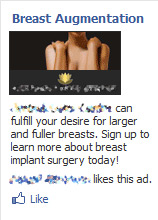
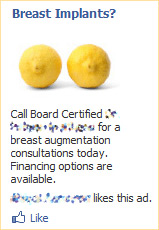
    This is my favorite type of ad. In the section on branding, I mentioned that uniqueness is the key to good advertising but the best way to get remembered (and clicked on) is using suggestive and playful imagery. As seen in  the Facebook Ad 3 example, I’m advertising breast augmentation for a client. Instead of using the standard smiling woman in a low-cut shirt, I opted for something a little more colorful and fun. Paired with the right copy, images like this not only encourage a click through but also a form submission. However, be warned – if you are not targeting the right demographic, you could burn through your ad spend due to the curious nature of clickers.

    Are these the only ways to select Facebook ads? Of course not. I can think of at least four other methods when choosing images for Facebook advertising (which I will likely explore in a future post). So the next time you are planning a Facebook ad campaign for your local business, do not be scared to experiment with the imagery. Who knows, that picture of your Aunt Petunia break dancing at your son’s Bar Mitzvah might double your leads.

  • Facebook Advertisting – The Internet Marketing Gold Rush

    I am frequently asked what the next big thing in paid marketing is – while I tend to keep my online marketing secrets close to my chest, I always answer Facebook. With hundreds of millions active users, it is Sutter’s Mill in the pay-per-click Gold Rush. As paid search platforms are experiencing exponential growth and decay, it offers advertisers an opportunity to target potential leads at a significantly lower cost than traditional PPC.

    As the world’s largest social media site, Facebook has become the popular choice for the local and niche businesses. By allowing marketers to directly interact with people through paid ads, interest groups and applications, it adds a level of engagement lacking in traditional online marketing.

    What Not To Do On Facebook
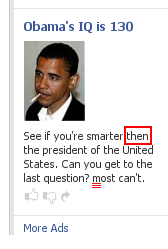
    Grammar Fail. Picture Win?

    Facebook Paid Ads

    With the increasing cost of paid search marketing, advertisers are looking for more cost effective alternatives. As previously discussed on this blog, FB advertising yields a much higher conversion rate for a significantly lower cost. This is attributed completely to demographic targeting and graphical ads. Running an ad with ad content that appeals to your targeted demographic is key to conversion.

    Little Nugget: Paid ads are great for new and niche businesses trying to generate brand awareness locally.

    Using Facebook Groups and Fan Pages

    Active engagement with potential leads is priceless – literally. The best way to do this is through groups and fan pages. Free to set up and great for social media and SEO, groups and fan pages give businesses an opportunity to strengthen customer interest. Because of Facebook’s social nature, they also give businesses the human element that websites lack.

    Little Nugget: Groups and fan pages can be used to market to leads before they reach the business’ website.

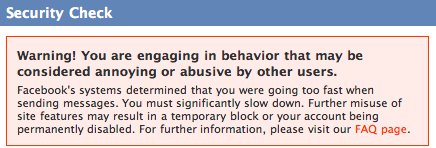
    Facebook Spam Warning
    If you get this message, you're doing it wrong.

    Facebook Applications

    While many only think of Facebook apps in the terms of Farmville and the endless number of “gifts”, there are many applications that are indispensable for brand building. Two personal favorites of mine are Extended Info and Blog RSS Feed Reader.

    Extended Info allows you to integrate custom HTML to create new and interesting fields on the page. Instead of being overly pushing with daily reminders on their timelines, you can designate areas on the page for contest and promotional offers.

    Like with Extended Info, Blog RSS Feed Reader can be used to incorporate content you are discussing on your blog with your profile without the use of status updates. Reader always allows fans a chance to share this information via other social media outlets.

    Internet marketing is no longer the Wild West. It’s becoming more interactive, sophisticated, and accessible to people of all walks of life. While there has always been a question of how to leverage social media, Facebook is making it easier to build communities and generate higher quality leads. I am positive that as it continues evolving, there will be feverish migration of online marketers looking to capitalize on its success.

    Thanks to larcher the Facebook ad image!

  • Facebook Introduces Conversion Tracking for Advertisers

    Data.

    This is the most fundamental building block when trying to determine the success of a Pay-Per-Click campaign.

    Data tells you if that “iffy” ad copy you wrote is actually paying off and it also tells you when something’s gone belly up and is stinking up your cost per lead. But despite being extremely useful, data is also extremely problematic especially when you are using third party report tool with unrelated PPC platform.  The data gets well… unpleasant. This statement has been especially true for me using tools such as Analytics to track Facebook advertising performance.

    Don’t misunderstand, I am a huge fan of Google Analytics because it is useful and free (two of my favorite software attributes). While Analytics has proven to be useful in determining the actual run-of-the-mill site metrics, figuring out specific Facebook ad details has been tedious. I mean we’ve all seen that highlighted message they displays when you start using expressions and Advanced Segments – “This report is based on sampled data. Learn more.

    Google Analytics Sample Data Warning
    Google Analytics Sample Data Warning.

    I hate this message.

    I especially it when I’m trying to figure out performance of a Facebook ad. I constantly ask myself, “Why is Analytics ignoring all the information built into the URL? Is this bounce rate even correct? Why doesn’t Facebook allow conversion tracking so I don’t have to deal with these messy urls?”

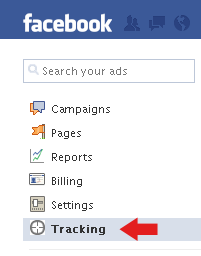
    Whether it was other advertisers demanding more functionality or FB’s development team telepathically sensing my frustration, Facebook is now offering conversion tracking! Even though it is still in beta, Facebook conversion tracking is going to allow advertisers to see at a glance how well new images and adcopy is converting visitors. No more relying completely on Google Analytics and its jaundiced sampled data!

    Facebook Tracking
    Facebook new "Tracking" tool.

    Another benefit of Facebook conversion tracking, conversion data can be compared for accuracy. This is huge for me because having Facebook conversion data allows me to see how accurate the Analytics conversion data is. I trust Analytics but ultimately things do fall through the virtual cracks because of outages, page load errors, or malformed urls. Plus having multiple  sources of data allows advertisers to determine the percent of data loss between platforms.

    While I will never know why Facebook didn’t include conversion tracking initially, I am happy after months of tedious URL building and endless data confusion it’s being offered. With an increasing number of advertisers using Facebook, we should see more advanced conversion tracking options. Now if only they’d do something about the archaic reporting tool…

  • Exploring the Successfulness of Facebook Advertising

    Hi, my name is Anthony and I am a recovering search marketing luddite.

    Facebook Yields High ROI on PPC Ads
    Facebook Yields High ROI on PPC Ads

    For years there have been only three internet ad services I viewed successful: Google Adwords, Yahoo Sponsored Search, and MSN Adcenter.  Don’t misunderstand; I was aware of other services.  I am a social media packrat after all, but I never considered them realistic alternatives to the holy SEM trinity. They seemed like gimmicks. As PPC manager at Search Influence, I provide these services to our clients but I never realized how truly profitable social media advertising was until I started comparing the conversion rates. The numbers spoke loud and clear – Facebook (to my surprise) was generating a high return with a significantly lower cost because of demographic targeting and editorial-like advertisements.

    Relevant Facebook Ad
    Facebook ad that targets keyword's in an user profile

    Demographic targeting has always been the corner of successful search marketing.  Though Google Adwords has demographic targeting capabilities, it lacks Facebook’s knowledge of its users. Facebook allows internet marketers to directly advertise to their core audience based not only geo-location, age, and sex, but a plethora of user define information.

    Facebook Demographic Targeting
    Facebook Demographic Targeting

    Facebook Advertising allows you to target by:

    • Geo-location
    • Age
    • Sex
    • Education Level
    • Relationship Status
    • Sexual Orientation
    • Keywords

    Instead of trying to convince a “researcher” to click through (as you compete with nine other ads and organic results), you can use demographic targeting to directly advertise to your potential client. Showing highly relevant ads to a smaller and more focused group of viewers leads to higher quality leads and lower cost per click (cpc).

    While demographic targeting is key to finding your audience, the proper verbage is also needed. Unlike search engine advertising, these users are not looking for tax specialists or new-age spa retreats. This type of user is uploading pictures from their kid’s birthday and accepting event invites.

    Facebook Editorial Ads
    Example of Facebook Ad

    So how do you engage these users?

    Write magazine-like editorial ads for your targeted demographic.

    The reason magazine and newspaper ads are so successful is they provide a great value proposition to a targeted user. Incorporating graphical elements gives Facebook ads a stark advantage over search engine advertising. This element not only allows user to visually convey the ad purpose, it is also a good way to generate a higher quality click-through rate (CTR). A relevant image will always be worth a thousand plus words.

    In the end, while search engine paid advertising is beneficial in capturing high-level researchers, Facebook allows you direct access to a potential client. With a well-written advert, you can lead the horse to water instead of yelling at him to drink.