Tag: digital marketing

  • #1 Organic & No Clicks? Google Ads 2023 SERP Smackdown!

    #1 Organic & No Clicks? Google Ads 2023 SERP Smackdown!

    High Ranking Keywords and Low Traffic?
    google ads 2023

    Are algorithm updates and AI just a red herring for more Google Ads in 2023?

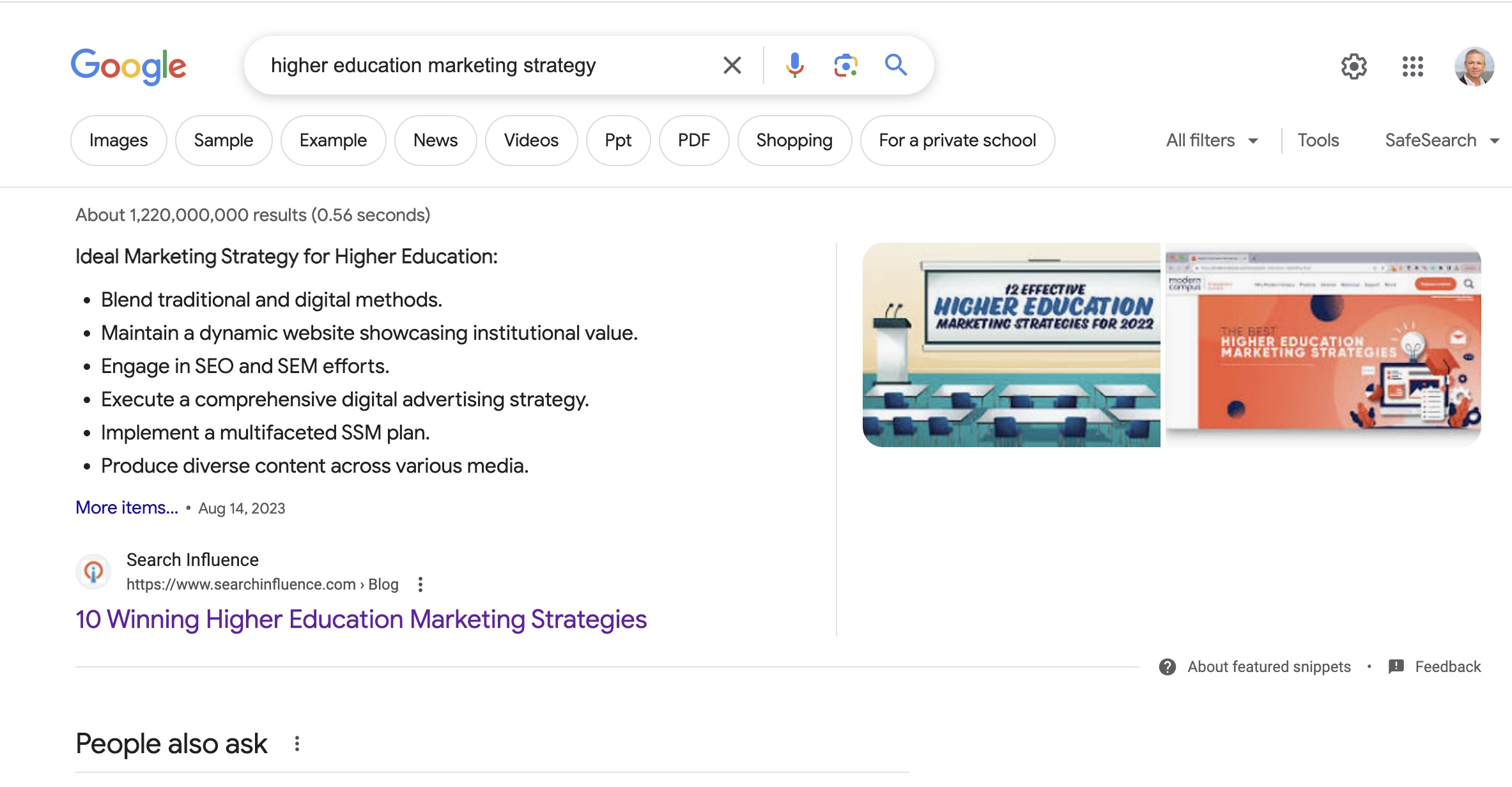
    It’s not just a #1 position. It’s a rich snippet. And a full-feature rich snippet with images, a bulleted list, and everything.

    But the CTR (click-through rate) is a measly 3%.

    We searched for the cause. Was it not a real ranking? Were we seeing a personalized search?
    higher ed marketing

    Screenshot of “Higher Education Marketing Strategy” query on Google

    No. It was Google!

    Google Ads, to be specific.

    And for some searches, Google SGE, the new Search Generative Experience.

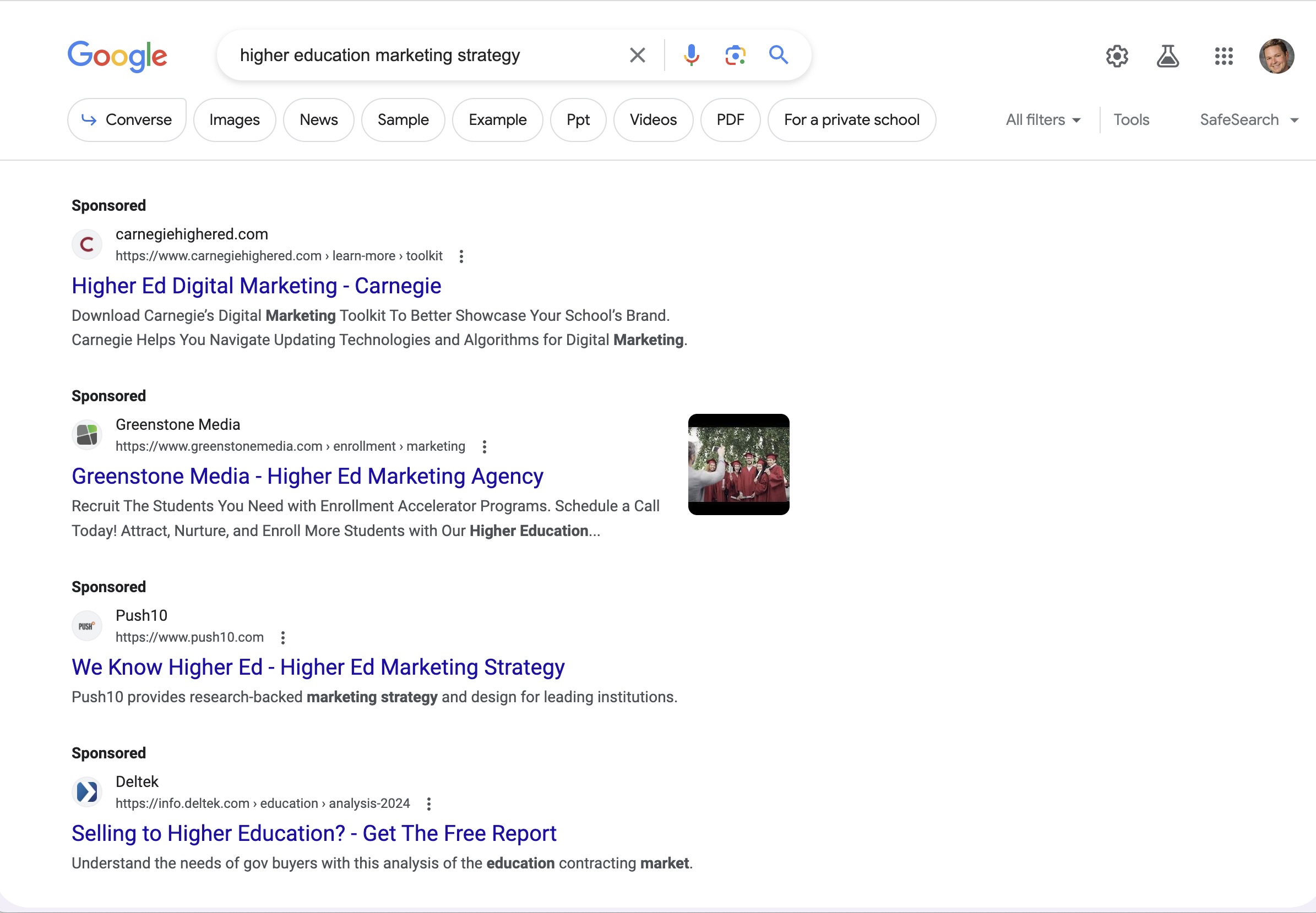
    We discovered that there was now a big fat pack of ads over the top of organic results. Where there used to be a couple of small ads, there are now four, with site links and lots of white space.

    Depending on the search, you have to scroll once, and sometimes twice, to get to the organic results.
    google ads 2023

    Screenshot of “Higher Education Marketing Strategy” query on Google from a non-SI account.

    Why would Google want to suppress organic search results? Let’s look at some examples and see what we find.

    While the SEO community has been worrying about Google Algorithm updates and the impact of AI, Google has quietly expanded the real estate devoted to Google Ads in 2023.

    Perhaps the talk of algorithm updates and AI was a red herring.

    Google SERP (Search Engine Results Page) 2023

    2023 was a busy year for Google. In addition to several algorithm updates, Google had to contend with AI, both in its index and in its user interface.

    AI, specifically the use of Large Language Models, exploded in early 2023. Tools for AI-enabled content creation, previously on the fringe, became mainstream.

    In addition to a flood of new content clogging up its index, Google — already an AI-powered platform — brought some of that intelligence to the search interface in the form of SGE (Search Generative Experience).

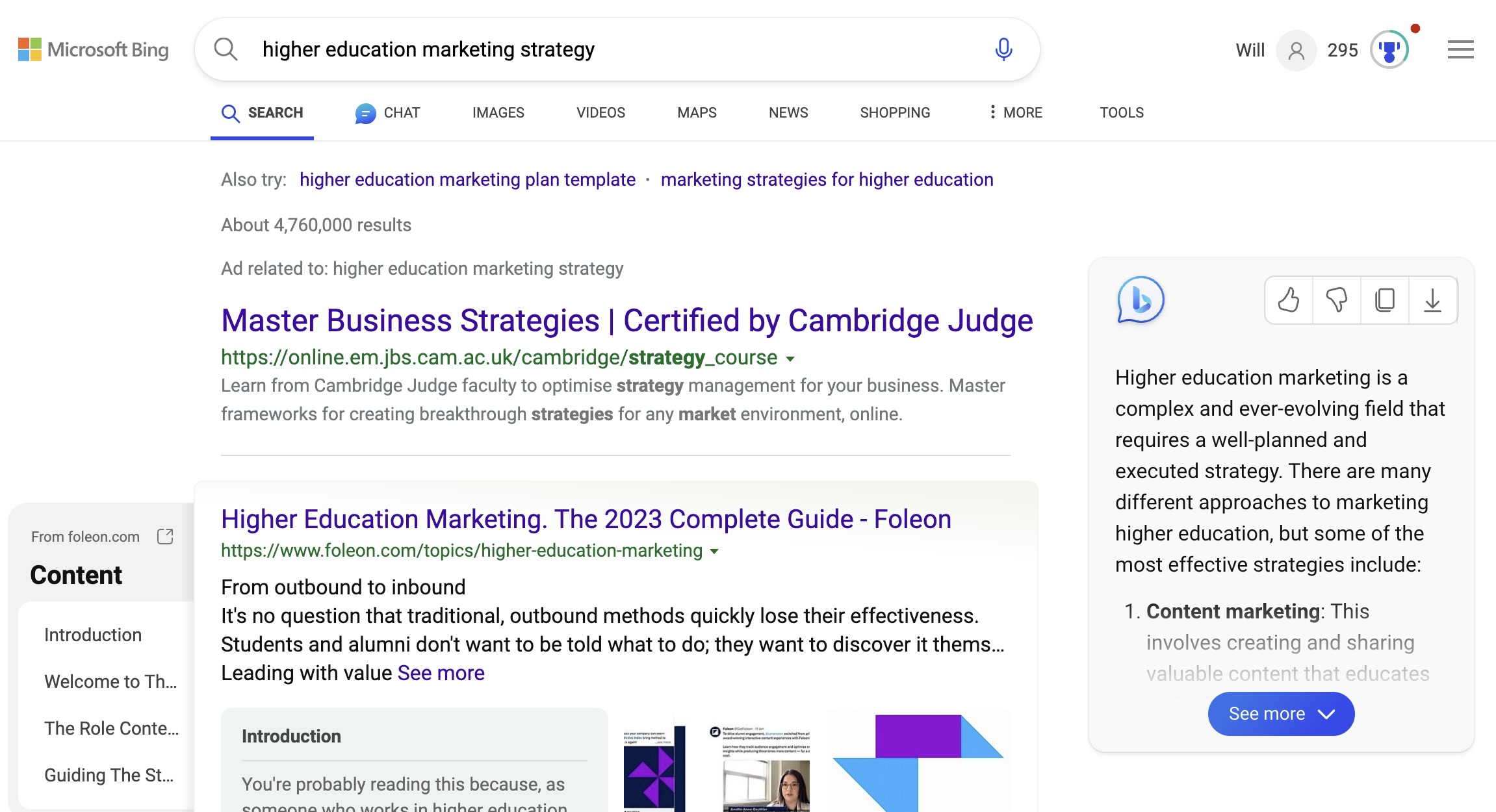
    Bing was the first to market with an AI-powered search experience. But, since it required the Microsoft Edge web browser, it only got a little play outside the Windows world.
    google ads 2023

    That little box on the right is the OpenAI-powered chat module.

    When BingGPT first launched, it was much more like the current Google interface, where the AI-powered elements were above the fold. This version is still accessible in “Chat” mode on Bing, but it’s not the default.
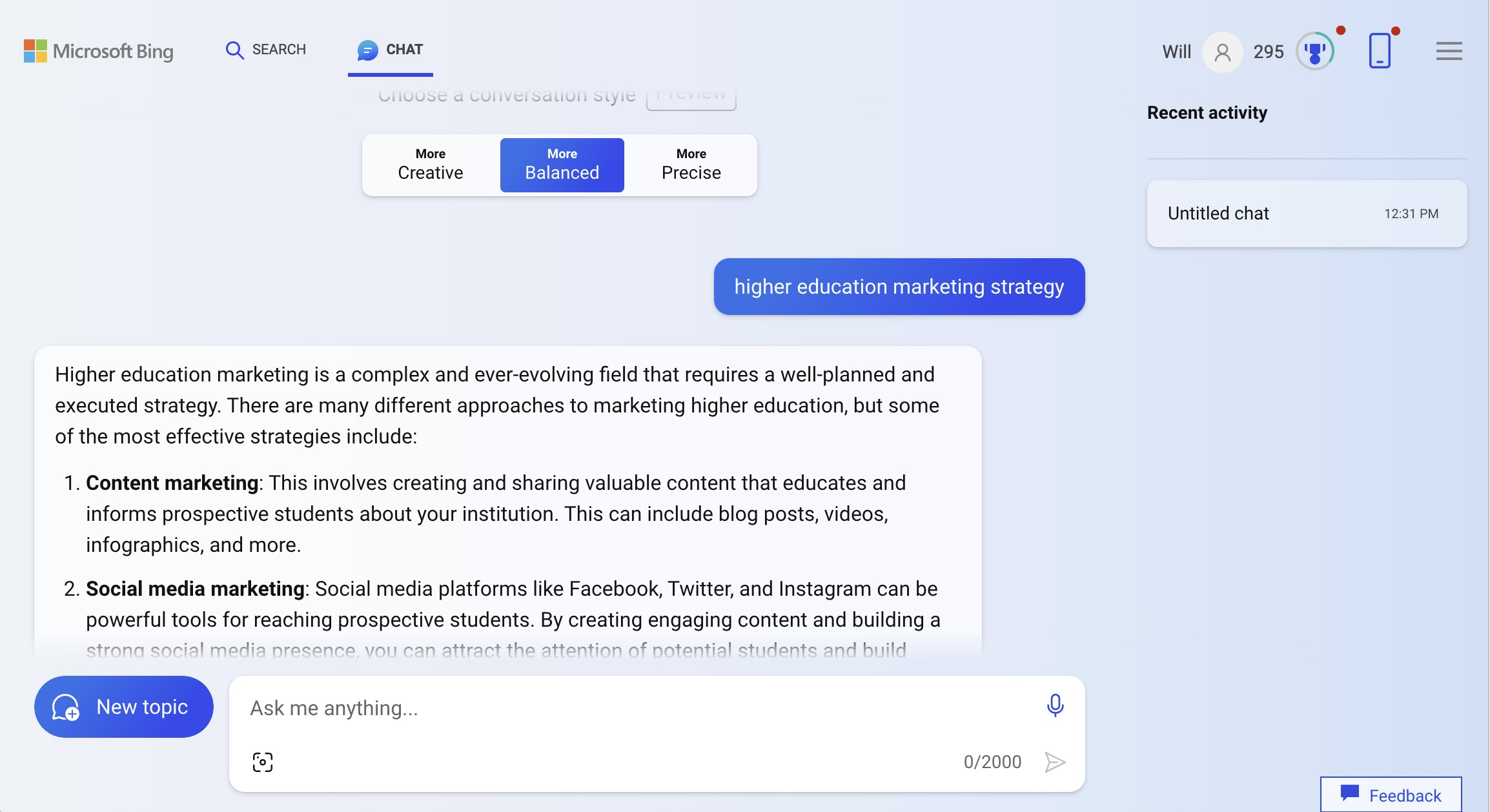
    google ads 2023

    Depending on the search query, Google has gone all in. Some see a slimming of the SGE box, but for our example search “Higher Education Marketing Strategy,” SGE is even more impactful than the ads.
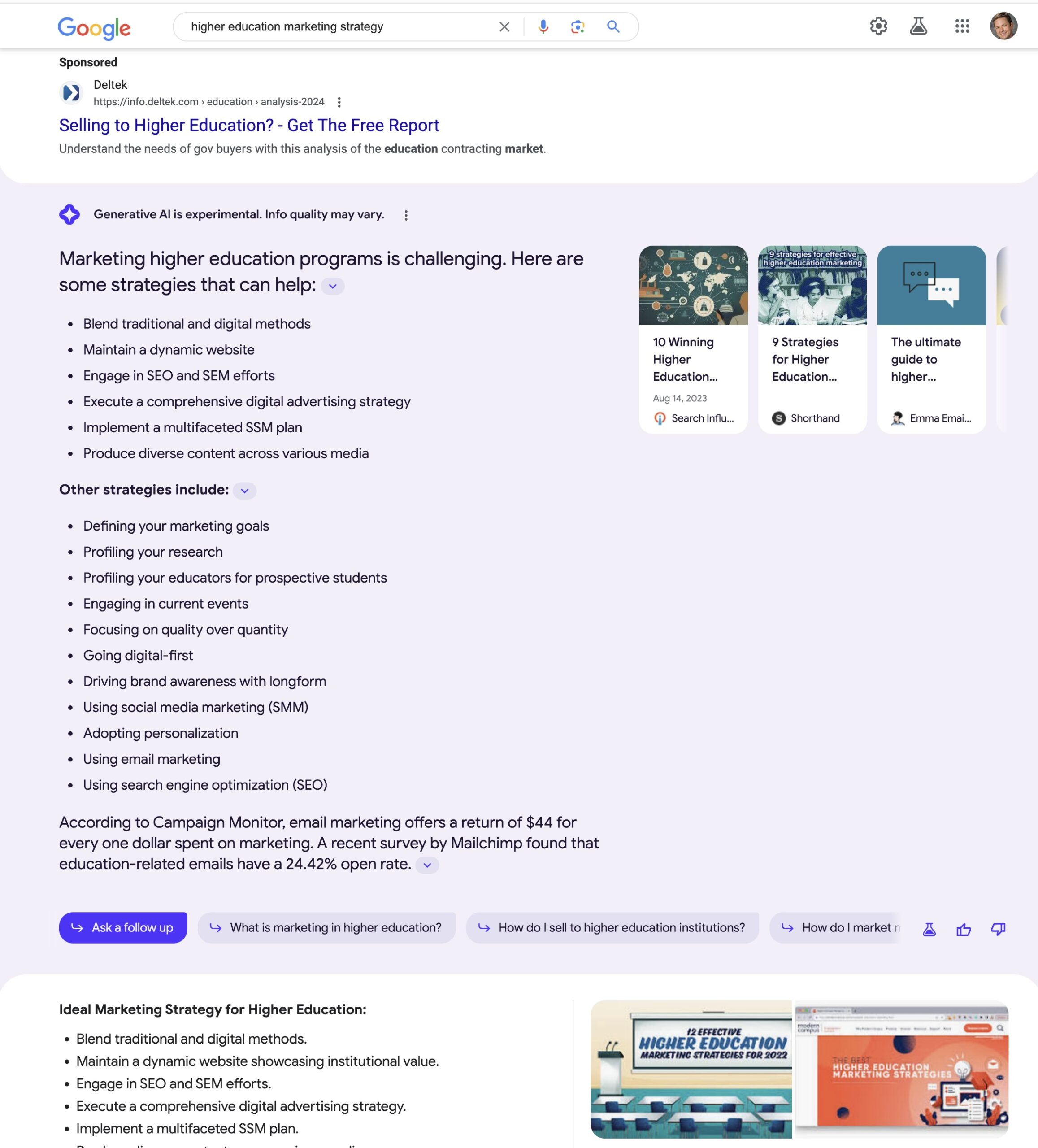
    google ads 2023

    The good news is our content is good enough to be included in (scraped for) the SGE-generated result, but as you can see, even on my 27-inch monitor, I have to scroll to get past the ads and SGE to the rich snippet.

    Not to mention how far you would have to go to reach the traditional 10 blue links.

    More good news is that for many very local (hyperlocal, as Greg Sterling would say) searches, the map still prevails.
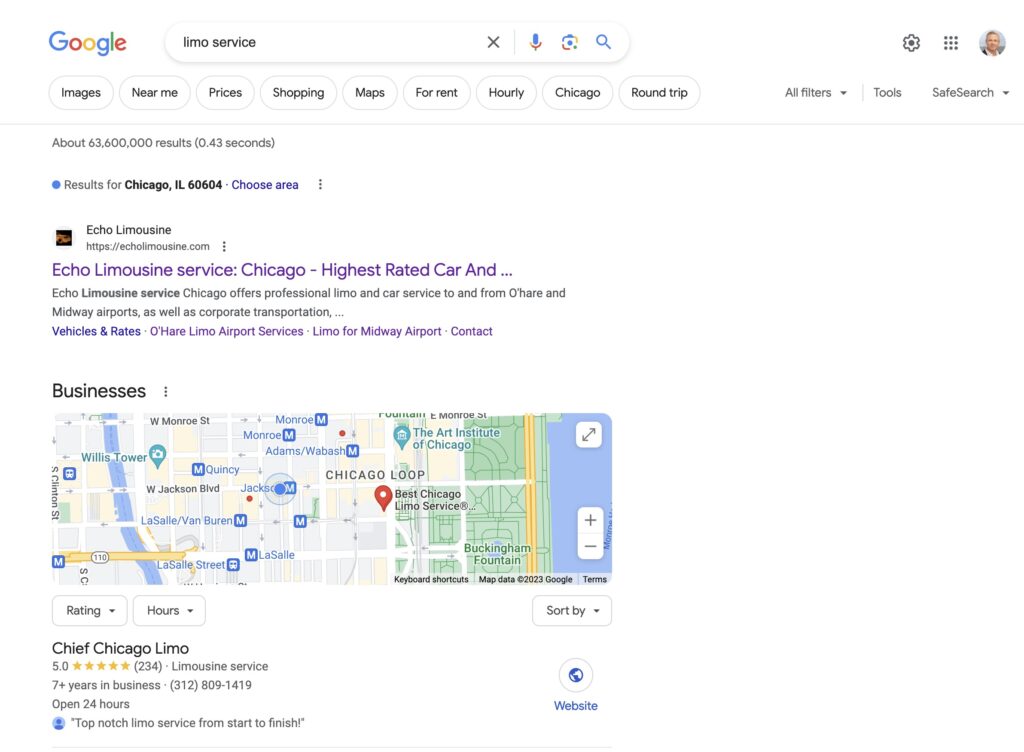
    google ads 2023

    Digital marketers and Google still have much to learn about user behavior on the SGE results page.

    It’s safe to say that, presented with the above and the typical attention span of the search engine user, the organic results will not get the clicks. And the ads may seem like the most useful part of the page.

    The Rise of Google’s Ad Empire

    Back in the early 2000s, Google ad placements were a speck on the vast landscape of organic search results. Today, as we see above, they’re monolithic.

    The History of Google Ads

    When I first ventured online in the late ’90s, online ads were the equivalent of newspaper ads. They were giant banners with obvious messaging that as much as screamed, “I’m an ad!”

    Google, starting with “Premium Sponsorship,” over the years made their ads more and more subtle, ultimately looking like native content.

    This graphic from Ginny Marvin in her Search Engine Land article A visual history of Google ad labeling in search results tells a pretty good story of how what was originally an obvious ad has become increasingly subtle over time.
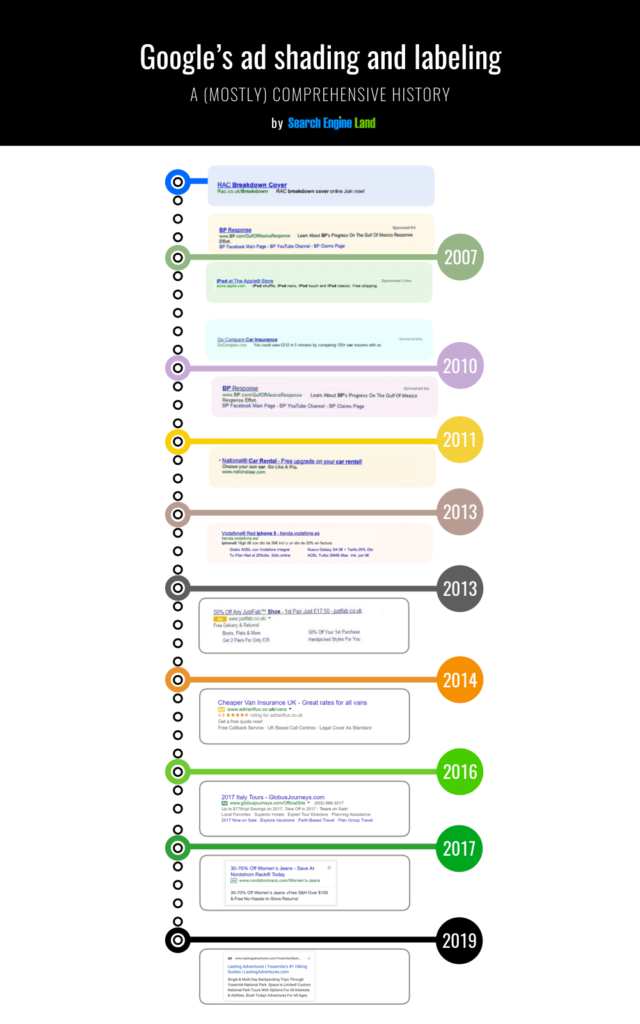
    google ads 2023

    It’s compelling to remember back to a time when ads were so obvious they were highlighted. It’s almost as if the original user interface engineers wanted to make sure you knew it was an ad.

    The graphic is a couple of years old and doesn’t account for the more visual ad types like product ads. In the case of product ads and some local service ads, they’re indiscernible from organic content.

    Follow the Money

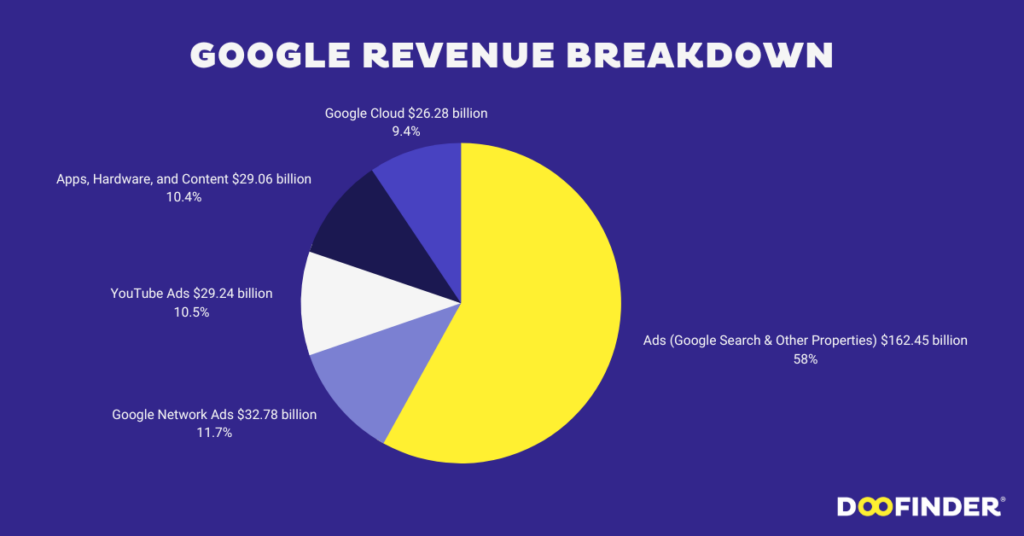
    As this chart from Doofinder, an e-commerce site search provider, shows, ads are the most significant part of Google’s revenue.
    google ads 2023

    Yes, Facebook, Amazon, and TikTok all take their share of the digital advertising market, but Google is still far and wide the leader with the most to lose.

    Why Is Google Doing This? Is This Ethical?

    On socials, there’s argument over whether Google should be regulated or if they’re entitled to do whatever they want.

    The argument goes, “They’re a public for-profit corporation, they can do as they please.” But can they? As the monopoly provider of access to business information, they have become a de-facto public utility.

    In the 1990s, the telephone companies were forced to give up their listing data to competitive phone books, and in the early 2000s, Microsoft was sued for antitrust violations and made two separate parts of their business.

    Is it crazy to think that when Google becomes self-serving (sometimes through aggressive — perhaps “unfair” competition), they should be regulated?

    What are some reasons Google would be taking this approach?

    1. Greed: It’s their search engine, and they can do what they want. The free listings aren’t paying anything, and they’re seeing benefits from inclusion.
    2. Spam: AI content is flooding the internet (not throwing stones, by the way.) Google has recently had issues indexing all the content.
    3. Resources: Indexing is hard. Even excluding spam, the rate of content production from “reputable” publishers is accelerating.
    4. Reality: The search engine results pages are getting pretty crappy. For most searches, authority sites dominate, whether or not they are niche-relevant. Some at Google might argue they at least have validation, by payment, of the trustworthiness of their advertisers.

    The European Union has started to regulate big tech, but the U.S. is not there yet. Arguably, the effect of regulation in the EU is a drop in the bucket compared to the valuations of Google, Facebook, and Amazon.

    We May Be on Our Way to a Pay-to-Play Google

    Until and unless Google reverts the SERP, we may have to buy back our hard-earned ranking for non-local searches.

    As an agency and a business owner, this is frustrating. We will have to watch the evolving SERP to understand the ratio between paid and organic search needs to maintain and grow the number of leads we’ve been accustomed to.

    I know that organic SEO will continue to deliver leads and value. While we wait to see the final form of the Google SERP, we should be focused on two strategies:

    1. Suck it up and buy our previously high-converting keywords.
    2. Continue developing content.
      • Long-tail content where there are fewer ads.
      • Alternative channels: YouTube, Social Media, etc. — the good news on this front is it doesn’t have to be new and unique but just repackaged for the medium.

    We would love to hear your thoughts. Are you seeing the same thing? Is it time to break up Alphabet? What else should we be looking for?

    Postscript – Google Ads 2023 Before & After Pics

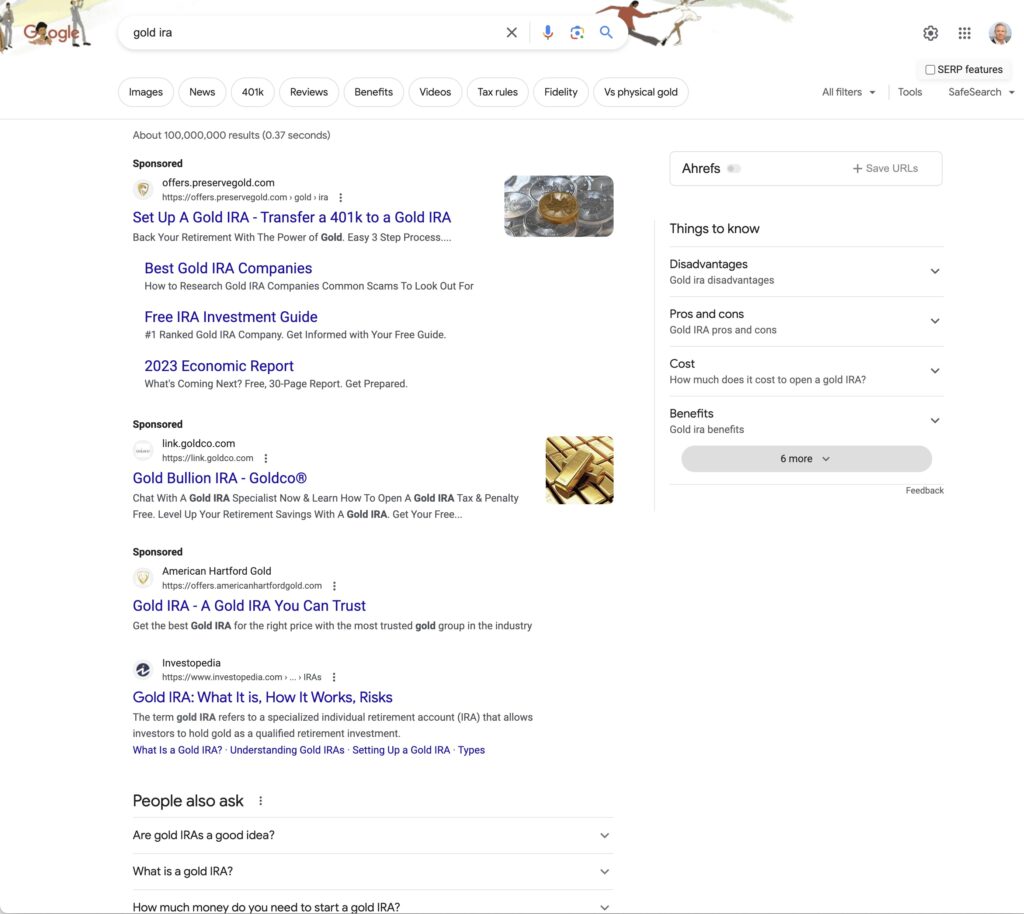
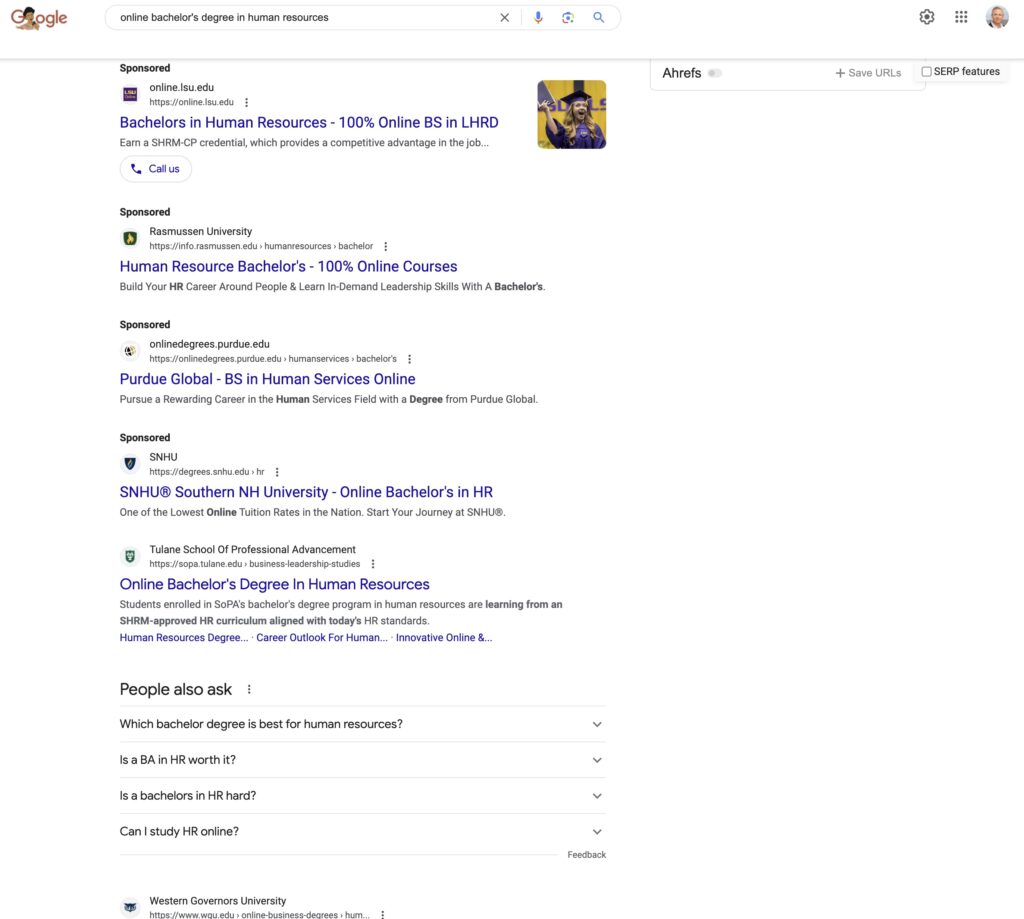
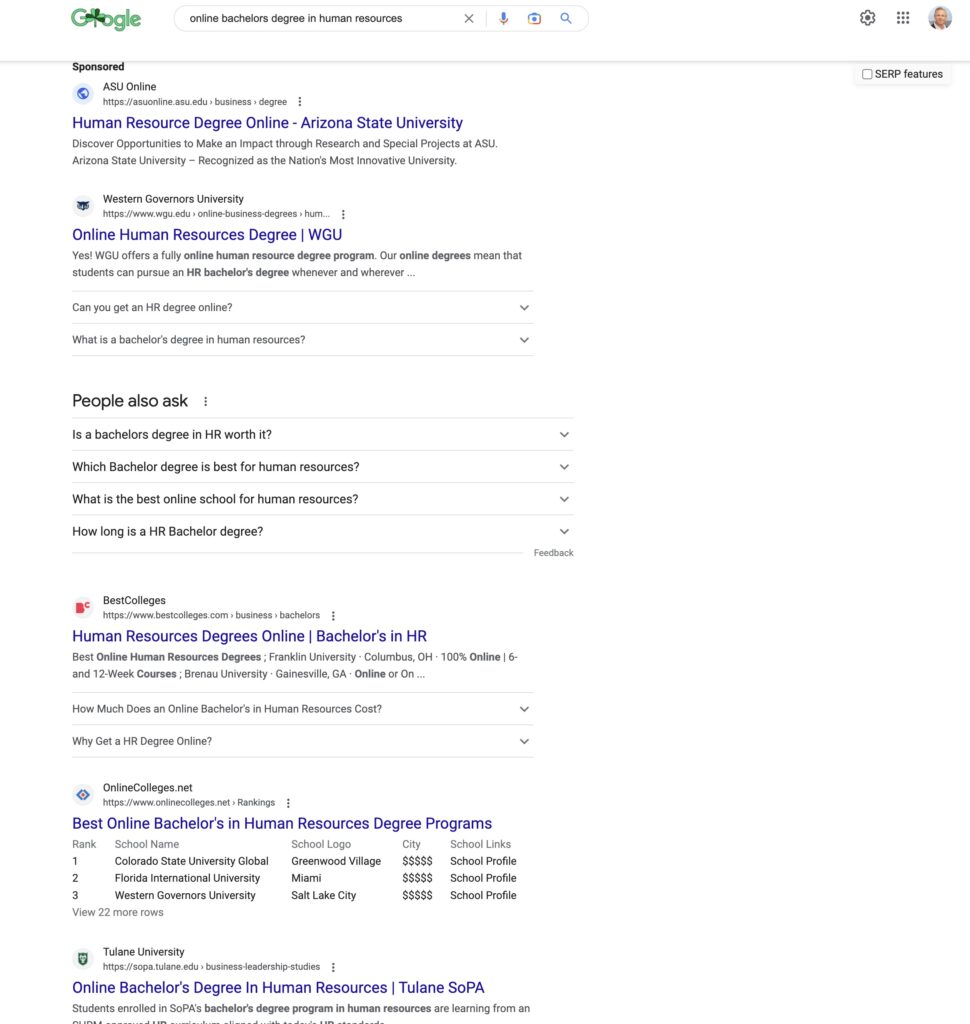
    I was asked to provide some screenshots of the new fat ads pack by our marketing associate and had surprisingly few SERP screenshots. The two below show the extreme nature of the Google Ads 2023 SERP smackdown.

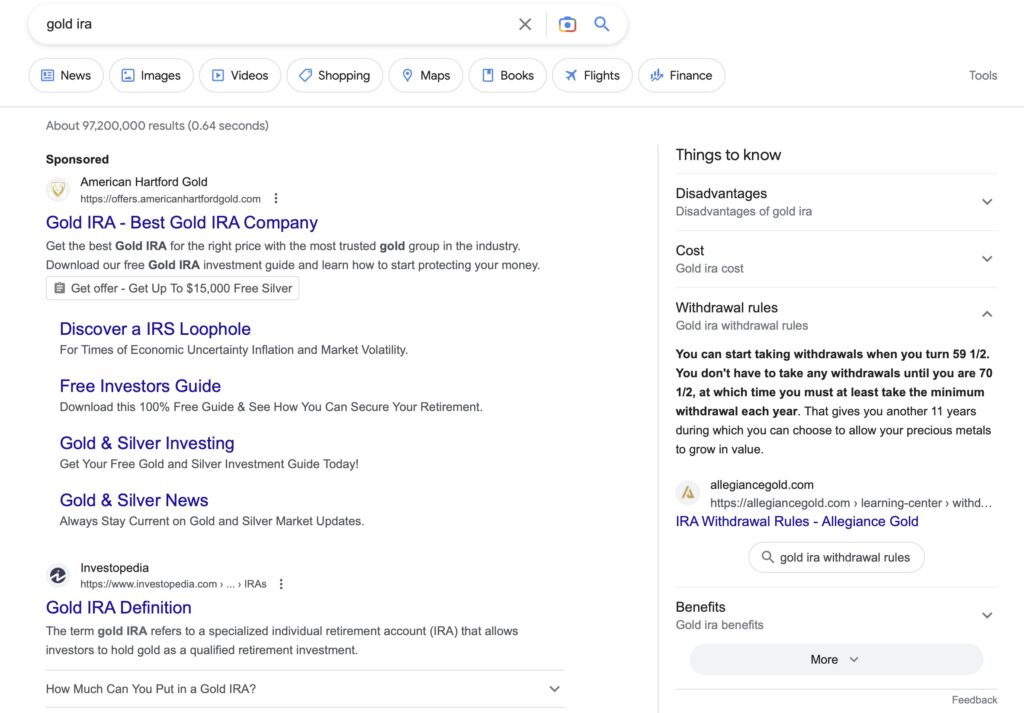
    Gold IRA Today
    google ads 2023

    Gold IRA April 2023

    google ads 2023

    Online Bachelor’s Degree in Human Resources Today
    google ads 2023

    Online Bachelor’s Degree in Human Resources March 2023
    google ads 2023

    Additional References

    Everything wrong with Google in one competitive result – Cyrus Shepard
    How Search Generative Experience works and why retrieval-augmented generation is our future – Mike King
  • Beyond the Hype: Is Geofencing the Right Strategy for Your Brand?

    Key Insights

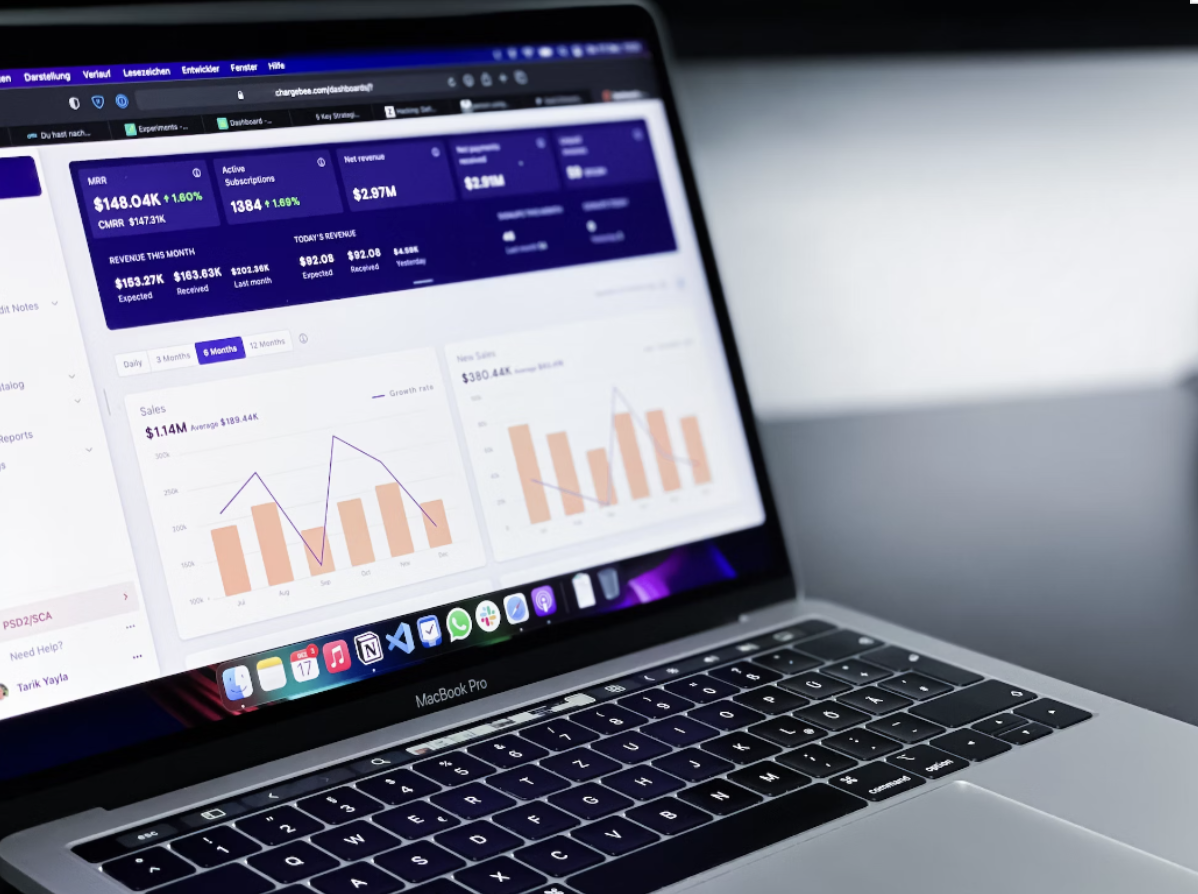
    • While geofencing offers the unique advantage of targeting potential customers within a specific geographic range, it doesn’t guarantee ROI.
    • Geofencing holds the potential to drive impactful results by targeting specific geographic locations, but its effectiveness varies based on a brand’s goals and audience.
    • Geofencing is a potent tool that works best in conjunction with a broader marketing strategy — a strategy that incorporates multiple forms of online advertising and keeps the audience at the center.

    Marketers around the globe are touting geofencing as the new golden child of online advertising.

    While geofencing’s ability to target potential customers in a specific geographic radius makes it a worthwhile tool, it’s not a magic wand you can use to guarantee ROI.

    The strategy behind its use is more important than any tool.

    Targeting the right audience is the most critical tactic to pursue, whether that includes geofencing or traditional PPC ads.

    In this blog post, we will go beyond the hype and help you determine when to use geofencing ads.

    Geofencing Strategy

    How Do Geofencing Ad Campaigns Work?

    Patented in 1995 by American inventor Michael Dimino, geofencing allows businesses to advertise directly to mobile users within a targeted geographic radius.

    Since then, the success of geofencing has become evident. 95% of companies worldwide use some variation of geofence marketing in their online advertising campaigns.

    The power of geofencing is its ability to engage potential customers based on their location in real time — offering marketers a highly targeted advertising approach.

    This is advanced, exciting stuff!

    The nitty-gritty of how it works is even more interesting.

    Geofencing ads use GPS, Wi-Fi, and cellular data to determine a user’s location — all with varying levels of accuracy.

    Marketers use software to set up geofenced areas, ranging from broad (a neighborhood) to very specific (inside a store).

    When a user crosses a geofenced area, they trigger specific actions, such as being sent a push notification, text message, or an ad within an app. These conversion opportunities all have the potential to turn a prospect into a customer.

    Geofencing Example

    Say you’re a local pizza shop in Downtown NOLA trying to attract more customers on a Saints football Sunday.

    While people might not have traveled Downtown to grab a quick slice from your shop, they will undoubtedly be hungry after the game.

    You can use geofencing ads to target the area outside the Superdome. Once the user steps outside the Dome, they will be targeted with ads about your delicious za only being a 10-minute walk away.

    In scenarios like this, geofencing should be your go-to digital advertising strategy — like pizza is your go-to meal after the big game.

    The Benefits of Geofencing Ad Campaigns

    Geofencing ads offer many unique benefits that marketers can utilize as part of a broader digital marketing campaign, including:

    • Hyper-Localized Targeting: Allows businesses to target customers within a particular geographic area, even as precisely as a single building.
    • Real-Time Engagement: Provides the ability to engage consumers as they enter, leave, or linger in the geofenced area, offering timely and relevant promotions or messages.
    • Increased Foot Traffic: Drives customers to physical locations, such as retail stores or events.
    • Contextual Relevance: Brands can create highly relevant and contextual promotions, deals, or alerts based on a user’s location.
    • Personalization: The ability to tailor messages to individual user behavior, enhancing the user experience and increasing the likelihood of engagement.
    • Improved Data Collection: Geofencing allows businesses to collect valuable data on consumer behavior, such as how often they visit a location. Pro tip: Use this data for your future targeting and strategy.
    • Highly Measurable: Provides in-depth analytics to measure campaign effectiveness, including visit frequency, dwell time, and conversion rates.

    At this point, you might be thinking, “Wow! Geofencing ads cover all the bases necessary for a successful digital marketing campaign. Why would I use anything else?”

    While your excitement is warranted, it’s still important to remember that the digital marketing world is home to many valuable types of ads.

    Let’s learn about them and see how they compare to geofencing ads.

    Comparing Geofencing Ads vs. Typical Display Targeting vs. “Traditional” PPC/Paid Search Ads

    Online advertisement variations are tools. No one type of ad is better than another because they each serve a unique purpose.

    In the same way sandals are better for a beach day, and tennis shoes are better for a jog — each shoe has its specific use. Your ability to choose the right one is what optimizes your experience.

    Not one is better than the other — they’re just different.

    How they differ in their approach

    • Geofencing Ads: Most often used in display ad targeting, geofencing ads focus on a specific geographic location, targeting users within a particular area to drive actions like store visits, event attendance, or online conversions.
    • Typical Display Ad Targeting: Operates on a broader scale, focusing on demographics, interests, and behaviors to reach a broad but relevant audience.
    • Traditional PPC/Paid Search Ads: Focus on search intent or behavior-based angles, aiming to capture users already interested in a service, product, or topic.

    How they differ in their reach

    • Geofencing Ads: Limited to a specific geographic area or individual locations, such as a single building or street. The audience is inherently localized.
    • Typical Display Ad Targeting: Designed for flexibility, these ads can be cast wide or narrowed down based on various factors like demographics, interests, and behaviors. While they can target specific locations, they are not restricted by it, giving advertisers the freedom to reach audiences across regions, countries, or even continents.
    • Traditional PPC/Paid Search Ads: Have the potential for a broader, even global reach, depending on campaign settings.

    How their overall goals differ

    • Geofencing Ads: Primarily aim to drive real-world actions, such as increasing foot traffic to a physical location, engaging attendees at an event, or capturing consumers near a competitor’s site (geo-conquesting).
    • Typical Display Ad Targeting: These ads balance raising brand awareness and prompting specific user actions. While they can drive real-world interactions, their strength lies in reaching users across various digital touchpoints, aiming to increase brand visibility and online engagement.
    • Traditional PPC/Paid Search Ads: Typically aim to drive online actions, such as website visits, form submissions, or online sales, although you can also use them for local business promotion.

    Most Successful Geofencing Targets

    Geofencing ads work best in a largely populated city or when your brand has many locations or has a lot of foot traffic (such as a pizza shop with multiple locations in a city’s business district).

    This is where geofencing ads shine because you can use them to capture potential customers near your business location — even if unintentionally.

    Some examples of popular places to target using geofencing ads include:

    • Airports
    • Near competitor locations
    • Near schools for child-friendly activities (like visiting the zoo)
    • Near events (sporting events, concerts, business seminars)
    • Near universities

    The powers of geofencing are also best used when your other targeting options are limited.

    For example, Facebook has policies so you cannot target people based on housing. This has made it difficult for real estate companies and housing communities to target users on the platform. To mitigate these limitations, you can run geofencing display campaigns around competitors to help reach this audience.

    Limitations and Challenges of Geofencing Ad Campaigns

    While geofencing can be highly effective, it might not always be the best move for your business.

    Limitations and challenges of geofencing ads include:

    • Accuracy and Precision: While GPS technology is generally accurate, it’s not perfect. Buildings, lousy weather, and other physical obstructions can affect the accuracy of location data.
    • Privacy Concerns: Collecting and using location-based data raises concerns about user privacy. Brands need to be transparent and comply with data protection regulations.
    • User Opt-in Required: For geofencing to work, users must opt-in to location services for the particular app pushing the ad. This limits the pool of potential recipients.
    • Limited Reach: Geofencing is a hyper-local strategy targeting users within a defined geographic area. This can limit businesses with a more diverse or widespread audience.
    • Platform and Device Limitations: Not all devices support geofencing, and there may be variability in how different mobile operating systems interact with geofencing technology.
    • Scalability: While geofencing can be effective for local campaigns, it may not be easily scalable for national or global marketing initiatives.

    All expert marketers know the key to a successful campaign is targeting the right audience, not just the nearest audience. Your best customers could live on the other side of town.

    It would be a waste to lose out on those potential sales, right?

    The Importance of Audience Analysis

    In any online advertising campaign, the need for audience analysis is paramount to success.

    Creating a target based on audience behavior, needs, or preferences allows you to build a more personalized and effective strategy than focusing only on where your audience is located.

    When you only use geofencing ads, you’re actually doing the ads themselves a disservice.

    Geofencing ads are a team player — they work best when woven into a broader marketing strategy that keeps the audience at the center.

    Geofencing Strategy

    Integrating Geofencing into a Broader Marketing Strategy

    In today’s marketing landscape, brands need more than just a single tactic to make a lasting impact. Geofencing, while powerful, is just one tool in a marketer’s arsenal. To truly resonate with audiences and cultivate memorable brand experiences, it’s crucial to weave geofencing into a holistic marketing approach.

    Here are some strategies to consider when integrating geofencing into your overarching marketing blueprint:

    • Multi-Channel Synergy: Utilize geofencing as a complementary tactic alongside other display targeting, as well as other marketing channels like social media, email, and paid search, to create a seamless brand experience.
    • Consumer Journey Mapping: Integrate geofencing touchpoints into your overall consumer journey map to ensure that you’re reaching people at the right time and place.
    • Timing and Frequency: Align the timing of your geofencing ads with other marketing campaigns to maximize their impact.

    An example of geofencing integration in a broader marketing strategy

    When skilled marketing professionals use different variations of online advertising in tandem, the result is a return on investment for clients.

    Search Influence recently integrated a geofencing campaign with a Facebook ads campaign for our longtime higher education marketing collaborator Tulane SoPA’s Fall 2023 Grad Fair.

    To help boost enrollment in Tulane SoPA’s graduate programs, we put a geofence around other undergrad schools in hopes of capturing interesting students who might want to go to grad school once they finish undergrad.

    Once people became aware of the programs via the geofence campaign, we utilized Facebook event ads to get them to respond whether or not they were interested in attending the Fall Grad Fair.

    After this, we created a Facebook conversion campaign to remarket to those who responded to the event ads.

    Geofencing Ad Campaigns FAQs

    What’s the difference between geofencing and geotargeting?

    Geofencing involves setting up virtual boundaries around a specific location, allowing marketers to target users when they enter, exit, or spend time within these boundaries.

    Geotargeting refers to delivering content or ads to users based on broader geographical locations, like cities, regions, or countries, often leveraging criteria like user preferences, demographics, or search behavior in tandem with their location.

    Is there a minimum or maximum area that can be geofenced?

    Geofencing can be incredibly precise, targeting areas as small as a specific building or street. However, the exact minimum or maximum area can vary based on the platform or service provider used. Typically, there’s no strict maximum limit.

    How quickly can I see results from my geofencing ad campaign?

    The immediacy of results from a geofencing ad campaign largely depends on the targeted location’s foot traffic and the campaign’s specific objectives. You can observe interactions within hours of launching for areas with high foot traffic. However, it might take days or weeks to gauge significant results for campaigns with long-term goals or in less frequented areas.

    No matter how long it takes, the data shows you will likely see results. According to the U.S. Data Corporation, 53% of shoppers visited a retailer after receiving a location-based message.

    How do device permissions and location settings impact geofencing effectiveness?

    Geofencing heavily relies on users’ device location services. If a user has turned off location permissions for a specific app or their device in general, geofencing campaigns targeting them will be ineffective.

    What platforms or tools are best for setting up and monitoring geofencing campaigns?

    Several platforms excel in geofencing capabilities, with popular choices including Google Ads, Facebook Ads Manager, and dedicated platforms like GroundTruth or Simpli.fi. These platforms facilitate the setup of geofenced areas and provide robust analytics to monitor campaign performance in real time.

    Focus on the Best Return, Above All Else

    At Search Influence, we have the industry expertise to support you in reaching your online advertising goals. Our experience has helped clients from a multitude of industries reach their desired audience.

    Whether through geofencing, display targeting, or paid search, we will partner with you to build an all-encompassing digital ads strategy that delivers a return on your investment.

    If you’re ready to learn if geofencing ads are a good fit for your digital marketing strategy, contact our expert team to get started.


    Image sources:

    1. https://images.unsplash.com/photo-1608222351212-18fe0ec7b13b?auto=format&fit=crop&q=80&w=1974&ixlib=rb-4.0.3&ixid=M3wxMjA3fDB8MHxwaG90by1wYWdlfHx8fGVufDB8fHx8fA%3D%3D
    2. https://images.unsplash.com/photo-1570101945621-945409a6370f?auto=format&fit=crop&q=80&w=2070&ixlib=rb-4.0.3&ixid=M3wxMjA3fDB8MHxwaG90by1wYWdlfHx8fGVufDB8fHx8fA%3D%3D
  • Search Influence Finds a 4-Leaf Clover with 4 New Team Members!

    Search Influence finds a four-leaf clover with four new team members. Let’s meet our newest Influencers!

    Becca Michelet, New HireBecca Michelet Account Manager
    Born in Honduras, Becca and her twin were adopted and raised in New Orleans, with their adopted (honorary) triplet, by two awesome parents. She graduated from Louisiana State University with a bachelor’s degree in Fashion Merchandising, and a minor in Business. Becca brings a wealth of experience in customer service to her new role. When she’s not working on her client’s campaigns, you can find her snuggling with her dogs, Pepperoni & Roux, spoiling her nephews, cycling on her bike, or catching happy hour with her friends and family.

    Tyla Maiden, New Hire

    Tyla Maiden Account Coordinator
    Moving to New Orleans in 2019 after graduating from Radford University, Tyla jumped right into her digital marketing career as a Social Media Manager for a local small business obtaining her Digital Marketing certification from Generation USA. Outside of Search Influence, Tyla is an accomplished freelance artist, painting murals and other art projects around the city.

    Gi Levet, New HireGi Levet Account Manager
    A Louisiana native, Gi graduated with a bachelor’s degree in Organizational Communication from Southeastern Louisiana University and is currently on schedule to graduate with a Master’s degree in Strategic Communication in May 2023. Gi brings to the team an extensive background in social media and small business marketing. When she’s not working with her clients, you can find her spending time with her dog, Beans, traveling with her boyfriend, Josh, or checking out the newest true crime documentary.

    Mikayla Hammer Technical Digital Marketing AssociateMikayla Hammer, New Hire
    Originally from North Carolina, Mikayla has lived in Louisiana for the last 5 years with her husband and 3 children. Mikayla brings a diverse range of experience to her new role from service industry manager to graphic t-shirt business owner to being a stay-at-home mom. Outside of work, you can find Mikayla reading, gardening, or interior designing.

    Welcome to Search Influence, Becca, Tyla, Gi, and Mikayla!

    Interested in joining our team? Check out our open positions!

  • How a User Experience Audit Benefits Your Business

    Key Insights

    • Website user experience audits help businesses retain users and increase conversions.
    • If you understand the data behind user behavior, you can anticipate a user’s needs when designing and optimizing your website.
    • Examine trust factors, content considerations, and device usage when completing an audit.

    Woman typing on laptop computer and media app icons

    What Is a User Experience Audit?

    A user experience audit, or UX audit, is the process of reviewing a website for areas of usability improvement. There’s no one way to complete an audit because each one depends on the type of products or services offered and data analysis of user types and behaviors. It’s important to keep in mind a few key questions when completing a UX audit:

    • How does user experience impact conversions?
    • Are there usability issues, design issues, or both?
    • Should you consider your business initiatives when performing a UX audit?

    In this post, we’ll cover the questions above, along with the impacts of trust factors, content, and device usage in order to retain visitors and improve conversions.

    User Experience’s Impact on Conversions

    Imagine visiting a website to purchase shoes but find that you can’t add the item to your cart. You could refresh the page or revisit the site at another time, but many people will just visit other websites in search of the same shoe.

    If you’re the business of the original website, you’ve just lost out on a conversion—and likely more than one. Ensuring that your site supports users’ interactions without interruption is vital in retaining users and ensuring they convert.

    Usability Issues

    A site might seem functional, but it could lack the design necessary to increase user interaction and conversions. A ResearchGate study attributes 94% of a user’s first impressions of a site to its design. A poorly designed site could make all the difference in a user staying on the site or leaving with little to no engagement.

    Consider Business Initiatives When Performing a UX Audit

    Each business will have its own specific business initiatives that they want to achieve, such as raising awareness of their brand, increasing user engagement, or improving their ROI. Those initiatives can drive how to look for improvements to a user’s experience when completing a UX audit.

    Graphic of speech bubbles in multiple colors

    The Value of Trust

    Include trust factors on your site to establish credibility with your users. Trust factors are indicators on your site that can help users feel more assured in using your services or buying your products, such as testimonials, awards, and certifications.

    Content accuracy and quality can also impact a user’s trust. Issues such as incorrect grammar or inconsistent contact information help users to decide whether your business has credibility.

    Content Considerations

    A site with lots of pretty pictures won’t cut it. Written content plays a crucial role in determining user engagement. Site language should compel the user to stay on the site and learn more about the products or services offered.

    According to Small Business Trends, 70% of small businesses don’t use calls to action on their site. When a user visits a website, they expect some sort of direction in order to convert. If all they see are images but no clear and obvious path to purchasing a product or service, they likely won’t comb over the site to find out where to complete the purchase. Having clear and specific calls to action is imperative for driving conversions on your site.

    Why Device Type Matters

    Examining how users engage on your site helps you understand how to design for devices that best work for your users. In recent years, mobile device usage has grown over desktop usage. In the span of a single year, mobile usage went up by 10%, while desktop dropped by 6%.

    Several factors impact device usage, so it’s important to understand the data behind user visits and behavior on your site. Do more users visit your site on mobile versus desktop? If so, you should design your site in a way that lends itself to a better user experience on mobile.

    As you can see, UX audits are important for ensuring your site is designed in a way that is suitable to a user’s needs. Incorporating trust factors, understanding user behavior, and captivating content are necessary for a business’s success. By executing these concepts, you can increase visitor retention and engagement, thus increasing your conversions.

    Ready to grow your business with a UX audit today? If so, contact our team for a free consultation!

  • Hot or Not: Content Trends Pre- and Post-COVID-19

    Key Insights

    • Business owners shouldn’t let the uncertainty of COVID-19 discourage them from marketing.
    • An empathetic brand tone is important.
    • As people stay at home, online user engagement has increased and brands are being more heavily scrutinized for mistakes than ever before. This creates an opportunity to reach users more effectively, but with a lower margin of error.

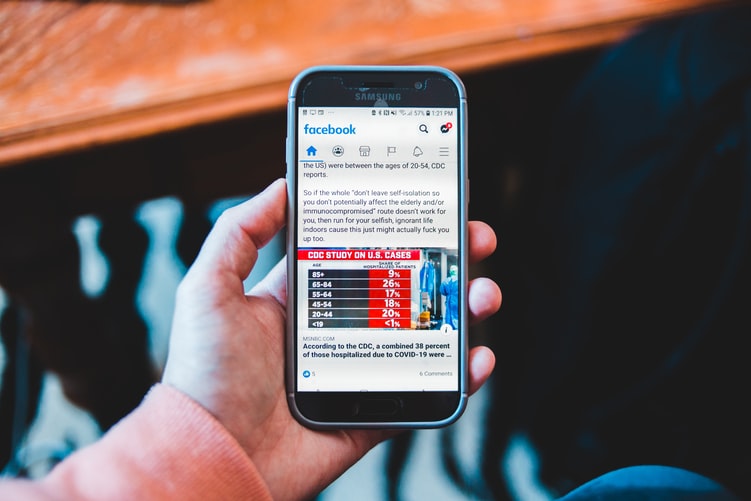
    Person holding mobile device looking at Facebook news feed

    Introduction

    Navigating the harsh reality of changing phases, mandatory closures, and reduced capacity during COVID-19 has left many business owners feeling overwhelmed and uncertain about the future. With frequent changes affecting businesses everywhere, customer communication is more important than ever.

    In this blog, I will unpack four evergreen content trends to determine if they’re ideal for communicating messages in a post-COVID-19 world. Some of this insight was derived from a SEMPDX presentation by Search Influence CEO Will Scott.

    Conversational Content: HOT

    Conversational content is—without a doubt—HOT. With the constant change of information since mid-March of this year, you should keep open communication with target audiences.

    Conversational content is informal and encourages the user to initiate communication directly with a brand or company. Examples of this include a live chat on your website or hosting a webinar with live Q&A. Even before COVID-19, users looked for more human engagement; but months of isolation have created a greater yearning for connections of any kind. In regard to marketing, this need is evident in the increase in the number of B2B webinars during the early months of isolation. Comparing March to January 2020, the number of B2B Webinars increased by almost 50%.

    In the Guide to Conversational Marketing, CEO Jitendra Gidwani explains: “The idea that you can build lasting customer relationships through quality conversation over time isn’t just anecdotal conjecture. Feeling as if they are genuinely heard is the single most likely thing to keep customers devoted to a brand.” Learn more about how to communicate with your customers by reviewing our guide to business continuity messaging during COVID-19.

    Influencer Marketing: HOT

    Influencer marketing is HOT. A post-COVID-19 world doesn’t seem like the ideal market for a social media influencer…or is it? Increased engagement combined with lower prices will result in maximum return in your marketing investment.

    Influencer marketers have large social media followings and are able to effectively convey their experience to followers and promote different products or services by simply using them and posting about it. The brand or company featured typically pays a fee, which varies depending on the size of the Influencer’s following.

    Engagement with Influencer content has surged because of increased screen time in 2020. Research from Later.com shows that the average screen time is up to 5h40m per day, an 18% increase from weeks prior to COVID-19 stay-at-home orders. Followers are paying attention in this new era of content creation, with nearly 80% of influencers reporting higher engagement from their followers.

    In addition to increased user engagement, another perk of Influencer marketing in the current climate is reduced prices. According to Business Insider, sponsored deal drop-offs have devastated travel, dining, and event-based creators whose content depends on the ability to leave their homes. Some have responded by lowering their rates. In a survey sent to over 500 Influencers, it showed that over 40% are currently reducing their normal rates, and the reductions average at 30%.

    Your business could collaborate with an Influencer by asking them to promote the re-opening of a business, and if applicable, demonstrate their individual social distancing and COVID-19 procedures!

    User Generated Content: HOT

    Content created by users is always HOT, not only because it’s free, but also because it’s honest. Why not let your users kick-start your content process?

    User generated content (UGC) is indicative of its name; it’s content created by customers that features and/or promotes a brand/product. Keep in mind: it’s not all about ratings and reviews. If you’re on the lookout for brand mentions, even of adjacent topics, UGC can be a great source for your own content machine.

    Oysters XO has the ultimate UGC success story. Oysters XO provides an innovative oyster-shucking experience that adds a lively, interactive touch to luxury events of all kinds. As events everywhere were cancelled, they adapted to the new restrictions and started to offer a virtual experience, teaching users how to shuck fresh oysters in the comfort of their own homes. One satisfied customer decided to create a video testimonial to tell his followers about his amazing experience. The customer was Neil Patrick Harris…yeah, you read that correctly. The video he created, on his cell phone, will now help elevate the Oysters XO brand in a way that a high production advertisement never could because it is raw (no pun intended) and sincere. Check out the video below.

    High-Production Content: NOT

    High-production content is NOT HOT. Pre-pandemic, it was valuable for certain industries; however, now there’s less budgeted for bells and whistles, and more demand for empathetic content.

    High-production content includes any content created with a large production value, such as professionally produced videos or podcasts. As the world has adjusted to COVID-19 protocols, there has been a large increase in content created at home. Examples include television interviews on talk shows like “Live With Kelly and Ryan” being conducted virtually and musicians hosting concerts from their homes on Instagram and Facebook Live.

    Businesses everywhere have been affected financially by the mandatory closings and other COVID-19 restrictions. According to Ad Exchanger, brands leaning into faster, cheaper production may not return to the old way of doing things post-pandemic.

    For more information about adapting to the “new normal” of marketing, check out our “6 Messaging Adjustments to Remain Relevant During COVID-19.”

    Want to keep your business hot? One of our strategists can help adapt your marketing plan to keep in line with best practices during this ever-changing time. Contact a member of our team today.

    Images

    Mobile device

  • 6 Messaging Adjustments to Remain Relevant During COVID-19

    As digital marketers, a global crisis like COVID-19 (also known as the coronavirus) can affect all aspects of your digital campaigns, from advertising spend to messaging. The faster you can pivot, the better for your business and for your consumer.

    Although there isn’t a one-size-fits-all approach to handling each campaign or client, here are six key ground rules to follow to stay relevant in the midst of any crisis.

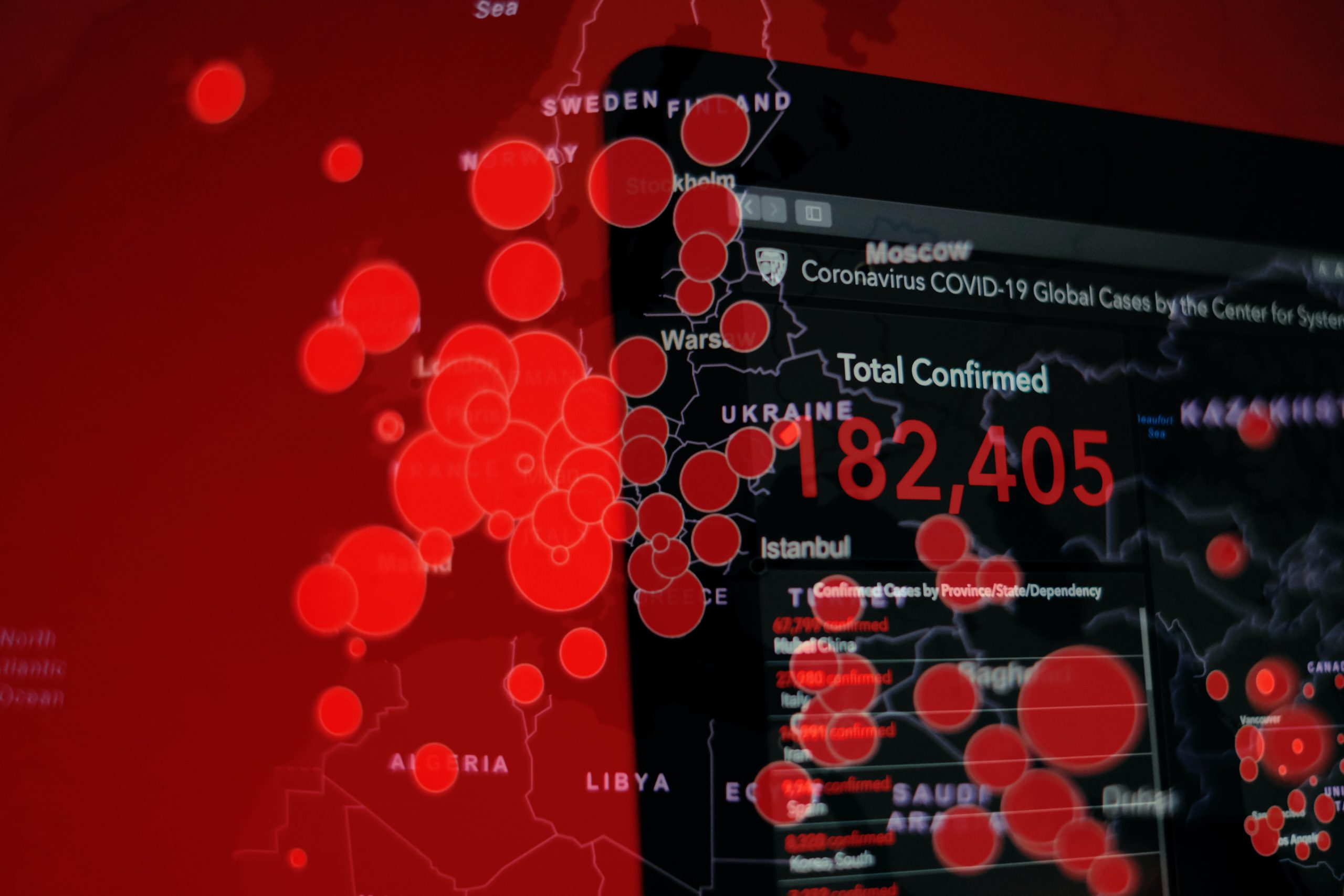
    Graphic showing growing cases of COVID-19

    Align with Local and Federal Agencies and Authorities

    Ensure your marketing aligns with federal and local mandates and encourages safe and approved behavior. Marketing messages out-of-step with government recommendations may come off as insensitive or even be interpreted as malicious.

    • Verify that your marketing campaigns do not call for behavior that puts your clients or potential customers at legal risk or in danger. If so, put a pause on that campaign until the crisis is over.
    • Sign up for alerts to stay up-to-date on all federal and local decisions, since circumstances change daily (and even hourly.) This will allow you to update your marketing to keep them timely.
    • Use local and federal officials as your guide as to when you can resume paused marketing efforts.

    Update Messaging for Closures

    During a crisis, it’s likely that some businesses will have to shut down or limit their operations.

    • Pause marketing that encourages any immediate action that they cannot task. For example, if you work in the museum, zoo, or tourism industries, preserve resources by pausing any marketing that encourages visits to your attractions.
    • If customers already purchased tickets to your attractions for specific dates, provide messaging about how you will honor those existing tickets on future dates.
    • Promote opening dates only when you have a clear picture of when your attractions can reopen.

    Review All Creative

    While maintaining business and bringing in revenue is important during difficult and uncertain times, make sure your marketing is in tune with the current climate.

    • Review all of your copy to ensure the tone reflects current sensitivities and realities.
    • Consider local context when rewriting copy. Are customers and audiences in your market more or less sensitive to the portrayal of a particular issue?
    • Scrutinize your visuals to ensure they reflect current sensitivities. As governments have instituted social distancing guidelines, pay careful attention to creative that depicts interactions such as hand shakes, hugs, and close groups.
    • Constantly reassess campaigns. What felt comfortable to say or portray two weeks ago may no longer feel appropriate.

    Promote Digital Consultations

    If you are a doctor, lawyer or in another progressional service, your customers may still need your expertise during COVID-19 and other crises, even if your offices remain closed to the public. If you are able to make the switch to digital consultations, focus your marketing on promoting these services.

    • Shift all marketing calls-to-action from “Schedule a Consultation” to “Schedule a Virtual Consultation.” Not only does this set the expectation of how and where you will fulfill your services, but it also indicates that you are abiding by all local and federal mandates.

    Maintain Awareness Through Virtual Content

    Stay engaged with your audience and maintain brand awareness by offering fun and/or useful online content. Your audience, especially caregivers of young children, are looking for ways to keep their children entertaining while still being safe.

    • Consider virtual tours If you are in the museum, zoo, or tourism industries.
    • Offer downloadable entertainment, such as coloring sheets, crossword puzzles, or at-home scavenger hunts.

    Consider Optics When It’s Time to Transition

    There will eventually be a light at the end of the tunnel. Make a plan to slowly transition back to your campaigns that were running before the crisis hit.

      • Review all of your campaigns before relaunching and be sure to add in any new, relevant information that might have to come to light during the crisis.
      • Refresh your creative messages to articulate the mood of the current climate, post crisis.

    Unsure where to begin? Take advantage of a free consulting session with one of our strategists today!

    Images

    Emergency pull

    COVID-19 Map

  • Trends in SEO: 2020 and Beyond

    The beginning of a new year marks a fresh start, new outlooks, and perhaps new approaches to a person’s conventional wisdom or habits. Digital marketing, though constantly evolving through the calendar year, is no different. As we begin to envision digital success in the new year, one important exercise is to evaluate where you have been and which trends you need to follow to stay ahead of the competition moving forward. Many of the topics we will discuss are not necessarily new information or revelations, but rather, the relative importance of them has increased and will continue to do so as search goes in a certain direction. With that out the way, let’s jump into the biggest trends that will impact SEO throughout 2020.

    Start Learning and Understanding Google’s BERT Update

    Announced in the latter half of last year, this announcement made waves in the search community due to the potential implications around how digital marketers perform keyword research and develop content. BERT, or Bidirectional Encoder Representations, originated as an open-source research project that aims to better understand the contextual relationship between words and how that tacit relationship may affect the meaning, or intent, of those words when used together. In plainer terms, it is a framework that tries to better understand natural language to deliver better search results rather than serving up more direct, literal word-for-word results.

    Bert from Sesame Street using a banana as a phone and saying hello?

    So, Why Does BERT Matter for Businesses?

    Google posted a blog on October 25th, 2019 announcing their reasoning behind introducing this new algorithmic feature. In his post Pandu Nayak, a Google Fellow and Vice President of Search at Google stated:

    “Particularly for longer, more conversational queries, or searches where prepositions like “for” and “to” matter a lot to the meaning, Search will be able to understand the context of the words in your query. You can search in a way that feels natural for you.”

    Essentially, Google is trying to deliver better results by understanding searcher intent rather than responding to an exact query. This has large implications for content because SEOs will now have to consider intent, or what customers are trying to find, rather than getting bogged down with the exact search value of a keyword string. That is not to say that keyword research does not serve a purpose; this type of research will be helpful to understand broad trends or high-level areas of the search funnel, but what businesses and digital marketers will need to better understand is what the searcher ultimately wants.

    The English language is chock-full of nuance, so this is really a move to try to get at the heart of that nuance. An example of that would be a query such as “how to play a stand up bass”—it is fairly apparent we are not talking about bipedal fish. Trying to better understand the relationship between words and why context matters when delivering search results is at the core of this BERT update. It bears mentioning that John Mueller from Google recently came out and reflected the idea that keyword research is not “dead,” but rather, diminishing in importance a bit:

    “There’s probably always gonna be a little bit of room for keyword research… And even if search engines are trying to understand more than just those words, showing specific words to users can make it a little bit easier for them to understand what your pages are about.”

    While it’s hard to trust Google when talking about these topics, it seems to me he’s implying there will still be value in optimizing towards general keywords with established search volume.

    This discussion leads nicely into another concern for digital marketers moving forward:

    Expansion of Voice Search

    This will be a much shorter section because, as it stands, most of the SEO recommendations made for voice search align with already established SEO trends applicable in normal search context. However, while there are not special SEO tactics needed for voice search, the level of adoption of this product is something to be mindful of because of—you guessed it—BERT!

    People tend to use more natural, longer-tail questions when using a voice-assistant device. A happy coincidence of generating content with BERT in mind is that it will inherently align with the intent of a lot of voice searches. This matters because, according to analytics firm Comscore, nearly half of the searches in 2020 will be done via a voice device.

    As we know, voice search typically serves up a single result that answers the query; in order for businesses to best position themselves for voice search, they will need to be mindful of both BERT and another large issue moving into 2020 and beyond:

    The Rise of Zero-Click Searches

    If you have used Google to find an answer to an inane question in the last few years, you have undoubtedly performed a zero-click search. It may be fairly obvious why these are called “zero-click searches,” but it’s important to understand why this is happening and the ways brands and businesses can work around a system that diminishes traffic to their website. The decline of clicks is likely the reality for the foreseeable future. As mobile and voice search grows, the need for Google to provide quick, relevant answers versus pushing you to a third-party site increases. The goal from there should be to figure out how to get your brand best positioned to be the answer that voice and mobile searchers are looking for.

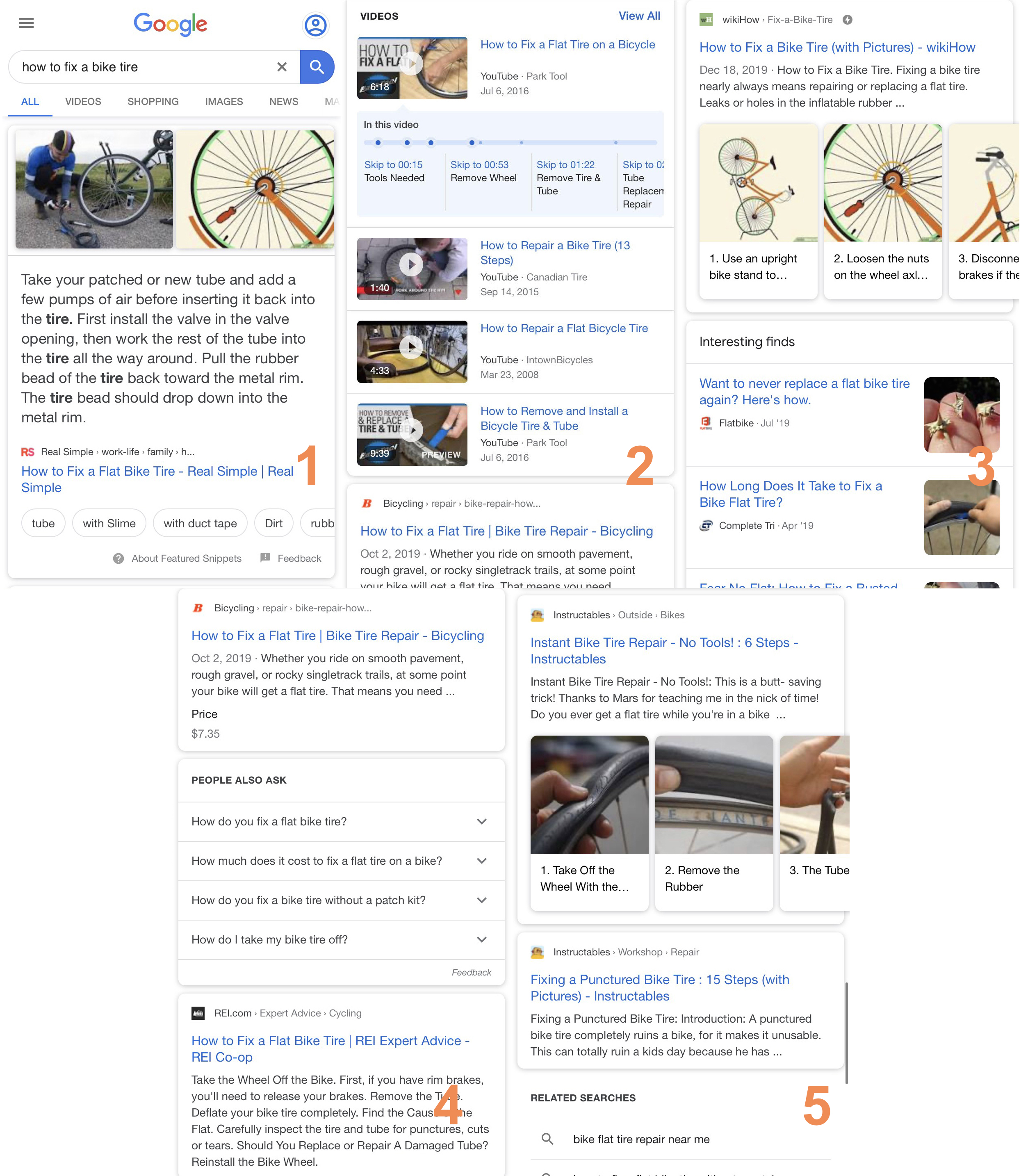
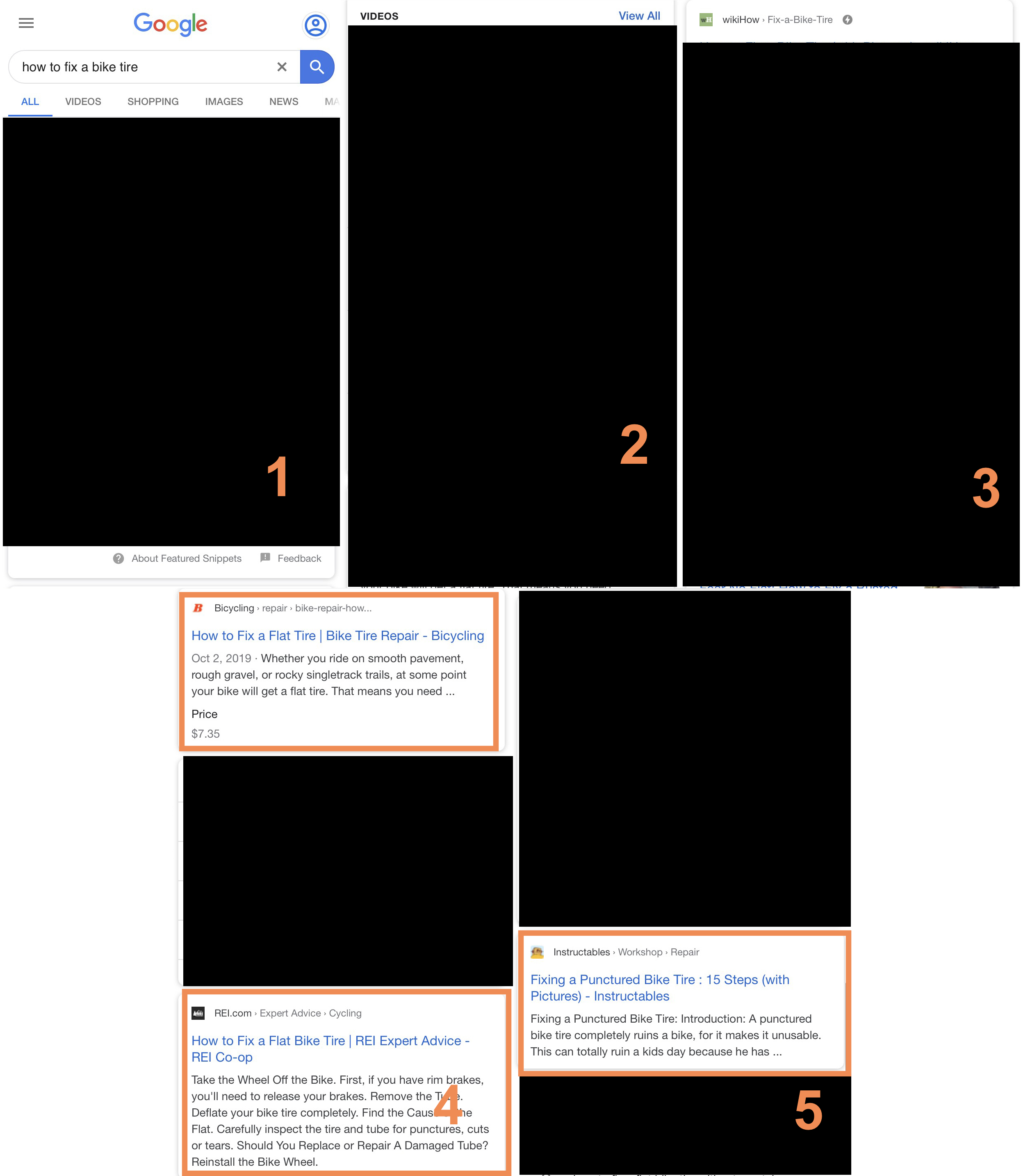
    As mobile search increasingly becomes the search method of choice for users, it’s helpful to visualize just how this impacts user behavior. Let’s take a basic question like “how to fix a bike tire.”

    Screenshot of mobile search on Google for Search Influence blog

    As you can see, there is competition amongst featured snippets, video content, and embedded images. While discussing this very topic at Local U Advanced in Denver, CO, Cindy Crum from MobileMoxie offered a really interesting visual way to see why zero clicks are becoming more and more important to deal with. If we block out anything that is not a traditional “organic result” in the SERP, you will see that other types of results occupy most real estate.

    Mobile search on Google with all non-organic results blacked out

    How to Combat Zero-Click Searches

    It may be time to stop thinking purely in terms of organic traffic. Much of SEO for businesses moving forward is about visibility. How can we position ourselves to be the brand that answers the questions our clients want to know? This is why content will continue to be the backbone of any SEO strategy. Doing proper research into the questions, queries, or searches that align with your business goals and striving to be the authority in your industry is the best way to ensure you remain competitive—and visible—in a landscape that does not necessarily reward good content with clicks.

    In shorter terms, you really want to try to be the featured snippet. This is an extremely difficult task as we know there is a high barrier to entry and it takes content tweaks, patience, and a strong will to see it through to grab snippets. Good content research includes finding the least competitive snippets and prioritizing those over a more competitive, higher level search. Doing simple keyword research is not enough nowadays. Moving forward, thinking about how these searches propagate results is equally as important.

    Google Maps: The New Home for Local Search?

    When people think of search, the Google homepage with the requisite search box is likely most people’s first mental image. However, for businesses moving forward, there should be an increased focus on how the Google My Business/Google Maps product is influencing and driving local search.

    Another big takeaway from the Local U Advanced conference is the volume at which users are going directly to Google Maps to find local businesses. According to the data from industry thought leader David Mihm’s presentation, from March of 2018 to August of 2019, 72% of all impressions on search were on Google Maps as opposed to Google Search (the traditional SERP). This is a huge discrepancy, and one of the big takeaways is that businesses are not leveraging Google My Business as much as they should.

    In order to be competitive in rankings in Maps, it is important to breathe as much life and information into your listing as possible. This includes driving reviews and optimizing descriptions, including appointment links, booking platforms, a healthy number of photos and videos, answering questions, and, finally, ensuring you are engaging with reviews. While proximity to a location plays a huge role in how the Maps listings are displayed, if you are actively managing your profile, the chances are that you will see some benefit.

    Also, consider how public-facing this listing is. If it looks sloppy, incomplete, or utilizes blurry images, users might be less engaged and less inclined to click through to your listing. While this seems relatively simple, many businesses fail to leverage this product—or even use it at all.

    Design Your Site for Mobile First. Always.

    This is not new for 2020, or even 2019 for that matter, but that does not minimize the importance of designing your site to perform well on mobile. Back in late 2018, the SEO community started talking about mobile-first indexing, and this was a major shift in the way search engine crawlers—and Google—understood and indexed your site.

    In response to Internet searches becoming an increasingly mobile experience, Google decided to push developers and business owners in that direction by making the mobile version of the site the version that is indexed in Google. In other words, Google crawls the mobile version of your site and makes determinations about its health on that basis. Web development is often thought about in terms of desktop computers, but it is becoming increasingly the case that your mobile version is at least, if not more, functional than the desktop experience.

    One of the biggest factors and problems searchers find with mobile sites is the overall speed. We know there is a direct correlation between load times and how many people will abandon your page. In the same way that users respond negatively to slow sites, the crawler will factor that in when crawling your site. A slow experience is not good for users, crawlers, or your business.

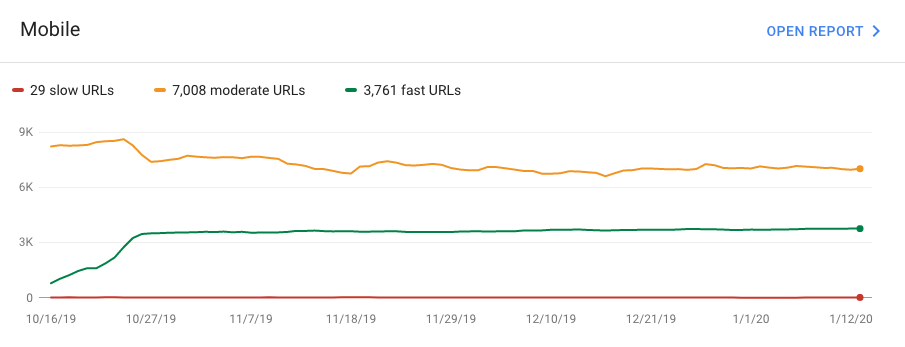
    This became increasingly visible to digital marketers when they rolled out site speed evaluation in Search Console. Google is essentially giving people feedback about their site speed in the hopes that flagging this will lead developers and businesses to try to create better mobile experiences for users. As seen below, this a report that is now standard in all Google Search Console reports.

    Example of Google Search Console speed tests for Search Influence blog

    Google has been poking and prodding at digital marketers and developers for a while, indicating their sites are “relatively slow.” To the extent that this is accurate is questionable in my view—my belief is Google is inclined to tell you that your site is slow because they want you to go after improvements that ultimately make Google’s life easier. In that way, I do not see it as super nefarious because ultimately it helps everyone in the end, from users to large businesses.

    What’s Old Is New

    While we have pinpointed some newer aspects or changing directions, there are some old tenets of SEO that will remain very important moving forward. Backlinks are still relevant, you need to leverage structured data, video content will remain a huge differentiator in terms of content, leveraging E-A-T guidelines and content can help drive traffic, and, finally, write good content that serves the need of your users.

    SEO is constantly evolving. Many of these trends will change over the coming months, and different algorithms will impact different industries in unique ways. It will be next to impossible for businesses to develop the “perfect” site for ranking well—the best we can do is interpret what Google is asking for and do our best to align with their needs while also considering the needs of users. Ultimately, Google is incentivized to provide the user a good search experience, so by reading the tea leaves and (skeptically) following their guidance, your site should be in a good place to grow its audience.

    Do you have questions about how SEO could help your business? Need a consultation? The team at Search Influence has experience managing SEO campaigns of all shapes and sizes. Reach out to us today for more information.

    Images

    B.E.R.T.

  • A Look Back at 2019: Search Influence Style

    A Look Back at 2019: Search Influence Style

    I’m fairly certain that at some point in the first quarter of this year, I fell into a wormhole and recently emerged to discover that 2019 is coming to an end. How did this happen so fast?! And not just 2019, it’s the end of the DECADE, people!

    It’s like it happened in the blink of an eye, yet this year was jam-packed with exciting happenings.Happy 2020 New Year from Search Influence

    Whether you’re still suffering from the nationwide White Claw shortage or re-binge-watching the last season of Game of Thrones while eating Popeye’s new chicken sandwich, you probably agree that 2019 was a doozy. Lizzo rose to stardom, there was a new royal baby, and Stranger Things graced us with a third season.

    Clients and employees of Search Influence had an equally eventful year! This Year-in-Review post reflects on and celebrates the many exciting accomplishments of our team and our clients in 2019.

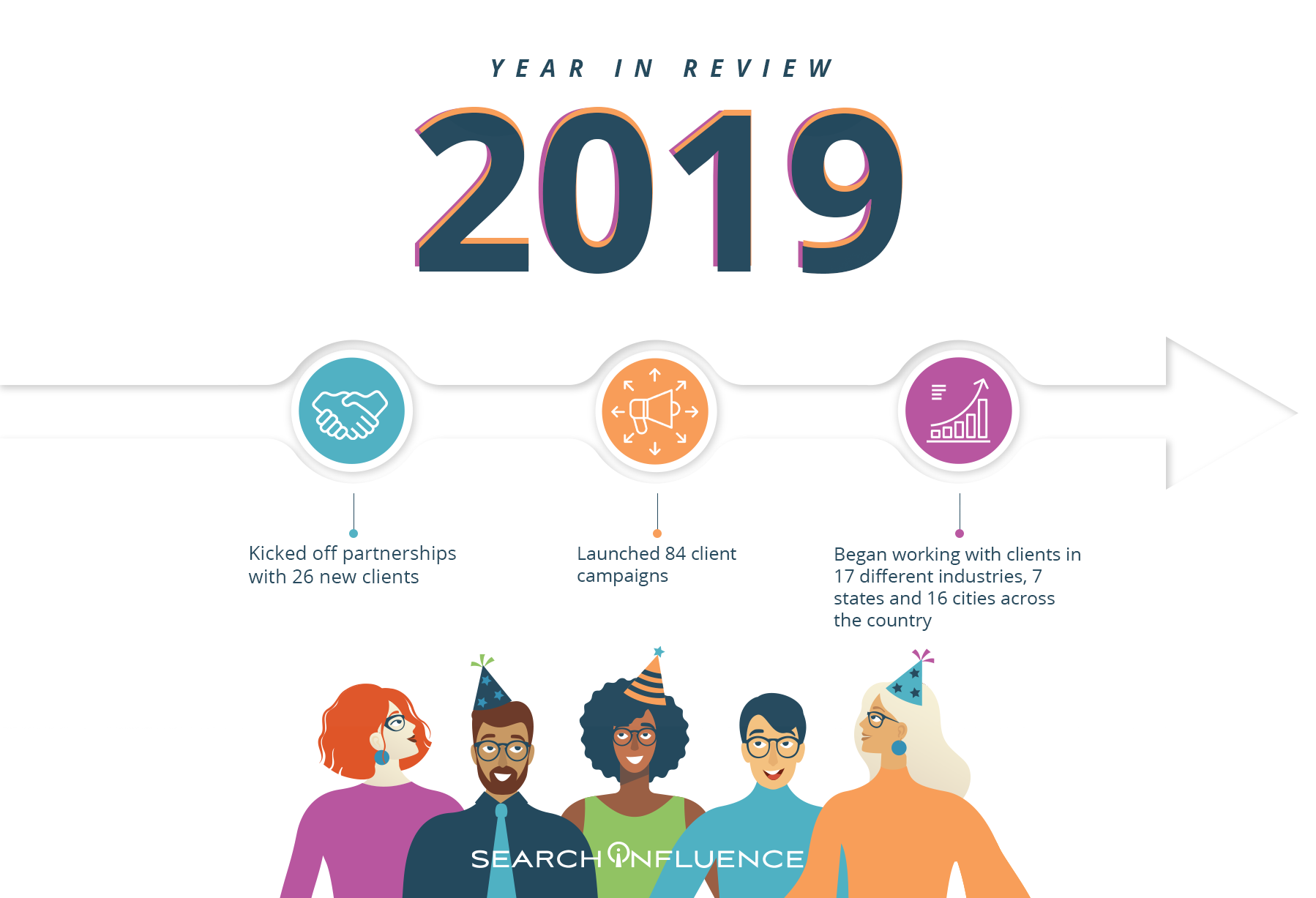
    Here’s the TL;DR version of our 2019. More on all of this below!

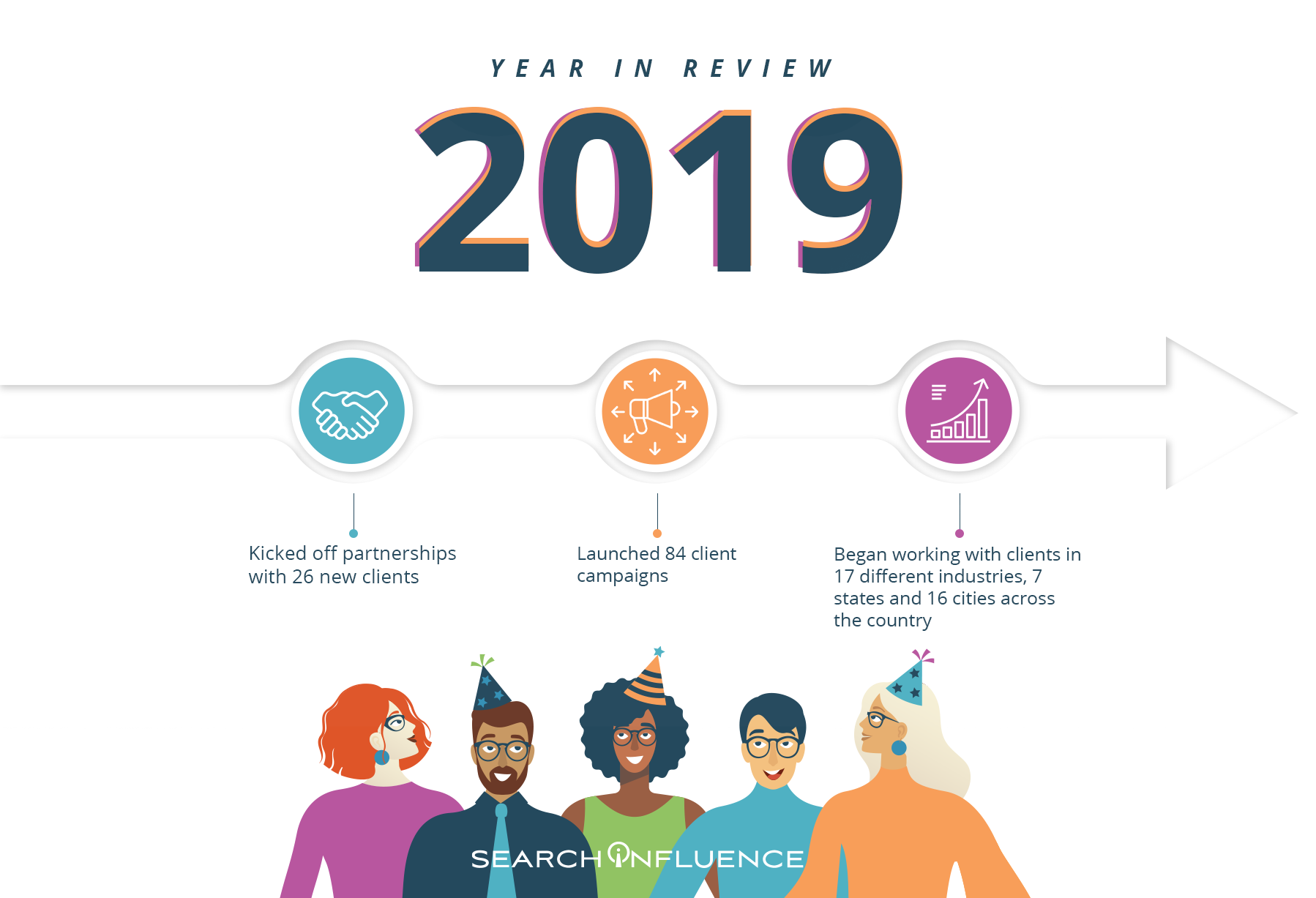
    In 2019, we…

    • Kicked off partnerships with 26 new clients 👟
    • Launched 84 client campaigns 🚀
    • Congratulated 5 newly married Influencers
    • Welcomed back 2 more Influencers who “boomeranged” back to Search Influence after going to work elsewhere ♻️
    • Said “Happy birthday” to 5 new Influencer babies in the last 12 months
    • Moved from downtown NOLA into a historic three-story building in Central City with our own courtyard
    • Initiated SMART Goal setting for each of our clients, an effort to hold ourselves accountable while focusing on our clients’ marketing objectives
    • Won a PRAL Flambeaux award for our successful digital campaign to produce a favorable vote to evenly distribute taxes among NOLA’s parks and greenspaces
    • Traveled to 6 cities in 5 states (Austin, TX; St. Paul and Minneapolis, MN; Denver, CO; Nashville, TN; and Torrance, CA) to develop our expertise, share our knowledge, and visit with our clients
    • Began working with clients in 17 different industries, 7 states, and 16 cities across the country
    • Achieved a company-wide profit threshold as a unified team through a culture of transparency and collaboration
    • Achieved an above-industry standard client retention rate by focusing on client ROI and employee education
    • Shared our expertise with speaking engagements at MN Search, Zenith, New Orleans & Company’s Tourism University, 2019 UPCEA Marketing and Enrollment Management Seminar, Mississippi Alliance for Nonprofits, Public Relations Association of Louisiana, and Public Relations Society of America, New Orleans Chapter
    • Blushed when three of our leaders were nominated for Ada Lovelace Awards
    • Topped off our 14th year in business and marveled at the change from early days around Will & Angie’s dining room table to now

    Search Influence 2019 Year in Review

    A Happy & Prosperous 2019 for Our Clients

    This year our Account Management team put a focus on strategy and client ROI, spending significant time ensuring that our campaigns align with our clients’ ultimate goals. Leveraging the methodology of SMART Goal setting, we worked hard to ensure all aspects of our campaigns are connected to the greater purpose of achieving client goals. And we have made these goals transparent to every member of our agency so that each individual can understand how their work is connected to the big picture.

    We launched and ran successful campaigns for key clients, including New Orleans City Park, Creole Cuisine Restaurant Concepts, the Tulane School of Professional Advancement, New Orleans Wine & Food Experience, and many more.

    Through a newly-formatted quarterly feedback survey, we solicited valuable insights from our clients about their experience with us and gathered some amazing testimonials:

    On Data and Analytics Reporting:

    “One of the biggest advantages to using Search Influence is their transparency and collaboration in reporting on analytics. The SI team worked with the Tulane School of Professional Advancement (SoPA) to determine what analytics and benchmarks were most important to us and made sure to align them to our outcomes. Each month, the SI team presents these data and analytics to the SoPA team and we ask questions, discuss strategy, and make data-informed decisions. Search Influence works with us each month to refine both the gathering and reporting of data. As a result, not only do we have a better understanding of the impact of our digital strategy, we are part of a continuous improvement process.”
    From Christa Payne, Assistant Dean at the Tulane School of Professional Advancement

    On Expertise and Client Experience:

    “I tell pretty much anyone who will listen how much I love working with y’all. Jordan and Ariel are both amazing—they’ve done so much for our Editorial Team and our overall approach to content on the site. On top of being incredibly knowledgeable, they do a great job of explaining oftentimes complicated subject matter to our team in a way that’s approachable. 10/10—y’all are the best!”
    From Hartley Casbon Wasser, Director of Editorial & Content Marketing of New Orleans Tourism & Marketing Corporation

    On Holistic Marketing Strategy:

    “Search Influence has been an integral and essential part of the New Orleans Wine and Food Experience’s marketing. The team goes above and beyond to make sure we are happy and taken care of. At the beginning of each season for NOWFE, Search Influence sees our vision and then brings it to life, offering advice and suggestions along the way to help meet our goals. I know that when I give the Search Influence team a task that it will be done, and having that kind of trust and loyalty in this industry is everything to us.“
    From Aimee Brown, Executive Director of New Orleans Wine & Food Experience

    A Productive & Rewarding 2019 for Our Employees

    The biggest development in 2019 for our team was our move from downtown New Orleans to a historic building in Central City! Moving from the CBD resulted in savings for both the company and each individual employee thanks to FREE PARKING! We also gained several outdoor spaces for our team to enjoy and use for collaboration. We’ve already enjoyed using our new space to host clients for in-person meetings and lend meeting space to organizations in need. We hosted our first Careers Open House this December, welcoming 20+ prospective employees and others looking to network.

    Ribbon cutting at Search Influence's new office at 1610 Oretha Castle Haley Blvd, New Orleans, LA

    We’re proud to say that our team rallied around a collective goal to achieve a profit threshold this year, and we accomplished it months earlier than planned! Through a culture of transparency (we share financials in our company-wide meetings monthly) and collaboration, we worked together to exceed our own expectations. No doubt this is thanks to the hard work of each individual team member staying connected to client goals and delighting our clients with strong results.

    A Focus on Professional Development

    Members of our team traveled to Austin, Denver, and Nashville to further their education in key areas of our work, from Local SEO to Analytics and tracking. A key initiative for the year was a renewed commitment to our employees’ personal and professional growth. We kicked off a program enabling all employees access to a mentor from our leadership team (from any department) and empowered them to set SMART Goals for their personal and/or professional lives.

    A Focus on Fun

    When we worked together to achieve milestones set by our leadership team through quarterly planning, we celebrated with a Stranger Things themed party that featured Eggo waffles and just about any topping you can dream up. We mused. We boozed. We watched movies. We played Clue. We found fun ways to unwind together. Our work—and more importantly our clients—are better because of it!

    Can’t-Miss Content From 2019

    Our core purpose is to “optimize potential,” the potential of our clients, our employees, and the community in which we work. One way we live this is by constantly growing and sharing our knowledge with the larger community, whether within our industry or to small businesses or nonprofits in need.

    This year, our team produced presentations, blogs, and oodles of content to educate the larger community of which we are a part. We spoke at several conferences, luncheons, and community organizations. And we consistently kept our blog updated with useful information. Here are five of our most-read blogs in 2019:

    Cheers to 2020

    Writing this post has made it clear that capturing the happenings in a digital agency like ours over the course of a year is nearly impossible! With such a fast pace to our work and industry and a company goal of continuous improvement, it was a year packed with fun, exciting changes, and growth. We look forward to dialing up the fun and prosperity—here’s to seeing you in 2020!

  • How to Best Utilize Facebook’s 3D Photos for Your Brand

    Facebook introduced 3D photos in October 2018, and users have been posting these fun “window views” that give viewers a new perspective on once-flat photos in their newsfeed. Originally only available to those with an iPhone with Portrait Mode, 3D photos can now be uploaded by anyone with a dual-camera smartphone or by anyone who had manually created a depth map.

    This new format saw some traction right after its launch, but has slowly plateaued in popularity over the year. This could be due to it only being available to certain iPhone users at first, or maybe just a general lack of awareness of the feature, but, either way, this means brands that do utilize it will stand out in newsfeeds even more.

    Why Use 3D Images in the First Place?

    Any new feature that Facebook introduces is inherently attention-grabbing, and 3D images have the best of both the video and flat image worlds. The eye-catching movement is automatic as the user scrolls through their feed, but taking in a 3D image doesn’t take as long as watching a video. This immersive experience offers a self-guided glimpse into a “window.”

    The feature was released for users, not pages or brands, to share photos. However, users have found that if they can post 3D images from their personal accounts, they can post them from business accounts too. With this workaround, business pages are able to blend in more with their audiences’ newsfeeds, behaving and looking more like their friends and family.

    As older smartphones are phased out, 3D images will likely become even more common on newsfeeds. A brand that gets ahead of the trend before it really takes off will prove itself more innovative than its competitors and establish more authority with its followers.

    How to Use 3D Images

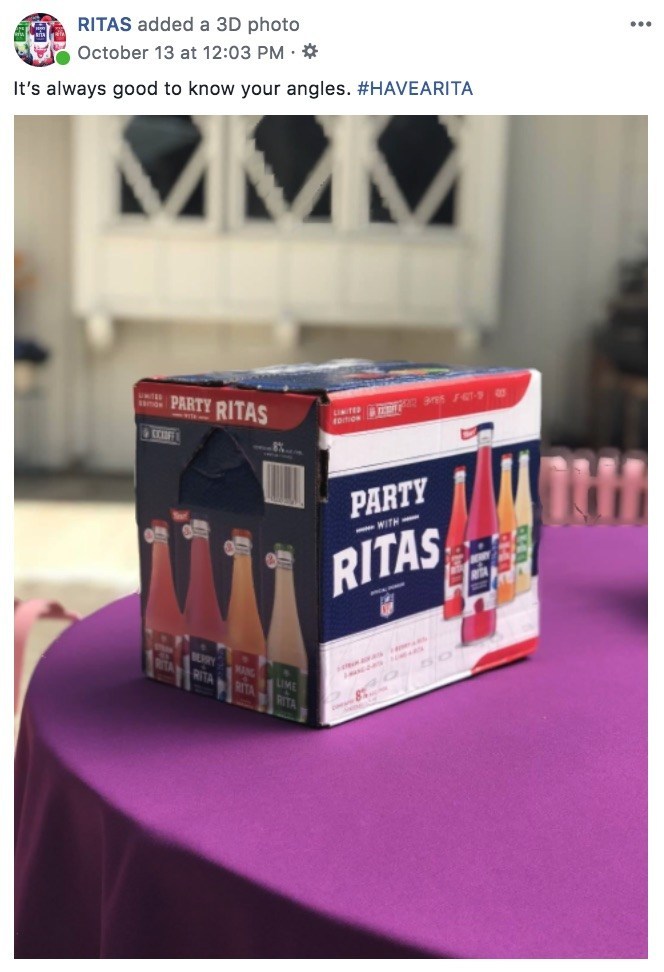
    More casual images will look the most natural when using this feature. Your audience will be scrolling through their newsfeeds expecting the 3D image to be posted by someone they actually know, so keeping this in mind will help your brand seamlessly blend. The post below, for example, was posted by the official Bud Light Ritas Facebook Page and looks like it could have been posted by anyone celebrating the weekend or watching some football.

    Facebook example for a brand using 3D images in advertising

    If you have creative that was created NOT using portrait mode on a smartphone, you can still manually create a depth map, too. This is a bit more challenging and time-consuming, but it’s completely possible to make a 3D photo in Adobe Photoshop or with other online tools. Get creative with your creative!

    Tips for Taking Great Portrait Mode Photos

    • Put a few feet in between the camera, the subject, and the background. To highlight the depth in the photo, there needs to actually be depth.
    • Make sure the subject of your photo contrasts with the background. Don’t have a woman wearing a green sweater against a green wall.
    • Transparent or shiny objects, like glass or windows, can confuse the depth sensors and might turn out distorted. This may also happen with hair. Combining these two, like a person standing in front of a wall of glass, may totally warp the photo.

    Making the most of recently released features is a great tactic for drawing users in on social media. At Search Influence, we’re always looking for new ways to make our clients’ marketing campaigns more effective. To learn more about using advertising to grow your business, start a conversation with our marketing strategists.

  • Three Lessons From the Fried Chicken Frenzy: Popeyes’ Brilliant Marketing Moment

    Three Lessons From the Fried Chicken Frenzy: Popeyes’ Brilliant Marketing Moment

    The drive-thru line on Sunday, Nov. 3 at a Popeyes Louisiana Kitchen in Metairie blocked traffic and almost caused an accident in the traffic lanes as I drove by. The highly anticipated fried chicken sandwich that had sold out just two weeks after its original release was back on the menu. Meanwhile, tumbleweeds blew through the local Chick-Fil-A parking lot because… they’re closed on Sundays.

    The Chicken Sandwich War: How It All Started

    With the launch of Popeyes’ first-ever chicken sandwich in August 2019 and the Popeyes marketing team’s quick reply to a tweet by their rival Chick-Fil-A, The Great Chicken Sandwich War began. In case you were wondering, Twitter is most definitely still relevant in today’s marketplace and can have a direct impact on consumer behavior when used well. And, people are still petty.

    Chick-Fil-A, while not without its own political controversy, remains one of the most popular fast-food chains in the nation and is known for its chicken sandwiches: bun, pickles, chicken. In the midst of Popeyes new product release on August 19, Chick-Fil-A touted their sandwich as “the original” on Twitter, seemingly throwing shade at Popeyes’ chicken sandwich:

    In a matter of 15 minutes, the marketing team at Popeyes decided to reply quite simply with “…y’all good?” and Twitter went bananas. Chick-Fil-A’s original tweet had ~3,000 retweets while Popeyes’ response earned ~86,000.

    From there, the Internet did its thing. Memes, gifs, homemade videos, and taste tests that compared the two chains’ sandwiches flooded social media feeds while the lines at Popeyes grew. Within two weeks, the 3,102 location restaurant chain ran out of its seven-week supply of chicken sandwiches.

    Positioning: A Limited Time Offer or Just the Best Dang Chicken Sandwich?

    Popeyes couldn’t have planned a better product release, and they really have social media to thank for its wild success. When they first announced the product (during Wendy’s campaign announcing the return of spicy nuggets), they made no mention of it being a limited time offer (LTO), which has become a frequently used tactic in the fast food industry. LTOs include things like Taco Bell’s nacho fries and the McRib at McDonald’s. Typically LTOs are launched with creative or gimmicky advertising messages making it known that the product is not a permanent menu item, creating a sense of urgency for the consumer to get it while it lasts.

    Popeyes didn’t take that stance. Instead, they added the sandwich to the menu specifically positioning it to compete for Chick-Fil-A’s top spot in the chicken sandwich standings. And they used their advertising to challenge their competitor rather than pressure the consumer.

    And well, people love a good competition. As the social media buzz grew, it caught the attention of news outlets, who are always looking for content the general public is interested in engaging with. And so began their coverage about Popeyes running out of product, celebrities joining in on the fun, and partaking in taste tests. This is when Popeyes experienced a huge jump in earned media value, according to Apex Marketing Group, who placed a $65 million media valuation on the national coverage Popeyes earned before, during, and immediately after the time the sandwich stock sold out.

    UGC: The Power of User Generated Content

    It’s the digital marketer’s dream: an idea, product, or creative approach that goes viral and sets the world on fire, creating more demand for the product than there is inventory. In today’s world of completely saturated and constantly flowing feeds, achieving that level of buzz can seem impossible. The key, as this case study shows, is to consider the opportunity for consumers to actively participate. Everyone’s a content producer (or “influencer” in their own right), so give the people something to talk about.

    The perfect recipe in Popeyes’ case was starting slow and kicking it up a notch by engaging in some banter with Chick-Fil-A. This ignited a fire of user-generated-content which is inherently more viral than any single advertising or marketing message published by a brand. Wendy’s has been engaging in similar hilarity on Twitter for quite some time with its competitors and customers, but given Chick-Fil-A’s political notoriety, this was just the right chicken fight to pick.

    Although the wave of UGC wasn’t even intentional on Popeyes’ part, their team did a great job of highlighting customers and showing social proof when announcing that the sandwich was returning (see: the first tweet embedded in this post).

    3 Key Lessons Learned From Popeyes Brilliant Marketing Moment

    • Twitter is still relevant and people are still petty. They love a good competition and will jump at the chance to back a brand they feel loyal to. This nationwide game of chicken sandwich thrones began because of two tweets between rival fast food chains.
    • Smart competitive positioning can make or break a new product launch. When launching its first ever chicken sandwich, Popeyes did NOT focus on gimmicky advertising pushing that the product was only available for a limited time, which is a common tactic in fast food marketing. Instead, they positioned it for what it was, a challenge to direct competitor Chick-Fil-A, and it paid off in droves.
    • To truly ignite a viral fire digitally, marketers must give customers the opportunity to actively participate and then leverage the power of user-generated content.