Tag: digital marketing

  • From Cold to Gold: How to Measure Lead Quality

    Note: This post was updated by Gi Levet on 10/7/2025 to reflect current best practices. It was originally published on 12/8/2023.
    Key Insights

    • Quality of digital marketing leads always trumps quantity of leads.
    • Knowing the differences between high-quality and low-quality leads helps you determine the quality of your own leads.
    • Ongoing measurement is a multi-step process that gives you a consistent pulse on the quality of your sales leads.
    • Several tools can help you with DIY lead tracking and scoring, such as Google Analytics and CallRail.

    Leads are the lifeblood of digital marketing, offering valuable insights and opportunities to connect with potential customers.

    However, to actually see the impact of these leads, you need to understand that not all leads are created equal. Having leads doesn’t necessarily mean you’re dominating your industry.

    The idea “The more the merrier!” works well for click-through rates and conversions. When it comes to leads, quality trumps quantity. Having a funnel of incoming leads might look good on paper, but it’s the high-quality leads that drive business growth.

    That’s exactly why 79% of marketers identified generating quality leads as their main goal, according to Semrush research.

    But how do you know the quality of your sales leads?

    Two words: ongoing measurement.

    When you keep a steady pulse on the quality of your leads, you can:

    • Better optimize your marketing strategies.
    • Ensure efficient resource allocation.
    • Boost your conversion rates.

    In this post, we’ll discuss how to measure lead quality, why it’s so important, and what it can mean for the success of your marketing campaigns.

    What Is Lead Quality?

    In digital marketing, a lead is an individual or entity that has expressed interest in a product or service, typically through an action or engagement online. This could be through activities such as filling out a contact form or downloading key content on your site. Lead quality refers to the potential of a lead to convert into a customer.

    Categories of Lead Quality

    There’s a spectrum of lead quality, akin to the classic temperature scale (from cold to hot). These lead quality categories include:

    Unqualified leads

    Unqualified leads are those who have shown some level of interest in your products or services but have not been vetted to determine if they are a good fit for what is being offered. These leads may lack the necessary budget, authority, need, or timeline to make a purchase. Unqualified leads require more time and resources to nurture and qualify, and there is a higher likelihood that they may not convert into customers.

    Qualified leads

    Qualified leads have passed a certain evaluation threshold, indicating they are more likely to be interested in and capable of purchasing the product or service. This evaluation might include verifying that the lead has the budget, authority, need, and a specific timeline — ensuring a higher chance of conversion. Qualified leads are generally more informed about your product or service and have shown genuine interest, making them easier to convert into customers than unqualified leads.

    Ideal qualified leads

    Ideal qualified leads represent the best potential customers, meeting all the criteria that define an ideal buyer for the product or service. These leads have the budget, authority, need, and timeline to partner with you. They also align with your target market and buyer persona. They are highly likely to convert and have a strong potential to become long-term, valuable customers. Nurturing and closing deals with ideal qualified leads tends to require less effort and resources, providing a higher return on investment.

    Assessing High-Quality and Low-Quality Leads

    We recommend starting your lead assessment as a manual process at first. This will help you familiarize yourself with your leads and define what quality looks like for your brand. Ideally, you can automate your lead ratings from then on.

    Let’s put this into perspective with an example.

    Say you’re a higher education marketer responsible for ensuring your institution’s undergraduate programs attract and enroll the most qualified and interested students.

    To effectively do so, you take a look at three main qualifiers/differences:

    Behavioral differences

    • High-Quality Leads: Engage actively with content, often returning to your university’s website multiple times. A high-quality lead interacts more with calls-to-action and may spend longer durations on key pages. They frequently participate in admission/open house webinars, download course catalogs, or engage in live chats with admissions counselors.
    • Low-Quality Leads: Display passive or erratic behavior, like bouncing quickly from the website. These leads have limited interactions with the site’s main features or content. They rarely engage in deeper interactions, such as signing up for campus events or accessing gated content, such as program requirements.

    Level of purchase intent or interest differences

    • High-Quality Leads: Display a clear interest in specific courses or programs, often inquiring about curriculum details, faculty, or research opportunities.
    • Low-Quality Leads: Express a vague or general interest, like “I’m thinking about studying business somewhere.” Low-quality leads rarely ask detailed or specific questions that indicate a deeper interest.

    Demographic and target audience differences

    • High-Quality Leads: Often fit the typical age range and academic prerequisites of the intended program. These leads may hail from regions or schools that frequently send students to your institution. They possess a strong academic or extracurricular background aligning with your program’s focus.
    • Low-Quality Leads: Might fall outside the typical age or academic background suitable for the program. They may have educational aspirations that don’t match the institution’s offerings.

    Once you’ve assessed the criteria of your leads, you have a blueprint to apply to future measurements.

    Importance of Lead Quality in Digital Marketing

    Lead quality is the secret sauce of online advertising success. But it’s not just because better leads = higher probability of more conversions.

    Measuring lead quality is an involved, insightful, and impactful process. When you take the time to measure it, you can benefit from:

    • Efficient use of marketing budget and resources: Optimizing toward lead quality allows for a targeted approach, maximizing the impact of every marketing dollar spent. This reduces wasted budget on unqualified leads, ensuring more resources are directed toward potential conversions.
    • Direct influence on sales efforts and productivity: High-quality leads increase the efficiency of your sales team, enabling them to close deals more effectively. This reduces time spent chasing leads with low conversion potential, increasing overall sales productivity.
    • The link between lead quality and customer lifetime value: High-quality leads are more likely to become loyal customers, leading to repeated sales over time. This increases overall revenue for your company, as these leads not only convert but can also advocate for your brand, bringing in more potential customers.

    How does lead quality impact conversion rates?

    Lead quality plays a pivotal role in conversion rates, as it directly influences a potential customer’s likelihood to purchase or engage with a product or service.

    High-quality leads align with the target demographic and have demonstrated a clear interest in a company’s offerings, both of which set the stage for a smoother conversion process. These high-quality leads tend to move more quickly and efficiently through the sales funnel because their intent to purchase is clear and strong from the outset.

    As a result, there’s a reduced chance of these leads dropping out or losing interest mid-funnel, ensuring that your sales team’s efforts are concentrated on prospects with the highest likelihood of converting.
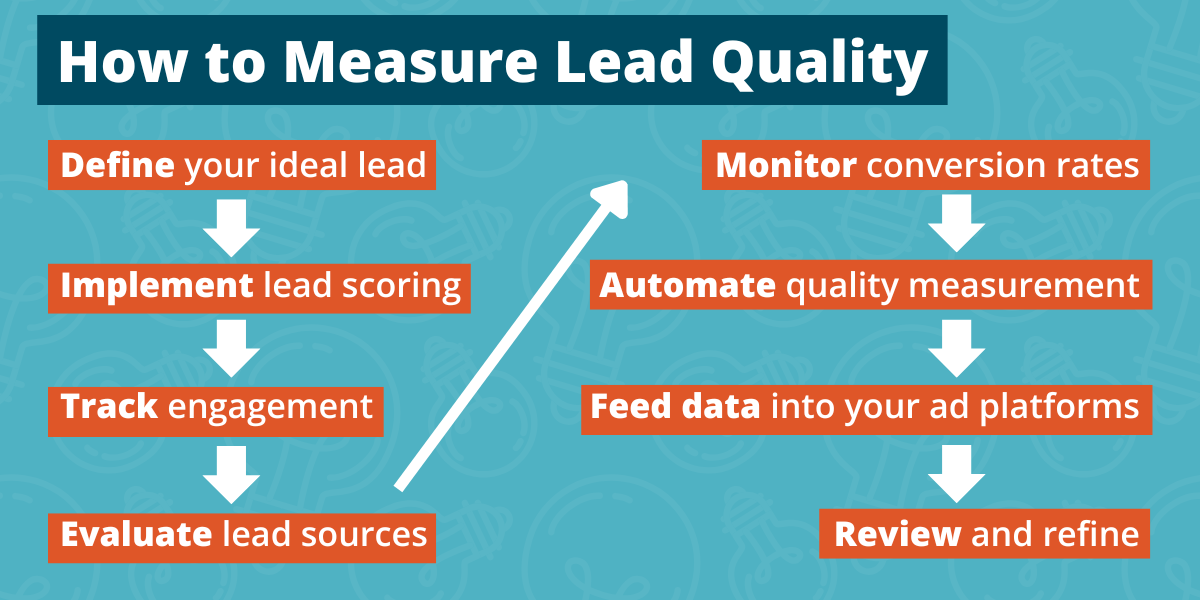
    How to Measure and Monitor Lead Quality

    Measuring the quality of your leads can be a tough nut to crack, especially if you’re a first-timer. But it doesn’t have to be.

    To help you get started, we’ve developed a set of best practices for assessing the quality of a lead:

    Step 1: Define your ideal lead

    Create a profile of your ideal lead, considering factors like demographics, location, interests, and behaviors that align with your product or service. It’s important to be as precise as possible in this phase since this profile serves as the cornerstone for your lead quality assessment.

    Think of it as sketching out a detailed buyer persona that embodies the characteristics of someone who would not just be interested in, but most likely to benefit from and purchase, your product or service.

    Step 2: Implement lead scoring

    After you’ve crafted your ideal quality lead, implement a lead scoring system that assigns points to various lead attributes and behaviors.

    For example, a lead visiting a pricing page might get more points than one just reading a blog post. A lead that matches your ideal customer profile in terms of demographics might also receive higher points.

    This scoring system acts as a quantitative method to gauge lead quality, enabling your teams to prioritize their efforts on the most promising leads and, thereby, optimize the overall efficiency of your sales process.

    Step 3: Track engagement metrics

    Monitoring engagement is one of the clearest ways to understand lead quality. Look at signals such as time on site, return visits, or downloads of gated resources. These actions tell you how invested a prospect is in learning more.

    Many analytics platforms now integrate AI to surface deeper engagement insights automatically, reducing the time it takes to spot patterns. With automation, you don’t just see the raw metrics. You see which behaviors consistently correlate with higher-quality leads.

    Step 4: Evaluate the lead source

    Not all traffic sources are created equal. Some channels reliably deliver prospects that align with your buyer persona, while others flood your funnel with unqualified leads. By evaluating lead sources, you can see which campaigns and platforms produce the highest-value opportunities.

    Advanced tools can also automate source attribution, helping you see at a glance which channels drive the highest-quality leads. With accurate attribution, you can confidently invest in the platforms that consistently deliver ideal leads.

    Step 5: Monitor conversion rates

    Conversion rates are one of the most reliable indicators of lead quality. If leads from a specific source convert into paying customers more often, that source is worth prioritizing.

    With automated tracking, you can quickly identify which leads move through the funnel faster and use that data to refine your scoring models. Instead of waiting weeks to spot trends, you can optimize in near real time.

    Step 6: Automate your lead quality measurement

    Manual lead scoring can be inconsistent and time-consuming. Automation makes the process scalable. AI-driven tools like CallRail’s AI-powered automated scoring remove guesswork by assigning scores based on real behaviors and outcomes, not assumptions.

    Automation allows you to:

    • Capture real-time insights without manual effort.
    • Eliminate bias in how leads are evaluated.
    • Scale your measurement process as lead volume grows.

    By shifting to automated scoring, you create a consistent, always-on system that improves accuracy and frees up your team for higher-value strategy.

    Step 7: Feed lead data into your ad platforms

    Your CRM data doesn’t just help your sales team. It can make your ad campaigns smarter, too. Feeding qualified lead data into platforms like Google Ads and Facebook ensures those platforms optimize for quality, not just volume.

    Here’s how it works:

    • A prospect fills out a form.
    • Their info flows into your CRM.
    • The CRM verifies and scores the lead over time.
    • Qualified lead data is synced back to your ad platforms.

    This workflow bypasses cookie-tracking issues and creates a feedback loop where campaigns automatically improve. Many CRMs already support automated qualification, which reduces manual effort and ensures reporting accuracy.

    Step 8: Regularly review and refine

    Automation and CRM integrations give you accurate, real-time data, but they don’t replace the value of human oversight. Your team still needs to regularly review results, refine scoring criteria, and re-evaluate lead sources to ensure they reflect changing audience behavior and market conditions.

    With automation handling the heavy lifting, you can focus on strategic improvements, making adjustments that strengthen the overall process while staying confident that the data guiding those refinements is current and reliable.

    Tools and Software for Evaluating Lead Quality

    Evaluating lead quality doesn’t have to feel overwhelming. The right tools can take the guesswork out of measurement and give you a clearer picture of which prospects are worth your team’s time.

    At Search Influence, we often recommend a combination of software and frameworks that cover different points of the funnel:

    • CallRail: Track inbound calls and attribute them to the right marketing source, so you know which campaigns are driving real conversations.
    • CRM systems (HubSpot, Salesforce, etc.): Manage leads as they move through the pipeline, apply scoring models, and feed quality data back into your ad platforms.
    • Google Analytics: Understand website behavior and map out the conversion paths that indicate strong purchase intent.

    Together, these platforms create a practical foundation for measuring lead quality, from the first interaction through to conversion.

    CPI Worksheet for higher ed marketers

    In higher ed? Search Influence’s CPI Worksheet is a practical tool for connecting lead quality back to enrollment outcomes. It helps you calculate:

    • Overall CPI across all programs
    • CPI by program type (undergraduate, graduate, non-credit)
    • Cost per enrolled student to see the true return on your marketing efforts

    Using this worksheet alongside lead quality measurement shows whether optimizing for better-qualified leads lowers costs and helps you allocate budget to the campaigns most likely to drive enrollment growth.

    Measuring Lead Quality FAQs

    How to measure lead quality from organic search leads?

    You can measure lead quality from organic search by tracking engagement signals like time on site, pages viewed, and conversion actions completed. Leads that interact with high-value content, such as service pages, pricing, or gated resources, show stronger intent than those who bounce quickly. Pairing this behavioral data with lead scoring in your CRM helps confirm whether your SEO is attracting prospects likely to convert.

    How to measure the quality of leads coming from different channels?

    The quality of leads from different channels is measured by comparing conversion rates, cost per qualified lead, and long-term customer value across sources. For example, leads from paid search may convert faster, while leads from organic or referral traffic may have higher lifetime value. Attribution tools and CRM integrations make it easier to see which channels consistently deliver the best-fit prospects.

    What is the key indicator of a high-quality lead?

    The key indicator of a high-quality lead is purchase intent that aligns with your target customer profile. This often shows up in behaviors like filling out detailed forms, requesting demos, or asking specific questions that demonstrate readiness to convert. When paired with demographic or firmographic alignment, these intent signals give sales teams confidence that the lead is worth pursuing.

    What makes a lead unqualified?

    A lead is considered unqualified if they lack the budget, authority, need, or timeline to purchase your product or service. For instance, they might engage with your content but fall outside your target audience, or they may express only casual interest without the means to act. Unqualified leads often require more nurturing and have a much lower likelihood of conversion.

    How to increase the quality of leads?

    You can increase lead quality by targeting campaigns toward your ideal customer profile and using filters like geography, demographics, or job role to narrow your reach. Optimizing landing pages for clarity, offering valuable gated content, and feeding qualified lead data back into ad platforms also improves lead quality over time. Combining precise targeting with automation ensures your pipeline attracts prospects more likely to convert.

    Lead Tracking With Search Influence

    According to Hubspot, over 50% of marketers across the globe find generating leads and traffic their most challenging task. Is it yours?

    Search Influence offers expert analytics and lead tracking services to help you make more informed decisions about targeting your ideal leads. When you work with us, we’ll help you know the impact of your marketing efforts with everything from website form and call tracking to coprehensive reporting and ROI analysis. We’ll identify your target audience, track all interactions, and pinpoint the best opportunities to improve lead quality.

    Don’t let the complexity of your leads leave you in the dark.

    Contact us today to explore the depth of our lead tracking services and tap into our industry-leading expertise.
  • How Marketing Supports SEO and Helps You Score Big With AI Search

    How Marketing Supports SEO and Helps You Score Big With AI Search

    How Marketing Supports SEO and Helps You Score Big With AI Search

    Key Insights

    • AI search engines reward brands that align SEO with all marketing channels, including social, PR, paid, and email.
    • Social media content marketing reinforces SEO performance by increasing entity signals and driving engagement.
    • Earned media and PR build domain authority and citations that support higher search engine rankings.
    • Email and paid campaigns indirectly boost SEO by influencing user behavior signals like CTR and repeat visits.
    • AI SEO tracking tools and Google Search Console help track how your marketing efforts affect AI search visibility.

    AI-generated search has changed what a winning digital marketing strategy looks like.

    To stay competitive in search, you need more than keywords, high-quality backlinks, and old-school content marketing.

    You need a coordinated offense.

    If AI-powered search is your end zone, then SEO is your quarterback, calling the plays.

    And your other marketing channels (social media, earned media, email, and paid campaigns) are the wide receivers, running backs, and tight ends moving the ball downfield.

    When they work together, you don’t just show up in search —  you win the search results.

    Search rankings success now hinges on how well your entire marketing strategy supports visibility in Google’s AI Overviews and tools like ChatGPT and Perplexity.

    Learn how content marketing, social media, PR, paid ads, and email all reinforce your search engine optimization efforts and help your brand dominate the AI-driven digital playing field.

    How Marketing Supports SEO and Helps You Score Big With AI Search

    Why SEO Needs a Team Effort in the Age of AI Search

    AI search engines reward brands that align SEO and other forms of marketing for maximum authority.

    Search engines like Google Search no longer rely solely on keywords and link building to decide what ranks. AI-powered search pulls from trusted sources, structured content, and recognizable entities.

    Brands that show up consistently across the web, in blog posts, press releases, social profiles, and paid placements, are more likely to be recognized and cited in search engine results pages, including AI Overviews.

    That consistency helps solidify your brand across the three key AI SEO pillars: entity recognition, semantic relevance, and authoritative citations. When your content, PR, and paid efforts echo the same message, it signals trust to both users and search engines.

    Building SEO Momentum Across Your Marketing Channels

    Social media: the unsung SEO MVP

    Social media posts amplify your SEO by reinforcing entities and driving engagement signals.

    Platforms like TikTok, Instagram, and LinkedIn are now part of the search journey. With social content appearing in search results, these channels are critical for reinforcing relevance, brand awareness, and your online presence.

    Best practices for social search optimization include:

    • Using keywords in bios and captions/text posts to reflect your brand and services.
    • Linking consistently to your core SEO pages.
    • Repurposing high-quality content into bite-sized posts to boost visibility.
    • Using hashtags strategically to build topical associations and reach your target audience.

    Even more importantly, optimized social profiles with consistent NAP (name, address, phone number) data contribute to local SEO and entity alignment.

    By driving traffic and user engagement, social also sends quality signals that search engines interpret as ranking factors. This not only improves on-page SEO but also strengthens your presence in organic search results and social search algorithms.

    PR & earned media: link-building powerhouse

    Earned media strengthens SEO by building authoritative citations and backlinks.

    A press hit or podcast appearance isn’t just good publicity; it’s an SEO asset. Media mentions and thought leadership build domain authority and keyword associations that help you rank higher in organic search.

    Ways to reinforce SEO in PR efforts:

    • Include locked-in phrases (your preferred product or service descriptions) in boilerplate bios and releases.
    • Syndicate press releases via newswire services to generate multiple backlinks and citations.
    • Contribute guest posts to relevant industry blogs with links to cornerstone content.
    • Promote media wins on social channels and your website to extend reach and reinforce relevance.

    These earned links and mentions feed directly into Google’s understanding of your authority.

    They can also boost brand awareness and credibility, which in turn fuels more engagement, links, and overall SEO success. In AI search results, those citations often become the deciding factor in whether your content gets featured.

    Paid advertising & email campaigns: driving SEO clickstream data

    Paid campaigns and email traffic support SEO by sending quality signals to key pages.

    While paid search/PPC, digital ads, and email don’t directly influence search rankings, they impact user behavior metrics like pageviews, bounce rate, and time on page, all of which contribute to overall SEO performance.

    Use paid advertising (paid search/PPC and digital ads) and email to:

    • Drive targeted traffic to SEO-priority pages.
    • Retarget users to increase return visits and page engagement.
    • Feature blogs or cornerstone content in newsletters to boost visibility.

    When users consistently visit and engage with your site after a paid ad or email click, analytics and tools like Google Analytics pick up on those signals.

    They show that your content meets user intent and delivers value. In AI search engines, where quality content and user signals are ranking factors, this kind of reinforcement is critical.

    Tracking Your SEO Wins in AI Search

    How Marketing Supports SEO and Helps You Score Big With AI Search

    Tracking tools reveal how your marketing impacts SEO visibility in AI-powered search.

    You can’t improve what you can’t measure. Fortunately, new tools make it easier to track your AI search website traffic.

    Here’s what to monitor:

    • Referral traffic from generative AI sources
    • Presence in AI Overviews or AI-generated responses.
    • Entity recognition for your brand and key pages in tools like Scrunch AI.
    • Search engine rankings and keyword rankings in traditional search. You should still care about organic search rankings because they are still used by most audiences, and they influence AI search results.

    Despite popular belief, AI SEO isn’t a black box.

    At Search Influence, we recommend AI SEO tracking tools for clients who want visibility into how their content is retrieved and referenced in tools like Google’s AI Overviews or ChatGPT.

    Tools like Scrunch AI, Semrush, and Advanced Web Ranking are rolling out new features to help track keyword visibility and AI answer inclusion across different search results.

    The ability to measure these AI SEO metrics gives your team the confidence to double down on what’s working and identify new content marketing opportunities that align with search intent and digital marketing best practices.

    Higher Ed Example: When Marketing Plays as a Team

    An integrated marketing strategy helps universities dominate AI search with consistent brand signals.

    Let’s take higher education as a case study. Universities have complex websites with multiple departments, programs, and voices. When every touchpoint supports a unified SEO strategy, it makes a measurable difference in organic traffic, visibility, and user experience.

    Despite this, 51% of higher ed marketing departments lack an SEO plan.

    That’s like getting ready to snap the ball without having a play drawn up.

    Here’s what it looks like when all higher ed digital marketing channels play like a team to support SEO:

    • Press mentions are strategically related to, and link to, key website pages.
    • Faculty speaking engagements are published on YouTube and social media.
    • Social media posts present the same info as your blogs in a format designed specifically for that platform.
    • Faculty bios link to relevant departments, publications, and press mentions.
    • PR campaigns and social posts highlight research topics tied to search intent.
    • Paid ad teams run ads to SEO-targeted website pages and blogs.
    • Podcast appearances link to and mention key degrees and programs alongside your brand name.

    At Search Influence, we’ve helped higher ed clients align SEO strategy with marketing efforts by identifying opportunities to promote targeted programs and degrees through traditional methods that support SEO, and by republishing assets online in a way that is best found and leveraged by search engines and AI models.

    When SEO, PR, social, paid, and content marketing teams share data and strategy, the result is a powerful flywheel that delivers relevant content, builds domain authority, and earns organic traffic.

    Bringing It All Together: Your Winning SEO Playbook

    To win in the AI search era, you need every part of your digital marketing team working toward one goal: SEO success.

    Here’s how your marketing supports the core principles of AI-driven SEO:

    • Entities: Use structured content and consistent messaging to help search engines understand your brand and offerings.
    • Semantic relevance: Align content across platforms to reinforce semantic relevance and meet user intent.
    • Citations: Earn trust and build authority through strategic outreach, earned media, and consistent engagement.

    A data-driven, coordinated approach ensures you’re not just showing up, but standing out.

    FAQ: Marketing, AI SEO, and Brand Authority

    How does social media help SEO rankings?

    Social media boosts SEO by increasing entity mentions and driving engagement signals.

    Search engines and users alike take note of your brand’s presence across platforms. Social profiles with complete business info, regular content posts, and linked landing pages help clarify who you are and what you do. When your content is widely shared, it gains visibility and relevance in the eyes of search engines.

    How does earned media drive SEO success?

    Earned media strengthens SEO with backlinks and authoritative citations.

    Publications, podcast appearances, and industry blogs serve as third-party validators. These citations build trust and domain authority, two key elements in both traditional SEO and AI-driven rankings.

    What’s the relationship between PPC and SEO?

    Paid search (PPC) supports SEO by driving traffic and reinforcing branded search terms.

    Paid search helps fill gaps while organic SEO takes time to build. When users see both your ad and your organic listing in the search engine results pages, they’re more likely to click. That overlap improves brand recognition, click-through rate, and long-term search performance.

    How do you track AI search visibility?

    AI SEO tools measure your brand’s presence in AI Overviews and conversational search.

    Emerging platforms like Scrunch AI are designed specifically to track AI search visibility. They track how often your content appears in Google’s AI Overviews, ChatGPT citations, and other AI-driven results. Pair that with traditional metrics in Google Analytics and Google Search Console for a complete view of performance.

    Why is branding important for AI search visibility?

    Strong branding improves AI search visibility by helping engines recognize and prioritize your brand as a trusted entity.

    When your name, offerings, and messaging are consistent across the web, from your website and social channels to business directories and review platforms, you build trust. That clarity and consistency make it easier for AI to pull accurate information about your brand and include it in AI-generated responses.

    Ready to Win With SEO? Let’s Talk.

    Want your marketing efforts to work harder for SEO and get results in AI search?

    At Search Influence, we help brands align every part of their marketing strategy to drive visibility, authority, and engagement where it matters most. Our experts bring together quality content, technical SEO, paid media, and brand strategy to help you rank in search engine results and show up in AI-generated answers.

    We specialize in working with higher education, healthcare, and hospitality brands that need long-term, scalable SEO strategies rooted in best practices.

    Contact us today to learn how we can help you create a winning SEO strategy tailored to your goals.

    Images:
    Unsplash
    Unsplash

  • In-House Marketing vs. Agency Teams: Build a Strong Strategy Together

    In-House Marketing vs. Agency Teams: Build a Strong Strategy Together

    This post was updated by Paula French on 2/28/25 to reflect recent trends and best practice. It was originally published on 12/6/2018.

    Working professionals giving each other a high five

    Key Insights

    • As brands grow, marketing demands increase, making it difficult for internal teams to execute strategy, create content, analyze performance, and keep up with industry shifts all at once.
    • Agencies provide specialized expertise and resources that complement in-house efforts, allowing internal teams to focus on core business priorities and guide overall strategy.
    • Combining internal marketing strengths with agency support creates a scalable, results-driven strategy that adapts to changing needs without overloading your team.

    Internal marketing teams are often expected to manage it all — strategy, execution, and analysis — on top of keeping up with regular day-to-day tasks. But as the workload grows, so does the risk of burnout, missed priorities and deadlines, and campaigns that don’t perform as expected. The faster the industry evolves, the harder it is for stretched-thin teams to keep up, leading to outdated strategies and missed opportunities.

    While outsourcing can help lighten the internal load, some in-house teams hesitate to seek out agency support, fearing they’ll lose control over their marketing strategy. In reality, internal teams and agencies don’t have to compete. They can leverage their respective strengths to create an agile, focused, and impactful marketing approach.

    If you’re deciding between keeping all of your marketing in-house or partnering with an agency, here’s why you don’t have to choose just one, plus how to balance both for the best results.

    How Can an Agency Help Me If I Am a…

    Single-person marketing team

    Instead of feeling like a one-person show, you’ll have a team to bounce ideas off, refine strategies, and make sure nothing slips through the cracks while improving your results.

    Single-person marketing “teams” can feel isolated and underappreciated. Your organization’s leaders expect you to handle it on your own, but as you’ve tried to run campaigns, manage vendors, write content, plan the strategy, update your website, and still get results, you find two challenges:

    1. There isn’t enough time to do it all yourself.
    2. One person rarely has the skills to be strategic, create graphics, update a website, monitor results, and evaluate and manage vendors.

    A marketing agency takes the weight off your shoulders by acting as an extension of your team. They bring the time, skills, and experience to tackle everything from strategy planning to execution and performance tracking, so you’re not stuck doing it alone.

    Business leader

    No more juggling ads, content, and campaigns on the fly. Partnering with an agency ensures your marketing is always working, even when you’re too busy to think about it.

    When you’re responsible for driving the business forward, marketing is just one of many things competing for your time. Whether you’re managing it all yourself or working with local media vendors, it can be difficult to stay strategic and aligned with your goals.

    You may often feel that:

    1. Marketing takes a back seat when business operations call for urgent attention.
    2. You got into your field to do what you love, not market what you love.
    3. You are reacting to promotional ideas as they cross your desk, with no real strategy about how to best reach your customers.

    Being a leader means wearing many hats, and marketing often ends up as an afterthought. An agency helps shift it from a scattered, reactionary task to a well-planned strategy that actually supports your growth.

    Medium-to-large marketing team

    Even with a well-staffed, in-house department, keeping up with every aspect of marketing can be a challenge. Between aligning team members, executing campaigns, and adapting to industry updates, it’s easy to get stuck in the weeds and lose valuable time for strategy. You may find that:

    1. Your internal marketing team needs support in strategy and direction.
    2. The time it takes to execute tactics gets in the way of strategically analyzing what is truly working (and what is not).
    3. You struggle to keep up with new and changing marketing technologies and ideas.

    Partnering with a marketing agency helps bridge these gaps by bringing fresh insights, specialized expertise, and extra hands where you need them most.  Whether it’s adjusting your strategy, handling time-consuming execution, or keeping your team ahead of evolving trends, they’ll keep your marketing in check and on track without overloading your internal resources.

    Higher education marketer

    Instead of constantly shifting from one urgent task to the next, an agency’s support helps you be more intentional with your marketing.

    Higher education marketing is a constant balancing act. One minute you’re fine-tuning messaging for a new degree program, the next you’re trying to boost student engagement — all while keeping an eye on enrollment goals. With so many priorities commanding your attention, it’s easy to feel like you’re always in reactive mode and that:

    1. Your marketing efforts are spread too thin. You’re trying to serve prospective students, current students, and alumni all at once while balancing multiple degrees and programs.
    2. Data analysis and performance reporting fall by the wayside due to time constraints.
    3. Meeting ambitious enrollment goals feels unattainable without additional resources or expertise.

    An agency will take on recruitment and retention efforts, ensuring you reach the right students at the right time. With deeper data insights, you’ll make informed strategic decisions, focusing your time and budget on what drives real results.

    Want to find out if partnering with an agency is right for your institution? Take our Higher Ed SEO Quiz to discover your best staffing approach based on your current resources, strategy, and performance.

    In-House Marketing vs. Agency Partnerships

    A person giving a presentation in a conference room

    Balancing in-house marketing with agency support lets you stay involved while tapping into advanced expertise. Your team knows your brand best, while an agency brings the skills, strategy, and execution power to amplify your efforts.

    At Search Influence, many of our clients handle routine tasks internally while relying on us for more strategic, high-impact initiatives. The key is knowing which responsibilities are best handled by your in-house team and which most benefit from external support.

    What work should my in-house marketing team handle?

    Identifying unique stories that can be included in marketing

    Great marketing starts with great stories, but you can’t share what you don’t know.

    As part of your internal tasks, build relationships with departments and stakeholders across your organization. This ensures you stay informed of exciting news and developments that bring your marketing to life.

    For example, let’s say you are marketing for a university, and one of your instructors learns that one of her students won a research award. Would your marketing team hear about it?

    If you educate your staff on your marketing goals and build vital relationships, you’ll be less likely to miss valuable stories that strengthen your outreach.

    Serving as spokespeople for public relations and media opportunities

    Having the right people represent your organization in the media bolsters your brand’s credibility and reach. Instead of scrambling when a press opportunity arises, establish a roster of internal experts who can confidently speak on key topics.

    Identifying multiple spokespeople prevents over-reliance on a single person, speeds up media responses, and ensures you always have a knowledgeable representative prepared to engage with the public.

    By designating these spokespeople internally, you streamline the process and create a sense of ownership within your team. When staff members are prepared and empowered to speak on behalf of the organization, it fosters consistent messaging and a proactive approach to media inquiries.

    Creating day-to-day organic social posts

    Social media is where you build a genuine connection with your audience, and staying consistent is what’s key to maintaining that bond. Hubspot reports that social media is the preferred means for product discovery among consumers aged 18 to 44, making routine posting all the more important.

    For businesses with the right in-house resources, managing daily posts can be straightforward. But when time or expertise is limited, outsourcing certain aspects to an agency — like content scheduling, caption writing, or hashtag strategy — can help maintain consistency without adding to your team’s workload.

    You may find that capturing photos or videos in-house and passing them along to an agency for posting works best. This ensures fresh, timely content without the hassle of managing every detail.

    When should I hire a digital marketing agency?

    To improve your website’s SEO and increase organic traffic

    If your in-house team can’t keep up with the nuances of SEO, it’s time to bring in the experts.

    SEO is fundamental to getting your site seen, but it’s far from a one-size-fits-all solution. It takes ongoing attention, work, and a deep understanding of both on and off-site SEO tactics to rank high and stay ranked high.

    An agency will create a comprehensive SEO strategy that aligns with your specific goals, covering key areas like:

    • Deep keyword research to target the right audience
    • On-page optimization to improve visibility, from meta descriptions to header tags
    • Content creation that considers what your audience is actually searching for
    • Site performance improvements, from navigation to mobile optimization
    • Building valuable backlinks to boost your site’s authority
    • Performance tracking to refine strategies and stay ahead of the curve

    When an agency handles these technical details, you free up your team to focus on bigger-picture goals, knowing that your SEO is in the best hands.

    To manage and optimize your digital advertising campaigns

    With an agency managing your digital ads, you’ll rest easy knowing your budget is being spent efficiently, your ads are reaching the right people, and your strategy is always evolving to stay competitive.

    Digital advertising is one of the fastest ways to get your brand in front of the right audience. However, making the most of it is no easy feat. If you’re struggling to create effective campaigns, manage budgets, or keep up with performance tracking, an agency will give your campaigns the focus they need.

    Applying their specialized expertise, an agency positions your brand for paid advertising success by:

    • Crafting targeted campaigns on platforms like Google Ads and Meta
    • Selecting and optimizing keywords for maximum visibility
    • Writing engaging ad copy and designing eye-catching visuals
    • Leveraging advanced targeting to refine audience demographics and interests
    • Setting and managing budgets to ensure your ads reach the right people without overspending
    • Testing different ad variations to identify the most effective strategy
    • Monitoring and adjusting campaigns to keep things running smoothly

    To monitor campaign success through advanced analytics tracking and reporting

    Let an agency take the guesswork out of ad management, using data to refine and enhance your campaigns for maximum performance.

    Analytics and lead tracking require more than just simple data collection. It takes advanced know-how to make sense of your metrics, assess your performance, and use the insights as fuel for your future strategy. If you’re feeling lost in a sea of metrics, an agency will interpret the numbers and guide you toward smarter decisions.

    Trust your advanced tracking and reporting to an agency when you need support with:

    • Tracking leads from forms, calls, and other inquiries
    • Identifying the top-performing marketing channels to allocate resources effectively
    • Analyzing lead quality to improve conversion rates and maximize ROI
    • Conversion tracking set-up to measure sales, sign-ups, and other key outcomes
    • Making sense of your data with customized reports and KPI dashboards 
    • Conducting an ROI analysis to showcase the effectiveness of your efforts
    • Optimizing your campaigns based on performance data

    To craft and execute customized email marketing strategies

    With an agency’s guidance, your email marketing will be a well-oiled machine that consistently delivers high-quality, results-driven campaigns.

    Email marketing often gets treated as an internal “check the box” task without much thought beyond getting the message sent. But when the average cold email open rate is only 27.7%, it’s clear that every detail matters to help your emails stand out in a cluttered inbox.

    From timing to content, getting it right from the start is how you improve opens, reads, and conversions. An agency helps support your email strategy by:

    • Developing the right mix, whether that’s newsletters, nurture campaigns, or frequent email reminders
    • Curating relevant, targeted content that aligns with recipients’ interests and needs
    • Crafting compelling subject lines designed to increase open rates
    • Designing visually appealing emails that work across all types and prompt clicks
    • Segmenting your audience to send the right emails to the right people at the right time
    • Timing emails to ensure they land in inboxes at peak engagement times

    But I Don’t Want to Give Up Control! How Do I Balance In-House and Outsourced Marketing?

    Still debating between in-house vs. agency marketing, or a hybrid approach?

    For the aspects you are currently handling internally, take a moment and ask yourself if it’s the right responsibility for your business. As you go through each item, think…

    Yes, you CAN do it, but…

    1. Are you doing it well?
    2. Are you doing consistently?
    3. Are you monitoring results and making adjustments?
    4. If you were not spending time on this, what else could you be doing?

    If you’re worried about losing control over your marketing when you outsource, rest assured. While your agency will take the heavy lifting off your plate, you’ll still have the head seat at the dinner table. The best agency for you will integrate themselves as part of your team and include you in the strategy and reporting of results, at a minimum.

    Find Your Right Approach to Working With a Marketing Agency

    Are you feeling stretched thin in your marketing approach?

    When your in-house team partners with an agency, you create a dream duo that distributes the workload, increases your day-to-day efficiency, and grants you the extra bandwidth to achieve sustainable success.

    If you’re a higher education marketer interested in further assessing your ideal marketing approach, check out our Higher Ed SEO Quiz. This 5-question quiz will help you determine whether to outsource your work, keep it internal, or take on a hybrid strategy. In just minutes, you’ll have personalized insights to make informed staffing choices.

    See how Search Influence can help you develop a marketing plan that works for your team today!

  • Why Hire a Digital Marketing Agency? Outsource for Faster Growth

    Why Hire a Digital Marketing Agency? Outsource for Faster Growth

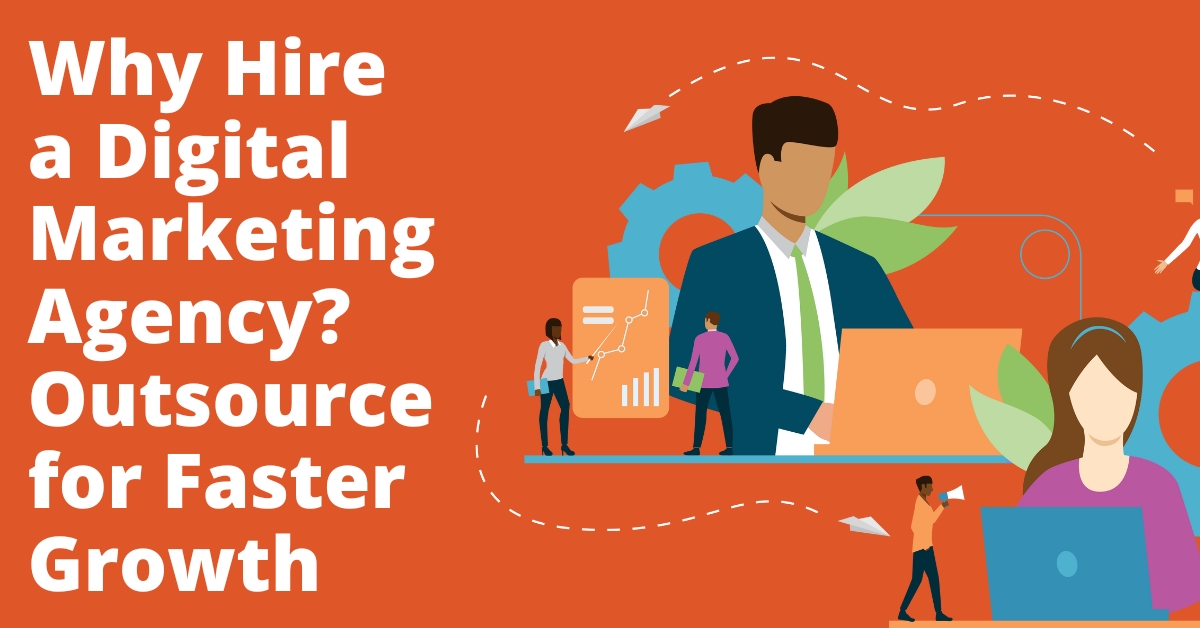
    A graphic of an agency growing due to outsourcing digital marketing

    Key Insights

    • Hiring a digital marketing agency gives in-house marketers access to a team of experts with specialized skills and knowledge. Companies benefit from advanced marketing techniques without ongoing in-house training and investment in expensive tools.
    • Outsourcing digital marketing to an agency frees up time for businesses and internal teams to focus on their core operations.
    • Hiring and managing an in-house marketing team comes with risks, such as turnover and unmet expectations.

    If your online growth is slowing because your advertising strategies fall short…

    Who you gonna call?

    A digital marketing agency!

    Taking on all aspects of marketing in-house is scary, especially when you lack the time, expertise, and resources to create campaigns that connect with potential customers.

    A good digital marketing agency helps you reach your target audience with results-driven campaigns that meet your business goals. It also requires less commitment while adding more overall capacity to your business.

    Hiring an experienced digital marketing company will offer a fresh perspective and help grow your business online.

    Why Hire a Digital Marketing Agency?

    When you hire the right digital marketing agency, their team becomes an expansion of your own. A great digital marketing agency is an invaluable asset, from handling your social media advertising and paid digital advertising to helping you create marketing materials and optimizing your website for search engines.

    There’s no need to spend the time, effort, and money on building an in-house marketing team when the benefits of hiring a digital marketing agency are abundantly clear.

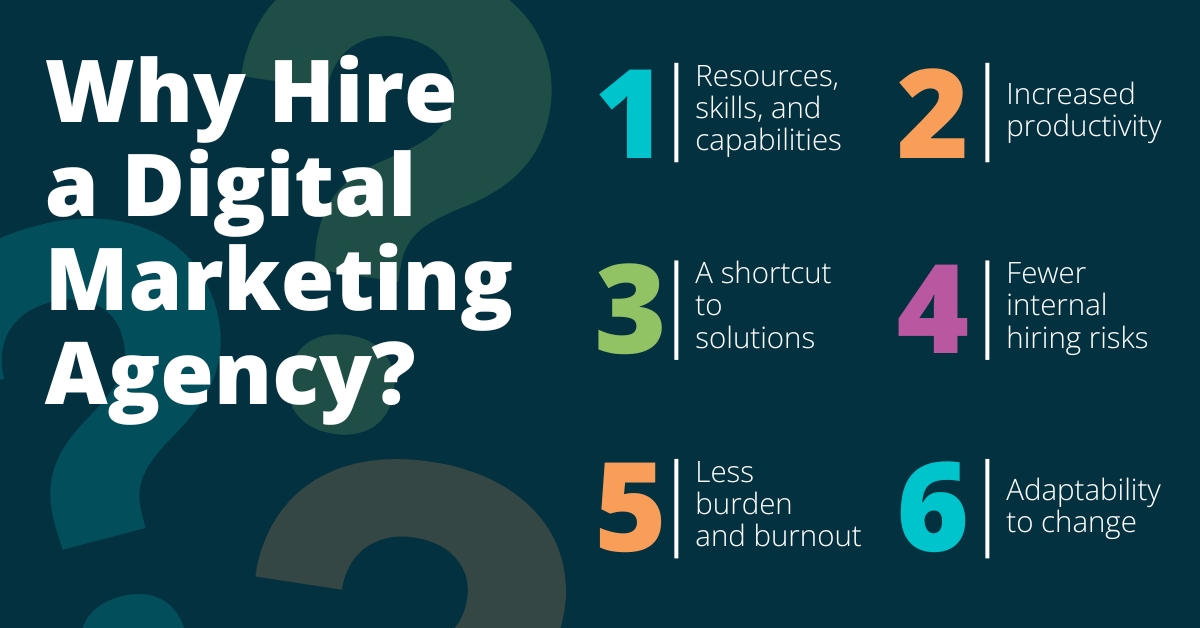
    1. Expand your resources, skills, and capabilities

    Outsourcing your digital marketing services allows you to access more specialized skills, knowledge, and tools without the long-term commitment of hiring an in-house team.

    Digital marketing agencies stay updated on the latest marketing trends and strategies. This allows you to reap the benefits of the most advanced marketing campaigns without committing time and resources to keep up with this constantly evolving industry.

    And with those trends comes a rollout of new (and expensive!) tools and skills you must master to stay in stride with the industry.

    Do you have time to learn about Google’s AI overview rollout and choosing the right attribution model for GA4? Of course not. You have other priorities — like setting strategy and planning budgets.

    2. Gain greater capacity for increased productivity

    We get it; we’re marketers, too. You take pride in your adaptability and knack for learning new skills on the fly.

    But there is hardly enough time in a day to complete all your to-dos, much less become an experienced SEO professional, creative copywriter, and detail-oriented digital ads manager.

    You’re wearing more hats than an MLB dugout!

    Hiring a digital marketing agency allows you to be the manager without having to play first base and shortstop too.

    This helps you focus on your other daily responsibilities, freeing you up so you can be more effective.

    3. Receive a shortcut to solutions

    An agency solves your marketing challenges fast and with proven expertise.

    Like any industry, digital marketing is full of its own quirks. Digital marketers are well aware of these oddities and are prepared to anticipate and navigate them.

    For example, say you’re struggling with rising online advertising costs in 2024. The right agency would pinpoint that online advertising costs are rising because it’s an election year and then pivot your marketing strategy to a more cost-effective solution.

    A list of reasons why to hire a digital marketing agency

    4. Mitigate common risks associated with internal hiring

    Hiring a digital marketing agency to expand your team requires less commitment and time than building one in-house team while delivering greater lead generation in return.

    Building a full-service in-house team is no small task.

    You have to spend time and money on recruiting and training new employees, all while risking turnover or not meeting expectations.

    Why gamble on an in-house marketing team when you can pay for what you need when you need it with a digital marketing agency?

    The answer is clear.

    5. Decrease burden and burnout

    Being a marketing manager is hard enough. Don’t add to your burden by hiring and overseeing a full-on team to manage your marketing process. Your time should focus on the broader marketing picture, not nearing burnout because you’re trying to master new digital advertising techniques.

    6. Adapt quickly to change

    You must be a campaign chameleon to ensure longevity in your marketing efforts, always ready to adapt to new environments and circumstances.

    But if you’re not much for reptiles, a knowledgeable digital marketing agency brings a similar knack for adaptability.

    A marketing agency can pivot your strategy at a moment’s notice. Whether your key performance indicators are down or you need to update your social media platforms, your agency is there.

    Why Businesses Choose Digital Marketing Agencies Over In-House Teams

    At this point, you might be thinking, “Of course, a blog written by a digital marketing agency recommends hiring a digital marketing agency.”

    While your skepticism is understandable, we aren’t the only ones who recommend hiring a digital marketing agency. Our clients do, too.

    • An hour’s worth of your research goes beyond what we can come up with in a week” – B2B SaaS Company
    • “With not even a full year together, we are already seeing the impact of SI’s expertise on our program awareness and engagement.” – Private Research University
    • “Search Influence offers the expertise of a large and long-established organization with the culture and adaptability of a small boutique shop.” – State University
    • “Knowledgeable, professional staff who are leaders in their field.” – Regional Cultural Venue
    • “The overall turnaround time from the first meeting to the deliverables was quick, and they were always communicative.” – State University

    'With not even a full year together, we are already seeing the impact of SI’s expertise on our program awareness and engagement.' - Private Research University

    The payoffs in action

    Below is a perfect example of how partnering with an agency can elevate your marketing efforts.

    The marketing team at a continuing education school at a large university had the skills to build their website and write content, but they needed guidance on how to build the site with SEO in mind from the start.

    Search Influence completed an SEO audit and UX audit for them. This client brought us in at the start of the website redesign so we could offer extra guidance on what was good and not so good about their current website.

    Since completing the audit, the school partnered with us on six months of consulting to ensure our recommendations were carried out during the redesign.

    This is a perfect example of how partnering with an agency can elevate your marketing efforts. With our recommendations, the client’s website is expertly built to dominate the SERPs from day one.

    Take Our Higher Ed SEO Quiz to Find Your Best Approach

    Making decisions about managing your SEO strategy in-house or outsourcing it to an agency can feel overwhelming.

    Fortunately, tools and frameworks exist to streamline this process — like Search Influence’s Quiz: Higher Ed SEO – In-House or Outsource?

    Our Higher Ed SEO Quiz simplifies the decision-making process for university marketers by helping you determine the best approach for managing your SEO — whether that’s keeping it in-house, outsourcing, or adopting a hybrid model. In just a few minutes, you’ll gain customized recommendations that align with your institution’s goals and resources.

    These actionable insights empower you to make smarter staffing decisions, maximize your team’s potential, and enhance the effectiveness of your SEO strategy.

    The Higher Ed SEO Quiz is designed with busy higher education professionals in mind, offering quick and actionable results.

    By integrating this decision-making framework into your broader marketing strategy, you can make informed decisions about your staffing choices, ultimately boosting your SEO efforts and your institution’s ability to connect with prospective students in a highly competitive marketplace.

    Take our Higher Ed SEO Quiz for custom recommendations.

    Experience the Benefits of Hiring a Digital Marketing Agency

    Search Influence has helped businesses create ROI-focused marketing strategies since 2006.

    With our expertise and commitment to staying ahead of industry trends and research, we’re here to help you optimize your digital marketing efforts.

    Ready to find the best approach for your higher ed SEO strategy?

    Take our Quiz: Higher Ed SEO – In-House or Outsource? to get personalized insights, or contact Search Influence today to see how we can help you navigate the complexities of digital marketing with confidence.

  • SEO In-House vs. Outsourced: Should You Hire an Agency?

    Search Influence SEO

    Key Insights

    • SEO is crucial for online visibility, increased website traffic, brand recognition, and revenue growth.
    • While it may be tempting to handle SEO in-house, it’s essential to recognize that effective SEO requires meticulous attention to detail, constant monitoring, and adaptation to evolving search engine algorithms.
    • When deciding between in-house and outsourced SEO, consider your budget, the need to stay updated on SEO trends, your SEO goals, and the tech necessary for effective SEO.

    Incorporating SEO into your digital marketing strategy is paramount in today’s fiercely competitive online arena. SEO (Search Engine Optimization) is one of the driving forces behind your business’s online visibility.

    It’s the key that unlocks the doors to higher website traffic, increased brand recognition, and, ultimately, greater revenue.

    When deciding the best route for your SEO success, it might be tempting to take SEO efforts into your own hands, especially if you have an in-house team with some digital marketing know-how.

    After all, who understands your business goals better than your employees? But before you embark on the journey of handling SEO in-house, it’s crucial to pause and reflect.

    Effective SEO isn’t just about understanding your business; it’s a multifaceted discipline that demands meticulous attention to detail, constant monitoring, and adaptation to ever-evolving search engines.

    In this blog post, we’ll delve into the debate of SEO in-house vs. outsourcing, offering insights and compelling reasons why entrusting your SEO efforts to a specialized SEO agency may be the smartest move for your business’s growth and online success.

    Skills & Knowledge for Effective SEO

    If you’re considering taking your SEO efforts in-house, the SEO skills you need to drive results include:

    Research and analysis

    Crafting a successful SEO strategy hinges on thorough research and analysis. This entails extensive keyword research and competitive analysis, the basis for well-informed SEO campaigns.

    Content writing

    Content remains central to SEO, demanding the creation of SEO-friendly materials. This encompasses everything from on-page optimizations to new content marketing pieces. Proficient content writers produce high-quality, engaging content that resonates with your target audience while also favorably positioning your site in search engine results.

    Technical SEO expertise

    Technical SEO is a critical facet of the SEO landscape. It involves optimizing website structure, enhancing loading speeds, and ensuring search engine compatibility.

    Website development

    Proper SEO goes hand-in-hand with seamless website development. SEO success often requires collaboration with web developers and graphic designers to create a user-friendly, visually appealing website. A well-designed website improves user experience and plays a pivotal role in SEO rankings. Search Influence’s web development team works with your existing website to execute our SEO recommendations.

    Outreach / PR for link building

    Link building is a fundamental element of SEO. Building valuable backlinks demands skillfully executed outreach and PR activities. These high-quality backlinks enhance website authority and visibility in search results.

    Data and analytics

    Data-driven decision-making is at the core of effective SEO. Leveraging advanced analytics tools, SEO practitioners monitor the performance of strategies, providing insightful reports.

    Analytics and lead tracking allow for adjustments and alignment of SEO efforts with your business objectives.

    These skills and knowledge areas are essential for anyone looking to successfully navigate the complex world of SEO. Whether you choose an in-house SEO team or partner with an SEO agency, understanding these foundational aspects is crucial for achieving favorable results in the digital landscape.

    Time Commitment for Successful SEO

    Effective SEO isn’t a one-time task; it’s an ongoing commitment that demands significant time and effort. Typically, you can expect to allocate anywhere from 25 to 50 hours per month for SEO-related activities. This allocation includes time spent on strategy development, execution, and continuous evaluation.

    SEO campaigns require meticulous planning and execution, involving keyword research, content optimization, technical SEO enhancements, and link building efforts. Managing this workload can overwhelm a small business or those with limited resources.

    Plus, SEO isn’t static. Search engine algorithms evolve, user behavior changes, and competitors adapt their strategies. To remain competitive, you must update your SEO strategies and tactics every three months. This iterative approach ensures your SEO campaign stays aligned with industry trends and search engine updates.

    It’s essential to take a step back and assess the performance of your SEO efforts annually. Determine which pages are excelling in search engine rankings and which are not. This evaluation allows you to reallocate resources and update your priorities for the following year.

    For many businesses, maintaining this level of commitment and staying up-to-date with the SEO world can be challenging. This is where SEO agencies and their teams of SEO experts come into play, offering the time commitment required and the expertise and ongoing training needed to ensure your business grows and thrives in the digital marketing arena. An agency’s dedicated marketing manager or SEO team can handle specific tasks and provide the time and skills to drive your business forward online.

    What You Get From a Skilled SEO Agency

    Outsourcing SEO to a skilled SEO agency offers many advantages that impact the success of your projects.

    Some of the benefits of hiring a skilled SEO agency include:

    • Access to and Knowledge of Tools: SEO agencies are equipped with a wide array of essential tools and resources for effective SEO management, such as Semrush, Ahrefs, and Google Search Console. These tools aid in keyword research, competitive analysis, and performance tracking.
    • Staying Up-to-Date on SEO Trends and Changes: SEO is a dynamic field with frequent algorithm updates and evolving best practices. SEO agencies are dedicated to staying current with these changes, ensuring your SEO strategy remains effective and compliant with industry trends.
    • Established Processes for Implementation: SEO agencies have well-defined processes for implementing changes and optimizations swiftly and efficiently. This systematic approach ensures a seamless execution of your SEO strategy.
    • Experience: SEO professionals within an agency have extensive experience working on various SEO projects. Their expertise allows them to easily navigate the complexities of SEO, offering solutions tailored to your unique needs.
    • Skills Across Specialties: A skilled SEO agency boasts a diverse team of experts, including content writers, researchers/strategists, and technical SEO specialists. This multidisciplinary approach provides you with a range of skills at your fingertips without the need to build and manage an in-house SEO team.
    • Data-Backed Strategy: SEO agencies base their strategies on data-driven insights. They analyze performance metrics to gauge the impact of your tactics on rankings, traffic, and lead generation, ensuring concrete evidence guides your SEO journey.
    • Diagnosing Underperformance: When your SEO efforts don’t yield the desired results, SEO agencies have the expertise to diagnose underperformance and recommend corrective actions promptly. This proactive approach is crucial for maintaining and improving your organic traffic and search engine rankings.

    Collaborating with an SEO agency grants you access to a team of seasoned professionals who can streamline your SEO efforts, enhance your online visibility, and confidently drive your business forward.

    An outsourced SEO success story

    The Tulane School of Professional Advancement (SoPA) partnered with Search Influence, an experienced higher education digital marketing agency, to enhance their online visibility and attract prospective students. Over this multi-year collaboration, Search Influence has implemented a suite of digital marketing strategies, including SEO, paid digital ads, and email marketing. These digital marketing tactics have increased enrollment across various programs, from bachelor’s to master’s programs and graduate certificates.

    One of the standout success stories from this partnership came when Search Influence helped Tulane SoPA bring an underperforming third-party Online Program Management (OPM) built microsite back from the dead.

    On the direction of Tulane SoPA’s former OPM partner, the private continuing education school hosted information about their information technology and cybersecurity degrees on a microsite separate from their main website.

    Tulane SoPA came to Search Influence with the following concerns about their microsite:

    • The look and feel (user experience) was inconsistent across the two properties.
    • The OPM did not allow Tulane SoPA to apply edits to the microsite, adding another layer of complication that made it difficult to capitalize on the IT undergrad program.
    • It was difficult to holistically analyze data and performance.
    • The former OPM partner owned Tulane SoPA’s microsite, which meant that a vendor change would prompt the loss of any SEO authority gained from the microsite.

    On top of the above concerns, Search Influence also recognized a separate set of challenges:

    • Running these two programs on individual websites proved to be a counterproductive strategy. The online visibility of both programs suffered as they couldn’t tap into the wealth of educational content available on the primary website. Conversely, the main website lacked the necessary depth of information about these programs and what they offered.
    • Both websites faced the risk of being flagged for duplicate content. Vital details such as tuition fees, the admissions process, and financial aid information were duplicated on each site, making them susceptible to search engine penalties. Neither site was positioned to organically rank well for IT or cybersecurity keywords, nor were they effectively nurturing prospective students interested in these programs to take the next step and apply.

    Search Influence used an SEO-first approach to migrate the OPM microsite pages into Tulane SoPA’s main site. At the end of the project, the microsite was completely sunset.

    As a result of this strategy, Tulane SoPA:

    • Enhanced their content’s richness by implementing comprehensive front and back-end content optimization and expansion strategies
    • Ensured the microsite’s search engine prominence remained intact during a seamless technical transition
      Solidified its position as a prominent leader by actively refining conversion strategies and introducing supplementary inquiry forms

    Search Influence’s expert SEO knowledge and implementation fixed Tulane SoPA’s website woes and helped them drive more prospective students to their site.

    The results below look at a year-over-year comparison to the three-months prior to the migration (to account for seasonality).

    • 90% increase in total organic traffic
    • 456% increase in organic blog entrances
    • 890% increase in organic blog traffic
    • 895% increase in new users to the blog
    • 54% of organic website traffic is attributed to the blog in this time period, compared to just 10% prior.

    This success reflects the expertise of an outsourced SEO agency in driving targeted results and leveraging industry insights to optimize websites. It demonstrates the value of outsourcing SEO tasks to dedicated specialists and the potential for substantial business growth through practical SEO work.

    Search Influence SEO

    Questions to Ask Yourself When Making Your Decision

    What’s our organization’s budget for SEO services?

    When deciding between in-house SEO or outsourcing SEO services, consider the following financial factors:

    • Initial Investment and Ongoing Costs: Understand the distinction between one-time setup costs and monthly or annual expenses. Also, consider potential overruns or unexpected costs that may arise during your SEO journey. You will be responsible for these unforeseen costs if you choose in-house SEO.
    • Cost of an In-House SEO Expert vs. Agency Retainer/Fees: Compare the cost of hiring and maintaining an in-house SEO team to the fees associated with an SEO services agency or freelance SEO expert. If you choose to outsource SEO, it may be more expensive upfront but will save you money and headaches in the long run.
    • Tools and Software: Evaluate the availability and cost of essential SEO tools and software needed for effective SEO campaign management. Can your in-house team afford the necessary digital marketing software?
    • Training and Conferences: If you choose an in-house SEO specialist, you must set aside funds for courses, webinars, and potentially attending SEO conferences for your SEO professional’s ongoing education and skill enhancement.

    While hiring a skilled SEO agency for your higher education marketing can help you craft successful campaigns, Search Influence understands that might not always be in the budget.

    That’s why we created an SEO workbook to help higher ed markets take charge of their online campaigns.

    Do we know the latest SEO best practices and trends?

    When deciding between in-house SEO or outsourced SEO services, you should consider the following:

    • Internal Expertise: Assess the current knowledge level of your internal teams or SEO manager and identify any gaps in expertise that might require external training or assistance.
    • Stay Up-to-Date: Recognize the frequency of search engine algorithm updates and the importance of staying ahead in a constantly evolving field.
    • Dedicated Learning Time: If you can’t allocate regular time for your team to learn and stay updated on the latest SEO best practices, ensuring continuous improvement, you should consider hiring an SEO specialist agency.

    What are the goals of our SEO project?

    When deciding between in-house SEO or SEO outsourcing, you should consider the following:

    • Short-Term vs. Long-Term Goals: Define immediate objectives and long-term SEO strategies to ensure your SEO efforts align with your business goals.
    • On-Page vs. Off-Page Optimization: Determine the balance between improving on-page website elements and addressing off-page SEO factors to achieve your desired results.
    • Local vs. National Focus: Decide whether to prioritize local search optimization or expand your reach to a broader national or global audience.
    • Integration With Other Marketing Efforts: Understand how SEO will fit into your overall marketing strategy, including its integration with PPC, social media, and email marketing efforts. Most SEO agencies can handle all your digital marketing needs.

    What does a staff member or agency need to learn about our niche?

    When deciding between in-house SEO or SEO outsourcing, you should consider the following:

    • Unique Challenges of Niche Industries: Recognize potential obstacles or limited resources specific to your niche sector that may impact your SEO strategy.
    • Specialized Knowledge: Consider the specific information needed to understand keywords, your target audience, and the intricacies of your industry, which will be vital for practical SEO work and content creation.

    Do we have the technical skills and software subscriptions necessary for effective SEO?

    When deciding between in-house SEO or an outsourced agency, you should consider the following:

    • SEO Toolkits: Review the availability of tools for keyword research, link building, and on-site optimization to ensure you have the necessary resources for your SEO campaign.
    • Website Infrastructure: In order to implement effective SEO, you must have someone who knows how to evaluate your current website’s SEO-friendliness and then determine whether migrations or significant overhauls are needed.
    • Analytics and Reporting: Ensure access to robust analytics tools that allow you to measure and report on the progress of your SEO efforts effectively.
    • Integration Capabilities: Before deciding to bring your SEO in-house, you should determine if you know how to integrate SEO tools with other marketing and analytics platforms to streamline your SEO operations and improve overall efficiency.

    After considering your SEO goals and industry knowledge, it will be easier to decide between an in-house or outsourced SEO strategy.

    Should You Outsource SEO Services or Build an Internal Team?

    Considering that 68% of online experiences begin with a search engine, you can’t afford to ignore SEO.

    But should you build an in-house team or hire an agency?

    Several key takeaways emerge when deciding between outsourcing SEO services and building an in-house team. Your choice depends on various factors, including budget constraints, existing expertise, the need to stay current with SEO trends, and your specific project goals.

    One critical consideration is the remarkable potential of partnering with the right SEO agency.

    When you collaborate with a skilled agency, they don’t merely provide services; they become an extension of your team. This partnership can yield immense cost savings, as agencies have the tools and expertise required for efficient SEO results.

    Search Influence Can Help Your Business Grow

    As a leading SEO agency in New Orleans, we understand the significance of being found online. That’s why we’ve spent nearly 20 years helping businesses just like yours find success.

    Our dedicated experts have honed their SEO skills through years of strategizing, testing, and developing cutting-edge methods to ensure potential customers can discover your business.

    Take Search Influence’s In-House vs. Outsourcing SEO Quiz to answer whether partnering with a higher ed digital marketing agency is the right approach for your institution.

    Your journey to digital success starts here.

    Image Sources:

    Image 1: https://images.unsplash.com/photo-1531545514256-b1400bc00f31?auto=format&fit=crop&q=80&w=2874&ixlib=rb-4.0.3&ixid=M3wxMjA3fDB8MHxwaG90by1wYWdlfHx8fGVufDB8fHx8fA%3D%3D

    Image 2: https://images.unsplash.com/photo-1516321318423-f06f85e504b3?auto=format&fit=crop&q=80&w=2940&ixlib=rb-4.0.3&ixid=M3wxMjA3fDB8MHxwaG90by1wYWdlfHx8fGVufDB8fHx8fA%3D%3D

  • Learn About Key Higher Education Marketing Metrics From Paula French’s UPCEA Blog

    Learn about Key Higher Education Marketing Metrics from Paula Frenh's UPCEA Blog

    Search Influence’s Director of Sales and Marketing Paula French recently wrote a guest blog post for UPCEA titled “How Higher Education Marketing Metrics Help You Boost Enrollment.”

    While this is Paula’s first guest blog post for UPCEA, she is a regular speaker at UPCEA conferences and our joint webinars.

    As with her speaking appearances, Paula’s UPCEA blog is filled with higher education marketing insights to help universities see real-world results.

    An Overview of Paula French’s UPCEA Blog Post

    In her guest post for UPCEA, Paula addresses the growing challenges higher education institutions face, particularly the shrinking demand for traditional undergraduate degrees.

    She highlights a key opportunity to boost enrollment: focusing on adult learners — students aged 25 and older — who prioritize career advancement, flexibility, and program quality.

    To successfully reach this audience, Paula emphasizes the importance of understanding marketing benchmarks in higher education, specifically two critical metrics: cost per inquiry (CPI) and cost per enrolled student.

    Paula’s blog underscores that tracking CPI helps institutions optimize their budgets by revealing which of their campaigns best generate inquiries. Additionally, monitoring the cost per enrolled student provides a more comprehensive view of how efficiently marketing efforts convert interest into actual enrollments.

    By consistently tracking these higher education digital marketing benchmarks, universities will make smarter, data-driven decisions that lead to more sustainable growth.

    To dive deeper into these strategies, download the 2024 Higher Education Marketing Metrics Research Study Search Influence created in collaboration with UPCEA.
    Higher Ed Marketing Metrics Research Study 

    The Search Influence x UPCEA Partnership

    As an UPCEA Platinum Partner, Search Influence helps higher education institutions learn how to measure marketing success.

    This partnership focuses on providing valuable insights through joint research, including our recent Higher Education Marketing Metrics Research Study and our 2023 Higher Ed SEO Research Study.

    Together with UPCEA, we explore the state of higher education digital marketing, offering institutions industry insights and data-driven strategies for optimizing their marketing efforts.
    In addition to research, Search Influence and UPCEA collaborate on webinars to educate universities on enhancing their SEO and paid ad strategies.

    Learn More About Higher Education Marketing Metrics

    How Higher Education Metrics Help You Boost Enrollment

    Read Paula French’s full blog post on UPCEA’s website for expert insights into tracking the higher education marketing metrics that matter most.

    Find even more higher education marketing insights in our past UPCEA guest blog posts written by our Director of Account Management Alison Zeringue, and CEO & Co-Founder Will Scott.

    Whether you’re looking to refine your SEO strategies or optimize your paid advertising, Search Influence is here to help.

    Contact us today to learn how we can help your institution achieve sustainable growth through data-driven marketing strategies.

  • AI Content Marketing: Achieve More in Less Time [ANYWORD X SEARCH INFLUENCE WEBINAR]

    Acheive More in Less Time - Search Influence & anyword Webinar

    Key Insights:

    • AI content marketing is changing the way agencies, internal marketing departments, and freelancers go about their daily workflow.
    • As more marketers add generative AI to their competitive toolkit, the gap between those who use AI versus those who don’t will grow. This makes jumping on the proverbial AI train today more crucial than ever.
    • Search Influence uses a suite of data-driven AI tools, including Anyword, to complement our content creation processes, thus maximizing our efficiency while ensuring our content is performance-optimized.
    • Just as AI has its benefits, it also has its limitations. To mitigate AI shortcomings, it’s important to maintain the magic touch of the human editor via the “AI sandwich.”
    • Intuitive prompting can distinguish between content that meets expectations and content that falls short of them.

    Over the course of history, countless tech advancements have reshaped how we view and approach our daily workload.

    In the late 19th century, the invention of the tractor revolutionized the average farmer’s day-to-day by enhancing planting and harvesting efficiency, thus reducing the need for manual labor. In the mid-20th century, the introduction of ATMs made banking more accessible, minimizing the necessity for bank tellers to be available around the clock. Now, fast forward to the early 21st century, and generative AI tools are empowering content marketers to maximize their productivity and automate the creation of performance-driven copy, all in just a few keystrokes.

    Recently, I had the pleasure of sitting down with our good friends at AI platform Anyword to discuss the impact of AI on content creation and how it helps our team work smarter. In our joint webinar “AI Performance Writing: How to Apply AI + Analytics to Your Content,” we dove deep into the state of AI content marketing, its opportunities and challenges, and how Search Influences uses data-driven tools like Anyword to better predict the success of our content collateral.

    In case you missed it, here’s a quick overview of our action-packed discussion for your convenience, and maybe — just maybe — you’ll consider giving it a watch in your free time if you’re interested (100% shameless plug there).

    The AI Train: Getting On or Getting Left Behind

    Few industries will be as affected by generative AI as marketing. That is, if you look at some hot takes by sites like Hotjar, Spiceworks, and U.S. News & World Report… among many, many others.
    The pressure is on many agencies, internal marketing departments, and freelancers to adopt AI into their daily workflows. This mounting pressure isn’t necessarily being applied from internal sources, but rather in the way the industry tides are naturally turning.

    The data shows that more and more marketers are integrating AI into their daily tasks, whether it’s to help generate a punchy headline or to save time in their workload altogether. With a steady influx of marketers leveraging the power of AI, those who do not will inevitably feel the brunt of a competitive disadvantage.

    Since generative AI first broke, Search Influence knew we couldn’t be one to miss the proverbial “AI train,” as it would only pass us right up on the route to our competitors. As Bora Tarimcilar, our Anyword webinar co-panelist and client support specialist, put it, “If you’re not on the train, there is this kind of sense of getting left behind.”

    Anyword: The AI Software Built for Content Marketing

    Search Influence started testing Anyword in 2023, at a time when generative AI was first starting to grow wings and take flight in the public eye. We set out on a mission to add another AI platform to our diverse suite of tools, which includes platforms like ChatGPT, Adobe Suite, Surfer SEO, and Google Gemini, among several others.

    With Anyword, we’ve found success in creating performance-driven content that resonates with our clients and their audiences. The tool has since become one of many key strategy components for producing high-quality, impactful content.

    Benefits of Using AI in Content Marketing

    Investing in AI today has its payoffs tomorrow.

    Timesaving for peak efficiency

    The phrase “time is money” rings true in content marketing. We all wish we had more hours in the day, especially when deadlines are looming.

    With AI as a +1 on our teams, we can now produce an entire ad campaign’s worth of copy in minutes versus the hours we’d have likely spent prior.

    The faster we produce content, the more time we have to focus on strategy, optimization, and the bigger picture as a whole.

    Relevant, competitive content

    An important disclaimer: Generative AI is not a subject matter expert. It doesn’t have a degree, it doesn’t have any certifications, and it certainly doesn’t have real-world industry experience.

    However, AI models do function by scraping the web for a “common consensus” on what to include in its outputs in response to your prompts.

    For example, let’s say you’re writing a blog for your legal client titled, “When Should You See a Personal Injury Lawyer?” and you default to AI to help get you started. After receiving your prompt, the AI model will analyze a vast dataset of online content, including articles, legal blogs, FAQs, and expert opinions on personal injury law. It will then identify common themes, important legal terms, and frequently mentioned advice to construct a well-rounded response.

    This helps ensure that the content you write is robust, researched, and in line with what your competitors are discussing. Plus, it may even help fill in some topic gaps that you’ve missed but your competitors haven’t.

    A hub for brainstorming

    Sometimes, the hardest part of content creation is simply getting that first word or sentence down.

    AI tools are perfect for those “blank page” moments. Need a catchy headline or an engaging intro? Generative AI’s brainstorming capabilities can spark creativity and help overcome writer’s block, setting the stage for compelling content that doesn’t leave you with a headache.

    If you’re not all in for AI automation, using tools for brainstorming purposes is one of the best use cases for getting your feet wet with this new tech. Even the best fires need an accelerant here and there, and AI is just that for your content creation process.

    Challenges of AI Content Marketing

    Despite all its benefits, AI content marketing is not without its limitations. To get the most value from an AI tool, you’ll need to know what to look out for — just as much as what to look for.

    Robotic tendencies

    AI is, in its truest form, just a robot. It’s not the kind you see in science fiction movies that are cynically threatening, but nonetheless, there’s no human behind the screen.

    Generative AI is not capable of experiencing human emotion, and it naturally lacks empathy. Unless you give it highly detailed context, it won’t automatically know that you’re maybe speaking to an audience with highly sensitive needs, like, for example, those in the “Your Money or Your Life” category.

    Because the model is not human, it also does not know how to distinguish fluff from lean, helpful content. With fluffy content, you lose the full extent your content can make on your audience simply by being generic and impactful. You’ll always need to bring humanness to the content, which also means double-checking that the content reads natural and conversational, not robotic.

    AI buzzwords

    “Unwavering,” “top-notch,” “a beacon of,” and so on — sometimes, it seems like AI has a few favorite words and a severely limited vocabulary.

    With these “AI buzzwords” comes one inevitable pitfall: Your content ends up using the same adjectives to describe your brand or services as your competitors.

    This can be beneficial in some areas, like when you’re trying to establish a place in the industry relative to your competitors, but it also leaves you with the risk of content that sounds the same as everyone else’s — thus affecting your ability to stand out.

    At one point, these terms likely did do considerable justice to content, and some could even have been classified as power words. Now, however, their impact seems diluted due to overuse.

    Machine hallucination

    AI is, again, no subject matter expert, and it is capable of making mistakes.

    The phenomenon “AI hallucination” occurs when an AI model generates content that is factually incorrect or nonsensical. This happens because the AI tries its best to create plausible-sounding information based on patterns it has learned, even if the actual data or facts do not exist.

    ChatGPT even has a disclaimer that it can make mistakes, and to always check information that isn’t common knowledge.

    By blindly trusting the facts and evidence AI provides you, you risk publishing inaccurate and possibly even offensive content that could harm your brand’s trustworthiness, authoritativeness, and overall bottom line.

    Mitigating Common AI Shortcomings

    Where there are problems, there are solutions.

    The AI Sandwich

    Generative AI is your teammate, it’s your dynamic +1, but it is not your replacement.

    The human editor will always be necessary to create a human-like feel in the content, fact-check all information, and optimize it for maximum engagement.

    At Search Influence, we like to call the relationship between the human and the AI model the “AI Sandwich.”*

    The human (acting as the top bun or slice of bread) prompts the machine with all the important information it needs to produce a quality output, and then they wait as the machine gets to work (acting as the sandwich’s hearty sandwich ingredients — think lettuce, tomato, onion, cheese, and meat). Once the machine produces its output, the human editor (now acting as the bottom bun or slice of bread) goes behind it, cleans it up, personalizes it more to the brand, fact-checks it, and overall adds that human touch.

    While the content is not produced top-to-bottom by a sole human writer, it is perfected by the human, which grants an overall stamp of approval that the copy meets quality standards.

    *Learn more about the AI Sandwich and its use cases with Search Influence CEO, Will Scott, on the “Make Marketing Make Sense” podcast.

    Practical prompting

    If you’re worried about generic, impactful content and the overuse of AI buzzwords in your content, the solution starts with your prompt.

    I’m a strong believer that the quality of your prompt determines the quality of your output. If you give the AI model a bare-bones prompt and expect it to fill in the gaps, it may do so in a way that doesn’t suit your brand or campaign goals.

    I recommend you include these points to be as specific as possible with your prompts:

    • Your campaign goal and keywords (if applicable)
    • Your tone of voice and your target audience
    • Your desired call to action
    • Your desired word count
    • Any terms you do or do not want to be included in your output

    When you’re working with a platform like Anyword, with pre-built prompts, covering all your bases is simple. But if you aren’t using a tool with pre-built prompts provided, there are a ton of helpful articles, videos, and templates online that can get you started.

    9 Prompting Tips for AI Content Marketing - Courtesy of Search Influence and the Search Influence and anyword Webinar

    Dive Deeper Into AI Content Marketing

    A very, very big thank you to Anyword for inviting me to join “AI Performance Writing: How to Apply AI + Analytics to Your Content.” I hope that you all are just as excited and geeked out as we are about this new wave of content marketing.

    And, if you’re not, that’s perfectly okay. Just know the AI train does have a seat open for you.

    Search Influence specializes in full-service content marketing, from SEO and paid advertising to email marketing, social media, and beyond. To learn more about how we’re using AI content marketing to drive client success at scale, get in touch with us today.

  • Rising Online Advertising Costs in 2024: The Election Year Effect

    2024-Election-and-Ad-Cost

    Key Insights

    • With the U.S. presidential election coming up, experts project increased advertising competition and rising digital ad costs throughout 2024.
    • While it may be tempting to slash your marketing budget to save short-term advertising costs, you’ll pay the long-term price of leaving your brand dormant this year.
    • The right channel, campaign, and strategy can make the difference between a profitable year and one that succumbs to the pressure of a changing market.

    Yes, it’s an election year. Yes, online advertising costs will rise. No, you shouldn’t take the (mistakenly) “economically sound” route and cut the cord on your campaigns.

    Digital ad costs ebb and flow seasonally each year, which ushers in higher prices for a slice of inventory. The same goes for when a major election is on the table, like the upcoming U.S. presidential election, which is already proving to be an ad-spend field day on its own.

    As high demand and low supply for ad inventory during elections cause prices to hike, many brands put marketing on the chopping block. However, despite the higher price tags, the brands that stay the course and continue advertising are the ones who go into the next year with the best results.

    In this blog, we’ll cover everything you need to know about rising digital ad costs in 2024 and offer practical tips for keeping your strategy in shape amidst uncertainty.

    Digital Advertising Costs Predicted to Remain High Beyond Q4

    Between impromptu holiday campaigns and year-in-review wrap-ups with higher-ups, Q4 is often a frenzy.

    Historically, Q4 brings with it an extra chunk of change, often to the advertiser’s benefit. Shoppers rush to both brick-and-mortar and e-commerce stores for holiday deals, spending more than ever, earlier than ever. A smart marketer runs at least one holiday campaign, which ideally, spikes profits and leads that outperform last year.

    However, despite these hot sales, there are some drawbacks.

    Supply, demand, dilemma

    Q4 is a remarkably advantageous time to advertise, and most advertisers know it — making the market more crowded.

    This time of year, advertisers find themselves in a bidding war against direct competitors in their industry and against a broad spectrum of entities all vying for the same precious commodity: consumer attention. From small-scale Etsy vendors to major national retailers, the fight for digital ad space becomes increasingly fierce — and costly.

    It’s the classic law of supply and demand. More advertisers want online ad space, meaning the demand for inventory on high-converting channels naturally grows. With that growth comes increased competition and rising prices per click or per impression.

    2024 to change the tune

    For safe budgetary measures, you should always expect rising digital advertising costs in Q4 — unless the yearly data shows differently. Fortunately, though, the dust left over from the madness typically settles in Q1 of the new year.

    However, 2024 is shaping up to be different. This year’s Q4 isn’t just about the usual holiday shopping and Black Friday sales. The presidential election will take November by storm, and much of 2024 will be impacted, too.

    As political candidates gear up to increase their spend on advertising throughout the year, experts predict costs to remain high across most of 2024 — not just the tail end of the year.

    Impact of the 2024 Presidential Election on Digital Ad Costs

    2024-Election-and-Ad-Cost

    Presidential elections are great for the advertising market itself. For the average digital marketer looking to get in front of the eyes of potential buyers, not so much.

    Increased spend = increased competition

    The 2020 election shattered political ad spending records, being crowned the most expensive campaign year in American history. From traditional media like broadcast TV to online advertising with Google, political advertisers hopped on any and all channels to push their envelope to whoever would take it.

    This year’s election is set to take 2020’s ad spend and give it a facelift — to the tune of an estimated $15.9b across all mediums. This whopping forecast would be a 30% jump from the previous presidential election, with AdImpact projecting the 2023-2024 election as the most expensive of all time.

    As always, political advertisers mostly rely on local broadcast TV to get their message across. However, an influx of this ad spending growth is moving toward digital channels, with politicians utilizing every medium at their fingertips, from paid search to display.

    There’s a whole new layer of competition in the mix this year, one with a powerful presence on both the advertising industry and its market.

    Increased competition = increased costs

    If there’s one thing all advertisers want, it’s inventory. And if there’s one thing that isn’t always guaranteed, it’s premium inventory.

    Running ads on high-converting channels is the goldmine in any advertising sector, be it political, healthcare, or higher education.

    Elbowing through a tight crowd to get to those channels is generally to be expected. This election year, however, that crowd looks a little different and a lot bigger.

    When competition rises with political advertisers entering the scene, online advertising costs follow suit. Google, Meta, and other prominent digital ad space realtors are auction-based, meaning the bids to show naturally increase with a surge in competition.

    How Competition and Rising Online Ad Costs in 2024 Might Affect Your Results

    Potential impacts on display campaigns

    Being proactive about potential losses during this election year is the best way to safeguard quality results.

    Today, display campaigns are particularly popular. If you’re already running one, this is likely where your results will be hit the hardest in 2024.

    The worst-case scenario? You see fewer inquiries or leads and fewer sales overall from your digital advertising sources. But that’s assuming you keep the same budget as initially planned.

    In this instance, your best bet to mitigate a drop-off in conversions is to increase your ad spend to maintain consistent lead quantities. Sure, the price tag may be a tad higher, but the losses from missed revenue are even greater.

    Potential impacts on paid search campaigns

    Working with paid search? Now, that’s a different, likely easier story.

    With paid search, you’re only competing with other brands relevant to your keywords. Whether you’re a local zoo or a national SEO agency, you won’t be threatened by Candidate X, Y, or Z encroaching upon your space in the search results. You’ll just be warding off direct competitors also bidding on your keywords.

    However, you may see an impact if brands in your industry start cropping up, looking to earn more business around Q1 and Q4. Most brands want to begin and end the year on a high note, and rightfully so.

    Just be sure to stick to a thoughtful, well-executed advertising strategy, and you won’t feel too much pressure.

    The same sentiment goes for all of your digital advertising campaigns in 2024. Put in the right amount of time, effort, and money, and you can maintain the results and even accomplish your goals for the year.

    Strategies to Manage Increased Digital Ad Costs in 2024

    2024-Election-and-Ad-Cost

    Stay the course

    As the old saying goes, “When the going gets tough, the tough get going.”

    Inevitably, the market will be disrupted from time to time. Sometimes, it even gets turned on its head, like we saw with the COVID-19 pandemic. But brands who persist in uncertain times are the ones who come out on top, now and well into the future.

    A consistent online presence is what will make you relevant amidst all the political clutter.

    It’s important to avoid caving into the temptation that pulling the plug on or limiting your use of online ads this year will save you money. In the long run, you’ll only lose your brand reach, impression, and the results you worked so hard to maintain.

    Marketing is a long-term investment, not an on-and-off again, quirky commitment. As long as you keep with the course, budget appropriately, and stay vigilant of your competition, you’ll avoid the aftermath of dormant mode.

    Optimize your marketing mix

    Just because you shouldn’t cut online ad expenditures doesn’t mean you can’t save any money this election year.

    The cheat code for low ad costs and high-performing results boils down to your marketing mix.

    • Where are you advertising?
    • What campaigns are you running, and to whom?
    • Are any campaigns underperforming, and if so, on which channel(s)?

    Keep your budget and results in good standing by leveraging the marketing mix that yields the best returns. We recommend concentrating your efforts on the ad campaigns/channels that yield the most clicks or conversions and are most popular with your target audience.

    Track trends in your target audience and relevant consumer shopping trends to best optimize your marketing mix and meet prospects where they are.

    Remember that consumer behavior is also expected to shift during this election year. Many people will spend more time online to stay updated on the election, which could increase their exposure to your ads. Others may pull back their time surfing the Web or change where they spend their time online.

    Enlist an online advertising agency for help

    If 2024’s advertising market changes leave you with more questions than answers, the good news is you don’t have to navigate it alone.

    Outsourcing your marketing to an agency takes much of the heavy lifting off your plate at a fraction of the headache of doing it all DIY. When you put your strategy in the hands of experts, you’ll get industry insights, creative, tech, and strategic know-how, and performance results backed by rigorous data.

    Working with an agency also doesn’t have to be a huge cost undertaking in an already unsteady landscape. The best agencies are there to ensure you make the most use of your advertising budget by optimizing for the right marketing mix.

    Plus, with their industry expertise, you’ll always be made aware of any economic shifts and trends in the ad atmosphere.

    Proactive, not reactive.

    As Jared Belsky from MarketingPros writes, “Don’t underestimate the cost of not being at the forefront of trends.” Otherwise, you may get lost in the shuffle of the industry’s next bout of turbulence.

    Stay Ahead of the Curve With Search Influence

    At Search Influence, we’ve weathered the advertising storms of elections, pandemics, recessions, and everything in between.

    When you partner with us, your goals become our goals, and we’ll work to always keep your advertising campaigns running at peak performance. This election year, we’ll place extra emphasis on the right messaging and creative and testing new platforms to maintain your results.

    As always, we’ll monitor and optimize your campaigns based on the goals set with a focus on leveraging your competitive advantage. Your dedicated account manager will promptly alert you to any changes we see in your market, with actionable steps for maximizing your online presence.

    Keep your strategy in safe hands during times of uncertainty. See how our expert digital advertising services can put you ahead of the curve today.

    Image Sources:

    Image 1: https://images.unsplash.com/photo-1523292562811-8fa7962a78c8?q=80&w=2940&auto=format&fit=crop&ixlib=rb-4.0.3&ixid=M3wxMjA3fDB8MHxwaG90by1wYWdlfHx8fGVufDB8fHx8fA%3D%3D

    Image 2: https://images.unsplash.com/photo-1622219999459-ab5b14e5f45a?q=80&w=2832&auto=format&fit=crop&ixlib=rb-4.0.3&ixid=M3wxMjA3fDB8MHxwaG90by1wYWdlfHx8fGVufDB8fHx8fA%3D%3D

    Image 3: https://images.unsplash.com/photo-1620325867502-221cfb5faa5f?q=80&w=2957&auto=format&fit=crop&ixlib=rb-4.0.3&ixid=M3wxMjA3fDB8MHxwaG90by1wYWdlfHx8fGVufDB8fHx8fA%3D%3D

  • Search Influence Wins Silver Award in the 2023 U.S. Agency Awards

    Search Influence Best Places to Work 2023

    The Search Influence team has won a Silver Award in the 2023 U.S. Agency Awards’ “Best Integrated Campaign” category!

    The U.S. Agency Awards recognized our online advertising campaign for the Center for Restorative Breast Surgery (CRBS) — “Helping Women Find Care Through Meta Display and Google Paid Search” — for its exceptional combination of thought leadership, strategy, and collaboration.

    Our Partnership With the Center for Restorative Breast Surgery

    For over a decade, Search Influence has assisted the Center for Restorative Breast Surgery in using the power of digital marketing to help women find the knowledge and support they need when dealing with a breast cancer diagnosis.

    CRBS, a pioneer in breast cancer treatment, runs St. Charles Surgical Hospital, the only hospital in the world focused solely on breast reconstruction.

    Known for its innovative surgical methods, including flap surgeries and nipple-sparing mastectomies, CRBS is a worldwide authority in complete breast reconstruction, drawing patients from across the globe.

    The award-winning collaboration

    In our latest collaboration, the 2022-2023 Meta Display and Google Paid Search campaign, we helped CRBS increase their visibility, number of qualified inquiries, and amount of inquiries leading to education calls.

    These calls give women the information they need to make informed decisions about their breast reconstruction journey, doubling as a key conversion for the treatment center.

    While we are proud of the success of this campaign, it brings us even more satisfaction knowing our work helped women find the healthcare resources they need.

    The U.S. Agency Awards: Honoring Industry Vets

    Each year, the U.S. Agency Awards celebrate the most outstanding contributors in the marketing and advertising sectors across the country. These awards recognize digital marketing individuals and teams that consistently excel and produce impactful outcomes in their field.

    The event features 25 distinct award categories, each meticulously evaluated by a panel comprising industry insiders through a comprehensive two-stage judging procedure.

    We are honored to have won a Silver Award in the “Best Integrated Campaign “ category and to have spent many years collaborating with the Center for Restorative Breast Surgery.

    Our New Orleans Digital Marketing Agency’s Commitment to Excellence

    Search Influence crafts top-level digital marketing campaigns that help our clients reach new heights.

    Contact us today to learn more about our record of success in SEO and digital advertising.

  • Search Influence CEO Will Scott Named a 2024 Biz New Orleans 500

    Biz New Orleans has named Search Influence CEO and Co-founder Will Scott to its 2024 New Orleans 500 list!

    Published annually by Biz New Orleans magazine, the New Orleans 500 recognizes and profiles all the business leaders driving growth in the metro New Orleans economy. Biz New Orleans is a national award-winning monthly publication covering all the latest business happenings in The Big Easy and its surrounding areas.

    Will is humbled to be mentioned alongside New Orleans’ sharpest minds and most forward-thinking entrepreneurs — but this journey to the top didn’t happen overnight. Will has spent the last 30 years learning, growing, and innovating in all things digital marketing.

    Biz New Orleans has named Search Influence CEO and Co-founder Will Scott to its 2024 New Orleans 500 list

    About Will Scott: Digital Marketing Mogul

    Since his first website went live in 1994, Will hasn’t taken his foot off the gas. He’s led innovative teams responsible for developing thousands of business websites, hundreds of thousands of web pages, and millions of visits from searchers across industries.

    Will has not only participated in the SEO industry — he’s helped to shape it.

    As a recognized digital marketing leader, Will coined the phrase “barnacle SEO” in 2008 to describe the act of leveraging authoritative websites for highly competitive keywords to boost one’s own content.

    Today, the strategy is used by everyone from Semrush to Moz.

    Alongside his wife and business partner Angie Scott, Will founded the digital marketing agency Search Influence in 2006. Together, Will and Angie have grown Search Influence from its humble beginnings as a spare bedroom operation serving local businesses to a nationally recognized digital marketing agency known for embracing the latest and greatest technologies.

    Like a surfer searching for the next big wave to conquer, Will has spent most of 2023 knee-deep in his latest SEO marketing obsession — artificial intelligence.

    From developing the AI sandwich to presenting at the UPCEA MEMS Conference and Pubcon, Will has quickly positioned himself as an AI marketing expert in this newfound landscape.

    Contact Will’s Digital Marketing Agency in New Orleans

    Will and the entire Search Influence team thank Biz New Orleans for their recognition.

    If you’re ready to work with an experienced SEO team backed by an award-winning CEO, contact Search Influence to learn more about all the SEO services we offer.